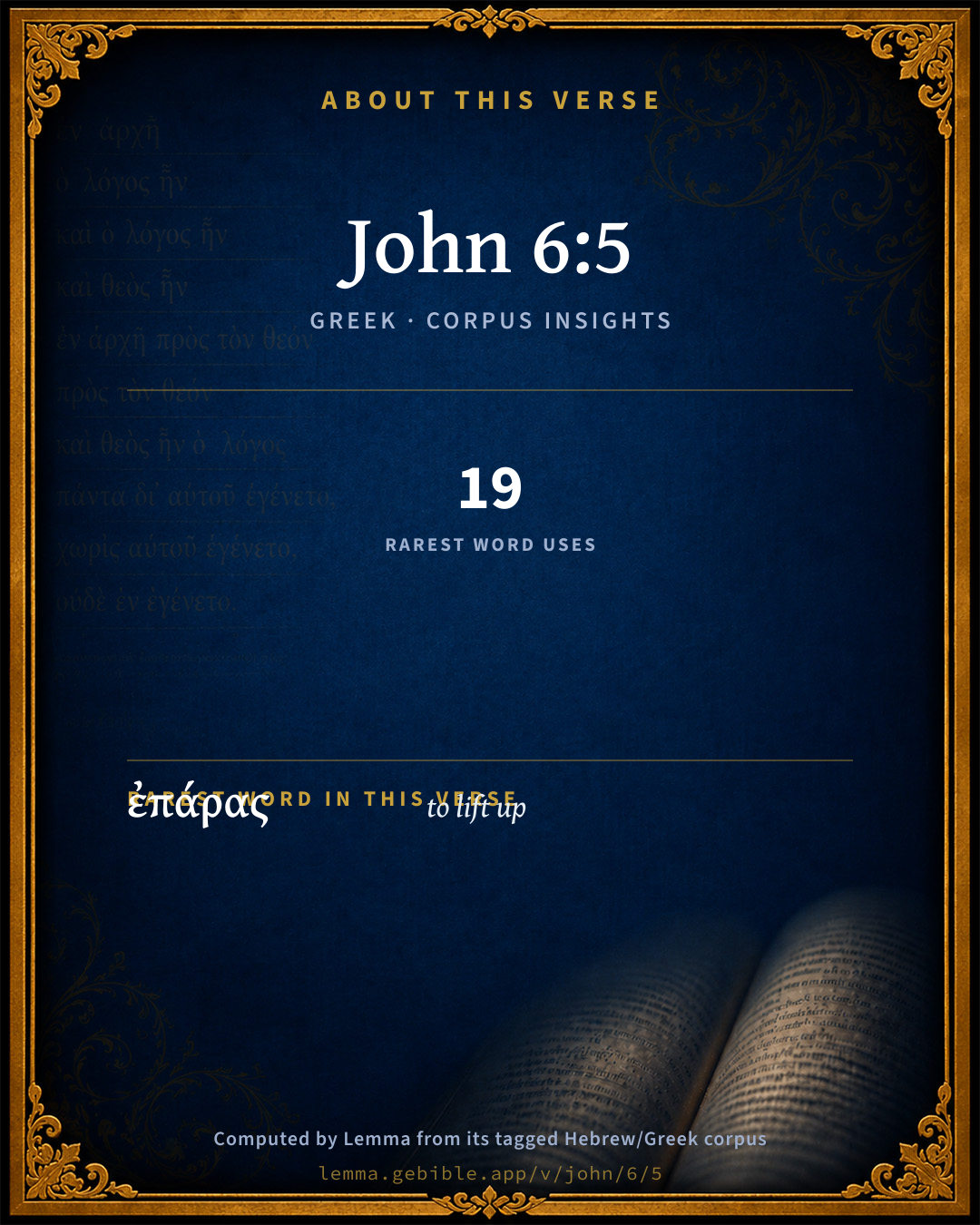
John 6:5

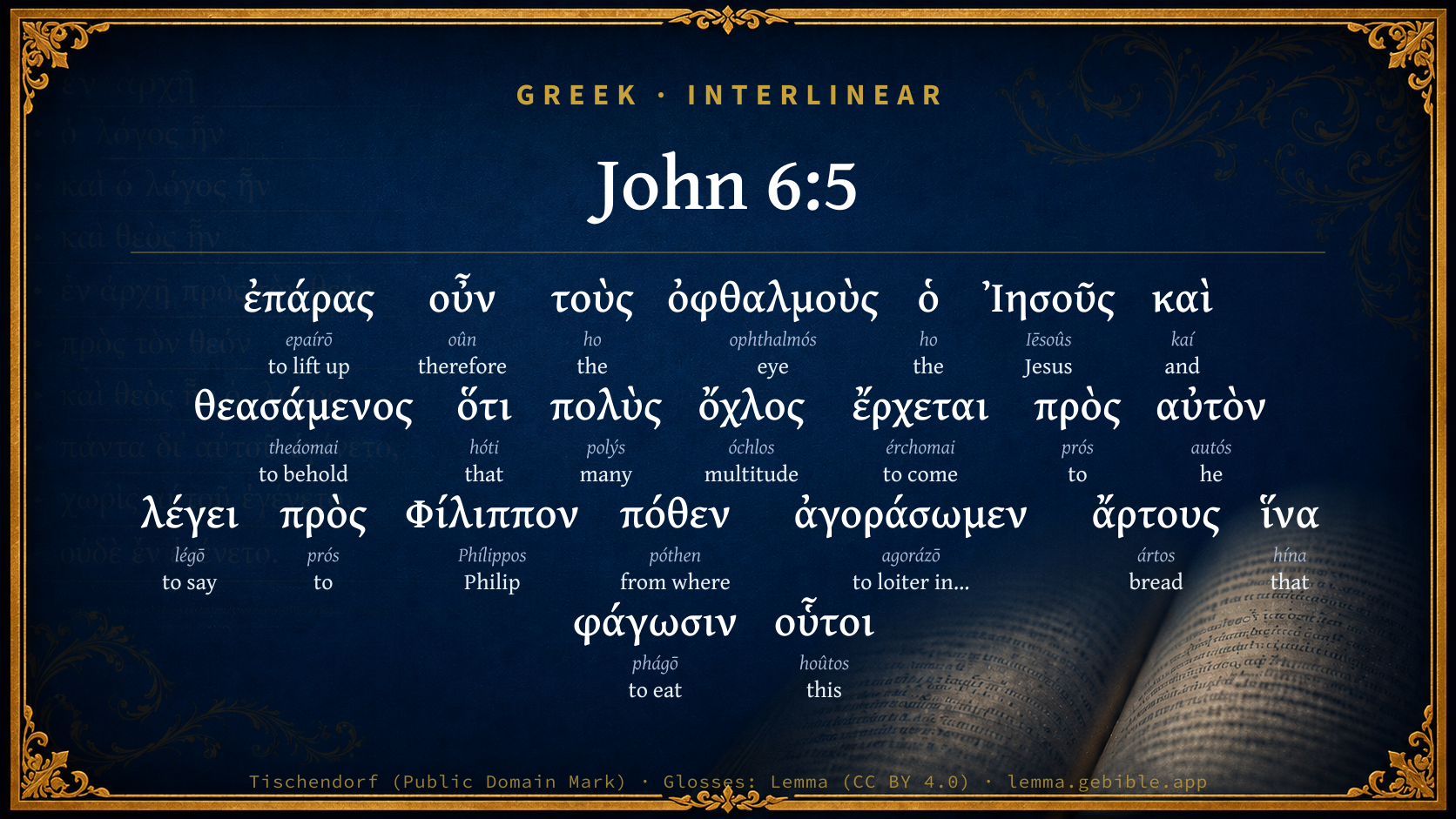
Greek (Tischendorf 8th ed.) John 6:5 appears in the Greek New Testament. The text above is from the Tischendorf 8th edition. Each word links to its Strong’s number and a concise gloss. Click any word for its full Thayer’s Greek Lexicon entry.
Download image
Cite this verse

John 6:5 (World English Bible). Public Domain. Lemma interlinear Bible study tool, https://lemma.gebible.app/v/john/6/5.

Show BibTeX & RIS
BibTeX
RIS
English Translation
Jesus therefore lifting up his eyes, and seeing that a great multitude was coming to him, said to Philip, "Where are we to buy bread, that these may eat?"
World English Bible · Public Domain
Download a study sheet

One document with this verse’s original text, its word-by-word gloss line, the meaning frame, cross-references with their text, attributed commentary, and full source and license credits — printable, and it pastes into notes with its structure intact.

This verse Autodidact and up

Study sheet (.html) Plain text (.txt)

A passage Seminary Student

Up to 50 verses in one chapter. A passage sheet keeps up to 6 commentary sources and 12 cross-references per verse, in the order this page ranks them, and says so on the sheet whenever that leaves anything out. Ask for a single verse and you get the Autodidact verse sheet above.

Everything on this page stays free to read, with no account — the sheet is a download of what is already on screen, not access to it.

Want to remove ads? Support Godless Engineer
Compare translations 3

The same verse in 3 English versions, stacked beneath the original-language interlinear above. Click any original word for its lexicon entry.

Each is an independent rendering of the whole verse — the interlinear is not word-aligned to these translations.

Highlighted words mark where these versions differ — a whole-verse word diff, not a word-by-word alignment.

  • World English Bible Public Domain
    Jesus therefore lifting up his eyes, and seeing that a great multitude was coming to him, said to Philip, "Where are we to buy bread, that these may eat?"
  • King James Version Public Domain
    When Jesus then lifted up his eyes, and saw a great company come unto him, he saith unto Philip, Whence shall we buy bread, that these may eat?
  • unfoldingWord Literal Text CC BY-SA 4.0
    Then Jesus, having lifted up his eyes and having seen that a great crowd is coming to him, says to Philip, “From where might we buy bread so that these might eat?”

unfoldingWord Literal Text — © unfoldingWord, licensed CC BY-SA 4.0. Word-aligned USFM3 via Door43 (git.door43.org/unfoldingWord/en_ult).

Versions to compare (up to 4)

3 of 4 selected

Show all 19 translations

Every available English version of this verse, each an independent rendering of the whole verse.

  • World English Bible Public Domain
    Jesus therefore lifting up his eyes, and seeing that a great multitude was coming to him, said to Philip, "Where are we to buy bread, that these may eat?"
  • Berean Standard Bible Public Domain
    When Jesus looked up and saw a large crowd coming toward Him, He said to Philip, “Where can we buy bread for these people to eat?”
  • Majority Standard Bible Public Domain
    When Jesus looked up and saw a large crowd coming toward Him, He said to Philip, “Where can we buy bread for these people to eat?”
  • King James Version Public Domain
    When Jesus then lifted up his eyes, and saw a great company come unto him, he saith unto Philip, Whence shall we buy bread, that these may eat?
  • American Standard Version (1901) Public Domain
    Jesus therefore lifting up his eyes, and seeing that a great multitude cometh unto him, saith unto Philip, Whence are we to buy bread, that these may eat?
  • Revised Version (1885) Public Domain
    Jesus therefore lifting up his eyes, and seeing that a great multitude cometh unto him, saith unto Philip, Whence are we to buy bread, that these may eat?
  • Geneva Bible (1599) Public Domain
    Then Iesus lift vp his eyes, and seeing that a great multitude came vnto him, hee sayde vnto Philippe, Whence shall we buy breade, that these might eate?
  • Douay-Rheims (1899) Public Domain
    When Jesus therefore had lifted up his eyes, and seen that a very great multitude cometh to him, he said to Philip: Whence shall we buy bread, that these may eat
  • Young's Literal Translation Public Domain
    Jesus then having lifted up `his' eyes and having seen that a great multitude doth come to him, saith unto Philip, `Whence shall we buy loaves, that these may eat?' --
  • Literal Standard Version CC BY-SA 4.0
    Jesus then having lifted up [His] eyes and having seen that a great multitude comes to Him, says to Philip, “From where will we buy loaves, that these may eat?”
  • Unlocked Literal Bible CC BY-SA 4.0
    When Jesus looked up and saw a great crowd coming to him, he said to Philip, “Where are we going to buy bread so that these may eat?”
  • unfoldingWord Literal Text CC BY-SA 4.0
    Then Jesus, having lifted up his eyes and having seen that a great crowd is coming to him, says to Philip, “From where might we buy bread so that these might eat?”
  • Darby Bible Public Domain
    Jesus then, lifting up his eyes and seeing that a great crowd is coming to him, says to Philip, Whence shall we buy loaves that these may eat?
  • World Messianic Bible Public Domain
    Yeshua therefore, lifting up his eyes and seeing that a great multitude was coming to him, said to Philip, “Where are we to buy bread, that these may eat?”
  • Webster's Bible Public Domain
    When Jesus then lifted up his eyes, and saw a great company come to him, he saith to Philip, Whence shall we buy bread that these may eat?
  • Free Bible Version CC BY-SA 4.0
    When Jesus looked up, and saw a large crowd coming towards him, he asked Philip, “Where can we buy bread to feed these people?”
  • Bible in Basic English Public Domain
    Lifting up his eyes, Jesus saw a great number of people coming to where he was, and he said to Philip, Where may we get bread for all these people?
  • Text-Critical English NT CC BY 4.0
    When Jesus lifted up his eyes and saw that a large crowd was coming to him, he said to Philip, “Where shall we buy bread so that these people may eat?”
  • Tyndale New Testament (1534) Public Domain
    Then Iesus lifte vp his eyes and sawe a greate company come vnto him and sayde vnto Philip: whence shall we bye breed that these might eate.

Literal Standard Version (2020), Covenant Press — licensed CC BY-SA 4.0. Text via the HelloAO Bible API (eBible.org). Unlocked Literal Bible (unfoldingWord) — licensed CC BY-SA 4.0. Text via the HelloAO Bible API (eBible.org). unfoldingWord Literal Text — © unfoldingWord, licensed CC BY-SA 4.0. Word-aligned USFM3 via Door43 (git.door43.org/unfoldingWord/en_ult). Free Bible Version, Dr. Jonathan Gallagher — licensed CC BY-SA 4.0. Text via the HelloAO Bible API (eBible.org).

Word by word

More ways to search: Search by grammar → Find every occurrence → Compare this word →

Practice this passage: Drill this verse → Learn its vocabulary →

ἐπάρας
epaírō
G1869
“to lift up”
Verb, Aorist, Active, Participle, Nominative, Singular, Masculine
Part of Speech
Verb
Tense
Aorist
Voice
Active
Mood
Participle
Case
Nominative
Number
Singular
Gender
Masculine
Full Thayer's Definition

Origin: from G1909 and G142

TDNT: 04:06,3

1. to lift up, raise up, raise on high 2. metaph. to be lifted up with pride, to exalt one's self
  1. οὖν oûn G3767 “therefore” Conjunction
  2. τοὺς ho G3588 “the” Article, Accusative, Plural, Masculine
  3. ὀφθαλμοὺς ophthalmós G3788 “eye” Noun, Accusative, Plural, Masculine
  4. ὁ ho G3588 “the” Article, Nominative, Singular, Masculine
  5. Ἰησοῦς Iēsoûs G2424 “Jesus” Noun, Nominative, Singular, Masculine
  6. καὶ kaí G2532 “and” Conjunction
  7. θεασάμενος theáomai G2300 “to behold” Verb, Aorist, Middle deponent, Participle, Nominative, Singular, Masculine
  8. ὅτι hóti G3754 “that” Conjunction
  9. πολὺς polýs G4183 “many” Adjective, Nominative, Singular, Masculine
  10. ὄχλος óchlos G3793 “multitude” Noun, Nominative, Singular, Masculine
  11. ἔρχεται érchomai G2064 “to come” Verb, Present, Middle or Passive deponent, Indicative, 3rd person, Singular
  12. πρὸς prós G4314 “to” Preposition
  13. αὐτὸν autós G846 “he” Personal pronoun, Accusative, Singular, Masculine
  14. λέγει légō G3004 “to say” Verb, Present, Active, Indicative, 3rd person, Singular
  15. πρὸς prós G4314 “to” Preposition
  16. Φίλιππον Phílippos G5376 “Philip” Noun, Accusative, Singular, Masculine
  17. πόθεν póthen G4159 “from where” Adverb, Interrogative
  18. ἀγοράσωμεν agorázō G59 “to loiter in marketplace” Verb, Aorist, Active, Subjunctive, 1st person, Plural
  19. ἄρτους ártos G740 “bread” Noun, Accusative, Plural, Masculine
  20. ἵνα hína G2443 “that” Conjunction
  21. φάγωσιν phágō G5315 “to eat” Verb, Aorist, Active, Subjunctive, 3rd person, Plural
  22. οὗτοι hoûtos G3778 “this” Demonstrative pronoun, Nominative, Plural, Masculine

About this verse

These counts appear in no published source. They are computed here, from the morphology-tagged text and Lemma’s own curated glosses. What Lemma adds →

23
words
21
distinct lemmas
Gospels
section

Notable vocabulary

The rarest word here is ἐπάρας to lift up G1869 — appearing just 19 times in the whole Greek New Testament.

Shared distinctive vocabulary

ἐπάρας to lift up G1869 occurs in 19 verses of the Greek New Testament. Also found in:

Repetition

Words recur within this verse:

Cross-references

6

Topical passages linked to John 6:5 in the Treasury of Scripture Knowledge — connected by theme and wording, ordered by reader-vote popularity; previews shown in the World English Bible.

  • Matthew 15:33 The disciples said to him, "Where should we get so many loaves in a deserted place as to satisfy so great a multitude?"
  • Luke 9:12–13 The day began to wear away; and the twelve came, and said to him, "Send the multitude away, that they may go into the surrounding villages and farms, and lodge, and get food, for we are here in a deserted place."
  • Matthew 14:14–15 Jesus went out, and he saw a great multitude. He had compassion on them, and healed their sick.
  • John 1:43 On the next day, he was determined to go out into Galilee, and he found Philip. Jesus said to him, "Follow me."
  • John 4:35 Don't you say, 'There are yet four months until the harvest?' Behold, I tell you, lift up your eyes, and look at the fields, that they are white for harvest already.
  • Mark 6:34–35 Jesus came out, saw a great multitude, and he had compassion on them, because they were like sheep without a shepherd, and he began to teach them many things.

Cross-references courtesy of OpenBible.info (CC BY 4.0).

Commentary

Notes on John 6:5 from classic Christian and Jewish commentators (each source and its license shown beneath its notes). The classic Christian expositions comment on the surrounding passage and are grouped to its opening verse, so a note may address several verses; the Jewish commentaries on the Tanakh (Rashi and others) are per-verse, so they appear only where the commentator wrote on this verse.

Lemma curates 59 commentaries, every one of them public domain or Creative Commons licensed, each selected and text-cleaned for this edition rather than reprinted as found. About our sources →

Joseph Benson's Commentary

Joh 6:5-14. When Jesus lifted up his eyes, and saw a great company come to him — That is, gathered round him; he saith unto Philip — Namely, after he had first taught the people many things, as we learn from the other evangelists, and had healed them, that had need of healing, Mar 6:34; Luk 9:11; Whence shall we buy bread, that these may eat? — He addressed himself to Philip particularly, because he, being a native of Bethsaida, was best acquainted with that country. This he said to prove him — To try what idea he had conceived of his divine power, and to give him an opportunity of observing what followed more attentively. Philip answered, Two hundred pennyworth of bread is not sufficient, &c. — The Roman denarius, or penny, being equal to about seven pence half- penny of English money, two hundred of them were equal to about six pounds five shillings sterling, as much, probably, as their whole stock amounted to. One of his disciples saith — In answer to Jesus’s inquiring how many loaves they had, Mar 6:38; There is a lad here which hath five barley loaves and two small fishes — He meant which might be purchased of him; but what are they — To satisfy the hunger of so great a company? It seems, this disciple did not think on the proofs which Jesus had formerly given of his power, or did not form a just notion thereof. Jesus said, Make the men sit down — For an explanation of the circumstances of the miracle recorded in the following verses of this paragraph, see notes on Mat 14:15-21; Mar 6:30-44. Then those men — Who were present upon this occasion, and were thus miraculously entertained, when they had seen the miracle that Jesus did, after all the wonderful cures he had wrought upon the sick that same day; said, This is of a truth that prophet — Who has been so long and impatiently expected by us, even the Messiah himself; that should come into the world — According to the prediction of Moses, Deu 18:18.

Joseph Benson's Commentary on the Old and New Testaments (1811–1818) — public domain. Text from a community e-Sword module.

Tyndale Open Study Notes

Tyndale Open Resources

6:5 Where can we buy bread: When the Israelites left Egypt following the first Passover and entered the desert, finding food and water was also their first concern (Exod 15:22–16:3).

Tyndale Open Study Notes — © Tyndale Open Resources, licensed CC BY-SA 4.0. Text via the HelloAO Bible API.

Bengel's Gnomon

Johann Albrecht Bengel

Joh 6:5. [114] Ἔρχεται, cometh) Whilst the people were coming, Jesus already provided the food for them: comp. Joh 6:6, “He Himself knew what He would do:” moreover He fed the people, immediately before sending them away: Mat 14:15, “The disciples came to Him, saying, This is a desert place, and the time is now past; send the multitude away.”—Φιλιππόν, Philip) It is the part of a good teacher at times to appeal to some one, who needs it, out of the whole band of His disciples. Perhaps also Philip was the one among the disciples who had the care of the supply of provisions.

[114] τὸ πάσχα, the Passover) Preceding His passion by the interval of a year.—V. g.

Bengel's Gnomon of the New Testament — English translation (T&T Clark, Edinburgh, 1860) — public domain. Text from a community e-Sword module.

Meyer's Critical & Exegetical Commentary

Heinrich August Wilhelm Meyer

Joh_6:5-6. According to the reading ἀγοράσωμεν, whence are we to buy? deliberative conjunctive. The fact that Jesus thus takes the initiative (as host, Ewald thinks, but this is not enough), and takes action without the prompting of any expressed need, however real, is not to be explained merely on the supposition that this is an abridgment (Lücke, Neander, Hengstenberg) of the synoptical account (Mat_14:15); it is a discrepancy, which, however, does not destroy the fact that John was an eye-witness. It is purely arbitrary on Baurs part to assume the design to be that of directing attention more directly to the spiritual purpose of the miracle, or, with Hilgenfeld, to regard all here as composed out of synoptical materials to prove the omnipotence of the Logos. The most simple and obvious course is to explain the representation given as flowing from the preponderating idea of the Messiahs autonomy.[225] See on Mat_14:15. It is an analogous case when Jesus Himself gave occasion to and introduced the miracle at Bethesda, Joh_5:6. It is a supplement to the narrative in the Synoptics, that Jesus discussed with Philip (Joh_1:44) the question of bread. Why with him? According to Bengel, because it fell to him to manage the res alimentaria, which is improbable, for Judas was treasurer, Joh_13:29. Judging from Joh_6:6, we might say it was because Philip had to be tested according to his intellectual idiosyncrasy (Joh_14:8 ff.), and convinced of his inability to advise. The πειράζειν does not signify the trial of faith (so usually, even Hengstenberg), but, as αὐτὸς γὰρ ᾔδει shows, was a test whether he could here suggest any expedient; and the answer of the disciple (Joh_6:7) conveys only the impression that he knew of none. This consciousness, howzever, was intended also to prepare the disciple, who so closely resembled Thomas, and for whom the question, therefore, had an educative purpose, the more readily to feel, by the new and coming miracle, how the power of faith in the divine agency of his Lord transcended all calculations of the intellect. This was too important a matter for Jesus with respect to that disciple, to allow us to suppose that πειράζων αὐτόν is a mere notion of Johns own, which had its origin among the transfiguring recollections of a later time (Ewald). ΗἼΔΕΙ ΤῶΝ ΜΑΘΗΤῶΝ ΤΟῪς ΜΆΛΙΣΤΑ ΔΕΟΜΈΝΟΥς ΠΛΕΊΟΝΟς ΔΙΔΑΣΚΑΛΊΑς, Theodore of Mopsuestia; in which there is nothing to suggest our attributing to Philip a simplicité naïve, Godet.

αὐτός] Himself, without having any need to resort to the advice of another.

[225] Amid such minor circumstances, the idea might certainly supplant the more exact historical recollection even in a John. We have no right, however, on that account, to compare Jesus, according to Johns representation, to a housewife, who, when she sees the guests coming in the distance, thinks in the first place of what she can set before them, as Hase (Tübing. Schule, p. 4) very inappropriately has done.

Vers. 79. For 200 denarii (about 80 Rhenish Guldens, nearly £7) we cannot get bread enough for them, etc. This amount is not named as the contents of the purse, but generally as a large sum, which nevertheless was inadequate to meet the need. Different in Mar_6:37.

Joh_6:8-9. A special trait of originality.

εἷς ἐκ τ. μαθητ. αὐτοῦ] may seem strange, for Philip was himself a disciple, and it is explained by Wassenbach as a gloss. It has, however, this significance; Philip had been specially asked, and after he had answered so helplessly, another from the circle of the disciples, viz. Andrew, directed a communication to the Lord, which, though made with a consciousness of helplessness, was made the instrument for the further procedure of Jesus.

παιδάριον ἕν] who had these victuals for sale as a market boy, not a servant of the company, B. Crusius. It may be read one single lad (Mat_11:16), or even one single young slave (see Lobeck, ad Phryn. p. 240; Schleusner, Thes. III. p. 160). Comp. the German ein Bürschchen (a lad), as also the manner in which παιδιόν is used (Aristoph. Ran. 37; Nub. 131). In which of the two senses it stands here we cannot decide. In neither case can ἕν stand for τί, but ἕν, as well as the diminutive παιδίον, helps to describe the meagre-ness of the resource, the emphasis, however, being on the latter; and hence ἕν follows, which is not to be taken as an argument against its genuineness (Gersd. p. 420; Lücke, and most others), though in all other places, when John uses εἷς with a substantive (Joh_7:21, Joh_8:41, Joh_10:16, Joh_11:50, Joh_18:14, Joh_20:7), the numeral has the emphasis, and therefore takes the lead. But here: one single lad, a mere boy, who can carry little enough!

ἄρτους κριθίνους] comp. Xen. Anab. iv. 5. 31; Luc. Macrob. 5. Barley bread was eaten mainly by the poorer classes; Jdg_7:13, and Studer, in loc.; Liv. xxvii. 13; Sen. ep. xviii. 8; see also Wetstein and Kypke, I. p. 368.

ὀψάριον] denotes generally a small relish, but in particular used, as here (comp. Joh_21:9; Joh_21:13), of fish. It belongs to later Greek. See Wetstein.

εἰς τοσούτους] for so many. Comp. Xen. Anab. i. 1. 10 : εἰς δισχιλίους μισθόν.

Meyer — Critical and Exegetical Commentary on the New Testament — English translation by Peter Christie, edited by Frederick Crombie (T&T Clark, 1880) — public domain. Text from a community e-Sword module.

Expositor's Greek Testament

ed. W. Robertson Nicoll

Joh 6:5 . πολὺς ὄχλος ἔρχεται , not the same crowd as was mentioned in Joh 6:2 , else the article would have been inserted, but a Passover caravan coming from some other direction, and probably guided to Jesus’ retirement by some of those who had followed in the first crowd. Seeing the crowd approaching, He initiates the idea of giving them a meal. The synoptic account is different. λέγει πρὸς τὸν φίλιππον . Why to Philip? The question was put to Philip not because he happened at the moment to be nearest to Jesus (Alford); nor, as Bengel suggests, because he had charge of the commissariat, “fortasse Philippus rem alimentariam curabat inter discipulos”; nor “because he knew the country best”; nor only, as Euthymius says, ἵνα τὴν ἀπορίαν ὁμολογήσας , ἀκριβέστερον καταμάθη τοῦ μέλλοντος γενέσθαι θαύματος τὸ μέγεθος ; but Cyril is right who finds the explanation in the character of Philip and in the word πειράζων of Joh 6:6 [ γυμνάζων εἰς πίστιν τὸν μαθήτην ]. Philip was apparently a matter-of-fact person (Joh 14:8 ), a quick reckoner and good man of business, and therefore perhaps more ready to rely on his own shrewd calculations than on unseen resources. This weakness Jesus gives him an opportunity of conquering, by putting the question πόθεν ἀγοράσωμεν ἄρτους ; “Whence are we to buy bread?” [lit. loaves]. πόθεν may either mean “from what village,” or “from what pecuniary resources”. Cf. πόθεν γὰρ ἔσται βιοτά ; Soph., Philoct. , 1159.

The Expositor's Greek Testament, edited by W. Robertson Nicoll (1897–1910) — public domain. Text from a community e-Sword module.

Geneva Bible (1599)

Geneva Bible translators

They that follow Christ do sometimes hunger, but they are never destitute of help.

Geneva Bible (1599) marginal notes — public domain. Text via Bolls.life.

Adam Clarke's Commentary

Verse 5. Saw a great company] See this miracle explained at large on Mt 14:13, c. Mr 6:31, c. Lu 9:10, c.

In speaking of the passovers, and various other matters, it does not appear that John follows any strict chronological order.

From Joh 6:15, it appears that our Lord had come down from the mountain, and fed the multitudes in a plain at the foot of it.

Saith unto Philip] This, with what follows, to the end of Joh 6:7 the seventh verse, is not mentioned by any of the other evangelists.

Philip was probably the provider for the disciples, as Judas was the treasurer.

Whence shall we buy bread] Instead of αγορασομεν, shall we buy, I should read αγορασωμεν, may we buy, which is the reading of ABDEHLS, Mt. VB, and many others. As Philip was of Bethsaida, Joh 1:44; Joh 12:21, he must have been much better acquainted with the country in which they then were than any other of the disciples.

Adam Clarke's Commentary on the Bible (1810–1826) — public domain. Text from a community e-Sword/MySword module.

John Calvin's Commentaries

5. He saith to Philip. What we here read as having been said to Philip alone, the other Evangelists tell us, was said to all. But there is no inconsistency in this; for it is probable that Philip spoke according to the opinion entertained by all, and, therefore, Christ replies to him in particular; just as John, immediately afterwards, introduces Andrew as speaking, where the other Evangelists attribute the discourse to all alike. Perceiving that they have no conception of an extraordinary remedy, he then arouses their minds, which may be said to be asleep, so that they may, at least, have their eyes open to behold what shall be immediately exhibited to them. The design of all that is alleged by the disciples is, to persuade Christ not to detain the people; and, perhaps, in this respect they consult their private advantage, that a part of the inconvenience may not fall upon themselves. Accordingly, Christ disregards their objections, and proceeds in his design.

John Calvin's Commentaries (1540-1563) — public domain. Text from the Calvin Translation Society English edition (1840s-50s) via the Christian Classics Ethereal Library (ccel.org). Calvin's coverage is partial (roughly two-thirds of the Bible); uncommented books and verses are honest gaps, never fabricated. The 19th-century editor's footnotes and remarks are omitted so the notes are faithfully Calvin's own voice.

Ellicott's Commentary for English Readers

(5) The converse with Philip is also peculiar to this Gospel. (Comp. Joh_14:8 et seq.) The impression of the immediate antecedents of the miracle is different from, but not opposed to, that of the other narratives. They all represent the request coming from the disciples as the first step. St. John does not say it was not so They represent what took place as seen from the outer circle; he, from the point of view of those near to his Master. We may think of the group of disciples seated round Him, and of the first-called Andrew and Peter, James and John, and Philip (comp. Joh_1:40 et seq.) as closer to Him than the others, who come and speak to Him about the multitudes. While the wants of all are present, the wants of the individuals are not absent. There is something in the character of Philip which this occasion may test. To him is the question spoken which may yet have been an answer to their remark. For “saw a great company come,” read saw that a great multitude cometh. It is the vivid present of the crowd coming. “Whence shall we buy bread . . .?” or rather, Whence are we to buy bread? with the best MSS.

A Bible Commentary for English Readers, edited by Charles John Ellicott (1878–1897) — public domain. Text from a community e-Sword module.

The Cambridge Bible for Schools and Colleges

gen. ed. J. J. S. Perowne

5. When Jesus then, &c.] Better, Jesus therefore having lifted up His eyes and seen that a great multitude cometh.

he saith unto Philip] Why Philip? Because he was nearest to Him; or because his forward spirit (Joh_14:8) needed to be convinced of its own helplessness; or because, as living on the lake (Joh_1:44) he would know the neighbourhood. Any or all of these suggestions may be correct. As Judas kept the bag it is not likely that Philip commonly provided food for the party. A more important question remains: “we notice that the impulse to the performance of the miracle comes in the Synoptists from the disciples; in S. John, solely from our Lord Himself.” This is difference, but not contradiction: S. John’s narrative does not preclude the possibility of the disciples having spontaneously applied to Christ for help either before or after this conversation with Philip. “For the rest the superiority in distinctness and precision is all on the side of S. John. He knows to whom the question was put; he knows exactly what Philip answered; and again the remark of Andrew, Simon Peter’s brother … Some memories are essentially pictorial; and the Apostle’s appears to have been one of these. It is wonderful with what precision every stroke is thrown in. Most minds would have become confused in reproducing events which had occurred so long ago; but there is no confusion here. The whole scene could be transferred to canvas without any difficulty.” S. pp. 121–123.

Whence shall we buy] Or, whence must we buy; the deliberative subjunctive.

The Cambridge Bible for Schools and Colleges (gen. ed. J. J. S. Perowne; Cambridge University Press, 1878–1918) — public domain. Text from a community e-Sword module.

John Gill's Exposition

When Jesus then lift up his eyes,.... Being before engaged in close conversation with his disciples, and looking wistly and intently on them, whilst he was discoursing with them:

and saw a great company come unto him; who came on foot, over the bridge at Chammath, from Capernaum, and other cities of Galilee:

he saith unto Philip; he directed his discourse to him particularly, because he was of Bethsaida, near to which place Christ now was, and therefore might be best able to answer the following question:

whence shall we buy bread, that these may eat? This, according to the other evangelists, must be said after Christ came from the mountain, and the people were come to him, and he had received them kindly, and had instructed them about the kingdom of God, and had healed the diseased among them, and expressed great compassion for them; and after the disciples had desired him to dismiss them, that they might go to the adjacent towns, and provide food for themselves; which Christ would not admit of and declared it unnecessary, and then put this question, with the following view.

John Gill's Exposition of the Whole Bible (1746–1763) — public domain (CC PDM 1.0). Text via the HelloAO Bible API.

Trapp's Complete Commentary

John Trapp

5 When Jesus then lifted up his eyes, and saw a great company come unto him, he saith unto Philip, Whence shall we buy bread, that these may eat?

Ver. 5. He saith unto Philip] The people took no thought for food. Christ doth it for them. And surely if he so far provided for those, that out of a sudden motion, and no great good intention, came out after him, can we think he will be wanting to those that seek him constantly, and with full purpose of heart adhere unto him?

John Trapp, A Commentary or Exposition upon All the Books of the Old and New Testament (1647–1656) — public domain. Text from a community e-Sword module.

Haydock's Catholic Bible Commentary

Our Lord first said, (Matthew xiv. 16.) Give them to eat; but afterwards, accommodating himself to the weakness of his disciples, he says: Whence shall we buy bread? So there is no contradiction.

George Leo Haydock (1774–1849), Haydock's Catholic Family Bible and Commentary, 1859 edition — public domain. Excludes Psalms (Douay-Rheims chapter numbering differs from Protestant) and Deuterocanonical books (Catholic canon only).

Matthew Poole's English Annotations

This is apparently the same history which we have met with in all the former three evangelists. Mat 14:15-21; Mar 6:35-44; Luk 9:10-17. See the differing circumstances considered in our annotations on those chapters. The other evangelists observe, that Christ had first been preaching to them, until it was near night; and then bring in the disciples first moving him (because they had eaten nothing) to send them away to provide themselves food. This evangelist begins with some words Christ should speak to Philip.

Matthew Poole's English Annotations on the Holy Bible (1683–1685) — public domain. Text from a community e-Sword/MySword module.

Whedon's Commentary on the Bible

Daniel D. Whedon

5-13. See parallel passage in Matthew.

Daniel D. Whedon (gen. ed.), Commentary on the Old and New Testaments (1874–1909) — public domain. Text from a community e-Sword module.

The Pulpit Commentary

Jesus therefore, seated with his disciples on the rising ground in full view of the lake with its shipping and its fringe of villages, and of the gathering crowds of pilgrims to the Passover, having lifted up his eyes, and having beheld that a great multitude cometh (was coming) unto him, saith. Mat_14:14,mr Mat_6:34, and Luk_9:11 show that the miracle which they all, with John, prepare to describe was preceded by a day in which the Lord instructed the multitudes, "had compassion upon them," "taught them many things," "spake to them concerning the kingdom of God," "healed their sick." The first approach of the multitude was the occasion of a suggestion which Jesus made to Philip. The other evangelists record the reopening of the conversation on the same theme, stimulated by the question already put to Philip in the forenoon, and on this occasion originated by the disciples. The company arrived by the head of the lake; (cf. Mar_6:33, "They ran afoot out of all the cities and the first compassionate thought is attributed by John to the Lord himself: Whence are we to buy (bread) loaves, that these multitudes may eat? This very question shows the intimate relations between our Lord and his disciples the touch of nature. The identification of his interests with theirs is in the "we." Why should Philip be selected for the questioning or suggestion? Luthardt argues that it was a part of the needed education of that apostle that he should have been submitted to the searching anxiety. It is indeed added

The Pulpit Commentary (1880–1919), ed. H.D.M. Spence-Jones & Joseph S. Exell — public domain. Text from a community e-Sword module.

John Wesley's Explanatory Notes

Jesus saith to Philip - Perhaps he had the care of providing victuals for the family of the apostles.

John Wesley, Explanatory Notes Upon the Whole Bible (1754–1765) — public domain. Text via the GEBible commentary corpus.

Kretzmann's Popular Commentary

Paul E. Kretzmann

Jesus tests the faith of the disciples:

v. 5. When Jesus then lifted up His eyes, and saw a great company come unto Him, He saith unto Philip, Whence shall we buy bread that these may eat?

v. 6. And this He said to prove him; for He Himself knew what He would do.

v. 7. Philip answered Him, Two hundred pennyworth of bread is not sufficient for them that every one of them may take a little.

v. 8. One of His disciples, Andrew, Simon Peter’s brother, saith unto Him,

v. 9. There is a lad here which hath five barley loaves and two small fishes; but what are they among so many?

Jesus was busy all day, teaching and healing the sick, and hardly had time to look around. In the meantime, however, the crowd increased in number continually; the people kept coming all day long. When Jesus, then, upon the urgent request of the disciples, halted in His work of mercy and raised His eyes, He saw the assembled multitudes all around Him in the plain at the foot of the hill. The emphatic suggestion of the disciples as to the dismissal of the people at once caused a plan to form in the mind of the Lord, whose principal part concerned the disciples themselves. He proposed both to feed the multitude and to test the faith of His followers. Addressing Himself to Philip, whose acquaintance with the country hereabout might be assumed to be reasonably good, Jesus asked where there was a place at which they might buy food. His speech presupposes it as a self-evident fact that the people should be treated as the guests of the apostles and Himself. He had fully decided what He would do, but He was anxious to try out the faith of Philip, as well as that of the rest. Philip, having ascertained the amount of money at hand, answered according to, His understanding that two hundred denarii (almost thirty-four dollars) would hardly buy a sufficient quantity of bread to give to each one at least a little. Philip’s anxiety had caused him to make a careful calculation. He had forgotten the first miracle at Cana as well as the many that had happened since. He figured in exactly the same way as the average person, even if he be a confessed Christian, who tends to forget that God has His own ways to figure in emergencies, if His Christians will but trust in Him. Andrew was no better than Philip, so far as his trust in the Lord was concerned. He had scouted around and found that there was a small boy present who had five barley loaves and two small fishes for his provisions, but he immediately added, in doleful helplessness, that there was no hope that this would reach with so many people present. The weakness of both disciples is repeated in numerous instances in our days. Christians are often worried with anxious care for the needs of the body. Then they sit and calculate and go through all possible cupboards and storing-places to find out whether they will have enough to sustain their lives. They forget the almighty power of their Lord.

Paul E. Kretzmann, Popular Commentary of the Bible (1921–1924) — public domain. Text from a community e-Sword module.

Cambridge Greek Testament for Schools and Colleges

5. ἔρχεται. Is coming; present of graphic description. The quiet which He sought is being invaded; yet He welcomes the opportunity and at once surrenders His rest to His Father’s work, as in the case of Nicodemus and the Samaritan woman. But why does He address Philip? Because he was nearest to Him; or because his forward spirit (Joh 14:8) needed to be convinced of its own helplessness; or because, as living on the lake (Joh 1:44), he would know the neighbourhood. Any or all of these suggestions may be correct. Throughout we see how Jesus uses events for the education of His disciples. As Judas kept the purse it is not likely that Philip commonly provided food for the party. A more important question remains: “we notice that the impulse to the performance of the miracle comes in the Synoptists from the disciples; in S. John, solely from our Lord Himself.” This is difference, but not contradiction: S. John’s narrative does not preclude the possibility of the disciples having spontaneously applied to Christ for help either before or after this conversation with Philip. “For the rest the superiority in distinctness and precision is all on the side of S. John. He knows to whom the question was put; he knows exactly what Philip answered; and again the remark of Andrew, Simon Peter’s brother.… Some memories are essentially pictorial; and the Apostle’s appears to have been one of these. It is wonderful with what precision every stroke is thrown in. Most minds would have become confused in reproducing events which had occurred so long ago; but there is no confusion here” (Sanday).

ἀγοράσωμεν. Must we buy: deliberative subjunctive.

Cambridge Greek Testament for Schools and Colleges (Cambridge University Press, 1896; 21 vols, various authors incl. Carr, Maclear, Plummer, Farrar, Lumby, Moule, M. R. James, Simcox) — public domain. Text from a community e-Sword module.

Alford’s Greek Testament

Henry Alford

5.] Here there is considerable difficulty, on account of the variation from Matt., Mark, and Luke, who relate that the disciples came to the Lord after He had been teaching and healing the multitudes, and when it was now evening,—and asked him to dismiss the multitudes, that they might buy food;—whereupon He commanded, ‘Give ye them to eat;’—whereas here apparently, on their first coming, the Lord Himself suggests the question, how they were to be fed, to Philip. This difference is not to be passed over, as it has usually been by English Commentators, without notice. Still less are we to invent improbable and hardly honest harmonistic shifts to piece the two narratives together. There can be no doubt, fairly and honestly speaking, that the narratives, in their mere letter, disagree. But those who are not slaves to the mere letter will see here that inner and deeper accordance of which Augustine (De Consensu Evang. ii. 46, vol. iii. pt. i.) speaks in commenting on this passage: “Ex qua universa varietate verborum, rerum autem sententiarumque concordia, satis apparet salubriter nos doceri, nihil quærendum in verbis nisi loquentium voluntatem; cui demonstrandæ invigilare debent omnes veridici narratores, cum de homine vel de angelo vel de Deo aliquid narrant.” I repeat the remark so often made in this Commentary,—that if we were in possession of the facts as they happened, there is no doubt that the various forms of the literal narrations would fall into their places, and the truthfulness of each historian would be apparent:—but as we cannot at present reconcile them in this way, the humble and believing Christian will not be tempted to handle the word of God deceitfully, but to admire the gracious condescension which has given us the evidence of so many independent witnesses, whose very difference in detail makes their accordance in the great central truths so much the more weighty. On every point of importance here, the four sacred historians are entirely and absolutely agreed. That every minor detail related by them had its ground in historical fact, we fully believe; it is the tracking it to this ground in each case, which is now beyond our power; and here comes in the simplicity and reliance of faith: and the justification of those who believe and receive each Gospel as they find it written.

πρὸς Φ.] Why to Philip, does not appear; perhaps some reason lay in the πειράζων αὐτόν, which is now lost to us. From his words in ch. 14:8, we cannot infer, as has been done by Chrys. (Hom. xlii. 1, in Joann. vol. viii. p. 249) and others, that he was weaker in faith, or tardier in spiritual apprehension, than the rest. Of all the Apostles who appear in the sacred narrative, something might be quoted shewing equal unreadiness to believe and understand. I would take the circumstance as simple matter of fact, implying perhaps that Philip was nearest to our Lord at the moment. We must not fall into the mistake of supposing that Philip being of Bethsaida the city of Andrew and Peter (ch. 1:45) throws any light on the question: for the Bethsaida near which our Lord now was, Luk 9:10, was another place, see notes there.

πόθεν—whence—‘from what store.’ Hence Philip’s answer.

Henry Alford, The Greek Testament (1849–1861) — public domain. Text from a community e-Sword module.

International Critical Commentary

5. ἐπάρας οὖν τοὺς ὀφθαλμοὺς ὁ Ἰη. For this phrase, see on 4:35, where, as here, it is followed by the verb θεᾶσθαι. It is used again of Jesus at 17:1; cf. also 11:41 and Luk 6:20. For θεᾶσθαι see on 1:14.

πολὺς ὄχλος, i.e. apparently the ὄχλος πολύς of v. 2 (see on 12:9), who had followed Jesus and His disciples round the head of the lake. But, no doubt, once it was known where He was, people would flock to the place from the neighbouring villages to see and hear Him. According to the Synoptists (see on v. 2), the crowd came upon Jesus early in the morning, and the day was spent teaching or healing their sick. Then, towards evening, the disciples suggest that the people should be sent away that they might buy food for themselves. Jn. tells nothing of teaching or healing on this occasion, and he represents Jesus as having foreseen, as soon as the crowd began to gather, the difficulty that would arise about food. When He saw the great multitude coming, He asked Philip, “Whence are we to buy loaves?”

It is to be observed that in the narratives of the Feeding of the Four Thousand (Mar 8:4, Mat 15:33), although not in the parallel narratives of the Feeding of the Five Thousand, the disciples put this question (πόθεν) to Jesus. The question is the same as that which Moses puts to Yahweh (Num 11:13), πόθεν μοι κρέα δοῦναι παντὶ τῷ λαῷ τούτῳ; and the misgivings of Moses, when he reflects that he had 600,000 footmen to feed, are expressed in terms not unlike those which Philip uses here, πᾶν τὸ ὄψος τῆς θαλάσσης συναχθήσεται αὐτοῖς καὶ ἀρκέσει αὐτοῖς; (Num 11:22).

Another O.T. parallel may be found in 2Ki 4:42f., where Elisha’s servant exclaims at the impossibility of feeding a hundred men with twenty barley loaves and ears of corn “in his sack” (εἴκοσι ἄρτους κριθίνους καὶ παλάθας, i.e. cakes). The narrative relates that Elisha said, Δὸς τῷ λαῷ καὶ ἐσθιέτωσαν, declaring that Yahweh had told him there would be enough and to spare. And so it was: ἔφαγον καὶ κατέλιπον. This is a story which bears a likeness to the Feedings of the Multitudes in the Gospels, in detail much more striking than the story of the miraculous increase of meal and oil by Elijah’s intervention (1Ki 17:16). See Introd., p. clxxxi.

However, in Jn.’s narrative the question (πόθεν) is a question put by Jesus Himself to Philip. Philip was of Bethsaida (1:44), and presumably he knew the neighbourhood; he was thus the natural person of whom to ask where bread could be bought. This is one of those reminiscences which suggest the testimony of an eye-witness. The Synoptists, in their accounts of the wonderful Feedings of the Multitudes, do not name individual disciples; but Jn. names both Philip and Andrew, and their figures emerge from his narrative as those of real persons, each with his own characteristics. See below on v. 8.

λέγει πρὸς Φίλ. For this constr., see on 2:3.

For ἀγοράσωμεν (אABDNWΘ), the rec. has ἀγοράσομεν.

International Critical Commentary — older volumes (1896–1929), various authors — public domain. Text from a community e-Sword module.

Vincent's Word Studies in the New Testament

Marvin R. Vincent

Come [ερχεται] . Better, is coming. Unto Him [προς] is rather toward. Bread [αρτους] . Properly, loaves. See on Mt 4:1.

Marvin R. Vincent, Word Studies in the New Testament (1887–1900) — public domain. Text from a community e-Sword/MySword module.

Godet's Commentaries

Frédéric Louis Godet

Vv. 5-7. “Jesus therefore, lifting up His eyes and seeing a great multitude coming to Him, says to Philip: Whence shall we buy bread, that these may eat? 6. Now this he said to prove him; for, as for himself, he knew what he was going to do. 7. Philip answered him: Two hundred denarii-worth of bread is not sufficient for them,that every one of them may take a little.”

John does not say how long the confidential interview of Jesus with His disciples, which is mentioned in Joh 6:3, continued. The term ἐκάθητο, he sat there, Joh 6:3, which the Sinatic MS. wrongly changes into ἐκαθέζετο proves that He remained for a certain time alone with them while the companies were successively coming up. For it is impossible to imagine five or six thousand persons arriving all at once in the locality into which Jesus had withdrawn (this in answer to Weiss). While Jesus and His disciples came directly by water from Capernaum or the environs, these crowds of people, who had observed from the western shore the point towards which the bark directed its course, made on foot (πεζῇ, Mar 6:33; Mat 14:13), the circuit of the northern shore of the lake, and thus arrived successively during the day at the scene of action. According to the Synoptics, Jesus went forth from the solitude (Matt. and Mark) and received them with kindness (Luke).

Thus a part of the day was devoted to teaching and healing. Then seeing the crowd which was so eager and was continually increasing (Mar 6:33 : “They ran thither afoot from all the cities”), Jesus experiences that feeling of profound compassion which Matthew and Mark describe. But another feeling, of which John alone has caught the secret, is predominant in His heart: it is that of joy. No doubt, He had wished to be alone, and this arrival thwarted His purpose. But such earnestness, such perseverance are for Him an irresistible appeal. He enters with eagerness into the new situation which is opened to Him; for He discerns here a thought of the Father and He prepares Himself to give to this body of people the feast for which the opportunity is thus granted Him. Indeed, in John, it is Jesus who takes the initiative; He addresses Himself to Philip: “There are our guests; we must give them supper. Have you already thought of it?”

In the Synoptics, it is the disciples who are disturbed about the multitude, and urge Jesus to dismiss them. The need of food may have occupied the minds of Jesus and the disciples simultaneously as they saw the evening drawing on. But as for Jesus, He had already taken His resolution (Joh 6:6). The thought of what He was going to do had formed itself in His mind during the work of that day. The narrative of the Synoptics is written from the disciples’ point of view, which must very naturally have prevailed in the stories emanating from the Twelve, particularly in those of Peter and Matthew, while John, who had read the heart of the Master, brings out the other point of departure—the inward impulse of the Lord. Thus, the disciples address themselves to Jesus and communicate their anxiety to Him. Jesus, having already formed His plan, says to them: “Give ye them to eat,” and, in speaking thus, addresses Himself especially to Philip, as we have just seen. Why to him, rather than some other? Bengel thinks that he was charged with the care of the res alimentaria. But it seems more probable from Joh 13:29, that it was Judas who made the purchases. According to Luthardt, Jesus wished to bring an educating influence on Philip, who had a hesitating and over-careful character. This is possible. But the playful tone of Jesus’ question: “Whence shall we buy?” may lead us to suppose that naivete8 was one of the traits of this disciple’s character. This is the reason why Jesus addresses him this question, which was insoluble from the standpoint of natural resources; and he, on his side, answers it with a good-natured simplicity. This slight touch gives an idea of the amenity which prevailed in the relations of Jesus to His disciples; it appertained to the picture of the glory “full of grace” of the Word made flesh.

The expression: to prove him, does not have the solemn sense which this term ordinarily has. It signifies merely that Jesus desired to see whether, in this situation, he would know how to find the true answer of faith. Philip makes his calculation with prudence. It is good sense, not faith, which speaks through his mouth. The denarius was a Roman coin worth about fifteen cents; two hundred denarii were, therefore, equivalent to thirty dollars of our money; a large sum, which, however, was still far below the necessity of the case! Mark has also preserved this circumstance respecting the two hundred denarii; only, he puts this calculation in the mouth of the disciples in general. If the connection between the question of Jesus and Philip’s answer were not so close in John, we might try to insert here between Joh 6:6-7 the brief conversation of Jesus with the disciples reported in Mar 6:37. But it is much more probable that the reflection which Mark attributes to the disciples in general is nothing else than the reproduction of Philip’s words, which are preserved by John in their most exact historical form.

Frédéric Louis Godet — Commentaries on Luke, John, Romans, and 1 Corinthians — English translation (T&T Clark, Edinburgh, 1870s–1890s) — public domain. Text from a community e-Sword module.

Lesson kit

Teaching starters — assembled from the data on this page, not authored interpretation. Every prompt links to the verse data it draws on. Edit before teaching.

John, in the Gospels, opens this verse with 23 words (21 distinct Greek lemmas). Its most distinctive word is epaírō (“to lift up”). A historical commentator’s framing appears above. Read the whole chapter for the surrounding context.

Discussion questions

  1. The word epaírō carries the sense “to lift up.” How does it shape the verse?
  2. Matthew 17:8 shares the word «to lift up» with this verse. How do the two illuminate each other?
  3. “the” occurs 2× in this one verse. What is the effect of the repetition?
  4. These translations render this verse differently. What is at stake in choosing one wording over another?
  5. Reading how Joseph Benson's Commentary and Tyndale Open Study Notes read this verse, where do the two commentators agree and where do they part?

Things to notice

Reading settings

Reading text

Shown beneath each verse's original-language words.

Old Testament
Old Testament edition

Read the OT as the Masoretic Hebrew (MT) or the Greek Septuagint (LXX).

English shown for the Greek Septuagint (in the Hebrew ↔ Greek comparison).

Comparing translations? Open the Compare panel on any verse page to stack up to four side by side.