John 1:38

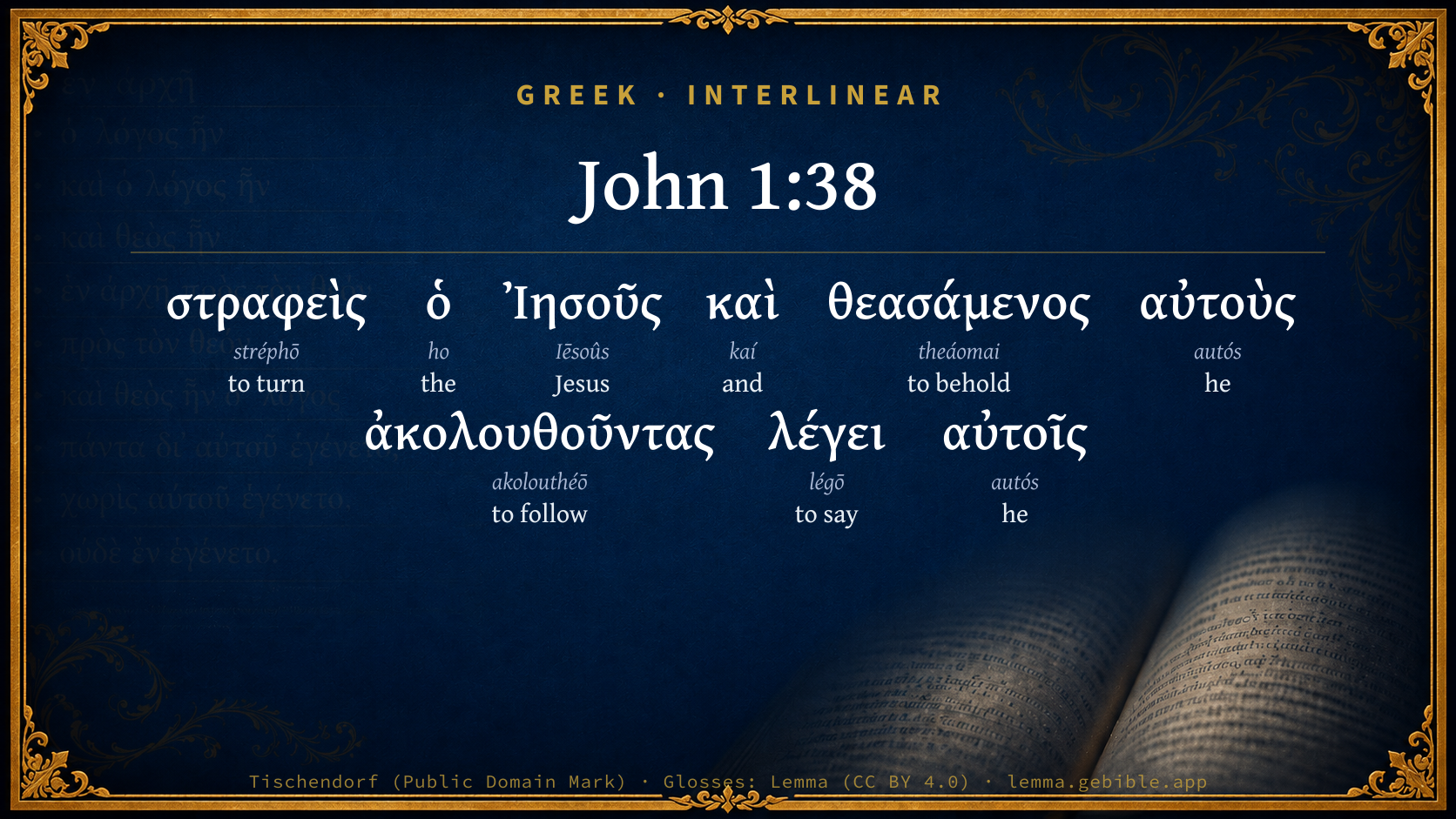
Greek (Tischendorf 8th ed.) John 1:38 appears in the Greek New Testament. The text above is from the Tischendorf 8th edition. Each word links to its Strong’s number and a concise gloss. Click any word for its full Thayer’s Greek Lexicon entry.
Download image
Cite this verse

John 1:38 (World English Bible). Public Domain. Lemma interlinear Bible study tool, https://lemma.gebible.app/v/john/1/38.

Show BibTeX & RIS
BibTeX
RIS
English Translation
Jesus turned, and saw them following, and said to them, "What are you looking for?" They said to him, "Rabbi" (which is to say, being interpreted, Teacher), "where are you staying?"
World English Bible · Public Domain
Download a study sheet

One document with this verse’s original text, its word-by-word gloss line, the meaning frame, cross-references with their text, attributed commentary, and full source and license credits — printable, and it pastes into notes with its structure intact.

This verse Autodidact and up

Study sheet (.html) Plain text (.txt)

A passage Seminary Student

Up to 50 verses in one chapter. A passage sheet keeps up to 6 commentary sources and 12 cross-references per verse, in the order this page ranks them, and says so on the sheet whenever that leaves anything out. Ask for a single verse and you get the Autodidact verse sheet above.

Everything on this page stays free to read, with no account — the sheet is a download of what is already on screen, not access to it.

Want to remove ads? Support Godless Engineer
Compare translations 3

The same verse in 3 English versions, stacked beneath the original-language interlinear above. Click any original word for its lexicon entry.

Each is an independent rendering of the whole verse — the interlinear is not word-aligned to these translations.

Highlighted words mark where these versions differ — a whole-verse word diff, not a word-by-word alignment.

  • World English Bible Public Domain
    Jesus turned, and saw them following, and said to them, "What are you looking for?" They said to him, "Rabbi" (which is to say, being interpreted, Teacher), "where are you staying?"
  • King James Version Public Domain
    Then Jesus turned, and saw them following, and saith unto them, What seek ye? They said unto him, Rabbi, (which is to say, being interpreted, Master,) where dwellest thou?
  • unfoldingWord Literal Text CC BY-SA 4.0
    But Jesus, having turned and having seen them following, says to them, “What do you seek?” And they said to him, “Rabbi (which being translated means Teacher), where are you staying?”

unfoldingWord Literal Text — © unfoldingWord, licensed CC BY-SA 4.0. Word-aligned USFM3 via Door43 (git.door43.org/unfoldingWord/en_ult).

Versions to compare (up to 4)

3 of 4 selected

Show all 19 translations

Every available English version of this verse, each an independent rendering of the whole verse.

  • World English Bible Public Domain
    Jesus turned, and saw them following, and said to them, "What are you looking for?" They said to him, "Rabbi" (which is to say, being interpreted, Teacher), "where are you staying?"
  • Berean Standard Bible Public Domain
    Jesus turned and saw them following. “What do you want?” He asked. They said to Him, “Rabbi” (which means Teacher), “where are You staying?”
  • Majority Standard Bible Public Domain
    Jesus turned and saw them following. “What do you want?” He asked. They said to Him, “Rabbi” (which means Teacher), “where are You staying?”
  • King James Version Public Domain
    Then Jesus turned, and saw them following, and saith unto them, What seek ye? They said unto him, Rabbi, (which is to say, being interpreted, Master,) where dwellest thou?
  • American Standard Version (1901) Public Domain
    And Jesus turned, and beheld them following, and saith unto them, What seek ye? And they said unto him, Rabbi (which is to say, being interpreted, Teacher), where abideth thou?
  • Revised Version (1885) Public Domain
    And Jesus turned, and beheld them following, and saith unto them, What seek ye? And they said unto him, Rabbi (which is to say, being interpreted, Master), where abidest thou?
  • Geneva Bible (1599) Public Domain
    Then Iesus turned about, and saw them follow, and saide vnto them, What seeke ye? And they saide vnto him, Rabbi (which is to say by interpretation, Master) where dwellest thou?
  • Douay-Rheims (1899) Public Domain
    And Jesus turning, and seeing them following him, saith to them: What seek you Who said to him, Rabbi, (which is to say, being interpreted, Master,) where dwellest thou
  • Young's Literal Translation Public Domain
    And Jesus having turned, and having beheld them following, saith to them, `What seek ye?' and they said to them, `Rabbi, (which is, being interpreted, Teacher,) where remainest thou?'
  • Literal Standard Version CC BY-SA 4.0
    And Jesus having turned, and having beheld them following, says to them, “What do you seek?” And they said to Him, “Rabbi” (which is, being interpreted, Teacher), “where do You remain?”
  • Unlocked Literal Bible CC BY-SA 4.0
    Then Jesus turned and saw them following him and said to them, “What do you want?” They replied, “Rabbi (which translated means teacher), where are you staying?”
  • unfoldingWord Literal Text CC BY-SA 4.0
    But Jesus, having turned and having seen them following, says to them, “What do you seek?” And they said to him, “Rabbi (which being translated means Teacher), where are you staying?”
  • Darby Bible Public Domain
    But Jesus having turned, and seeing them following, says to them, What seek ye? And *they* said to him, Rabbi (which, being interpreted, signifies Teacher), where abidest thou?
  • World Messianic Bible Public Domain
    Yeshua turned and saw them following, and said to them, “What are you looking for?” They said to him, “Rabbi” (which is to say, being interpreted, Teacher), “where are you staying?”
  • Webster's Bible Public Domain
    Then Jesus turned, and saw them following, and saith to them, What seek ye? They said to him, Rabbi (which is to say, being interpreted, Master) where dwellest thou?
  • Free Bible Version CC BY-SA 4.0
    Jesus turned round and saw them following him. “What are you looking for?” he asked them. “Rabbi (which means ‘Teacher’), where are you staying?” they asked in reply.
  • Bible in Basic English Public Domain
    And Jesus, turning round, saw them coming after him and said to them, What are you looking for? They said to him, Rabbi (which is to say, Master), where are you living?
  • Text-Critical English NT CC BY 4.0
    Turning around, Jesus saw them following him and said to them, “What are you seeking?” They said to him, “Rabbi” (which means “Teacher”), “where are yoʋ staying?”
  • Tyndale New Testament (1534) Public Domain
    And Iesus turned about and sawe them folowe and sayde vnto them: what seke ye? They sayde vnto him: Rabbi (which is to saye by interpretacion Master) where dwellest thou?

Literal Standard Version (2020), Covenant Press — licensed CC BY-SA 4.0. Text via the HelloAO Bible API (eBible.org). Unlocked Literal Bible (unfoldingWord) — licensed CC BY-SA 4.0. Text via the HelloAO Bible API (eBible.org). unfoldingWord Literal Text — © unfoldingWord, licensed CC BY-SA 4.0. Word-aligned USFM3 via Door43 (git.door43.org/unfoldingWord/en_ult). Free Bible Version, Dr. Jonathan Gallagher — licensed CC BY-SA 4.0. Text via the HelloAO Bible API (eBible.org).

Word by word

More ways to search: Search by grammar → Find every occurrence → Compare this word →

Practice this passage: Drill this verse → Learn its vocabulary →

στραφεὶς
stréphō
G4762
“to turn”
Verb, Aorist, Passive, Participle, Nominative, Singular, Masculine
Part of Speech
Verb
Tense
Aorist
Voice
Passive
Mood
Participle
Case
Nominative
Number
Singular
Gender
Masculine
Full Thayer's Definition

Origin: strengthened from the base of G5157

TDNT: 18:54,1

1. to turn, turn around 2. to turn one's self (i.e. to turn the back to one a. of one who no longer cares for another) b. metaph. to turn one's self from one's course of conduct, i.e. to change one's mind
  1. ὁ ho G3588 “the” Article, Nominative, Singular, Masculine
  2. Ἰησοῦς Iēsoûs G2424 “Jesus” Noun, Nominative, Singular, Masculine
  3. καὶ kaí G2532 “and” Conjunction
  4. θεασάμενος theáomai G2300 “to behold” Verb, Aorist, Middle deponent, Participle, Nominative, Singular, Masculine
  5. αὐτοὺς autós G846 “he” Personal pronoun, Accusative, Plural, Masculine
  6. ἀκολουθοῦντας akolouthéō G190 “to follow” Verb, Present, Active, Participle, Accusative, Plural, Masculine
  7. λέγει légō G3004 “to say” Verb, Present, Active, Indicative, 3rd person, Singular
  8. αὐτοῖς autós G846 “he” Personal pronoun, Dative, Plural, Masculine

About this verse

These counts appear in no published source. They are computed here, from the morphology-tagged text and Lemma’s own curated glosses. What Lemma adds →

9
words
8
distinct lemmas
Gospels
section

Notable vocabulary

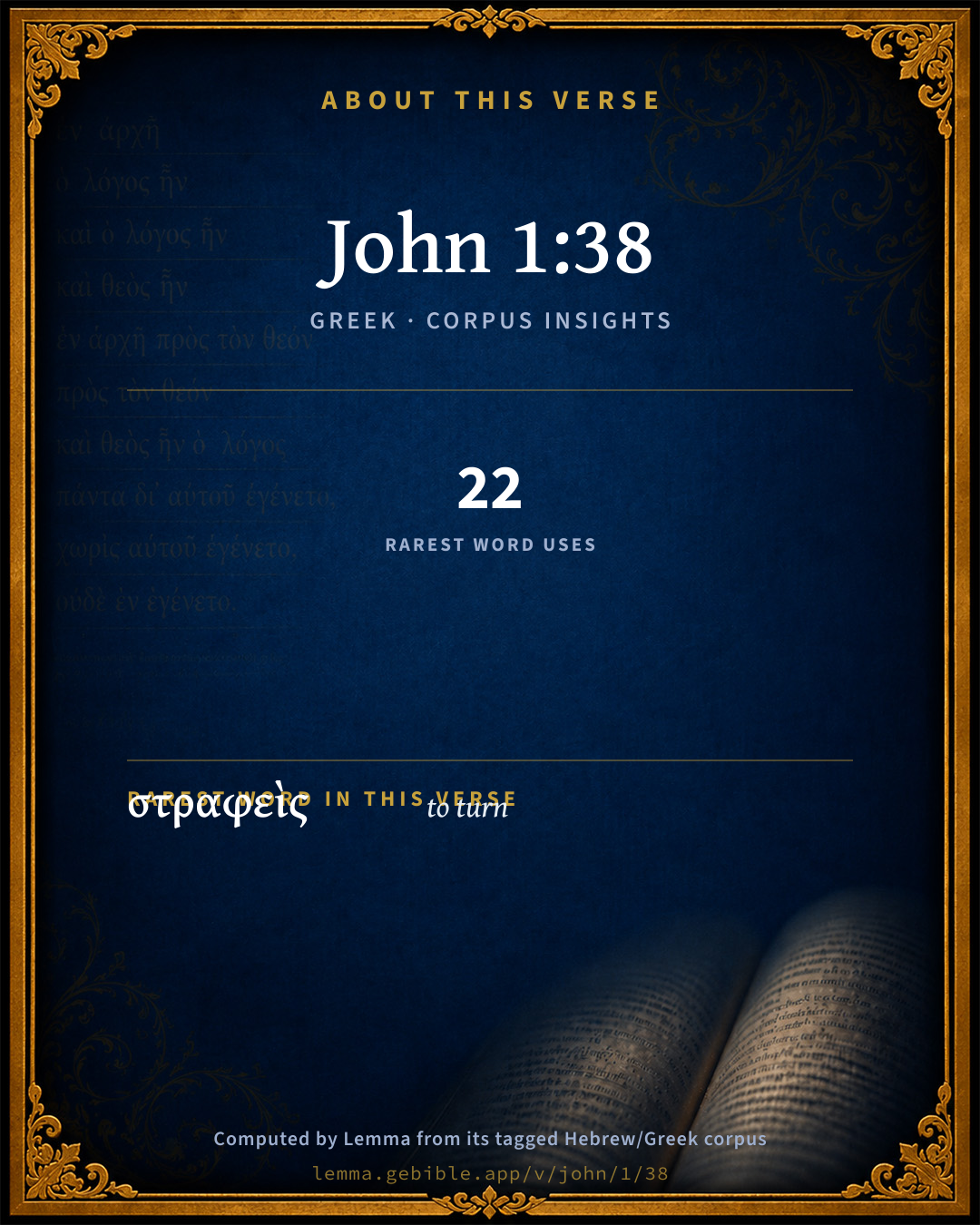
The rarest word here is στραφεὶς to turn G4762 — appearing just 22 times in the whole Greek New Testament.

Shared distinctive vocabulary

στραφεὶς to turn G4762 occurs in 22 verses of the Greek New Testament. Also found in:

Repetition

A word recurs within this verse:

  • αὐτοὺς he G846 ×2

Cross-references

25

Topical passages linked to John 1:38 in the Treasury of Scripture Knowledge — connected by theme and wording, ordered by reader-vote popularity; previews shown in the World English Bible.

  • John 18:7 Again therefore he asked them, "Who are you looking for?" They said, "Jesus of Nazareth."
  • John 3:2 The same came to him by night, and said to him, "Rabbi, we know that you are a teacher come from God, for no one can do these signs that you do, unless God is with him."
  • John 1:49 Nathanael answered him, "Rabbi, you are the Son of God! You are King of Israel!"
  • Psalms 27:4 One thing I have asked of Yahweh, that I will seek after, That I may dwell in the house of Yahweh all the days of my life, To see Yahweh's beauty, And to inquire in his temple.
  • Proverbs 8:34 Blessed is the man who hears me, Watching daily at my gates, Waiting at my door posts.
  • John 18:4 Jesus therefore, knowing all the things that were happening to him, went forth, and said to them, "Who are you looking for?"
  • John 3:26 They came to John, and said to him, "Rabbi, he who was with you beyond the Jordan, to whom you have testified, behold, the same baptizes, and everyone is coming to him."
  • John 6:25 When they found him on the other side of the sea, they asked him, "Rabbi, when did you come here?"
  • John 12:21 These, therefore, came to Philip, who was from Bethsaida of Galilee, and asked him, saying, "Sir, we want to see Jesus."
  • Matthew 23:7–8 the salutations in the marketplaces, and to be called 'Rabbi, Rabbi' by men.
  • Luke 19:5 When Jesus came to the place, he looked up and saw him, and said to him, "Zacchaeus, hurry and come down, for today I must stay at your house."
  • John 20:15–16 Jesus said to her, "Woman, why are you weeping? Who are you looking for?" She, supposing him to be the gardener, said to him, "Sir, if you have carried him away, tell me where you have laid him, and I will take him away."
  • Acts 10:29 Therefore also I came without complaint when I was sent for. I ask therefore, why did you send for me?"
  • Ruth 1:16 Ruth said, "Don't entreat me to leave you, and to return from following after you, for where you go, I will go; and where you lodge, I will lodge; your people shall be my people, and your God my God;
  • Proverbs 3:18 She is a tree of life to those who lay hold of her. Happy is everyone who retains her.
  • Proverbs 13:20 One who walks with wise men grows wise, But a companion of fools suffers harm.
  • Song of Solomon 1:7–8 Tell me, you whom my soul loves, Where you graze your flock, Where you rest them at noon; For why should I be as one who is veiled Beside the flocks of your companions? Lover
  • Luke 7:24–27 When John's messengers had departed, he began to tell the multitudes about John, "What did you go out into the wilderness to see? A reed shaken by the wind?
  • Luke 8:38 But the man from whom the demons had gone out begged him that he might go with him, but Jesus sent him away, saying,
  • Luke 10:39 She had a sister called Mary, who also sat at Jesus' feet, and heard his word.
  • Luke 14:25 Now great multitudes were going with him. He turned and said to them,
  • Luke 15:20 "He arose, and came to his father. But while he was still far off, his father saw him, and was moved with compassion, and ran, and fell on his neck, and kissed him.
  • Luke 18:40–41 Standing still, Jesus commanded him to be brought to him. When he had come near, he asked him,
  • Luke 22:61 The Lord turned, and looked at Peter. Then Peter remembered the Lord's word, how he said to him, "Before the rooster crows you will deny me three times."
  • Acts 10:21 Peter went down to the men, and said, "Behold, I am he whom you seek. Why have you come?"

Cross-references courtesy of OpenBible.info (CC BY 4.0).

Commentary

Notes on John 1:38 from classic Christian and Jewish commentators (each source and its license shown beneath its notes). The classic Christian expositions comment on the surrounding passage and are grouped to its opening verse, so a note may address several verses; the Jewish commentaries on the Tanakh (Rashi and others) are per-verse, so they appear only where the commentator wrote on this verse.

Lemma curates 59 commentaries, every one of them public domain or Creative Commons licensed, each selected and text-cleaned for this edition rather than reprinted as found. About our sources →

The Preacher's Complete Homiletical Commentary

Joseph S. Exell (gen. ed.)

EXPLANATORY AND CRITICAL NOTES

Joh_1:38-43. Jesus turned, etc.—Jesus saw these two young men modestly following Him, too diffident to accost Him. He, therefore, with friendly invitation encouraged them. “What seek ye?” The apparently irrelevant answer of the disciples, “Rabbi, where dwellest Thou?” may be understood as simply expressing a desire for further acquaintance and conversation with the Saviour. The use of the word Rabbi with the interpretation shows that this Gospel was intended in part for Gentiles.

Joh_1:39. Come and see are His friendly words; and in response to His invitation they went with Him for the remainder of that day, i.e. from the tenth hour (between three and four o’clock in the afternoon) until sunset. Of the place of Jesus’ abode no record is given.

Joh_1:40. Andrew.—The apostle better known as Peter’s brother (vide also Joh_6:8). The other disciple, modestly unnamed, is the Evangelist himself.

Joh_1:41.—On the impulse of simple, glowing faith Andrew first sought his own brother, Simon, as dearest to him, so that he might impart to him this new-found treasure. It is to be inferred that John also sought his own brother, James, with a like intention. We have found Messias (משׁיח).—The use of this Hebrew word, with its Greek interpretation, again shows that the Gospel was intended for a mixed community, a community where a Greek element existed.

Joh_1:42. Cephas.—“He is called Petrus, ‘a stone,’ from Petra, ‘the rock’ ” (Aug.). “Petrus (or Peter) has the same meaning in Greek as Cephas (פּיפּא) in Syriac (Aram.); and the apostle was called Peter from the firmness of his faith, by which he clave to that Petra, or Rock, of whom the apostle Paul speaks: ‘That Rock was Christ’ ” (Chr. Wordsworth). See also Mat_16:18. The latter passage denotes an advance. Here Simon’s name is changed to Peter; in St. Matthew, “Thou art Peter,” says Christ, “and this name henceforth describes thy character.” The passages are independent, and throw light on each other. Thus if Petrus = a stone, then the explanation is found in 1Pe_2:5.

Joh_1:43. On the morrow, etc.—I.e. the fourth day from the incident recorded in Joh_1:29. He would (ἠθέλησεν) go forth, and as He did so He found Philip. The words Jesus addressed to Philip, “Follow Me,” are more than a mere invitation to accompany Him. No doubt other words of teaching were spoken which are not here recorded, but the result is seen in this word of command and its upshot.

Joh_1:44. Bethsaida.—Jesus met Philip on the way from Bethania to Cana. This Bethsaida was on the west side of the Lake of Galilee, and is called Bethsaida of Galilee, ch. 12. (probably on a site north of Khan Minyeh), to distinguish it from Bethsaida Julias on the east side.

MAIN HOMILETICS OF THE PARAGRAPH.—Joh_1:38-44

Jesus manifests Himself to His first disciples.—The choice of His disciples was a matter of great moment to Jesus. It was necessary that some of them should be witnesses of His life and work from the beginning of His public ministry (Joh_15:27), that they might learn to know and understand Himself and His mission, so as to be fitted to carry out the work of His kingdom. He did not choose those “hide-bound” by the traditions of the rabbinic schools, with fixed and earthly notions of His state and kingdom, nor those who rejected the divine word (Sadducees), to be His witnesses. He chose men of simple, unsophisticated, yet strong and earnest mind, already led to repentance by the Baptist’s teaching, and waiting in their own honest fashion (not idly dreaming, but actively working) for “the consolation of Israel.”

I. Such were the first two disciples led to the Saviour. Acting on John’s indication, they “followed Jesus,” not at first apparently presuming to accost and speak to Him. But He ever knows His own. He saw them coming after Him, and with a simple question led them to that great, that important decision, which changed the whole current of their lives, and made their names shine amongst the most honoured and revered in history.

1. How simple and natural the story of it all is! “Rabbi,” they say, “where dwellest Thou?” in answer to His question, “What seek ye?” This simple and almost irrelevant question of theirs “breaks the ice” for them, so to speak. It was their wish, probably, to converse with Him at some other time, as the day was declining apace, and they might not wish to disturb Him when evening was approaching. But,

2. His answer at once decided them—“Come and see”: words of simple invitation, but implying so much on the lips of Him who spoke them. We know not where it was that Jesus was dwelling. It is Himself and not the place that is important. Where He is as our friend and host, there is all heaven. The writer of this account (one of the two) was so impressed by the events of that afternoon interview with Jesus, never to be forgotten, that he recollects the hour when first he heard the voice of that Jesus whose teaching he was to assimilate and understand so deeply—whose latest word he was to hear from the cross (Joh_19:30), whom he was to recognise first of all the disciples after the resurrection (Joh_21:7), and whom again he was to hear in apocalyptic vision speaking in words of power (Rev_1:17-20).

3. And is not the first meeting of the Saviour with all His true disciples, when they first recognise Him as the Sent of God and their Redeemer, a time to be cherished in memory?

II. The second incident has a special interest.—It tells us:

1. That those who truly come to Christ do not go back from Him. They come to know Him in all His loveliness and tenderness, His grace and truth. But, more than that, they become—

2. Active workers for Jesus. John modestly records Andrew’s action only; but no doubt at the same time he led his own brother James to Jesus. It is interesting and instructive to notice that no sooner did these two come to Christ than they became witnesses to Him. They are the first distinctively gospel preachers.

3. A notable member of the apostolic band came in response to Andrew’s call. Jesus recognised the great qualities of this man, Simon, son of Jona (best MSS. John), and to signalise his entrance in the service of the kingdom gave him a new name, distinctive of the prominent and important work he was to do. But there is nothing in this, or in any of the gospel narratives, or the New Testament generally, to lead us to suppose that he ever occupied a position analogous to that given him in mediæval Church history. “In Church history St. Peter is everything and St. Andrew nothing; but would there have been an apostle Peter but for Andrew?” (Plummer).

III. The third incident is also noteworthy in an especial manner from this fact, that in bringing Philip into the circle of the disciples Jesus for the first time issued that oft-repeated direct call, “Follow Me.”

1. This command is in the Gospels issued only by our Lord Himself. It is “addressed to but one outside the circle of the apostles, the rich young man, whom Jesus loved (Mat_19:21, etc.). In other parts of the New Testament it is used but once (Act_12:8), in the words of the angel to Peter” (Watkins).

2. This word implies that now there is a new centre for humanity—not Moses, not Jerusalem, but Christ (Joh_1:17; Joh_4:23-26).

3. Obedience to this command is a test of genuine Christianity:

(1) In the preacher of the cross. His chief duty is to direct, like John, his hearers to Christ, and to be able to say like St. Paul, “Be ye followers of me, even as I also am of Christ” (1Co_11:1).

(2) Those who hear this call should, like Philip, promptly and unhesitatingly obey it.

HOMILETIC NOTES

Leadership.—

1. As men are constituted they must follow some leader—are drawn by some power to choose a certain direction in life.

2. The leaders of men also are led. They too are dominated by some power, not themselves, which makes either for righteousness or unrighteousness; they are moved either by principle or caprice; they are swayed either by the desires and passions of their lower nature, or by reason and conscience. And so much power have those prominent and noteworthy men we call leaders, that they attract to themselves a following of disciples, more or less numerous, and exert an influence that not only tells on human history here, but extends into eternity. We cannot compute or measure the results for good and for evil that have flowed from the activity of great leaders of men past and present.

3. Therefore the necessity of choosing men of principle, unswerving in their love of righteousness, as leaders in the social, political, and ecclesiastic spheres. For if they be not men of principle, however plausible and good their schemes or measures may seem, something will lie behind that will vitiate all. It is true men here are imperfect, and much of evil may often mingle with what is good; but are righteousness, truth, benevolence, principle, the prominent and ruling traits in the character of one who offers himself as a leader of men, then let them rejoice, for undoubtedly such a one is heavensent. And if men in choosing their leaders fixed on such, the world would speedily be happier and better.

4. We believers in Christ have a fixed standard by which men may be tried who offer themselves as our guides, especially in things religious. Again and again St. Paul calls on his converts to follow him and his fellow-workers; but he shows that his words and actions must be tested by the ultimate standard, “Be ye followers of me, even as I also am of Christ” (1Co_11:1). Here is the standard to which our leaders should be conformed, especially our religious leaders. And as the mass of men in the present state of the world still depend, to a great extent, on teachers and guides, prominent human leaders, it is greatly to be desired that they should be led in choosing them to ascertain in how far they conform to the perfect pattern given us in Christ. “He is our example that we should follow in His steps” (1Pe_2:21). He called His disciples to “follow” Him.

5. And the test by which teachers and leaders in the religious sphere should be tried is this: do they lead those who come under their influence to follow Christ Himself? When to John the Baptist it was revealed at the baptism of Jesus that the Son of Mary was indeed no other than the Son of God, the promised Messiah, he did not delay to point his own disciples to the Lamb of God, so that “they followed Jesus.” This is the spirit of all faithful teachers and guides in the Church. “Not in the words which man’s wisdom teacheth,” but, guided by the Holy Ghost, and therefore “in demonstration of the Spirit and of power” (1Co_2:4), they point men to Christ. They forget and lose themselves in Him whom they proclaim. O, si sic omnes!

ILLUSTRATIONS

The Peter name.—“Thou art Simon, son of Jona; thou shalt be called Peter.” The apostle received this grand and astonishing word deep in his heart. It revealed to him a great and mysterious destiny. It would rise before him as a warning, and often in reproach. Always, whatsoever he might do, it would start into remembrance. Ah! what did it say in that hour of his fall and triple denial? With what remorse would it transpierce his soul. And if at times pride laid hold of the thought of this great vocation which his name presaged, how would he then learn in his weakness that God alone who called him to this destiny could give him power to realise it. Brethren, all called by Jesus Christ to serve and follow Him as Peter was, what name would your Saviour give you were He present now in our midst? Ah, without doubt, as to Simon, a name which would express the end you ought to press toward, and the new character you ought to assume: to you who are yet fearful and weak in your faith a name which would express firmness; to you who are besieged by temptations that humiliate you a name expressive of the liberty of a purified soul; to you dominated by obstinate pride and ambition a name which would recall you to humility, to the discipline which you require. Well then, you must accept and lay hold of this glorious destiny; you must attain to this end; you must respond to the divine will, for fear lest, following the stern words of Scripture, you “frustrate the grace of God concerning you.” Simon, remember that thou art called Peter. Oh, you who hear me, remember you have been redeemed by the Saviour! No, you were not made for this life only, to be entirely absorbed by the preoccupations of the world, by those dreams of fortune, of glory, and of egoistic happiness. No, you are not made for that inward servitude, that shameless slavery of hidden passion which weakens you, paralyses you, and eats away the substance of your life and your moral strength. No, my sister, you were not made for this insensate dissipation by which your days are wasted, for those vain dreams of vanity, for that lying homage, for that idolatry which is so pleasing to you. It is to another way, to another aim, which those prayers by which you have been encompassed have called you, those pure and sweet remembrances of a Christian childhood, those deep emotions, those tears at former times shed at the Saviour’s feet, those multiplied warnings sent by the love of a faithful God. Christian soul, soul redeemed by the blood of Jesus Christ, called to eternal life, awake, throw off your slave chains, and return to God, who is willing to save you. And Thou, Saviour whose love is so faithful; Thou whose gifts, according to Thy word, are without repentance; Thou who dost call and who dost save, who dost convert and sanctify, who dost commence and finish; Thou who dost place before us so great a destiny, who desirest that we should be conquerors of the world and of ourselves, and inheritors of eternity, citizens of heaven, kings and priests, fulfil in us Thy will, make us submissive to Thy holy law, and in place of these fleshly hearts, subject to vanity, give us new hearts, freed from evil and consecrated to Thee for evermore.—Translated from Eug. Bersier.

“To live unto righteousness”—thus alone to the honour of my Saviour and Redeemer ought I to live, to suffer, to die. Such a life—a new life in righteousness—does the Saviour implant in all His own. Has it begun in you to germinate, to put forth buds, to flourish, this new spiritual life? Are there souls among you in which the Holy Ghost has begun His work; plants of righteousness who to-day, in the springtide glow of their first love to the Saviour, in the vernal dress of a pure youthhood stand before the Lord like a tree covered with white, fragrant blossom?… Oh that those blossoms of “first love” may not fall off as blighted blossoms, but may ripen into fruit, into “the fruits of righteousness.” Oh that all who hitherto have been like dry wood might yet flourish in very righteousness and holiness! There is nothing more beautiful on earth than a son or daughter, blooming not alone in body, but also in soul, flourishing before God in innocency, and growing up by their Saviour, as a rose which has climbed up around the cross. Oh that in us all, even in aged hearts, the new divine life once more would stir, the blossoms of godly love would finally open, the fruits of righteousness would yet ripen, by which the Lord knows His own! That would indeed be a lovely May blossom, a most blessed springtide of the soul.—From an Easter Address to Catechumens, Dr. Karl Gerok.

The Preacher's Complete Homiletical Commentary (gen. ed. Joseph S. Exell; Funk & Wagnalls, c. 1892) — public domain (pre-1929). A full-Bible homiletical/sermon-outline anthology covering 65 of 66 books (2 John is absent from the source module). Text from a community e-Sword module.

Bengel's Gnomon

Johann Albrecht Bengel

Joh 1:38. Τὶ ζητεῖτε, what seek ye?) He was aware it was Himself they sought. He means therefore. What seek ye with Me? not, Whom seek ye? By this question He touched their heart. He showed that He knew that they were seeking something; and He gives them the opportunity of begging [from Him] what they would.—Ῥαββί, Rabbi) Seasonably they give this title to Jesus; Joh 1:49.[39] Also the interpretation being added, shows that the disciples assigned it to Him in the restricted signification.—ποῦ μένεις) we ask, where thou art stopping, where thou hast thy μονή [mansion, residence]. They are desirous of His intimacy.

[39] i.e. as ver. 40. Nathanael there addressed Jesus, in consequence of learning His omniscience in having seen Him under the fig-tree, Rabbi, etc.: so here, ver. 38, the disciples give Him the same title for the same reason, viz. their learning His omniscience, as extending to the knowledge of their thoughts and what they were seeking.—E. and T.

Bengel's Gnomon of the New Testament — English translation (T&T Clark, Edinburgh, 1860) — public domain. Text from a community e-Sword module.

Expositor's Greek Testament

ed. W. Robertson Nicoll

Joh 1:38 . στραφεὶς δὲ … τί ζητεῖτε ; Jesus, hearing their steps behind Him, turns. To all who follow He gives their opportunity. Having turned and perceived that they were following Him, He asks τί ζητεῖτε ; the obvious first inquiry, but perhaps with a breath in it of that Fan which the Baptist had warned them to expect in the Messiah; as if, Are you seeking what I can give? They reply Ῥαββεί … μένεις ; Lightfoot ( Hor. Heb. ) tells us that “Rabbi” was a new title which had not been used long before the Christian era, and possibly arose during the rivalries of the schools of Hillel and Shammai. “The word means “my greatness”. Cf. His Majesty, etc., and for the absorption of the pronoun cf. monsieur or madame. See Lampe. As it occurs here for the first time John translates it, and renders by διδάσκαλε , Teacher; so that as yet they were scarcely prepared to give Him the greater title Lord, or Messiah. Unready with are answer to His question they put another which may stand for an answer, ποῦ μένεις ; where are you staying , where are you dwelling? So used in N.T., Luk 19:5 , and in later Greek, Polybius, 30, 4, 10, and 34, 9, 9, of dwelling for a short time in a place; not so much implying, as Holtzmann suggests, that they wished to go to His lodging that they might have more uninterrupted talk with Him; for that scarcely fits Oriental habits; but rather implying that they were shy of prolonging intercourse and wished to know where they might find Him another time. From this unsatisfactory issue they are saved by His frank invitation (Joh 1:40 ) ἔρχεσθε καὶ ὄψεσθε . “Come and ye shall see.” Use the opportunity you now have. Christ’s door is ever on the latch: He is always accessible. ἦλθαν οὖν … ὡς δεκάτη . The two men remained in conversation with Jesus during the remainder of the day [but Grotius gives the sense as “ibidem pernoctarunt, quia jam serum erat”], a day so memorable to John that he recalls the very hour when they first approached Jesus, four o’clock in the afternoon. It seems that at this time throughout the Græco-Roman world one system of reckoning the hours prevailed. There is indisputable evidence that while the Romans calculated their civil day, by which leases and contracts were dated, as extending from midnight to midnight, the hours of each day were reckoned from sunrise to sunset. Thus on the Roman sun-dials noon is marked VI. (see Becker’s Gallus , p. 319). Martial’s description of the manner in which each hour was spent ( Ep. , iv., 8) leads to the same couclusion; and for proof that no different method was followed in the provinces, see Prof. Ramsay’s paper “On the Sixth Hour” in the Expositor , 1893. Cf. also paper by Mr. Cross in Classical Review , June, 1891.

The Expositor's Greek Testament, edited by W. Robertson Nicoll (1897–1910) — public domain. Text from a community e-Sword module.

Godet's Commentaries

Frédéric Louis Godet

Second Section: 1:38-52. Beginnings of the Work of Jesus. Birth of Faith.

Testimony is the condition of faith. For faith is, at the outset, the acceptance of a divine fact on the foundation of testimony. But there is here only an external relation between the believer and the object of faith. In order to become living, faith must enter into direct contact with its object. In the case which occupies our thought, this contact demanded personal manifestations of Jesus, fitted to change believers into witnesses, and to form a direct connection between their hearts and Jesus. This is precisely what the following narratives describe to us. They are divided into two groups; the first comprising that which relates to the three earliest disciples, Andrew, John and Peter (Joh 1:38-43); the second, that which concerns Philip and Nathanael (Joh 1:44-51).

I. First Group: vv. 38-43.

We have just mentioned John. Almost all the adversaries of the authenticity themselves acknowledge that the author, in relating his story as he does here, wishes to pass himself off as one of the apostles. EvenHilgenfeld says: “Andrew and an unnamed person who is assuredly John.”

Vv. 38, 39. “Then Jesus turned and saw them following and saith unto them, What seek ye? 39. They said unto Him: Rabbi (which is to say, Master) where dwellest thou?”

Jesus, hearing footsteps behind Him, turns about. He sees these two young men who are following Him with the desire to accost Him, but who do not venture to begin the conversation by addressing Him. He anticipates them: “What seek ye?” He who thus interrogates them knows full well what they are seeking after. He knows to whom the desire of Israel and the sighing of humanity tend; He is not ignorant that He is Himself their object. By their answer, the disciples modestly express the desire to speak with Him in private. The title Rabbi is undoubtedly quite inferior to that which the testimony of John had revealed to them concerning Jesus. But discretion prevents them for the moment from saying more. This title, at the same time, expresses indirectly the intention to offer themselves to Him as disciples. The translation of this term, which is added by the evangelist, proves that the author is writing for Greek readers.

Frédéric Louis Godet — Commentaries on Luke, John, Romans, and 1 Corinthians — English translation (T&T Clark, Edinburgh, 1870s–1890s) — public domain. Text from a community e-Sword module.

Geneva Bible (1599)

Geneva Bible translators

Where is thy lodging?

Geneva Bible (1599) marginal notes — public domain. Text via Bolls.life.

Jamieson, Fausset & Brown

Robert Jamieson, A. R. Fausset & David Brown

FIRST GATHERING OF DISCIPLES--JOHN ANDREW, SIMON, PHILIP, NATHANAEL. (Joh 1:37-51)

What seek ye--gentle, winning question, remarkable as the Redeemer's first public utterance. (See on Mat 12:18-20.)

where dwellest thou--that is, "That is a question we cannot answer in a moment; but had we Thy company for a calm hour in private, gladly should we open our burden."

Jamieson, Fausset & Brown — Commentary Critical and Explanatory on the Whole Bible (1871) — public domain (CC PDM 1.0). Text via the HelloAO Bible API.

Adam Clarke's Commentary

Verse 38. What seek ye?] These disciples might have felt some embarrassment in addressing our blessed Lord, after hearing the character which the Baptist gave of him; to remove or prevent this, he graciously accosts them, and gives them an opportunity of explaining themselves to him. Such questions, we may conceive, the blessed Jesus still puts to those who in simplicity of heart desire an acquaintance with him. A question of this nature we may profitably ask ourselves: What seek ye? In this place! In the company you frequent? In the conversation you engage in? In the affairs with which you are occupied? In the works which you perform? Do you seek the humiliation, illumination, justification, edification, or sanctification of your soul? The edification of your neighbour? The good of the Church of Christ? Or, The glory of God? Questions of this nature often put to our hearts, in the fear of God, would induce us to do many things which we now leave undone, and to leave undone many things which we now perform.

Rabbi] Teacher. Behold the modesty of these disciples-we wish to be scholars, we are ignorant-we desire to be taught; we believe thou art a teacher come from God.

Where dwellest thou?] That we may come and receive thy instructions.

Adam Clarke's Commentary on the Bible (1810–1826) — public domain. Text from a community e-Sword/MySword module.

John Calvin's Commentaries

38. Rabbi. This name was commonly given to persons of high rank, or who possessed any kind of honor. But the Evangelist here points out another use of it which was made in his own age, which was, that they addressed by this name the teachers and expounders of the word of God. Although, therefore, those two disciples do not yet recognize Christ as the only Teacher of the Church, yet, moved by the commendation bestowed on him by John the Baptist, they hold him to be a Prophet and teacher, which is the first step towards receiving instruction.

Where dwellest thou? By this example we are taught that from the first, rudiments of the Church we ought to draw such a relish for Christ as will excite our desire to profit; and next, that we ought not to be satisfied with a mere passing look, but that we ought to seek his dwelling, that he may receive us as guests. For there are very many who smell the gospel at a distance only, and thus allow Christ suddenly to disappear, and all that they have learned concerning him to pass away. And though those two persons did not at that time become his ordinary disciples, yet there can be no doubt that, during that night, he instructed them more fully, so that they soon afterwards became entirely devoted to him.

John Calvin's Commentaries (1540-1563) — public domain. Text from the Calvin Translation Society English edition (1840s-50s) via the Christian Classics Ethereal Library (ccel.org). Calvin's coverage is partial (roughly two-thirds of the Bible); uncommented books and verses are honest gaps, never fabricated. The 19th-century editor's footnotes and remarks are omitted so the notes are faithfully Calvin's own voice.

Ellicott's Commentary for English Readers

(38) Jesus turned, and saw them following.—They follow wishing, and yet not daring, to question Him. He sees this, and seeks to draw them forth by Himself asking the first question. They are not prepared for this question, and wish for more than a passing interview. They inquire, “Where dost thou sojourn?” “Where are you staying for the night?” They will visit Him and ask the many things they seek. They address Him as “Rabbi,” placing themselves in the position of His scholars; but they have not yet learnt all that John had taught them of His office. The title is natural from them, for it was the then current title of a revered teacher, and one that John’s disciples applied to him (Joh_3:26); but the writer remembers it was a modern word (comp. Mat_23:7-8), known to Jews only since the days of Hillel (president of the Sanhedrin about B.C. 30), not likely to be known to Greeks at all, and he therefore translates it, as he does Messias and Cephas in this same section.

A Bible Commentary for English Readers, edited by Charles John Ellicott (1878–1897) — public domain. Text from a community e-Sword module.

The Cambridge Bible for Schools and Colleges

gen. ed. J. J. S. Perowne

38–51. The Testimony of Disciples

38. saw them] Same verb as in Joh_1:14; Joh_1:32. The context shews that He saw into their hearts as well. For ‘Then’ read But.

What seek ye?] i.e. in Me. He does not ask ‘Whom seek ye?’ It was evident that they sought Him.

Rabbi] A comparatively modern word when S. John wrote, and therefore all the more requiring explanation to Gentile readers. S. John often interprets between Hebrew and Greek; thrice in this section. (Comp. Joh_1:41-42.)

where dwellest thou?] Better, where abidest Thou? (See on Joh_1:33.) They have more to ask than can be answered on the spot. Perhaps they think Him a travelling Rabbi staying with friends close by; and they intend to visit Him at some future time. He bids them come at once: now is the day of salvation.

The Cambridge Bible for Schools and Colleges (gen. ed. J. J. S. Perowne; Cambridge University Press, 1878–1918) — public domain. Text from a community e-Sword module.

John Gill's Exposition

Then Jesus turned, and saw them following,.... That is, "him", as the Vulgate Latin, and all the Oriental versions add: he saw by their walk, and by their countenances, that they were following him; and which he knew before he turned himself: he knew what John had said, and what an effect it had upon these disciples, and what was working in their hearts, and how desirous they were of coming up to him, and conversing with him; and therefore he turned himself, that they might have an opportunity of speaking to him; or rather, in order to speak to them first, as he did:

and saith unto them, what seek ye? This he said, not as ignorant of whom, and what they were seeking, and desirous; but to encourage them to speak to him, which, through fear and bashfulness, they might be backward to do; and therefore, he who will not break the bruised reed, nor quench the smoking flax, but cherishes and encourages the first motions of grace, begins first with them, and treats them in a free and familiar manner; thereby to animate and engage them to use freedom with him, and which end was answered:

they said unto him, Rabbi; a title which now began to be in much use with the Jews, and which they gave to their celebrated doctors; and these disciples of John, observing how magnificently their master spoke of Jesus, in great reverence to him, addressed him under this character; See Gill on Mat 23:7,

which is to say, being interpreted, master. These are the words of the evangelist, interpreting the word "Rabbi", and not of the disciples, and are left out in the Syriac and Persic versions, who, for "Rabbi", read "our master", or our "Rabbi"; being said by both the disciples, or by one in the name of both, putting the following question:

where dwellest thou? signifying, that that was not a proper place, in the public way, to enter into a conversation with him, and acquaint him with what they were desirous of; but should be glad to know where he lodged, that they might wait upon him there, either then, or on the morrow, or at any convenient time.

John Gill's Exposition of the Whole Bible (1746–1763) — public domain (CC PDM 1.0). Text via the HelloAO Bible API.

Trapp's Complete Commentary

John Trapp

38 Then Jesus turned, and saw them following, and saith unto them, What seek ye? They said unto him, Rabbi, (which is to say, being interpreted, Master,) where dwellest thou?

Ver. 38. What seek ye] He saith still in effect as much as all this to all his suitors; and infinitely scorns that it should be said that any one seeketh him in vain, Isa 45:19. He is found of them that sought him not, and saith, "Behold me" to every passenger, Isa 65:1. Here he offers himself to these two disciples, and speaks first. He of his own accord (without any monitor) is wont to aid us. "His eyes are upon the righteous, as well as his ears are open to their prayers," Psa 34:15. Should he not see as well as hear, and prevent as well as follow us with his favours, we should want many things, and it would go full ill with us.

John Trapp, A Commentary or Exposition upon All the Books of the Old and New Testament (1647–1656) — public domain. Text from a community e-Sword module.

Albert Barnes' Notes on the Bible

What seek ye? - This was not asked to obtain “information.” Compare Joh 1:48. It was not a harsh reproof, forbidding them to follow him. Compare Mat 11:28-30. It was a kind inquiry respecting their desires; an invitation to lay open their minds, to state their wishes, and to express all their feelings respecting the Messiah and their own salvation. We may learn:

That Jesus regards the first inclinations of the soul to follow him. He “turned” toward these disciples, and he will incline his ear to all who begin to approach him for salvation. Jesus is ready to hear their requests and to answer them. Ministers of the gospel, and all other Christians, should be accessible, kind, and tender toward all who are inquiring the way to life. In conformity with their Master, they should be willing to aid all those who look to them for guidance and help in the great work of their salvation.

Rabbi - This was a Jewish title conferred somewhat as literary degrees now are, and meaning literally “a great one,” and was applied to a teacher or master in the Jewish schools. It corresponded with the title “Doctor.” Our Saviour solemnly forbade his disciples to wear that title. See the notes at Mat 23:8. The fact that John “interpreted” this word shows that he wrote his gospel not for the Jews only, but for those who did not understand the Hebrew language. It is supposed to have been written at Ephesus.

Where dwellest thou? - This question they probably asked him in order to signify their wish to be with him and to be instructed by him. They desired more fully to listen to him than they could now by the wayside. They were unwilling to interrupt him in his traveling. Religion teaches people true politeness, or a disposition to consult the convenience of others, and not improperly to molest them, or to break in upon them when engaged. It also teaches us to “desire to be with Christ;” to seek every opportunity of communion with him, and chiefly to desire “to be with him where he is” when we leave this world. Compare Phi 1:23.

Albert Barnes' Notes on the Bible (1834–1885) — public domain. Text from a community e-Sword/MySword module.

Matthew Poole's English Annotations

Christ, as he walked, turning him, and seeing two men following him, inquires of their end, what they sought; to teach us, in all our religious motions and actions, to do the like; for the end will contribute much to specify the action, and to make it good or bad. They gave him that honourable title which was then in fashion, by and under which they were wont to speak to those upon whom they relied for instruction, whose doctrine they desired to know, and with whom they desired to converse, and to learn of him. They asked him where he abode, or where he lodged.

Matthew Poole's English Annotations on the Holy Bible (1683–1685) — public domain. Text from a community e-Sword/MySword module.

Whedon's Commentary on the Bible

Daniel D. Whedon

38. Jesus turned—John still stands to his work; but his disciples will follow the Lamb. How far we know not; but Jesus turns, and our Evangelist arrives at the first thrilling word which the eternal Word uttered in his hearing. That word is not to teach, but to question, and draw out.

What seek ye?—This is the word which the great Teacher addresses to us all, to call us to reflection, and to seeking aright the right.

Where dwellest thou— They address this to the TRUTH; and so we ask of divine and suffering truth where it dwells.

Daniel D. Whedon (gen. ed.), Commentary on the Old and New Testaments (1874–1909) — public domain. Text from a community e-Sword module.

The Pulpit Commentary

Then Jesus turned hearing their footfall, he welcomed their sincere approach, attentive as he ever was to the faintest indication of genuine faith and desire for his best giftsand beheld them following, ( yeaomai is used of intense gaze at that which is august and wonderful, vers. 14, 32 1Jn_1:1; but used also of special and interested contemplation, Mat 6:1Jo Mat_6:5) and he saith to them, What seek ye? The first words of Jesus, as recorded in this Gospel, reveal the incarnate Logos, anointed of the Holy Spirit, beginning to search the heart and anticipate the unuttered questions of humanity. He assumes their desire for that which he alone can supply. They, on seeing their Christ, the Son of God, all humanly before them, do not fall at his feet, but approach him as a human teacher, and give him the ordinary honorific title of a wise, competent instructor. They said unto him, Rabbi ( which is, being interpreted, Teacher). The parenthetic clause reveals the fact that the Gospel was written for Gentile readers. The title "Rabbi" was a modem one, only dating from the days of Hillel, about B.C. 30, and therefore needing interpretation. Where abidest thou? Renan founds on this phrase "Rabbi" the supposition that, when John and Jesus meet, they are both surrounded by groups of followers. The narrative is written to convey a precisely opposite conception. Christ did not refuse this "courtesy title", (Mat_23:8 Joh_13:13) and we can gather nothing else from the narrative. The question itself reveals the mind of the evangelist. In the opinion of all writers (favourable and hostile), the writer, according to a deliberate method adopted by him, wished to imply that he was one of the two disciples who first left the Baptist to attach themselves to Jesus. The very form of the question adds to the probability. It is a characteristic longing of the disciple, whom Jesus loved so well, to be near and with his Master. He craved no laconic phrase, no solitary word, but some more prolonged fellowship, some undisturbed communion and instruction. The varied emotions of that day, moreover, were conspicuously reproduced in the solemn title which the son of Zebedee most persistently applied to his glorified Lord in the Apocalypse. More than thirty times he refers to him as "the Lamb.

A question for seekers.

I A FIRST MEETING WITH SOME OF THE DISCIPLES. Interesting to look back from the concluding to the beginning chapters of this Gospel from the days when the apostles were trusted friends to the days when Jesus and they were but as strangers. Here we have a record of the first meeting with some of them. Jesus is walking by the banks of the Jordan a Teacher who has been made fit to teach, waiting now for scholars; and some of the scholars, all unknown to themselves, have been becoming fit for Jesus in the preparatory school of John. To them John must often have spoken of the sin of the world, and the appointed Lamb of God who was to take it away. What wonder, then, that the Lamb of God, really set before their gaze, should draw their footsteps towards him?

II THE EVIDENT STRONG INTEREST WHICH JESUS HAD EXCITED IN THE MINDS OF THESE TWO MEN. They could not help following him. We cannot but contrast this overmastering interest on their part with the absence of interest in Jesus on our part. Surely, if such an interest was possible to them, it must in some way be possible to us. As we read the Gospels we ought to feel that Jesus of Nazareth was the most important Person in the world at that time, far more important than the greatest of rulers and the wisest of men; far more important to each person who came in contact with him than the nearest of his kindred could be far more important to John the Baptist than his parents, Zacharias and Elisabeth; far more important to John the disciple than Zebedee his father; far more important to Andrew than Simon his brother; far more important to Philip than Nathanael his friend. If we are not more interested in the doings and claims of Jesus than in the doings and claims of any one else, we shall fail to appreciate Jesus as he ought to be appreciated.

III HOW CAME THIS STRONG INTEREST TO BE EXCITED? The men had been amply prepared. They had been impressively told of the need Jesus came to supply. Often must John and Andrew have heard the Baptist calling the crowd to repentance. Doubtless the Baptist had often led his disciples to meditate very earnestly on the wickedness, the wants, and the woes of the great world around them, with its Pharisees and Sadducees, its publicans and sinners, its blind and lame, lepers and demoniacs, poor and destitute. How could earnest and pitying men be otherwise than interested in him who was to sweep the sin-caused troubles of the world away? And our interest must come in the same way.

IV THE QUESTION JESUS ASKS THESE INTERESTED ONES. He seeks to give direction and depth to this interest. He seeks to eliminate all mere curiosity and wonder seeking. Jesus himself was a Seeker having definite and most decided aims. Such a question as met these disciples should meet us in all our formal approaches to God. Are we really seeking anything? and if so, what is it? Only those who are evidently real seekers can ever get anything out of Christ. Such persons will soon be able to answer Christ"s question. He helps the intent seeker to find all he wants in him. Y.

The Pulpit Commentary (1880–1919), ed. H.D.M. Spence-Jones & Joseph S. Exell — public domain. Text from a community e-Sword module.

The People's New Testament

B. W. Johnson

38. Rabbi. A term meaning teacher, or master. Where dwellest thou? These disciples had followed at the bidding of John. Their question implies a desire to be in the company of Jesus.

B. W. Johnson's The People's New Testament with Notes (1889–1891) — public domain. Electronic text from the Christian Classics Ethereal Library (CCEL) ThML edition.

Cambridge Greek Testament for Schools and Colleges

38–51. THE TESTIMONY OF DISCIPLES

This section falls into two divisions, each occupying a day; (1) the call of Andrew, John, Peter, and perhaps James; (2) that of Philip and Nathanael. Of these Peter and James were probably disciples of John. In this also he was the Elijah who was to come first.

38–42. ANDREW, JOHN AND PETER

38. θεασάμενος. Comp. Joh 1:14; Joh 1:32. The context shews that He saw into their hearts as well.

Cambridge Greek Testament for Schools and Colleges (Cambridge University Press, 1896; 21 vols, various authors incl. Carr, Maclear, Plummer, Farrar, Lumby, Moule, M. R. James, Simcox) — public domain. Text from a community e-Sword module.

International Critical Commentary

38. στραφεὶς δέ κτλ. He turned round (cf. 20:14), for He had heard their steps behind Him.

For θεασάμενος, always used of bodily vision, see on v. 14.

He asks, τί ζητεῖτε; “What do you seek? what are you looking for?” Their answer is, “Where are you staying?” for they desired an opportunity of private conversation with Him, They had not yet reached the stage of discipleship; they wished to know a little more about Him.

Abbott (Diat. 2649b) finds an illustration of τί ζητεῖτε; in Philo (quod. det. pot. 8) who, commenting on τί ζητεῖς; of Gen 37:15, explains it as the utterance of the ἔλεγχος to the wandering soul. Later on (c. 40) the ἔλεγχος is identified with the λόγος. But the parallel is not close enough to prove that Jn. is indebted to Philo for the use of so familiar a phrase as τί ζητεῖτε; Cf. 18:4, 20:15.

The disciples address Jesus as Rabbi, a title which Jn., writing for Greek readers, at once interprets, ὃ λέγεται μεθερμηνευόμενον, Διδάσκαλε. For similar interpretations of Aramaic or Hebrew words, cf. vv. 41, 42, 4:25, 5:2, 9:7, 11:16, 19:13, 17, 20:16.

They may have addressed Jesus thus because they took Him for a Rabbi travelling alone, but more likely they used Rabbi as an ordinary title of respect, It was the title which the Baptist’s disciples were accustomed to use when addressing their master (3:26); and it appears from 13:13 that afterwards the disciples of Jesus habitually addressed Him either as Rabbi (teacher) or as Mari (lord). The distinction is only this, that the antithesis to Rabbi is “scholar,” and to Mar is “servant” or “slave” (cf. 15:15); the terms being often used without any clear sense of a difference between them. Either might be rendered “Sir,” without going wrong. Thus, in the Synoptic narratives of the Transfiguration, where Mk. (9:5) has Rabbi, Lk. (9:33) renders it by ἐπιστάτα, and Mt. (17:4) by κύριε. So in the story about the storm on the lake, where Mk. (4:38) has διδάσκαλε, Lk. (8:24) has ἐπιστάτα, and Mt. (8:25) has κύριε. But while κύριε may thus sometimes represent Rabbi, or be used (as at 12:21, 21:15) merely as the equivalent of the English “Sir,” it generally points to an original מָרִי or Mari.1

The Johannine usage of these terms is interesting. In the early part of the Gospel the disciples are always represented as saying Rabbi, while others,2 such as the woman of Samaria (4:11), the noble man ofCapernaum (4:49), the sick man at Bethesda (5:7), the blind man after his cure (9:36), Mary and Martha of Bethany (11:3, 21, 27, 32, but cf. 11:28 and note there), say κύριε. The multitude who were fed with the five loaves first say Rabbi (6:25); but, after they have heard the discourse about the heavenly bread, say κύριε (6:34). The first occasion on which a disciple is represented as saying κύριε is at the conclusion of this discourse, when Peter says, “Lord, to whom shall we go?” (6:68). We have Ῥαββεί used again by the disciples at 11:8, but κύριε at 11:12; and thenceforward Rabbi disappears from their speech, and they say Lord (13:6, 25, 14:5, 8, 22, 21:15, etc.), the change in address indicating a growing reverence. The title Rabbi was not employed after the Resurrection of Jesus, who was afterwards spoken of as Maran or ὁ κύριος (cf. 1Co 16:22, and see note on 4:1).

Thus Jn.’s report as to the use of these titles by the disciples is not only consistent, but is probably historical. Nothing of this kind can be traced in the Synoptists, who do not distinguish between διδάσκαλε and κύριε as modes of address, both being in use, as they represent the facts, at all stages of the association of the Twelve with Jesus. Indeed, Lk. (11:1) puts the phrase κύριε δίδαξον ἡμᾶς into the mouth of the disciples. In this regard, a more primitive tradition is preserved in the Fourth Gospel.

The Aramaic Rabbi is not found in Lk., and in Mt. only in the greeting of Judas to his Master (26:25, 49). Mk. has it in the corresponding place (Mar 14:45), and also places it twice in Peter’s mouth (Mar 9:5, Mar 11:21). Rabboni is found in Mar 10:51. With these exceptions, the Synoptists always translate רַבִּי, and do not reproduce the title itself.

Lk. and Jn., both of whom wrote for Greek readers, thus differ markedly as to the title Rabbi, Lk. never mentioning it, while Jn. has it again and again, giving the Greek rendering of it on its first occurrence. Probably the explanation is that behind Jn. we have the report of one who spoke Aramaic, and who was present at many of the scenes which he describes; while Lk. rests on documents and on information gained at second hand. In the reminiscences of his first intercourse with Jesus, as John the son of Zebedee dictated them, he employed the term Rabbi, which he remembers that

he used; and his interpreter, Jn., naturally translated it for the benefit of his Greek readers, but preserved the original word.

International Critical Commentary — older volumes (1896–1929), various authors — public domain. Text from a community e-Sword module.

Lesson kit

Teaching starters — assembled from the data on this page, not authored interpretation. Every prompt links to the verse data it draws on. Edit before teaching.

John, in the Gospels, opens this verse with 9 words (8 distinct Greek lemmas). Its most distinctive word is stréphō (“to turn”). A historical commentator’s framing appears above. Read the whole chapter for the surrounding context.

Discussion questions

  1. The word stréphō carries the sense “to turn.” How does it shape the verse?
  2. How does Matthew 5:39, which shares the word «to turn», read alongside this verse?
  3. What does the repetition of “he” (2× in this one verse) do in this verse?
  4. The translations on this page render this verse differently — a whole-verse word diff, not a word-by-word alignment. What might account for the different wordings?
  5. Compare how The Preacher's Complete Homiletical Commentary and Bengel's Gnomon read this verse. Where do they agree or differ?

Things to notice

Reading settings

Reading text

Shown beneath each verse's original-language words.

Old Testament
Old Testament edition

Read the OT as the Masoretic Hebrew (MT) or the Greek Septuagint (LXX).

English shown for the Greek Septuagint (in the Hebrew ↔ Greek comparison).

Comparing translations? Open the Compare panel on any verse page to stack up to four side by side.