John 5:8

Greek (Tischendorf 8th ed.) John 5:8 appears in the Greek New Testament. The text above is from the Tischendorf 8th edition. Each word links to its Strong’s number and a concise gloss. Click any word for its full Thayer’s Greek Lexicon entry.
Download image
Cite this verse

John 5:8 (World English Bible). Public Domain. Lemma interlinear Bible study tool, https://lemma.gebible.app/v/john/5/8.

Show BibTeX & RIS
BibTeX
RIS
English Translation
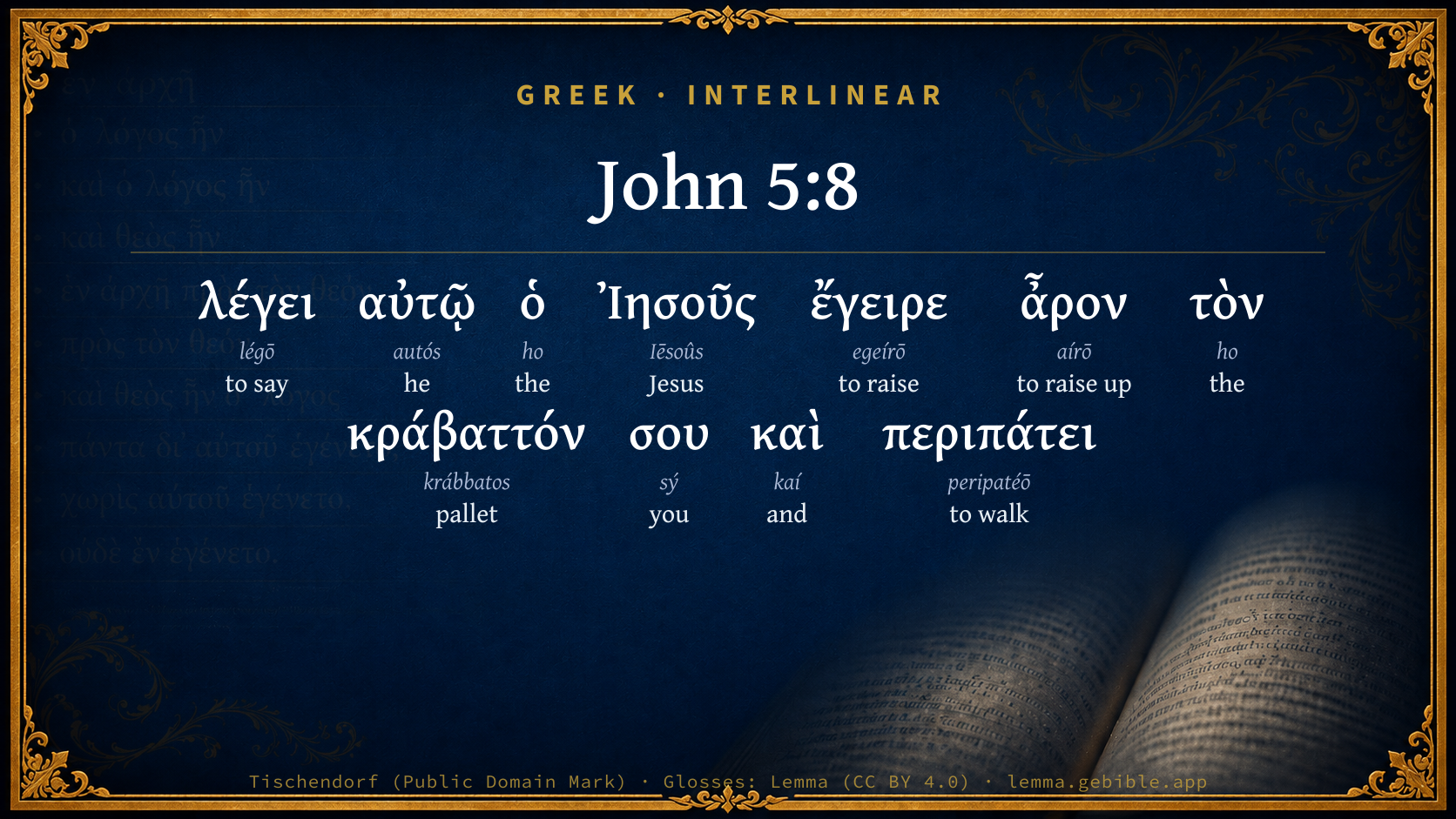
Jesus said to him, "Arise, take up your mat, and walk."
World English Bible · Public Domain
Download a study sheet

One document with this verse’s original text, its word-by-word gloss line, the meaning frame, cross-references with their text, attributed commentary, and full source and license credits — printable, and it pastes into notes with its structure intact.

This verse Autodidact and up

Study sheet (.html) Plain text (.txt)

A passage Seminary Student

Up to 50 verses in one chapter. A passage sheet keeps up to 6 commentary sources and 12 cross-references per verse, in the order this page ranks them, and says so on the sheet whenever that leaves anything out. Ask for a single verse and you get the Autodidact verse sheet above.

Everything on this page stays free to read, with no account — the sheet is a download of what is already on screen, not access to it.

Want to remove ads? Support Godless Engineer
Compare translations 3

The same verse in 3 English versions, stacked beneath the original-language interlinear above. Click any original word for its lexicon entry.

Each is an independent rendering of the whole verse — the interlinear is not word-aligned to these translations.

Highlighted words mark where these versions differ — a whole-verse word diff, not a word-by-word alignment.

  • World English Bible Public Domain
    Jesus said to him, "Arise, take up your mat, and walk."
  • King James Version Public Domain
    Jesus saith unto him, Rise, take up thy bed, and walk.
  • unfoldingWord Literal Text CC BY-SA 4.0
    Jesus says to him, “Get up, take up your bed, and walk.”

unfoldingWord Literal Text — © unfoldingWord, licensed CC BY-SA 4.0. Word-aligned USFM3 via Door43 (git.door43.org/unfoldingWord/en_ult).

Versions to compare (up to 4)

3 of 4 selected

Show all 19 translations

Every available English version of this verse, each an independent rendering of the whole verse.

  • World English Bible Public Domain
    Jesus said to him, "Arise, take up your mat, and walk."
  • Berean Standard Bible Public Domain
    Then Jesus told him, “Get up, pick up your mat, and walk.”
  • Majority Standard Bible Public Domain
    Then Jesus told him, “Get up, pick up your mat, and walk.”
  • King James Version Public Domain
    Jesus saith unto him, Rise, take up thy bed, and walk.
  • American Standard Version (1901) Public Domain
    Jesus saith unto him, Arise, take up thy bed, and walk.
  • Revised Version (1885) Public Domain
    Jesus saith unto him, Arise, take up thy bed, and walk.
  • Geneva Bible (1599) Public Domain
    Iesus said vnto him, Rise: take vp thy bed, and walke.
  • Douay-Rheims (1899) Public Domain
    Jesus saith to him: Arise, take up thy bed, and walk.
  • Young's Literal Translation Public Domain
    Jesus saith to him, `Rise, take up thy couch, and be walking;'
  • Literal Standard Version CC BY-SA 4.0
    Jesus says to him, “Rise, take up your pallet, and be walking”;
  • Unlocked Literal Bible CC BY-SA 4.0
    Jesus said to him, “Get up, take up your bed, and walk.”
  • unfoldingWord Literal Text CC BY-SA 4.0
    Jesus says to him, “Get up, take up your bed, and walk.”
  • Darby Bible Public Domain
    Jesus says to him, Arise, take up thy couch and walk.
  • World Messianic Bible Public Domain
    Yeshua said to him, “Arise, take up your mat, and walk.”
  • Webster's Bible Public Domain
    Jesus saith to him, Rise, take up thy bed, and walk.
  • Free Bible Version CC BY-SA 4.0
    “Stand up, pick up your mat, and start walking!” Jesus told him.
  • Bible in Basic English Public Domain
    Jesus said to him, Get up, take your bed and go.
  • Text-Critical English NT CC BY 4.0
    Jesus said to him, “Rise, pick up yoʋr mat, and walk.”
  • Tyndale New Testament (1534) Public Domain
    And Iesus sayde vnto him: ryse take vp thy beed and walke.

Literal Standard Version (2020), Covenant Press — licensed CC BY-SA 4.0. Text via the HelloAO Bible API (eBible.org). Unlocked Literal Bible (unfoldingWord) — licensed CC BY-SA 4.0. Text via the HelloAO Bible API (eBible.org). unfoldingWord Literal Text — © unfoldingWord, licensed CC BY-SA 4.0. Word-aligned USFM3 via Door43 (git.door43.org/unfoldingWord/en_ult). Free Bible Version, Dr. Jonathan Gallagher — licensed CC BY-SA 4.0. Text via the HelloAO Bible API (eBible.org).

Word by word

More ways to search: Search by grammar → Find every occurrence → Compare this word →

Practice this passage: Drill this verse → Learn its vocabulary →

About this verse

These counts appear in no published source. They are computed here, from the morphology-tagged text and Lemma’s own curated glosses. What Lemma adds →

11
words
10
distinct lemmas
Gospels
section

Notable vocabulary

The rarest word here is κράβαττόν pallet G2895 — appearing just 11 times in the whole Greek New Testament.

Shared distinctive vocabulary

κράβαττόν pallet G2895 occurs in 11 verses of the Greek New Testament. Also found in:

Repetition

A word recurs within this verse:

Cross-references

4

Topical passages linked to John 5:8 in the Treasury of Scripture Knowledge — connected by theme and wording, ordered by reader-vote popularity; previews shown in the World English Bible.

  • Luke 5:24 But that you may know that the Son of Man has authority on earth to forgive sins" (he said to the paralyzed man), "I tell you, arise, and take up your cot, and go to your house."
  • Matthew 9:6 But that you may know that the Son of Man has authority on earth to forgive sins..." (then he said to the paralytic), "Get up, and take up your mat, and go up to your house."
  • Mark 2:11 "I tell you, arise, take up your mat, and go to your house."
  • Acts 9:34 Peter said to him, "Aeneas, Jesus Christ heals you. Get up and make your bed!" Immediately he arose.

Cross-references courtesy of OpenBible.info (CC BY 4.0).

Commentary

Notes on John 5:8 from classic Christian and Jewish commentators (each source and its license shown beneath its notes). The classic Christian expositions comment on the surrounding passage and are grouped to its opening verse, so a note may address several verses; the Jewish commentaries on the Tanakh (Rashi and others) are per-verse, so they appear only where the commentator wrote on this verse.

Lemma curates 59 commentaries, every one of them public domain or Creative Commons licensed, each selected and text-cleaned for this edition rather than reprinted as found. About our sources →

Joseph Benson's Commentary

Joh 5:8. Jesus saith, Rise, take up thy bed, and walk — A strange command to be given to an impotent man, that had been long disabled; but this divine word was to be the vehicle of a divine power; it was a command to the disease to be gone, to nature to be strong. But it is expressed as a command to him to exert himself. He must rise and walk, that is, attempt to do so, and, in the essay, he shall receive strength. Thus the conversion of a sinner is the cure of a chronical disease, and is ordinarily effected by the word, a word of command; arise and walk; turn and live; make ye a new heart: but this no more supposes a power in us to obey such commands, without the grace of God, than these words of Christ supposed such a power in the impotent man. But if he had not attempted to help himself, he would not have been cured, but must have borne the blame of his continuing to be weak and helpless. Christ commanded him to take up his bed, 1st, That it might be evident a perfect cure was wrought, and that miraculously; for the man did not recover strength by degrees, but from the extremity of weakness, he suddenly stepped into the highest degree of bodily strength; so that he was able to carry as great a load as any porter, who had been as long used to carry burdens as he had been unaccustomed to any thing of the kind. 2d, Christ intended hereby to proclaim the cure, and make it public: for as it was the sabbath day, by carrying a burden through the streets he made himself very remarkable, and every one would inquire why he did it, by which means the notice of the miracle would spread, to the honour of God. 3d, Christ intended thus to witness against the traditions of the elders, who had stretched the law of the sabbath beyond its intention; and likewise to show, that he was Lord of the sabbath, and had power to make what alterations he pleased respecting it, and to overrule the law. The case may be such, that it may become a work of necessity, or mercy, to carry a bed on the sabbath day; but here it was more; it was a work of piety, being designed purely for the glory of God. 4th, He meant hereby to try the faith and obedience of his patient, who, by carrying his bed, would publicly expose himself to the censure of the ecclesiastical court, and become liable, at least, to be scourged in the synagogue. Now will he venture to subject himself to this reproach and suffering in obedience to Christ? Yes, he will. Those that have been healed by Christ’s word, ought to be ruled by his word, whatever it may cost them.

Joseph Benson's Commentary on the Old and New Testaments (1811–1818) — public domain. Text from a community e-Sword module.

MacLaren's Expositions of Holy Scripture

Alexander MacLaren

John

THE THIRD MIRACLE IN JOHN’S GOSPEL

Joh 5:8.

This third of the miracles recorded in John’s Gospel finds a place there, as it would appear, for two reasons: first, because it marks the beginning of the angry unbelief on the part of the Jewish rulers, the development of which it is one part of the purpose of this Gospel to trace; second, because it is the occasion for that great utterance of our Lord about His Sonship and His divine working as the Father also works, which occupies the whole of the rest of the chapter, and is the foundation of much which follows in the Gospel. It is for these reasons, and not for the mere sake of adding another story of a miraculous cure to the many which the other Evangelists have given us, that John narrates for us this history.

If, then, we consider the reason for the introduction of the miracle into the Gospel, we may be saved from the necessity of dwelling, except very lightly, upon some of the preliminary details which preceded the actual cure. It does not matter much to us for our present purpose which Feast it was on which Jesus went up to Jerusalem, nor whether the pool was by the sheep-market or by the sheep-gate, nor whereabouts in Jerusalem Bethesda might happen to be. It may be of importance for us to notice that the mention of the angel who appears in the fourth verse is not a part of the original narrative. The true text only tells us of an intermittent pool which possessed, or was supposed to possess, curative energy; and round which the kindness of some forgotten benefactor had built five rude porches. There lay a crowd of wasted forms, and pale, sorrowful faces, with all varieties of pain and emaciation and impotence marked upon them, who yet were gathered in Bethesda, which being interpreted means ‘a house of mercy.’ It is the type of a world full of men suffering various sicknesses, but all sick; the type of a world that gathers with an eagerness, not far removed from despair, round anything that seems to promise, however vaguely, to help and to heal; the type of a world, blessed be God, which, amidst all its sad variety of woe and weariness, yet sits in the porches of ‘a house of mercy,’ and has in the midst a ‘fountain opened for sin and for uncleanness,’ whose energy is as mighty for the last comer of all the generations as for the first that stepped into its cleansing flood.

This poor man, sick and impotent for eight and thirty years-many of which he had spent, as it would appear, day by day, wearily dragging his paralysed limbs to the fountain with daily diminishing hope-this poor man attracts the regard of Christ when He enters, and He puts to him the strange question, ‘Wilt thou be made whole?’ Surely there was no need to ask that; but no doubt the many disappointments and the long years of waiting and of suffering had stamped apathy upon the sufferer’s face, and Christ saw that the first thing that was needed, in order that His healing power might have a point of contact in the man’s nature, was to kindle some little flicker of hope in him once more.

And so, no doubt, with a smile on His face, which converted the question into an offer, He says: ‘Wilt thou be made whole?’ meaning thereby to say, ‘I will heal thee if thou wilt.’ And there comes the weary answer, as if the man had said: ‘Will I be made whole? What have I been lying here all these years for? I have nobody to put me into the pool.’

Yes, it is a hopeful prospect to hold out to a man whose disease is inability to walk, that if he will walk to the water he will get cured, and be able to walk afterwards. Why, he could not even roll himself into the pond, and so there he had lain, a type of the hopeless efforts at self-healing which we sick men put forth, a type of the tantalising gospels which the world preaches to its subjects when it says to a paralysed man: ‘Walk that you may be healed; keep the commandments that you may enter into life.’

And so we have come at last to the main point of the narrative before us, and I fix upon these words, the actual words in which the cure was conveyed, as communicating to us some very important lessons and thoughts about Christ and our relation to Him.

I. First, I see in them Christ manifesting Himself as the Giver of power to the powerless who trust Him.

His words may seem at first hearing to partake of the very same almost cruel irony as the condition of cure which had already proved hopelessly impracticable. He, too, says, ‘Walk that you may be cured’; and He says it to a paralysed and impotent man. But the two things are very different, for before this cripple could attempt to drag his impotent limbs into an upright position, and take up the little light couch and sling it over his shoulders, he must have had some kind of trust in the person that told him to do so. A very ignorant trust, no doubt, it was; but all that was set before him about Jesus Christ he grasped and rested upon. He only knew Him as a Healer, and he trusted Him as such. The contents of a man’s faith have nothing to do with the reality of his faith; and he that, having only had the healing power of Christ revealed to him, lays hold of that Healer, cleaves to Him with as genuine a faith as the man who has the whole fulness and sublimity of Christ’s divine and human character and redeeming work laid out before him, and who cleaves to these. The hand that grasps is one, whatsoever be the thing that it grasps.

So it is no spiritualising of this story, or reading into it a deeper and more religious meaning than belongs to it, to say that what passed in that man’s heart and mind before he caught up his little bed and walked away with it, was essentially the same action of mind and heart by which a sinful man, who knows that Christ is his Redeemer, grasps His Cross and trusts his soul to Him. In the one case, as in the other, there is confidence in the person; only in the one case the person was only known as a Healer, and in the other the person is known as a Saviour. But the faith is the same whatever it apprehends.

Christ comes and says to him, ‘Rise, take up thy bed and walk.’ There is a movement of confidence in the man’s heart; he tries to obey, and in the act of obedience the power comes to him.

Ah, brother! it is always so. All Christ’s commandments are gifts. When He says to you, ‘Do this!’ He pledges Himself to give you power to do it. Whatsoever He enjoins He strengthens for. He binds Himself, by His commandments, and every word of His lips which says to us ‘Thou shalt!’ contains as its kernel a word of His which says ‘I will.’ So when He commands, He bestows; and we get the power to keep His commandments when in humble faith we make the effort to do His will. It is only when we try to obey for the love’s sake of Him that has healed us that we are able to obey. And be sure of this, whensoever we attempt to do what we know to be the Master’s will, because He has given Himself for us, our power will be equal to our desire, and enough for our duty. As St. Augustine says: ‘Give what Thou commandest, and command what Thou wilt.’

‘Rise, take up thy bed and walk,’ or as in another case, ‘Stretch forth thy hand.’ ‘And he stretched it forth, and his hand was restored whole as the other.’ Christ gives power to keep His commandments to the impotent who try to obey, because they have been healed by Him.

II. In the next place, we have in this miracle our Lord set forth as the absolute Master, because He is the Healer.

The Pharisees and their friends had no eyes for the miracle; but if they found a man carrying his light couch on the Sabbath day, that was a thing that excited their interest, and must be seen to immediately.

And so, paying no attention to the fact that it was a paralysed man who was doing this, with the true narrow instinct of the formalist, they lay hold only of the fact of the broken Rabbinical restrictions, and try to stop him with these. ‘It is the Sabbath day! It is not lawful for thee to carry thy bed.’

And they get an answer which goes a great deal deeper than the speaker knew, and puts the whole subject of Christian obedience on its right footing. ‘He answered them, He that made me whole, the same said unto me, Take up thy bed and walk.’ As if he had said: ‘He gave me the power, had He not a right to tell me what to do with it? It was His gift that I could lift my bed; was I not bound to walk when and where He that had made me able to walk at all chose to bid me?’

And if you generalise that it just comes to this: the only person that has a right to command you is the Christ who saves you. He has the absolute authority to do as He will with your restored spiritual powers, because He has bestowed them all upon you. His dominion is built upon His benefits. He is the King because He is the Saviour. He rules because He has redeemed. He begins with giving, and it is only afterwards that He commands; and He turns to each of us with that smile upon His lips, and with tenderness in His voice which will bind any man, who is not an ingrate, to Him for ever. ‘If ye love Me, keep My commandments.’

There is always something hard and distasteful to the individual will in the tone of authority assumed by any man whatsoever. We always more or less rebel and shrink from that; and there is only one thing that makes commandment sweet, and that is when it drops like honey from the honeycomb, from lips that we love. So does it in the case of Christ’s commands to us. It is joy to know and to do the will of One to whom the whole heart turns with gratitude and affection. And Christ blesses and privileges us by the communication to us of His pleasure concerning us, that we may have the gladness of yielding to His desires, and so meeting the love which commands with the happy love which obeys. ‘He that made me whole, the same said unto me . . . ‘ and what He says it must be joy to do.

So, ‘My yoke is easy and My burden is light,’ not because Christ diminishes the requirements of law; not because the standard of Christian obedience is lowered beneath any other standard of conduct and character. It is far higher. The things which make Christian duty are often very painful in themselves. There is always self-sacrifice in Christian virtue, and self-sacrifice has always a sting in it; but the ‘yoke is easy and the burden is light,’ because, if I may so say, the yoke is padded with the softest velvet of love, and lies upon our necks lightly because He has laid it there. All the rigid harshness of precept is done away when the precept comes from Christ’s lips, and His commandment ‘makes the crooked things straight and the rough places plain’; and turns duty, distasteful duty, into joyful service. The blessed basis of Christian obedience, and of Christ’s authority, is Christ’s redemption.

III. And then, still further, we have here our Lord setting Himself forth as the divine Son, whose working needs and knows no rest.

We find, in the subsequent part of the chapter, that ‘the Jews,’ as they are called, by which is meant the antagonistic portion of the nation, sought to slay Christ ‘because He had done these things on the Sabbath day.’ But Jesus answered them, ‘My Father worketh hitherto, and I work.’ Unquestionably the form which the healing took was intended by our Lord to bring into prominence the very point which these pedantic casuists laid hold of. He meant to draw attention to His sweeping aside of the Rabbinical casuistries of the law of the Sabbath. And He meant to do it in order that He might have the occasion of making this mighty claim, which is lodged in these solemn and profound words, to possess a Sonship, which, like the divine working, wrought, needing and knowing no repose.

‘My Father worketh hitherto, and I work.’ The rest, which the old story in Genesis attributed to the Creator after the Creation, was not to be construed as if it meant the rest of inactivity; but it was the rest of continuous action. God’s rest and God’s work are one. Throughout all the ages preservation is a continuous creation. The divine energy is streaming out for evermore, as the bush that burns unconsumed, as the sun that flames undiminished for ever, pouring out from the depth of that divine nature, and for ever sustaining a universe. So that there is no Sabbath, in the sense of a cessation from action, proper to the divine nature; because all His action is repose, and ‘e’en in His very motion there is rest.’ And this divine coincidence of activity and of repose belongs to the divine Son in His divine-human nature. With that arrogance which is the very audacity of blasphemy, if it be not the simplicity of a divine consciousness, He puts His own work side by side with the Father’s work, as the same in principle, the same in method, the same in purpose, the same in its majestic coincidence of repose and of energy.

‘My Father worketh hitherto, and I work. Therefore for Me, as for Him, there is no need of a Sabbath of repose.’ Human activity is dissipated by toil, human energy is exhausted by expenditure. Man works and is weary; man works and is distracted. For the recovery of the serenity of his spirit, and for the renewal of his physical strength, repose of body and gathering in of mind, such as the Sabbath brought, were needed; but neither is needed for Him who toils unwearied in the heavens; and neither is needed for the divine nature of Him who labours in labours parallel with the Father’s here upon the earth.

Now remember that this is no abolition of the Sabbatic rest for Christ’s followers. Rather the ground on which He here asserts His superiority over, and His non-dependence upon, such a repose shows, or at all events implies, that all mere human workers need such rest, and should thankfully accept it. But it is a claim on His part to a divine equality. It is a claim on His part to do works which are other than human works. It is a claim on His part to be the Lord of a divine institution, living above the need of it, and able to mould it at His will.

And so it opens up depths, into which we cannot go now, of the relations of that divine Father and that divine Son; and makes us feel that the little incident in which He turned to a paralysed man and said: ‘Rise, take up thy bed and walk,’ on the Sabbath day, like some small floating leaf of sea-weed upon the surface, has great deep tendrils that go down and down into the very abyss of things, and lays hold upon that central truth of Christianity, the divinity of the Son of God, who is One with the ever-working Father.

IV. Lastly, we have in this incident yet another lesson. We have the Healer who is also the Judge, warning the healed of the possibilities of a relapse.

‘Jesus findeth him in the Temple, and said unto him, Behold, thou art made whole: sin no more, lest a worse thing come unto thee.’ The man’s eight-and-thirty years of illness had apparently been brought on by dissipation. It was a sin of flesh, avenged in the flesh, that had given him that miserable life. One would have thought he had got warning enough, but we all know the old proverb about what happened when the devil was ill, and what befell his resolutions when he got better. And so Christ comes to him again with this solemn warning: ‘There is a worse thing than eight-and-thirty years of paralysis. You fell once, and sore was your punishment. If you fall twice, your punishment will be sorer.’ Why? Because the first one had done him no good. So here are lessons for us. There is always danger that we shall fall back into old sins, even if we think we have overcome them. The mystic influence of habit, enfeebled will, the familiar temptation, the imagination rebelling, the memory tempting, sometimes even, as in the case of a man that has been a drunkard, the physical effect of the odour of his temptation upon his nostrils-all these things make it extremely unlikely that a man who has once been under the condemnation of any evil shall never be tempted to fall under its sway again.

And such a fall is not only more criminal than the former, it is more deadly than the former. ‘It were better for them not to have known the way of righteousness, than after they have known it to turn aside.’ ‘The last state of that man is worse than the first.’

My brother, there is no blacker condemnation; and if I may use a strong word, there is no hotter hell, than that which belongs to an apostate Christian. ‘It has happened unto them according to the true proverb. The dog is turned to his vomit again.’ Very unpolite, a very coarse metaphor? Yes; to express a far worse reality.

Christian men and women! you have been made whole. ‘Sin no more, lest a worse thing come unto you.’ And turn to that Lord and say, ‘Hold Thou me up and I shall be saved.’ Then the enemies will not be able to recapture you, and the chains which have dropped from your wrists will never enclose them any more.

Alexander MacLaren, Expositions of Holy Scripture (1904–1910) — public domain. Text from a community e-Sword module.

Tyndale Open Study Notes

Tyndale Open Resources

5:8-9 Jesus healed the sick man instantly, only asking for his obedience. As proof of healing, Jesus told him to pick up his mat and walk. • Jesus worked this miracle on the Sabbath, a weekly day of rest on which all work was prohibited (based on Gen 2:2; Exod 20:8). Jewish tradition outlined thirty-nine categories of work that were not allowed (Mishnah Shabbat 7:2). Carrying something such as a sleeping mat from one place to another was banned (John 5:10). Therefore, the healed man broke the tradition by obeying Jesus’ command.

Tyndale Open Study Notes — © Tyndale Open Resources, licensed CC BY-SA 4.0. Text via the HelloAO Bible API.

Bengel's Gnomon

Johann Albrecht Bengel

Joh 5:8. Ἔγειραι, rise) Jesus heals the sick man, without entering the pool. He was therefore greater than the angel.—ᾆρον, take up) This work, which was the more conspicuous on the Sabbath day, tended to the greater glory of God in Jesus Christ; [also it tended to remove the error of the Jews, especially of their doctors, concerning the Sabbath.—Harm., p. 182.]

Bengel's Gnomon of the New Testament — English translation (T&T Clark, Edinburgh, 1860) — public domain. Text from a community e-Sword module.

Meyer's Critical & Exegetical Commentary

Heinrich August Wilhelm Meyer

Joh_5:8-9. Comp. Mat_9:6; Mar_2:9; Mar_2:11.

περιπάτει] walk, go; hitherto he had lain down there, Joh_5:6. The command implies the mans faith, which had been recognised by Christ.

καὶ ᾖρε] simply and emphatically told in the very words which Jesus had spoken.

Some (Strauss) quite arbitrarily regard this story as a legendary exaggeration of the healing of the paralytic in the Synoptics (Matthew 9; Mark 2); time, place, circumstances, and what ensues, especially its essential connection with the healing on the Sabbath-day, are all original and independent, as is also the whole account, so full of life and psychologically true, and very different from that in the Synoptics. Notwithstanding, Baur again (p. 243 ff.) would make the story in John a composition out of synoptical materials, appealing especially to Mar_2:9-10; and Hilgenfeld, Evang. 269 f., adopts the same course, finding the inner peculiarity of the narrative in the idea that the omnipotence of the Logos cannot be controlled by any earthly law or human custom; whilst Weisse (Evangelienfr. 268) sees in the mans lameness the helplessness of one morally sick, and attributes the origin of the entire narrative to what was originally a parable. Thus they themselves complete the fiction, and then pass it on off the evangelist, while the simplest as well as the most distinctive and characteristic historical features are now interwoven into his supposed plans. See, on the contrary, Brückner, in loc.

Meyer — Critical and Exegetical Commentary on the New Testament — English translation by Peter Christie, edited by Frederick Crombie (T&T Clark, 1880) — public domain. Text from a community e-Sword module.

Expositor's Greek Testament

ed. W. Robertson Nicoll

Joh 5:8 . The impotent man having declared his helplessness, Jesus says to him, Ἔγειρε , a command to be obeyed on the moment by faith in Him who gave it. Cf. Joh 6:63 , and Augustine’s “Da quod jubes, et jube quod vis”. ἆρον τὸν κράββατόν σου , “take up your pallet”. κράββατος is the Latin grabatus , and is late Greek; see Rutherford’s New Phryn. , 137; and McLellan’s Greek Test. , p. 106, for references and anecdote. He was commanded to take up his bed that he might recognise that the cure was permanent. No doubt many of the cures at the pool were merely temporary. περιπάτει “walk,” ability was given not merely to rise, but to walk. The cures wrought by Christ are perfect, and do not only give some relief.

The Expositor's Greek Testament, edited by W. Robertson Nicoll (1897–1910) — public domain. Text from a community e-Sword module.

Jamieson, Fausset & Brown

Robert Jamieson, A. R. Fausset & David Brown

Rise, take up thy bed, &c.--"Immediately" he did so. "He spake and it was done." The slinging of his portable couch over his shoulders was designed to show the perfection of the cure.

Jamieson, Fausset & Brown — Commentary Critical and Explanatory on the Whole Bible (1871) — public domain (CC PDM 1.0). Text via the HelloAO Bible API.

Adam Clarke's Commentary

Verse 8. Rise, take up thy bed, and walk.] Jesus speaks here as God. He speaks in no name but his own, and with an authority which belongs to God alone. And what is the consequence? The man became whole immediately; and this sudden restoration to health and strength was an incontestable proof of the omnipotence of Christ. It has been remarked, that our Lord, after having performed a miracle, was accustomed to connect some circumstance with it, which attested its truth. After the miracle of the five loaves, he ordered the fragments to be collected, which were more in quantity than the loaves themselves, though several thousands had been fed. When he changed the water into wine, he ordered some to be taken first to the steward of the feast, that he might taste and bear testimony to its genuineness and excellency. When he cured the lepers, he commanded them to show themselves to the priests, whose business it was to judge of the cure. So here, he judged it necessary, after having cured this infirm man, to order him not only to arise, but to take up his bed, and walk, which sufficiently attested the miracle which he had wrought. God's work is ever known by its excellence and good effects.

The bed of a poor Hindoo is seldom any thing besides a single mat, or a cloth as thick as a bed-quilt. Men carrying such beds may be seen daily on the highways.

Adam Clarke's Commentary on the Bible (1810–1826) — public domain. Text from a community e-Sword/MySword module.

Ellicott's Commentary for English Readers

(8) Jesus saith unto him.—There is no formal demand, or formal statement of faith as preceding the healing. (Comp., e.g., Notes on Mat_13:58; Mar_9:24.) Men have often wondered at this. If faith is an expression in words or anything outside man, then there is room for wonder; but if it be a living principle, the “seeing Him who is invisible” (Heb_11:27), then surely we may seek in vain for a more striking instance of its power than in this man; who in all, and through all, and in spite of all, trusted in, and looked for, the mercy of God, and had faith to be healed.

Jesus sees in him this receptive power, which in his very helplessness is strength, and calls it forth. He who could barely move is told to rise! he who had for eight-and-thirty years lain on his bed is to carry that bed and walk!

A Bible Commentary for English Readers, edited by Charles John Ellicott (1878–1897) — public domain. Text from a community e-Sword module.

The Cambridge Bible for Schools and Colleges

gen. ed. J. J. S. Perowne

8. Rise, take up thy bed] As in the case of the paralytic (Mar_2:9), Christ makes no enquiry as to the man’s faith. Christ knew that he had faith; and the man’s attempting to rise and carry his bed after 38 years of impotency was an open confession of faith. His bed would probably be only a mat or rug, still common in the East.

It is scarcely necessary to discuss whether this miracle can be identical with the healing of the paralytic let down through the roof (Matthew 9; Mark 2; Luke 5). Time, place, details and context are all different, especially the important point that this miracle was wrought on the Sabbath.

The Cambridge Bible for Schools and Colleges (gen. ed. J. J. S. Perowne; Cambridge University Press, 1878–1918) — public domain. Text from a community e-Sword module.

John Gill's Exposition

Jesus saith to him, rise,.... From thy bed, or couch, on which he lay in one of the porches: and

take up thy bed and walk; these words were spoken by the same power, as those to Lazarus, which called him out of his grave; as appears from the effect they had upon the man, who was in himself impotent, weak, and helpless.

John Gill's Exposition of the Whole Bible (1746–1763) — public domain (CC PDM 1.0). Text via the HelloAO Bible API.

Trapp's Complete Commentary

John Trapp

8 Jesus saith unto him, Rise, take up thy bed, and walk.

Ver. 8. Rise, take up thy bed, &c.] A servile work upon the sabbath day. This our Saviour here commends not as a servile work, but for confirmation of the truth of a miracle greatly tending to God’s glory; like as, another time, he bade them give meat to the damsel he had raised, not for any necessity, but to insure the cure.

John Trapp, A Commentary or Exposition upon All the Books of the Old and New Testament (1647–1656) — public domain. Text from a community e-Sword module.

Albert Barnes' Notes on the Bible

Rise, take up ... - Jesus not only restored him to health, but he gave evidence to those around him that this was a real miracle. and that he was really healed. For almost 40 years he had been afflicted. He was not even able to walk. Jesus commanded him not only to “walk,” but to take up his “bed” also, and carry that as proof that he was truly made whole. In regard to this we may observe,

1. That it was a remarkable command. The poor man had been sick for a long time, and it does not appear that he expected to be healed except by being put into the waters. Yet Jesus, when he gives a commandment, can give strength to obey it.

2. It is our business to obey the commands of Jesus, however feeble we feel ourselves to be. His grace will be sufficient for us, and his burden will be light.

3. The weak and helpless sinner should put forth his efforts in obedience to the command of Jesus. Never was a sinner more helpless than was this man. If God gave him strength to do his will, so he can all others; and the plea that we can do nothing could have been urged with far more propriety by this man than it can be by any impenitent sinner.

4. This narrative should not be abused. It should not be supposed as intended to teach that a sinner should delay repentance, as if “waiting for God.” The narrative neither teaches nor implies “any such thing.” It is a simple record of a fact in regard to a man who had no power to heal himself, and who was under no obligation to heal himself. There is no reference in the narrative to the difficulties of a sinner - no intimation that it was intended to refer to his condition; and to make this example an excuse for delay, or an argument for waiting, is to abuse and pervert the Bible. Seldom is more mischief done than by attempting to draw from the Bible what it was not intended to teach, and by an effort to make that convey spiritual instruction which God has not declared designed for that purpose.

Thy bed - Thy couch; or the mattress or clothes on which he lay.

Albert Barnes' Notes on the Bible (1834–1885) — public domain. Text from a community e-Sword/MySword module.

Haydock's Catholic Bible Commentary

Arise, take up thy bed, and walk. The man found himself healed at that very moment, and did as he was ordered, though it was the sabbath-day. The Jews blamed him for it: he told them, that he who had healed him, bade him do so. And who it was he knew not, till Jesus finding him in the temple, said to him: (ver. 14.) Sin no more, lest some worse thing happen to thee. Upon this he went, not out of malice, but out of gratitude, and told the Jews that Jesus had cured him. (Witham)

George Leo Haydock (1774–1849), Haydock's Catholic Family Bible and Commentary, 1859 edition — public domain. Excludes Psalms (Douay-Rheims chapter numbering differs from Protestant) and Deuterocanonical books (Catholic canon only).

Matthew Poole's English Annotations

Our Lord will let this poor man know, that the waters and the angel derived their power from him; and that he with a word could do as much for him, as the waters troubled by the angel could effect: he therefore bids him arise, and take up his bed and walk, that others might see and be assured that he was perfectly cured.

Matthew Poole's English Annotations on the Holy Bible (1683–1685) — public domain. Text from a community e-Sword/MySword module.

Whedon's Commentary on the Bible

Daniel D. Whedon

8. Take up thy bed—A small rug upon which he lay; but he whom the bed once bore must now bear his bed, a trophy and proof of miracle and mercy.

Daniel D. Whedon (gen. ed.), Commentary on the Old and New Testaments (1874–1909) — public domain. Text from a community e-Sword module.

The Pulpit Commentary

Jesus smith to him, Rise, take up thy bed (krabbaton sou) thy mattress or pallet; the word is said to be of Macedonian origin, it isLatinized in the Vulgate into grabbatus, and is not unfrequently found in the New Testament; (Mar_2:4, 9 6:55 Act_5:15 Act_9:33) the ordinary Greek word skimpouv skimpodonand walk. These are in part the identical words which Jesus addressed to the paralytic. (Mar_2:9) He did not touch him or use any other means than his own life-giving word to confer the cure. He put forth, in royal might and spontaneous unsolicited exertion, the miraculous force.

The energy of the Lord"s will mastered the palsied will of the sick man, and infused into him the lacking energy. Archdeacon Watkins supposes that the man did possess incipient and recipient faith, moved by the generous tenderness and sympathetic interest of the Stranger in his ease. The very striking fact mentioned in the synoptic cure of the paralytic, viz. that he was borne into the presence of Jesus by four friends, ought to have prevented Thoma"s caricature of criticism, which makes this narrative a mere idealization of that.

The Pulpit Commentary (1880–1919), ed. H.D.M. Spence-Jones & Joseph S. Exell — public domain. Text from a community e-Sword module.

The People's New Testament

B. W. Johnson

8. Rise, take up thy bed, and walk. Then came the command to rise and walk. He spoke with an authority that compelled obedience.

B. W. Johnson's The People's New Testament with Notes (1889–1891) — public domain. Electronic text from the Christian Classics Ethereal Library (CCEL) ThML edition.

Cambridge Greek Testament for Schools and Colleges

8–11. κράβαττον is the form now generally received in N.T. for κράββατον.

8. ἔγειρε, ἆρον. As with the paralytic (Mar 2:9), Christ does not ask as to the man’s faith: He knew that he had it; and the man’s attempting to rise and carry his bed after 38 years of impotence was an open confession of faith.

κράβαττον. Grabatus (Cic. Div. II. LXIII.); a pallet: probably only a mat or rug, still common in the East. The word is said to be Macedonian (Mar 2:4; Mar 6:55; Act 5:15; Act 9:33).

Cambridge Greek Testament for Schools and Colleges (Cambridge University Press, 1896; 21 vols, various authors incl. Carr, Maclear, Plummer, Farrar, Lumby, Moule, M. R. James, Simcox) — public domain. Text from a community e-Sword module.

Alford’s Greek Testament

Henry Alford

8.] The ἆρον τ. κρ. σου has been treated (Stier, iv. 168, edn. 2: Trench, Mir. 251, edn. 2) as making a difference between the man lame from his birth in Act 3:8, who walked and leaped and praised God; and this man, who, since sin had been the cause of his disease (ver. 14), is ordered to carry his bed, “a present memento of his past sin.” Possibly; but our Lord must have had in his view what was to follow, and have ordered it also to bring about this his first open controversy with the Jews.

Henry Alford, The Greek Testament (1849–1861) — public domain. Text from a community e-Sword module.

International Critical Commentary

8. ἔγειρε ἆρον κτλ. Jesus ignores the belief of the sick man about the healing waters of the pool, to which He makes no reference. Nor does He, as in the case of the Synoptic paralytic, give him a word of spiritual consolation (Mar 2:5) before He heals him. Nothing is said to the man, except the sharp command, ἔγειρε ἆρον τὸν κράβαττόν σου καὶ περιπάτει, “Get up, take your pallet and walk.” The words are almost, identical with those of Mar 2:11, but there the evangelistic comment is that they were effectively spoken in order to show the wondering bystanders that He who spoke them had really the spiritual authority to forgive sins. Here is nothing similar. As has been said (v. 6), there is no clear proof that Jn. regarded the healing of the man at Bethesda as miraculous, nor need we do so. The patient obeyed a sudden, authoritative order to stand up and walk, and when he tried he found that he could do it. That may be the whole of the matter. However, no disciple is expressly said to have been present on the occasion; and the story, which may have come to the evangelist at second or third hand, is told in barest outline.

ἔγειρε (אABCDWΘ) is to be preferred to the rec. ἔγειραι.

κράβαττος (grabatus), a pallet or mattress, such as was used by the poor, is said to be a late word of Macedonian origin, and is not approved by Phrynichus. It occurs in the N.T. again only in Mar 2:2-12, Mar 6:55, Act 5:15, Act 9:33, and always stands for the bed of a sick person.

περιπάτει So in Luk 5:23; but at Mar 2:11, Mat 9:6, we have ὕπαγε εἰς τὸν οἷκόν σου.

International Critical Commentary — older volumes (1896–1929), various authors — public domain. Text from a community e-Sword module.

Vincent's Word Studies in the New Testament

Marvin R. Vincent

Bed [κραββατον] . Used by both Mark and Luke. See on Mr 2:4, and compare Act 5:15; Act 9:33.

Marvin R. Vincent, Word Studies in the New Testament (1887–1900) — public domain. Text from a community e-Sword/MySword module.

Godet's Commentaries

Frédéric Louis Godet

Vv. 8, 9. “Jesus saith unto him: Arise, take up thy bed, and walk. 9. And immediately the man was healed,and he took up his bed, and walked. Now that day was a Sabbath.”

The word κράββατος comes from the Macedonian dialect (Passow); it is written in different ways. The imperfect he walked dramatically paints the joy in the recovered power.

Frédéric Louis Godet — Commentaries on Luke, John, Romans, and 1 Corinthians — English translation (T&T Clark, Edinburgh, 1870s–1890s) — public domain. Text from a community e-Sword module.

Lesson kit

Teaching starters — assembled from the data on this page, not authored interpretation. Every prompt links to the verse data it draws on. Edit before teaching.

John, in the Gospels, opens this verse with 11 words (10 distinct Greek lemmas). Its most distinctive word is krábbatos (“pallet”). A historical commentator’s framing appears above. Read the whole chapter for the surrounding context.

Discussion questions

  1. How does “pallet” (krábbatos) shape what this verse is saying?
  2. Mark 2:4 shares the word «pallet» with this verse. How do the two illuminate each other?
  3. “the” occurs 2× in this one verse. What is the effect of the repetition?
  4. These translations render this verse differently. What is at stake in choosing one wording over another?
  5. Reading how Joseph Benson's Commentary and MacLaren's Expositions of Holy Scripture read this verse, where do the two commentators agree and where do they part?

Things to notice

Reading settings

Reading text

Shown beneath each verse's original-language words.

Old Testament
Old Testament edition

Read the OT as the Masoretic Hebrew (MT) or the Greek Septuagint (LXX).

English shown for the Greek Septuagint (in the Hebrew ↔ Greek comparison).

Comparing translations? Open the Compare panel on any verse page to stack up to four side by side.