John 7:5

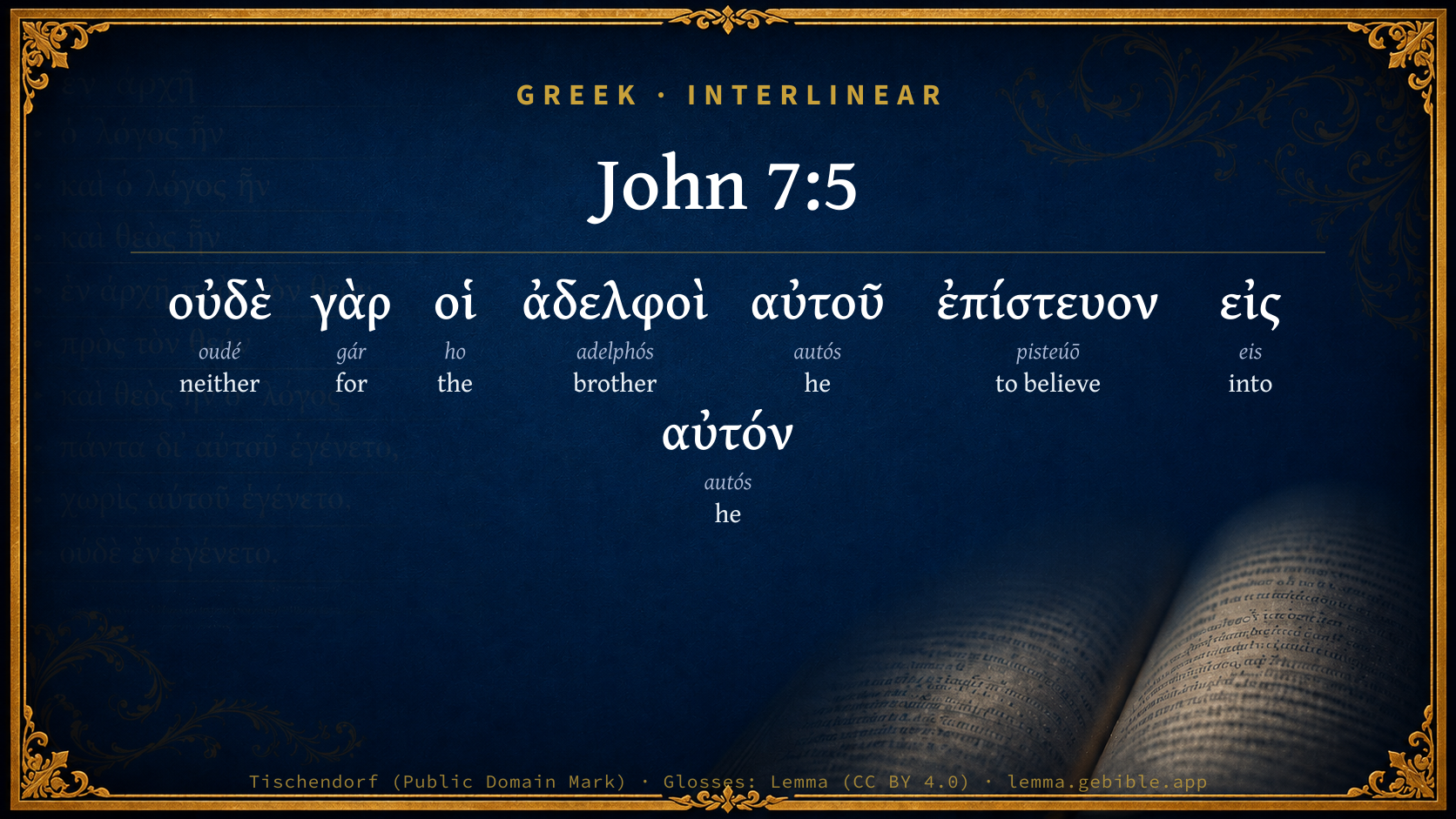
Greek (Tischendorf 8th ed.) John 7:5 appears in the Greek New Testament. The text above is from the Tischendorf 8th edition. Each word links to its Strong’s number and a concise gloss. Click any word for its full Thayer’s Greek Lexicon entry.
Download image
Cite this verse

John 7:5 (World English Bible). Public Domain. Lemma interlinear Bible study tool, https://lemma.gebible.app/v/john/7/5.

Show BibTeX & RIS
BibTeX
RIS
English Translation
For even his brothers didn't believe in him.
World English Bible · Public Domain
Download a study sheet

One document with this verse’s original text, its word-by-word gloss line, the meaning frame, cross-references with their text, attributed commentary, and full source and license credits — printable, and it pastes into notes with its structure intact.

This verse Autodidact and up

Study sheet (.html) Plain text (.txt)

A passage Seminary Student

Up to 50 verses in one chapter. A passage sheet keeps up to 6 commentary sources and 12 cross-references per verse, in the order this page ranks them, and says so on the sheet whenever that leaves anything out. Ask for a single verse and you get the Autodidact verse sheet above.

Everything on this page stays free to read, with no account — the sheet is a download of what is already on screen, not access to it.

Want to remove ads? Support Godless Engineer
Compare translations 3

The same verse in 3 English versions, stacked beneath the original-language interlinear above. Click any original word for its lexicon entry.

Each is an independent rendering of the whole verse — the interlinear is not word-aligned to these translations.

Highlighted words mark where these versions differ — a whole-verse word diff, not a word-by-word alignment.

  • World English Bible Public Domain
    For even his brothers didn't believe in him.
  • King James Version Public Domain
    For neither did his brethren believe in him.
  • unfoldingWord Literal Text CC BY-SA 4.0
    For not even his brothers were believing in him.

unfoldingWord Literal Text — © unfoldingWord, licensed CC BY-SA 4.0. Word-aligned USFM3 via Door43 (git.door43.org/unfoldingWord/en_ult).

Versions to compare (up to 4)

3 of 4 selected

Show all 19 translations

Every available English version of this verse, each an independent rendering of the whole verse.

  • World English Bible Public Domain
    For even his brothers didn't believe in him.
  • Berean Standard Bible Public Domain
    For even His own brothers did not believe in Him.
  • Majority Standard Bible Public Domain
    For even His own brothers did not believe in Him.
  • King James Version Public Domain
    For neither did his brethren believe in him.
  • American Standard Version (1901) Public Domain
    For even his brethren did not believe on him.
  • Revised Version (1885) Public Domain
    For even his brethren did not believe on him.
  • Geneva Bible (1599) Public Domain
    For as yet his brethren beleeued not in him.
  • Douay-Rheims (1899) Public Domain
    For neither did his brethren believe in him.
  • Young's Literal Translation Public Domain
    for not even were his brethren believing in him.
  • Literal Standard Version CC BY-SA 4.0
    for not even His brothers were believing in Him.
  • Unlocked Literal Bible CC BY-SA 4.0
    For even his brothers did not believe in him.
  • unfoldingWord Literal Text CC BY-SA 4.0
    For not even his brothers were believing in him.
  • Darby Bible Public Domain
    for neither did his brethren believe on him.
  • World Messianic Bible Public Domain
    For even his brothers didn’t believe in him.
  • Webster's Bible Public Domain
    (For neither did his brethren believe in him.)
  • Free Bible Version CC BY-SA 4.0
    For even his own brothers really didn't believe in him.
  • Bible in Basic English Public Domain
    For even his brothers had no belief in him.
  • Text-Critical English NT CC BY 4.0
    (For not even his brothers believed in him.)
  • Tyndale New Testament (1534) Public Domain
    For as yet his brethren beleved not in him.

Literal Standard Version (2020), Covenant Press — licensed CC BY-SA 4.0. Text via the HelloAO Bible API (eBible.org). Unlocked Literal Bible (unfoldingWord) — licensed CC BY-SA 4.0. Text via the HelloAO Bible API (eBible.org). unfoldingWord Literal Text — © unfoldingWord, licensed CC BY-SA 4.0. Word-aligned USFM3 via Door43 (git.door43.org/unfoldingWord/en_ult). Free Bible Version, Dr. Jonathan Gallagher — licensed CC BY-SA 4.0. Text via the HelloAO Bible API (eBible.org).

Cross-references

5

Topical passages linked to John 7:5 in the Treasury of Scripture Knowledge — connected by theme and wording, ordered by reader-vote popularity; previews shown in the World English Bible.

  • Mark 3:21 When his friends heard it, they went out to seize him: for they said, "He is insane."
  • John 1:11–13 He came to his own, and those who were his own didn't receive him.
  • Micah 7:5–6 Don't trust in a neighbor. Don't put confidence in a friend. With the woman lying in your embrace, Be careful of the words of your mouth!
  • John 7:3 His brothers therefore said to him, "Depart from here, and go into Judea, that your disciples also may see your works which you do.
  • John 7:10 But when his brothers had gone up to the feast, then he also went up, not publicly, but as it were in secret.

Cross-references courtesy of OpenBible.info (CC BY 4.0).

Commentary

Notes on John 7:5 from classic Christian and Jewish commentators (each source and its license shown beneath its notes). The classic Christian expositions comment on the surrounding passage and are grouped to its opening verse, so a note may address several verses; the Jewish commentaries on the Tanakh (Rashi and others) are per-verse, so they appear only where the commentator wrote on this verse.

Lemma curates 59 commentaries, every one of them public domain or Creative Commons licensed, each selected and text-cleaned for this edition rather than reprinted as found. About our sources →

Bengel's Gnomon

Johann Albrecht Bengel

Joh 7:5. Οὐδέ) not even: so few they were that believed! Not except by Divine succours was faith in Jesus of Nazareth established: the very members of His family were opposed to Him.

Bengel's Gnomon of the New Testament — English translation (T&T Clark, Edinburgh, 1860) — public domain. Text from a community e-Sword module.

Meyer's Critical & Exegetical Commentary

Heinrich August Wilhelm Meyer

Joh_7:5-6. For not even His brothers, whom we might have expected to have been foremost, etc.; otherwise they would not have urged Him to the test of a public appearance. They urged this upon Him all the more, because He had absented Himself from the previous Passover at Jerusalem,a fact which could not have been unknown to them.

ἐπίστ. εἰς αὐτ.] in the ordinary sense; they did not believe in Him as the Messiah. To take the words to mean only the perfect self-surrender of faith, which they had not yet attained to (Lange, Hengstenberg), is an inference necessitated by the mistaken notion that these brothers were not literally brothers (see on Mat_12:46; Act_1:14; Mar_3:31; 1Co_9:5). Nonnus admirably says: ἀπειθέες οἷάπερ ἄλλοι, Χριστοῦ παμμεδέοντος ἀδελφειοί περ ἐόντες. See Joh_7:7.

ὁ καιρὸς ὁ ἐμός] cannot mean the time to make the journey to the feast (Luther, Jansen, Cornelius a Lapide, and most expositors); the antithesis ὁ καιρὸς ὁ ὑμ. demands a deeper reference. It is, according to the context, the time to manifest myself to the world, Joh_7:4, by which Jesus certainly understood the divinely appointed yet still expected moment of public decision concerning Him (comp. Joh_2:4), which did come historically at the very next Passover, but which He now felt in a general way was not yet come. Thus the explanation of Chrysostom, Euthymius Zigabenus, Lampe, and most others, who refer the words to the time of His passion, is not wrong, only that this is not actually expressed, but was historically the fulfillment of what is here said. The corresponding ὁ καιρὸς ὁ ὑμέτερος in like manner means the time for showing themselves openly to the world, which the brothers might do at any time, because they stood in no opposition to the world (Joh_7:7; Joh_15:19).

Meyer — Critical and Exegetical Commentary on the New Testament — English translation by Peter Christie, edited by Frederick Crombie (T&T Clark, 1880) — public domain. Text from a community e-Sword module.

Expositor's Greek Testament

ed. W. Robertson Nicoll

Joh 7:5 . It is indeed added οὐδὲ γὰρ … αὐτόν , “For not even did His brothers believe in Him”; but this does not mean that they did not believe He wrought miracles, but that they had not submitted to His claim to be Messiah. They required to see Him publicly acknowledged before they could believe. Therefore this clause is introduced to explain why they urged Him to go to Jerusalem.

The Expositor's Greek Testament, edited by W. Robertson Nicoll (1897–1910) — public domain. Text from a community e-Sword module.

Geneva Bible (1599)

Geneva Bible translators

His kinsfolk: for so use the Hebrews to speak.

Geneva Bible (1599) marginal notes — public domain. Text via Bolls.life.

Adam Clarke's Commentary

Verse 5. Neither did his brethren believe in him.] They did not receive him as the promised Messiah; but, having seen so many of his miracles, they could not but consider him as an eminent prophet. They supposed that, if he were the Messiah, he would wish to manifest himself as such to the world; and, because he did not do so, they did not believe that he was the salvation of Israel.

Adam Clarke's Commentary on the Bible (1810–1826) — public domain. Text from a community e-Sword/MySword module.

John Calvin's Commentaries

5. For even his brethren did not believe in him. Hence we infer how small is the value of carnal relationship; for the Holy Spirit stamps with a perpetual mark of infamy the relations of Christ, because, though convinced by the testimonies of so many works, they did not even then believe. Therefore, whosoever wishes to be thought to be in Christ, as Paul says, let him be a new creature, (2 Corinthians 5:17; Galatians 6:15;) for they who dedicate themselves wholly to God obtain the place of father, and mother, and brethren to Christ, and all others he utterly disavows, (Matthew 12:50.) So much the more ridiculous is the superstition of Papists, who, disregarding everything else in the Virgin Mary, extol her only on the ground of relationship, bestowing on her the title of the Mother of Christ, as if Christ himself had not reproved the woman who exclaimed from the midst of the crowd,

Blessed is the womb that bore thee, and the breasts that suckled thee; for Christ replied, Nay, rather, blessed are they who hear the word of God, (Luke 11:27, 28.)

John Calvin's Commentaries (1540-1563) — public domain. Text from the Calvin Translation Society English edition (1840s-50s) via the Christian Classics Ethereal Library (ccel.org). Calvin's coverage is partial (roughly two-thirds of the Bible); uncommented books and verses are honest gaps, never fabricated. The 19th-century editor's footnotes and remarks are omitted so the notes are faithfully Calvin's own voice.

Ellicott's Commentary for English Readers

(5) For neither did his brethren believe.—Comp. Note on Joh_7:3. The words do not admit of any other meaning than the obvious one that even His brethren did not at this time believe Him to be the Messiah. That they are found in the very first chapter of the Acts of the Apostles joining with the Apostles, and the women, and Mary, with one accord in prayer (Joh_7:14), is one of the striking instances of the hardened ground of human hearts passing into the fruitful ground receptive of the seed, as the case of Judas at the close of the last chapter is an instance of the opposite. For the immediate cause of the decisive change, see 1Co_15:7.

A Bible Commentary for English Readers, edited by Charles John Ellicott (1878–1897) — public domain. Text from a community e-Sword module.

The Cambridge Bible for Schools and Colleges

gen. ed. J. J. S. Perowne

5. For neither did his brethren believe in him] Or, For not even did His brethren (as one would expect) believe on Him. It is marvellous that in the face of this verse any one should have maintained that three of His brethren (James, Simon, and Judas) were Apostles. This verse is also fatal to the common theory, that these ‘brethren’ are really our Lord’s cousins, the sons of Alphæus. Certainly one of the sons of Alphæus (James) was an Apostle; probably a second was (Matthew, if Levi and Matthew are the same person, as is almost universally admitted); possibly a third was (Judas, if ‘Judas of James’ means ‘Judas, brother of James,’ as is commonly supposed). By this time the company of the Twelve was complete (Joh_6:67; Joh_6:70-71); so that we cannot suppose that some of the Twelve have still to be converted. If then one, two, or three sons of Alphæus were Apostles how could it be true that the sons of Alphæus ‘did not believe on Him?’ ‘His brethren’ cannot be the sons of Alphæus. They seem to have been converted by the Resurrection. Immediately after the Ascension we find them with the Apostles and the holy women (Act_1:14; comp. 1Co_9:5, Gal_1:19).

The Cambridge Bible for Schools and Colleges (gen. ed. J. J. S. Perowne; Cambridge University Press, 1878–1918) — public domain. Text from a community e-Sword module.

John Gill's Exposition

For neither did his brethren believe in him. At first they might take to him, and embrace him as the Messiah, and expect he would set up a temporal kingdom; in which they might hope, on account of their relation to him, according to the flesh to enjoy great honours and privileges; but finding that he was not inclined to anything of that nature, and talked in a quite different way, they grew sick of him, and rejected him, as the Messiah; so, little regard is to be had, or confidence placed, in carnal descent from, or alliance to the best of men; as to Abraham, or any other true believer, if they have not the same grace, or the same faith as such have; and which comes not by blood, or natural generation, but by the free favour of God; for it matters not, if men have known Christ, or have been allied to him after the flesh, unless they are new creatures in him; they may be the one, and not the other; even the carnal brethren of Christ, and yet not believers in him; and it is only such who are so in a spiritual sense, that are regarded by him, Mat 12:49.

.

John 7:6

joh 7:6

joh 7:6

joh 7:6Then Jesus said unto them,.... In answer to their solicitations and arguments used with him, to go up to the feast:

my time is not yet come; meaning, not the time of his death, or of his exaltation and glorification, or of the showing of himself forth unto the world; though all this was true; but of his going up to this feast; as appears from Joh 7:8;

but your time is always ready; intimating, they might go at any time; their lives were not in any danger, as his was, and had nothing to consult about the preservation of them; it was all one to them when they went up, whether before the feast, that they might be ready for it, or at the beginning, middle, or end of it, as to any notice that would be taken of them, unless they should be guilty of an omission of their duty; but not on any other account; which was not his case.

John Gill's Exposition of the Whole Bible (1746–1763) — public domain (CC PDM 1.0). Text via the HelloAO Bible API.

Trapp's Complete Commentary

John Trapp

5 For neither did his brethren believe in him.

Ver. 5. For neither did his brethren believe] This the Jews of this day read with much wonderment; and take occasion from this text to slander our Saviour’s miracles, as nothing so manifest as we conceive them, since his own kindred believed not in him.

John Trapp, A Commentary or Exposition upon All the Books of the Old and New Testament (1647–1656) — public domain. Text from a community e-Sword module.

Haydock's Catholic Bible Commentary

Neither did his brethren believe in him; by his brethren here, we are to understand his kindred, this townsmen or countrymen, at or about Nazareth. (Witham)

George Leo Haydock (1774–1849), Haydock's Catholic Family Bible and Commentary, 1859 edition — public domain. Excludes Psalms (Douay-Rheims chapter numbering differs from Protestant) and Deuterocanonical books (Catholic canon only).

Matthew Poole's English Annotations

Not all his own friends and kindred; he came not only among his own countrymen, but among his own relations, and they received him not; or if they had some opinion of him, and some little hopes concerning him, yet they did not believe as they ought to have believed. Certainly there cannot be a greater proof and demonstration that faith is not of ourselves, nor a thing in our own power, no, not with all the external aids of gospel doctrine and arguments, than is in this text. We cannot imagine but our Lord’s brethren were willing enough to have believed in Christ as the true Messiah and Saviour of the world; the very honour of their family would have so far inclined them. It is impossible that they, or any others, should have had greater external means, aids, and assistances for their faith, than Christ’s preaching amongst them, and confirming his doctrine by miraculous operations before them; if now they had a power in their own wills, to have looked upon Christ as the true Messiah and Saviour of the world, and accordingly to have received and embraced him, what was the matter they believed not, or as yet at least they believed not in him?

Matthew Poole's English Annotations on the Holy Bible (1683–1685) — public domain. Text from a community e-Sword/MySword module.

Whedon's Commentary on the Bible

Daniel D. Whedon

5. Neither… his brethren believe—The brothers of a sinless, perfect child would, then, give him no credit for being such! However right he may be, they would always hold him wrong when he differed from themselves. So they do on the present occasion. He is waiting his “time” from the Father in his most perfect rectitude of soul, and these brothers rather think him a miraculous fool!

Daniel D. Whedon (gen. ed.), Commentary on the Old and New Testaments (1874–1909) — public domain. Text from a community e-Sword module.

The Pulpit Commentary

For not even did his brethren believe in him. The evangelist, writing a generation later, and keenly remembering the attitude the brothel"s had assumed before the Resurrection, adds, "not even his brothers," who ought to have been the most prominent of his disciples, "did up to this time believe on him," i.e. entrust themselves to him, dispose of their prejudices, change their conceptions, accept his spiritual lead, acknowledge his Divine mission, or know him to be the Holy One of God. They had not come into the position of the twelve. What ideas soever they grasped fell immeasurably short of "eating his flesh and drinking his blood," of coming to him, being given to him and drawn to him by the Father. It was a world Messiah, a theocratic King, a Prophet-Captain, a royal Christ, that they sought and would have been glad to find in him. This treatment of the Lord was another striking parallel to the temptation of Jesus as described by the synoptists, "All these things will I give thee, if thou wilt fall down and worship me" (see note on ch. 4., and Introduction, VIII 5). The non-belief of the brothers is in remarkable unison with the widespread unbelief of the people, who were anxious to discern the Christ of their own traditional expectations, and ready to press almost any possible claimant to premature demonstrations. The Pharisees and the people sought some sign from heaven. But while the people demanded it, they expected that he would and might gratify them if he chose. The Pharisees cynically tempted him to proclaim what they believed would prove his irremediable failure (Weiss, "Life of Christ.," vol. 3. Eng. trans., pp. 167-188).

HOMILIES BY J.R. THOMSON Ver. 5. Brethren, but not believers.

In recording this fact the evangelist shows his usual candour. The fact that some of those who were nearest akin to Jesus withheld from him their faith is at first sight surprising. It must have been very distressing to the human heart of our Lord to meet with such unbelief; and it must have been painful, and to some extent discouraging, to his avowed and ardent disciples. Yet the fact is so suggestive and instructive that, upon reflection, we cannot wonder that it was thus put upon record.

I IT IS POSSIBLE TO BE FAMILIAR WITH CHRIST, HIS DOCTRINE, AND GOSPEL, AND YET NOT TO BELIEVE ON HIM. In reading the gospel narrative, we meet with instances of unbelief which do not surprise us, which seem easily accounted for. There were many who did not really know Christ, who simply took other people"s judgment concerning him, or acted upon the prejudices natural to ignorance. We scarcely wonder that the selfish, unscrupulous, unspiritual rulers and scribes at Jerusalem rejected Christ"s claims, and acted towards him with hostility; or that the Roman procurator Pilate misunderstood him, and finally abandoned him to his foes. But we are shocked when we learn that the very brethren of Jesus wanted faith at all events, thorough faith in Jesus. They were his kin; they had known him for many years; they must have enjoyed many opportunities of studying his character and verifying his claims. Yet they withheld their faith, at least for a time. This fact is not unparalleled. In condemning the brethren of Jesus, the hearer of the gospel may possibly be condemning himself. In our own day, in the very heart of Christian society, there may be found many who are very familiar with the gospel, who are frequent readers and hearers of the Word, who have seen in their nearest friends very favourable representatives of the Christian character, who yet have little interest, and no faith, in Christ himself.

II EXPLANATIONS OF THIS REJECTION OF CHRIST, CONSISTENT WITH FAMILIARITY WITH HIM MAY BE DISCOVERED IN HUMAN NATURE AND EXPERIENCE.

1. There are cases in which familiarity itself seems adverse to faith. A striking illustration of the action of this principle is recorded by St. Luke. The Nazarenes knew Jesus well; he had been brought up among them, had dwelt in their town; everything they had known of him must have been favourable. "Familiarity," says the proverb, "breeds contempt;" and in vulgar natures this is true. Accordingly, the people of Nazareth, when the Divine Prophet visited them, were not only incredulous, they were hostile. In his own city he had no honour. It seems to have been the same with our Lord"s kindred; it was hard for them to believe that one brought up among them, and in circumstances resembling their own, could be so far above them, in true rank and in spiritual authority, as Jesus claimed to be. To how many has the name of Jesus been familiar from childhood, without awakening sentiments of reverence and faith! When some such persons have the dignity and the power and preciousness of Jesus brought in some way with unusual vividness before their minds, it may be noticed that resentment is aroused rather than faith. Christ has occupied a familiar place in their stock of knowledge; but perhaps on that very account they are indisposed to see in him what they have never seen before. There are cases in which worldliness and sluggishness of spirit are abarrier to faith in Christ. Such persons may be, through birth and association, almost as brethren to the Lord; yet their habits of mind prevent them from rousing themselves even to consider his claims. They live at a low level, and they hate everything that would raise them to a higher. They resist any demand upon admiration or faith. They may be indisposed to believe in anyone or in anything; how much mere in a Being so glorious, in doctrines so inspiring, as Christianity presents!

2. There are cases in which example explains indifference to the Saviour.No doubt our Lord"s kinsmen ought to have been influenced by the better example of the mother and the disciples of Jesus. But they appear to have been more affected by the negligence and unbelief of others. It is observable that they came to believe at a later period perhaps, under the influence of the growing numbers of the Lord"s adherents. Certain it is, that many of the hearers of the gospel have no better reason to give for their incredulity than the faithlessness of others, especially of those with whom they most associate, and from whom they unconsciously take their moral tone. A "reason" this is not, but it is a sufficient explanation to those acquainted with human nature.

III VALUABLE PRACTICAL LESSONS MAY BE LEARNED FROM THE UNBELIEF OF CHRIST"S BRETHREN. Those especially who have long enjoyed many religious advantages may gain profit from this record, which contains suggestions of very serious admonition.

1. It is foolish and wrong to rest in outward privileges; for these of themselves, if not used aright, are of no avail. If it served no valuable end for these relatives of Jesus to be so near him in blood, we shall act foolishly if we rest in our association with Christ"s Church.

2. It is important to penetrate through superficial acquaintance with Christ to real spiritual knowledge of him. It is well to have an acquaintance with the facts and doctrines of Christianity. But these are merely means to a higher end, to faith and fellowship, assimilation and devotion.

3. Not to believe in Christ is to reject him in all his glorious offices. He came to earth to be a Prophet, a Priest, and a King. To refuse our faith to him in these several offices, is to forfeit the spiritual, the priceless blessings which it is his heart"s desire to confer upon the children of men. T.

The Pulpit Commentary (1880–1919), ed. H.D.M. Spence-Jones & Joseph S. Exell — public domain. Text from a community e-Sword module.

unfoldingWord translationNotes

Door43 World Missions Community

For even his brothers did not believe in him

This sentence is a break from the main story line as John tells us some background information about the brothers of Jesus. (See: Background Information)

his brothers

"his younger brothers"

My time has not yet come

The word "time" is a metonym. Jesus is implying that it is not the right time for him to bring his ministry to a close. AT: "It is not the right time for me to end my work" (See: Metonymy and Assumed Knowledge and Implicit Information)

your time is always ready

"any time is good for you"

The world cannot hate you

Here the "world" is a metonym for the people who live in the world. AT: "All the people in the world cannot hate you" (See: Metonymy)

I testify about it that its works are evil

"I tell them that what they are doing is evil"

translationWords

believe

testimony

works

evil

unfoldingWord translationNotes — © Distant Shores Media and the Door43 World Missions Community, licensed CC BY-SA 4.0. Source: git.door43.org/Door43/en_tn.

International Critical Commentary

5. οὐδὲ γάρ οἱ ἀδελφοὶ αὐτοῦ ἐπίτευον (DLW have ἐπίστευσαν, which is plainly wrong) εἰς αὐτόν. The form of the sentence suggests that it is remarkable that His own kinsfolk did not believe in Jesus, the imperfect tense indicating their general attitude. For the constr. πιστεύειν εἰς αὐτόν, see on 1:12. It is a favourite constr. in Jn., and it implies a belief in Jesus, as distinct from mere belief in His doctrine. It is used thus throughout this chapter (vv. 31, 38, 39, 48; and cf. 8:30), and its use at this point means that the brethren of Jesus did not believe in Him as Messiah. Their incredulity, as reported by Jn., is in accordance with the Synoptic narratives (cf. Mar 3:21, Mat 12:46, Mat 13:57).

International Critical Commentary — older volumes (1896–1929), various authors — public domain. Text from a community e-Sword module.

Vincent's Word Studies in the New Testament

Marvin R. Vincent

Neither [ουδε] . Better, as Rev., not even.

Did believe [επιστευον] . The imperfect, were believing; referring not to a single act of faith, but to faith as habitual and controlling.

Marvin R. Vincent, Word Studies in the New Testament (1887–1900) — public domain. Text from a community e-Sword/MySword module.

Lesson kit

Teaching starters — assembled from the data on this page, not authored interpretation. Every prompt links to the verse data it draws on. Edit before teaching.

John, in the Gospels, opens this verse with 8 words (7 distinct Greek lemmas). Its most distinctive word is oudé (“neither”). A historical commentator’s framing appears above. Read the whole chapter for the surrounding context.

Discussion questions

  1. What does “neither” (oudé) contribute to the verse as a whole?
  2. How does Mark 3:21, which shares this passage’s theme, read alongside this verse?
  3. What does the repetition of “he” (2× in this one verse) do in this verse?
  4. These translations render this verse differently; the difference is in the English rendering, not the original. What questions does that raise?
  5. Compare how Bengel's Gnomon and Meyer's Critical & Exegetical Commentary read this verse. Where do they agree or differ?

Things to notice

  • These translations choose different wording for 8 words in this verse.
  • “he” occurs 2× in this single verse.
  • 7 distinct Greek lemmas span 8 words in this verse.

Reading settings

Reading text

Shown beneath each verse's original-language words.

Old Testament
Old Testament edition

Read the OT as the Masoretic Hebrew (MT) or the Greek Septuagint (LXX).

English shown for the Greek Septuagint (in the Hebrew ↔ Greek comparison).

Comparing translations? Open the Compare panel on any verse page to stack up to four side by side.