John 1:29

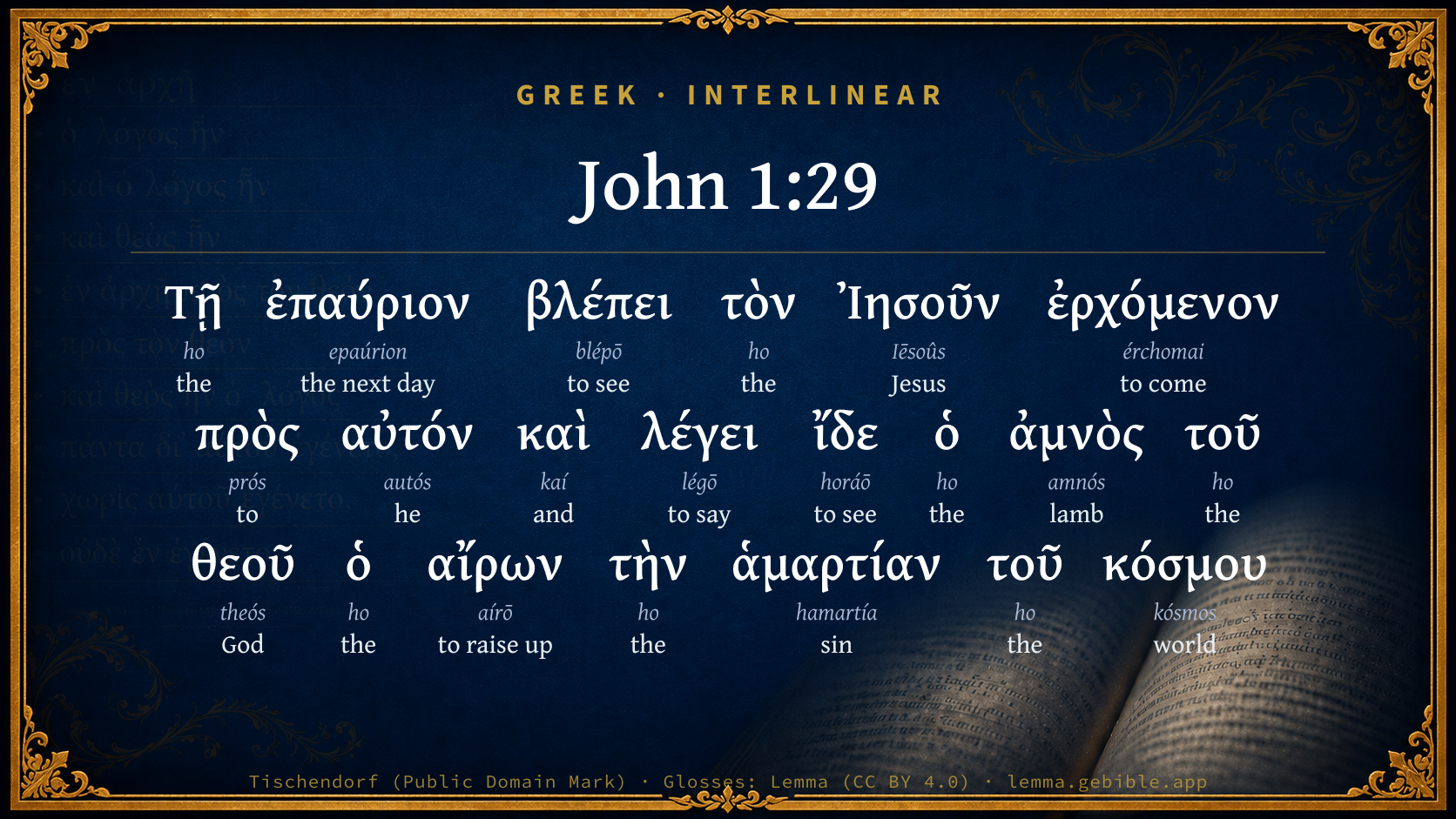
Greek (Tischendorf 8th ed.) John 1:29 appears in the Greek New Testament. The text above is from the Tischendorf 8th edition. Each word links to its Strong’s number and a concise gloss. Click any word for its full Thayer’s Greek Lexicon entry.
Download image
Cite this verse

John 1:29 (World English Bible). Public Domain. Lemma interlinear Bible study tool, https://lemma.gebible.app/v/john/1/29.

Show BibTeX & RIS
BibTeX
RIS
English Translation
The next day, he saw Jesus coming to him, and said, "Behold, the Lamb of God, who takes away the sin of the world!
World English Bible · Public Domain
Highlights
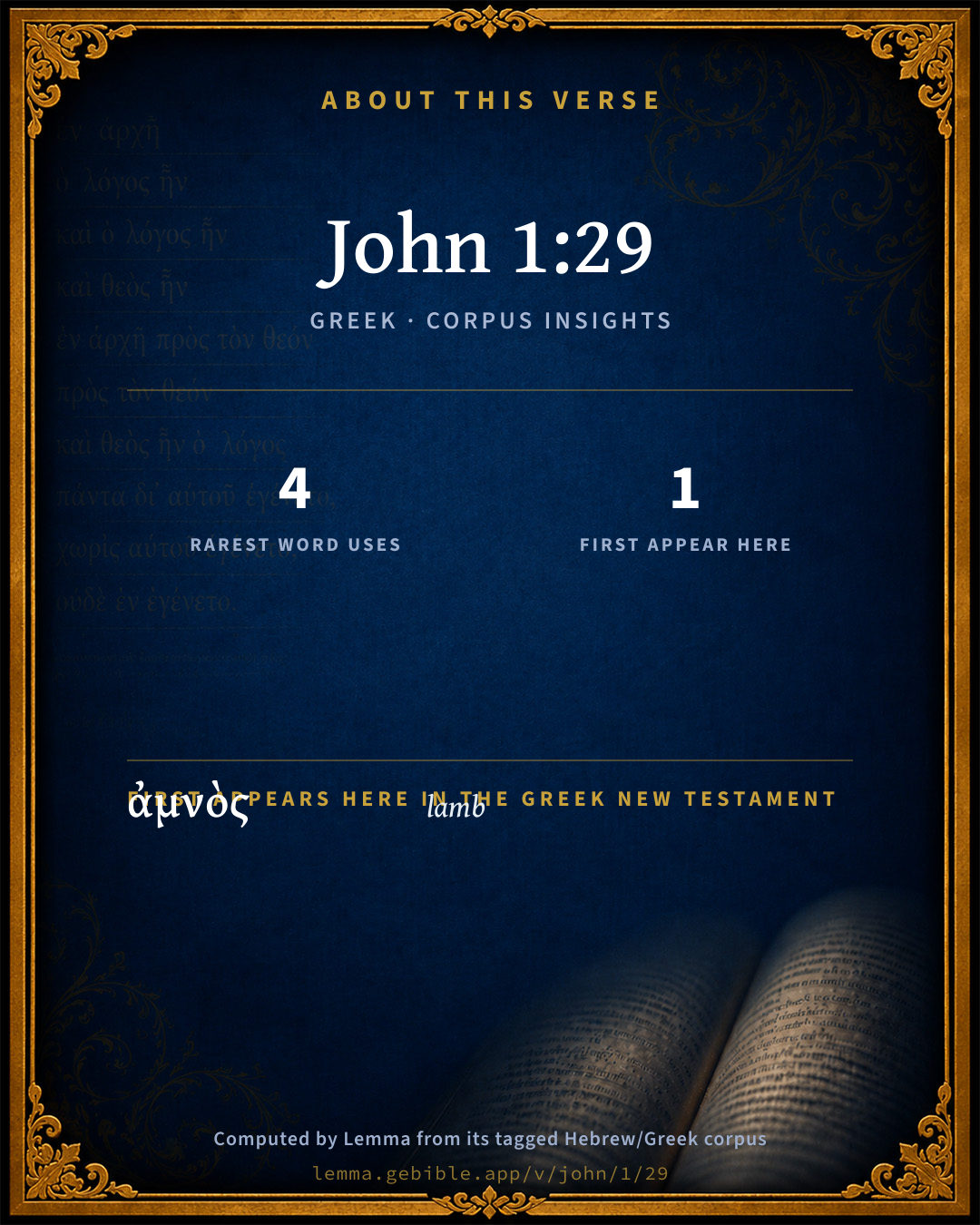
  • 1 first appearance in the Greek New Testament
Full analysis ↓
Download a study sheet

One document with this verse’s original text, its word-by-word gloss line, the meaning frame, cross-references with their text, attributed commentary, and full source and license credits — printable, and it pastes into notes with its structure intact.

This verse Autodidact and up

Study sheet (.html) Plain text (.txt)

A passage Seminary Student

Up to 50 verses in one chapter. A passage sheet keeps up to 6 commentary sources and 12 cross-references per verse, in the order this page ranks them, and says so on the sheet whenever that leaves anything out. Ask for a single verse and you get the Autodidact verse sheet above.

Everything on this page stays free to read, with no account — the sheet is a download of what is already on screen, not access to it.

Want to remove ads? Support Godless Engineer
Compare translations 3

The same verse in 3 English versions, stacked beneath the original-language interlinear above. Click any original word for its lexicon entry.

Each is an independent rendering of the whole verse — the interlinear is not word-aligned to these translations.

Highlighted words mark where these versions differ — a whole-verse word diff, not a word-by-word alignment.

  • World English Bible Public Domain
    The next day, he saw Jesus coming to him, and said, "Behold, the Lamb of God, who takes away the sin of the world!
  • King James Version Public Domain
    The next day John seeth Jesus coming unto him, and saith, Behold the Lamb of God, which taketh away the sin of the world.
  • unfoldingWord Literal Text CC BY-SA 4.0
    The next day he sees Jesus coming to him and says, “Behold, the Lamb of God, the one taking away the sin of the world!

unfoldingWord Literal Text — © unfoldingWord, licensed CC BY-SA 4.0. Word-aligned USFM3 via Door43 (git.door43.org/unfoldingWord/en_ult).

Versions to compare (up to 4)

3 of 4 selected

Show all 19 translations

Every available English version of this verse, each an independent rendering of the whole verse.

  • World English Bible Public Domain
    The next day, he saw Jesus coming to him, and said, "Behold, the Lamb of God, who takes away the sin of the world!
  • Berean Standard Bible Public Domain
    The next day John saw Jesus coming toward him and said, “Look, the Lamb of God, who takes away the sin of the world!
  • Majority Standard Bible Public Domain
    The next day John saw Jesus coming toward him and said, “Look, the Lamb of God, who takes away the sin of the world!
  • King James Version Public Domain
    The next day John seeth Jesus coming unto him, and saith, Behold the Lamb of God, which taketh away the sin of the world.
  • American Standard Version (1901) Public Domain
    On the morrow he seeth Jesus coming unto him, and saith, Behold, the Lamb of God, that taketh away the sin of the world!
  • Revised Version (1885) Public Domain
    On the morrow he seeth Jesus coming unto him, and saith, Behold, the Lamb of God, which taketh away the sin of the world!
  • Geneva Bible (1599) Public Domain
    The next day Iohn, seeth Iesus comming vnto him, and saith, Beholde that Lambe of God, which taketh away the sinne of the world.
  • Douay-Rheims (1899) Public Domain
    The next day, John saw Jesus coming to him, and he saith: Behold the Lamb of God, behold him who taketh away the sin of the world.
  • Young's Literal Translation Public Domain
    on the morrow John seeth Jesus coming unto him, and saith, `Lo, the Lamb of God, who is taking away the sin of the world;
  • Literal Standard Version CC BY-SA 4.0
    On the next day John sees Jesus coming to him and says, “Behold, the Lamb of God, who is taking away the sin of the world;
  • Unlocked Literal Bible CC BY-SA 4.0
    The next day John saw Jesus coming to him and said, “Look, there is the Lamb of God, who takes away the sin of the world!
  • unfoldingWord Literal Text CC BY-SA 4.0
    The next day he sees Jesus coming to him and says, “Behold, the Lamb of God, the one taking away the sin of the world!
  • Darby Bible Public Domain
    On the morrow he sees Jesus coming to him, and says, Behold the Lamb of God, who takes away the sin of the world.
  • World Messianic Bible Public Domain
    The next day, he saw Yeshua coming to him, and said, “Behold, the Lamb of God, who takes away the sin of the world!
  • Webster's Bible Public Domain
    The next day John seeth Jesus coming to him, and saith, Behold the Lamb of God, who taketh away the sin of the world.
  • Free Bible Version CC BY-SA 4.0
    The next day John saw Jesus approaching him, and said, “Look, the Lamb of God, who takes away the sin of the world!
  • Bible in Basic English Public Domain
    The day after, John sees Jesus coming to him and says, See, here is the Lamb of God who takes away the sin of the world!
  • Text-Critical English NT CC BY 4.0
    On the next day John saw Jesus coming to him and said, “Behold, the Lamb of God, who takes away the sin of the world!
  • Tyndale New Testament (1534) Public Domain
    The nexte daye Iohn sawe Iesus commyge vnto him and sayde: beholde the lambe of God which taketh awaye the synne of the worlde.

Literal Standard Version (2020), Covenant Press — licensed CC BY-SA 4.0. Text via the HelloAO Bible API (eBible.org). Unlocked Literal Bible (unfoldingWord) — licensed CC BY-SA 4.0. Text via the HelloAO Bible API (eBible.org). unfoldingWord Literal Text — © unfoldingWord, licensed CC BY-SA 4.0. Word-aligned USFM3 via Door43 (git.door43.org/unfoldingWord/en_ult). Free Bible Version, Dr. Jonathan Gallagher — licensed CC BY-SA 4.0. Text via the HelloAO Bible API (eBible.org).

Word by word

More ways to search: Search by grammar → Find every occurrence → Compare this word →

Practice this passage: Drill this verse → Learn its vocabulary →

ἀμνὸς
amnós
G286
“lamb”
Noun, Nominative, Singular, Masculine
Part of Speech
Noun
Case
Nominative
Number
Singular
Gender
Masculine
Full Thayer's Definition

Origin: apparently a primary word

TDNT: 06:38,5

1. a lamb
  1. Τῇ ho G3588 “the” Article, Dative, Singular, Feminine
  2. ἐπαύριον epaúrion G1887 “the next day” Adverb
  3. βλέπει blépō G991 “to see” Verb, Present, Active, Indicative, 3rd person, Singular
  4. τὸν ho G3588 “the” Article, Accusative, Singular, Masculine
  5. Ἰησοῦν Iēsoûs G2424 “Jesus” Noun, Accusative, Singular, Masculine
  6. ἐρχόμενον érchomai G2064 “to come” Verb, Present, Middle or Passive deponent, Participle, Accusative, Singular, Masculine
  7. πρὸς prós G4314 “to” Preposition
  8. αὐτόν autós G846 “he” Personal pronoun, Accusative, Singular, Masculine
  9. καὶ kaí G2532 “and” Conjunction
  10. λέγει légō G3004 “to say” Verb, Present, Active, Indicative, 3rd person, Singular
  11. ἴδε horáō G3708 “to see” Verb, Aorist, Active, Imperative, 2nd person, Singular
  12. ὁ ho G3588 “the” Article, Nominative, Singular, Masculine
  13. τοῦ ho G3588 “the” Article, Genitive, Singular, Masculine
  14. θεοῦ theós G2316 “God” Noun, Genitive, Singular, Masculine
  15. ὁ ho G3588 “the” Article, Nominative, Singular, Masculine
  16. αἴρων aírō G142 “to raise up” Verb, Present, Active, Participle, Nominative, Singular, Masculine
  17. τὴν ho G3588 “the” Article, Accusative, Singular, Feminine
  18. ἁμαρτίαν hamartía G266 “sin” Noun, Accusative, Singular, Feminine
  19. τοῦ ho G3588 “the” Article, Genitive, Singular, Masculine
  20. κόσμου kósmos G2889 “world” Noun, Genitive, Singular, Masculine

About this verse

These counts appear in no published source. They are computed here, from the morphology-tagged text and Lemma’s own curated glosses. What Lemma adds →

21
words
15
distinct lemmas
Gospels
section

Notable vocabulary

The rarest word here is ἀμνὸς lamb G286 — appearing just 4 times in the whole Greek New Testament.

First appearance in Scripture

This word makes its first canonical appearance in the Greek New Testament here:

  • ἀμνὸς lamb G286

Shared distinctive vocabulary

ἀμνὸς lamb G286 occurs in 4 verses of the Greek New Testament. Also found in:

Repetition

A word recurs within this verse:

Cross-references

53

Topical passages linked to John 1:29 in the Treasury of Scripture Knowledge — connected by theme and wording, ordered by reader-vote popularity; previews shown in the World English Bible.

  • Isaiah 53:7 He was oppressed, yet when he was afflicted he didn't open his mouth; as a lamb that is led to the slaughter, and as a sheep that before its shearers is mute, so he didn't open his mouth.
  • 1 John 2:2 And he is the atoning sacrifice for our sins, and not for ours only, but also for the whole world.
  • 1 Peter 1:19 but with precious blood, as of a lamb without spot, the blood of Christ;
  • 1 John 3:5 You know that he was revealed to take away our sins, and in him is no sin.
  • 2 Corinthians 5:21 For him who knew no sin he made to be sin on our behalf; so that in him we might become the righteousness of God.
  • 1 Peter 2:24 who his own self bore our sins in his body on the tree, that we, having died to sins, might live to righteousness; by whose stripes you were healed.
  • Isaiah 53:11 He shall see of the travail of his soul, [and] shall be satisfied: by the knowledge of himself shall my righteous servant justify many; and he shall bear their iniquities.
  • Hebrews 1:3 His Son is the radiance of his glory, the very image of his substance, and upholding all things by the word of his power, when he had by himself made purification for our sins, sat down on the right hand of the Majesty on high;
  • Revelation 12:11 They overcame him because of the Lamb's blood, and because of the word of their testimony. They didn't love their life, even to death.
  • Revelation 6:1 I saw that the Lamb opened one of the seven seals, and I heard one of the four living creatures saying, as with a voice of thunder, "Come and see!"
  • John 1:36 and he looked at Jesus as he walked, and said, "Behold, the Lamb of God!"
  • Acts 8:32 Now the passage of the Scripture which he was reading was this, "He was led as a sheep to the slaughter. As a lamb before his shearer is silent, So he doesn't open his mouth.
  • Galatians 3:13 Christ redeemed us from the curse of the law, having become a curse for us. For it is written, "Cursed is everyone who hangs on a tree,"
  • Revelation 7:17 for the Lamb who is in the midst of the throne shepherds them, and leads them to springs of waters of life. And God will wipe away every tear from their eyes."
  • Revelation 17:14 These will war against the Lamb, and the Lamb will overcome them, for he is Lord of lords, and King of kings. They also will overcome who are with him, called and chosen and faithful."
  • Revelation 7:14 I told him, "My lord, you know." He said to me, "These are those who came out of the great tribulation. They washed their robes, and made them white in the Lamb's blood.
  • Revelation 14:1 I saw, and behold, the Lamb standing on Mount Zion, and with him a number, one hundred forty-four thousand, having his name, and the name of his Father, written on their foreheads.
  • Revelation 15:3 They sang the song of Moses, the servant of God, and the song of the Lamb, saying, "Great and marvelous are your works, Lord God, the Almighty; Righteous and true are your ways, you King of the nations.
  • 1 Peter 3:18 Because Christ also suffered for sins once, the righteous for the unrighteous, that he might bring you to God; being put to death in the flesh, but made alive in the spirit;
  • Revelation 13:8 All who dwell on the earth will worship him, everyone whose name has not been written from the foundation of the world in the book of life of the Lamb who has been killed.
  • Revelation 19:9 He said to me, "Write, 'Blessed are those who are invited to the marriage supper of the Lamb.'" He said to me, "These are true words of God."
  • John 3:16 For God so loved the world, that he gave his one and only Son, that whoever believes in him should not perish, but have eternal life.
  • Revelation 14:4 These are those who were not defiled with women, for they are virgins. These are those who follow the Lamb wherever he goes. These were redeemed by Jesus from among men, the first fruits to God and to the Lamb.
  • Revelation 5:8 Now when he had taken the book, the four living creatures and the twenty-four elders fell down before the Lamb, each one having a harp, and golden bowls full of incense, which are the prayers of the saints.
  • Revelation 5:12–13 saying with a loud voice, "Worthy is the Lamb who has been killed to receive the power, wealth, wisdom, strength, honor, glory, and blessing!"
  • Revelation 14:10 he also will drink of the wine of the wrath of God, which is prepared unmixed in the cup of his anger. He will be tormented with fire and sulfur in the presence of the holy angels, and in the presence of the Lamb.
  • Revelation 19:7 Let us rejoice and be exceedingly glad, and let us give the glory to him. For the marriage of the Lamb has come, and his wife has made herself ready."
  • Genesis 22:7–8 Isaac spoke to Abraham his father, and said, "My father?" He said, "Here I am, my son." He said, "Here is the fire and the wood, but where is the lamb for a burnt offering?"
  • Exodus 12:3–13 Speak to all the congregation of Israel, saying, 'On the tenth day of this month, they shall take to them every man a lamb, according to their fathers' houses, a lamb for a household;
  • Titus 2:14 who gave himself for us, that he might redeem us from all iniquity, and purify for himself a people for his own possession, zealous for good works.
  • 1 John 4:10 In this is love, not that we loved God, but that he loved us, and sent his Son as the atoning sacrifice for our sins.
  • Revelation 1:5 and from Jesus Christ, the faithful witness, the firstborn of the dead, and the ruler of the kings of the earth. To him who loves us, and washed us from our sins by his blood;
  • Revelation 6:16 They told the mountains and the rocks, "Fall on us, and hide us from the face of him who sits on the throne, and from the wrath of the Lamb,
  • Revelation 21:9 One of the seven angels who had the seven bowls, who were loaded with the seven last plagues came, and he spoke with me, saying, "Come here. I will show you the wife, the Lamb's bride."
  • Revelation 21:27–22:3 There will in no way enter into it anything profane, or one who causes an abomination or a lie, but only those who are written in the Lamb's book of life.
  • Matthew 20:28 even as the Son of Man came not to be served, but to serve, and to give his life as a ransom for many."
  • 1 Corinthians 15:3 For I delivered to you first of all that which I also received: that Christ died for our sins according to the Scriptures,
  • 1 Timothy 2:6 who gave himself as a ransom for all; the testimony in its own times;
  • Hebrews 9:28 so Christ also, having been once offered to bear the sins of many, will appear a second time, without sin, to those who are eagerly waiting for him for salvation.
  • Revelation 5:6 I saw in the midst of the throne and of the four living creatures, and in the midst of the elders, a Lamb standing, as though it had been slain, having seven horns, and seven eyes, which are the seven Spirits of God, sent out into all the earth.
  • Matthew 1:21 She shall bring forth a son. You shall call his name Jesus, for it is he who shall save his people from their sins."
  • Acts 13:39 and by him everyone who believes is justified from all things, from which you could not be justified by the law of Moses.
  • Galatians 1:4 who gave himself for our sins, that he might deliver us out of this present evil age, according to the will of our God and Father--
  • Revelation 7:9–10 After these things I looked, and behold, a great multitude, which no man could number, out of every nation and of all tribes, peoples, and languages, standing before the throne and before the Lamb, dressed in white robes, with palm branches in their hands.
  • Leviticus 16:21–22 Aaron shall lay both his hands on the head of the live goat, and confess over him all the iniquities of the children of Israel, and all their transgressions, even all their sins; and he shall put them on the head of the goat, and shall send him away into the wilderness by the hand of a man who is in readiness.
  • Hebrews 2:17 Therefore he was obligated in all things to be made like his brothers, that he might become a merciful and faithful high priest in things pertaining to God, to make atonement for the sins of the people.
  • Revelation 21:14 The wall of the city had twelve foundations, and on them twelve names of the twelve Apostles of the Lamb.
  • Revelation 21:22–23 I saw no temple in it, for the Lord God, the Almighty, and the Lamb, are its temple.
  • Leviticus 10:17 "Why haven't you eaten the sin offering in the place of the sanctuary, seeing it is most holy, and he has given it you to bear the iniquity of the congregation, to make atonement for them before Yahweh?
  • Hosea 14:2 Take words with you, and return to Yahweh. Tell him, "Forgive all our sins, And accept that which is good: So we offer like bulls our lips.
  • Exodus 28:38 It shall be on Aaron's forehead, and Aaron shall bear the iniquity of the holy things, which the children of Israel shall make holy in all their holy gifts; and it shall be always on his forehead, that they may be accepted before Yahweh.
  • Numbers 18:23 But the Levites shall do the service of the tent of meeting, and they shall bear their iniquity: it shall be a statute forever throughout your generations; and among the children of Israel they shall have no inheritance.
  • Numbers 28:3–10 You shall tell them, This is the offering made by fire which you shall offer to Yahweh: he-lambs a year old without blemish, two day by day, for a continual burnt offering.

Cross-references courtesy of OpenBible.info (CC BY 4.0).

Commentary

Notes on John 1:29 from classic Christian and Jewish commentators (each source and its license shown beneath its notes). The classic Christian expositions comment on the surrounding passage and are grouped to its opening verse, so a note may address several verses; the Jewish commentaries on the Tanakh (Rashi and others) are per-verse, so they appear only where the commentator wrote on this verse.

Lemma curates 59 commentaries, every one of them public domain or Creative Commons licensed, each selected and text-cleaned for this edition rather than reprinted as found. About our sources →

Matthew Henry's Commentary

We have in these verses an account of John's testimony concerning Jesus Christ, which he witnessed to his own disciples that followed him. As soon as ever Christ was baptized he was immediately hurried into the wilderness, to be tempted; and there he was forty days. During his absence John had continued to bear testimony to him, and to tell the people of him; but now at last he sees Jesus coming to him, returning from the wilderness of temptation. As soon as that conflict was over Christ immediately returned to John, who was preaching and baptizing. Now Christ was tempted for example and encouragement to us; and this teaches us, 1. That the hardships of a tempted state should engage us to keep close to ordinances; to go into the sanctuary of God, Psa 73:17. Our combats with Satan should oblige us to keep close to the communion of saints: two are better than one. 2. That the honours of a victorious state must not set us above ordinances. Christ had triumphed over Satan, and been attended by angels, and yet, after all, he returns to the place where John was preaching and baptizing. As long as we are on this side heaven, whatever extraordinary visits of divine grace we may have here at any time, we must still keep close to the ordinary means of grace and comfort, and walk with God in them. Now here are two testimonies borne by John to Christ, but those two agree in one.

I. Here is his testimony to Christ on the first day that he saw him coming from the wilderness; and here four things are witnessed by him concerning Christ, when he had him before his eyes: -

1. That he is the Lamb of God which taketh away the sin of the world, Joh 1:29. Let us learn here,

(1.) That Jesus Christ is the Lamb of God, which bespeaks him the great sacrifice, by which atonement is made for sin, and man reconciled to God. Of all the legal sacrifices he chooses to allude to the lambs that were offered, not only because a lamb is an emblem of meekness, and Christ must be led as a lamb to the slaughter (Isa 53:7), but with a special reference, [1.] To the daily sacrifice, which was offered every morning and evening continually, and that was always a lamb (Exo 29:38), which was a type of Christ, as the everlasting propitiation, whose blood continually speaks. [2.] To the paschal lamb, the blood of which, being sprinkled upon the door-posts, secured the Israelites from the stroke of the destroying angel. Christ is our passover, Co1 5:7. He is the Lamb of God; he is appointed by him (Rom 3:25), he was devoted to him (Joh 17:19), and he was accepted with him; in him he was well pleased. The lot which fell on the goat that was to be offered for a sin-offering was called the Lord's lot (Lev 16:8, Lev 16:9); so Christ, who was to make atonement for sin, is called the Lamb of God.

(2.) That Jesus Christ, as the Lamb of God, takes away the sin of the world. This was his undertaking; he appeared, to put away sin by the sacrifice of himself, Heb 9:26. John Baptist had called people to repent of their sins, in order to the remission of them. Now here he shows how and by whom that remission was to be expected, what ground of hope we have that our sins shall be pardoned upon our repentance, though our repentance makes no satisfaction for them. This ground of hope we have - Jesus Christ is the Lamb of God. [1.] He takes away sin. He, being Mediator between God and man, takes away that which is, above any thing, offensive to the holiness of God, and destructive to the happiness of man. He came, First, To take away the guilt of sin by the merit of his death, to vacate the judgment, and reverse the attainder, which mankind lay under, by an act of indemnity, of which all penitent obedient believers may claim the benefit. Secondly, To take away the power of sin by the Spirit of his grace, so that it shall not have dominion, Rom 6:14. Christ, as the Lamb of God, washes us from our sins in his own blood; that is, he both justifies and sanctifies us: he takes away sin. He is ho airōn - he is taking away the sin of the world, which denotes it not a single but a continued act; it is his constant work and office to take away sin, which is such a work of time that it will never be completed till time shall be no more. He is always taking away sin, by the continual intercession of his blood in heaven, and the continual influence of his grace on earth. [2.] He takes away the sin of the world; purchases pardon for all those that repent, and believe the gospel, of what country, nation, or language, soever they be. The legal sacrifices had reference only to the sins of Israel, to make atonement for them; but the Lamb of God was offered to be a propitiation for the sin of the whole world; see Jo1 2:2. This is encouraging to our faith; if Christ takes away the sin of the world, then why not my sin? Christ levelled his force at the main body of sin's army, struck at the root, and aimed at the overthrow, of that wickedness which the whole world lay in. God was in him reconciling the world to himself. [3.] He does this by taking it upon himself. He is the Lamb of God, that bears the sin of the world; so the margin reads it. He bore sin for us, and so bears it from us; he bore the sin of many, as the scape-goat had the sins of Israel put upon his head, Lev 16:21. God could have taken away the sin by taking away the sinner, as he took away the sin of the old world; but he has found out a way of abolishing the sin, and yet sparing the sinner, by making his Son sin for us.

(3.) That it is our duty, with an eye of faith, to behold the Lamb of God thus taking away the sin of the world. See him taking away sin, and let that increase our hatred of sin, and resolutions against it. Let not us hold that fast which the Lamb of God came to take away: for Christ will either take our sins away or take us away. Let it increase our love to Christ, who loved us, and washed us from our sins in his own blood, Rev 1:5. Whatever God is pleased to take away from us, if withal he take away our sins, we have reason to be thankful, and no reason to complain.

2. That this was he of whom he had spoken before (Joh 1:30, Joh 1:31): This is he, this person whom I now point at, you see where he stands, this is he of whom I said, After me cometh a man. Observe, (1.) This honour John had above all the prophets, that, whereas they spoke of him as one that should come, he saw him already come. This is he. He sees him now, he sees him nigh, Num 24:17. Such a difference there is between present faith and future vision. Now we love one whom we have not seen; then we shall see him whom our souls love, shall see him, and say, This is he of whom I said, my Christ, and my all, my beloved, and my friend. (2.) John calls Christ a man; after me comes a man - anēr, a strong man: like the man, the branch, or the man of God's right hand. (3.) He refers to what he had himself said of him before: This is he of whom I said. Note, Those who have said the most honourable things of Christ will never see cause to unsay them; but the more they know him the more they are confirmed in their esteem of him. John still thinks as meanly of himself, and as highly of Christ, as ever. Though Christ appeared not in any external pomp or grandeur, yet John is not ashamed to own, This is he whom I meant, who is preferred before me. And it was necessary that John should thus show them the person, otherwise they could not have believed that one who made so mean a figure should be he of whom John had spoken such great things. (4.) He protests against any confederacy or combination with this Jesus: And I knew him not. Though there was some relation between them (Elisabeth was cousin to the virgin Mary), yet there was no acquaintance at all between them; John had no personal knowledge of Jesus till he saw him come to his baptism. Their manner of life had been different: John had spent his time in the wilderness, in solitude; Jesus at Nazareth, in conversation. There was no correspondence, no interview between them, that the matter might appear to be wholly carried on by the direction and disposal of Heaven, and not by any design or concert of the persons themselves. And as he hereby disowns all collusion, so also all partiality and sinister regard in it; he could not be supposed to favour him as a friend, for there was no friendship or familiarity between them. Nay, as he could not be biassed to speak honourably of him because he was a stranger to him, he was not able to say any thing of him but what he received from above, to which he appeals, Joh 3:27. Note, They who are taught believe and confess one whom they have not seen, and blessed are they who yet have believed. (5.) The great intention of John's ministry and baptism was to introduce Jesus Christ. That he should be made manifest to Israel, therefore am I come baptizing with water. Observe, [1.] Though John did not know Jesus by face, yet he knew that he should be made manifest. Note, We may know the certainty of that which yet we do not fully know the nature and intention of. We know that the happiness of heaven shall be made manifest to Israel, but cannot describe it. [2.] The general assurance John had that Christ should be made manifest served to carry him with diligence and resolution through his work, though he was kept in the dark concerning particulars: Therefore am I come. Our assurance of the reality of things, though they are unseen, is enough to quicken us to our duty. [3.] God reveals himself to his people by degrees. At first, John knew no more concerning Christ but that he should be made manifest; in confidence of that, he came baptizing, and now he is favoured with a sight of him. They who, upon God's word, believe what they do not see, shall shortly see what they now believe. [4.] The ministry of the word and sacraments is designed for no other end than to lead people to Christ, and to make him more and more manifest. [5.] Baptism with water made way for the manifesting of Christ, as it supposed our corruption and filthiness, and signified our cleansing by him who is the fountain opened.

3. That this was he upon whom the Spirit descended from heaven like a dove. For the confirming of his testimony concerning Christ, he here vouches the extraordinary appearance at his baptism, in which God himself bore witness to him. This was a considerable proof of Christ's mission. Now, to assure us of the truth of it, we are here told (Joh 1:32-34),

(1.) That John Baptist saw it: He bore record; did not relate it as a story, but solemnly attested it, with all the seriousness and solemnity of witness-bearing. He made affidavit of it: I saw the Spirit descending from heaven. John could not see the Spirit, but he saw the dove which was a sign and representation of the Spirit. The Spirit came now upon Christ, both to make him fir for his work and to make him known to the world. Christ was notified, not by the descent of a crown upon him, or by a transfiguration, but by the descent of the Spirit as a dove upon him, to qualify him for his undertaking. Thus the first testimony given to the apostles was by the descent of the Spirit upon them. God's children are made manifest by their graces; their glories are reserved for their future state. Observe, [1.] The spirit descended from heaven, for every good and perfect gift is from above. [2.] He descended like a dove - an emblem of meekness, and mildness, and gentleness, which makes him fit to teach. The dove brought the olive-branch of peace, Gen 8:11. [3.] The Spirit that descended upon Christ abode upon him, as was foretold, Isa 11:2. The Spirit did not move him at times, as Samson (Jdg 13:25), but at all times. The Spirit was given to him without measure; it was his prerogative to have the Spirit always upon him, so that he could at no time be found either unqualified for his work himself or unfurnished for the supply of those that seek to him for his grace.

(2.) That he was told to expect it, which very much corroborates the proof. It was not John's bare conjecture, that surely he on whom he saw the Spirit descending was the Son of God; but it was an instituted sign given him before, by which he might certainly know it (Joh 1:33): I knew him not. He insists much upon this, that he knew no more of him than other people did, otherwise than by revelation. But he that sent me to baptize gave me this sign, Upon whom thou shalt see the Spirit descending, the same is he. [1.] See here what sure grounds John went upon in his ministry and baptism, that he might proceed with all imaginable satisfaction. First, He did not run without sending: God sent him to baptize. He had a warrant from heaven for what he did. When a minister's call is clear, his comfort is sure, though his success is not always so. Secondly, He did not run without speeding; for, when he was sent to baptize with water, he was directed to one that should baptize with the Holy Ghost. Under this notion John Baptist was taught to expect Christ, as one who would give that repentance and faith which he called people to, and would carry on and complete that blessed structure of which he was now laying the foundation. Note, It is a great comfort to Christ's ministers, in their administration of the outward signs, that he whose ministers they are can confer the grace signified thereby, and so put life, and soul, and power into their ministrations; can speak to the heart what they speak to the ear, and breathe upon the dry bones to which they prophesy. [2.] See what sure grounds he went upon in his designation of the person of the Messiah. God had before given him a sign, as he did to Samuel concerning Saul: "On whom thou shalt see the Spirit descend, that same is he." This not only prevented any mistakes, but gave him boldness in his testimony. When he had such assurance as this given him, he could speak with assurance. When John was told this before, his expectations could not but be very much raised; and, when the event exactly answered the prediction, his faith could not but be much confirmed: and these things are written that we may believe.

4. That he is the Son of God. This is the conclusion of John's testimony, that in which all the particulars centre, as the quod erat demonstrandum - the fact to be demonstrated (Joh 1:34): I saw, and bore record, that this is the Son of God. (1.) The truth asserted is, that this is the Son of God. The voice from heaven proclaimed, and John subscribed to it, not only that he should baptize with the Holy Ghost by a divine authority, but that he has a divine nature. This was the peculiar Christian creed, that Jesus is the Son of God (Mat 16:16), and here is the first framing of it. (2.) John's testimony to it: "I saw, and bore record. Not only I now bear record of it, but I did so as soon as I had seen it." Observe, [1.] What he saw he was forward to bear record of, as they, Act 4:20 : We cannot but speak the things which we have seen. [2.] What he bore record of was what he saw. Christ's witnesses were eye-witnesses, and therefore the more to be credited: they did not speak by hear-say and report, Pe2 1:16.

II. Here is John's testimony to Christ, the next day after, Joh 1:35, Joh 1:36. Where observe, 1. He took every opportunity that offered itself to lead people to Christ: John stood looking upon Jesus as he walked. It should seem, John was now retired from the multitude, and was in close conversation with two of his disciples. Note, Ministers should not only in their public preaching, but in their private converse, witness to Christ, and serve his interests. He saw Jesus walking at some distance, yet did not go to him himself, because he would shun every thing that might give the least colour to suspect a combination. He was looking upon Jesus - emblepsas; he looked stedfastly, and fixed his eyes upon him. Those that would lead others to Christ must be diligent and frequent in the contemplation of him themselves. John had seen Christ before, but now looked upon him, Jo1 1:1. 2. He repeated the same testimony which he had given to Christ the day before, though he could have delivered some other great truth concerning him; but thus he would show that he was uniform and constant in his testimony, and consistent with himself. His doctrine was the same in private that it was in public, as Paul's was, Act 20:20, Act 20:21. It is good to have that repeated which we have heard, Phi 3:1. The doctrine of Christ's sacrifice for the taking away of the sin of the world ought especially to be insisted upon by all good ministers: Christ, the Lamb of God, Christ and him crucified. 3. He intended this especially for his two disciples that stood with him; he was willing to turn them over to Christ, for to this end he bore witness to Christ in their hearing that they might leave all to follow him, even that they might leave him. He did not reckon that he lost those disciples who went over from him to Christ, any more than the schoolmaster reckons that scholar lost whom he sends to the university. John gathered disciples, not for himself, but for Christ to prepare them for the Lord, Luk 1:17. So far was he from being jealous of Christ's growing interest, that there was nothing he was more desirous of. Humble generous souls will give others their due praise without fear of diminishing themselves by it. What we have of reputation, as well as of other things, will not be the less for our giving every body his own.

Matthew Henry's Commentary on the Whole Bible (1708–1710) — public domain (CC PDM 1.0). Text via the HelloAO Bible API.

The Biblical Illustrator

Joseph S. Exell

Joh_1:29

Behold the Lamb of God!

The work of Christ, and of His disciples

I.THE SAVIOURS WORK IN THE SALVATION OF MEN.

1. He taketh away the sin of the world. The father says, Save the family; the citizen, Save the town; the patriot, Save the country; Christ, Save the world --and not merely says, but accomplishes.

2. His qualification for the work; the Lamb of God, innocent, pure, spotless; the Son of Man; the Son of God. The head of humanity and the heart of God were in the great sacrifice.

3. His constant watching. Christ asks men to follow what they seek. Not one follower is unnoticed.

4. His ready welcome. The noble gathering up of the Gospel is in the golden word Come. It is not the mere sentimental emotion roused by a Sunday service that He seeks, but the coming and believing in Him.

5. His intimate knowledge of the character of any that may come. Christ reveals to men their ideals. Peter. Nathaniel.

II. THE DISCIPLES WORK IN THE SALVATION OF MEN.

1. Manifestation of humility in the presence of Christ. I am not worthy.

2. Manifest perseverance. Men scarcely listen; but John repeats his direction. The humble man is not changeful, not persistent.

3. Exquisite naturalness. Andrew thought of his brother: a rather obscure man brings Peter to Christ. (U. R. Thomas.)

The Baptists message

I. THE TRUE MESSENGER.

1. One who sees Jesus for himself (Joh_1:33), The true herald of Jesus is like John.

(1) He is on the look-out for is Lord s appearing.

(2) He rejoices to preach Jesus, as One whom he has seen and known, and still hopes to see.

(3) He preaches Him as come, and as coming.

2. He calls upon men to see Jesus.

(1) Plainly and confidently.

(2) Continually and solely (Joh_1:35).

(3) Earnestly and emphatically.

3. He leads his own followers to Jesus (Joh_1:37).

(1) He had enough force to induce men to be his followers.

(2) Enough humility to induce his followers to leave him for Jesus.

(3) Enough grace to make him rejoice that it was so (2Co_4:5).

4. He loses himself in Jesus.

(1) He sees the necessity of this (Joh_3:43).

(2) The propriety of this (Joh_3:29).

II. THE TRUE MESSAGE. Johns word was brief, but emphatic. He declared Jesus to be

1. Sent and ordained of God.

2. The one real, Divinely appointed sacrifice for sin--the Lamb of God.

3. The only remover of human guilt-- which taketh away the sin of the world.

4. Set forth as the object of faiths Behold the Lamb. He exhorted his hearers to look at him with that look which saves. The end of all ministries and ordinances is to bring men to look to Jesus. Both John, who ran before, and we, who run after, must point in the same direction.

III. THE TRUE RECEPTION OF THAT MESSAGE. The conduct of Johns disciples shows that our true wisdom concerning gospel testimony is

1. To believe it, and so to acknowledge Jesus as our sin-removing sacrifice.

2. To follow Jesus (Joh_1:37).

3. To follow Jesus, even if we be alone. These were the vanguard of the vast hosts who have since followed Jesus. They knew not what suffering it might involve, but went first and foremost.

4. To abide with Jesus (Joh_1:39).

5. To go forth and tell others of Jesus (Joh_1:40-41).

Conclusion: Here is

1. A lesson for those who preach. Johns sermon was short, but full of Jesus, and effectual for soul-winning. Imitate him.

2. An example for those who have believed.

3. A gospel for those who hitherto have not known the Saviour. (C. H.Spurgeon.)

The great message

Johns prior life was Divinely ordered for this evangelical apprehension of Jesus. Born of the lineage of Levi, he renounced all priestly heritage and claim, and even attendance at the Temple; and thus was lifted above the class interests and sordid motives which might have swayed him toward the worldly and temporal expectations of the Messiah, and disentangled himself from the meshes of rabbinical tradition. By his seclusion, the direct reading of the Old Testament, and his communion with God, his perception would be farther cleared to discern the spiritual nature of the kingdom of Christ and the innermost case and necessity of that kingdom--redemption by sacrifice. Notice

I. The TENDERNESS of the message.

1. A Lamb--symbol of sweetness, innocence, harmlessness, patience; an idea peculiarly grateful to hearts pierced with sin and worn weak by the anguish of self-accusation.

2. An idea the opposite of the wolf element in man--oppres-sion, injustice, self-seeking, revenge.

3. The first death was a murder. Lamb-like virtues have never been admired.

II. The PREPARATION of the message. The all but universal hope of the Jews was of a warring, conquering King. How fitting that the disappointment should be broken by the proclamation of a Lamb! By His very peacefulness and harmlessness many would be prepared to surrender their misconceptions.

III. The SIGNIFICANCE Of the message.

1. The Divine appointment of the Lamb.

2. His atoning character, as foreshadowed by the prophets.

3. The redemption through His blood.

IV. The DEFINITENESS of the message. The sin of the world taken away from every one who will accept Him for a Saviour.

V. The PECULIARITY of the message. What an antithesis to other kings, whose path has been reddened with blood, and who have come and gone without the slightest benefit to the race. Christ comes to deliver and bless.

VI. The BREADTH of the message. The world. not Jews merely. (A. B.Groshart, D. D.)

I. THE PECULIAR NAME WHICH THE BAPTIST GIVES TO CHRIST. The Lamb of God. Let us serve Him faithfully as our Master. Let us obey Him loyally as our King. Let us study His teaching as our Prophet. Let us walk diligently after Him as our Example. Let us look anxiously for Him as our coming Redeemer of body as well as soul. But above all, let us prize Him as our Sacrifice, and rest our whole weight on His death as an atonement for sin. Let His blood be more precious in our eyes every year we live.

II. THE PECULIAR WORK WHICH THE BAPTIST DESCRIBES JESUS AS DOING.

1. Christ is a Saviour; not a conqueror, a philosopher, a moralist.

2. A complete Saviour; not merely makes vague proclamations of pardon and mercy, but takes away sin.

3. An almighty and universal Saviour. He died not for Jews only, or a few persons, but all mankind.

(1) His work on the cross was more than enough to make satisfaction for the sins of all.

(2) His blood was precious enough to wash away all guilt.

(3) But the efficiency of Christs atonement is for those only who believe.

4. A perpetual and unwearied Saviour taketh. He is daily doing this.

III. THE PECULIAR OFFICE WHICH THE BAPTIST ATTRIBUTES TO CHRIST.

1. This baptism is not the baptism of water.

(1) It does not consist either of dipping or sprinkling.

(2) It does not belong exclusively to infants or adults.

(3) It cannot be given to any minister or layman of whatever church.

(4) It is a baptism which the Head of the Church keeps wholly in His own hands.

It consists of the implanting of grace into the inward man. It is the same thing with the new birth. It is a baptism, not of the body, but of the heart. It is a baptism which the penitent thief received, though neither dipped nor sprinkled by the hand of man. It is a baptism which Ananias and Sapphira did not receive, though admitted into church-communion by apostolic men. (Bishop Ryle.)

Israels Messiah

I. JOHNS PROCLAMATION OF THE MESSIAH.

1. His person identified (Joh_1:30).

2. His calling declared (Joh_1:20).

(1) Divine in its appointment. The Lamb chosen, provided, sent by, and consecrated and belonging to God.

(2) Saving in its character: to realize and fulfil all that had been foreshadowed by the paschal lamb, the lamb for burnt-offering, and the suffering Servant of Jehovah.

(3) World-wide in its destination: not for Israel alone, or believers simply, but for humanity at large (Joh_3:16; Joh_12:32; 1Jn_2:2; 1Ti_2:6; 1Ti_4:10). Upon the ground of Christs expiation, a bona fide offer of forgiveness is made to the world (Eph_1:7).

3. His dignity announced.

(1) His higher being (Joh_1:15).

(2) His loftier calling.

(3) His nobler name.

II. JOHNS KNOWLEDGE OF MESSIAH.

1. When it originated. At the Baptism (Joh_1:33). Prior to this John may have had surmises, hopes, expectations, but not certain knowledge; neither have we without the Fathers testimony, to which also Christ (Joh_5:37), John (1Jn_5:9; 1Jn_5:11), and Peter (2Jn_1:16) appeal.

2. Whence it proceeded. From the Spirit. It was no deduction or conclusion of His own. From the same source proceeds all spiritual understanding of Christ or His truth (Joh_14:26; Joh_16:13-15; 1Jn_2:20; 1Jn_2:27; 1Jn_5:20; cf. 1Co_2:14).

3. On what it rested.

(1) An open heaven. As in ancient times, to Jacob (Gen_28:12), Isaiah (Isa_6:1), Ezekiel (Eze_1:1), Daniel (Dan_10:5-6), and afterwards to Stephen (Act_7:5-6), Paul (2Co_12:4), Rev_4:1). This a symbolic representation. The heavens had opened, that Gods Son might come forth, and that Christs brethren might enter in: for the outflow of grace to men, and for the entrance of men to glory.

(2) A descended Spirit. Of this the dove an emblem. The permanent endowment of Jesus with the fulness of the Spirit convinced the Baptist.

Lessons:

1. The twofold character of Christs salvation.

(1) The removal of sin.

(2) The implantation of a new life by the Spirit.

2. The twofold condition of receiving Christs salvation.

(1) Repentance, symbolized by baptism.

(2) Faith upheld in beholding the Lamb of God.

3. The twofold qualification for preaching Christs salvation.

(1) A knowledge of Christ.

(2) An acquaintance with self.

4. The twofold evidence that Christ is the Son of God.

(1) He can open heaven by removing sin.

(2) He can qualify for heaven by imparting the Spirit. (T. Whitelaw, D. D.)

The Lamb of God

I. THE OBJECT OF SAVING FAITH. The Lamb of God was the original and universal sacrifice. The early worshippers were instructed to offer a lamb. A lamb was the morning and evening sacrifice. Isaiah lift has reference to it. John pointed to the substance, of which these were shadows: Jesus in all His humiliation, down to the moment of His expiring cry. To this believers of previous dispensations looked forward. John would hays the faith of his hearers to coincide with that of Abel, Abraham, and the Old Testament saints. The way of life has never varied. Never has a soul been saved, never will a soul be saved, but by the Lamb of God.

II. THE DUTY TO WHICH JOHN SUMMONED HIS HEARERS.

1. To receive the tidings he conveyed to them. No event had ever occurred like this. Mans attention in every age is imperatively called to this. It is the great central truth on which all history hangs. If rightly received, the message must tell on the entire character.

2. To banish from them whatever might oppose the reception of the message. The Jews had much to do in this way. The natural operation of the heart is to establish a righteousness of its own. Men depend on good character, station in the Church, the use of means. But we must be made to lose confidence in any such hope.

3. To rest positively on Christ.

III. THE PARTIES CALLED TO THIS DUTY.

1. Generally all men, in every condition, of every character.

2. Those who thirst, and are conscious that they need a resting place, an object on which to bestow their affections, to satisfy their hearts.

3. Those who are pierced by Gods arrows of conviction. (J. Beith, D. D.)

The Lamb of God

I. THE ATTRIBUTES OF THE VICTIM. Gentleness and innocence are suggested by lambs generally. Besides this, the lamb selected for sacrifice was to be without blemish. And Jesus was gentle. He did not cry, etc. This was not the gentleness of weakness, for He calmed the storm and raised the dead. He was without spot--holy, harmless, undefiled.

II. THE DEATH OF THE VICTIM. The lamb was slain in sacrifice. So the death of Christ was the chief feature of His life--predicted, prominent in His own mind, the chief feature of the gospels and epistles.

III. SALVATION IS CONNECTED WITH THE DEATH OF THE VICTIM. Ancient prophecy spoke of Him as wounded for our transgressions. He Himself said, As Moses lifted up, etc. The apostles proclaimed salvation through His death.

IV. CONSIDER WHAT, AS SAVIOUR, HE DOES.

1. He takes away the guilt and penalty of sin. It was not the guilt of separate sins that the Lamb of God expiated. It was sin itself.

2. He takes away the power of sin. He destroys sin itself.

V. THIS HE DOES FOR ALL MANKIND. The whole world needed salvation, and we may infer that the supply is co-extensive with the want. As He commands the gospel to be preached to every creature, there must be a gospel for every creature; and those who do not actually obtain salvation fail only because of unbelief. (Newman Hall, LL. B.)

The Lamb of God

I. THE SAVIOUR DESIGNATED The Lamb of God.

II. HIS WORK DESCRIBED, Taketh away the sin of the world.

III. FAITH ENJOINED. Behold the Lamb of God.

IV. DUTY URGED.

1. Let the careless and impenitent behold Him.

2. Let those who are trusting in their own merits behold Him.

3. Let penitent sinners behold Him.

4. Let Christians, for their habitual comfort and strength, behold Him. (Newman Hall, LL. B.)

The Lamb of God

We must admit two postulates.

1. That the world and all its inhabitants are sinners.

2. That there is a Saviour who takes away the sin of the world. Let me direct your attention to

I. THE BEING HERE MENTIONED. The Israelites found that the forgiveness of their sins was connected in some way with the sacrificial offerings, and therefore came too generally to suppose that there was some inherent virtue in the victims. They were pleased with the shadow instead of looking to the substance. The Baptist broke in upon this lifeless form of things, and, pointing to Christ, said, Behold, etc. All types are now to merge in the Antitype. The communion bears something of the same relation as the morning and evening and passover lambs bore to Christ. Beware, then, of the mistake of the Jews.

1. In pointing to the Lamb of God, John conveys an important lesson to us. Men expect forgiveness either from the goodness of God or their own good works. Look not on these refuges of lies. Behold the only Being who taketh away sins.

2. Christ is called the Lamb.of God, because appointed by God and accepted by God.

II. THE NATURE AND EXTENT OF HIS FUNCTIONS.

1. He endured the Cross, not to raise the Jewish nation to a temporal sovereignty, nor to enrich mankind with wealth and pleasure, nor to acquaint the minds of the inquisitive with philosophy and science. Had that been so, He had been acceptable to Jews, politicians, and philosophers. But by taking away sin, the very ends sought for are most thoroughly achieved. Take away that, and you take away the worlds darkness and the worlds misery.

2. There are two great evils which sin has entailed.

(1) It has brought us under condemnation, taken away our title to heaven, and left us outcasts.

(2) It has subjected us so to its ascendency and power, that every affection and appetite is the minister of sin, and we are disqualified for the joys of heaven. To save us, therefore, Christ takes away the guilt and condemnation, and also the power and pollution of sin.

3. The salvation is universally offered, on the condition of faith.

III. THE IMPORTANCE OF THE WORDS BEHOLD, etc. We may suppose the Baptist addressing himself to

1. Angels. As ye wing your flight on errands of mercy, ye do behold Him; for into these things the angels desire to look.

2. Fallen angels. Beheld the issue of your evil efforts, the promised bruiser of the serpents head!

3. Sinners. Turn from trusting in your useless efforts. Why will ye die!

4. Ye people of God, behold the author of that joy and peace with which your hearts are filled. (J. Cumming, D. D.)

The Lamb of God

I. A POINTING TO CHRIST. We can imagine these words spoken in heaven, and angels desiring to look into them. We can imagine them spoken in hell and devils beholding Him, but not nigh. But, alas! on earth how few point or look. The rich man points to his wealth, the young man to his pleasures, the Pharisee to himself; but those who belong to Christ point to Him.

II. A NAME OF CHRIST.

1. Open your Bibles, and you will see this name above every other. View Him

(1) In the patriarchal days; in the sacrifice of Abel.

(2) Under the law, as the Paschal Lamb.

(3) In Psa_23:1-6.

(4) In Isa_53:1-12.

(5) In the gospels.

(6) In the epistles (1Pe_1:19).

(7) In the Apocalypse.

2. He was Gods Lamb because

(1) Gods property was in Him. He was Gods Son, Servant,

Angel, Prophet, Messenger.

(2) Gods Name was in Him.

(3) Gods love was in Him.

(4) Gods power was in Him.

III. A WORK OF CHRIST. He takes our sins away.

1. From the sinners heart.

2. From Gods Book.

3. From Gods bar.

4. From Gods sight.

5. To His cross.

6. To His grave. (R. S. Brooke, M. A.)

The Lamb of God

1. John had urged the duty of repentance. Now when Jesus made His appearance, John discloses the great object to be accomplished by Him--viz., the pardon of sin. For this mere repentance is insufficient, for it can never remove the penalty of a broken law. It only prepares the penitent to avoid transgression in the future by inspiring a sorrow for and a hatred of sin; so John did not tell the Jews that they would be forgiven because of their repentance; but urged it as an indispensable condition of securing Christs blessing. When he had done this, he bade them behold the Saviour.

2. The term Lamb

(1) Has respect to disposition and character, and is significant of innocence, meekness, and unresisting submission (Isa_53:7). But there were, doubtless, many others to whom the term could be applied besides Christ. But this did not make them saviours from sin. Had Jesus been only a lamb in this sense, He might have been thus qualified for a teacher. But would not John have added something indicative of his Teachers office? To choose a lamb for illustration, and to mean by taking away the sin of the world the influence of sagacious instruction, is utterly confusing and unintelligible; and then, if Christ saves by His instruction, why was not Paul called a saviour of men?

(2) But the term has respect to an atoning sacrifice, by which pardon of sin is secured. And it would be very natural for John, as a Jew, familiar with the Mosaic offerings, and with their application in Isaiah lift., to use the term in this sense. The same idea was familiar to Paul (1Co

5:7), Peter (1Pe_1:18-19; cf. Exo_12:5), and John Rev_5:8-14).

3. Jesus is the Lamb of God. This cannot be a mere term of excellence, like mountains of God, but either the Lamb who belongs to, or is provided by, God. The former would make an inept and frigid meaning; for John is showing the relation in which Christ stands to man. The latter, therefore, is the meaning. Every Jew had to provide and present as a sin-offering a lamb without spot or blemish. What each had done for himself, God now does for all men.

(1) Christ takes away sin. The Hebrews employed the phrase as meaning to bear the punishment or consequences of sin, or to expiate sin, or to forgive it. Either of the first two meanings will answer well here (1Pe_2:24; Gal_3:13; 2Co_5:29). So Christ takes away sin by removing its condemning and soul-destroying power. The Greek verb means first to lift up and then to raise up and remove, as one lifts a burden and conveys it away. And so Christ took the burden of our sins, and this load He carried away.

(2) He takes away the sin of the world. Other conditions are required besides His expiatory death. The sinner must be penitent, and behold the Lamb with the eye of faith. This done, salvation is as wide as the world of men; and so the proffer is universal. (Moses Stuart.)

The Lamb of God

I. THE OBJECT WHICH WAS TO BE ACCOMPLISHED. The abolition of the worlds sin: a most desirable object. Were any one to offer to take away the worlds sorrow, or its toil and trouble, or its care, what a benefactor he would be. But how much more when the Son of God comes from heaven and suffers to take away its sin. Because the sting and bitterness is nothing but that. But we are led aside from the truth by the consideration of second causes and immediate results, and so forget the nature of sin and disregard the Baptists invitation. And yet sin is the universal curse, and those who are unacquainted with sorrow are sinful; and sin unrepented of will bring the bitterest sorrow. The need, then, of the abolition of sin is

1. Universal.

2. The greatest of our needs. Other needs man can remedy; but no man can help his brother here.

3. The most pressing.

4. In proportion we do not feel this, our sin is the greater.

II. THE MEANS ORDAINED FOR ITS ACCOMPLISHMENT. Such a need in Gods universe could not be without a remedy. This was provided in the Lamb of God, which expression looks back to Isa_53:1-12. and Gen_22:1-24. Christ was the Lamb of God in being Gods appointed sacrifice, and the sacrifice offered by God. He was the federal head of our race, the one Being in whom our race was gathered up, who took upon Himself the penalty of sin. His great qualification for this was his sinlessness. Two conclusions

1. That if Christ was the Lamb of God He must have been an adequate provision for dealing with the worlds sin.

2. That He must have been the exclusive sacrifice for sin. There was no other means appointed by God; there can be no other means devised by man.

III. THE METHOD OF APPLYING THESE MEANS.

1. Christ takes away the punishment of sift--sin with all its accidents and qualities.

2. Christ destroys the power of sin in the heart.

3. You cannot get rid of sin by resolutions or efforts, but only by faith in Him. There is in us a sinful will which prompts to sin. We cannot get rid of that by thwarting or discipling our sinful will. We can only do it by taking cognizance of a higher will in Christ. And as we believe in Him we submit to His will, and become inspired with a fresh will which prompts to good and not to evil. (Stanley Leathes, B. D.)

The Lamb of God

1. How long our first parents remained innocent is not revealed; but we scarcely read of their fall before we read also of their restoration. The gates of Paradise are hardly closed before the altar of atonement is erected at the entrance. The flame of the Cherubic sword is blended with the flame of the consuming sacrifice. The promise of salvation was sealed by blood, not of bears and lions, but of oxen, sheep, and lambs. Blood being put for life, the lesson taught was

(1) that man was a sinner, and that sin must be punished;

(2) that sin might be forgiven and the sinner saved. The offerer placed his hands upon the victim and confessed his sin, thereby symbolically transferring his guilt.

2. But how can sin be transferred to a dumb animal (Heb_10:4)? And yet the voice of the whole dispensation cries Without shedding of blood there is no remission. How shall these discordant sounds be tempered into unison? Only by looking beyond the sacrifice to another which it represents. In Christ these seeming contradictions are reconciled. That which was pleasing in the sight of God for His sake, was abhorrent when considered apart from Him. The faith of old believers, therefore, was the same as ours, only darkened by the symbols which the Antitype has now abolished.

3. We cannot tell how far the doctrine of atonement was maintained without corruption in the age immediately preceding the Advent. The great mass of the people had undoubtedly lost sight of it; but others certainly felt their lost and wretched state, and looked with a prospective faith to the coming and dying of the Lamb of God. Their hopes were naturally stimulated by the Baptist. But he did satisfy them being a preacher of righteousness--not a sacrifice for sin. But having strengthened their sense of guilt and need of expiation by the preaching of the law, John led them to the altar and pointed to the Lamb of God.

4. Two to whom these words were addressed followed Jesus--a sufficient proof that they were waiting for Him, and prepared for His reception. But in what did their preparation consist? Not in personal merit; they were sinners. Not in superior wisdom; they were fishermen. In one point, it is true, they were peculiarly enlightened, and in that consisted their peculiar preparation to receive the Saviour. They knew that they were lost, and that He alone could save them; so that when their former master said, Ò Behold the Lamb of God, they followed Him at once. And so it has been ever since. In all cases the same preparation is necessary, a sense of need and a conviction of the Saviours being able to supply it.

5. This doctrine lies at the basis of all efforts for the reformation

(1) of the individual,

(2) of the community. (J. A. Alexander, D. D.)

Forgiveness of sins through the atoning sacrifice of Christ is a blessing which it is the glory of God to reveal, and the privilege of Christians to experience

I. SIN, WHICH IS THE TRANSGRESSION OF THE LAW, JUSTLY EXPOSES THE OFFENDER TO THE PUNISHMENT OF DEATH. God created man upright; made him subject to law; encouraged his obedience by promises, and threatened disobedience with the penalty of death. Man transgressed: all men have transgressed; so the condemnation rests upon all.

II. THE GRACIOUS GOD, THOUGH JUSTLY OFFENDED BY THE SINS OF MEN, HAS IN MERCY MADE PROVISION FOR THE RESTORATION OF ALL WHO REPENT AND BELIEVE. That death may be abolished, sin must be removed. Sin has been atoned for, and therefore can he removed by the sacrifice of Christ. It is removed by a penitent trust in that sacrifice.

III. TO THE FAITH OF BELIEVERS THE DIVINE PROVISION WAS EXHIBITED IN THE TYPE AND PROPHECIES OF THE OLD TESTAMENT (Lev_16:1-34.; Isa_53:1-12.). In the former one victim was slain to represent the death of Christ; the other went away alive to represent Christ as living again after having borne our sins.

IV. ALL THESE TYPES AND PROPHECIES WERE FULFILLED BY THE ATONING DEATH AND TRIUMPHANT RESURRECTION OF OUR LORD.

V. THROUGH THE SACRIFICE AND RESURRECTION OF CHRIST, SINNERS OF ALL CONDITIONS ARE ENTITLED TO THE BLESSINGS OF REDEMPTION. Consider

1. The influence of these truths upon the mind (Rom_5:1-5).

2. The encouragement hereby given to the returning sinner.

3. The madness of expecting salvation in any other way. (T. Slatterie.)

The Lamb of God which taketh away the sin of the world

I. WHO IS THIS LAMB OF GOD. Christ Jesus typified by the paschal lamb; which was

1. Without spot (Heb_9:14).

2. Separated the tenth day.

3. Killed.

4. The blood sprinkled on the post so that the destroying angel might pass 1Pe_1:2; Heb_10:22).

5. Boasted with fire.

6. It expiated sin typically, Christ really (1Jn_2:2).

7. It was meek and patient in all its sufferings: so Christ (Isa_53:7).

II. WHAT SIN DOTH HE TAKE AWAY?

1. Original (Rom_5:19).

2. Actual (Eph_1:7).

3. Habitual (Act_3:26).

III. HOW DOTH CHRIST TAKE AWAY SIN?

1. He became man (Joh_1:14).

2. In the human nature He assumed He suffered death (Php_2:8).

3. The human nature in Him dying, by that death He expiated the sins of human persons (Isa_53:5-6).

4. By this means He took our sins away from us, Himself becoming our sin-offering (2Co_5:21).

5. And so He takes away whatever in sin is prejudicial to us; as

(1) The guilt.

(2) The curse (Gal_3:13).

(3) The strength of sin. USE. Behold this Lamb of God.

1. In the manger.

2. In the temple.

3. In the garden.

4. In the judgment-hall.

5. Upon the cross.

6. Ascending.

7. Now at the right hand of God. (Bp. Beveridge.)

The great work of Christ, and the great work of the preacher

I. THE GREAT WORK OF CHRIST. Sin always implies the existence of taw, knowledge of law, capability of obeying law, and actual departure from law. Christ came to take sin away.

1. This work is of all works most difficult. In some respects it is impossible. Its fact cannot be taken away, nor its memory, nor its influence; but its painful consciousness, its controlling power, its polluting influences, and its dawning consequences can. But this transcends all human power. Senators, sages, poets, priests have tried and failed. Christ alone can do it, and has done it.

2. This work is of all works the most indispensable, Sin is the foundation of all mans suffering, physical, political, social, religious. The work required is to dry up this fountain. Sin must be taken away from our literature, governments, institutions, hearts, before the world can be saved. This is the great work of Christ.

II. THE GREAT WORK OF THE PREACHER. To point to the Lamb of God. This designation suggests

1. Sinlessness.

2. Sacrifice. Christs was voluntary, all-sufficient, exemplary.

3. Divinity. Christ was Gods messenger and atoner. The preachers work, therefore, is not to deal in controversies or speculations. The world wants a Saviour, not a system or a creed. (D. Thomas, D. D.)

The excellency of the Christian, Atonement

I. Christ excels in the NATURE OF THE VICTIM.

1. The faultlessness of the Saviour. According to Judaism the lamb of sacrifice must be a year old, and without a blemish. Thus Jesus went through the four seasons--the spring, summer, autumn, winter of existence, without receiving or inflicting injury. Without blemish in the inward life, without spot in the outward character. Many are without spot to men, but are conscious of being full of spots unto God. Jesus was without spot to God.

2. His Divine appointment. According to Judaism, the lamb of sacrifice was separated from the flock days before it was slain. And Jesus was marked out from the foundation of the world.

(1) This verse teaches us that a Lamb slain is the central idea of creation and that in this light the universe was planned. The idea of sacrifice is the scarlet thread that stretches from eternity to eternity. God sprinkled the door posts of creation with blood when He framed them.

(2) The Lamb slain is also the centre of the Divine nature. Sacrifice is the deepest principle of God Himself. Christ was fore-ordained before the foundation of the world. In eternity the Father anointed the Son to be a priest and a sacrifice with the consecrating oil of the Holy Ghost. The Gospel does not create this principle, it only reveals it. God purchased His Church with His own blood.

3. His Divine nature. The Lamb of God is partaker of the nature of God. According to Judaism, the sacrificial lamb was to be brought up on the farm of the offerer: for this reason that it must cost some thought and pains, and consequently be something united to him by a tie of affection. And Jesus was a Lamb which God reared upon His own farm. I was by Him as one brought up with Him; according to the Chaldee paraphrase. I was nursed at His side. But He was not only of God. He was God. This it was that imparted efficacy to His sufferings.

II. It excels in THE EFFICACY OF THE WORK. The Jewish sacrifices brought sin to remembrance; Christs sacrifice took it away.

1. Look at Christ as bearing the sin of the world. But to bear it He must go under it. In the Old Testament to forgive means literally to carry. Who is a God like unto Thee that pardoneth (lit. beareth) iniquity? Other Gods pardoned. Jehovah carried sin; under the Old Testament in respect of covenant, under the New through Incarnation and imputation.

2. Christ bore sin away. Christ hath wholly purchased us from the curse of the law (Welsh translation). How? By fully paying.

3. Christ bore it away once for ever. The Jewish sacrifices had to be repeated; but Christ cancelled it once for all.

III. It excels in the AREA OF ITS INFLUENCE. The Jewish sacrifices availed for one nation only. Christs sacrifice is intended for the benefit of the world.

1. Sin, not sins; sin in its root, its deepest, bitterest nature.

2. The sin of the world. When the Great Western Railway was first made in South Wales, it was constructed on the broad-gauge principle; but the directors years afterwards judged it expedient to convert it from the broad gauge into the narrow gauge. In the history of the way of salvation, however, the contrary process was observed,--the narrow gauge under the Old Testament, and the broad gauge under the New.

3. All the sin of all the world. According to Judaism, a sacrifice was not left for all sins, such as adultery, murder, Sabbath desecration--sins committed with a high hand. Whoever was found guilty of these was to be cut off from among his people. But the sacrifice of Christ covers all, not a single sin excepted. (J. Cynddylan Jones, D. D.)

Objections met

It has been said that the view of Christs work here put into the Baptists mouth could not have been entertained by him because

I. The pre-Christian times were not acquainted with the idea of a suffering Saviour. But this idea is not foreign to the Old Testament, with which the Baptist may be presumed to have had some acquaintance.

II. The disciples of Jesus were incapable of understanding this idea Mat_16:22). But though not understood by, the idea cannot be shown to have been strange to them; while, even if it was, that would not prove it to have been strange to John, who was reared as a prophet.

III. The idea which was only at a later period in the Christian Church fully developed could hardly have been anticipated by individual reflection. But the Baptist refers to Divine inspiration as the source of his knowledge (verse 23).

IV. The Baptist expected a theocratic and not a suffering Messiah Mat_11:3). But Johns doubts were occasioned, not by Christs sufferings, but by His delay in asserting His Messianic dignity. Besides, it is not safe to argue from the thoughts of a prisoner to the views of the same individual at liberty. (T. Whitelaw, D. D.)

Johns call for attention

In that simple Behold, we have the highest and crowning direction for the right reception of the Christ. It was a look that betrayed the whole world into sin and condemnation, and it is a look that again unites men with their proper Lord, and recovers them from their guilt and misery. But it must be an earnest look--a look of faith,--a look of appreciative confidence--a look which transfers the whole trust and affection of the heart to the object on which it rests,--a look which draws after it the entire wish and desire of the soul. Such a look Andrew had, when he rushed in search of his brother Simon, saying, We have found the Messias! Such a look Philip had, when he went to Nathanael exclaiming, We have found Him, of whom Moses in the Law, and the prophets, did write! (verses 41-45). And such a look, my brethren, is in the power of every one of us this day. Oh the blessedness of our privileges! (J. A.Seiss, D. D.)

Christ the Passover Lamb

The Passover was close at hand (2:13). We know its significance, and what a fundamental importance the deliverance from Egypt had for the history of Israel as well as for its knowledge of salvation. This fact stands so alone that only the day of the new salvation is to be compared with it, and the latter again has such a fitting type in no fact of the Old Testament history as it has in the former. Now the Baptist knew that the time of the final closing salvation had dawned, and that Jesus was the one bringing it. Why should he not, above all, compare this salvation and Him who brought it with that first typical redemption of Israel? Then, however, that Lamb was the means of sparing the nation. For its sake destruction passed over the people. Thus now will Jesus be the means of sparing. (C. E. Luthardt, D. D.)

Christ the Lamb and the Lion

Doth not St. John call Christ a Lion? Rev_5:5). Why then doth the Baptist call Him a Lamb? The lion and the lamb, the prophet Isaiah tells us, shall both dwell together in the days of Christ: but may they both be together in the Person of Christ? not only in one place together, but also in one case together? Different respects may tie discordant titles unto one subject. His courage against Satan, whom He conquered, His patience among men, whom He suffered, declared there was met in one Messias the stoutness of a lion, and the meekness of a lamb. St. Bernards distinction so determines it; He rose like a lion, but he suffered like a lamb. (R. Clerke, D. D.)

Christ bearing the sins of the world

The other day I saw a contrivance to judge a mans strength by the power of his breath--you breathe into the machine, and by the weight you lift will be accurately estimated the power of your lungs. And Jesus Christ keeps the stars floating by the power of His breath just as children keep bubbles on a summer eve; He breathes and the planets swim as feathers in a breeze; but He who upholds the stars with His word, who bears with ease the burden of ten thousand worlds, bends and staggers under the weight of your sins. The Lord hath made the iniquity of us all to meet on Him. Sin came from all directions; a multitude of sins from our own neighbourhood went that day on a pilgrimage to Mount Calvary; iniquity poured in from all quarters, and fell in terrible cataracts on the devoted head of the patient victim. He was wounded for our transgressions, etc. (J. Cynddylan Jones, D. D.)

Praise of Christ the Lamb of God

A gentleman travelling in Norway went to see the church in a certain town. Looking up at its tower he was surprised to see the carved figure of a lamb near the top. He inquired why it was placed in that position, and was told that when the church was being built a workman fell from the high scaffold. His fellows saw him fall, and horror-stricken rushed down expecting to find him dashed to pieces. But to their surprise and joy he was almost unhurt. How had he escaped? & flock of sheep was passing by the church at the moment of his fall, and he fell amongst them and right on the top of a lamb. The lamb was crushed to death, but the man was saved. And the lamb was carved on the tower at the height from which he fell to commemorate his escape. Shall we then not give the highest place of honour to the Lamb of God who was crushed beneath our load. (F. E. Turner.)

The value of Christs sacrifice

How can one atone for thousands? asked the North American Indians of the missionary Brainerd. The missionary solved their difficulty by showing that one sovereign is worth two hundred and forty pence--one gold coin being equal in value to many copper ones, the difference in the metal making a difference in the value. Similarly the sufferings of one God-man are a sufficient propitiation for the sins of millions of mere men, the difference in the rank constituting a difference in the worth. (J. C. Jones, D. D.)

How weighty must be the blood of the Lamb, by whom the world was made, to turn the scale when weighed against the world! (Augustine.)

Christs work not frustrated by His rejection

I am aware the objection is often made, that if Christ taketh away the sin of the world, and yet the vast majority of men die in their sins and are lost, Christs work for many was wrought in vain. I see no force in this. I think we might as well argue, that because sin came into the world and marred creation, creation was in vain. We are not talking of the works of men, but of the eternal Word, and we must be content to see much in His works that we do not entirely understand. Though multitudes are lost, I have no doubt the last day will prove that nothing that Christ did for them was in vain. (Bp. Ryle.)

The sacrificial lamb of the Mohammedans

It is noticeable that although modern Islam rejects the idea of the sacrifice of Christ, the custom of sacrifice is still commanded; as, for instance, for certain offences during the Pilgrimage. Something approaching to the Jewish Day of Atonement is thus described by an American missionary in India: On a great day with the Mohammedans of Calcutta they offered their yearly sacrifice, the atonement for sin. A lamb or a kid without spot or blemish is taken to the priest or moulvie; the person who presents the offering lays his hands on the animals head, saying: For my head I give thine. Then he touches the ears, the mouth, the eyes, etc., of the sacrifice, still repeating: For my ears, thy ears; for my mouth, thy mouth; for my eyes, thy eyes; and so on till he has mentioned all that he has to say. Then he exclaims: For my life, thy life; and as he pronounces these words the priest plunges a knife into the kids heart, and pronounces an absolution for the sinner. Is not this a strange custom, showing that the Mohammedan also acknowledges the necessity of an atonement, and without the shedding of blood there is no remission for sin? (S. S. Times.)

The death of Christ the preachers theme

In one of the old-fashioned mansions in the United States there is still to be seen a brass-bound clock upon the staircase landing with the hands fixed at the minute and hour when Washington died. The grandfather of the present owner was a pall-bearer at the funeral of the great republican, and set the hands where they have ever since remained. Even so the preachers finger must ever point the multitude to Jesus Christ and Him crucified. (H. O. Mackey.)

Christ the preachers theme

Among those who visited Dr. Carey, the great Baptist missionary, in his last illness was Alexander Duff, the Scotch missionary. On one occasion he spent some time talking chiefly about Careys missionary life, until the dying man whispered Pray. Duff knelt down and prayed, and then said good.bye. As he passed from the room, he thought he heard a feeble voice pronouncing his name, and turning, found that he was recalled. He stepped back accordingly, and this is what he heard, spoken with a gracious solemnity: Mr. Duff, you have been speaking about Dr. Carey, Dr. Carey: when I am gone say nothing about Dr. Carey--speak about Dr. Careys Saviour. Duff went away rebuked and awed, with a lesson in his heart that he never forgot. (H. O. Mackey.)

We must look to Christ

When I was in Belfast I knew a doctor who had a friend, a leading surgeon there, and he told me that the surgeons custom was, before performing any operation, to say to the patient, Take a good look at the wound, and then fix your eyes on me, and dont take them off till I get through. I thought at the time that was a good illustration. Sinner, take a good look at the wound tonight, and then fix your eyes on Christ, and do not take them off. It is better to look at the remedy than at the wound. See what a poor wretched sinner you are, and then look at the Lamb of God that taketh away the sin of the world. He died for the ungodly and the sinner. Say Ill take Him, and may God help you to lift your eye to the Man on Calvary. And as the Israelites looked upon the serpent and were healed, so may you look and live to-night. (D. L. Moody.)

.

Jesus the propitiation for sin

When our Lord was thus set forth by John, it is well to note the special character under which He was declared. John knew much of the Lord Jesus, and could have pictured Him in many lights and characters. He might especially have pointed Him out as the great moral example, the founder of a higher form of life, the great teacher of holiness and love; yet this did not strike the Baptist as the head and front of our Lords character, but he proclaimed Him as one who had come into the world to be the great sacrifice for sin. Lifting up his hand and pointing to Jesus, he cried, Behold the Lamb of God, which taketh away the sin of the world. He did not say, Behold the great Exemplar; no doubt he would have said that in due season. He did not even say, Behold the king and leader of a new dispensation; that fact he would by no means have denied, but would have gloried in it. Still, the first point that he dwells upon, and that which wins his enthusiasm is, Behold the Lamb of God. John the Baptist views Him as the propitiation for sin, and so he cries, Behold the Lamb of God, which taketh away the sin of the world! (C. H.Spurgeon.)

A saving message

It is told of the Rev. C. H. Spurgeon, that when about to preach in the Crystal Palace, Sydenham, in 1857, he went down a short time before the service to arrange where the platform should be placed, and whilst trying the various positions he cried aloud, Behold the Lamb of God, which taketh away the sin of the world! A man was at that time at work in the Palace, who heard the text spoken under such unusual circumstances. It went with power to his heart, convinced him of sin, and led him to the sin-atoning Lamb, in whom he found forgiveness, peace, and joy.

The atonement and the Scriptures

A Socinian preacher once said to Mr. Newton, Sir, I have collated every word in the Hebrew Scriptures seventeen times; and it is very strange if the doctrine of atonement which you hold should not have been found by me. Mr. Newton replied, I am not surprised at this; I once went to light my candle with the extinguisher on it. Prejudices from education, learning, etc., often form an extinguisher. It is not enough that you bring the candle; you must remove the extinguisher.

The great remedy

Hannah More relates that Dr. Johnson, on his deathbed, was in great distress of mind. Not being comforted by ordinary conversation, he desired to see a minister. Mr. Winstanley was named, and the doctor requested him to be sent for. Mr. Winstanley did not come, but wrote to the doctor as follows:--Sir,--I beg to acknowledge the honour of your note, and am very sorry that the state of my health prevents my compliance with your request. I can easily conceive what would be the subject of your inquiry. I can conceive that on the near approach of death what you once considered mere peccadilloes have risen into mountains of guilt, on whichsoever side you look you see only positive transgression, defective obedience; and hence in self-despair are eagerly inquiring, What must I do to be saved? I say to you in the language of the Baptist, Behold, the Lamb of God, that taketh away the sin of the world! When this was read to the doctor he anxiously asked, Does he say so? The consequence was that he was brought to the renunciation of himself and a simple reliance on Jesus as his Saviour.

Free trade with heaven established by Christ

Under the Old Testament no free trade was carried on between heaven and earth, no unrestricted commerce, for the duty was so high--a lamb being taken from one farm, a bullock from another, a heifer from the third, a goat from the fourth, and fowls from the poor, to pay the imposed duty; but the sacrifice once offered on Calvary for the sin of the world has, I am glad to tell you, established Free Trade for ever. (J. C. Jones, D. D.)

The message for sinners

John Wesley, preaching to an audience of scholars and noblemen, used the generation of vipers text, and flung denunciation right and left. That sermon should have been preached at Newgate, said a displeased courtier. No, said the fearless apostle, my text there would have been, Behold the Lamb of God, etc. (C. H.Spurgeon.)

A young telegraph operator was anxious about his soul. After a sleepless night he went to his duties; while restless and absorbed in the thought of being a sinner he heard the click of his instrument, and with great astonishment and emotion spelt out this message:--From H--, Windermere, to J-- B-- , Warkworth. Behold the Lamb of God which taketh away the sin of the world; in whom we have redemption through His blood, even the forgiveness of sins. This was sent as an answer to a letter from a young man who also was seeking peace. It acted as a double blessing, showing to both operator and receiver the way of salvation. (C. H.Spurgeon.)

The sin of the world

I think John the Baptist in this text speaks about sin as we think of a terrible epidemic from which individual men suffer, and which we are accustomed to speak of as that by which we are all affected. The symptoms may vary in individual cases; the course of the disease may sometimes be more or less rapid; and there may be great differences in the pain which it inflicts on different men. When we speak of the cholera or some malignant fever, we regard those who suffer from it as smitten down by some terrible power which travels from house to house, and involves all its victims in one common peril; that some poison is in the blood of those who suffer; that they are all wrestling with the same ghastly enemy; and that they are all in danger of the same doom. Now it is thus that John the Baptist thougtht of sin. What we describe as the accidental lapses of individual men were to him the symptoms and the result of something vaster and more dreadful; the sins of individual men were to him only the revelations of an evil energy which had taken possession of the race. There was a great confederacy into which all men had entered, consciously or unconsciously--a confederacy against the authority of God, and against the eternal law of righteousness. Different men break different commandments; their individual transgressions vary according to their circumstances, their training, or their temper. But no man stands apart--no man refuses to share in the great revolt against the majesty of heaven. Where there is not a profligate, reckless disobedience, there is indifference to the Divine authority--an indifference which is just as fatal, and involves a separation from God as positive as it he had been an active antagonist to it. This is a common sin. This is a sin in which we are all sharers, and in which we still share if we are not redeemed, and constitutes an essential moral element and characteristic spirit of the world, but it finds expression in infinitely various ways. Now, I can imagine some of you saying--Did He take away the sin of the world? What signs are there that He has done it? Sin is here still. There is no solitary country the world over that is redeemed from it. It stains this century, as it has stained every century that has gone by. Will you consider it as guilt--guilt which one does recognize, and which fills the heart with terror, with dark and gloomy anticipations of the lust penalty with which it must be visited. Well, millions upon millions who have appealed to Christ will tell you that its guilt has been taken away. Or will you consider sin as involving the terrible necessity of the separation of the soul from God. This is one of its worst and most malignant effects. We see, as the result of our sin, that we are driven away from that Divine presence--that our sin comes between us and the favour of Heaven--and we find that we cannot break through it, and speak to God face to face. God is holy, and by the necessity of His nature shrinks from contact with sin. Well, Christ has taken sin away even in that sense. If sin is no longer a dominant power in this world, there is something here that is stronger than it; there is the liberty into which we can enter through Christ Jesus our Lord. He has taken it away as the authority by which we were controlled, and through Him we are able to enter into the fullest freedom, and to keep Gods commandments. I admit that sin has not disappeared from the world, but God has done His part towards causing it to disappear. He can give eternal life, but He cannot receive it for us; we must receive it. All He could do to take away our sin He has actually done; and we ought to rejoice with great exulting joy in the redemption that is wrought for us through Christ Jesus our Lord. Now there are two or three considerations I wish to impress upon you before I close, suggested by this subject.

1. In the first place, in this work of the Lord we are all deeply concerned.

2. Again, that which He has done excludes altogether the plea that you are helplessly under the power of sin.

3. Again this takes away the excuse for persisting in sin.

4. If you remain under the power of sin, it is by your own choice. All sin is, no doubt, the result of choice.

5. Finally, the truth that we have been considering excludes all hope that if we fail to receive the Lord Jesus Christ as our Saviour that we shall ever obtain Gods mercy and eternal life. (R. W. Dale, M. A.)

The Biblical Illustrator, edited by Joseph S. Exell (c. 1880s–1900s) — public domain. Text from a community e-Sword module.

Joseph Benson's Commentary

Joh 1:29. The next day — Namely, the day after John had returned the answer mentioned Joh 1:26-27, to the priests and Levites sent to inquire into his character and mission; John seeth Jesus coming unto him — Having now returned from the desert, in which he had been tempted; and saith, Behold the Lamb of God — That innocent and holy person, who is to be offered up a sacrifice for the sins of mankind; prophesied of by Isaiah, (Isa 53:7,) and typified by the paschal lamb, and by the daily sacrifice; which, taketh away the sin of the world — Which so atones for and expiates the guilt of mankind, not only of the Jews, but also of the Gentiles, that through his mediation, whosoever, being truly penitent, and bringing forth fruits worthy of repentance, believeth in him, may receive remission of sins. Grotius, indeed, understands this of Christ’s reforming men’s lives; but it plainly refers to his being slain as a piacular victim, (1Pe 1:19,) to redeem us to God by his blood, (Rev 5:9,) or to procure for us that redemption which ensures to the penitent, that believe in him with a true and living faith, remission of sins, (Eph 1:7; Col 1:14,) and an exemption from the punishment deserved thereby. To understand this doctrine more fully, the reader must observe that, when a sacrifice was to be offered for sin, he that brought it laid his hand upon the head of the victim, according to the command of God, Lev 1:4; Lev 3:2; Lev 4:4; (where see the notes;) and by that rite was supposed to transfer his sins upon the victim, which is said to take them upon itself and to carry them away. Accordingly, in the daily sacrifice of the lamb, the stationary men, says Dr. Lightfoot, who were the representatives of the people, laid their hands upon the lambs thus offered for them; and these two lambs offered for the daily sacrifice were bought with that half shekel which all the Jews yearly paid, εις λυτρον της ψυχης αυτων, εξιλασασθαι περι των ψυξων αυτων, as the price of redemption of their souls, to make atonement for them, Exo 12:3; Exo 12:14; Exo 12:16. This lamb was therefore offered to take away the guilt of their sin, as this phrase signifies when it relates to sacrifices. Since, therefore, the Baptist had said, he baptized them for the remission of their sins, he here shows them by what means that remission was to be obtained. See Whitby.

Joseph Benson's Commentary on the Old and New Testaments (1811–1818) — public domain. Text from a community e-Sword module.

Whedon's Commentary on the Bible

Daniel D. Whedon

SECOND testimony of the Baptist to Jesus—That before the people, Joh_1:29-34.

29. The next day—There were three days of testimony of John to Jesus, Joh_1:19; Joh_1:29; Joh_1:35. The last two were testimonies to the present Jesus.

Seeth Jesus coming unto him—He who had been standing among them now singles himself out. To others’ eyes he is but an ordinary man; to the divinely-opened eyes of the Baptist there is a dignity in his person above all earthly dignity. And in Jesus there is a silence, at once elevated and meek, by which he waits to be attested, but must not say to the world, I am he, until his official introducer says, “

This is he.” Behold the Lamb of God— The Lamb by God supplied for the sacrifice. Gen_22:8. The term Lamb here used must have been full of meaning to the men of Jerusalem, who were accustomed every day to see two lambs taken to the great altar and sacrificed, one in the morning and one at evening. Dr. Gill tells us that “the Jewish doctors say that the morning daily sacrifice made atonement for the iniquities done in the night; and the evening sacrifice made atonement for the iniquities done by day.” Josephus tells us that “the Jews say that they offer sacrifice twice a day for Caesar and the people of the Romans.” And in his Antiquities, he says, “The law is, that at public expiations a lamb of a year old shall be sacrificed at the opening and closing of each day.” It may indeed be true, that John alludes to Isa_53:7, making Jesus to be the lamb of prophecy. But prophecy is but the spoken prediction, of which the sacrifice is the visible sign. The lamb of the daily sacrifice, though not specifically a sin-offering, doubtless had an expiatory force. This lamb of God, not of man, takes away sin in reality; as the lamb of man’s providing did in symbol.

Taketh away the sin—On the great day of the atonement the priest, confessing the sins of the people, laid them upon the scape-goat, who both bore them as substitute for the people, and took them away, being sent into the unknown depths of the desert. As the innocence of Jesus is prefigured by the Lamb, so his taking away the sin of the world is borrowed from this act, though not from the animal, on the day of atonement. The lamb is selected to symbolize the personal innocence of the Redeemer; the goat to signify his symbolical or representative guilt as substitute for the sinner. This taking away of sin is, first, by expiation; second, by forgiveness; and third, by sanctification through the Holy Spirit.

Of the world—Many of the Jewish doctors limited the atoning power of sacrifice to Israel, but John extends it to the world. Such is the divine design. Christ died for every man alike. No plan or decree excludes any man from its blessed results; nothing but man’s own will; a will fully able to accept when it refuses.

Strauss and others wonder how it is that John should understand the doctrine of the atonement, of which even the apostles at the time of Christ’s resurrection had but little conception. Our reply is, that John at this time was living in inspired communication from God, as is repeatedly declared. He understood it as Isaiah announced it centuries beforehand. We do not doubt that there were numbers of the more spiritual Jews who understood the prophetic and typical doctrines of the atonement; but of all persons in the nation, none should have a more clear view (even if it had to be obtained by immediate prophetic revelation) of the true nature of the Messiah’s office than he, the harbinger himself. His clearness of view, in this the bright morning of his mission, may not only have been clearer than that of the apostles during the Saviour’s sojourn; but clearer than even he possessed, when in the day of darkness and trial he sent his message from prison to Jesus. Nor is it true that the Baptist is represented by our Evangelist as expressing views of the dignity and future history of Jesus in advance of any thing he is made to utter in the first three Gospels. The Baptist is clearly made to declare that the personage whose forerunner he is, is LORD, that is, Jehovah, in Mat_3:3; he indicates the call of the Gentiles in Mat_3:9; he ascribes the sending of the Holy Ghost to Christ, Mat_3:11; and he pronounces Christ the judge and executor of final and eternal retribution, Mat_3:12. Our present Evangelist is indeed, as he purposes to be, more diffuse and extended in representing the Baptist’s testimony to the high personality of Jesus; but he is not more decisive. The Baptist’s Christ is just as divine a being in the first Evangelist as in the last.

Daniel D. Whedon (gen. ed.), Commentary on the Old and New Testaments (1874–1909) — public domain. Text from a community e-Sword module.

MacLaren's Expositions of Holy Scripture

Alexander MacLaren

John

THE WORLD’S SIN-BEARER

Joh 1:29.

Our Lord, on returning from His temptation in the wilderness, came straight to John the Baptist. He was welcomed with these wonderful and rapturous words, familiarity with which has deadened our sense of their greatness. How audacious they would sound to some of their first hearers! Think of these two, one of them a young Galilean carpenter, to whom His companion witnesses and declares that He is of worldwide and infinite significance. It was the first public designation of Jesus Christ, and it throws into exclusive prominence one aspect of His work.

John the Baptist summing up the whole of former revelation which concentrated in Him, pointed a designating finger to Jesus and said, ‘That is He!’ My text is the sum of all Christian teaching ever since. My task, and that of all preachers, if we understand it aright, is but to repeat the same message, and to concentrate attention on the same fact-’The Lamb of God which taketh away the sin of the world.’ It is the one thing needful for you, dear friend, to believe. It is the truth that we all need most of all. There is no reason for our being gathered together now, except that I may beseech you to behold for yourselves the Lamb of God which takes away the world’s sin.

I. Now let me ask you to note, first, that Jesus Christ is the world’s sin-bearer.

The significance of the first clause of my text, ‘the Lamb of God,’ is deplorably weakened if it is taken to mean only, or mainly, that Jesus Christ, in the sweetness of His human nature, is gentle and meek and patient and innocent and pure. It does mean all that, thank God! But it was no mere description of Christ’s disposition which John the Baptist conceived himself to be uttering, as is clear by the words that follow in the next clause. His reason for selecting {under divine guidance, as I believe} that image of ‘the Lamb of God,’ went a great deal deeper than anything in the temper of the Person of whom he was speaking. Many streams of ancient prophecy and ritual converge upon this emblem, and if we want to understand what is meant by the designation ‘the Lamb of God,’ we must not content ourselves with the sentimentalisms which some superficial teachers have supposed to exhaust the significance of the expression; but we must submit to be led back by John, who was the summing up of all the ancient Revelation, to the sources in that Revelation from which he drew this metaphor.

First and chiefest of these, as I take it, are the words which no Jew ever doubted referred to the Messiah, until after He had come, and the Rabbis would not believe in Him, and so were bound to hunt up another interpretation-I mean the great words in the prophecy which, I suppose, is familiar to most of us, where there are found two representations, one, ‘He was led as a Lamb to the slaughter, and as a sheep before her shearers is dumb, so He opened not His mouth’; and the other, still more germane to the purpose of my text, ‘the Lord hath laid on Him the iniquity of us all. . . . By His knowledge shall He justify many, for He shall bear their iniquities.’ John the Baptist, looking back through the ages to that ancient prophetic utterance, points to the young Man standing by his side, and says, ‘There it is fulfilled.’

But the prophetic symbol of the Lamb, and the thought that He bore the iniquity of the many, had their roots in the past, and pointed back to the sacrificial lamb, the lamb of the daily sacrifice, and especially to the lamb slain at the Passover, which was an emblem and sacrament of deliverance from bondage. Thus the conceptions of vicarious suffering, and of a death which is a deliverance, and of blood which, sprinkled on the doorposts, guards the house from the destroying angel, are all gathered into these words.

Nor do these exhaust the sources of this figure, as it comes from the venerable and sacred past. For when we read ‘the Lamb of God,’ who is there that does not recognise, unless his eyes are blinded by obstinate prejudice, a glance backward to that sweet and pathetic story when the father went up with his son to the top of Mount Moriah, and to the boy’s question, ‘Where is the lamb?’ answered, ‘My son, God Himself will provide the lamb!’ John says, ‘Behold the Lamb that God has provided, the Sacrifice, on whom is laid a world’s sins, and who bears them away.’

Note, too, the universality of the power of Christ’s sacrificial work. John does not say ‘the sins,’ as the Litany, following an imperfect translation, makes him say. But he says, ‘the sin of the world,’ as if the whole mass of human transgression was bound together, in one black and awful bundle, and laid upon the unshrinking shoulders of this better Atlas who can bear it all, and bear it all away. Your sin, and mine, and every man’s, they were all laid upon Jesus Christ.

Now remember, dear brethren, that in this wondrous representation there lie, plain and distinct, two things which to me, and I pray they may be to you, are the very foundation of the Gospel to which we have to trust. One is that on Christ Jesus, in His life and in His death, were laid the guilt and the consequences of a world’s sin. I do not profess to be ready with an explanation of how that is possible. That it is a fact I believe, on the authority of Christ Himself and of Scripture; that it is inconsistent with the laws of human nature may be asserted, but never can be proved. Theories manifold have been invented in order to make it plain. I do not know that any of them have gone to the bottom of the bottomless. But Christ in His perfect manhood, wedded, as I believe it is, to true divinity, is capable of entering into-not merely by sympathy, though that has much to do with it-such closeness of relation with human kind, and with every man, as that on Him can be laid the iniquity of us all.

Oh, brethren! what was the meaning of ‘I have a baptism to be baptized with,’ unless the cold waters of the flood into which He unshrinkingly stepped, and allowed to flow over Him, were made by the gathered accumulation of the sins of the whole world? What was the meaning of the agony in Gethsemane? What was the meaning of that most awful word ever spoken by human lips, in which the consciousness of union with, and of separation from, God, were so marvellously blended, ‘My God! my God! why hast Thou forsaken Me?’ unless the Guiltless was then loaded with the sins of the world, which rose between Him and God?

Dear friends, it seems to me that unless this transcendent element be fairly recognised as existing in the passion and death of Jesus Christ, His demeanour when He came to die was far less heroic and noble and worthy of imitation than have been the deaths of hundreds of people who drew all their strength to die from Him. I do not venture to bring a theory, but I press upon you the fact, He bears the sins of the world, and in that awful load are yours and mine.

There is the other truth here, as clearly, and perhaps more directly, meant by the selection of the expression in my text, that the Sin-bearer not only carries, but carries away, the burden that is laid upon Him. Perhaps there may be a reference-in addition to the other sources of the figure which I have indicated as existing in ritual, and prophecy, and history-there may be a reference in the words to yet another of the eloquent symbols of that ancient system which enshrined truths that were not peculiar to any people, but were the property of humanity. You remember, no doubt, the singular ceremonial connected with the scapegoat, and many of you will recall the wonderful embodiment of it given by the Christian genius of a modern painter. The sins of the nation were symbolically laid upon its head, and it was carried out to the edge of the wilderness and driven forth to wander alone, bearing away upon itself into the darkness and solitude-far from man and far from God-the whole burden of the nation’s sins. Jesus Christ takes away the sin which He bears, and there is, as I believe, only one way by which individuals, or society, or the world at large, can thoroughly get rid of the guilt and penal consequences and of the dominion of sin, and that is, by beholding the Lamb of God that takes upon Himself, that He may carry away out of sight, the sin of the world. So much, then, for the first thought that I wish to suggest to you.

II. Now let me ask you to look with me at a second thought, that such a world’s Sin-bearer is the world’s deepest need.

The sacrifices of every land witness to the fact that humanity all over the world, and through all the ages, and under all varieties of culture, has been dimly conscious that its deepest need was that the fact of sin should be dealt with. I know that there are plenty of modern ingenious ways of explaining the universal prevalence of an altar and a sacrifice, and the slaying of innocent creatures, on other grounds, some of which I think it is not uncharitable to suppose are in favour mainly because they weaken this branch of the evidence for the conformity of Christian truth with human necessities. But notwithstanding these, I venture to affirm, with all proper submission to wiser men, that you cannot legitimately explain the universal prevalence of sacrifice, unless you take into account as one-I should say the main-element in it, this universally diffused sense that things are wrong between man and the higher Power, and need to be set right even by such a method.

But I do not need to appeal only to this world-wide fact as being a declaration of what man’s deepest need is. I would appeal to every man’s own consciousness-hard though it be to get at it; buried as it is, with some of us, under mountains of indifference and neglect; and callous as it is with many of us by reason of indulgence in habits of evil. I believe that in every one of us, if we will be honest, and give heed to the inward voice, there does echo a response and an amen to the Scripture declaration, ‘God hath shut up all under sin.’ I ask you about yourselves, is it not so? Do you not know that, however you may gloss over the thing, or forget it amidst a whirl of engagements and occupations, or try to divert your thoughts into more or less noble or ignoble channels of pleasures and pursuits, there does lie, in each of our hearts, the sense, dormant often, but sometimes like a snake in its hybernation, waking up enough to move, and sometimes enough to sting-there does lie, in each of us, the consciousness that we are wrong with God, and need something to put us right?

And, brethren, let modern philanthropists of all sorts take this lesson: The thing that the world wants is to have sin dealt with-dealt with in the way of conscious forgiveness; dealt with in the way of drying up its source, and delivering men from the power of it. Unless you do that, I do not say you do nothing, but you pour a bottle full of cold water into Vesuvius, and try to put the fire out with that. You may educate, you may cultivate, you may refine; you may set political and economical arrangements right in accordance with the newest notions of the century, and what then? Why! the old thing will just begin over again, and the old miseries will appear again, because the old grandmother of them all is there, the sin that has led to them.

Now do not misunderstand me, as if I were warring against good and noble men who are trying to remedy the world’s evils by less thorough methods than Christ’s Gospel. They will do a great deal. But you may have high education, beautiful refinement of culture and manners; you may divide out political power in accordance with the most democratic notions; you may give everybody ‘a living wage,’ however extravagant his notions of a living wage may be. You may carry out all these panaceas and the world will groan still, because you have not dealt with the tap-root of all the mischief. You cannot cure an internal cancer with a plaster upon the little finger, and you will never stanch the world’s wounds until you go to the Physician that has balm and bandage, even Jesus Christ, that takes away the sins of the world. I profoundly distrust all these remedies for the world’s misery as in themselves inadequate, even whilst I would help them all, and regard them all as then blessed and powerful, when they are consequences and secondary results of the Gospel, the first task of which is to deal by forgiveness and by cleansing with individual transgression.

And if I might venture to go a step further, I would like to say that this aspect of our Lord’s work on which John the Baptist concentrated all our attention is the only one which gives Him power to sway men, and which makes the Gospel-the record of His work-the kingly power in the world that it is meant to be. Depend upon it, that in the measure in which Christian teachers fail to give supreme importance to that aspect of Christ’s work they fail altogether. There are many other aspects which, as I have just said, follow in my conception from this first one; but if, as is obviously the tendency in many quarters to-day, Christianity be thought of as being mainly a means of social improvement, or if its principles of action be applied to life without that basis of them all, in the Cross which takes away the world’s iniquity, then it needs no prophet to foretell that such a Christianity will only have superficial effects, and that, in losing sight of this central thought, it will have cast away all its power.

I beseech you, dear brethren, remember that Jesus Christ is something more than a social reformer, though He is the first of them, and the only one whose work will last. Jesus Christ is something more than a lovely pattern of human conduct, though He is that. Jesus Christ is something more than a great religious genius who set forth the Fatherhood of God as it had never been set forth before. The Gospel of Jesus Christ is the record not only of what He said but of what He did, not only that He lived but that He died; and all His other powers, and all His other benefits and blessings to society, come as results of His dealing with the individual soul when He takes away its guilt and reconciles it to God.

III. And so, lastly, let me ask you to notice that this Sin-bearer of the world is our Sin-bearer if we ‘behold’ Him.

John was simply summoning ignorant eyes to look, and telling of what they would see. But his call is susceptible, without violence, of a far deeper meaning. This is really the one truth that I want to press upon you, dear friends-’Behold the Lamb of God!’

What is that beholding? Surely it is nothing else than our recognising in Him the great and blessed work which I have been trying to describe, and then resting ourselves upon that great Lord and sufficient Sacrifice. And such an exercise of simple trust is well named beholding, because they who believe do see, with a deeper and a truer vision than sense can give. You and I can see Christ more really than these men who stood round Him, and to whom His flesh was ‘a veil’-as the Epistle to the Hebrews calls it-hiding His true divinity and work. They who thus behold by faith lack nothing either of the directness or of the certitude that belong to vision. ‘Seeing is believing,’ says the cynical proverb. The Christian version inverts its terms, ‘Believing is seeing.’ ‘Whom having not seen ye love, in whom though now ye see Him not, yet believing ye rejoice.’

And your simple act of ‘beholding,’ by the recognition of His work and the resting of yourself upon it, makes the world’s Sin-bearer your Sin-bearer. You appropriate the general blessing, like a man taking in a little piece of a boundless prairie for his very own. Your possession does not make my possession of Him less, for every eye gets its own beam, and however many eyes wait upon Him, they all receive the light on to their happy eyeballs. You can make Christ your own, and have all that He has done for the world as your possession, and can experience in your own hearts the sense of your own forgiveness and deliverance from the power and guilt of your own sin, on the simple condition of looking unto Jesus. The serpent is lifted on the pole, the dying camp cannot go to it, but the filming eyes of the man in his last gasp may turn to the gleaming image hanging on high; and as he looks the health begins to tingle back into his veins, and he is healed.

And so, dear brethren, behold Him; for unless you do, though He has borne the world’s sin, your sin will not be there, but will remain on your back to crush you down. ‘O Lamb of God, that taketh away the sins of the world, have mercy upon me!’

Alexander MacLaren, Expositions of Holy Scripture (1904–1910) — public domain. Text from a community e-Sword module.

Tyndale Open Study Notes

Tyndale Open Resources

1:29 The phrase Lamb of God might refer to the Passover sacrifice of a lamb or to the daily sacrifice in the Temple (Exod 29:38-46; Heb 10). See also Rev 5.

Tyndale Open Study Notes — © Tyndale Open Resources, licensed CC BY-SA 4.0. Text via the HelloAO Bible API.

Bengel's Gnomon

Johann Albrecht Bengel

Joh 1:29. Εῤχόμενον πρὸς αὐτόν, coming to him) after His baptism, as we have seen [and indeed not on the very day of His baptism, on which Jesus was immediately led up into the wilderness (Mat 4:1.) In this place, it seems, Jesus began to walk publickly, Joh 1:36; Joh 1:43, after His return from the wilderness full of victory (we say flushed with victory, victoriæ plenum) Jesus came to John in such a way, that John could point Him out close at hand: and yet Jesus did not begin the conversation with him.—V. g.]—ὁ ἀμνὸς τοῦ Θεοῦ, the Lamb of God) He calls Him the Iamb, [as being] innocent, [and] about to be immolated;[One] who renders active and passive obedience, 1Pe 1:19 [the precious blood of Christ, as of a lamb without blemish and without spot]. Ὁ, the article has respect to the prophecy delivered concerning Him under this figure, Isa 53:7 [He is brought as a lamb to the slaughter, and as a sheep before her shearers is dumb, so He opened not His mouth]; also under the type of the Paschal lamb. Moreover the passover itself was then near, ch. Joh 2:13. John being divinely instructed, calls Him the Lamb of God: although at that early time the exact understanding of this appellation would escape, if not John himself, at least his hearers. [Having first asserted his knowledge as to the exalted nature of the person of Jesus Christ, to wit, as to the Word which was made Flesh; next John describes His office and His chief benefit. In like manner Jesus Christ first presented Himself to be acknowledged by the disciples as Son of God; then He instructed them as to His sufferings, etc.—V. g.]—τοῦ Θεοῦ, of God) The Lamb of God, whom God gave and approved of; and concerning whom He Himself bears such testimony, This is the only Lamb, this is the only victim pleasing to Me, Heb 10:5, etc. “Sacrifice and offering Thou wouldst not, but a body hast Thou prepared Me: In burnt offerings and sacrifices for sin Thou hast had no pleasure, Then said I, Lo I come to do Thy will O God.” So Psa 51:17, The sacrifices of God [mean those] which God acknowledges [as pleasing to Him], Luk 2:26, the Lord’s Christ.—ὁ αἴρων,) Chrysost. John says, ἀμνὸν ΚΑΙ ΟΤΙ αἴρει, κ.τ.λ. “Behold the Lamb, and that He takes away,” etc. The Vulgate has Ecce Agnus Dei, ECCE qui tollit, etc. [Behold the Lamb, behold Him who takes away]. Both understood the words ὁ ἀμνὸς, ὁ αἴρων, not in the construction of substantive and adjective, but as in apposition. The Lamb of God, i.e., He who takes away, etc. And this second clause was added by either the Baptist, or the Evangelist, as ch. Joh 4:25 [Messias cometh, which is called Christ]. The Lamb of God first took the load of sin off the world on Himself, then rolled it off from Himself. [The same expression evidently, as 1Jn 3:5 (He was manifested to take away our sins).—V. g.]—τὴν ἁμαρτίαν, the sin) The singular number, with the article, [gives it] the greatest force. [There was] the one plague, which seized on all; He bore the whole; He did not so bear one part [of our sin], as not to bear the other. The same singular number is interposed between Plurals, Isa 53:6; Isa 53:8; Isa 53:12, “The Lord hath laid on Him the iniquity of us all:” whereas in Joh 1:5, “He was wounded for our transgressions;”—“for the transgression of My people was He stricken;” “He bare the sin of many.” Sin and the world are equally widely extended.

Bengel's Gnomon of the New Testament — English translation (T&T Clark, Edinburgh, 1860) — public domain. Text from a community e-Sword module.

Meyer's Critical & Exegetical Commentary

Heinrich August Wilhelm Meyer

Joh_1:29. Τῇ ἐπαύριον] on the following day, the next after the events narrated in Joh_1:19-28. Comp. Joh_1:35; Joh_1:44 (Joh_2:1), Joh_6:22, Joh_12:12.

ἐρχόμ. πρὸς αὐτ.] coming towards him, not coming to him, i.e. only so near that he could point to Him (Baur). He came, however, neither to take leave of the Baptist before His temptation (Kuinoel, against which is Joh_1:35), nor to be baptized of him (Evvald, Hengstenberg; see the foregoing note); but with a purpose not more fully known to us, which John has not stated, because he was not concerned about that, but about the testimony of the Baptist. If we were to take into account the narrative of the temptation,which, however, is not the case,

Jesus might be regarded as here returning from the temptation (see Euthymius Zigabenus, Lücke, Luthardt, Riggenbach, Godet).

ἴδε ὁ ἀμνὸς τοῦ θεοῦ, κ.τ.λ.] These words are not addressed to Jesus, but to those who are around the Baptist, and they are suggested by the sight of Jesus; comp. Joh_1:36. As to the use of the singular ἴδε, when nevertheless several are addressed, see on Mat_10:16. The article denotes the appointed Lamb of God, which, according to the prophetic utterance presupposed as well known, was expected in the person of the Messiah. This characteristic form of Messianic expectation is based upon Isa_53:7. Comp. Mat_8:17; Luk_22:37; Act_8:32; 1Pe_2:22 ff.; and the ἀρνίον in the Apocalypse. On the force of the article, see Joh_1:21, ὁ προφήτης; also ἡ ῥίζα τοῦ Ἰεσσαί, Rom_15:12; ὁ λέων ὁ ἐκ τῆς φυλῆς Ἰούδα, Rev_5:5. The genitive is that of possession, that which belongs to God, i.e. the lamb appointed as a sacrifice by God Himself. This interpretation follows from the entire contents of Isaiah 53, and from the idea of sacrifice which is contained in ὁ αἴρων, κ.τ.λ. We must not therefore render: the Lamb given by God (Hofmann, Luthardt). But while, according to this view, the lamb, designated and appointed by God, is meant,the lamb already spoken of in holy prophecies of old, whose fulfilment in Jesus was already recognised by the Baptist,it is erroneous to assume any reference to the paschal lamb (Luther, Grotius, Bengel, Lampe, Olshausen, Maier, Reuss, Luthardt, Hofmann, Hengstenberg; comp. Godet). Such an assumption derives no support from the more precise definition in ὁ αἴρων, κ.τ.λ., and would produce a ὕστερον πρότερον; for the view which regarded Christ as the paschal lamb first arose ex eventu, because He was crucified upon the same day on which the paschal lamb was slain (see on Joh_18:28; 1Co_5:7). He certainly thus became the antitype of the paschal lamb, but, according to the whole tenor of the passage in Isaiah, He was not regarded by the Baptist in this special aspect, nor could He be so conceived of by his hearers. The conception of sacrifice which, according to the prophecy in Isaiah and the immediate connection in John, is contained in ὁ ἀμνὸς τοῦ θεοῦ, is that of the trespass-offering, אָשָׁם, Isa_53:10;[116] 1Jn_2:2; 1Jn_4:10; 1Jn_1:7. It by no means militates against this, that, according to the law, lambs were not as a rule employed for trespass-offerings (Lev_14:2, Num_6:12, relate to exceptional cases only; and the daily morning and evening sacrifices, Exo_29:38 ff., Numbers 28, which Wetstein here introduces, were prayer- and thank-offerings), but for sacrifices of purification (Lev_5:1-6; Lev_14:12; Num_6:12):[117] for in Isaiah the Servant of Jehovah, who makes atonement for the people by His vicarious sufferings, is represented as a lamb; and it is this prophetic view, not the legal prescription, which is the ruling thought here. Christ was, as the Baptist here prophetically recognises Him, the antitype of the O. T. sacrifices: He must therefore, as such, be represented in the form of some animal appointed for sacrifice; and the appropriate figure was given not in the law, but by the prophet, who, contemplating Him in His gentleness and meekness, represents Him as a sacrificial lamb, and from this was derived the form which came to be the normal one in the Christian manner of view. The apostolic church consequently could apprehend Him as the Christian Passover; though legally the passover lamb, as a trespass-offering, which it certainly was, differed from the ordinary trespass-offerings (Ewald, Alterth. p. 467 f.; Hengstenberg takes a different view, Opfer, d. h. Schr. p. 24 ff.). This Christian method of view accordingly had a prophetical, and not a legal foundation. To exclude the idea of sacrifice altogether, and to find in the expression Lamb of God the representation merely of a divinely consecrated, innocent, and gentle sufferer (Gabler, Melet. in Joh_1:29, Jen. 18081811, in his Opusc. p. 514 ff.; Paulus, Kuinoel), is opposed to the context both in Isaiah and in John, as well as to the view of the work of redemption which pervades the whole of the N. T. Weiss, Lehrbegr. p. 159 ff.

ὁ αἴρων τ. ἁμαρτ. τ. κόσμου] may either signify, who takes away the sin of the world, or, who takes upon himself, etc., i.e. in order to bear it. Both renderings (which Flacius, Melancthon, and most others, even Bäumlein, combine) must, according to Isaiah 53., express the idea of atonement; so that in the first the cancelling of the guilt is conceived of as a removing, a doing away with sin (an abolition of it); in the second, as a bearing (an expiation) of it. The latter interpretation is usually preferred (so Lücke, B. Crusius, De Wette, Hengstenberg, Brückner, Ewald, Weber, v. Zorne Gottes, p. 250), because in Isaiah 53 the idea is certainly that of bearing by way of expiation (נשא: LXX. ΦΈΡΕΙ, ἈΝΈΝΕΓΚΕ, ἈΝΟΊΣΕΙ). But since the LXX. never use ΑἼΡΕΙΝ to express the bearing of sin, but always φέρειν, etc., while on the other hand they express the taking away of sin by ΑἼΡΕΙΝ (1Sa_15:25; 1Sa_25:28; Aq. Psa_31:5, where Symm. has ἈΦΈΛῌς and the LXX. ἈΦῆΚΑς); and as the context of 1Jn_3:5, in like manner, requires us to take ΤᾺς ἉΜΑΡΤΊΑς ἩΜῶΝ ἌΡῌ, there used to denote the act of expiation (comp. Joh_2:2), as signifying the taking away of sins; so ὁ αἴρων, etc., here is to be explained in this sense,not, indeed, that the Baptist expresses an idea different from Isaiah 53, but the expiation there described as a bearing of sins is represented, according to its necessary and immediate result, as the abolition of sins by virtue of the vicarious sacrificial suffering and death of the victim, as the ἀθέτησις ἁμαρτίας, Heb_9:26. Comp. already Cyril: ἵνα τοῦ κόσμου τὴν ἁμαρτίαν ἀνέλῃ; Vulgate: qui tollit; Goth.: afnimith. John himself expresses this idea in 1Jn_1:7, when referring to the sin-cleansing power of Christs blood, which operates also on those who are already regenerate (see Düsterdieck in loc., p. 99 ff.), by ΚΑΘΑΡΊΖΕΙ ἩΜᾶς ἈΠῸ ΠΆΣΗς ἉΜΑΡΤΊΑς. The taking away of sins by the Lamb presupposes His taking them upon Himself. The interpretation to take away, in itself correct, is (after Grotius) misused by Kuinoel: removebit peccata hominum, i.e. pravitatem e terra;[118] and Gabler has misinterpreted the rendering to bear; qui pravitatem hominum … i.e. mala sibi inflicta, patienti et mansueto animo sustinebit. Both are opposed to the necessary relation of the word to ὁ ἀμνὸς τ. θεοῦ, as well as to the real meaning of Isaiah 53; although even Gablers explanation would not in itself be linguistically erroneous, but would have to be referred back to the signification, to take upon oneself, to take over (Æsch. Pers. 544; Soph. Tr. 70; Xen. Mem. iv. 4. 14; 1Ma_13:17; Mat_11:29, al.).

The Present ὁ αἴρων arises from the fact that the Baptist prophetically views the act of atonement accomplished by the Lamb of God as present. This act is ever-enduring, not in itself, but in its effects (against Hengstenberg). Luthardt holds that the words are not to be understood of the future, and that the Baptist had not Christs death in view, but only regarded and designated Him in a general way, as one who was manifested in a body of weakness, and with liability to suffering, in order to the salvation of men. But this is far too general for the concrete representation of Christ as the Lamb of God, and for the express reference herein made to sin, especially from the lips of a man belonging to the old theocracy, who was himself the son of a sacrificing priest, a Nazarite and a prophet.

τὴν ἁμαρτίαν] the sins of the world conceived of as a collective unity; una pestis, quse omnes corripuit, Bengel. Comp. Rom_5:20.

τοῦ κόσμου] an extension of the earlier prophetic representation of atonement for the people, Isaiah 53. to all mankind, the reconciliation of whom has been objectively accomplished by the ἱλαστήριον of the Lamb of God, but is accomplished subjectively in all who believe (Joh_3:15-16). Comp. Rom_5:18.

[116] As to the distinction between trespass or guilt and sin offerings, הַטָּאת, see Ewald, Alterth. p. 76 ff.; and for the various opinions on this distinction, especially Keil, Arch. I. § 46; Oehler in Herzogs Encykl. X. p. 462 ff.; Saalschütz, M. R. p. 321 ff.

[117] Concerning אשׁם, Lev_5:6, see Knobel in loc.

[118] Comp. Baur, N. T. Theol. p. 396: In a general sense, He bears away and removes sin by His personal manifestation and ministry throughout. This is connected with the error that we do not find in John the same significance attached to Christs death which we find in Paul.

Note.

That the Baptist describes Jesus as the Messiah, who by His sufferings maizes expiation for the worlds sin, is to be explained by considering his apocalyptic position, by which his prophecies, which had immediate reference to the person and work of Jesus, were conditioned; comp. Joh_1:31 ff. It was not that he had obtained a sudden glimpse of light in a natural manner (Hofmann, Schweizer, Lange), or a growing presentiment (De Wette), or a certitude arrived at by reason and deep reflection (Ewald); but a revelation had been made to him (comp. Joh_1:33). This was necessary in order to announce the idea of a suffering Messiah with such decision and distinctness, even according to its historical realization in Jesus;an idea which, though it had been discovered by a few deep-seeing minds through prophetic hints or divine enlightenment (Luk_2:25; Luk_2:34-35), nevertheless undoubtedly encountered in general expectations of a kind diametrically opposite (Joh_12:34; Luk_24:26),and in order likewise to give to that idea the impress of world-embracing universality, although the way was already prepared for this by the promise made to Abraham. The more foreign the idea of a suffering Messiah was to the people in general, the more disinclined the disciples of Jesus showed themselves to accept such a view (Mat_16:21; Luk_24:25); the more certain that its dissemination was effected by the development of the history, while even thus remaining a constant σκάνδαλον to the Jews, the more necessary and justifiable does it appear to suppose a special divine revelation, with which the expression borrowed from Isaiah 53 may very well be consistent. And the more certain it is that the Baptist really was the subject of divine revelations as the forerunner of the Messiah (comp. Mat_3:14), all the more unhistorical is the assumption that the evangelist divests the idea of the Messiah of its historical form (Keim) by putting his own knowledge into the Baptists mouth (Strauss, Weisse, Baur, Hilgenfeld, Scholten; comp. De Wettes doubt, but against this latter, Brückner). This view receives no support from the subsequent vacillation of the Baptist (Mat_11:3), because the revelation which he had received, as well as that made to him at the baptism (Joh_1:32), would not exclude a subsequent and temporary falling into error, and because this was not caused by any sufferings which Jesus underwent, but by his own sufferings in face of the Messianic works of Jesus, whereby the divine light previously received was dimmed through human weakness and impatience. It is only by surrendering the true interpretation (see ὁ αἴρων above) that Luthardt avoids such a supposition as this. The notion of a spiritualizing legend (Schenkel) is of itself excluded by the genuineness of the Gospel, whose author had been a disciple of the Baptist. Moreover, Jesus Himself, according even to the testimony of the Synoptics (Mar_2:20; Mat_12:39, etc.), was sufficiently acquainted from the very first with the certainty of His final sufferings.

Meyer — Critical and Exegetical Commentary on the New Testament — English translation by Peter Christie, edited by Frederick Crombie (T&T Clark, 1880) — public domain. Text from a community e-Sword module.

Expositor's Greek Testament

ed. W. Robertson Nicoll

Joh 1:29-34 . The witness of John based on the sign at the baptism of Jesus .

Joh 1:29 . τῇ ἐπαύριον , the first instance of John’s accurate definition of time. Cf. 35, 43, Joh 2:1 . The deputation had withdrawn, but the usual crowd attracted by John would be present. “The inquiries made from Jerusalem would naturally create fresh expectation among John’s disciples. At this crisis,” etc. (Westcott). βλέπει τὸν Ἰησοῦν ἐρχόμενον πρὸς αὐτόν . Jesus had quite recently returned from the retirement in the wilderness, and naturally sought John’s company. Around John He is more likely to find receptive spirits than elsewhere. And it gave His herald an opportunity to proclaim Him, ἴδε ὁ ἀμνὸς τοῦ θεοῦ ὁ αἴρων τὴν αμαρτίαν τοῦ κόσμου . The article indicates that a person who could thus be designated had been expected; or it may merely be introductory to the further definition of the succeeding clause. τοῦ θεοῦ , provided by God; cf. “bread of God,” Joh 6:33 ; also Rom 8:32 . It is impossible to suppose with the author of Ecce Homo that by this title “the lamb of God” the Baptist merely meant to designate Jesus as a man “full of gentleness who could patiently bear the ills to which He would be subjected” ( cf. Aristoph., Pax , 935). The second clause forbids this interpretation. He is a lamb αἴρων τὴν ἁμαρτίαν , and there is only one way in which a lamb can take away sin, and that is by sacrifice. The expression might suggest the picture of the suffering servant of the Lord in Isa 53 , “led as a lamb to the slaughter,” but unless the Baptist had previously been speaking of this part of Scripture, it is doubtful whether those who heard him speak would think of it. In Isaiah it is as a symbol of patient endurance the lamb is introduced; here it is as the symbol of sacrifice. It is needless to discuss whether the paschal lamb or the lamb of daily sacrifice was in the Baptist’s thoughts. He used “the lamb” as the symbol of sacrifice in general. Here, he says, is the reality of which all animal sacrifice was the symbol. ὁ αἴρων , the present participle, indicating the chief characteristic of the lamb. αἴρω has three meanings: (1) to raise or lift up, Joh 8:59 , ἦραν λίθους ; (2) to bear or carry, Mat 16:24 , ἀράτω τὸν σταυρὸν αὑτοῦ ; (3) to remove or take away, Joh 20:1 , of the stone ἠρμένον from the sepulchre; and 1Jn 3:5 , ἵνα τὰς ἁμαρτίας ἄρῃ , that He might take away sins. In the LXX φέρειν , not αἴρειν , is regularly used to express the “bearing” of sin (see Leviticus, passim ). In 1Sa 15:25 Saul beseeches Samuel in the words ἆρον τὸ ἁμάρτημά μου , which obviously means “remove” (not “bear”) my sin. So in 1Sa 25:28 . But a lamb can remove sin only by sacrificially bearing it, so that here αἴρειν includes and implies φέρειν . τοῦ κόσμου , cf. 1Jn 2:2 , αὐτὸς ἱλασμός ἐστὶ … περὶ ὅλου τοῦ κόσμου , and especially Philo’s assertion quoted by Wetstein that some sacrifices were ὑπὲρ ἅπαντος ἀνθρώπων γένους .

In this verse Holtzmann finds two marks of late date. (1) The Baptist was markedly a man of his own people, whose eye never ranged beyond a Jewish horizon; yet here he is represented as from the first perceiving that the work of Jesus was valid for all men. And (2) the allusion to the sacrificial efficacy of Christ’s death could not have been made till after that event. Strauss stated this difficulty with his usual lucidity. “So foreign to the current opinion at least was this notion of the Messiah that the disciples of Jesus, during the whole period of their intercourse with Him, could not reconcile themselves to it; and when His death had actually taken place their trust in Him as the Messiah was utterly confounded.” Yet Strauss himself admits that “a penetrating mind like that of the Baptist might, even before the death of Jesus, gather from the O.T. phrases and types the notion of a suffering Messiah, and that his obscure hints on the subject might not be comprehended by his disciples and contemporaries”. The solution is probably to be found in the intercourse of John with Jesus, and especially after His return from the Temptation. These men must have talked long and earnestly on the work of the Messiah; and even though after his imprisonment John seems to have had other thoughts about the Messiah, that is not inconsistent with his making this statement under the direct influence of Jesus. We must also consider that John’s own relation to the Messianic King must have greatly stimulated his thought; and his desire to respond to the cravings he stirred in the people must have led him to consider what the Messiah must be and do.

The Expositor's Greek Testament, edited by W. Robertson Nicoll (1897–1910) — public domain. Text from a community e-Sword module.

International Critical Commentary

29. τῇ ἐπαύριον. We now come to the second day of this spiritual diary (see on v. 19). One of the characteristics of the Fourth Gospel is the precision with which the author gives dates (see Introd., p. cii).

βηέπει τὸν Ἰησοῦν. The name Ἰησοῦς generally takes the article in Jn. (as in the Synoptists), except where an appositional phrase with the article is introduced, or in a quotation (4:1, 47, 6:24), or in the phrase ἀπεκρίθη Ἰη. (see on 1:50), or before οῦν (see on 6:15). There are a few other exceptions to the rule (e.g. 11:51, 12:44), but where the article is missing before Ἰη. the text always calls for scrutiny. B is more prone to omit ὁ before Ἰη. than the other great uncials. (See Introd., p. lxvi.)

ἐρχόμενον πρὸς αὐτόν, “coming towards him.” According to the Johannine narrative, Jesus had been baptized already, and probably the Temptation in the Wilderness had taken place. It would be natural that He should come back to John’s neighbourhood, where many earnest inquirers were gathered. There is no mention of any conversation between Him and John on this occasion; but John, as He passes, designates Him publicly as the Christ.

Ἴδε κτλ. This is a favourite word with Jn.; cf. 1:36, 47, 3:26, 5:14, 7:26, 52, 11:3, 36. 12:19, 16:29, 18:21, 19:4, 5, 14, 20:27. The Apocalyptist prefers ἰδοῦ.

ὁ ἀμνὸς τοῦ θεοῦ, i.e. the Lamb provided by God (see on 6:33).

The word ἀμνός common in LXX, appears in N.T only here, v. 36, 1Pe 1:19, and Act 8:32 (a quotation from Isa 53:7), in each instance being applied to Christ, and with a sacrificial connotation. On the other hand, the diminutive ἀρνίον (occurring occasionally in the LXX, e.g. Psa 114:4, Psa 114:6, Jer 11:19, Jer 50:45, but not as often as ἀμνός) is found in the N.T. only at 21:15 and in the Apocalypse, where it is applied to Christ 29 times. Although the distribution of ἀμνός and ἀρνίον is thus markedly different, no distinction of meaning can be traced when they are applied to Christ.

ὁ ἀμνὸς τοῦ θεοῦ κτλ. We have, first, to ask what the evangelist understood by the unique title “the Lamb of God,” and what connotation it had for him.

(a) In Jer 11:19 we have: “I was as a gentle lamb (ἀρνίον) led away to be slaughtered,” the emphasis being on the innocence of the victim; and Isaiah’s “as a lamb (ἀμνός) before her shearers is dumb” (Isa 53:7) conveys the same idea. The two passages are brought together by Origen,1 and the point of the comparison need not be missed. But the thought of the gentleness of a lamb is insufficient to explain the “Lamb of God which takes away the sin of the world.”

(b) In 1Pe 1:19 the Redemption of Christ is likened to that wrought on a lower plane by the sacrifice of a lamb without blemish. The deliverance from Egypt is the type of deliverance from the bondage of sin, and so the blood of the Paschal lamb was typical of the blood of Christ. At the institution of the Passover, indeed, the blood of the Paschal lamb was not primarily piacular or redemptive; it was sprinkled on the doorposts, that the destroying angel might “pass over” the house (Exo 12:13). Nevertheless, the conception of its redemptive efficacy prevailed in later Jewish thought; and Hort quotes (on 1Pe 1:19) an apposite Midrash on Exo 12:22: “With two bloods were the Israelites delivered from Egypt, the blood of the Paschal lamb and the blood of circumcision.” The reference in 1Pe 1:19, then, relates to the Paschal lamb rather than to the lamb of Isa 53:7.

In the Apocalypse, the application of ἀρνίον to Christ has primary reference to the idea of a lamb as a victim1 (Rev 5:6, Rev 5:9, Rev 5:7:14), whose death is an expiatory sacrifice, efficacious for all mankind. And the association in Rev 15:3 of the “Song of Moses” with the “Song of the Lamb” suggests that, as in 1Pe 1:19, the slain Lamb of the Apocalypse is compared with the Paschal lamb, rather than with the lamb of the daily sacrifice.

The comparison of Christ with the Paschal lamb appears also in a document earlier than either 1 Peter or the Apocalypse, viz. 1Co 5:7, “Christ our Passover has been sacrificed for us.” And, inasmuch as this thought is conspicuously present in the Johannine narrative of the Passion (see on 19:36), it would be legitimate to interpret “the Lamb of God” in the present passage in the same way, and to find here the thought that “the Lamb of God, that taketh away the sins of the world,” is the true Paschal Lamb, of whom the Passover victims of the past had been a type.

(c) It seems, however, that in the Johannine use of the title, “the Lamb of God,” there is a reference to Isa 53:6, Isa 53:7: “Yahweh hath laid on Him the iniquity of us all … as a lamb that is led to the slaughter … He opened not His mouth.”2 The passage is directly applied to Christ in Act 8:32, and other phrases from the same prophecy are treated as having a Messianic reference in Mat 8:17, 1Pe 2:22f., Heb 9:28. It is certain that, soon after the Passion, Christian believers found in Isa. 53 a forecast of the sufferings and the redemption of Jesus Christ. And the author of the Fourth Gospel, writing at the end of the first century, could not have been unaware of this Christian interpretation of Hebrew prophecy,3 which would be quite sufficient to explain the majestic title, “The Lamb of God, that taketh away the sin of the world.” Indeed, Jn. treats Isa_53 as a Messianic chapter at 12:38; see on 19:30.

Such considerations help us to understand Jn.’s use of the title. But it is the Baptist’s use of the title that presents difficulty. That he had been led to identify Jesus with Messiah who was to come, whether by private converse with Him before His baptism, or by the sign at the baptism which he believed himself to have received (v. 33), is in accordance with all the evidence that is available.1 But that John the, Baptist should have spoken of the Christ as “the Lamb of God, that taketh away the sin of the world,” and have done so, not only before His Passion, but before His public ministry had begun, requires explanation.

The idea of a Suffering Messiah was not prevalent among the Jews of the first century2 (see on 12:34). The apostles never reconciled themselves to the idea that Jesus was to die by violence (Mar 9:32 and passim; cf. Luk 24:21). Yet here we find the Baptist represented as foreseeing from the beginning that the climax of the ministry of Jesus would be death, and as announcing this publicly by acclaiming Him as the true Lamb of sacrifice, foreordained of God. It has been urged, in explanation, that the Baptist was the son of a priest, familiar with sacrificial ideas all his life. He certainly thought of himself as the Forerunner of the Christ, and Jn. represents him as believing that he was the herald of Isa 40:3 (see on v. 23). He was, therefore, a student of the Isaianic prophecies which tell of the ideal Servant of Yahweh, the chosen One in whom Yahweh delights (Isa 42:1). Later he was reassured, when in perplexity, by learning that the mighty works of Jesus were such as had been predicted of this Servant of Yahweh (Mat 11:5, Luk 7:22; cf. Isa 35:5, Isa 35:6, 42:7, 61:1). And so what more natural than that he should apply to Jesus the most striking of all the prophecies about Yahweh’s Servant, viz. Isa_53? If he identified in his thoughts this great prophetic ideal with the person of Jesus, it would be explicable that he should call Jesus “the Lamb of God, which taketh away the sin of the world.”

Dr. C. J. Ball3 held that the title “Lamb of God” has an even closer connexion with Isa_53 than is indicated by the word ἀμνός in Isa 53:6. The Hebrew word טָלֶה “lamb” came in its Aramaic form טַלְיָא to mean “child,” “boy,” “servant”; and he suggested that what the Baptist really said in Aramaic was, “Behold the Servant of God, who takes away the sin of the world,” the Greek rendering in Joh 1:29 being an excusable mistranslation. Ball urged further that ὁ υἱὸς τοῦ θεοῦ in v. 34 is a more correct rendering of the same Aramaic phrase, in both cases the explicit reference being to the παῖς of Isa 42:1, Isa 52:13, Act 3:13, Act 4:27.

The main difficulty in the way of all such explanations is that there is no good evidence that the Messianic application of Isa_53 was current among the Jews in pre-Christian times. As has been said above, it became current among Christians immediately after the Passion of Christ; but it does not appear that either the Jews or the early disciples during the earthly ministry of Jesus conceived of Isa_53 as foretelling a suffering Christ.1 It is, therefore, hard to believe that John the Baptist, alone among the witnesses of the ministry of Jesus, and before that ministry had begun, should have associated Him with the central figure of Isa_53; and that he should have so markedly anticipated the conclusions reached by those who, after the Passion, looking back upon the life and death of Jesus, found them to fulfil the predictions of the Hebrew prophet.

To sum up. John Baptist believed Jesus to be the Christ of Jewish expectation, and announced Him as such, probably in the hearing of John, the son of Zebedee. Looking back, the aged apostle in after years realised how momentous an announcement this was, even more momentous than the Baptist had understood. And when dictating his recollections of an incident on which he had pondered long and deeply, it is intelligible that he should state the Baptist’s cry, “Behold the Christ,” in terms which unfolded all that Jesus had come to mean for himself. Jesus was “the Lamb of God, who takes away the world’s sin.” We do not suppose that the speeches in the Fourth Gospel were all spoken exactly as they are set down, although they may have been in some instances. But here, whether we attribute the form of the Baptist’s announcement to John the son of Zebedee, or to the scribe and editor of the Gospel who put in order the old man’s reminiscences, we must recognise the probability that the Baptist’s actual words were simpler, and a less perfect expression of the Gospel of Redemption. Cf. Introd., p. cii.

ὁ αἴρων τὴν ἁμαρτίαν τοῦ κόσμου. In 1Jn 3:5 we have ἐκεῖνος ἐφανερώθη ἵνα τὰς ἁμαρτίας ἄρῃ. Here the “taking away” is in the present tense, the futurum instans (like μαρτυρεῖ in v. 15). ὁ αἴρων is He who takes away and is always taking away the world’s sin, a profound Christian conception, formulated first in this verse, and reproduced with fidelity in the liturgical “Lamb of God, which takest away (not which took away once for all at Calvary, although that also is true) the sins of the world.” For the Atonement is not only an event in time, but an eternal process.

The sin of the world—not sins in the plural, as at 1Jn 3:5 —is here contemplated. Western liturgies have followed 1Jn 3:5 rather than Joh 1:29 in pleading “Agnus Dei qui tollis peccata mundi, miserere nobis.” But the sin of the world is a deeper stain than the sins of individual men and women; and the Fourth Evangelist, who views the mission of Jesus sub specie æternitatis, sees that it is the sin of the κόσμος (cf. v. 9), the lawlessness and rebellion of all created being, that is the subject of redemption. This includes, indeed, the sins of all men, but it is the sin of the κόσμος, which knew not Jesus (v. 10), that is in view in this tremendous phrase.

αἴρειν is used of taking away sin at 1Sa 15:25, 1Sa 25:28, as at 1Jn 3:5; at Isa 53:4 we have οὗτος τὰς ἁμαρτίας φέρει, the image being of the bearing of another’s sin.

International Critical Commentary — older volumes (1896–1929), various authors — public domain. Text from a community e-Sword module.

Geneva Bible (1599)

Geneva Bible translators

The body and truth of all the sacrifices of the Law, to make satisfaction for the sin of the world, is in Christ.

That is, that root of sins, to wit, our corruption, and so consequently, the fruits of sin, which are commonly called in the plural number sins.

This word of the present time signifieth a continual act, for the Lamb hath this virtue proper unto him, and forever, to take away the sins of the world.

This word (That) which is added, hath great force in it, not only to set forth the worthiness of Christ, and so to separate him from the Lamb which was a figure of him, and from all other sacrifices of the Law, but also to bring into our mind the Prophecies of Isaiah and others.

Geneva Bible (1599) marginal notes — public domain. Text via Bolls.life.

Jamieson, Fausset & Brown

Robert Jamieson, A. R. Fausset & David Brown

seeth Jesus--fresh, probably, from the scene of the temptation.

coming unto him--as to congenial company (Act 4:23), and to receive from him His first greeting.

and saith--catching a sublime inspiration at the sight of Him approaching.

the Lamb of God--the one God-ordained, God-gifted sacrificial offering.

that taketh away--taketh up and taketh away. The word signifies both, as does the corresponding Hebrew word. Applied to sin, it means to be chargeable with the guilt of it (Exo 28:38; Lev 5:1; Eze 18:20), and to bear it away (as often). In the Levitical victims both ideas met, as they do in Christ, the people's guilt being viewed as transferred to them, avenged in their death, and so borne away by them (Lev 4:15; Lev 16:15, Lev 16:21-22; and compare Isa 53:6-12; Co2 5:21).

the sin--The singular number being used to mark the collective burden and all-embracing efficacy.

of the world--not of Israel only, for whom the typical victims were exclusively offered. Wherever there shall live a sinner throughout the wide world, sinking under that burden too heavy for him to bear, he shall find in this "Lamb of God," a shoulder equal to the weight. The right note was struck at the first--balm, doubtless, to Christ's own spirit; nor was ever after, or ever will be, a more glorious utterance.

Jamieson, Fausset & Brown — Commentary Critical and Explanatory on the Whole Bible (1871) — public domain (CC PDM 1.0). Text via the HelloAO Bible API.

Adam Clarke's Commentary

Verse 29. The next day] The day after that on which the Jews had been with John, Joh 1:19.

Behold the Lamb of God, c.] This was said in allusion to what was spoken Isa 53:7. Jesus was the true Lamb or Sacrifice required and appointed by God, of which those offered daily in the tabernacle and temple, Ex 29:38-39, and especially the paschal lamb, were only the types and representatives. See Ex 12:4-5; 1Co 5:7. The continual morning and evening sacrifice of a lamb, under the Jewish law, was intended to point out the continual efficacy of the blood of atonement: for even at the throne of God, Jesus Christ is ever represented as a lamb newly slain, Re 5:6. But John, pointing to Christ, calls him emphatically, the Lamb of God:-all the lambs which had been hitherto offered had been furnished by men: this was provided by GOD, as the only sufficient and available sacrifice for the sin of the world. In three essential respects, this lamb differed from those by which it was represented.

1st. It was the Lamb of God; the most excellent, and the most available.

2nd. It made an atonement for sin: it carried sin away in reality, the others only representatively.

3rd. It carried away the sin of the WORLD, whereas the other was offered only on behalf of the Jewish people. In Yalcut Rubeni, fol. 30, it is said, "The Messiah shall bear the sins of the Israelites." But this salvation was now to be extended to the whole world.

Adam Clarke's Commentary on the Bible (1810–1826) — public domain. Text from a community e-Sword/MySword module.

John Calvin's Commentaries

29. The next day. There can be no doubt that John had already spoken about the manifestation of the Messiah; but when Christ began to appear, he wished that his announcement of him should quickly become known, and the time was now at hand when Christ would put an end to John’s ministry, as, when the sun is risen, the dawn suddenly disappears. After having testified to the priests who were sent to him, that he from whom they ought to seek the truth and power of baptism was already present, and was conversing in the midst of the people, the next day he pointed him out to the view of all. For these two acts, following each other in close succession, must have powerfully affected their minds. This too is the reason why Christ appeared in the presence of John.

Behold the Lamb of God. The principal office of Christ is briefly but clearly stated; that he takes away the sins of the world by the sacrifice of his death, and reconciles men to God. There are other favors, indeed, which Christ bestows upon us, but this is the chief favor, and the rest depend on it; that, by appeasing the wrath of God, he makes us to be reckoned holy and righteous. For from this source flow all the streams of blessings, that, by not imputing our sins, he receives us into favor. Accordingly, John, in order to conduct us to Christ, commences with the gratuitous forgiveness of sins which we obtain through him.

By the word Lamb he alludes to the ancient sacrifices of the Law. He had to do with Jews who, having been accustomed to sacrifices, could not be instructed about atonement for sins in any other way than by holding out to them a sacrifice. As there were various kinds of them, he makes one, by a figure of speech, to stand for the whole; and it is probable that John alluded to the paschal lamb. It must be observed, in general, that John employed this mode of expression, which was better adapted to instruct the Jews, and possessed greater force; as in our own day, in consequence of baptism being generally practiced, we understand better what is meant by obtaining forgiveness of sins through the blood of Christ, when we are told that we are washed and cleansed by it from our pollutions. At the same time, as the Jews commonly held superstitious notions about sacrifices, he corrects this fault in passing, by reminding them of the object to which all the sacrifices were directed. It was a very wicked abuse of the institution of sacrifice, that they had their confidence fixed on the outward signs; and therefore John, holding out Christ, testifies that he is the Lamb of God; by which he means that all the sacrifices, which the Jews were accustomed to offer under the Law, had no power whatever to atone for sins, but that they were only figures, the truth of which was manifested in Christ himself.

Who taketh away the sin of the world. He uses the word sin in the singular number, for any kind of iniquity; as if he had said, that every kind of unrighteousness which alienates men from God is taken away by Christ. And when he says, the sin Of The World, he extends this favor indiscriminately to the whole human race; that the Jews might not think that he had been sent to them alone. But hence we infer that the whole world is involved in the same condemnation; and that as all men without exception are guilty of unrighteousness before God, they need to be reconciled to him. John the Baptist, therefore, by speaking generally of the sin of the world, intended to impress upon us the conviction of our own misery, and to exhort us to seek the remedy. Now our duty is, to embrace the benefit which is offered to all, that each of us may be convinced that there is nothing to hinder him from obtaining reconciliation in Christ, provided that he comes to him by the guidance of faith.

Besides, he lays down but one method of taking away sins We know that from the beginning of the world, when their own consciences held them convinced, men labored anxiously to procure forgiveness. Hence the vast number of propitiatory offerings, by which they falsely imagined that they appeased God. I own, indeed, that all the spurious rites of a propitiatory nature drew their existence from a holy origin, which was, that God had appointed the sacrifices which directed men to Christ; but yet every man contrived for himself his own method of appeasing God. But John leads us back to Christ alone, and informs us that there is no other way in which God is reconciled to us than through his agency, because he alone takes away sin. He therefore leaves no other refuge for sinners than to flee to Christ; by which he overturns all satisfactions, and purifications, and redemptions, that are invented by men; as, indeed, they are nothing else than base inventions framed by the subtlety of the devil.

The verb αἴρειν (to take away) may be explained in two ways; either that Christ took upon himself the load which weighed us down, as it is said that he carried our sins on the tree, (1 Peter 2:24;) and Isaiah says that

the chastisement of our peace was laid on him, (Isaiah 53:5;)

or that he blots out sins. But as the latter statement depends on the former, I gladly embrace both; namely, that Christ, by bearing our sins, takes them away. Although, therefore, sin continually dwells in us, yet there is none in the judgment of God, because when it has been annulled by the grace of Christ, it is not imputed to us. Nor do I dislike the remark of Chrysostom, that the verb in the present tense — ὁ αἴρων, who taketh away, denotes a continued act; for the satisfaction which Christ once made is always in full vigor. But he does not merely teach us that Christ takes away sin, but points out also the method, namely, that he hath reconciled the Father to us by means of his death; for this is what he means by the word Lamb. Let us therefore learn that we become reconciled to God by the grace of Christ, if we go straight to his death, and when we believe that he who was nailed to the cross is the only propitiatory sacrifice, by which all our guilt is removed.

John Calvin's Commentaries (1540-1563) — public domain. Text from the Calvin Translation Society English edition (1840s-50s) via the Christian Classics Ethereal Library (ccel.org). Calvin's coverage is partial (roughly two-thirds of the Bible); uncommented books and verses are honest gaps, never fabricated. The 19th-century editor's footnotes and remarks are omitted so the notes are faithfully Calvin's own voice.

Ellicott's Commentary for English Readers

(29) The next day.—We pass on to the witness of John on the second day, when he sees Jesus coming unto him, probably on the return from the Temptation. Forty days had passed since they met before, and since John knew at the baptism that Jesus was the Messiah. These days were for the One a period of loneliness, temptation, and victory. They must have been for the other a time of quickened energy, wondering thought, and earnest study of what the prophets foretold the Messianic advent should be. Prominent among those prophecies which every Rabbi of that day interpreted of the Messiah, was Isa_52:13; Isa_53:12. We know that on the previous day the fortieth chapter is quoted (Joh_1:23), and that this prophet is therefore in the speaker’s thoughts. Side by side with these thoughts was the daily continuing tale of grief and sorrow and sin from those who came to be baptised. How often must there have came to the mind such words as, “He hath borne our griefs and carried our sorrows,” “He was wounded for our transgressions,” “He is brought as a lamb to the slaughter,” “He bare the sin of many”! The Messiah, then, was the servant of Jehovah, the true Paschal Lamb of Isaiah’s thought. While the heart burns with this living truth that all men needed, and that one heart only knew, that same Form is seen advancing. It bears indeed no halo of glory, but it bears marks of the agonising contest and yet the calm of accomplished victory. “He hath no form nor comeliness,” “no beauty that we should desire Him.” John looks at Him as He is coming, sees there living, walking in their midst, the bearer of the world’s sin and sorrow; and utters words than which in depth and width of meaning none more full have ever come from human lips, “Behold the Lamb of God which taketh away the sin of the world.”

The margin gives “beareth” as an alternative rendering for “taketh away,” and this union exactly expresses the force of the original. He is ever taking away sin, but this He does by bearing the burden Himself. (Comp. 1Jn_3:5.) A reference to the words of Isa_53:4, above, fully establishes this. The Baptist probably used the very word of the prophet; but the Evangelist does not, in recording this for Greek readers, use the word of the LXX. as St. Peter does (1Pe_2:24, “bare our sin in His own body”), but are-translates, and chooses the wider word which includes both meanings.

A Bible Commentary for English Readers, edited by Charles John Ellicott (1878–1897) — public domain. Text from a community e-Sword module.

The Cambridge Bible for Schools and Colleges

gen. ed. J. J. S. Perowne

29–34. The Testimony of the Baptist to the people

29. The next day] These words prevent us from inserting the Temptation between Joh_1:28-29. The fact of the Baptist knowing who Jesus is shews that the Baptism, and therefore the Temptation, must have preceded the deputation from Jerusalem. The Evangelist assumes that his readers are well acquainted with the history of the Baptism and Temptation.

the Lamb of God] Evidently some Lamb well known to John’s hearers is meant, viz. the Lamb of Isaiah 53 (comp. Act_8:32); but there may be an indirect allusion to the Paschal Lamb. With ‘Behold’ comp. Joh_19:5; Joh_19:14 : with ‘of God’ comp. Gen_22:8.

which taketh away, &c.] These words seem to make the reference to Isaiah 53, esp. Joh_1:4-5; Joh_1:10, clear. The marginal reading, beareth, is not right here (1Jn_3:5).

the sin] Regarding it as one great burden or plague.

of the world] Isaiah (Isa_53:8) seems to see no further than the redemption of the Jews: ‘for the transgression of my people was he stricken.’ The Baptist knows that the Messiah comes to save the whole human race, even those hostile to Him.

The Cambridge Bible for Schools and Colleges (gen. ed. J. J. S. Perowne; Cambridge University Press, 1878–1918) — public domain. Text from a community e-Sword module.

John Gill's Exposition

The next day John seeth Jesus coming unto him,.... Not to be baptized, for he had been baptized before by him. This seems to have been after Christ had been forty days in the wilderness, from whence he now returned, and came to attend on John's ministry; both to do honour to him, and that he might be made manifest by him; and this was the day after John had bore such a testimony concerning him, to the priests and Levites; and which Christ the omniscient God, knew full well, and therefore came at this season, when the minds of the people were prepared by John's testimony, to expect and receive him: one part of the work of Elias, which the Jews assign unto him, and the precise time of his doing it, exactly agree with this account of John the Baptist; they say (c), that his work is

“to bring to them (the Israelites) the good news of the coming of the Redeemer; and this shall be, , "one day", before the coming of the, Messiah; and this is that which is written, "behold I will send you Elijah the prophet, before the coming of the great and dreadful day of the Lord". Mal 4:5.

For John, the day before Christ Lord, came to him, had signified to the priests and Levites, that the Messiah was already come; and now on the day following, seeing him, pointed as with his finger to him,

and saith, behold the Lamb of God, which taketh away the sin of the world: he calls him a "lamb", either with respect to any lamb in common, for his harmlessness and innocence; for his meekness and humility; for his patience; and for his usefulness, both for food and clothing, in a spiritual sense; as well as for his being to be a sacrifice for the sins of his people: or else with respect to the lambs that were offered in sacrifice, under the legal dispensation; and that either to the passover lamb, or rather to the lambs of the daily sacrifice, that were offered morning and evening; since the account of them best agrees with what is said of this Lamb of God, who was slain in type, in the morning of the world, or from the foundation of the world; and actually in the evening of the world, or in the end of it; and who has a continued virtue to take away the sins of his people, from the beginning, to the end of the world; and their sins, both of the day and night, or which are committed every day: for as they are daily committed, there is need of the daily application of the blood and sacrifice of Christ, to remove them; or of continual looking unto him by faith, whose blood has a continual virtue, to cleanse from all sin: the Jewish doctors say (d), that "the morning daily sacrifice made atonement for the iniquities done in the night; and the evening sacrifice made atonement for the iniquities that were by day:

and in various things they were typical of Christ, as that they were lambs of the first year, which may denote the weakness of the human nature of Christ, which had all the sinless infirmities of it; they, were also without spot, signifying the purity of Christ's human nature, who was holy and harmless, a lamb without spot and blemish; these were offered as a sacrifice, and for the children of Israel only, as Christ has given himself an offering and a sacrifice to God, both in soul and body, for the sins of the mystical Israel of God, the Israel whom God has chosen for himself, whether Jews or Gentiles; for Christ is the propitiation for the sins of both: and these were offered daily, morning and evening; and though Christ was but once offered, otherwise he must have often suffered; yet as he has by one offering put away sin for ever, so there is a perpetual virtue in his sacrifice to take it away, and there is a constant application of it for that purpose; to which may be added, that these lambs were offered with fine flour, oil and wine, for a sweet savour to the Lord; denoting the acceptableness of the sacrifice of Christ to his Father, to whom it is for a sweet smelling savour, Eph 5:2. And Christ is styled the Lamb "of God", in allusion to the same, whom the Cabalistic Jews (e) call the secret of the mystery, and , "the Lambs of God"; because God has a special property in him; he is his own Son; and because he is of his providing and appointing, as a sacrifice for sin, and is acceptable to him as such; and to distinguish him from all other lambs; and to give him the preference, since he does that which they could not do, "taketh away the sin of the world": by the "sin of the world", is not meant the sin, or sins of every individual person in the world; for some die in their sins, and their sins go before hand to judgment, and they go into everlasting punishment for them; which could not be, if Christ took them away: rather, the sin which is common to the whole world, namely: original sin; but then it must be observed, that this is not the only sin Christ takes away; for he also takes away actual sins; and the Arabic and Ethiopic versions read in the plural, "the sins of the world"; and also that this he takes away, only with respect the elect; wherefore they are the persons intended by the world, as in Joh 6:33, whose sin, or sins, Christ takes away: and a peculiar regard seems to be had to the elect among the Gentiles, who are called the world, in distinction from the Jews, as in Joh 3:16, and the rather, since the lambs of the daily sacrifice, to which the allusion is, were only offered for the sins of the Jews: but John here signifies, that the Lamb of God he pointed at, and which was the antitype of these lambs, not only took away the sins of God's people among the Jews, but the sins of such of them also as were among the Gentiles; and this seems to me to be the true sense of the passage. The phrase "taking away sin", signifies a taking it up, as Christ did; he took it voluntarily upon himself, and became responsible to divine justice for it; and also a bearing and carrying it, for taking it upon himself, he bore it in his own body on the tree, and carried it away, as the scape goat did under the law; and so likewise a taking it quite away: Christ has removed it as far as the east is from the west, out of sight, so as never to be seen any more; he has destroyed, abolished, and made an utter end of it: and this is expressed in the present tense, "taketh away": to denote the continued virtue of Christ's sacrifice to take away sin, and the constant efficacy of his blood to cleanse from it, and the daily application of it to the consciences of his people; and which is owing to the dignity of his person, as the Son of God; and to his continual and powerful mediation and intercession: this must be a great relief to minds afflicted with the continual ebullitions of sin, which is taken away by the Lamb of God, as fast as it rises; and who, for that purpose, are called to "behold", and wonder at, the love and grace of Christ, in taking up, bearing, and taking away sin; and to look to him by faith continually, for everlasting salvation; and love him, and give him the honour of it, and glorify him for it,

(c) R. Abraham ben David in Misn. Ediot, c. 8. sect. 7. (d) R. Menachem, fol. 115. apud Ainsworth, in Exod. xxix. 39. (e) Raya Mehimna, in Zohar in Lev. fol. 33. 2.

John Gill's Exposition of the Whole Bible (1746–1763) — public domain (CC PDM 1.0). Text via the HelloAO Bible API.

Trapp's Complete Commentary

John Trapp

29 The next day John seeth Jesus coming unto him, and saith, Behold the Lamb of God, which taketh away the sin of the world.

Ver. 29. Taketh away] Or, that is taking away, ο αιρων, by a perpetual act, as the sun doth shine, as the spring doth run, Zec 13:1. This should be as a perpetual picture in our hearts. As we multiply sins, he multiplieth pardons, Isa 55:7.

John Trapp, A Commentary or Exposition upon All the Books of the Old and New Testament (1647–1656) — public domain. Text from a community e-Sword module.

Albert Barnes' Notes on the Bible

The next day - The day after the Jews made inquiry whether he was the Christ.

Behold the Lamb of God - A “lamb,” among the Jews, was killed and eaten at the Passover to commemorate their deliverance from Egypt, Exo 12:3-11. A lamb was offered in the tabernacle, and afterward in the temple, every morning and evening, as a part of the daily worship, Exo 29:38-39. The Messiah was predicted as a lamb led to the slaughter, to show his patience in his sufferings, and readiness to die for man, Isa 53:7. A lamb, among the Jews, was also an emblem of patience, meekness, gentleness. On “all” these accounts, rather than on any one of them alone, Jesus was called “the Lamb.” He was innocent 1Pe 2:23-25; he was a sacrifice for sin the substance represented by the daily offering of the lamb, and slain at the usual time of the evening sacrifice Luk 23:44-46; and he was what was represented by the Passover, turning away the anger of God, and saving sinners by his blood from vengeance and eternal death, 1Co 5:7.

Of God - Appointed by God, approved by God, and most dear to him; the sacrifice which he chose, and which he approves to save people from death.

Which taketh away - This denotes his “bearing” the sins of the world, or the sufferings which made an atonement for sin. Compare Isa 53:4; 1Jo 3:5; 1Pe 2:24. He takes away sin by “bearing” in his own body the sufferings which God appointed to show his sense of the evil of sin, thus magnifying the law, and rendering it consistent for him to pardon. See the notes at Rom 3:24-25.

Of the world - Of all mankind, Jew and Gentile. His work was not to be confined to the Jew, but was also to benefit the Gentile; it was not confined to any one part of the world, but was designed to open the way of pardon to all men. He was the propitiation for the sins of the whole world, 1Jo 2:2. See the notes at 2Co 5:15.

Albert Barnes' Notes on the Bible (1834–1885) — public domain. Text from a community e-Sword/MySword module.

Haydock's Catholic Bible Commentary

Behold the Lamb of God. John the Baptist let the Jews know who Jesus was, by divers testimonies. 1st, By telling them he was the Lamb of God who taketh away the sin, or sins of the world, who was come to be their Redeemer, and to free mankind from the slavery of sin; 2ndly, that he was greater than he, and before him, though born after him; 3rdly, that God had revealed to him that Jesus was to baptize in the Holy Ghost; 4thly, that he saw the Spirit descending upon him from heaven, and remaining upon him; 5thly, that he was the Son of God, ver. 34. (Witham) --- Who taketh away. It was only a being like Christ, in whose person the divine and human natures were united, that could effectually take away the sins of the world. As man, hew was enabled to suffer; and as God, his sufferings obtained a value equal to the infinite atonement required. (Haydock)

George Leo Haydock (1774–1849), Haydock's Catholic Family Bible and Commentary, 1859 edition — public domain. Excludes Psalms (Douay-Rheims chapter numbering differs from Protestant) and Deuterocanonical books (Catholic canon only).

Matthew Poole's English Annotations

The next day; the most think, the day following that day when the messengers from Jerusalem had been examining the Baptist. Heinsius thinks it was the same day, and saith, the Hellenists usually so interpret εν επαυπιον, for μετα ταυτα, after these things; but the former sense is more generally embraced.

John seeth Jesus coming to him, out of the wilderness, as some think, where he had been tempted by the devil; but then it must follow, that he was not amongst the crowd, Joh 1:2, standing in the midst of them, when the messengers were there; and it should appear by Joh 1:32,33, that this which is here recorded happened after Christ’s baptism by John (of which this evangelist saith nothing): it seemeth rather to be understood of another coming of Christ to John after he had been baptized, when John, seeing him, pointed as it were with his finger to him, (for the term

Behold seemeth to be here used demonstratively), showing them the person whom he would have them cast their eye upon; whom he calls,

the Lamb of God, not only to denote his excellency, as we read of the night of the Lord, Exo 12:42, and the bread of God, Lev 21:21; which indeed Christ was, being without blemish, 1Pe 1:19; but with reference to the lambs used in the Jewish sacrifices, not only at the passover, Exo 12:5, but in the daily sacrifice, Exo 29:38; Lev 1:10, or the burnt offering; and in the peace offering, Lev 3:7, and in the sin offering, Lev 4:32. He calls Christ the Lamb of God, probably, because divers of the priests were there to hear, and (as appears, Joh 1:39) it was nigh the time of their daily sacrifice; that so he might remind them that Christ was the truth and Antitype to all their sacrifices.

Which taketh away the sin of the world; ο αιρων, the word signifies both to take up, and to take away: which taketh away the sin of the world, as God, to whom it belongs to forgive sin; and this he did by taking it upon himself, (so it is translated, Mat 16:24), expiating it, which expiation is followed by a plenary remission, and taking it away, both the punishment of it, and the root, and body, and power of it; redeeming them as from the grave and hell, due to man for sin; so from a vain conversation, 1Pe 1:18; and not doing this for the Jews only, but for the Gentiles also, 1Jo 2:2, for many in the world, being he without whom there is no remission, Act 4:12. Nor doth his gracious act cease at any time, it is a work he is always doing, and which none but he can do: ministers may persuade, priests of old offered lambs and other beasts in sacrifice; but he alone taketh away sin. So that, as what he said to the messengers of the sanhedrim gave all the honour of any valuable effect of baptism to Christ; so, what he saith here gives him all the honour of any good effect of preaching, or any good effect of our ministry; it is he alone, who (when we have said or done what we can) taketh away the sin of the world.

Matthew Poole's English Annotations on the Holy Bible (1683–1685) — public domain. Text from a community e-Sword/MySword module.

The Pulpit Commentary

On the following day. Next after the day on which the Sanhedrin had heard from John the vindication of his own right to baptize in virtue of the commencement of the Messiah"s ministry, which as yet was concealed from all eyes but his own. He John seeth Jesus coming towards him, within reach of observation (certainly not, as Ewald and others have imagined, to be baptized of him, for, as we have seen, the statements of ver. 33 exclude the possibility of such a purpose. The design of Jesus is not stated. The evangelist is here occupied with the testimony of the Baptist to Christ. Enough is said to provide the opportunity for the most wonderful and mysterious utterances of the forerunner. Behold (ide in the singular, although several persons are addressed, is not unusual; see Mat_10:16 and Joh_11:3) the Lamb of God, which taketh away the sin of the world. We should observe, from the later context, that already John had perceived by special signs and Divine inspiration that Jesus was the Son of God, and the veritable Baptizer with the Holy Ghost; that he was before him in dignity, honour, and by pre-existence, although his earthly ministry had been delayed until after John"s preparatory work had been done. John had felt that the "confession of sins" made by the guilty multitude, by generations of vipers, was needful, rational, imperative upon them ; but that in the case of Jesus this confession was not only superfluous, but a kind of contradiction in terms. The Lord over whom the heavens had opened, and to whom the heavenly name had been given, fulfilling all righteousness by submitting to the baptism of repentance unto the remission of sins, was a profound perplexity to the Baptist. Strange was it that he who would have power to deal with the Holy Ghost even as John had been using water should have been called in any real sense to confess the sins of his own nature or life. John believed that Jesus was the Source of a fiery purity and purifying power, and that according to his own showing he had rejected all proposals which might bring Israel to his feet by assuming the role of their conquering Messiah. He had even treated these suggestions as temptations of the devil. Not to save his physical life from starvation would he use his miraculous energies for his own personal ends. Not to bring the whole Sanhedrin, priesthood, and temple guard, nay, even the Roman governor and court, to his feet, will he utter a word or wave a signal which they could misunderstand. His purpose was to identify himself, Son of God though he be, with the world to "suffer all, that he might succour all." Because John knew that Jesus was so great he was brought to apprehend the veritable fact and central reality of the Lord"s person and work. He saw by a Divine inspiration what Jesus was, and what he was about to do. The simple supposition that Jesus had made John the Baptist his confidant, on his return from the wilderness of temptation and victory, and that we owe the story of the temptation to the facts of Christ"s experience which had been communicated to John, do more than any other supposition does to expound the standpoint of John"s remarkable exclamation. A library of discussion and exposition has been produced by the words which John uttered on this occasion, and different writers have taken opposite views, which in their origin proceed from the same root. The early Greek interpreters were moving in a true direction when they looked to the celebrated oracle of Isaiah lift as the primary signification of the great phrase, "The Lamb of God." The image used to portray the suffering Sin-bearer is the "Lamb brought silently to the slaughter," "a Sheep dumb before his shearers." Doubtless the first implication of this comparison arose from the prophet"s conception of the patience, gentleness, and submission of the sublime but suffering "Servant of God;" but the fourth, fifth, sixth, and twelfth verses of that chapter are so charged with the sin bearing of the great Victim, the vicarious and propitiatory virtue of his agony unto death, that we cannot separate the one from the other. He who is led as a Lamb to the slaughter bears our sins and suffers pain for us, is wounded on account of our transgressions: "The Lord has laid on him the iniquity of us all... it pleased the Lord to bruise him," etc. The Servant of God is God"s Lamb, appointed and consecrated for the highest work of sacrificial suffering and death. The LXX has certainly used the verb ferein , to bear, where John uses airein , to take away. Meyer suggests that in the idea of aarein the previous notion of ferein is involved and presupposed. The Hebrew formula, afje acn and wO acn, are variously translated by the LXX, but generally in the sense of bearing the consequences of personal guilt or the sin of another. (Num_14:34 Lev_5:17 Lev_20:17 Eze_18:19) In Lev_10:17 it is distinctly used of the priestly expiation for sin to be effected by Eleazar. Here and elsewhere acn is translated in the LXX by afairein , where God as the subject of the verb is described as lifting off sin from the transgressor and by bearing it himself bearing it away. In several places the LXX has gone further, translating the word, when God is the subject, by ajfienai, with the idea of forgiveness. (Psa_32:5 Psa_85:3 Gen_50:17 Isa_33:24) Hence the Baptist, in using the word airein , had doubtless in his mind the large connotation of the Hebrew word acn with the fundamental prerequisite of the taking away, which the oracle of Isaiah had suggested to him. John knew that the taking away of sin involved the twofold process:

(1) the conference of a new spiritual life by the gift and grace of the Holy Spirit; and

(2) such a removal of the consequences and shame and peril of sin as is involved by the bearing of sins in his own Divine personality. Thus he not only perceived from the accompaniments of the baptism that Jesus was the Son of God and the Baptizer with the Holy Ghost, but that, being these, his meek submission and his triumphant repudiation of the temptations of the devil which were based upon the fact of his Divine sonship proved that he was the Divine sin-bearing Lamb of Isaiah"s oracle. Many commentators have, however, seen a special reference to the Paschal lamb, with which Christ"s work was, without hesitation, compared in later years. (1Co_5:7) There can be no doubt that the Passover lamb was a "sin offering" (Hengstenberg, "Christ of the Old Testament," vol. 4:351; Baur, "Uber die Ursprung und Bedeutung des Passah-Fest," quoted by Lucke, 1:404). It was God"s sacrifice by pre-eminence, and the blood of the lamb was offered to God to make atonement, and it freed Israel from the curse that fell on the firstborn of Egypt. John, the son of a sacrificing priest, the Nazarite, the stern prophet of the wilderness, was familiar with all the ritual and the lessons of that solemn festival; and might look on the Son of God, selected for this sacrifice, as fulfilling in singular and unique fashion the function of the Passover Lamb for the whole world. But John would not be limited by the Paschal associations. Day by day lambs were presented before God as burnt offerings, as expressions of the desire of the offerers to accept absolutely the supreme will of God. Moreover, the lamb of the trespass offering was slain for atonement, (Lev_4:35 Lev_14:11 Num_6:12) either when physical defilement excluded the sufferer from temple worship, or when a Nazarite had lost the advantage of his vow by contact with the dead. Even the ceremonial of the great Day of Atonement, though other animal victims were used, suggested the same great thought of propitiatory suffering and death. These various forms of sacrificial worship must have been in the minds of both Isaiah and John. They are the key to Isaiah s prophecy, and this in its turn is the basis of the cry of John. The New Testament apostles and evangelists, whether accurate or not in their exegesis, did repeatedly take this oracle of Isaiah"s as descriptive of the work of the Lord, and other early Christian writers treated the chapter as though it were a fragment of their contemporaneous evidence and exposition. (Mat_8:17 1Pe_2:22-25 Act_8:28 Luk_22:37 Rev_5:6 Rev_13:8 Rom_10:16; Clement, "1 Ep. ad Cor.," 16.) John was standing further back, and on an Old Testament platform, but we have, in his knowledge of Isaiah"s prophecies, and his familiarity with the sacrificial system of which that oracle foreshadowed the fulfilment, quite enough to account for the burning words in which he condensed the meaning of the ancient sacrifices, and saw them all transcended in the suffering Son of God. The author of "Ecce Homo," by identifying the "Lamb of God" with the imagery of Psalm 23, supposed that John saw, in the inward repose and spiritual joyfulness of Jesus, the power he would wield to take away the sin of the world. "He (John) was one of the dogs of the flock of Jehovah, Jesus was one of the Lambs of the good Shepherd." There is no hint whatever of these ideas in the psalm. This curiosity of exegesis has not secured any acceptance. Some difficulty has been felt in the fact that John should have made such progress in New Testament thought; but the experience through which John has passed during his contact with Jesus, the sentiment with which he found the Lord whom he sought coming to his baptism, the agony that he foresaw must follow the contact of such a One with the prejudices and sins of the people, above all, the mode in which our Lord was treating the current expectation of Messiah regarding its eagerly desired manifestations as temptations of the devil, flashed the whole of Isaiah"s oracle into sudden splendour. He saw the Lamb already led to slaughter, and his blood upon the very door posts of every house; he saw him lifting, bearing, carrying away, the sin of the world, all impurity, transgression, and shame. His atoning sacrifice is already going on. The sins of mankind fall on the Holy One. He sees him pouring out his soul unto death, and making gentle intercession for his murderers; so in a glorious ecstasy he cries, "BEHOLD THE LAMB OF GOD!" (see my "John the Baptist," ch. 6. pp. 369-386).

Vers. 29-34. Third testimony borne by the Baptist to Jesus.

This incident, which occurred on the following day, must have been immediately after the temptation. The Baptist identifies Christ by implication, not by name.

I THE REDEEMER IS IDENTIFIED BY HIS WORK. "Behold the Lamb of God, which taketh away the sin of the world!" This title is taken from Isaiah 53, which the Jewish commentators themselves originally applied to the Messiah. The passage sets forth:

1. The Object offered in sacrifice. "The Lamb of God.

(1) It applies to Christ on account of his personal character on account of

(a) the innocence and holiness of his life;

(b) his meekness and lowliness;

(c) his patience in suffering.

(2) It applies to Christ as the great Sacrifice for sin. There is but one sacrifice that could correspond to the Paschal sacrifice, and that, as we know, was the basis of the whole sacrificial system of the Jews.

(a) He is God"s Lamb;

(i) because God claims him as his own;

(ii) because God provides him.

(b) He is "the Lamb the only one, not one out of many. Many Iambs were sacrificed in Old Testament times. All the shadows disappeared, when Christ, as the Substance, came. It is an advantage to have the whole attention concentrated upon one glorious spectacle the Lamb of God!

2. The object or effect of the sacrifice. "Which taketh away the sin of the world." The word signifies bearing as well as taking away. Christ takes away sin by bearing it.

(1) He bears sin. The phrase implies the idea of a heavy burden or of penal endurance, pointing inevitably to the penal consequences inseparable from the sins of mankind. He was "made sin the world"s sin and bore it, thus enduring the penalty due to the sins of the world.

(a) The word "beareth sin," in the present tense, is not a mere prophecy as to what would occur at Calvary;

(b) nor does it imply merely the constant efficacy of the sacrifice;

(c) but the fact that he was even then the actual Bearer of the world"s sin. Thus there is no foundation for the notion that he was not a Sin-bearer except on the cross. He bore sin all through his life.

(2) "He taketh away" sin. He does it by bearing it. "We know that Jesus Christ was manifested to take away our sins". (1Jn_3:5) Therefore we may say that Christ is

(a) a Saviour, not a mere Prophet;

(b) a perfect Saviour; (Heb_7:25)

(c) an unwearying Saviour.

3. The burden removed by the sacrifice. "The sin of the world.

(1) It is the sin, not the sins.

(a) This does not signify original sin as the root-sin of the world; but sin in the mass, regarded in its unity as the common guilt and corruption of the world.

(b) It does not refer merely to the punishment of sin, for the Lamb of God secures by his sacrifice the complete extirpation of sin.

(2) It is the sin of the world.

(a) Not the sin of the Jews, but of the Gentiles also; for it had been said long before to Abraham, "In thy seed shall all the families of the earth be blessed". (Gen_12:3)

(b) The Baptist, in using the singular number, thought, not so much of the extent, as of the nature of sin. The sin of the world is the sin that belongs to the world as such which is of the world, from the world. On the world"s side there is nothing but sin; on God"s side nothing but the Lamb of God. See how God overcomes with good the evil of the world.

II THE REDEEMER IS CLEARLY IDENTIFIED IN HIS PERSON. "This is he of whom I said, After me cometh a man which is become before me: for he was before me." These words now meet us for the third time. The human and Divine natures are exhibited in one sentence. The Baptist believed in the pre-existence of the Messiah.

III THE EXTRAORDINARY MODE IN WHICH THE REDEEMER WAS IDENTIFIED BY JOHN HIMSELF.

1. I knew him not. " Yet John must have known him, for else he could not have hesitated as he did about baptizing our Lord. "I have need to be baptized of thee, and comest thou to me?". (Mat_3:14) The son of Elisabeth must have personally known the Son of Mary. The Baptist means that he did not know him as Messiah, and the descent of the Spirit upon Jesus, which he immediately records, points to the method and circumstances of the revelation.

2. Jesus was revealed to the Baptist by the descent of the Spirit upon him as a dove.

(1) The sign the descent and abiding of the dove upon Jesus was seen by the Baptist as an actual fact, and signified the actual consecration of the Redeemer to his Divine work.

(2) The two baptisms the baptism in water, and the baptism in the Holy Ghost.

(a) John"s baptism was

(i) "that he might be made manifest in Israel;

(ii) it was "unto repentance for remission of sins not that it effected such a remission, for John had no such power, and never claimed it but it pointed to that which could alone take away sin.

(b) Christ"s baptism was not

(i) the baptism which he was to institute for the Christian Church, it was not a baptism of water;

(ii) nor was it a baptism which any man can give, whether priest or minister;

(iii) nor was it a baptism for miraculous gifts at Pentecost;

(iv) but it was a baptism of regenerating grace such a baptism as the dying thief received, though not baptized with water, such a baptism as Simon Magus never received, though he was admitted into the communion of the Church by the ministers of Christ.

IV THE IMPORTANCE OF THE RECORD JUST MADE BY THE BAPTIST. "And I have seen, and I have borne witness that this is the Son of God." The vision is regarded as still present and remaining in its blessed results. He sets forth the abiding record that Jesus is the Son of God as welt as the Son of man, therefore a Divine Being.

The Pulpit Commentary (1880–1919), ed. H.D.M. Spence-Jones & Joseph S. Exell — public domain. Text from a community e-Sword module.

John Wesley's Explanatory Notes

He seeth Jesus coming and saith, Behold the Lamb - Innocent; to be offered up; prophesied of by Isaiah, Isaiah liii, 7, typified by the paschal lamb, and by the daily sacrifice: The Lamb of God - Whom God gave, approves, accepts of; who taketh away - Atoneth for; the sin - That is, all the sins: of the world - Of all mankind. Sin and the world are of equal extent.

John Wesley, Explanatory Notes Upon the Whole Bible (1754–1765) — public domain. Text via the GEBible commentary corpus.

Scofield Reference Notes

C. I. Scofield

sins

Sin. (See Scofield "Rom 3:23").

The Scofield Reference Bible (1917 edition), notes by C. I. Scofield — public domain. Text from a community e-Sword module.

Kretzmann's Popular Commentary

Paul E. Kretzmann

John points to the Lamb of God:

v. 29. The next day John seeth Jesus coming unto him and saith, Behold the Lamb of God, which taketh away the sin of the world.

v. 30. This is He of whom I said, After me cometh a Man which is preferred before me; for He was before me.

v. 31. And I knew Him not; but that He should be made manifest to Israel, therefore am I come baptizing with water.

v. 32. And John bare record, saying, I saw the Spirit descending from heaven like a dove, and it abode upon Him.

v. 33. And I knew Him not; but He that sent me to baptize with water, the same said unto me, Upon whom thou shalt see the Spirit descending, and remaining on Him, the same is He which baptizeth with the Holy Ghost.

v. 34. And I saw, and bare record that this is the Son of God.

The very next day after the embassy of the Sanhedrin had been with John, he saw Jesus coming toward him. This incident probably took place after the temptation in the wilderness. John said, in the hearing of his disciples and such other people as may have been present at the time: Behold the Lamb of God that beareth the sin of the world. The herald proclaimed the coming of the King, undoubtedly with the passage Isa 53:1-12 in mind. Christ was the prophesied Lamb, the sacrificial Lamb, the Passover Lamb, the Lamb that was led to the slaughter. And He was the Lamb of God, He was provided by God, sent out by God, He came with God’s full consent and will. In His capacity as Lamb of God, He lifts up and carries away, He puts away entirely, without leaving a trace behind, He renders full satisfaction for the sin, all the sin without exception, all the transgression with all its guilt. This bearing and taking away was a continuous work and labor. The entire life of Jesus was a bearing and atoning for sin and the guilt of sin. The sin of the world, of the whole world, He bore and took away, without restriction or reservation. "This is preaching with exceptional beauty and consolation of Christ, our Savior; we can never reach it with our words, yea, not even with our thoughts. In yonder life we shall in all eternity have our joy and delight in that fact that the Son of God humiliates Himself thus far and takes my sins on His back; yea, not only my sins, but also those of the whole world, all that have been committed since Adam, down to the very last person,—all this He assumes as having been done by Him, and He wants to suffer and die for it, in order that I may be without sin and obtain eternal life and salvation. Who can adequately speak or think of that, namely, that the whole world with all her sanctity, righteousness, power, and glory is included in sin and has no value in the sight of God, and wherever someone wants to be saved and be rid of his sin, that he knows his sins are all laid upon the Lamb’s back? This Lamb bears the sins, not mine or thine, or any other person’s alone, nor those of a single kingdom or country, but those of the whole world; and thou art also a part of the world. " John identifies Christ more exactly by referring to his words of the day before. He whom I am pointing out to you, He who is here before you, He is the one that in point of human existence is later than I, but by reason of His divinity stands far in advance of me, surpasses me in every respect. Jesus Was before John, had been in existence from eternity, and this attribute of eternity is confessed by John. When Jesus first came to John, the latter did not know Him personally, he was not sure as to His identity, he could not have recognized Him beyond the possibility of a mistake. See Mat 3:14. John had known of the existence of Jesus; he had probably been told by his parents or received other revelations concerning Him whose coming he proclaimed. But His person was not known to the Baptist. This fact had nothing to do with John’s ministry, which consisted in witnessing and preaching of Him, in order to make Him manifest before the people of Israel. Before Jesus could be revealed, the ministry of John should prepare the way. To Israel, as to the chosen people of God, Jesus was to be revealed first, and to that end the baptizing of John was to serve. The people, having confessed their sins and having received the assurance of pardon in baptism, would be eager for the full and complete revelation of the grace and mercy of God in the person and work of Jesus. And John had proof positive that the Man to whom he was pointing was the Messiah. For he had seen the heavens opened, and the Spirit of God descending upon Christ in visible form, Mat 3:16; Mar 1:10; Luk 3:22. That Spirit which Jesus had received upon that occasion had not left Him again, but had remained upon Him. Jesus had had the Holy Ghost from the moment of His conception, but this Spirit had been passive within Him. Now, however, by this open revelation, the formal beginning of the ministry of Christ was indicated. From that time on the Spirit of God proved Himself a living, active power in the human nature of Christ. He was anointed with the Holy Ghost and with power, Act 10:38. Thus the visible communication of the Spirit at the time of Christ’s baptism was incidentally a preparation of Jesus for His prophetic office and work.

John now summarizes once more. He had not been personally acquainted with Christ, but when God had given him tile command and sent him forth to baptize and perform all the works of his ministry, He had given him that revelation, that definite sign by which he should distinguish with unfailing certainty the person of the Messiah. John would see the Spirit descending upon Christ, and this same person would be He that would baptize with the Holy Ghost. This was one of the functions of Christ according to prophecy. The first work of the Savior is this, that He bears and takes away the sin of the world. The second is this, that He sanctifies the sinners that have accepted His salvation through the Holy Spirit. They must be cleansed and purified of sins and all uncleanness. Hence the importance of the sending of the Spirit. And John had been an eye. witness, he was absolutely sure of what he had seen. And therefore he could now bear witness with such certainty. He could preach and proclaim with absolute definiteness that this Jesus who had received the Holy Ghost without measure was the Son of God. Note: All truly Christian preaching must have the essential content of the proclamation and witness of John. A true Christian preacher will first prepare the way for the coming of the Lord through the preaching of repentance. He that is no sinner and does not want to acknowledge himself a sinner, has no need of a Savior. But then follows the preaching of Christ, of Jesus of Nazareth, of the Redeemer of the world. Only by and through such preaching is the eternal Light revealed to men.

Paul E. Kretzmann, Popular Commentary of the Bible (1921–1924) — public domain. Text from a community e-Sword module.

Burkitt's Expository Notes on the New Testament

William Burkitt

This is John the Baptist’s third testimony concerning Christ; in which he points out Christ as the true Sacrifice for the expiation of sin. Behold the lamb of God: the Lamb of God’s appointing, to be an expiatory sacrifice; the Lamb of God’s election; the Lamb of God’s affection; the Lamb of God’s acceptation; the Lamb of God’s exaltation; who, by the sacrifice of his death, has taken away the sin of the world.

The sin, not sins, (in the plural number,) to denote original sin, as some think; or, as others, to show, that Christ hath universally taken upon himself the whole burden of our sin and guilt. And there seems to be a secret antithesis in the word world. In the Levitical sacrifices, only the sins of the Jews were laid upon the sacrificed beast; but this Lamb takes away the sin both of the Jew and the Gentile. The Lord has caused to meet on him the iniquity of us all.

And the word, taketh away, being in the present tense, denotes a continued act, and it intimates to us thus much, viz. That it is the daily office of Christ to take away our sin, by presenting to the Father the memorials of his death. Christ takes away from all believers the guilt and punishment of their sins, the filth and pollution of them, the power and dominion that is in them: as St. John called upon the Jews, to behold this Lamb of God with an eye of observation; so it is our duty to behold him now with an eye of admiration; with an eye of gratulation; but especially with an eye of faith and dependence, improving the fruit of his death to our own consolation and salvation, Look unto me, and be saved. Isa 14:22.

William Burkitt's Expository Notes on the New Testament (1700–1703) — public domain. Text from a community e-Sword module.

The People's New Testament

B. W. Johnson

29. The next day John seeth Jesus. Here Jesus first appears, in person, in John's account, who omits all the details given by Matthew and Luke of his earlier life. He was now thirty years old, and came from Galilee to Jordan to be baptized of John. This interview was after the baptism (verse 33), and probably after the Temptation. Behold the Lamb of God. Innocent like the lamb, to be offered as a lamb, “led as a lamb to the slaughter” (Isa. 53:7). The lamb was commonly used as a sin offering (Lev. 4:32), and when John points to Jesus as the Lamb of God he can only mean that God had provided him as a sacrificial offering. The sin of the world. Not of Jews only, but of Gentiles. John points to Jesus as the world's Savior.

B. W. Johnson's The People's New Testament with Notes (1889–1891) — public domain. Electronic text from the Christian Classics Ethereal Library (CCEL) ThML edition.

unfoldingWord translationNotes

Door43 World Missions Community

Lamb of God

This is a metaphor that represents God's perfect sacrifice. Jesus is called the "Lamb of God" because he was sacrificed to pay for people's sins. (See: Metaphor)

world

The word "world" is a metonym and refers to all the people in the world. (See: Metonymy)

The one who comes after me is more than me, for he was before me

See how you translated this in John 1:15.

translationWords

Jesus

lamb

sin

world

reveal

Israel

unfoldingWord translationNotes — © Distant Shores Media and the Door43 World Missions Community, licensed CC BY-SA 4.0. Source: git.door43.org/Door43/en_tn.

Cambridge Greek Testament for Schools and Colleges

29–34. THE TESTIMONY OF THE BAPTIST TO THE PEOPLE

29. τῇ ἐπαύριον. These words prevent us from inserting the Temptation between Joh 1:28-29. The fact of the Baptist knowing who Jesus is, shews that the Baptism, and therefore the Temptation, must have preceded the deputation from Jerusalem. S. John omits both, as being events well known to his readers. The Baptist’s announcements are not a continuous discourse. They come forth like sudden intuitions, of which he did not himself know the full meaning.

ἴδε. S. John uses this form about 20 times (Joh 1:36; Joh 1:47-48, Joh 3:26, Joh 5:14, &c.), and ἰδού only four times (Joh 4:35, [Joh 12:15,] Joh 16:32, Joh 19:5). The Synoptists use ἴδε about 10 times (not in Luke) and ἰδού more than 120 times. Both words are interjections, ‘Lo! Behold!,’ not imperatives, ‘See, Look at.’ Hence the nominative case. Comp. Joh 19:14.

ὁ ἀμνὸς τοῦ θεοῦ. The article shews that some Lamb familiar to the Baptist’s hearers must be meant, and probably the Lamb of Isaiah 53 (comp. Act 8:32), with perhaps an indirect allusion to the Paschal Lamb (Joh 19:36). The addition τοῦ θεοῦ may remind us of Gen 22:8. The figure of the Lamb for Christ appears in N.T. elsewhere only 1Pe 1:19, and throughout the Apocalypse; but in the Apocalypse the word is always ἀρνίον, never ἀμνός (Joh 5:6; Joh 5:8; Joh 5:12, &c.).

ὁ αἴρων. This seems to make the reference both to Isaiah 53 esp. Joh 1:4-8; Joh 1:10, and also to the Paschal Lamb, more clear. The Paschal Lamb was expiatory (Exo 12:13). Taketh away, rather than beareth (margin), is right; comp. 1Jn 3:5. ‘Bear’ would rather be φέρω, as in the LXX. in Isa 53:4. Christ took away the burden of sin by bearing it; but this is not expressed here, though it may be implied. Τὴν ἁμαρτίαν. Regarded as one great burden or plague.

τοῦ κόσμου. Isaiah sees no further than the redemption of the Jews: ‘for the transgression of my people—τοῦ λαοῦ μου—was He stricken’ (Isa 53:8). The Baptist knows that the Messiah comes to make atonement for the whole human race, even His enemies.

Cambridge Greek Testament for Schools and Colleges (Cambridge University Press, 1896; 21 vols, various authors incl. Carr, Maclear, Plummer, Farrar, Lumby, Moule, M. R. James, Simcox) — public domain. Text from a community e-Sword module.

Alford’s Greek Testament

Henry Alford

29-34.] Second witness borne by John to Jesus: apparently before his disciples.

29.] τῇ ἐπαύριον, the day after. Those who wish to introduce the Temptation between vv. 28 and 29, interpret it, ‘on some day after.’ Thus Euthym. τῇ ἐπ., μετὰ τὴν ἀπὸ ἐρήμου κάθοδον αὐτοῦ δηλονότι. But this sense of τῇ ἐπ., although certainly found in the LXX,—see Gen 30:33,—is not according to the usage of John (see reff.), and would be quite alien from the precision of this whole portion of the narrative, which, ver. 40, specifies even the hours of the day. I understand it therefore literally, both here and in vv. 35 and 44.

ἐρχ. π. αὐτ.] It is not said whence, or why, or whether for the purpose of an interview, or not; the fact merely is related, for the sake of the testimony which follows. I mention this, because on these points difficulties have been raised.

ἴδε ὁ ἀμν. τ. θ.] This is one of the most important and difficult sayings in the N.T. The question to be answered is, in calling Jesus by so definite a name as ὁ ἀμνὸς τοῦ θεοῦ, to what did John refer? And this question is intimately connected with that of the meaning of the following words, ὁ αἴρων τὴν ἁμαρτίαν τοῦ κόσμου.

(α) The title must refer to some known and particular lamb, and cannot be a mere figure for a just and holy man, as Kuinoel and Gabler suppose. It is inconceivable, that ὁ ἀμνὸς τοῦ θεοῦ should in a testimony so precise and formal as this of the Baptist, be nothing but an hyperbole, and that one wholly unprecedented, and to his hearers unintelligible. Had no doctrinal considerations been at stake, we may safely say that this interpretation would never have been proposed. In its bearing on the latter clause of the verse, it is equally untenable. These interpreters make ὁ αἴρων τ. ἁμ. τ. κόσ. to mean, “qui pravitatem hominum per vitam suam graviter quidem etsi innocens experietur, sed agni instar mala sibi inflicta patiente et mansueto animo sustinebit” (Gabler); or, “Hic removebit peccata hominum, i. e, pravitatem e terra,” The first of these meanings of αἴρειν is altogether without example:—that cited from 1 Macc. 13:17, not being applicable. The second, though common enough in other connexions, is never found with ἁμαρτίαν: see reff. The commonsense account of this part of the matter is:—John wished to point out Jesus as the Messiah: he designates Him as the Lamb of God; he therefore referred to some definite lamb,—revealed by God, sent by God, pleasing to God, or in some meaning especially, τοῦ θεοῦ. Whence did this idea come?

(β) Can John have referred to the paschal lamb? Further than that the very use of the name brings in with it the general typical use of the animal, and that thus this particular use may lie in the background, I think not,—and for this reason:—The dominant idea in the paschal sacrifice has no connexion, in any sense of the words, with αἴρειν τὴν ἁμαρτίαν. However by the light now thrown back on it since the Spirit has opened the things of Christ, we discern this typical meaning in the sprinkling of the blood (see 1Co 5:7),—in the Jewish mind, no mention being made of sin or the removing of sin in any connexion with the paschal lamb, the two could not be brought forward, in such an announcement as this, in close connexion with one another.

(γ) Can the reference be to the lamb of the daily morning and evening sacrifice? or to the sacrificial lamb generally? With the same reservation as above, I think not: for (1) this expression is too definite to have so general and miscellaneous a reference; (2) of many animals which were used for sacrifice, the lamb was only one, and that one not by any means so prominent as to serve as a type for the whole: and (3) the lamb (with only two exceptions, Lev 4:32: Num 6:14, in both which cases it was to be a female, as if for express distinction from the ordinary use of the lamb) was never used for a sin-offering, properly so called and known. The question is not, whether Christ be not typified by all these offerings, which we now know to be the case (1Pe 1:19 al.), but whether the Baptist is likely to have referred to them in such words as these.

(δ) There remains but one reference, and that is, to the prophetic announcement in Isa 53:7Isa 53:7. The whole of that latter section of Isaiah, as before remarked on ver. 23, is Messianic, and was so understood by the Jews (see my Hulsean Lectures for 1841, pp. 62-66). We have there the servant of God (= the Messiah) compared to a lamb brought to the slaughter (53:7), and it is said of Him (ib. ver. 4), οὗτος τὰς ἁμαρτίας ἡμῶν φέρει καὶ περὶ ἡμῶν ὀδυνᾶται—ver. 5, αὐτὸς δὲ ἐτραυματίσθη διὰ τὰς ἁμαρτίας ἡμῶν—ver. 6, καὶ κύριος παρέδωκεν αὐτὸν ταῖς ἁμαρτίαις ἡμῶν—ver. 8, αἴρεται ἀπὸ τῆς γῆς ἡ ζωὴ αὐτοῦ, ἀπὸ τῶν ἀνομιῶν τοῦ λαοῦ μου ἤχθη εἰς θάνατον—ver. 12, καὶ αὐτὸς ἁμαρτίας πολλῶν ἀνήνεγκε καὶ διὰ τὰς ἀνομίας αὐτῶν παρεδόθη. So that here, and here only, we have the connexion of which we are in search,—between the lamb, and the bearing or taking away of sin,—expressly stated, so that it could be formally referred to in a testimony like the present. And I have therefore no doubt that this was the reference.

(ε) We have now to enquire into the specific meaning of ὁ αἴρων τὴν ἁμαρτίαν τοῦ κόσμου (see above under (α)). αἴρειν answers to the Heb. נָשָׂא, which is used frequently in the O.T. in connexion with חֵטְא or עָוֹן, in the sense of peccati pœnas luere:—see Lev 24:15: Num 5:31; Num 14:34: Eze 4:5; Eze 23:35 al.:—and variously rendered in the LXX by ἀναφέρειν, as above, Isa 53:11, Isa 53:12, or φέρειν, ib. ver. 4,—or λαμβάνειν, Eze 4:5; Eze 18:19: Num 5:31; Num 14:34: Lev 24:15. ἀφαιρεῖν (which though not a compound of αἴρειν, seems to have almost been adopted as such, the actual compound ἀπαίρειν being intransitive) is used in the sense of ‘taking away of sin and its guilt,’ but taking it away by expiation: see Exo 34:7: Lev 10:17: Num 14:18.

The word in our verse will bear either of these meanings, or both conjoined; for if the Lamb is to suffer the burden of the sins of the world, and to take away sin and its guilt by expiation, this result must be accomplished by the offering of Himself.

But (ζ) it is objected, that this view of a suffering Messiah and of expiation by the sufferings of one, was alien from the Jewish expectations;—and that the Baptist (see Mat 11:2 ff. and note) cannot himself have had any such view. But the answer to this may be found in the fact that the view, though not generally prevalent among the Jews, was by no means unknown to many. The application by the early Jewish expositors of Isa_53 to the Messiah, could hardly have been made, without the idea of the suffering and death of their Messiah being presented to their minds. The same would be the case in the whole sacrificial œconomy:—the removal of guilt (which was universally ascribed to the Messiah) by suffering and death would be familiarized to their minds. Traces of this are found in their own writings. In 2 Macc. 7:37, 38, the last of the seven brethren thus speaks before his martyrdom: ἐγὼ δὲ καθάπερ οἱ ἀδελφοί μου καὶ σῶμα καὶ ψυχὴν προδίδωμι περὶ τῶν πατρίων νόμων, ἐπικαλούμενος τὸν θεὸν ἵλεων ταχὺ τῷ ἔθνει γενέσθαι, καὶ σὲ μετὰ ἑτασμῶν καὶ μαστίγων ἐξομολογήσασθαι, διότι μόνος αὐτὸς θεός ἐστιν. ἐν ἐμοὶ δὲ καὶ τοῖς ἀδελφοῖς μου στῆναι τὴν τοῦ παντοκράτορος ὀργὴν τὴν ἐπὶ τὸ σύμπαν ἡμῶν γένος δικαίως ἐπηγμένην. And Josephus, de Maccab. § 17 (4 Macc. 17:22) says of these same martyrs. that they were ὥσπερ ἀντίψυχον τῆς τοῦ ἔθνους ἁμαρτίας. καὶ διὰ τοῦ αἵματος τῶν εὐσεβῶν ἐκείνων καὶ (τοῦ) ἱλαστηρίου τοῦ θανάτου αὐτῶν ἡ θεία πρόνοια τὸν Ἰσραὴλ προκακωθέντα διέσωσε. The whole history of the sacrifices and devotions of the heathen world abounds with examples of the same idea variously brought forward; and to these the better-informed among the Jews could be no strangers. And as to the Baptist himself, we must not forget that the power of the Holy Spirit which enabled him to recognize by a special sign the Redeemer, also spoke in him, and therefore his words would not be the result of education merely, or his own reasoning, but of that kind of intuitive perception of divine truth, which those have had who have been for any special purpose the organs of the Holy Ghost.

And as regards Mat 11:3, the doubt on the mind of John there expressed does not appear to have touched at all on the matter now in question,—but to have rather been a form of expressing his impatience at the slow and quiet progress of Him of whom he expected greater things and a more rapid public manifestation.

See this whole enquiry pursued at greater length in Lücke’s Commentary, vol. i. pp. 401-416, from whence the substance of this note is taken.

Henry Alford, The Greek Testament (1849–1861) — public domain. Text from a community e-Sword module.

Godet's Commentaries

Frédéric Louis Godet

Ver. 29. “The next day he sees Jesus coming to him, and he says: Behold the Lamb of God who takes away the sin of the world.”

The very next day after the day when John had proclaimed the presence of the Messiah in the midst of the people, Jesus approaches His forerunner, who recognizes Him and declares Him to be the Messiah. The words, coming to Him, have troubled the interpreters. Some have understood that He came to be baptized, which is impossible, since the following verses (Joh 1:31-33), and even Joh 1:26, imply that the baptism was already accomplished. Baur thinks that Jesus came to John for the purpose of receiving his testimony, and he, of course, finds in this fact, thus understood, a proof of the purely ideal character of the narrative. But this detail implies simply that Jesus, after having been baptized, had, previously to this meeting, separated Himself from John for a certain time, and that after this interval He, on this very day, returned to the presence of His forerunner, hoping to find in His presence those whom God should give to Him in order to begin His work. And we know, in fact, from the Synoptical account, that Jesus, after His baptism, had withdrawn into the solitude of the desert, where He had passed several weeks; it was now the moment, therefore, when He reappeared to take up His work as Redeemer. Nothing is more natural than that, with this design, He should return to the presence of John. Was not he the one who had been sent to open the way for Him to Israel? Was it not at his hands that He could hope to receive the instruments which were indispensable to Him for the accomplishment of His task? Jesus Himself (Joh 10:3) designates John as the porter who opens to the Shepherd the door of the sheepfold, so that He does not have to climb over the wall of the inclosure like the robber, but can enter without violence into the sheepfold.

Lucke also places this return of Jesus in connection with the narrative of the temptation.

We may be surprised that for the purpose of designating Jesus as the Messiah John does not employ one of the titles which were commonly used for this end: Christ, Son of God, or King of Israel. The term Lamb of God is so original that, if it is historical, it must have its ground in some particular impression which the Baptist had received at the time of his previous meeting with Jesus. And indeed, we must remember that when an Israelite came to have himself baptized by John, he began by making confession of his sins (Mat 3:6; Mar 1:5). Jesus could not have dispensed with this preparatory act without arrogating to Himself from the first an exceptional position, and nothing was farther from His thought than this: He wished to “fulfill all righteousness” (Mat 3:15). What, then, could His confession be? Undoubtedly a collective confession, analogous to that of Daniel (Daniel 9), or that of Nehemiah (Nehemiah 9), a representation of the sin of Israel and of the world, as it could be traced by the pure being who was in communion with the perfectly holy God, and at the same time the tenderly loving being, who, instead of judging His brethren, consecrated Himself to the work of saving them. If, as we cannot doubt, this was the spirit in which Jesus spoke and perhaps prayed at that moment, we may understand that the expression which the forerunner uses here to designate Him, is indeed the reflection of what he had experienced when hearing and seeing this unique man, who, by His tender sympathy and His intercession, took upon Himself the burden of the sin of the world. On the other hand, in order that the title of which the Baptist made use might be intelligible for his hearers, it was indispensable that it should connect itself with some well-known word or some well-known fact of the Old Covenant, which was generally referred to the Messiah. This is implied by the article ὁ, the, before the term Lamb of God, an article which signifies the Lamb known and expected by the hearers. The thought which presents itself most naturally to the mind is that of seeing here an allusion to the Servant of the Lord described in Isaiah 53, under the figure of a lamb which allows itself “to be led to the slaughter without opening its mouth.” On the preceding day, the Baptist had already appealed to a saying of the same prophet (Isa 40:3). Before the polemic against the Christians had driven the Jewish interpreters to another explanation, they did not hesitate to apply that sublime representation (Isa 52:13 to Isa 53:12) to the Messiah. Abarbanel says expressly: “Jonathan, the son of Usiel, referred this prophecy to the Messiah who was to come, and this is also the opinion of our sages of blessed memory.” (See Eisenmenger,Entdeckt, Judenth, II. Th. p. 758; Lucke, I. p. 406).

We need not here prove the truth of this explanation of Isaiah 53 and the insoluble difficulties in which every contrary interpretation is involved. The fact is sufficient for us that it was the prevalent one among the ancient Jews. From this it follows that the allusion of John the Baptist could be easi!y understood by the people who were present. Some interpreters have claimed that the term, Lamb, represents, in the mouth of the forerunner as well as in the book of Isaiah, only the meekness and patience of the just one suffering for the cause of God. Thus Gabler: “Here is the man full of meekness who will support patiently the evils which human perversity shall occasion him;” andKuinoel: “Here is the innocent and pious being who will take away wickedness from the earth.” But these explanations do not account for the article ὁ, the well-known, expected, Lamb, and they entirely efface the manifest relation which the text establishes between the figure of lamb and the act of taking away sin. Weiss explains, almost as the preceding writers do, by emphasizing the allusion to Isa 53:7, but without finding here the least notion of sacrifice. This last view seems to us not defensible. The idea of sacrifice is at the foundation of the whole passage Isaiah 53; comp. especially, Joh 1:10-12 : “When his soul shall have offered the expiatory sacrifice ascham),” and: “He shall bear their iniquities,” words to which precisely John the Baptist alludes in these last words: “who takes away the sin of the world.” The Lamb of God designates Jesus, therefore, as realizing the type of the Servant of Jehovah, Isaiah 53, charged with delivering the world from sin by His sacrifice. Some interpreters, especially Grotius, Lampe, Luthardt and Hofmann, believe that the Baptist is thinking only of the sacrifices of the Old Covenant in which the lamb was used as a victim, specially of that of the Paschal lamb. It is, indeed, indisputable that, among the clean animals used as victims, the lamb was the one which, by its character of innocence and mildness, presented the emblem most suited to the character of the Messiah as John the Baptist here describes Him (comp. Lev 4:32; Lev 5:6; Lev 14:12; Num 6:12), and that, in particular, the sacrifice of the Paschal lamb really possessed an expiatory value (comp. Exo 12:13).

It appears to me indubitable, therefore, notwithstanding all that Weiss and Keil still say, that, in expressing himself as he does here, the forerunner is thinking of the part of the lamb, not in the daily Jewish worship, but in the Paschal feast. And this allusion seems to me to be perfectly reconcilable with the reference to that saying of Isaiah 53 since in this chapter Isaiah represents the Servant of the Lord precisely under the figure of the lamb sacrificed as an expiatory and delivering victim. The complement θεοῦ, of God, is the genitive of possession, and at the same time of origin. In this sacrifice, indeed, it is not man who offers and slays, it is God who gives, and gives of His own. Comp. 1Pe 1:19-20; Rom 8:32. It is remarkable that this title of lamb, under which the evangelist learned to know Jesus for the first time, is that by means of which the Saviour is by preference designated in the Apocalypse. The chord which had vibrated, at this decisive hour, in the deepest part of John’s heart resounded within him even to his latest breath.

Exegetes are not agreed as to the sense which the word αἴρων, who takes away, has here. The verb αἴρειν sometimes signifies to raise a thing from the ground, to lift it, sometimes to take it away, to carry it away. For the first sense, comp. Joh 8:29 (stones); Mat 11:29 (the yoke): Joh 16:24 (the cross). For the second: Joh 11:39; Joh 11:48; Joh 15:2; Joh 17:15, etc., and especially 1Jn 3:5 : “Jesus Christ appeared to take away our sins.” The second sense would lead rather to the idea of the destruction of sin; the first, to that of expiation, as in some expressions of the fifty-third chapter of Isaiah. But if John had thought especially of expiation, he would probably have employed the term βαστάζειν, to bear, which the LXX. used in the words quoted from Isaiah 53. He is probably, therefore, thinking of the taking away of sin. Let us not forget, however, that, in accordance with Isaiah 53 and the Israelitish worship in general, this end cannot be attained except by means of expiation. In order to take away sin, it was necessary that Christ should begin by taking upon Himself the burden of it, to the end that he might be able afterwards to remove it by the work of sanctification. The idea of removing includes, therefore, implicitly that of bearing. The present participle αἴρων might be referred to the idea of the mission of Jesus. But it is more simple to see in it an historical present; since the first act of His ministry, Jesus has labored for the taking away of sin on earth.

The burden to be taken away is designated in a grand and sublime way: the sin of the world. This substantive in the singular presents the sinful error of humanity in its profound unity. It is sin in the mass, in which all the sins of all the sinners of the world are comprehended. Do they not all spring from the same root? We must guard against understanding by ἁμαρτία, as de Wette does, the penalty of sin. This idea, “the sin of the world,” has been judged too universal for the Baptist’s mouth. So Weiss ascribes it solely to the evangelist. Reuss says: “We have here an essentially Christian declaration.” But in Isa 52:13-15, it was already said that the sight of the suffering Servant would startle many peoples (rabbim) and would strike their kings with astonishment. And who, then, were these many individuals (rabbim) whom, according to Isa 53:11, this same Servant was to justify, after Israel had rejected Him (Joh 1:1)? Comp. also the wonderful prophecy, Isa 19:24-25, where the Assyrians, the Egyptians and Israel are represented as forming the three parts, perfectly equal in dignity, of the kingdom of God. Could Isaiah have surpassed in clearness of vision the Baptist, who was not only a prophet, but the greatest of the prophets? This expression the world says no more, in reality, than that threatening or promise which the Synoptics put into the mouth of the forerunner: “Even of these stones God will raise up children to Abraham.” Let us also recall that first word of the Lord to Abraham (Gen 12:3): “All the families of the earth shall be blessed (or shall bless themselves) in thee.”

The forerunner, after having described the work of Jesus, designates Him Himself as the one to whom, notwithstanding His humble appearance, his declaration of the day before applies:

Frédéric Louis Godet — Commentaries on Luke, John, Romans, and 1 Corinthians — English translation (T&T Clark, Edinburgh, 1870s–1890s) — public domain. Text from a community e-Sword module.

Lesson kit

Teaching starters — assembled from the data on this page, not authored interpretation. Every prompt links to the verse data it draws on. Edit before teaching.

John, in the Gospels, opens this verse with 21 words (15 distinct Greek lemmas). Its most distinctive word is amnós (“lamb”). A historical commentator’s framing appears above. Read the whole chapter for the surrounding context.

Discussion questions

  1. The word amnós carries the sense “lamb.” How does it shape the verse?
  2. This is the first place “lamb” appears in Scripture (first appears here). What does its debut here establish?
  3. How does John 1:36, which shares the word «lamb», read alongside this verse?
  4. What does the repetition of “the” (7× in this one verse) do in this verse?
  5. The translations on this page render this verse differently — a whole-verse word diff, not a word-by-word alignment. What might account for the different wordings?
  6. Compare how Matthew Henry's Commentary and The Biblical Illustrator read this verse. Where do they agree or differ?

Things to notice

  • 1 word makes its first canonical appearance in Scripture here.
  • These translations choose different wording for 12 words in this verse.
  • “the” occurs 7× in this single verse.
  • 15 distinct Greek lemmas span 21 words in this verse.

Reading settings

Reading text

Shown beneath each verse's original-language words.

Old Testament
Old Testament edition

Read the OT as the Masoretic Hebrew (MT) or the Greek Septuagint (LXX).

English shown for the Greek Septuagint (in the Hebrew ↔ Greek comparison).

Comparing translations? Open the Compare panel on any verse page to stack up to four side by side.