John 6:11

Greek (Tischendorf 8th ed.) John 6:11 appears in the Greek New Testament. The text above is from the Tischendorf 8th edition. Each word links to its Strong’s number and a concise gloss. Click any word for its full Thayer’s Greek Lexicon entry.
Download image
Cite this verse

John 6:11 (World English Bible). Public Domain. Lemma interlinear Bible study tool, https://lemma.gebible.app/v/john/6/11.

Show BibTeX & RIS
BibTeX
RIS
English Translation
Jesus took the loaves; and having given thanks, he distributed to the disciples, and the disciples to those who were sitting down; likewise also of the fish as much as they desired.
World English Bible · Public Domain
Download a study sheet

One document with this verse’s original text, its word-by-word gloss line, the meaning frame, cross-references with their text, attributed commentary, and full source and license credits — printable, and it pastes into notes with its structure intact.

This verse Autodidact and up

Study sheet (.html) Plain text (.txt)

A passage Seminary Student

Up to 50 verses in one chapter. A passage sheet keeps up to 6 commentary sources and 12 cross-references per verse, in the order this page ranks them, and says so on the sheet whenever that leaves anything out. Ask for a single verse and you get the Autodidact verse sheet above.

Everything on this page stays free to read, with no account — the sheet is a download of what is already on screen, not access to it.

Want to remove ads? Support Godless Engineer
Compare translations 3

The same verse in 3 English versions, stacked beneath the original-language interlinear above. Click any original word for its lexicon entry.

Each is an independent rendering of the whole verse — the interlinear is not word-aligned to these translations.

Highlighted words mark where these versions differ — a whole-verse word diff, not a word-by-word alignment.

  • World English Bible Public Domain
    Jesus took the loaves; and having given thanks, he distributed to the disciples, and the disciples to those who were sitting down; likewise also of the fish as much as they desired.
  • King James Version Public Domain
    And Jesus took the loaves; and when he had given thanks, he distributed to the disciples, and the disciples to them that were set down; and likewise of the fishes as much as they would.
  • unfoldingWord Literal Text CC BY-SA 4.0
    Then Jesus took the loaves, and having given thanks, he gave them to the ones reclining to eat; likewise also with the fish, as much as they wanted.

unfoldingWord Literal Text — © unfoldingWord, licensed CC BY-SA 4.0. Word-aligned USFM3 via Door43 (git.door43.org/unfoldingWord/en_ult).

Versions to compare (up to 4)

3 of 4 selected

Show all 19 translations

Every available English version of this verse, each an independent rendering of the whole verse.

  • World English Bible Public Domain
    Jesus took the loaves; and having given thanks, he distributed to the disciples, and the disciples to those who were sitting down; likewise also of the fish as much as they desired.
  • Berean Standard Bible Public Domain
    Then Jesus took the loaves and the fish, gave thanks, and distributed to those who were seated as much as they wanted.
  • Majority Standard Bible Public Domain
    Then Jesus took the loaves, gave thanks, and distributed them to the disciples, and the disciples to those who were seated—and the fish—as much as they wanted.
  • King James Version Public Domain
    And Jesus took the loaves; and when he had given thanks, he distributed to the disciples, and the disciples to them that were set down; and likewise of the fishes as much as they would.
  • American Standard Version (1901) Public Domain
    Jesus therefore took the loaves; and having given thanks, he distributed to them that were set down; likewise also of the fishes as much as they would.
  • Revised Version (1885) Public Domain
    Jesus therefore took the loaves; and having given thanks, he distributed to them that were set down; likewise also of the fishes as much as they would.
  • Geneva Bible (1599) Public Domain
    And Iesus tooke the bread, and gaue thanks, and gaue to the disciples, and the disciples, to them that were set downe: and likewise of the fishes as much as they would.
  • Douay-Rheims (1899) Public Domain
    And Jesus took the loaves: and when he had given thanks, he distributed to them that were set down. In like manner also of the fishes, as much as they would.
  • Young's Literal Translation Public Domain
    and Jesus took the loaves, and having given thanks he distributed to the disciples, and the disciples to those reclining, in like manner, also of the little fishes as much as they wished.
  • Literal Standard Version CC BY-SA 4.0
    and Jesus took the loaves, and having given thanks He distributed [them] to the disciples, and the disciples to those reclining, in like manner, also of the little fishes as much as they wished.
  • Unlocked Literal Bible CC BY-SA 4.0
    Then Jesus took the loaves and after giving thanks, he gave it to those who were sitting. He did the same with the fish, as much as they wanted.
  • unfoldingWord Literal Text CC BY-SA 4.0
    Then Jesus took the loaves, and having given thanks, he gave them to the ones reclining to eat; likewise also with the fish, as much as they wanted.
  • Darby Bible Public Domain
    And Jesus took the loaves, and having given thanks, distributed [them] to those that were set down; and in like manner of the small fishes as much as they would.
  • World Messianic Bible Public Domain
    Yeshua took the loaves, and having given thanks, he distributed to the disciples, and the disciples to those who were sitting down, likewise also of the fish as much as they desired.
  • Webster's Bible Public Domain
    And Jesus took the loaves; and when he had given thanks, he distributed to the disciples, and the disciples to them that were set down; and likewise of the fishes, as much as they would.
  • Free Bible Version CC BY-SA 4.0
    Jesus took the bread, gave thanks, and had it handed out to the people as they sat there. Then he did the same with the fishes, making sure the people had as much as they wanted.
  • Bible in Basic English Public Domain
    Then Jesus took the cakes and having given praise to God, he gave them to the people who were seated, and the fishes in the same way, as much as they had need of.
  • Text-Critical English NT CC BY 4.0
    Then Jesus took the loaves, and after giving thanks, he distributed them to the disciples, and the disciples distributed them to those who were seated. He did the same with the fish, and the people ate as much as they wanted.
  • Tyndale New Testament (1534) Public Domain
    And Iesus toke the breed and gave thankes and gave to the disciples and his disciples to them that were set doune. And lykwyse of the fysshes as moche as they wolde.

Literal Standard Version (2020), Covenant Press — licensed CC BY-SA 4.0. Text via the HelloAO Bible API (eBible.org). Unlocked Literal Bible (unfoldingWord) — licensed CC BY-SA 4.0. Text via the HelloAO Bible API (eBible.org). unfoldingWord Literal Text — © unfoldingWord, licensed CC BY-SA 4.0. Word-aligned USFM3 via Door43 (git.door43.org/unfoldingWord/en_ult). Free Bible Version, Dr. Jonathan Gallagher — licensed CC BY-SA 4.0. Text via the HelloAO Bible API (eBible.org).

Word by word

More ways to search: Search by grammar → Find every occurrence → Compare this word →

Practice this passage: Drill this verse → Learn its vocabulary →

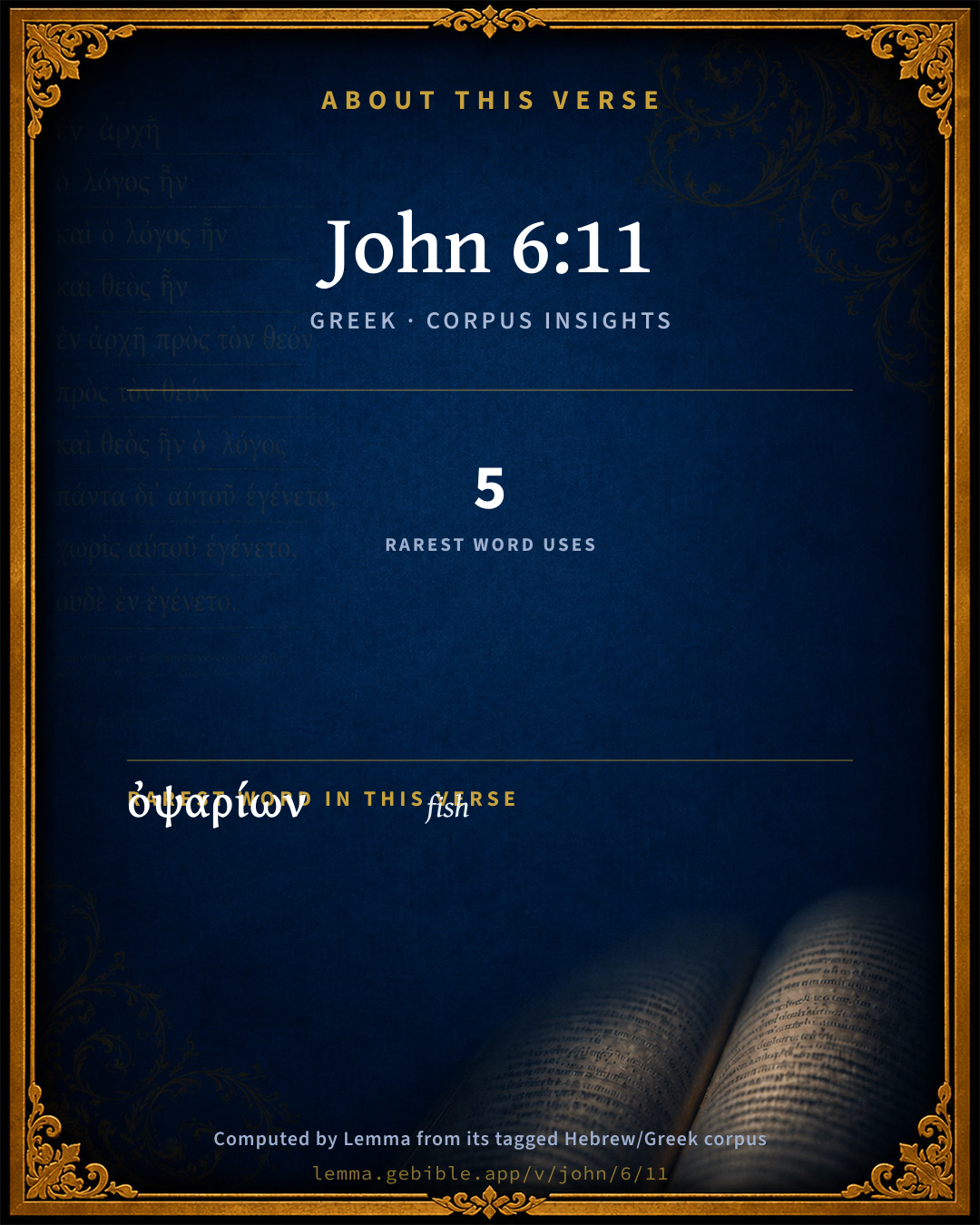
ὀψαρίων
opsárion
G3795
“fish”
Noun, Genitive, Plural, Neuter
Part of Speech
Noun
Case
Genitive
Number
Plural
Gender
Neuter
Full Thayer's Definition

Origin: from a presumed derivative of the base of G3702

TDNT: None

1. fish
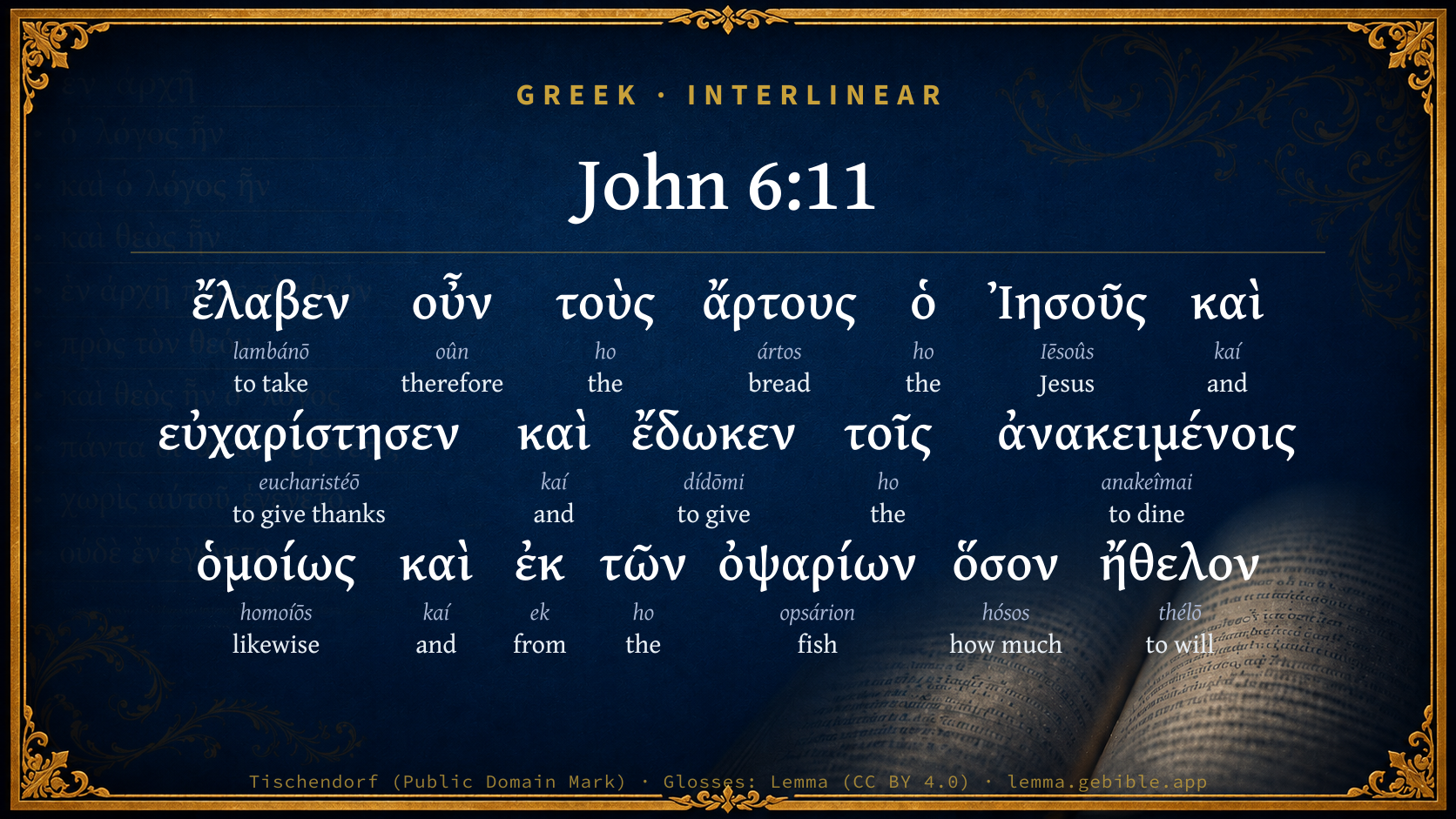
  1. ἔλαβεν lambánō G2983 “to take” Verb, Aorist, Active, Indicative, 3rd person, Singular
  2. οὖν oûn G3767 “therefore” Conjunction
  3. τοὺς ho G3588 “the” Article, Accusative, Plural, Masculine
  4. ἄρτους ártos G740 “bread” Noun, Accusative, Plural, Masculine
  5. ὁ ho G3588 “the” Article, Nominative, Singular, Masculine
  6. Ἰησοῦς Iēsoûs G2424 “Jesus” Noun, Nominative, Singular, Masculine
  7. καὶ kaí G2532 “and” Conjunction
  8. εὐχαρίστησεν eucharistéō G2168 “to give thanks” Verb, Aorist, Active, Indicative, 3rd person, Singular
  9. καὶ kaí G2532 “and” Conjunction
  10. ἔδωκεν dídōmi G1325 “to give” Verb, Aorist, Active, Indicative, 3rd person, Singular
  11. τοῖς ho G3588 “the” Article, Dative, Plural, Masculine
  12. ἀνακειμένοις anakeîmai G345 “to dine” Verb, Present, Middle or Passive deponent, Participle, Dative, Plural, Masculine
  13. ὁμοίως homoíōs G3668 “likewise” Adverb
  14. καὶ kaí G2532 “and” Conjunction
  15. ἐκ ek G1537 “from” Preposition
  16. τῶν ho G3588 “the” Article, Genitive, Plural, Neuter
  17. ὅσον hósos G3745 “how much” Correlative pronoun, Accusative, Singular, Neuter
  18. ἤθελον thélō G2309 “to will” Verb, Imperfect, Active, Indicative, 3rd person, Plural

About this verse

These counts appear in no published source. They are computed here, from the morphology-tagged text and Lemma’s own curated glosses. What Lemma adds →

19
words
14
distinct lemmas
Gospels
section

Notable vocabulary

The rarest word here is ὀψαρίων fish G3795 — appearing just 5 times in the whole Greek New Testament.

Shared distinctive vocabulary

ὀψαρίων fish G3795 occurs in 5 verses of the Greek New Testament. Also found in:

Repetition

Words recur within this verse:

Cross-references

9

Topical passages linked to John 6:11 in the Treasury of Scripture Knowledge — connected by theme and wording, ordered by reader-vote popularity; previews shown in the World English Bible.

  • 1 Thessalonians 5:18 In everything give thanks, for this is the will of God in Christ Jesus toward you.
  • John 6:23 However boats from Tiberias came near to the place where they ate the bread after the Lord had given thanks.
  • Matthew 15:36 and he took the seven loaves and the fish. He gave thanks and broke them, and gave to the disciples, and the disciples to the multitudes.
  • Luke 24:30 It happened, that when he had sat down at the table with them, he took the bread and gave thanks. Breaking it, he gave to them.
  • Romans 14:6 He who observes the day, observes it to the Lord; and he who does not observe the day, to the Lord he does not observe it. He who eats, eats to the Lord, for he gives God thanks. He who doesn't eat, to the Lord he doesn't eat, and gives God thanks.
  • 1 Corinthians 10:31 Whether therefore you eat, or drink, or whatever you do, do all to the glory of God.
  • 1 Timothy 4:4–5 For every creature of God is good, and nothing is to be rejected, if it is received with thanksgiving.
  • 1 Samuel 9:13 as soon as you are come into the city, you shall immediately find him, before he goes up to the high place to eat; for the people will not eat until he come, because he does bless the sacrifice; [and] afterwards they eat who are invited. Now therefore get you up; for at this time you shall find him.
  • Acts 27:35 When he had said this, and had taken bread, he gave thanks to God in the presence of all, and he broke it, and began to eat.

Cross-references courtesy of OpenBible.info (CC BY 4.0).

Where the printed editions differ

1 variant

Places in this verse where the major printed Greek editions disagree on the wording in a way that affects the translation — a comparison of editions, not a manuscript-by-manuscript collation. The editions are the modern critical texts (Nestlé-Aland 28/27, SBL, Westcott-Hort, Tregelles, Tyndale House) and the traditional texts behind the KJV (the Textus Receptus and the Byzantine/Majority text). It is not a claim about which reading is original.

  1. Extra text
    τοῖς μαθηταῖς οἱ δὲ μαθηταὶ

    “to the disciples <the> now the disciples”

    In TRByz Not in NA28NA27TynSBLWHTreg

    τοῖς μαθηταῖς οἱ δὲ μαθηταὶ (tois mathētais hoi de mathētai) 'to the disciples now the disciples' is only in traditional manuscripts (TR+Byz)

Textual data: Translators Amalgamated Greek New Testament (STEPBible TAGNT) · CC BY 4.0.

Commentary

Notes on John 6:11 from classic Christian and Jewish commentators (each source and its license shown beneath its notes). The classic Christian expositions comment on the surrounding passage and are grouped to its opening verse, so a note may address several verses; the Jewish commentaries on the Tanakh (Rashi and others) are per-verse, so they appear only where the commentator wrote on this verse.

Lemma curates 59 commentaries, every one of them public domain or Creative Commons licensed, each selected and text-cleaned for this edition rather than reprinted as found. About our sources →

MacLaren's Expositions of Holy Scripture

Alexander MacLaren

John

THE FOURTH MIRACLE IN JOHN’S GOSPEL

Joh 6:11.

This narrative of the miraculous feeding of the five thousand is introduced into John’s Gospel with singular abruptness. We read in the first verse of the chapter: ‘After these things Jesus went over the Sea of Galilee,’ i.e. from the western to the eastern side. But the Evangelist does not tell us how or when He got to the western side. ‘These things,’ which are recorded in the previous chapter, are the healing of the impotent man at the Pool of Bethesda, the consequent outburst of Jewish hostility, and the profound and solemn discourse of our Lord, in which He claims filial relationship to the Father. So that we must insert between the chapters a journey from Jerusalem to Galilee, and a lapse at all events of some months-or, if the feast referred to in the previous chapter be, as it may be, the Passover, an interval of nearly a year. So little care for the mere framework of events has this fourth Gospel; so entirely would the Evangelist have us see that his reason for narrating this miracle is mainly its spiritual lessons and the revelation which it makes of Christ as Himself the Bread of Life.

Similarly, he has no care to tell us anything about the reasons for our Lord’s retirement with His disciples from Galilee to the eastern bank. These we have to learn from the other Evangelists. They give us several concurrent motives-the news of the death of John the Baptist; and of the desire of the bloody tyrant to see Jesus, which foreboded evil; also the return of the twelve Apostles from their trial journey, which involved the necessity of rest for them; and, perhaps, the approach of the Passover, which our Lord did not purpose to observe in Jerusalem because of the Jewish hostility, and which, therefore, suggested the withdrawal to temporary retirement.

All these reasons concurring, He and His disciples would seek for a brief space of seclusion and repose. But the hope of securing such was vain. The people followed in crowds so eagerly, so hastily, in such enormous numbers, that no natural or ordinary provision for their wants could be thought of. Hence the occasion for the miracle before us.

Now I think that this narrative, with which I wish to deal, falls mainly into two portions, both of which suggest for us some important lessons. There is, first, the preparations for the sign; and then there is the sign itself. Let us look at these two points in succession.

I. First, then, the preparations for the sign.

Now it is to be observed that this is the only incident before our Lord’s last journey to Jerusalem which is recorded by all four Evangelists; therefore the variations between the narratives are of especial interest, and these variations are very considerable. We find, for instance, that in John’s account the question as to how the bread was to be provided came from Christ; in the other Evangelists’ accounts that question is discussed first amongst the Apostles privately. We find from John’s narrative that the question was suggested even before the multitudes had come to Jesus. We find in the Synoptic Gospels that it arose at the close of a long day of teaching and of healing.

Now it is possible that this diversity of time may be the solution of the diversity of the person proposing. That is to say, it is quite legitimate to conclude that John’s account takes up the incident at an earlier period than the other Evangelists do, and that the full order of events was this; that, privately, at the beginning of the day, whilst the people were yet flocking to our Lord, He, to one of the disciples alone, suggests the question, ‘Whence shall we buy bread that these may eat?’ and that the answer, ‘Two hundred pennyworth of bread is not sufficient that every one of them may take a little,’ explains for us the suggestion of the same amount at a subsequent part of the day, by the Apostles when they asked our Lord the question, ‘Shall we go and buy two hundred pennyworth of bread that these may eat?’

Be that as it may, we may pause for a moment upon this question of our Lord’s, ‘Whence shall we buy bread that these may eat?’

Now notice what a lovely glimpse we get there into the quick-rising sympathy of the Saviour with all forms of human necessity. He had gone away to snatch a brief moment of rest. The rest is denied Him; the hurrying crowds come pressing with their vulgar curiosity-for it was nothing better-after Him. No movement of impatience passes across His mind; no reluctance as He turns away from the vanishing prospect of a quiet afternoon with His friends. He looks upon them, and the first thought is a quick, instinctive movement of a divine and yet most human sympathy. The question rises in His mind of how He was to provide for them; they were not hungry yet; they had not thought where their bread was to come from. But He cared for the careless, and His heart was prophetic of their necessities, and quick to determine ‘what He should do’ to supply them. So is it ever. Before we call, He answers. Thy mercy, O loving Christ! needs no more than the sight of human necessities, or even the anticipation of them, swiftly to bestir itself for their satisfaction and their supply.

But, farther, He selects for the question Philip, a man who seems to have been what is called-as if it were the highest praise-an ‘intensely practical person’; who seems to have had little faith in anything that he could not get hold of by his senses, and who lived upon the low level of ‘common sense.’ He always lays stress upon ‘seeing.’ His answer to Nathanael when he said, ‘Can any good thing come out of Nazareth?’ was, ‘Come and see.’ A very good answer, and yet one that relies only on the external manifestation of Christ to the senses. Then, on another occasion, he breaks in upon the lofty spiritualities of our Lord’s final discourse to His disciples, with the malapropos request, ‘Lord, show us the Father, and it sufficeth us.’ And so here, to the man who believed in his eyesight, and did not easily apprehend much else, Jesus puts this question, ‘Where is the bread to come from for all these people? This He said to prove him.’ He hoped that the question might have shaped itself in the hearer’s mind into a promise, and that he might have been able to say in answer, ‘Thou canst supply; we need not buy.’

So Christ does still. He puts problems before us, too, to settle; takes us, as it were, into His confidence with interrogations that try us, whether we can rise above the level of the material and visible, or whether all our conceptions of possibilities are bounded by these. And sometimes, even though the question at first sight seems to evoke only such a response as it did here, it works more deeply down below afterwards, and we are helped by the very difficulty to rise to a clear faith.

Philip’s answer is very significant. ‘Two hundred pennyworth of bread are not sufficient.’ He casts his eye over the multitude, he makes a rough, rapid calculation, one does not exactly see the data on which it was based; and he comes to the conclusion, ‘Two hundred pennyworth’ {in our English money some L. 7 or L. 8 worth} would give them each a morsel. And no doubt he thought himself very practical. He was a man of figures; he believed in what could be put into tables and statistics. Yes; and like a great many other people of his sort, he left out one small element in his calculation, and that was Jesus Christ, and so his answer went creeping along the low levels, dragging itself like a half-wounded snake, when it might have risen on the wings of faith into the empyrean, and soared and sung.

So learn that when we have to deal with Christ’s working-and when have we not to deal with Christ’s working?-perhaps probabilities that can be tabulated are not altogether the best bases upon which to rest our calculations. Learn that the audacity of a faith that expects great things, though there be nothing visible upon which to build, is wiser and more prudent than the creeping common-sense that adheres to facts which are shadows, and forgets that the chief fact is that we have an Almighty Helper and Friend at our sides.

Still further, among these preliminaries, let us point to the exhibition of the inadequate resources which Christ, according to the fuller narrative in the other Evangelists, desired to know. ‘There is a little lad here with five barley loaves’-one per thousand-’and two small fishes’-insufficient in quantity and very, very common in quality, for barley bread was the food of the poorest. ‘But what are they among so many?’ And Christ says, ‘Bring them to Me.’

Christ’s preparation for making our poor resources adequate for anything is to drive home into our hearts the consciousness of their insufficiency. We need, first of all, to be brought to this, ‘All that I have is this wretched little stock; and what is that measured against the work that I have to do, and the claims upon me?’ Only when we are brought to that can His great power pour itself into us and fill us with rejoicing and overcoming strength. The old mystics used to say, and they said truly: ‘You must be emptied of yourself before you can be filled by God.’ And the first thing for any man to learn, in preparation for receiving a mightier power than his own into his opening heart, is to know that all his own strength is utter and absolute weakness. ‘What are they among so many?’ When we have once gone right down into the depths of felt impotence, and when our work has risen before us, as if it were far too great for our poor strengths which are weaknesses, then we are brought, and only then, into the position in which we may begin to hope that power equal to our desire will be poured into our souls.

And so the last of the preparations that I will touch upon is that majestic preparation for blessing by obedience. ‘And Jesus said, Make the men sit down.’ And there they sat themselves, as Mark puts it in his picturesque way, like so many garden plots-the rectangular oblongs in a garden in which pot-herbs are grown-on the green grass, below the blue sky, by the side of the quiet lake. Cannot you fancy how some of them seated themselves with a scoff, and some with a quiet smile of incredulity; and some half sheepishly and reluctantly; and some in mute expectancy; and some in foolish wonder; and yet all of them with a partial obedience? And says John in the true translation: ‘So the men sat down, therefore Jesus took the loaves.’ Sit you down where He bids you, and your mouths will not be long empty. Do the things He tells you, and you will get the food that you need. Our business is to obey and to wait, and His business is, when we are seated, to open His hand and let the mercy drop. So much for the preparations for this great miracle.

II. Now, in the next place, a word as to the sign itself.

I take two lessons, and two only, out of it. I see in it, first, a revelation of Christ, as continually through all the ages sustaining men’s physical life. And I see in it, second, a symbol of Christ as Himself the Bread of Life.

As to the first, there is here, I believe, a revelation of the law of the universe, of Christ as being through all the ages the Sustainer of the physical life of men. What was done then once, with the suppression of certain links in the chain, is done always, with the introduction of those links. The miraculous moment in the narrative is not described to us. We do not know where or when there came in the supernatural power which multiplied the loaves-probably as they passed from the hand of the Master. But be that as it may, it was Christ’s will that made the provision which fed all these five thousand. And I believe that the teaching of Scripture is in accordance with the deepest philosophy, that the one cause of all physical phenomena is the will of a present God; howsoever that may usually conform to the ordinary method of working which people generalise and call laws. The reason why anything is, and the reason why all things change, is the energy there and then of the indwelling God who is in all His works, and who is the only Will and Power in the physical world.

And I believe, further, that Scripture teaches us that that continuous will, which is the cause of all phenomena and the underlying subsistence on which all things repose, is all managed and mediated by Him who from of old was named the Word; ‘in whom was life, and without whom was not anything made that was made.’ Our Christ is Creator, our Christ is Sustainer, our Christ moves the stars and feeds the sparrows. He was ‘before all things, and in Him all things consist.’ He opens His hand-and there is the print of a nail in it-and ‘satisfies the desire of every living thing.’

So learn how to think of second causes, and see in this story a transient manifestation, in unusual form, of an eternal and permanent fact. Jesus took the loaves and distributed to them that were set down.

And so, secondly, the miracle is a sign-a symbol of Him as the true Bread and Food of the world. That is the explanation and commentary which He Himself appends to it in the subsequent part of the chapter, in the great discourse which is founded upon this miracle.

‘I am the Bread of Life.’ There is a triple statement by our Lord upon this subject in the remaining portion of the chapter. He says, ‘I am the Bread of Life.’ My personality is that which not only sustains life when it is given, but gives life to them that feed upon it. But more than that, ‘the bread which I will give,’ pointing to some future ‘giving’ beyond the present moment, and therefore something more than His life and example, ‘is My flesh, which’-in some as yet unexplained way-’I give for the life of the world.’ And that there may be no misunderstanding, there is a third, deeper, more mysterious statement still: ‘My flesh is meat indeed, and My blood is drink indeed.’ Repulsive and paradoxical, but in its very offensiveness and paradox, proclaiming that it covers a mighty truth, and the truth, brother, is this, the one Food that gives life to will, affections, conscience, understanding, to the whole spirit of a man, is that great Sacrifice of the Incarnate Lord who gave upon the Cross His flesh, and on the Cross shed His blood, for the life of the world that was ‘dead in trespasses and sins.’ Christ, our Passover, is sacrificed for us, and we feed on the sacrifice. Let your conscience, your heart, your desires, your anticipations, your understanding, your will, your whole being feed on Him. He will be cleansing, He will be love, He will be fruition, He will be hope, He will be truth, He will be righteousness, He will be all. Feed upon Him by that faith which is the true eating of the true Bread, and your souls shall live.

And notice finally here, the result of this miracle as transferred to the region of symbol. ‘They did all eat and were filled’; men, women, children, both sexes, all ages, all classes, found the food that they needed in the bread that came from Christ’s hands. If any man wants dainties that will tickle the palates of Epicureans, let him go somewhere else. But if he wants bread, to keep the life in and to stay his hunger, let him go to this Christ who is ‘human nature’s daily food.’

The world has scoffed for nineteen centuries at the barley bread that the Gospel provides; coarse by the side of its confectionery, but it is enough to give life to all who eat it. It goes straight to the primal necessities of human nature. It does not coddle a class, or pander to unwholesome, diseased, or fastidious appetites. It is the food of the world, and not of a section. All men can relish it, all men need it. It is offered to them all.

And more than that; notice the inexhaustible abundance. ‘They did all eat, and were filled.’ And then they took up-not ‘of the fragments,’ as our Bible gives it, conveying the idea of the crumbs that littered the grass after the repast was over, but of the ‘broken pieces’-the portions that came from Christ’s hands-twelve baskets full, an immensely greater quantity than they had to start with. ‘The gift doth stretch itself as ‘tis received.’ Other goods and other possessions perish with the using, but this increases with use. The more one eats, the more there is for him to eat. And all the world may live upon it for ever, and there will be more at the end than there was at the beginning.

Brethren, why do ye ‘spend your money for that which is not bread’? There is no answer worthy of a rational soul, no answer that will stand either the light of conscience or the clearer light of the Day of Judgment. I come to you now, and although my poor words may be but like the barley bread and the two fishes-nothing amongst all this gathered audience-I come with Christ in my hands, and I say to you, ‘Eat, and your souls shall live.’ He will spread a table for you in the wilderness, and take you to sit at last at His table in His Kingdom.

Alexander MacLaren, Expositions of Holy Scripture (1904–1910) — public domain. Text from a community e-Sword module.

Tyndale Open Study Notes

Tyndale Open Resources

6:11 The modest meal provided the crowd with as much as they wanted, echoing the miraculous provision of manna in the wilderness (Exod 16:35). Moses had first supplied Israel with heavenly bread; Jesus was the new supplier.

Tyndale Open Study Notes — © Tyndale Open Resources, licensed CC BY-SA 4.0. Text via the HelloAO Bible API.

Expositor's Greek Testament

ed. W. Robertson Nicoll

Joh 6:11 . Facing the vast and hungry crowd Jesus took up and gave thanks for the slender provision, ἔλαβε δὲ [better ἔλαβεν οὖν ] τοὺς ἄρτους , the loaves already mentioned, καὶ εὐχαριστήσας [Phrynichus says εὐχαριστεῖν οὐδεὶς τῶν δοκίμων εἶπεν , ἀλλὰ χάριν εἰδέναι ; and Rutherford says Polybius is the first writer who uses the word in the sense of “give thanks”]. Pagans, by libation, or by throwing a handful on the household altar, gave thanks before a meal; Jews pronounced a blessing, ἁγιασμός or εὐλογία . (Luk 24:30 , Mat 14:19 , and especially 1Ti 4:4 . See also Grotius’ note on Mat 26:27 .) Having given thanks Jesus διέδωκε … τοῖς ἀνακειμένοις . The words added from the Synoptists give a fuller account of what actually happened. But curiosity as to the precise stage at which the multiplication occurred, or whether it could distinctly be seen, is not satisfied. They all received ὅσον ἤθελον , not the βραχύ τι of Philip; and even this did not exhaust the supply; for (Joh 6:12 ) ὡς δὲ ἐνεπλήσθησαν , when no one could eat any more, there were seen to be κλάσματα περισσεύσαντα , pieces broken off but not used. These Jesus directs the disciples to gather ἵνα μή τι ἀπόληται , “that nothing be lost”. The Father’s bounty must not be wasted. Infinite resource does not justify waste. Euthymius ingeniously supposes the order to have been given ἵνα μὴ δόξῃ φαντασία τις τὸ γενόμενον ; but of course those who had eaten already knew that the provision was substantial and real.

The Expositor's Greek Testament, edited by W. Robertson Nicoll (1897–1910) — public domain. Text from a community e-Sword module.

Adam Clarke's Commentary

Verse 11. Jesus took the loaves] See the notes on Mt 14:19-21. As there were five loaves and five thousand people, so there was one loaf to every thousand men, independently of the women and children.

Adam Clarke's Commentary on the Bible (1810–1826) — public domain. Text from a community e-Sword/MySword module.

John Calvin's Commentaries

11. After having given thanks. Christ has oftener than once instructed us by his example that, whenever we take food, we ought to begin with prayer. For those things which God has appointed for our use, being evidences of his infinite goodness and fatherly love towards us, call on us to offer praise to Him; and thanksgiving, as Paul informs us, is a kind of solemn sanctification, by means of which the use of them begins to be pure to us, (1 Timothy 4:4.) Hence it follows, that they who swallow them down without thinking of God, are guilty of sacrilege, and of profaning the gifts of God. And this instruction is the more worthy of attention, because we daily see a great part of the world feeding themselves like brute beasts. When Christ determined that the bread given to the disciples should grow among their hands, we are taught by it that God blesses our labor when we are serviceable to each other.

Let us now sum up the meaning of the whole miracle. It has this in common with the other miracles, that Christ displayed in it his Divine power in union with beneficence, It is also a confirmation to us of that statement by which he exhorts us to seek the kingdom of God, promising that all other things shall be added to us, (Matthew 6:33.) For if he took care of those who were led to him only by a sudden impulse, how would he desert us, if we seek him with a firm and steady purpose? True, indeed, he will sometimes allow his own people, as I have said, to suffer hunger; but he will never deprive them of his aid; and, in the meantime, he has very good reasons for not assisting us till matters come to an extremity.

Besides, Christ plainly showed that he not only bestows spiritual life on the world, but that his Father commanded him also to nourish the body. For abundance of all blessings is committed to his hand, that, as a channel, he may convey them to us; though I speak incorrectly by calling him a channel, for he is rather the living fountain flowing from the eternal Father. Accordingly, Paul prays that all blessings may come to us from God the Father, and from the Lord Jesus Christ, in common, (1 Corinthians 1:3;) and, in another passage, he shows that

in all things we ought to give thanks to God the Father, through our Lord Jesus Christ, (Ephesians 5:20.)

And not only does this office belong to his eternal Divinity, but even in his human nature, and so far as he has taken upon him our flesh, the Father has appointed him to be the dispenser, that by his hands he may feed us. Now, though we do not every day see miracles before our eyes, yet not less bountifully does God display his power in feeding us. And indeed we do not read that, when he wished to give a supper to his people, he used any new means; and, therefore, it would be an inconsiderate prayer, if any one were to ask that meat and drink might be given to him by some unusual method.

Again, Christ did not provide great delicacies for the people, but they who saw his amazing power displayed in that supper, were obliged to rest satisfied with barley-bread and fish without sauce. And though he does not now satisfy five thousand men with five loaves, still he does not cease to feed the whole world in a wonderful manner. It sounds to us, no doubt, like a paradox, that

man liveth not by bread alone, but by the word which proceedeth out of the mouth of God, (Deuteronomy 8:3.)

For we are so strongly attached to outward means, that nothing is more difficult than to depend on the providence of God. Hence it arises that we tremble so much, as soon as we have not bread at hand. And if we consider every thing aright, we shall be compelled to discern the blessing of God in all the creatures which serve for our bodily support; but use and frequency lead us to undervalue the miracles of nature. And yet, in this respect, it is not so much our stupidity as our malignity that hinders us; for where is the man to be found who does not choose to wander astray in his mind, and to encompass heaven and earth a hundred times, rather than look at God who presents himself to his view?

John Calvin's Commentaries (1540-1563) — public domain. Text from the Calvin Translation Society English edition (1840s-50s) via the Christian Classics Ethereal Library (ccel.org). Calvin's coverage is partial (roughly two-thirds of the Bible); uncommented books and verses are honest gaps, never fabricated. The 19th-century editor's footnotes and remarks are omitted so the notes are faithfully Calvin's own voice.

Ellicott's Commentary for English Readers

(11) The better MSS. omit “to the disciples, and the disciples to.” It is included in the sense, but is not here expressed in word.

A Bible Commentary for English Readers, edited by Charles John Ellicott (1878–1897) — public domain. Text from a community e-Sword module.

The Cambridge Bible for Schools and Colleges

gen. ed. J. J. S. Perowne

11. when he had given thanks] The usual grace before meat said by the head of the house or the host. ‘He that enjoys aught without thanksgiving, is as though he robbed God.’ Talmud. But it seems clear that this giving of thanks or blessing of the food (Luk_9:16) was the means of the miracle, because (1) all four narratives notice it; (2) it is pointedly, mentioned again Joh_6:23; (3) it is also mentioned in both accounts of the feeding of the 4000 (Mat_15:36; Mar_8:6).

to the disciples, and the disciples] These words are wanting in authority; the best texts run, He distributed to them that were lying down. It is futile to ask whether the multiplication took place in Christ’s hands only: the manner of the miracle eludes us, as in the turning of the water into wine. That was a change of quality, this of quantity. This is a literal fulfilment of Mat_6:33.

The Cambridge Bible for Schools and Colleges (gen. ed. J. J. S. Perowne; Cambridge University Press, 1878–1918) — public domain. Text from a community e-Sword module.

John Gill's Exposition

And Jesus took the loaves,.... Into his hands, as also the fishes, in order to feed the multitude with them:

and when he had given thanks; for them, and blessed them, or implored a blessing on them, that they might be nourishing to the bodies of men, as was his usual manner, and which is an example to us;

he distributed to the disciples, and the disciples to them that were sat down. The Vulgate Latin, and all the Oriental versions, only read, "he distributed to them that were sat down": but it was not by his own hands, but by the means of the disciples, who received from him, and gave it to them; so that the sense is the same;

and likewise of the fishes, as much as they would; that is, they had as much, both of the bread and of the fishes, distributed to them, and which they took and ate, as they chose: in some printed copies it is read, "as much as he would", and so the Persic version; that is, as much as Jesus would; but the former is the true reading, and makes the miracle more illustrious.

John Gill's Exposition of the Whole Bible (1746–1763) — public domain (CC PDM 1.0). Text via the HelloAO Bible API.

Trapp's Complete Commentary

John Trapp

11 And Jesus took the loaves; and when he had given thanks, he distributed to the disciples, and the disciples to them that were set down; and likewise of the fishes as much as they would.

Ver. 11. He distributed to the disciples] These five loaves (by a strange kind of arithmetic) were multiplied by division, and augmented by subtraction. The Macedonians found, that not getting, but giving, is the way to thrive, 2Co 9:8. Ex fame quaestum captabat Iosephus; et benignitate sua emit Egyptum: Nos etiam coelum. So in spiritual alms and good offices: God’s gifts grow in the hands of them that employ them, to feed many. Salienti aquarum fonti undas si tollas, nec exhauritur, nec extenuatur, sed dulcescit. Scientia, docendi officio, dulcedinem sentiat, non minutias.

John Trapp, A Commentary or Exposition upon All the Books of the Old and New Testament (1647–1656) — public domain. Text from a community e-Sword module.

Haydock's Catholic Bible Commentary

In the Greek, there is this addition: He distributed to the disciples, and the disciples to them that were sitting. The Syriac, and some Greek copies agree with the Vulgate.

George Leo Haydock (1774–1849), Haydock's Catholic Family Bible and Commentary, 1859 edition — public domain. Excludes Psalms (Douay-Rheims chapter numbering differs from Protestant) and Deuterocanonical books (Catholic canon only).

The Pulpit Commentary

Jesus then took the loaves; and having given thanks (eucaristhsav is used by John, whereas Mark speaks of his looking up to heaven and blessing the loaves, uttering words of praise. The Eucharistial expression corresponds with the function of the head of a household at the Paschal feast, and is another hint of relation between the Passover and the discourse which here follows) he distributedto them who were set down. This is not incompatible with the language of the synoptists, that he gave to the disciples, they to the multitude, an undoubted allegory of the method in which all his greatest gifts have been diffused over the world; but John calls special attention to the part, the supreme part, taken in this proceeding by the Lord himself. Advantage has been taken of this to show that the narrative is a glorification of the Eucharistial meal, at which Jesus gave to his disciples the bread which he brake. Likewise also of the fishes (oqariwn) as much as they wished. This is, doubtless, the place or moment when the mighty miracle occurred. seed-time when he blessed the bread, "Twas harvest when he brake.

This pretty couplet, with Augmstine"s and Olshausen"s remarks that the processes of nature were hastened by the great organ of the Divine Creator, does not throw any light upon the phenomenon. It makes it more inexplicable, for ground corn and baked barley loaves afford no parallel with living seeds, and dead and salted fish create even greater difficulties. "Frugality exaggerated into a miracle" (Renan) is far more thinkable, though it leaves the sequel unexplained. We must either reject the narrative, notwithstanding its wonderful confirmation by two or three separate eyewitnesses, or we must accept it. If we do the latter, we see in this (and the following) miracle an assertion that the creative will of Christ is the sole cause of the additional food that was provided for the sustenance of this multitude. The Son of God added to the sum of things, to the quantity of matter, or called together from surrounding air the elements needed for the purpose, just as in hushing the storm he met force by that will of his which is the ultimate source and ground of all force. He spake in the power of Heaven, and it was done. He gave thanks, and he distributed.

The Pulpit Commentary (1880–1919), ed. H.D.M. Spence-Jones & Joseph S. Exell — public domain. Text from a community e-Sword module.

Cambridge Greek Testament for Schools and Colleges

11. ἔλαβεν οὖν (S. John’s favourite particle) for ἔλαβε δέ. Omit (א1ABL) τοῖς μαθηταῖς, οἱ δὲ μαθηταί after διέδωκεν. The insertion (D) comes from the Synoptic narrative.

11. εὐχαριστ. The usual grace before meat said by the head of the house or the host. ‘He that enjoys aught without thanksgiving, is as though he robbed God.’ Talmud. But it seems clear that this giving of thanks or blessing of the food (Luk 9:16) was the means of the miracle, because (1) all four narratives notice it; (2) it is pointedly mentioned again Joh 6:23; (3) it is also mentioned in both accounts of the feeding of the 4000 (Mat 15:36; Mar 8:6). It should be remembered that this act is again prominent at the institution of the Eucharist (Mat 26:26; Mar 14:22; Luk 22:17; Luk 22:19; 2Co 11:24). It is futile to ask whether the multiplication took place in Christ’s hands only: the manner of the miracle eludes us, as in the turning of the water into wine. That was a change of quality, this of quantity. This is a literal fulfilment of Mat 6:33.

Cambridge Greek Testament for Schools and Colleges (Cambridge University Press, 1896; 21 vols, various authors incl. Carr, Maclear, Plummer, Farrar, Lumby, Moule, M. R. James, Simcox) — public domain. Text from a community e-Sword module.

Alford’s Greek Testament

Henry Alford

11.] On the process of the miracle, see notes on Matt. John describes the διάδοσις as being the act of the Lord Himself, and leaves the intervention of the disciples to be understood.

εὐχαριστήσας here answers to εὐλόγησεν in the other Gospels. It was the ‘grace’ of the father of the family; perhaps the ordinary one in use among the Jews. John seems to connect with it the idea brought out by Luke, εὐλ. αὐτούς, i.e. τοὺς ἄρτους: see ver. 23.

Henry Alford, The Greek Testament (1849–1861) — public domain. Text from a community e-Sword module.

International Critical Commentary

11. ἔλαβεν οὖν τοὺς ἄρτους. Jesus took the loaves, and blessing them, caused them to be distributed, thus acting as host.

It is remarkable, and probably significant, that Jn., alone of the evangelists, does not say that the loaves were broken by Jesus, as well as blessed. In all the narratives descriptive of the Feedings of the Multitudes, except this, we have ἄρτους ἔκλασεν or κατέκλασεν τοὺς ἄρτους, or the like. Jn. never uses the verb κλάω or κατακλάω. Now, in all the accounts of the institution of the Lord’s Supper, that Jesus “brake the Bread” is explicitly mentioned, ἔκλασεν ἄρτον, only one loaf being used. The rite itself is called in Act 2:42 ἡ κλάσις τοῦ ἄρτου (cf. Act 20:7, and perhaps Act 27:35), so essential a feature was the breaking of the one loaf deemed to be. Thus, in this particular, the Johannine narrative of the Feeding of the Five Thousand is less suggestive of the action of Jesus at the Last Supper than are the Synoptic narratives of the same miracle. By the omission of ἄρτους ἔκλασεν Jn. has deviated from the Synoptic tradition in a fashion which suggests that he did not regard the miraculous meal, which he describes, as anticipatory of the sacrament with which he was familiar, although he does not tell of its institution. The discourse which follows (cf. esp. vv. 52-56) cannot be interpreted without including a sacramental reference; but it would seem, nevertheless, that Jn. wishes to avoid suggesting that the miraculous feeding was a sacramental meal.

It is just possible, although unlikely, that Jn. omits all mention of the breaking of the bread, not because he did not regard the meal as sacramental, but because he lays stress on the circumstance (19:33) that the Body of Christ was not broken on the Cross.

We must also note that Jn. omits the words, ἀναβλέψας εἰς τὸν οὐρανόν before the blessing of the loaves, which are common to all three Synoptists. This “lifting up of the eyes” was a very ancient feature of the Eucharistic rite, and we cannot be sure how far back it goes (cf. 11:41, 17:1, and see on 4:35).

In another detail, per contra, Jn.’s narrative of the Feeding of the Five Thousand suggests the Last Supper more clearly than the Synoptists do. In Jn., it is Jesus Himself who distributes the loaves to the multitudes, διέδωκεν τοῖς ἀνακειμένοις, just as He distributed the Bread to His disciples on the eve of His Passion (cf. also 21:13); but in the Synoptists, it is the Twelve who, acting under His direction, bring the loaves round, which probably was what actually took place. Jn.’s διέδωκεν, however, need not be taken as excluding the assistance of the Twelve in the distribution, although this is not explicitly mentioned. Qui facit per alium, facit per se.

The rec. text inserts after διέδωκεν the words τοῖς μαθηταῖς, οἱ δὲ μαθηταί (so אcDΓΔΘ), but this is a harmonising gloss introduced from Mat 14:19. The intercalated words are not found in א*ABLNW or in most vss.

We must now examine the word εὐχαριστήσας, “having given thanks.” εὐλογεῖν is the verb used in the Synoptic parallels (Mar 6:41, Mat 14:19, Luk 9:16); but Mk. (8:6) and Mt. (15:36) have εὐχαριστεῖν in a similar context in their narratives of the Feeding of the Four Thousand. In the accounts of the institution of the Lord’s Supper, Lk. (22:19) and Paul (1Co 11:24) use εὐχαριστεῖν of the Blessing of the Bread, while Mt. (26:27), Mk. (14:23), and Lk. (22:17) use it of the Blessing of the Cup, the Cup being called by Paul τὸ ποτήριον τῆς εὐλογίας ὃ εὐλογοῦμεν (1Co 10:16). In these passages it is not possible to distinguish in meaning between εὐχαριστεῖν and εὐλογεῖν,1 although εὐχαριστεῖν and εὐχαριστία soon came to be used in a special sense in connexion with the Holy Communion (cf. Ignat. Philad. 4 σπουδάσατε οὖν μιᾷ εὐχαριστίᾳ, and see Justin, Apol. i. 66, and Iren. Hær. iv. 18. 5).

But the verb εὐλογεῖν is never used in Jn. (except once in a quotation, 12:13); and he uses εὐχαριστεῖν elsewhere (11:41, Πάτερ εὐχαριστῶ σοι) where no sacramental reference is possible. In this general sense, “giving of thanks,” εὐχαριστεῖν occurs a few times in the later books of the LXX (Judith 8:25, 2 Macc. 12:31) and in Philo, as well as frequently in the N.T., e.g. Luk 17:16, Luk 18:11, and very often in Paul.

It may be that the “giving of thanks” or “blessing” which all the evangelists mention in their narratives of the miraculous Feedings of the Multitudes was the grace before meat which the Lord used, and which was the usual habit of piety before a meal (cf. Deu 8:10). The form of Jewish “grace” which has come down to us is, “Blessed art thou, O Lord our God, king of the world, who bringeth forth bread from the earth.” But if this is the allusion in εὐχαριστήσας or εὐλογήσας in the evangelical narratives of the Miraculous Feedings, it is curious that no such phrase occurs in connexion with the other meals described in the Gospels at which Jesus presided or was the principal Guest (Luk 24:30 is sacramental). Jn. does not hint that “a blessing” was asked or pronounced at the Marriage Feast in Cana (2:1, or at the supper in Bethany (12:2), or at the meal by the lake-side (21:13). Cf. Mar 14:3, Luk 5:29, Luk 7:37. In Act 27:35 it is said, indeed, of Paul λαβὼν ἄρτον εὐχαρίστησεν τῷ θεῷ ἐνώπιον πάντων καὶ κλάσας ἤρξατο ἐσθίειν; but it is not clear that this was an ordinary meal preceded by a “grace.” Knowling and Blass regard it as a sacramental celebration.

Whatever be the reason, it would seem that the evangelical traditions handed down the incident of Jesus “blessing” the loaves at the Miraculous Feedings as an incident of special significance. The similarity to this verse of Joh 21:13, λαμβάνει τὸν ἄρτον καὶ δίδωσιν αὐτοῖς καὶ τὸ ὀψάριον ὁμοίως, brings out the more clearly the omission of any such word as εὐχαριστήσας or εὐλογήσας in the latter passage.

The stress that was laid in early times on the blessing of the loaves, in connexion with their multiplication, is apparent in a legend preserved in the second-century Acts of John (§ 93):“If at any time He were bidden by one of the Pharisees and went to the bidding, we accompanied Him; and before each was set one loaf by him that had bidden us, He also receiving one loaf. And, blessing His own loaf, He would divide it among us; and from that little each was filled (ἐκ τοῦ βραχέος ἕκαστος ἐχορτάζετο: see v. 7 above), and our own loaves were saved whole, so that they who bade Him were amazed.” The act of blessing is a preliminary condition of the miracle, according to this writer. See on 6:23 below.

ὅσον ἤθελον. All the evangelists agree in the statement that the multitudes “were filled,” i.e. that they had a substantial meal, and not merely a scrap of food; but Jn. is even more explicit, saying that of the fish as well as of the loaves they had as much as they wished for.

International Critical Commentary — older volumes (1896–1929), various authors — public domain. Text from a community e-Sword module.

Vincent's Word Studies in the New Testament

Marvin R. Vincent

Given thanks. All the Synoptists relate his looking up to heaven and blessing. Perhaps he used the familiar formula, "Blessed art thou Jehovah our God, King of the world, who causes to come forth bread from the earth."

To the disciples, and the disciples. The best texts omit. Render, as Rev., He distributed to them that were set down.

Likewise of the fishes. So also Mark.

As much as they would. Peculiar to John.

Marvin R. Vincent, Word Studies in the New Testament (1887–1900) — public domain. Text from a community e-Sword/MySword module.

Godet's Commentaries

Frédéric Louis Godet

Ver. 11. “Then Jesus took the loaves, and having given thanks he distributed them to those who were seated; and likewise of the fishes, as much as they wished.”

This was the solemn moment. Jesus takes in the midst of this multitude the position of the father of a family, as in an ordinary supper, and particularly that of the Passover. He gives thanks, as the father surrounded by his family did for the blessings of God in nature and in the covenant. This moment seems to have been especially impressive to the spectators. It is made almost equally prominent in the four accounts; the multitude and the disciples themselves seem to have had the impression that it was this act of thanksgiving which caused omnipotence to act and which produced the miracle. Comp. Joh 6:23. After giving thanks, Jesus distributes the food, as the father did at the Paschal-supper. We have rejected from the text the words: to the disciples and the disciples, which are omitted by the Alexandrian authorities. It is more probable that there is an interpolation here, borrowed from Matthew. The little detail: as much as they wished, forms a contrast to the words of Andrew: “But what are these for so many” (Joh 6:9).

Frédéric Louis Godet — Commentaries on Luke, John, Romans, and 1 Corinthians — English translation (T&T Clark, Edinburgh, 1870s–1890s) — public domain. Text from a community e-Sword module.

Lesson kit

Teaching starters — assembled from the data on this page, not authored interpretation. Every prompt links to the verse data it draws on. Edit before teaching.

John, in the Gospels, opens this verse with 19 words (14 distinct Greek lemmas). Its most distinctive word is opsárion (“fish”). A historical commentator’s framing appears above. Read the whole chapter for the surrounding context.

Discussion questions

  1. How does “fish” (opsárion) shape what this verse is saying?
  2. How does John 6:9, which shares the word «fish», read alongside this verse?
  3. What does the repetition of “the” (4× in this one verse) do in this verse?
  4. The translations on this page render this verse differently — a whole-verse word diff, not a word-by-word alignment. What might account for the different wordings?
  5. Compare how MacLaren's Expositions of Holy Scripture and Tyndale Open Study Notes read this verse. Where do they agree or differ?

Things to notice

Reading settings

Reading text

Shown beneath each verse's original-language words.

Old Testament
Old Testament edition

Read the OT as the Masoretic Hebrew (MT) or the Greek Septuagint (LXX).

English shown for the Greek Septuagint (in the Hebrew ↔ Greek comparison).

Comparing translations? Open the Compare panel on any verse page to stack up to four side by side.