
Matthew 6:2

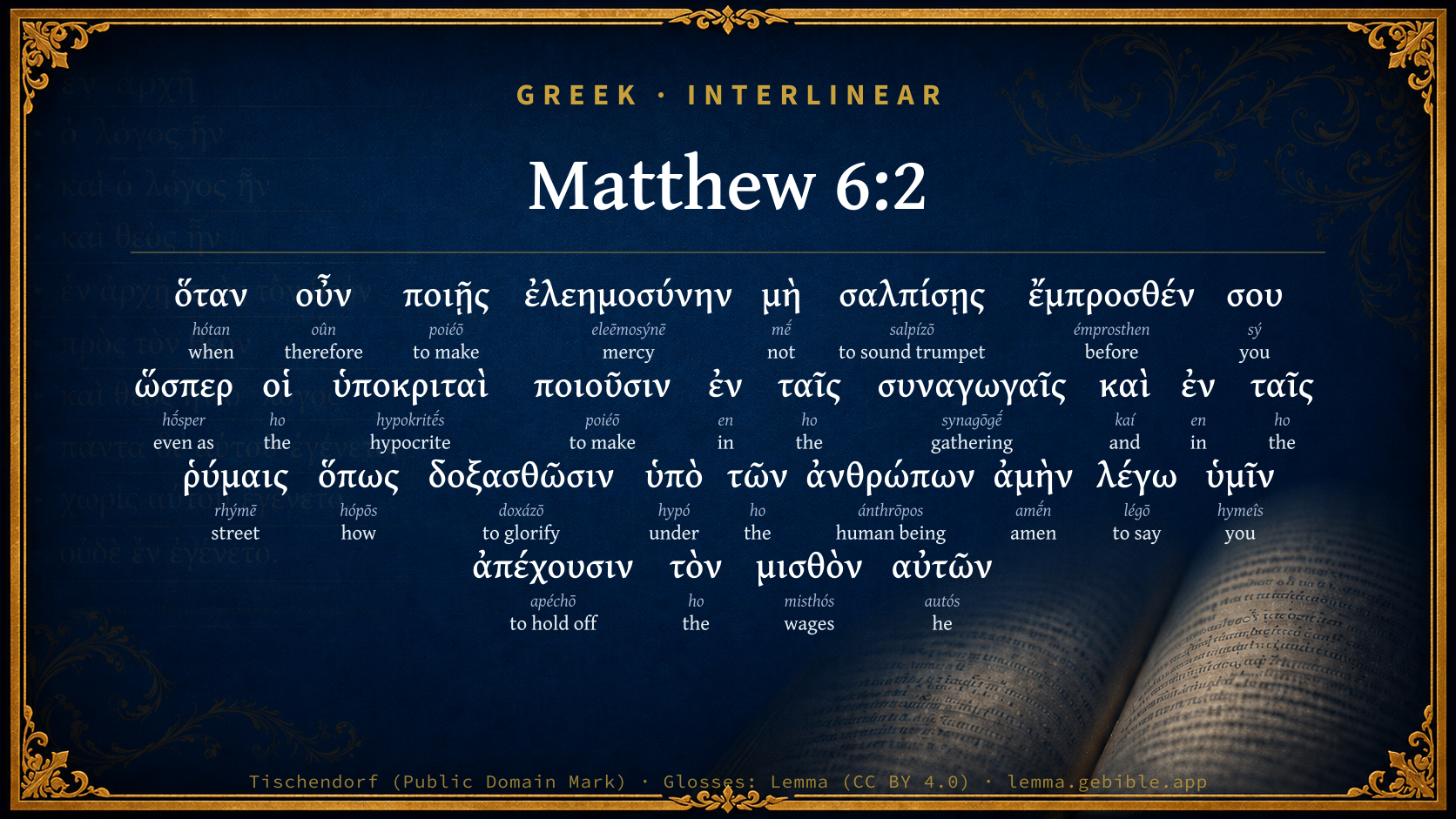
Greek (Tischendorf 8th ed.) Matthew 6:2 appears in the Greek New Testament. The text above is from the Tischendorf 8th edition. Each word links to its Strong’s number and a concise gloss. Click any word for its full Thayer’s Greek Lexicon entry.
Download image
Cite this verse

Matthew 6:2 (World English Bible). Public Domain. Lemma interlinear Bible study tool, https://lemma.gebible.app/v/matthew/6/2.

Show BibTeX & RIS
BibTeX
RIS
English Translation
Therefore when you do merciful deeds, don't sound a trumpet before yourself, as the hypocrites do in the synagogues and in the streets, that they may get glory from men. Most assuredly I tell you, they have received their reward.
World English Bible · Public Domain
Highlights
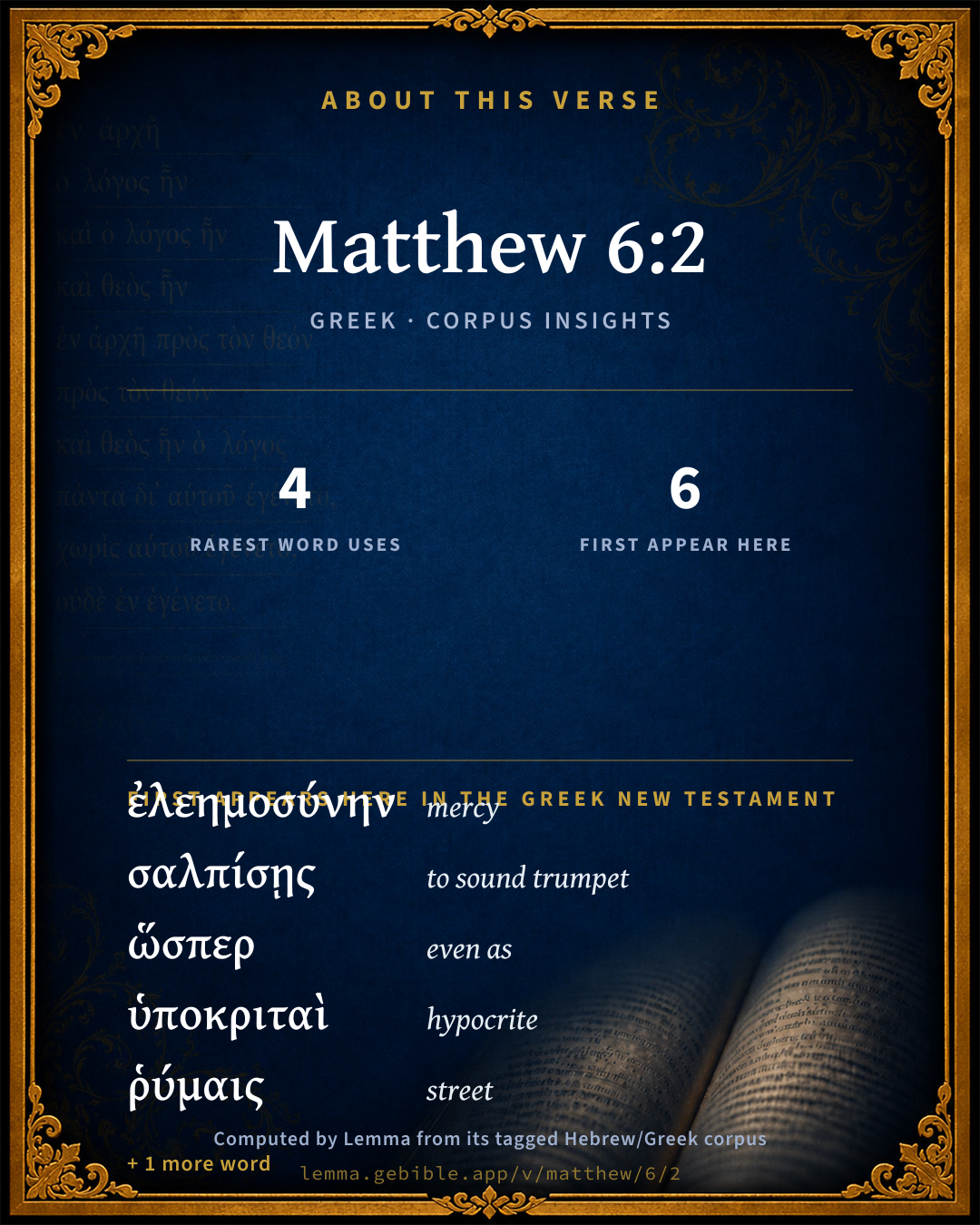
  • 6 first appearances in the Greek New Testament
Full analysis ↓
Download a study sheet

One document with this verse’s original text, its word-by-word gloss line, the meaning frame, cross-references with their text, attributed commentary, and full source and license credits — printable, and it pastes into notes with its structure intact.

This verse Autodidact and up

Study sheet (.html) Plain text (.txt)

A passage Seminary Student

Up to 50 verses in one chapter. A passage sheet keeps up to 6 commentary sources and 12 cross-references per verse, in the order this page ranks them, and says so on the sheet whenever that leaves anything out. Ask for a single verse and you get the Autodidact verse sheet above.

Everything on this page stays free to read, with no account — the sheet is a download of what is already on screen, not access to it.

Want to remove ads? Support Godless Engineer
Compare translations 3

The same verse in 3 English versions, stacked beneath the original-language interlinear above. Click any original word for its lexicon entry.

Each is an independent rendering of the whole verse — the interlinear is not word-aligned to these translations.

Highlighted words mark where these versions differ — a whole-verse word diff, not a word-by-word alignment.

  • World English Bible Public Domain
    Therefore when you do merciful deeds, don't sound a trumpet before yourself, as the hypocrites do in the synagogues and in the streets, that they may get glory from men. Most assuredly I tell you, they have received their reward.
  • King James Version Public Domain
    Therefore when thou doest thine alms, do not sound a trumpet before thee, as the hypocrites do in the synagogues and in the streets, that they may have glory of men. Verily I say unto you, They have their reward.
  • unfoldingWord Literal Text CC BY-SA 4.0
    So when you give alms, do not sound a trumpet before yourself even as the hypocrites do in the synagogues and in the streets so that they may be glorified by men. Truly I say to you, they have their reward in full.

unfoldingWord Literal Text — © unfoldingWord, licensed CC BY-SA 4.0. Word-aligned USFM3 via Door43 (git.door43.org/unfoldingWord/en_ult).

Versions to compare (up to 4)

3 of 4 selected

Show all 19 translations

Every available English version of this verse, each an independent rendering of the whole verse.

  • World English Bible Public Domain
    Therefore when you do merciful deeds, don't sound a trumpet before yourself, as the hypocrites do in the synagogues and in the streets, that they may get glory from men. Most assuredly I tell you, they have received their reward.
  • Berean Standard Bible Public Domain
    So when you give to the needy, do not sound a trumpet before you, as the hypocrites do in the synagogues and on the streets, to be honored by men. Truly I tell you, they already have their full reward.
  • Majority Standard Bible Public Domain
    So when you give to the needy, do not sound a trumpet before you, as the hypocrites do in the synagogues and on the streets, to be honored by men. Truly I tell you, they already have their full reward.
  • King James Version Public Domain
    Therefore when thou doest thine alms, do not sound a trumpet before thee, as the hypocrites do in the synagogues and in the streets, that they may have glory of men. Verily I say unto you, They have their reward.
  • American Standard Version (1901) Public Domain
    When therefore thou doest alms, sound not a trumpet before thee, as the hypocrites do in the synagogues and in the streets, that they may have glory of men. Verily I say unto you, They have received their reward.
  • Revised Version (1885) Public Domain
    When therefore thou doest alms, sound not a trumpet before thee, as the hypocrites do in the synagogues and in the streets, that they may have glory of men. Verily I say unto you, They have received their reward.
  • Geneva Bible (1599) Public Domain
    Therefore when thou giuest thine almes, thou shalt not make a trumpet to be blowen before thee, as the hypocrites doe in the Synagogues and in the streetes, to be praysed of men. Verely I say vnto you, they haue their rewarde.
  • Douay-Rheims (1899) Public Domain
    Therefore when thou dost an almsdeed, sound not a trumpet before thee, as the hypocrites do in the synagogues and in the streets, that they may be honoured by men. Amen I say to you, they have received their reward.
  • Young's Literal Translation Public Domain
    whenever, therefore, thou mayest do kindness, thou mayest not sound a trumpet before thee as the hypocrites do, in the synagogues, and in the streets, that they may have glory from men; verily I say to you -- they have their reward!
  • Literal Standard Version CC BY-SA 4.0
    whenever, therefore, you may do kindness, you may not sound a trumpet before you as the hypocrites do, in the synagogues, and in the streets, that they may have glory from men; truly I say to you, they have their reward!
  • Unlocked Literal Bible CC BY-SA 4.0
    So when you give alms, do not sound a trumpet before yourself as the hypocrites do in the synagogues and in the streets, so that they may have the praise of people. Truly I say to you, they have received their reward.
  • unfoldingWord Literal Text CC BY-SA 4.0
    So when you give alms, do not sound a trumpet before yourself even as the hypocrites do in the synagogues and in the streets so that they may be glorified by men. Truly I say to you, they have their reward in full.
  • Darby Bible Public Domain
    When therefore thou doest alms, sound not a trumpet before thee, as the hypocrites do in the synagogues and in the streets, so that they may have glory from men. Verily I say unto you, They have their reward.
  • World Messianic Bible Public Domain
    Therefore, when you do merciful deeds, don’t sound a shofar before yourself, as the hypocrites do in the synagogues and in the streets, that they may get glory from men. Most certainly I tell you, they have received their reward.
  • Webster's Bible Public Domain
    Therefore, when thou doest thy alms, do not sound a trumpet before thee, as the hypocrites do, in the synagogues, and in the streets, that they may have glory from men. Verily, I say to you, they have their reward.
  • Free Bible Version CC BY-SA 4.0
    When you give to the poor, don't be like the hypocrites who blow their own trumpets to announce what they're doing in the synagogues and in the streets so that people will praise them. I tell you the truth: they already have their reward.
  • Bible in Basic English Public Domain
    When then you give money to the poor, do not make a noise about it, as the false-hearted men do in the Synagogues and in the streets, so that they may have glory from men. Truly, I say to you, They have their reward.
  • Text-Critical English NT CC BY 4.0
    So when yoʋ give to the needy, do not sound a trumpet before yoʋ, as the hypocrites do in the synagogues and in the streets, so that they may be praised by others. Truly I say to you, they have received their reward.
  • Tyndale New Testament (1534) Public Domain
    When soever therfore thou gevest thine almes thou shalt not make a tropet to be blowe before the as the ypocrites do in the synagogis and in the stretis for to be preysed of men. Verely I say vnto you they have their rewarde.

Literal Standard Version (2020), Covenant Press — licensed CC BY-SA 4.0. Text via the HelloAO Bible API (eBible.org). Unlocked Literal Bible (unfoldingWord) — licensed CC BY-SA 4.0. Text via the HelloAO Bible API (eBible.org). unfoldingWord Literal Text — © unfoldingWord, licensed CC BY-SA 4.0. Word-aligned USFM3 via Door43 (git.door43.org/unfoldingWord/en_ult). Free Bible Version, Dr. Jonathan Gallagher — licensed CC BY-SA 4.0. Text via the HelloAO Bible API (eBible.org).

Word by word

More ways to search: Search by grammar → Find every occurrence → Compare this word →

Practice this passage: Drill this verse → Learn its vocabulary →

ῥύμαις
rhýmē
G4505
“street”
Noun, Dative, Plural, Feminine
Part of Speech
Noun
Case
Dative
Number
Plural
Gender
Feminine
Full Thayer's Definition

Origin: prolongation from G4506 in its original sense

TDNT: None

1. a swing, rush, force, trail, of a body in motion 2. a tract of way in a town shut in by buildings on both sides 3. a street, a lane
  1. ὅταν hótan G3752 “when” Conjunction
  2. οὖν oûn G3767 “therefore” Conjunction
  3. ποιῇς poiéō G4160 “to make” Verb, Present, Active, Subjunctive, 2nd person, Singular
  4. ἐλεημοσύνην eleēmosýnē G1654 “mercy” Noun, Accusative, Singular, Feminine
  5. μὴ mḗ G3361 “not” Particle, Negative
  6. σαλπίσῃς salpízō G4537 “to sound trumpet” Verb, Aorist, Active, Subjunctive, 2nd person, Singular
  7. ἔμπροσθέν émprosthen G1715 “before” Preposition
  8. σου sý G4771 “you” Personal pronoun, 2nd person, Genitive, Singular
  9. ὥσπερ hṓsper G5618 “even as” Adverb
  10. οἱ ho G3588 “the” Article, Nominative, Plural, Masculine
  11. ὑποκριταὶ hypokritḗs G5273 “hypocrite” Noun, Nominative, Plural, Masculine
  12. ποιοῦσιν poiéō G4160 “to make” Verb, Present, Active, Indicative, 3rd person, Plural
  13. ἐν en G1722 “in” Preposition
  14. ταῖς ho G3588 “the” Article, Dative, Plural, Feminine
  15. συναγωγαῖς synagōgḗ G4864 “gathering” Noun, Dative, Plural, Feminine
  16. καὶ kaí G2532 “and” Conjunction
  17. ἐν en G1722 “in” Preposition
  18. ταῖς ho G3588 “the” Article, Dative, Plural, Feminine
  19. ὅπως hópōs G3704 “how” Adverb
  20. δοξασθῶσιν doxázō G1392 “to glorify” Verb, Aorist, Passive, Subjunctive, 3rd person, Plural
  21. ὑπὸ hypó G5259 “under” Preposition
  22. τῶν ho G3588 “the” Article, Genitive, Plural, Masculine
  23. ἀνθρώπων ánthrōpos G444 “human being” Noun, Genitive, Plural, Masculine
  24. ἀμὴν amḗn G281 “amen” Hebrew transliteration
  25. λέγω légō G3004 “to say” Verb, Present, Active, Indicative, 1st person, Singular
  26. ὑμῖν hymeîs G5210 “you” Personal pronoun, 2nd person, Dative, Plural
  27. ἀπέχουσιν apéchō G568 “to hold off” Verb, Present, Active, Indicative, 3rd person, Plural
  28. τὸν ho G3588 “the” Article, Accusative, Singular, Masculine
  29. μισθὸν misthós G3408 “wages” Noun, Accusative, Singular, Masculine
  30. αὐτῶν autós G846 “he” Personal pronoun, Genitive, Plural, Masculine

About this verse

These counts appear in no published source. They are computed here, from the morphology-tagged text and Lemma’s own curated glosses. What Lemma adds →

31
words
25
distinct lemmas
Gospels
section

Notable vocabulary

The rarest word here is ῥύμαις street G4505 — appearing just 4 times in the whole Greek New Testament.

First appearance in Scripture

These words make their first canonical appearance in the Greek New Testament here:

  • ἐλεημοσύνην mercy G1654
  • σαλπίσῃς to sound trumpet G4537
  • ὥσπερ even as G5618
  • ὑποκριταὶ hypocrite G5273
  • ῥύμαις street G4505
  • ἀπέχουσιν to hold off G568

Shared distinctive vocabulary

ῥύμαις street G4505 occurs in 4 verses of the Greek New Testament. Also found in:
Repetition

Words recur within this verse:

Cross-references

52

Topical passages linked to Matthew 6:2 in the Treasury of Scripture Knowledge — connected by theme and wording, ordered by reader-vote popularity; previews shown in the World English Bible.

  • Matthew 6:5 "When you pray, you shall not be as the hypocrites, for they love to stand and pray in the synagogues and in the corners of the streets, that they may be seen by men. Most assuredly, I tell you, they have received their reward.
  • Matthew 6:16 "Moreover when you fast, don't be like the hypocrites, with sad faces. For they disfigure their faces, that they may be seen by men to be fasting. Most assuredly I tell you, they have received their reward.
  • 2 Corinthians 9:6–15 Remember this: he who sows sparingly will also reap sparingly. He who sows bountifully will also reap bountifully.
  • John 5:41 I don't receive glory from men.
  • James 2:15–16 And if a brother or sister is naked and in lack of daily food,
  • Luke 20:46 "Beware of the scribes, who like to walk in long robes, and love greetings in the marketplaces, the best seats in the synagogues, and the best places at feasts;
  • John 7:18 He who speaks from himself seeks his own glory, but he who seeks the glory of him who sent him, the same is true, and no unrighteousness is in him.
  • Hebrews 13:16 But don't forget to be doing good and sharing, for with such sacrifices God is well pleased.
  • 1 John 3:17–19 But whoever has the world's goods, and sees his brother in need, and closes his heart of compassion against him, how does the love of God remain in him?
  • 1 Peter 4:11 If any man speaks, let it be as it were oracles of God. If any man serves, let it be as of the strength which God supplies, that in all things God may be glorified through Jesus Christ, to whom belong the glory and the dominion forever and ever. Amen.
  • Psalms 37:21 The wicked borrow, and don't pay back, But the righteous give generously.
  • Hosea 8:1 "Put the trumpet to your lips! Something like an eagle is over Yahweh's house, Because they have broken my covenant, And rebelled against my law.
  • John 5:44 How can you believe, who receive glory from one another, and you don't seek the glory that comes from the only God?
  • Acts 10:4 He, fastening his eyes on him, and being frightened, said, "What is it, Lord?" He said to him, "Your prayers and your gifts to the needy have gone up for a memorial before God.
  • Acts 10:31 and said, 'Cornelius, your prayer is heard, and your gifts to the needy are remembered in the sight of God.
  • Romans 12:8 or he who exhorts, to his exhorting: he who gives, let him do it with liberality; he who rules, with diligence; he who shows mercy, with cheerfulness.
  • Galatians 2:10 They only asked us to remember the poor--which very thing I was also zealous to do.
  • Ephesians 4:28 Let him who stole steal no more; but rather let him labor, working with his hands the thing that is good, that he may have something to give to him who has need.
  • Psalms 112:9 He has dispersed, he has given to the poor. His righteousness endures forever. His horn will be exalted with honor.
  • Proverbs 19:17 He who has pity on the poor lends to Yahweh; He will reward him.
  • Proverbs 20:6 Many men claim to be men of unfailing love, But who can find a faithful man?
  • Matthew 23:13–29 "Woe to you, scribes and Pharisees, hypocrites! For you devour widows' houses, and as a pretense you make long prayers. Therefore you will receive greater condemnation.
  • Mark 12:39 and the best seats in the synagogues, and the best places at feasts:
  • Luke 6:42 Or how can you tell your brother, 'Brother, let me remove the speck of chaff that is in your eye,' when you yourself don't see the beam that is in your own eye? You hypocrite! First remove the beam from your own eye, and then you can see clearly to remove the speck of chaff that is in your brother's eye.
  • John 13:29 For some thought, because Judas had the money box, that Jesus said to him, "Buy what things we need for the feast," or that he should give something to the poor.
  • Acts 9:36 Now there was at Joppa a certain disciple named Tabitha, which when translated, means Dorcas. This woman was full of good works and acts of mercy which she did.
  • Acts 10:2 a devout man, and one who feared God with all his house, who gave gifts for the needy generously to the people, and always prayed to God.
  • Acts 24:17 Now after some years, I came to bring gifts for the needy to my nation, and offerings;
  • 1 Samuel 15:30 Then he said, I have sinned: yet honor me now, Please, before the elders of my people, and before Israel, and turn again with me, that I may worship Yahweh your God.
  • Job 31:16–20 "If I have withheld the poor from their desire, Or have caused the eyes of the widow to fail,
  • Ecclesiastes 11:2 Give a portion to seven, yes, even to eight; For you don't know what evil will be on the earth.
  • Isaiah 9:17 Therefore the Lord will not rejoice over their young men, neither will he have compassion on their fatherless and widows; for everyone is profane and an evil-doer, and every mouth speaks folly. For all this his anger is not turned away, but his hand is stretched out still.
  • Isaiah 58:7 Isn't it to deal your bread to the hungry, and that you bring the poor who are cast out to your house? when you see the naked, that you cover him; and that you not hide yourself from your own flesh?
  • Isaiah 58:10–12 and if you draw out your soul to the hungry, and satisfy the afflicted soul: then shall your light rise in darkness, and your obscurity be as the noonday;
  • Matthew 15:7 You hypocrites! Well did Isaiah prophesy of you, saying,
  • Matthew 16:3 In the morning, 'It will be foul weather today, for the sky is red and threatening.' Hypocrites! You know how to discern the appearance of the sky, but you can't discern the signs of the times!
  • Matthew 22:18 But Jesus perceived their wickedness, and said, "Why do you test me, you hypocrites?
  • Matthew 23:6 and love the place of honor at feasts, the best seats in the synagogues,
  • Matthew 24:51 and will cut him in pieces, and appoint his portion with the hypocrites; there is where the weeping and grinding of teeth will be.
  • Mark 7:6 He answered them, "Well did Isaiah prophesy of you hypocrites, as it is written, 'This people honors me with their lips, But their heart is far from me.
  • Luke 6:24 "But woe to you who are rich! For you have received your consolation.
  • Luke 11:41 But give for gifts to the needy those things which are within, and behold, all things will be clean to you.
  • Luke 11:43 Woe to you Pharisees! For you love the best seats in the synagogues, and the greetings in the marketplaces.
  • Luke 12:33 Sell that which you have, and give gifts to the needy. Make for yourselves purses which don't grow old, a treasure in the heavens that doesn't fail, where no thief approaches, neither moth destroys.
  • Luke 12:56 You hypocrites! You know how to interpret the appearance of the earth and the sky, but how is it that you don't interpret this time?
  • Luke 13:15 Therefore the Lord answered him, "You hypocrites! Doesn't each one of you free his ox or his donkey from the stall on the Sabbath, and lead him away to water?
  • Acts 11:29 As any of the disciples had plenty, each determined to send relief to the brothers who lived in Judea;
  • 1 Thessalonians 2:6 nor seeking glory from men (neither from you nor from others), when we might have claimed authority as apostles of Christ.
  • 1 Timothy 6:18 that they do good, that they be rich in good works, that they be ready to distribute, willing to communicate;
  • Philemon 1:7 For we have much joy and comfort in your love, because the hearts of the saints have been refreshed through you, brother.
  • Matthew 5:18 For most assuredly, I tell you, until heaven and earth pass away, not even one smallest letter or one tiny pen stroke shall in any way pass away from the law, until all things are accomplished.
  • Matthew 7:5 You hypocrite! First remove the beam out of your own eye, and then you can see clearly to remove the speck out of your brother's eye.

Cross-references courtesy of OpenBible.info (CC BY 4.0).

Commentary

Notes on Matthew 6:2 from classic Christian and Jewish commentators (each source and its license shown beneath its notes). The classic Christian expositions comment on the surrounding passage and are grouped to its opening verse, so a note may address several verses; the Jewish commentaries on the Tanakh (Rashi and others) are per-verse, so they appear only where the commentator wrote on this verse.

Lemma curates 59 commentaries, every one of them public domain or Creative Commons licensed, each selected and text-cleaned for this edition rather than reprinted as found. About our sources →

The Biblical Illustrator

Joseph S. Exell

Mat_6:2

Their reward.

Having ones reward

I. A profound truth about human nature-man works for reward.

II. There is a suggested contrast-their reward. In God all the noblest aspirations of men are met.

III. A sentence which the Divine Speaker passes upon some of the men of the time. They have their reward. They have it altogether. Irony, pathos. Their reward was transient, worthless. It does not necessarily follow that all good works done publicly forfeit Gods approval hereafter. (Canon Liddon.)

Their reward

Ostentatious piety has its own remuneration. There is real happiness in other things besides goodness. There is pleasure in wrong-doing; quarrelsome, destructive, lazy, gluttonous men find a certain kind of enjoyment in these. There is pleasure in the love of praise and pride. But that is all their reward. The gospel points out the great life that lies beyond; it charges man to use himself in this life that he may gain the higher. (Beecher.)

The Biblical Illustrator, edited by Joseph S. Exell (c. 1880s–1900s) — public domain. Text from a community e-Sword module.

Joseph Benson's Commentary

Mat 6:2-4. Therefore, &c. — The caution is so important, that our Lord illustrates it in various particulars. When thou doest thine alms — Exercisest thy charity by performing works of mercy; do not sound a trumpet before thee, as the hypocrites do — From this it would appear that, in our Lord’s time, persons who affected the reputation of being extremely charitable, sometimes sounded a trumpet when they distributed their alms, on pretence, no doubt, of calling together the poor to receive them, while their real intention was to proclaim their own good works, and receive glory of men. Wherefore, as his disciples were to do no work of charity from the motive of vanity, he absolutely forbade this custom of the hypocrites. Verily, I say unto you, they have their reward — All they will have; for they shall have none from God. Let not thy left hand know what thy right hand doeth — A proverbial expression for doing a thing secretly. Do it as secretly as is consistent, 1st, with the doing it at all; 2d, with the doing it in the most effectual manner. And never speak of it afterward, unless there be good reasons for making it known. That thine alms may be in secret — May be known to none but God, whose glory thou must have in view in all thy works, whether of piety, justice, or charity, and whose will it must be thy intention to obey in all things. And thy Father, which seeth in secret — Who knows every circumstance of mews most retired and private actions; himself shall reward thee openly — Viz., before men and angels, at the day of final judgment. For, though it be true, as Grotius here observes, that God often visibly rewards the charitable actions of pious persons, performed from true love to him, with temporal blessings in this life; yet will he chiefly do it in the sight of men and angels in the world to come. See Mat 25:34; Luk 14:14.

Joseph Benson's Commentary on the Old and New Testaments (1811–1818) — public domain. Text from a community e-Sword module.

Tyndale Open Study Notes

Tyndale Open Resources

6:2 the hypocrites: See study note on 23:13. • The blowing of trumpets accompanied major rituals, including public fasts.

Tyndale Open Study Notes — © Tyndale Open Resources, licensed CC BY-SA 4.0. Text via the HelloAO Bible API.

Bengel's Gnomon

Johann Albrecht Bengel

Mat 6:2. Μὴ σαλπίσης ἔμπροσθέν σου, do not sound a trumpet before thee) This affected and insolent ostentation of actually sounding a trumpet is not inconsistent with the practices of hypocrites among the Jews of that age: cf. Mat 6:5; Mat 6:16. The poor would be easily summoned by a trumpet: hypocrisy, therefore, employs it as a means of display.—οἱ ὑποκριταὶ, the hypocrites) Hypocrisy is the combination of actual vice with apparent virtue, by means of which a man deceives either himself or others.—ἀμήν, assuredly) our Lord [by virtue of His essential and proper divinity] knows the secrets of the Divine counsels.—ἀπέχουσι τὸν μισθὸν αὐτῶν, they have their reward[248]) An example of metonymy of the antecedent for the consequent, i.e. they will not receive any reward hereafter at the hands of their Heavenly Father; see Mat 6:1.

[248] Which consists in the praise of men.—B. G. V.

Bengel's Gnomon of the New Testament — English translation (T&T Clark, Edinburgh, 1860) — public domain. Text from a community e-Sword module.

Meyer's Critical & Exegetical Commentary

Heinrich August Wilhelm Meyer

Mat_6:2. Μὴ σαλπίσῃς] do not sound a trumpet, metaphorically: make no noise and display with it (Chrysostom, Theophylact, Euth. Zigabenus). Comp. Achill. Tat. viii. p. 507; Cic. ad Div. xvi. 21 : te buccinatorem fore existimationis meae. Prudent, de Symmach. ii. 68. Here ἔμπρ. refers to the idea of a person sounding a trumpet, which he holds up to his mouth. Others (Calvin, Calovius, Wolf, Paulus, also τινές referred to by Euth. Zigabenus) render: cause not a trumpet to be sounded before thee. They think that, in order to make a display, the Pharisees had actually made the poor assemble together by the blowing of trumpets. But the expression itself is as decidedly incompatible with this extraordinary explanation as it is with the notion that what is meant (Homberg, Schoettgen) is the sound produced by the clinking of the money, dropped into the alleged trumpet-like chests in the temple (see on Mar_12:41), and this notwithstanding that it is added, ἐν τ. συναγ. κ. ἐν τ. ῥύμ. On the injunction generally, comp. Babyl. Chagig. f. v. 1 : R. Jannai vidit quendam nummum pauperi dantem palam; cui dixit: praestat non dedisse, quam sic dedisse. In the synagogues it was the practice to collect the alms on the Sabbath; Lightfoot and Wetstein on this passage.

ὑποκριταί] in classical writers means actors; in the New Testament, hypocrites. Hypocrisis est mixtura malitiae cum specie bonitatis, Bengel.

ἀπέχουσι … αὐτε͂ν] inasmuch as they have already attained what was the sole object of their liberality, popular applause, and therefore have nothing more to expect. ἀπέχειν, to have obtained, to have fully received. See on Php_4:18.

Meyer — Critical and Exegetical Commentary on the New Testament — English translation by Peter Christie, edited by Frederick Crombie (T&T Clark, 1880) — public domain. Text from a community e-Sword module.

Expositor's Greek Testament

ed. W. Robertson Nicoll

Mat 6:2-4 . Almsgiving . Mat 6:2 . ἐλεημοσύνην , mercy in general, but specifically alms, as a common mode of showing mercy. Compare our word charity. σαλπίσῃς : to be understood metaphorically, as there is no evidence of the literal practice. Furrer gives this from Consul Wetstein to illustrate the word. When a man (in Damascus) wants to do a good act which may bring a blessing by way of divine recompense on his own family, e.g. , healing to a sick child, he goes to a water-carrier with a good voice, gives him a piece of money, and says “Sebil,” i.e. , give the thirsty a fresh drink of water. The water-carrier fills his skin, takes his stand in the market, and sings in varied tones: “O thirsty, come to the drink-offering,” the giver standing by, to whom the carrier says, as the thirsty drink, “God forgive thy sins, O giver of the drink” ( Zscht. für M. und R. , 1890. Vide also his Wanderungen d. d. H. L. , p. 437). ὑποκριταὶ , stage-players in classics, used in N. T. in a moral and sinister sense, and for the Christian mind heavily burdened with evil connotation hypocrites ! What a deepening of the moral sense is implied in the new meaning! The abhorrence of acting for effect in religion is due to Christ’s teaching. It has not yet quite banished the thing. There are religious actors still, and they draw good houses. συναγωγαῖς : where alms were collected, and apparently also distributed. ῥύμαις , streets, in eastern cities narrow lanes, a late meaning; in earlier Greek = impetus onset. Vide Rutherford’s New Phryn. , 488. Cf. πλατειῶν , Mat 6:5 . πλατεῖα , supp. ὁδός = a broad street. δοξασθῶσιν : in chap. Mat 5:16 God is conceived as recipient of the glory; here the almsgiver, giving for that purpose. ἀμὴν : introducing a solemn statement, and a very serious one for the parties concerned. ἀπέχουσι , they have in full ; they will get no more, nothing from God: so in Luk 6:24 , Phi 4:18 ( vide on Mar 14:41 ). The hypocrite partly does not believe this, partly does not care, so long as he gets the applause of his public.

The Expositor's Greek Testament, edited by W. Robertson Nicoll (1897–1910) — public domain. Text from a community e-Sword module.

Geneva Bible (1599)

Geneva Bible translators

Counterfeits, for Hypocrites were players that played a part in a play.

Geneva Bible (1599) marginal notes — public domain. Text via Bolls.life.

Jamieson, Fausset & Brown

Robert Jamieson, A. R. Fausset & David Brown

Therefore, when thou doest thine alms, do not sound a trumpet before thee--The expression is to be taken figuratively for blazoning it. Hence our expression to "trumpet."

as the hypocrites do--This word--of such frequent occurrence in Scripture, signifying primarily "one who acts a part"--denotes one who either pretends to be what he is not (as here), or dissembles what he really is (as in Luk 12:1-2).

in the synagogues and in the streets--the places of religious and secular resort.

that they may have glory of men. Verily I say unto you--In such august expressions, it is the Lawgiver and Judge Himself that we hear speaking to us.

They have their reward--All they wanted was human applause, and they have it--and with it, all they will ever get.

Jamieson, Fausset & Brown — Commentary Critical and Explanatory on the Whole Bible (1871) — public domain (CC PDM 1.0). Text via the HelloAO Bible API.

Adam Clarke's Commentary

Verse 2. Therefore when thou doest thine alms] In the first verse the exhortation is general: Take YE heed. In this verse the address is pointed - and THOU - man - woman - who readest - hearest.

Do not sound a trumpet] It is very likely that this was literally practised among the Pharisees, who seemed to live on the public esteem, and were excessively self-righteous and vain. Having something to distribute by way of alms, it is very probable they caused this to be published by blowing a trumpet or horn, under pretence of collecting the poor; though with no other design than to gratify their own ambition. There is a custom in the east not much unlike this. "The derveeshes carry horns with them, which they frequently blow, when any thing is given to them, in honor of the donor. It is not impossible that some of the poor Jews who begged alms might be furnished like the Persian derveeshes, who are a sort of religious beggars, and that these hypocrites might be disposed to confine their alms-giving to those that they knew would pay them this honour." HARMER'S Observat. vol. i. p. 474.

It must be granted, that in the Jewish writings there is no such practice referred to as that which I have supposed above, viz. blowing a trumpet to gather the poor, or the poor blowing a horn when relieved. Hence some learned men have thought that the word shopher, a trumpet, refers to the hole in the public alms chest, into which the money was dropped which was allotted for the service of the poor. Such holes, because they were wide at one end and grew gradually narrow towards the other, were actually termed שופרות shopheroth, trumpets, by the rabbins; of this Schoettgen furnishes several examples. An ostentatious man, who wished to attract the notice of those around him, would throw in his money with some force into these trumpet-resembling holes, and thus he might be said שופר σαλπιζειν, to sound the trumpet. The Jerusalem Gemara, tract Shekalim, describes these שופרות shopheroth thus - These trumpet holes were crooked, narrow above and wide below, in order to prevent fraud. As our Lord only uses the words, μησαλπισης, it may be tantamount to our term jingle. Do not make a public ostentatious jingle of that money which you give to public charities. Pride and hypocrisy are the things here reprehended. The Pharisees, no doubt, felt the weight of the reproof. Still the words may be taken in their literal meaning, as we know that the Moslimans, who nearly resemble the ancient Pharisees in the ostentation, bigotry, and cruelty of their character, are accustomed, in their festival of Muhurram, to erect stages in the public streets, and, by the sound of a trumpet, call the poor together to receive alms of rice, and other kinds of food. See WARD.

Works of charity and mercy should be done as much in private as is consistent with the advancement of the glory of God, and the effectual relief of the poor.

In the synagogues and in the streets] That such chests or boxes, for receiving the alms of well-disposed people, were placed in the synagogues, we may readily believe; but what were the streets? Schoettgen supposes that courts or avenues in the temple and in the synagogues may be intended - places where the people were accustomed to walk, for air, amusement, c., for it is not to be supposed that such chests were fixed in the public streets.

They have their reward.] That is, the honour and esteem of men which they sought. God is under no obligation to them-they did nothing with an eye to his glory, and from HIM they can expect no recompense. They had their recompense in this life and could expect none in the world to come.

Adam Clarke's Commentary on the Bible (1810–1826) — public domain. Text from a community e-Sword/MySword module.

Ellicott's Commentary for English Readers

(2) Alms.—The history of the word is singularly interesting. In the original meaning of the Greek it was the quality of mercy, or rather of “mercifulness,” as something more complete. The practice of the Hellenistic Jews limited the word (eleemosyna) to money-gifts. It passed with this meaning untranslated into the language of Latin Christendom, and from that again into European languages, in various forms, “aumone,” “almose,” and at last the word of six syllables and rich fulness of meaning contracts and collapses into our modern English “alms.”

Do not sound a trumpet before thee.—Two conjectural interpretations have been given of the words:—It has been supposed (1) that the wealthy Pharisees had a trumpet literally blown before them, to give notice to the poor of the neighbourhood that they were distributing their alms; (2) that the words refer to the clang of the money as it fell into the metal trumpet-shaped alms-boxes which were found in the synagogue, a clang which came as sweet music to the ears of the purse-proud giver. But as regards (1), the best scholars have found no trace of any such practice in Jewish literature, and it is hardly credible that such a thing could have been done in the synagogues; and (2) seems hardly adequate to the active meaning of the verb. There is no reason, however, for taking the words so literally. The figure of speech which describes a vain man as being “his own trumpeter,” or making a “flourish of trumpets” about his own acts, has been, or might be. common in every country where trumpets have been used. What is meant is that, whether in the “offertories” of the synagogue or the alms given to beggars in the streets, there was a parade of benevolence which practically summoned men to gaze and admire.

As the hypocrites do.—Here again the word has a history of its own. Derived from a Greek verb which signifies answering, taking part in a dialogue, acting a part in a play, the noun in classical Greek was used simply for an actor, a man who plays a part. In one passage only in the LXX. version of the Old Testament (Job_36:13) it appears in the figurative sense of one who feigns a virtue which he has not. It thus lay ready for the wider use which the Evangelists have given it (it is not used by any writer of the New Testament except St. Matthew, St. Mark, and St. Luke), and passed with this new meaning, hardly altered in form, first into Latin and then into most of the languages of modern Europe.

The streets.—More strictly, the lanes or alleys of a city, as distinguished from the wider streets, properly so called, of Mat_6:5; Mat_12:19, and elsewhere.

They have their reward.—The Greek is more expressive: They have to the full, and so exhaust. There is nothing more for them to look for. They bargained for that praise of men, and they get it; but they sought not the honour that cometh of God only, and therefore He gives them none.

A Bible Commentary for English Readers, edited by Charles John Ellicott (1878–1897) — public domain. Text from a community e-Sword module.

The Cambridge Bible for Schools and Colleges

gen. ed. J. J. S. Perowne

2. do not sound a trumpet before thee] The chests for alms in the Court of the Women, where the temple-treasury was placed, were called “trumpets” from their shape. Possibly the words of the text contain an allusion to these alms-chests. See Edersheim’s Temple in the time of our Lord, ch. ii. p. 26. But perhaps the expression means simply, “avoid ostentation in almsgiving.”

hypocrites] Lit. actors; those who play a part in life, whose actions are not the true reflection of their thoughts, whose religion is external and unreal. Such men begin by deceiving others, but end in self-deception. It is against these that our Lord’s severest reproofs are delivered.

in the synagogues] To this day alms are given in the Jewish synagogues.

They have] Strictly, have in full. Their reward is now and on earth.

The Cambridge Bible for Schools and Colleges (gen. ed. J. J. S. Perowne; Cambridge University Press, 1878–1918) — public domain. Text from a community e-Sword module.

John Gill's Exposition

Wherefore, when thou dost thine alms,.... Christ proceeds to give some directions and cautions about giving of alms, that they might be done aright, and answer some valuable purposes for the glory of God, the good of others, and their own:

do not sound a trumpet before thee, as the hypocrites do, in the synagogues, and in the streets, that they may have glory of men. The persons Christ has reference to were the Scribes and Pharisees, who did all they did to be seen of men; whom he calls "hypocrites"; as he often does, because they put on an appearance of religion and holiness, but inwardly, and otherwise, were very wicked men. It does not appear that any such practice was literally performed, as blowing a trumpet before them, when they gave their alms; though the collectors of alms did, by some means, publicly notify to the people when they were about that service: for one of their rules is (m),

"the collectors of alms do not proclaim on a feast, as they proclaim on a common day; but they collected "privately", and put it into their bosom, and distributed it to everyone by himself.''

Wherefore this must be understood proverbially; and the sense is, that when they did their alms, they chose public places for it, such as the "synagogues", where was a large concourse of people met together for religious worship; or the open "streets" of the city, where people were continually walking to and fro, so that nothing could be done in this way, but what must be seen and observed: and moreover, they took care, either by themselves, or others, to proclaim their good actions, that they might "have glory of men"; not only of the poor, or the collectors for them, but of the spectators. R. Aben Ezra (n) says, that

"a man that gives alms to the poor, must not give it because of the glory of the collector, i.e. that he may have glory of him; nor that the children of men may praise him.''

But his ancestors were of another mind: but what did they get by it?

verily I say unto you, they have their reward; and a poor one it is, the applause of men: however, it is what they seek after, and is all their empty performances deserve, and all they will have.

"He that glories in anything done by himself, , "he takes", or receives "his reward" (o); for as for any reward from God, they will have none;''

in this sense, as the Ethiopic version reads it, "they have lost their reward": and, as a learned critic has thought, is the sense of the Greek word, "they forbid", or "hinder their reward". By seeking the glory of men, they lay impediments in the way of receiving honour from God.

(m) T. Hieros. Demai, fol. 23. 2. (n) In Exod. xx. 3. (o) R. Jona apud Capell. Spicileg. in loc.

John Gill's Exposition of the Whole Bible (1746–1763) — public domain (CC PDM 1.0). Text via the HelloAO Bible API.

Trapp's Complete Commentary

John Trapp

2 Therefore when thou doest thine alms, do not sound a trumpet before thee, as the hypocrites do in the synagogues and in the streets, that they may have glory of men. Verily I say unto you, They have their reward.

Ver. 2. Therefore when thou doest thine alms] Unless thou set light by thy reward, as Esau did by his birthright; unless thou holdest heaven hardly worth having, and art of that carnal cardinal’s mind (Card. Bourbon), who preferred his part in Paris before his part in Paradise.

Do not sound a trumpet before thee] As the Pharisees did, under a show of assembling the poor to take dole, but indeed to notify their liberality. If they had been truly liberal, they had made no noise of it. Those vessels yield most sound that have least liquor. Vasa quae magis continent, minus sonant. (Seneca.)

As the hypocrites do] From whom as the saints differ in nature so they should in practice. We should have nothing common with them, no more than a chaste matron desires to have with a base strumpet. Son 2:7, the spouse desireth to know where Christ feedeth, that she may repair to him; for why should I be, saith she, as one that turneth aside (or, that is covered and veiled, which was the habit of harlots, Gen 38:15-16), why should I be reputed a light housewife, while I turn aside by the flocks of thy companions? She would shun and be shy of all appearance of dishonesty; so should we of hypocrisy. Those Christians of Corinth are much condemned by the apostle that carried themselves so carnally that a man could hardly discern them from other men. Richard Redman, Bishop of Ely, 1501, was not much to be commended for looking so like a Pharisee in that practice of his, of causing a bell to be rung wherever he came, to give notice to the poor of the place that they should have six pence a-piece, as many as came to him. And why are alms houses commonly built by the highway sides? &c.

That they may have glory of men] As Jehu, Come, see what a zeal I have for the Lord of hosts. Is thine heart upright as mine? &c. A gracious heart is not a blab of his tongue, but rests and rejoiceth silently in the conscience of a secret goodness. Not so the hypocrite, the self-seeker, the stage player, for so the word "hypocrite" properly signifieth, such as though little better than rogues, yet sometimes represent the persons of princes, and carry themselves with other faces than their own, that they may have glory of men, that they may get a plaudit. {a} And herewith agree all the former expressions; whatsoever these men do is merely theatrical (προς το θεαθηναι), hypocritical, histrionical. {b} They sound a trumpet, as is usual on stages: they do their devoir in the synagogues, public assemblies, and streets, as stage players act in open places, and by drums and outcries get as much company together as they can. And as they can act to the life those whom they impersonate, yea, outstrip them in outward actions, so do hypocrites the true Christian. Doth the publican fix his eyes on the ground? those hypocrites in Isaiah will hang down their heads like bulrushes. Doth Timothy weaken his constitution with abstinence? the false Pharisee will not only weaken his constitution, but wither his complexion with fasting. Doth Zaecheus give half of what he hath to the poor? the pretender to piety and charity will bestow all his goods to feed the poor, and, besides, give his body to be burned, 1Co 13:3, as Servetus did at Geneva, A.D. 1555. And all for a name, for a little glory among men, which is but a breath, and yet not able to blow so much as one cold blast upon hypocrites, when they shall be cast into unquenchable flames, when God shall wash off their varnish with rivers of brimstone. No natural face hath so clear a white and red as the painted. No rush is so green and smooth as the bulrush; he is curious to a miracle that can find a knot in it; yet within is nothing but a useless and spongy pith. {c} Overly fair shows are a just argument of unsoundness.

Verily I say unto you] q.d. You would little think it, and themselves will hardly believe it: for they are an impudent kind of people, and will not soon be said. But I assever and assure you of it, in the word of Amen, the faithfill and true witness, Rev 3:14, all the words of whose mouth are in righteousness, there is nothing froward or perverse in them, Pro 8:8, that this is the very truth, and time will prove it so. Asses that have fed on hemlock, are so stupefied thereby, that they lie for dead, and feel not till half their hides be hilded off: then they rise and run away with a foul noise. {d} So these.

They have their reward] Paid them down upon the nail in ready money, and have given their acquittance. They take up all their wages before the year’s end, they receive it now and leave none till hereafter. {e} It is all they are ever likely to have, and let them make them merry with it. Egregiam vero laudem, et spolia ampla refertis. A poor reward, God knows; but it is that which they would have. It is their own reward, not God’s, saith St Jerome. {f} As Judas went to his own place, a place of his own providing, Act 1:25, so these have their own reward, much good may it do them. Here they have their consolation with Dives :let them look for no further reward in the day of refreshing, if they do, they are like to be disappointed, saith the Judge. To themselves they bore fruit, Hos 10:1, and shall therefore be turned off as empty vines; when the faithful spouse that lays up her fruit for Christ, Son 7:13, shall hear, "Thou art like a green fir tree; from me is thy fruit found," Hos 14:8. And albeit in her works of charity in secret, and without hope of reward from men, she may seem to cast her bread upon the waters, down the river (as we say), or on the sea to feed fishes; yet after many days she shall be sure to find it, Ecc 11:1. That labour of love cannot be lost that we resolve to cast away (as the world accounts it) upon Christ.

{a} Hos Plautus vocat Holophantas, qui omnia ostentant et mentiantur. Sic Roscias Ulyssis, aut Aeneae repraesentat personaam, cum Ulysses non sit, nec Aeneas. Aretius.

{b} Theatrical in character or style, ‘stagey’; also fig. ‘acting a part’, hypocritical, deceitful. ŒD

{c} Nodum in scirpo quaerit. Isa 58:5.

{d} Dimidia pellis parte propendente, foedum rudorem edunt. Mathiolus.

{e} απεχουσι, They receive it as their full pay, whence αποχη, an acquittance. Luk 6:23.

{f} Mercedem suam, non Dei. Jerome.

John Trapp, A Commentary or Exposition upon All the Books of the Old and New Testament (1647–1656) — public domain. Text from a community e-Sword module.

Albert Barnes' Notes on the Bible

Do not sound a trumpet before thee, as the hypocrites do - The word “hypocrite” is taken from “stage-players,” who act the part of others, or speak not their own sentiments, but the sentiments of others. It means here, and in the New Testament generally, those who “dissemble” or hide their real sentiments, and assume or express other feelings than their own - those who, for purposes of ostentation, gain, or applause, put on the appearance of religion. It is probable that such persons, when they were about to bestow alms, caused a trumpet to be sounded, professedly to call the poor together to receive it, but really to call the people to see the proofs of their liberality and piety; or perhaps it may mean that they should not make a great noise about it, like sounding a trumpet.

In the synagogues - The word “synagogue” commonly means the place of assembling for religious worship known by that name. See the notes at Mat 4:23. It might mean, however, any “collection of people” assembled for any purpose, and it is not improbable that it has that meaning here. It does not appear that they made a noise in bestowing charity in the synagogues, or that charity was commonly bestowed there; but it was probably done on occasion of any great assemblage, in any place of concourse, and at the corners of the streets, where it could be seen by many.

They have their reward - That is, they obtain the applause they seek the reputation of being charitable; and as this applause was all they wished, there is, of course, no further reward to be looked for or obtained.

Albert Barnes' Notes on the Bible (1834–1885) — public domain. Text from a community e-Sword/MySword module.

Haydock's Catholic Bible Commentary

This must be understood figuratively, that we must avoid all ostentation in the performance of our good works. Many respectable authors are of opinion, that it was customary with the Pharisees and other hypocrites, to assemble the poor they designed to relieve by sound of trumpet. (Menochius) --- Let us avoid vain glory, the agreeable plunderer of our good works, the pleasant enemy of our souls, which presents its poison to us under the appearance of honey. (St. Basil)

George Leo Haydock (1774–1849), Haydock's Catholic Family Bible and Commentary, 1859 edition — public domain. Excludes Psalms (Douay-Rheims chapter numbering differs from Protestant) and Deuterocanonical books (Catholic canon only).

Matthew Poole's English Annotations

There are some who think that our Saviour here reflects upon some practice of the Pharisees then in use for ostentation, who, under a pretence of a means to call people together, caused a trumpet to be sounded when they distributed their alms; but those learned in their writings assure us they could never find in them any foundation for such an opinion. The speech is rather metaphorical, prohibiting all ostentation in acts of charity, and inviting others to take notice of them, as Jehu invited Jonadab to come and see his zeal, 2Ki 10:16; as the third verse is but a proverbial expression expounded Mat 6:4,

That thine alms may be in secret. Not that it is not lawful to give a poor body money or bread, &c., in the sight of others; but only to do it for that end, that we might be seen of others. The thing forbidden under the metaphorical expression is ostentation, and seeking our own honour and applause. The thing commanded is sincerity with respect to our end. The apostle calls it a giving with simplicity, singly aiming at the glorifying of God, by an obedient performance of our duty. He tells us those who give their alms to be honoured of men have their reward, that is, all which they are like to have; men applaud and cry them up, there is their reward: others shall have their reward from God,

who seeth in secret, and so needeth not such a publication of our good deeds; and he will reward them openly before men and angels at the last day, Mat 25:31,32,34, and ordinarily in this life, Psa 37:25; 41:1; Psa 112:9,10.

Matthew Poole's English Annotations on the Holy Bible (1683–1685) — public domain. Text from a community e-Sword/MySword module.

Whedon's Commentary on the Bible

Daniel D. Whedon

2. When thou doest thine alms — With a delicate reference to the secresy and individuality enjoined, our Lord changes the plural pronoun ye of the last verse to the more pointed thou. Do thou thus, personally and alone.

Be it here marked that our Lord presupposes that alms would be given. Even fallen Judaism was liberal to God and the poor. The extravagance of the present day, lavish of showy expense, has but a small surplus to spare for charities and liberalities. The Jew gave one tenth of his income; the Christian generally cannot give the hundredth part, since he needs it to supply rich furniture, personal pleasures, and investments for future profit!

Sound a trumpet — Symbol for making a great display to attract attention. There is no proof of the existence among the Jews of the practice of blowing a trumpet in almsgiving. Their reward — The applause of men which they seek, and the disapprobation of God whom they mock.

Daniel D. Whedon (gen. ed.), Commentary on the Old and New Testaments (1874–1909) — public domain. Text from a community e-Sword module.

The Pulpit Commentary

Vers. 2-4. Almsgiving. Matthew only.

Therefore. A deduction from the general principle laid down in ver. 1. When thou doest alms (poihv elehmosunhn). The exact phrase comes here and ver. 3 only. In Luk_11:41 and Luk_12:33 (dote) alms are con-sidereal rather as a gift; in Act_9:36 Act_10:2 Act_24:17 (elehmosunav), rather as to their separate occasions and materials; here quite generally but rather as an action, a work. Do not sound a trumpet (mh salpishv ). Probably a purely metaphorical expression (cf. our "He is his own trumpeter"). Edersheim, "Temple," etc., p. 27 (cf. Schottgen) sees rather in it an ironical allusion to the form and name of the treasure-chests in the court of the women. "The Lord, making use of the word "trumpet," describes the conduct of those who, in their almsgiving, sought glory from men as "sounding a trumpet" before them that is, carrying before them, as it were, in full display one of these trumpet-shaped alms-boxes (literally called in the Talmud, "trumpets"), and, as it were, sounding it." This interpretation would have been less fanciful if the substantive had been used instead of the verb. Others (e.g. Calvin, Bengel) have taken it of a literal trumpet; but of this practice there is no evidence whatever. "I have not found, although I have sought for it much and seriously, even the least mention of a trumpet in almsgiving" (J. Lightfoot, "Hor. Hebr."). Before thee; part of the metaphor, since one holds a trumpet up to one"s mouth. As the hypocrites do. The comma after do" in the ordinary text of the Authorized Version (not in Scrivener) connects "do not sound a trumpet before thee" with "in the synagogues," etc., and more readily suggests the literal interpretation of "trumpet" to the English reader. The hypocrites (o upokritai). In Attic usage the word means those who play a part upon the stage. Hence, by an easy transition to the moral sphere," hypocrisy" became used in later Greek of "the assumption of a part which masked men"s genuine feelings, and made them appear otherwise than they were". (cf. Bishop Lightfoot, on Gal_2:13) Persons who assumed this part would indeed often be identical with oo asebeiv oi paranomoi , and the term upokritai may sometimes be used as synonymous with these (an extension of language which would be the more easy as the Hebrew word for "hypocrite" (pnj) implies not so much hypocrisy as pollution by sin); but there seems no need (contrast Hatch, "Essays," p. 91) to see any other connotation in the New Testament than "hypocrite." To wilfully and continuously attempt to produce a false impression especially in religion is, after all, a mark of extreme distance from the truth-loving God. In the synagogues and in the streets (ver. 5, note). That they may have glory of men ( opwv doxasywsin); instead of this glory being given to God. (Mat_5:16) The thought, however, of the word is rather of the glory John given than of their welcome reception of it. (doxan lambanein , Mat_5:44; contrast Luk_4:15) Verily. (Mat_5:18, note) They have; Revised Version, they have received (apecousin). The force of the preposition is "correspond ence, i.e. of the contents to the capacity, of the possession to the desire, etc., so that it denotes the full complement". (Bishop Lightfoot, on Php_4:18) That which fully corresponds to their desires and their rightful expectation they have to the full. They therefore have (ecousi) no other reward left for them to receive (ver. 1). Schottgen gives several examples of Jewish sayings about men receiving their reward in this life only (cf. Ign., "Polyc.," "If a man boast of his chastity, he is lost").

Character shown in religious duties.

There is no certain evidence of such a custom as our Lord here refers to. Rich men sometimes had a certain day on which they distributed their alms. Then they may have sent round with a trumpet to call the poor people together. "In some cities Saturday is beggars" day, and every merchant, shopkeeper, and housewife lays by a store of coppers and remnants of food." Probably our Lord only used a figure, such as we employ when we speak of the "flourish of trumpets" by the boastful man. The chests in the temple to receive alms were trumpet-shaped, and were called trumpets; and no doubt some almsgivers would fling their coins into these trumpets so as to make a ringing noise, and call public attention to their benevolence. The point our Lord presents is this: alms-giving, as a recognized religious duty, finds expression for character and it cultures the character through finding it expression but let us be very careful that our charity finds expression for Christian character.

I NATURAL CHARACTER FINDING NATURAL EXPRESSION. There is such a thing as the "milk of human kindness." Some people are born with amiable, sympathetic, charitable dispositions. Doing kind things is simply natural to them. It costs no effort. It involves no self-denial. They give freely. They give so pleasantly that we do not realize how little the giving costs them. We may thank God for the "charitably disposed" among us, and accept thankfully their help toward the perfecting of the human brotherhood.

II DETERIORATED CHARACTER FINDING REPRESENTATIVE EXPRESSION, This is the case which Christ presents as a warning. Guileful persons, with lowered characters, will make their charity serve their selfish ends. You will see, by the way in which the gilt is made, the publicity of it; the anxiety about a suitable report being made of it; the mean advantage taken of the recipient of it; and the continuous after-brag about it; that a very deteriorated character, with very low and poor motives ruling it, was at the back of the gift. If we accept the gift, we cannot approve the giver.

III SANCTIFIED CHARACTER FINDING PIOUS EXPRESSION. Our Lord puts the pious expression into these forms. The disciple with the qualities indicated in the Beatitudes

(1) keeps his giving secret from other people;

(2) he even keeps it a secret from himself, and tries not to think about it (ver. 3); and

(3) he does his kindness for his heavenly Father"s sake, and because he wants to be a worthy child of him who is continually doing good. R.T.

The Pulpit Commentary (1880–1919), ed. H.D.M. Spence-Jones & Joseph S. Exell — public domain. Text from a community e-Sword module.

John Wesley's Explanatory Notes

As the hypocrites do - Many of the scribes and Pharisees did this, under a pretense of calling the poor together. They have their reward - All they will have; for they shall have none from God.

John Wesley, Explanatory Notes Upon the Whole Bible (1754–1765) — public domain. Text via the GEBible commentary corpus.

Scofield Reference Notes

C. I. Scofield

reward

i.e. the reward they have sought.

The Scofield Reference Bible (1917 edition), notes by C. I. Scofield — public domain. Text from a community e-Sword module.

Kretzmann's Popular Commentary

Paul E. Kretzmann

The false way to give alms:

v. 2. Therefore, when thou doest thine alms, do not sound a trumpet before thee, as the hypocrites do, in the synagogues and in the streets, that they may have glory of men. Verily, I say unto you, They have their reward

Christ mentions no names, but with one word characterizes those that make a show of their charity. Hypocrites they are, actors; they are acting for effect, there is nothing real and sound about the righteousness they affect. The sounding of trumpets, the attracting of attention was their object, not the helping of the poor. When the collection was made in the synagogues, they were most prominent in the act, though not in the gift. When beggars stopped them on the street, they were sure to attract the attention of all passers-by before making a show at almsgiving. They want the glory which properly belongs to God alone, chapter 5:16. In bitter irony, Christ says of them that they have their reward. The word is taken from the language of the banks. " They can sign the receipt of their reward: their right to receive the reward is realized, precisely as if they already had given a receipt for it. " They have nothing more to expect, they will get nothing from God.

Paul E. Kretzmann, Popular Commentary of the Bible (1921–1924) — public domain. Text from a community e-Sword module.

The People's New Testament

B. W. Johnson

2. When, therefore, thou doest alms. This is the first example. The wrong way, that of the hypocrites, is described. The Greek word rendered hypocrite means a theatrical actor, one who is not real, but acts a part. Their method was to give ostentatiously. In our age the world rings with the praises of the millionaire who gives a few thousands, but is silent concerning the humble ones who have taken from their necessities and given to the same cause. Sound a trumpet before thee. This seems to be a proverbial expression to denote the making of a thing publicly known. The meaning is, when you give to the poor, do not make a show of it. Hypocrite. A Grecian actor. The actors wore masks and appeared to be somebody else than they really were. So, too, the religious hypocrites.

B. W. Johnson's The People's New Testament with Notes (1889–1891) — public domain. Electronic text from the Christian Classics Ethereal Library (CCEL) ThML edition.

Cambridge Greek Testament for Schools and Colleges

2. ἐλεημοσύνη, not classical: it occurs in a poem by Callimachus of Cyrene, librarian of the famous Alexandrian library, circa 260 B.C. Elsewhere it seems to be confined to LXX. and to two writers in the N.T., St Matthew and St Luke. With Christianity the word became frequent and is found in all western languages in different forms—aumône, almosen, alms.

μὴ σαλπίσῃς. The chests for alms in the Synagogue and also in the Temple treasury were called shopharoth (trumpets) from their shape. Possibly the words of the text contain a reference to these shopharoth. Those who dropped their coins into the ‘trumpets’ with a ringing sound might be said σαλπίζειν. Schöttgen ad loc. But perhaps the expression means simply ‘avoid ostentation in almsgiving.’

οἱ ὑποκριταί. ὑποκριτὴς (1) lit. ‘one who answers,’ then from dialogues on the stage (2) ‘an actor,’ hence (3) in a sense confined to LXX. (Job 34:30; Job 36:13) and N.T. and there with one exception (Mar 7:6) to Matthew and Luke, ‘hypocrites,’ those who play a part in life, whose actions are not the true reflection of their thoughts, whose religion is external and unreal. Such men begin by deceiving others, but end in self-deception. It is against these that our Lord’s severest reproofs are delivered. ὑπόκρισις occurs in late authors (Polyb., Lucian) in the sense of ‘dissimulation,’ ‘hypocrisy.’

ἐν ταῖς ῥύμαις. ῥύμη passed from its classical force of ‘a rush,’ ‘impetus’, through the softened meaning of ‘going’, to that of a narrow lane or street, like English ‘alley’ from French aller. Polybius uses the word for the streets in a camp. In Luk 14:21 the ῥύμαι are contrasted with the πλατεῖαι or broad open spaces in an Eastern city. Schöttgen suggests that the meaning here may be the narrow ‘passages’ in a synagogue.

ἀπέχουσιν, ‘have in full.’ Their reward is now and on earth, cp. Luk 6:24, ἀπέχετε τὴν παράκλησιν. Php 4:18, ἀπέχω πάντα, and for the thought, ἀπέλαβες τὰ ἀγαθά σου ἐν τῇ ζωῇ σου, Luk 16:25.

Cambridge Greek Testament for Schools and Colleges (Cambridge University Press, 1896; 21 vols, various authors incl. Carr, Maclear, Plummer, Farrar, Lumby, Moule, M. R. James, Simcox) — public domain. Text from a community e-Sword module.

Alford’s Greek Testament

Henry Alford

2-4.] First example. Almsgiving.

2. μὴ σαλπίσῃς] A proverbial expression, not implying any such custom of the hypocrites of that day, but the habit of self-laudation, and display of good works in general. οὐχ ὅτι σάλπιγγας εἶχον ἐκεῖνοι, ἀλλὰ τὴν πολλὴν αὐτῶν ἐπιδεῖξαι βούλεται μανίαν τῇ λέξει τῆς μεταφορᾶς ταύτης, κωμῳδῶν ταύτῃ καὶ ἐκπομπεύων αὐτούς. Chrys. Hom, xix. 1, p. 245. Meyer remarks that the word σαλπίσῃς is tuba canas, not tuba cani cures, and must therefore refer to what the person himself does: but all verbs of action may surely refer to action per alterum, so that this does not decide the point. Many Commentators, among whom are Calvin and Bengel, think that the words are to be taken literally; and mentions this view: φασὶ δέ τινες ὅτι ὑποκριταὶ τότε διὰ σάλπιγγος συνεκάλουν τοὺς δεομένους. But Lightfoot says, “Non inveni, quæsiverim licet multum serioque, vel minimum tubæ vestigium in præstandis eleemosynis.” See his note, containing an account of the practices of the Jews in giving alms;—and many illustrative passages in Tholuck; among which may be mentioned Cic. ad diversos xvi. 21, ‘te buccinatorem fore existimationis meæ.’

For the classical senses of ὑποκριτής, see Lexx. The N.T. sense, connected with that of “actor,” is unknown to classic Greek, and first found in the LXX. See reff.

ἔμπρ. σου] According to the way in which the former verse is taken, these words are variously understood to apply to the trumpet being held up before the mouth in blowing (as Meyer), or to another person going before (Thol., .).

συναγωγαῖς can hardly bear any sense but synagogues, see ver. 5: and if so, the literal meaning of σαλπίσῃς cannot well be maintained. The synagogues, as afterwards the Christian churches, were the regular places for the collection of alms: see Tholuck and Vitringa de Synag. vet. iii. 1. 13.

ἀπέχουσιν] have in full,—exhaust: not have their due reward: see reff. Plutarch in Solon (.) says, that he who marries for pleasure, and not for children, τὸν μισθὸν ἀπέχει.

Henry Alford, The Greek Testament (1849–1861) — public domain. Text from a community e-Sword module.

International Critical Commentary

2-4. First illustration.

(L)

2. But when thou art doing alms, do not sound a trumpet before thee, as the hypocrites do in the synagogues and in the streets, that they may be glorified by men. Verily I say to you, They have their reward already.]

σαλπίσῃς] Not to be taken literally, but as a metaphor for methods of attracting notice.—οἱ ὑποκριταί] i.e. the scribes and Pharisees; cf. 15:7, 22:18, 23:13, 14, 15, 23, 25, 27, 29.

ῥμαις] See Kennedy, Sources, p. 15.

ὅπως δοξασθῶσιν] Contrast Bab. Bathra 10b “They (idolators) only do alms to be exalted.”

ἀπέχουσι] For ἀπέχω and its use in receipts, see Deissm. Bible Studies, p. 229. It means here, “They have their reward now, and can expect none in future.”

(L)

International Critical Commentary — older volumes (1896–1929), various authors — public domain. Text from a community e-Sword module.

Vincent's Word Studies in the New Testament

Marvin R. Vincent

Sound a trumpet [σαλπισης] . There seems to be no trace of any such custom on the part of almsgivers, so that the expression must be taken as a figurative one for making a display. It is just possible that the figure may have been suggested by the "trumpets" of the temple treasury - thirteen trumpet - shaped chests to receive the contributions of worshippers. (See on Luk 21:2.)

Have their reward (ajpecousin). The preposition ajpo indicates receipt in full. Rev. renders they have received, so that there is nothing more to receive. So Wyc., They have received their need.

Marvin R. Vincent, Word Studies in the New Testament (1887–1900) — public domain. Text from a community e-Sword/MySword module.

Lesson kit

Teaching starters — assembled from the data on this page, not authored interpretation. Every prompt links to the verse data it draws on. Edit before teaching.

Matthew, in the Gospels, opens this verse with 31 words (25 distinct Greek lemmas). Its most distinctive word is rhýmē (“street”). A historical commentator’s framing appears above. Read the whole chapter for the surrounding context.

Discussion questions

  1. How does “street” (rhýmē) shape what this verse is saying?
  2. 6 words here appear for the first time in Scripture. What is being introduced at this debut?
  3. Luke 14:21 shares the word «street» with this verse. How do the two illuminate each other?
  4. “to make” occurs 2× in this one verse. What is the effect of the repetition?
  5. The translations on this page render this verse differently — a whole-verse word diff, not a word-by-word alignment. What might account for the different wordings?
  6. Reading how The Biblical Illustrator and Joseph Benson's Commentary read this verse, where do the two commentators agree and where do they part?

Things to notice

  • 6 words make their first canonical appearance in Scripture here.
  • These translations choose different wording for 20 words in this verse.
  • “to make” occurs 2× in this single verse.
  • 25 distinct Greek lemmas span 31 words in this verse.

Reading settings

Reading text

Shown beneath each verse's original-language words.

Old Testament
Old Testament edition

Read the OT as the Masoretic Hebrew (MT) or the Greek Septuagint (LXX).

English shown for the Greek Septuagint (in the Hebrew ↔ Greek comparison).

Comparing translations? Open the Compare panel on any verse page to stack up to four side by side.