

Mark 16:18
Greek (Tischendorf 8th ed.) Mark 16:18 appears in the Greek New Testament. The text above is from the Tischendorf 8th edition. Each word links to its Strong’s number and a concise gloss. Click any word for its full Thayer’s Greek Lexicon entry.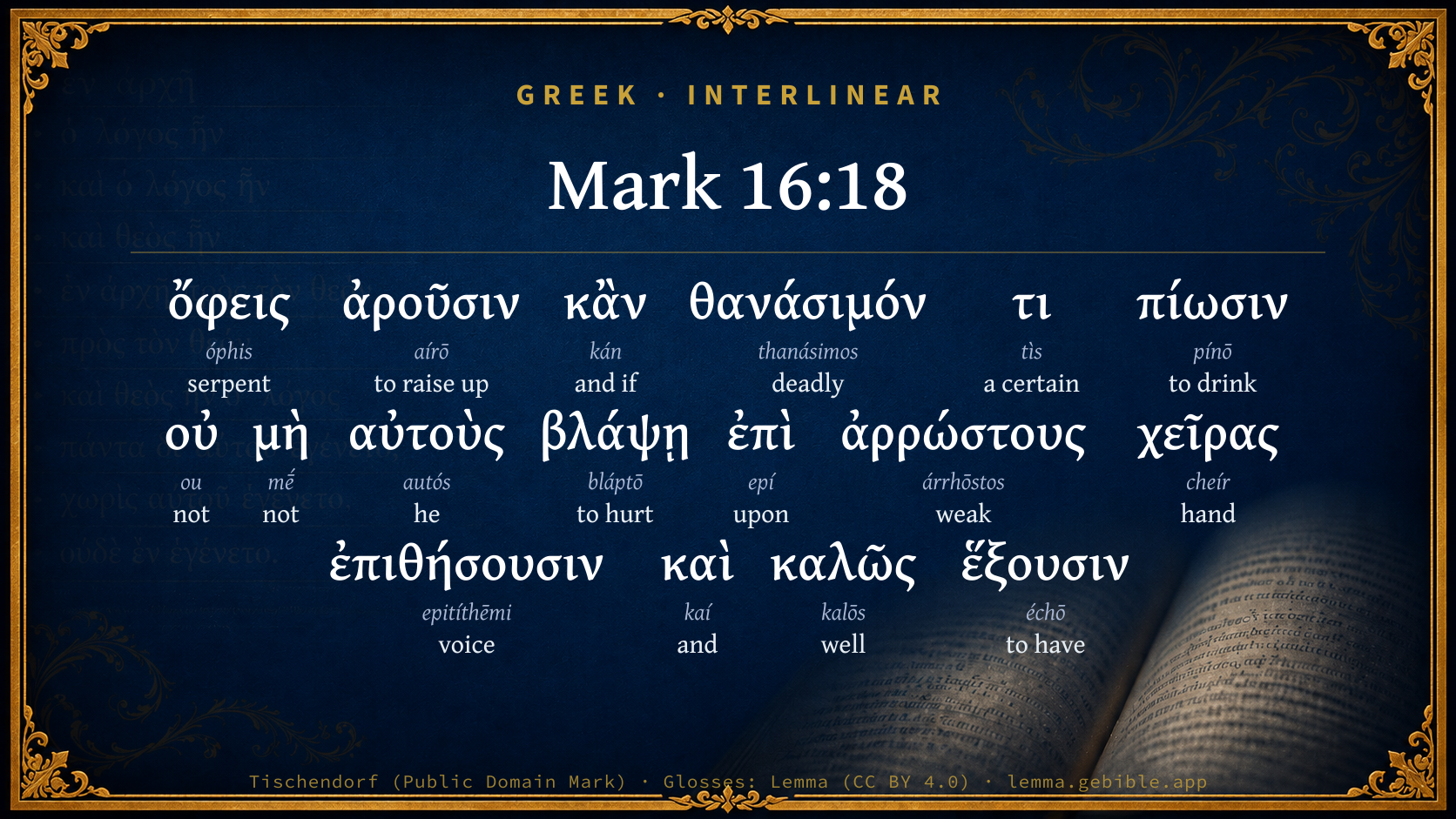
they will take up serpents; and if they drink any deadly thing, it will in no way hurt them; they will lay hands on the sick, and they will recover."
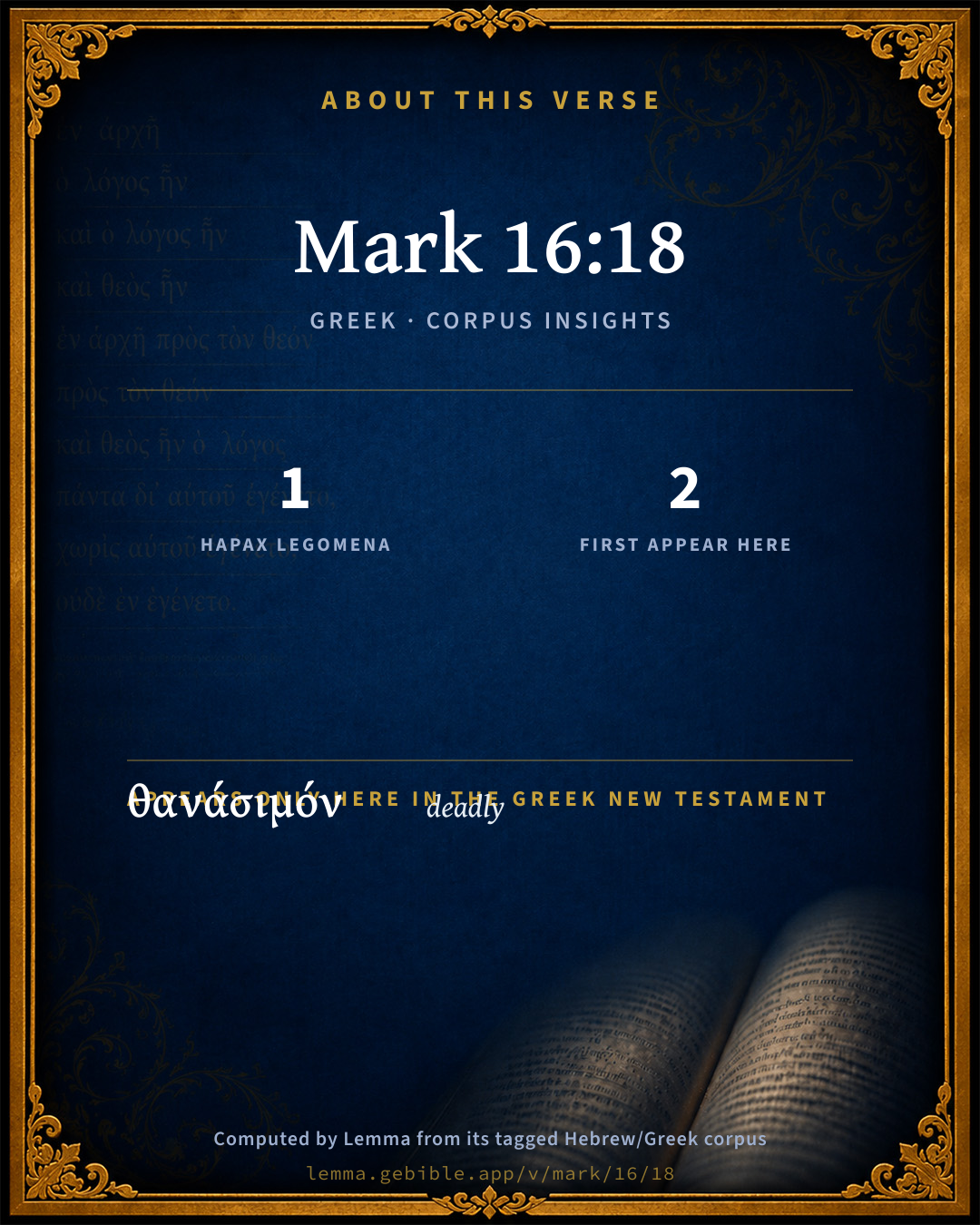
- 1 hapax legomenon — only here in the Greek New Testament
- 2 first appearances in the Greek New Testament
Download a study sheet
One document with this verse’s original text, its word-by-word gloss line, the meaning frame, cross-references with their text, attributed commentary, and full source and license credits — printable, and it pastes into notes with its structure intact.
This verse Autodidact and up
A passage Seminary Student
Up to 50 verses in one chapter. A passage sheet keeps up to 6 commentary sources and 12 cross-references per verse, in the order this page ranks them, and says so on the sheet whenever that leaves anything out. Ask for a single verse and you get the Autodidact verse sheet above.
Everything on this page stays free to read, with no account — the sheet is a download of what is already on screen, not access to it.
Compare translations 3
The same verse in 3 English versions, stacked beneath the original-language interlinear above. Click any original word for its lexicon entry.
Each is an independent rendering of the whole verse — the interlinear is not word-aligned to these translations.
Highlighted words mark where these versions differ — a whole-verse word diff, not a word-by-word alignment.
-
World English Bible Public Domain
they will take up serpents; and if they drink any deadly thing, it will in no way hurt them; they will lay hands on the sick, and they will recover."
-
King James Version Public Domain
They shall take up serpents; and if they drink any deadly thing, it shall not hurt them; they shall lay hands on the sick, and they shall recover.
-
unfoldingWord Literal Text CC BY-SA 4.0
they will pick up snakes, and if they drink anything deadly, it will certainly not hurt them; they will lay hands on the sick, and they will get well.”
unfoldingWord Literal Text — © unfoldingWord, licensed CC BY-SA 4.0. Word-aligned USFM3 via Door43 (git.door43.org/unfoldingWord/en_ult).
Show all 19 translations
Every available English version of this verse, each an independent rendering of the whole verse.
-
World English Bible Public Domain
they will take up serpents; and if they drink any deadly thing, it will in no way hurt them; they will lay hands on the sick, and they will recover."
-
Berean Standard Bible Public Domain
they will pick up snakes with their hands, and if they drink any deadly poison, it will not harm them; they will lay their hands on the sick, and they will be made well.”
-
Majority Standard Bible Public Domain
they will pick up snakes, and if they drink any deadly poison, it will not harm them; they will lay their hands on the sick, and they will be made well.”
-
King James Version Public Domain
They shall take up serpents; and if they drink any deadly thing, it shall not hurt them; they shall lay hands on the sick, and they shall recover.
-
American Standard Version (1901) Public Domain
they shall take up serpents, and if they drink any deadly thing, it shall in no wise hurt them; they shall lay hands on the sick, and they shall recover.
-
Revised Version (1885) Public Domain
they shall take up serpents, and if they drink any deadly thing, it shall in no wise hurt them; they shall lay hands on the sick, and they shall recover.
-
Geneva Bible (1599) Public Domain
And shall take away serpents, and if they shall drinke any deadly thing, it shall not hurt them: they shall lay their handes on the sicke, and they shall recouer.
-
Douay-Rheims (1899) Public Domain
They shall take up serpents; and if they shall drink any deadly thing, it shall not hurt them: they shall lay their hands upon the sick, and they shall recover.
-
Young's Literal Translation Public Domain
serpents they shall take up; and if any deadly thing they may drink, it shall not hurt them; on the ailing they shall lay hands, and they shall be well.'
-
Literal Standard Version CC BY-SA 4.0
they will take up serpents; and if they may drink any deadly thing, it will not hurt them; they will lay hands on the ailing, and they will be well.”
-
Unlocked Literal Bible CC BY-SA 4.0
They will pick up snakes with their hands, and if they drink anything deadly, it will not hurt them. They will lay hands on the sick, and they will get well.”
-
unfoldingWord Literal Text CC BY-SA 4.0
they will pick up snakes, and if they drink anything deadly, it will certainly not hurt them; they will lay hands on the sick, and they will get well.”
-
Darby Bible Public Domain
they shall take up serpents; and if they should drink any deadly thing it shall not injure them; they shall lay hands upon the infirm, and they shall be well.
-
World Messianic Bible Public Domain
they will take up serpents; and if they drink any deadly thing, it will in no way hurt them; they will lay hands on the sick, and they will recover.”
-
Webster's Bible Public Domain
They shall take up serpents; and if they drink any deadly thing, it shall not hurt them; they shall lay hands on the sick, and they shall recover.
-
Free Bible Version CC BY-SA 4.0
they will be able to handle snakes; if they drink something poisonous they won't be harmed; they will place their hands on the sick and they will be healed.”
-
Bible in Basic English Public Domain
They will take up snakes, and if there is poison in their drink, it will do them no evil; they will put their hands on those who are ill, and they will get well.
-
Text-Critical English NT CC BY 4.0
they will pick up serpents, and if they drink any deadly poison, it will certainly not harm them; they will lay hands on the sick, and they will get well.”
-
Tyndale New Testament (1534) Public Domain
and shall kyll serpentes. And yf they drinke eny dedly thinge that shall not hurte the. They shall laye their hondes on the sicke and they shall recover.
Literal Standard Version (2020), Covenant Press — licensed CC BY-SA 4.0. Text via the HelloAO Bible API (eBible.org). Unlocked Literal Bible (unfoldingWord) — licensed CC BY-SA 4.0. Text via the HelloAO Bible API (eBible.org). unfoldingWord Literal Text — © unfoldingWord, licensed CC BY-SA 4.0. Word-aligned USFM3 via Door43 (git.door43.org/unfoldingWord/en_ult). Free Bible Version, Dr. Jonathan Gallagher — licensed CC BY-SA 4.0. Text via the HelloAO Bible API (eBible.org).
Word by word
More ways to search: Search by grammar → Find every occurrence → Compare this word →
Practice this passage: Drill this verse → Learn its vocabulary →
- Appears 1× in the Greek New Testament
- First appears here
- Part of Speech
- Adjective
- Case
- Accusative
- Number
- Singular
- Gender
- Neuter
Full Thayer's Definition
- ὄφεις óphis G3789 “serpent” Noun, Accusative, Plural, Masculine
- ἀροῦσιν aírō G142 “to raise up” Verb, Future, Active, Indicative, 3rd person, Plural
- κἂν kán G2579 “and if” Conditional, Aramaic form
- θανάσιμόν thanásimos G2286 “deadly” Adjective, Accusative, Singular, Neuter
- τι tìs G5100 “a certain” Indefinite pronoun, Nominative, Singular, Neuter
- πίωσιν pínō G4095 “to drink” Verb, Aorist, Active, Subjunctive, 3rd person, Plural
- οὐ ou G3756 “not” Particle, Negative
- μὴ mḗ G3361 “not” Particle, Negative
- αὐτοὺς autós G846 “he” Personal pronoun, Accusative, Plural, Masculine
- βλάψῃ bláptō G984 “to hurt” Verb, Aorist, Active, Subjunctive, 3rd person, Singular
- ἐπὶ epí G1909 “upon” Preposition
- ἀρρώστους árrhōstos G732 “weak” Adjective, Accusative, Plural, Masculine
- χεῖρας cheír G5495 “hand” Noun, Accusative, Plural, Feminine
- ἐπιθήσουσιν epitíthēmi G2007 “voice” Verb, Future, Active, Indicative, 3rd person, Plural
- καὶ kaí G2532 “and” Conjunction
- καλῶς kalōs G2573 “well” Adverb
- ἕξουσιν échō G2192 “to have” Verb, Future, Active, Indicative, 3rd person, Plural
About this verse
These counts appear in no published source. They are computed here, from the morphology-tagged text and Lemma’s own curated glosses. What Lemma adds →
- 17
- words
- 17
- distinct lemmas
- Gospels
- section
Notable vocabulary
1 hapax legomenon — a word that appears only here in the entire Greek New Testament:
- θανάσιμόν deadly G2286
First appearance in Scripture
These words make their first canonical appearance in the Greek New Testament here:
Shared distinctive vocabulary
βλάψῃ to hurt G984 occurs in 2 verses of the Greek New Testament. Also found in:
Cross-references
21Topical passages linked to Mark 16:18 in the Treasury of Scripture Knowledge — connected by theme and wording, ordered by reader-vote popularity; previews shown in the World English Bible.
- Luke 10:19 Behold, I give you authority to tread on serpents and scorpions, and over all the power of the enemy. Nothing will in any way hurt you.
- James 5:14–15 Is any among you sick? Let him call for the elders of the assembly, and let them pray over him, anointing him with oil in the name of the Lord,
- Acts 28:3–6 But when Paul had gathered a bundle of sticks and laid them on the fire, a viper came out because of the heat, and fastened on his hand.
- Acts 19:12 so that even handkerchiefs or aprons were carried away from his body to the sick, and the evil spirits went out.
- Acts 4:30 while you stretch out your hand to heal; and that signs and wonders may be done through the name of your holy Servant Jesus."
- Acts 28:8–9 It happened that the father of Publius lay sick of fever and dysentery. Paul entered in to him, prayed, and laying his hands on him, healed him.
- Mark 5:23 and begged him much, saying, "My little daughter is at the point of death. Please come and lay your hands on her, that she may be made healthy, and live."
- Acts 3:16 By faith in his name has his name made this man strong, whom you see and know. Yes, the faith which is through him has given him this perfect soundness in the presence of you all.
- Psalms 91:13 You will tread on the lion and cobra. You will trample the young lion and the serpent underfoot.
- Acts 3:12 When Peter saw it, he responded to the people, "You men of Israel, why do you marvel at this man? Why do you fasten your eyes on us, as though by our own power or godliness we had made him walk?
- Acts 9:34 Peter said to him, "Aeneas, Jesus Christ heals you. Get up and make your bed!" Immediately he arose.
- Romans 16:20 And the God of peace will quickly crush Satan under your feet. The grace of our Lord Jesus Christ be with you.
- Acts 3:6–8 But Peter said, "Silver and gold have I none, but what I have, that I give you. In the name of Jesus Christ of Nazareth, get up and walk!"
- Acts 5:15–16 They even carried out the sick into the streets, and laid them on cots and mattresses, so that as Peter came by, at the least his shadow might overshadow some of them.
- Acts 9:17–18 Ananias departed, and entered into the house. Laying his hands on him, he said, "Brother Saul, the Lord, who appeared to you on the road by which you came, has sent me, that you may receive your sight, and be filled with the Holy Spirit."
- Acts 9:40–42 Peter put them all out, and kneeled down and prayed. Turning to the body, he said, "Tabitha, get up!" She opened her eyes, and when she saw Peter, she sat up.
- 2 Kings 4:39–41 One went out into the field to gather herbs, and found a wild vine, and gathered of it wild gourds his lap full, and came and shred them into the pot of stew; for they didn't recognize them.
- 1 Corinthians 12:9 to another faith, by the same Spirit; and to another gifts of healings, by the same Spirit;
- Genesis 3:15 I will put enmity between you and the woman, and between your offspring and her offspring. He will bruise your head, and you will bruise his heel."
- Acts 4:10 be it known to you all, and to all the people of Israel, that in the name of Jesus Christ of Nazareth, whom you crucified, whom God raised from the dead, in him does this man stand here before you whole.
- Acts 4:22 For the man on whom this miracle of healing was performed was more than forty years old.
Cross-references courtesy of OpenBible.info (CC BY 4.0).
Where the printed editions differ
3 variantsPlaces in this verse where the major printed Greek editions disagree on the wording in a way that affects the translation — a comparison of editions, not a manuscript-by-manuscript collation. The editions are the modern critical texts (Nestlé-Aland 28/27, SBL, Westcott-Hort, Tregelles, Tyndale House) and the traditional texts behind the KJV (the Textus Receptus and the Byzantine/Majority text). It is not a claim about which reading is original.
-
Extra text
καὶ ἐν ταῖς χερσὶν
“and with their hands”
In NA28NA27TynWHTreg Not in SBLTRByz -
Extra text
ὄφεις ἀροῦσιν, κἂν θανάσιμόν τι πίωσιν, οὐ μὴ αὐτοὺς
“serpents they will take up, and if deadly anything they shall drink, certainly not them”
In NA28NA27TynWHTregTRByz Not in SBL -
Extra text
ἐπὶ ἀρρώστους χεῖρας ἐπιθήσουσιν καὶ καλῶς ἕξουσιν.
“upon [the] sick hands they will lay and well they will be.”
In NA28NA27TynWHTregTRByz Not in SBLκαὶ ἐν ταῖς χερσὶν ὄφεις ἀροῦσιν, κἂν θανάσιμόν τι πίωσιν, οὐ μὴ αὐτοὺς βλάψει, ἐπὶ ἀρρώστους χεῖρας ἐπιθήσουσιν καὶ καλῶς ἕξουσιν.¶ (kai en tais chersin opheis arousin kan thanasimon ti piōsin ou mē autous blapsei epi arrōstous cheiras epithēsousin kai kalōs hexousin) 'and with their hands serpents they will take up, and if deadly anything they shall drink, certainly not them it will hurt, upon [the] sick hands they will lay and well they will be.' is only in traditional manuscripts
Textual data: Translators Amalgamated Greek New Testament (STEPBible TAGNT) · CC BY 4.0.
Lesson kit
Teaching starters — assembled from the data on this page, not authored interpretation. Every prompt links to the verse data it draws on. Edit before teaching.
Mark, in the Gospels, opens this verse with 17 words (17 distinct Greek lemmas). Its most distinctive word is thanásimos (“deadly”). A historical commentator’s framing appears above. Read the whole chapter for the surrounding context.
Discussion questions
- How does “deadly” (thanásimos) shape what this verse is saying?
- 1 word here appears nowhere else in the Greek New Testament. Why might the author reach for such rare wording?
- 2 words make their first appearance in Scripture here. What does this debut establish?
- How does Luke 4:35, which shares the word «to hurt», read alongside this verse?
- These translations render this verse differently. What is at stake in choosing one wording over another?
- Compare how The Biblical Illustrator and Bengel's Gnomon read this verse. Where do they agree or differ?
Things to notice
- 1 word in this verse appears nowhere else in the Greek New Testament.
- 2 words make their first canonical appearance in Scripture here.
- These translations choose different wording for 14 words in this verse.
- 17 distinct Greek lemmas span 17 words in this verse.
Commentary
Notes on Mark 16:18 from classic Christian and Jewish commentators (each source and its license shown beneath its notes). The classic Christian expositions comment on the surrounding passage and are grouped to its opening verse, so a note may address several verses; the Jewish commentaries on the Tanakh (Rashi and others) are per-verse, so they appear only where the commentator wrote on this verse.
Lemma curates 59 commentaries, every one of them public domain or Creative Commons licensed, each selected and text-cleaned for this edition rather than reprinted as found. About our sources →
The Biblical Illustrator
Joseph S. Exell
The Biblical Illustrator, edited by Joseph S. Exell (c. 1880s–1900s) — public domain. Text from a community e-Sword module.
Bengel's Gnomon
Johann Albrecht Bengel
Bengel's Gnomon of the New Testament — English translation (T&T Clark, Edinburgh, 1860) — public domain. Text from a community e-Sword module.
Meyer's Critical & Exegetical Commentary
Heinrich August Wilhelm Meyer
Meyer — Critical and Exegetical Commentary on the New Testament — English translation by Peter Christie, edited by Frederick Crombie (T&T Clark, 1880) — public domain. Text from a community e-Sword module.
Adam Clarke's Commentary
Adam Clarke's Commentary on the Bible (1810–1826) — public domain. Text from a community e-Sword/MySword module.
Ellicott's Commentary for English Readers
A Bible Commentary for English Readers, edited by Charles John Ellicott (1878–1897) — public domain. Text from a community e-Sword module.
The Cambridge Bible for Schools and Colleges
gen. ed. J. J. S. Perowne
The Cambridge Bible for Schools and Colleges (gen. ed. J. J. S. Perowne; Cambridge University Press, 1878–1918) — public domain. Text from a community e-Sword module.
John Gill's Exposition
John Gill's Exposition of the Whole Bible (1746–1763) — public domain (CC PDM 1.0). Text via the HelloAO Bible API.
Trapp's Complete Commentary
John Trapp
John Trapp, A Commentary or Exposition upon All the Books of the Old and New Testament (1647–1656) — public domain. Text from a community e-Sword module.
Albert Barnes' Notes on the Bible
Albert Barnes' Notes on the Bible (1834–1885) — public domain. Text from a community e-Sword/MySword module.
Whedon's Commentary on the Bible
Daniel D. Whedon
Daniel D. Whedon (gen. ed.), Commentary on the Old and New Testaments (1874–1909) — public domain. Text from a community e-Sword module.
John Wesley's Explanatory Notes
John Wesley, Explanatory Notes Upon the Whole Bible (1754–1765) — public domain. Text via the GEBible commentary corpus.
Cambridge Greek Testament for Schools and Colleges
Cambridge Greek Testament for Schools and Colleges (Cambridge University Press, 1896; 21 vols, various authors incl. Carr, Maclear, Plummer, Farrar, Lumby, Moule, M. R. James, Simcox) — public domain. Text from a community e-Sword module.
Alford’s Greek Testament
Henry Alford
Henry Alford, The Greek Testament (1849–1861) — public domain. Text from a community e-Sword module.
Vincent's Word Studies in the New Testament
Marvin R. Vincent
Marvin R. Vincent, Word Studies in the New Testament (1887–1900) — public domain. Text from a community e-Sword/MySword module.