
Matthew 5:42

Greek (Tischendorf 8th ed.) Matthew 5:42 appears in the Greek New Testament. The text above is from the Tischendorf 8th edition. Each word links to its Strong’s number and a concise gloss. Click any word for its full Thayer’s Greek Lexicon entry.
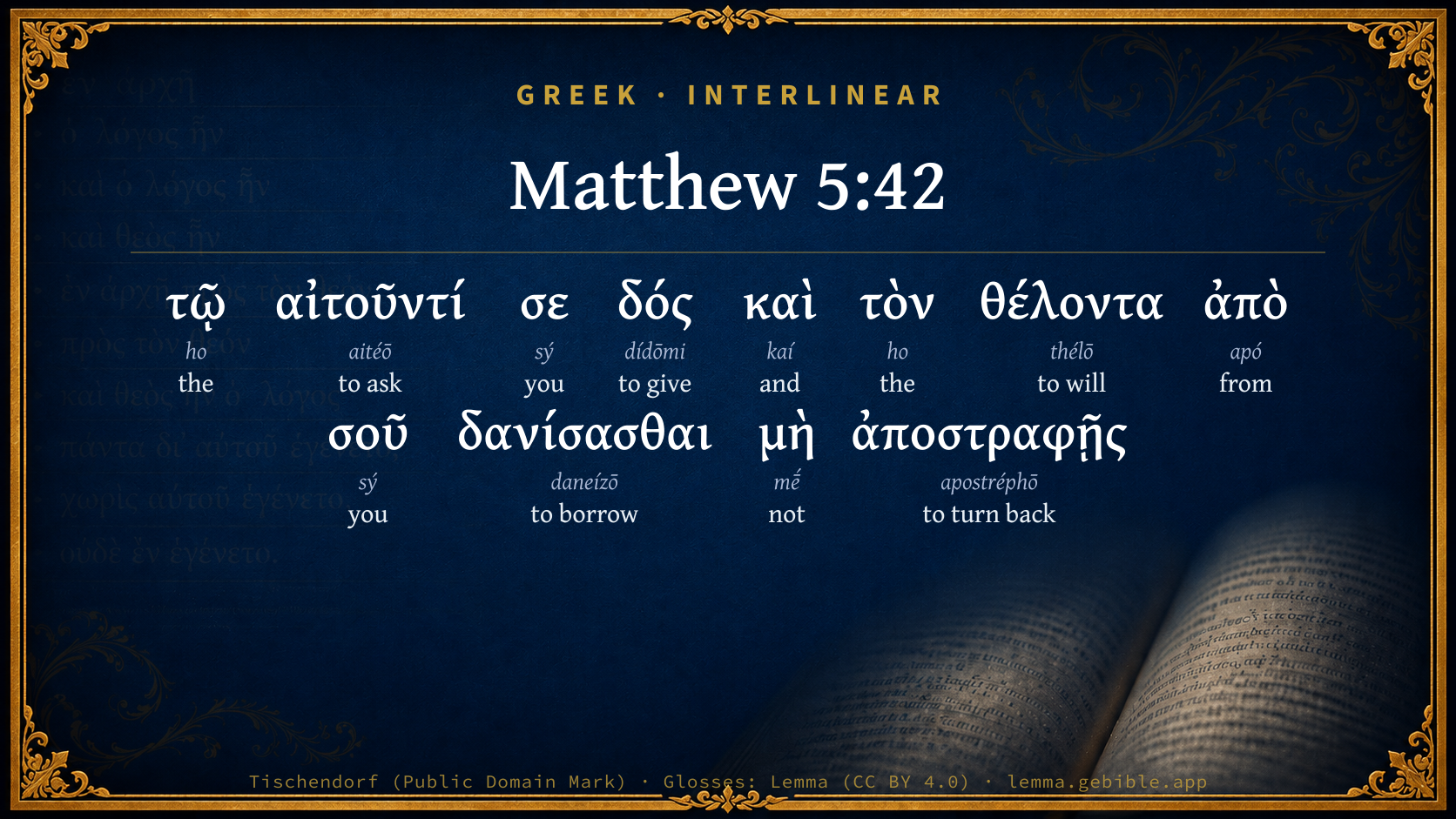
Download image
Cite this verse

Matthew 5:42 (World English Bible). Public Domain. Lemma interlinear Bible study tool, https://lemma.gebible.app/v/matthew/5/42.

Show BibTeX & RIS
BibTeX
RIS
English Translation
Give to him who asks you, and don't turn away him who desires to borrow from you.
World English Bible · Public Domain
Highlights
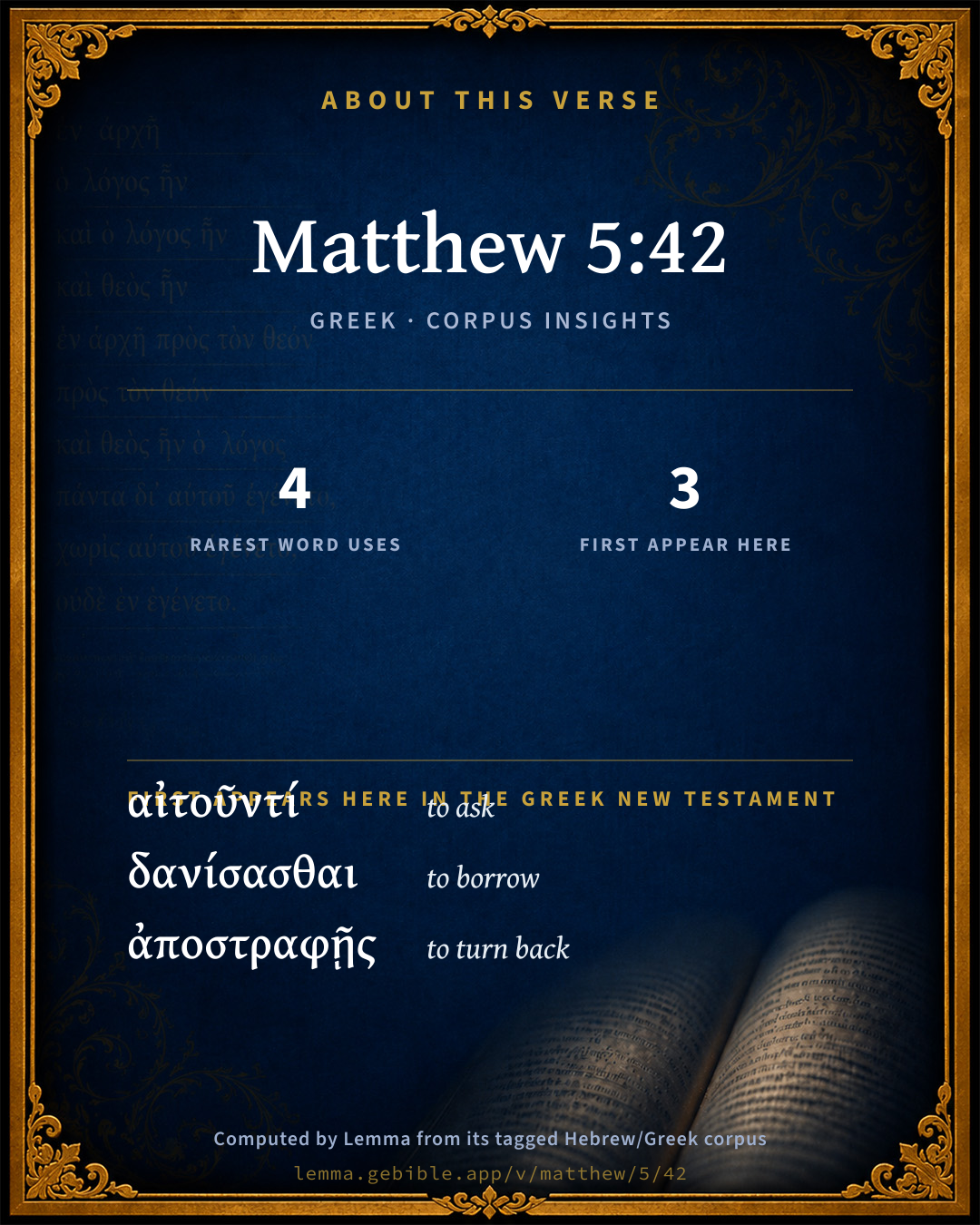
  • 3 first appearances in the Greek New Testament
Full analysis ↓
Download a study sheet

One document with this verse’s original text, its word-by-word gloss line, the meaning frame, cross-references with their text, attributed commentary, and full source and license credits — printable, and it pastes into notes with its structure intact.

This verse Autodidact and up

Study sheet (.html) Plain text (.txt)

A passage Seminary Student

Up to 50 verses in one chapter. A passage sheet keeps up to 6 commentary sources and 12 cross-references per verse, in the order this page ranks them, and says so on the sheet whenever that leaves anything out. Ask for a single verse and you get the Autodidact verse sheet above.

Everything on this page stays free to read, with no account — the sheet is a download of what is already on screen, not access to it.

Want to remove ads? Support Godless Engineer
Compare translations 3

The same verse in 3 English versions, stacked beneath the original-language interlinear above. Click any original word for its lexicon entry.

Each is an independent rendering of the whole verse — the interlinear is not word-aligned to these translations.

Highlighted words mark where these versions differ — a whole-verse word diff, not a word-by-word alignment.

  • World English Bible Public Domain
    Give to him who asks you, and don't turn away him who desires to borrow from you.
  • King James Version Public Domain
    Give to him that asketh thee, and from him that would borrow of thee turn not thou away.
  • unfoldingWord Literal Text CC BY-SA 4.0
    Give to the one asking you, and do not turn away from the one wanting to borrow from you.

unfoldingWord Literal Text — © unfoldingWord, licensed CC BY-SA 4.0. Word-aligned USFM3 via Door43 (git.door43.org/unfoldingWord/en_ult).

Versions to compare (up to 4)

3 of 4 selected

Show all 19 translations

Every available English version of this verse, each an independent rendering of the whole verse.

  • World English Bible Public Domain
    Give to him who asks you, and don't turn away him who desires to borrow from you.
  • Berean Standard Bible Public Domain
    Give to the one who asks you, and do not turn away from the one who wants to borrow from you.
  • Majority Standard Bible Public Domain
    Give to the one who asks you, and do not turn away from the one who wants to borrow from you.
  • King James Version Public Domain
    Give to him that asketh thee, and from him that would borrow of thee turn not thou away.
  • American Standard Version (1901) Public Domain
    Give to him that asketh thee, and from him that would borrow of thee turn not thou away.
  • Revised Version (1885) Public Domain
    Give to him that asketh thee, and from him that would borrow of thee turn not thou away.
  • Geneva Bible (1599) Public Domain
    Giue to him that asketh, and from him that would borowe of thee, turne not away.
  • Douay-Rheims (1899) Public Domain
    Give to him that asketh of thee and from him that would borrow of thee turn not away.
  • Young's Literal Translation Public Domain
    to him who is asking of thee be giving, and him who is willing to borrow from thee thou mayest not turn away.
  • Literal Standard Version CC BY-SA 4.0
    to him who is asking of you be giving, and him who is willing to borrow from you, you may not turn away.
  • Unlocked Literal Bible CC BY-SA 4.0
    Give to anyone who asks you, and do not turn away from anyone who wishes to borrow from you.
  • unfoldingWord Literal Text CC BY-SA 4.0
    Give to the one asking you, and do not turn away from the one wanting to borrow from you.
  • Darby Bible Public Domain
    To him that asks of thee give, and from him that desires to borrow of thee turn not away.
  • World Messianic Bible Public Domain
    Give to him who asks you, and don’t turn away him who desires to borrow from you.
  • Webster's Bible Public Domain
    Give to him that asketh thee, and from him that would borrow of thee, turn not thou away.
  • Free Bible Version CC BY-SA 4.0
    Give to those who ask you, and don't turn away those who want to borrow from you.
  • Bible in Basic English Public Domain
    Give to him who comes with a request, and keep not your property from him who would for a time make use of it.
  • Text-Critical English NT CC BY 4.0
    Give to everyone who asks of yoʋ, and do not turn away from anyone who wants to borrow from yoʋ.
  • Tyndale New Testament (1534) Public Domain
    Geve to him that axeth and from him that wolde borowe tourne not awaye.

Literal Standard Version (2020), Covenant Press — licensed CC BY-SA 4.0. Text via the HelloAO Bible API (eBible.org). Unlocked Literal Bible (unfoldingWord) — licensed CC BY-SA 4.0. Text via the HelloAO Bible API (eBible.org). unfoldingWord Literal Text — © unfoldingWord, licensed CC BY-SA 4.0. Word-aligned USFM3 via Door43 (git.door43.org/unfoldingWord/en_ult). Free Bible Version, Dr. Jonathan Gallagher — licensed CC BY-SA 4.0. Text via the HelloAO Bible API (eBible.org).

Word by word

More ways to search: Search by grammar → Find every occurrence → Compare this word →

Practice this passage: Drill this verse → Learn its vocabulary →

About this verse

These counts appear in no published source. They are computed here, from the morphology-tagged text and Lemma’s own curated glosses. What Lemma adds →

12
words
10
distinct lemmas
Gospels
section

Notable vocabulary

The rarest word here is δανίσασθαι to borrow G1155 — appearing just 4 times in the whole Greek New Testament.

First appearance in Scripture

These words make their first canonical appearance in the Greek New Testament here:

  • αἰτοῦντί to ask G154
  • δανίσασθαι to borrow G1155
  • ἀποστραφῇς to turn back G654

Shared distinctive vocabulary

δανίσασθαι to borrow G1155 occurs in 3 verses of the Greek New Testament. Also found in:
Repetition

Words recur within this verse:

Cross-references

22

Topical passages linked to Matthew 5:42 in the Treasury of Scripture Knowledge — connected by theme and wording, ordered by reader-vote popularity; previews shown in the World English Bible.

  • Proverbs 19:17 He who has pity on the poor lends to Yahweh; He will reward him.
  • Hebrews 13:16 But don't forget to be doing good and sharing, for with such sacrifices God is well pleased.
  • Luke 6:30–36 Give to everyone who asks you, and don't ask him who takes away your goods to give them back again.
  • Psalms 37:21 The wicked borrow, and don't pay back, But the righteous give generously.
  • Psalms 112:5–9 It is well with the man who deals graciously and lends. He will maintain his cause in judgment.
  • 1 Timothy 6:17–19 Charge those who are rich in this present world that they not be haughty, nor have their hope set on the uncertainty of riches, but on the living God, who richly provides us with everything to enjoy;
  • 1 John 3:16–18 By this we know love, because he laid down his life for us. And we ought to lay down our lives for the brothers.
  • Deuteronomy 15:7–14 If there be with you a poor man, one of your brothers, within any of your gates in your land which Yahweh your God gives you, you shall not harden your heart, nor shut your hand from your poor brother;
  • Romans 12:20 Therefore "If your enemy is hungry, feed him. If he is thirsty, give him a drink. For in doing so, you will heap coals of fire on his head."
  • 2 Corinthians 9:6–15 Remember this: he who sows sparingly will also reap sparingly. He who sows bountifully will also reap bountifully.
  • Psalms 37:25–26 I have been young, and now am old, Yet I have not seen the righteous forsaken, Nor his children begging for bread.
  • Proverbs 3:27–28 Don't withhold good from those to whom it is due, When it is in the power of your hand to do it.
  • Matthew 25:35–40 for I was hungry, and you gave me food to eat; I was thirsty, and you gave me drink; I was a stranger, and you took me in;
  • James 2:15–16 And if a brother or sister is naked and in lack of daily food,
  • Ecclesiastes 11:6 In the morning sow your seed, And in the evening don't withhold your hand; For you don't know which will prosper, whether this or that, Or whether they both will be equally good.
  • Daniel 4:27 Therefore, O king, let my counsel be acceptable to you, and break off your sins by righteousness, and your iniquities by showing mercy to the poor; if there may be a lengthening of your tranquillity.
  • Job 31:16–20 "If I have withheld the poor from their desire, Or have caused the eyes of the widow to fail,
  • Proverbs 11:24–25 There is one who scatters, and increases yet more. There is one who withholds more than is appropriate, but gains poverty.
  • Isaiah 58:6–12 Isn't this the fast that I have chosen: to loose the bonds of wickedness, to undo the bands of the yoke, and to let the oppressed go free, and that you break every yoke?
  • Luke 14:12–14 He also said to the one who had invited him, "When you make a dinner or a supper, don't call your friends, nor your brothers, nor your kinsmen, nor rich neighbors, or perhaps they might also return the favor, and pay you back.
  • Hebrews 6:10 For God is not unrighteous, so as to forget your work and the labor of love which you showed toward his name, in that you served the saints, and still do serve them.
  • Ecclesiastes 11:1–2 Cast your bread on the waters; For you shall find it after many days.

Cross-references courtesy of OpenBible.info (CC BY 4.0).

Commentary

Notes on Matthew 5:42 from classic Christian and Jewish commentators (each source and its license shown beneath its notes). The classic Christian expositions comment on the surrounding passage and are grouped to its opening verse, so a note may address several verses; the Jewish commentaries on the Tanakh (Rashi and others) are per-verse, so they appear only where the commentator wrote on this verse.

Lemma curates 59 commentaries, every one of them public domain or Creative Commons licensed, each selected and text-cleaned for this edition rather than reprinted as found. About our sources →

Tyndale Open Study Notes

Tyndale Open Resources

5:42 See Deut 15:7-11.

Tyndale Open Study Notes — © Tyndale Open Resources, licensed CC BY-SA 4.0. Text via the HelloAO Bible API.

Bengel's Gnomon

Johann Albrecht Bengel

Mat 5:42. Αἰτοῦντι, to him that asketh) who wishes you to give to him gratuitously, even though he do not ask with the best claim.—δίδου, give) as God does; see Luk 11:10.—τὸν θέλοντα, him that would) even though he does not venture to beseech thee vehemently.—μὴ ἀποστραφῆς, turn not thou away) although you have a specious pretext for so doing.

Bengel's Gnomon of the New Testament — English translation (T&T Clark, Edinburgh, 1860) — public domain. Text from a community e-Sword module.

Meyer's Critical & Exegetical Commentary

Heinrich August Wilhelm Meyer

Mat_5:42. A precept (in opposition to selfishness) which does not stand indeed in essential connection with what precedes, but which is still brought into connection with it through the natural connection of the thoughts. According to Ewald, who here lays weight (Jahrb. I. p. 132 f.) upon the number seven in the quotations of the O. T. laws, there must have stood after Mat_5:41 in the original collection of sayings the following words: ἠκούσατε, ὅτι ἐῤῥήθη· οὐ κλέψεις, ἀποδώσεις δὲ τὸ ἱμάτιον τῷ πτωχῷ· ἐγὼ δὲ λέγω ὑμῖν· τῷ αἰτοῦντι, and so on, and then, Mat_5:40. The command that is wanting was put together from Exo_20:15; Deu_24:12 f. A very thoughtful conjecture, which is followed by Holtzmann; but unnecessary, for this reason, that the contents and order of the sentences, Mat_5:40-42, attach themselves to one fundamental thought; and improbable, because not merely an omission, but also a transposition, is assumed, and because τῷ αἰτοῦντι, κ.τ.λ., does not correspond to the prohibition of thieving as its fulfilment.

δανείς.] That Jesus did not think of lending out at interest, appears from Exo_22:24; Lev_25:37; Deu_15:7; Deu_23:20; Ewald, Alterthumer, p. 242 f. [E. T. 181].

Meyer — Critical and Exegetical Commentary on the New Testament — English translation by Peter Christie, edited by Frederick Crombie (T&T Clark, 1880) — public domain. Text from a community e-Sword module.

Expositor's Greek Testament

ed. W. Robertson Nicoll

Mat 5:42 . This counsel does not seem to belong to the same category as the preceding three. One does not think of begging or borrowing as an injury, but at most as a nuisance. Some have doubted the genuineness of the logion as a part of the Sermon. But it occurs in Luke’s redaction (Mat 6:30 ), transformed indeed so as to make it a case of the sturdy beggar who helps himself to what he does not get for the asking. Were there idle, lawless tramps in Palestine in our Lord’s time, and would He counsel such treatment of them? If so, it is the extreme instance of not resisting evil. μὴ ἀποστραφῇς with τὸν θέλοντα in accusative. One would expect the genitive with the middle, the active taking an accusative with genitive, e.g. , 2Ti 4:4 , τὴν ἀκοὴν ἀπὸ τῆς ἀληθείας . But the transitive sense is intelligible. In turning myself away from another, I turn him away from me. Vide Heb 12:25 , 2Ti 1:15 .

The Expositor's Greek Testament, edited by W. Robertson Nicoll (1897–1910) — public domain. Text from a community e-Sword module.

Jamieson, Fausset & Brown

Robert Jamieson, A. R. Fausset & David Brown

Give to him that asketh thee--The sense of unreasonable asking is here implied (compare Luk 6:30).

and from him that would borrow of thee turn not thou away--Though the word signifies classically "to have money lent to one on security," or "with interest," yet as this was not the original sense of the word, and as usury was forbidden among the Jews (Exo 22:25, &c.), it is doubtless simple borrowing which our Lord here means, as indeed the whole strain of the exhortation implies. This shows that such counsels as "Owe no man anything" (Rom 13:8), are not to be taken absolutely; else the Scripture commendations of the righteous for "lending" to his necessitous brother (Psa 37:36; Psa 112:5; Luk 6:37) would have no application.

turn not thou away--a graphic expression of unfeeling refusal to relieve a brother in extremity.

Same Subject--Love to Enemies (Mat 5:43-48).

Jamieson, Fausset & Brown — Commentary Critical and Explanatory on the Whole Bible (1871) — public domain (CC PDM 1.0). Text via the HelloAO Bible API.

Adam Clarke's Commentary

Verse 42. Give to him that asketh thee, and from him that would borrow] To give and lend freely to all who are in need, is a general precept from which we are only excused by our inability to perform it. Men are more or less obliged to it as they are more or less able, as the want is more or less pressing, as they are more or less burthened with common poor, or with necessitous relatives. In all these matters, both prudence and charity must be consulted. That God, who makes use of the beggar's hand to ask our charity, is the same from whom we ourselves beg our daily bread: and dare we refuse HIM! Let us show at least mildness and compassion, when we can do no more; and if we cannot or will not relieve a poor man, let us never give him an ill word nor an ill look. If we do not relieve him, we have no right to insult him.

To give and to lend, are two duties of charity which Christ joins together, and which he sets on equal footing. A rich man is one of God's stewards: God has given him money for the poor, and he cannot deny it without an act of injustice. But no man, from what is called a principle of charity or generosity, should give that in alms which belongs to his creditors. Generosity is godlike; but justice has ever, both in law and Gospel, the first claim.

A loan is often more beneficial than an absolute gift: first, because it flatters less the vanity of him who lends; secondly, it spares more the shame of him who is in real want; and, thirdly, it gives less encouragement to the idleness of him who may not be very honest. However, no advantage should be taken of the necessities of the borrower: he who does so is, at least, half a murderer. The lending which our Lord here inculcates is that which requires no more than the restoration of the principal in a convenient time: otherwise to live upon trust is the sure way to pay double.

Adam Clarke's Commentary on the Bible (1810–1826) — public domain. Text from a community e-Sword/MySword module.

Ellicott's Commentary for English Readers

(42) Give to him that asketh.—Here again our Lord teaches us by the method of a seeming paradox, and enforces a principle binding upon every one in the form of a rule which in its letter is binding upon no man. Were we to give to all men what they ask, we should in many cases be cursing, not blessing, them with our gifts. Not so does our Father give us what we ask in prayer; not so did Christ grant the prayers of His disciples. That which the words really teach as the ideal of the perfect life which we ought to aim at, is the loving and the giving temper that sees in every request made to us the expression of a want of some kind, which we are to consider as a call to thoughtful inquiry how best to meet the want, giving what is asked for if we honestly believe that it is really for the good of him who asks, giving something else if that would seem to be really better for him. Rightly understood, the words do not bid us idly give alms to the idle or the impostor; and St. Paul’s rule, “If a man will not work, neither let him eat” (2Th_3:10), is not a departure from the law of Christ, but its truest application and fulfilment.

From him that would borrow.—The force of the precept depends on its connection with the Jewish Law, which forbade not only what we call usury, i.e., excessive interest, but all interest on loans where debtor and creditor alike were Israelites (Exo_22:25; Lev_25:37; Deu_23:19-20). From our modern point of view that law cannot be regarded as in harmony with the present order of society, nor consistent with our modern views of financial justice. It is not the less true, however, that in the education of a family or nation, such a prohibition may be a necessary and useful discipline. We should look with scorn on boys who lent on interest to their brothers or their schoolfellows, and the ideal of the Law of Moses was that of treating all Israelites as brothers brought under the discipline of the schoolmaster. As if with a prescient insight into the besetting temptation of the race, the lawgiver forbade a practice which would have destroyed, and eventually did destroy, the sense of brotherhood (Neh_5:1-13), leaving it open to receive interest from strangers who were outside the limits of the family (Deu_23:20). The higher law of Christ treats all men as brothers, and bids us, if it is right to lend as an act of charity, to do so for love, and not for profit. Cases where the business of the world calls for loans not for the relief of want, but as a matter of commercial convenience, lie obviously outside the range of the precept.

A Bible Commentary for English Readers, edited by Charles John Ellicott (1878–1897) — public domain. Text from a community e-Sword module.

The Cambridge Bible for Schools and Colleges

gen. ed. J. J. S. Perowne

42. from him that would borrow of thee] Luke has “lend, hoping for nothing again.” Forced loans have been a mode of oppression in every age, for which, perhaps, no people have suffered more than the Jews.

The Cambridge Bible for Schools and Colleges (gen. ed. J. J. S. Perowne; Cambridge University Press, 1878–1918) — public domain. Text from a community e-Sword module.

John Gill's Exposition

Give to him that asketh thee,.... To every man, Luk 6:30 whether Jew or Gentile; friend or foe; believer or unbeliever; a good, or a bad man; worthy or unworthy; deserving or not, that asketh alms, whether food or money; give it freely, readily, cheerfully, according to your abilities, and as the necessity of the object requires: for such rules are always supposed, and to be observed; and though all are to be relieved, yet the circumstances of persons, and their relation to men, are to be considered, and special regard is to be had to the household of faith.

And from him that would borrow of thee, turn not away; refuse him not, turn not away from him with a frown, or without speaking to him, or with a denial; look upon him with a pleasant countenance, cheerfully lend him what he wants, whether he be a Jew, from whom it was not lawful to take usury, or a stranger, from whom it, was lawful to take it, yet take it not; lend him freely, "hoping for nothing again", Luk 6:35 which must not be understood of not hoping for the money lent, for then it would be giving, and not lending; but of not hoping for any reward for lending it: and indeed the money itself is not to be hoped for again, when the circumstances of the borrower are such, that he is not able to make a return.

John Gill's Exposition of the Whole Bible (1746–1763) — public domain (CC PDM 1.0). Text via the HelloAO Bible API.

Trapp's Complete Commentary

John Trapp

42 Give to him that asketh thee, and from him that would borrow of thee turn not thou away.

Ver. 42. Give to him that asketh thee] Yet with discretion and choice of a fit object. {a} Which having met with be not weary of well doing; for in due season ye shall reap, if ye faint not, Gal 6:9. Giving is compared to sowing, which, in good ground, is usually with increase. Therefore a worthy minister, upon occasion, asking his wife whether there were any money in the house, she answered, that she knew but of one three pence; well, saith he, we must go sow, that is, give something to the poor, knowing that to be the way of bringing in, Pro 11:24-25 Deu 15:10. The mercy of God crowns our beneficence with the blessing of store. {b} Happy was the Sareptan that she was no niggard of her last handful. The more we give, the more we have: it increaseth in the giving, as the loaves in our Saviour’s hands did. Never did a charitable act go away without the retribution of a blessing. How improvident therefore are we, that will not offer a sacrifice of alms when God sets up an altar before us! It were an excellent course, surely, if Christians now, as they of old at Corinth, would lay up weekly a part of their gettings for pious and charitable uses; and that men would abound in this work of the Lord, as knowing that their labour is not in vain in the Lord (I speak of them that are able, for we may not stretch beyond our staple, and so spoil all). We read of a bishop of Lincoln, that never thought he had that thing that he did not give; and of one bishop of Rome (though that is a rare thing) that was so liberal to the poor, that when he was asked by certain ambassadors whether he had any hunting dogs to show them, he answered, Yes. And bringing them to a great sort of poor people, whom he daily relieved at his table, These are the dogs, saith he, wherewith I hunt after heaven. {c} Bishop Hooper, also, had his board of beggars. Twice I was (saith Mr Fox) in his house at Worcester: where in his common hall, I saw a table spread with good store of food, and beset full of beggars and poor folk. And this was his daily custom. And when they were served and catechised, then he himself sat down to dinner, and not before. Queen Anna Boleyn carried ever about her a certain little purse, out of which she was wont daily to scatter some alms to the needy: thinking no day well spent wherein some man had not fared the better by some benefit at her hands. The Savoy, Bridewell, and another hospital, founded by King Edward VI, upon a sermon of Bp Ridley’s, do speak and testify both his tender heart and his bountiful hand. Bonfinius relateth of Stephen, King of Hungary (and the same thing is reported of Oswald, King of England), that his right hand rotted not for a long time after he was dead. And well it might be so (saith he) that that hand should he kept from corruption, that never suffered any to beg, to hunger, to lie in captivity, or any other misery. {d} But these, alas, are the last and worst days, wherein love is waxen cold: men’s hearts are frozen, and their hands withered up. A great deal of mouth mercy there is, as in St James’s time, Go thy ways and be fed, clothed, and warmed: but with what? with a mess of words, a suit of words, a fire of words: these are good cheap: but a little handful were better than a great many such mouthfuls. We may today wait for some good Samaritan to come and prove himself a neighbour; and after all complain, There is no mercy in the land, Hos 4:1; "Merciful men are taken away, the liberal man faileth from among the children of men," Isa 57:1; Psa 12:1. Elias lacketh his hostess of Sarepta, and Elisha the Shunammite. Paul cannot find the purpurisse, {e} nor Peter the currier. {f} Abraham we have not, and Job we find not. Captain Cornelius is a black swan in this generation, that gave to him that asked, and from him that would borrow of him, turned not away, &c.

And from him that would borrow of thee, turn not away] Some were ashamed to beg and take alms, who yet, being pressed with great necessity, could be glad to borrow. And a greater kindness it might be to lend them a larger sum than to give them a lesser. Here therefore a good man is merciful and lendeth, he will lend, looking for nothing again, Psa 112:5: not looking that a poor neighbour should earn it out, or do as much for him some other way. Nay, we ought not in this case so to look for our own again, as that which is the chief thing we aim at, but to obey Christ, and to do a poor man a pleasure. And what if "the wicked borroweth, and payeth not again," Psa 37:21; let not others fare the worse for their fault. The godly make great conscience of paying that which they owe, as the son of the prophets that was so sorry for the loss of the axe, "Alas, master! it was but borrowed," 2Ki 6:5. And Elisha bade the widow first pay her debts with her oil, and then live off of the rest. Now from such borrowers turn not away: plead not excuse, make not delays when it is in thy hand to help them presently. "He that hideth his eyes (in this case) shall have many a curse," Pro 28:27. Not to do good (in this kind) is to do harm; not to save a life, or uphold a poor man’s declining estate, is to destroy it, Luk 6:6; Mar 3:4. Carnal reason will here stand up and plead, as Nabal did, Shall I take my bread and my flesh, that I have provided for my shearers, and give it to strangers? 1Sa 25:11. So, shall I take my money or my means, which I have provided for my children, and give it or lend it to such and such? Here then you must silence your reason and exalt your faith. Consider how great an honour it is to be almoner to the King of heaven; that by laying out upon such, you lay hold upon eternal life; that the apostle, 2Co 8:2, setteth out liberality by a word that signifieth simplicity, απλοτης, in opposition to that crafty wiliness that is in the covetous, to defend themselves from the danger (as they think) of liberality: that the liberal man deviseth liberal things, and by liberal things he shall stand. When a man would think he should fall, rather he takes a right course to stand and thrive: he lays up for himself a sure foundation.

{a} Give such before they ask, Psa 41:1. Qui praeoccupat vocem petituri. Aug.

{b} Pauperum manus Christi est gazophylacium. Iulius Caesar dicere solitus est, se vel tum imprimis ditescere, cure bene merentes aliquo munere prosequeretur; quanto magis egenos?

Nunquam deficiunt charitates, cum dantur, habentur;

Cumque absumuntur, multiplicantur opes.

{c} Hi sunt canes quos alo quotidie, quibus spero me coelestem gloriam venaturum. Iam vero longe aliter, pauperibus sua dat gratis, nec munera curat.

{d} Merito manus illa corruptionis expers esse debuit, quae neminem mendicare, esurire, et in captivitate, aut quavis miseria iacere, perpessa est.

{e} A kind of red or purple colouring matter, used by the ancients. ŒD

{f} One whose trade is the dressing and colouring of leather after it is tanned. ŒD

John Trapp, A Commentary or Exposition upon All the Books of the Old and New Testament (1647–1656) — public domain. Text from a community e-Sword module.

Albert Barnes' Notes on the Bible

Give to him that asketh thee - This is the general rule. It is better to give sometimes to an undeserving person than to turn away one who is really in need. It is good to be in the habit of giving. At the same time, the rule must be interpreted so as to be consistent with our duty to our families 1Ti 5:8 and with other objects of justice and charity. It is seldom, perhaps never, good to give to a person who is able to work, 2Th 3:10. To give to such is to encourage laziness, and to support the idle at the expense of the industrious. If such a one is indeed hungry, feed him; if he needs anything further, give him employment. If a widow, an orphan, a man of misfortune, or an infirmed man, lame, or sick, is at your door, never send any of them away empty. See Heb 13:2; Mat 25:35-45. So this is true of a poor and needy friend that wishes to borrow. We are not to turn away or deny him. This deserves, however, some limitation. It must be done in consistency with other duties. To lend to every worthless man would be to throw away our property, encourage laziness and crime, and ruin our own families. It should be done consistently with every other obligation, and of this everyone is to be the judge. Perhaps our Saviour meant to teach that where there was a deserving friend or brother in need, we should lend to him without usury, and without standing much about the security.

Albert Barnes' Notes on the Bible (1834–1885) — public domain. Text from a community e-Sword/MySword module.

Matthew Poole's English Annotations

In these words our Saviour presseth another piece of charity, viz. liberality to those who are poor; who are of two sorts: some such as are never able to repay us; to those he commandeth Christians to give.

To him that asketh, who hath need to ask, and in that order too which God hath directed, who hath commanded us to provide for our own household, and to do good to all, but especially to the household of faith. The other sort are such as may have only a temporary want: to these he commandeth us to lend, and not to turn away from them, when they desire to borrow of us, and we can spare it. This was an ancient precept of God, Deu 15:7-9, confirmed by Christ, as a piece of his will under the gospel.

Matthew Poole's English Annotations on the Holy Bible (1683–1685) — public domain. Text from a community e-Sword/MySword module.

Whedon's Commentary on the Bible

Daniel D. Whedon

42. Give… turn not away — This forbids a churlish, unsympathizing closeness. It rebukes the maxim, “I neither ask nor grant favours.” It commands generosity; yet it is a suggestive, not a universal command. It does not mean that an industrious man’s purse must open at the call of every idle vagabond. There are occasions to which it is applicable, and others to which it is not; or rather, it presents specimens of the actions that come under the head of winning men by generous habits.

Daniel D. Whedon (gen. ed.), Commentary on the Old and New Testaments (1874–1909) — public domain. Text from a community e-Sword module.

The Pulpit Commentary

Cf. Luk_6:30, Luk_6:34, Luk_6:35. The connexion is as follows: Our Lord spoke first (ver. 39) of entire submission to injuries; then (ver. 40) of acceptance of loss of property; then (ver. 41) of acceptance of a burden imposed; here of acceptance of a demand for pecuniary assistance. This, in its turn, forms an easy transition to the subject of ver. 43, sqq. Give to him that asketh thee, etc. This verse has been often adduced by unbelievers to prove the incompatibility of our Lord"s utterances with the conditions of modern society. Wrongly. Because our Lord is inculcating the proper spirit of Christian life, not giving rules to be literally carried out irrespective of circumstances. Hammond (vide Ford) points out that we have "a countermand" in 2Th_3:7, 2Th_3:10. (For the possibility of accounting for the verbal differences between this verse and Luk_6:30 by supposing an Aramaic original, see Professor Marshall, in the Expositor, April, 1891, p. 287)

The Pulpit Commentary (1880–1919), ed. H.D.M. Spence-Jones & Joseph S. Exell — public domain. Text from a community e-Sword module.

John Wesley's Explanatory Notes

Thus much for your behaviour toward the violent. As for those who use milder methods, Give to him that asketh thee - Give and lend to any so far, (but no further, for God never contradicts himself) as is consistent with thy engagements to thy creditors, thy family, and the household of faith. Luke vi, 30.

John Wesley, Explanatory Notes Upon the Whole Bible (1754–1765) — public domain. Text via the GEBible commentary corpus.

Kretzmann's Popular Commentary

Paul E. Kretzmann

v. 42. Give to him that asketh thee; and from him that would borrow of thee turn not thou away.

To give and to lend are two duties of charity which Christ puts on a level, both guided by prudence and the interest of the neighbor, 2Th 3:10; Pro 20:4. Stewards of God’s bounty will have to give an account at the last day, and their sentence may depend largely upon the manner in which they appreciated the trust of God. All such assistance rendered to the needy neighbor should be given cheerfully, without a thought of reward.

Paul E. Kretzmann, Popular Commentary of the Bible (1921–1924) — public domain. Text from a community e-Sword module.

Burkitt's Expository Notes on the New Testament

William Burkitt

Our Saviour here presses the law of charity upon his disciples: this is two-fold; a charity in giving to them that beg, and a charity in lending to them that desire to borrow. Christianity obliges all those who have ability to abound in works of charity of all sorts and kinds whatsoever. He that is truly charitable, doth not only give, but lend; yea, sometimes lends, looking for nothing again. It is not enough to act charity of one sort, but we must be ready to act it in every kind, and to the highest degree that our circumstances and abilities will admit.

Giving is a god-like thing, he is the giver of every good and perfect gift; he gives before we ask; and we must imitate God in giving: namely, by giving what we give cheerfully, sincerely, discreetly, proportionably, universally, in obedience to God’s command, and with an eye at his glory. And there is sometimes as great charity in lending, as there is in giving; many a poor family, by our lending them a small matter, may raise themselves into a condition to live comfortably and honestly in the world.

William Burkitt's Expository Notes on the New Testament (1700–1703) — public domain. Text from a community e-Sword module.

The People's New Testament

B. W. Johnson

42. Give to him that asketh thee. Palestine swarmed with blind, lepers, and maimed, who were dependent on charity. Turn not away. The Lord does not bid to give to every one, not to loan to every one, for this would not be a blessing, but to have a spirit that will be ready to do so whenever it is right.

B. W. Johnson's The People's New Testament with Notes (1889–1891) — public domain. Electronic text from the Christian Classics Ethereal Library (CCEL) ThML edition.

Cambridge Greek Testament for Schools and Colleges

42. τὸν θέλοντα ἀπὸ σοῦ δανείσασθαι. St Luke has, δανείζετε μηδὲν ἀπελπίζοντες (Luk 6:35). Forced loans have been a mode of oppression in every age, from which, perhaps, no people have suffered more than the Jews.

Cambridge Greek Testament for Schools and Colleges (Cambridge University Press, 1896; 21 vols, various authors incl. Carr, Maclear, Plummer, Farrar, Lumby, Moule, M. R. James, Simcox) — public domain. Text from a community e-Sword module.

Alford’s Greek Testament

Henry Alford

42.] The proper understanding of the command in this verse may be arrived at from considering the way in which the Lord Himself, who declares, ‘If ye shall ask any thing in my name, I will do it’ (Joh 14:14), performs this promise to us. It would obviously be, not a promise of love, but a sentence of condemnation to us, understood in its bare literal sense; but our gracious Saviour, knowing what is good for us, so answers our prayers, that we never are sent empty away; not always, indeed, receiving what we ask,—but that which in the very disappointment we are constrained thankfully to confess is better than our wish. So, in his humble sphere, should the Christian giver act. To give every thing to every one—the sword to the madman, the alms to the impostor, the criminal request to the temptress—would be to act as the enemy of others and ourselves. Ours should be a higher and deeper charity, flowing from those inner springs of love, which are the sources of outward actions sometimes widely divergent; whence may arise both the timely concession, and the timely refusal. As Chrysostom observes on a former verse, μὴ τοίνυν ἁπλῶς τὰ πράγματα ἐξετάσωμεν, ἀλλὰ καὶ καιρὸν καὶ αἰτίαν καὶ γνώμην καὶ προσώπων διαφοράν, καὶ ὅσα ἂν αὐτοῖς ἕτερα συμβαίνῃ, πάντα μετὰ ἀκριβείας ζητῶμεν· οὐδὲ γάρ ἐστιν ἑτέρως ἐφίκεσθαι τῆς ἀληθείας. Hom. xvii. 6, p. 231.

δανείσασθαι] Here, to borrow,—without usury, which was forbidden by the law, Exo 22:25: Lev 25:37: Deu 23:19, Deu 23:20.

Henry Alford, The Greek Testament (1849–1861) — public domain. Text from a community e-Sword module.

Vincent's Word Studies in the New Testament

Marvin R. Vincent

Borrow [δανισασθαι] . Properly, to borrow at interest.

Marvin R. Vincent, Word Studies in the New Testament (1887–1900) — public domain. Text from a community e-Sword/MySword module.

Lesson kit

Teaching starters — assembled from the data on this page, not authored interpretation. Every prompt links to the verse data it draws on. Edit before teaching.

Matthew, in the Gospels, opens this verse with 12 words (10 distinct Greek lemmas). Its most distinctive word is daneízō (“to borrow”). A historical commentator’s framing appears above. Read the whole chapter for the surrounding context.

Discussion questions

  1. What does “to borrow” (daneízō) contribute to the verse as a whole?
  2. 3 words make their first appearance in Scripture here. What does this debut establish?
  3. How does Luke 6:34, which shares the word «to borrow», read alongside this verse?
  4. What does the repetition of “the” (2× in this one verse) do in this verse?
  5. These translations render this verse differently; the difference is in the English rendering, not the original. What questions does that raise?
  6. Compare how Tyndale Open Study Notes and Bengel's Gnomon read this verse. Where do they agree or differ?

Things to notice

  • 3 words make their first canonical appearance in Scripture here.
  • These translations choose different wording for 12 words in this verse.
  • “the” occurs 2× in this single verse.
  • 10 distinct Greek lemmas span 12 words in this verse.

Reading settings

Reading text

Shown beneath each verse's original-language words.

Old Testament
Old Testament edition

Read the OT as the Masoretic Hebrew (MT) or the Greek Septuagint (LXX).

English shown for the Greek Septuagint (in the Hebrew ↔ Greek comparison).

Comparing translations? Open the Compare panel on any verse page to stack up to four side by side.