Matthew 24:23

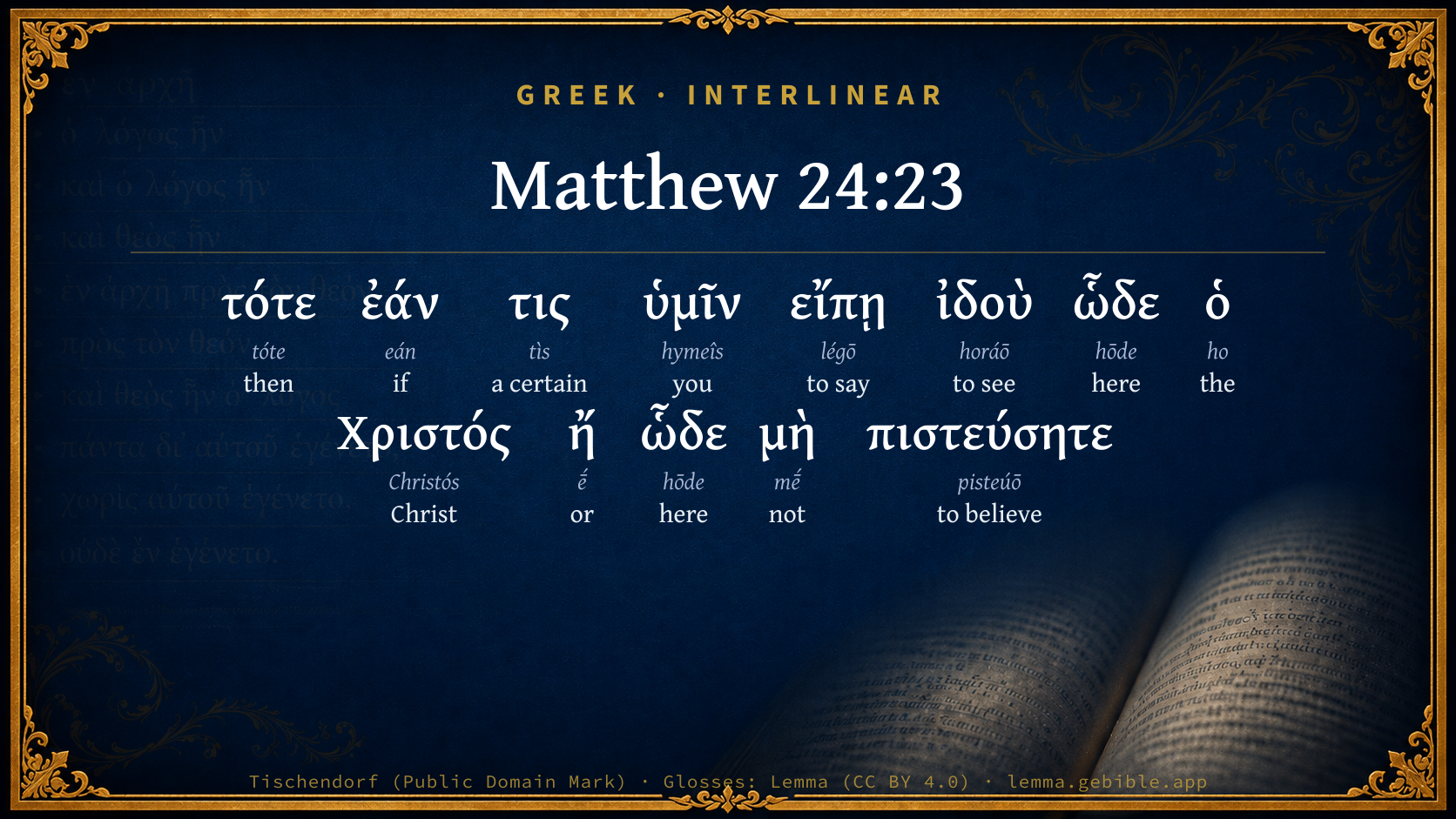
Greek (Tischendorf 8th ed.) Matthew 24:23 appears in the Greek New Testament. The text above is from the Tischendorf 8th edition. Each word links to its Strong’s number and a concise gloss. Click any word for its full Thayer’s Greek Lexicon entry.
Download image
Cite this verse

Matthew 24:23 (World English Bible). Public Domain. Lemma interlinear Bible study tool, https://lemma.gebible.app/v/matthew/24/23.

Show BibTeX & RIS
BibTeX
RIS
English Translation
"Then if any man tells you, 'Behold, here is the Christ,' or, 'There,' don't believe it.
World English Bible · Public Domain
Download a study sheet

One document with this verse’s original text, its word-by-word gloss line, the meaning frame, cross-references with their text, attributed commentary, and full source and license credits — printable, and it pastes into notes with its structure intact.

This verse Autodidact and up

Study sheet (.html) Plain text (.txt)

A passage Seminary Student

Up to 50 verses in one chapter. A passage sheet keeps up to 6 commentary sources and 12 cross-references per verse, in the order this page ranks them, and says so on the sheet whenever that leaves anything out. Ask for a single verse and you get the Autodidact verse sheet above.

Everything on this page stays free to read, with no account — the sheet is a download of what is already on screen, not access to it.

Want to remove ads? Support Godless Engineer
Compare translations 3

The same verse in 3 English versions, stacked beneath the original-language interlinear above. Click any original word for its lexicon entry.

Each is an independent rendering of the whole verse — the interlinear is not word-aligned to these translations.

Highlighted words mark where these versions differ — a whole-verse word diff, not a word-by-word alignment.

  • World English Bible Public Domain
    "Then if any man tells you, 'Behold, here is the Christ,' or, 'There,' don't believe it.
  • King James Version Public Domain
    Then if any man shall say unto you, Lo, here is Christ, or there; believe it not.
  • unfoldingWord Literal Text CC BY-SA 4.0
    Then if anyone says to you, ‘Behold, here the Christ!’ or, ‘Here!’ you should not believe;

unfoldingWord Literal Text — © unfoldingWord, licensed CC BY-SA 4.0. Word-aligned USFM3 via Door43 (git.door43.org/unfoldingWord/en_ult).

Versions to compare (up to 4)

3 of 4 selected

Show all 19 translations

Every available English version of this verse, each an independent rendering of the whole verse.

  • World English Bible Public Domain
    "Then if any man tells you, 'Behold, here is the Christ,' or, 'There,' don't believe it.
  • Berean Standard Bible Public Domain
    At that time, if anyone says to you, ‘Look, here is the Christ!’ or ‘There He is!’ do not believe it.
  • Majority Standard Bible Public Domain
    At that time, if anyone says to you, ‘Look, here is the Christ!’ or ‘There He is!’ do not believe it.
  • King James Version Public Domain
    Then if any man shall say unto you, Lo, here is Christ, or there; believe it not.
  • American Standard Version (1901) Public Domain
    Then if any man shall say unto you, Lo, here is the Christ, or, Here; believe `it' not.
  • Revised Version (1885) Public Domain
    Then if any man shall say unto you, Lo, here is the Christ, or, Here; believe it not.
  • Geneva Bible (1599) Public Domain
    Then if any shall say vnto you, Loe, here is Christ, or there, beleeue it not.
  • Douay-Rheims (1899) Public Domain
    Then if any man shall say to you: Lo here is Christ, or there, do not believe him.
  • Young's Literal Translation Public Domain
    `Then if any one may say to you, Lo, here `is' the Christ! or here! ye may not believe;
  • Literal Standard Version CC BY-SA 4.0
    Then if anyone may say to you, Behold, here [is] the Christ! Or, Here! You may not believe;
  • Unlocked Literal Bible CC BY-SA 4.0
    Then if anyone says to you, 'Look, here is the Christ!' or, 'There is the Christ!' do not believe it.
  • unfoldingWord Literal Text CC BY-SA 4.0
    Then if anyone says to you, ‘Behold, here the Christ!’ or, ‘Here!’ you should not believe;
  • Darby Bible Public Domain
    Then if any one say to you, Behold, here is the Christ, or here, believe [it] not.
  • World Messianic Bible Public Domain
    “Then if any man tells you, ‘Behold, here is the Messiah!’ or, ‘There!’ don’t believe it.
  • Webster's Bible Public Domain
    Then if any man shall say to you, Lo, here is Christ, or there; believe it not.
  • Free Bible Version CC BY-SA 4.0
    So if anyone tells you, ‘Look, here's the Messiah,’ or, ‘There he is,’ don't believe it.
  • Bible in Basic English Public Domain
    Then if any man says to you, See, here is the Christ, or, Here; do not put faith in him;
  • Text-Critical English NT CC BY 4.0
    If anyone says to you at that time, ‘Behold, here is the Christ!’ or, ‘Here he is!’ do not believe him.
  • Tyndale New Testament (1534) Public Domain
    Then yf eny man shall saye vnto you: lo here is Christ or there is Christ: beleve it not.

Literal Standard Version (2020), Covenant Press — licensed CC BY-SA 4.0. Text via the HelloAO Bible API (eBible.org). Unlocked Literal Bible (unfoldingWord) — licensed CC BY-SA 4.0. Text via the HelloAO Bible API (eBible.org). unfoldingWord Literal Text — © unfoldingWord, licensed CC BY-SA 4.0. Word-aligned USFM3 via Door43 (git.door43.org/unfoldingWord/en_ult). Free Bible Version, Dr. Jonathan Gallagher — licensed CC BY-SA 4.0. Text via the HelloAO Bible API (eBible.org).

Word by word

More ways to search: Search by grammar → Find every occurrence → Compare this word →

Practice this passage: Drill this verse → Learn its vocabulary →

About this verse

These counts appear in no published source. They are computed here, from the morphology-tagged text and Lemma’s own curated glosses. What Lemma adds →

13
words
12
distinct lemmas
Gospels
section

Shared distinctive vocabulary

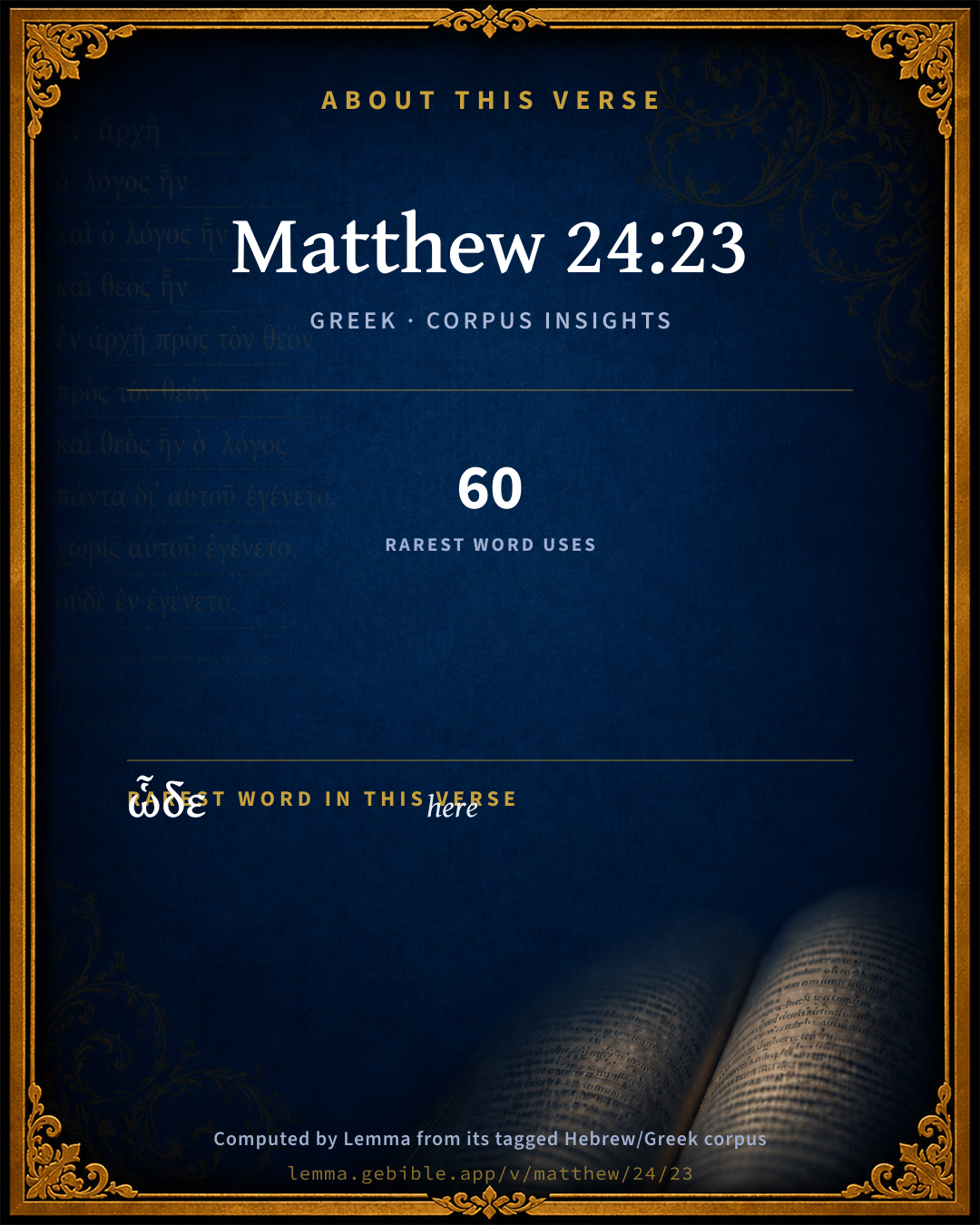
ὧδε here G5602 occurs in 58 verses of the Greek New Testament. Also found in:

Repetition

A word recurs within this verse:

Cross-references

5

Topical passages linked to Matthew 24:23 in the Treasury of Scripture Knowledge — connected by theme and wording, ordered by reader-vote popularity; previews shown in the World English Bible.

  • Luke 21:8 He said, "Watch out that you don't get led astray, for many will come in my name, saying, 'I AM,' and, 'The time is at hand.' Therefore don't follow them.
  • Luke 17:23–24 They will tell you, 'Look, here!' or 'Look, there!' Don't go away, nor follow after them,
  • Deuteronomy 13:1–3 If there arise in the midst of you a prophet, or a dreamer of dreams, and he give you a sign or a wonder,
  • Mark 13:21 Then if anyone tells you, 'Look, here is the Christ!' or, 'Look, there!' don't believe it.
  • John 5:43 I have come in my Father's name, and you don't receive me. If another comes in his own name, you will receive him.

Cross-references courtesy of OpenBible.info (CC BY 4.0).

Commentary

Notes on Matthew 24:23 from classic Christian and Jewish commentators (each source and its license shown beneath its notes). The classic Christian expositions comment on the surrounding passage and are grouped to its opening verse, so a note may address several verses; the Jewish commentaries on the Tanakh (Rashi and others) are per-verse, so they appear only where the commentator wrote on this verse.

Lemma curates 59 commentaries, every one of them public domain or Creative Commons licensed, each selected and text-cleaned for this edition rather than reprinted as found. About our sources →

The Cambridge Bible for Schools and Colleges

gen. ed. J. J. S. Perowne

23. Then] The transition is marked by this word, it was possibly also marked by a pause in the Saviour’s discourse.

23–31. The Second Coming of Christ

Mar_13:21-27; Luk_21:24-28

The following scheme, intended to shew a parallelism between the two Predictions, is borrowed from an interesting monograph by the Rev. W. Sherlock, who argues for the division of the prophecy at Mat_24:22 :

the fall of jerusalem (Mat_24:5-22).the second advent (Mat_24:23-31).1. False Christs and false prophets (Mat_24:5; Mat_24:11).1. False Christs and false prophets (Mat_24:23-24).2. Persecution and apostasy (Mat_24:9-10; Mat_24:12).2. Dangers even to the elect (Mat_24:24).3. Wars, famine, pestilence (Mat_24:6-7).3. Distress of nations (Mat_24:29).4. Great tribulation (Mat_24:21).4. The sun and moon darkened (Mat_24:29).5. The abomination of desolation (Mat_24:15).5. The sign of the Son of man (Mat_24:30).6. The escape of the Christians (Mat_24:16-18).6. The salvation of the elect (Mat_24:31).24. shall deceive the very elect] Compare this with the less dangerous influence of false prophets before the siege of Jerusalem, “shall deceive many.”

The Cambridge Bible for Schools and Colleges (gen. ed. J. J. S. Perowne; Cambridge University Press, 1878–1918) — public domain. Text from a community e-Sword module.

The Biblical Illustrator

Joseph S. Exell

Mat_24:23-26

Then if any man shall say unto you, Lo, here is Christ.

I. Let us settle what we really want in life, and we may safely shut our ears to many counsellors.

II. Let us learn more and more of the true Christ, and we shall not be led astray by false Christs.

III. Let us give ourselves to earnest practical living, and not gape after wonders.

IV. Let us not think that some other Christ is needed when we are surrounded by great and unwonted troubles. (Anon.)

The glory of the coming of Christ

The coming of Christ will be-

I. Preceded by frequent delusive turnouts.

II. A self-evident manifestation.

III. A time of judgment.

IV. A time of great distress of nations.

V. With power and great glory.

VI. For the salvation of the elect. (Anon.)

I. The Christian dispensation is disturbed by attempts of impostors to delude the unwary.

II. These attempts at imposture are accompanied by credentials likely to deceive many.

III. There is in our possession a test sufficient to unmask all pretenders. (Anon.)

Forewarned

Our Lord forewarns-

I. His own people of the danger of being led astray.

II. Of the manner of His coming-sudden, unmistakable.

III. Sinners of the certainty of judgment. Do we heed the warnings? Do we live as if we gave attention to them? (Anon.)

Christs advent not restricted

Take as an example of the twilight condition in which the Christian world stands to-day, the different opinions that its members have concerning the Lords second coming. Some say He came in judgment when the Roman army encompassed and subdued Jerusalem. Lo I Christ was there; and so He was, in that Divine Word of His which then and thus became visibly true. Others affirm that He came in the descent of the Holy Ghost; and so He certainly did, and by that Spirit He still abides and works here on earth, remaining with and in His Church always even unto the end of the world. Yes, Christ is here as well as there, in this temple as well as in that where the first disciples were gathered. Yet another voice says, The Redeemer comes in every signal manifestation of spiritual life, in each great reformation and revival of faith, in each social uplifting of the people to holier desires and to a better life. In all of these Christ is, no doubt, present. By and in them He is evermore coming. And He comes, moreover, to each individual soul at baptism, at conversion, and in the Holy Communion. He comes into the secret closet of prayer and meditation. He comes to every open heart, and outside the closed door of others He stands, and knocks, and waits. Blessed truths are these, all of them. Christ does come by many paths to help the needy, and He comes with power. But no one of these comings is exclusive of the others. We are not to believe that Christ is altogether here or there, that His presence is entirely restricted to any single one of the many ways by which He has promised to bestow the blessings of His risen life. And all of these comings put together should not exclude from our minds the belief or the constant thought of that other coming, which is to be not as a combination or succession of separate star-gleams, but as the lightning, a body of glory covering the whole world, and reaching at once from the east even unto the west. (E. E. Johnson, M. A.)

.

The Biblical Illustrator, edited by Joseph S. Exell (c. 1880s–1900s) — public domain. Text from a community e-Sword module.

Joseph Benson's Commentary

Mat 24:23-26. If any man say, Lo, here is Christ, or there — During the terrible calamities here foretold, the expectations of the nation were all turned toward their Messiah; for they thought if ever he was to appear, it would be then, to deliver them from the impending destruction. Hence many arose, pretending to be the Messiah, and boasting that they would deliver the nation; the effect of which was, that the multitude, giving credit to these deceivers, became obstinate in their opposition to the Romans, whereby their destruction was rendered both the more severe and the more inevitable. Our Lord, it must be observed, had cautioned his disciples against false Christs and false prophets before, (see Mat 24:5,) but what he here says is not to be considered as a repetition of that, but relates to those impostors who should appear during the time of the siege. And, in fact, many such impostors did arise about that time, as we learn from Josephus, (lib. 6. cap. 5, § 2,) and promised deliverance from God, being suborned by the tyrants or governors, to prevent the people and soldiers from deserting to the Romans; and the lower the Jews were reduced, the more disposed were they to listen to these deceptions, and the more ready to follow the deceivers. Hegesippus also, quoted by Eusebius, mentions the coming of false Christs and false prophets about the same time. And shall show great signs — As it was to little purpose for a man to take upon him the character of the Christ, or even of a prophet, without miracles to vouch his mission; so it was the common artifice and pretence of these impostors to show signs and wonders, σημεια και τερατα, the very words used by Christ in this prophecy, and by Josephus in his history. Behold, I have told you before — Behold, I have given you sufficient warning. If they shall say, He is in the desert — It is surprising that our Lord should not only foretel the appearance of these impostors, but also the manner and circumstances of their conduct. For some he mentions as appearing in the desert, and some in the secret chambers; and the event, in all points, answered to the prediction. Josephus says (Antiq., lib. 20. cap. 7, and Bell. Jud., lib. 2. cap. 13,) that “many impostors and cheats persuaded the people to follow them into the desert, where they promised to show manifest wonders and signs done by the providence of God; and many, being persuaded, suffered the punishment of their folly.” And he mentions an Egyptian false prophet, Antiq., Mat 20:7, (spoken of also Act 21:38,) who led out into the desert four thousand men who were murderers; and who were all taken or destroyed by Felix: another impostor is also mentioned by the same author, who promised deliverance to the people if they would follow him into the desert, but Festus sent horse and foot against him, and destroyed both him and his followers. These things happened before the destruction of Jerusalem; and a little after, one Jonathan, a weaver, persuaded many to follow him into the desert, most or all of whom were slain or made prisoners, and he himself taken and burned alive, by order of Vespasian. As several of these impostors thus conducted their followers into the desert, so did others into the secret chambers, or places of security. One of these (according to Josephus, Bell., Mat 6:5) declared to the people in the city, that God commanded them to go up into the temple, and there they should receive the signs of deliverance. A multitude of men, women, and children went up accordingly; but, instead of deliverance, the place was set on fire by the Romans, and six thousand perished miserably in the flames, by throwing themselves down to escape them. Our Saviour therefore might well caution his disciples both against the former and the latter sort of these deceivers.

Joseph Benson's Commentary on the Old and New Testaments (1811–1818) — public domain. Text from a community e-Sword module.

Bengel's Gnomon

Johann Albrecht Bengel

Mat 24:23. τοτέ, then) sc. at the time of the fall of Jerusalem.—μὴ πιστεύσητε, do not believe) For from that time forth the Son of Man will not be seen until His Advent. His coming to judgment, therefore, is mentioned incidentally in Mat 24:27, and professedly in Mat 24:29,[1048] 30.—ὧδε, here) sc. where any one is who calls himself the Messiah.

[1048] Bengel means, that until His final Advent, which all must recognise when it takes place, Christ shall not be visible; and that, therefore, any who says he is Christ before then, is ipso facto an impostor. The coming, accordingly, in Mat 24:27, is not a personal one, but a virtual coming in the judgments inflicted on Jerusalem and Judea: therefore it is only incidentally dwelt on as His coming. But the coming, in Mat 24:29, is the personal, visible, and final coming; and therefore it is described professedly as such: “Then shall appear the sign of the Son of man—they shall see the Son of man.”—ED.

Bengel's Gnomon of the New Testament — English translation (T&T Clark, Edinburgh, 1860) — public domain. Text from a community e-Sword module.

Meyer's Critical & Exegetical Commentary

Heinrich August Wilhelm Meyer

Mat_24:23 ff. Τότε] then, when the desolation of the temple and the great θλίψις shall have arrived, false Messiahs, and such as falsely represent themselves to be prophets, will again come forward and urge their claims with greater energy than ever, nay, in the most seductive ways possible. Those here referred to are different from the pretenders of Mat_24:4 f. The excitement and longing that will be awakened in the midst of such terrible distress will be taken advantage of by impostors with pretensions to miracle-working, and then how dangerous they will prove! By such early expositors as Chrysostom and those who come after him, Mat_24:23 was supposed to mark the transition to the subject of the advent, so that τότε would pass over the whole period between the destruction of Jerusalem and the second advent; while, according to Ebrard (comp. Schott), the meaning intended by Jesus in Mat_24:23-24 is, that after the destruction of the capital, the condition of the church and of the world, described in Mat_24:4-14, in posterum quoque mansurum esse. Such views would have been discarded if due regard had been paid to the τότε by which the point of time is precisely defined, as well as to the circumstance that the allusion here is merely to the coming forward of false Christs and false prophets. Consequently we should also beware of saying, with Calovius, that at this point Christ passes to the subject of His adventus spiritualis per evangelium. He is still speaking of that period of distress, Mat_24:21 f., which is to be immediately followed, Mat_24:29, by the second advent.

ψευδόχριστοι] those who falsely claim to be Messiah; nothing is known regarding the historical fulfilment of this. Jonathan (Joseph. Bell. vii. 11. 3) and Barcochba (see on Mat_24:5) appeared at a later period.

ψευδοπροφῆται] according to the context, not Christian teachers (Mat_24:11), in the present instance, but such as pretended to be sent by God, and inspired to speak to the people in the season of their calamity,deceivers similar to those who had tried to impose upon their fellow-countrymen during the national misfortunes of earlier times (Jer_14:14; Jer_5:13; Jer_6:13; Jer_8:10). Comp. Joseph. Bell. ii. 13. 4 : πλάνοι γὰρ ἄνθρωποι καὶ ἀπατῶντες προσχήματι θειασμοῦ νεωτερισμοὺς καὶ μεταβολὰς πραγματευόμενοι, δαιμονᾷν τὸ πλῆθος ἀνέπειθον, κ.τ.λ. Others suppose that the reference is to such as sought to pass for Elijah or some other prophet risen from the dead (Kuinoel), which would scarcely agree with the use of a term so general as the present; there are those also who think it is the emissaries of the false Messiahs who are intended (Grotius).

δώσουσι] not: promise (Kypke, Krebs), but: give, so as to suit the idea involved in σημεῖα. Comp. Mat_12:39; Deu_13:1.

On σημεῖα καὶ τέρατα, between which there is no material difference, see on Rom_15:19. Miracles may also be performed by Satanic agency, 2Th_2:9.

ὥστε πλανηθῆναι (see critical notes): so that the very elect may be led astray (Kühner, II. 2, p. 1005) if possible (εἰ δυνατόν: si fieri possit; conatus summus, sed tamen irritus, Bengel).

Mat_24:25. Διαμαρτύρεται ἐξασφαλιζόμενος, Euthymius Zigabenus. Comp. Joh_14:29.

Meyer — Critical and Exegetical Commentary on the New Testament — English translation by Peter Christie, edited by Frederick Crombie (T&T Clark, 1880) — public domain. Text from a community e-Sword module.

Expositor's Greek Testament

ed. W. Robertson Nicoll

Mat 24:23-28 . False Christs again (Mar 13:21-23 , Luk 17:23-24 ; Luk 17:37 ).

The Expositor's Greek Testament, edited by W. Robertson Nicoll (1897–1910) — public domain. Text from a community e-Sword module.

Adam Clarke's Commentary

Verse 23. Then if any man shall say unto you, Lo here is Christ] Our Lord had cautioned his disciples against false Christs and prophets before, Mt 24:11; but he seems here to intimate that there would be especial need to attend to this caution about the time of the siege. And in fact many such impostors did arise about that time, promising deliverance from God; and the lower the Jews were reduced, the more disposed they were to listen to such deceivers. Like a man drowning, they were willing to catch even at a straw, while there was any prospect of being saved. But as it was to little purpose for a man to take upon him the character of the Christ, without miracles to avouch his Divine mission, so it was the common artifice of these impostors to show signs and wonders, σημεια και τερατα; the very words used by Christ in this prophecy, and by Josephus in his history: ANT. b. xx. c. 7. Among these Simon Magus, and Dositheus, mentioned before; and Barcocab, who, St. Jerome says, pretended to vomit flames. And it is certain these and some others were so dexterous in imitating miraculous works that they deceived many; and such were their works, that if the elect, the chosen persons, the Christians, had not had the fullest evidence of the truth of Christ's mission and miracles, they must have been deceived too: but, having had these proofs, they could not possibly be deceived by these impostors. This is simply the meaning of this place; and it is truly astonishing that it should be brought as a proof for the doctrine (whether true or false is at present out of the question) of the necessary and eternal perseverance of the saints! How abundant the Jews were in magic, divination, sorcery, incantation, &c., see proved by Dr. Lightfoot on this place.

Adam Clarke's Commentary on the Bible (1810–1826) — public domain. Text from a community e-Sword/MySword module.

Ellicott's Commentary for English Readers

(23) Lo, here is Christ, or there.—Better, Lo, here is the Christ. The narrative of Josephus, while speaking of many “deceivers” claiming divine authority (Wars, ii. 13, § 4), is silent as to any pretenders to the character of the Messiah. It is scarcely conceivable, however, that this should not have been one of the results of the fevered dreams of the people, and the reticence of the historian was probably a suppressio veri connected with his own recognition of Vespasian as a quasi Christ (Wars, vi. 5, § 4).

A Bible Commentary for English Readers, edited by Charles John Ellicott (1878–1897) — public domain. Text from a community e-Sword module.

John Gill's Exposition

Then if any man shall say unto you,.... Either at the time when the siege shall be begun, and the abomination of desolation standing in the holy place; or during the days of tribulation, whilst the siege lasted; or after those days were shortened, and the city destroyed, and the Roman army was gone with their captives: when some, that were scattered up and down in the country, would insinuate to their countrymen, that the Messiah was in such a place: saying,

lo! here is Christ, or there, believe it not; for both during the time of the siege, there were such that sprung up, and pretended to be Messiahs, and deliverers of them from the Roman power, and had their several abettors; one saying he was in such place, and another that he was in such a place; and so spirited up the people not to fly, nor to deliver up the city; and also, after the city was taken and destroyed, one and another set up for the Messiah. Very quickly after, one Jonathan, a very wicked man, led many into the desert of Cyrene, promising to show them signs and wonders, and was overthrown by Catullius, the Roman governor (q); and after that, in the times of Adrian, the famous Barcochab set up for the Messiah, and was encouraged by R. Akiba, and a multitude of Jews (r).

(q) Joseph. Antiq. l. 7. c. 12. (r) Ganz. Tzemach David, par. 1. fol. 28. 2.

John Gill's Exposition of the Whole Bible (1746–1763) — public domain (CC PDM 1.0). Text via the HelloAO Bible API.

Trapp's Complete Commentary

John Trapp

23 Then if any man shall say unto you, Lo, here is Christ, or there; believe it not.

Ver. 23. Then, if any man shall say] Here again our Saviour returns to the description of the last times, containing the rise, reign, and ruin of Antichrist, whose chief engine shall be to persuade Christ’s corporal presence here and there in certain places, and to tie his worship and service to such or such a city, country, temple, &c., where he may be seen, touched, eaten, &c., as they feign in the eucharist.

John Trapp, A Commentary or Exposition upon All the Books of the Old and New Testament (1647–1656) — public domain. Text from a community e-Sword module.

Albert Barnes' Notes on the Bible

Lo, here is Christ - The Messiah. The Jews expected the Messiah to deliver them from Roman oppression. In the time of these great calamities they would anxiously look for him. Many would claim “to be” the Messiah. Many would follow those who set up that claim. Many would rejoice to believe that he was come, and would call on others, Christians with the rest, to follow them.

Believe it not - You have evidence that the Messiah has come, and you are not to be deceived by the plausible pretensions of others.

Albert Barnes' Notes on the Bible (1834–1885) — public domain. Text from a community e-Sword/MySword module.

Haydock's Catholic Bible Commentary

Lo, here is Christ. These words are very aptly applied by Catholics to the conventicles of heretics; and would Christians attend to the injunctions of their divine Master, Go ye not out: --- believe it not, we should not see the miserable confusion occasioned in the Catholic Church, by unsteady Christians; who are guilty of schism, in forsaking the one true fold, and one shepherd, to follow their blind and unauthorized leaders. (Estius)

George Leo Haydock (1774–1849), Haydock's Catholic Family Bible and Commentary, 1859 edition — public domain. Excludes Psalms (Douay-Rheims chapter numbering differs from Protestant) and Deuterocanonical books (Catholic canon only).

Matthew Poole's English Annotations

Mark hath much the same, Mat 13:21-23. There is no doubt but that our Saviour here hath a special respect to those persons who, about the time of the destruction of Jerusalem, taking advantage of the Jewish expectation of the Messiah as a secular prince, who should restore them to liberty, (an opinion which, as we have often heard, had infected the generality of the Jews, and not a little even the disciples of Christ), made themselves heads of parties, and pretended that they were the Messiah, the Christ, thereby to encourage people to follow them, and to stand up for their liberty; of which kind there were several mentioned both in the history of Josephus, and in the Roman history, respecting those times. Our Lord therefore cautions his disciples against such, and thereby taketh them off their expectation of any such secular kingdom of the Messiah as they had dreamed of. He tells them that there would such persons arise, and some of them should do great signs and wonders, insomuch that if it were possible they would deceive the elect of God; but he had prayed for them; only they must also watch and take heed, that they might not be cheated and deceived by them, though they came with never so fair pretences, for his coming would be quite of another nature, and his kingdom would be a quite other kingdom.

Matthew Poole's English Annotations on the Holy Bible (1683–1685) — public domain. Text from a community e-Sword/MySword module.

Whedon's Commentary on the Bible

Daniel D. Whedon

23-27. Our Lord now proceeds to give such warnings as should protect his followers from being deluded by false Christs, which should appear. Their coming would be on earth, while his next advent will be in the sky, like the lightnings flashing along the firmament.

23. Lo, here is Christ — The notion that the coming of Christ would be at the destruction of Jerusalem, was liable to lead them to credit the false deliverers, by which the Jews were deluded in immense numbers to their own destruction.

Daniel D. Whedon (gen. ed.), Commentary on the Old and New Testaments (1874–1909) — public domain. Text from a community e-Sword module.

The Pulpit Commentary

And then. The third section of the prophecy, contained in vers. 23-35, passes from the fortunes of Jerusalem to the end of the world. To the Lord"s hearers was conveyed the truth that the signs and events now indicated were to be subsequent to the destruction of the city. No further note of chronology was given. The uncertainty of the future caused a state of constant expectation and hope. And this is the feeling which we Christians are intended to embrace and cultivate. "The word "then" relates not to the connection in the order of time with the things just mentioned,... not meaning what should follow straightway after these things, but what should be in the time when these things were to be done of which he was about to speak" (St. Chrysostom, "Horn.," in loc. ). Lo, here is Christ! This refers to something different from the announcement in ver. 5. Some analogous deceptions doubtless occurred at the siege of Jerusalem, but the Lord is predicting the remote events of the latter days, of which previous occurrences were types and anticipations. Believe it not. When Christ does come the second time, there shall be no doubt or ignorance of his appearance. (see ver. 27, and compare the warning in Deu_13:1-3)

The Pulpit Commentary (1880–1919), ed. H.D.M. Spence-Jones & Joseph S. Exell — public domain. Text from a community e-Sword module.

John Wesley's Explanatory Notes

Mark xiii, 21; Luke xvii, 23.

John Wesley, Explanatory Notes Upon the Whole Bible (1754–1765) — public domain. Text via the GEBible commentary corpus.

Kretzmann's Popular Commentary

Paul E. Kretzmann

The attack upon the faith:

v. 23. Then, if any man shall say unto you, Lo, here is Christ, or there, believe it not.

v. 24. For there shall arise false Christs and false prophets, and shall show great signs and wonders, insomuch that, if it were possible, they shall deceive the very elect.

v. 25. Behold, I have told you before.

v. 26. Wherefore, if they shall say unto you, Behold, He is in the desert, go not forth; behold, He is in the secret chambers, believe it not.

v. 27. For as the lightning cometh out of the east and shineth even unto the west, so shall also the coming of the Son of Man be.

v. 28. For wheresoever the carcass is, there will the eagles be gathered together.

The Lord still has in mind principally the days preceding the destruction of Jerusalem, though His words may be said to find a general application. The external afflictions would become still more unbearable owing to the fact that the attacks on the faith of the disciples of Christ would be more subtle and be managed with much boldness. False Messiahs would attempt to gain power, at least for a time. The manner and circumstances of their conduct are here briefly sketched, and they find their application to this day. They would present to an astonished world great signs and wonders, such in appearance as well as such in truth, such as are easily explained by reference to religious psychology and plain swindle, and such as baffle the investigators. There is need of careful distinction here to keep the false Christs separate from the true Christ, the false teachers from the true teachers. "Here you may consider whereon the right doctrine, from which we dare not budge, depends. Here remember: The right doctrine does nothing else than to show and set before thee Christ, in order that thou mayest comfort thy heart through Him against sin and death. This is done thus that we are taught Christ is the true, eternal, almighty God, together with the Father and the Holy Ghost, come down to us men on earth, conceived by the Holy Ghost, and born of the Virgin Mary into this world; that He finally died on the cross, not on account of His sins, for He, as God, could not sin, but on account of our sins, in order that God by such death might be satisfied and our debt be paid, and we by Christ’s resurrection from the dead might also come to eternal life; that therefore Christ conquered sin and death for our benefit, that sin and death should not harm us; and now henceforth sits at the right hand of God, in order to defend us against the devil, mercifully grant us His Spirit, and hear us in all things which we need for body and soul and ask in His name. That is preaching correctly concerning Christ, and agrees in every detail with the Word; therefore one need not worry about the Antichrist and his lies in that case. " In case one’s faith is firmly based upon this Gospel of Jesus, he will not be disturbed by the signs and wonders of the false Christs. "This we should remember, in order that we may meet such as praise the miraculous signs so highly and say: I know the devil, he can imitate God (for he is God’s ape), he can do all miraculous signs, but they are false miraculous signs. The people imagine, indeed, that they are true signs; even those upon whom they are performed, have no other feeling than that they are blind, dead. But they are false signs, which are done for the purpose that we desert God and pledge ourselves to some saint. But when the people have pledged themselves, then the devil removes the ghost. Then the people say: This or that saint has helped me, and are strengthened in their idolatry. Such false miraculous signs, which the devil has done to substantiate his lies and errors, and that idolatry might become all the greater in the world, the Pope has confirmed and strengthened with his indulgences. " Thus the subtlety of the false Christs might succeed, if such a thing were possible, if God should permit such an outrage, in deceiving even those that are believers. But no man can pluck them out of His hands, Joh 10:28.

Two further characteristics of false teachers are that they always aim to pique curiosity by making their teachings as obscure as possible, either by going out into desert places or by hiding themselves in inner chambers. Such cases are mentioned not only in the Bible, Act 21:38, and by the historian Josephus, but they have had their logical successors in the ascetics, the monks and nuns of all times, that shut themselves away from the world in the foolish effort to know Christ more fully. Many such people were regarded with the greatest veneration by the ignorant and vested with the personality and power of Christ Himself. Such fanaticism is branded in the words of Christ: Behold, I have told you in advance; believe it not! And He emphasizes His words by a picture, that of the unexpectedness of the lightning, whose brightness nevertheless illumines the earth. So will Christ come to Judgment, first of all upon the Jews that had rejected Him and His Word. The clouds may have been coming up for some time and the thunder reverberated in the distance, but the sudden flash of lightning, sending its bolt in fearful destruction, is unexpected. So the signs preceding the fall of Jerusalem, as those presaging the Judgment Day, will make the watchful more alert, and yet the actual appearance of the Judge will be like a bolt of lightning, sudden, terrible. Hence the striking, though homely admonition: wherever the dead body is lying, there the carrion vultures will assemble. Where Christ is, there shall His elect also be. "Thus the Lord has made use of two parables, first of a heavenly one, that of the lightning, which is a fine light, to indicate that His kingdom is unfettered and uncaptured. For since Jerusalem is now destroyed, where the kingdom of Christ was formerly, the question is asked where the kingdom will now be, since Jerusalem is now torn to pieces. There it is said: Where the lightning and where the carcass will be, that is, where the divine Word will be, whether it be here or in another place, there will the Church be."

Paul E. Kretzmann, Popular Commentary of the Bible (1921–1924) — public domain. Text from a community e-Sword module.

Burkitt's Expository Notes on the New Testament

William Burkitt

The Jews had all along cherished in themselves a vain expectation, that the promised Messiah should be a temporal deliverer, that should set them at liberty from the power and slavery of the Romans; and accordingly Christ declares to his disciples here, that immediately before Jerusalem’s destruction, several persons, taking the advantage of this expectation, would make themselves heads of parties, and pretend tha they were the true Messiah, who would save and deliver them from their enemies, if they would repair to them, and follow after them.

Hereupon our Lord cautions his disciples against such false Christs and false prophets, and bids them believe them not, though they did never so many great signs and wonders, and promised them never such glorious deliverances.

Learn hence, That the church’s great danger is from seducers that come in Christ’s name, and pretend to work signs and wonders by his authority.

2. That such is the power of seduction and delusion, that many are carried away with seducers and false teachers.

3. That the elect themselves, if left unto themselves, might be seduced; but divine power guards them against seduction and delusion: They shall deceive, if it were possible, the very elect. Which phrase imports not what the event would be upon the elect, but the vehemency of the endeavours of seducers; namely, that they would do the utmost that they could, to shock the Christian, and cause him to fall upon his steadfastness.

William Burkitt's Expository Notes on the New Testament (1700–1703) — public domain. Text from a community e-Sword module.

The People's New Testament

B. W. Johnson

23–26. Then. During this period of tribulation, give no heed to false prophets, false Christs, or to those who say Christ is here or there.

B. W. Johnson's The People's New Testament with Notes (1889–1891) — public domain. Electronic text from the Christian Classics Ethereal Library (CCEL) ThML edition.

unfoldingWord translationNotes

Door43 World Missions Community

Connecting Statement:

Jesus continues speaking to his disciples.

do not believe it

"do not believe the false things they have said to you"

so as to lead astray, if possible, even the elect

Here "lead astray" is a metaphor for persuading someone to believe something that is not true. This can be translated as two sentences. AT: "so as to deceive, if possible, even the elect" or "so as to deceive people. If possible, they would even deceive the elect"

translationWords

Christ

believe

false prophet

miracle

chosen one

unfoldingWord translationNotes — © Distant Shores Media and the Door43 World Missions Community, licensed CC BY-SA 4.0. Source: git.door43.org/Door43/en_tn.

Cambridge Greek Testament for Schools and Colleges

23–31. THE SECOND COMING OF CHRIST

Mar 13:21-27; Luk 21:24-28

23. τότε. According to Chrysostom, Jerome and others who make the division at Mat 24:22 τότε marks a transition, and the description which follows is applicable to the end of the world not to the fall of Jerusalem.

Cambridge Greek Testament for Schools and Colleges (Cambridge University Press, 1896; 21 vols, various authors incl. Carr, Maclear, Plummer, Farrar, Lumby, Moule, M. R. James, Simcox) — public domain. Text from a community e-Sword module.

Alford’s Greek Testament

Henry Alford

23-26.] These verses have but a faint reference (though an unmistakable one) to the time of the siege (Jos., B. J. ii. 13. 4, says, πλάνοι γὰρ ἄνθρωποι καὶ ἀπατεῶνες προσχήματι θειασμοῦ νεωτερισμοὺς καὶ μεταβολὰς πραγματευόμενοι, δαιμονᾷν τὸ πλῆθος ἀνέπειθον …): their principal reference is to the latter days. In their first meaning, they would tend to correct the idea of the Christians that the Lord’s coming was to be simultaneous with the destruction of Jerusalem: and to guard them against the impostors who led people out into the wilderness (see Act 21:38), or invited them to consult them privately, with the promise of deliverance. In their main view, they will preserve the Church firm in her waiting for Christ, through even the awful troubles of the latter days, unmoved by enthusiasm or superstition, but seeing and looking for Him who is invisible. On the signs and wonders, see 2Th 2:9-12: Deu 13:1-3.

27,

Henry Alford, The Greek Testament (1849–1861) — public domain. Text from a community e-Sword module.

International Critical Commentary

(M) 23. Then if any one say to you, Behold, here is the Messiah, or here; believe (him) not.] Mk. has: “And then if any one say to you, Behold, here is the Messiah; behold, there; do not believe (him).”—μὴ πιστεύσητε] Mk. has μὴ πιστεύετε, which is less applicable to a future occurrence. See Moulton, p. 124.

International Critical Commentary — older volumes (1896–1929), various authors — public domain. Text from a community e-Sword module.

Lesson kit

Teaching starters — assembled from the data on this page, not authored interpretation. Every prompt links to the verse data it draws on. Edit before teaching.

Matthew, in the Gospels, opens this verse with 13 words (12 distinct Greek lemmas). Its most distinctive word is hōde (“here”). A historical commentator’s framing appears above. Read the whole chapter for the surrounding context.

Discussion questions

  1. What does “here” (hōde) contribute to the verse as a whole?
  2. How does Matthew 8:29, which shares the word «here», read alongside this verse?
  3. What does the repetition of “here” (2× in this one verse) do in this verse?
  4. The translations on this page render this verse differently — a whole-verse word diff, not a word-by-word alignment. What might account for the different wordings?
  5. Compare how The Cambridge Bible for Schools and Colleges and The Biblical Illustrator read this verse. Where do they agree or differ?

Things to notice

Reading settings

Reading text

Shown beneath each verse's original-language words.

Old Testament
Old Testament edition

Read the OT as the Masoretic Hebrew (MT) or the Greek Septuagint (LXX).

English shown for the Greek Septuagint (in the Hebrew ↔ Greek comparison).

Comparing translations? Open the Compare panel on any verse page to stack up to four side by side.