Matthew 24:26

Greek (Tischendorf 8th ed.) Matthew 24:26 appears in the Greek New Testament. The text above is from the Tischendorf 8th edition. Each word links to its Strong’s number and a concise gloss. Click any word for its full Thayer’s Greek Lexicon entry.
Download image
Cite this verse

Matthew 24:26 (World English Bible). Public Domain. Lemma interlinear Bible study tool, https://lemma.gebible.app/v/matthew/24/26.

Show BibTeX & RIS
BibTeX
RIS
English Translation
If therefore they tell you, 'Behold, he is in the wilderness,' don't go out; 'Behold, he is in the inner chambers,' don't believe it.
World English Bible · Public Domain
Download a study sheet

One document with this verse’s original text, its word-by-word gloss line, the meaning frame, cross-references with their text, attributed commentary, and full source and license credits — printable, and it pastes into notes with its structure intact.

This verse Autodidact and up

Study sheet (.html) Plain text (.txt)

A passage Seminary Student

Up to 50 verses in one chapter. A passage sheet keeps up to 6 commentary sources and 12 cross-references per verse, in the order this page ranks them, and says so on the sheet whenever that leaves anything out. Ask for a single verse and you get the Autodidact verse sheet above.

Everything on this page stays free to read, with no account — the sheet is a download of what is already on screen, not access to it.

Want to remove ads? Support Godless Engineer
Compare translations 3

The same verse in 3 English versions, stacked beneath the original-language interlinear above. Click any original word for its lexicon entry.

Each is an independent rendering of the whole verse — the interlinear is not word-aligned to these translations.

Highlighted words mark where these versions differ — a whole-verse word diff, not a word-by-word alignment.

  • World English Bible Public Domain
    If therefore they tell you, 'Behold, he is in the wilderness,' don't go out; 'Behold, he is in the inner chambers,' don't believe it.
  • King James Version Public Domain
    Wherefore if they shall say unto you, Behold, he is in the desert; go not forth: behold, he is in the secret chambers; believe it not.
  • unfoldingWord Literal Text CC BY-SA 4.0
    Therefore, if they say to you, ‘Behold, he is in the wilderness,’ you should not go out; ‘Behold, in the inner chambers,’ you should not believe.

unfoldingWord Literal Text — © unfoldingWord, licensed CC BY-SA 4.0. Word-aligned USFM3 via Door43 (git.door43.org/unfoldingWord/en_ult).

Versions to compare (up to 4)

3 of 4 selected

Show all 19 translations

Every available English version of this verse, each an independent rendering of the whole verse.

  • World English Bible Public Domain
    If therefore they tell you, 'Behold, he is in the wilderness,' don't go out; 'Behold, he is in the inner chambers,' don't believe it.
  • Berean Standard Bible Public Domain
    So if they tell you, ‘There He is in the wilderness,’ do not go out; or, ‘Here He is in the inner rooms,’ do not believe it.
  • Majority Standard Bible Public Domain
    So if they tell you, ‘There He is in the wilderness,’ do not go out, or, ‘Here He is in the inner rooms,’ do not believe it.
  • King James Version Public Domain
    Wherefore if they shall say unto you, Behold, he is in the desert; go not forth: behold, he is in the secret chambers; believe it not.
  • American Standard Version (1901) Public Domain
    If therefore they shall say unto you, Behold, he is in the wilderness; go not forth: Behold, he is in the inner chambers; believe `it' not.
  • Revised Version (1885) Public Domain
    If therefore they shall say unto you, Behold, he is in the wilderness; go not forth: Behold, he is in the inner chambers; believe it not.
  • Geneva Bible (1599) Public Domain
    Wherefore if they shall say vnto you, Beholde, he is in the desert, goe not forth: Beholde, he is in the secret places, beleeue it not.
  • Douay-Rheims (1899) Public Domain
    If therefore they shall say to you: Behold he is in the desert, go ye not out: Behold he is in the closets, believe it not.
  • Young's Literal Translation Public Domain
    `If therefore they may say to you, Lo, in the wilderness he is, ye may not go forth; lo, in the inner chambers, ye may not believe;
  • Literal Standard Version CC BY-SA 4.0
    If therefore they may say to you, Behold, He is in the wilderness, you may not go forth; Behold, in the inner chambers, you may not believe;
  • Unlocked Literal Bible CC BY-SA 4.0
    Therefore, if they say to you, 'Look, he is in the wilderness,' do not go out to the wilderness. Or, 'See, he is in the inner rooms,' do not believe it.
  • unfoldingWord Literal Text CC BY-SA 4.0
    Therefore, if they say to you, ‘Behold, he is in the wilderness,’ you should not go out; ‘Behold, in the inner chambers,’ you should not believe.
  • Darby Bible Public Domain
    If therefore they say to you, Behold, he is in the desert, go not forth; behold, [he is] in the inner chambers, do not believe [it].
  • World Messianic Bible Public Domain
    “If therefore they tell you, ‘Behold, he is in the wilderness,’ don’t go out; or ‘Behold, he is in the inner rooms,’ don’t believe it.
  • Webster's Bible Public Domain
    Wherefore, if they shall say to you, Behold, he is in the desert; go not forth: behold, he is in the secret chambers; believe it not.
  • Free Bible Version CC BY-SA 4.0
    So if they tell you, ‘Look, he's out in the desert,’ don't go looking there; or if they say, ‘Look, he's secretly here,’ don't believe it.
  • Bible in Basic English Public Domain
    If, then, they say to you, See, he is in the waste land; go not out: See, he is in the inner rooms; put no faith in it.
  • Text-Critical English NT CC BY 4.0
    So if they say to you, ‘Behold, he is in the wilderness,’ do not go out, or, ‘Behold, he is in the inner rooms,’ do not believe it.
  • Tyndale New Testament (1534) Public Domain
    Wherfore if they shall saye vnto you: beholde he is in the desert go not forth: beholde he is in the secret places beleve not.

Literal Standard Version (2020), Covenant Press — licensed CC BY-SA 4.0. Text via the HelloAO Bible API (eBible.org). Unlocked Literal Bible (unfoldingWord) — licensed CC BY-SA 4.0. Text via the HelloAO Bible API (eBible.org). unfoldingWord Literal Text — © unfoldingWord, licensed CC BY-SA 4.0. Word-aligned USFM3 via Door43 (git.door43.org/unfoldingWord/en_ult). Free Bible Version, Dr. Jonathan Gallagher — licensed CC BY-SA 4.0. Text via the HelloAO Bible API (eBible.org).

Word by word

More ways to search: Search by grammar → Find every occurrence → Compare this word →

Practice this passage: Drill this verse → Learn its vocabulary →

ταμείοις
tameîon
G5009
“storeroom”
Noun, Dative, Plural, Neuter
Part of Speech
Noun
Case
Dative
Number
Plural
Gender
Neuter
Full Thayer's Definition

Origin: contraction of a presumed derivative of tamias (a dispenser or distributor

TDNT: None

1. a storage chamber, storeroom 2. a chamber esp. an inner chamber 3. a secret room
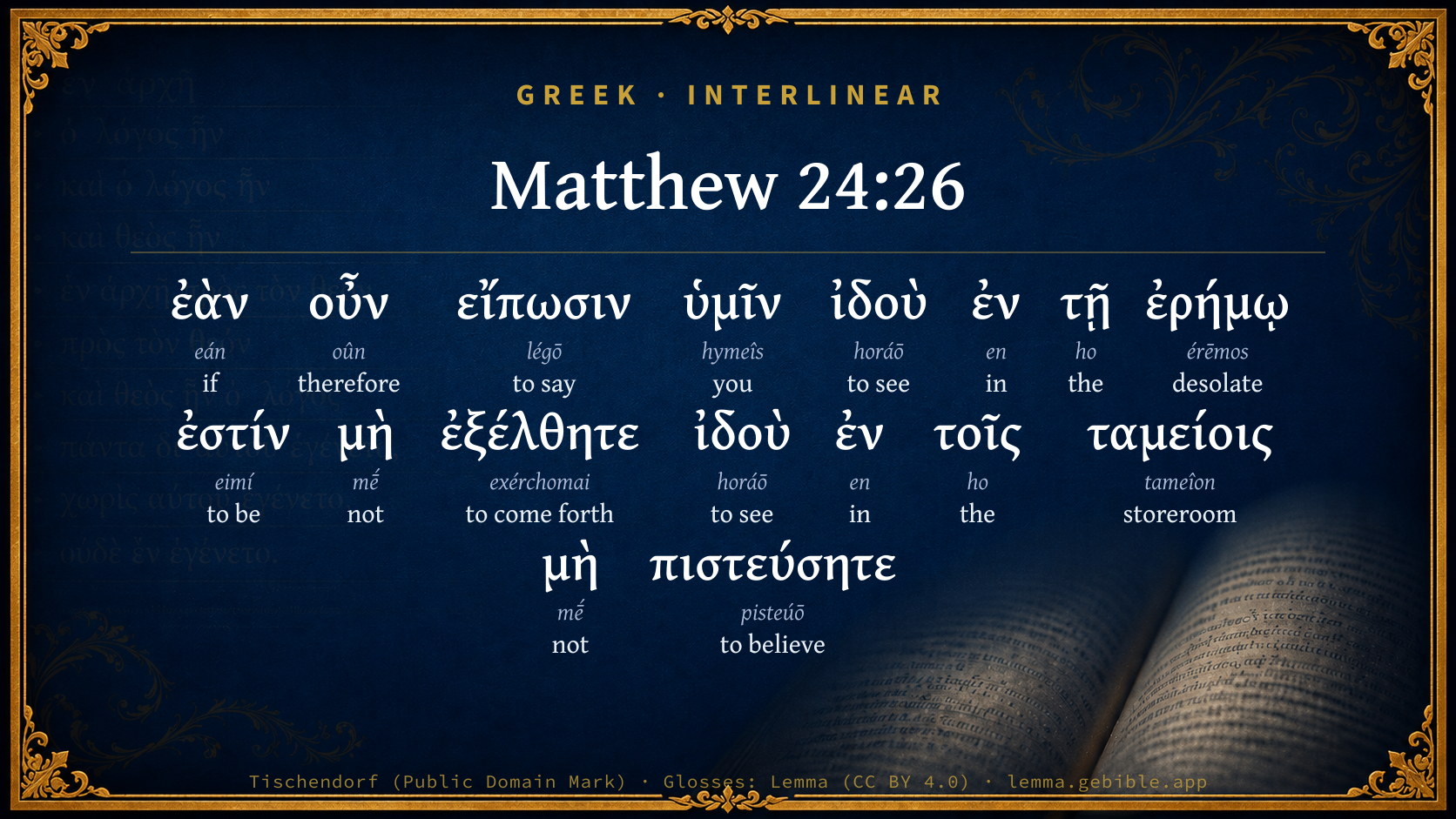
  1. ἐὰν eán G1437 “if” Conditional
  2. οὖν oûn G3767 “therefore” Conjunction
  3. εἴπωσιν légō G3004 “to say” Verb, Aorist, Active, Subjunctive, 3rd person, Plural
  4. ὑμῖν hymeîs G5210 “you” Personal pronoun, 2nd person, Dative, Plural
  5. ἰδοὺ horáō G3708 “to see” Verb, Aorist, Middle, Imperative, 2nd person, Singular
  6. ἐν en G1722 “in” Preposition
  7. τῇ ho G3588 “the” Article, Dative, Singular, Feminine
  8. ἐρήμῳ érēmos G2048 “desolate” Adjective, Dative, Singular, Feminine
  9. ἐστίν eimí G1510 “to be” Verb, Present, Active, Indicative, 3rd person, Singular
  10. μὴ mḗ G3361 “not” Particle, Negative
  11. ἐξέλθητε exérchomai G1831 “to come forth” Verb, Aorist, Active, Subjunctive, 2nd person, Plural
  12. ἰδοὺ horáō G3708 “to see” Verb, Aorist, Middle, Imperative, 2nd person, Singular
  13. ἐν en G1722 “in” Preposition
  14. τοῖς ho G3588 “the” Article, Dative, Plural, Neuter
  15. μὴ mḗ G3361 “not” Particle, Negative
  16. πιστεύσητε pisteúō G4100 “to believe” Verb, Aorist, Active, Subjunctive, 2nd person, Plural

About this verse

These counts appear in no published source. They are computed here, from the morphology-tagged text and Lemma’s own curated glosses. What Lemma adds →

17
words
13
distinct lemmas
Gospels
section

Notable vocabulary

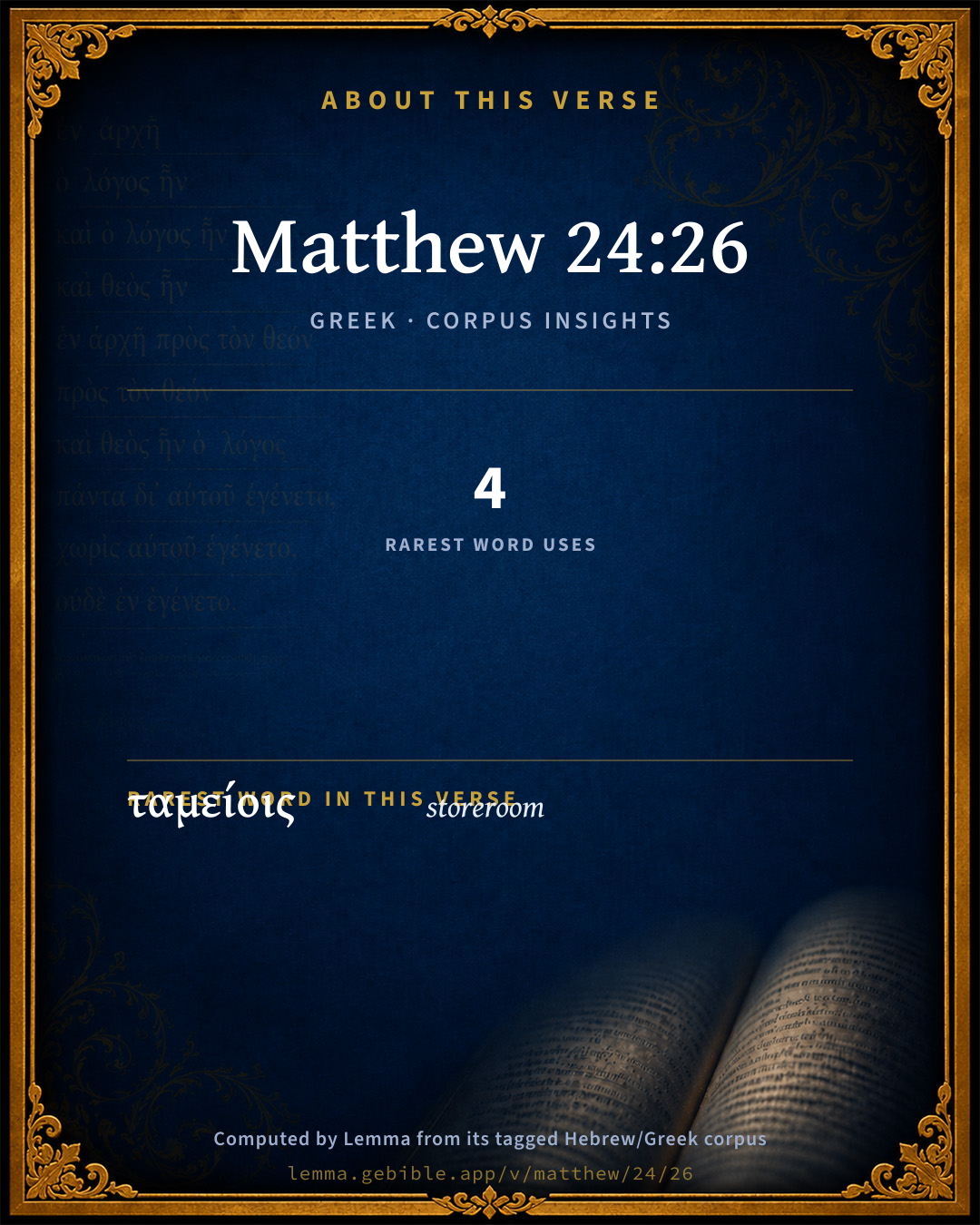
The rarest word here is ταμείοις storeroom G5009 — appearing just 4 times in the whole Greek New Testament.

Shared distinctive vocabulary

ταμείοις storeroom G5009 occurs in 4 verses of the Greek New Testament. Also found in:

Repetition

Words recur within this verse:

Commentary

Notes on Matthew 24:26 from classic Christian and Jewish commentators (each source and its license shown beneath its notes). The classic Christian expositions comment on the surrounding passage and are grouped to its opening verse, so a note may address several verses; the Jewish commentaries on the Tanakh (Rashi and others) are per-verse, so they appear only where the commentator wrote on this verse.

Lemma curates 59 commentaries, every one of them public domain or Creative Commons licensed, each selected and text-cleaned for this edition rather than reprinted as found. About our sources →

Tyndale Open Study Notes

Tyndale Open Resources

24:26-28 These verses are an expansion of 24:23. The place and manner of the Messiah’s appearing was disputed among Jews. The Messiah’s glorious appearance and vindication will be unmistakable.

24:26 Some Jewish prophets persuaded the masses to follow them into the desert to see signs of deliverance (cp. 24:4-8). • hiding here: This is perhaps a reference to secretive sects, such as those at Qumran, or to the small fellowship groups associated with the Pharisees.

Tyndale Open Study Notes — © Tyndale Open Resources, licensed CC BY-SA 4.0. Text via the HelloAO Bible API.

Bengel's Gnomon

Johann Albrecht Bengel

Mat 24:26. Ἐν τῆ ἐρήμῳ, in the desert) This might be said speciously (cf. ch. Mat 3:3), and is applicable to those who drew crowds and bands tumultuously after them; see Act 21:38. Therefore our Lord adds, “Go not forth.”—ἐν τοῖς ταμείοις, in the secret chambers) This applies to those who pretended to possess hidden treasures, therefore our Lord adds, “Believe it not.”

Bengel's Gnomon of the New Testament — English translation (T&T Clark, Edinburgh, 1860) — public domain. Text from a community e-Sword module.

Meyer's Critical & Exegetical Commentary

Heinrich August Wilhelm Meyer

Mat_24:26. Οὖν] according to the tenor of this my prediction. Mat_24:26 does not stand to Mat_24:23 in the relation of a strange reduplication (Weiss), but as a rhetorical amplification which is brought to an emphatic close by a repetition of the μὴ πιστεύσητε of Mat_24:23.

ἐστί] the Messiah, Mat_24:23.

ἐν τοῖς ταμείοις] the article is to be taken demonstratively, while the plural denotes the inner rooms of a house. According to Fritzsche, we have here the categorical plural (see on Mat_2:20): en, ibi est locorum, quae conclavia appellantur. That would be too vague a pretence. The phraseology here made use of: in the wildernessin the inner rooms of the houseis simply apocalyptic imagery. Ultra de deserto et penetralibus quaerere non est sobrii interpretis, Maldonatus.

Meyer — Critical and Exegetical Commentary on the New Testament — English translation by Peter Christie, edited by Frederick Crombie (T&T Clark, 1880) — public domain. Text from a community e-Sword module.

Expositor's Greek Testament

ed. W. Robertson Nicoll

Mat 24:26 . ἐν τῇ ἐρήμῳ , a likely place for a Christ to be (Moses, Israel’s first deliverer). μὴ ἐξέλθητε , go not out ( cf. Mat 11:7-9 ). ἐν τοῖς ταμείοις ( vide Mat 6:6 ), in the secret chambers, the plural indicating the kind of place, not any particular place. Both expressions in the desert, in the secret recesses point to non-visibility. The false prophets bid the people put their faith in a Messiah not in evidence, the Great Unseen = “The hour is come, and the man is somewhere, out of view, not far away, take my word for it”. Interpreters who seek for exact historical fulfilments point to Simon son of Gioras, and John of Giscala: the former the Messiah in the desert of Tekoah, gathering a confiding multitude about him; the latter the Messiah in the secret places, taking possession of the interior part of the temple with its belongings in the final struggle ( vide Josephus, B. J., iv., 9, 5 and 7; Mat 24:6 ; Mat 24:1 , and Lutteroth, ad loc. ).

The Expositor's Greek Testament, edited by W. Robertson Nicoll (1897–1910) — public domain. Text from a community e-Sword module.

Adam Clarke's Commentary

Verse 26. If they shall say unto you, Behold, he is in the desert] Is it not worthy of remark that our Lord not only foretold the appearance of these impostors, but also the manner and circumstances of their conduct? Some he mentions as appearing in the desert. Josephus says, ANT. b. xx. c. 7, and WAR, book ii. c. 13: That many impostors and cheats persuaded the people to follow them to the desert, promising to show them signs and wonders done by the providence of God, is well attested. An Egyptian false prophet, mentioned by Josephus, ANT. b. xx. c. 7, and in the Acts, Ac 21:38, led out into the DESERT four thousand men, who were murderers, but these were all taken or destroyed by Felix. Another promised salvation to the people, if they would follow him to the DESERT, and he was destroyed by Festus, ANT. b. xx. c. 7. Also, one Jonathan, a weaver, persuaded a number to follow him to the DESERT, but he was taken and burnt alive by Vespasian. See WAR, b. vii. c. 11.

As some conducted their deluded followers to the DESERT, so did others to the secret chambers. Josephus mentions a false prophet, WAR, b. vi. c. 5, who declared to the people in the city, that God commanded them to go up into the temple, and there they should receive the signs of deliverance. A multitude of men, women, and children, went up accordingly; but, instead of deliverance, the place was set on fire by the Romans, and 6,000 perished miserably in the flames, or in attempting to escape them.

Adam Clarke's Commentary on the Bible (1810–1826) — public domain. Text from a community e-Sword/MySword module.

Ellicott's Commentary for English Readers

(26) In the secret chambers.—The word is the same as that translated “closet” in Mat_6:6. What is meant is that the pretenders will in some way or other shun the publicity which would test their claims. There would be whispered rumours that the Christ was concealing Himself in the wilderness beyond the Jordan, or in the inner recesses of some zealot’s house, and would at the last moment appear to claim the throne of His father David. (Comp. Jos. Wars, vi. 5, § 2). Believers in Christ would hear such words with a calm indifference, for they would know that such was not to be the manner of His approach.

A Bible Commentary for English Readers, edited by Charles John Ellicott (1878–1897) — public domain. Text from a community e-Sword module.

The Cambridge Bible for Schools and Colleges

gen. ed. J. J. S. Perowne

26. in the desert … in the secret chambers] i. e. whether the false Christ shall go forth into the desert and draw men to him by an ascetic life, or shall influence by teaching in the “schools” of the synagogues, be not deceived.

secret chambers] one word in the original. The same word is translated “closet” (ch. Mat_6:6), that is the place for prayer on the top or in the upper part of an Eastern house.

The Cambridge Bible for Schools and Colleges (gen. ed. J. J. S. Perowne; Cambridge University Press, 1878–1918) — public domain. Text from a community e-Sword module.

John Gill's Exposition

For as the lightning cometh out of the east,.... The eastern part of the horizon,

and shineth even unto the west; to the western part of it, with great clearness; in a moment; in the twinkling of an eye, filling the whole intermediate space;

so shall also the coming of the son of man be; which must be understood not of his last coming to judgment, though that will be sudden, visible, and universal; he will at once come to, and be seen by all, in the clouds of heaven, and not in deserts and secret chambers: nor of his spiritual coming in the more sudden, and clear, and powerful preaching of the Gospel all over the Gentile world; for this was to be done before the destruction of Jerusalem: but of his coming in his wrath and vengeance to destroy that people, their nation, city, and temple: so that after this to look for the Messiah in a desert, or secret chamber, must argue great stupidity and blindness; when his coming was as sudden, visible, powerful, and general, to the destruction of that nation, as the lightning that comes from the east, and, in a moment, shines to the west.

John Gill's Exposition of the Whole Bible (1746–1763) — public domain (CC PDM 1.0). Text via the HelloAO Bible API.

Trapp's Complete Commentary

John Trapp

26 Wherefore if they shall say unto you, Behold, he is in the desert; go not forth: behold, he is in the secret chambers; believe it not.

Ver. 26. Behold, he is in the desert] In such a hermitage, or blind chapel, built in a by-place to the honour of such a saint, as our Lady of Loretto, Hall, or Sichem (Lipsius’ last dotages). "Behold, he is in the secret chambers," or conclaves, εν τοις ταμειοις (scil. of cardinals, &c.), or cupboards, as the breaden god borne up and down in a box, or on an altar, and worshipped by the common people. The rebels of Norfolk in Edward VI’s time, brought with them into the battle the pyx {a} under his canopy, as the Israelites brought the ark, 1Sa 4:3, and said it should save them. But as then the ark, so now the consecrated god, with all the trumpery about him, was taken in a cart, which was then instead of an altar, and there lay all in the dust. Believe them not therefore in any of these their fopperies and forgeries. "The simple believeth every word: but the prudent man looketh well to his going." {b} He is a slave to good reason, but not easily swayed by every new opinion.

{a} The vessel in which the host or consecrated bread of the sacrament is reserved. ŒD

{b} Fatuus, פתא faluellus. Lips. Pro 14:15.

John Trapp, A Commentary or Exposition upon All the Books of the Old and New Testament (1647–1656) — public domain. Text from a community e-Sword module.

Albert Barnes' Notes on the Bible

Behold, he is in the desert - The Jews had formed the expectation that the Messiah would appear suddenly from some unexpected quarter; hence, many would be looking to desert places, expecting that he would come from them. Accordingly, most of the impostors and pretended prophets led their people into the deserts.

Go not forth - Do not follow them; they will only deceive you.

In secret chambers - Concealed in some house, or some retired part of the city. Many would, doubtless, pretend that the Messiah was concealed there, and, either for the purpose of encouraging or deceiving the people, would pretend that they had discovered him.

Albert Barnes' Notes on the Bible (1834–1885) — public domain. Text from a community e-Sword/MySword module.

Haydock's Catholic Bible Commentary

Behold he is in the desert. This prediction of false Christs, may be understood before the destruction of Jerusalem, but chiefly before the end of the world. (Witham) --- As we have mentioned above, in note on verse 5.

George Leo Haydock (1774–1849), Haydock's Catholic Family Bible and Commentary, 1859 edition — public domain. Excludes Psalms (Douay-Rheims chapter numbering differs from Protestant) and Deuterocanonical books (Catholic canon only).

Whedon's Commentary on the Bible

Daniel D. Whedon

26. Believe it not — For my second coming is not of this earthly or terrestrial nature. We may here remark, that if the following verse is to be interpreted allegorically, as many commentators at the present day interpret it, it could be no protection against the wiles of false Christs. If the coming were invisible or figurative, and might be fulfilled in the Roman armies, or in Titus, why not in some promising heroic Jewish deliverer in the midst of the siege.

The contrast is between the personal coming of a false Christ and the personal advent of the true Christ. The one would be earthly and lurking; the other celestial and lightning-like, from east to west.

The common view would make the contrast lie between the coming of false Christs and the coming of the Roman armies! The former secret, the latter like lightning from heaven!

Daniel D. Whedon (gen. ed.), Commentary on the Old and New Testaments (1874–1909) — public domain. Text from a community e-Sword module.

The Pulpit Commentary

Wherefore if (ea , if therefore). The Lord proceeds to make the matter more plain by entering into details which the "here" and "there" of ver. 23 had not sufficiently denoted. He (Christ) is in the desert. If there was a partial fulfilment of this warning at the siege of Jerusalem, when some impostors tried to persuade the people that Messiah was in the wilderness, preparing to march to their relief, it is to have its chief accomplishment just before the final consummation. Go not forth. Be not deluded into following any local deceiver. The definite place of appearance proves its falsity (see ver. 27). The secret chambers; in penetralibus (Vulgate). When Christ comes the second time, he will not come as at Bethlehem, in secret, in a corner. If any pretender should be announced under such conditions, they were to put no belief in him. These were simple tests which all could apply. To limit the Lord"s appearance to particular persons or to a particular place, was to incur fatal error.

The Pulpit Commentary (1880–1919), ed. H.D.M. Spence-Jones & Joseph S. Exell — public domain. Text from a community e-Sword module.

unfoldingWord translationNotes

Door43 World Missions Community

if they say to you, 'Look, he is in the wilderness,' do

This can be stated as an indirect quotation. AT: "if someone tells you that the Christ is in the wilderness, do" (See: Direct and Indirect Quotations)

Or, 'See, he is in the inner rooms,'

This can be stated as an indirect quotation. AT: "Or, if someone tells you that the Christ is in the inner room," (See: Direct and Indirect Quotations)

in the inner rooms

"in a secret room" or "in secret places"

as the lightning shines ... so will be the coming

This means that the Son of Man will come very quickly and will be easy to see. (See: Simile)

the Son of Man

Jesus is speaking about himself in the third person. (See: First, Second, or Third Person)

Wherever a dead animal is, there the vultures will gather

This is probably a proverb that the people of Jesus' time understood. Possible meanings are 1) when the Son of Man comes, everyone will see him and know that he has come, or 2) wherever spiritually dead people are, false prophets will be there to tell them lies. (See: Proverbs)

vultures

birds that eat the bodies of dead or dying creatures

translationWords

Christ

desert

Son of Man

unfoldingWord translationNotes — © Distant Shores Media and the Door43 World Missions Community, licensed CC BY-SA 4.0. Source: git.door43.org/Door43/en_tn.

Cambridge Greek Testament for Schools and Colleges

26. ἐν τῇ ἐρήμῳ. Cp. Joseph. B. J. II. 13. 4.

ἐν τοῖς ταμείοις. Here probably ‘the lecture rooms’ of the synagogue, so that the meaning of the verse would be, ‘whether the false Christ come like John the Baptist in the desert, or like a great Rabbi in the schools of the synagogue, be not deceived.’

Cambridge Greek Testament for Schools and Colleges (Cambridge University Press, 1896; 21 vols, various authors incl. Carr, Maclear, Plummer, Farrar, Lumby, Moule, M. R. James, Simcox) — public domain. Text from a community e-Sword module.

International Critical Commentary

26-27. Occur in Luk 17:23-24.

(L) 26. If, therefore, they say to you, Behold, he is in the desert; go not forth: behold, he is in the chambers; believe (them) not.] Lk. has “And they will say to you, Behold there, or behold here. Go not after nor follow (them).”

International Critical Commentary — older volumes (1896–1929), various authors — public domain. Text from a community e-Sword module.

Vincent's Word Studies in the New Testament

Marvin R. Vincent

In the desert - Secret chambers. Rev., wilderness - inner chambers. Both retired places, indicating that the false Messiahs will avoid public scrutiny.

Marvin R. Vincent, Word Studies in the New Testament (1887–1900) — public domain. Text from a community e-Sword/MySword module.

Lesson kit

Teaching starters — assembled from the data on this page, not authored interpretation. Every prompt links to the verse data it draws on. Edit before teaching.

Matthew, in the Gospels, opens this verse with 17 words (13 distinct Greek lemmas). Its most distinctive word is tameîon (“storeroom”). A historical commentator’s framing appears above. Read the whole chapter for the surrounding context.

Discussion questions

  1. What does “storeroom” (tameîon) contribute to the verse as a whole?
  2. Matthew 6:6 shares the word «storeroom» with this verse. How do the two illuminate each other?
  3. “to see” occurs 2× in this one verse. What is the effect of the repetition?
  4. These translations render this verse differently; the difference is in the English rendering, not the original. What questions does that raise?
  5. Reading how Tyndale Open Study Notes and Bengel's Gnomon read this verse, where do the two commentators agree and where do they part?

Things to notice

Reading settings

Reading text

Shown beneath each verse's original-language words.

Old Testament
Old Testament edition

Read the OT as the Masoretic Hebrew (MT) or the Greek Septuagint (LXX).

English shown for the Greek Septuagint (in the Hebrew ↔ Greek comparison).

Comparing translations? Open the Compare panel on any verse page to stack up to four side by side.