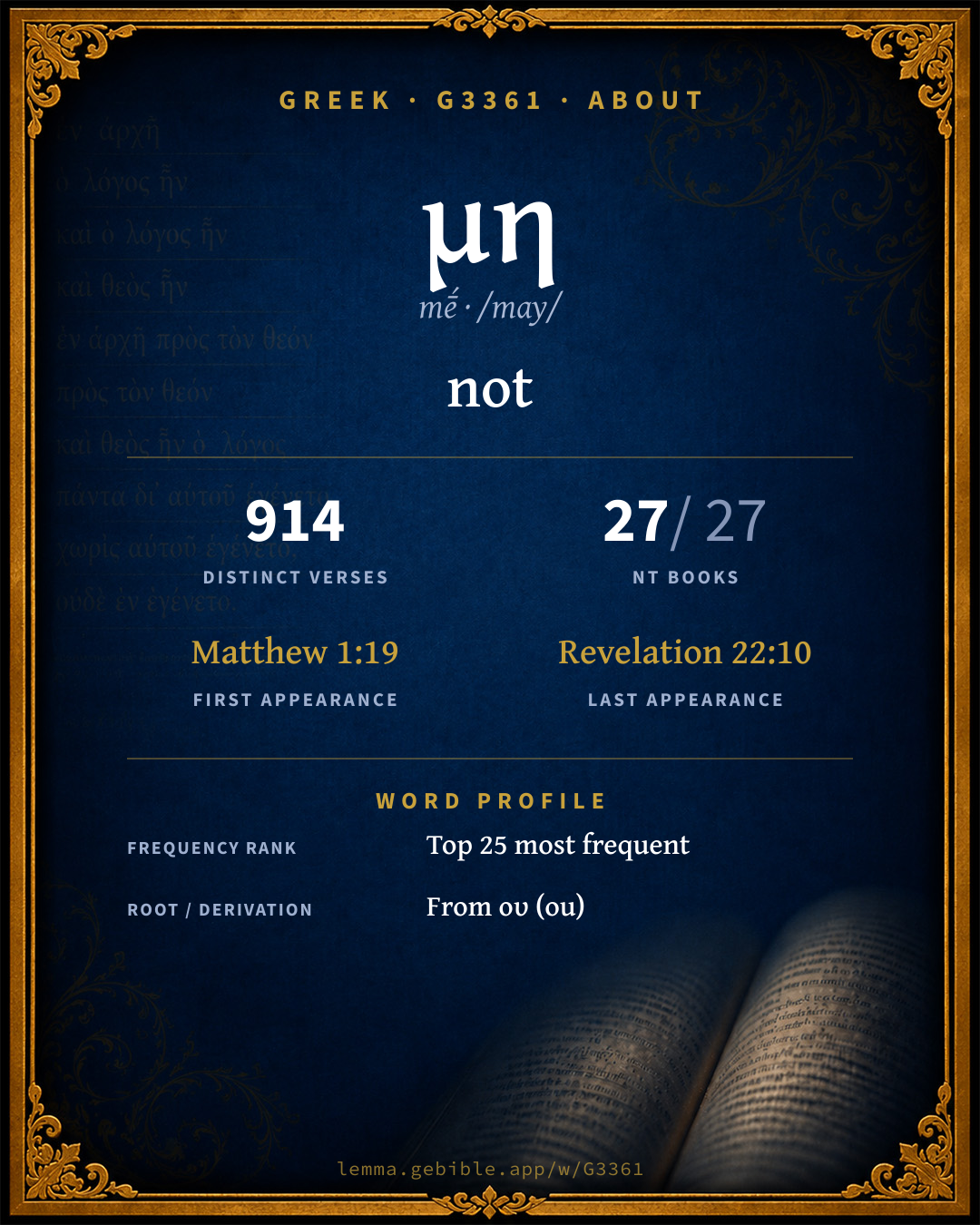
μή
not
Full lexicon entry — Thayer's Greek Lexicon
From Thayer's Greek Lexicon
Where this word appears
Grammar key — what these labels mean
Part of speech
- Particle
- A short, often untranslatable function word adding nuance or connection.
Degree
- Negative
- Marks a negative form.
Every verse where G3361 appears in the Book of Hebrews — 37 distinct verses. Click any verse to open its interlinear word-by-word view. Verse text shown in the World English Bible for context — . Each verse’s Greek form is shown with its reference; the English is not keyword-highlighted, since the data carries no word-level English alignment. Use “Compare translations” on any verse to read it across multiple English versions. This concordance covers the Greek New Testament; Septuagint (Greek Old Testament) occurrences of this word are not indexed here.
Hebrews
- Hebrews 3:8 μὴ ptcl neg Don't harden your hearts, as in the provocation, Like as in the day of the trial in the wilderness,
- Hebrews 3:13 μὴ ptcl neg but exhort one another day by day, so long as it is called "today;" lest any one of you be hardened by the deceitfulness of sin.
- Hebrews 3:15 μὴ ptcl neg while it is said, "Today if you will hear his voice, Don't harden your hearts, as in the rebellion."
- Hebrews 3:18 μὴ μὴ ptcl neg ptcl neg To whom did he swear that they wouldn't enter into his rest, but to those who were disobedient?
- Hebrews 4:2 μὴ ptcl neg For indeed we have had good news preached to us, even as they also did, but the word they heard didn't profit them, because it wasn't mixed with faith by those who heard.
- Hebrews 4:7 μὴ ptcl neg he again defines a certain day, today, saying through David so long a time afterward (just as has been said), "Today if you will hear his voice, Don't harden your hearts."
- Hebrews 4:11 μὴ ptcl neg Let us therefore give diligence to enter into that rest, lest anyone fall after the same example of disobedience.
- Hebrews 4:15 μὴ ptcl neg For we don't have a high priest who can't be touched with the feeling of our infirmities, but one who has been in all points tempted like we are, yet without sin.
- Hebrews 6:1 μὴ ptcl neg Therefore leaving the doctrine of the first principles of Christ, let us press on to perfection--not laying again a foundation of repentance from dead works, of faith toward God,
- Hebrews 6:12 μὴ ptcl neg that you won't be sluggish, but imitators of those who through faith and patience inherited the promises.
- Hebrews 7:6 μὴ ptcl neg but he whose genealogy is not counted from them has taken tithes of Abraham, and has blessed him who has the promises.
- Hebrews 8:11 μὴ ptcl neg They will not teach every man his fellow citizen, Every man his brother, saying, 'Know the Lord,' For all will know me, From the least of them to the greatest of them.
- Hebrews 8:12 μὴ ptcl neg For I will be merciful to their unrighteousness. I will remember their sins and lawless deeds no more."
- Hebrews 9:9 μὴ ptcl neg which is a symbol of the present age, where gifts and sacrifices are offered that are incapable, concerning the conscience, of making the worshipper perfect;
- Hebrews 10:17 μὴ ptcl neg "I will remember their sins and their iniquities no more."
- Hebrews 10:25 μὴ ptcl neg not forsaking our own assembling together, as the custom of some is, but exhorting one another; and so much the more, as you see the Day approaching.
- Hebrews 10:35 μὴ ptcl neg Therefore don't throw away your boldness, which has a great reward.
- Hebrews 11:3 μὴ ptcl neg By faith, we understand that the universe has been framed by the word of God, so that what is seen has not been made out of things which are visible.
- Hebrews 11:5 μὴ ptcl neg By faith, Enoch was taken away, so that he wouldn't see death, and he was not found, because God translated him. For he has had testimony given to him that before his translation he had been well pleasing to God.
- Hebrews 11:8 μὴ ptcl neg By faith, Abraham, when he was called, obeyed to go out to the place which he was to receive for an inheritance. He went out, not knowing where he went.
- Hebrews 11:13 μὴ ptcl neg These all died in faith, not having received the promises, but having seen them and embraced them from afar, and having confessed that they were strangers and pilgrims on the earth.
- Hebrews 11:27 μὴ ptcl neg By faith, he left Egypt, not fearing the wrath of the king; for he endured, as seeing him who is invisible.
- Hebrews 11:28 μὴ ptcl neg By faith, he kept the Passover, and the sprinkling of the blood, that the destroyer of the firstborn should not touch them.
- Hebrews 11:40 μὴ ptcl neg God having provided some better thing concerning us, so that apart from us they should not be made perfect.
- Hebrews 12:3 μὴ ptcl neg For consider him who has endured such contradiction of sinners against himself, that you don't grow weary, fainting in your souls.
- Hebrews 12:5 μὴ ptcl neg and you have forgotten the exhortation which reasons with you as with children, "My son, don't take lightly the chastening of the Lord, Nor faint when you are reproved by him;
- Hebrews 12:13 μὴ ptcl neg and make straight paths for your feet, so that which is lame may not be dislocated, but rather be healed.
- Hebrews 12:15 μή μή ptcl neg ptcl neg looking carefully lest there be any man who falls short of the grace of God; lest any root of bitterness springing up trouble you, and thereby the many be defiled;
- Hebrews 12:16 μή ptcl neg lest there be any sexually immoral person, or profane person, as Esau, who sold his birthright for one meal.
- Hebrews 12:19 μὴ ptcl neg the sound of a trumpet, and the voice of words; which those who heard it begged that not one more word should be spoken to them,
- Hebrews 12:25 μὴ ptcl neg See that you don't refuse him who speaks. For if they didn't escape when they refused him who warned on the Earth, how much more will we not escape who turn away from him who warns from heaven,
- Hebrews 12:27 μὴ ptcl neg This phrase, "Yet once more," signifies the removing of those things that are shaken, as of things that have been made, that those things which are not shaken may remain.
- Hebrews 13:2 μὴ ptcl neg Don't forget to show hospitality to strangers, for in doing so, some have entertained angels without knowing it.
- Hebrews 13:5 μή μή ptcl neg ptcl neg Be free from the love of money, content with such things as you have, for he has said, "I will in no way leave you, neither will I in any way forsake you."
- Hebrews 13:9 μὴ ptcl neg Don't be carried away by various and strange teachings, for it is good that the heart be established by grace, not by food, through which those who were so occupied were not benefited.
- Hebrews 13:16 μὴ ptcl neg But don't forget to be doing good and sharing, for with such sacrifices God is well pleased.
- Hebrews 13:17 μὴ ptcl neg Obey your leaders and submit to them, for they watch on behalf of your souls, as those who will give account, that they may do this with joy, and not with groaning, for that would be unprofitable for you.
About this entry
At a glance — auto-summarized from this page’s data, not written by a person. Every figure links to its source below. This summary describes the numbers; it doesn’t interpret them.
At its core, μη (mḗ) means “not.” It first appears in Matthew 1:19. It turns up in 914 verses across 27 books, one of the most common footprint. Sharing its root, it stands alongside ου, ου μη and ουδε. Each statement above links to its evidence; the full detail follows below.
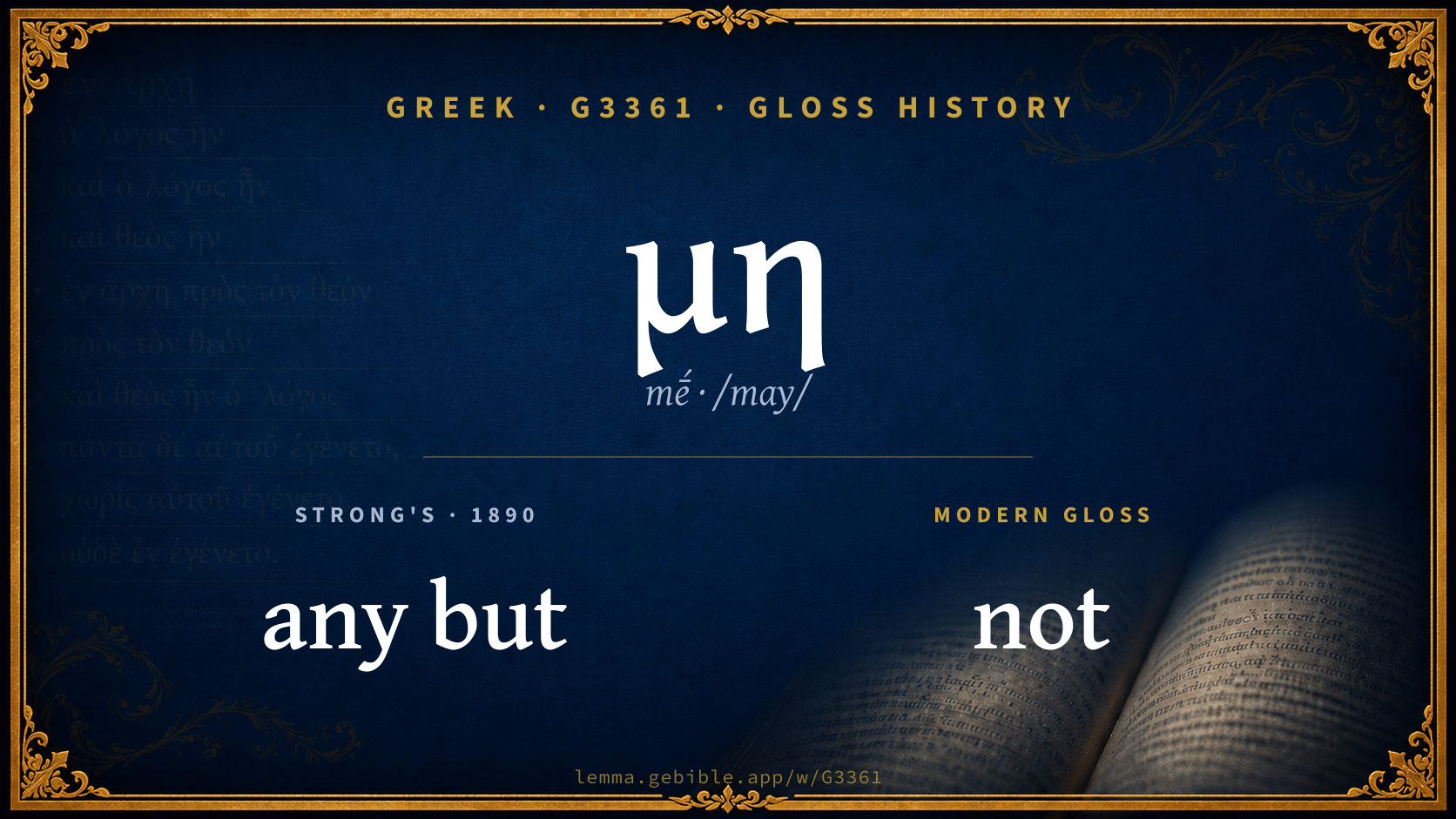
Gloss history
Strong's 1890 vs modern scholarship
About this word
Strong's G3361 catalogs a Greek word from the Greek New Testament.
These counts are not copied from any lexicon or concordance. They are computed here, from the morphology-tagged Greek New Testament. What Lemma adds →
- 914
- distinct verses
- The word appears in 914 distinct verses.
- 27 / 27
- NT books
- The word appears in 27 of 27 New Testament books.
- #19
- by frequency
- Top 25 most frequent Greek words (rank 19 of 5,347 Greek words by occurrence).
View all 914 occurrences in the concordance →
By section of the New Testament
By traditional corpus
Conventional, traditional groupings — biblical authorship is debated, so this is a traditional corpus grouping, not an authorship claim. Some books belong to more than one corpus (Luke is in both the Gospels and the Lukan corpus, and so on), so these shares overlap and need not total 100%. Each figure is a share of the word’s 914 distinct verses.
- Gospels 419 verses · 46%
- Pauline corpus 290 verses · 32%
- Lukan (Luke–Acts) 186 verses · 20%
- Johannine 174 verses · 19%
- General (Catholic) Epistles 67 verses · 7%
- Revelation 41 verses · 4%
- Hebrews 37 verses · 4%
How translations render this word
Counts come from each version’s own published word-to-Strong’s tagging or interlinear alignment — an approximate guide to how each version renders this word, not a word-level alignment the data otherwise carries. Because each total is that version’s own tagged count, the per-version totals vary from one another and need not match the appearance or distinct-verse counts above. These counts may also differ from a printed concordance because Lemma counts each distinctly tagged rendering and does not collapse phrase taggings into a single head-word total. This is a fixed set of word-tagged versions (KJV, ASV, BSB, ULT) and does not change with the reading translation you choose elsewhere. Each version’s license is shown beside its name below (and on Sources).
- King James Version: Not 493×, No 49×, God forbid 15×
- American Standard Version: Not 535×, No 64×, Lest 20×
- Berean Standard Bible: Not 142×, Do not 122×, No 41×
- unfoldingWord Literal Text: Not 754×, Certainly not 88×, Except 67×
King James Version Public Domain
Renders G3361 across 647 tagged occurrences — most commonly:
Plus other, less common renderings. Plus 33 renderings that appear only once — usually multi-word phrases or single function words the recovered tagging swept in, not distinct renderings. Not rendered by a distinct English word in 27 further occurrences.
American Standard Version Public Domain
Renders G3361 across 863 tagged occurrences — most commonly:
Plus other, less common renderings. Plus 89 renderings that appear only once — usually multi-word phrases or single function words the recovered tagging swept in, not distinct renderings. Not rendered by a distinct English word in 4 further occurrences.
Berean Standard Bible Public Domain
Renders G3361 across 413 tagged occurrences — most commonly:
Plus other, less common renderings. Plus 26 renderings that appear only once — usually multi-word phrases or single function words the recovered tagging swept in, not distinct renderings. Not rendered by a distinct English word in 242 further occurrences.
unfoldingWord Literal Text CC BY-SA 4.0
Renders G3361 across 1,087 tagged occurrences — most commonly:
Plus other, less common renderings. Plus 14 renderings that appear only once — usually multi-word phrases or single function words the recovered tagging swept in, not distinct renderings.
Senses in Thayer's
The 1 sense Thayer's distinguishes for this word, in lexicon order (not ranked by frequency or importance). The full entry — with sub-senses — is in the Lexicon Entry tab.
- no, not lest
Word origin
Derived from ου (ou) (G3756) — not.
A primary particle of qualified negation (whereas G3756 expresses an absolute denial); (adverbially) not (conjugationally) lest ; also (as interrogitive implying a negative answer [whereas G3756 expects an affirmative one]); whether : - any but (that) X forbear + God forbid + lack lest neither never no (X wise in) none nor [can-] not nothing that not un [-taken] without. Often used in compounds in substantially the same relations. See also G3362 G3363 G3364 G3372 G3373 G3375 G3378 .
— Strong’s Exhaustive Concordance (1890), public domain.
Forms in the corpus
The 4 distinct written forms G3361 takes in the Greek New Testament, most frequent first — each parse links to that case’s occurrences in the concordance.
| Form | Parsing | Example | Uses |
|---|---|---|---|
| μὴ mḕ | Particle, Negative | Matthew 1:19 | 966 |
| μή mḗ | Particle, Negative | Matthew 23:39 | 47 |
| Μὴ Mḕ | Particle, Negative | Matthew 5:17 | 12 |
| μήγε mḗge | Particle, Negative | Matthew 6:1 | 8 |
Same root — word family
Other Thayer's entries built from the same root as G3361, grouped by Strong’s listed origin. These share a root / origin per the lexicon — not necessarily a shared meaning. Each links to that word’s own entry.
Derives from
Shares the same root
- ου μη ou mḗ G3364 by no means
- ουδε oudé G3761 neither
- ουκετι oukéti G3765 no longer
- ουκουν oukoûn G3766 not therefore
- ουπω oúpō G3768 not yet
- ουτε oúte G3777 neither
- ουχι ouchí G3780 not at all
Derived from this word
- μηδαμως mēdamōs G3365 by no means
- μηδε mēdé G3366 and not
- μηδεις mēdeís G3367 no one
- μηκετι mēkéti G3371 no longer
- μη ουκ mḕ ouk G3378 not ever
- μηποτε mḗpote G3379 lest
- μηπω mḗpō G3380 not yet
- μηπως mḗpōs G3381 lest
- μητε mḗte G3383 nor
- μητι mḗti G3385 whether
- μητις mḗtis G3387 let no one
- ου ou G3756 not
Compare all same-root words → Showing 4 of 20 — not the complete family. They share a root, not necessarily a meaning.
Septuagint usage
The same Greek word μη appears 2,278 times in the Greek Old Testament (Septuagint), across 1,896 verses in 37 books.
- 2,278
- LXX occurrences
- Tagged occurrences of this Greek word in the Septuagint.
- 1,896
- verses
- Distinct Septuagint verses containing this word.
- 37 / 39
- OT books
- The word appears in 37 of the 39 Old Testament books.
Sample Septuagint occurrences
- Genesis 3:1 μή
- Exodus 2:14 μή
- Leviticus 5:1 μή
- Numbers 4:15 μή
- Deuteronomy 1:17 μή
- Joshua 1:9 μή
- Judges 2:3 μή
- Ruth 1:11 μή
- 1 Samuel 1:6 μή
- 2 Samuel 1:20 μή
- 1 Kings 2:9 μή
- 2 Kings 1:3 μή
Septuagint occurrences (same lexeme)
Every verse where the same Strong’s number (G3361) appears in the Greek Septuagint — showing the first 50 of 1,896. Verse text shown in the World English Bible for context; the Greek form is the matched word — the English is not keyword-highlighted.
- Genesis 3:1 μή Now the serpent was more subtle than any animal of the field which Yahweh God had made. He said to the woman, "Yes, has God said, 'You shall not eat of any tree of the garden?'"
- Genesis 3:3 μή but of the fruit of the tree which is in the midst of the garden, God has said, 'You shall not eat of it, neither shall you touch it, lest you die.'"
- Genesis 3:11 μή God said, "Who told you that you were naked? Have you eaten from the tree that I commanded you not to eat from?"
- Genesis 3:17 μή To Adam he said, "Because you have listened to your wife's voice, and have eaten of the tree, of which I commanded you, saying, 'You shall not eat of it,' cursed is the ground for your sake. In toil you will eat of it all the days of your life.
- Genesis 4:7 μή If you do well, will it not be lifted up? If you don't do well, sin crouches at the door. Its desire is for you, but you are to rule over it."
- Genesis 4:9 μή Yahweh said to Cain, "Where is Abel, your brother?" He said, "I don't know. Am I my brother's keeper?"
- Genesis 4:15 μή Yahweh said to him, "Therefore whoever slays Cain, vengeance will be taken on him sevenfold." Yahweh appointed a sign for Cain, lest any finding him should strike him.
- Genesis 6:3 μή Yahweh said, "My Spirit will not strive with man forever, because he also is flesh; yet will his days be one hundred twenty years."
- Genesis 7:2 μή You shall take seven pairs of every clean animal with you, the male and his female. Of the animals that are not clean, take two, the male and his female.
- Genesis 7:3 μή Also of the birds of the sky, seven and seven, male and female, to keep seed alive on the surface of all the earth.
- Genesis 7:8 μή Clean animals, animals that are not clean, birds, and everything that creeps on the ground
- Genesis 11:7 μή Come, let's go down, and there confuse their language, that they may not understand one another's speech."
- Genesis 13:8 μή Abram said to Lot, "Please, let there be no strife between me and you, and between my herdsmen and your herdsmen; for we are relatives.
- Genesis 14:23 μή that I will not take a thread nor a shoe-latchet nor anything that is yours, lest you should say, 'I have made Abram rich.'
- Genesis 15:1 μή After these things the word of Yahweh came to Abram in a vision, saying, "Don't be afraid, Abram. I am your shield, your exceedingly great reward."
- Genesis 16:2 μή Sarai said to Abram," See now, Yahweh has restrained me from bearing. Please go in to my handmaid. It may be that I will obtain children by her." Abram listened to the voice of Sarai.
- Genesis 18:3 μή and said, "My lord, if now I have found favor in your sight, please don't go away from your servant.
- Genesis 18:14 μή Is anything too hard for Yahweh? At the set time I will return to you, when the season comes round, and Sarah will have a son."
- Genesis 18:17 μή Yahweh said, "Will I hide from Abraham what I do,
- Genesis 18:21 μή I will go down now, and see whether they have done altogether according to the cry of it, which is come to me. If not, I will know."
- Genesis 18:23 μή Abraham drew near, and said, "Will you consume the righteous with the wicked?
- Genesis 18:28 μή What if there will lack five of the fifty righteous? Will you destroy all the city for lack of five?" He said, "I will not destroy it, if I find forty-five there."
- Genesis 18:29 μή He spoke to him yet again, and said, "What if there are forty found there?" He said, "I will not do it for the forty's sake."
- Genesis 18:30 μή He said, "Oh don't let the Lord be angry, and I will speak. What if there are thirty found there?" He said, "I will not do it, if I find thirty there."
- Genesis 18:31 μή He said, "See now, I have taken it on myself to speak to the Lord. What if there are twenty found there?" He said, "I will not destroy it for the twenty's sake."
- Genesis 18:32 μή He said, "Oh don't let the Lord be angry, and I will speak yet but this once. What if ten are found there?" He said, "I will not destroy it for the ten's sake."
- Genesis 19:7 μή He said, "Please, my brothers, don't act so wickedly.
- Genesis 19:8 μή See now, I have two virgin daughters. Please let me bring them out to you, and do you to them as is good in your eyes. Only don't do anything to these men, because they have come under the shadow of my roof."
- Genesis 19:9 μή They said, "Stand back!" They said, "This one fellow came in to live as a foreigner, and he appoints himself a judge. Now will we deal worse with you, than with them!" They pressed hard on the man, even Lot, and drew near to break the door.
- Genesis 19:15 μή When the morning arose, then the angels hurried Lot, saying, "Arise, take your wife, and your two daughters who are here, lest you be consumed in the iniquity of the city."
- Genesis 19:17 μή It came to pass, when they had taken them out, that he said, "Escape for your life! Don't look behind you, neither stay anywhere in the plain. Escape to the mountain, lest you be consumed!"
- Genesis 19:19 μή See now, your servant has found favor in your sight, and you have magnified your loving kindness, which you have shown to me in saving my life. I can't escape to the mountain, lest evil overtake me, and I die.
- Genesis 19:21 μή He said to him, "Behold, I have granted your request concerning this thing also, that I will not overthrow the city of which you have spoken.
- Genesis 20:6 μή God said to him in the dream, "Yes, I know that in the integrity of your heart you have done this, and I also withheld you from sinning against me. Therefore I didn't allow you to touch her.
- Genesis 20:7 μή Now therefore, restore the man's wife. For he is a prophet, and he will pray for you, and you will live. If you don't restore her, know for sure that you will die, you, and all who are yours."
- Genesis 20:9 μή Then Abimelech called Abraham, and said to him, "What have you done to us? How have I sinned against you, that you have brought on me and on my kingdom a great sin? You have done deeds to me that ought not to be done!"
- Genesis 21:12 μή God said to Abraham, "Don't let it be grievous in your sight because of the boy, and because of your handmaid. In all that Sarah says to you, listen to her voice. For from Isaac will your seed be called.
- Genesis 21:16 μή She went and sat down opposite him, a good way off, about a bow shot away. For she said, "Don't let me see the death of the child." She sat over against him, and lifted up her voice, and wept.
- Genesis 21:17 μή God heard the voice of the boy. The angel of God called to Hagar out of the sky, and said to her, "What ails you, Hagar? Don't be afraid. For God has heard the voice of the boy where he is.
- Genesis 21:23 μή Now therefore swear to me here by God that you will not deal falsely with me, nor with my son, nor with my son's son. But according to the kindness that I have done to you, you shall do to me, and to the land in which you have lived as a foreigner."
- Genesis 22:12 μή He said, "Don't lay your hand on the boy, neither do anything to him. For now I know that you fear God, seeing you have not withheld your son, your only son, from me."
- Genesis 23:6 μή "Hear us, my lord. You are a prince of God among us. In the choice of our tombs bury your dead. None of us will withhold from you his tomb, but that you may bury your dead."
- Genesis 24:3 μή I will make you swear by Yahweh, the God of heaven and the God of the earth, that you shall not take a wife for my son of the daughters of the Canaanites, among whom I live.
- Genesis 24:6 μή Abraham said to him, "Beware that you don't bring my son there again.
- Genesis 24:8 μή If the woman isn't willing to follow you, then you shall be clear from this my oath. Only you shall not bring my son there again."
- Genesis 24:33 μή Food was set before him to eat. But he said, "I will not eat until I have told my message." He said, "Speak on."
- Genesis 24:41 μή Then will you be clear from my oath, when you come to my relatives. If they don't give her to you, you shall be clear from my oath.'
- Genesis 24:49 μή Now if you will deal kindly and truly with my master, tell me. If not, tell me. That I may turn to the right hand, or to the left."
- Genesis 24:56 μή He said to them, "Don't hinder me, seeing Yahweh has prospered my way. Send me away that I may go to my master."
- Genesis 26:2 μή Yahweh appeared to him, and said, "Don't go down into Egypt. Dwell in the land which I will tell you of.
These are occurrences of the same Greek lexeme (G3361) in the Septuagint — not a translation of any one Hebrew word. The store carries no word-level Hebrew↔Greek alignment, so no Hebrew original is asserted here. Counts come from the recovered LXX Strong's tagging — high-frequency vocabulary is well covered, while rare or late forms may be untagged — so they reflect tagged occurrences and may slightly undercount.