
Matthew 24:4

Greek (Tischendorf 8th ed.) Matthew 24:4 appears in the Greek New Testament. The text above is from the Tischendorf 8th edition. Each word links to its Strong’s number and a concise gloss. Click any word for its full Thayer’s Greek Lexicon entry.
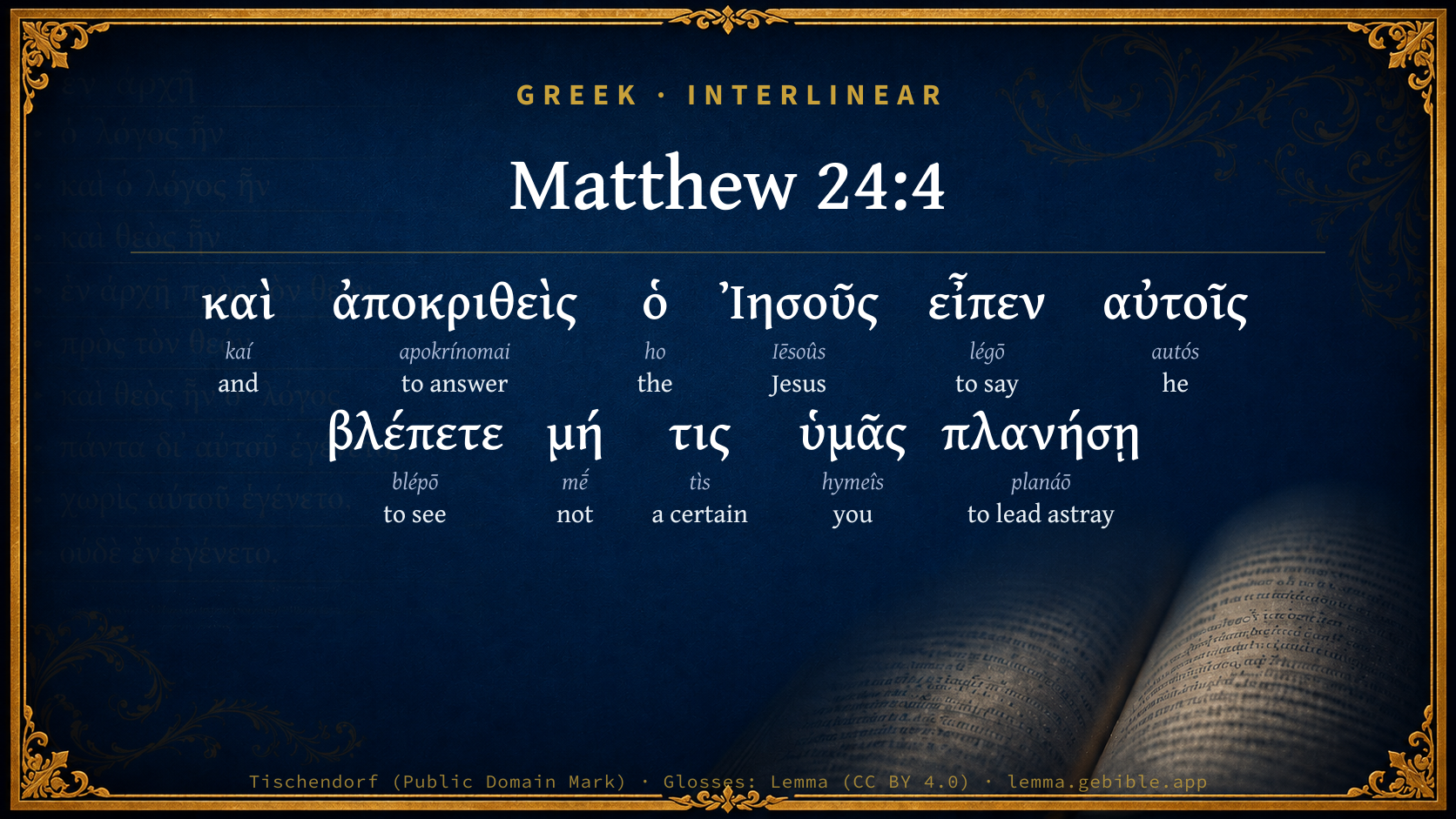
Download image
Cite this verse

Matthew 24:4 (World English Bible). Public Domain. Lemma interlinear Bible study tool, https://lemma.gebible.app/v/matthew/24/4.

Show BibTeX & RIS
BibTeX
RIS
English Translation
Jesus answered them, "Be careful that no one leads you astray.
World English Bible · Public Domain
Download a study sheet

One document with this verse’s original text, its word-by-word gloss line, the meaning frame, cross-references with their text, attributed commentary, and full source and license credits — printable, and it pastes into notes with its structure intact.

This verse Autodidact and up

Study sheet (.html) Plain text (.txt)

A passage Seminary Student

Up to 50 verses in one chapter. A passage sheet keeps up to 6 commentary sources and 12 cross-references per verse, in the order this page ranks them, and says so on the sheet whenever that leaves anything out. Ask for a single verse and you get the Autodidact verse sheet above.

Everything on this page stays free to read, with no account — the sheet is a download of what is already on screen, not access to it.

Want to remove ads? Support Godless Engineer
Compare translations 3

The same verse in 3 English versions, stacked beneath the original-language interlinear above. Click any original word for its lexicon entry.

Each is an independent rendering of the whole verse — the interlinear is not word-aligned to these translations.

Highlighted words mark where these versions differ — a whole-verse word diff, not a word-by-word alignment.

  • World English Bible Public Domain
    Jesus answered them, "Be careful that no one leads you astray.
  • King James Version Public Domain
    And Jesus answered and said unto them, Take heed that no man deceive you.
  • unfoldingWord Literal Text CC BY-SA 4.0
    And answering, Jesus said to them, “Be careful that no one leads you astray.

unfoldingWord Literal Text — © unfoldingWord, licensed CC BY-SA 4.0. Word-aligned USFM3 via Door43 (git.door43.org/unfoldingWord/en_ult).

Versions to compare (up to 4)

3 of 4 selected

Show all 19 translations

Every available English version of this verse, each an independent rendering of the whole verse.

  • World English Bible Public Domain
    Jesus answered them, "Be careful that no one leads you astray.
  • Berean Standard Bible Public Domain
    Jesus answered, “See to it that no one deceives you.
  • Majority Standard Bible Public Domain
    Jesus answered, “See to it that no one deceives you.
  • King James Version Public Domain
    And Jesus answered and said unto them, Take heed that no man deceive you.
  • American Standard Version (1901) Public Domain
    And Jesus answered and said unto them, Take heed that no man lead you astray.
  • Revised Version (1885) Public Domain
    And Jesus answered and said unto them, Take heed that no man lead you astray.
  • Geneva Bible (1599) Public Domain
    And Iesus answered, and sayd vnto them, Take heede that no man deceiue you.
  • Douay-Rheims (1899) Public Domain
    And Jesus answering, said to them: Take heed that no man seduce you:
  • Young's Literal Translation Public Domain
    And Jesus answering said to them, `Take heed that no one may lead you astray,
  • Literal Standard Version CC BY-SA 4.0
    And Jesus answering said to them, “Take heed that no one may lead you astray,
  • Unlocked Literal Bible CC BY-SA 4.0
    Jesus answered and said to them, “Be careful that no one leads you astray.
  • unfoldingWord Literal Text CC BY-SA 4.0
    And answering, Jesus said to them, “Be careful that no one leads you astray.
  • Darby Bible Public Domain
    And Jesus answering said to them, See that no one mislead you.
  • World Messianic Bible Public Domain
    Yeshua answered them, “Be careful that no one leads you astray.
  • Webster's Bible Public Domain
    And Jesus answered and said to them, Take heed that no man deceive you.
  • Free Bible Version CC BY-SA 4.0
    “Make sure no one misleads you,” Jesus replied.
  • Bible in Basic English Public Domain
    And Jesus said to them in answer, Take care that you are not tricked.
  • Text-Critical English NT CC BY 4.0
    Jesus answered them, “Make sure no one leads you astray.
  • Tyndale New Testament (1534) Public Domain
    And Iesus answered and sayde vnto them: take hede that no man deceave you.

Literal Standard Version (2020), Covenant Press — licensed CC BY-SA 4.0. Text via the HelloAO Bible API (eBible.org). Unlocked Literal Bible (unfoldingWord) — licensed CC BY-SA 4.0. Text via the HelloAO Bible API (eBible.org). unfoldingWord Literal Text — © unfoldingWord, licensed CC BY-SA 4.0. Word-aligned USFM3 via Door43 (git.door43.org/unfoldingWord/en_ult). Free Bible Version, Dr. Jonathan Gallagher — licensed CC BY-SA 4.0. Text via the HelloAO Bible API (eBible.org).

Word by word

More ways to search: Search by grammar → Find every occurrence → Compare this word →

Practice this passage: Drill this verse → Learn its vocabulary →

πλανήσῃ
planáō
G4105
“to lead astray”
Verb, Aorist, Active, Subjunctive, 3rd person, Singular
Part of Speech
Verb
Tense
Aorist
Voice
Active
Mood
Subjunctive
Person
3rd person
Number
Singular
Full Thayer's Definition

Origin: from G4106

TDNT: 09:48,9

1. to cause to stray, to lead astray, lead aside from the right way a. to go astray, wander, roam about 2. metaph. a. to lead away from the truth, to lead into error, to deceive b. to be led into error c. to be led aside from the path of virtue, to go astray, sin d. to sever or fall away from the truth 1. of heretics e. to be led away into error and sin
  1. καὶ kaí G2532 “and” Conjunction
  2. ἀποκριθεὶς apokrínomai G611 “to answer” Verb, Aorist, Passive deponent, Participle, Nominative, Singular, Masculine
  3. ὁ ho G3588 “the” Article, Nominative, Singular, Masculine
  4. Ἰησοῦς Iēsoûs G2424 “Jesus” Noun, Nominative, Singular, Masculine
  5. εἶπεν légō G3004 “to say” Verb, Aorist, Active, Indicative, 3rd person, Singular
  6. αὐτοῖς autós G846 “he” Personal pronoun, Dative, Plural, Masculine
  7. βλέπετε blépō G991 “to see” Verb, Present, Active, Imperative, 2nd person, Plural
  8. μή mḗ G3361 “not” Particle, Negative
  9. τις tìs G5100 “a certain” Indefinite pronoun, Nominative, Singular, Masculine
  10. ὑμᾶς hymeîs G5210 “you” Personal pronoun, 2nd person, Accusative, Plural

About this verse

These counts appear in no published source. They are computed here, from the morphology-tagged text and Lemma’s own curated glosses. What Lemma adds →

11
words
11
distinct lemmas
Gospels
section

Shared distinctive vocabulary

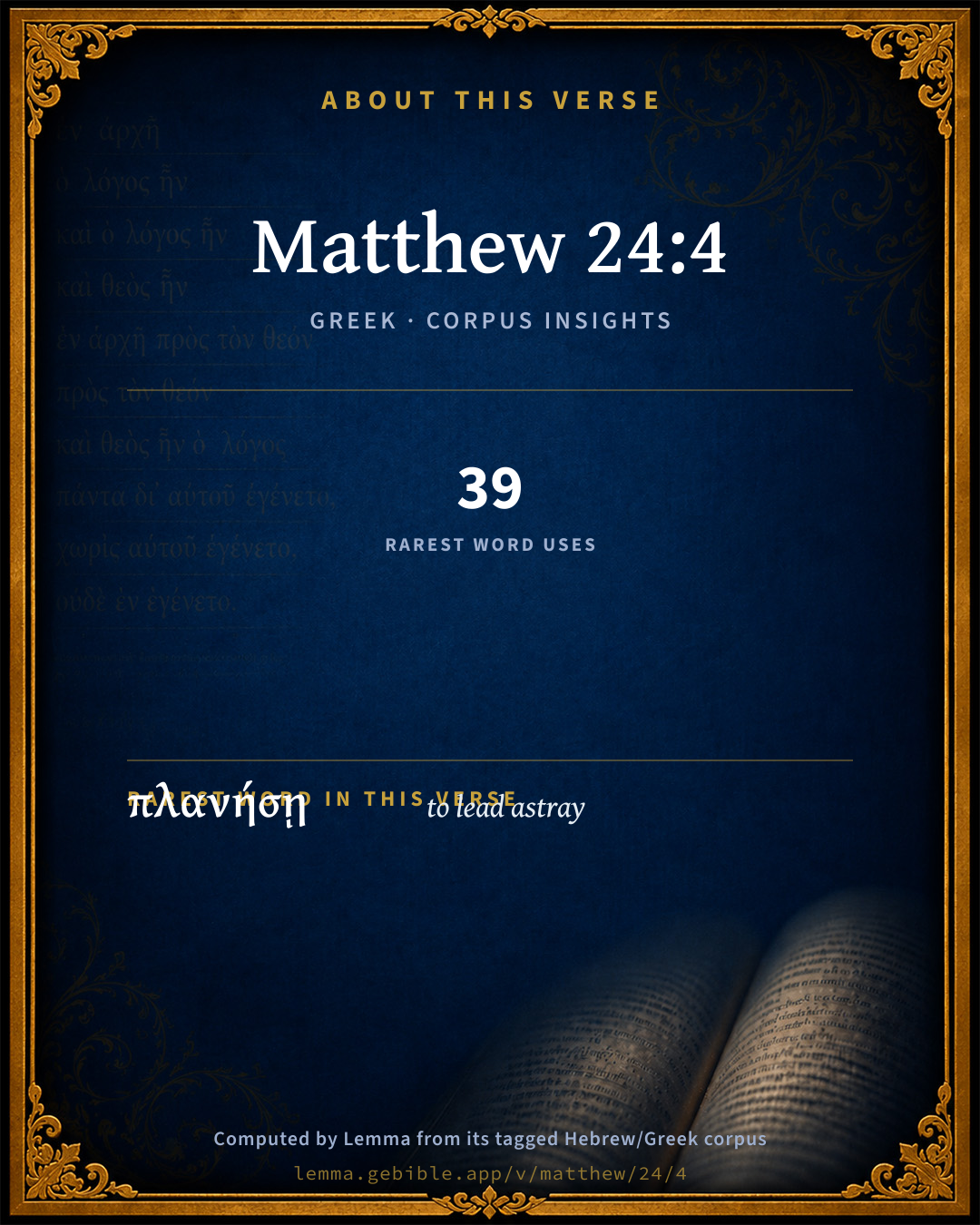
πλανήσῃ to lead astray G4105 occurs in 37 verses of the Greek New Testament. Also found in:
Cross-references

12

Topical passages linked to Matthew 24:4 in the Treasury of Scripture Knowledge — connected by theme and wording, ordered by reader-vote popularity; previews shown in the World English Bible.

  • 1 John 4:1 Beloved, don't believe every spirit, but test the spirits, whether they are of God, because many false prophets have gone out into the world.
  • Jeremiah 29:8 For thus says Yahweh of hosts, the God of Israel: Don't let your prophets who are in the midst of you, and your diviners, deceive you; neither listen you to your dreams which you cause to be dreamed.
  • 2 Thessalonians 2:3 Let no one deceive you in any way. For it will not be, unless the departure comes first, and the man of sin is revealed, the son of destruction,
  • Colossians 2:8 Be careful that you don't let anyone rob you through his philosophy and vain deceit, after the tradition of men, after the elements of the world, and not after Christ.
  • Ephesians 5:6 Let no one deceive you with empty words. For because of these things, the wrath of God comes on the children of disobedience.
  • Mark 13:5–6 Jesus, answering, began to tell them, "Be careful that no one leads you astray.
  • Mark 13:22 For there will arise false christs and false prophets, and will show signs and wonders, that they may lead astray, if possible, even the chosen ones.
  • Luke 21:8 He said, "Watch out that you don't get led astray, for many will come in my name, saying, 'I AM,' and, 'The time is at hand.' Therefore don't follow them.
  • Ephesians 4:14 that we may no longer be children, tossed back and forth and carried about with every wind of doctrine, by the trickery of men, in craftiness, after the wiles of error;
  • 2 Corinthians 11:13–15 For such men are false apostles, deceitful workers, masquerading as Christ's apostles.
  • Colossians 2:18 Let no one rob you of your prize by a voluntary humility and worshipping of the angels, dwelling in the things which he has not seen, vainly puffed up by his fleshly mind,
  • 2 Peter 2:1–3 But there also arose false prophets among the people, as among you also there will be false teachers, who will secretly bring in destructive heresies, denying even the Master who bought them, bringing on themselves swift destruction.

Cross-references courtesy of OpenBible.info (CC BY 4.0).

Commentary

Notes on Matthew 24:4 from classic Christian and Jewish commentators (each source and its license shown beneath its notes). The classic Christian expositions comment on the surrounding passage and are grouped to its opening verse, so a note may address several verses; the Jewish commentaries on the Tanakh (Rashi and others) are per-verse, so they appear only where the commentator wrote on this verse.

Lemma curates 59 commentaries, every one of them public domain or Creative Commons licensed, each selected and text-cleaned for this edition rather than reprinted as found. About our sources →

Whedon's Commentary on the Bible

Daniel D. Whedon

4. Jesus answered and said unto them — The discourse consists of three parts. The First is a description of the THESE THINGS of their first question, namely, the destruction of Jerusalem; at the same time distinguishing that event from the second COMING of Christ, Mat_24:4-42.

Secondly, Parabolic illustrations of the second coming, Mat_24:43 to Mat_25:30.

Thirdly, A description of the judgment at the second coming, Mat_25:31-46.

It is with the first of these three divisions that all the difficulty arises. I suppose this whole division to consist of five paragraphs, in which the downfall of the city and state are described, and distinguished from the second coming.

I. A caution not to confound the DESTRUCTION of the city with the END of the world, Mat_24:4-6.

II. The commotions and PERSECUTIONS preceding the destruction of the city described, and then contrasted with the EVANGELIZATION of the world before the end, Mat_24:7-14.

III. A description of the trials of the siege, closing with a contrast between the COMING of the FALSE Christs and the ADVENT of the TRUE Christ, Mat_24:15-27.

IV. The PROLIXITY of the slaughter and captivity attendant upon, and through ages succeeding the destruction of the city, described and contrasted with the SUDDENNESS of the end, Mat_24:28-31. Luk_21:24.

V. The easy CALCULABILITY of the approaching destruction of the city described, and then contrasted with the divine CONCEALMENT of the knowledge of the end, Mat_24:32-41.

Each one of these paragraphs, it is seen, contains a description of the circumstances of the destruction of the city, etc., terminating with some point of contrast with the end.

It would greatly aid a proper understanding of the contrast drawn by our Lord, if the first part of the discourse were printed in five separate paragraphs. Of the five paragraphs, the proper subject is the downfall of Judaism; but each ends with a point of contrast with the end.

I. OUR LORD WARNS THEM NOT TO CONFOUND JERUSALEM’S DESTRUCTION WITH THE END OF THE WORLD, Mat_24:4-6.

4. Take heed that no man deceive you — The disciples no doubt believed that the time when Jerusalem would be destroyed would be the end of the world. That they had some doubt of this, appears from the fact that they embraced the two events in two separate questions. Our Lord’s first care was, to set them right, in this paragraph, upon that point. He therefore warns them, that no future false Christ should tempt them to believe that his second advent had arrived; and that no commotion should induce them to fear that the end of the world was nigh.

Daniel D. Whedon (gen. ed.), Commentary on the Old and New Testaments (1874–1909) — public domain. Text from a community e-Sword module.

Tyndale Open Study Notes

Tyndale Open Resources

24:4-8 Jesus warned the disciples not to be deceived by impostors or overwhelmed by catastrophes in hope of a premature end to history. Time must run its predestined course. The signs predicted in 24:4-8 are not necessarily at the end; rather, they are signs prior to the end.

Tyndale Open Study Notes — © Tyndale Open Resources, licensed CC BY-SA 4.0. Text via the HelloAO Bible API.

Bengel's Gnomon

Johann Albrecht Bengel

Mat 24:4. Καὶ ἀποκριθεὶς ὁ Ἰησοῦς εἶπεν αὐτοῖς, κ.τ.λ., and Jesus answered and said, unto them, etc.) The disciples had asked without distinguishing their questions—(1) Concerning the time of the destruction of the temple; (2) Concerning the sign of the coming of the Lord and the end of the world, as if both events would occur simultaneously, and consequently have a common time and a common sign. Our Lord answers them distinctly [and separately]—(1) Concerning the destruction of the temple and the city, and the signs of this event, in Mat 24:4-5; Mat 24:15-16; (2) Concerning His coming and the end of the world, and the signs of that event, in Mat 24:29-31; (3) Concerning the time when the temple was to be destroyed, in Mat 24:32-33; (4) Concerning the time of the end of the world, in Mat 24:36. Thus is it also in St Mark, and St Luke, who in ch. Mat 21:11; Mat 21:25, distinguishes the signs of each event.—βλέπετε, see) i.e. take heed. We ought to inquire concerning future events, especially those of the last days, not for the sake of gratifying our curiosity, but from a desire to fortify ourselves. All things in this discourse must be referred to firmness in acknowledging and confessing Jesus Christ; for the drift and object of the prophecy is to enforce this duty: other matters, which we might make use of for mere knowledge, are mentioned abruptly and obscurely. A thesis on the perspicuity and perfection of Scripture might be suitably illustrated from this discourse of our Lord.—ὑμᾶς, you) This is said not so much to the apostles, who were shortly to receive the Holy Ghost, as to the whole flock of believers whom they then represented, lest they should be seduced by the greater perils to which they would be exposed. The beginning is Prudence; the end, Patience.

Bengel's Gnomon of the New Testament — English translation (T&T Clark, Edinburgh, 1860) — public domain. Text from a community e-Sword module.

Meyer's Critical & Exegetical Commentary

Heinrich August Wilhelm Meyer

Mat_24:4. The reply of Jesus is directed, in the first instance, to the second question (τί τὸ σημεῖον, κ.τ.λ.), inasmuch as He indicates, as the discourse advances, the things that are to precede His second coming, till, in Mat_24:28, He reaches the point which borders immediately upon the latter event (see Mat_24:29). But this answer to the second question involves, at the same time, an indirect answer to the first, in so far as it was possible to give this latter at all (for see Mat_24:36), and in so far as it was advisable to do so, if the watchfulness of the disciples was to be maintained. The discourse proceeds in the following order down to Mat_24:28 : first there is a warning with regard to the appearing of false Messiahs (extending to Mat_24:5), then the announcement of the beginning and development of the dolores Messiae on to their termination (Mat_24:6-14), and finally the hint that these latter are to end with the destruction of the temple and the accompanying disasters (Mat_24:15-22), with a repetition of the warning against false Messiahs (Mat_24:23-28). Ebrard (adv. erroneam nonnull. opinion., qua Christus Christique apost. existumasse perhibentur, fore ut univ. iudicium ipsor. aetate superveniret, 1842) finds in Mat_24:4-14 the reply of Jesus to the disciples second question. He thinks that in Mat_24:15 Jesus passes to the first, and that in Mat_24:29 He comes back ad σημεῖον τῆς ἑαυτοῦ παρουσίας κατʼ ἐξοχήν, i.e. ad secundae quaestionis partem priorem. This supposition is simply the result of an imperious dogmatic preconception, and cannot be justified on any fair exegetical principle. See below. Dorner, who spiritualizes the discourse, understands Mat_24:4-14 as setting forth the nature of the gospel and its necessary development, while he regards what follows, from Mat_24:15 onward, as describing the historical decursum Christianae religionis; he thinks that Jesus desired by this means to dispel the premature Messianic hopes of the disciples, and make them reflect on what they must bear and suffer ut evangelium munere suo historico perfungi possit.

Mat_24:4-5. In the first placeand how appropriate and necessary, considering the eagerness of the disciples for the second coming!a warning against false Messiahs, and then Mat_24:6 f. the first, far off, indirect prognostics of the second advent, like the roll of the distant thunder.

ἐπὶ τ. ὀνόμ. μου] on the strength of my name, so that they rest their claim a upon the name of Messiah, which they arrogate to themselves. Comp. Mat_18:5. The following λέγοντες, κ.τ.λ. is epexegetical. We possess no historical record of any false Messiahs having appeared previous to the destruction of Jerusalem (Barcochba did not make his appearance till the time of Hadrian); for Simon Magus (Act_8:9), Theudas (Act_5:36), the Egyptian (Act_21:38), Menander, Dositheus, who have been referred to as cases in point (Theophylact, Euthymius Zigabenus, Grotius, Calovius, Bengel), did not pretend to be the Messiah. Comp. Joseph. Antt. xx. 5. 1; 8. 6; Bell. ii. 13. 5. Then as for the period subsequent to the destruction of the capital, it is not here in question (in answer to Luthardt, Cremer, Lange); for see on Mat_24:29 And consequently it cannot have been intended, as yet, to point to such personages as Manes, Montanus, and least of all Mohammed.

Meyer — Critical and Exegetical Commentary on the New Testament — English translation by Peter Christie, edited by Frederick Crombie (T&T Clark, 1880) — public domain. Text from a community e-Sword module.

Expositor's Greek Testament

ed. W. Robertson Nicoll

Mat 24:4-14 . Signs prelusive of the end . (Mar 13:5-13 , Luk 21:8-19 ).

Mat 24:4 . βλέπετε : again ( vide Mat 24:2 ), but here = see to it, take heed. Cf. Heb 3:12 . πλανήσῃ , lest any one deceive you; striking the practical ethical keynote of the whole discourse: its aim not to gratify curiosity, but to guard against deception and terror ( μὴ θροεῖσθε , Mat 24:6 ) heads cool, hearts brave, in a tragic epoch.

The Expositor's Greek Testament, edited by W. Robertson Nicoll (1897–1910) — public domain. Text from a community e-Sword module.

Geneva Bible (1599)

Geneva Bible translators

The Church shall have a continual conflict with infinite miseries and offences, and that more is, with false prophets, until the day of victory and triumph cometh.

Geneva Bible (1599) marginal notes — public domain. Text via Bolls.life.

Adam Clarke's Commentary

Verse 4. Take heed that no man deceive you.] The world is full of deceivers, and it is only by taking heed to the counsel of Christ that even his followers can escape being ruined by them. From this to Mt 24:31, our Lord mentions the signs which should precede his coming.

Adam Clarke's Commentary on the Bible (1810–1826) — public domain. Text from a community e-Sword/MySword module.

Ellicott's Commentary for English Readers

(4) Jesus answered and said unto them . . .—The great discourse which follows is given with substantial agreement by St. Mark and St. Luke, the variations being such as were naturally incident to reports made from memory, and probably after an interval of many years. In all probability, the written record came, in the first instance, from the lips of St. Peter, and it will accordingly be instructive to compare its eschatology, or “teaching as to the last things,” with that which we find in his discourses and epistles. St. Paul’s reference to “the day of the Lord “coming” as a thief in the night” (1Th_5:2) suggests the inference that its substance had become known at a comparatively early date; but it was probably not published, i.e., not thrown as a document into circulation, among Christian Jews, till the time was near when its warnings would be needed; and this may, in part, account for the variations with which it then appeared.

A Bible Commentary for English Readers, edited by Charles John Ellicott (1878–1897) — public domain. Text from a community e-Sword module.

John Gill's Exposition

And Jesus answered and said unto them,.... Not to indulge their curiosity, but to instruct them in things useful to be known, and which might be cautions to them and others, against deceivers; confirm them in the faith of himself, when they should see his predictions accomplished; and be directions to them, of what might shortly be expected.

Take heed that no man deceive you: by pretending to come from God with a new revelation, setting himself up for the Messiah, after my departure; suggesting himself to be the person designed by God to be the deliverer of Israel, and to be sent by him, to set up a temporal kingdom, in great worldly splendour and glory; promising great names, and high places of honour and trust in it; things which Christ knew his disciples were fond of, and were in danger of being ensnared by; and therefore gives them this suitable and seasonable advice, and caution.

John Gill's Exposition of the Whole Bible (1746–1763) — public domain (CC PDM 1.0). Text via the HelloAO Bible API.

Trapp's Complete Commentary

John Trapp

4 And Jesus answered and said unto them, Take heed that no man deceive you.

Ver. 4. Take heed that no man deceive you] Try the spirits, and turn from false doctrines, as you would do from a serpent in your way, or from poison in your meats. Deceivers are sly and subtle, and that old serpent, more subtle than them all, catcheth the deceived by the deceiver, as the fisher doth one fish by another, that he may make a prey of them both. These, as harpies, {a} have virgins’ faces, vultures’ talons; they are ravening wolves in sheep’s clothing, &c. Shun them therefore, for they will increase to more ungodliness, and their words will eat as doth a gangrene, 2Ti 2:16-17. Theodosius tore the writings of the Arians that were presented to him; {a} and when he desired to confer with Eunomius, his empress Placilla dissuaded him very earnestly, lest being perverted by his speeches he might fall into heresy.

{a} Gr. and Lat. Myth. A fabulous monster, rapacious and filthy, having a woman’s face and body and a bird’s wings and claws, and supposed to act as a minister of divine vengeance. ŒD

{b} Theod. Imp. laceravit scripta Arianorum pugnantia cum testimoniis divinis. Selnec., Sozom. vii. 7.

John Trapp, A Commentary or Exposition upon All the Books of the Old and New Testament (1647–1656) — public domain. Text from a community e-Sword module.

Albert Barnes' Notes on the Bible

Take heed ... - Jesus, in reply to their question, first gives them a caution to beware of deception. They were to be constantly on their guard, because many would arise to deceive the people.

Many shall come in my name - Not in the name or by the authority of Jesus, or claiming to be His followers, and to be sent by him, but in the name of the Messiah, or claiming to be the Messiah.

I am Christ - I am the Messiah. See the notes at Mat 1:1. The Messiah was expected at that time, Mat 2:1-2. Many would lay, claims to being the Messiah, and, as He was universally expected, multitudes would easily be led to believe in them. There is abundant evidence that this was fully accomplished. Josephus informs us that there were many who pretended to divine inspiration; who deceived the people, leading out numbers of them into the desert. “The land,” says He “was overrun with magicians, seducers, and impostors, who drew the people after them in multitudes into solitudes and deserts, to see I the signs and miracles which they promised to show by the power of God.” Among these are mentioned particularly Dositheus, the Samaritan, who affirmed that He was Christ; Simon Magus, who said He appeared among the Jews as the Son of God; and Theudas, who persuaded many to go with him to the river Jordan, to see the waters divided. The names of 24 false Messiahs are recorded as having appeared between the time of the Emperor Adrian and the year 1682.

Albert Barnes' Notes on the Bible (1834–1885) — public domain. Text from a community e-Sword/MySword module.

Haydock's Catholic Bible Commentary

And Jesus answering. Various are the interpretations given here. Some will have it refer to the destruction of Jerusalem, which took place, A.D. 70; and others, to the end of the world. That of St. John Chrysostom seems to be very conformable to the context, and is followed by many. He explains all, to the 23d verse exclusively, of what shall precede the destruction of Jerusalem; nor is there any circumstance which cannot easily be referred to that event, as will appear from a careful and attentive observation of the history of the Jews, and of the Church at that time, in the writings of Josephus and Eusebius. Even the preaching of the gospel to the whole world, which seems to favour the contrary explanation, is by the same father said to have taken place before the destruction of Jerusalem. St. Paul tells the Colossians, that even in his time the faith was spread all over the world. The abomination of desolation may be explained of the Roman soldiery, or, of the seditious zealots, who, by their murders and other atrocities, polluted the temple. See Josephus, b. 4. and 5. of the Jewish war. As deicide was a crime peculiar to the Jews and exceeded every other crime, their punishment was severe above measure. Had the Almighty punished them to the full of what they had deserved, not one of the Jews would have escaped. But as he formerly would have spared Sodom and Gomorrha, had there been found therein ten just men to avert the impending ruin; so shall these days of affliction be shortened for the sake of some who believe. The verses subsequent to the 22d, are explained by St. John Chrysostom of the second coming of Christ, previous to the general judgment. (Jansenius) --- Such as wish for a more particular explanation of every thing preceding the 23d verse, how it applies to the Jews, may consult the concordance of Jansenius, who thus concludes his observations: "Hitherto we have explained all things of the destruction of Jerusalem, which prophecies, though they principally regarded the times of the apostles, may be of use to us in two ways. 1. It will confirm our faith, when we see clearly fulfilled whatever was distinctly foretold of this people; and may serve to increase our fears, when we reflect, that what is immediately added concerning the day of judgment, shall be fulfilled with the same rigorous exactitude and certainty. It is another effect of divine Providence for the increase of our faith, that this prophecy, which was to take place with regard to Jerusalem, is not mentioned by St. John, who lived long enough to see it accomplished, but by the other evangelists, who died long before the event. 2. Is should animate us in the practice of virtue, and gratitude to reflect, that whatever tribulations happen to the Church, or throughout the earth, all co-operate to the advantage of the elect. Such as will be good, have nothing to fear." (Jansenius)

George Leo Haydock (1774–1849), Haydock's Catholic Family Bible and Commentary, 1859 edition — public domain. Excludes Psalms (Douay-Rheims chapter numbering differs from Protestant) and Deuterocanonical books (Catholic canon only).

The Pulpit Commentary

Vers. 4-41. The first portion of the great prophecy.

Jesus answered and said. The succeeding prophecy has much exercised the minds of commentators from the earliest times unto the present. It is, indeed, full of mysteries, dark sayings, profundities, which our minds cannot fathom. Many of these are and must be inherent in the subject; but some difficulties have been created by the imperfect views taken by those who have applied themselves to explain the Lord"s utterances. It is seen by all that we have here predictions concerning the fate of Jerusalem, concerning the parousia of Christ, and concerning the last times; it is the attempt to assign to these events separately certain definite portions of the address that has led to confusion and perplexity. Over-refinement and over-wisdom have marred the exposition of many critics. They have limited to one event that which was spoken of more than that one; confining their view to one point, they have excluded other points which were equally in the mind of the Revealer. It has been usual to divide the prophecy in this chapter into two sections, of which the first, extending to the twenty-ninth verse, is supposed to relate to the fate of Jerusalem itself; the second, comprising the rest of the chapter, to the parousia and the coming to judgment. But such definite partition will not stand investigation, and can be maintained only by doing violence to language or ignoring more natural explanations. The prophecy announces analogous events, the description of which has more than one application, and often passes from one to another with nothing to closely mark the transition. The combination of facts thus woven together cannot be coarsely unravelled. The same words, the same expressions, are used to denote the arrival or fulfilment of distinct occurrences. To limit these to one event only is to set bounds to the Omniscient. So it seems to be not only most expedient, but most reverent, to look on our Lord"s eschatological address as one whole, of which the several parts are in full harmony and sequence (if we were only able to understand them), and to acknowledge that insuperable difficulties in the interpretation do exist and are meant to exist. The Lord had to prepare his followers for the overthrow of their city, and the dangers to life and faith which would accompany that judgment. He desired also to raise in them a constant expectation of his advent, so that Christians then and thenceforward might ever live in hope and watch for a great future. Herein will be found the key to the perplexities of the address; not that even this unlocks all the mysteries, but, it opens the drift of these wonderful utterances, and enables us to see light amid the gloom. This will appear more fully as we examine the details. Take heed that no man deceive you; planhsh : lead you astray (so ver. 5). Jesus does not answer the disciples" question as to the time when "these things" shall occur; that is purposely left uncertain. He proceeds to warn them against the dangers which would beset them in the coming crisis. He withdraws them from the speculative to the practical (see vers. 23-25).

Vers. 4-14. Signs of the advent.

The coming of Christ in his kingdom being the great event of prophecy to be fulfilled, the time and signs of that coming became questions of intense interest to the disciples. The time is generally indicated by the signs. These are

I APOSTASY THROUGH THE INFLUENCE OF FALSE CHRISTS.

1. Many antichrists appeared before the destruction of Jerusalem.

(1) Even in apostolic days the mystery of iniquity was already working. (see 2Th_2:7 1Jn_2:18) Note: Antiquity is no certain evidence of truth. Error is very nearly as ancient. The spirit of falsehood invaded the garden of Eden.

(2) Many came professing to be the Christ. "Theophylact has recorded that one Dosatheus, a Samaritan, put himself forth as the prophet foretold by Moses; that Simon of Samaria also declared himself to be the great power, that is, the "great power of God," mentioned in the Acts. This prophecy also seems to contemplate Theudas, and "that Egyptian", (see Act_21:38) and another impostor mentioned, but not named, by Josephus, all of whom styled themselves prophets, though only rebels and deceivers. Manes, in later times, presumed to call himself the Christ, and to choose twelve apostles, in imitation of our Lord" (Joachim Camerarius). Since Christ in Christianity is all that is Divine and saving, so all false systems of Christianity are false Christs.

2. Many have since been deceived by the popes.

(1) The popes affect to be vicars of Christ, and usurp his prerogatives. They claim infallibility. They assert dominion over the faith of Christians. They undertake to forgive sins committed against God.

(2) Multitudes have apostatized through their deceptions. The state of Christendom was deplorable before the Reformation. The mischief is still extensive. (see Rev_13:3)

(3) This seems to be the apostasy indicated by Paul as that destined to be developed when the restraining power of the Roman emperors should be taken out of the way. (see 2Th_2:7, 2Th_2:8)

3. Many have been deceived in the Mohammedan delusion.

(1) Mohammed was an antichrist, as he set himself above the Lord Jesus Christ.

(2) He made converts by hundreds of thousands by the eloquence of his sword. How extensive were the conquests of the Saracens! What an empire was once that of the Turks!

(3) Mohammedan Mahdis are ever arising. We are warned to take heed against deceivers. "The colour of the greatest good is often the cover of the greatest evil" (Henry). Seducers are enemies more dangerous to the Church than persecutors.

II EXCITEMENTS OF MILITARY COMMOTION.

1. These existed before the destruction of Jerusalem.

(1) When Jesus was born there was peace. The temple of Janus was shut.

(2) But think not that he came to continue such a peace. (see Luk_13:4-5) War comes of refusing the gospel.

(3) "Rumours of wars." When Caius Caligula resolved to erect his statue in the temple at Jerusalem, the consternation was so great that the people omitted to till the land.

(4) Christians were to "hear of wars." They are more apt to "hear" of them than to engage in them. Many of them submitted to die rather than serve in the armies.

(5) "Nation rising against nation." In Palestine, before the time of Joshua, there were "many nations and great." At this time there were many divisions in the land Judaea with Samaria, Galilee, Ituraea, Abilene. These were in conflict and commotion (see Bishop Newton"s "Diss. on Prophecy").

2. They are to precede the millennial reign.

(1) The war spirit, born in depraved human nature, has become organized in these last times, viz. since the great prophetical era marked by the first French Revolution.

(2) Standing armies have now swollen to enormous proportions; and science has been taxed to render weapons of war terribly destructive.

(3) To support this system industry is oppressed. Ploughshares are beaten into swords a process which was destined to precede the reverse operation of beating swords into ploughshares. (cf. Isa_2:4 Joe_3:9, 10 Mic_4:3)

III FEARFUL PUBLIC CALAMITIES.

1. Famines.

(1) Such there were before the destruction of Jerusalem. One of these was foretold by Agabus. (see Act_11:28) Josephus and Eusebius mention two famines which took place in the days of Claudius; and Josephus expressly says, "There was a great famine throughout Judaea" ("Ant.," 20:2).

(2) Such have occurred in modern times, and are likely to become increasingly destructive as the population of the world increases, and the war spirit increases with it.

2. Pestilences. These are the usual attendants of famines.

(1) Epidemic disorders are generally produced from the scarcity or badness of provisions.

(2) The carnage of the battlefield is also a source of epidemic disease.

3. Earthquakes.

(1) Such there were before the destruction of Jerusalem. The first of the series was that in connection with the crucifixion of Jesus. The histories of Claudius and of the following emperors notice many in Asia and the islands of the Aegean. They took place in Crete, in Smyrna, Miletus, Chios, Samos; in Laodicaea in the consulship of Nero; at Hierapolis and Colosse. In all these places the Jews resided. Add to these that dreadful one in Judaea mentioned by Josephus ("Wars," 4:4), accompanied by a furious tempest, with continual lightnings, thunders, and rain.

(2) The thoughtful observer of the signs of these times cannot overlook the earthquakes by which they are ever increasingly distinguished (see Mallett"s tables).

IV THE WIDE PUBLICATION OF THE GOSPEL.

1. The publication was at first limited to the Jews.

(1) Our Lord in Person came to the "lost sheep of the house of Israel.

(2) Occasionally, however, he presaged the publication of his gospel to the Gentiles.

(3) Though he commissioned his disciples to preach the gospel to every creature, he instructed them to begin at Jerusalem.

2. When the Jews rejected it, then the apostles turned to the Gentiles.

(1) It soon was carried throughout the Roman empire, then styled the world. (see Rom_1:8 Rom_10:18 Col_1:6, Col_1:23) Then followed "the end" in the judgment upon Jerusalem.

(2) Now, through the great evangelistic societies Bible societies and missionary societies the testimony of the gospel is carried into "all the world" in the wider sense. May we not therefore look for the day of judgment upon the antichristian nations? Of all these things Christians are to take heed. For the confirming of their faith. For the inspiration of their hope. For their personal safety. J.A.M.

The Pulpit Commentary (1880–1919), ed. H.D.M. Spence-Jones & Joseph S. Exell — public domain. Text from a community e-Sword module.

John Wesley's Explanatory Notes

Take heed that no man deceive you - The caution is more particularly designed for the succeeding Christians, whom the apostles then represented. The first sign of my coming is, the rise of false prophets. But it is highly probable, many of these things refer to more important events, which are yet to come.

John Wesley, Explanatory Notes Upon the Whole Bible (1754–1765) — public domain. Text via the GEBible commentary corpus.

The People's New Testament

B. W. Johnson

4, 5. Take heed that no man deceive you. By pretending to be Christ. As they yet believed that Christ would surely return to reign at Jerusalem, this admonition was needed.

Come in my name. As the Messiah. We learn from Josephus that enthusiasts did come about the time of the end of Jerusalem, claiming to be sent of God. Bar-cocheba, “the son of the star,” appeared in a.d. 120. From time to time other deceivers have appeared.

B. W. Johnson's The People's New Testament with Notes (1889–1891) — public domain. Electronic text from the Christian Classics Ethereal Library (CCEL) ThML edition.

International Critical Commentary

(M) 4. And Jesus answered and said to them, Take heed lest any man lead you astray.] Mk. has: “And Jesus began to say to them,” etc. Mt. omits Mk.’s ἤρξατο, as often.

International Critical Commentary — older volumes (1896–1929), various authors — public domain. Text from a community e-Sword module.

Vincent's Word Studies in the New Testament

Marvin R. Vincent

Deceive [πλανηση] . Lit., lead astray, as Rev.

Marvin R. Vincent, Word Studies in the New Testament (1887–1900) — public domain. Text from a community e-Sword/MySword module.

Lesson kit

Teaching starters — assembled from the data on this page, not authored interpretation. Every prompt links to the verse data it draws on. Edit before teaching.

Matthew, in the Gospels, opens this verse with 11 words (11 distinct Greek lemmas). Its most distinctive word is planáō (“to lead astray”). A historical commentator’s framing appears above. Read the whole chapter for the surrounding context.

Discussion questions

  1. What does “to lead astray” (planáō) contribute to the verse as a whole?
  2. Matthew 18:12 shares the word «to lead astray» with this verse. How do the two illuminate each other?
  3. The translations on this page render this verse differently — a whole-verse word diff, not a word-by-word alignment. What might account for the different wordings?
  4. Reading how Whedon's Commentary on the Bible and Tyndale Open Study Notes read this verse, where do the two commentators agree and where do they part?

Things to notice

Reading settings

Reading text

Shown beneath each verse's original-language words.

Old Testament
Old Testament edition

Read the OT as the Masoretic Hebrew (MT) or the Greek Septuagint (LXX).

English shown for the Greek Septuagint (in the Hebrew ↔ Greek comparison).

Comparing translations? Open the Compare panel on any verse page to stack up to four side by side.