
Mark 13:5

Greek (Tischendorf 8th ed.) Mark 13:5 appears in the Greek New Testament. The text above is from the Tischendorf 8th edition. Each word links to its Strong’s number and a concise gloss. Click any word for its full Thayer’s Greek Lexicon entry.
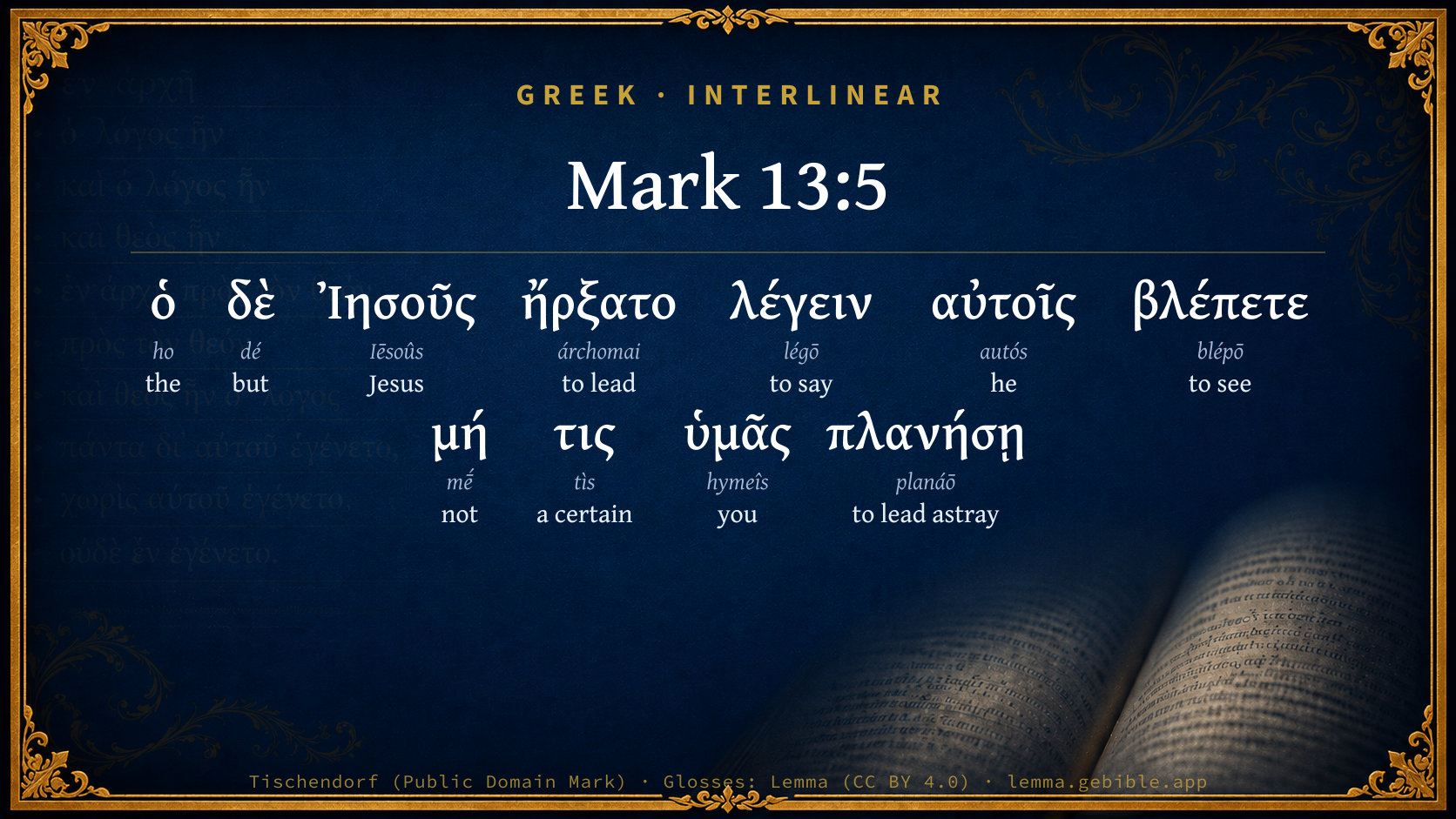
Download image
Cite this verse

Mark 13:5 (World English Bible). Public Domain. Lemma interlinear Bible study tool, https://lemma.gebible.app/v/mark/13/5.

Show BibTeX & RIS
BibTeX
RIS
English Translation
Jesus, answering, began to tell them, "Be careful that no one leads you astray.
World English Bible · Public Domain
Download a study sheet

One document with this verse’s original text, its word-by-word gloss line, the meaning frame, cross-references with their text, attributed commentary, and full source and license credits — printable, and it pastes into notes with its structure intact.

This verse Autodidact and up

Study sheet (.html) Plain text (.txt)

A passage Seminary Student

Up to 50 verses in one chapter. A passage sheet keeps up to 6 commentary sources and 12 cross-references per verse, in the order this page ranks them, and says so on the sheet whenever that leaves anything out. Ask for a single verse and you get the Autodidact verse sheet above.

Everything on this page stays free to read, with no account — the sheet is a download of what is already on screen, not access to it.

Want to remove ads? Support Godless Engineer
Compare translations 3

The same verse in 3 English versions, stacked beneath the original-language interlinear above. Click any original word for its lexicon entry.

Each is an independent rendering of the whole verse — the interlinear is not word-aligned to these translations.

Highlighted words mark where these versions differ — a whole-verse word diff, not a word-by-word alignment.

  • World English Bible Public Domain
    Jesus, answering, began to tell them, "Be careful that no one leads you astray.
  • King James Version Public Domain
    And Jesus answering them began to say, Take heed lest any man deceive you:
  • unfoldingWord Literal Text CC BY-SA 4.0
    Now Jesus began to say to them, “Be careful that no one leads you astray.

unfoldingWord Literal Text — © unfoldingWord, licensed CC BY-SA 4.0. Word-aligned USFM3 via Door43 (git.door43.org/unfoldingWord/en_ult).

Versions to compare (up to 4)

3 of 4 selected

Show all 19 translations

Every available English version of this verse, each an independent rendering of the whole verse.

  • World English Bible Public Domain
    Jesus, answering, began to tell them, "Be careful that no one leads you astray.
  • Berean Standard Bible Public Domain
    Jesus began by telling them, “See to it that no one deceives you.
  • Majority Standard Bible Public Domain
    In response, Jesus began by telling them, “See to it that no one deceives you.
  • King James Version Public Domain
    And Jesus answering them began to say, Take heed lest any man deceive you:
  • American Standard Version (1901) Public Domain
    And Jesus began to say unto them, Take heed that no man lead you astray.
  • Revised Version (1885) Public Domain
    And Jesus began to say unto them, Take heed that no man lead you astray.
  • Geneva Bible (1599) Public Domain
    And Iesus answered them, and began to say, Take heede lest any man deceiue you.
  • Douay-Rheims (1899) Public Domain
    And Jesus answering, began to say to them, Take heed lest any man deceive you.
  • Young's Literal Translation Public Domain
    And Jesus answering them, began to say, `Take heed lest any one may lead you astray,
  • Literal Standard Version CC BY-SA 4.0
    And Jesus answering them, began to say, “Take heed lest anyone may lead you astray,
  • Unlocked Literal Bible CC BY-SA 4.0
    Jesus began to say to them, “Be careful that no one leads you astray.
  • unfoldingWord Literal Text CC BY-SA 4.0
    Now Jesus began to say to them, “Be careful that no one leads you astray.
  • Darby Bible Public Domain
    And Jesus answering them began to say, Take heed lest any one mislead you.
  • World Messianic Bible Public Domain
    Yeshua, answering, began to tell them, “Be careful that no one leads you astray.
  • Webster's Bible Public Domain
    And Jesus answering them, began to say, Take heed lest any man deceive you:
  • Free Bible Version CC BY-SA 4.0
    Jesus began telling them, “Make sure no one deceives you.
  • Bible in Basic English Public Domain
    And Jesus said to them, Take care that you are not tricked by anyone.
  • Text-Critical English NT CC BY 4.0
    Jesus began to say to them in response, “Make sure no one leads you astray.
  • Tyndale New Testament (1534) Public Domain
    And Iesus answered them and began to saye: take hede lest eny man deceave you.

Literal Standard Version (2020), Covenant Press — licensed CC BY-SA 4.0. Text via the HelloAO Bible API (eBible.org). Unlocked Literal Bible (unfoldingWord) — licensed CC BY-SA 4.0. Text via the HelloAO Bible API (eBible.org). unfoldingWord Literal Text — © unfoldingWord, licensed CC BY-SA 4.0. Word-aligned USFM3 via Door43 (git.door43.org/unfoldingWord/en_ult). Free Bible Version, Dr. Jonathan Gallagher — licensed CC BY-SA 4.0. Text via the HelloAO Bible API (eBible.org).

Word by word

More ways to search: Search by grammar → Find every occurrence → Compare this word →

Practice this passage: Drill this verse → Learn its vocabulary →

πλανήσῃ
planáō
G4105
“to lead astray”
Verb, Aorist, Active, Subjunctive, 3rd person, Singular
Part of Speech
Verb
Tense
Aorist
Voice
Active
Mood
Subjunctive
Person
3rd person
Number
Singular
Full Thayer's Definition

Origin: from G4106

TDNT: 09:48,9

1. to cause to stray, to lead astray, lead aside from the right way a. to go astray, wander, roam about 2. metaph. a. to lead away from the truth, to lead into error, to deceive b. to be led into error c. to be led aside from the path of virtue, to go astray, sin d. to sever or fall away from the truth 1. of heretics e. to be led away into error and sin
  1. ὁ ho G3588 “the” Article, Nominative, Singular, Masculine
  2. δὲ dé G1161 “but” Conjunction
  3. Ἰησοῦς Iēsoûs G2424 “Jesus” Noun, Nominative, Singular, Masculine
  4. ἤρξατο árchomai G756 “to lead” Verb, Aorist, Middle deponent, Indicative, 3rd person, Singular
  5. λέγειν légō G3004 “to say” Verb, Present, Active, Infinitive
  6. αὐτοῖς autós G846 “he” Personal pronoun, Dative, Plural, Masculine
  7. βλέπετε blépō G991 “to see” Verb, Present, Active, Imperative, 2nd person, Plural
  8. μή mḗ G3361 “not” Particle, Negative
  9. τις tìs G5100 “a certain” Indefinite pronoun, Nominative, Singular, Masculine
  10. ὑμᾶς hymeîs G5210 “you” Personal pronoun, 2nd person, Accusative, Plural

About this verse

These counts appear in no published source. They are computed here, from the morphology-tagged text and Lemma’s own curated glosses. What Lemma adds →

11
words
11
distinct lemmas
Gospels
section

Shared distinctive vocabulary

πλανήσῃ to lead astray G4105 occurs in 37 verses of the Greek New Testament. Also found in:
Cross-references

9

Topical passages linked to Mark 13:5 in the Treasury of Scripture Knowledge — connected by theme and wording, ordered by reader-vote popularity; previews shown in the World English Bible.

  • Ephesians 5:6 Let no one deceive you with empty words. For because of these things, the wrath of God comes on the children of disobedience.
  • Colossians 2:8 Be careful that you don't let anyone rob you through his philosophy and vain deceit, after the tradition of men, after the elements of the world, and not after Christ.
  • Jeremiah 29:8 For thus says Yahweh of hosts, the God of Israel: Don't let your prophets who are in the midst of you, and your diviners, deceive you; neither listen you to your dreams which you cause to be dreamed.
  • Matthew 24:4–5 Jesus answered them, "Be careful that no one leads you astray.
  • Luke 21:8 He said, "Watch out that you don't get led astray, for many will come in my name, saying, 'I AM,' and, 'The time is at hand.' Therefore don't follow them.
  • 1 Corinthians 15:33 Don't be deceived! "Evil companionships corrupt good morals."
  • 2 Thessalonians 2:3 Let no one deceive you in any way. For it will not be, unless the departure comes first, and the man of sin is revealed, the son of destruction,
  • 1 John 4:1 Beloved, don't believe every spirit, but test the spirits, whether they are of God, because many false prophets have gone out into the world.

Cross-references courtesy of OpenBible.info (CC BY 4.0).

Commentary

Notes on Mark 13:5 from classic Christian and Jewish commentators (each source and its license shown beneath its notes). The classic Christian expositions comment on the surrounding passage and are grouped to its opening verse, so a note may address several verses; the Jewish commentaries on the Tanakh (Rashi and others) are per-verse, so they appear only where the commentator wrote on this verse.

Lemma curates 59 commentaries, every one of them public domain or Creative Commons licensed, each selected and text-cleaned for this edition rather than reprinted as found. About our sources →

Matthew Henry's Commentary

Our Lord Jesus, in reply to their question, sets himself, not so much to satisfy their curiosity as to direct their consciences; leaves them still in the dark concerning the times and seasons, which the father has kept in his own power, and which it was not for them to know; but gives them the cautions which were needful, with reference to the events that should now shortly come to pass.

I. They must take heed that they be not deceived by the seducers and imposters that should now shortly arise (Mar 13:5, Mar 13:6); "Take heed lest any man deceive you, lest, having found the true Messiah, you lose him again in the crowd of pretenders, or be inveigled to embrace others in rivalship with him. Many shall come in my name (not in the name of Jesus), but saying, I am the Christ, and so claiming the dignities which I only an entitled to." After the Jews had rejected the true Christ, they were imposed upon, and so exposed by many false Christs, but never before; those false Christs deceived many; Therefore take heed lest they deceive you. Note, When many are deceived, we should thereby be awakened to look to ourselves.

II. They must take heed that they be not disturbed at the noise of wars, which they should be alarmed with, Mar 13:7, Mar 13:8. Sin introduced wars, and they come from men's lusts. But at some times the nations are more distracted and wasted with wars than at other times; so it shall be now; Christ was born into the world when there was a general peace, but soon after he went out of the world there were general wars; Nation shall rise against nation, and kingdom against kingdom. And what will become of them then who are to preach the gospel to every nation? Inter arma silent leges - Amidst the clash of arms, the voice of law is not heard. "But be not troubled at it." 1. "Let it be no surprise to you; you are bid to expect it, and such things must needs be, for God has appointed them, in order to further accomplishment of his purposes, and by the wars of the Jews" (which Josephus has given us a large account of) "God will punish the wickedness of the Jews." 2. "Let it be no terror to you, as if your interest were in danger of being overthrown, or your work obstructed by these wars; you have no concern in them, and therefore need not be apprehensive of any damage by them." Note, Those that despise the smiles of the world, and do not court and covet them, may despise the frowns of the world, and need not fear them. If we seek not to rise with them that rise in the world, why should we dread falling with them that fall in the world? 3. "Let it not be looked upon as an omen of the approaching period of the world, for the end is not yet, Mar 13:7. Think not that these wars will bring the world to a period; no, there are other intermediate counsels to be fulfilled betwixt that end and the end of all things, which are designed to prepare you for the end, but not to hasten it out of due time." 4. "Let it not be looked upon as if in them God has done his worst; no, he has more arrows in his quiver, and they are ordained against the persecutors; be not troubled at the wars you shall hear of, for they are but the beginnings of sorrows, and therefore, instead of being disturbed at them, you ought to prepare for worse; for there shall also be earthquakes in divers places, which shall bury multitudes in the ruins of their own houses, and there shall be famines, by which many of the poor shall perish for want of bread, and troubles and commotions; so that there shall be no peace to him that goes out or comes in. The world shall be full of troubles, but be not ye troubled; without are fightings, within are fears, but fear not ye their fear." Note, The disciples of Christ, if it be not their own fault, may enjoy a holy security and serenity of mind, when all about them is in the greatest disorder.

III. They must take heed that they be not drawn away from Christ, and from their duty to him, by the sufferings they should meet with for Christ's sake. Again, he saith, "Take heed to yourselves, Mar 13:9. Though you may escape the sword of war, better than some of your neighbours, because you interest not yourselves in the public quarrels, yet be not secure; you will be exposed to the sword of justice more than others, and the parties that contend with one another, will unite against you. Take heed therefore lest you deceive yourselves with the hopes of outward prosperity, and such a temporal kingdom as you have been dreaming of, when it is through many tribulations that you must enter into the kingdom of God. Take heed lest you needlessly expose yourselves to trouble, and pull it upon your own head. Take heed what you say and do, for you will have many eyes upon you." Observe,

1. What the trouble is which they must expect.

(1.) They shall be hated of all men; trouble enough! The thoughts of being hated are grievous to a tender spirit, and the fruits of that hatred must needs be a constant vexation; those that are malicious, will be mischievous. It was not for any thing amiss in them, or done amiss by them, that they were hated, but for Christ's name sake, because they were called by his name, called upon his name, preached his name, and wrought miracles in his name. The world hated them because he loved them.

(2.) Their own relations shall betray them, those to whom they were most nearly allied, and on whom therefore they depended for protection; "They shall betray you, shall inform against you, and be your prosecutors." If a father has a child that is a Christian, he shall become void of natural affection, it shall be swallowed up in bigotry, and he shall betray his own child to the persecutors, as if he were a worshipper of other gods, Deu 13:6-10.

(3.) Their church-rulers shall inflict their censures upon them; "You shall be delivered up to the great Sanhedrim at Jerusalem, and to the inferior courts and consistories in other cities, and shall be beaten in the synagogues with forty stripes at a time, as offenders against the law which was read in the synagogue." It is no new thing for the church's artillery, through the treachery of its officers, to be turned against some of its best friends.

(4.) Governors and kings shall use their power against them. Because the Jews have not power to put them to death, they shall incense the Roman powers against them, as they did Herod against James and Peter; and they shall cause you to be put to death, as enemies to the empire. They must resist unto blood, and still resist.

2. What they shall have to comfort themselves with, in the midst of these great and sore troubles.

(1.) That the work they were called to should be carried on and prosper, notwithstanding all this opposition which they should meet with in it (Mar 13:10); "The gospel shall, for all this, be published among all nations, and before the destruction of Jerusalem the sound of it shall go forth into all the earth; not only through all the nation of the Jews, but to all the nations of the earth." It is comfort to those who suffer for the gospel, that, though they may be crushed and borne down, the gospel cannot; it shall keep its ground, and carry the day.

(2.) That their sufferings, instead of obstructing their work, should forward it; "Your being brought before governors and kings shall be for a testimony of them (so some read it, Mar 13:9); it shall give you an opportunity of preaching the gospel to those before whom you are brought as criminals, to whom otherwise you could not have access." Thus St. Paul's being brought before Felix, and Festus, and Agrippa, and Nero, was a testimony to them concerning Christ and his gospel. Or, as we read it, It shall be for a testimony against them, against both the judges and the prosecutors, who pursue those with the utmost rage that appear, upon examination, to be not only innocent but excellent persons. The gospel is a testimony to us concerning Christ and heaven. If we receive it, it will be a testimony for us: it will justify and save us; if not, it will be a testimony against us in the great day.

(3.) That, when they were brought before kings and governors for Christ's sake, they should have special assistance from heaven, to plead Christ's cause and their own (Mar 13:11); "Take no thought before-hand what he shall speak, be not solicitous how to address yourselves to great men, so as to obtain their favour; your cause is just and glorious, and needs not be supported by premeditated speeches and harangues; but whatsoever shall be given you in that hour, whatsoever shall be suggested to you, and put into your minds, and into your mouths" (pro re nat - on the spur of the occasion), "that speak ye, and fear not the success of it, because it is off-hand, for it is not ye that speak, purely by the strength of your own wisdom, consideration, and resolution, but it is the Holy Ghost." Note, Those whom Christ calls out to be advocates for him, shall be furnished with full instructions: and when we are engaged in the service of Christ, we may depend upon the aids of the Spirit of Christ.

(4.) That heaven at last would make amends for all; "You will meet with a great deal of hardship in your way, but have a good heart on it, your warfare will be accomplished, and your testimony finished, and he that shall endure to the end, the same shall be saved," Mar 13:13. Perseverance gains the crown. The salvation here promised is more than a deliverance from evil, it is an everlasting blessedness, which shall be an abundant recompence for all their services and sufferings. All this we have, Mat 10:17, etc.

Matthew Henry's Commentary on the Whole Bible (1708–1710) — public domain (CC PDM 1.0). Text via the HelloAO Bible API.

Tyndale Open Study Notes

Tyndale Open Resources

13:5-23 This section is often divided into two parts, 13:5-13 and 13:14-23. The first part is often interpreted as describing the destruction of Jerusalem, which occurred in AD 70, while the second part is taken to describe the coming of the Son of Man in the future. It is best, however, to interpret all of 13:5-23 as describing events surrounding the destruction of Jerusalem in AD 70 because: (1) 13:5-23 is Jesus’ answer to the two questions (13:4) that deal with the destruction of Jerusalem (13:2); (2) The commands to flee Judea (13:14-16), the woe announced upon pregnant and nursing women (13:17), and the prayer that it not take place in winter (13:18) make sense if they refer to the events of AD 70 but not if they refer to the future return of Christ; (3) Three warnings in this passage (13:5, 9, 23) tie this passage together and indicate that 13:5-23 should be understood as a unit. • The subdivisions of this section are arranged as a chiasm (X-pattern): A: Deceivers claim to be the Messiah (13:5-6). B: There are reports of fighting and natural disasters (13:7-8). C: There is persecution of believers (13:9-13). B': The fighting in Judea and resulting tribulation begin (13:14-20). A': Deceivers claim to be the Messiah (13:21-23).

13:5-6 Jesus warned his followers not to be misled by the many false messiahs who would come claiming, ‘I am the Messiah’ and would deceive many into following them. These false claimants would profess to be the long-awaited Jewish Messiah (not Jesus per se) or to speak on the Messiah’s behalf. Such claimants included Theudas the Galilean (Acts 5:36), Simon the son of Gioras, and John of Gischala, who deceived many in the AD 60s.

Tyndale Open Study Notes — © Tyndale Open Resources, licensed CC BY-SA 4.0. Text via the HelloAO Bible API.

Bengel's Gnomon

Johann Albrecht Bengel

Mar 13:5. Ἤρξατο, He began) Previously He had not spoken much concerning these things.

Bengel's Gnomon of the New Testament — English translation (T&T Clark, Edinburgh, 1860) — public domain. Text from a community e-Sword module.

Expositor's Greek Testament

ed. W. Robertson Nicoll

Mar 13:5-8 . Signs prelusive of the end (Mat 24:4-8 , Luk 21:8-11 ). Jerusalem’s judgment-day not to come till certain things have happened: advent of false Messiahs, rise of wars. βλέπετε , take heed that no one deceive you; the ethical key-note struck at once; the aim of the whole discourse to help disciples to keep heads cool, and hearts brave in a perilous evil time ( vide on Mt.).

The Expositor's Greek Testament, edited by W. Robertson Nicoll (1897–1910) — public domain. Text from a community e-Sword module.

Ellicott's Commentary for English Readers

(5) And Jesus answering them began to say.—The report which follows, common as it is to the first three Gospels, serves as an admirable example of the extent of variation compatible with substantial accuracy, and with the recognition of an inspired guidance as ensuring that accuracy. The discourse obviously made a deep impression on those who heard it, as afterwards on those to whom they repeated it, and so it passed from mouth to mouth, but probably it was not committed to writing till the events which it foretold came within the horizon. On all points common to the three records, see Notes on Matthew 24.

A Bible Commentary for English Readers, edited by Charles John Ellicott (1878–1897) — public domain. Text from a community e-Sword module.

The Cambridge Bible for Schools and Colleges

gen. ed. J. J. S. Perowne

5. Take heed] “The four moral key-notes of the Discourse on the Last Things are “Beware,” “Watch,” “Endure,” “Pray.” Farrar, Life, ii. p. 258.

The Cambridge Bible for Schools and Colleges (gen. ed. J. J. S. Perowne; Cambridge University Press, 1878–1918) — public domain. Text from a community e-Sword module.

John Gill's Exposition

And Jesus answering them,.... His four disciples, Peter, John, James, and Andrew: "began to say"; or "said", a way of speaking frequent with this evangelist:

take heed lest any man deceive you; See Gill on Mat 24:4.

John Gill's Exposition of the Whole Bible (1746–1763) — public domain (CC PDM 1.0). Text via the HelloAO Bible API.

Trapp's Complete Commentary

John Trapp

5 And Jesus answering them began to say, Take heed lest any man deceive you:

Ver. 5. And Jesus answering them, &c.] Not directly to their question, but far better to their edification. This was ordinary with our Saviour.

John Trapp, A Commentary or Exposition upon All the Books of the Old and New Testament (1647–1656) — public domain. Text from a community e-Sword module.

Matthew Poole's English Annotations

See Poole on "Mat 24:4-5". This is the first sign, fulfilled before the destruction of Jerusalem in part, and which had been fulfilling ever since; and probably before the day of judgment the number of such impostors will increase.

Matthew Poole's English Annotations on the Holy Bible (1683–1685) — public domain. Text from a community e-Sword/MySword module.

The Pulpit Commentary

Vers. 5, 6. Take heed that no man lead you astray. The Greek word is planhsh . Their first temptation would be of this kind that many would come in Christ"s name, saying, "I am he;" claiming, that is, the title which belonged to him alone. Such were Theudas (Act_5:36) and Simon Magus, (Act_8:10) who, according to Jerome, said, "Ego sum Sermo Dei, ego speciosus, ego Paracletus, ego omnipotens, ego omnia." Such were Menander and the Gnostics.

The Pulpit Commentary (1880–1919), ed. H.D.M. Spence-Jones & Joseph S. Exell — public domain. Text from a community e-Sword module.

Burkitt's Expository Notes on the New Testament

William Burkitt

Here, and in the following verses, our Saviour gives his disciples the signs which should forerun the destruction of Jerusalem. The first of which was this, that there should arise false Christs, false prophets, and seducers; such as Theudas, and others, under the name and person of the Messiah, some affirming themselves to be Christ personal, or the promised Messiah; others to be Christ doctrinal, affirming their erroneous opinions to be the mind and doctrine of Jesus Christ.

Learn hence, That as there will be many seducers before the end of the world (for Jerusalem’s destruction was a type and emblem of the world’s destruction) and many will be seduced and misled by them: so it is the duty of Christ’s own disciples to take heed lest they, being also led away by the error of the wicked, do fall from their own stedfastness: Take heed, says Christ, that no man deceive you: for many will come in my name, saying, I am Christ, and will deceive many.

The second sign of Jerusalem’s destruction was, wars and rumors of wars; that is, civil broils, and intestine commotions among themselves; as also famines and earthquakes.

Whence note, That war and fire, earthquakes and famines, are judgments and calamities inflicted by God upon sinful people, for their contempt of Christ and gospel grace.

2. That although these be very terrible judgments, and desolating calamities, yet to an incorrigible and irreclaimable people are they the forerunners of worse judgments. These are, says Christ, the beginnings of sorrows.

The third sign of this approaching destruction, was a general persecution of the ministers of the gospel, for preaching the doctrine of the gospel to a lost world; Ye shall be beaten, and brought before kings for my sake, for a testimony.

From whence note, That the preaching of the gospel wherever it comes, will be for a testimony to them to whom it comes; either a testimony for them, or against them: to the humble it is a testimony for, to despisers and scorners it is a testimony against; if the dust of ministers feet bear witness against the despisers of the gospel, their sermons much more.

The word of God delivered in the scriptures, and dispensed in the ministry thereof, hath its divers and contrary effects upon different and contrary subjects; from both which ye Almighty God knows how to raise his own glory; to the humble and teachable, the gospel is in adjutorium: to some, the saviour of life unto life; to others, the saviour of death unto death.

William Burkitt's Expository Notes on the New Testament (1700–1703) — public domain. Text from a community e-Sword module.

unfoldingWord translationNotes

Door43 World Missions Community

to them

"to his disciples"

leads you astray ... they will lead many astray

Here "leads ... astray" is a metaphor for persuading someone to believe what is not true. AT: "deceives you ... they will deceive many people"

in my name

Possible meanings are 1) "claiming my authority" or 2) "claiming that God sent them." (See: Metonymy)

I am he

"I am the Christ"

translationWords

Jesus

astray

unfoldingWord translationNotes — © Distant Shores Media and the Door43 World Missions Community, licensed CC BY-SA 4.0. Source: git.door43.org/Door43/en_tn.

Cambridge Greek Testament for Schools and Colleges

5. [2880][2881][2882][2883] omit ἀποκριθείς.

[2880] Codex Sinaiticus. 4th cent. Discovered by Tischendorf in 1859 at the Monastery of St Katharine on Mount Sinai. Now at St Petersburg. The whole Gospel, ending at Mar 16:8. Photographic facsimile, 1911.

[2881] Codex Vaticanus. 4th cent., but perhaps a little later than א. In the Vatican Library almost since its foundation by Pope Nicolas V., and one of its greatest treasures. The whole Gospel, ending at Mar 16:8. Photographic facsimile, 1889.

[2882] Codex Regius. 8th cent. An important witness. At Paris. Contains Mar 1:1 to Mar 10:15; Mar 10:30 to Mar 15:1; Mar 15:20 to Mar 16:20, but the shorter ending is inserted between Mar 16:8 and Mar 16:9, showing that the scribe preferred it to the longer one.

[2883] Codex Athous Laurae. 8th cent. Like N and Σ, it is written in silver letters on purple vellum. Contains Mar 9:5 to Mar 16:20, and, as in L, the shorter ending is inserted between Mar 16:8 and Mar 16:9. As in Δ, the text of Mark is specially good.

5. ἤρξατο. The verb is not pleonastic; He is beginning a new course of instruction. Cf. Mar 8:31, Mar 12:1. This is the longest of Christ’s utterances in Mk. The only other connected discourses of Christ which Mk gives us are parables, and of those he has only four, against twenty-three in Lk. We need not reject this discourse because it is unique in this Gospel, any more than we need reject the one parable which is peculiar to Mk.

Βλέπετε μή. He takes the second question first, and, as often, gives no direct reply. Instead of telling them of some manifest signal, He bids them be on their guard against false signals. A great deal must take place before the end comes and there will be much deception. All three have βλέπετε μή, and his charge, to “be on their guard,” is the main lesson of the chapter; it recurs Mar 13:9; Mar 13:23; Mar 13:33: ἄλλο τοίνυν ἠρώτησαν, ἄλλο ἀποκρίνεται (Victor).

ὑμᾶς πλανήσῃ. Lead you astray (R.V.). Cf. Mar 12:24; Mar 12:27. The verb is freq. in the Johannine and Pauline writings, and it is used of serious departure from the truth. see on 1Jn 1:8.

Cambridge Greek Testament for Schools and Colleges (Cambridge University Press, 1896; 21 vols, various authors incl. Carr, Maclear, Plummer, Farrar, Lumby, Moule, M. R. James, Simcox) — public domain. Text from a community e-Sword module.

Alford’s Greek Testament

Henry Alford

5.] ἤρξατο λέγειν—with this begins our Lord’s full explanation on the matter. See reff.

Henry Alford, The Greek Testament (1849–1861) — public domain. Text from a community e-Sword module.

International Critical Commentary

5. Ὁ δὲ Ἰησοῦς ἤρξατο λέγειν αὐτοῖς, Βλέπετε μὴ1—And Jesus began to say to them, Beware lest.

Omit ἀποκριθεὶς, answering, Tisch. Treg. WH. RV. א BL 33, Egyptt. Pesh.

International Critical Commentary — older volumes (1896–1929), various authors — public domain. Text from a community e-Sword module.

Lesson kit

Teaching starters — assembled from the data on this page, not authored interpretation. Every prompt links to the verse data it draws on. Edit before teaching.

Mark, in the Gospels, opens this verse with 11 words (11 distinct Greek lemmas). Its most distinctive word is planáō (“to lead astray”). A historical commentator’s framing appears above. Read the whole chapter for the surrounding context.

Discussion questions

  1. How does “to lead astray” (planáō) shape what this verse is saying?
  2. Matthew 18:12 shares the word «to lead astray» with this verse. How do the two illuminate each other?
  3. These translations render this verse differently. What is at stake in choosing one wording over another?
  4. Reading how Matthew Henry's Commentary and Tyndale Open Study Notes read this verse, where do the two commentators agree and where do they part?

Things to notice

Reading settings

Reading text

Shown beneath each verse's original-language words.

Old Testament
Old Testament edition

Read the OT as the Masoretic Hebrew (MT) or the Greek Septuagint (LXX).

English shown for the Greek Septuagint (in the Hebrew ↔ Greek comparison).

Comparing translations? Open the Compare panel on any verse page to stack up to four side by side.