
Matthew 3:10

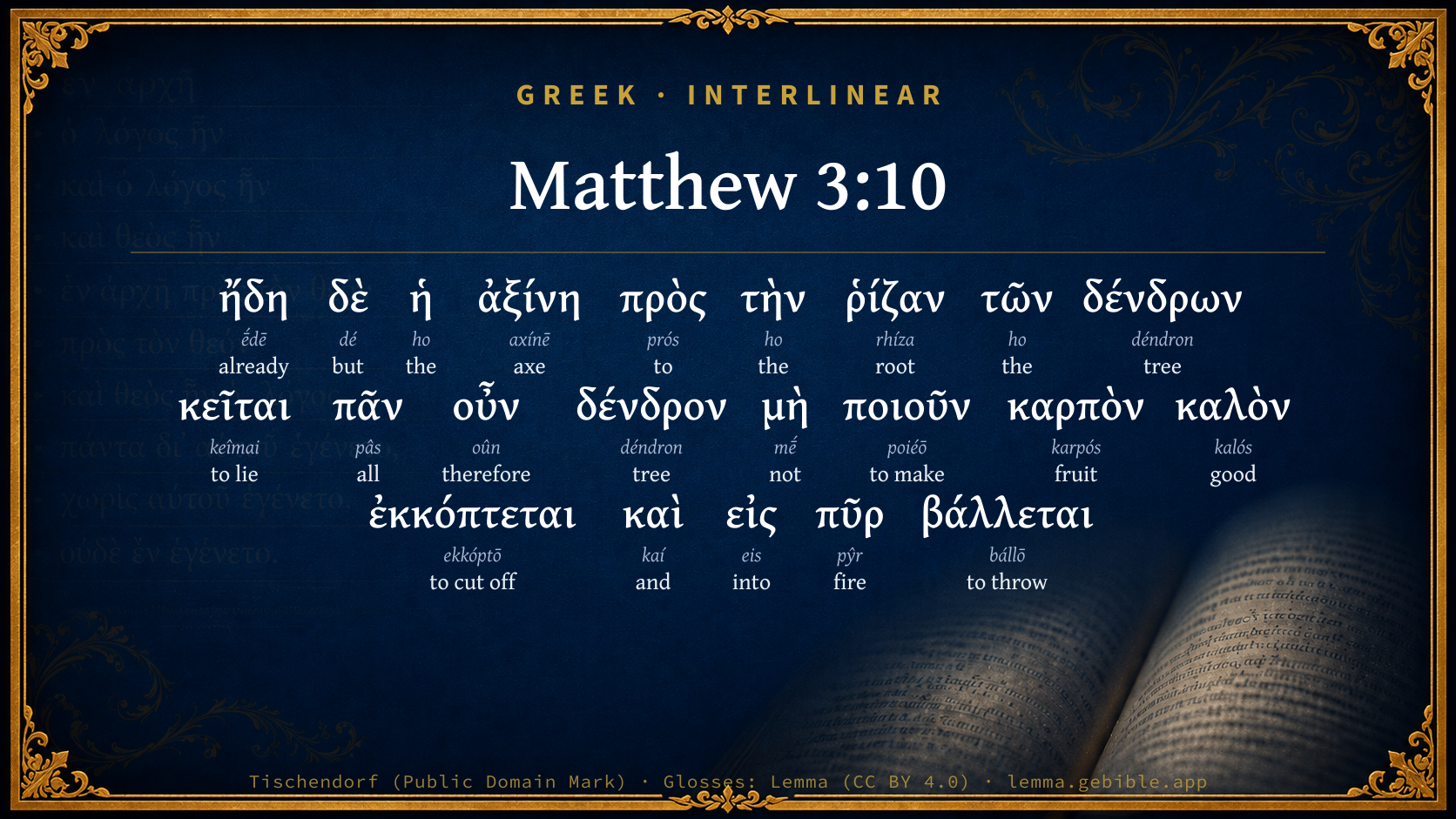
Greek (Tischendorf 8th ed.) Matthew 3:10 appears in the Greek New Testament. The text above is from the Tischendorf 8th edition. Each word links to its Strong’s number and a concise gloss. Click any word for its full Thayer’s Greek Lexicon entry.
Download image
Cite this verse

Matthew 3:10 (World English Bible). Public Domain. Lemma interlinear Bible study tool, https://lemma.gebible.app/v/matthew/3/10.

Show BibTeX & RIS
BibTeX
RIS
English Translation
"Even now the axe lies at the root of the trees. Therefore, every tree that doesn't bring forth good fruit is cut down, and cast into the fire.
World English Bible · Public Domain
Highlights
  • 9 first appearances in the Greek New Testament
Full analysis ↓
Download a study sheet

One document with this verse’s original text, its word-by-word gloss line, the meaning frame, cross-references with their text, attributed commentary, and full source and license credits — printable, and it pastes into notes with its structure intact.

This verse Autodidact and up

Study sheet (.html) Plain text (.txt)

A passage Seminary Student

Up to 50 verses in one chapter. A passage sheet keeps up to 6 commentary sources and 12 cross-references per verse, in the order this page ranks them, and says so on the sheet whenever that leaves anything out. Ask for a single verse and you get the Autodidact verse sheet above.

Everything on this page stays free to read, with no account — the sheet is a download of what is already on screen, not access to it.

Want to remove ads? Support Godless Engineer
Compare translations 3

The same verse in 3 English versions, stacked beneath the original-language interlinear above. Click any original word for its lexicon entry.

Each is an independent rendering of the whole verse — the interlinear is not word-aligned to these translations.

Highlighted words mark where these versions differ — a whole-verse word diff, not a word-by-word alignment.

  • World English Bible Public Domain
    "Even now the axe lies at the root of the trees. Therefore, every tree that doesn't bring forth good fruit is cut down, and cast into the fire.
  • King James Version Public Domain
    And now also the axe is laid unto the root of the trees: therefore every tree which bringeth not forth good fruit is hewn down, and cast into the fire.
  • unfoldingWord Literal Text CC BY-SA 4.0
    But already the ax is set against the root of the trees. So, every tree not producing good fruit is chopped down and thrown into a fire.

unfoldingWord Literal Text — © unfoldingWord, licensed CC BY-SA 4.0. Word-aligned USFM3 via Door43 (git.door43.org/unfoldingWord/en_ult).

Versions to compare (up to 4)

3 of 4 selected

Show all 19 translations

Every available English version of this verse, each an independent rendering of the whole verse.

  • World English Bible Public Domain
    "Even now the axe lies at the root of the trees. Therefore, every tree that doesn't bring forth good fruit is cut down, and cast into the fire.
  • Berean Standard Bible Public Domain
    The axe lies ready at the root of the trees, and every tree that does not produce good fruit will be cut down and thrown into the fire.
  • Majority Standard Bible Public Domain
    The axe lies ready at the root of the trees, and every tree that does not produce good fruit will be cut down and thrown into the fire.
  • King James Version Public Domain
    And now also the axe is laid unto the root of the trees: therefore every tree which bringeth not forth good fruit is hewn down, and cast into the fire.
  • American Standard Version (1901) Public Domain
    And even now the axe lieth at the root of the trees: every tree therefore that bringeth not forth good fruit is hewn down, and cast into the fire.
  • Revised Version (1885) Public Domain
    And even now is the axe laid unto the root of the trees: every tree therefore that bringeth not forth good fruit is hewn down, and cast into the fire.
  • Geneva Bible (1599) Public Domain
    And now also is the axe put to the roote of the trees: therfore euery tree which bringeth not forth good fruit, is hewen downe, and cast into ye fire.
  • Douay-Rheims (1899) Public Domain
    For now the axe is laid to the root of the trees. Every tree therefore that doth not yield good fruit, shall be cut down, and cast into the fire.
  • Young's Literal Translation Public Domain
    and now also, the axe unto the root of the trees is laid, every tree therefore not bearing good fruit is hewn down, and to fire is cast.
  • Literal Standard Version CC BY-SA 4.0
    and now also, the axe is laid to the root of the trees, therefore, every tree not bearing good fruit is cut down, and is cast into fire.
  • Unlocked Literal Bible CC BY-SA 4.0
    Already the ax has been placed against the root of the trees. So every tree that does not produce good fruit is chopped down and thrown into the fire.
  • unfoldingWord Literal Text CC BY-SA 4.0
    But already the ax is set against the root of the trees. So, every tree not producing good fruit is chopped down and thrown into a fire.
  • Darby Bible Public Domain
    And already the axe is applied to the root of the trees; every tree therefore not producing good fruit is cut down and cast into the fire.
  • World Messianic Bible Public Domain
    Even now the ax lies at the root of the trees. Therefore every tree that doesn’t produce good fruit is cut down, and cast into the fire.
  • Webster's Bible Public Domain
    And now also the ax is laid to the root of the trees: therefore every tree which bringeth not forth good fruit is hewn down, and cast into the fire.
  • Free Bible Version CC BY-SA 4.0
    In fact the ax is ready to chop down the trees. Every tree that doesn't produce good fruit will be chopped down and thrown into the fire.
  • Bible in Basic English Public Domain
    And even now the axe is put to the root of the trees; every tree then which does not give good fruit is cut down, and put into the fire.
  • Text-Critical English NT CC BY 4.0
    Even now the axe is laid to the root of the trees. Every tree therefore that does not produce good fruit is cut down and thrown into the fire.
  • Tyndale New Testament (1534) Public Domain
    Euen nowe is the axe put vnto the rote of the trees: soo that every tree which bringeth not forthe goode frute is hewe doune and cast into the fyre.

Literal Standard Version (2020), Covenant Press — licensed CC BY-SA 4.0. Text via the HelloAO Bible API (eBible.org). Unlocked Literal Bible (unfoldingWord) — licensed CC BY-SA 4.0. Text via the HelloAO Bible API (eBible.org). unfoldingWord Literal Text — © unfoldingWord, licensed CC BY-SA 4.0. Word-aligned USFM3 via Door43 (git.door43.org/unfoldingWord/en_ult). Free Bible Version, Dr. Jonathan Gallagher — licensed CC BY-SA 4.0. Text via the HelloAO Bible API (eBible.org).

Word by word

More ways to search: Search by grammar → Find every occurrence → Compare this word →

Practice this passage: Drill this verse → Learn its vocabulary →

ἀξίνη
axínē
G513
“axe”
Noun, Nominative, Singular, Feminine
Part of Speech
Noun
Case
Nominative
Number
Singular
Gender
Feminine
Full Thayer's Definition

Origin: probably from agnumi (to break, cf G4486 )

TDNT: None

1. an axe
  1. ἤδη ḗdē G2235 “already” Adverb
  2. δὲ dé G1161 “but” Conjunction
  3. ἡ ho G3588 “the” Article, Nominative, Singular, Feminine
  4. πρὸς prós G4314 “to” Preposition
  5. τὴν ho G3588 “the” Article, Accusative, Singular, Feminine
  6. ῥίζαν rhíza G4491 “root” Noun, Accusative, Singular, Feminine
  7. τῶν ho G3588 “the” Article, Genitive, Plural, Neuter
  8. δένδρων déndron G1186 “tree” Noun, Genitive, Plural, Neuter
  9. κεῖται keîmai G2749 “to lie” Verb, Present, Middle or Passive deponent, Indicative, 3rd person, Singular
  10. πᾶν pâs G3956 “all” Adjective, Nominative, Singular, Neuter
  11. οὖν oûn G3767 “therefore” Conjunction
  12. δένδρον déndron G1186 “tree” Noun, Nominative, Singular, Neuter
  13. μὴ mḗ G3361 “not” Particle, Negative
  14. ποιοῦν poiéō G4160 “to make” Verb, Present, Active, Participle, Nominative, Singular, Neuter
  15. καρπὸν karpós G2590 “fruit” Noun, Accusative, Singular, Masculine
  16. καλὸν kalós G2570 “good” Adjective, Accusative, Singular, Masculine
  17. ἐκκόπτεται ekkóptō G1581 “to cut off” Verb, Present, Passive, Indicative, 3rd person, Singular
  18. καὶ kaí G2532 “and” Conjunction
  19. εἰς eis G1519 “into” Preposition
  20. πῦρ pŷr G4442 “fire” Noun, Accusative, Singular, Neuter
  21. βάλλεται bállō G906 “to throw” Verb, Present, Passive, Indicative, 3rd person, Singular

About this verse

These counts appear in no published source. They are computed here, from the morphology-tagged text and Lemma’s own curated glosses. What Lemma adds →

22
words
19
distinct lemmas
Gospels
section

Notable vocabulary

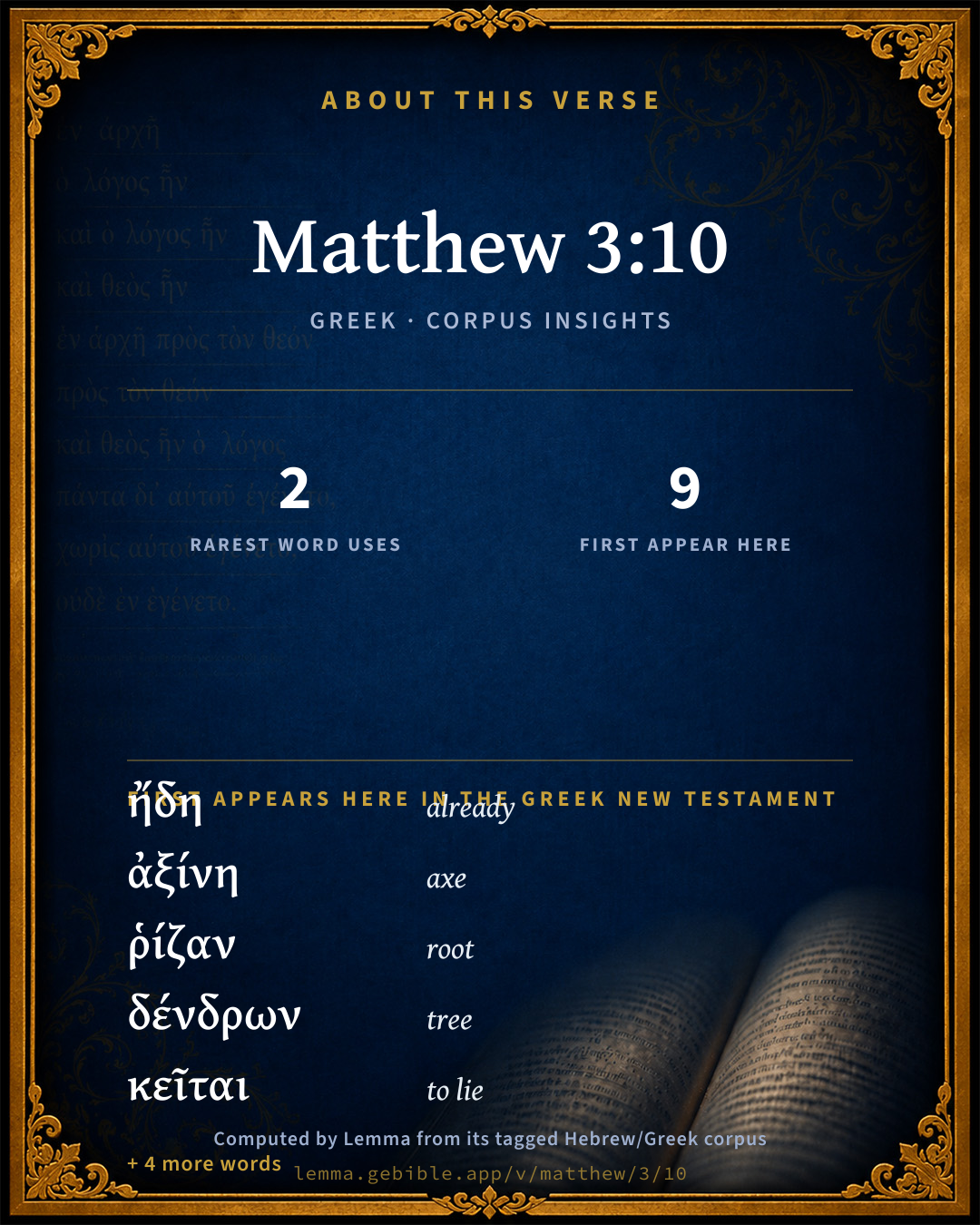
The rarest word here is ἀξίνη axe G513 — appearing just 2 times in the whole Greek New Testament.

First appearance in Scripture

These words make their first canonical appearance in the Greek New Testament here (9 in total — showing 8):

Shared distinctive vocabulary

ἀξίνη axe G513 occurs in 2 verses of the Greek New Testament. Also found in:
Repetition

Words recur within this verse:

Cross-references

22

Topical passages linked to Matthew 3:10 in the Treasury of Scripture Knowledge — connected by theme and wording, ordered by reader-vote popularity; previews shown in the World English Bible.

  • John 15:6 If a man doesn't remain in me, he is thrown out as a branch, and is withered; and they gather them, throw them into the fire, and they are burned.
  • Luke 3:9 Even now the axe also lies at the root of the trees. Every tree therefore that doesn't bring forth good fruit is cut down, and thrown into the fire."
  • Matthew 7:19 Every tree that doesn't grow good fruit is cut down, and thrown into the fire.
  • John 15:2 Every branch in me that doesn't bear fruit, he takes away. Every branch that bears fruit, he prunes, that it may bear more fruit.
  • Luke 13:6–9 He spoke this parable. "A certain man had a fig tree planted in his vineyard, and he came seeking fruit on it, and found none.
  • Jeremiah 17:8 For he shall be as a tree planted by the waters, who spreads out its roots by the river, and shall not fear when heat comes, but its leaf shall be green; and shall not be careful in the year of drought, neither shall cease from yielding fruit.
  • Ezekiel 15:2–7 Son of man, what is the vine tree more than any tree, the vine-branch which is among the trees of the forest?
  • Malachi 3:1–3 "Behold, I send my messenger, and he will prepare the way before me; and the Lord, whom you seek, will suddenly come to his temple; and the messenger of the covenant, whom you desire, behold, he comes!" says Yahweh of hosts.
  • Psalms 92:13–14 They are planted in Yahweh's house. They will flourish in our God's courts.
  • Malachi 4:1 "For, behold, the day comes, it burns as a furnace; and all the proud, and all who work wickedness, will be stubble; and the day that comes will burn them up," says Yahweh of Hosts, "that it shall leave them neither root nor branch.
  • Hebrews 6:8 but if it bears thorns and thistles, it is rejected and near being cursed, whose end is to be burned.
  • 1 Peter 4:17–18 For the time has come for judgment to begin at the house of God. If it begins first with us, what will happen to those who don't obey the Gospel of God?
  • Psalms 1:3 He will be like a tree planted by the streams of water, That brings forth its fruit in its season, Whose leaf also does not wither. Whatever he does shall prosper.
  • Matthew 21:19 Seeing a fig tree by the road, he came to it, and found nothing on it but leaves. He said to it, "Let there be no fruit from you forever!" Immediately the fig tree withered away.
  • Psalms 80:15–16 The stock which your right hand planted, The branch that you made strong for yourself.
  • Isaiah 27:11 When the boughs of it are withered, they shall be broken off; the women shall come, and set them on fire; for it is a people of no understanding: therefore he who made them will not have compassion on them, and he who formed them will show them no favor.
  • Isaiah 61:3 to appoint to those who mourn in Zion, to give to them a garland for ashes, the oil of joy for mourning, the garment of praise for the spirit of heaviness; that they may be called trees of righteousness, the planting of Yahweh, that he may be glorified.
  • Luke 23:31 For if they do these things in the green tree, what will be done in the dry?"
  • Hebrews 10:28–31 A man who disregards Moses' law dies without compassion on the word of two or three witnesses.
  • Isaiah 5:2–7 He dug it up, Gathered out its stones, Planted it with the choicest vine, Built a tower in its midst, And also cut out a winepress therein. He looked for it to yield grapes, But it yielded wild grapes.
  • Hebrews 3:1–3 Therefore, holy brothers, partakers of a heavenly calling, consider the Apostle and High Priest of our confession, Jesus;
  • Hebrews 12:25 See that you don't refuse him who speaks. For if they didn't escape when they refused him who warned on the Earth, how much more will we not escape who turn away from him who warns from heaven,

Cross-references courtesy of OpenBible.info (CC BY 4.0).

Commentary

Notes on Matthew 3:10 from classic Christian and Jewish commentators (each source and its license shown beneath its notes). The classic Christian expositions comment on the surrounding passage and are grouped to its opening verse, so a note may address several verses; the Jewish commentaries on the Tanakh (Rashi and others) are per-verse, so they appear only where the commentator wrote on this verse.

Lemma curates 59 commentaries, every one of them public domain or Creative Commons licensed, each selected and text-cleaned for this edition rather than reprinted as found. About our sources →

Jamieson, Fausset & Brown

Robert Jamieson, A. R. Fausset & David Brown

And now also--And even already.

the axe is laid unto--"lieth at."

the root of the trees--as it were ready to strike: an expressive figure of impending judgment, only to be averted in the way next described.

therefore every tree which bringeth not forth good fruit is hewn down, and cast into the fire--Language so personal and individual as this can scarcely be understood of any national judgment like the approaching destruction of Jerusalem, with the breaking up of the Jewish polity and the extrusion of the chosen people from their peculiar privileges which followed it; though this would serve as the dark shadow, cast before, of a more terrible retribution to come. The "fire," which in another verse is called "unquenchable," can be no other than that future "torment" of the impenitent whose "smoke ascendeth up for ever and ever," and which by the Judge Himself is styled "everlasting punishment" (Mat 25:46). What a strength, too, of just indignation is in that word "cast" or "flung into the fire!"

The third Gospel here adds the following important particulars in Luk 3:10-16.

Luk 3:10 :

And the people--the multitudes.

asked him, saying, What shall we do then?--that is, to show the sincerity of our repentance.

Luk 3:11 :

He answereth and saith unto them, He that hath two coats, let him impart to him that hath none; and he that hath meat--provisions, victuals.

let him do likewise--This is directed against the reigning avarice and selfishness. (Compare the corresponding precepts of the Sermon on the Mount, Mat 5:40-42).

Luk 3:12 :

Then came also the publicans to be baptized, and said unto him, Master--Teacher.

what shall we do?--In what special way is the genuineness of our repentance to be manifested?

Luk 3:13 :

And he said unto them, Exact no more than that which is appointed you--This is directed against that extortion which made the publicans a byword. (See on Mat 5:46; Luk 15:1).

Luk 3:14 :

And the soldiers--rather, "And soldiers"--the word means "soldiers on active duty."

likewise demanded--asked.

of him, saying, And what shall we do? And he said unto them, Do violence to no man--Intimidate. The word signifies to "shake thoroughly," and refers probably to the extorting of money or other property.

neither accuse any falsely--by acting as informers vexatiously on frivolous or false pretexts.

and be content with your wages--or "rations." We may take this, say WEBSTER and WILKINSON, as a warning against mutiny, which the officers attempted to suppress by largesses and donations. And thus the "fruits" which would evidence their repentance were just resistance to the reigning sins--particularly of the class to which the penitent belonged--and the manifestation of an opposite spirit.

Luk 3:15 :

And as the people were in expectation--in a state of excitement, looking for something new

and all men mused in their hearts of John, whether he were the Christ, or not--rather, "whether he himself might be the Christ." The structure of this clause implies that they could hardly think it, but yet could not help asking themselves whether it might not be; showing both how successful he had been in awakening the expectation of Messiah's immediate appearing, and the high estimation and even reverence, which his own character commanded.

Luk 3:16 :

John answered--either to that deputation from Jerusalem, of which we read in Joh 1:19, &c., or on some other occasion, to remove impressions derogatory to his blessed Master, which he knew to be taking hold of the popular mind.

saying unto them all--in solemn protestation.

(We now return to the first Gospel.)

Jamieson, Fausset & Brown — Commentary Critical and Explanatory on the Whole Bible (1871) — public domain (CC PDM 1.0). Text via the HelloAO Bible API.

The Biblical Illustrator

Joseph S. Exell

Mat_3:10

Axe is laid.

The axe lying at the root

I. The kind of fruit which God requires from us-good fruit.

II. The means which God employs to render us productive of this kind of fruit, and which show how reasonable it is that He should expect it from us.

1. God has endowed you with a capacity to produce this kind of fruit.

2. In order to enable you to bring forth good fruit, God has supplied you with the gospel of His Son, which contains the means, motives, and influences of fruitfulness.

3. God has visited you with various dispensations of providence, and with various convictions of conscience.

III. The continued unfruitfulness of some persons, notwithstanding all the means which the God of mercy has employed.

1. Some of these unfruitful persons are sensual and profane.

2. Some are intellectual, moral, and amiable.

3. Some are professors of the gospel.

IV. The axe which is lying at the root of such unfruitful persons.

1. The axe which is lying at your root reminds you of the patience and long-suffering of God.

2. It reminds you of the critical circumstances in which you are placed.

3. It has sometimes admonished you of its being there.

V. The awful condition to which such unfruitful persons are doomed.

1. The nature of this condition is indescribably terrible: He is hewn down. The certainty that this condition will be incurred: He is hewn, etc. (J. Alexander.)

I. What are we to understand by the axe?

1. It may denote temporal judgments.

2. It may denote church discipline.

3. It may denote eternal wrath and vengeance. The axe laid to the root of the tree seems to imply its utter destruction.

II. By whom is the axe laid?

1. Ministerially, by preachers of the Word.

2. By the inflicting of temporal judgments.

3. By God Himself. Whether it be an act of mercy or of judgment, He directs, strengthens for, and assists in it.

III. The axe is laid.

1. Gods judgments are certain and inevitable.

2. They are near at hand when least expected, least prepared for.

3. These judgments already begin to operate. (B. Beddome.)

The Biblical Illustrator, edited by Joseph S. Exell (c. 1880s–1900s) — public domain. Text from a community e-Sword module.

Joseph Benson's Commentary

Mat 3:10. And now, also, the axe, &c. — To enforce his exhortation, he informs them that they had no time to delay their repentance, because the patience of God was very near exhausted, and come to an end with respect to them. His judgments were at hand and ready to be inflicted, so that, if they continued unfruitful, notwithstanding the extraordinary means that were now to be tried with them, destruction would speedily overtake them; as if he had said, God now once more offers you his grace in and through his Son, which, if you refuse, he will no longer bear with you. You think of national deliverances, but I am sent to warn you of national judgments; judgments, which even now hang over your heads, and are ready to fall upon you if you still continue barren, or do not bring forth good fruit: for I assure you, the hand of God is lifted up to strike the fatal blow. There is an allusion in the words to a woodman, who, having marked a tree for excision, lays his axe at the root of it, till he puts off his upper garment, and then immediately goes to work to cut it down. Therefore, every tree that bringeth not forth good fruit — Every one that, while he professes to be one of God’s people, contradicts that profession by a wicked life, or by the neglect of vital and practical religion, is cut down, &c. — Instantly, without further delay; and cast into the fire — Of hell: a prediction this, 1st, of that dreadful destruction which, within the short period of forty-four years, came, by the Romans, upon the whole Jewish nation; as if he had said, The Babylonians formerly lopped off your branches, but now the tree shall be cut down; your commonwealth shall be destroyed, and your temple, city, and nation totally ruined: and, 2dly, it is a prediction of that particular destruction which shall soon overtake all that reject the counsel of God against themselves, or, as the apostle expresses it, that obey not the gospel of our Lord Jesus Christ.

Joseph Benson's Commentary on the Old and New Testaments (1811–1818) — public domain. Text from a community e-Sword module.

Bengel's Gnomon

Johann Albrecht Bengel

Mat 3:10. Ἤδη δὲ, but now) Placed in opposition[126] to μελλόυσης, which is to come, in Mat 3:7.—καὶ, κ.τ.λ., also, etc) Where grace manifests itself, there also is wrath shown to the ungrateful. It is not only possible that you should be punished, but also punishment is nigh at hand.—τὴν ῥίζαν, the root) The axe was aimed not merely at the branches, but at the root itself.—τῶν δὲνδρων, of the trees) i.e. the Jews (see Luk 13:7-9), in comparison with whom the Gentiles were mere stones.—κεῖται, lies) Although the blow has not yet begun to be struck.—ἑκκόπτεται, is being cut down) The present tense is used, to show that there will be no delay.—πῦρ, fire) See Heb 6:8.

[126] In Mat 3:7 he spoke of the wrath of God as future, as yet to come; he now speaks of it as already present, or close at hand.—(I. B.)

Bengel's Gnomon of the New Testament — English translation (T&T Clark, Edinburgh, 1860) — public domain. Text from a community e-Sword module.

Meyer's Critical & Exegetical Commentary

Heinrich August Wilhelm Meyer

Mat_3:10. Already, however (it is then high time), is the decision near at hand, according to which the unworthy are excluded from Messiahs kingdom, and are consigned to Gehenna.

In ἤδη is contained the thought that the hearers did not yet expect this state of things; see Baeumlein, Partik. p. 139; the presents ἐκκόπτεται and βάλλεται denote what is to happen at once and certainly, with demonstrative definiteness, not the general idea: is accustomed to be hewn down, against which οὖν is decisive (in answer to Fritzsche), the meaning of which is: that, as a consequence of this, the axe, etc., every tree will be, and so on. See upon the present, Dissen, ad Pind. Nem. iv. 39 f., p. 401.

Meyer — Critical and Exegetical Commentary on the New Testament — English translation by Peter Christie, edited by Frederick Crombie (T&T Clark, 1880) — public domain. Text from a community e-Sword module.

Expositor's Greek Testament

ed. W. Robertson Nicoll

Mat 3:10 . ἤδη δὲ ἡ ἀξίνη … κεῖται : judgment is at hand. The axe has been placed ( κεῖμαι = perfect passive of τίθημι ) at the root of the tree to lay it low as hopelessly barren. This is the doom of every non-productive fruit tree. ἐκκόπτεται : the present tense, expressive not so much of the usual practice (Fritzsche) as of the near inevitable event. μὴ ποιοῦν καρπὸν καλὸν , in case it produce not ( μὴ conditional) good fruit, not merely fruit of some kind. degenerate, unpalatable. εἰς πῦρ βάλλεται : useless for any other purpose except to be firewood, as the wood of many fruit trees is.

The Expositor's Greek Testament, edited by W. Robertson Nicoll (1897–1910) — public domain. Text from a community e-Sword module.

Adam Clarke's Commentary

Verse 10. And now also the axe is laid] Or, Even now the axe lieth. As if he had said, There is not a moment to spare - God is about to cut off every impenitent soul - you must therefore either turn to God immediately, or be utterly and finally ruined. It was customary with the prophets to represent the kingdoms, nations, and individuals, whose ruin they predicted, under the notion of forests and trees, doomed to be cut down. See Jer 46:22-23; Eze 31:3, Eze 31:11-12. The Baptist follows the same metaphor: the Jewish nation is the tree, and the Romans the axe, which, by the just judgment of God, was speedily to cut it down. It has been well observed, that there is an allusion here to a woodman, who, having marked a tree for excision, lays his axe at its root, and strips off his outer garment, that he may wield his blows more powerfully, and that his work may be quickly performed. For about sixty years before the coming of Christ, this axe had been lying at the root of the Jewish tree, Judea having been made a province to the Roman empire, from the time that Pompey took the city of Jerusalem, during the contentions of the two brothers Hyrcanus and Aristobulus, which was about sixty-three years before the coming of Christ. See Joseph. Antiq. l. xiv. c. 1-5. But as the country might be still considered as in the hands of the Jews, though subject to the Romans, and God had waited on them now nearly ninety years from the above time, expecting them to bring forth fruit, and none was yet produced; he kept the Romans as an axe, lying at the root of this tree, who were ready to cut it down the moment God gave them the commission.

Adam Clarke's Commentary on the Bible (1810–1826) — public domain. Text from a community e-Sword/MySword module.

Ellicott's Commentary for English Readers

(10) Now.—Rather, already. The present of an act no longer future.

The ax is laid unto the root of the trees.—The symbolism which saw in “trees” the representatives of human characters, of nations, and institutions, had been recognised in Isaiah’s parable of the vine (Isa_5:1-7), in Jeremiah’s of the vine and the olive (Jer_2:21; Jer_11:16), and the Baptist’s application of it was but a natural extension. Judgments that were only partial or corrective were as the pruning of the branches (Joh_15:2). Now the axe was laid to the root, and the alternative was preservation or destruction. For the unfruitful tree there was the doom of fire.

A Bible Commentary for English Readers, edited by Charles John Ellicott (1878–1897) — public domain. Text from a community e-Sword module.

The Cambridge Bible for Schools and Colleges

gen. ed. J. J. S. Perowne

10. which bringeth not forth] Lit. if it bring not forth.

fruit] The Oriental values trees only as productive of fruit, all others are cut down as cumberers of the ground. He lays his axe literally at the root. Land and Book, p. 341.

the fire] Rather, fire, there is no definite article in the original.

The Cambridge Bible for Schools and Colleges (gen. ed. J. J. S. Perowne; Cambridge University Press, 1878–1918) — public domain. Text from a community e-Sword module.

John Gill's Exposition

And now also the axe is laid,.... These words may be rendered, "for now also", and contain in them a reason why they might expect future wrath; why they should bring forth good fruit; and why they should not trust to nor plead their descent from Abraham, because "the axe is now laid": by which is meant, not the Gospel which now began to be preached by John; though this was like an axe laid to the root of, and which cut down, their pride and vanity, their self-confidence and glorying in their righteousness, holiness, carnal wisdom, and fleshly privileges: but rather; the axe of God's judgment and vengeance is here designed, which, because of the certainty and near approach of it, is said to be "now laid"; and that not to some of the branches only, to lop them off, to take away from the Jews some particular privileges, but "to the root" of all their privileges, civil and ecclesiastical; even the covenant which God had made with that people as a nation, who was now about to write "Lo Ammi" upon them; so that henceforward they would have nothing to expect from their being the seed of Abraham, Israelites, or circumcised persons. The time was just at hand, when the Lord would take his "staff Beauty and cut it asunder, that he might break the covenant he had made with all the people", Zac 11:10 in a short time their civil polity and church state would be both at an end. The Romans, who were already among them and over them, would very quickly come upon them, and cut them off root and branch; and utterly destroy their temple, city, and nation: and this ruin and destruction was levelled not at a single tree, a single person, or family only, as Jesse's, or any others, but at the root

of the trees: of all the trees of the whole body of the people; for the covenant which was made with them all being broke, and which was their hedge and fence, they were all exposed to the wild boar of the forest.

Therefore every tree, every individual person, though one of Abraham's children, and made never such a fair show in the

flesh, which bringeth not forth good fruit; does not perform good works from a right principle, to a right end, such as are meet for repentance; particularly, does not believe in the Messiah now ready to be revealed, which is the main and principal work; and does not continue so doing, and thus believing,

is hewn down and cast into the fire. Temporal ruin and destruction shall come upon him; he shall not escape divine vengeance here, and shall be cast into everlasting burnings hereafter; which is quite contrary to a notion of theirs, that "by the merits of Abraham", the Israelites shall be delivered from the fire of hell (d).

(d) Zohar in Exod. fol. 34. 4.

John Gill's Exposition of the Whole Bible (1746–1763) — public domain (CC PDM 1.0). Text via the HelloAO Bible API.

Trapp's Complete Commentary

John Trapp

10 And now also the axe is laid unto the root of the trees: therefore every tree which bringeth not forth good fruit is hewn down, and cast into the fire.

Ver. 10. And now also is the axe laid to the root of the trees] q.d. God is now taking aim where to hit, and how to fell you, as a man layeth his axe at that very place that he intends to smite at: he seeth well enough that all his patience and pains in digging, in dunging, and in dressing you, is to no purpose. He comes "seeking fruit from time to time, but findeth none," Luk 13:7. Now therefore he hath laid down his basket, and taken up his axe, as resolved to ruin you, unless present course be taken. Neglect not the present "now," lest ye be cut off for ever. {a} God will not always serve you for a sinning stock. Since ye have a preacher, repent or perish. Let this spring distinguish between dead and living trees.

Every tree that bringeth not forth good fruit] So God is graciously pleased to style our poor performances; in every of which there is something of his, as well as something of our own (Jerome). That which is his he accepts, that which is ours he pardons. But good it must be, quoad fontem, as long as the souce, the Spirit of God: and quoad finem, as long as the end, the glory of God. Negative goodness serves no man’s turn to save him from the axe. It is said of Ithacius, that the hatred of the Priscillian heresy was all the virtue that he had. (Hooker ex Sulpitio.) The evil servant did not riot out his talent; those reprobates {Mat 25:41-46} robbed not the saints, but relieved them not. Moab and Ammon were bastardized and banished the sanctuary to the tenth generation, for a mere omission, because they met not God’s Israel with bread and water in the wilderness; {Deu 23:4} and Edom is forethreatened for not harbouring them when scattered by the Chaldeans. (Obadiah.) Take we heed that live in the last age of the world, lest God hasten the calling of the Jews, and cast us off for our unfruitfulness, Rom 11:17-24.

{a} Ultimae desperationis indicium est, quoties securis admovetur radici. Erasmus, Annot.

John Trapp, A Commentary or Exposition upon All the Books of the Old and New Testament (1647–1656) — public domain. Text from a community e-Sword module.

Albert Barnes' Notes on the Bible

The axe is laid at the root of the tree - Laying the axe at the root of a tree is intended to denote that the tree is to be cut down. It was not merely to be trimmed, or to be cut about the limbs, but the very tree itself was to be struck. That is, a searching, trying kind of preaching has been commenced. A kingdom of justice is to be set up. Principles and conduct are to be investigated. No art, no dissimulation, will be successful: People are to be tried by their lives, not by birth or profession. They who are not found to bear this test are to be rejected. The very root shall feel the blow, and the fruitless tree shall fall. This is a beautiful and very striking figure of speech, and a very direct threatening of future wrath. John regarded them as making a fair and promising profession, as trees in blossom do. But he told them, also, that they should bear fruit as well as flowers. Their professions of repentance were not enough. They should show, by a holy life, that their profession was genuine.

Albert Barnes' Notes on the Bible (1834–1885) — public domain. Text from a community e-Sword/MySword module.

Haydock's Catholic Bible Commentary

Without the least attention to its origin, or other advantages. Hence you must not rest your hopes of salvation on your birth alone, nor on the baptism alone you receive at my hands. (Bible de Vence)

George Leo Haydock (1774–1849), Haydock's Catholic Family Bible and Commentary, 1859 edition — public domain. Excludes Psalms (Douay-Rheims chapter numbering differs from Protestant) and Deuterocanonical books (Catholic canon only).

Matthew Poole's English Annotations

A prediction, as some think, of that dreadful destruction which within a few years came by the Romans upon the whole Jewish nation. The sense is, The vengeance of God is very near to be revealed, men must repent now or never, for

every tree which bringeth not forth good fruit shall be hewn down, and cast into the fire; judgment now is as nigh unto men, as the tree is to falling, to the root of which the axe is already applied: whether it be to be understood of the judgment common to all unbelievers, all that know not God, and obey not the gospel of Christ, as 2Th 1:8,9, or the particular destruction of this nation of the Jews. I shall not determine, though I rather judge the latter probable. The latter part of the text is made use of by our Saviour, Mat 7:19, in the latter part of his sermon upon the mount. It letteth us know, that it is not improper, nor dissonant to the style of John Baptist, and Christ, and others the most eminent first gospel preachers, to press repentance, faith, and holiness of life, from arguments of terror.

Matthew Poole's English Annotations on the Holy Bible (1683–1685) — public domain. Text from a community e-Sword/MySword module.

Whedon's Commentary on the Bible

Daniel D. Whedon

10. Axe is laid unto the root of the trees — Is about being laid by the axeman’s stroke. The verbs of this verse are in the present, to express a closely approaching future. Root — To express utter destruction. It was not to be a simply organic destruction, but individual also. Each individual fruitless tree was to be hewn down by a stroke of death and cast into the subsequent fire of perdition. No Abrahamic descent could save them.

Daniel D. Whedon (gen. ed.), Commentary on the Old and New Testaments (1874–1909) — public domain. Text from a community e-Sword module.

The Pulpit Commentary

And now also; Revised Version, and even now. "And" (de), slightly adversative. In contrast to the delay supposed in ver. 9 a, preparations have already been made for your destruction. The axe is laid; Revised Version, is the axe laid; bringing out more emphatically its present position. The American Revisers propose, "the axe lieth at," avoiding the suggestion of an agent; but keimai often implies one, being used of vessels set ready for use; e.g. Joh_2:6 Joh_19:29. (cf. Rev_4:2) Unto (prov); brought near to (Thayer, s.v., 1:2, a). Therefore. The axe is lying there, therefore every useless tree is sure to be cut down (cf. Winer, 40:2, a). Every tree, etc.; even the noblest (Weiss). However good the tree ought to be, from the character of its original stock (you claim to be Abraham"s children, ver. 9), yet, if it does not bear good fruit, it is cut down. (Mat_7:19, note) Into the fire (eiv pur). Not into a fire prepared with a definite purpose, nor into any one fire pictured as burning, (Mat_17:15; cf. to pur , Joh_15:6) but into fire generally, which may be in many different places. Worthless trees are only for burning. (For thought, cf. Heb_6:8)

The Pulpit Commentary (1880–1919), ed. H.D.M. Spence-Jones & Joseph S. Exell — public domain. Text from a community e-Sword module.

John Wesley's Explanatory Notes

But the axe also already lieth - That is, there is no room for such idle pretenses. Speedy execution is determined against all that do not repent. The comparison seems to be taken from a woodman that has laid down his axe to put off his coat, and then immediately goes to work to cut down the tree. This refers to the wrath to come in verse 7. Is hewn down - Instantly, without farther delay.

John Wesley, Explanatory Notes Upon the Whole Bible (1754–1765) — public domain. Text via the GEBible commentary corpus.

Kretzmann's Popular Commentary

Paul E. Kretzmann

And this is not all:

v. 10. And now also the ax is laid to the root of the trees. Therefore every tree which bringeth not forth good fruit is hewn down, and cast into the fire.

The ax has been placed, it is even now ready to begin its work of just retribution, of stern justice upon every spurious descendant of Abraham. Every tree which proves itself hopelessly barren cannot escape the near inevitable doom. And John makes use of careful phrasing. Not only is fruit demanded, which may, under circumstances, be unpalatable and even poisonous, but his condition is that the tree produce good fruit. Unless this demand is met, there is no other alternative: The useless tree is condemned to be firewood; the unbelieving Jew will be excluded from the kingdom of the Messiah.

Paul E. Kretzmann, Popular Commentary of the Bible (1921–1924) — public domain. Text from a community e-Sword module.

Burkitt's Expository Notes on the New Testament

William Burkitt

The baptist had preached the doctrine of repentance in the former verses, he backs it with a powerful motive in this verse, drawn from the certainty, the severity, and suddenness of that vengeance which would come upon them, if they continued impentent: Now is the ax laid to the root of the trees.

Learn, 1. That those whose hearts are not pierced and destroyed by the ax of his judgments.

Learn, 2. That it is not unsuitable for gospel preachers to press repentance and holiness of life upon their hearers from arguments of terror: John does it here, and Christ elsewhere.

Observe farther, That forasmuch as the sin here specified, is a sin of omission, which brings this sore and severe judgment, Every tree that bringeth not forth good fruit, as well as that which bringeth forth evil fruit, is hewn down, and cast into the fire; we may gather, that sins of omission are certainly damning as well as sins of commission; the neglects of duty are as dangerous and damnable as the acts of sin. Such trees as stand in God’s orchard, and bring forth no good fruit, are marked out as fuel for the devil’s fire.

William Burkitt's Expository Notes on the New Testament (1700–1703) — public domain. Text from a community e-Sword module.

The People's New Testament

B. W. Johnson

10. The axe laid at the root of the trees. A sign that the tree is to be cut down. The tree meant is the Jewish nation. Every tree. A fruitless fig-tree was afterward made by our Lord the representative of the whole Jewish nation (Luke 13:6), but here John declares a universal law. What does not bear good fruit shall finally be destroyed. Cast into the fire. When the tree is not fruitful, or bears useless fruit, it is fit for nothing but to be burned.

B. W. Johnson's The People's New Testament with Notes (1889–1891) — public domain. Electronic text from the Christian Classics Ethereal Library (CCEL) ThML edition.

unfoldingWord translationNotes

Door43 World Missions Community

Connecting Statement:

John the Baptist continues to rebuke the Pharisees and Sadducees.

Already the ax has been placed against the root of the trees. So every tree that does not produce good fruit is chopped down and thrown into the fire

This metaphor means God is ready to punish sinners. This can be stated in active form. AT: "God has his axe and he is ready to cut down and burn any tree that grows bad fruit" or "As a person gets his axe ready to cut down and burn a tree that grows bad fruit, God is ready to punish you for your sins" (See: Metaphor and Active or Passive)

for repentance

"to show that you have repented"

But he who comes after me

Jesus is the person who comes after John.

is mightier than I

"is more important than I am"

He will baptize you with the Holy Spirit and with fire

This metaphor compares John's baptism with water to the future baptism with fire. This means John's baptism only symbolically cleanses people of their sins. The baptism by Holy Spirit and fire will truly cleanse people of their sins. If possible, use the word "baptize" in your translation to keep the comparison to John's baptism. (See: Metaphor)

His winnowing fork is in his hand to thoroughly clear off his threshing floor

This metaphor compares the way Christ will separate the righteous people from the unrighteous people to the way a man separates wheat grain from chaff. AT: "Christ is like a man whose winnowing fork is in his hand" (See: Metaphor)

His winnowing fork is in his hand

Here "in his hand" means the person is ready to act. AT: "Christ is holding a winnowing fork because he is ready" (See: Idiom)

winnowing fork

This is a tool for tossing wheat up into the air to separate the wheat grain from the chaff. The heavier grain falls back down and the unwanted chaff is blown away by the wind. It is similar in shape to a pitchfork but with wide tines made of wood. (See: Translate Unknowns)

to thoroughly clear off his threshing floor

Christ is like a man with a winnowing fork who is ready to clear off his threshing floor.

his threshing floor

"his ground" or "the ground where he separates the grain from the chaff"

gather his wheat into the storehouse ... burn up the chaff with fire that can never be put

This is a metaphor showing how God will separate righteous people from evil people. The righteous will go to heaven like wheat into a farmer's storehouse, and God will burn the people who are like chaff with a fire that will never be put out. (See: Metaphor)

can never be put out

This can be stated in active form. AT: "will never burn out" (See: Active or Passive)

translationWords

ax

fruit

fire

baptize

repent

worthy

sandal

Holy Spirit

winnow

thresh

wheat

storehouse

chaff

unfoldingWord translationNotes — © Distant Shores Media and the Door43 World Missions Community, licensed CC BY-SA 4.0. Source: git.door43.org/Door43/en_tn.

Cambridge Greek Testament for Schools and Colleges

10. μὴ ποιοῦν, ‘if it bring not forth.’

ἐκκόπτεται, ‘is being cut down,’ the work has already begun. ἐκκόπτειν, used specially of cutting down trees. Cp. ἔκκοψον αὐτήν, Luk 13:7, and πίτυς μούνη πάντων δενδρέων ἐκκοπεῖσα βλαστὸν οὐδένα μετίει, Hdt. VI. 37. ἐκ denotes completion of act.

καρπὸν καλόν. The Oriental values trees only as productive of fruit, all others are cut down as cumberers of the ground. He lays his axe literally at the root. Land and Book, p. 341.

Cambridge Greek Testament for Schools and Colleges (Cambridge University Press, 1896; 21 vols, various authors incl. Carr, Maclear, Plummer, Farrar, Lumby, Moule, M. R. James, Simcox) — public domain. Text from a community e-Sword module.

Alford’s Greek Testament

Henry Alford

10.] Of ἤδη δέ, Klotz says, Devar. p. 606, “Respondent Latinis particulis jam vero, et habent idoneum atque alacrem transitum ab una re ad aliam.… Transitum faciunt illæ particulæ, ut nos ad rem præsentem revocent:” Eurip. Med. 772: Rhes. 499: Herodot. vii. 35.

The presents, κεῖται, ἐκκόπτεται, and βάλλεται, imply the law, or habit, which now and henceforward, in the kingdom of heaven, prevails: ‘from this time it is so.’

Henry Alford, The Greek Testament (1849–1861) — public domain. Text from a community e-Sword module.

International Critical Commentary

10. And already the axe is laid at the root of the trees. Every tree therefore which bringeth not forth good fruit is cut down, and cast into the fire.] So Lk. Moreover, delay will be fatal. Already the judgement is beginning.

(M)

International Critical Commentary — older volumes (1896–1929), various authors — public domain. Text from a community e-Sword module.

Vincent's Word Studies in the New Testament

Marvin R. Vincent

Is laid [κειται] . Not, is applied, as "She layeth her hands to the spindle" (Pro 31:19), but is lying.

Is hewn down and cast. The present tense is graphic, denoting what is to happen at once and certainly.

Marvin R. Vincent, Word Studies in the New Testament (1887–1900) — public domain. Text from a community e-Sword/MySword module.

Lesson kit

Teaching starters — assembled from the data on this page, not authored interpretation. Every prompt links to the verse data it draws on. Edit before teaching.

Matthew, in the Gospels, opens this verse with 22 words (19 distinct Greek lemmas). Its most distinctive word is axínē (“axe”). A historical commentator’s framing appears above. Read the whole chapter for the surrounding context.

Discussion questions

  1. How does “axe” (axínē) shape what this verse is saying?
  2. 9 words here appear for the first time in Scripture. What is being introduced at this debut?
  3. Luke 3:9 shares the word «axe» with this verse. How do the two illuminate each other?
  4. “tree” occurs 2× in this one verse. What is the effect of the repetition?
  5. These translations render this verse differently; the difference is in the English rendering, not the original. What questions does that raise?
  6. Reading how Jamieson, Fausset & Brown and The Biblical Illustrator read this verse, where do the two commentators agree and where do they part?

Things to notice

  • 9 words make their first canonical appearance in Scripture here.
  • These translations choose different wording for 22 words in this verse.
  • “tree” occurs 2× in this single verse.
  • 19 distinct Greek lemmas span 22 words in this verse.

Reading settings

Reading text

Shown beneath each verse's original-language words.

Old Testament
Old Testament edition

Read the OT as the Masoretic Hebrew (MT) or the Greek Septuagint (LXX).

English shown for the Greek Septuagint (in the Hebrew ↔ Greek comparison).

Comparing translations? Open the Compare panel on any verse page to stack up to four side by side.