Mark 13:21

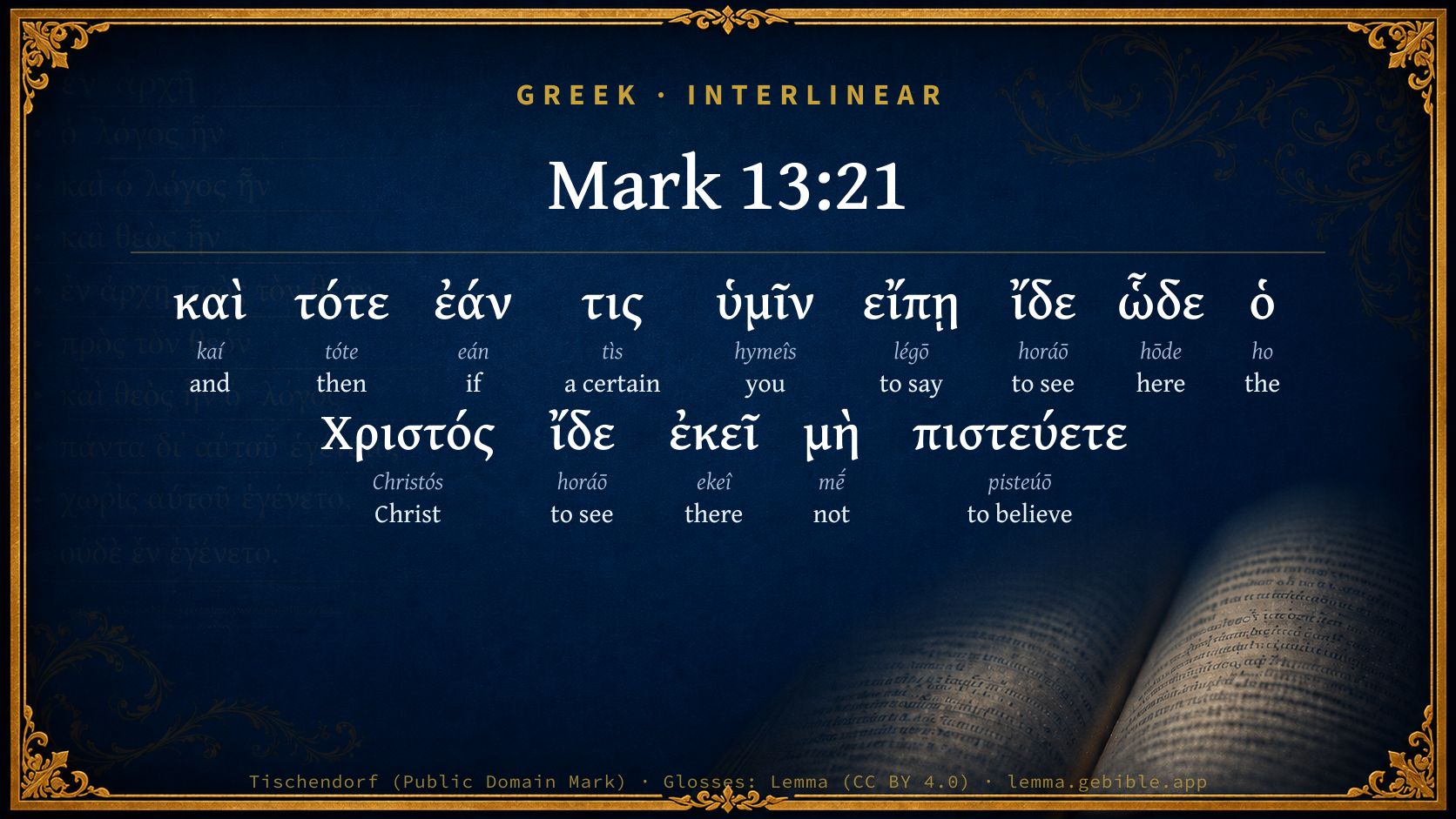
Greek (Tischendorf 8th ed.) Mark 13:21 appears in the Greek New Testament. The text above is from the Tischendorf 8th edition. Each word links to its Strong’s number and a concise gloss. Click any word for its full Thayer’s Greek Lexicon entry.
Download image
Cite this verse

Mark 13:21 (World English Bible). Public Domain. Lemma interlinear Bible study tool, https://lemma.gebible.app/v/mark/13/21.

Show BibTeX & RIS
BibTeX
RIS
English Translation
Then if anyone tells you, 'Look, here is the Christ!' or, 'Look, there!' don't believe it.
World English Bible · Public Domain
Download a study sheet

One document with this verse’s original text, its word-by-word gloss line, the meaning frame, cross-references with their text, attributed commentary, and full source and license credits — printable, and it pastes into notes with its structure intact.

This verse Autodidact and up

Study sheet (.html) Plain text (.txt)

A passage Seminary Student

Up to 50 verses in one chapter. A passage sheet keeps up to 6 commentary sources and 12 cross-references per verse, in the order this page ranks them, and says so on the sheet whenever that leaves anything out. Ask for a single verse and you get the Autodidact verse sheet above.

Everything on this page stays free to read, with no account — the sheet is a download of what is already on screen, not access to it.

Want to remove ads? Support Godless Engineer
Compare translations 3

The same verse in 3 English versions, stacked beneath the original-language interlinear above. Click any original word for its lexicon entry.

Each is an independent rendering of the whole verse — the interlinear is not word-aligned to these translations.

Highlighted words mark where these versions differ — a whole-verse word diff, not a word-by-word alignment.

  • World English Bible Public Domain
    Then if anyone tells you, 'Look, here is the Christ!' or, 'Look, there!' don't believe it.
  • King James Version Public Domain
    And then if any man shall say to you, Lo, here is Christ; or, lo, he is there; believe him not:
  • unfoldingWord Literal Text CC BY-SA 4.0
    And then if anyone says to you, ‘Behold, here the Christ! Behold, there!’ do not believe.

unfoldingWord Literal Text — © unfoldingWord, licensed CC BY-SA 4.0. Word-aligned USFM3 via Door43 (git.door43.org/unfoldingWord/en_ult).

Versions to compare (up to 4)

3 of 4 selected

Show all 19 translations

Every available English version of this verse, each an independent rendering of the whole verse.

  • World English Bible Public Domain
    Then if anyone tells you, 'Look, here is the Christ!' or, 'Look, there!' don't believe it.
  • Berean Standard Bible Public Domain
    At that time if anyone says to you, ‘Look, here is the Christ!’ or ‘There He is!’ do not believe it.
  • Majority Standard Bible Public Domain
    At that time if anyone says to you, ‘Look, here is the Christ!’ or ‘There He is!’ do not believe it.
  • King James Version Public Domain
    And then if any man shall say to you, Lo, here is Christ; or, lo, he is there; believe him not:
  • American Standard Version (1901) Public Domain
    And then if any man shall say unto you, Lo, here is the Christ; or, Lo, there; believe `it' not:
  • Revised Version (1885) Public Domain
    And then if any man shall say unto you, Lo, here is the Christ; or, Lo, there; believe it not:
  • Geneva Bible (1599) Public Domain
    Then if any man say to you, Loe, here is Christ, or, lo, he is there, beleeue it not.
  • Douay-Rheims (1899) Public Domain
    And then if any man shall say to you, Lo, here is Christ; lo, he is here: do not believe.
  • Young's Literal Translation Public Domain
    `And then, if any may say to you, Lo, here `is' the Christ, or, Lo, there, ye may not believe;
  • Literal Standard Version CC BY-SA 4.0
    And then, if any may say to you, Behold, here [is] the Christ, or, Behold, there, you may not believe;
  • Unlocked Literal Bible CC BY-SA 4.0
    Then if anyone says to you, 'Look, here is the Christ!' or 'Look, there he is!' do not believe it.
  • unfoldingWord Literal Text CC BY-SA 4.0
    And then if anyone says to you, ‘Behold, here the Christ! Behold, there!’ do not believe.
  • Darby Bible Public Domain
    And then if any one say to you, Lo, here [is] the Christ, or Lo, there, believe [it] not.
  • World Messianic Bible Public Domain
    Then if anyone tells you, ‘Look, here is the Messiah!’ or, ‘Look, there!’ don’t believe it.
  • Webster's Bible Public Domain
    And then, if any man shall say to you, Lo, here is Christ; or lo, he is there; believe him not.
  • Free Bible Version CC BY-SA 4.0
    So if anyone tells you, ‘Look, here is the Messiah,’ or ‘Look, there he is,’ don't believe it.
  • Bible in Basic English Public Domain
    And then if any man says to you, See, here is Christ; or, See, there; have no faith in it:
  • Text-Critical English NT CC BY 4.0
    If anyone says to you at that time, ‘Behold, here is the Christ!’ or, ‘Behold, there he is!’ do not believe him.
  • Tyndale New Testament (1534) Public Domain
    And then yf eny man saye to you: loo here is Christ: loo he is there beleve not.

Literal Standard Version (2020), Covenant Press — licensed CC BY-SA 4.0. Text via the HelloAO Bible API (eBible.org). Unlocked Literal Bible (unfoldingWord) — licensed CC BY-SA 4.0. Text via the HelloAO Bible API (eBible.org). unfoldingWord Literal Text — © unfoldingWord, licensed CC BY-SA 4.0. Word-aligned USFM3 via Door43 (git.door43.org/unfoldingWord/en_ult). Free Bible Version, Dr. Jonathan Gallagher — licensed CC BY-SA 4.0. Text via the HelloAO Bible API (eBible.org).

Word by word

More ways to search: Search by grammar → Find every occurrence → Compare this word →

Practice this passage: Drill this verse → Learn its vocabulary →

About this verse

These counts appear in no published source. They are computed here, from the morphology-tagged text and Lemma’s own curated glosses. What Lemma adds →

14
words
13
distinct lemmas
Gospels
section

Shared distinctive vocabulary

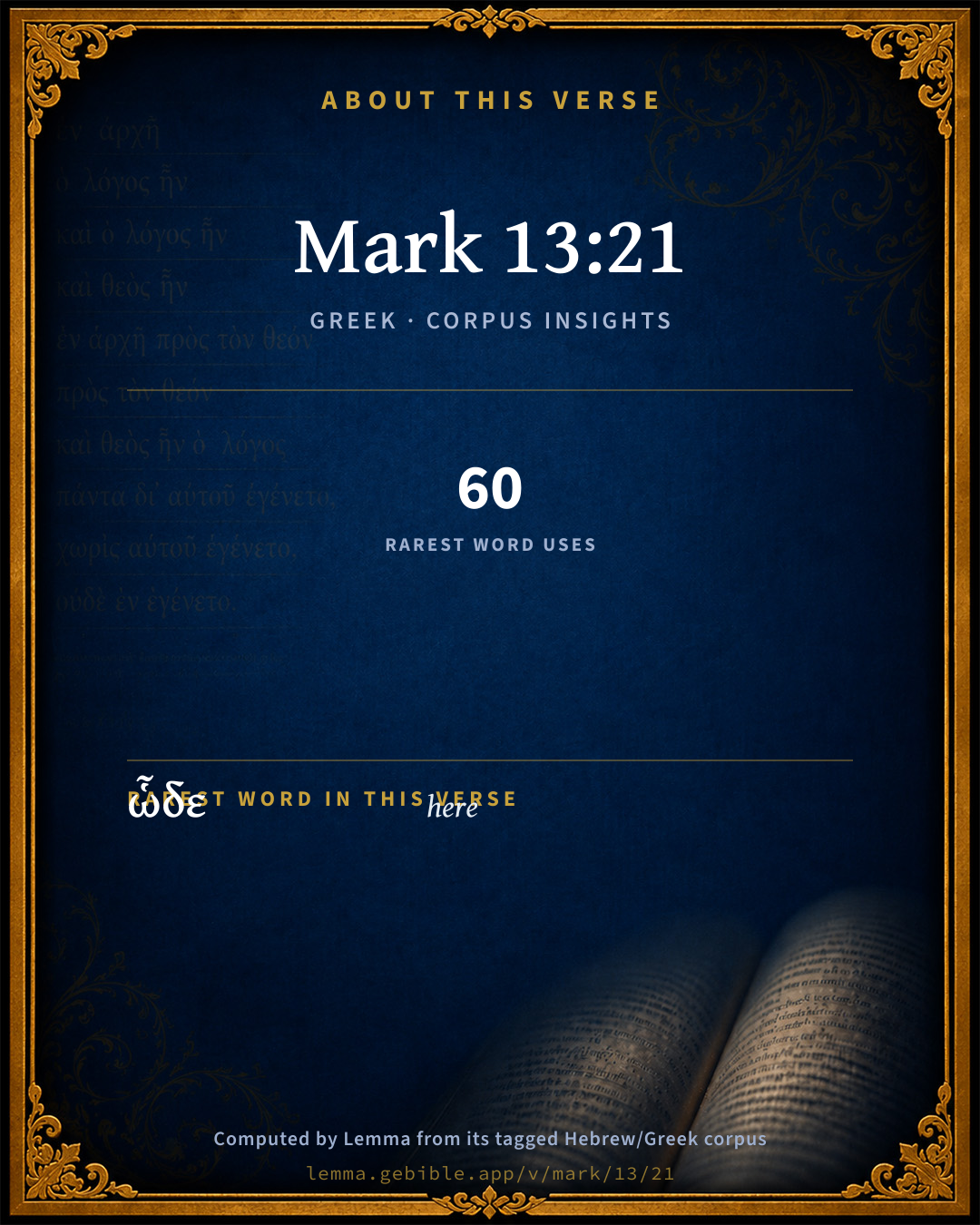
ὧδε here G5602 occurs in 58 verses of the Greek New Testament. Also found in:

Repetition

A word recurs within this verse:

  • ἴδε to see G3708 ×2

Cross-references

6

Topical passages linked to Mark 13:21 in the Treasury of Scripture Knowledge — connected by theme and wording, ordered by reader-vote popularity; previews shown in the World English Bible.

  • Matthew 24:23–25 "Then if any man tells you, 'Behold, here is the Christ,' or, 'There,' don't believe it.
  • Luke 21:8 He said, "Watch out that you don't get led astray, for many will come in my name, saying, 'I AM,' and, 'The time is at hand.' Therefore don't follow them.
  • Matthew 24:5 For many will come in my name, saying, 'I am the Christ,' and will lead many astray.
  • Deuteronomy 13:1–3 If there arise in the midst of you a prophet, or a dreamer of dreams, and he give you a sign or a wonder,
  • Luke 17:23–24 They will tell you, 'Look, here!' or 'Look, there!' Don't go away, nor follow after them,
  • John 5:43 I have come in my Father's name, and you don't receive me. If another comes in his own name, you will receive him.

Cross-references courtesy of OpenBible.info (CC BY 4.0).

Where the printed editions differ

1 variant

Places in this verse where the major printed Greek editions disagree on the wording in a way that affects the translation — a comparison of editions, not a manuscript-by-manuscript collation. The editions are the modern critical texts (Nestlé-Aland 28/27, SBL, Westcott-Hort, Tregelles, Tyndale House) and the traditional texts behind the KJV (the Textus Receptus and the Byzantine/Majority text). It is not a claim about which reading is original.

  1. Extra text
    ἢ,

    “or”

    In TregTRByz Not in NA28NA27TynSBLWH

    ἢ, (ē) 'or' is only in traditional manuscripts (Treg+TR+Byz)

Textual data: Translators Amalgamated Greek New Testament (STEPBible TAGNT) · CC BY 4.0.

Commentary

Notes on Mark 13:21 from classic Christian and Jewish commentators (each source and its license shown beneath its notes). The classic Christian expositions comment on the surrounding passage and are grouped to its opening verse, so a note may address several verses; the Jewish commentaries on the Tanakh (Rashi and others) are per-verse, so they appear only where the commentator wrote on this verse.

Lemma curates 59 commentaries, every one of them public domain or Creative Commons licensed, each selected and text-cleaned for this edition rather than reprinted as found. About our sources →

Joseph Benson's Commentary

Mar 13:21-23. If any shall say to you, Lo, here is Christ — See on Mat 24:23-28. For there shall arise false Christs — Grotius, and some others, think our Lord had Barchochebas in view here, because he expressly called himself Messiah, and pretended to work great miracles. But as the passage describes what was to happen about the time of the destruction of Jerusalem, it cannot be applied to Barchochebas, who arose in the reign of Adrian, about sixty years after. Josephus (Antiq., 20:6) tells us, that under the government of Felix, “the whole country was full of magicians who deceived the people.” In the same chapter, he says, “The magicians and deceivers persuaded the common people to follow them into the wilderness, promising to show them evident signs and miracles.” It seems these impostors pretended that the miracles they were going to perform, were those which God had predicted the Messiah would perform; perhaps they assumed the title directly, though Josephus, after the destruction of his nation, was ashamed to make any mention of the Messiah at all, or of the prophecies relating to him. After the example of Moses, these false Christs appealed to the miracles which they promised to perform, in proof of their being sent to deliver the nation from slavery. This appears evidently from a passage of his Jewish War, (ii. 12,) where, speaking of the affairs under Felix, he says, “Impostors and deceivers, under pretence of inspiration, attempting innovations and changes, made the common people mad, and led them into the wilderness, promising that God would there show them, σημεια ελευθεριας, signs of liberty;” that is, miracles in proof that they should be delivered from the Roman yoke, and obtain their liberty. This was the benefit the nation expected from the Messiah; and those deceivers who promised it to them were readily believed: for the common people daily expected that the Messiah would put them in possession of universal empire. Every impostor, therefore, who assumed that character, and promised them deliverance, was quickly followed and obeyed. Hence the propriety of Josephus’s observation. The same historian, Antiq., 20:6, mentions an Egyptian Jew, calling himself a prophet, who persuaded the people to go with him to the mount of Olives, promising to show them from that place the walls of Jerusalem falling down, and giving them an entrance into the city. He speaks of this deceiver likewise, Bell. Jud., 2:12, as “gathering together thirty thousand men on the mount of Olives, proposing to go thence and take Jerusalem by force, to drive out the Roman garrison, and rule over the people.” Here this impostor plainly acted the Messiah. But Felix, getting notice of his designs, came out and routed him. And shall show signs and wonders to seduce, if possible, even the elect — This relates especially to those impostors who appeared during the time of the siege, of which see Josephus, Bell. Jud., 6:5; and Eusebius, Hist. Ecclesiastes, 4:6. As for the objection which is urged from this text against admitting miracles as a proof of doctrines, two things may be here transiently observed: “1st, That it cannot certainly be proved that the works here referred to were true miracles: they might be like the lying powers, signs, and wonders, mentioned 2Th 2:9. Or, 2d, That if we should, for argument’s sake, grant them to be real miracles, yet they are supposed to be wrought at a time when there were in the Christian Church teachers endued with superior miraculous powers. But it can never be inferred from such a supposition in that case, that God will suffer miracles to be wrought in proof of falsehood, when there are none of his servants to perform greater miracles on the side of truth. And when such superior miracles on the side of truth do exist, the opposite miracles, at most, can only prove that some invisible beings of great power, who are the abetters of falsehood, are strongly engaged to support the contrary doctrine; the consideration of which must excite all wise and good men to receive a truth so opposed with greater readiness, and to endeavour to promote it with greater zeal; as they may be sure the excellence and importance of it is proportionable to the solicitude of these malignant spirits to prevent its progress.” — Doddridge. But take ye heed — Be cautiously upon your guard against so dangerous an imposition: Behold, I have foretold you all these things — That, comparing the event with the prediction, your faith may be established by those very circumstances which, in another view, might have a tendency to shake it.

Joseph Benson's Commentary on the Old and New Testaments (1811–1818) — public domain. Text from a community e-Sword module.

Tyndale Open Study Notes

Tyndale Open Resources

13:21-23 The larger section (13:5-23) concludes with another warning about messianic pretenders. Here the pretenders are associated with the events of AD 70, whereas in 13:5-6 they were associated with the normal course of events. Along with false messiahs, prophets would appear and perform miraculous signs and wonders (13:22), hoping to deceive not only the Jews of Judea and Jerusalem but even the Christians (God’s chosen ones). Jesus warned his followers not to believe such reports. When the Messiah comes from heaven (13:26), everyone will see and know it (see Rev 1:7). • Watch out! This warning unifies the section (Mark 13:5-23) and brings it to a close. Jesus’ teaching in this section was to warn his followers in Judea and Jerusalem not to be misled by false messianic hopes and claims. Many Jews succumbed to such claims in the late AD 60s, and Josephus (Antiquities 17.10.8) describes the great harm done by these pretenders, who encouraged the Jewish people to resist the Romans. Nothing should distract Christians from fleeing Judea and Jerusalem when they see the sacrilegious object that causes desecration taking place. • For Mark’s readers in Rome, Jesus’ message had a different application. Mark wanted his readers to watch out for those who promised timetables for prophecy to be fulfilled. They could not know the time (13:32), and a frenzy about the second coming of Christ was forbidden, but they were to be alert (13:33-37) and prepare themselves for persecution (13:9-13; see 8:34-38) according to Jesus’ words of encouragement (13:11, 13).

Tyndale Open Study Notes — © Tyndale Open Resources, licensed CC BY-SA 4.0. Text via the HelloAO Bible API.

John Gill's Exposition

But take ye heed,.... The Persic version adds, "of them"; of the false Christs, and false prophets: for though the purposes of God, concerning the salvation of his elect, are infrustrable; his promises are yea and amen; his grace is efficacious and irresistible, and his power uncontrollable; and the salvation of his chosen ones certain; yet it becomes them to be on their guard against every deception, and temptation, and to make use of all means for their perseverance:

behold, I have foretold you all things; relating to the destruction of the temple, city, and nation of the Jews; the signs that would go before it, as the disciples had desired; the miseries and calamities that would attend it, and the danger they would be exposed to through false Christs, and false prophets; and therefore would be inexcusable, if they did not observe the caution he now gave them: and moreover, when all these should be accomplished, they would remember that he had told them of them beforehand; which would be a proof of his omniscience, and so an establishment of them in the truth of him, as the Messiah; See Gill on Mat 24:25.

John Gill's Exposition of the Whole Bible (1746–1763) — public domain (CC PDM 1.0). Text via the HelloAO Bible API.

Matthew Poole's English Annotations

See Poole on "Mat 24:23", and following verses to Mat 24:25. The history of Josephus, and those Roman historians who wrote the history of those times that went immediately before the destruction of Jerusalem, and give us account of the taking of that city, are the best commentary on these verses. It hath been often said, that the Jews were in expectation of a Messias, and are so still. But by him they understood not a person who should be God man, and save his people from their sins, and set up a spiritual kingdom in the world, but a secular prince, who should come of the house of David, and restore them to their civil liberties. So that the name of Christ was a fair name to patronize any rebellious faction, where the leader would arrogate it to herself, especially if he could pretend to the house of David. Near the destruction of Jerusalem, several persons used these arts to draw people after them to defend themselves, and to stand up for their liberties. Our Saviour having discerned his disciples tinctured with this common error of the nation, and knowing what would come to pass, gives his disciples warning to avoid these delusions, and not to run after such pretenders, to their ruin and destruction.

Matthew Poole's English Annotations on the Holy Bible (1683–1685) — public domain. Text from a community e-Sword/MySword module.

The Pulpit Commentary

Vers. 21, 22. And then if any man shall say unto you, Lo, here is the Christ; or, Lo, there, believe it not; for there shall arise false Christs and false prophets. Josephus mentions one Simon of Gerasa, who, pretending to be a deliverer of the people from the Romans, gathered around him a crowd of followers, and gained admission into Jerusalem, and harassed the Jews. In like manner, Eleazar and John, leaders of the Zealots, gained admission into the holy place, under pretense of defending the city, but really that they might plunder it. But it seems as though our Lord here. looked beyond the siege of Jerusalem to the end of the world; and he warns us that as the time of his second advent approaches, deceivers will arise, to seduce, if it were possible, even the elect. The word "to seduce" (apoplanan) is more properly rendered, as in the Revised Version, to lead astray. Every age has produced its crop of such deceivers; and it may be expected that, as the time of the end draws nearer and nearer, their number will increase. Sometimes those idiosyncrasies in them which show themselves in lying wonders, are the result of self-delusion; but still oftener they are deliberate attempts made for the purpose of imposing on the unwary. Sometimes they are a combination of both. In the cases to which our Lord refers there is evidently an intention to lead astray, although it may have had its origin in self-deceit. In our day there is a sad tendency to lead men astray with regard to the great fundamental verities of Christianity. And the words of St. Jerome may well be remembered here: "If any would persuade you that Christ is to be found in the wilderness of unbelief or sceptical philosophy, or in the secret chambers of heresy, believe them not."

The Pulpit Commentary (1880–1919), ed. H.D.M. Spence-Jones & Joseph S. Exell — public domain. Text from a community e-Sword module.

John Wesley's Explanatory Notes

Matt. xxiv, 23.

John Wesley, Explanatory Notes Upon the Whole Bible (1754–1765) — public domain. Text via the GEBible commentary corpus.

Kretzmann's Popular Commentary

Paul E. Kretzmann

The false Christs:

v. 21. And then if any man shall say to you, Lo, here is Christ; or, Lo, He is there; believe him not;

v. 22. for false Christs and false prophets shall rise, and shall show signs and wonders, to seduce, if it were possible, even the elect.

v. 23. But take ye heed: behold, I have foretold you all things.

A second warning against the insidiousness and impertinence of the false teachers. They came in those days, in increasing numbers, political Messiahs that promised deliverance from the yoke of the Romans. Their apparent sincerity, the power of their oratory, the mere influence of their personality induced many a person foolishly to cast his lot with them and be carried along with them to his destruction. And they are coming in our days, without the Church and within the Church, political Messiahs, social reformers, millennial dreamers that place the kingdom of Christ here upon earth, that glibly prate of the emancipation of the masses and of a final glorious state where all men will be equal and all men will be happy. They even do signs and wonders, both false and apparently real, by the help of Satan. The object always is to seduce, if possible, the believers, God’s own elect. But there will be a deliverance at the last hour. Therefore the believers will, in the meantime, be on their guard. Christ has come, He has left us His infallible Word; we need no further word, or revelation, no key, no new light; all these are signs of the false Christs. The Word is nigh unto us, the Word of the Gospel; that will save our souls, all other words and books of new sects are dangerous, deceiving, destroying. Christ’s warning was given in advance on their account.

Paul E. Kretzmann, Popular Commentary of the Bible (1921–1924) — public domain. Text from a community e-Sword module.

Burkitt's Expository Notes on the New Testament

William Burkitt

The Jews had all along cherished in themselves a vain expectation, that the promised Messias should be a temporal deliverer; and set them at liberty from the power and slavery of the Romans; and accordingly, our Saviour declares to his discples here, That, immediately before Jerusalem’s destruction, several persons, taking the advantage of this expectation, would make themselves heads of parties; and pretend that they were the true Messiah, who should save and deliver them from their enemies, if they would follow them. Hereupon our Saviour cautions his disciples against such false Christs, and false prophets, and bids them not believe them, though they did ever so many great signs and wonders, and promise them ever such glorious deliverances.

From hence note, 1. That the church’s great danger is from seducers, that come in Christ’s name and pretend to work signs and wonders by his authority.

Note, 2. That such is the power of seduction and delusion, that, many, in all ages of the church, have been carried away with seducers and false teachers.

3. That the elect themselves, if left to themselves might be seduced; but being guarded by divine power against seduction and delusion, they shall be preserved from that fatal mischief; They shall seduce, if possible, even the elect.

William Burkitt's Expository Notes on the New Testament (1700–1703) — public domain. Text from a community e-Sword module.

unfoldingWord translationNotes

Door43 World Missions Community

General Information:

In verse 21 Jesus gives a command, and in 22 he tells the reason for the command. This can be reordered with the reason first, and the command second, as in the UDB. (See: Verse Bridges)

false Christs

"people who claim they are Christ"

so as to deceive

"in order to deceive" or "hoping to deceive" or "trying to deceive"

so as to deceive, if possible, even the elect

The phrase "even the elect" implies that the false Christs and false prophets will expect to deceive some people, but they will not know if they will be able to deceive the elect. AT: "in order to deceive people, and even deceive the elect, if that is possible" (See: Ellipsis)

the elect

"the people whom God has chosen"

Be on guard

"Be watchful" or "Be alert"

I have told you all these things ahead of time

Jesus told them these things to warn them. AT: "I have told you all these things ahead of time to warn you" (See: Assumed Knowledge and Implicit Information)

translationWords

Christ

prophet

miracle

deceive

chosen one

unfoldingWord translationNotes — © Distant Shores Media and the Door43 World Missions Community, licensed CC BY-SA 4.0. Source: git.door43.org/Door43/en_tn.

Cambridge Greek Testament for Schools and Colleges

21. καὶ τότε. “It will be a time of great excitement and much fanaticism, and those who are looking for signs will be easily misled; therefore be on your guard against impostors.” In the Sermon Christ points out that at all times, if we want to find the right way, we must beware of seducing guides (Mat 7:15-20).

Ἴδε ὧδε κ.τ.λ. Mt’s expansion of this is characteristic, as also is Mk’s simplicity.

μὴ πιστεύετε. Not “cease to believe,” as μὴ φοβεῖσθε (Mar 6:50) and μἠ κωλύετε (Mar 10:14), but “continually abstain from believing,” as μὴ προμεριμνᾶτε (Mar 13:11). Mt. here has aorists.

Cambridge Greek Testament for Schools and Colleges (Cambridge University Press, 1896; 21 vols, various authors incl. Carr, Maclear, Plummer, Farrar, Lumby, Moule, M. R. James, Simcox) — public domain. Text from a community e-Sword module.

International Critical Commentary

21. Καὶ τότε ἐάν τις ὑμῖν εἴπῃ, Ἴδε, ὧδε ὁ χριστός, ἴδε, ἐκεῖ, μὴ πιστεύετε—And then, if any one says to you, See, here the Messiah, see, there, believe it not. τότε, then, is added to the warning against false Messiahs appearing in the preceding period (v. 6).

Ἴδε, instead of the first ἰδού, Tisch. Treg. WH. א BL. Ἴδε, instead of second Ἰδού, Tisch. Treg. WH. א BDL 28. Omit ἤ, or, before it, Tisch. WH. א LU 40, 69, 127, 131, 157, two mss. Lat. Vet. Vulg. πιστεύετε, instead of πιστεύσητε, Tisch. Treg. WH. א ABCDEFHLV Δ.

International Critical Commentary — older volumes (1896–1929), various authors — public domain. Text from a community e-Sword module.

Lesson kit

Teaching starters — assembled from the data on this page, not authored interpretation. Every prompt links to the verse data it draws on. Edit before teaching.

Mark, in the Gospels, opens this verse with 14 words (13 distinct Greek lemmas). Its most distinctive word is hōde (“here”). A historical commentator’s framing appears above. Read the whole chapter for the surrounding context.

Discussion questions

  1. How does “here” (hōde) shape what this verse is saying?
  2. Matthew 8:29 shares the word «here» with this verse. How do the two illuminate each other?
  3. “to see” occurs 2× in this one verse. What is the effect of the repetition?
  4. The translations on this page render this verse differently — a whole-verse word diff, not a word-by-word alignment. What might account for the different wordings?
  5. Reading how Joseph Benson's Commentary and Tyndale Open Study Notes read this verse, where do the two commentators agree and where do they part?

Things to notice

Reading settings

Reading text

Shown beneath each verse's original-language words.

Old Testament
Old Testament edition

Read the OT as the Masoretic Hebrew (MT) or the Greek Septuagint (LXX).

English shown for the Greek Septuagint (in the Hebrew ↔ Greek comparison).

Comparing translations? Open the Compare panel on any verse page to stack up to four side by side.