Matthew 22:29

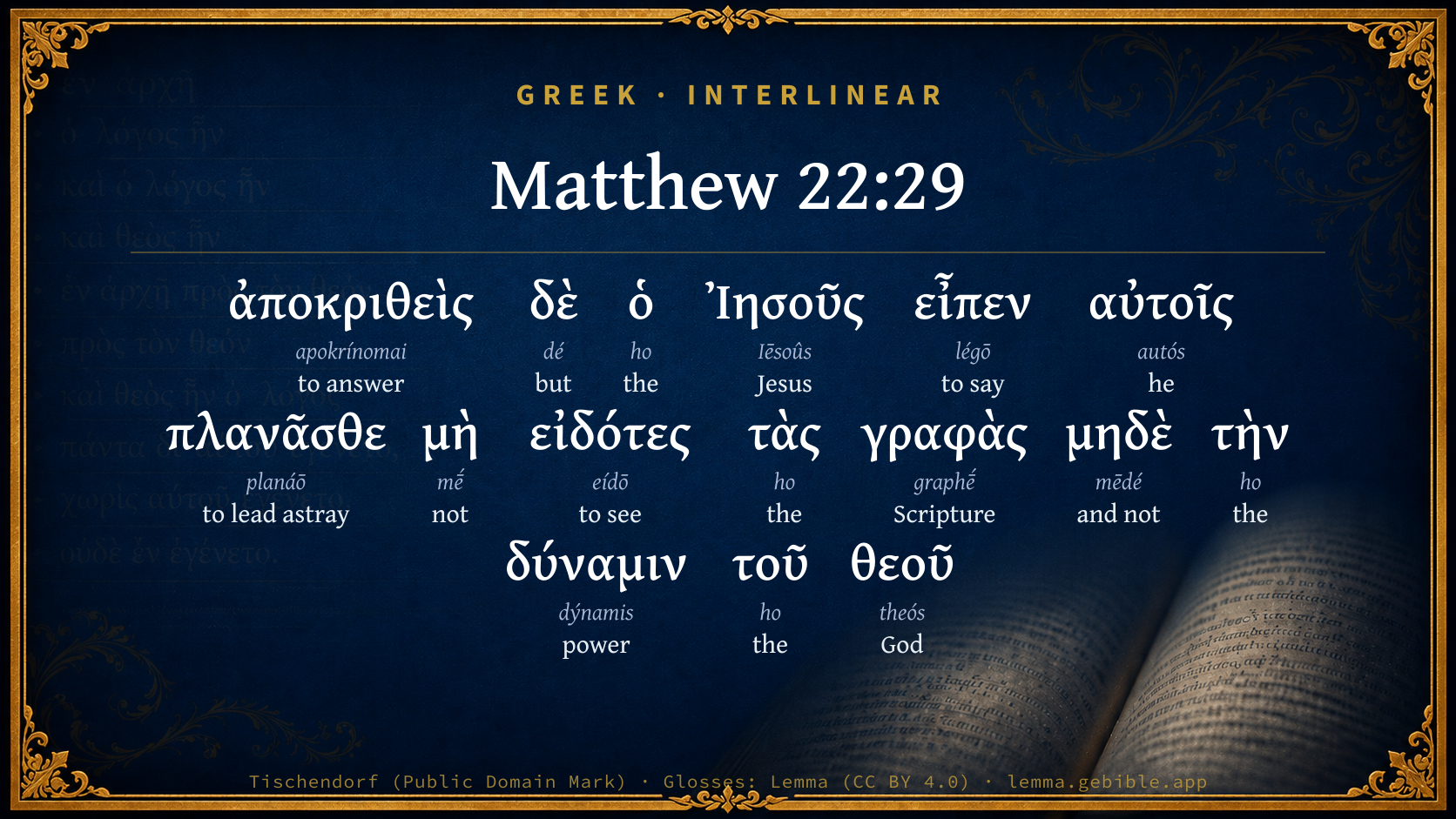
Greek (Tischendorf 8th ed.) Matthew 22:29 appears in the Greek New Testament. The text above is from the Tischendorf 8th edition. Each word links to its Strong’s number and a concise gloss. Click any word for its full Thayer’s Greek Lexicon entry.
Download image
Cite this verse

Matthew 22:29 (World English Bible). Public Domain. Lemma interlinear Bible study tool, https://lemma.gebible.app/v/matthew/22/29.

Show BibTeX & RIS
BibTeX
RIS
English Translation
But Jesus answered them, "You are mistaken, not knowing the Scriptures, nor the power of God.
World English Bible · Public Domain
Download a study sheet

One document with this verse’s original text, its word-by-word gloss line, the meaning frame, cross-references with their text, attributed commentary, and full source and license credits — printable, and it pastes into notes with its structure intact.

This verse Autodidact and up

Study sheet (.html) Plain text (.txt)

A passage Seminary Student

Up to 50 verses in one chapter. A passage sheet keeps up to 6 commentary sources and 12 cross-references per verse, in the order this page ranks them, and says so on the sheet whenever that leaves anything out. Ask for a single verse and you get the Autodidact verse sheet above.

Everything on this page stays free to read, with no account — the sheet is a download of what is already on screen, not access to it.

Want to remove ads? Support Godless Engineer
Compare translations 3

The same verse in 3 English versions, stacked beneath the original-language interlinear above. Click any original word for its lexicon entry.

Each is an independent rendering of the whole verse — the interlinear is not word-aligned to these translations.

Highlighted words mark where these versions differ — a whole-verse word diff, not a word-by-word alignment.

  • World English Bible Public Domain
    But Jesus answered them, "You are mistaken, not knowing the Scriptures, nor the power of God.
  • King James Version Public Domain
    Jesus answered and said unto them, Ye do err, not knowing the scriptures, nor the power of God.
  • unfoldingWord Literal Text CC BY-SA 4.0
    But answering, Jesus said to them, “You are being led astray, not knowing the Scriptures or the power of God.

unfoldingWord Literal Text — © unfoldingWord, licensed CC BY-SA 4.0. Word-aligned USFM3 via Door43 (git.door43.org/unfoldingWord/en_ult).

Versions to compare (up to 4)

3 of 4 selected

Show all 19 translations

Every available English version of this verse, each an independent rendering of the whole verse.

  • World English Bible Public Domain
    But Jesus answered them, "You are mistaken, not knowing the Scriptures, nor the power of God.
  • Berean Standard Bible Public Domain
    Jesus answered, “You are mistaken because you do not know the Scriptures or the power of God.
  • Majority Standard Bible Public Domain
    Jesus answered, “You are mistaken because you do not know the Scriptures or the power of God.
  • King James Version Public Domain
    Jesus answered and said unto them, Ye do err, not knowing the scriptures, nor the power of God.
  • American Standard Version (1901) Public Domain
    But Jesus answered and said unto them, Ye do err, not knowing the scriptures, nor the power of God.
  • Revised Version (1885) Public Domain
    But Jesus answered and said unto them, Ye do err, not knowing the scriptures, nor the power of God.
  • Geneva Bible (1599) Public Domain
    Then Iesus answered, and sayd vnto them, Ye are deceiued, not knowing the Scriptures, nor the power of God.
  • Douay-Rheims (1899) Public Domain
    And Jesus answering, said to them: You err, not knowing the Scriptures, nor the power of God.
  • Young's Literal Translation Public Domain
    And Jesus answering said to them, `Ye go astray, not knowing the Writings, nor the power of God;
  • Literal Standard Version CC BY-SA 4.0
    And Jesus answering said to them, “You go astray, not knowing the Writings, nor the power of God;
  • Unlocked Literal Bible CC BY-SA 4.0
    But Jesus answered and said to them, “You are mistaken, because you do not know the scriptures or the power of God.
  • unfoldingWord Literal Text CC BY-SA 4.0
    But answering, Jesus said to them, “You are being led astray, not knowing the Scriptures or the power of God.
  • Darby Bible Public Domain
    And Jesus answering said to them, Ye err, not knowing the scriptures nor the power of God.
  • World Messianic Bible Public Domain
    But Yeshua answered them, “You are mistaken, not knowing the Scriptures, nor the power of God.
  • Webster's Bible Public Domain
    Jesus answered and said to them, Ye do err, not knowing the scriptures, nor the power of God.
  • Free Bible Version CC BY-SA 4.0
    Jesus replied, “Your mistake is you don't know Scripture or what God can do.
  • Bible in Basic English Public Domain
    But Jesus said to them in answer, You are in error, not having knowledge of the Writings, or of the power of God.
  • Text-Critical English NT CC BY 4.0
    Jesus answered them, “You are in error because you know neither the Scriptures nor the power of God.
  • Tyndale New Testament (1534) Public Domain
    Iesus answered and sayde vnto the: ye are deceaved and vnderstonde not the scriptures nor yet the power of God.

Literal Standard Version (2020), Covenant Press — licensed CC BY-SA 4.0. Text via the HelloAO Bible API (eBible.org). Unlocked Literal Bible (unfoldingWord) — licensed CC BY-SA 4.0. Text via the HelloAO Bible API (eBible.org). unfoldingWord Literal Text — © unfoldingWord, licensed CC BY-SA 4.0. Word-aligned USFM3 via Door43 (git.door43.org/unfoldingWord/en_ult). Free Bible Version, Dr. Jonathan Gallagher — licensed CC BY-SA 4.0. Text via the HelloAO Bible API (eBible.org).

Word by word

More ways to search: Search by grammar → Find every occurrence → Compare this word →

Practice this passage: Drill this verse → Learn its vocabulary →

πλανᾶσθε
planáō
G4105
“to lead astray”
Verb, Present, Passive, Indicative, 2nd person, Plural
Part of Speech
Verb
Tense
Present
Voice
Passive
Mood
Indicative
Person
2nd person
Number
Plural
Full Thayer's Definition

Origin: from G4106

TDNT: 09:48,9

1. to cause to stray, to lead astray, lead aside from the right way a. to go astray, wander, roam about 2. metaph. a. to lead away from the truth, to lead into error, to deceive b. to be led into error c. to be led aside from the path of virtue, to go astray, sin d. to sever or fall away from the truth 1. of heretics e. to be led away into error and sin
  1. ἀποκριθεὶς apokrínomai G611 “to answer” Verb, Aorist, Passive deponent, Participle, Nominative, Singular, Masculine
  2. δὲ dé G1161 “but” Conjunction
  3. ὁ ho G3588 “the” Article, Nominative, Singular, Masculine
  4. Ἰησοῦς Iēsoûs G2424 “Jesus” Noun, Nominative, Singular, Masculine
  5. εἶπεν légō G3004 “to say” Verb, Aorist, Active, Indicative, 3rd person, Singular
  6. αὐτοῖς autós G846 “he” Personal pronoun, Dative, Plural, Masculine
  7. μὴ mḗ G3361 “not” Particle, Negative
  8. εἰδότες eídō G1492 “to see” Verb, Perfect, Active, Participle, Nominative, Plural, Masculine
  9. τὰς ho G3588 “the” Article, Accusative, Plural, Feminine
  10. γραφὰς graphḗ G1124 “Scripture” Noun, Accusative, Plural, Feminine
  11. μηδὲ mēdé G3366 “and not” Conjunction, Negative
  12. τὴν ho G3588 “the” Article, Accusative, Singular, Feminine
  13. δύναμιν dýnamis G1411 “power” Noun, Accusative, Singular, Feminine
  14. τοῦ ho G3588 “the” Article, Genitive, Singular, Masculine
  15. θεοῦ theós G2316 “God” Noun, Genitive, Singular, Masculine

About this verse

These counts appear in no published source. They are computed here, from the morphology-tagged text and Lemma’s own curated glosses. What Lemma adds →

16
words
13
distinct lemmas
Gospels
section

Shared distinctive vocabulary

πλανᾶσθε to lead astray G4105 occurs in 37 verses of the Greek New Testament. Also found in:

Repetition

A word recurs within this verse:

Cross-references

18

Topical passages linked to Matthew 22:29 in the Treasury of Scripture Knowledge — connected by theme and wording, ordered by reader-vote popularity; previews shown in the World English Bible.

  • John 20:9 For as yet they didn't know the Scripture, that he must rise from the dead.
  • Romans 15:4 For whatever things were written before were written for our learning, that through patience and through encouragement of the Scriptures we might have hope.
  • Luke 1:37 For everything spoken by God is possible."
  • Jeremiah 32:17 Ah Lord Yahweh! behold, you have made the heavens and the earth by your great power and by your outstretched arm; there is nothing too hard for you,
  • Daniel 12:2–3 Many of those who sleep in the dust of the earth shall awake, some to everlasting life, and some to shame and everlasting contempt.
  • Psalms 17:15 As for me, I shall see your face in righteousness; I shall be satisfied, when I awake, with seeing your form.
  • Psalms 73:25–26 Who do I have in heaven? There is no one on earth who I desire besides you.
  • Isaiah 26:19 Your dead shall live; my dead bodies shall arise. Awake and sing, you who dwell in the dust; for your dew is [as] the dew of herbs, and the earth shall cast forth the dead.
  • Philippians 3:21 who will change the body of our humiliation to be conformed to the body of his glory, according to the working by which he is able even to subject all things to himself.
  • Genesis 18:14 Is anything too hard for Yahweh? At the set time I will return to you, when the season comes round, and Sarah will have a son."
  • Job 19:25–27 But as for me, I know that my Redeemer lives. In the end, he will stand upon the earth.
  • Psalms 49:14–15 They are appointed as a flock for Sheol. Death shall be their shepherd. The upright shall have dominion over them in the morning. Their beauty shall decay in Sheol, Far from their mansion.
  • Acts 26:8 Why is it judged incredible with you, if God does raise the dead?
  • Isaiah 25:8 He has swallowed up death forever; and the Lord Yahweh will wipe away tears from off all faces; and the reproach of his people will he take away from off all the earth: for Yahweh has spoken it.
  • Luke 24:44–47 He said to them, "This is what I told you, while I was still with you, that all things which are written in the law of Moses, the prophets, and the psalms, concerning me must be fulfilled."
  • Hosea 13:14 I will ransom them from the power of Sheol. I will redeem them from death! Death, where are your plagues? Sheol, where is your destruction? Compassion will be hidden from my eyes.
  • Psalms 16:9–11 Therefore my heart is glad, and my tongue rejoices. My body shall also dwell in safety.
  • Isaiah 57:1–2 The righteous perishes, and no man lays it to heart; and merciful men are taken away, none considering that the righteous is taken away from the evil [to come].

Cross-references courtesy of OpenBible.info (CC BY 4.0).

Commentary

Notes on Matthew 22:29 from classic Christian and Jewish commentators (each source and its license shown beneath its notes). The classic Christian expositions comment on the surrounding passage and are grouped to its opening verse, so a note may address several verses; the Jewish commentaries on the Tanakh (Rashi and others) are per-verse, so they appear only where the commentator wrote on this verse.

Lemma curates 59 commentaries, every one of them public domain or Creative Commons licensed, each selected and text-cleaned for this edition rather than reprinted as found. About our sources →

Joseph Benson's Commentary

Mat 22:29-30. Jesus answered, Ye do err, not knowing the Scriptures — Which plainly assert a future state; nor the power of God — Who created spirit as well as matter, and can preserve it in existence when the body is dissolved, and can also raise the body from the dust and render it immortal; and who can make the whole man completely happy in the knowledge, love, and enjoyment of himself, without any of the pleasures or objects of this visible and temporal world. For in the resurrection they neither marry, &c. — Our Lord proceeds to observe further, that they entirely mistook the nature of the life to be enjoyed in a future state: that those who attained it being as the angels of God, incorruptible and immortal, marriage and the procreation of an offspring were no longer necessary to continue the species, or maintain the population of the spiritual world.

Joseph Benson's Commentary on the Old and New Testaments (1811–1818) — public domain. Text from a community e-Sword module.

Tyndale Open Study Notes

Tyndale Open Resources

22:29 The power of God most likely refers to God’s ability to raise the dead.

Tyndale Open Study Notes — © Tyndale Open Resources, licensed CC BY-SA 4.0. Text via the HelloAO Bible API.

Meyer's Critical & Exegetical Commentary

Heinrich August Wilhelm Meyer

Mat_22:29. Jesus answers that, in founding upon Deu_25:5 the denial of the resurrection, which their question implies, they are mistaken, and that in a twofold respect: (1) they do not understand the Scriptures, i.e. they fail to see how that doctrine actually underlies many a scriptural utterance; and (2) they do not sufficiently realize the extent of the power of God, inasmuch as their conceptions of the resurrection are purely material, and because they cannot grasp the thought of a higher corporeality to be evolved from the material body by the divine power. And then comes an illustration of the latter point in Mat_22:30, and of the former in Mat_22:31.

Meyer — Critical and Exegetical Commentary on the New Testament — English translation by Peter Christie, edited by Frederick Crombie (T&T Clark, 1880) — public domain. Text from a community e-Sword module.

Expositor's Greek Testament

ed. W. Robertson Nicoll

Mat 22:29-33 . Christ’s answer . One at first wonders that He deigned to answer such triflers; but He was willing meekly to instruct even the perverse, and He never forgot that there might be receptive earnest people within hearing. The Sadducees drew from Him one of His great words.

Mat 22:29 . πλανᾶσθε , ye err, passionless unprovocative statement, as if speaking indulgently to ignorant men. μὴ εἰδότες , etc.: doubly ignorant; of the Scriptures and of God’s power, the latter form of ignorance being dealt with first.

The Expositor's Greek Testament, edited by W. Robertson Nicoll (1897–1910) — public domain. Text from a community e-Sword module.

Adam Clarke's Commentary

Verse 29. Ye do err] Or, Ye are deceived - by your impure passions: not knowing the scriptures, which assert the resurrection: - nor the miraculous power of God (την δυναμιν του Θεου) by which it is to be effected. In Avoda Sara, fol. 18, Sanhedrin, fol. 90, it is said: "These are they which shall have no part in the world to come: Those who say, the Lord did not come from heaven; and those who say, the resurrection cannot be proved out of the law."

Their deception appeared in their supposing, that if there were a resurrection, men and women were to marry and be given in marriage as in this life; which our Lord shows is not the case: for men and women there shall be like the angels of God, immortal, and free from all human passions, and from those propensities which were to continue with them only during this present state of existence. There shall be no death; and consequently no need of marriage to maintain the population of the spiritual world.

Adam Clarke's Commentary on the Bible (1810–1826) — public domain. Text from a community e-Sword/MySword module.

Ellicott's Commentary for English Readers

(29) Ye do err.—This is, it may be noted, the one occasion in the Gospel history in which our Lord comes into direct collision with the Sadducees. On the whole, while distinctly condemning and refuting their characteristic error, the tone in which He speaks is less stern than that in which He addresses the Pharisees. They were less characterised by hypocrisy, and that, as the pessima corruptio optimi, was that which called down His sternest reproof. The causes of their error were, He told them, two-fold: (1) an imperfect knowledge even of the Scriptures which they recognised; (2) imperfect conceptions of the divine attributes, and therefore an à priori limitation of the divine power. They could not conceive of any human fellowship in the life of the resurrection except such as reproduced the relations and conditions of this earthly life.

A Bible Commentary for English Readers, edited by Charles John Ellicott (1878–1897) — public domain. Text from a community e-Sword module.

The Cambridge Bible for Schools and Colleges

gen. ed. J. J. S. Perowne

29. not knowing] i. e. “because ye do not know” (1) the Scriptures, which affirm the doctrine; nor (2) the power of God, which is able to effect the resurrection, and after the resurrection to create a new order of things in the new world.

The Cambridge Bible for Schools and Colleges (gen. ed. J. J. S. Perowne; Cambridge University Press, 1878–1918) — public domain. Text from a community e-Sword module.

John Gill's Exposition

I am the God of Abraham, and the God of Isaac, and the God of Jacob,.... The Sadducees expressly denied, that the resurrection could be proved out of the law,

"Says R. Eliezer, with R. Jose (g), I have found the books of the Sadducees to be corrupt; for they say that the resurrection of the dead is not to be proved out of the law: I said unto them, you have corrupted your law, and ye have not caused anything to come up into your hands, for ye say the resurrection of the dead is not to be proved out of the law; lo! he saith, Num 15:31 "That soul shall be utterly cut off, his iniquity shall be upon him; he shall be utterly cut off" in this world; "his iniquity shall be upon him", is not this said with respect to the world to come?.

Hence, in opposition to this notion of the Sadducees, the other Jews say (h), that "Though a man confesses and believes that the dead will be raised, yet that it is not intimated in the law, he is an heretic; since it is a fundamental point, that the resurrection of the dead is of the law.

Hence they set themselves, with all their might and main, to prove this doctrine from thence, of which take the following instances (i),

"Says R. Simai, from whence is the resurrection of the dead to be proved out of the law? From Exo 6:4 as it is said, "I have also established my covenant with them, to give them the land of Canaan: to you" it is not said, but "to them"; from hence then, the resurrection of the dead may be proved out of the law.

The gloss upon it is,

"the sense is, that the holy blessed God, promised to our fathers Abraham, Isaac, and Jacob, that he would give to them the land of Israel; and because he gave it to them, has he not given it to their children? But we learn from hence, that they shall be raised, and that God will hereafter give them the land of Israel.

And which the learned Mr. Mede takes to be the sense of the words of this text, cited by our Lord;, and this the force of his reasoning, by which he proves the resurrection of the dead. Again,

"the Sadducees asked Rabban Gamaliel, from whence does it appear that the holy blessed God will quicken the dead? He said unto them, out of the law, and out of the prophets, and out of the Hagiographa; but they did not receive of him (or regard him): out of the law, as it is written, "Thou shalt sleep with thy fathers, and rise up", Deu 31:16 And there are that say from this Scripture, Deu 4:4. "But ye that did cleave unto the Lord your God, are alive every one of you this day": as this day all of you stand, so in the world to come, all of you shall stand.

Thus our Lord having to do with the same sort of persons, fetches his proof of the doctrine of the resurrection out of the law, and from a passage which respects the covenant relation God stands in to his people, particularly Abraham, Isaac, and Jacob; and which respects not their souls only, but their bodies also, even their whole persons, body and soul; for God is the God of the whole: and therefore as their souls now live with God, their bodies also will be raised from the dead, that they, with their souls, may enjoy everlasting glory and happiness; which is the grand promise, and great blessing of the covenant of grace,

God is not the God of the dead, but of the living; as all the saints are; for though their bodies are dead, their souls are alive, and their bodies will be raised in consequence of their covenant interest in God, to enjoy an immortal life with him: so the Jews are wont to say, that the righteous, even in their death, are called living (k):

"from whence is it proved, (say they,) that the righteous, even in their death, , "are called living?"

from Deu 34:4 as it is written, "and he said unto him, this is the land which I have sworn to Abraham, to Isaac, and to Jacob, saying." Menasseh ben Israel, a learned Jew, of the last century, has produced (l) this same passage of Scripture, Christ here does in proof of the immortality of the soul, and argues from it in much the same manner: having mentioned the words, he adds,

"for God is not the God of the dead, for the dead are not; but of the living, for the living exist; therefore also the patriarchs, in respect of the soul, may rightly be inferred from hence to live.

(g) T. Bab. Sanhedrin, fol. 90. 2. (h) Gloss. in ib. col. 1. (i) T. Bab. Sanhedrin, fol. 90. 2. (k) T. Hieros. Betacot, fol. 4. 4, Midrash Kohelet, fol. 78. 2. Tzeror Hammor, fol. 158. 3. (l) De Resurrect. Mort, l. i. c. 10. sect. 6.

John Gill's Exposition of the Whole Bible (1746–1763) — public domain (CC PDM 1.0). Text via the HelloAO Bible API.

Trapp's Complete Commentary

John Trapp

28 Therefore in the resurrection whose wife shall she be of the seven? for they all had her.

29 Jesus answered and said unto them, Ye do err, not knowing the scriptures, nor the power of God.

Ver. 29. Ye do err, not knowing] Ignorance is a breeder. All sins are seminally in ignorance. St Paul thanks it for all his persecutions, 1Ti 1:13. Aristotle makes it the mother of all the misrule in the world. (Ethic. 3.) All heresies, saith Chemnitius, are known to have proceeded, Vel ex supercilio Samosateni fastu, vel ex Arrii dialectica, vel ex Aetii ολιγομαθεια, from pride, sophistry, or ignorance.

Nor the power of God] Who can as easily raise the dead as he did at first create them. This the Athenians, with all their learning, understood not; and therefore counted all that St Paul could say to it, bibble babble (σλερμολογος), because he preached Jesus, and Anastasis , or the resurrection, which they took to be some strange goddess, Act 17:18-19. They saw not how there could possibly be a regress from a privation to a habit. Neither can any of us see it, unless God by his Spirit of revelation give us to know what is the exceeding greatness of his power, according to the working of his mighty power, which he wrought in raising Christ, and us by him, Eph 1:19-20, where it is easy to observe a six-fold gradation in the original, and all to set forth the power of God, in Christ’s and our resurrection.

John Trapp, A Commentary or Exposition upon All the Books of the Old and New Testament (1647–1656) — public domain. Text from a community e-Sword module.

Haydock's Catholic Bible Commentary

You err. The Sadducees erred in supposing that there would be no resurrection, or if there was, that the future state would be like the present. Unable to conceive any thing else, they thought themselves justified in concluding that the soul would not survive the body. Had they known the Scriptures, they would not have fallen into this error; since therein are found abundant testimonies of a resurrection, as Job xiv and xix, Isaias xxvi, Ezechiel xxxvii, Daniel xii. The power of God also, had they paid sufficient attention to that consideration, would have taught them the same truth. It cannot be difficult for that power, which created and formed all things from nothing, to raise the body again after it has been reduced to ashes: nor impossible to prepare in a future state, rewards and enjoyments superior to and widely different from any thing that is seen in our present stage of existence. (Jansenius)

George Leo Haydock (1774–1849), Haydock's Catholic Family Bible and Commentary, 1859 edition — public domain. Excludes Psalms (Douay-Rheims chapter numbering differs from Protestant) and Deuterocanonical books (Catholic canon only).

Matthew Poole's English Annotations

Mark hath the same, Mar 12:24,25, only he propounds it as a question, Do ye not therefore err, because ye know, not the Scriptures? Luke saith, Luk 20:34,35, And Jesus answering said unto them, The children of this world marry, and are given in marriage: but they which shall be accounted worthy to obtain that world, and the resurrection from the dead, neither marry, nor are given in marriage: neither can they die any more: for they are equal unto the angels; and are the children of God, being the children of the resurrection. The discourse of the Sadducees was bottomed upon this mistake, that there should not only be a resurrection of bodies, but of relations too; and the state of the world to come should be like the state of this world, in, which, for the propagation and continuance of mankind, men and women marry, and are given in marriage. Now, saith our Saviour, your error is bottomed in your ignorance, because ye know not the Scriptures, ( which indeed is the foundation of all men’s errors in matter of faith),

nor the power of God. If you knew the power of God, you would know that God is able to raise the dead. To confirm our faith in the resurrection, the Scripture every where sendeth us to the consideration of the Divine power, Rom 8:11; Phi 3:21. If you knew the Scriptures, you would know that God will raise the dead, and the state of men in the resurrection shall not be as in this life, where men and women die daily; and in case they did not marry and give in marriage, the generation of men would quickly be extinct. But (saith Luke) they who shall be accounted worthy to obtain that world, and the resurrection from the dead. It is manifest by the first words, that the latter words are not to be understood of the general resurrection, (to which all shall come, worthy or unworthy), but of the resurrection unto life; that resurrection which is not the mere effect of Divine providence, necessary in order to the last judgment, but that resurrection to life which is the effect of Christ’s purchase. And this is observable, that the resurrection from the dead will be of so little advantage, nay, of such miserable disadvantage, to wicked men, that the Scripture sometimes speaketh of the resurrection as if it were peculiar to saints, 1Co 15:22; Phi 3:11; so in this text. Hence Luke calls them afterward, the children of the resurrection; not that others shall not rise, but the children of God alone shall be the favourites of the resurrection, those who shall rise as children to an eternal inheritance. Concerning the state of persons in the resurrection our Saviour thus describes it: that men and women there shall be

as the angels, not in all things, but in the things mentioned, which are two, one of them mentioned by Matthew, both by Luke:

1. They shall not die any more.

2. They shall not marry, nor be given in marriage.

The first showeth the needlessness of the latter, for one great reason of marriage was to supply the gaps which death maketh in the world; but men shall not die any more, therefore there will be no need of conjugal relations amongst men, more than among angels. The children of this world (saith Luke) marry, and are given in marriage. Marriage was only an institution for this world, and is to continue no longer than this world stands; for the state of men in another world will be such as needs it not, being a state of immortality, so not needing it for propagation; and a state for perfection, and so not needing it for mutual help in the affairs of man’s life, nor a remedy against extravagant lust.

Matthew Poole's English Annotations on the Holy Bible (1683–1685) — public domain. Text from a community e-Sword/MySword module.

Whedon's Commentary on the Bible

Daniel D. Whedon

29. Ye do err — To err means to wander. They do not merely make a mistake, but they wander in ignorance of the Scriptures. Not knowing the Scriptures — What they have to say, namely, with regard to man’s relations in eternity. Nor the power of God — By which he is able to carry our resurrection through, despite all the difficulties raised by theology or science. Even at the present day the main objections against the resurrection are at issue with its possibility, through not knowing the Scriptures and the power of God.

Daniel D. Whedon (gen. ed.), Commentary on the Old and New Testaments (1874–1909) — public domain. Text from a community e-Sword module.

The Pulpit Commentary

Ye do err. Jesus does not condescend to answer directly to the contemptuous question proposed. He goes to the root of the matter, and shows the great error in which it originated. These disputants are treated with patience and calm argument, because they are not hypocrites like the Pharisees, but have the courage of their opinions, and do not seek to appear other than they are. They erred, said Christ, for two reasons: first, not knowing the Scriptures. Whatever might be the lax opinions which they held respecting the prophets, there was no dispute about the supreme authority of the Pentateuch, and these Scriptures (as Christ proceeded to prove) plainly implied the doctrine of the resurrection. Secondly, they ignored the power of God, to whom nothing is impossible, and who, in the resurrection, would perform a work very different from what they supposed changing the natural into the spiritual, and transforming the characteristics of the life that now is into a different and higher sphere, yet preserving identity.

The Pulpit Commentary (1880–1919), ed. H.D.M. Spence-Jones & Joseph S. Exell — public domain. Text from a community e-Sword module.

John Wesley's Explanatory Notes

Ye err, not knowing the Scriptures - Which plainly assert a resurrection. Nor the power of God - Which is well able to effect it. How many errors flow from the same source?

John Wesley, Explanatory Notes Upon the Whole Bible (1754–1765) — public domain. Text via the GEBible commentary corpus.

Scofield Reference Notes

C. I. Scofield

ye do err

Or, ye deceive yourselves, etc. Jesus’ answer gives the three incapacities of the rationalist: self-deception, Rom 1:21; Rom 1:22 ignorance of the spiritual content of Scripture, Act 13:27, disbelief in the intervention of divine power, 2Pe 3:5-9.

The Scofield Reference Bible (1917 edition), notes by C. I. Scofield — public domain. Text from a community e-Sword module.

Kretzmann's Popular Commentary

Paul E. Kretzmann

Christ’s answer:

v. 29. Jesus answered and said unto them, Ye do err, not knowing the Scriptures nor the power of God.

v. 30. For in the resurrection they neither marry, nor are given in marriage, but are as the angels of God in heaven.

In an entirely dispassionate way, but with crushing emphasis, Jesus gives them His answer: Ye are altogether wrong, and that because ye know neither the plain facts of Scripture nor the power of God. According to the first, they should have known that the fact of the resurrection is stated in the Old Testament. According to the second, they should have known that God is able to raise from the dead. Note: Their question itself is a secondary consideration with Christ; the motive for the question concerns Him far more. And so far as their story goes, the difficulty which, they sneeringly imply, exists in case there is a resurrection, is by no means so great. In heaven, Christ tells them, the resurrected believers will be sexless, like the angels, since there is no longer any need for marriage, both the procreation of children and the sexual desires of the body being things of the past.

Paul E. Kretzmann, Popular Commentary of the Bible (1921–1924) — public domain. Text from a community e-Sword module.

The People's New Testament

B. W. Johnson

29. Ye do err. “Not knowing the Scriptures, nor the power of God.”

B. W. Johnson's The People's New Testament with Notes (1889–1891) — public domain. Electronic text from the Christian Classics Ethereal Library (CCEL) ThML edition.

unfoldingWord translationNotes

Door43 World Missions Community

You are mistaken

It is implied that Jesus means that they are mistaken about what they think about the resurrection. AT: "You are mistaken about the resurrection" (See: Assumed Knowledge and Implicit Information)

the power of God

"what God is able to do"

in the resurrection

"when dead people rise back to life"

they neither marry

"people will not marry"

nor are given in marriage

This can be stated in active form. AT: "nor will people give their children in marriage" (See: Active or Passive)

translationWords

Jesus

word of God

power

God

resurrection

angel

heaven

unfoldingWord translationNotes — © Distant Shores Media and the Door43 World Missions Community, licensed CC BY-SA 4.0. Source: git.door43.org/Door43/en_tn.

Cambridge Greek Testament for Schools and Colleges

29. μὴ εἰδότες, i.e. ‘because ye do not know’ (μὴ states the ground or reason of the mistake) (1) the Scriptures, which affirm the doctrine; nor (2) the power of God, which is able to effect the resurrection, and after the resurrection to create a new order of things in the new world.

Cambridge Greek Testament for Schools and Colleges (Cambridge University Press, 1896; 21 vols, various authors incl. Carr, Maclear, Plummer, Farrar, Lumby, Moule, M. R. James, Simcox) — public domain. Text from a community e-Sword module.

International Critical Commentary

29. And Jesus answered and said to them, Ye err, not knowing the Scriptures, nor the power of God.] Mk. has: “Jesus said to them, Do ye not therefore err,” etc. Christ’s answer is twofold. In denying the possibility of a resurrection, and in supposing that imaginary complications arising out of earthly relationships could be used as an argument against it, they betrayed (a) insufficient knowledge of the law, which, if it did not explicitly teach the doctrine of the resurrection, yet did implicitly teach its possibility; (b) want of faith in the power of God to solve all such difficulties as they alleged. Broadly speaking, a belief in a resurrection was a fundamental doctrine of Jewish literature from the second century b.c. See Charles, Eschatology; Volz, Jüd. Eschat. 240 ff.; Schürer, II. ii. 179 ff. But very varied views were held as to its scope. The Sadducees denied it; see Jos. Wars, ii. 165; B. Sanh 90:b. So did the Samaritans, who were accused by the Jews of having falsified the Pentateuch in order to obliterate passages which taught it; Sanh 90:b. Appeal was made on behalf of it to Scripture, e.g. in B. Sanh 90:b. R. Jochanan appeals to Num 18:28, from which it is deduced that Aaron is eternally living: “Here is also the resurrection of the dead signified.” R. Simai appealed to Exo 6:4 “The Sadducees asked R. Gamaliel, Whence is it proved that the Holy One, blessed be He, will raise the dead? He answered, From the Pentateuch, the Prophets, and the Hagiographa.” There follow citations of Deu 31:16, Isa 26:19, and Son 7:10. “He has no part in the world to come,” says the Mishnah (Sanh 10:1), “who denies that the resurrection can be proved from the Pentateuch.”

(M)

International Critical Commentary — older volumes (1896–1929), various authors — public domain. Text from a community e-Sword module.

Lesson kit

Teaching starters — assembled from the data on this page, not authored interpretation. Every prompt links to the verse data it draws on. Edit before teaching.

Matthew, in the Gospels, opens this verse with 16 words (13 distinct Greek lemmas). Its most distinctive word is planáō (“to lead astray”). A historical commentator’s framing appears above. Read the whole chapter for the surrounding context.

Discussion questions

  1. How does “to lead astray” (planáō) shape what this verse is saying?
  2. How does Matthew 18:12, which shares the word «to lead astray», read alongside this verse?
  3. What does the repetition of “the” (4× in this one verse) do in this verse?
  4. The translations on this page render this verse differently — a whole-verse word diff, not a word-by-word alignment. What might account for the different wordings?
  5. Compare how Joseph Benson's Commentary and Tyndale Open Study Notes read this verse. Where do they agree or differ?

Things to notice

Reading settings

Reading text

Shown beneath each verse's original-language words.

Old Testament
Old Testament edition

Read the OT as the Masoretic Hebrew (MT) or the Greek Septuagint (LXX).

English shown for the Greek Septuagint (in the Hebrew ↔ Greek comparison).

Comparing translations? Open the Compare panel on any verse page to stack up to four side by side.