
Matthew 28:10

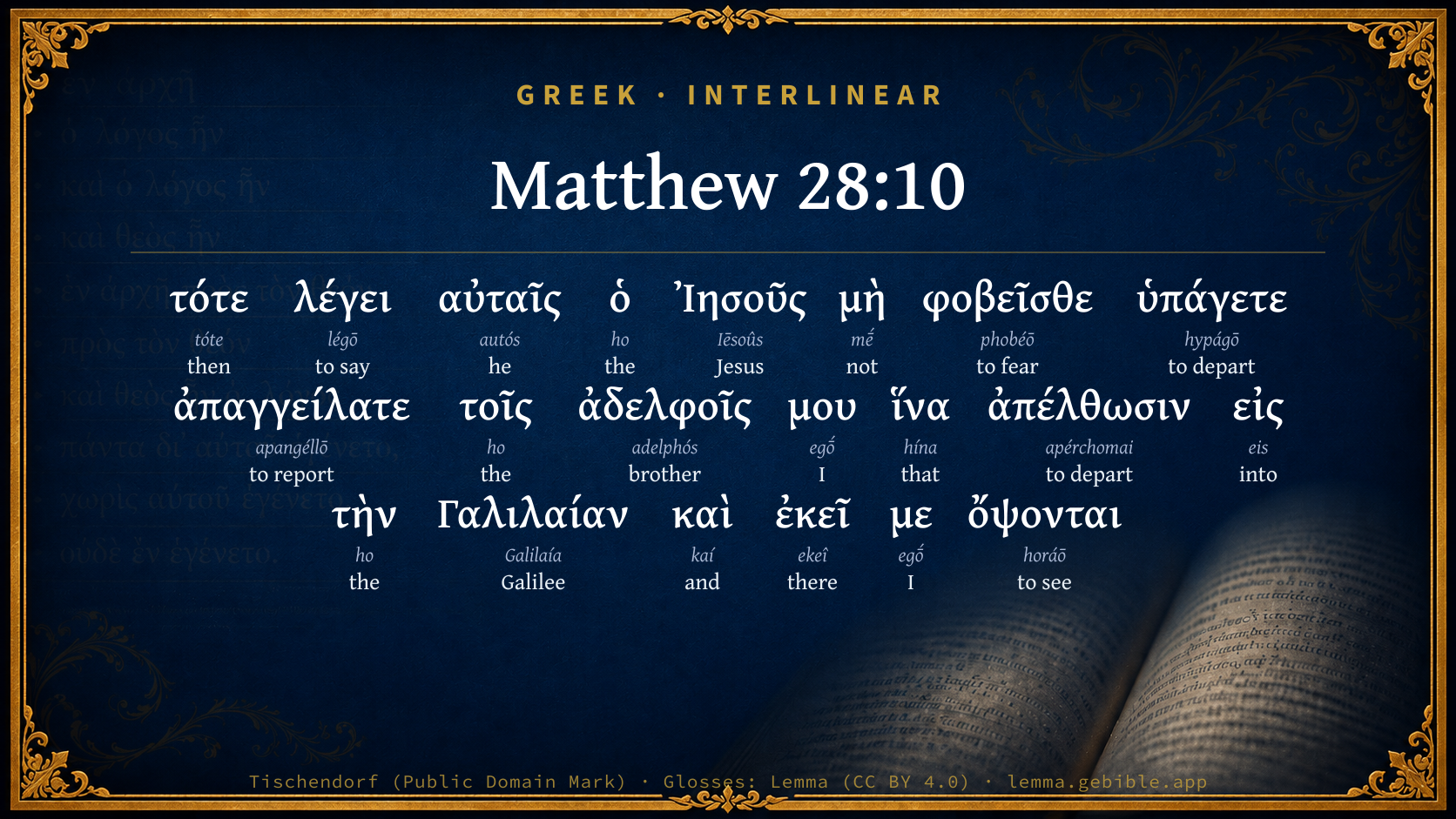
Greek (Tischendorf 8th ed.) Matthew 28:10 appears in the Greek New Testament. The text above is from the Tischendorf 8th edition. Each word links to its Strong’s number and a concise gloss. Click any word for its full Thayer’s Greek Lexicon entry.
Download image
Cite this verse

Matthew 28:10 (World English Bible). Public Domain. Lemma interlinear Bible study tool, https://lemma.gebible.app/v/matthew/28/10.

Show BibTeX & RIS
BibTeX
RIS
English Translation
Then Jesus said to them, "Don't be afraid. Go tell my brothers that they should go into Galilee, and there they will see me."
World English Bible · Public Domain
Download a study sheet

One document with this verse’s original text, its word-by-word gloss line, the meaning frame, cross-references with their text, attributed commentary, and full source and license credits — printable, and it pastes into notes with its structure intact.

This verse Autodidact and up

Study sheet (.html) Plain text (.txt)

A passage Seminary Student

Up to 50 verses in one chapter. A passage sheet keeps up to 6 commentary sources and 12 cross-references per verse, in the order this page ranks them, and says so on the sheet whenever that leaves anything out. Ask for a single verse and you get the Autodidact verse sheet above.

Everything on this page stays free to read, with no account — the sheet is a download of what is already on screen, not access to it.

Want to remove ads? Support Godless Engineer
Compare translations 3

The same verse in 3 English versions, stacked beneath the original-language interlinear above. Click any original word for its lexicon entry.

Each is an independent rendering of the whole verse — the interlinear is not word-aligned to these translations.

Highlighted words mark where these versions differ — a whole-verse word diff, not a word-by-word alignment.

  • World English Bible Public Domain
    Then Jesus said to them, "Don't be afraid. Go tell my brothers that they should go into Galilee, and there they will see me."
  • King James Version Public Domain
    Then said Jesus unto them, Be not afraid: go tell my brethren that they go into Galilee, and there shall they see me.
  • unfoldingWord Literal Text CC BY-SA 4.0
    Then Jesus says to them, “Do not be afraid. Go, report to my brothers so that they might go away to Galilee, and there they will see me.”

unfoldingWord Literal Text — © unfoldingWord, licensed CC BY-SA 4.0. Word-aligned USFM3 via Door43 (git.door43.org/unfoldingWord/en_ult).

Versions to compare (up to 4)

3 of 4 selected

Show all 19 translations

Every available English version of this verse, each an independent rendering of the whole verse.

  • World English Bible Public Domain
    Then Jesus said to them, "Don't be afraid. Go tell my brothers that they should go into Galilee, and there they will see me."
  • Berean Standard Bible Public Domain
    “Do not be afraid,” said Jesus. “Go and tell My brothers to go to Galilee. There they will see Me.”
  • Majority Standard Bible Public Domain
    “Do not be afraid,” said Jesus. “Go and tell My brothers to go to Galilee. There they will see Me.”
  • King James Version Public Domain
    Then said Jesus unto them, Be not afraid: go tell my brethren that they go into Galilee, and there shall they see me.
  • American Standard Version (1901) Public Domain
    Then saith Jesus unto them, Fear not: go tell my brethren that they depart into Galilee, and there shall they see me.
  • Revised Version (1885) Public Domain
    Then saith Jesus unto them, Fear not: go tell my brethren that they depart into Galilee, and there shall they see me.
  • Geneva Bible (1599) Public Domain
    Then said Iesus vnto them, Be not afraide. Goe, and tell my brethren, that they goe into Galile, and there shall they see me.
  • Douay-Rheims (1899) Public Domain
    Then Jesus said to them: Fear not. Go, tell my brethren that they go into Galilee, there they shall see me.
  • Young's Literal Translation Public Domain
    Then saith Jesus to them, `Fear ye not, go away, tell to my brethren that they may go away to Galilee, and there they shall see me.'
  • Literal Standard Version CC BY-SA 4.0
    Then Jesus says to them, “Do not fear, go away, tell My brothers that they may go away to Galilee, and there they will see Me.”
  • Unlocked Literal Bible CC BY-SA 4.0
    Then Jesus said to them, “Do not be afraid. Go tell my brothers to leave for Galilee. There they will see me.”
  • unfoldingWord Literal Text CC BY-SA 4.0
    Then Jesus says to them, “Do not be afraid. Go, report to my brothers so that they might go away to Galilee, and there they will see me.”
  • Darby Bible Public Domain
    Then Jesus says to them, Fear not; go, bring word to my brethren that they go into Galilee, and there they shall see me.
  • World Messianic Bible Public Domain
    Then Yeshua said to them, “Don’t be afraid. Go tell my brothers that they should go into Galilee, and there they will see me.”
  • Webster's Bible Public Domain
    Then said Jesus to them, Be not afraid: go tell my brethren, that they go into Galilee, and there shall they see me.
  • Free Bible Version CC BY-SA 4.0
    Then Jesus said to them, “Don't be afraid! Go and tell my brothers to leave for Galilee, and they will see me there.”
  • Bible in Basic English Public Domain
    Then said Jesus to them, Have no fear: go and give word to my brothers to go into Galilee, and there they will see me.
  • Text-Critical English NT CC BY 4.0
    Then Jesus said to them, “Do not be afraid; go tell my brothers to go to Galilee, and there they will see me.”
  • Tyndale New Testament (1534) Public Domain
    Then sayde Iesus vnto them: be not afrayde. Go and tell my brethren that they goo in to Galile and there shall they se me.

Literal Standard Version (2020), Covenant Press — licensed CC BY-SA 4.0. Text via the HelloAO Bible API (eBible.org). Unlocked Literal Bible (unfoldingWord) — licensed CC BY-SA 4.0. Text via the HelloAO Bible API (eBible.org). unfoldingWord Literal Text — © unfoldingWord, licensed CC BY-SA 4.0. Word-aligned USFM3 via Door43 (git.door43.org/unfoldingWord/en_ult). Free Bible Version, Dr. Jonathan Gallagher — licensed CC BY-SA 4.0. Text via the HelloAO Bible API (eBible.org).

Word by word

More ways to search: Search by grammar → Find every occurrence → Compare this word →

Practice this passage: Drill this verse → Learn its vocabulary →

ἀπαγγείλατε
apangéllō
G518
“to report”
Verb, Aorist, Active, Imperative, 2nd person, Plural
Part of Speech
Verb
Tense
Aorist
Voice
Active
Mood
Imperative
Person
2nd person
Number
Plural
Full Thayer's Definition

Origin: from G575 and the base of G32

TDNT: 02:04,1

1. to bring tidings (from a person or a thing), bring word, report 2. to proclaim, to make known openly, declare
  1. τότε tóte G5119 “then” Adverb
  2. λέγει légō G3004 “to say” Verb, Present, Active, Indicative, 3rd person, Singular
  3. αὐταῖς autós G846 “he” Personal pronoun, Dative, Plural, Feminine
  4. ὁ ho G3588 “the” Article, Nominative, Singular, Masculine
  5. Ἰησοῦς Iēsoûs G2424 “Jesus” Noun, Nominative, Singular, Masculine
  6. μὴ mḗ G3361 “not” Particle, Negative
  7. φοβεῖσθε phobéō G5399 “to fear” Verb, Present, Middle or Passive deponent, Imperative, 2nd person, Plural
  8. ὑπάγετε hypágō G5217 “to depart” Verb, Present, Active, Imperative, 2nd person, Plural
  9. τοῖς ho G3588 “the” Article, Dative, Plural, Masculine
  10. ἀδελφοῖς adelphós G80 “brother” Noun, Dative, Plural, Masculine
  11. μου egṓ G1473 “I” Personal pronoun, 1st person, Genitive, Singular
  12. ἵνα hína G2443 “that” Conjunction
  13. ἀπέλθωσιν apérchomai G565 “to depart” Verb, Aorist, Active, Subjunctive, 3rd person, Plural
  14. εἰς eis G1519 “into” Preposition
  15. τὴν ho G3588 “the” Article, Accusative, Singular, Feminine
  16. Γαλιλαίαν Galilaía G1056 “Galilee” Noun, Accusative, Singular, Feminine
  17. καὶ kaí G2532 “and” Conjunction
  18. ἐκεῖ ekeî G1563 “there” Adverb
  19. με egṓ G1473 “I” Personal pronoun, 1st person, Accusative, Singular
  20. ὄψονται horáō G3708 “to see” Verb, Future, Middle deponent, Indicative, 3rd person, Plural

About this verse

These counts appear in no published source. They are computed here, from the morphology-tagged text and Lemma’s own curated glosses. What Lemma adds →

21
words
18
distinct lemmas
Gospels
section

Shared distinctive vocabulary

ἀπαγγείλατε to report G518 occurs in 47 verses of the Greek New Testament. Also found in:
Repetition

Words recur within this verse:

Cross-references

15

Topical passages linked to Matthew 28:10 in the Treasury of Scripture Knowledge — connected by theme and wording, ordered by reader-vote popularity; previews shown in the World English Bible.

  • Romans 8:29 For whom he foreknew, he also predestined to be conformed to the image of his Son, that he might be the firstborn among many brothers.
  • Matthew 28:7 Go quickly and tell his disciples, 'He has risen from the dead, and behold, he goes before you into Galilee; there you will see him.' Behold, I have told you."
  • John 20:17 Jesus said to her, "Don't touch me, for I haven't yet ascended to my Father; but go to my brothers, and tell them, 'I am ascending to my Father and your Father, to my God and your God.'"
  • Matthew 14:27 But immediately Jesus spoke to them, saying "Cheer up! I AM! Don't be afraid."
  • Matthew 28:5 The angel answered the women, "Don't be afraid, for I know that you seek Jesus, who has been crucified.
  • Mark 16:7 But go, tell his disciples and Peter, 'He goes before you into Galilee. There you will see him, as he said to you.'"
  • Matthew 12:48–50 But he answered him who spoke to him, "Who is my mother? Who are my brothers?"
  • Matthew 25:40 "The King will answer them, 'Most assuredly I tell you, inasmuch as you did it to one of the least of these my brothers, you did it to me.'
  • Matthew 25:45 "Then he will answer them, saying, 'Most assuredly I tell you, inasmuch as you didn't do it to one of the least of these, you didn't do it to me.'
  • Mark 3:33–35 He answered them, "Who are my mother and my brothers?"
  • Luke 24:36–38 As they said these things, Jesus himself stood among them, and said to them, "Peace be to you."
  • John 6:20 But he said to them, "I AM. Don't be afraid."
  • Judges 10:16 They put away the foreign gods from among them, and served Yahweh; and his soul was grieved for the misery of Israel.
  • Psalms 103:8–13 Yahweh is merciful and gracious, Slow to anger, and abundant in loving kindness.
  • Hebrews 2:11–18 For both he who sanctifies and those who are sanctified are all from one, for which cause he is not ashamed to call them brothers,

Cross-references courtesy of OpenBible.info (CC BY 4.0).

Commentary

Notes on Matthew 28:10 from classic Christian and Jewish commentators (each source and its license shown beneath its notes). The classic Christian expositions comment on the surrounding passage and are grouped to its opening verse, so a note may address several verses; the Jewish commentaries on the Tanakh (Rashi and others) are per-verse, so they appear only where the commentator wrote on this verse.

Lemma curates 59 commentaries, every one of them public domain or Creative Commons licensed, each selected and text-cleaned for this edition rather than reprinted as found. About our sources →

Bengel's Gnomon

Johann Albrecht Bengel

Mat 28:10. Τοῖς ἀδελφοῖς Μου, to My brethren) See Gnomon on Joh 20:17.

Bengel's Gnomon of the New Testament — English translation (T&T Clark, Edinburgh, 1860) — public domain. Text from a community e-Sword module.

Meyer's Critical & Exegetical Commentary

Heinrich August Wilhelm Meyer

Mat_28:10. Μὴ φοβεῖσθε· ὑπάγετε, ἀπαγγ.] Asyndeton, the matter being pressing, urgent.

τοῖς ἀδελφοῖς μου] He thus designates His disciples (comp. on Joh_20:17; Justin, c. Tr. 106), not πρὸς τιμὴν αὐτῶν (Euthymius Zigabenus), for which there was no occasion, but in view of that conception of Him as a superhuman being which had so profoundly impressed the women prostrate at His feet.

ἵνα] does not state the purport of the order involved in ἀπαγγ. (de Wette; there is nothing whatever of the nature of an order about ἀπαγ.), but the idea is: take word to my brethren (namely, about my resurrection, about your having seen me, about my having spoken to you, and what I said), in order that (as soon as they receive these tidings from you) they may proceed to Galilee, Mat_26:32.

κἀκεῖ με ὄψονται] is not to be regarded as dependent on ἵνα, but: and there they shall see me. This repetition of the directions about going to Galilee (Mat_28:7), to which latter our evangelist gives considerable prominence as the scene of the new reunion (Mat_28:16 ff.), cannot be characterized as superfluous (de Wette, Bruno Bauer), or even as poor and meaningless (Keim), betraying the hand of a later editor, but is intended to be express and emphatic; comp. Steinmeyer. With the exception of John 21, the other canonical Gospels, in which, however, we cannot include the spurious conclusion of Mark, make no mention of any appearance of the risen Lord in Galilee; according to John 20, Jesus remained at least eight days in Jerusalem, as did also His disciples, to whom He there manifested Himself on two occasions, though it would appear from John 21 that the third manifestation took place in Galilee, while Luke, on the other hand (Mat_24:49; Act_1:4; Act_13:31), excludes Galilee altogether, just as Matthew excludes Judaea. To harmonize these divergent accounts is impossible (Strauss, II. p. 558 ff.; Holtzmann, p. 500 f.; Keim); and, with regard to the account of Matthew in particular, it may be observed that it is so far from assuming the manifestations to the disciples in Judaea as having previously occurred (in opposition to Augustine, Olshausen, Krabbe, Ebrard, Lange), that it clearly intends the meeting with the eleven, Mat_28:16 ff., as the first appearance to those latter, and as the one that had been promised by the angel, Mat_28:7, and by Jesus Himself, Mat_28:10. From those divergent accounts, however, it may be fairly inferred that the tradition regarding the appearances of the risen Lord to His disciples assumed a threefold shape: (1) the purely Galilaean, which is that adopted by Matthew; (2) the purely Judaean, which is that of Luke, and also of John with the supplementary ch. 21 left out; (3) the combined form in which the appearances both in Galilee and Judaea are embraced, which is that of John with the supplementary chapter in question included. That Jesus appeared to the disciples both in Jerusalem and in Galilee as well might be already deduced as a legitimate historical inference from the fact of a distinct Judaean and Galilaean tradition having been current; but the matter is placed beyond a doubt by John, if, as we are entitled to assume, the apostle is to be regarded as the author of ch. 21. The next step, of course, is to regard it as an ascertained historical fact that the appearances in Judaea preceded those in Galilee; though, at the same time, it should not be forgotten that Matthews account is not merely vague and concise (Bleek), but that it, in fact, ignores the appearances in Judaea altogether,[40] entirely excludes them as being unsuited to the connection; comp. Schleiermacher, L. J. p. 465 f. Now, as this is inconceivable in the case of Matthew the apostle, we are bound to infer from our narrative that this is another of those passages in our Gospel which show traces of other than apostolic authorship. See Introd. § 2.

[40] Rud. Hofmann (de Berg Galiläa, 1856), following certain early expositors, has attempted to explain the discrepancies between the various narratives by maintaining that ἡ Γαλιλαία, Matthew 28, is not the country, but a mountain of this name, namely, the northmost of the three peaks of the Mount of Olives. But nowhere in the New Testament do we find such a designation applied to any locality but the well-known province of that name; nor, if we interpret fairly the passages quoted by Hofmann from Tertullian (Apol. 21), Lactantius (iv. 19), and Chrysostom, are we able to find in them any allusion to a mountain called Galilee; and surely it is not to be presumed that anything of a trustworthy nature can be learnt as to the existence of such a mountain from the confusions of a certain corrupt part of the text in the Evang, Nicod. 14; see already, Thilo, ad Cod, Apocr. I. p. 620 f.

REMARK.

It is evident from 1Co_15:5 ff. that, even taking the narratives of all the evangelists together, we would have but an imperfect enumeration of the appearances of Jesus subsequent to His resurrection, Matthews account being the most deficient of any. With regard to the appearances themselves, modern criticism, discarding the idea that the death was only apparent (see on Mat_27:50), has treated them partly as subjective creations, either of the intellect (Strauss, Scholten), in its efforts to reconcile the Messianic prophecies and the belief in the Messiah with the fact of His death, or of ecstatic vision (Baur, Strauss, 1864; Holsten, Ewald), and therefore as mere mental phenomena which came to be embodied in certain objective incidents. There are those again who, attributing the appearances in question to some objective influence emanating from Christ Himself, have felt constrained to regard them as real manifestations of His person in the glorified form (Schenkel) in which it emerged from out of death (not from the grave),a view in which Weisse, Keim, Schweizer substantially concur, inasmuch as Keim, in particular, lays stress on the necessity of such a telegram from heaven after the extinction of Christs earthly nature, though he considers the question as to whether our Lord also communicated the form of the vision directly or only indirectly, as of but secondary consequence. But all these attempts to treat what has been recorded as an actual fact as though it were based merely on mental phenomena are in opposition in general to the explicit and unhesitating view of all the evangelists and apostles as well as in particular to the uniform reference to the empty grave, and no less uniform use of the expression third day, all classical testimonies which can never be silenced. If, in addition to all this, it be borne in mind that the apostles found in the resurrection of their Lord a living and unfailing source of courage and hope, and of that cheerfulness with which they bore suffering and death,that the apostolic church generally saw in it the foundation on which its own existence was based,that Paul, in particular, insists upon it as incontrovertible evidence for, and as an ἀπαρχή of the resurrection of the body (1Co_15:23; Rom_8:11), and as constituting an essential factor in mans justification (Rom_4:25; Php_3:10), though he is fond of speaking of being buried and raised up with Christ as descriptive of what is essential to the moral standing of the Christian (Rom_6:4; Col_2:12), and can only conceive of the glorified body of the Lord, to which those of believers will one day be conformed (Php_3:21), as no other than that which came forth from the grave and was taken up to heaven,if, we say, this be borne in mind, not the shadow of an exegetical pretext will be left for construing the resurrection from the grave of one whose body was exempted from corruption (Act_2:31; Act_10:41) into something or other which might be more appropriately described as a resurrection from the cross, and which would therefore require us to suppose that all the apostles and the whole church from the very beginning had been the victims of a delusion. See, in answer to Keim, Schmidt in the Jahrb. f. D. Theol. 1872, p. 413 ff. If this view of the resurrection were adopted, then, in opposition once more to New Testament authority, we should have to identify it with the ascension (comp. on Luk_24:51, Remark); while, on the other hand, it would be necessary to give up the Descensus Christi ad inferos as a second error arising out of that which has just been referred to.

Meyer — Critical and Exegetical Commentary on the New Testament — English translation by Peter Christie, edited by Frederick Crombie (T&T Clark, 1880) — public domain. Text from a community e-Sword module.

Expositor's Greek Testament

ed. W. Robertson Nicoll

Mat 28:10 . μὴ φοβεῖσθε : kindly in word and tone, meant to remove the embarrassment visible in their manner. ὑπάγετε ἀπαγγείλατε , another asyndeton as in Mat 27:65 . The instructions to the women simply repeat, in much the same words, those given by the angel (Mat 28:7 ), with the exception that the disciples are spoken of by the kindly name of “brethren”.

The similarity of Mat 28:9-10 to Joh 20:14-18 has been remarked on ( vide Weiss, Meyer, on Mat 28:9 ). It has been lately commented on in connection with the theory of a “four-gospel Canon” prepared by the Presbyters of Asia Minor in the beginning of the second century. Vide Der Schlnss des Marcus-Evangeliums der Vier-Evangelien-Kanon und die Kleinasiatischen Presbyter , by Dr. Paul Rohrbach. Rohrbach’s idea is that when this Canon was prepared the editors altered more or less the statements of the Synoptists as to the visions of the Risen Christ so as to bring them somewhat into harmony with those of the fourth Gospel. For this purpose Mark’s original ending was cancelled and the present one, Mat 28:9-20 , put in its place. The editorial procedure in the case of Matthew consisted in inserting Mat 28:9-10 in the narrative, thus providing for at least one vision in Jerusalem, and making room for more, and so cancelling the impression otherwise produced that Jesus was seen only in Galilee. In support of the view that Mat 28:9-10 are an editorial addition at a later date Rohrbach adduces the fact that the narrative has an appearance of continuity when they are omitted, and also that the instructions of Jesus to the women are a mere echo of those given by the angel.

The Expositor's Greek Testament, edited by W. Robertson Nicoll (1897–1910) — public domain. Text from a community e-Sword module.

Jamieson, Fausset & Brown

Robert Jamieson, A. R. Fausset & David Brown

Then said Jesus unto them, Be not afraid--What dear associations would these familiar words--now uttered in a higher style, but by the same Lips--bring rushing back to their recollection!

go tell my brethren that they go into Galilee, and there shall they see me--The brethren here meant must have been His brethren after the flesh (compare Mat 13:55); for His brethren in the higher sense (see on Joh 20:17) had several meetings with Him at Jerusalem before He went to Galilee, which they would have missed if they had been the persons ordered to Galilee to meet Him.

The Guards Bribed (Mat 28:11-15).

The whole of this important portion is peculiar to Matthew.

Jamieson, Fausset & Brown — Commentary Critical and Explanatory on the Whole Bible (1871) — public domain (CC PDM 1.0). Text via the HelloAO Bible API.

Adam Clarke's Commentary

Verse 10. Be not afraid] They were seized with fear at the sight of the angel; and this was now renewed by this unexpected appearance of Christ. See Clarke on Mt 28:8.

Go, tell my brethren] This is the first time our Lord called his disciples by this endearing name: they no doubt thought that their Lord would reproach them with their past cowardice and infidelity; but, in speaking thus, he gives them a full assurance, in the most tender terms, that all that was passed was as buried for ever.

Adam Clarke's Commentary on the Bible (1810–1826) — public domain. Text from a community e-Sword/MySword module.

Ellicott's Commentary for English Readers

(10) Go, tell my brethren.—The words are clearly used of those who were brethren by spiritual relationship, as in Mat_12:49, and have their counterpart in Joh_20:17, “I ascend to My Father and your Father.”

A Bible Commentary for English Readers, edited by Charles John Ellicott (1878–1897) — public domain. Text from a community e-Sword module.

The Cambridge Bible for Schools and Colleges

gen. ed. J. J. S. Perowne

10. go tell my brethren that they go] i. e. tell my brethren (of my Resurrection), in order that they may go.

my brethren] The disciples; “He named them brethren, as being Himself a man and their kinsman according to man’s nature” (Euthymius quoted by Ellicott, Life of our Lord); comp. Heb_2:11, “He is not ashamed to call them brethren.” Now that Christ had clearly manifested the power of the Godhead, there was special need of reminding His disciples that He was still man, and that they were brethren.

The Cambridge Bible for Schools and Colleges (gen. ed. J. J. S. Perowne; Cambridge University Press, 1878–1918) — public domain. Text from a community e-Sword module.

John Gill's Exposition

Then said Jesus unto them, be not afraid,.... Of me, or what you have seen; or lest there should be any deception in the case. In other respects the saints are subject to fears; as lest they should have no share in the love of God, nor interest in Christ, or the work of God is not begun in their hearts; and by reason of sin, lest that should get the ascendant over them, and they perish by it, and so fall short of eternal glory; when it is the will of Christ to have these fears removed, by shedding abroad his love in their hearts, by affording his gracious presence, views of interest in him, and promises of his grace, by sending his Spirit, word, and ministers to comfort them, by discovering and applying pardoning grace to them, and showing his power to keep them.

Go tell my brethren; meaning not his kinsmen according to the flesh, but his disciples, who were in this relation to him, as all the elect of God are; not only through his incarnation, he being their "Goel", their near kinsman, and Redeemer, and of the same nature, flesh, and blood with them, and like unto them in all things, excepting sin; but on account of their divine adoption, to which they were predestinated, and which they received through his redemption, and under the witnessings of the Spirit: he that is his God being theirs; and he that is his Father being theirs also: and which was made manifest in their regeneration, by their faith in him; and obedience to him, and his Father; see Mat 12:49. A very considerable relation this is, that the disciples stood in to Christ, who is the eternal Son of God, and heir of all things; and wonderful grace and condescension it was in Christ to own the relation, when they had so lately forsaken him; and now he was raised from the dead, and had glory given him:

that they go into Galilee, and there shall they see me: he does not say they should not see him before: for they saw him, all but Thomas, that very evening, and all of them eight days after; and both times were before they went into Galilee: but this he said, to put them in mind of what he had promised them, Mat 26:32, and to confirm the words of the angel; and which might serve for a confirmation of the truth of these things, both to the women, and to the disciples, when they observed the exact agreement between the words of Christ, and of the angel. Moreover, it may be remarked, that wherever Christ has appointed to meet his people, they may expect, and be sure to see him at one time or another; as in his house and ordinances, where they are sometimes indulged with a sight of him by faith, which is an appropriating, assimilating, soul rejoicing, and satisfying one; when with pleasure they behold the glory of his divine person, and of his offices, the transcendent excellencies and perfections of his nature, his love and his loveliness, the beauty and amiableness of him, the fulness of grace, life, and righteousness in him, and so the suitableness of him as their Saviour and Redeemer; and when they are favoured with communion with him, and the joys of his salvation.

John Gill's Exposition of the Whole Bible (1746–1763) — public domain (CC PDM 1.0). Text via the HelloAO Bible API.

Trapp's Complete Commentary

John Trapp

10 Then said Jesus unto them, Be not afraid: go tell my brethren that they go into Galilee, and there shall they see me.

Ver. 10. Go tell my brethren] Brethren still, though foully fallen, Jer 3:1. Infirmities discard us not, if bewailed, disclaimed, set against.

John Trapp, A Commentary or Exposition upon All the Books of the Old and New Testament (1647–1656) — public domain. Text from a community e-Sword module.

Albert Barnes' Notes on the Bible

Be not afraid - The ancients, when in the presence of a heavenly being - an angel, or one who was supposed to be possessed of divine power were commonly struck with great “fear,” as well as a great sense of their unworthiness. See Luk 5:8; Jdg 6:22-23; Jdg 13:21-22. These women were in like manner alarmed when they saw Jesus, believing him now especially to be a Divine Being; seeing him returning from the regions of the dead, and doubtless impressed with a new consciousness that they were unworthy of being in his presence. Jesus comforted them. He was the “same Jesus” with whom they had been before his death, and they had no reason now to fear him.

Go tell my brethren - There is something exceedingly tender in the appellation used here - “my brethren.” Though he was risen from the dead, though about to be exalted to heaven, yet he did not disdain to call his disciples his brethren. This was calculated still further to silence the fears of the women and to inspire them with confidence.

Into Galilee - Galilee was the northern part of the land. There the Saviour commenced his ministry; and there, away from the noise and confusion of the city, he purposed again to meet them, in retirement and quietness, to satisfy them of his resurrection, and to commission them to go forth and preach the everlasting gospel.

Albert Barnes' Notes on the Bible (1834–1885) — public domain. Text from a community e-Sword/MySword module.

Haydock's Catholic Bible Commentary

There they shall see me. Our Saviour, on the day of this resurrection, shewed himself alive five different times: 1. to Mary Magdalene; 2. to the women leaving the sepulchre; 3. to St. Peter; 4. to the two disciples going to Emmaus; 5. to the disciples assembled together, when the two returned from Emmaus. And after the day of his resurrection, before he ascended into heaven, he appeared other five times: 1. after eight days, when Thomas was present; 2. when the seven disciples were fishing on the sea of Tiberias; (St. John chap. xxi.) 3. to the eleven on Mount Thabor; 4. in Jerusalem, on the day of his ascension; and 5. on the same day on Mount Olivet, when he was taken form them. (Denis the Carthusian) --- The seventh apparition of Jesus, which was by the sea or lake of Tiberias, St. John calls the third, which may mean in any numerous assembly of his disciples; the first being on the day of his resurrection, and the second the Sunday following. This may also be referred to the number of days. He first appeared to different persons on the very day of his resurrection; secondly, eight days afterwards, and then a third time. (St. Augustine) --- The history of our Lord’s different apparitions in not very clear, and it is necessary to have recourse to the first chapter of the Acts, and to the 15th chapter of St. Paul’s first epistle to the Corinthians. St. Augustine says, (lib. ii. de cons. Evang. chap. xxv,) that there are ten apparitions of our Lord recorded in the four evangelists, which he specifies; but Maldonatus, on the 28th chap. of St. Matthew enumerates 13 different apparitions.

George Leo Haydock (1774–1849), Haydock's Catholic Family Bible and Commentary, 1859 edition — public domain. Excludes Psalms (Douay-Rheims chapter numbering differs from Protestant) and Deuterocanonical books (Catholic canon only).

The Pulpit Commentary

Be not afraid. So he spake on other occasions when his acts had caused terror and amazement. (comp. Mat_14:27 Mat_17:7) With all their joy and love, the women could not help feeling fear at his sudden appearance and at the nearness of this unearthly yet familiar form. Go, tell my brethren. He here for the first time calls his disciples his brethren, intending thereby to assure them of his love and good will in spite of their cowardly desertion, and to signify that he was in very truth the Man Christ Jesus, their Lord and their Master, whom they had known so long and so well. He had called them friends before his Passion; (Joh_15:14, Joh_15:15) now he gives them a tenderer title; he is not ashamed to call them brethren. (Heb_2:11) That they go (ina apelywsin , in order that they may depart) into Galilee. The message is the same as that given by the angel (ver. 7). It was meant to comfort them in the absence of daily intercourse with him. But they were not to set out immediately; some other incidents were first to befall them. And there shall they see me. Galilee was to be the scene of the most important revelation, though the Lord vouchsafed to individuals many proofs of his risen life before the promised great announcement. Why St. Matthew mentions none of these we may form conjectures, but we cannot determine (see on ver. 16).

The Pulpit Commentary (1880–1919), ed. H.D.M. Spence-Jones & Joseph S. Exell — public domain. Text from a community e-Sword module.

John Wesley's Explanatory Notes

Go tell my brethren -- I still own them as such, though they so lately disowned and forsook me.

John Wesley, Explanatory Notes Upon the Whole Bible (1754–1765) — public domain. Text via the GEBible commentary corpus.

The People's New Testament

B. W. Johnson

10. Be not afraid. They had met the Lord while hastening to tell the story of his resurrection. It is when we are in the path of duty that we will enjoy his presence and his blessing. Go tell my brethren. This is the first time he had called the disciples his brethren.

B. W. Johnson's The People's New Testament with Notes (1889–1891) — public domain. Electronic text from the Christian Classics Ethereal Library (CCEL) ThML edition.

Cambridge Greek Testament for Schools and Colleges

10. ἀπαγγείλατε κ.τ.λ. i.e. tell my brethren (of my Resurrection), in order that they may go.

ἀδελφοῖς μου. The disciples; ‘He named them brethren, as being Himself a man and their kinsman according to man’s nature’ (Euthymius quoted by Ellicott, Life of our Lord); comp. Heb 2:11, ὃ τε γὰρ ἁγιάζων καὶ οἱ ἁγιαζόμενοι ἐξ ἑνὸς πάντες· διʼ ἥν αἰτίαν οὐκ ἐπαισχύνεται ἀδελφοὺς αὐτοὺς καλεῖν. The name of ‘brethren’ is not directly applied by Christ to his disciples, until after the Resurrection (cp. Joh 20:17). He had clearly manifested the power of the Godhead, and there was special need of reminding his disciples that He was still man, and that they were brethren.

Cambridge Greek Testament for Schools and Colleges (Cambridge University Press, 1896; 21 vols, various authors incl. Carr, Maclear, Plummer, Farrar, Lumby, Moule, M. R. James, Simcox) — public domain. Text from a community e-Sword module.

Alford’s Greek Testament

Henry Alford

10. τοῖς ἀδελφ.] so also to Mary Magdalene, Joh 20:17. The repetition of this injunction by the Lord has been thought to indicate that this is a portion of another narrative inwoven here, and may possibly belong to the same incident as that in ver. 7. But all probability is against this: the passages are distinctly consecutive, and moreover both are in the well-known style of Matthew (e.g. καὶ ἰδού in both). There is perhaps more probability that this may be the same appearance as that in Joh 20:11-18, on account of μή μου ἅπτου there and τοὺς ἀδελφ. μου,—but in our present imperfect state of information, this must remain a mere probability.

Henry Alford, The Greek Testament (1849–1861) — public domain. Text from a community e-Sword module.

International Critical Commentary

10. Then saith Jesus to them, Fear not: go tell My brethren, that they go into Galilee, and there they shall see Me.]—τότε] See on 2:7.—τοῖς ἀδελφοῖς μου] Is this to be understood as referring to Christ’s brethren in the literal sense, or to His spiritual brethren, “the disciples” of v. 7? Cf. 12:49.

International Critical Commentary — older volumes (1896–1929), various authors — public domain. Text from a community e-Sword module.

Lesson kit

Teaching starters — assembled from the data on this page, not authored interpretation. Every prompt links to the verse data it draws on. Edit before teaching.

Matthew, in the Gospels, opens this verse with 21 words (18 distinct Greek lemmas). Its most distinctive word is apangéllō (“to report”). A historical commentator’s framing appears above. Read the whole chapter for the surrounding context.

Discussion questions

  1. How does “to report” (apangéllō) shape what this verse is saying?
  2. How does Matthew 2:8, which shares the word «to report», read alongside this verse?
  3. What does the repetition of “the” (3× in this one verse) do in this verse?
  4. These translations render this verse differently. What is at stake in choosing one wording over another?
  5. Compare how Bengel's Gnomon and Meyer's Critical & Exegetical Commentary read this verse. Where do they agree or differ?

Things to notice

Reading settings

Reading text

Shown beneath each verse's original-language words.

Old Testament
Old Testament edition

Read the OT as the Masoretic Hebrew (MT) or the Greek Septuagint (LXX).

English shown for the Greek Septuagint (in the Hebrew ↔ Greek comparison).

Comparing translations? Open the Compare panel on any verse page to stack up to four side by side.