

Luke 1:20
Greek (Tischendorf 8th ed.) Luke 1:20 appears in the Greek New Testament. The text above is from the Tischendorf 8th edition. Each word links to its Strong’s number and a concise gloss. Click any word for its full Thayer’s Greek Lexicon entry.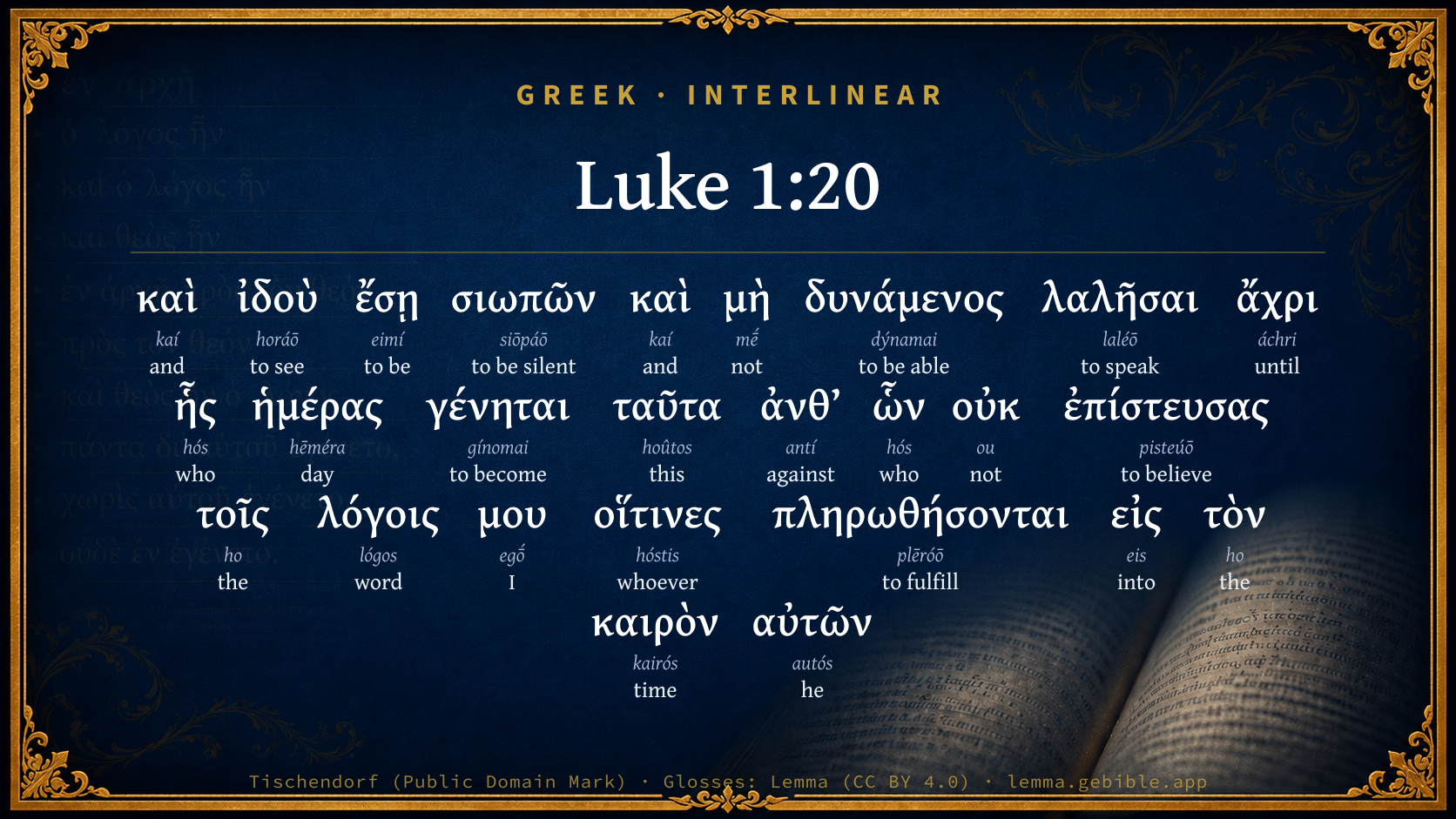
Behold, you will be silent and not able to speak, until the day that these things will happen, because you didn't believe my words, which will be fulfilled in their proper time."
Download a study sheet
One document with this verse’s original text, its word-by-word gloss line, the meaning frame, cross-references with their text, attributed commentary, and full source and license credits — printable, and it pastes into notes with its structure intact.
This verse Autodidact and up
A passage Seminary Student
Up to 50 verses in one chapter. A passage sheet keeps up to 6 commentary sources and 12 cross-references per verse, in the order this page ranks them, and says so on the sheet whenever that leaves anything out. Ask for a single verse and you get the Autodidact verse sheet above.
Everything on this page stays free to read, with no account — the sheet is a download of what is already on screen, not access to it.
Compare translations 3
The same verse in 3 English versions, stacked beneath the original-language interlinear above. Click any original word for its lexicon entry.
Each is an independent rendering of the whole verse — the interlinear is not word-aligned to these translations.
Highlighted words mark where these versions differ — a whole-verse word diff, not a word-by-word alignment.
-
World English Bible Public Domain
Behold, you will be silent and not able to speak, until the day that these things will happen, because you didn't believe my words, which will be fulfilled in their proper time."
-
King James Version Public Domain
And, behold, thou shalt be dumb, and not able to speak, until the day that these things shall be performed, because thou believest not my words, which shall be fulfilled in their season.
-
unfoldingWord Literal Text CC BY-SA 4.0
And behold, you will be silent and not able to speak until that day when these things take place, because you did not believe my words, which will be fulfilled in their time.”
unfoldingWord Literal Text — © unfoldingWord, licensed CC BY-SA 4.0. Word-aligned USFM3 via Door43 (git.door43.org/unfoldingWord/en_ult).
Show all 19 translations
Every available English version of this verse, each an independent rendering of the whole verse.
-
World English Bible Public Domain
Behold, you will be silent and not able to speak, until the day that these things will happen, because you didn't believe my words, which will be fulfilled in their proper time."
-
Berean Standard Bible Public Domain
And now you will be silent and unable to speak until the day this comes to pass, because you did not believe my words, which will be fulfilled at their proper time.”
-
Majority Standard Bible Public Domain
And now you will be silent and unable to speak until the day this comes to pass, because you did not believe my words, which will be fulfilled at their proper time.”
-
King James Version Public Domain
And, behold, thou shalt be dumb, and not able to speak, until the day that these things shall be performed, because thou believest not my words, which shall be fulfilled in their season.
-
American Standard Version (1901) Public Domain
And behold, thou shalt be silent and not able to speak, until the day that these things shall come to pass, because thou believedst not my words, which shall be fulfilled in their season.
-
Revised Version (1885) Public Domain
And behold, thou shalt be silent and not able to speak, until the day that these things shall come to pass, because thou believedst not my words, which shall be fulfilled in their season.
-
Geneva Bible (1599) Public Domain
And beholde, thou shalt be domme, and not be able to speake, vntill the day that these things be done, because thou beleeuedst not my words, which shalbe fulfilled in their season.
-
Douay-Rheims (1899) Public Domain
And behold, thou shalt be dumb, and shalt not be able to speak until the day wherein these things shall come to pass, because thou hast not believed my words, which shall be fulfilled in their time.
-
Young's Literal Translation Public Domain
and lo, thou shalt be silent, and not able to speak, till the day that these things shall come to pass, because thou didst not believe my words, that shall be fulfilled in their season.'
-
Literal Standard Version CC BY-SA 4.0
and behold, you will be silent, and not able to speak, until the day that these things will come to pass, because you did not believe my words that will be fulfilled in their season.”
-
Unlocked Literal Bible CC BY-SA 4.0
Behold! You will be silent, unable to speak, until the day these things take place. This is because you did not believe my words, which will be fulfilled at the right time.”
-
unfoldingWord Literal Text CC BY-SA 4.0
And behold, you will be silent and not able to speak until that day when these things take place, because you did not believe my words, which will be fulfilled in their time.”
-
Darby Bible Public Domain
and behold, thou shalt be silent and not able to speak, till the day in which these things shall take place, because thou hast not believed my words, the which shall be fulfilled in their time.
-
World Messianic Bible Public Domain
Behold, you will be silent and not able to speak until the day that these things will happen, because you didn’t believe my words, which will be fulfilled in their proper time.”
-
Webster's Bible Public Domain
And behold, thou shalt be dumb, and not able to speak, until the day that these things shall be performed, because thou believest not my words which shall be fulfilled in their season.
-
Free Bible Version CC BY-SA 4.0
But since you didn't believe what I told you, you'll become dumb, unable to speak, until the appointed time when my words come true.”
-
Bible in Basic English Public Domain
Now, see, you will be without voice or language till the day when these things come about, because you had not faith in my words, which will have effect at the right time.
-
Text-Critical English NT CC BY 4.0
But behold, yoʋ will be silent and unable to speak until the day these things take place, because yoʋ did not believe my words, which will be fulfilled at their appointed time.”
-
Tyndale New Testament (1534) Public Domain
And beholde thou shalt be domme and not able to speake vntyll the tyme that these thinges be performed because thou belevedst not my wordes which shalbe fulfilled in their season.
Literal Standard Version (2020), Covenant Press — licensed CC BY-SA 4.0. Text via the HelloAO Bible API (eBible.org). Unlocked Literal Bible (unfoldingWord) — licensed CC BY-SA 4.0. Text via the HelloAO Bible API (eBible.org). unfoldingWord Literal Text — © unfoldingWord, licensed CC BY-SA 4.0. Word-aligned USFM3 via Door43 (git.door43.org/unfoldingWord/en_ult). Free Bible Version, Dr. Jonathan Gallagher — licensed CC BY-SA 4.0. Text via the HelloAO Bible API (eBible.org).
Word by word
More ways to search: Search by grammar → Find every occurrence → Compare this word →
Practice this passage: Drill this verse → Learn its vocabulary →
- Appears 10× in the Greek New Testament
- First appears at Matthew 20:31
- Part of Speech
- Verb
- Tense
- Present
- Voice
- Active
- Mood
- Participle
- Case
- Nominative
- Number
- Singular
- Gender
- Masculine
Full Thayer's Definition
- καὶ kaí G2532 “and” Conjunction
- ἰδοὺ horáō G3708 “to see” Verb, Aorist, Middle, Imperative, 2nd person, Singular
- ἔσῃ eimí G1510 “to be” Verb, Future, Middle deponent, Indicative, 2nd person, Singular
- σιωπῶν siōpáō G4623 “to be silent” Verb, Present, Active, Participle, Nominative, Singular, Masculine
- καὶ kaí G2532 “and” Conjunction
- μὴ mḗ G3361 “not” Particle, Negative
- δυνάμενος dýnamai G1410 “to be able” Verb, Present, Middle or Passive deponent, Participle, Nominative, Singular, Masculine
- λαλῆσαι laléō G2980 “to speak” Verb, Aorist, Active, Infinitive
- ἄχρι áchri G891 “until” Adverb
- ἧς hós G3739 “who” Relative pronoun, Genitive, Singular, Feminine
- ἡμέρας hēméra G2250 “day” Noun, Genitive, Singular, Feminine
- γένηται gínomai G1096 “to become” Verb, Aorist, Middle deponent, Subjunctive, 3rd person, Singular
- ταῦτα hoûtos G3778 “this” Demonstrative pronoun, Nominative, Plural, Neuter
- ἀνθ’ antí G473 “against” Preposition
- ὧν hós G3739 “who” Relative pronoun, Genitive, Plural, Masculine
- οὐκ ou G3756 “not” Particle, Negative
- ἐπίστευσας pisteúō G4100 “to believe” Verb, Aorist, Active, Indicative, 2nd person, Singular
- τοῖς ho G3588 “the” Article, Dative, Plural, Masculine
- λόγοις lógos G3056 “word” Noun, Dative, Plural, Masculine
- μου egṓ G1473 “I” Personal pronoun, 1st person, Genitive, Singular
- οἵτινες hóstis G3748 “whoever” Relative pronoun, Nominative, Plural, Masculine
- πληρωθήσονται plēróō G4137 “to fulfill” Verb, Future, Passive, Indicative, 3rd person, Plural
- εἰς eis G1519 “into” Preposition
- τὸν ho G3588 “the” Article, Accusative, Singular, Masculine
- καιρὸν kairós G2540 “time” Noun, Accusative, Singular, Masculine
- αὐτῶν autós G846 “he” Personal pronoun, Genitive, Plural, Masculine
About this verse
These counts appear in no published source. They are computed here, from the morphology-tagged text and Lemma’s own curated glosses. What Lemma adds →
- 26
- words
- 23
- distinct lemmas
- Gospels
- section
Cross-references
16Topical passages linked to Luke 1:20 in the Treasury of Scripture Knowledge — connected by theme and wording, ordered by reader-vote popularity; previews shown in the World English Bible.
- Ezekiel 3:26 and I will make your tongue cleave to the roof of your mouth, that you shall be mute, and shall not be to them a reprover; for they are a rebellious house.
- Ezekiel 24:27 In that day shall your mouth be opened to him who is escaped, and you shall speak, and be no more mute: so shall you be a sign to them; and they shall know that I am Yahweh.
- Hebrews 6:18 that by two immutable things, in which it is impossible for God to lie, we may have a strong encouragement, who have fled for refuge to take hold of the hope set before us.
- 2 Timothy 2:13 If we are faithless, He remains faithful. He can't deny himself.
- Luke 1:22 When he came out, he could not speak to them, and they perceived that he had seen a vision in the temple. He continued making signs to them, and remained mute.
- Luke 1:45 Blessed is she who believed, for there will be a fulfillment of the things which have been spoken to her from the Lord!"
- Titus 1:2 in hope of eternal life, which God, who can't lie, promised before eternal times;
- Revelation 3:19 As many as I love, I reprove and chasten. Be zealous therefore, and repent.
- Genesis 18:10–15 He said, "I will certainly return to you when the season comes round. Behold, Sarah your wife will have a son." Sarah heard in the tent door, which was behind him.
- 2 Kings 7:2 Then the captain on whose hand the king leaned answered the man of God, and said, Behold, if Yahweh should make windows in heaven, might this thing be? He said, Behold, you shall see it with your eyes, but shall not eat of it.
- 2 Kings 7:19 and that captain answered the man of God, and said, Now, behold, if Yahweh should make windows in heaven, might such a thing be? and he said, Behold, you shall see it with your eyes, but shall not eat of it:
- Isaiah 7:9 and the head of Ephraim is Samaria, and the head of Samaria is Remaliah's son. If you will not believe, surely you shall not be established.'"
- Luke 1:62–63 They made signs to his father, what he would have him called.
- Exodus 4:11 Yahweh said to him, "Who made man's mouth? Or who makes one mute, or deaf, or seeing, or blind? Isn't it I, Yahweh?
- Numbers 20:12 Yahweh said to Moses and Aaron, Because you didn't believe in me, to sanctify me in the eyes of the children of Israel, therefore you shall not bring this assembly into the land which I have given them.
- Mark 16:14 Afterward he was revealed to the eleven themselves as they sat at the table, and he rebuked them for their unbelief and hardness of heart, because they didn't believe those who had seen him after he had risen.
Cross-references courtesy of OpenBible.info (CC BY 4.0).
Lesson kit
Teaching starters — assembled from the data on this page, not authored interpretation. Every prompt links to the verse data it draws on. Edit before teaching.
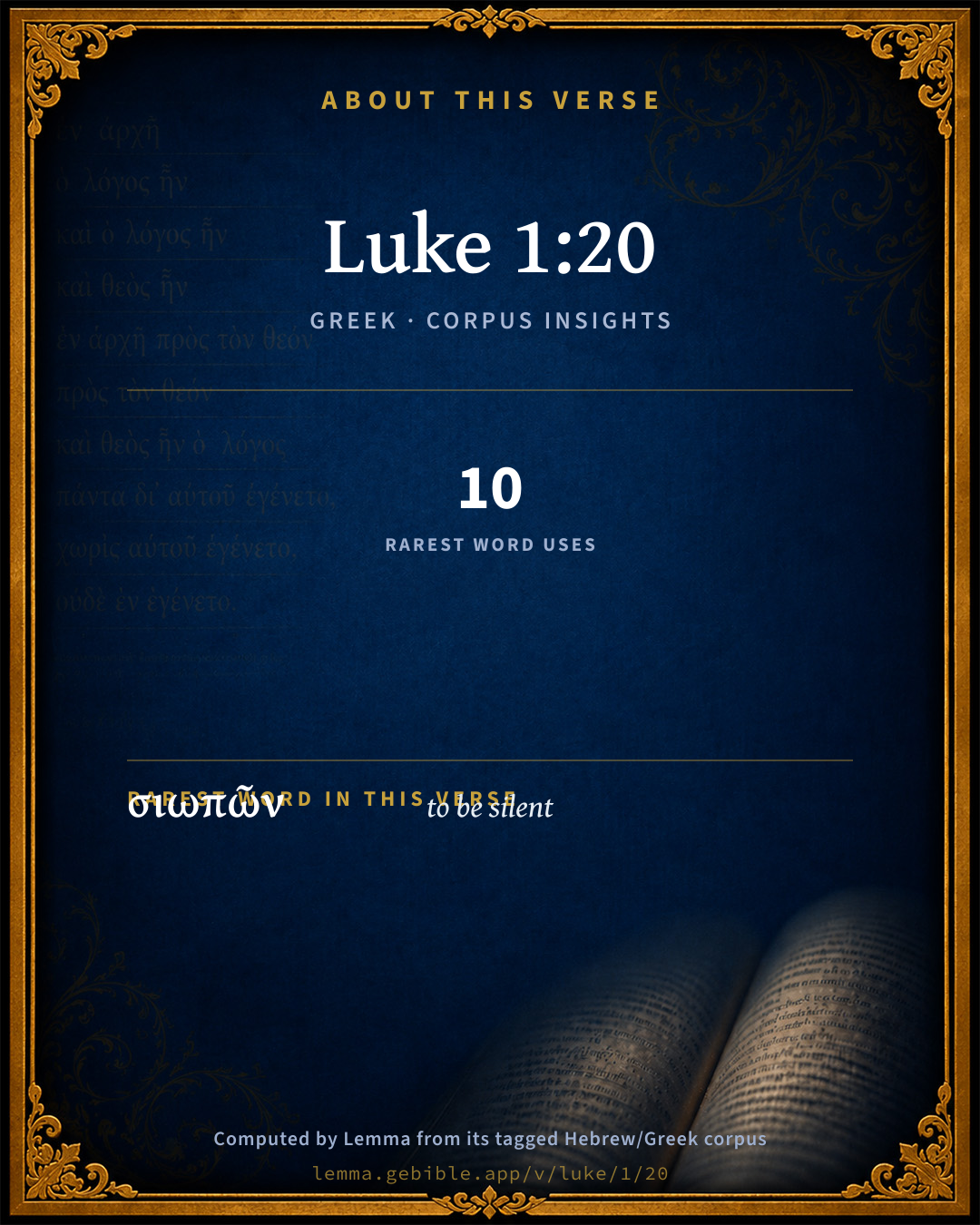
Luke, in the Gospels, opens this verse with 26 words (23 distinct Greek lemmas). Its most distinctive word is siōpáō (“to be silent”). A historical commentator’s framing appears above. Read the whole chapter for the surrounding context.
Discussion questions
- The word siōpáō carries the sense “to be silent.” How does it shape the verse?
- Matthew 20:31 shares the word «to be silent» with this verse. How do the two illuminate each other?
- “and” occurs 2× in this one verse. What is the effect of the repetition?
- These translations render this verse differently. What is at stake in choosing one wording over another?
- Reading how Tyndale Open Study Notes and Bengel's Gnomon read this verse, where do the two commentators agree and where do they part?
Things to notice
- These translations choose different wording for 17 words in this verse.
- “and” occurs 2× in this single verse.
- 23 distinct Greek lemmas span 26 words in this verse.
Commentary
Notes on Luke 1:20 from classic Christian and Jewish commentators (each source and its license shown beneath its notes). The classic Christian expositions comment on the surrounding passage and are grouped to its opening verse, so a note may address several verses; the Jewish commentaries on the Tanakh (Rashi and others) are per-verse, so they appear only where the commentator wrote on this verse.
Lemma curates 59 commentaries, every one of them public domain or Creative Commons licensed, each selected and text-cleaned for this edition rather than reprinted as found. About our sources →
Tyndale Open Study Notes
Tyndale Open Resources
Tyndale Open Study Notes — © Tyndale Open Resources, licensed CC BY-SA 4.0. Text via the HelloAO Bible API.
Bengel's Gnomon
Johann Albrecht Bengel
Bengel's Gnomon of the New Testament — English translation (T&T Clark, Edinburgh, 1860) — public domain. Text from a community e-Sword module.
Expositor's Greek Testament
ed. W. Robertson Nicoll
The Expositor's Greek Testament, edited by W. Robertson Nicoll (1897–1910) — public domain. Text from a community e-Sword module.
International Critical Commentary
International Critical Commentary — older volumes (1896–1929), various authors — public domain. Text from a community e-Sword module.
Jamieson, Fausset & Brown
Robert Jamieson, A. R. Fausset & David Brown
Jamieson, Fausset & Brown — Commentary Critical and Explanatory on the Whole Bible (1871) — public domain (CC PDM 1.0). Text via the HelloAO Bible API.
Adam Clarke's Commentary
Adam Clarke's Commentary on the Bible (1810–1826) — public domain. Text from a community e-Sword/MySword module.
Ellicott's Commentary for English Readers
A Bible Commentary for English Readers, edited by Charles John Ellicott (1878–1897) — public domain. Text from a community e-Sword module.
The Cambridge Bible for Schools and Colleges
gen. ed. J. J. S. Perowne
The Cambridge Bible for Schools and Colleges (gen. ed. J. J. S. Perowne; Cambridge University Press, 1878–1918) — public domain. Text from a community e-Sword module.
John Gill's Exposition
John Gill's Exposition of the Whole Bible (1746–1763) — public domain (CC PDM 1.0). Text via the HelloAO Bible API.
Trapp's Complete Commentary
John Trapp
John Trapp, A Commentary or Exposition upon All the Books of the Old and New Testament (1647–1656) — public domain. Text from a community e-Sword module.
Albert Barnes' Notes on the Bible
Albert Barnes' Notes on the Bible (1834–1885) — public domain. Text from a community e-Sword/MySword module.
Haydock's Catholic Bible Commentary
George Leo Haydock (1774–1849), Haydock's Catholic Family Bible and Commentary, 1859 edition — public domain. Excludes Psalms (Douay-Rheims chapter numbering differs from Protestant) and Deuterocanonical books (Catholic canon only).
John Wesley's Explanatory Notes
John Wesley, Explanatory Notes Upon the Whole Bible (1754–1765) — public domain. Text via the GEBible commentary corpus.
The People's New Testament
B. W. Johnson
B. W. Johnson's The People's New Testament with Notes (1889–1891) — public domain. Electronic text from the Christian Classics Ethereal Library (CCEL) ThML edition.
Cambridge Greek Testament for Schools and Colleges
Cambridge Greek Testament for Schools and Colleges (Cambridge University Press, 1896; 21 vols, various authors incl. Carr, Maclear, Plummer, Farrar, Lumby, Moule, M. R. James, Simcox) — public domain. Text from a community e-Sword module.
Alford’s Greek Testament
Henry Alford
Henry Alford, The Greek Testament (1849–1861) — public domain. Text from a community e-Sword module.
Vincent's Word Studies in the New Testament
Marvin R. Vincent
Marvin R. Vincent, Word Studies in the New Testament (1887–1900) — public domain. Text from a community e-Sword/MySword module.