
Matthew 19:6

Greek (Tischendorf 8th ed.) Matthew 19:6 appears in the Greek New Testament. The text above is from the Tischendorf 8th edition. Each word links to its Strong’s number and a concise gloss. Click any word for its full Thayer’s Greek Lexicon entry.
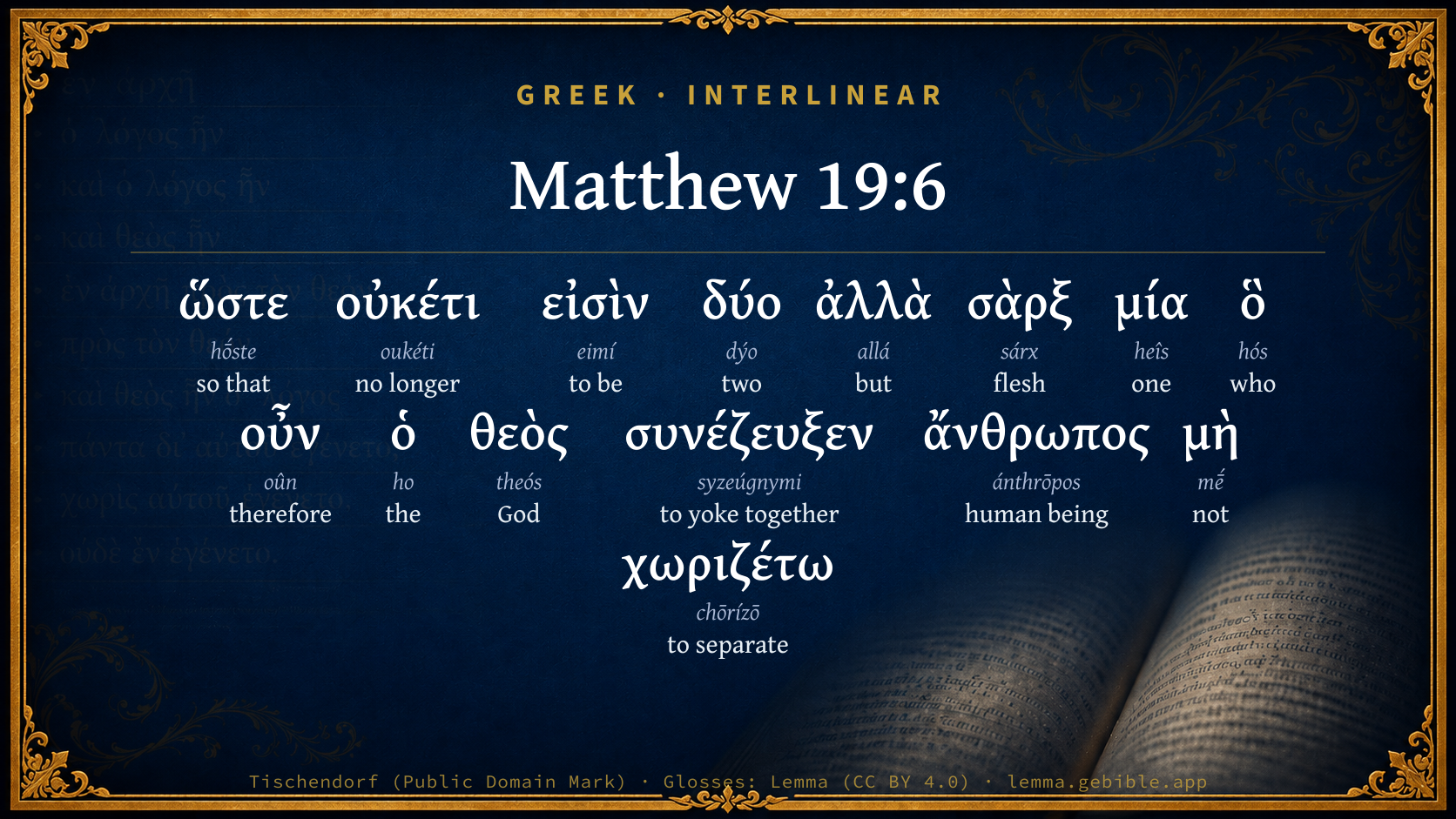
Download image
Cite this verse

Matthew 19:6 (World English Bible). Public Domain. Lemma interlinear Bible study tool, https://lemma.gebible.app/v/matthew/19/6.

Show BibTeX & RIS
BibTeX
RIS
English Translation
So that they are no more two, but one flesh. What therefore God has joined together, don't let man tear apart."
World English Bible · Public Domain
Highlights
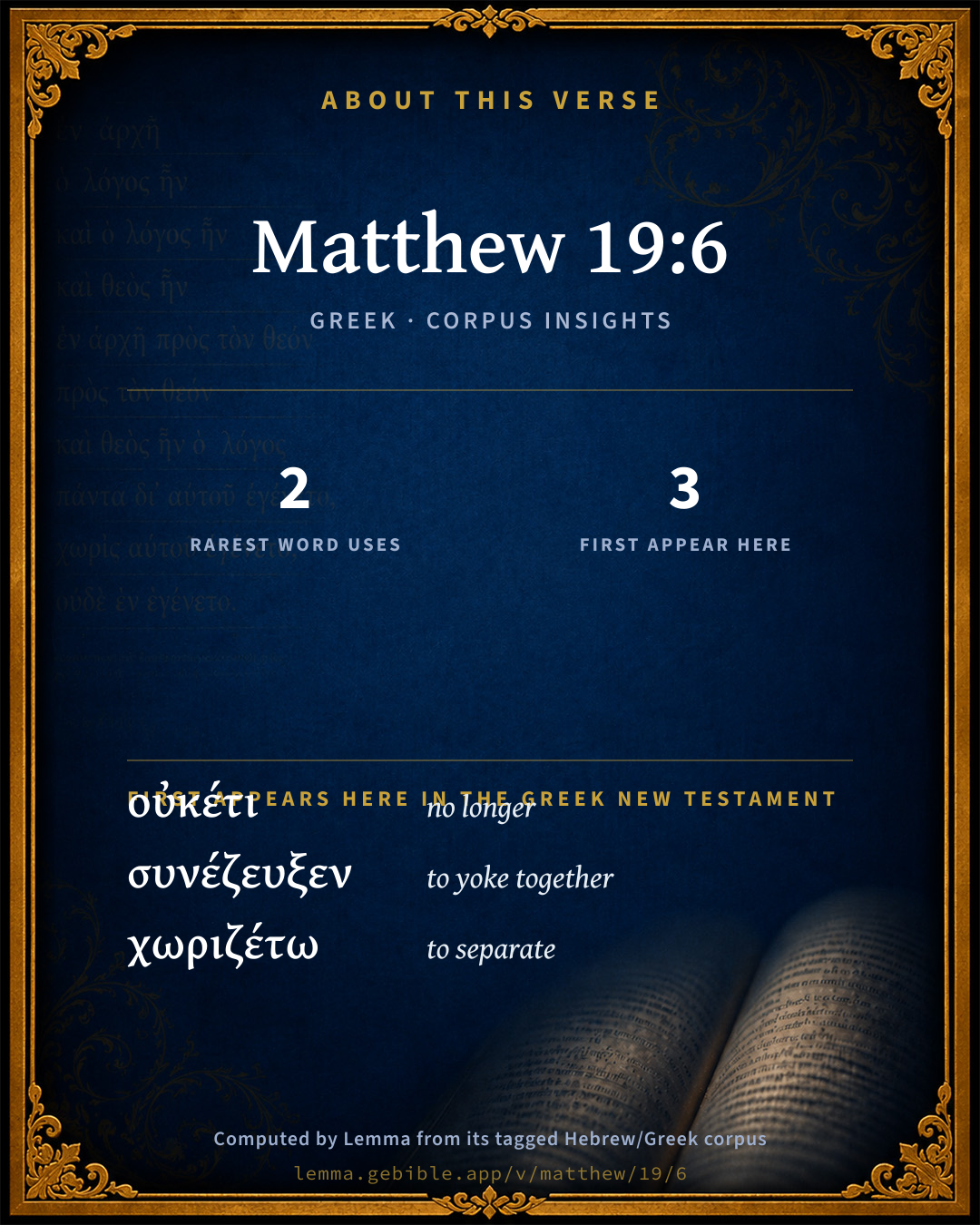
  • 3 first appearances in the Greek New Testament
Full analysis ↓
Download a study sheet

One document with this verse’s original text, its word-by-word gloss line, the meaning frame, cross-references with their text, attributed commentary, and full source and license credits — printable, and it pastes into notes with its structure intact.

This verse Autodidact and up

Study sheet (.html) Plain text (.txt)

A passage Seminary Student

Up to 50 verses in one chapter. A passage sheet keeps up to 6 commentary sources and 12 cross-references per verse, in the order this page ranks them, and says so on the sheet whenever that leaves anything out. Ask for a single verse and you get the Autodidact verse sheet above.

Everything on this page stays free to read, with no account — the sheet is a download of what is already on screen, not access to it.

Want to remove ads? Support Godless Engineer
Compare translations 3

The same verse in 3 English versions, stacked beneath the original-language interlinear above. Click any original word for its lexicon entry.

Each is an independent rendering of the whole verse — the interlinear is not word-aligned to these translations.

Highlighted words mark where these versions differ — a whole-verse word diff, not a word-by-word alignment.

  • World English Bible Public Domain
    So that they are no more two, but one flesh. What therefore God has joined together, don't let man tear apart."
  • King James Version Public Domain
    Wherefore they are no more twain, but one flesh. What therefore God hath joined together, let not man put asunder.
  • unfoldingWord Literal Text CC BY-SA 4.0
    So then, they are no longer two, but one flesh. Therefore, what God joined together, let man not separate.”

unfoldingWord Literal Text — © unfoldingWord, licensed CC BY-SA 4.0. Word-aligned USFM3 via Door43 (git.door43.org/unfoldingWord/en_ult).

Versions to compare (up to 4)

3 of 4 selected

Show all 19 translations

Every available English version of this verse, each an independent rendering of the whole verse.

  • World English Bible Public Domain
    So that they are no more two, but one flesh. What therefore God has joined together, don't let man tear apart."
  • Berean Standard Bible Public Domain
    So they are no longer two, but one flesh. Therefore what God has joined together, let man not separate.”
  • Majority Standard Bible Public Domain
    So they are no longer two, but one flesh. Therefore what God has joined together, let man not separate.”
  • King James Version Public Domain
    Wherefore they are no more twain, but one flesh. What therefore God hath joined together, let not man put asunder.
  • American Standard Version (1901) Public Domain
    So that they are no more two, but one flesh. What therefore God hath joined together, let not man put asunder.
  • Revised Version (1885) Public Domain
    So that they are no more twain, but one flesh. What therefore God hath joined together, let not man put asunder.
  • Geneva Bible (1599) Public Domain
    Wherefore they are no more twaine, but one flesh. Let not man therefore put asunder that, which God hath coupled together.
  • Douay-Rheims (1899) Public Domain
    Therefore now they are not two, but one flesh. What therefore God hath joined together, let no man put asunder.
  • Young's Literal Translation Public Domain
    so that they are no more two, but one flesh; what therefore God did join together, let no man put asunder.'
  • Literal Standard Version CC BY-SA 4.0
    So that they are no longer two, but one flesh; what therefore God joined together, let no man separate.”
  • Unlocked Literal Bible CC BY-SA 4.0
    So they are no longer two, but one flesh. Therefore what God has joined together, let no one tear apart.”
  • unfoldingWord Literal Text CC BY-SA 4.0
    So then, they are no longer two, but one flesh. Therefore, what God joined together, let man not separate.”
  • Darby Bible Public Domain
    so that they are no longer two, but one flesh. What therefore God has joined together, let not man separate.
  • World Messianic Bible Public Domain
    So that they are no more two, but one flesh. What therefore God has joined together, don’t let man tear apart.”
  • Webster's Bible Public Domain
    Wherefore they are no more two, but one flesh. Therefore what God hath joined together, let not man put asunder.
  • Free Bible Version CC BY-SA 4.0
    Now they're no longer two, but one. What God has joined together no one should separate.”
  • Bible in Basic English Public Domain
    So that they are no longer two, but one flesh. Then let not that which has been joined by God be parted by man.
  • Text-Critical English NT CC BY 4.0
    So then, they are no longer two, but one flesh. Therefore what God has joined together, let no one separate.”
  • Tyndale New Testament (1534) Public Domain
    Wherfore now are they not twayne but one flesshe. Let not man therfore put a sunder that which God hath cuppled to gedder.

Literal Standard Version (2020), Covenant Press — licensed CC BY-SA 4.0. Text via the HelloAO Bible API (eBible.org). Unlocked Literal Bible (unfoldingWord) — licensed CC BY-SA 4.0. Text via the HelloAO Bible API (eBible.org). unfoldingWord Literal Text — © unfoldingWord, licensed CC BY-SA 4.0. Word-aligned USFM3 via Door43 (git.door43.org/unfoldingWord/en_ult). Free Bible Version, Dr. Jonathan Gallagher — licensed CC BY-SA 4.0. Text via the HelloAO Bible API (eBible.org).

Word by word

More ways to search: Search by grammar → Find every occurrence → Compare this word →

Practice this passage: Drill this verse → Learn its vocabulary →

συνέζευξεν
syzeúgnymi
G4801
“to yoke together”
Verb, Aorist, Active, Indicative, 3rd person, Singular
Part of Speech
Verb
Tense
Aorist
Voice
Active
Mood
Indicative
Person
3rd person
Number
Singular
Full Thayer's Definition

Origin: from G4862 and the base of G2201

TDNT: None

1. to fasten to one yoke, yoke together 2. to join together unite a. of the marriage tie
  1. ὥστε hṓste G5620 “so that” Conjunction
  2. οὐκέτι oukéti G3765 “no longer” Adverb, Negative
  3. εἰσὶν eimí G1510 “to be” Verb, Present, Active, Indicative, 3rd person, Plural
  4. δύο dýo G1417 “two” Adjective, Numeral (indeclinable)
  5. ἀλλὰ allá G235 “but” Conjunction
  6. σὰρξ sárx G4561 “flesh” Noun, Nominative, Singular, Feminine
  7. μία heîs G1520 “one” Adjective, Nominative, Singular, Feminine
  8. ὃ hós G3739 “who” Relative pronoun, Accusative, Singular, Neuter
  9. οὖν oûn G3767 “therefore” Conjunction
  10. ὁ ho G3588 “the” Article, Nominative, Singular, Masculine
  11. θεὸς theós G2316 “God” Noun, Nominative, Singular, Masculine
  12. ἄνθρωπος ánthrōpos G444 “human being” Noun, Nominative, Singular, Masculine
  13. μὴ mḗ G3361 “not” Particle, Negative
  14. χωριζέτω chōrízō G5563 “to separate” Verb, Present, Active, Imperative, 3rd person, Singular

About this verse

These counts appear in no published source. They are computed here, from the morphology-tagged text and Lemma’s own curated glosses. What Lemma adds →

15
words
15
distinct lemmas
Gospels
section

Notable vocabulary

The rarest word here is συνέζευξεν to yoke together G4801 — appearing just 2 times in the whole Greek New Testament.

First appearance in Scripture

These words make their first canonical appearance in the Greek New Testament here:

  • οὐκέτι no longer G3765
  • συνέζευξεν to yoke together G4801
  • χωριζέτω to separate G5563

Shared distinctive vocabulary

συνέζευξεν to yoke together G4801 occurs in 2 verses of the Greek New Testament. Also found in:
Cross-references

7

Topical passages linked to Matthew 19:6 in the Treasury of Scripture Knowledge — connected by theme and wording, ordered by reader-vote popularity; previews shown in the World English Bible.

  • Mark 10:9 What therefore God has joined together, let no man separate."
  • Hebrews 13:4 Let marriage be held in honor among all, and let the bed be undefiled: but God will judge the sexually immoral and adulterers.
  • Romans 7:2 For the woman that has a husband is bound by law to the husband while he lives, but if the husband dies, she is discharged from the law of the husband.
  • 1 Corinthians 7:10–14 But to the married I command--not I, but the Lord--that the wife not leave her husband
  • Ephesians 5:28 Even so ought husbands also to love their own wives as their own bodies. He who loves his own wife loves himself.
  • Malachi 2:14 Yet you say, 'Why?' Because Yahweh has been witness between you and the wife of your youth, against whom you have dealt treacherously, though she is your companion, and the wife of your covenant.
  • Proverbs 2:17 Who forsakes the friend of her youth, And forgets the covenant of her God:

Cross-references courtesy of OpenBible.info (CC BY 4.0).

Commentary

Notes on Matthew 19:6 from classic Christian and Jewish commentators (each source and its license shown beneath its notes). The classic Christian expositions comment on the surrounding passage and are grouped to its opening verse, so a note may address several verses; the Jewish commentaries on the Tanakh (Rashi and others) are per-verse, so they appear only where the commentator wrote on this verse.

Lemma curates 59 commentaries, every one of them public domain or Creative Commons licensed, each selected and text-cleaned for this edition rather than reprinted as found. About our sources →

Tyndale Open Study Notes

Tyndale Open Resources

19:6 Since God made marriage a union, humans do not have the right to break that union. Jesus affirmed the indissolubility of marriage.

Tyndale Open Study Notes — © Tyndale Open Resources, licensed CC BY-SA 4.0. Text via the HelloAO Bible API.

Bengel's Gnomon

Johann Albrecht Bengel

Mat 19:6. οὐκ ἔτι εἰσὶ, they are no more) They are now no longer two, as they were before.—δύο, two) We should not understand σάρκες, fleshes (carnes): for in Mat 19:5 we find οἱ δύο (the two, they twain).—ὃ, that which (quod), not ἅ, those which (quae): for they are now one flesh.—συνέζευεξεν, hath joined together) hath made one.—ἄνθρωπος, man) see Mat 19:3.—μὴ, κ.τ.λ., let not, etc.) The principle here involved admits of a widely extended application: what GOD hath separated, commanded, conceded, prohibited, blessed, praised, loosed, bound, etc., let not Man join together, prohibit, forbid, command, curse, blame, bind, loose, etc., not even in his own case; see Act 10:15; Num 23:8; Rom 14:3; Rom 14:20.—χωριζέτω, put asunder) In every case of sexual connection, either God hath joined the two, or He hath not joined them: if He hath not joined them, their connection is unlawful; if He hath joined them, why are they separated?

Bengel's Gnomon of the New Testament — English translation (T&T Clark, Edinburgh, 1860) — public domain. Text from a community e-Sword module.

Meyer's Critical & Exegetical Commentary

Heinrich August Wilhelm Meyer

Mat_19:6. Οὐκέτι] after this union, Mat_19:5.

εἰσί] are they, that is, the two of Mat_19:5.

ὅ] quod, ut non tanquam de duobus, sed tanquam de uno corpore loqueretur, Maldonatus.

ὁ θεός] through what is said in Mat_19:5. Observe the contrast to ἄνθρωπος.

Having regard, therefore, to the specific nature of marriage as a divine institution, Jesus utterly condemns divorce generally as being a putting asunder on the part of man of what, in a very special way, God has joined together. With regard to the exception, by which, in fact, the essential idea of marriage as a divine institution is already practically destroyed, see Mat_19:9, and comp. note on Mat_5:32.

Meyer — Critical and Exegetical Commentary on the New Testament — English translation by Peter Christie, edited by Frederick Crombie (T&T Clark, 1880) — public domain. Text from a community e-Sword module.

Expositor's Greek Testament

ed. W. Robertson Nicoll

Mat 19:6 . ὥστε with indicative, expressing actual result as Christ views the matter. They are no longer two, but one flesh, one spirit, one person. ὃ οὖν : inference from God’s will to man’s duty. The creation of sex, and the high doctrine as to the cohesion it produces between man and woman, laid down in Gen., interdict separation. Let the Divine Syzygy be held sacredel How small the Pharisaic disputants must have felt in presence of such holy teaching, which soars above the partisan views of contemporary controversialists into the serene region of ideal, universal, eternal truth!

The Expositor's Greek Testament, edited by W. Robertson Nicoll (1897–1910) — public domain. Text from a community e-Sword module.

Geneva Bible (1599)

Geneva Bible translators

Hath made them yoke fellows, as the marriage itself is by a borrowed kind of speech called a yoke.

Geneva Bible (1599) marginal notes — public domain. Text via Bolls.life.

Adam Clarke's Commentary

Verse 6. What therefore God hath joined together] συνεζευξεν, yoked together, as oxen in the plough, where each must pull equally, in order to bring it on. Among the ancients, when persons were newly married, they put a yoke upon their necks, or chains upon their arms, to show that they were to be one, closely united, and pulling equally together in all the concerns of life. See KYPKE in loco.

The finest allegorical representation of the marriage union I have met with, is that antique gem representing the marriage of Cupid and Psyche, in the collection of the duke of Marlborough: it may be seen also among Baron Stoch's gems, and casts or copies of it in various other collections.

1. Both are represented as winged, to show the alacrity with which the husband and wife should help, comfort and support each ether; preventing, as much as possible, the expressing of a wish or want on either side, by fulfilling it before it can be expressed.

2. Both are veiled, to show that modesty is an inseparable attendant on pure matrimonial connections.

3. Hymen or Marriage goes before them with a lighted torch, leading them by a chain, of which each has a hold, to show that they are united together, and are bound to each other, and that they are led to this by the pure flame of love, which at the same instant both enlightens and warms them.

4. This chain is not iron nor brass, (to intimate that the marriage union is a state of thraldom or slavery,) but it is a chain of pearls, to show that the union is precious, beautiful, and delightful.

5. They hold a dove, the emblem of conjugal fidelity, which they appear to embrace affectionately, to show that they are faithful to each other, not merely through duty, but by affection, and that this fidelity contributes to the happiness of their lives.

6. A winged Cupid, or Love, is represented as having gone before them, preparing the nuptial feast; to intimate that active affections, warm and cordial love, are to be to them a continual source of comfort and enjoyment; and that this is the entertainment they are to meet with at every step of their affectionate lives.

7. Another Cupid, or genius of love comes behind, and places on their heads a basket of ripe fruits; to intimate that a matrimonial union of this kind will generally be blessed with children, who shall be as pleasing to all their senses as ripe and delicious fruits to the smell and taste.

8. The genius of love that follows them has his wings shrivelled up, or the feathers all curled, so as to render them utterly unfit for flight; to intimate that love is to abide with them, that there is to be no separation in affection, but that they are to continue to love one another with pure hearts fervently. Thus love begins and continues this sacred union; as to end, there can be none, for God hath yoked them together.

A finer or more expressive set of emblems has never, I believe, been produced, even by modern refined taste and ingenuity. This group of emblematical figures is engraved upon an onyx by Tryphon, an ancient Grecian artist. A fine drawing was made of this by Cypriani, and was engraved both by Bartolozzi and Sherwin. See one of these plates in the second volume of Bryant's Analysis of Ancient Mythology, page 392.

Adam Clarke's Commentary on the Bible (1810–1826) — public domain. Text from a community e-Sword/MySword module.

Ellicott's Commentary for English Readers

(6) What therefore God hath joined.—Strictly interpreted, the words go further than those of Mat_5:32, and appear to forbid divorce under all circumstances. They are, however, rather the expression of the principle that should underlie laws, than the formulated law itself, and, as such, they assert the true ideal of marriage without making provision (such as was made before) for that which violates and annuls the ideal. It is remarkable that the essence of the marriage is made to depend, not on laws, or contracts, or religious ceremonies, but on the natural fact of union. Strictly speaking, that constitutes, or should constitute, marriage. The sin of all illicit intercourse, whether in adultery, or concubinage, or prostitution, is that it separates that union from the relations and duties which the divine order has attached to and makes. if Simply minister to the lusts of man’s lower nature. The evil of every system that multiplies facilities for divorce is that it treats as temporary what was designed to be permanent, and reduces marriage, so far as it goes, to concubinage durante bene placito. This may, in some stages of social progress, as the next verses indicate, be the least of two evils; but it does not cease to be an evil, and the efforts of all teachers and legislators should be directed to raise the standard of duty rather than to acquiesce in its debasement.

A Bible Commentary for English Readers, edited by Charles John Ellicott (1878–1897) — public domain. Text from a community e-Sword module.

John Gill's Exposition

Wherefore they are no more twain,.... They were two before marriage, but now no more so; not but that they remain two distinct persons,

but one flesh; or, as the Syriac, Arabic, Persic, and Ethiopic versions read, "one body": hence the wife is to beloved by the husband as his own body, as himself, as his own flesh, Eph 5:28.

what therefore God hath joined together; or, by the first institution of marriage, has declared to be so closely united together, as to be, as it were, one flesh, and one body, as husband and wife are;

let no man put asunder; break the bond of union, dissolve the relation, and separate them from each other, for every trivial thing, upon any slight occasion, or for anything; but what is hereafter mentioned. The sense is, that the bond of marriage being made by God himself, is so sacred and inviolable, as that it ought not to be dissolved by any man; not by the husband himself, or any other for him; nor by any state or government, by any prince or potentate, by any legislator whatever; no, not by Moses himself, who is, at least, included, if not chiefly designed here, though not named, to avoid offence: and God and man being opposed in this passage, shows, that marriage is an institution and appointment of God, and therefore not to be changed and altered by man at his pleasure; this not merely a civil, but a sacred affair, in which God is concerned.

John Gill's Exposition of the Whole Bible (1746–1763) — public domain (CC PDM 1.0). Text via the HelloAO Bible API.

Trapp's Complete Commentary

John Trapp

6 Wherefore they are no more twain, but one flesh. What therefore God hath joined together, let not man put asunder.

Ver. 6. They are no more twain] A man’s wife is himself, εαυτον, Eph 5:28; (as is likewise a man’s country, Luk 4:23, to cure his country is to cure himself), and they twain, saith our Saviour in the former verse, shall be εις σαρκα μιαν, into one flesh. The man misseth his rib, and the woman would be in her old place again, under the man’s arm or wing; hence no rest till they be re-united and concorporated. "My daughter," said Naomi to Ruth, "should I not seek rest for thee, that it may be well with thee?" Rth 3:1. Why, then, should there be divorces for light matters? why should there be beating of wives, and laying upon them (as some) with their unmanly fists? Did ever any man "hate his own flesh," Eph 5:29, or but hide his eyes from it? Isa 58:7, how much less tear it with his teeth, and pull it away piecemeal, unless it were mad demoniacs and rash divorcers? Christ, the best husband, hates putting away, Mal 2:16; yea, though never so much provoked to it, Jer 3:1; Job 13:1, he will not do it.

John Trapp, A Commentary or Exposition upon All the Books of the Old and New Testament (1647–1656) — public domain. Text from a community e-Sword module.

Whedon's Commentary on the Bible

Daniel D. Whedon

6. One flesh — As in Adam before the creation of Eve the twain were one, so now, by marriage, the oneness is restored. They are two halves of one whole, forming one person. Yet, however much we may talk of their oneness, they are not one soul. They have an eternal separateness of individuality, by which they may be eternally separated in future destiny. Hence they are indeed one flesh, but not one soul. Let not man put asunder — It cannot be done in any case without crime, except by death.

Our Lord in this answer sides with neither party, but rises above them both. He does not say, with Schammai, that the letter of Moses’s law allowed no divorce but for adultery. Nor does he, with Hillel, affirm that divorce is allowable for every or any cause. He maintains that, upon the foundation of original creation, divorce for any other cause than adultery is wrong, and only permitted by Moses to prevent greater wrong.

Daniel D. Whedon (gen. ed.), Commentary on the Old and New Testaments (1874–1909) — public domain. Text from a community e-Sword module.

The Pulpit Commentary

Wherefore (wste); so that. This follows from the quotation just given. Our Lord explains and confirms the original dictum by an assertion of his own and a general law. What God hath joined together. The institution of marriage is God"s appointment. Christ says o , what, neuter singular, not "those whom," plural and concrete, that he may make it clear that he is here speaking in the abstract, not specially of Adam and Eve. What he enunciates is true of all wedlock, not simply of the case of our first parents. Let not man put asunder. Man does thus infringe the primitive rule when he divorces his with. Herein he opposes God and acts against nature. He and his wife are one; they can no more separate from one another than they can from themselves. If we regard our Lord"s language in this passage without prejudice, and not reading into it modem notions, we must consider that he here decrees the indissolubility of the marriage tie. His hearers plainly understood him so to speak, as we see from the objection which they urged.

HOMILIES BY R. TUCK Vers. 6, 7. Natural laws and human infirmities.

The law of marriage must be thought of as fixed for human beings before the Fall. Natural laws are not fixed in view of man"s wilfulness and sin. They remain natural laws after man has sinned; but their application and practical working are modified by the new conditions and relations which sin has introduced. God made man male and female. God designed single pairs. God proposed lifelong faithfulness of the wedded pairs. There is no natural provision made for divorce, because such a thing has no place in the natural order. In the Divine idea human society is based on the mutually helpful relation in which one man and one woman may stand. Instability of human society comes when the family bond can be easily broken. The human infirmities which have necessitated modifications of the natural marriage laws are

I CRUELTIES. It became necessary for woman to have some defence against man"s violence. Natural law makes man and woman equals. They are different; but their faculties and sympathies are relative, and each is head in a way. But sin took first shape as masterfulness; and man, the stronger, took advantage of woman, the weaker, and made her his slave. There had to be adjustment of law to meet this condition and give due protection to the weaker one. "But for the possibility of divorce, the wife would have been the victim of the husband"s tyranny; and law social law which has to deal with facts not with what ought to be, but withwhat is was compelled to choose between two evils." Woman"s lot, even in civilized times, would often be intolerable but for the possibility and the fear of divorce.

II INFIDELITIES. This subject needs to be touched very wisely in a general audience; and yet there is no subject on which wise words are more pressingly demanded. It is one of the most serious of the mischiefs wrought by sin, that it has loosened men"s control of bodily passion. And the mischief is wrought, not in man only, but also in woman. Infidelities make the continuance of natural relations impossible, though the modification of law, which permits divorce, makes no attempt to deliver man or woman from the power of their infirmity. R.T.

The Pulpit Commentary (1880–1919), ed. H.D.M. Spence-Jones & Joseph S. Exell — public domain. Text from a community e-Sword module.

The People's New Testament

B. W. Johnson

6. What God hath joined together. If God hath so joined them that the twain are one, no human ordinance has the right to separate them.

B. W. Johnson's The People's New Testament with Notes (1889–1891) — public domain. Electronic text from the Christian Classics Ethereal Library (CCEL) ThML edition.

Cambridge Greek Testament for Schools and Colleges

6. ὅ, the neuter strengthens the idea of complete fusion into a single being.

συνέζευξεν. The aorist of the divine action undetermined by time. Cp. εὐδόκησεν, ch. Mat 3:17, παρεδόθη, Mat 11:27, ἐδόθη, Mat 28:18.

Cambridge Greek Testament for Schools and Colleges (Cambridge University Press, 1896; 21 vols, various authors incl. Carr, Maclear, Plummer, Farrar, Lumby, Moule, M. R. James, Simcox) — public domain. Text from a community e-Sword module.

International Critical Commentary

(M) 6. So that they are no longer two, but one flesh. What therefore God joined together, let not man separate.] So Mk. Divorce, therefore, is from an ideal standpoint not to be thought of.

International Critical Commentary — older volumes (1896–1929), various authors — public domain. Text from a community e-Sword module.

Vincent's Word Studies in the New Testament

Marvin R. Vincent

What [ο] . Not those. Christ is contemplating, not the individuals, but the unity which God cemented; and so Wyc., that thing that God enjoined; i e., knit together. The aorist tense (denoting the occurrence of an event at some past time, considered as a momentary act) seems to refer to the original ordinance of God at the creation (ver. 4).

Marvin R. Vincent, Word Studies in the New Testament (1887–1900) — public domain. Text from a community e-Sword/MySword module.

Lesson kit

Teaching starters — assembled from the data on this page, not authored interpretation. Every prompt links to the verse data it draws on. Edit before teaching.

Matthew, in the Gospels, opens this verse with 15 words (15 distinct Greek lemmas). Its most distinctive word is syzeúgnymi (“to yoke together”). A historical commentator’s framing appears above. Read the whole chapter for the surrounding context.

Discussion questions

  1. The word syzeúgnymi carries the sense “to yoke together.” How does it shape the verse?
  2. 3 words here appear for the first time in Scripture. What is being introduced at this debut?
  3. Mark 10:9 shares the word «to yoke together» with this verse. How do the two illuminate each other?
  4. The translations on this page render this verse differently — a whole-verse word diff, not a word-by-word alignment. What might account for the different wordings?
  5. Reading how Tyndale Open Study Notes and Bengel's Gnomon read this verse, where do the two commentators agree and where do they part?

Things to notice

Reading settings

Reading text

Shown beneath each verse's original-language words.

Old Testament
Old Testament edition

Read the OT as the Masoretic Hebrew (MT) or the Greek Septuagint (LXX).

English shown for the Greek Septuagint (in the Hebrew ↔ Greek comparison).

Comparing translations? Open the Compare panel on any verse page to stack up to four side by side.