

Matthew 26:41
Greek (Tischendorf 8th ed.) Matthew 26:41 appears in the Greek New Testament. The text above is from the Tischendorf 8th edition. Each word links to its Strong’s number and a concise gloss. Click any word for its full Thayer’s Greek Lexicon entry.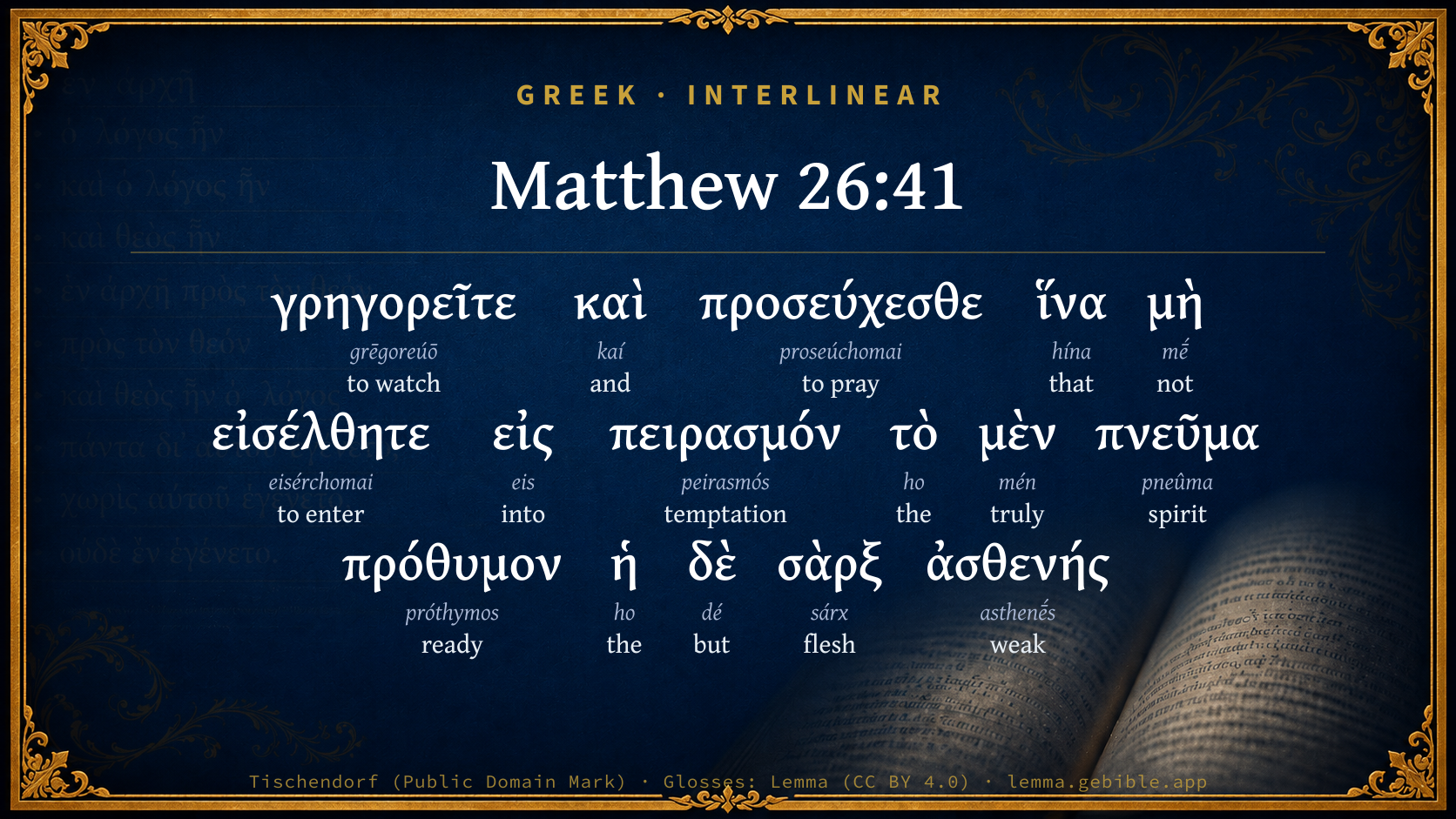
Watch and pray, that you don't enter into temptation. The spirit indeed is willing, but the flesh is weak."
Download a study sheet
One document with this verse’s original text, its word-by-word gloss line, the meaning frame, cross-references with their text, attributed commentary, and full source and license credits — printable, and it pastes into notes with its structure intact.
This verse Autodidact and up
A passage Seminary Student
Up to 50 verses in one chapter. A passage sheet keeps up to 6 commentary sources and 12 cross-references per verse, in the order this page ranks them, and says so on the sheet whenever that leaves anything out. Ask for a single verse and you get the Autodidact verse sheet above.
Everything on this page stays free to read, with no account — the sheet is a download of what is already on screen, not access to it.
Compare translations 3
The same verse in 3 English versions, stacked beneath the original-language interlinear above. Click any original word for its lexicon entry.
Each is an independent rendering of the whole verse — the interlinear is not word-aligned to these translations.
Highlighted words mark where these versions differ — a whole-verse word diff, not a word-by-word alignment.
-
World English Bible Public Domain
Watch and pray, that you don't enter into temptation. The spirit indeed is willing, but the flesh is weak."
-
King James Version Public Domain
Watch and pray, that ye enter not into temptation: the spirit indeed is willing, but the flesh is weak.
-
unfoldingWord Literal Text CC BY-SA 4.0
Be alert and pray so that you do not enter into temptation. The spirit indeed willing, but the flesh weak.”
unfoldingWord Literal Text — © unfoldingWord, licensed CC BY-SA 4.0. Word-aligned USFM3 via Door43 (git.door43.org/unfoldingWord/en_ult).
Show all 19 translations
Every available English version of this verse, each an independent rendering of the whole verse.
-
World English Bible Public Domain
Watch and pray, that you don't enter into temptation. The spirit indeed is willing, but the flesh is weak."
-
Berean Standard Bible Public Domain
“Watch and pray so that you will not enter into temptation. For the spirit is willing, but the body is weak.”
-
Majority Standard Bible Public Domain
“Watch and pray so that you will not enter into temptation. For the spirit is willing, but the body is weak.”
-
King James Version Public Domain
Watch and pray, that ye enter not into temptation: the spirit indeed is willing, but the flesh is weak.
-
American Standard Version (1901) Public Domain
Watch and pray, that ye enter not into temptation: the spirit indeed is willing, but the flesh is weak.
-
Revised Version (1885) Public Domain
Watch and pray, that ye enter not into temptation: the spirit indeed is willing, but the flesh is weak.
-
Geneva Bible (1599) Public Domain
Watch, and praie, that yee enter not into tentation: the spirit in deede is readie, but the flesh is weake.
-
Douay-Rheims (1899) Public Domain
Watch ye, and pray that ye enter not into temptation. The spirit indeed is willing, but the flesh weak.
-
Young's Literal Translation Public Domain
watch, and pray, that ye may not enter into temptation: the spirit indeed is forward, but the flesh weak.'
-
Literal Standard Version CC BY-SA 4.0
Watch, and pray, that you may not enter into temptation: the spirit indeed is forward, but the flesh weak.”
-
Unlocked Literal Bible CC BY-SA 4.0
Watch and pray that you do not enter into temptation. The spirit indeed is willing, but the flesh is weak.”
-
unfoldingWord Literal Text CC BY-SA 4.0
Be alert and pray so that you do not enter into temptation. The spirit indeed willing, but the flesh weak.”
-
Darby Bible Public Domain
Watch and pray, that ye enter not into temptation: the spirit indeed [is] ready, but the flesh weak.
-
World Messianic Bible Public Domain
Watch and pray, that you don’t enter into temptation. The spirit indeed is willing, but the flesh is weak.”
-
Webster's Bible Public Domain
Watch and pray, that ye enter not into temptation: the spirit indeed is willing, but the flesh is weak.
-
Free Bible Version CC BY-SA 4.0
Stay awake and pray, so that you don't fall into temptation. Yes, the spirit is willing, but the body is weak.”
-
Bible in Basic English Public Domain
Keep watch with prayer, so that you may not be put to the test: the spirit truly is ready, but the flesh is feeble.
-
Text-Critical English NT CC BY 4.0
Keep watch and pray, lest you enter into temptation. The spirit indeed is willing, but the flesh is weak.”
-
Tyndale New Testament (1534) Public Domain
watche and praye that ye fall not into temptacion. The spirite is willynge but the flesshe is weake.
Literal Standard Version (2020), Covenant Press — licensed CC BY-SA 4.0. Text via the HelloAO Bible API (eBible.org). Unlocked Literal Bible (unfoldingWord) — licensed CC BY-SA 4.0. Text via the HelloAO Bible API (eBible.org). unfoldingWord Literal Text — © unfoldingWord, licensed CC BY-SA 4.0. Word-aligned USFM3 via Door43 (git.door43.org/unfoldingWord/en_ult). Free Bible Version, Dr. Jonathan Gallagher — licensed CC BY-SA 4.0. Text via the HelloAO Bible API (eBible.org).
Word by word
More ways to search: Search by grammar → Find every occurrence → Compare this word →
Practice this passage: Drill this verse → Learn its vocabulary →
- Appears 3× in the Greek New Testament
- First appears here
- Part of Speech
- Adjective
- Case
- Nominative
- Number
- Singular
- Gender
- Neuter
Full Thayer's Definition
- γρηγορεῖτε grēgoreúō G1127 “to watch” Verb, Present, Active, Imperative, 2nd person, Plural
- καὶ kaí G2532 “and” Conjunction
- προσεύχεσθε proseúchomai G4336 “to pray” Verb, Present, Middle or Passive deponent, Imperative, 2nd person, Plural
- ἵνα hína G2443 “that” Conjunction
- μὴ mḗ G3361 “not” Particle, Negative
- εἰσέλθητε eisérchomai G1525 “to enter” Verb, Aorist, Active, Subjunctive, 2nd person, Plural
- εἰς eis G1519 “into” Preposition
- πειρασμόν peirasmós G3986 “temptation” Noun, Accusative, Singular, Masculine
- τὸ ho G3588 “the” Article, Nominative, Singular, Neuter
- μὲν mén G3303 “truly” Particle
- πνεῦμα pneûma G4151 “spirit” Noun, Nominative, Singular, Neuter
- πρόθυμον próthymos G4289 “ready” Adjective, Nominative, Singular, Neuter
- ἡ ho G3588 “the” Article, Nominative, Singular, Feminine
- δὲ dé G1161 “but” Conjunction
- σὰρξ sárx G4561 “flesh” Noun, Nominative, Singular, Feminine
- ἀσθενής asthenḗs G772 “weak” Adjective, Nominative, Singular, Feminine
About this verse
These counts appear in no published source. They are computed here, from the morphology-tagged text and Lemma’s own curated glosses. What Lemma adds →
- 16
- words
- 15
- distinct lemmas
- Gospels
- section
Notable vocabulary
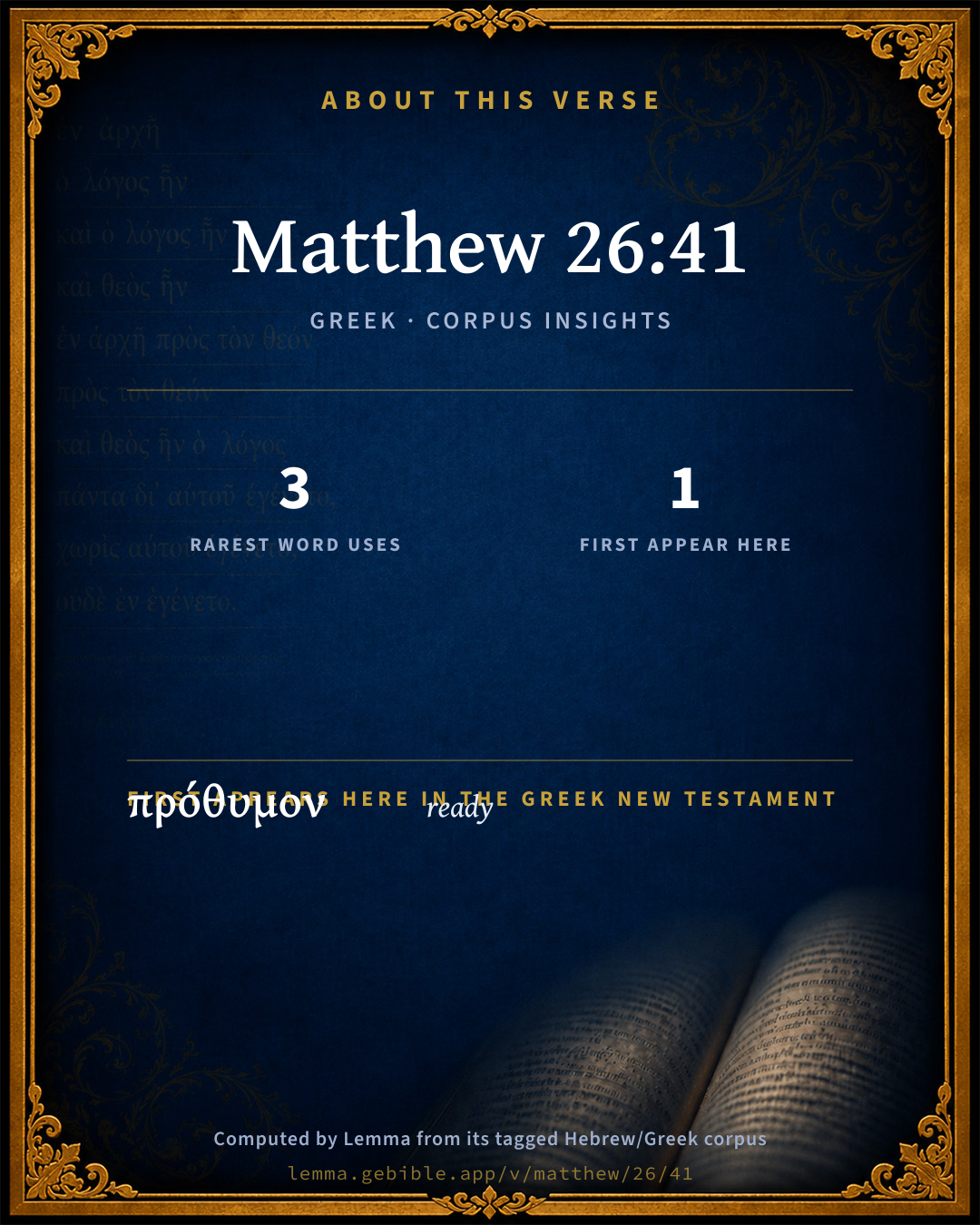
The rarest word here is πρόθυμον ready G4289 — appearing just 3 times in the whole Greek New Testament.
First appearance in Scripture
This word makes its first canonical appearance in the Greek New Testament here:
- πρόθυμον ready G4289
Shared distinctive vocabulary
πρόθυμον ready G4289 occurs in 3 verses of the Greek New Testament. Also found in:
Repetition
A word recurs within this verse:
- τὸ the G3588 ×2
Cross-references
34Topical passages linked to Matthew 26:41 in the Treasury of Scripture Knowledge — connected by theme and wording, ordered by reader-vote popularity; previews shown in the World English Bible.
- Mark 14:38 Watch and pray, that you may not enter into temptation. The spirit indeed is willing, but the flesh is weak."
- Luke 22:46 and said to them, "Why do you sleep? Rise and pray that you may not enter into temptation."
- Ephesians 6:18 with all prayer and requests, praying at all times in the Spirit, and being watchful to this end in all perseverance and requests for all the saints:
- Matthew 6:13 Bring us not into temptation, but deliver us from the evil one. For yours is the Kingdom, the power, and the glory forever. Amen.'
- Galatians 5:16–17 But I say, walk by the Spirit, and you won't fulfill the lust of the flesh.
- Revelation 16:15 "Behold, I come like a thief. Blessed is he who watches, and keeps his clothes, so that he doesn't walk naked, and they see his shame."
- Luke 21:36 Therefore be watchful all the time, asking that you may be counted worthy to escape all these things that will happen, and to stand before the Son of Man."
- 1 Corinthians 16:13 Watch! Stand firm in the faith! Be courageous! Be strong!
- 1 Peter 5:8 Be sober and self-controlled. Be watchful. Your adversary the devil, walks around like a roaring lion, seeking whom he may devour.
- 1 Corinthians 10:13 No temptation has taken you except what is common to man. God is faithful, who will not allow you to be tempted above what you are able, but will with the temptation also make the way of escape, that you may be able to endure it.
- Romans 7:18–25 For I know that in me, that is, in my flesh, dwells no good thing. For desire is present with me, but I don't find it doing that which is good.
- Matthew 24:42 Watch therefore, for you don't know in what hour your Lord comes.
- Mark 13:33–37 Watch, keep alert, and pray; for you don't know when the time is.
- 2 Peter 2:9 the Lord knows how to deliver the godly out of temptation and to keep the unrighteous under punishment for the day of judgment;
- 1 Peter 4:7 But the end of all things is near. Therefore be of sound mind, self-controlled, and sober in prayer.
- Revelation 3:10 Because you kept my command to endure, I also will keep you from the hour of testing, which is to come on the whole world, to test those who dwell on the earth.
- Matthew 25:13 Watch therefore, for you don't know the day nor the hour in which the Son of Man is coming.
- Psalms 119:32 I run in the path of your commandments, For you have set my heart free.
- Isaiah 26:8–9 Yes, in the way of your judgments, Yahweh, have we waited for you; to your name, even to your memorial [name], is the desire of our soul.
- Luke 22:40 When he was at the place, he said to them, "Pray that you don't enter into temptation."
- 1 Corinthians 9:27 but I beat my body and bring it into submission, lest by any means, after I have preached to others, I myself should be rejected.
- Galatians 5:24 Those who belong to Christ have crucified the flesh with its passions and lusts.
- Psalms 119:1 Blessed are those whose ways are blameless, Who walk according to Yahweh's law.
- Psalms 119:35–37 Direct me in the path of your commandments, For I delight in them.
- Psalms 119:115 Depart from me, you evildoers, That I may keep the commandments of my God.
- Proverbs 4:14–15 Don't enter into the path of the wicked. Don't walk in the way of evil men.
- Matthew 26:38 Then he said to them, "My soul is exceedingly sorrowful, even to death. Stay here, and watch with me."
- Psalms 119:4–5 You have commanded your precepts, That we should fully obey them.
- Luke 11:4 Forgive us our sins, For we ourselves also forgive everyone who is indebted to us. Bring us not into temptation, But deliver us from the evil one.'"
- Philippians 3:12–14 Not that I have already obtained, or am already made perfect; but I press on, if it is so that I may take hold of that for which also I was taken hold of by Christ Jesus.
- Psalms 119:24–25 Indeed your statutes are my delight, And my counselors.
- Psalms 119:117 Hold me up, and I will be safe, And will have respect for your statutes continually.
- Luke 8:13 Those on the rock are they who, when they hear, receive the word with joy; but these have no root, who believe for a while, then fall away in time of temptation.
- Romans 8:3 For what the law couldn't do, in that it was weak through the flesh, God did, sending his own Son in the likeness of sinful flesh and for sin, he condemned sin in the flesh;
Cross-references courtesy of OpenBible.info (CC BY 4.0).
Lesson kit
Teaching starters — assembled from the data on this page, not authored interpretation. Every prompt links to the verse data it draws on. Edit before teaching.
Matthew, in the Gospels, opens this verse with 16 words (15 distinct Greek lemmas). Its most distinctive word is próthymos (“ready”). A historical commentator’s framing appears above. Read the whole chapter for the surrounding context.
Discussion questions
- The word próthymos carries the sense “ready.” How does it shape the verse?
- This is the first place “ready” appears in Scripture (first appears here). What does its debut here establish?
- How does Mark 14:38, which shares the word «ready», read alongside this verse?
- What does the repetition of “the” (2× in this one verse) do in this verse?
- The translations on this page render this verse differently — a whole-verse word diff, not a word-by-word alignment. What might account for the different wordings?
- Compare how Bengel's Gnomon and Meyer's Critical & Exegetical Commentary read this verse. Where do they agree or differ?
Things to notice
- 1 word makes its first canonical appearance in Scripture here.
- These translations choose different wording for 5 words in this verse.
- “the” occurs 2× in this single verse.
- 15 distinct Greek lemmas span 16 words in this verse.
Commentary
Notes on Matthew 26:41 from classic Christian and Jewish commentators (each source and its license shown beneath its notes). The classic Christian expositions comment on the surrounding passage and are grouped to its opening verse, so a note may address several verses; the Jewish commentaries on the Tanakh (Rashi and others) are per-verse, so they appear only where the commentator wrote on this verse.
Lemma curates 59 commentaries, every one of them public domain or Creative Commons licensed, each selected and text-cleaned for this edition rather than reprinted as found. About our sources →
Bengel's Gnomon
Johann Albrecht Bengel
Bengel's Gnomon of the New Testament — English translation (T&T Clark, Edinburgh, 1860) — public domain. Text from a community e-Sword module.
Meyer's Critical & Exegetical Commentary
Heinrich August Wilhelm Meyer
Meyer — Critical and Exegetical Commentary on the New Testament — English translation by Peter Christie, edited by Frederick Crombie (T&T Clark, 1880) — public domain. Text from a community e-Sword module.
Adam Clarke's Commentary
Adam Clarke's Commentary on the Bible (1810–1826) — public domain. Text from a community e-Sword/MySword module.
Ellicott's Commentary for English Readers
A Bible Commentary for English Readers, edited by Charles John Ellicott (1878–1897) — public domain. Text from a community e-Sword module.
The Cambridge Bible for Schools and Colleges
gen. ed. J. J. S. Perowne
The Cambridge Bible for Schools and Colleges (gen. ed. J. J. S. Perowne; Cambridge University Press, 1878–1918) — public domain. Text from a community e-Sword module.
John Gill's Exposition
John Gill's Exposition of the Whole Bible (1746–1763) — public domain (CC PDM 1.0). Text via the HelloAO Bible API.
Trapp's Complete Commentary
John Trapp
John Trapp, A Commentary or Exposition upon All the Books of the Old and New Testament (1647–1656) — public domain. Text from a community e-Sword module.
Haydock's Catholic Bible Commentary
George Leo Haydock (1774–1849), Haydock's Catholic Family Bible and Commentary, 1859 edition — public domain. Excludes Psalms (Douay-Rheims chapter numbering differs from Protestant) and Deuterocanonical books (Catholic canon only).
Whedon's Commentary on the Bible
Daniel D. Whedon
Daniel D. Whedon (gen. ed.), Commentary on the Old and New Testaments (1874–1909) — public domain. Text from a community e-Sword module.
The Pulpit Commentary
The Pulpit Commentary (1880–1919), ed. H.D.M. Spence-Jones & Joseph S. Exell — public domain. Text from a community e-Sword module.
John Wesley's Explanatory Notes
John Wesley, Explanatory Notes Upon the Whole Bible (1754–1765) — public domain. Text via the GEBible commentary corpus.
The People's New Testament
B. W. Johnson
B. W. Johnson's The People's New Testament with Notes (1889–1891) — public domain. Electronic text from the Christian Classics Ethereal Library (CCEL) ThML edition.
Cambridge Greek Testament for Schools and Colleges
Cambridge Greek Testament for Schools and Colleges (Cambridge University Press, 1896; 21 vols, various authors incl. Carr, Maclear, Plummer, Farrar, Lumby, Moule, M. R. James, Simcox) — public domain. Text from a community e-Sword module.
Alford’s Greek Testament
Henry Alford
Henry Alford, The Greek Testament (1849–1861) — public domain. Text from a community e-Sword module.
International Critical Commentary
International Critical Commentary — older volumes (1896–1929), various authors — public domain. Text from a community e-Sword module.