
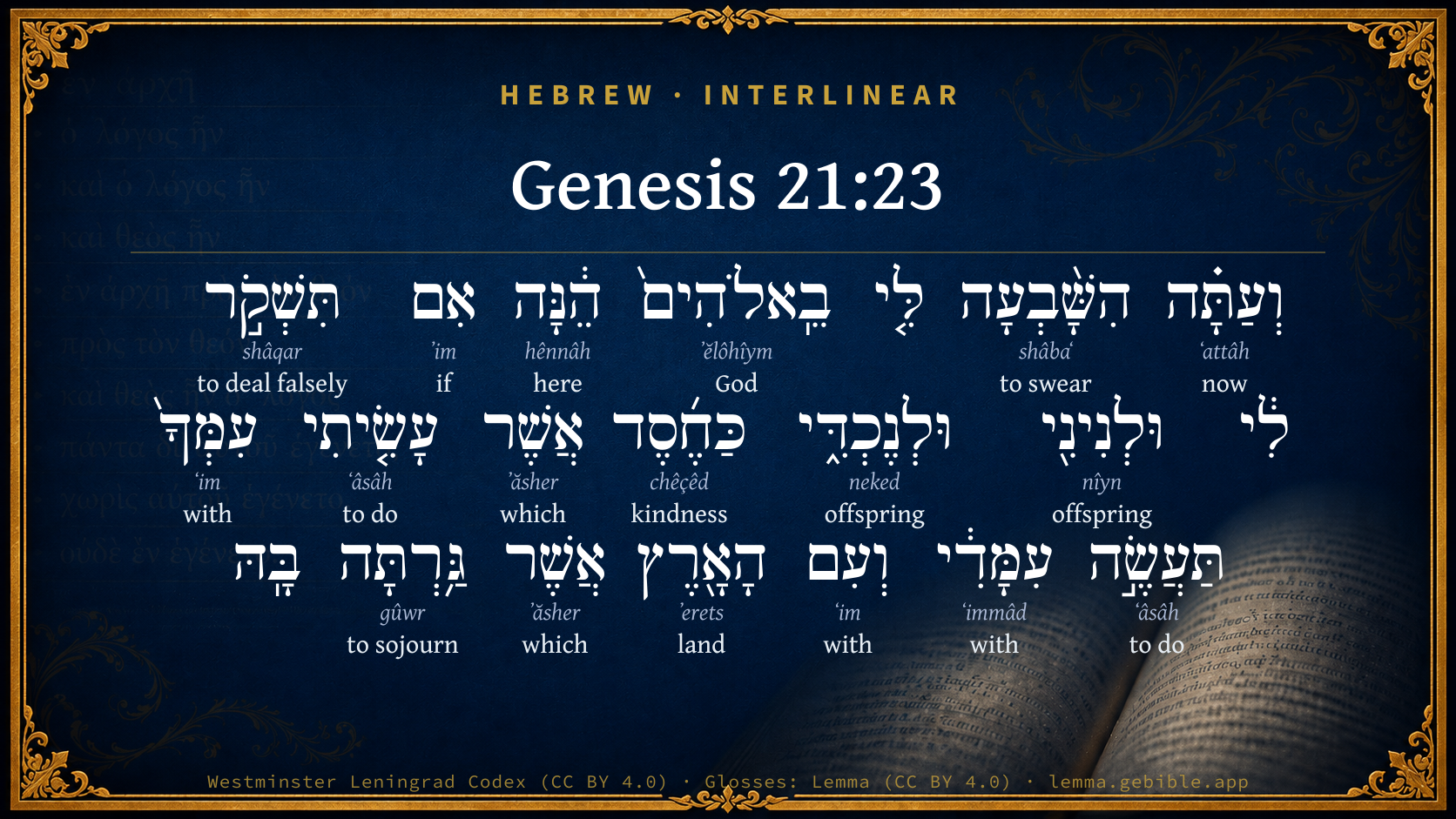
Genesis 21:23

Hebrew (Westminster Leningrad Codex) Genesis 21:23 appears in the Hebrew Old Testament. The text above is from the Westminster Leningrad Codex. Each word links to its Strong’s number, a concise gloss, and parsing drawn from the Open Scriptures Hebrew Bible morphology. Click any word for its full Brown-Driver-Briggs (BDB) entry.
Download image
Cite this verse

Genesis 21:23 (World English Bible). Public Domain. Lemma interlinear Bible study tool, https://lemma.gebible.app/v/genesis/21/23.

Show BibTeX & RIS
BibTeX
RIS
English Translation
Now therefore swear to me here by God that you will not deal falsely with me, nor with my son, nor with my son's son. But according to the kindness that I have done to you, you shall do to me, and to the land in which you have lived as a foreigner."
World English Bible · Public Domain
Highlights
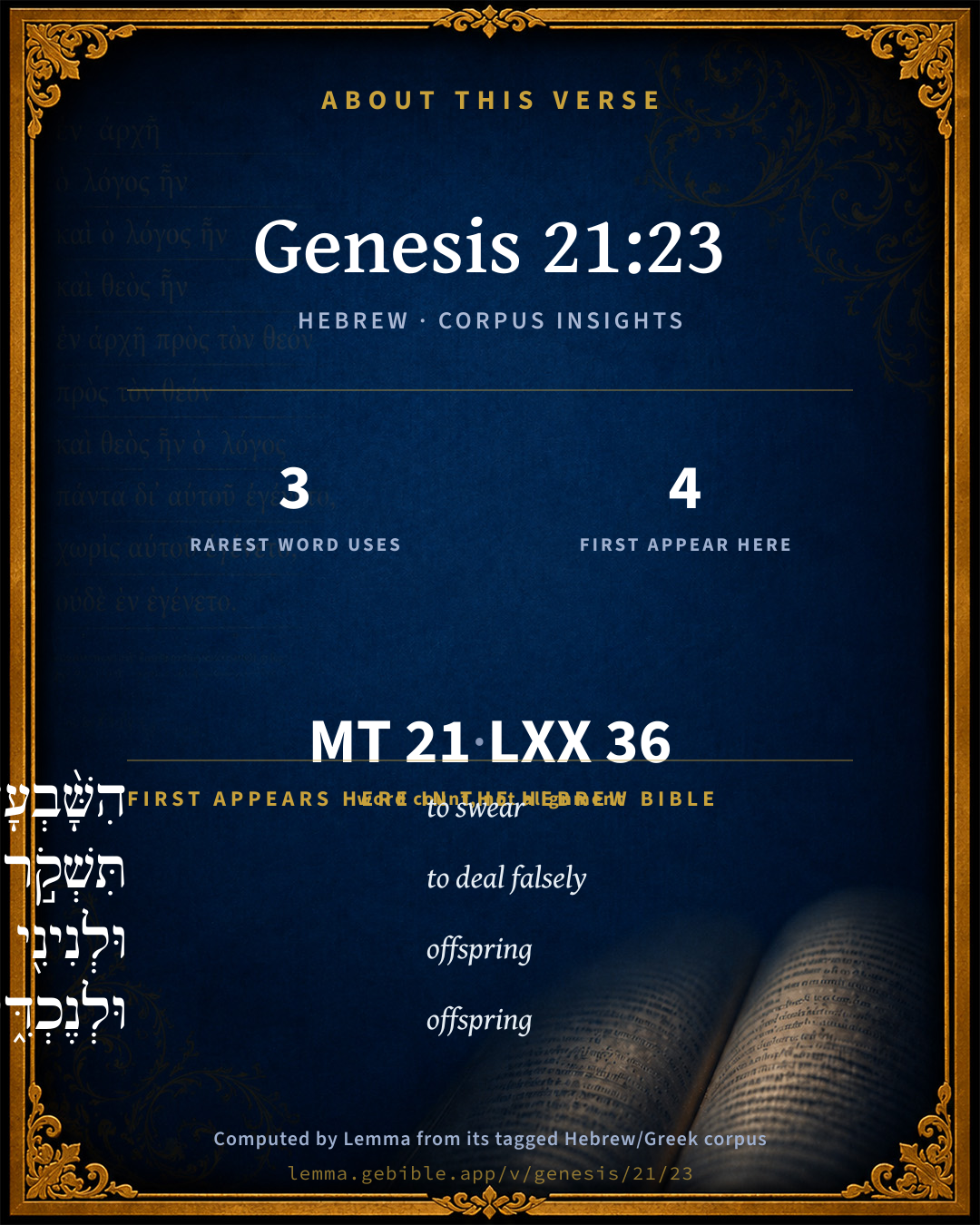
  • 4 first appearances in the Hebrew Bible
Full analysis ↓
Download a study sheet

One document with this verse’s original text, its word-by-word gloss line, the meaning frame, cross-references with their text, attributed commentary, and full source and license credits — printable, and it pastes into notes with its structure intact.

This verse Autodidact and up

Study sheet (.html) Plain text (.txt)

A passage Seminary Student

Up to 50 verses in one chapter. A passage sheet keeps up to 6 commentary sources and 12 cross-references per verse, in the order this page ranks them, and says so on the sheet whenever that leaves anything out. Ask for a single verse and you get the Autodidact verse sheet above.

Everything on this page stays free to read, with no account — the sheet is a download of what is already on screen, not access to it.

Want to remove ads? Support Godless Engineer
Compare translations 3

The same verse in 3 English versions, stacked beneath the original-language interlinear above. Click any original word for its lexicon entry.

Each is an independent rendering of the whole verse — the interlinear is not word-aligned to these translations.

Highlighted words mark where these versions differ — a whole-verse word diff, not a word-by-word alignment.

  • World English Bible Public Domain
    Now therefore swear to me here by God that you will not deal falsely with me, nor with my son, nor with my son's son. But according to the kindness that I have done to you, you shall do to me, and to the land in which you have lived as a foreigner."
  • King James Version Public Domain
    Now therefore swear unto me here by God that thou wilt not deal falsely with me, nor with my son, nor with my son's son: but according to the kindness that I have done unto thee, thou shalt do unto me, and to the land wherein thou hast sojourned.
  • unfoldingWord Literal Text CC BY-SA 4.0
    So now, swear to me here by God if you will deal falsely with me or with my children or with my descendants. According to the kindness that I have done to you, do to me and to the land which you are sojourning in.”

unfoldingWord Literal Text — © unfoldingWord, licensed CC BY-SA 4.0. Word-aligned USFM3 via Door43 (git.door43.org/unfoldingWord/en_ult).

Versions to compare (up to 4)

3 of 4 selected

Show all 18 translations

Every available English version of this verse, each an independent rendering of the whole verse.

  • World English Bible Public Domain
    Now therefore swear to me here by God that you will not deal falsely with me, nor with my son, nor with my son's son. But according to the kindness that I have done to you, you shall do to me, and to the land in which you have lived as a foreigner."
  • Berean Standard Bible Public Domain
    Now, therefore, swear to me here before God that you will not deal falsely with me or my children or descendants. Show to me and to the country in which you reside the same kindness that I have shown to you.”
  • Majority Standard Bible Public Domain
    Now, therefore, swear to me here before God that you will not deal falsely with me or my children or descendants. Show to me and to the country in which you reside the same kindness that I have shown to you.”
  • King James Version Public Domain
    Now therefore swear unto me here by God that thou wilt not deal falsely with me, nor with my son, nor with my son's son: but according to the kindness that I have done unto thee, thou shalt do unto me, and to the land wherein thou hast sojourned.
  • American Standard Version (1901) Public Domain
    Now therefore swear unto me here by God that thou wilt not deal falsely with me, nor with my son, nor with my son's son. But according to the kindness that I have done unto thee, thou shalt do unto me, and to the land wherein thou hast sojourned.
  • Revised Version (1885) Public Domain
    now therefore swear unto me here by God that thou wilt not deal falsely with me, nor with my son, nor with my son’s son: but according to the kindness that I have done unto thee, thou shalt do unto me, and to the land wherein thou hast sojourned.
  • Geneva Bible (1599) Public Domain
    Nowe therefore sweare vnto me here by God, that thou wilt not hurt me, nor my children, nor my childrens children: thou shalt deale with me, and with the countrey, where thou hast bene a stranger, according vnto the kindnesse that I haue shewed thee.
  • Douay-Rheims (1899) Public Domain
    Swear therefore by God, that thou wilt not hurt me, nor my posterity, nor my stock: but according to the kindness that I have done to thee, thou shalt do to me, and to the land wherein thou hast lived a stranger.
  • Young's Literal Translation Public Domain
    and now, swear to me by God here: thou dost not lie to me, or to my continuator, or to my successor; according to the kindness which I have done with thee thou dost with me, and with the land in which thou hast sojourned.'
  • Literal Standard Version CC BY-SA 4.0
    and now, swear to me by God here: you do not lie to me, or to my continuator, or to my successor; according to the kindness which I have done with you—do with me, and with the land in which you have sojourned.”
  • Unlocked Literal Bible CC BY-SA 4.0
    Now therefore swear to me here by God that you will not deal falsely with me, nor with my offspring, nor with my descendants. Show to me and to the land in which you have been staying the same covenant faithfulness that I have shown to you.”
  • unfoldingWord Literal Text CC BY-SA 4.0
    So now, swear to me here by God if you will deal falsely with me or with my children or with my descendants. According to the kindness that I have done to you, do to me and to the land which you are sojourning in.”
  • Darby Bible Public Domain
    And now swear to me here by God that thou wilt not deal deceitfully with me, nor with my son, nor with my grandson. According to the kindness that I have done to thee, thou shalt do to me, and to the land in which thou sojournest.
  • World Messianic Bible Public Domain
    Now, therefore, swear to me here by God that you will not deal falsely with me, nor with my son, nor with my son’s son. But according to the kindness that I have done to you, you shall do to me, and to the land in which you have lived as a foreigner.”
  • Webster's Bible Public Domain
    Now therefore swear to me here by God, that thou wilt not deal falsely with me, nor with my son, nor with my son's son: but according to the kindness that I have done to thee, thou shalt do to me, and to the land in which thou hast sojourned.
  • Free Bible Version CC BY-SA 4.0
    “So swear to me right here and now that you won't betray me, my children, or my descendants. In the same way I've proved I'm trustworthy to you, do the same to me and my country where you're currently living.”
  • Bible in Basic English Public Domain
    Now, then, give me your oath, in the name of God, that you will not be false to me or to my sons after me, but that as I have been good to you, so you will be to me and to this land where you have been living.
  • JPS Tanakh (1917) Public Domain
    Now therefore swear unto me here by God that thou wilt not deal falsely with me, nor with my son, nor with my son's son; but according to the kindness that I have done unto thee, thou shalt do unto me, and to the land wherein thou hast sojourned.'

Literal Standard Version (2020), Covenant Press — licensed CC BY-SA 4.0. Text via the HelloAO Bible API (eBible.org). Unlocked Literal Bible (unfoldingWord) — licensed CC BY-SA 4.0. Text via the HelloAO Bible API (eBible.org). unfoldingWord Literal Text — © unfoldingWord, licensed CC BY-SA 4.0. Word-aligned USFM3 via Door43 (git.door43.org/unfoldingWord/en_ult). Free Bible Version, Dr. Jonathan Gallagher — licensed CC BY-SA 4.0. Text via the HelloAO Bible API (eBible.org).

Word by word

More ways to search: Search by grammar → Find every occurrence → Compare this word →

Practice this passage: Drill this verse → Learn its vocabulary →

וּלְנִינִ֖י
nîyn
H5209
“and · to/for · offspring · my”
Conjunction + Preposition + Noun, Common, Masculine, Singular, Construct + Suffix, Personal, 1st Person, Common, Singular
Part of Speech
Conjunction + Preposition + Noun
Type
Common
Gender
Masculine
Number
Singular
State
Construct
Full BDB Definition

Origin: from H5125

TWOT: 1326a

offspring, posterity
  1. וְעַתָּ֗ה ʻattâh H6258 “and · now” Conjunction + Adverb
  2. הִשָּׁ֨בְעָה shâbaʻ H7650 “swear” Verb, Niphal, Imperative, 2nd Person, Masculine, Singular + Suffix, h
  3. בֵֽאלֹהִים֙ ʼĕlôhîym H430 “in/at · God(s)” Preposition + Noun, Common, Masculine, Plural, Absolute
  4. הֵ֔נָּה hênnâh H2008 “here” Adverb
  5. אִם ʼim H518 “if” Conjunction
  6. תִּשְׁקֹ֣ר shâqar H8266 “to deal falsely” Verb, Qal, Imperfect, 2nd Person, Masculine, Singular
  7. וּלְנֶכְדִּ֑י neked H5220 “and · to/for · offspring · my” Conjunction + Preposition + Noun, Common, Masculine, Singular, Construct + Suffix, Personal, 1st Person, Common, Singular
  8. כַּחֶ֜סֶד chêçêd H2617 “like/as the · kindness” Preposition, Determined + Noun, Common, Masculine, Singular, Absolute
  9. אֲשֶׁר ʼăsher H834 “which” Particle, Relative
  10. עָשִׂ֤יתִי ʻâsâh H6213 “to do” Verb, Qal, Perfect, 1st Person, Common, Singular
  11. עִמְּךָ֙ ʻim H5973 “with · you” Preposition + Suffix, Personal, 2nd Person, Masculine, Singular
  12. תַּעֲשֶׂ֣ה ʻâsâh H6213 “to do” Verb, Qal, Imperfect, 2nd Person, Masculine, Singular
  13. עִמָּדִ֔י ʻimmâd H5978 “with · me” Preposition + Suffix, Personal, 1st Person, Common, Singular
  14. וְעִם ʻim H5973 “and · with” Conjunction + Preposition
  15. הָאָ֖רֶץ ʼerets H776 “the · land” Particle, Definite Article + Noun, Common, Both, Singular, Absolute
  16. אֲשֶׁר ʼăsher H834 “which” Particle, Relative
  17. גַּ֥רְתָּה gûwr H1481 “to sojourn” Verb, Qal, Perfect, 2nd Person, Masculine, Singular

About this verse

These counts appear in no published source. They are computed here, from the morphology-tagged text and Lemma’s own curated glosses. What Lemma adds →

21
words
15
distinct lemmas
Pentateuch
section

Notable vocabulary

The rarest word here is וּלְנִינִ֖י offspring H5209 — appearing just 3 times in the whole Hebrew Bible.

First appearance in Scripture

These words make their first canonical appearance in the Hebrew Bible here:

  • הִשָּׁ֨בְעָה to swear H7650
  • תִּשְׁקֹ֣ר to deal falsely H8266
  • וּלְנִינִ֖י offspring H5209
  • וּלְנֶכְדִּ֑י offspring H5220

Shared distinctive vocabulary

וּלְנִינִ֖י offspring H5209 occurs in 3 verses of the Hebrew Bible. Also found in:

Grammatical profile

  • 5 verbs
  • 5 nouns
  • 6 prepositions
  • 1 conjunction
  • 2 adverbs
  • 2 particles

Verb forms

  • הִשָּׁ֨בְעָה Niphal · Imperative
  • תִּשְׁקֹ֣ר Qal · Imperfect
  • עָשִׂ֤יתִי Qal · Perfect
  • תַּעֲשֶׂ֣ה Qal · Imperfect
  • גַּ֥רְתָּה Qal · Perfect

Repetition

Words recur within this verse — often emphatic in Hebrew:

  • עָשִׂ֤יתִי to do H6213 ×2
  • אֲשֶׁר which H834 ×2
  • עִמְּךָ֙ with H5973 ×2

Hebrew & Septuagint length

In English translation the verse runs 53 words from the Hebrew and 44 from the Septuagint (LXX English) — closely comparable.

A rough comparison of the two English renderings, which tokenize alike — not a word-level alignment.

Word counts can differ between the Hebrew and the Greek without any difference in meaning — e.g. the Hebrew direct-object marker אֵת has no separate Greek word, and Greek often adds the article ὁ.

In the original languages it is 21 Hebrew tokens and 36 Greek tokens — but the two are counted differently (Hebrew bundles its prefixes and suffixes into one token; the Greek is in lemma form), so that isn’t a like-for-like length.

Cross-references

16

Topical passages linked to Genesis 21:23 in the Treasury of Scripture Knowledge — connected by theme and wording, ordered by reader-vote popularity; previews shown in the World English Bible.

  • Joshua 2:12 Now therefore, please swear to me by Yahweh, since I have dealt kindly with you, that you also will deal kindly with my father's house, and give me a true token;
  • Genesis 20:14 Abimelech took sheep and oxen, men-servants and women-servants, and gave them to Abraham, and restored Sarah, his wife to him.
  • Genesis 14:22–23 Abram said to the king of Sodom, "I have lifted up my hand to Yahweh, God Most High, possessor of heaven and earth,
  • Genesis 24:3 I will make you swear by Yahweh, the God of heaven and the God of the earth, that you shall not take a wife for my son of the daughters of the Canaanites, among whom I live.
  • Genesis 26:28 They said, "We saw plainly that Yahweh was with you. We said, 'Let there now be an oath between us, even between us and you, and let us make a covenant with you,
  • Genesis 31:44 Now come, let us make a covenant, you and I; and let it be for a witness between me and you."
  • Genesis 31:53 The God of Abraham, and the God of Nahor, the God of their father, judge between us." Then Jacob swore by the fear of his father, Isaac.
  • Deuteronomy 6:13 You shall fear Yahweh your God; and him shall you serve, and shall swear by his name.
  • 1 Samuel 20:13 Yahweh do so to Jonathan, and more also, should it please my father to do you evil, if I don't disclose it to you, and send you away, that you may go in peace: and Yahweh be with you, as he has been with my father.
  • 1 Samuel 20:17 Jonathan caused David to swear again, for the love that he had to him; for he loved him as he loved his own soul.
  • 1 Samuel 20:42 Jonathan said to David, Go in peace, because we have sworn both of us in the name of Yahweh, saying, Yahweh shall be between me and you, and between my seed and your seed, forever. He arose and departed: and Jonathan went into the city.
  • 1 Samuel 24:21–22 Swear now therefore to me by Yahweh, that you will not cut off my seed after me, and that you will not destroy my name out of my father's house.
  • 1 Samuel 30:15 David said to him, Will you bring me down to this troop? He said, Swear to me by God, that you will neither kill me, nor deliver me up into the hands of my master, and I will bring you down to this troop.
  • Jeremiah 4:2 and you shall swear, As Yahweh lives, in truth, in justice, and in righteousness; and the nations shall bless themselves in him, and in him shall they glory.
  • 2 Corinthians 1:23 But I call God for a witness to my soul, that I didn't come to Corinth to spare you.
  • Hebrews 6:16 For men indeed swear by a greater one, and in every dispute of theirs the oath is final for confirmation.

Cross-references courtesy of OpenBible.info (CC BY 4.0).

Hebrew and Greek witnesses Masoretic Hebrew ↔ Greek Septuagint

The same verse in the two great witnesses to the Old Testament, shown verse-for-verse.

These are two independent witnesses, not word-aligned to each other, and the Septuagint is shown in lemma (dictionary) form.

Hebrew Genesis 21:23 Masoretic · Westminster Leningrad Codex

וְעַתָּ֗ה הִשָּׁ֨בְעָה לִּ֤י בֵֽאלֹהִים֙ הֵ֔נָּה אִם תִּשְׁקֹ֣ר לִ֔י וּלְנִינִ֖י וּלְנֶכְדִּ֑י כַּחֶ֜סֶד אֲשֶׁר עָשִׂ֤יתִי עִמְּךָ֙ תַּעֲשֶׂ֣ה עִמָּדִ֔י וְעִם הָאָ֖רֶץ אֲשֶׁר גַּ֥רְתָּה בָּֽהּ

Now therefore swear to me here by God that you will not deal falsely with me, nor with my son, nor with my son's son. But according to the kindness that I have done to you, you shall do to me, and to the land in which you have lived as a foreigner."

World English Bible · Public Domain

Greek LXX Genesis 21:23 Septuagint · lemma form

νῦν οὖν ὄμνυμι ἐγώ ὁ θεός μή ἀδικέω ἐγώ μηδέ ὁ σπέρμα ἐγώ μηδέ ὁ ὄνομα ἐγώ ἀλλά κατά ὁ δικαιοσύνη ὅς ποιέω μετά σύ ποιέω μετά ἐγώ καί ὁ γῆ ὅς σύ παραοἰκέω ἐν αὐτός

Now therefore swear to me by God that you will not injure me, nor my seed, nor my name, but according to the righteousness which I have performed with you you shall deal with me, and with the land in which you have sojourned.

LXX2012 (modern English Septuagint) · Public Domain

On this verse, The Cambridge Bible for Schools and Colleges discusses the Septuagint’s reading. Read the note in Commentary ↓

Hebrew: Westminster Leningrad Codex (CC BY 4.0). Greek: Septuagint (public domain); English from LXX2012 (modern English Septuagint) (Public Domain). How the Septuagint differs from the Hebrew →

Targum (Aramaic paraphrase)

2

The Targum is the ancient Jewish Aramaic paraphrase of the Hebrew Scriptures — an interpretive translation, not the Hebrew text itself. Onkelos (literal) and Pseudo-Jonathan (expansive) render the Torah, and Jonathan the Prophets. Coverage is partial: where no permissively-licensed English translation exists for a verse, only the Aramaic is shown. This is verse-level text, not a word-by-word alignment to the Hebrew.

  1. Targum Onkelos Torah (Genesis–Deuteronomy)
    וּכְעַן קַיֵּם לִי בְּמֵימְרָא דַּיְיָ הָכָא דְּלָא תְשַׁקַּר בִּי וּבִבְרִי וּבְבַר בְּרִי כְּטִיבוֹתָא דִּי עֲבָדִית עִמָּךְ תַּעְבֵּד עִמִּי וְעִם אַרְעָא דְאִתּוֹתַבְתָּא בַהּ

    (no public-domain English translation for this verse)

    Targum Onkelos — Aramaic: “Onkelos Genesis” (public domain); “Onkelos Exodus” (public domain); “Onkelos Leviticus” (public domain); “Onkelos Numbers” (public domain); “Onkelos Deuteronomy” (public domain). English: “Sefaria Community Translation” (CC0 1.0 (public-domain dedication)); “J.W. Etheridge. The Targums of Onkelos and Jonathan Ben Uzziel on the Pentateuch. London: Longmans, Green, 1862” (public domain). Text via Sefaria.

  2. Targum Pseudo-Jonathan Torah (Genesis–Deuteronomy)
    וּכְעַן קְיַים לִי בְּמֵימְרָא דַיְיָ הָכָא אִין תִּשְׁקַר בִּי וּבִבְרִי וּבְבַר בְּרִי כְּטֵיבוּתָא דְעָבְדִית עִמָךְ תַּעֲבֵיד עִמִי וְעִם אַרְעָא דְדַרְתָּא בָּהּ

    And now, swear to me here, by the Word of the Lord, that thou wilt not be false with me, nor with my son, nor with the son of my son: according to the kindness which I have done with thee, thou shalt do with me, and with the land in which thou dwellest.

    Targum Pseudo-Jonathan — Aramaic: “Targum Jonathan on Genesis” (public domain); “Targum Jonathan on Exodus” (public domain); “Targum Jonathan on Leviticus” (public domain); “Targum Jonathan on Numbers” (public domain); “Targum Jonathan on Deuteronomy” (public domain). English: “The Targum of Jonathan ben Uzziel, trans. J. W. Etheridge, London, 1862” (public domain). Text via Sefaria.

Commentary

Notes on Genesis 21:23 from classic Christian and Jewish commentators (each source and its license shown beneath its notes). The classic Christian expositions comment on the surrounding passage and are grouped to its opening verse, so a note may address several verses; the Jewish commentaries on the Tanakh (Rashi and others) are per-verse, so they appear only where the commentator wrote on this verse.

Lemma curates 59 commentaries, every one of them public domain or Creative Commons licensed, each selected and text-cleaned for this edition rather than reprinted as found. About our sources →

Trapp's Complete Commentary

John Trapp

Gen 21:23 Now therefore swear unto me here by God that thou wilt not deal falsely with me, nor with my son, nor with my son’s son: [but] according to the kindness that I have done unto thee, thou shalt do unto me, and to the land wherein thou hast sojourned.

Ver. 23. Swear unto me here by God, &c.] This visit, we see, was more of fear than of love: there can be no hearty love, indeed, but between true Christians. Kings, then, have their cares, crowns their crosses: thistles in their arms, and thorns in their sides. This made one cry out of his diadem, O vilis pannus ,& c. And Canutus set his crown upon the crucifix. Frederick, the Elector of Saxony, is said to have been born with the sign of a cross upon his back. {a} And the next night after that Rodulphus Rufus was crowned emperor of Germany, anno Dom. 1273, over the temple, where the crown was set upon his head, a golden cross was seen to shine, like a star, to the admiration of all that beheld it. {b} These were the same emperor’s verses concerning his crown imperial: -

“ Nobilis es fateor, rutilisque onerata lapillis:

Innumeris curis sed comitata venis;

Quod bene si nossent omnes expendere, nemo

Nemo foret, qui te tollere vellet humo .”

{a} Scultet. Annal.

{b} Dan. Pare., Hist. Profan. Medulla., 723, 728.

John Trapp, A Commentary or Exposition upon All the Books of the Old and New Testament (1647–1656) — public domain. Text from a community e-Sword module.

The Biblical Illustrator

Joseph S. Exell

Gen_21:23-32

Swear unto me here by God that thou wilt not deal falsely with me

Abraham the friend of man

I.

ABRAHAM YIELDS READILY TO THE REQUEST FOR HIS FRIENDSHIP. Abimelechs motives in seeking the friendship of Abraham were probably mixed, and included.

1. Expediency.

2. The worship of success.

3. The admiration of goodness.

II. ABRAHAM UNDERTAKES THE DUTIES OF FRIENDSHIP. He freely accepts Abimelechs conditions.

1. True and righteous dealing.

2. Gratitude for favours shown.

3. Faithfulness to the faults of a friend.

III. ABRAHAM RECOGNIZED THE SACREDNESS OF FRIENDSHIP (Gen_21:24). (T. H.Leale.)

Abraham and Abimelech

Observe--

(1) The motive that induces this friendly request; he saw that God was with him. Probably the news of the extraordinary birth of Isaac had reached the court of Abimelech, and became a topic of conversation. This, said he, is a great man, and a great family, and will become a great nation; the blessing of heaven attends him. It is our wisdom therefore, to take the earliest opportunity to be on good terms with him! Had Abimelechs successors always acted on this principle towards Israel, it had been better for them; for whether they knew it or not, God, in blessing Abraham, had promised to bless them that blessed him, and to curse them that cursed him.

(2) The solemnity with which he wished the friendship to be confirmed: swear unto me by God. . . . It is a dictate of prudence very common among magistrates to require men to swear by a name which the party holds sacred. In this view Abimelech certainly acted a wise part; for whoever made light of Gods name, the party here concerned would not. Abrahams cheerful and ready compliance. I hope he did not need to be sworn not to deal falsely; but as posterity was concerned the mere solemn the engagement the better. The friend of God has no desire but to be the friend of man. (A. Fuller.)

The Biblical Illustrator, edited by Joseph S. Exell (c. 1880s–1900s) — public domain. Text from a community e-Sword module.

Geneva Bible (1599)

Geneva Bible translators

Hebrew, deal falsely with me, or lie.

Geneva Bible (1599) marginal notes — public domain. Text via Bolls.life.

Adam Clarke's Commentary

Verse 23. Now therefore swear unto me] The oath on such occasions probably meant no more than the mutual promise of both the parties, when they slew an animal, poured out the blood as a sacrifice to God, and then passed between the pieces. See this ceremony, Ge 15:18, and on Ge 15:9; Ge 15:10.

According to the kindness that I have done] The simple claims of justice were alone set up among virtuous people in those ancient times, which constitute the basis of the famous lex talionis, or law of like for like, kind office for kind office, and breach for breach.

Adam Clarke's Commentary on the Bible (1810–1826) — public domain. Text from a community e-Sword/MySword module.

John Calvin's Commentaries

23. That thou wilt not deal falsely with me Literally it is, ‘If thou shalt lie;’ for, among the Hebrews, a defective form of speech is common in taking oaths, which is to be thus explained: ‘If thou shouldst break the promise given to me, we call upon God to sit as Judge between us, and to show himself the avenger of perjury.’ But ‘to lie,’ some here take for dealing unjustly and fraudulently; others for failing in the conditions of the covenant. I simply understand it as if it were said, ‘Thou shalt do nothing perfidiously with me or with my descendants.’ Abimelech also enumerates his own acts of kindness, the lore effectually to exhort Abraham to exercise good faith; for, seeing he had been humanely treated, Abimelech declares it would be an act of base ingratitude if he did not, in return, endeavor to repay the benefits he had received. The Hebrew word חסד(chesed) signifies to deal gently or kindly with any one. For Abimelech did not come to implore compassion of Abraham, but rather to assert his own royal authority, as will appear from the context.

John Calvin's Commentaries (1540-1563) — public domain. Text from the Calvin Translation Society English edition (1840s-50s) via the Christian Classics Ethereal Library (ccel.org). Calvin's coverage is partial (roughly two-thirds of the Bible); uncommented books and verses are honest gaps, never fabricated. The 19th-century editor's footnotes and remarks are omitted so the notes are faithfully Calvin's own voice.

Ellicott's Commentary for English Readers

(23) Nor with my son, nor with my son’s son.—The words are not those commonly used for son and grandson, but a Hebrew phrase signifying my kith and kin. They might be translated, “nor with mine offshoot nor mine offspring.” The words occur again in the same proverbial way in Job_18:19; Isa_14:22.

A Bible Commentary for English Readers, edited by Charles John Ellicott (1878–1897) — public domain. Text from a community e-Sword module.

The Cambridge Bible for Schools and Colleges

gen. ed. J. J. S. Perowne

23. here] The reference is to the name of Beer-sheba and its popular etymology from the Hebrew word “to swear.” Abraham’s departure from Gerar is not recorded, but was doubtless included in the E narrative which is only fragmentarily preserved.

my son, &c.] R.V. marg. my offspring, nor with my posterity. The words which are not usual are found together in Job_18:19; Isa_14:22; LXX μηδὲ τὸ σπέρμα μου μηδέ τὸ ὄνομά μου, Lat. posteris stirpique meae. The original phrase is alliterative, like our “neither kith nor kin.”

the kindness] Referring to the gifts to Abraham in Gen_20:14, and the free welcome extended to Abraham in Gen_20:15. Abimelech is desirous to seal these friendly relations by a definite compact. There is an abrupt transition, in Gen_21:25-26, to occasions of friction.

The Cambridge Bible for Schools and Colleges (gen. ed. J. J. S. Perowne; Cambridge University Press, 1878–1918) — public domain. Text from a community e-Sword module.

John Gill's Exposition

And Abraham said, I will swear. Sensible of the many favours he had received from Abimelech in times past, and was still indulged with, he very readily agreed to his proposal; and the rather, as he knew by the vision between the pieces, that it would be four hundred years before his posterity should be put into the possession of the land of Canaan; and therefore could take an oath that neither he, nor his son, nor his grandson, should be injured or dispossessed.

And Abraham said, I will swear. Sensible of the many favours he had received from Abimelech in times past, and was still indulged with, he very readily agreed to his proposal; and the rather, as he knew by the vision between the pieces, that it would be four hundred years before his posterity should be put into the possession of the land of Canaan; and therefore could take an oath that neither he, nor his son, nor his grandson, should be injured or dispossessed.

Genesis 21:25

gen 21:25

gen 21:25

gen 21:25And Abraham reproved Abimelech because of a well of water,.... Before he swore and entered into covenant with him, he thought it advisable to inform him of an affair that had happened concerning a well of water, which in those hot and dry countries, as the southern parts of the land of Canaan were, was an affair of great importance; and to make complaint of the ill usage of Abimelech's servants with respect to it, and to reason with him about it, that the thing might be adjusted to mutual satisfaction, and so a firm basis and foundation be laid for the continuance of friendship for the future; which was wisely done before their league and covenant was ratified: this it seems was a well

which Abimelech's servants had violently taken away: that is, had by force taken the use of it to themselves for their cattle, and had deprived Abraham of it, though it was of his own digging; and perhaps there might be more than one, and the singular may be put for the plural; and so the Septuagint version has it, "the wells": see Gen 26:15.

John Gill's Exposition of the Whole Bible (1746–1763) — public domain (CC PDM 1.0). Text via the HelloAO Bible API.

Haydock's Catholic Bible Commentary

Hurt me. Hebrew, "lie unto me, " or revolt and disturb the peace of my people.

George Leo Haydock (1774–1849), Haydock's Catholic Family Bible and Commentary, 1859 edition — public domain. Excludes Psalms (Douay-Rheims chapter numbering differs from Protestant) and Deuterocanonical books (Catholic canon only).

Matthew Poole's English Annotations

That thou wilt not deal falsely with me; that thou wilt not do me any hurt or injury; Heb. That thou wilt not lie unto me; i.e. as thou hast formerly professed kindness and friendship to me, give me thy oath to assure me that thou wilt be true and constant to thy own professions.

Matthew Poole's English Annotations on the Holy Bible (1683–1685) — public domain. Text from a community e-Sword/MySword module.

Whedon's Commentary on the Bible

Daniel D. Whedon

23. Not deal falsely — Perhaps Abraham’s duplicity in the matter of Sarah had somewhat to do with inciting Abimelech to seek this oath. He feared his overreaching cunning and sagacity.

Daniel D. Whedon (gen. ed.), Commentary on the Old and New Testaments (1874–1909) — public domain. Text from a community e-Sword module.

The Pulpit Commentary

Now therefore swear unto me here by God the verb to swear is derived from the Hebrew numeral seven, inasmuch as the septennary number was sacred, and oaths were confirmed either by seven sacrifices. (Gen_21:28) or by seven witnesses and pledgesthat thou wilt not deal falsely with me, literally, if thou shalt lie unto me; a common form of oath in Hebrew, in which the other member of the sentence is for emphasis left unexpressed (cf. Rth_1:17, and vide. (Gen_14:23) As a prince, Abimelech was afraid of Abraham"s growing power; as a good man, he insures the safety of himself and his dominions not by resorting to war, but by forming an amicable treaty with his neighbornor with my son, nor with my son"s son: sperma kai onoma (LXX); posteri et stirps (Vulgate); offspring and progeny (Kalisch); kith and kin (Murphy)but according to the kindness that I have done unto thee, (vide Gen_20:15) thou shalt do unto me, and to the land wherein thou hast sojourned the land being put for the people (cf. Num_14:13)

The Pulpit Commentary (1880–1919), ed. H.D.M. Spence-Jones & Joseph S. Exell — public domain. Text from a community e-Sword module.

Rashi

Rabbi Shlomo Yitzchaki (Rashi)

ולניני ולנכדי NOR WITH MY SON NOR WITH MY SON’S SON — thus far extends a man’s pity for his descendants (Genesis Rabbah 54:2).

כחסד אשר עשיתי עמך תעשה עמדי ACCORDING TO THE KINDNESS THAT I HAVE DONE UNTO THEE THOU SHALT DO UNTO ME — viz., that I said to you. (Genesis 20:15) “Behold my land is before thee”.

Rashi on the Tanakh — English translations: “The Judaica Press complete Tanach with Rashi, translated by A. J. Rosenberg” (CC BY 4.0); “Pentateuch with Rashi's commentary by M. Rosenbaum and A.M. Silbermann, 1929-1934” (public domain); “The Metsudah Tanach series, Lakewood, N.J” (CC BY 4.0); and “The Book of Joshua, Metsudah Publications, 1997” (CC BY 4.0). Text via Sefaria.

Ramban (Nachmanides)

Rabbi Moshe ben Nachman (Ramban / Nachmanides)

NOW THEREFORE SWEAR UNTO ME HERE BY G-D ‘IM’ (IF) YOU WILL BE FALSE TO ME. The word im always expresses doubt — do not think of it in any other way to mean “that.” See Ramban there, where he explains it in a manner consistent with his teaching here. — and it appears in most places in connection with an oath: If you will be false to me; And therefore I have sworn unto the house of Eli ‘im’ (if) the iniquity of Eli’s house shall be expiated; Once I have sworn by My holiness ‘im’ (if) I will be false unto David; ‘im’ (if) they should enter into My rest;, 95:11. And he was wroth, and swore, saying, ‘im’ (if) one of these men will see. The purport of this is that since oaths are given with imprecation, Abimelech is stating, “Swear to me, saying, G-d do so to me, and more also if you will be false to me.” Likewise it is said, Let there now be an oath between us. And in the matter of a Divine oath: I have sworn by My holiness if I will be false to David; if the iniquity of Eli’s house shall be expiated, meaning “If that will be so, then My word is not true,” and in similar cases, since it does not want to expressly state the condition. Scripture modifies and shortens these expressions. A similar case of a shortened condition is the verse, And Jabez called on the G-d of Israel, saying: Oh that Thou wouldest bless me indeed, and enlarge my border, etc., and that Thou wouldest work deliverance from evil that it may not pain me. And G-d granted him that which he requested. Here the entire condition is missing. A similar example is the verse, If they will see the land, referring back to the first verse, As I live, and all shall be filled with the glory of the Eternal, Verse 21. and Scripture shortens the Divine oath.The expression, false to me, is because Abimelech was a king, and Abraham dwelt in his land. [Thus, if Abraham were to do him evil, it would be an act of disloyalty towards him in his royal capacity], or it would be a betrayal of Abimelech’s love for him, as he [Abimelech] was his trustworthy friend, honoring him and doing his will. For you see that Abraham found no fault with him except the well of water, which Abimelech’s servants had violently taken away, and the king said to him, According to the kindness that I have done unto thee.

Ramban (Nachmanides) on the Tanakh — English translation: “Commentary on the Torah by Ramban (Nachmanides). Translated and annotated by Charles B. Chavel. New York, Shilo Pub. House, 1971-1976” (CC BY 4.0). Text via Sefaria.

Radak

Rabbi David Kimhi (Radak)

ועתה..אם תשקור לי, perhaps the subject here is the immediate future, i.e. ועתה. Avimelech is concerned that within the next or subsequent generation the friendly relations between Avraham and himself might sour. Therefore he suggests a treaty reinforced by an oath as he is sure that Avraham would not renege on an undertaking confirmed by an oath. He is trying to commit the next 3 generations to this undertaking he asks from Avraham.

The words לי ולניני ולנכדי comprise three generations. The word נין refers to the son, whereas the word נכד refers to the son’s son. The same words appear in the same sense in Isaiah 14,22 והכרתי לבבל שם ושאר נין ונכד, “I will wipe out from Babylon name and remnant, son and grandson, etc.”

כחסד אשר עשיתי עמך תעשה עמדי, I allowed you to settle in any part of my country that you chose to settle in, and I respected you.

ועם הארץ אשר גרת בה, I expect you also to act in a friendly manner with all the inhabitants of this country who will survive me, both you and your children and grandchildren after you, seeing that you have been treated well in this country by its people.

Radak on the Tanakh — English translations: “Sefaria Community Translation” (CC0 1.0 (public-domain dedication)); “Eliyahu Munk, HaChut Hameshulash” (CC BY 4.0); “Rabbi Mike Feuer, Jerusalem Anthology” (CC BY 4.0); and “R. David Kimhi on the first book of Psalms, Translated by R.G. Finch, London, 1919” (public domain). Text via Sefaria.

Lesson kit

Teaching starters — assembled from the data on this page, not authored interpretation. Every prompt links to the verse data it draws on. Edit before teaching.

Genesis, in the Pentateuch, opens this verse with 21 words (15 distinct Hebrew lemmas). Its most distinctive word is nîyn (“offspring”). A historical commentator’s framing appears above. Read the whole chapter for the surrounding context.

Discussion questions

  1. How does “offspring” (nîyn) shape what this verse is saying?
  2. 4 words here appear for the first time in Scripture. What is being introduced at this debut?
  3. Job 18:19 shares the word «offspring» with this verse. How do the two illuminate each other?
  4. “to do” occurs 2× in this one verse. What is the effect of the repetition?
  5. The translations on this page render this verse differently — a whole-verse word diff, not a word-by-word alignment. What might account for the different wordings?
  6. The verb «הִשָּׁ֨בְעָה» is Niphal Imperative. How does its form color the action?
  7. Reading how Trapp's Complete Commentary and The Biblical Illustrator read this verse, where do the two commentators agree and where do they part?

Things to notice

Reading settings

Reading text

Shown beneath each verse's original-language words.

Old Testament
Old Testament edition

Read the OT as the Masoretic Hebrew (MT) or the Greek Septuagint (LXX).

English shown for the Greek Septuagint (in the Hebrew ↔ Greek comparison).

Comparing translations? Open the Compare panel on any verse page to stack up to four side by side.