
Matthew 7:26

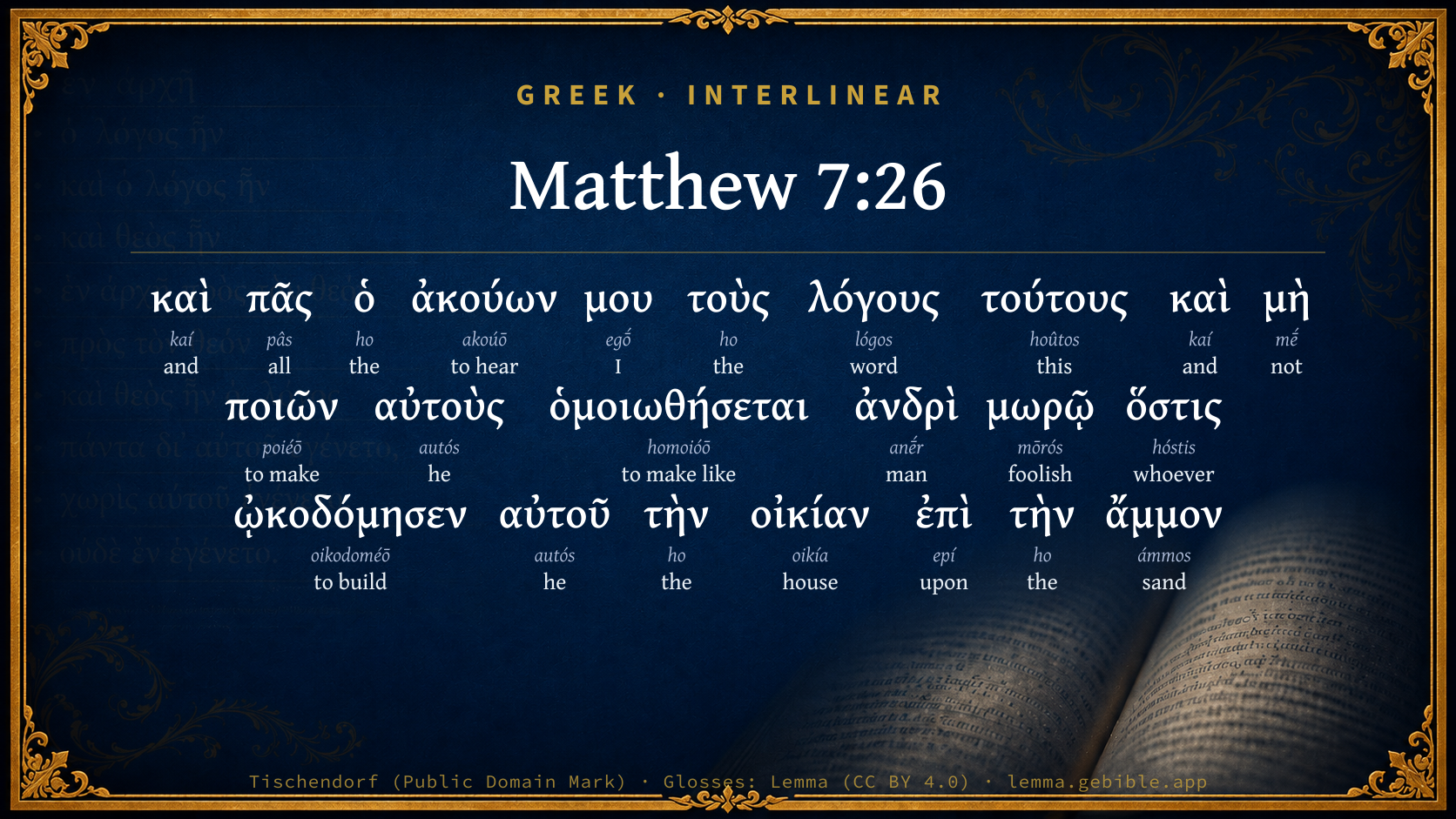
Greek (Tischendorf 8th ed.) Matthew 7:26 appears in the Greek New Testament. The text above is from the Tischendorf 8th edition. Each word links to its Strong’s number and a concise gloss. Click any word for its full Thayer’s Greek Lexicon entry.
Download image
Cite this verse

Matthew 7:26 (World English Bible). Public Domain. Lemma interlinear Bible study tool, https://lemma.gebible.app/v/matthew/7/26.

Show BibTeX & RIS
BibTeX
RIS
English Translation
Everyone who hears these words of mine, and doesn't do them will be like a foolish man, who built his house on the sand.
World English Bible · Public Domain
Highlights
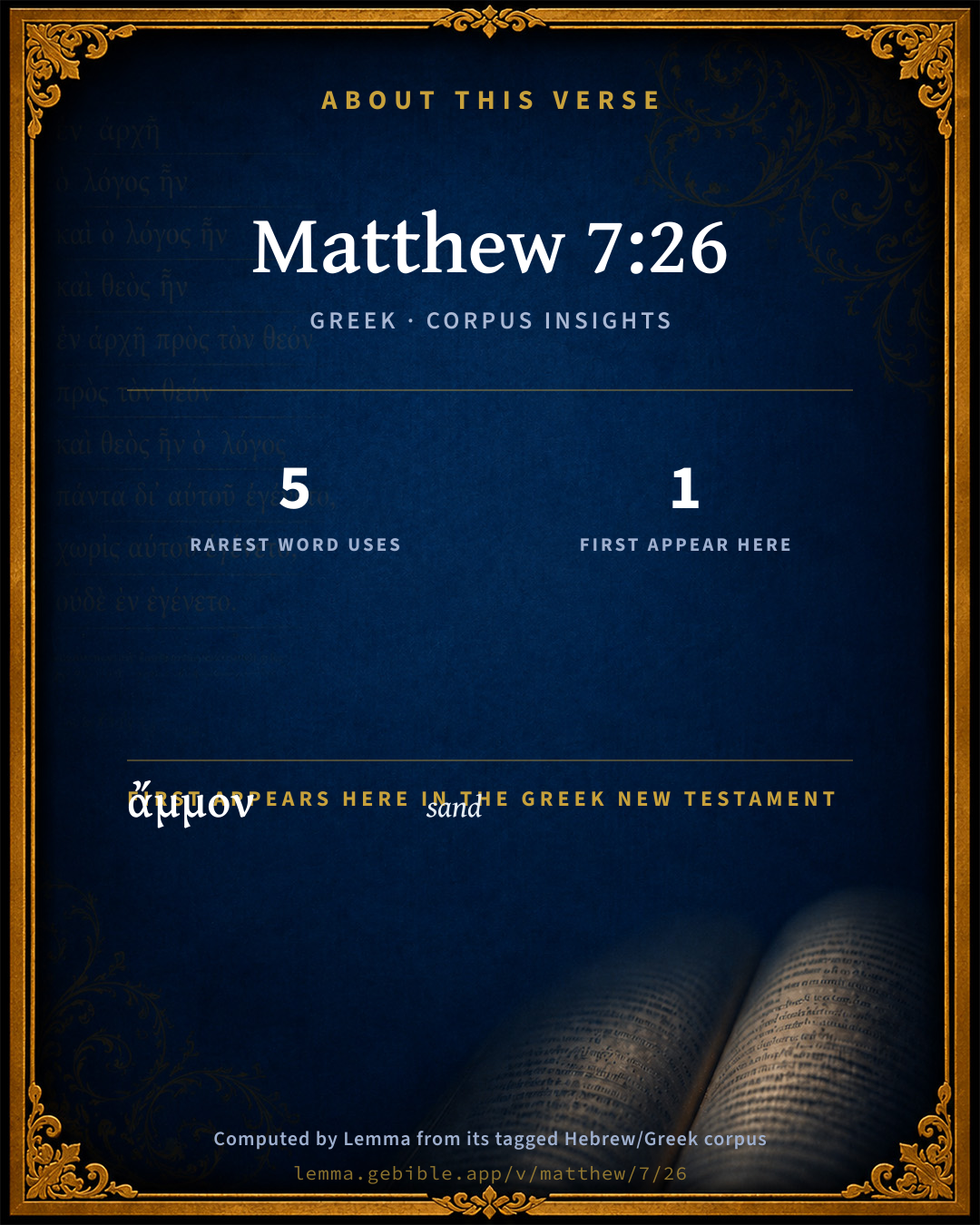
  • 1 first appearance in the Greek New Testament
Full analysis ↓
Download a study sheet

One document with this verse’s original text, its word-by-word gloss line, the meaning frame, cross-references with their text, attributed commentary, and full source and license credits — printable, and it pastes into notes with its structure intact.

This verse Autodidact and up

Study sheet (.html) Plain text (.txt)

A passage Seminary Student

Up to 50 verses in one chapter. A passage sheet keeps up to 6 commentary sources and 12 cross-references per verse, in the order this page ranks them, and says so on the sheet whenever that leaves anything out. Ask for a single verse and you get the Autodidact verse sheet above.

Everything on this page stays free to read, with no account — the sheet is a download of what is already on screen, not access to it.

Want to remove ads? Support Godless Engineer
Compare translations 3

The same verse in 3 English versions, stacked beneath the original-language interlinear above. Click any original word for its lexicon entry.

Each is an independent rendering of the whole verse — the interlinear is not word-aligned to these translations.

Highlighted words mark where these versions differ — a whole-verse word diff, not a word-by-word alignment.

  • World English Bible Public Domain
    Everyone who hears these words of mine, and doesn't do them will be like a foolish man, who built his house on the sand.
  • King James Version Public Domain
    And every one that heareth these sayings of mine, and doeth them not, shall be likened unto a foolish man, which built his house upon the sand:
  • unfoldingWord Literal Text CC BY-SA 4.0
    But everyone hearing these words of mine and not doing them will be compared to a foolish man who built his house upon the sand.

unfoldingWord Literal Text — © unfoldingWord, licensed CC BY-SA 4.0. Word-aligned USFM3 via Door43 (git.door43.org/unfoldingWord/en_ult).

Versions to compare (up to 4)

3 of 4 selected

Show all 19 translations

Every available English version of this verse, each an independent rendering of the whole verse.

  • World English Bible Public Domain
    Everyone who hears these words of mine, and doesn't do them will be like a foolish man, who built his house on the sand.
  • Berean Standard Bible Public Domain
    But everyone who hears these words of Mine and does not act on them is like a foolish man who built his house on sand.
  • Majority Standard Bible Public Domain
    But everyone who hears these words of Mine and does not act on them is like a foolish man who built his house on sand.
  • King James Version Public Domain
    And every one that heareth these sayings of mine, and doeth them not, shall be likened unto a foolish man, which built his house upon the sand:
  • American Standard Version (1901) Public Domain
    And every one that heareth these words of mine, and doeth them not, shall be likened unto a foolish man, who built his house upon the sand:
  • Revised Version (1885) Public Domain
    And every one that heareth these words of mine, and doeth them not, shall be likened unto a foolish man, which built his house upon the sand:
  • Geneva Bible (1599) Public Domain
    But whosoeuer heareth these my wordes, and doeth them not, shall be likened vnto a foolish man, which hath builded his house vpon the sand:
  • Douay-Rheims (1899) Public Domain
    And every one that heareth these my words, and doth them not, shall be like a foolish man that built his house upon the sand,
  • Young's Literal Translation Public Domain
    `And every one who is hearing of me these words, and is not doing them, shall be likened to a foolish man who built his house upon the sand;
  • Literal Standard Version CC BY-SA 4.0
    And everyone who is hearing these words of Mine, and is not doing them, will be likened to a foolish man who built his house on the sand;
  • Unlocked Literal Bible CC BY-SA 4.0
    But everyone who hears my words and does not obey them will be like a foolish man who built his house upon the sand.
  • unfoldingWord Literal Text CC BY-SA 4.0
    But everyone hearing these words of mine and not doing them will be compared to a foolish man who built his house upon the sand.
  • Darby Bible Public Domain
    And every one who hears these my words and does not do them, he shall be likened to a foolish man, who built his house upon the sand;
  • World Messianic Bible Public Domain
    Everyone who hears these words of mine and doesn’t do them will be like a foolish man who built his house on the sand.
  • Webster's Bible Public Domain
    And every one that heareth these sayings of mine, and doeth them not, shall be likened to a foolish man, who built his house upon the sand:
  • Free Bible Version CC BY-SA 4.0
    Everyone that hears the words I say, and doesn't follow them, is like a foolish man who built his house on the sand.
  • Bible in Basic English Public Domain
    And everyone to whom my words come and who does them not, will be like a foolish man who made his house on sand;
  • Text-Critical English NT CC BY 4.0
    But everyone who hears these words of mine and does not do them will be compared to a foolish man who built his house on the sand.
  • Tyndale New Testament (1534) Public Domain
    And whosoever heareth of me these sayinges and doth the not shalbe lykened vnto a folysh man which bilt hys housse apon the sonde:

Literal Standard Version (2020), Covenant Press — licensed CC BY-SA 4.0. Text via the HelloAO Bible API (eBible.org). Unlocked Literal Bible (unfoldingWord) — licensed CC BY-SA 4.0. Text via the HelloAO Bible API (eBible.org). unfoldingWord Literal Text — © unfoldingWord, licensed CC BY-SA 4.0. Word-aligned USFM3 via Door43 (git.door43.org/unfoldingWord/en_ult). Free Bible Version, Dr. Jonathan Gallagher — licensed CC BY-SA 4.0. Text via the HelloAO Bible API (eBible.org).

Word by word

More ways to search: Search by grammar → Find every occurrence → Compare this word →

Practice this passage: Drill this verse → Learn its vocabulary →

ἄμμον
ámmos
G285
“sand”
Noun, Accusative, Singular, Feminine
Part of Speech
Noun
Case
Accusative
Number
Singular
Gender
Feminine
Full Thayer's Definition

Origin: perhaps from G260

TDNT: None

1. sand, sandy ground
  1. καὶ kaí G2532 “and” Conjunction
  2. πᾶς pâs G3956 “all” Adjective, Nominative, Singular, Masculine
  3. ὁ ho G3588 “the” Article, Nominative, Singular, Masculine
  4. ἀκούων akoúō G191 “to hear” Verb, Present, Active, Participle, Nominative, Singular, Masculine
  5. μου egṓ G1473 “I” Personal pronoun, 1st person, Genitive, Singular
  6. τοὺς ho G3588 “the” Article, Accusative, Plural, Masculine
  7. λόγους lógos G3056 “word” Noun, Accusative, Plural, Masculine
  8. τούτους hoûtos G3778 “this” Demonstrative pronoun, Accusative, Plural, Masculine
  9. καὶ kaí G2532 “and” Conjunction
  10. μὴ mḗ G3361 “not” Particle, Negative
  11. ποιῶν poiéō G4160 “to make” Verb, Present, Active, Participle, Nominative, Singular, Masculine
  12. αὐτοὺς autós G846 “he” Personal pronoun, Accusative, Plural, Masculine
  13. ὁμοιωθήσεται homoióō G3666 “to make like” Verb, Future, Passive, Indicative, 3rd person, Singular
  14. ἀνδρὶ anḗr G435 “man” Noun, Dative, Singular, Masculine
  15. μωρῷ mōrós G3474 “foolish” Adjective, Dative, Singular, Masculine
  16. ὅστις hóstis G3748 “whoever” Relative pronoun, Nominative, Singular, Masculine
  17. ᾠκοδόμησεν oikodoméō G3618 “to build” Verb, Aorist, Active, Indicative, 3rd person, Singular
  18. αὐτοῦ autós G846 “he” Personal pronoun, Genitive, Singular, Masculine
  19. τὴν ho G3588 “the” Article, Accusative, Singular, Feminine
  20. οἰκίαν oikía G3614 “house” Noun, Accusative, Singular, Feminine
  21. ἐπὶ epí G1909 “upon” Preposition
  22. τὴν ho G3588 “the” Article, Accusative, Singular, Feminine

About this verse

These counts appear in no published source. They are computed here, from the morphology-tagged text and Lemma’s own curated glosses. What Lemma adds →

23
words
18
distinct lemmas
Gospels
section

Notable vocabulary

The rarest word here is ἄμμον sand G285 — appearing just 5 times in the whole Greek New Testament.

First appearance in Scripture

This word makes its first canonical appearance in the Greek New Testament here:

  • ἄμμον sand G285

Shared distinctive vocabulary

ἄμμον sand G285 occurs in 5 verses of the Greek New Testament. Also found in:
Repetition

Words recur within this verse:

Cross-references

5

Topical passages linked to Matthew 7:26 in the Treasury of Scripture Knowledge — connected by theme and wording, ordered by reader-vote popularity; previews shown in the World English Bible.

  • Jeremiah 8:9 The wise men are disappointed, they are dismayed and taken: behold, they have rejected the word of Yahweh; and what manner of wisdom is in them?
  • Luke 6:49 But he who hears, and doesn't do, is like a man who built a house on the earth without a foundation, against which the stream broke, and immediately it fell, and the ruin of that house was great."
  • James 2:20 But do you want to know, vain man, that faith apart from works is dead?
  • Proverbs 14:1 Every wise woman builds her house, But the foolish one tears it down with her own hands.
  • 1 Samuel 2:30 Therefore Yahweh, the God of Israel, says, I said indeed that your house, and the house of your father, should walk before me forever: but now Yahweh says, Be it far from me; for those who honor me I will honor, and those who despise me shall be lightly esteemed.

Cross-references courtesy of OpenBible.info (CC BY 4.0).

Commentary

Notes on Matthew 7:26 from classic Christian and Jewish commentators (each source and its license shown beneath its notes). The classic Christian expositions comment on the surrounding passage and are grouped to its opening verse, so a note may address several verses; the Jewish commentaries on the Tanakh (Rashi and others) are per-verse, so they appear only where the commentator wrote on this verse.

Lemma curates 59 commentaries, every one of them public domain or Creative Commons licensed, each selected and text-cleaned for this edition rather than reprinted as found. About our sources →

Bengel's Gnomon

Johann Albrecht Bengel

Mat 7:26. Ὁ ἀκούων, he that heareth) He who neither hears nor does, clearly does not build at all.—ἐπὶ τὴν ἄμμον, on the sand) which frequently looks like the rock, but is not of the same consistence.

Bengel's Gnomon of the New Testament — English translation (T&T Clark, Edinburgh, 1860) — public domain. Text from a community e-Sword module.

Expositor's Greek Testament

ed. W. Robertson Nicoll

Mat 7:26-27 . μωρῷ , Jesus seems here to offend against His own teaching, Mat 5:22 , but He speaks not in passion or contempt, but in deep sadness, and with humane intent to prevent such folly. Wherein lay the second builder’s folly? Not in deliberately selecting a bad foundation, but in taking no thought of foundation; in beginning to build at haphazard and anywhere; on loose sand ( ἄμμος ) near the bed of a mountain torrent. His fault was not an error in judgment, but inconsiderateness. It is not, as is commonly supposed, a question of two foundations, but of looking to, and neglecting to look to, the foundation. In the natural sphere no man in his senses commits such a mistake. But utterly improbable cases have to be supposed in parables to illustrate human folly in religion.

The Expositor's Greek Testament, edited by W. Robertson Nicoll (1897–1910) — public domain. Text from a community e-Sword module.

Jamieson, Fausset & Brown

Robert Jamieson, A. R. Fausset & David Brown

And every one that heareth these sayings of mine--in the attitude of discipleship.

and doeth them not, shall be likened unto a foolish man, which built his house upon the sand--denoting a loose foundation--that of an empty profession and mere external services.

Jamieson, Fausset & Brown — Commentary Critical and Explanatory on the Whole Bible (1871) — public domain (CC PDM 1.0). Text via the HelloAO Bible API.

Adam Clarke's Commentary

Verse 26. And every one that heareth - and doeth them not] Was there ever a stricter system of morality delivered by God to man, than in this sermon? He who reads or hears it, and does not look to God to conform his soul and life to it, and notwithstanding is hoping to enter into the kingdom of heaven, is like the fool who built his house on the sand. When the rain, the rivers, and the winds come, his building must fall, and his soul be crushed into the nethermost pit by its ruins. Talking about Christ, his righteousness, merits, and atonement, while the person is not conformed to his word and spirit, is no other than solemn self-deception.

Let it be observed, that it is not the man who hears or believes these sayings of Christ, whose building shall stand, when the earth and its works are burnt up; but the man who DOES them.

Many suppose that the law of Moses is abolished, merely because it is too strict, and impossible to be observed; and that the Gospel was brought in to liberate us from its obligations; but let all such know, that in the whole of the old covenant nothing can be found so exceedingly strict and holy as this sermon, which Christ lays down as the rule by which we are to walk. "Then, the fulfilling of these precepts is the purchase of glory." No, it is the WAY only to that glory which has already been purchased by the blood of the Lamb. To him that believes, all things are possible.

Adam Clarke's Commentary on the Bible (1810–1826) — public domain. Text from a community e-Sword/MySword module.

Trapp's Complete Commentary

John Trapp

26 And every one that heareth these sayings of mine, and doeth them not, shall be likened unto a foolish man, which built his house upon the sand:

Ver. 26. And every one that heareth these sayings of mine, and doeth them not, &c.] Which is the greater number of hearers, for most men hear to hear, and not to practise, {a} Some hear merely of form, or for fashion’ sake, or to save the penalty of the statute, or to find some recipe to procure a sleep, or to still the clamours of their consciences, or to make amends and purchase dispensation for some beloved lust, as Herod; or expecting from the preacher some choice novelty, as Mat 3:8, some deep point, Mat 12:37, or dainty expressions, as Eze 33:32. Or they hear and jeer, Act 17:32; hear and carp, as Doeg; hear and resist the Holy Ghost, Act 7:51. Or at least are no whit wrought upon, whether we pipe or lament to ThemMt 11:17. Or if they hear and admire, as those, Mat 22:22; yet they amend nothing, or but for a season, as the stony ground, Mat 13:20-21; they are hearers of forgetfulness (ακροαται επιλησμονης), Jas 1:25; like hour glasses, they are no sooner full, but running out again; like nets or sieves, they retain only the chaff or weeds, let go the pure water and good grain. The word runs through them, as water through a riven vessel (that is the apostle’s metaphor, Heb 2:1, μηποτε παραρυωμεν), or as that which is written upon moist paper, as others will have it. A general cause of our not practising what we hear is, that we put this spiritual treasure into broken bags, this precious liquor into leaking vessels. Whereas our souls should be as the ark, and our memories as the pot of manna, to retain what we have received, that we may have it ready for practice, as Saul had his cruse and his spear at his head, and David his scrip and stones ready by his side. A heavy ear is a singular judgment, Isa 6:10; but a slow heart and a heavy hand, to conceive and do what we hear, paves a way to remediless misery; besides the fool to boot which the judge here putteth upon him.

Shall be likened unto a foolish man] And he is a fool indeed whom Christ calleth fool. Conscionable hearers are counted good men (God wot), but simple, silly, and of no parts. But "wisdom is justified of her children." To walk precisely, is to walk wisely, Eph 5:15. And he that heareth and guideth his feet in the way, is wise, Pro 23:19. And, "Who is a wise man among you, and endued with knowledge? Let him show out of a good conversation his works," &c., Jas 3:13. All others are fools, because they fail in the main point of their salvation: they are troubled about many things, but neglect the one thing necessary; they trifle out their precious opportunities, and in hearing or other services they do worse than lose their labour, for they commit sin and heap up wrath. Their house will down, as the spider’s house doth, and all their building, ploughing, planting, sailing, come to nothing.

Which built his house upon the sand] Wherefore it soon sinks and shatters, as having not the loose earth thrown up first, by the practice of mortification and self-denial. Men should first sit down, and cast what it would cost them to build the tower of godliness, or e’er they leap into profession. They should put their hearts often to those grand questions of abnegation. Can I (as all must that will be Christ’s disciples) deny myself in all my selves (for a man hath many selves within himself, and must utterly and absolutely deny them all), take up my daily cross (for omnis Christianus crucianus, every Christian is a Crucian or cross bearer, saith Luther; the rain will fall, the floods flow, the winds blow, and beat upon his building, he shall have many trials and temptations that looks towards heaven, troubles without, terrors within, his back burden of both), and follow Christ through thick and thin, by doing and suffering his whole will? Many will follow Christ in such duties as suit with their humours, and no farther, as the rusty hand of a dial; they will break the hedge of his law, to shun a piece of foul way: they follow Christ, as the dog follows his master, till he come by a carrion, and then he turns him up. Orpah made a fair proffer of going along with Naomi, but when she had better considered it, she turned again. Lot’s wife set fair out of Sodom, but looked back. So do many forward hearers set their hands to God’s plough, but (loth to plough up the fallow ground of their hearts, and to lay a good foundation in humiliation) they start aside like broken bows, and steal away like cowardly soldiers (υποστειληται), Heb 10:38, and so judge themselves unworthy of eternal life, and unfit for God’s kingdom, Luk 9:62. For the foolish shall not stand in his sight, he hateth all the workers of iniquity, Psa 5:5. Caleb was not discouraged by the giants, therefore he had Hebron given him, the place of the giants, when the spies and murmurers were never suffered to enter; no more shall they that hold not out to the death obtain the crown of life.

{a} Panaetios apud Scythiam esse ferunt tam diffasa aurium magnitudine, ut omne corus ex eis contegant. Isidore xi. 3.

John Trapp, A Commentary or Exposition upon All the Books of the Old and New Testament (1647–1656) — public domain. Text from a community e-Sword module.

Haydock's Catholic Bible Commentary

Nothing can be more foolish than to raise an edifice on sand: it carries punishment with it, causing indeed abundance of labour, but yielding neither reward nor repose. The slaves of malice, luxury, and voluptuousness, labour in the pursuit of their desires, yet not only receive no reward, but, on the contrary, the greatest punishment. They sow in the flesh, from the flesh they shall reap corruption. (Galatians vi.) (St. John Chrysostom, hom. xxv.)

George Leo Haydock (1774–1849), Haydock's Catholic Family Bible and Commentary, 1859 edition — public domain. Excludes Psalms (Douay-Rheims chapter numbering differs from Protestant) and Deuterocanonical books (Catholic canon only).

Matthew Poole's English Annotations

There are and will be others, that, as foolish builders, run up a house in haste, without looking to the goodness of the foundation, and happen to build it upon loose ground. So they flatter themselves with the hopes of the house in the heavens not made with hands, 2Co 5:1, without looking to the bottom and foundation of these hopes, whether they be such as Christ hath warranted or not; but either build their hopes upon God’s infinite mercy, or the sufficiency of Christ’s merits, or their own works, hearing the word of God, and performing some other duties of religion, never regarding to live to the obedience of the will of God. And the same event will be to these men as to such foolish builders; their building may stand a while, but when a day of visitation, or death, or sharp afflictions or temptation, comes, then their house, their hopes, all fail and perish in a moment, because they had no good foundation, Job 8:13,14; Job 11:20; 27:8; Pro 11:7.

And great was the fall of it: their misery and calamity shall be the greater, by how much their hopes have been the stronger, the disappointment of their expectation adding to their misery.

Matthew Poole's English Annotations on the Holy Bible (1683–1685) — public domain. Text from a community e-Sword/MySword module.

The Pulpit Commentary

Vers. 26, 27. And every one that heareth these sayings of mine, and doeth them not, shall be likened unto a foolish man, which built his house upon the sand: and the rain descended, and the floods came, and the winds blew, and beat upon that house; and it fell; and great was the fall of it. In the Plain of Sharon the clay seems to have been so interior that not only were the jars made of it often worthless, but the bricks could offer so little resistance to the weather that the houses were hardly safe. Hence a special prayer was offered by the high priest on the Day of Atonement that the Lord would grant that their houses might not become their tombs (Talm. Jeremiah, "Yoma," 5:2 Schwab, p. 218; cf. Neubauer, "Geograph.," p. 48). In the parable, however, it is not the structure, but the foundation, that is wrong. The sand may refer, as Stanley suggests ("Sinai and Palestine," ch. 13. p. 430), to one locality, in which case it is probably "the long sandy strip of land which bounds the eastern plain of Acre, and through which the Kishon flows into the sea;" or, as would seem more probable, to the sand which would naturally be found on the edges of such a torrent as is here described. Beat upon; smote upon (Revised Version). In ver. 25 the thought is more of the swoop of the tempest (prosepesan); here, of its impact on the house (prosekoqan). It is possible that there is here less indication of force necessary for the destruction. "It needed only the first blow, and the house fell" (Weiss, "Matthaus-ev."). And great was the fall of it. Our Lord"s solemn verdict of the utter ruin awaiting him who does not put his assent into action. The clause conveys an impression even stronger than ver. 23. There the positive worker of lawlessness is banished from Christ"s presence; here, on the mere non-worker of Divine messages received is pronounced ruin and (for such, at least, seems suggested) that irremediable.

The Pulpit Commentary (1880–1919), ed. H.D.M. Spence-Jones & Joseph S. Exell — public domain. Text from a community e-Sword module.

The People's New Testament

B. W. Johnson

26. Heareth these sayings … and doeth them not. The hearer who obeys not is likened to the foolish man who built his house on the sand. Every one knows how transitory and shifting is a sandy foundation. Whole towns on the Missouri or lower Mississippi have been undermined and gone into the vortex because they were built upon the sand. So will fall the disobedient.

B. W. Johnson's The People's New Testament with Notes (1889–1891) — public domain. Electronic text from the Christian Classics Ethereal Library (CCEL) ThML edition.

unfoldingWord translationNotes

Door43 World Missions Community

Connecting Statement:

This is the end of Jesus' Sermon on the Mount, which began in Matthew 5:3.

like a foolish man who built his house upon the sand

Jesus continues the simile from the previous verse. He compares those who do not obey his words to foolish house-builders. Only a fool would build a house on a sandy place where rain, floods, and wind can sweep the sand away. (See: Simile)

fell

Use the general word in your language that describes what happens when a house falls down.

its destruction was complete

The rain, floods, and wind completely destroyed the house.

translationWords

word

obey

fool

flood

unfoldingWord translationNotes — © Distant Shores Media and the Door43 World Missions Community, licensed CC BY-SA 4.0. Source: git.door43.org/Door43/en_tn.

International Critical Commentary

26. And every one who heareth these My sayings, and doeth them not, shall be likened to a foolish man, who built his house upon the sand.] Lk. has: “But he who heard and did not, is like to a man who built a house upon the soil without a foundation.”

(L)

International Critical Commentary — older volumes (1896–1929), various authors — public domain. Text from a community e-Sword module.

Lesson kit

Teaching starters — assembled from the data on this page, not authored interpretation. Every prompt links to the verse data it draws on. Edit before teaching.

Matthew, in the Gospels, opens this verse with 23 words (18 distinct Greek lemmas). Its most distinctive word is ámmos (“sand”). A historical commentator’s framing appears above. Read the whole chapter for the surrounding context.

Discussion questions

  1. What does “sand” (ámmos) contribute to the verse as a whole?
  2. This is the first place “sand” appears in Scripture (first appears here). What does its debut here establish?
  3. How does Romans 9:27, which shares the word «sand», read alongside this verse?
  4. What does the repetition of “the” (4× in this one verse) do in this verse?
  5. These translations render this verse differently. What is at stake in choosing one wording over another?
  6. Compare how Bengel's Gnomon and Expositor's Greek Testament read this verse. Where do they agree or differ?

Things to notice

  • 1 word makes its first canonical appearance in Scripture here.
  • These translations choose different wording for 20 words in this verse.
  • “the” occurs 4× in this single verse.
  • 18 distinct Greek lemmas span 23 words in this verse.

Reading settings

Reading text

Shown beneath each verse's original-language words.

Old Testament
Old Testament edition

Read the OT as the Masoretic Hebrew (MT) or the Greek Septuagint (LXX).

English shown for the Greek Septuagint (in the Hebrew ↔ Greek comparison).

Comparing translations? Open the Compare panel on any verse page to stack up to four side by side.