
Matthew 10:14

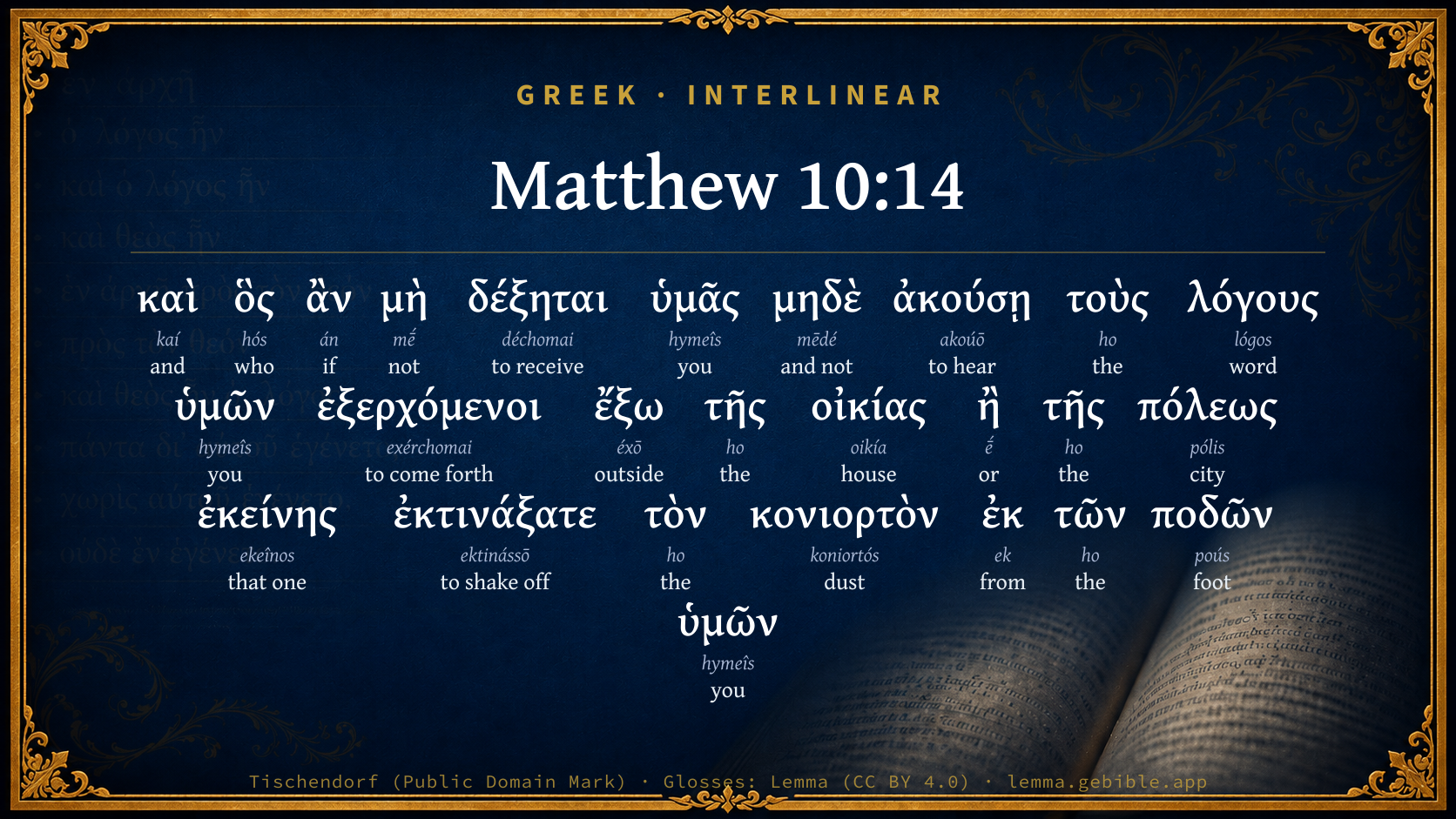
Greek (Tischendorf 8th ed.) Matthew 10:14 appears in the Greek New Testament. The text above is from the Tischendorf 8th edition. Each word links to its Strong’s number and a concise gloss. Click any word for its full Thayer’s Greek Lexicon entry.
Download image
Cite this verse

Matthew 10:14 (World English Bible). Public Domain. Lemma interlinear Bible study tool, https://lemma.gebible.app/v/matthew/10/14.

Show BibTeX & RIS
BibTeX
RIS
English Translation
Whoever doesn't receive you, nor hear your words, as you go out of that house or that city, shake off the dust from your feet.
World English Bible · Public Domain
Highlights
  • 3 first appearances in the Greek New Testament
Full analysis ↓
Download a study sheet

One document with this verse’s original text, its word-by-word gloss line, the meaning frame, cross-references with their text, attributed commentary, and full source and license credits — printable, and it pastes into notes with its structure intact.

This verse Autodidact and up

Study sheet (.html) Plain text (.txt)

A passage Seminary Student

Up to 50 verses in one chapter. A passage sheet keeps up to 6 commentary sources and 12 cross-references per verse, in the order this page ranks them, and says so on the sheet whenever that leaves anything out. Ask for a single verse and you get the Autodidact verse sheet above.

Everything on this page stays free to read, with no account — the sheet is a download of what is already on screen, not access to it.

Want to remove ads? Support Godless Engineer
Compare translations 3

The same verse in 3 English versions, stacked beneath the original-language interlinear above. Click any original word for its lexicon entry.

Each is an independent rendering of the whole verse — the interlinear is not word-aligned to these translations.

Highlighted words mark where these versions differ — a whole-verse word diff, not a word-by-word alignment.

  • World English Bible Public Domain
    Whoever doesn't receive you, nor hear your words, as you go out of that house or that city, shake off the dust from your feet.
  • King James Version Public Domain
    And whosoever shall not receive you, nor hear your words, when ye depart out of that house or city, shake off the dust of your feet.
  • unfoldingWord Literal Text CC BY-SA 4.0
    And whoever does not receive you nor listen to your words, departing from that house or city, shake off the dust from your feet.

unfoldingWord Literal Text — © unfoldingWord, licensed CC BY-SA 4.0. Word-aligned USFM3 via Door43 (git.door43.org/unfoldingWord/en_ult).

Versions to compare (up to 4)

3 of 4 selected

Show all 19 translations

Every available English version of this verse, each an independent rendering of the whole verse.

  • World English Bible Public Domain
    Whoever doesn't receive you, nor hear your words, as you go out of that house or that city, shake off the dust from your feet.
  • Berean Standard Bible Public Domain
    And if anyone will not welcome you or heed your words, shake the dust off your feet when you leave that home or town.
  • Majority Standard Bible Public Domain
    And if anyone will not welcome you or heed your words, shake the dust off your feet when you leave that home or town.
  • King James Version Public Domain
    And whosoever shall not receive you, nor hear your words, when ye depart out of that house or city, shake off the dust of your feet.
  • American Standard Version (1901) Public Domain
    And whosoever shall not receive you, nor hear your words, as ye go forth out of that house or that city, shake off the dust of your feet.
  • Revised Version (1885) Public Domain
    And whosoever shall not receive you, nor hear your words, as ye go forth out of that house or that city, shake off the dust of your feet.
  • Geneva Bible (1599) Public Domain
    And whosoeuer shall not receiue you, nor heare your woordes, when yee depart out of that house, or that citie, shake off the dust of your feete.
  • Douay-Rheims (1899) Public Domain
    And whosoever shall not receive you, nor hear your words: going forth out of that house or city shake off the dust from your feet.
  • Young's Literal Translation Public Domain
    `And whoever may not receive you nor hear your words, coming forth from that house or city, shake off the dust of your feet,
  • Literal Standard Version CC BY-SA 4.0
    And whoever may not receive you nor hear your words, coming forth from that house or city, shake off the dust of your feet,
  • Unlocked Literal Bible CC BY-SA 4.0
    As for those who do not receive you or listen to your words, when you depart from that house or city, shake off the dust from your feet.
  • unfoldingWord Literal Text CC BY-SA 4.0
    And whoever does not receive you nor listen to your words, departing from that house or city, shake off the dust from your feet.
  • Darby Bible Public Domain
    And whosoever shall not receive you, nor hear your words, as ye go forth out of that house or city, shake off the dust of your feet.
  • World Messianic Bible Public Domain
    Whoever doesn’t receive you or hear your words, as you go out of that house or that city, shake the dust off your feet.
  • Webster's Bible Public Domain
    And whoever shall not receive you, nor hear your words, when ye depart from that house, or city, shake off the dust of your feet.
  • Free Bible Version CC BY-SA 4.0
    If someone doesn't welcome you, and refuses to listen to what you have to say, then leave that house or that town, shaking its dust off your feet as you go.
  • Bible in Basic English Public Domain
    And whoever will not take you in, or give ear to your words, when you go out from that house or that town, put off its dust from your feet.
  • Text-Critical English NT CC BY 4.0
    If anyone will not receive you or listen to your words, shake off the dust from your feet as you go out from that house or town.
  • Tyndale New Testament (1534) Public Domain
    And whosoever shall not receave you nor will heare youre preachynge: when ye departe oute of that housse or that cite shake of the duste of youre fete.

Literal Standard Version (2020), Covenant Press — licensed CC BY-SA 4.0. Text via the HelloAO Bible API (eBible.org). Unlocked Literal Bible (unfoldingWord) — licensed CC BY-SA 4.0. Text via the HelloAO Bible API (eBible.org). unfoldingWord Literal Text — © unfoldingWord, licensed CC BY-SA 4.0. Word-aligned USFM3 via Door43 (git.door43.org/unfoldingWord/en_ult). Free Bible Version, Dr. Jonathan Gallagher — licensed CC BY-SA 4.0. Text via the HelloAO Bible API (eBible.org).

Word by word

More ways to search: Search by grammar → Find every occurrence → Compare this word →

Practice this passage: Drill this verse → Learn its vocabulary →

ἐκτινάξατε
ektinássō
G1621
“to shake off”
Verb, Aorist, Active, Imperative, 2nd person, Plural
Part of Speech
Verb
Tense
Aorist
Voice
Active
Mood
Imperative
Person
2nd person
Number
Plural
Full Thayer's Definition

Origin: from G1537 and tinasso (to swing)

TDNT: None

1. to shake off so that something adhering shall fall a. by this symbolic act a person, expresses extreme contempt for another and refuses to have any further dealings with him b. to shake off for (the cleansing of) one's self
  1. καὶ kaí G2532 “and” Conjunction
  2. ὃς hós G3739 “who” Relative pronoun, Nominative, Singular, Masculine
  3. ἂν án G302 “if” Particle
  4. μὴ mḗ G3361 “not” Particle, Negative
  5. δέξηται déchomai G1209 “to receive” Verb, Aorist, Middle deponent, Subjunctive, 3rd person, Singular
  6. ὑμᾶς hymeîs G5210 “you” Personal pronoun, 2nd person, Accusative, Plural
  7. μηδὲ mēdé G3366 “and not” Conjunction, Negative
  8. ἀκούσῃ akoúō G191 “to hear” Verb, Aorist, Active, Subjunctive, 3rd person, Singular
  9. τοὺς ho G3588 “the” Article, Accusative, Plural, Masculine
  10. λόγους lógos G3056 “word” Noun, Accusative, Plural, Masculine
  11. ὑμῶν hymeîs G5210 “you” Personal pronoun, 2nd person, Genitive, Plural
  12. ἐξερχόμενοι exérchomai G1831 “to come forth” Verb, Present, Middle or Passive deponent, Participle, Nominative, Plural, Masculine
  13. ἔξω éxō G1854 “outside” Adverb
  14. τῆς ho G3588 “the” Article, Genitive, Singular, Feminine
  15. οἰκίας oikía G3614 “house” Noun, Genitive, Singular, Feminine
  16. ἢ ḗ G2228 “or” Particle
  17. τῆς ho G3588 “the” Article, Genitive, Singular, Feminine
  18. πόλεως pólis G4172 “city” Noun, Genitive, Singular, Feminine
  19. ἐκείνης ekeînos G1565 “that one” Demonstrative pronoun, Genitive, Singular, Feminine
  20. τὸν ho G3588 “the” Article, Accusative, Singular, Masculine
  21. κονιορτὸν koniortós G2868 “dust” Noun, Accusative, Singular, Masculine
  22. ἐκ ek G1537 “from” Preposition
  23. τῶν ho G3588 “the” Article, Genitive, Plural, Masculine
  24. ποδῶν poús G4228 “foot” Noun, Genitive, Plural, Masculine
  25. ὑμῶν hymeîs G5210 “you” Personal pronoun, 2nd person, Genitive, Plural

About this verse

These counts appear in no published source. They are computed here, from the morphology-tagged text and Lemma’s own curated glosses. What Lemma adds →

26
words
20
distinct lemmas
Gospels
section

Notable vocabulary

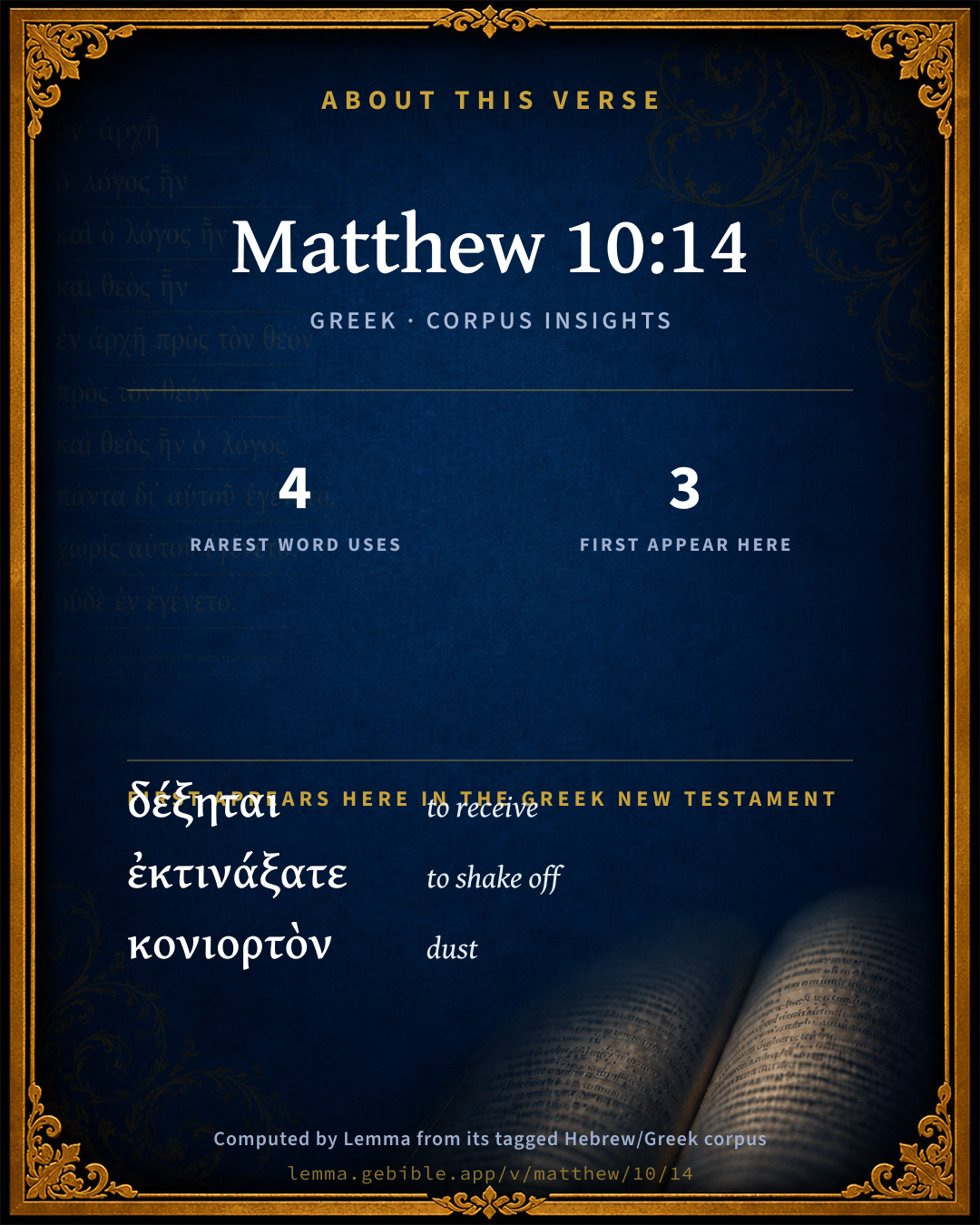
The rarest word here is ἐκτινάξατε to shake off G1621 — appearing just 4 times in the whole Greek New Testament.

First appearance in Scripture

These words make their first canonical appearance in the Greek New Testament here:

  • δέξηται to receive G1209
  • ἐκτινάξατε to shake off G1621
  • κονιορτὸν dust G2868

Shared distinctive vocabulary

ἐκτινάξατε to shake off G1621 occurs in 4 verses of the Greek New Testament. Also found in:
Repetition

Words recur within this verse:

  • τοὺς the G3588 ×5
  • ὑμᾶς you G5210 ×3

Cross-references

13

Topical passages linked to Matthew 10:14 in the Treasury of Scripture Knowledge — connected by theme and wording, ordered by reader-vote popularity; previews shown in the World English Bible.

  • Luke 10:10–11 But into whatever city you enter, and they don't receive you, go out into the streets of it and say,
  • Acts 18:6 When they opposed him and blasphemed, he shook out his clothing and said to them, "Your blood be on your own heads! I am clean. From now on, I will go to the Gentiles!"
  • Nehemiah 5:13 Also I shook out my lap, and said, So God shake out every man from his house, and from his labor, that doesn't perform this promise; even thus be he shaken out, and emptied. All the assembly said, Amen, and praised Yahweh. The people did according to this promise.
  • Acts 13:51 But they shook off the dust of their feet against them, and came to Iconium.
  • Mark 6:11 Whoever will not receive you nor hear you, as you depart from there, shake off the dust that is under your feet for a testimony against them. Assuredly, I tell you, it will be more tolerable for Sodom and Gomorrah in the day of judgment than for that city!"
  • Luke 9:5 As many as don't receive you, when you depart from that city, shake off even the dust from your feet for a testimony against them."
  • John 13:20 Most assuredly I tell you, he who receives whomever I send, receives me; and he who receives me, receives him who sent me."
  • 1 Thessalonians 4:8 Therefore he who rejects doesn't reject man, but God, who has also given his Holy Spirit to you.
  • Matthew 10:40–41 He who receives you receives me, and he who receives me receives him who sent me.
  • Matthew 18:5 Whoever receives one such little child in my name receives me,
  • Mark 9:37 "Whoever receives one such little child in my name, receives me, and whoever receives me, doesn't receive me, but him who sent me."
  • Luke 9:48 and said to them, "Whoever receives this little child in my name receives me. Whoever receives me receives him who sent me. For whoever is least among you all, this one will be great."
  • Acts 20:26–27 Therefore I testify to you this day that I am clean from the blood of all men,

Cross-references courtesy of OpenBible.info (CC BY 4.0).

Commentary

Notes on Matthew 10:14 from classic Christian and Jewish commentators (each source and its license shown beneath its notes). The classic Christian expositions comment on the surrounding passage and are grouped to its opening verse, so a note may address several verses; the Jewish commentaries on the Tanakh (Rashi and others) are per-verse, so they appear only where the commentator wrote on this verse.

Lemma curates 59 commentaries, every one of them public domain or Creative Commons licensed, each selected and text-cleaned for this edition rather than reprinted as found. About our sources →

The Biblical Illustrator

Joseph S. Exell

Mat_10:14

Shake off the dust of your feet.

-The sin of the Sodomites was single, but that of those rejecting the apostles would be manifold, including

(1) infidelity;

(2) disobedience;

(3) ingratitude;

(4) inhospitality;

(5) rebellion and contumacy against God, contrary to the law of nature, and in defiance of the grace of God. (Lapide.)

The danger of defilement

The danger of course was not from dust on the feet, but from defilement on the life and in the heart. Every apostle was to let his impenitent countrymen know that they were as heathen men in the sight of the Messiah, impure in the estimation of the infinitely Holy One. The spirit of the injunction runs through all the ages, and has come down to our day. Its spirit, but its spirit only. And hence a very heavy responsibility rests on that minister of the gospel who gives no intimation of any kind to the impenitent with whom he associates, that they are impure in the sight of God, and in danger of eternal separation from the good. (James Morison, D. D.)

The Biblical Illustrator, edited by Joseph S. Exell (c. 1880s–1900s) — public domain. Text from a community e-Sword module.

Joseph Benson's Commentary

Mat 10:14-15. Whosoever shall not receive you — That is, entertain you kindly; nor, in an obedient manner, hearken to your words, when you depart, &c., shake off the dust of your feet — The Jews thought the land of Israel so peculiarly holy, that when they came home from any heathen country they stopped at the borders, and shook or wiped off the dust of it from their feet, that the holy land might not be polluted with it. Therefore the action here enjoined was a lively intimation, that those Jews who had rejected the gospel were holy no longer, but were on a level with heathen and idolaters. Verily, It shall be more tolerable, &c. — As if he had said, And indeed you have reason to shake off the dust of your feet in such a case, for whatever profession such Jews may make of their regard to the true God, and however they may continue to boast of their national privileges, their punishment at the day of final judgment shall not only be greater than that of the generality of Gentile sinners, but even than that of those monsters of unnatural wickedness who formerly inhabited Sodom and Gomorrah, and were consumed with fire and brimstone from heaven. For the people of those cities never sinned against such extraordinary light and such singular favours as they will do who reject the gospel now to be preached to them, with great plainness and power, by you, and attested by such miracles as I shall enable you to perform.

Joseph Benson's Commentary on the Old and New Testaments (1811–1818) — public domain. Text from a community e-Sword module.

Tyndale Open Study Notes

Tyndale Open Resources

10:14 shake its dust from your feet: This prophet-like gesture is explained by the Israelite custom of expressing displeasure with ungodliness by shaking off Gentile dust whenever crossing the border into Israel. The gesture signifies the disciples’ rejection of those who oppose God’s work (see Acts 18:6). Pronouncing judgment on those who reject the message is part of proclaiming the Good News about the Kingdom (see Matt 11:20-24; 13:10-15; 23:37-39; 24:1-36).

Tyndale Open Study Notes — © Tyndale Open Resources, licensed CC BY-SA 4.0. Text via the HelloAO Bible API.

Bengel's Gnomon

Johann Albrecht Bengel

Mat 10:14. Ὅς ἐὰν, whosoever) whatever householder or magistrate.—ἐξερχόμενοι, when ye depart) The ignorance of men was not yet invincible. At present, in a greater multitude of labourers and hearers, it is not necessary to depart.[462]—ἤ, or) If you should not be admitted into any house of the city.—κονιορτὸν, dust) Because punishment (Mat 10:15) would overtake the very dust of the land trodden by the feet of the impious, from which the apostles would wish to be altogether free; see Act 13:51; cf. Mat 18:6; Mar 6:11. That seeing your determination, they may know it has been said to them as a testimony against them. The action combined with the word moves both spectators and auditors; see Neh 5:13.—τῶν ποδῶν, your feet) This depends upon ἐκτινάξατε, shake off from. Guilt is supposed to adhere to the feet or shoes; see 1Ki 2:5. Therefore the apostles ought to declare, by shaking the dust from their feet, that the fault of those who did not listen has been removed from them.

[462] Beng, seems to mean, There was not then, as yet, the invincible ignorance of men to contend with, that there is now: it was wilful unbelief; and in such a case it was their duty not to waste time, as the spiritual labourers were few, but to depart. In our day, on the other hand, where the numbers of both spiritual labourers and their hearers are many, it is not the duty of the former to depart, though many wilfully harden themselves, for there are others who labour under ignorance, and it is the minister’s duty to labour to overcome that ignorance, which, though invincible in itself, can be overcome by the Spirit of God.—ED.

Bengel's Gnomon of the New Testament — English translation (T&T Clark, Edinburgh, 1860) — public domain. Text from a community e-Sword module.

Meyer's Critical & Exegetical Commentary

Heinrich August Wilhelm Meyer

Mat_10:14. Καὶ ὃς ἐὰν, κ.τ.λ.] The nominative is a case of anacoluthon, and placed at the beginning, so as to be emphatic, as in Mat_7:24 : Whosoever will not have received you … as you quit that house or that town, shake, and so on.

ἐξέρχεσθαι, with a simple genitive (Act_16:39); Kühner, II. 1, p. 346. The ἔξω, which Lachmann, Tischendorf 8. insert (B D א), is a gloss upon what is a rare construction in the New Testament. Notice the present participle, thereby meaning upon the threshold, and relatively at the gate.

ἤ] or, should a whole town refuse to receive you and listen to you. The shaking off the dust is a sign of the merited contempt with which such people are reduced to the level of Gentiles, whose very dust is defiling. Iightfoot, p. 331 f.; Mischna Surenhusii, VI. p. 151; Wetstein on this passage; Act_13:51; Act_18:6. This forcible, meaning of the symbolical injunction is not to be weakened (Grotius, Bleek: Nil nobis vobiscum ultra commercii est; de Wette: Have nothing further to do with them; Ewald: Calmly, as though nothing had happened); on the contrary, it is strengthened by Mat_10:15. Comp. Mat_7:6.

Meyer — Critical and Exegetical Commentary on the New Testament — English translation by Peter Christie, edited by Frederick Crombie (T&T Clark, 1880) — public domain. Text from a community e-Sword module.

Jamieson, Fausset & Brown

Robert Jamieson, A. R. Fausset & David Brown

And whosoever shall not receive you, nor hear your words, when ye depart out of that house or city--for possibly a whole town might not furnish one "worthy."

shake off the dust of your feet--"for a testimony against them," as Mark and Luke add (Mar 6:11; Luk 10:11). By this symbolical action they vividly shook themselves from all connection with such, and all responsibility for the guilt of rejecting them and their message. Such symbolical actions were common in ancient times, even among others than the Jews, as strikingly appears in Pilate (Mat 27:24). And even to this day it prevails in the East.

Jamieson, Fausset & Brown — Commentary Critical and Explanatory on the Whole Bible (1871) — public domain (CC PDM 1.0). Text via the HelloAO Bible API.

Adam Clarke's Commentary

Verse 14. Shake off the dust of your feet.] The Jews considered themselves defiled by the dust of a heathen country, when was represented by the prophets as a polluted land, Am 7:17, when compared with the land of Israel, which was considered as a holy land, Eze 45:1; therefore, to shake the dust of any city of Israel from off one's clothes or feet was an emblematical action, signifying a renunciation of all farther connection with them, and placing them on a level with the cities of the Heathen. See Clarke on Am 9:7.

Adam Clarke's Commentary on the Bible (1810–1826) — public domain. Text from a community e-Sword/MySword module.

Ellicott's Commentary for English Readers

(14) Shake off the dust of your feet.—The act was a familiar symbol of the sense of indignation, as in the case of St. Paul (Act_13:51) at Antioch in Pisidia. The Jewish maxim, that even the very dust of a heathen land brought defilement with it, added to its significance. It was a protest in act, declaring (as our Lord declares in words) that the city or house which did not receive the messengers of the Christ was below the level even of the Gentiles.

A Bible Commentary for English Readers, edited by Charles John Ellicott (1878–1897) — public domain. Text from a community e-Sword module.

The Cambridge Bible for Schools and Colleges

gen. ed. J. J. S. Perowne

14. shake off the dust of your feet] as St Paul did at Antioch in Pisidia, Act_13:51. The cities of Israel that rejected the Gospel should be regarded as heathen. The very dust of them was a defilement as the dust of a heathen land. See Lightfoot, ad loc.

The Cambridge Bible for Schools and Colleges (gen. ed. J. J. S. Perowne; Cambridge University Press, 1878–1918) — public domain. Text from a community e-Sword module.

John Gill's Exposition

Verily, I say unto you,.... This was not all the punishment that should be inflicted on such despisers of the Gospel of Christ, and the ministers of it; as not to enjoy that peace and prosperity wished for by the apostles, and to be declared to be on an equal foot with Heathen cities and countries: but they were to suffer everlasting punishment in the world to come; which is here asserted by Christ in the strongest manner, saying:

it shall be more tolerable for the land of Sodom and Gomorrha, in the day of judgment, than for that city. The inhabitants of the land of Sodom and Gomorrha are the rather mentioned, because, as they were very notorious and abominable sinners, so their temporal punishment was well known, exemplary and awful, though not that, but their future damnation is here regarded, of which the Jews made no doubt; for they say (y),

"the men of Sodom have no part in the world to come; as it is said, Gen 13:13 "the men of Sodom were wicked, and sinners, before the Lord exceedingly": they were "wicked" in this world, and "sinners" in the world to come;''

meaning, that by this passage is designed their double punishment in this, and the other world. But though their punishment was very tremendous, and they will suffer also "the vengeance of eternal fire", as Jude says; yet, their punishment will be milder, and more tolerable, than that of the inhabitants of such a city, that rejects the Gospel of the grace of God: as there are degrees in sinning, for all sins are not alike, as the Stoics say; so there will be degrees in suffering; the sins of those that are favoured with the Gospel, are greater than those who only have had the light of nature, and so their torments will be greater. The inhabitants of Sodom and Gomorrha, though they sinned against the light of nature, despised the advice and admonitions of Lot, and ill treated the angels, yet will be more mildly punished than the wicked Jews, who rejected Christ, and his Gospel, and despised his apostles, and ministers; because they sinned not against so much light, and such means of grace, and knowledge, as these did; see Lam 4:6 which is thus paraphrased by the Targumist, and may be aptly applied to the Jews in Christ's time:

"the sin of the congregation of my people is greater than the sin of Sodom, which was overturned in a moment; and there dwelt no prophets in it to prophesy, and turn it to repentance.''

The time referred to, signified by "the day of judgment", respects not the destruction of Jerusalem, which was a very severe judgment on that people, but the general judgment, at the end of the world, which is appointed and fixed by God, though unknown to angels and men. The phrase is Jewish, and often to be met with in their writings, who use it in the same sense; particularly in the book of Zohar (z), mention is made of , "the day of judgment", when there will be no pollution in the sanctuary.

(y) Misn. Sanhedrim, c. 11. sect. 3. Hieros. Sanhedrim, fol. 29. 3. (z) In Gen. fol 13. 3. & 16. 1.

John Gill's Exposition of the Whole Bible (1746–1763) — public domain (CC PDM 1.0). Text via the HelloAO Bible API.

Trapp's Complete Commentary

John Trapp

14 And whosoever shall not receive you, nor hear your words, when ye depart out of that house or city, shake off the dust of your feet.

Ver. 14. And whosoever shall not receive you] Two sure signs of reprobate goats: 1. Not to receive Christ’s ministers to house and harbour, accounting themselves happy in such an entertainment. 2. Not to hear their words. The most good is done by God’s ministers commonly at first coming. Then some receive the word with admiration, others are daily more and more hardened: as fish, though fearful, stir not at the great noise of the sea, whereunto they are accustomed; and as birds that build in a belfry startle not at the tolling of the bell.

Shake off the dust of your feet] In token that you sought not theirs but them, and that you will not carry away so much as any of their accursed dust; and that you will not have any communion at all with them, wait no longer upon them; that the dust of those feet (that should have been beautiful) shall be fatal and feral to them; that God shall henceforward beat them here as small as dust with his heavy judgments, as with an iron mace, Psa 2:9; and that hereafter he shall shake them off as dust, when they come to him for salvation at the last judgment.

John Trapp, A Commentary or Exposition upon All the Books of the Old and New Testament (1647–1656) — public domain. Text from a community e-Sword module.

Haydock's Catholic Bible Commentary

Shake off the dust from your feet. It was common enough with the Jews, or at least with the preachers and prophets, to use some extraordinary outward actions, to make what they said more taken notice of by the people, as here the shaking off the dust from their feet was to denote to the obstinate unbelievers, that the very dust which their feet had contracted, in coming to preach to them the gospel, should hereafter rise in judgment against them. (Witham) By this, the apostles were to testify that they took nothing away with them belonging to these reprobate cities. They likewise shewed the long and painful journeys they had undertaken for their salvation. (St. John Chrysostom, hom. xxxiii.) --- He orders them to do this, to shew that they would have nothing in common with them, since they left them even their dust. Or it may be to shew, that the dust which they had gathered in their journey, would be a testimony against them in the day of judgment, because they had refused to receive them, as the Jews were accustomed to perform some remarkable action, for some great crime committed; thus, when they heard blasphemy, they tore their garments. (Menochius)

George Leo Haydock (1774–1849), Haydock's Catholic Family Bible and Commentary, 1859 edition — public domain. Excludes Psalms (Douay-Rheims chapter numbering differs from Protestant) and Deuterocanonical books (Catholic canon only).

Whedon's Commentary on the Bible

Daniel D. Whedon

14. Dust of your feet — Such was the custom of stricter Jews in departing from a heathen city. But henceforth the rejecters of Jesus, though Jews by blood, are heathen in heart. The meaning of the symbol of shaking the dust from your feet, is solemn and striking. It declares the city polluted, and not a particle of it shall adhere to the apostle’s person. It is given over to itself, and consigned to its own destruction.

Daniel D. Whedon (gen. ed.), Commentary on the Old and New Testaments (1874–1909) — public domain. Text from a community e-Sword module.

The Pulpit Commentary

Vers. 14, 15. If rejected, bear your solemn witness to the fact, for to reject you brings awful consequences.

Parallel passages: Mar_6:11 Luk_9:5 (the twelve); Luk_10:10, 11 (the seventy). And whosoever shall not receive you on your formal request as heralds of the kingdomnor hear your words, (Mat_21:17 Act_16:13) in this case finally. That house or (thai, Revised Version) city. "The house," rightly further defined by "that" in English, comes in Matthew only; "that city" comes also in the parallel passage, Mat_5:18, note) I say unto you, It shall be more tolerable for the land of Sodom and Gomorrha. Whose inhabitants were the typical example of the worst of sinners. (Deu_32:32 Isa_1:10 Eze_16:46 Rev_11:8) "The men of Sodom have no part in the world to come" (Mishna, "Sanh.," 10:3). In the day of judgment. Luke has "in that day;" cf. Mat_7:22. In the only two passages in the LXX (Pro_6:34 Isa_34:8) where, as it seems, our phrase occurs, it refers, not to the judgment of all, good and bad alike, but to that of the wicked alone. So also in 2Pe_2:9 2Pe_3:7; and possibly also in Mat_12:36, but not in 1Jn_4:17 (the only passage where it is not anarthrous). Than for that city. Observe that this verse implies that the wicked dead are still in existence, and are waiting for their final judgment; also that in the judgment of the wicked there will be degrees of punishment.

The Pulpit Commentary (1880–1919), ed. H.D.M. Spence-Jones & Joseph S. Exell — public domain. Text from a community e-Sword module.

John Wesley's Explanatory Notes

Shake off the dust from your feet - The Jews thought the land of Israel so peculiarly holy, that when they came home from any heathen country, they stopped at the borders and shook or wiped off the dust of it from their feet, that the holy land might not be polluted with it. Therefore the action here enjoined was a lively intimation, that those Jews who had rejected the Gospel were holy no longer, but were on a level with heathens and idolaters.

John Wesley, Explanatory Notes Upon the Whole Bible (1754–1765) — public domain. Text via the GEBible commentary corpus.

The People's New Testament

B. W. Johnson

14. Shake off the dust of your feet. This was done when there was a positive rejection of the gospel. It was a symbolical act, signifying that all responsibility for the stubborn household or city had ended. Compare Mark 6:11 and Acts 13:51. Nor can the gospel be forced upon an unwilling people in any age.

B. W. Johnson's The People's New Testament with Notes (1889–1891) — public domain. Electronic text from the Christian Classics Ethereal Library (CCEL) ThML edition.

unfoldingWord translationNotes

Door43 World Missions Community

Connecting Statement:

Jesus continues to instruct his disciples about what they should do when they go to preach.

As for those who do not receive you or listen

"If no people in that house or city will receive you or listen"

you ... your

This is plural and refers to the twelve apostles. (See: Forms of You)

listen to your words

Here "words" refers to what the disciples say. AT: "listen to your message" or "listen to what you have to say" (See: Metonymy)

city

You should translate this the same way you did in Matthew 10:11.

shake off the dust from your feet

"shake the dust off your feet as you leave." This is a sign that God has rejected the people of that house or city. (See: Symbolic Action)

Truly I say to you

"I tell you the truth." This phrase adds emphasis to what Jesus says next.

it shall be more tolerable

"the suffering shall be less"

the land of Sodom and Gomorrah

This refers to the people who lived in Sodom and Gomorrah. AT: "the people who lived in the cities of Sodom and Gomorrah" (See: Metonymy)

that city

This refers to the people in the city that does not receive the apostles or listen to their message. AT: "the people of the city that does not receive you" (See: Metonymy)

translationWords

receive

amen

Sodom

Gomorrah

judgment day

unfoldingWord translationNotes — © Distant Shores Media and the Door43 World Missions Community, licensed CC BY-SA 4.0. Source: git.door43.org/Door43/en_tn.

Cambridge Greek Testament for Schools and Colleges

14. ἐκτινάξατε τὸν κονιορτόν, as St Paul did at Antioch in Pisidia, Act 13:51. The cities of Israel that rejected the Gospel should be regarded as heathen. The very dust of them was a defilement as the dust of a heathen land. See Lightfoot, ad loc.

Cambridge Greek Testament for Schools and Colleges (Cambridge University Press, 1896; 21 vols, various authors incl. Carr, Maclear, Plummer, Farrar, Lumby, Moule, M. R. James, Simcox) — public domain. Text from a community e-Sword module.

Alford’s Greek Testament

Henry Alford

14.] See Act 13:51; Act 18:6. A solemn act which might have two meanings: (1) as Luk 10:11 expresses at more length,—‘We take nothing of yours with us, we free ourselves from all contact and communion with you;’ or (2),—which sense probably lies beneath both this and ver. 13, ‘We free ourselves from all participation in your condemnation: will have nothing in common with those who have rejected God’s message.’ See 1Ki 2:5, where the shoes on the feet are mentioned as partakers in the guilt of blood. It was a custom of the Pharisees, when they entered Judæa from a Gentile land, to do this act, as renouncing all communion with Gentiles: those then who would not receive the apostolic message were to be treated as no longer Israelites, but Gentiles. Thus the verse forms a kind of introduction to the next portion of the discourse, where the future mission to the Gentiles is treated of. The ἢ τῆς πόλεως ἐκ. brings in the alternative; “house, if it be a house that rejects you, city, if a whole city.”

Henry Alford, The Greek Testament (1849–1861) — public domain. Text from a community e-Sword module.

International Critical Commentary

(M) 14. And whosoever will not receive you, nor hear your words; as you go outside that house or city, shake off the dust of your feet.] Mk. has: “And whatsoever place will not receive you, and they will not hear you; as you proceed thence shake off the dust which is under your feet for a testimony against them.” Lk. has: “And whosoever will not receive you, as you go out from that city, shake away the dust from your feet for a testimony against them.” Both Mt. and Lk. substitute κονιορτός for Mk.’s χοῦς, and introduce the reference to the city. Lk. has the same features in the charge to the Seventy (10:10). They are due to the use of independent non-Marcan sources.

International Critical Commentary — older volumes (1896–1929), various authors — public domain. Text from a community e-Sword module.

Vincent's Word Studies in the New Testament

Marvin R. Vincent

Shake off [εκτιναξατε] . "The very dust of a heathen country was unclean, and it defiled by contact. It was regarded like a grave, or like the putrescence of death. If a spot of heathen dust had touched an offering, it must at once be burnt. More than that, if by mischance any heathen dust had been brought into Palestine, it did not and could not mingle with that of 'the land, ' but remained to the end what it had been - unclean, defiled and defiling everything to which it adhered." The apostles, therefore, were not only to leave the house or city which should refuse to receive the, "but it was to be considered and treated as if it were heathen, just as in the similar case mentioned in Mt 18:17. All contact with such must be avoided, all trace of it shaken off" (Edersheim, " Jewish Social Life in the Days of Christ "). The symbolic act indicated that the apostles and their Lord regarded them not only as unclean, but as entirely responsible for their uncleanness. See Act 18:6.

Marvin R. Vincent, Word Studies in the New Testament (1887–1900) — public domain. Text from a community e-Sword/MySword module.

Lesson kit

Teaching starters — assembled from the data on this page, not authored interpretation. Every prompt links to the verse data it draws on. Edit before teaching.

Matthew, in the Gospels, opens this verse with 26 words (20 distinct Greek lemmas). Its most distinctive word is ektinássō (“to shake off”). A historical commentator’s framing appears above. Read the whole chapter for the surrounding context.

Discussion questions

  1. What does “to shake off” (ektinássō) contribute to the verse as a whole?
  2. 3 words here appear for the first time in Scripture. What is being introduced at this debut?
  3. Mark 6:11 shares the word «to shake off» with this verse. How do the two illuminate each other?
  4. “the” occurs 5× in this one verse. What is the effect of the repetition?
  5. The translations on this page render this verse differently — a whole-verse word diff, not a word-by-word alignment. What might account for the different wordings?
  6. Reading how The Biblical Illustrator and Joseph Benson's Commentary read this verse, where do the two commentators agree and where do they part?

Things to notice

  • 3 words make their first canonical appearance in Scripture here.
  • These translations choose different wording for 12 words in this verse.
  • “the” occurs 5× in this single verse.
  • 20 distinct Greek lemmas span 26 words in this verse.

Reading settings

Reading text

Shown beneath each verse's original-language words.

Old Testament
Old Testament edition

Read the OT as the Masoretic Hebrew (MT) or the Greek Septuagint (LXX).

English shown for the Greek Septuagint (in the Hebrew ↔ Greek comparison).

Comparing translations? Open the Compare panel on any verse page to stack up to four side by side.