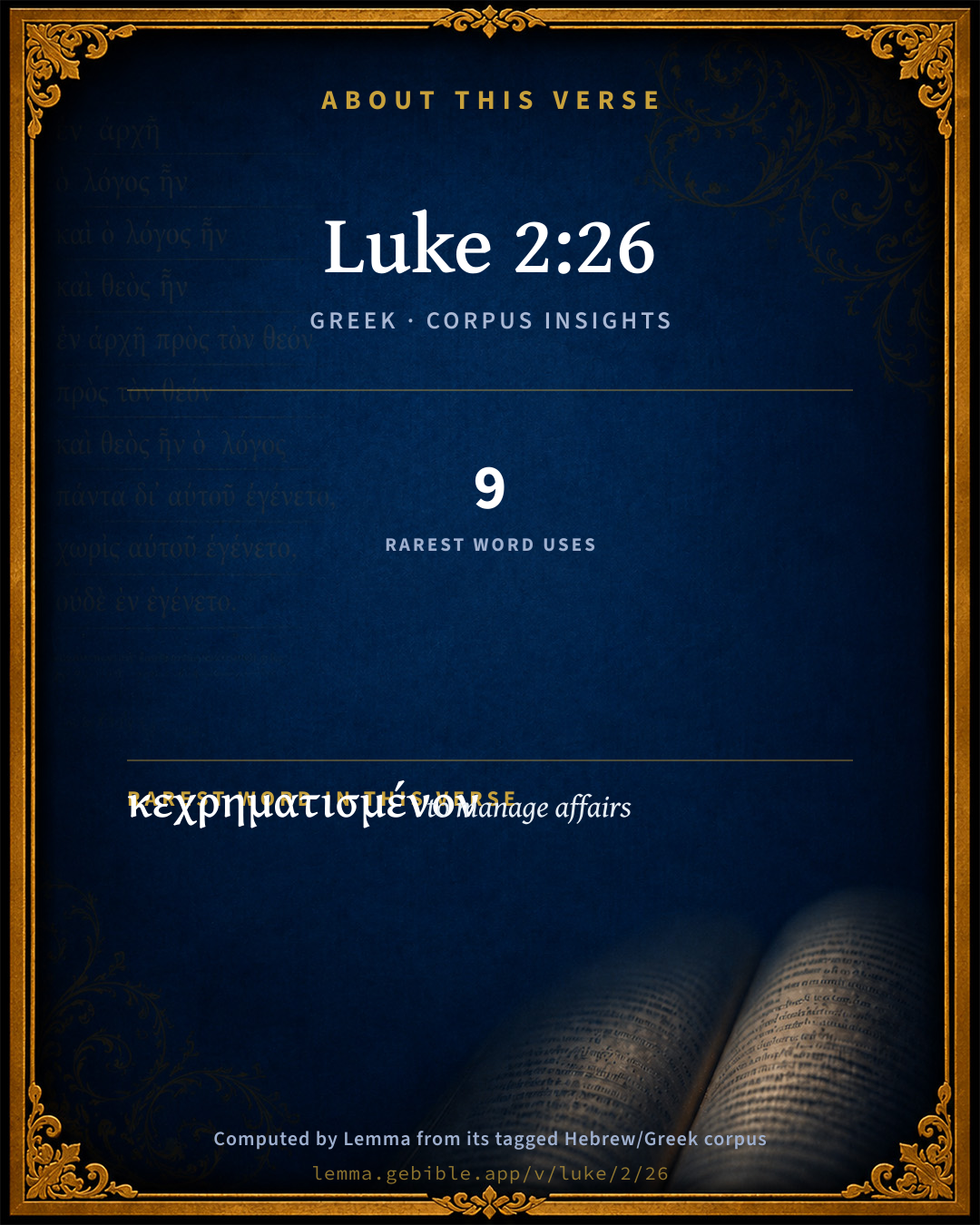
Luke 2:26

Greek (Tischendorf 8th ed.) Luke 2:26 appears in the Greek New Testament. The text above is from the Tischendorf 8th edition. Each word links to its Strong’s number and a concise gloss. Click any word for its full Thayer’s Greek Lexicon entry.
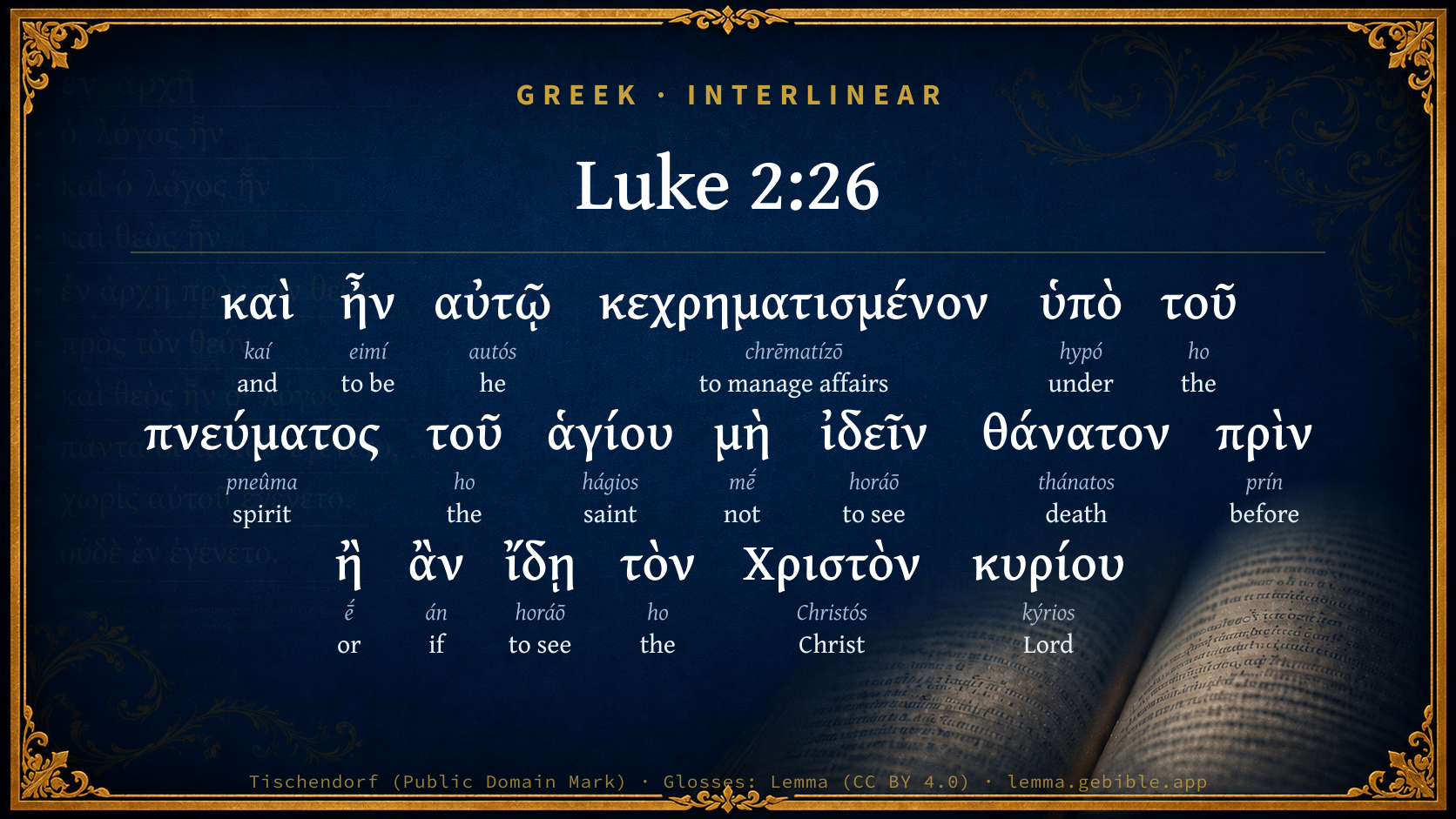
Download image
Cite this verse

Luke 2:26 (World English Bible). Public Domain. Lemma interlinear Bible study tool, https://lemma.gebible.app/v/luke/2/26.

Show BibTeX & RIS
BibTeX
RIS
English Translation
It had been revealed to him by the Holy Spirit that he should not see death before he had seen the Lord's Christ.
World English Bible · Public Domain
Download a study sheet

One document with this verse’s original text, its word-by-word gloss line, the meaning frame, cross-references with their text, attributed commentary, and full source and license credits — printable, and it pastes into notes with its structure intact.

This verse Autodidact and up

Study sheet (.html) Plain text (.txt)

A passage Seminary Student

Up to 50 verses in one chapter. A passage sheet keeps up to 6 commentary sources and 12 cross-references per verse, in the order this page ranks them, and says so on the sheet whenever that leaves anything out. Ask for a single verse and you get the Autodidact verse sheet above.

Everything on this page stays free to read, with no account — the sheet is a download of what is already on screen, not access to it.

Want to remove ads? Support Godless Engineer
Compare translations 3

The same verse in 3 English versions, stacked beneath the original-language interlinear above. Click any original word for its lexicon entry.

Each is an independent rendering of the whole verse — the interlinear is not word-aligned to these translations.

Highlighted words mark where these versions differ — a whole-verse word diff, not a word-by-word alignment.

  • World English Bible Public Domain
    It had been revealed to him by the Holy Spirit that he should not see death before he had seen the Lord's Christ.
  • King James Version Public Domain
    And it was revealed unto him by the Holy Ghost, that he should not see death, before he had seen the Lord's Christ.
  • unfoldingWord Literal Text CC BY-SA 4.0
    And it had been revealed to him by the Holy Spirit that he would not see death before he had seen the Lord’s Christ.

unfoldingWord Literal Text — © unfoldingWord, licensed CC BY-SA 4.0. Word-aligned USFM3 via Door43 (git.door43.org/unfoldingWord/en_ult).

Versions to compare (up to 4)

3 of 4 selected

Show all 19 translations

Every available English version of this verse, each an independent rendering of the whole verse.

  • World English Bible Public Domain
    It had been revealed to him by the Holy Spirit that he should not see death before he had seen the Lord's Christ.
  • Berean Standard Bible Public Domain
    The Holy Spirit had revealed to him that he would not see death before he had seen the Lord’s Christ.
  • Majority Standard Bible Public Domain
    The Holy Spirit had revealed to him that he would not see death before he had seen the Lord’s Christ.
  • King James Version Public Domain
    And it was revealed unto him by the Holy Ghost, that he should not see death, before he had seen the Lord's Christ.
  • American Standard Version (1901) Public Domain
    And it had been revealed unto him by the Holy Spirit, that he should not see death, before he had seen the Lord's Christ.
  • Revised Version (1885) Public Domain
    And it had been revealed unto him by the Holy Spirit, that he should not see death, before he had seen the Lord’s Christ.
  • Geneva Bible (1599) Public Domain
    And it was declared to him from God by the holy Ghost, that he shoulde not see death, before he had seene that Anointed of the Lord.
  • Douay-Rheims (1899) Public Domain
    And he had received an answer from the Holy Ghost, that he should not see death, before he had seen the Christ of the Lord.
  • Young's Literal Translation Public Domain
    and it hath been divinely told him by the Holy Spirit -- not to see death before he may see the Christ of the Lord.
  • Literal Standard Version CC BY-SA 4.0
    and it has been divinely told him by the Holy Spirit—not to see death before he may see the Christ of the LORD.
  • Unlocked Literal Bible CC BY-SA 4.0
    It had been revealed to him by the Holy Spirit that he would not see death before he had seen the Lord's Christ.
  • unfoldingWord Literal Text CC BY-SA 4.0
    And it had been revealed to him by the Holy Spirit that he would not see death before he had seen the Lord’s Christ.
  • Darby Bible Public Domain
    And it was divinely communicated to him by the Holy Spirit, that he should not see death before he should see [the] Lord's Christ.
  • World Messianic Bible Public Domain
    It had been revealed to him by the Holy Spirit that he should not see death before he had seen the Lord’s Messiah.
  • Webster's Bible Public Domain
    And it was revealed to him by the Holy Spirit, that he should not see death, before he had seen the Lord's Christ.
  • Free Bible Version CC BY-SA 4.0
    The Holy Spirit had shown him that he would not die before he saw the Lord's Messiah.
  • Bible in Basic English Public Domain
    And he had knowledge, through the Holy Spirit, that he would not see death till he had seen the Lord's Christ.
  • Text-Critical English NT CC BY 4.0
    It had been revealed to him by the Holy Spirit that he would not see death before he had seen the Lord's Christ.
  • Tyndale New Testament (1534) Public Domain
    And an answer was geven him of the holy goost that he shulde not se deethe before he had sene the lordes Christ.

Literal Standard Version (2020), Covenant Press — licensed CC BY-SA 4.0. Text via the HelloAO Bible API (eBible.org). Unlocked Literal Bible (unfoldingWord) — licensed CC BY-SA 4.0. Text via the HelloAO Bible API (eBible.org). unfoldingWord Literal Text — © unfoldingWord, licensed CC BY-SA 4.0. Word-aligned USFM3 via Door43 (git.door43.org/unfoldingWord/en_ult). Free Bible Version, Dr. Jonathan Gallagher — licensed CC BY-SA 4.0. Text via the HelloAO Bible API (eBible.org).

Word by word

More ways to search: Search by grammar → Find every occurrence → Compare this word →

Practice this passage: Drill this verse → Learn its vocabulary →

κεχρηματισμένον
chrēmatízō
G5537
“to manage affairs”
Verb, Perfect, Passive, Participle, Nominative, Singular, Neuter
Part of Speech
Verb
Tense
Perfect
Voice
Passive
Mood
Participle
Case
Nominative
Number
Singular
Gender
Neuter
Full Thayer's Definition

Origin: from G5536

TDNT: 17:00,1

1. to transact business, esp. to manage public affairs a. to advise or consult with one about public affairs b. to make answer to those who ask for advice, present enquiries or requests, etc. 1. of judges, magistrates, rulers, kings 2. to give a response to those consulting an oracle, to give a divine command or admonition, to teach from heaven a. to be divinely commanded, admonished, instructed b. to be the mouthpiece of divine revelations, to promulgate the commands of God 3. to assume or take to one's self a name from one's public business a. to receive a name or title, be called
  1. καὶ kaí G2532 “and” Conjunction
  2. ἦν eimí G1510 “to be” Verb, Imperfect, Active, Indicative, 3rd person, Singular
  3. αὐτῷ autós G846 “he” Personal pronoun, Dative, Singular, Masculine
  4. ὑπὸ hypó G5259 “under” Preposition
  5. τοῦ ho G3588 “the” Article, Genitive, Singular, Neuter
  6. πνεύματος pneûma G4151 “spirit” Noun, Genitive, Singular, Neuter
  7. τοῦ ho G3588 “the” Article, Genitive, Singular, Neuter
  8. ἁγίου hágios G40 “saint” Adjective, Genitive, Singular, Neuter
  9. μὴ mḗ G3361 “not” Particle, Negative
  10. ἰδεῖν horáō G3708 “to see” Verb, Aorist, Active, Infinitive
  11. θάνατον thánatos G2288 “death” Noun, Accusative, Singular, Masculine
  12. πρὶν prín G4250 “before” Adverb
  13. ἢ ḗ G2228 “or” Particle
  14. ἂν án G302 “if” Particle
  15. ἴδῃ horáō G3708 “to see” Verb, Aorist, Active, Subjunctive, 3rd person, Singular
  16. τὸν ho G3588 “the” Article, Accusative, Singular, Masculine
  17. Χριστὸν Christós G5547 “Christ” Noun, Accusative, Singular, Masculine
  18. κυρίου kýrios G2962 “Lord” Noun, Genitive, Singular, Masculine

About this verse

These counts appear in no published source. They are computed here, from the morphology-tagged text and Lemma’s own curated glosses. What Lemma adds →

19
words
16
distinct lemmas
Gospels
section

Notable vocabulary

The rarest word here is κεχρηματισμένον to manage affairs G5537 — appearing just 9 times in the whole Greek New Testament.

Shared distinctive vocabulary

κεχρηματισμένον to manage affairs G5537 occurs in 9 verses of the Greek New Testament. Also found in:

Repetition

Words recur within this verse:

  • ἰδεῖν to see G3708 ×2
  • τοῦ the G3588 ×3

Cross-references

18

Topical passages linked to Luke 2:26 in the Treasury of Scripture Knowledge — connected by theme and wording, ordered by reader-vote popularity; previews shown in the World English Bible.

  • John 8:51 Most assuredly, I tell you, if a person keeps my word, he will never see death."
  • Luke 9:27 But I tell you the truth: There are some of those who stand here, who will in no way taste of death, until they see the Kingdom of God."
  • Hebrews 11:5 By faith, Enoch was taken away, so that he wouldn't see death, and he was not found, because God translated him. For he has had testimony given to him that before his translation he had been well pleasing to God.
  • Acts 10:38 even Jesus of Nazareth, how God anointed him with the Holy Spirit and with power, who went about doing good and healing all who were oppressed by the devil, for God was with him.
  • Psalms 25:14 The friendship of Yahweh is with those who fear him. He will show them his covenant.
  • John 20:31 but these are written, that you may believe that Jesus is the Christ, the Son of God, and that believing you may have life in his name.
  • Psalms 89:48–49 What man is he who shall live and not see death, Who shall deliver his soul from the power of Sheol? Selah.
  • Acts 2:36 "Let all the house of Israel therefore know assuredly that God has made him both Lord and Christ, this Jesus whom you crucified."
  • Psalms 2:2 The kings of the earth take a stand, And the rulers take counsel together, Against Yahweh, and against his anointed, saying,
  • Psalms 2:6 "Yet I have set my king on my holy hill of Zion."
  • Daniel 9:24–26 Seventy weeks are decreed on your people and on your holy city, to finish disobedience, and to make an end of sins, and to make reconciliation for iniquity, and to bring in everlasting righteousness, and to seal up vision and prophecy, and to anoint the most holy.
  • John 1:41 He first found his own brother, Simon, and said to him, "We have found the Messiah!" (which is, being interpreted, Christ).
  • John 4:29 "Come, see a man who told me everything that I did. Can this be the Christ?"
  • Acts 9:20 Immediately in the synagogues he proclaimed the Christ, that he is the Son of God.
  • Acts 17:3 explaining and demonstrating that the Christ had to suffer and rise again from the dead, and saying, "This Jesus, whom I proclaim to you, is the Christ."
  • Hebrews 1:8–9 but of the Son he says, "Your throne, O God, is forever and ever; The scepter of uprightness is the scepter of your Kingdom.
  • Isaiah 61:1 The Spirit of the Lord Yahweh is on me; because Yahweh has anointed me to preach good news to the humble; he has sent me to bind up the broken-hearted, to proclaim liberty to the captives, and the opening [of the prison] to those who are bound;
  • Amos 3:7 Surely the Lord Yahweh will do nothing, Unless he reveals his secret to his servants the prophets.

Cross-references courtesy of OpenBible.info (CC BY 4.0).

Commentary

Notes on Luke 2:26 from classic Christian and Jewish commentators (each source and its license shown beneath its notes). The classic Christian expositions comment on the surrounding passage and are grouped to its opening verse, so a note may address several verses; the Jewish commentaries on the Tanakh (Rashi and others) are per-verse, so they appear only where the commentator wrote on this verse.

Lemma curates 59 commentaries, every one of them public domain or Creative Commons licensed, each selected and text-cleaned for this edition rather than reprinted as found. About our sources →

The Biblical Illustrator

Joseph S. Exell

Luk_2:26

And it was revealed unto him by the Holy Ghost

The leading of the Spirit

Observe that Simeon found Christ in the temple, being conducted thither by the Holy Ghost.

There was an ancient promise, The Lord whom ye seek shall suddenly come to His Temple, and this probably drew the holy man to the courts of the Lord. But the Lord might have come, and Simeon might not have been there, or the good old man might have been occupied in some other court of the holy place; but being led of the Spirit he came to the appointed spot at the very time when the mother of Christ was bringing the Babe in her arms to do for Him according to the law. In this Simeon is an instance of the truth that they find Christ who are led by the Spirit, and they alone. No man ever comes to Christ by his own wit and wisdom, nor by his own unprompted will: he alone who is drawn of the Spirit comes to Christ. We must submit ourselves to Divine teaching and Divine drawing, or else Christ may come to His temple, but we shall not perceive Him. (C. H. Spurgeon.)

Simeons felicity

How highly favoured was Simeon! A glorious anticipation truly for a pious Israelite to entertain! A stupendous assurance to carry about with him! How must it have stirred his inmost soul at times to think upon it! At one time, joy--at another, alarm--must have filled his heart; joy at the thought that God was about to visit and redeem His people; alarm, for who might abide the day of His coming, and who should stand when He appeared? Every rumour which reached him must have made his pulse throb and his heart beat; for he knew that he was destined to look upon Him to whom all type and all prophecy for four thousand years had been steadily pointing His words of recognition, the inspired hymn which bears his name, must doubtless have flowed from his burning lips like words of fire. His embrace must surely have been an act of unspeakable gratitude, wonder, and joy! (Dean Burgon.)

Blessedness found in the path of duty

Let us put ourselves in his position from the day that he received the promise, and consider, as far as may be, not merely what we should have felt, but how we should have acted, had we been in his place. It may be thought that we should have adopted one of the most probable opinions as to the manner in which Messiah would appear, and have anxiously expected His manifestation. We might perhaps have gone out of our way in this pursuit; and when the time grew long, we might have fancied that we were called upon to take some step in order to meet the Divine condescension half way. But what was the course adopted by devout Simeon? We find him frequenting the Temple faithfully, as aforetime; until, on a certain day, which was like every other day except in its results to him, the desire of his soul was gratified. A humble pair enter, and the mother bears in her arms a little Babe. There is nothing to distinguish that group from ordinary worshippers. Nay, their attire and their offering bespeak great poverty. Simeon is made aware by a sudden revelation of the Spirit, that in that helpless Child he beholds the Lords Christ: whereupon he takes Him up in his arms, and blesses God, and pours out his soul in solemn thankfulness. Surely the lesson to be derived from this incident is the same which is taught us by many a page of Holy Scripture besides; namely, that blessedness is to be found in the path of duty. This lesson we dare not overlook, or neglect. Every one is apt to think that there is something in his own position, peculiarly uncongenial to holiness; that his own path of life is peculiarly difficult and embarrassing. Especially are men prone to think that the common round of daily duties affords but little time, and presents yet fewer opportunities, for the service of God. The daily task is so humble, or so uncongenial; so simply worldly, or so extremely private, that many who desire a closer walk with God are apt to wish that they were not exactly what and where they are; but, indeed, almost anything besides. It is our own infirmity, if we thus think. God requires at our hand good things, not great things. He can do without us; and it is He who does in us all that we ever seem to do well. Moreover, if He does but find in us a perfect willingness to serve Him, let us be well assured that He will minister to us occasions of holiness; or rather, that we shall find ample room for the execution of our best designs and desires, in those same daily duties, that same lowly round of perhaps distasteful task, which we half dislike and half despise. (Ibid.)

Simeons character

1. The Holy Ghost, his Leader.

2. Faith, his consolation.

3. Piety, his life.

4. The Saviour, his joy.

5. To depart for heaven, his desire. (Van Doren.)

In the huge Temple, deckd by Herods pride, Who fain would bribe a God he neer believed, Kneels a meek woman, that hath once conceived, Tho she was never like an earthly bride. And yet the stainless would be purified, And wash away the stain that yet was none, And for the birth of her immaculate Son, With the stern rigour of the law complied: The duty paid received its due reward When Simeon blessd the Baby in her arm; And though he plainly told her that a sword Must pierce her soul, she felt no weak alarm, For that for which a prophet thanked the Lord Once to have seen, could never end in harm. (Hartley Coleridge.)

The fear of death destroyed by a sight of Christ

Our text is a joyful exclamation of a venerable old saint upon seeing the Lords Christ. It seems that when his eyes once looked upon Jesus, he never wished them to gaze on aught more on earth. Hence he exclaimed, Now, Lord, lettest Thou Thy servant depart inpeace. We remark--

I. THAT GOD ALWAYS HONOURS PRE-EMINENTLY DEVOTED MEN. Them that honour Me, saith the Lord, will I honour. Undevout minds are too worldly, too apathetic, too dull to hear the secret whispering of heaven. Tis the spiritual ear alone that can hear the still small voice that comes across the universe from the spirit-world; tis the spiritual eye alone that reads the secrets of eternity, that sees passing in review before it the realities of the hidden state. Some simple-hearted Christians were once returning from chapel; they had been to hear the holy Bramwell preach. One of them said to the other, How is it that Mr. Bramwell has always something new to tell us? Ah! said the other, I can tell you how it is; he lives very much nearer the gates of heaven than many of us, and God tells him things He does not tell other people. And so it was with Simeon. He lived very much nearer the gates of heaven than many of his day; and God honoured him by telling him this great fact. It was revealed unto Simeon that he should not see death till he had seen the Lords Christ.

II. SIMEON WAS A MAN OF PRE-EMINENT DEVOTEDNESS TO GOD. And, behold, say the Scriptures, there was a man in Jerusalem whose name was Simeon. Observes an eminent divine, No doubt there were many persons in Jerusalem named Simeon besides this man, but there was none of the name who merited the attention of God so much as he in the text. There are four things said about him in the text, every one of which is an evidence of his great devotedness. It is said of him that he was just, devout, that he waited for the Consolation of Israel, and that the Holy Ghost was upon him. You cannot dispense with one of these elements from eminent piety, reconciliation, devoutness, a waiting upon God, and the possession of the Holy Ghost. A virtuous man said, a philosopher is the noblest work of God; but we would rather say a Christian, a devout man, is the noblest work of God. Such a man is Gods jewel, His friend; tis with him God delights to dwell; tis to him God will tell His secrets; on him confer His richest houours. Simeon was such a man; God honoured him by telling him the great fact, that before death should close his eyes, he should see the Lords Christ.

III. THAT THOUGH SIMEON WAS AN EMINENTLY DEVOTED MAN, HE HAD GREAT DISCOURAGEMENT IN OBTAINING A SIGHT OF THE OBJECT HE SO EXTREMELY DESIRED. What Simeon wanted was to see the Lords Christ. Unbelief would suggest to him, Simeon, you are an old man, your day is almost ended, the snow of age is upon your head,, your eyes are growing dim, your brow is wrinkled, your limbs totter, and death cannot be at a great distance; and where are the signs of His coming? You are resting, Simeon, on a phantom of the imagination--it is all a delusion. No, replies Simeon, I shall not see death till I have seen the Lords Christ. Yes, I shall see Him before I die. But unbelief would again suggest, But remember, Simeon, many holy men have desired to see the Lords Christ, but have died without the sight. Yes, says Simeon, I shall see the Lords Christ. I imagine I see Simeon walking out on a fine morning along one of the lovely vales of Palestine, meditating on the great subject that filled his mind. He is met by one of his friends--Peace be with you: have you heard the strange news? What news? replied Simeon. Do you not know Zacharias, the priest? Yes, well. According to the custom of the priests office, his lot was to burn incense in the temple of the Lord, and the whole multitude of the people were praying without. It was the time of incense, and there appeared unto him aa angel standing on the right side of the altar of incense, and told him that he should have a son, whose name should be called John: one who should be great in the sight of the Lord, who should neither drink wine nor strong drink, and he should be filled with the Holy Ghost from his infancy, and that he should go before the Messiah in the spirit and power of Elias, to turn many of the people of Israel to the Lord, and make ready a people prepared for the Lord. The angel was Gabriel, that stands in the presence of God, and because he believed not the angel, he was struck dumb. Ah! says Simeon, that is an exact fulfilment of the prophecy of Mal_4:5-6. This is the messenger of the Lord, to prepare the way; this is the forerunner; this is the morning star; the day dawn is not far off; the great Messiah is on His way--is nigh at hand. I shall not see death till I have seen the Lords Christ.Hallelujah! the Lord shall suddenly come to His Temple. Simeon ponders these things in his heart, and time rolls on. I imagine I see Simeon again on his morning meditative walk. He is again accosted by one of his neighbours: Well, Simeon, have you heard the news? What news? Why, theres a wry singular story almost in everybodys mouth. A company of shepherds on the plains of Bethlehem were watching their flocks; it was the still hour of night, and the mantle of darkness covered the world; a bright light shone around the shepherds, a light above the brightness of the midday sun; they looked up, and just above them appeared an angel glowing in all the lovely hues of heaven; the shepherds became greatly terrified, and the angel said to them, Fear not, behold I bring you glad tidings of great joy, which shall be to all people. This is the Lords Christ. I shall not see death till I have seen the Lords Christ. Simeon said to himself, They will bring Him to the Temple to circumcise Him. Away went Simeon, morning after morning, to see if he could get a glimpse of Jesus. Perhaps unbelief suggested to Simeon, You had better stop at home this wet morning; you have been so many mornings and have not seen Him, you may venture to be absent this once. No, says the Spirit, you must go to the Temple. Away went Simeon to the Temple. He would no doubt select a good post of observation. Look at him there, leaning his back against one of the pillars of the Temple; how intently he watches the door! He sees one mother after another bringing her infant to the Temple to be circumcised; he surveys the face of every child. No, says he, as his eye scans the countenance, that is not He, and that is not; but at length he sees the Virgin appear, and the Spirit told him that that was the long-expected Saviour. He grasped the Child in his arms, and pressed Him to his heart, and exclaimed, Now, Lord, lettest Thou Thy servant depart in peace, according to Thy word, for mine eyes have seen Thy salvation. Between Simeon and an awakened sinner there is one point of agreement: they both desire to see one object--the Lords Christ. What must I do? I want help: to whom must I look? Behold, a ray of light breaks in upon him--one single, but bright ray; it keeps him from utter despair, it gives him a faint hope, it enables him tremblingly to say, Before I see death, I shall see the Lords Christ.

1. Unbelief suggests, How do you suppose that you will be permitted to see the Lords Christ? Do you think the great Jehovah, whose majesty almost confounds the cherubim and seraphim--at least compels them to cover over their bright faces with their wings, and fall before His throne in deep adoration--whose temple is all space, whose arm is around all worlds, who inhabits eternity, at whose bidding the sun lights up his fire, whose empire is so vast that were an angel, with the lightnings swiftness, to fly in a direct line from the centre, he would not in millions of years sweep the outskirts of His creation, who sits upon the highest heavens, and sees worlds infinite dance beneath Him as atoms in the sunbeam, you an atom, a shade, a moth, a worm, a flower of the field to-day, and not tomorrow, in the morning, and not to-night, not master of a moment, not a match for a breeze, a dream, a vapour, a shadow, a sinner born to die--how do you suppose He will show you the Lords Christ? Replies the awakened sinner, One thing I know: I dare not die till I have seen the Lords Christ. He cares for my body: will He be less concerned about my soul? Will He arrange all nature to minister to my bodily wants, and leave my soul to perish? No; that is unlike Him.

2. Unbelief again suggests: Are not your sins too great in magnitude and multitude to be forgiven?

3. But unbelief again suggests, Do you suppose that the sins of an age can be pardoned in a moment of time--sins that have spread over years of your life? When we have seen Christ, the sting of death is gone. Simeon pressed the Lords Christ to his heart, and then he never wished his eyes to gaze on aught more of earth; and when the believing penitent has Christ in his heart, the hope of glory, then he is not afraid of death. A fact will bear out this statement. Some time since, a minister of the gospel was called upon to visit a dying woman. He ascended a flight of stairs that led into a miserable-looking garret; for, though clean and neat, there was scarcely an article of furniture to give an air of comfort to the chamber of death. In one corner of the room there was a bed--a bed of straw! On it lay a dying female, pale, and worn to a skeleton; she was near the verge, the trembling verge, of eternity. The minister drew nigh and said to her, Well, my friend, how do you feel? What are your prospects for the eternity which is just about to open upon you? She looked up in the ministers face with a countenance bright with heavenly radiance, and beaming with a brightness she had caught gazing on the visions of God, and said, Oh I sir,

Tis Jesus, the first and the last,

Whose Spirit shall guide me safe home.

Ill praise Him for all that is past,

And trust Him for what is to come.

Christianity can make a bed of straw into a bed of down--can convert a gloomy sick chamber into the vestibule of heaven, a chamber where the soul unrobes and plumes herself for her flight. (J. Caughey.)

The Biblical Illustrator, edited by Joseph S. Exell (c. 1880s–1900s) — public domain. Text from a community e-Sword module.

Tyndale Open Study Notes

Tyndale Open Resources

2:26 the Lord’s Messiah (or the Lord’s Anointed): This title, often used of David, came to refer to the Messiah, who would come from David’s line.

Tyndale Open Study Notes — © Tyndale Open Resources, licensed CC BY-SA 4.0. Text via the HelloAO Bible API.

Bengel's Gnomon

Johann Albrecht Bengel

Luk 2:26. Ἦν, it was) perhaps for a long time back: although the old age in the case of Anna is specially noticed, it is not so in the case of Simeon.—μὴ ἰδεῖν—ἢ ἴδῃ, that he should not see—before that he saw) A sweet antithesis.—πρὶν ἢ, before that) Moreover, when he had seen Him, he was immediately about to depart; as appears from Luk 2:29, according to Thy word.—τὸν Χριστὸν Κυρίου, the Lord’s Christ [Anointed]) So, the Christ [Anointed] of God, ch. Luk 9:20. It is He whom the Lord hath anointed, and in comparison with Whom God acknowledges no other as His Anointed.

Bengel's Gnomon of the New Testament — English translation (T&T Clark, Edinburgh, 1860) — public domain. Text from a community e-Sword module.

Expositor's Greek Testament

ed. W. Robertson Nicoll

Luk 2:26 . ἦν κεχρηματισμένον , it had been revealed (for the verb vide Mat 2:12 ), how long before not indicated. μὴ ἰδεῖν : we have here an instance of the aorist infinitive referring to what is future in relation to the principal verb. In such a case the aorist is really timeless, as it can be in dependent moods, vide Burton, M. and T. , § 114. πρὶν ἢ ἂν ἴδῃ : πρὶν here and in Act 25:16 with a finite verb, usually with the infinitive, vide Mat 1:18 ; Mat 26:34 .

The Expositor's Greek Testament, edited by W. Robertson Nicoll (1897–1910) — public domain. Text from a community e-Sword module.

Jamieson, Fausset & Brown

Robert Jamieson, A. R. Fausset & David Brown

revealed by the Holy Ghost--implying, beyond all doubt, the personality of the Spirit.

should see not death till he had seen--"sweet antithesis!" [BENGEL]. How would the one sight gild the gloom of the other! He was, probably, by this time, advanced in years.

Jamieson, Fausset & Brown — Commentary Critical and Explanatory on the Whole Bible (1871) — public domain (CC PDM 1.0). Text via the HelloAO Bible API.

Adam Clarke's Commentary

Verse 26. It was revealed unto him] He was divinely informed, κεχρηματισμενον - he had an express communication from God concerning the subject. The secret of the Lord is with them that fear him. The soul of a righteous and devout man is a proper habitation for the Holy Spirit.

He should not see death] They that seek shall find: it is impossible that a man who is earnestly seeking the salvation of God, should be permitted to die without finding it.

The Lord's Christ.] Rather, the Lord's anointed. That prophet, priest, and king, who was typified by so many anointed persons under the old covenant; and who was appointed to come in the fulness of time, to accomplish all that was written in the law, in the prophets, and in the Psalms, concerning him. See Clarke on Lu 2:11.

Adam Clarke's Commentary on the Bible (1810–1826) — public domain. Text from a community e-Sword/MySword module.

Ellicott's Commentary for English Readers

(26) It was revealed unto him.—The Greek word is the same as that rendered “warned” in Mat_2:12. It implies a divine oracular communication, but rests on a different idea from the “unveiling,” which lies at the root of the word “reveal.” The message in this case came clearly as an answer to prayers and yearnings.

The Lord’s Christ.—The word retains all the fulness of its meaning—the Messiah, the Anointed of Jehovah.

A Bible Commentary for English Readers, edited by Charles John Ellicott (1878–1897) — public domain. Text from a community e-Sword module.

The Cambridge Bible for Schools and Colleges

gen. ed. J. J. S. Perowne

26. it was revealed unto him] Christian legend says that he had stumbled at Isa_7:14, “Behold, a virgin shall conceive,” and had received a divine intimation that he should not die till he had seen it fulfilled (Nicephorus, a. d. 1450). The notion of his extreme age is not derived from Scripture but from the ‘Gospel of the Nativity of Mary,’ which says that he was 113.

the Lord’s Christ] The Anointed of Jehovah.

The Cambridge Bible for Schools and Colleges (gen. ed. J. J. S. Perowne; Cambridge University Press, 1878–1918) — public domain. Text from a community e-Sword module.

John Gill's Exposition

And it was revealed unto him by the Holy Ghost,.... Not in a dream, as the wise men were warned, nor by an angel, as Joseph, nor by a voice from heaven, which the Jews call "Bath Kol", but by the inspiration of the Holy Ghost, enlightening his understanding, and impressing on his mind:

that he should not see death; an Hebraism, see it in Psa 89:48 the same with the phrase, "to taste death", elsewhere used; and the sense is, as the Ethiopic version renders it, "that he should not die"; or as the Persic version, "that his death should not be"; as yet: he should live some time longer; nor should that messenger be sent to remove him, though a man in years, out of time into eternity,

before he had seen the Lord's Christ: with his bodily eyes: for he had seen him with an eye of faith already, and in the promise, as Abraham had; and in the types and sacrifices of the law, as the rest of believers under the Old Testament. The Messiah is called the Lord's Christ, referring to Psa 2:2 because he was anointed by Jehovah, the Father, and with Jehovah, the Spirit; with the Holy Ghost, the oil of gladness, to be prophet, priest, and king, in the Lord's house. So the Messiah is by the Targumist called, the Messiah of Jehovah, or Jehovah's Messiah; that is as here, the Lord's Christ: thus in the Targum on Isa 4:2 it is said,

"in that time, , "Jehovah's Messiah", shall be for joy and for glory.

And on Isa 28:5 the paraphrase is,

"at that time, , "the Messiah of the Lord" of hosts shall be for a crown of joy, and for a diadem of praise to the rest of his people.

Compare these paraphrases with what is said of Christ, in Luk 2:32. "The glory of thy people Israel"; Simeon's language exactly agrees with the Targumist. The Persic version adds, "and with this hope he passed his time, or age, and became very old and decrepit."

John Gill's Exposition of the Whole Bible (1746–1763) — public domain (CC PDM 1.0). Text via the HelloAO Bible API.

Trapp's Complete Commentary

John Trapp

26 And it was revealed unto him by the Holy Ghost, that he should not see death, before he had seen the Lord’s Christ.

Ver. 26. It was revealed unto him] By an immediate oracle, κεχρηματισμενον. The idolatrous, heathen made use of this word to signify their impious and diabolical oracles. The abuse of a word taketh not away the use of it.

John Trapp, A Commentary or Exposition upon All the Books of the Old and New Testament (1647–1656) — public domain. Text from a community e-Sword module.

Albert Barnes' Notes on the Bible

And it was revealed unto him - In what way this was done we are not informed. Sometimes a revelation was made by a dream, at others by a voice, and at others by silent suggestion. All we know of this is that it was by the Holy Spirit.

Not see death - Should not die. To “see” death and to “taste” of death, was a common way among the Hebrews of expressing death itself. Compare Psa 89:48.

The Lord’s Christ - Rather “the Lord’s Anointed.” The word “Christ” means “anointed,” and it would have been better to use that word here. To an aged man who had been long waiting for the Messiah, how grateful must have been this revelation - this solemn assurance that the Messiah was near! But this revelation is now given to every man, that he need not taste of death until, by the eye of faith, he may see the Christ of God. He is offered freely. He has come. He waits to manifest himself to the world, and he is not willing that any should die forever. To us also it will be as great a privilege in our dying hours to have seen Christ by faith as it was to Simeon. It will be the only thing that can support us then - the only thing that will enable us to depart in peace.

Albert Barnes' Notes on the Bible (1834–1885) — public domain. Text from a community e-Sword/MySword module.

Haydock's Catholic Bible Commentary

And he had received an answer, ... that he should not see death; i.e. die. (Witham)

George Leo Haydock (1774–1849), Haydock's Catholic Family Bible and Commentary, 1859 edition — public domain. Excludes Psalms (Douay-Rheims chapter numbering differs from Protestant) and Deuterocanonical books (Catholic canon only).

The Pulpit Commentary

That he should not see death. The idea of the aged Simeon comes from a notice in the apocryphal "Gospel of the Nativity," which speaks of him as a hundred and thirteen years old. These legendary "Gospels" are totally devoid of all authority; here and there possibly a true "memory" not preserved in any of the "four" may exist, but in general they are extravagant and improbable. The Arabic "Gospel of the Infancy" here speaks of Simeon seeing the Babe shining like a pillar of light in his mother"s arms. There is an old and striking legend which speaks of this devout Jew being long puzzled and disturbed by the Messianic prophecy, (Isa_7:14) "A virgin shall conceive;" at length he received a supernatural intimation that he should not see dearth until he had seen the fulfillment of the strange prophecy, the menacing of which he had so long failed to see.

The Pulpit Commentary (1880–1919), ed. H.D.M. Spence-Jones & Joseph S. Exell — public domain. Text from a community e-Sword module.

Cambridge Greek Testament for Schools and Colleges

26. ἦν αὐτῷ κεχρηματισμένον. For the use of this word to imply a divine communication see Act 10:22; Mat 2:12. χρηματισμὸς an oracle Rom 11:4. Christian legend says that he had stumbled at Isa 7:14, “Behold, a virgin shall conceive,” and had received a divine intimation that he should not die till he had seen it fulfilled (Nicephorus, A.D. 1450). The notion of his extreme age is not derived from Scripture but from the ‘Gospel of the Nativity of Mary,’ which says that he was 113.

τὸν Χριστὸν κυρίου. The anointed of Jehovah.

Cambridge Greek Testament for Schools and Colleges (Cambridge University Press, 1896; 21 vols, various authors incl. Carr, Maclear, Plummer, Farrar, Lumby, Moule, M. R. James, Simcox) — public domain. Text from a community e-Sword module.

Alford’s Greek Testament

Henry Alford

26.] Of the nature of this intimation, nothing is said. Symeon was the subject of an especial indwelling and leading of the Holy Ghost, analogous to that higher form of the spiritual life expressed in the earliest days by walking with God—and according to which God’s saints have often been directed and informed in an extraordinary manner by His Holy Spirit. In the power of this intimation, and in the spirit of prophecy consequent on it, he came into the Temple on this occasion.

Henry Alford, The Greek Testament (1849–1861) — public domain. Text from a community e-Sword module.

International Critical Commentary

26. κεχρηματισμένον. The act. = 1. “transact business” (χρῆμα); 2, “give a divine response” to one who consults an oracle; 3. “give a divine admonition, teach from heaven” (Jer 25:30, Jer 25:33:2; Job 40:8). The pass. is used both of the admonition divinely given, as here, and of the person divinely admonished (Mat 2:12, Mat 2:22; Act 10:22; Heb 8:5, Heb 11:7). It is gratuitous to conjecture that it was in a dream that the Holy Spirit made this known to Symeon. Comp. Act 11:26; Rom 7:3.

μὴ ἰδεῖν θ. πρὶν ἤ ἄν ἴδῃ. This is the only example in N.T. of πρίν with the subj. (Win. xli. 3. b, p. 371); and, if the reading is correct, the only instance of πρὶν ἄν: but perhaps either ἤ or ἄν should be omitted. The repetition of “see” is doubtless intentional. In many languages “see” is used of any kind of experience (Act 2:27, Act 2:31, 13:Act 2:35-37, etc.).

τὸν χριστὸν Κυρίου. “The Anointed of the Lord”; Him whom God has sent as the Messiah. Comp. τὸν Χρ. τοῦ Θεοῦ (9:20), and also 1Sa 24:7.

International Critical Commentary — older volumes (1896–1929), various authors — public domain. Text from a community e-Sword module.

Vincent's Word Studies in the New Testament

Marvin R. Vincent

It was revealed [ην κεχρηματισμενον] . Lit., it was having been revealed; i e., it stood revealed, while he waited for the fulfilment of the revelation. The verb means primarily to have dealings with; thence to consult or debate about business matter; and so of an oracle, to give a response to one consulting it. The word here implies that the revelation to Simeon had been given in answer to prayer. See on Mt 2:12.

Marvin R. Vincent, Word Studies in the New Testament (1887–1900) — public domain. Text from a community e-Sword/MySword module.

Lesson kit

Teaching starters — assembled from the data on this page, not authored interpretation. Every prompt links to the verse data it draws on. Edit before teaching.

Luke, in the Gospels, opens this verse with 19 words (16 distinct Greek lemmas). Its most distinctive word is chrēmatízō (“to manage affairs”). A historical commentator’s framing appears above. Read the whole chapter for the surrounding context.

Discussion questions

  1. How does “to manage affairs” (chrēmatízō) shape what this verse is saying?
  2. How does Matthew 2:12, which shares the word «to manage affairs», read alongside this verse?
  3. What does the repetition of “to see” (2× in this one verse) do in this verse?
  4. These translations render this verse differently; the difference is in the English rendering, not the original. What questions does that raise?
  5. Compare how The Biblical Illustrator and Tyndale Open Study Notes read this verse. Where do they agree or differ?

Things to notice

  • These translations choose different wording for 7 words in this verse.
  • “to see” occurs 2× in this single verse.
  • 16 distinct Greek lemmas span 19 words in this verse.

Reading settings

Reading text

Shown beneath each verse's original-language words.

Old Testament
Old Testament edition

Read the OT as the Masoretic Hebrew (MT) or the Greek Septuagint (LXX).

English shown for the Greek Septuagint (in the Hebrew ↔ Greek comparison).

Comparing translations? Open the Compare panel on any verse page to stack up to four side by side.