Matthew 10:19

Greek (Tischendorf 8th ed.) Matthew 10:19 appears in the Greek New Testament. The text above is from the Tischendorf 8th edition. Each word links to its Strong’s number and a concise gloss. Click any word for its full Thayer’s Greek Lexicon entry.
Download image
Cite this verse

Matthew 10:19 (World English Bible). Public Domain. Lemma interlinear Bible study tool, https://lemma.gebible.app/v/matthew/10/19.

Show BibTeX & RIS
BibTeX
RIS
English Translation
But when they deliver you up, don't be anxious how or what you will say, for it will be given you in that hour what you will say.
World English Bible · Public Domain
Download a study sheet

One document with this verse’s original text, its word-by-word gloss line, the meaning frame, cross-references with their text, attributed commentary, and full source and license credits — printable, and it pastes into notes with its structure intact.

This verse Autodidact and up

Study sheet (.html) Plain text (.txt)

A passage Seminary Student

Up to 50 verses in one chapter. A passage sheet keeps up to 6 commentary sources and 12 cross-references per verse, in the order this page ranks them, and says so on the sheet whenever that leaves anything out. Ask for a single verse and you get the Autodidact verse sheet above.

Everything on this page stays free to read, with no account — the sheet is a download of what is already on screen, not access to it.

Want to remove ads? Support Godless Engineer
Compare translations 3

The same verse in 3 English versions, stacked beneath the original-language interlinear above. Click any original word for its lexicon entry.

Each is an independent rendering of the whole verse — the interlinear is not word-aligned to these translations.

Highlighted words mark where these versions differ — a whole-verse word diff, not a word-by-word alignment.

  • World English Bible Public Domain
    But when they deliver you up, don't be anxious how or what you will say, for it will be given you in that hour what you will say.
  • King James Version Public Domain
    But when they deliver you up, take no thought how or what ye shall speak: for it shall be given you in that same hour what ye shall speak.
  • unfoldingWord Literal Text CC BY-SA 4.0
    But when they hand you over, do not worry about how or what you will speak, for what you will say will be given to you in that hour.

unfoldingWord Literal Text — © unfoldingWord, licensed CC BY-SA 4.0. Word-aligned USFM3 via Door43 (git.door43.org/unfoldingWord/en_ult).

Versions to compare (up to 4)

3 of 4 selected

Show all 19 translations

Every available English version of this verse, each an independent rendering of the whole verse.

  • World English Bible Public Domain
    But when they deliver you up, don't be anxious how or what you will say, for it will be given you in that hour what you will say.
  • Berean Standard Bible Public Domain
    But when they hand you over, do not worry about how to respond or what to say. In that hour you will be given what to say.
  • Majority Standard Bible Public Domain
    But when they hand you over, do not worry about how to respond or what to say. In that hour you will be given what to say.
  • King James Version Public Domain
    But when they deliver you up, take no thought how or what ye shall speak: for it shall be given you in that same hour what ye shall speak.
  • American Standard Version (1901) Public Domain
    But when they deliver you up, be not anxious how or what ye shall speak: for it shall be given you in that hour what ye shall speak.
  • Revised Version (1885) Public Domain
    But when they deliver you up, be not anxious how or what ye shall speak: for it shall be given you in that hour what ye shall speak.
  • Geneva Bible (1599) Public Domain
    But when they deliuer you vp, take no thought howe or what ye shall speake: for it shall be giuen you in that houre, what ye shall say.
  • Douay-Rheims (1899) Public Domain
    But when they shall deliver you up, take no thought how or what to speak: for it shall be given you in that hour what to speak.
  • Young's Literal Translation Public Domain
    `And whenever they may deliver you up, be not anxious how or what ye may speak, for it shall be given you in that hour what ye shall speak;
  • Literal Standard Version CC BY-SA 4.0
    And whenever they may deliver you up, do not be anxious how or what you may speak, for it will be given you in that hour what you will speak;
  • Unlocked Literal Bible CC BY-SA 4.0
    When they deliver you up, do not be anxious about how or what you will speak, for what to say will be given to you in that hour.
  • unfoldingWord Literal Text CC BY-SA 4.0
    But when they hand you over, do not worry about how or what you will speak, for what you will say will be given to you in that hour.
  • Darby Bible Public Domain
    But when they deliver you up, be not careful how or what ye shall speak; for it shall be given to you in that hour what ye shall speak.
  • World Messianic Bible Public Domain
    But when they deliver you up, don’t be anxious how or what you will say, for it will be given you in that hour what you will say.
  • Webster's Bible Public Domain
    But when they deliver you up, be not anxious how or what ye shall speak, for it shall be given to you in that same hour what ye shall speak.
  • Free Bible Version CC BY-SA 4.0
    But when they put you on trial, don't worry about how you should speak or what you should say, because you'll be told what to say at the right time.
  • Bible in Basic English Public Domain
    But when you are given up into their hands, do not be troubled about what to say or how to say it: for in that hour what you are to say will be given to you;
  • Text-Critical English NT CC BY 4.0
    When they hand you over, do not be anxious about how to speak or what to say, for what you are to say will be given to you in that hour.
  • Tyndale New Testament (1534) Public Domain
    But when they delyver you vp take no thought how or what ye shall speake for that shalbe geve you even in that same houre what ye shall saye.

Literal Standard Version (2020), Covenant Press — licensed CC BY-SA 4.0. Text via the HelloAO Bible API (eBible.org). Unlocked Literal Bible (unfoldingWord) — licensed CC BY-SA 4.0. Text via the HelloAO Bible API (eBible.org). unfoldingWord Literal Text — © unfoldingWord, licensed CC BY-SA 4.0. Word-aligned USFM3 via Door43 (git.door43.org/unfoldingWord/en_ult). Free Bible Version, Dr. Jonathan Gallagher — licensed CC BY-SA 4.0. Text via the HelloAO Bible API (eBible.org).

Word by word

More ways to search: Search by grammar → Find every occurrence → Compare this word →

Practice this passage: Drill this verse → Learn its vocabulary →

μεριμνήσητε
merimnáō
G3309
“to be anxious”
Verb, Aorist, Active, Subjunctive, 2nd person, Plural
Part of Speech
Verb
Tense
Aorist
Voice
Active
Mood
Subjunctive
Person
2nd person
Number
Plural
Full Thayer's Definition

Origin: from G3308

TDNT: 13:49,6

1. to be anxious a. to be troubled with cares 2. to care for, look out for (a thing) a. to seek to promote one's interests b. caring or providing for
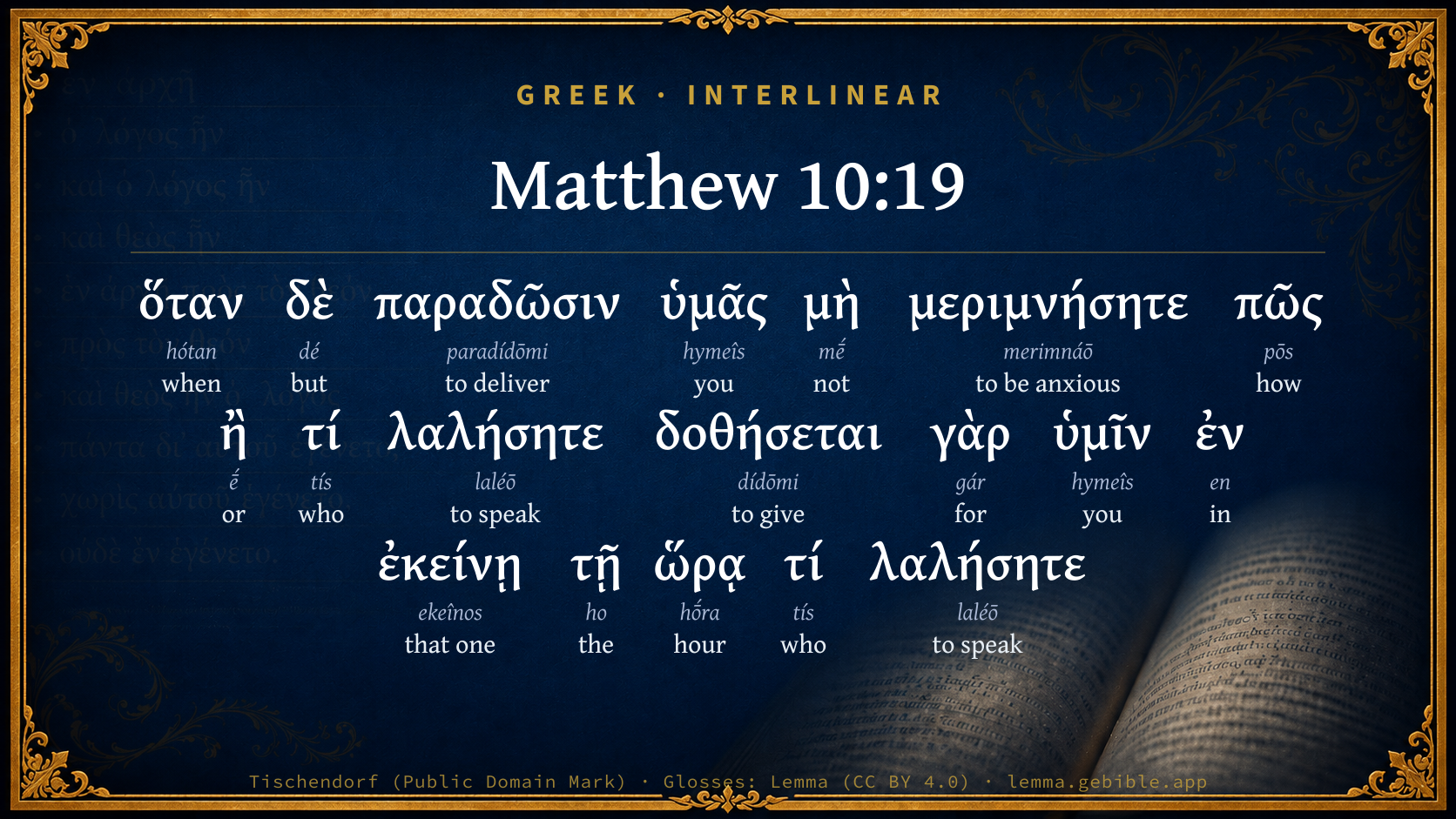
  1. ὅταν hótan G3752 “when” Conjunction
  2. δὲ dé G1161 “but” Conjunction
  3. παραδῶσιν paradídōmi G3860 “to deliver” Verb, Aorist, Active, Subjunctive, 3rd person, Plural
  4. ὑμᾶς hymeîs G5210 “you” Personal pronoun, 2nd person, Accusative, Plural
  5. μὴ mḗ G3361 “not” Particle, Negative
  6. πῶς pōs G4459 “how” Adverb, Interrogative
  7. ἢ ḗ G2228 “or” Particle
  8. τί tís G5101 “who” Interrogative pronoun, Accusative, Singular, Neuter
  9. λαλήσητε laléō G2980 “to speak” Verb, Aorist, Active, Subjunctive, 2nd person, Plural
  10. δοθήσεται dídōmi G1325 “to give” Verb, Future, Passive, Indicative, 3rd person, Singular
  11. γὰρ gár G1063 “for” Conjunction
  12. ὑμῖν hymeîs G5210 “you” Personal pronoun, 2nd person, Dative, Plural
  13. ἐν en G1722 “in” Preposition
  14. ἐκείνῃ ekeînos G1565 “that one” Demonstrative pronoun, Dative, Singular, Feminine
  15. τῇ ho G3588 “the” Article, Dative, Singular, Feminine
  16. ὥρᾳ hṓra G5610 “hour” Noun, Dative, Singular, Feminine
  17. τί tís G5101 “who” Interrogative pronoun, Accusative, Singular, Neuter
  18. λαλήσητε laléō G2980 “to speak” Verb, Aorist, Active, Subjunctive, 2nd person, Plural

About this verse

These counts appear in no published source. They are computed here, from the morphology-tagged text and Lemma’s own curated glosses. What Lemma adds →

19
words
16
distinct lemmas
Gospels
section

Notable vocabulary

The rarest word here is μεριμνήσητε to be anxious G3309 — appearing just 19 times in the whole Greek New Testament.

Shared distinctive vocabulary

μεριμνήσητε to be anxious G3309 occurs in 17 verses of the Greek New Testament. Also found in:

Repetition

Words recur within this verse:

  • λαλήσητε to speak G2980 ×2
  • ὑμᾶς you G5210 ×2
  • τί who G5101 ×2

Cross-references

18

Topical passages linked to Matthew 10:19 in the Treasury of Scripture Knowledge — connected by theme and wording, ordered by reader-vote popularity; previews shown in the World English Bible.

  • Exodus 4:12 Now therefore go, and I will be with your mouth, and teach you what you shall speak."
  • Mark 13:11–13 When they lead you away and deliver you up, don't be anxious beforehand, or premeditate what you will say, but say whatever will be given you in that hour. For it is not you who speak, but the Holy Spirit.
  • 2 Timothy 4:17 But the Lord stood by me, and strengthened me, that through me the message might be fully proclaimed, and that all the Gentiles might hear; and I was delivered out of the mouth of the lion.
  • Luke 12:11 When they bring you before the synagogues, the rulers, and the authorities, don't be anxious how or what you will answer, or what you will say;
  • Luke 21:12–17 But before all these things, they will lay their hands on you and will persecute you, delivering you up to synagogues and prisons, bringing you before kings and governors for my name's sake.
  • Exodus 4:15 You shall speak to him, and put the words in his mouth. I will be with your mouth, and with his mouth, and will teach you what you shall do.
  • Jeremiah 1:9 Then Yahweh put forth his hand, and touched my mouth; and Yahweh said to me, Behold, I have put my words in your mouth:
  • Daniel 3:16–18 Shadrach, Meshach, and Abednego answered the king, Nebuchadnezzar, we have no need to answer you in this matter.
  • Jeremiah 1:7 But Yahweh said to me, Don't say, I am a child; for to whoever I shall send you, you shall go, and whatever I shall command you, you shall speak.
  • Matthew 6:25 Therefore, I tell you, don't be anxious for your life: what you will eat, or what you will drink; nor yet for your body, what you will wear. Isn't life more than food, and the body more than clothing?
  • Matthew 6:31 "Therefore don't be anxious, saying, 'What will we eat?', 'What will we drink?' or, 'With what will we be clothed?'
  • Acts 6:10 They weren't able to withstand the wisdom and the Spirit by which he spoke.
  • James 1:5 But if any of you lacks wisdom, let him ask of God, who gives to all liberally and without reproach; and it will be given to him.
  • Philippians 4:6 In nothing be anxious, but in everything, by prayer and petition with thanksgiving, let your requests be made known to God.
  • Matthew 6:34 Therefore don't be anxious for tomorrow, for tomorrow will be anxious for itself. Each day's own evil is sufficient.
  • Acts 4:8–14 Then Peter, filled with the Holy Spirit, said to them, "You rulers of the people, and elders of Israel,
  • Acts 5:29–33 But Peter and the apostles answered, "We must obey God rather than men.
  • Acts 26:2–11 "I think myself happy, King Agrippa, that I am to make my defense before you this day concerning all the things that I am accused by the Jews,

Cross-references courtesy of OpenBible.info (CC BY 4.0).

Commentary

Notes on Matthew 10:19 from classic Christian and Jewish commentators (each source and its license shown beneath its notes). The classic Christian expositions comment on the surrounding passage and are grouped to its opening verse, so a note may address several verses; the Jewish commentaries on the Tanakh (Rashi and others) are per-verse, so they appear only where the commentator wrote on this verse.

Lemma curates 59 commentaries, every one of them public domain or Creative Commons licensed, each selected and text-cleaned for this edition rather than reprinted as found. About our sources →

Joseph Benson's Commentary

Mat 10:19. But take no thought how or what ye shall speak — When you are compelled to appear before such personages be not anxiously careful about your defence there, or how you shall answer for yourselves, but cheerfully confide in the divine direction, which shall certainly be given you, and shall be abundantly sufficient for you. The apostles being, in general, persons of a low education, and wholly unacquainted with the laws of the different countries whither they were to go, and with the forms of their courts, might have been much terrified at the thought of appearing before kings, governors, and other persons of distinction, and might have feared lest, in the hurry of their spirits, they should be betrayed into some impropriety of language or behaviour, by which the cause of the gospel might be injured. Nothing, therefore, could have been more proper, or better suited to the circumstances in which they were placed, than the promise which our Lord here makes them, which, if received in faith, was sufficient to prevent a thousand anxious apprehensions. Observe, reader, neither at such a time as is here referred to, nor on any sudden call, need the true disciples of Jesus be careful what or how to answer.

Joseph Benson's Commentary on the Old and New Testaments (1811–1818) — public domain. Text from a community e-Sword module.

Lange's Commentary on the Holy Scriptures

5. Care about their Defence. Mat_10:19-20

19But when they deliver you up,23 take no [anxious]24 thought how or what ye shall speak: for25 it shall be given you in that same hour [in that hour] what ye shall speak. 20For it is not ye that speak, but the Spirit of your Father which speaketh in you.

EXEGETICAL AND CRITICAL

Mat_10:19. How or what.—The form and the substance; πῶςἥ τί.—We might have expected that the latter would have been first mentioned; but, in planning an address, the first care is always about the form. [Bengel: “Ubi τὸ quid obtigit, τὸ quomodo non deest.… Spiritus non loquitur sine verbis. Dabo vobis os et sapientiam, Luk_21:15.”—P. S.]

Mat_10:20. [It is not ye that speak, but the Spirit of your Father, etc.—An indirect argument for the inspiration of the apostolic writings. For if the Holy Spirit suggested their oral testimony of Christ, He filled them still more in the act of writing, since books are permanent, and can be read by all. Comp. Joh_15:26-27.—Your Father.—It is remarkable that our Lord never says our Father, except in the Lord’s Prayer, which He taught His disciples, but My Father, or your Father; for He is the eternal and only begotten Son of the Father, we are children by adoption through faith in Him.—P. S.]

DOCTRINAL AND ETHICAL

1. In captivity, a person would naturally feel anxious how to defend himself, especially if he were to appear before the great, the learned, or the powerful of this world. The desire to speak well would be all the stronger, that they were deeply conscious of their innocence, and hence felt no concern on that point. But Christ knew better than any other how studied eloquence restrains and obstructs, perhaps even suppresses, the warm outgushings of the heart; how anxiety to hit upon the right word may suppress the faith from which alone that right word can flow; and how deep spiritual life quickens and calls into being appropriate exercises of the mind, so that, in every situation of life, we shall find both the right thought and the right word. Compare the speech of Paul against Tertullus in Acts 25.

2. It shall be given you. This is further explained by, “for it is not ye that speak, but the Spirit of your Father.” The contrast is absolute, and so is the doctrine of inspiration which results from it. All personal anxiety must disappear in the anticipation of the Spirit of the Father, who overrules all the events of life, and can not only fill His people with joy and peace, but elevate them to moral heroism. But when we say that all self and self-seeking are completely to cease, we do not mean that our intellectual faculties are to be overpowered and bound by a foreign influence (as in Montanism), but only that they are to be set free from all lower motives, and to be spiritually raised and quickened. Hence the inspiration promised will be of a moral rather than of a psychical character. For the removal of all selfishness and self-seeking implies, at the same time, the full development of the deepest spiritual motives and views. The Lord presents these future events as immediately impending, because the conduct of the disciples, when imprisoned, depends on their general relationship to the Father, which had already commenced at that time. Comp. Calvin’s reply to the confessors of the gospel imprisoned at Paris, in Henry’s Calvin, 1:467.

3. The inference of the inspiration of Scripture, derived from this and similar passages, is quite legitimate. Only, that the great point in inspiration is the τί, to which the πῶς is quite subordinate. Hence, in the promise given, we read only of the τί, not of the πῶς. Similarly, the promise is simply δοθήσεται τί λαλήσετε, not λαλήσητε.

HOMILETICAL AND PRACTICAL

The prohibition of carefulness about answering before councils, in its relation to the general prohibition of carefulness, Mat_6:34.—Carefulness may reappear, even in the Christian life, in the guise of piety, or in that of official zeal.—Take no thought for the how and the what, and the what shall supply the how.—Carefulness about rhetorical ornaments,26 in its dangers: 1. It springs from anxiety, and restrains the spiritual life; 2. it manifests itself by excitement and excess, and adulterates the spiritual life; 3. it leads to weariness or self-seeking, and destroys the spiritual life.—The putting aside of every false preparation, as giving place to true preparation: prayer, meditation, and inward conflict (oratio, meditatio, tentatio). For it is not you, etc. 1. An instruction as to the inspiration of the word by the Spirit of God; 2. an admonition not to put in our own word; 3. a promise that the Lord will speak by us.—When the orator has wholly disappeared, the True Orator shall appear.

Heubner:—Consciousness of innocence, and of the goodness of the cause in which we are engaged, is the best defence.—A Christian will leave his defence to God.—A Christian must not shape his own course, but leave himself to the guidance of God; there should always be quietness and Sabbath-rest in his soul.—The Holy Ghost the Comforter of the simple.—Proper sermons are they which are given by the Holy Ghost, not those which are artificially constructed.

Lange's Commentary on the Holy Scriptures (Critical, Doctrinal, and Homiletical), ed. John Peter Lange, English translation edited by Philip Schaff (1864–1880) — public domain. Text from a community e-Sword module.

Tyndale Open Study Notes

Tyndale Open Resources

10:19-20 As God gave Moses a spokesman in Aaron (Exod 4:10-17), so God would give Jesus’ disciples the right words at the right time through the Spirit (John 14:26; Acts 4:8).

Tyndale Open Study Notes — © Tyndale Open Resources, licensed CC BY-SA 4.0. Text via the HelloAO Bible API.

Bengel's Gnomon

Johann Albrecht Bengel

Mat 10:19. Μὴ μεριμνήσητε, Be not careful) Your only care must be to be without care. We are not forbidden by this passage from all preparation; see 1Ti 4:15, cf. Luk 21:14; 1Co 14:26. But on a sudden emergency, even in these times, a faithful professor should not be anxious as to what he has to say.—ἤ, or) Care is elegantly mentioned; where, however, the “what” (quid, τί) is supplied, there the “how”[468] (quomodo, πῶς) is not wanting. The “how or what” includes whatever can fall under the idea of care; therefore, especially also the words, concerning which many, who have the matter ready, are wont to be over anxious. The Spirit does not speak without words; see Mat 10:20: and in Luk 21:15, we read, “I will give you a mouth and wisdom.” Analogous combinations, under other circumstances, occur in Joh 8:28; Joh 12:49-50; Rom 8:26; 1Pe 1:11. The doctrine of verbal inspiration is not inferred from the difference of the words how and what, but from the promise itself.—ἐν ἐκείνῃ τῇ ὤρᾳ, in that hour) even though not before. Many feel most strongly their spiritual power when the hour arrives of imparting it to others.—τί, what) for ὅ, that which.—Cf. ch. Mat 15:32, and Luk 17:8.

[468] Referring to “HOW or WHAT ye shall speak”—(I. B.)

Bengel's Gnomon of the New Testament — English translation (T&T Clark, Edinburgh, 1860) — public domain. Text from a community e-Sword module.

Meyer's Critical & Exegetical Commentary

Heinrich August Wilhelm Meyer

Mat_10:19-20. But now, when the delivering of you up actually takes place, give yourselves no anxious concern, and so on.

ἢ τί] not καὶ τί, but the distinctive expression used renders more fully prominent the two elements, the how and the what (Dissen, ad Dem, de cor. p. 264), in which eleganter notatur cura (Bengel). The difficulty, first of all, is with regard to the πῶς; observe, however, that in the sequel only τί is used (ubi τό quid obtigit, τό quomodo non deest, Bengel).

δοθήσεται] not docebitur, but suggeretur, by God through the Holy Spirit, Isa_50:4; Eph_6:19; 1Co_2:10 ff.; Luk_21:15.

Observe the difference between τί λαλήσητε and τί λαλήσετε (what you ought to speak, and what you will speak); and for this use of τί, see Bernhardy, p. 443. Kühner, II. 2, p. 1016.

οὐ … ἀλλά] In this decided, and not in any half and half way, does Jesus conceive of that relation, in virtue of which His disciples were to become πνευματικοῖς πνευματικὰ συγκρίνοντες (1Co_2:13).

ἐστέ] the future situation is thought of as present.

Meyer — Critical and Exegetical Commentary on the New Testament — English translation by Peter Christie, edited by Frederick Crombie (T&T Clark, 1880) — public domain. Text from a community e-Sword module.

Expositor's Greek Testament

ed. W. Robertson Nicoll

Mat 10:19-22 . μὴ μεριμνήσητε , etc.: a second counsel against anxiety (Mat 6:25 ), this time not as to food and raiment, but as to speech at a critical hour. With equal emphasis: trouble not yourselves either as to manner or matter, word or thought ( πῶς ἢ τί ). δοθήσεται : thought, word, tone, gesture everything that tends to impress all will be given at the critical hour ( ἐν ἐκείνῃ τῇ ὥρᾳ ). In the former instance anxiety was restricted to the day (Mat 6:34 ). Full, absolute inspiration promised for the supreme moment. οὐ γὰρ ὑμεῖς , etc.: not you but the divine Spirit the speaker. οὐ , ἀλλὰ , non tam quam, interprets Grotius, followed by Pricaeus, Elsner, Fritzsche, etc. = not so much you as; as if it were an affair of division of labour, so much ours, so much, and more, God’s. It is, however, all God’s and yet all ours. It is a case of immanent action, τὸ λαλοῦν ἐν ὑμῖν , not of a transcendent power coming in upon us to help our infirmity, eking out our imperfect speech. Note the Spirit is called the Spirit τοῦ πατρὸς ὑμῶν , echo of Mat 6:32 . Some of the greatest, most inspired utterances have been speeches made by men on trial for religious convictions. A good conscience, tranquility of spirit, and a sense of the greatness of the issue involved, make human speech at such times touch the sublime. Theophy, distinguishes the human and the divine in such utterances thus: ours to confess, God’s to make a wise apology ( τὸ μὲν ὁμολογεῖν ἡμέτερον , τὸ δὲ σοφῶς ἀπολογεῖσθαι Θεοῦ ).

The Expositor's Greek Testament, edited by W. Robertson Nicoll (1897–1910) — public domain. Text from a community e-Sword module.

Jamieson, Fausset & Brown

Robert Jamieson, A. R. Fausset & David Brown

But when they deliver you up, take no thought--be not solicitous or anxious. (See on Mat 6:25).

how or what ye shall speak--that is, either in what manner ye shall make your defense, or of what matter it shall consist.

for it shall be given you in that same hour what ye shall speak--(See Exo 4:12; Jer 1:7).

Jamieson, Fausset & Brown — Commentary Critical and Explanatory on the Whole Bible (1871) — public domain (CC PDM 1.0). Text via the HelloAO Bible API.

Adam Clarke's Commentary

Verse 19. Take no thought how or what ye shall speak] μη μεριμνησετε - Be not anxiously careful, because such anxiety argues distrust in God, and infallibly produces a confused mind. In such a state, no person is fit to proclaim or vindicate the truth. This promise, It shall be given you, c., banishes all distrust and inquietude on dangerous occasions but without encouraging sloth and negligence, and without dispensing with the obligation we are under to prepare ourselves by the meditation of sacred truths, by the study of the Holy Scriptures, and by prayer.

It shall be given you in that same hour what] This clause is wanting in the MSS. D and L, and several others, some versions, and several of the fathers: but it is found in Mr 13:11, without any various reading; and in substance in Lu 11:13.

Adam Clarke's Commentary on the Bible (1810–1826) — public domain. Text from a community e-Sword/MySword module.

Ellicott's Commentary for English Readers

(19) Take no thought.—In the same sense as in Mat_6:25, “Do not at that moment be over-anxious.” The words indicate an almost tender sympathy with the feelings of Galilean disciples, “unlearned and ignorant men,” standing before those who were counted so much their superiors in power and knowledge. The words that follow contain a two-fold promise: not only what they should say, but how, in what form and phrase, to say it, should be given them in that hour. The courage of Peter and John before the Sanhedrin is at once the earliest and the most striking instance of the fulfilment of the promise (Act_4:13).

A Bible Commentary for English Readers, edited by Charles John Ellicott (1878–1897) — public domain. Text from a community e-Sword module.

The Cambridge Bible for Schools and Colleges

gen. ed. J. J. S. Perowne

19. take no thought how or what ye shall speak] Curiously enough this has been quoted as if it justified want of preparation for sermons or addresses to a Christian congregation. The direction points definitely to the Christian ‘apologies,’ of which specimens have come down to us.

The Cambridge Bible for Schools and Colleges (gen. ed. J. J. S. Perowne; Cambridge University Press, 1878–1918) — public domain. Text from a community e-Sword module.

John Gill's Exposition

For it is not ye that speak,.... Not but that they were to speak the words, and did; but then both the things they spoke, and the very words in which they spoke them, were not of themselves, but were suggested and dictated by the Spirit of God; for as "the preparation of the heart" in them, so "the answer of the tongue" by them, were both "from the Lord": the Spirit, he was the efficient cause, they were only instruments; for not they of themselves spoke; or not so much they,

but the Spirit of your father, which speaketh in you, or "by you": what they should say was not to be dictated by their own spirit or natural understanding, nor by an angel, but by the Spirit of God; called the "Spirit of" their "father", because he proceeds from him, is of the same nature with him, and is the reason of his being given to them: and this character of him might serve to strengthen their faith in the expectation of him, and in the assistance promised, and to be had by him; since he was the spirit of him, who stood in the relation of a father to them, and bore a paternal affection for them.

John Gill's Exposition of the Whole Bible (1746–1763) — public domain (CC PDM 1.0). Text via the HelloAO Bible API.

Trapp's Complete Commentary

John Trapp

19 But when they deliver you up, take no thought how or what ye shall speak: for it shall be given you in that same hour what ye shall speak.

Ver. 19. Take no thought how or what ye shall speak] Be not anxious about either matter or manner of your apology for yourselves. Ye shall be supplied from on high both with invention and elocution. Demosthenes, that great orator, was many times dismayed when he spoke to King Philip, and sometimes so disheartened that he had not a word more to say. Moses, that great scholar, feared he should lack words when he was to stand before Pharaoh, and professes, that since God had called him to that service, he found less freedom of speech than before. Latomus of Lovain, a very learned man, having prepared an eloquent oration to Charles V, emperor, was so confounded in the delivering of it, that he came off with great discredit, and fell into utter despair. No wonder therefore though the apostles, being ignorant and unlettered men, were somewhat troubled how to do when brought before kings and Caesars. Our Saviour here cures them of that care by a promise of help from heaven. And they had it, Act 5:41; Act 13:52. And so had the confessors and martyrs in all ages of the Church. Nescio unde veniunt istae meditationes, I do not know from where such thoughts come, saith Luther of himself in a letter to his friend. And in his book of the Babylonish captivity he professeth, that whether he would or no, he became every day more learned than other. {a} How bravely did Ann Askew, Alice Driver, and other poor women, answer the doctors, and put them to a nonplus! Was not that the Spirit of the Father speaking in them?

{a} Profitetur se quotidie, velit, nolit, doctiorem fieri.

John Trapp, A Commentary or Exposition upon All the Books of the Old and New Testament (1647–1656) — public domain. Text from a community e-Sword module.

Albert Barnes' Notes on the Bible

Take no thought - That is, be not anxious or unduly solicitous. See the notes at Mat 6:25. This was a full promise that they should be inspired, and was a most seasonable consolation. Poor, and ignorant, and obscure fishermen would naturally be solicitous what they should say before the great men of the earth. Eastern people regarded kings as raised far above common mortals - as approaching to divinity. How consoling, then, the assurance that God would aid them and speak within them!

Albert Barnes' Notes on the Bible (1834–1885) — public domain. Text from a community e-Sword/MySword module.

Haydock's Catholic Bible Commentary

Be not thoughtful, with too great a concern of mind. (Witham) --- That the apostles might not be discouraged at the description, which our Saviour gave them in the two preceding verses, of the troubles which they would have to sustain in their ministry, he now endeavours to console them. When you are called before councils, says he, do not think how or what to speak, for it shall be given you in that hour what to speak. A truly comfortable thought for all who should afterwards engage in the ministry of Christ. Whatever troubles, whatever persecutions may fall to your lot, if even you should be cited before kings and councils to answer for your faith, do not be troubled. You engage in the conflict, I will fight: you speak, but I will tell you what you ought to say. (Haydock)

George Leo Haydock (1774–1849), Haydock's Catholic Family Bible and Commentary, 1859 edition — public domain. Excludes Psalms (Douay-Rheims chapter numbering differs from Protestant) and Deuterocanonical books (Catholic canon only).

Matthew Poole's English Annotations

Mark hath much the same, Mar 13:11; so hath Luke, Luk 11:11,12. The apostles being men but of an ordinary education before Christ called them, he might reasonably suppose that they would not appear before councils, and kings, and governors without some abashment, having not been accustomed to such presences; he therefore arms them in these words, wherein he doth not prohibit ordinary thoughts, which every man hath before he speaketh, but anxious thoughts beforehand, for, ( saith he),

it shall be given you in that same hour what ye shall speak. The Lord seemeth to speak here as he did to Moses, Exo 4:12, complaining he was slow of speech, and of a slow tongue: Exo 4:11, Who hath made man’s mouth? It shall, ( saith Christ), be given you from God.

For it is not ye that speak, but the Spirit of your Father which speaketh in you; that is, not you from yourselves only: the Holy Spirit shall influence your thoughts as to the matter, and suggest that to you, and it shall influence your tongues, giving you a freedom of speech. This was verified in Stephen, Act 6:10, and hath been eminently verified in a multitude of martyrs. We may observe from hence, that the influence of the Spirit is not to be confined to the will and afflictions. It hath also an influence upon our words in the service of God: not that we can conclude, that whatsoever Christians so speak, either in their confessions or other duties, is from such immediate assistance; but there is such an influence, though the Spirit in this, as in other operations, like the wind, bloweth where and when it listeth.

Matthew Poole's English Annotations on the Holy Bible (1683–1685) — public domain. Text from a community e-Sword/MySword module.

Whedon's Commentary on the Bible

Daniel D. Whedon

19. Take no thought — Our Lord here earnestly places the mind of the persecuted apostle on its true basis. Let him renounce all earthly tempers and human ingenuity, and cast himself in simple, Christlike dependence upon divine aid.

Daniel D. Whedon (gen. ed.), Commentary on the Old and New Testaments (1874–1909) — public domain. Text from a community e-Sword module.

The Pulpit Commentary

Vers. 19, 20. For these two verses, compare (besides Mar_13:11 Luk_21:15; vide supra, ver. 17) Luk_12:11, Luk_12:12, with which there is doubtless a common basis. As the two verses do not seem to have in Luke 12 a very close connexion with their context, it is probable that there also, as here, they are taken from a speech of later date. But when they deliver you up, take no thought; be not anxious (Revised Version); Mat_6:25, note. So also Luk_12:2; but in Luk_21:14 goes further, and forbids the disciples to "meditate beforehand how to answer." Bengel says here, Usa, non curandi, cura sit. How or what. The general direction or the actual matter. Ye shall speaki.e. in defence, as defined Luk_12:11 Luk_21:14for it shall be given you in that same (omit "same," with the Revised Version) hour what ye shall speak. And if in similar extraordinary circumstances, the Christian may expect similar extraordinary help. The omission of this clause by some Western authorities is probably due to the fact that the next verse also begins with "for," and contains a promise that much resembles this. For it is not ye that speak, but the Spirit of your Father which speaketh in you. (cf. Gen_41:38) Observe:

(1) The thoughtful reminder, "your Father," whose children you have become, (Mat_5:16, note) and whose protection you may look for.

(2) It is not said that the Father, but that the Spirit speaks. (cf. Act_4:8 Act_13:9; and, for Christ speaking, 2Co_13:3)

(3) The phrase is quite compatible with, but would hardly have then been understood as expressing, the personality of the Holy Spirit.

(4) Though the promise would doubtless hold good, and that in a special degree, for the most important of all "defences," the writing of Holy Scripture, yet even there it did not preclude the use of human means. (Luk_1:3)

The Pulpit Commentary (1880–1919), ed. H.D.M. Spence-Jones & Joseph S. Exell — public domain. Text from a community e-Sword module.

John Wesley's Explanatory Notes

Take no thought - Neither at this time, on any sudden call, need we be careful how or what to answer. Luke xii, 11.

John Wesley, Explanatory Notes Upon the Whole Bible (1754–1765) — public domain. Text via the GEBible commentary corpus.

Scofield Reference Notes

C. I. Scofield

for it shall be given

An instruction to martyrs, not to preachers.

The Scofield Reference Bible (1917 edition), notes by C. I. Scofield — public domain. Text from a community e-Sword module.

Kretzmann's Popular Commentary

Paul E. Kretzmann

Counsel against anxiety:

v. 19. But when they deliver you up, take no thought how or what ye shall speak, for it shall be given you in that same hour what ye shall speak.

v. 20. For it is not ye that speak, but the Spirit of your Father which speaketh in you.

Since such persecutions, such trials, will come, since that fact is established, make your preparations accordingly, put your heart and mind in a condition which will enable you to stand the ordeal. Anxious, worrying thoughts argue distrust in God, and tend to produce confusion. It is no personal defense which they are undertaking, but that of a cause. Since it is Christ’s and God’s cause, He will provide a lawyer at the critical hour. Man’s speech is at best imperfect, even in matters concerning this world only; how much greater the cause of the eternal Word! Set apologetic speeches, when the veracity and the power of the Gospel are on trial, may have their value. But so far as the apostles were concerned, they could at such times depend implicitly upon inspiration from on high; the Holy Spirit would give them the very words which they were to speak in their defense, Act 26:1-32. And the promise holds true, in a measure, for all times. "Some of the greatest, most inspired utterances have been speeches made by men on trial for religious convictions. A good conscience, tranquility of spirit, and a sense of the greatness of the issue involved, make human speech at such times touch the sublime."

Paul E. Kretzmann, Popular Commentary of the Bible (1921–1924) — public domain. Text from a community e-Sword module.

The People's New Testament

B. W. Johnson

19, 20. Take no thought how or what ye shall speak. They are not told to take no thought what they shall preach, but that the Holy Spirit will give them utterance when they make their defense before civil magistrates.

Your Father. Not “Our Father.” The Savior never says, “Our Father,” except when he teaches the disciples to pray, but “My Father” and “Your Father.” God was his Father in a different sense from that in which he is our Father.

B. W. Johnson's The People's New Testament with Notes (1889–1891) — public domain. Electronic text from the Christian Classics Ethereal Library (CCEL) ThML edition.

unfoldingWord translationNotes

Door43 World Missions Community

Connecting Statement:

Jesus continues to instruct his disciples about the persecution they will endure when they go out to preach.

When they deliver you up

"When people take you to the councils." The "people" here are the same "people" as in Matthew 10:17.

you ... your

These are plural and refer to the twelve apostles. (See: Forms of You)

do not be anxious

"do not worry"

how or what you will speak

"how you are to speak or what you are to say." The two ideas may be combined: "what you are to say" (See: Hendiadys)

for what to say will be given to you

This can be stated in active form. AT: "for the Holy Spirit will tell you what to say" (See: Active or Passive)

in that hour

Here "hour" means "right then." AT: "right then" or "at that time" (See: Metonymy)

the Spirit of your Father

If necessary, this can be translated as "the Spirit of God your heavenly Father" or a footnote can be added to make it clear that this refers to God the Holy Spirit and not to the spirit of an earthly father.

Father

This is an important title for God. (See: Translating Son and Father)

in you

"through you"

translationWords

deliver

hour, hours

Holy Spirit

God the Father

unfoldingWord translationNotes — © Distant Shores Media and the Door43 World Missions Community, licensed CC BY-SA 4.0. Source: git.door43.org/Door43/en_tn.

Cambridge Greek Testament for Schools and Colleges

19. μὴ μεριμνήσητε πῶς ἢ τί λαλήσητε. Curiously enough this has been quoted as if it justified want of preparation for sermons or addresses to a Christian congregation. The direction points definitely to the Christian ‘apologies,’ of which specimens have come down to us in the Acts (Act 4:8-12; Act 5:29-32; Act 7:1-53; Act 26:2-29) and in the records of the Early Church.

Cambridge Greek Testament for Schools and Colleges (Cambridge University Press, 1896; 21 vols, various authors incl. Carr, Maclear, Plummer, Farrar, Lumby, Moule, M. R. James, Simcox) — public domain. Text from a community e-Sword module.

Alford’s Greek Testament

Henry Alford

19.] μὴ μεριμνήσητε—take not anxious (or distracting) thought. A spiritual prohibition, answering to the literal one in vv. 9, 10. See Exo 4:12.

Henry Alford, The Greek Testament (1849–1861) — public domain. Text from a community e-Sword module.

International Critical Commentary

(M) 19. And when they shall deliver you up, take no thought how or what ye shall speak: for there shall be given to you in that hour what ye shall speak.] Mk. has: And when they shall lead you, delivering you up, do not be taking thought beforehand what ye shall speak. But whatsoever shall be given to you in that hour, this speak.”

ὅταν δέ] Mk. has καὶ ὅταν; see Introduction, p. xx—παραδῶσιν] Mk. has ἄγωσιν—παραδιδόντες. The editor has carried the ἄγωσιν into the previous verse (ἀχθήσεσθε). The editor adds πῶς ἤ, which are found also in Luk 12:11.

19. πῶς ἥ] om. S1 a b k.

International Critical Commentary — older volumes (1896–1929), various authors — public domain. Text from a community e-Sword module.

Vincent's Word Studies in the New Testament

Marvin R. Vincent

Take no thought [μη μεριμνησητε] . Rev., Be not anxious. See on 6 25.

In that hour [εν εκεινη ωρα] . Very precise. "In that selfsame hour." Bengel remarks : "Even though not before. Many feel most strongly their spiritual power when the hour comes to impart it to others."

Marvin R. Vincent, Word Studies in the New Testament (1887–1900) — public domain. Text from a community e-Sword/MySword module.

Lesson kit

Teaching starters — assembled from the data on this page, not authored interpretation. Every prompt links to the verse data it draws on. Edit before teaching.

Matthew, in the Gospels, opens this verse with 19 words (16 distinct Greek lemmas). Its most distinctive word is merimnáō (“to be anxious”). A historical commentator’s framing appears above. Read the whole chapter for the surrounding context.

Discussion questions

  1. What does “to be anxious” (merimnáō) contribute to the verse as a whole?
  2. How does Matthew 6:25, which shares the word «to be anxious», read alongside this verse?
  3. What does the repetition of “to speak” (2× in this one verse) do in this verse?
  4. These translations render this verse differently. What is at stake in choosing one wording over another?
  5. Compare how Joseph Benson's Commentary and Lange's Commentary on the Holy Scriptures read this verse. Where do they agree or differ?

Things to notice

  • These translations choose different wording for 16 words in this verse.
  • “to speak” occurs 2× in this single verse.
  • 16 distinct Greek lemmas span 19 words in this verse.

Reading settings

Reading text

Shown beneath each verse's original-language words.

Old Testament
Old Testament edition

Read the OT as the Masoretic Hebrew (MT) or the Greek Septuagint (LXX).

English shown for the Greek Septuagint (in the Hebrew ↔ Greek comparison).

Comparing translations? Open the Compare panel on any verse page to stack up to four side by side.