Matthew 14:27

Greek (Tischendorf 8th ed.) Matthew 14:27 appears in the Greek New Testament. The text above is from the Tischendorf 8th edition. Each word links to its Strong’s number and a concise gloss. Click any word for its full Thayer’s Greek Lexicon entry.
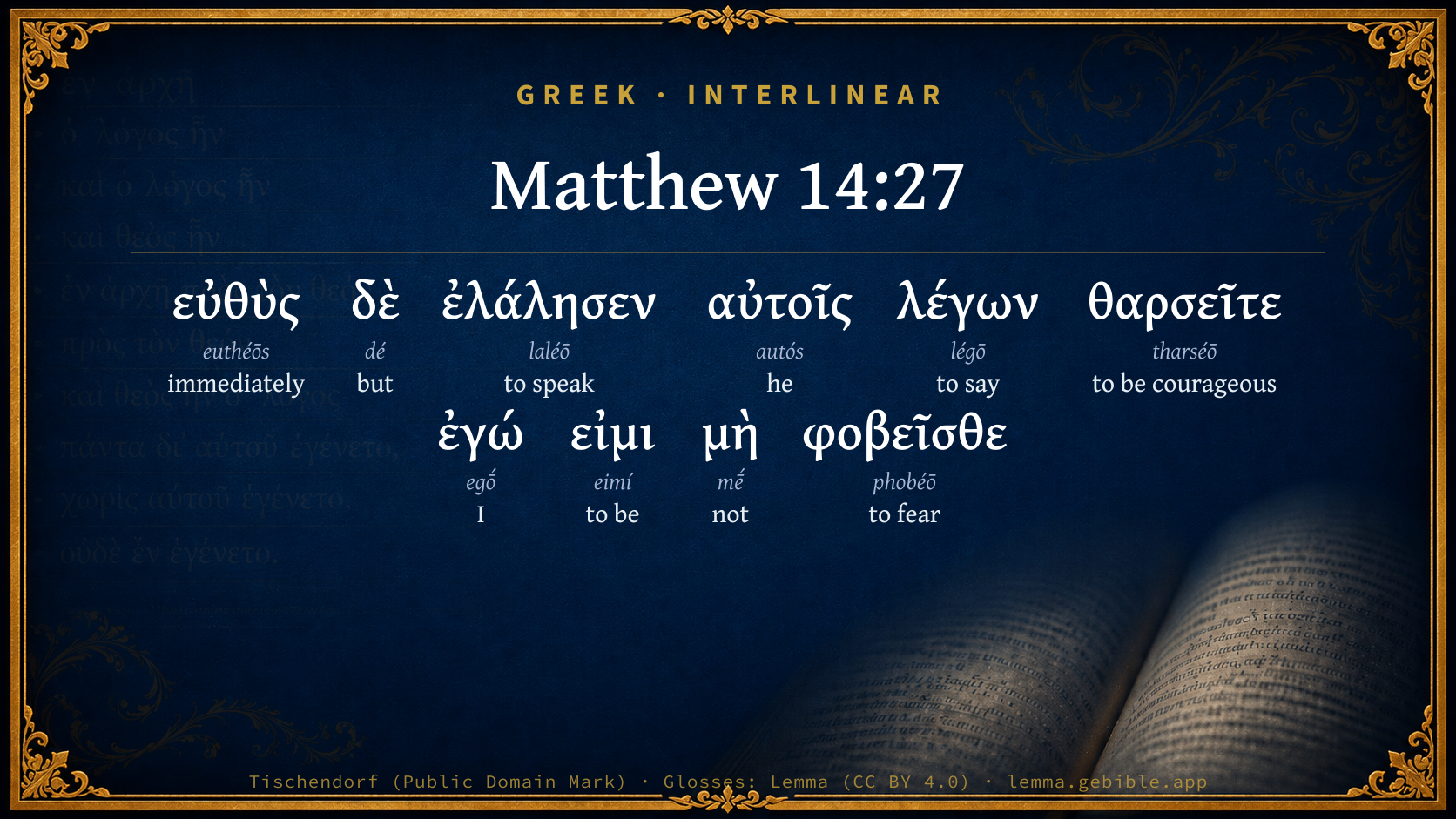
Download image
Cite this verse

Matthew 14:27 (World English Bible). Public Domain. Lemma interlinear Bible study tool, https://lemma.gebible.app/v/matthew/14/27.

Show BibTeX & RIS
BibTeX
RIS
English Translation
But immediately Jesus spoke to them, saying "Cheer up! I AM! Don't be afraid."
World English Bible · Public Domain
Download a study sheet

One document with this verse’s original text, its word-by-word gloss line, the meaning frame, cross-references with their text, attributed commentary, and full source and license credits — printable, and it pastes into notes with its structure intact.

This verse Autodidact and up

Study sheet (.html) Plain text (.txt)

A passage Seminary Student

Up to 50 verses in one chapter. A passage sheet keeps up to 6 commentary sources and 12 cross-references per verse, in the order this page ranks them, and says so on the sheet whenever that leaves anything out. Ask for a single verse and you get the Autodidact verse sheet above.

Everything on this page stays free to read, with no account — the sheet is a download of what is already on screen, not access to it.

Want to remove ads? Support Godless Engineer
Compare translations 3

The same verse in 3 English versions, stacked beneath the original-language interlinear above. Click any original word for its lexicon entry.

Each is an independent rendering of the whole verse — the interlinear is not word-aligned to these translations.

Highlighted words mark where these versions differ — a whole-verse word diff, not a word-by-word alignment.

  • World English Bible Public Domain
    But immediately Jesus spoke to them, saying "Cheer up! I AM! Don't be afraid."
  • King James Version Public Domain
    But straightway Jesus spake unto them, saying, Be of good cheer; it is I; be not afraid.
  • unfoldingWord Literal Text CC BY-SA 4.0
    But immediately Jesus spoke to them, saying, “Take courage! It is I! Do not be afraid.”

unfoldingWord Literal Text — © unfoldingWord, licensed CC BY-SA 4.0. Word-aligned USFM3 via Door43 (git.door43.org/unfoldingWord/en_ult).

Versions to compare (up to 4)

3 of 4 selected

Show all 19 translations

Every available English version of this verse, each an independent rendering of the whole verse.

  • World English Bible Public Domain
    But immediately Jesus spoke to them, saying "Cheer up! I AM! Don't be afraid."
  • Berean Standard Bible Public Domain
    But Jesus spoke up at once: “Take courage! It is I. Do not be afraid.”
  • Majority Standard Bible Public Domain
    But Jesus spoke up at once: “Take courage! It is I. Do not be afraid.”
  • King James Version Public Domain
    But straightway Jesus spake unto them, saying, Be of good cheer; it is I; be not afraid.
  • American Standard Version (1901) Public Domain
    But straightway Jesus spake unto them, saying Be of good cheer; it is I; be not afraid.
  • Revised Version (1885) Public Domain
    But straightway Jesus spake unto them, saying, Be of good cheer; it is I; be not afraid.
  • Geneva Bible (1599) Public Domain
    But straight way Iesus spake vnto them, saying, Be of good comfort, It is I: be not afraide.
  • Douay-Rheims (1899) Public Domain
    And immediately Jesus spoke to them, saying: Be of good heart: it is I, fear ye not.
  • Young's Literal Translation Public Domain
    and immediately Jesus spake to them, saying, `Be of good courage, I am `he', be not afraid.'
  • Literal Standard Version CC BY-SA 4.0
    and immediately Jesus spoke to them, saying, “Take courage! I AM; do not be afraid.”
  • Unlocked Literal Bible CC BY-SA 4.0
    But Jesus spoke to them right away and said, “Be brave! It is I! Do not be afraid.”
  • unfoldingWord Literal Text CC BY-SA 4.0
    But immediately Jesus spoke to them, saying, “Take courage! It is I! Do not be afraid.”
  • Darby Bible Public Domain
    But Jesus immediately spoke to them, saying, Take courage; it is *I*: be not afraid.
  • World Messianic Bible Public Domain
    But immediately Yeshua spoke to them, saying, “Cheer up! It is I! Don’t be afraid.”
  • Webster's Bible Public Domain
    But immediately Jesus spoke to them, saying, Be of good cheer; it is I; be not afraid.
  • Free Bible Version CC BY-SA 4.0
    But immediately Jesus said to them, “Don't worry, it's me! Don't be afraid!”
  • Bible in Basic English Public Domain
    But straight away Jesus said to them, Take heart; it is I, have no fear.
  • Text-Critical English NT CC BY 4.0
    But Jesus immediately said to them, “Take courage! It is I; do not be afraid.”
  • Tyndale New Testament (1534) Public Domain
    And streyght waye Iesus spake vnto them sayinge: be of god cheare it is I be not afrayed.

Literal Standard Version (2020), Covenant Press — licensed CC BY-SA 4.0. Text via the HelloAO Bible API (eBible.org). Unlocked Literal Bible (unfoldingWord) — licensed CC BY-SA 4.0. Text via the HelloAO Bible API (eBible.org). unfoldingWord Literal Text — © unfoldingWord, licensed CC BY-SA 4.0. Word-aligned USFM3 via Door43 (git.door43.org/unfoldingWord/en_ult). Free Bible Version, Dr. Jonathan Gallagher — licensed CC BY-SA 4.0. Text via the HelloAO Bible API (eBible.org).

Word by word

More ways to search: Search by grammar → Find every occurrence → Compare this word →

Practice this passage: Drill this verse → Learn its vocabulary →

About this verse

These counts appear in no published source. They are computed here, from the morphology-tagged text and Lemma’s own curated glosses. What Lemma adds →

10
words
10
distinct lemmas
Gospels
section

Notable vocabulary

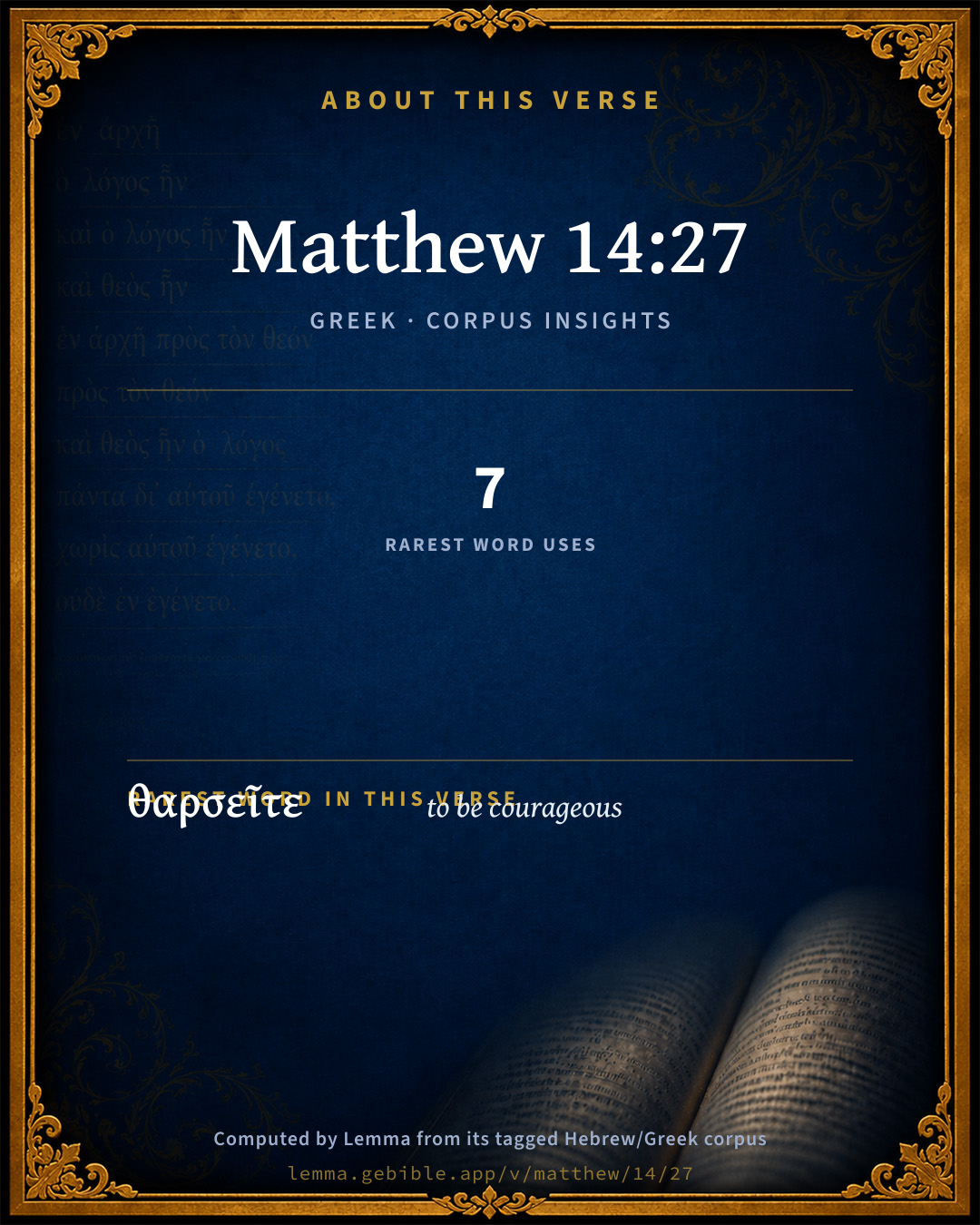
The rarest word here is θαρσεῖτε to be courageous G2293 — appearing just 7 times in the whole Greek New Testament.

Shared distinctive vocabulary

θαρσεῖτε to be courageous G2293 occurs in 7 verses of the Greek New Testament. Also found in:

Cross-references

16

Topical passages linked to Matthew 14:27 in the Treasury of Scripture Knowledge — connected by theme and wording, ordered by reader-vote popularity; previews shown in the World English Bible.

  • John 16:33 I have told you these things, that in me you may have peace. In the world you have oppression; but cheer up! I have overcome the world."
  • Isaiah 41:10 Don't you be afraid, for I am with you; don't be dismayed, for I am your God; I will strengthen you; yes, I will help you; yes, I will uphold you with the right hand of my righteousness.
  • Acts 23:11 The following night, the Lord stood by him, and said, "Cheer up, Paul, for as you have testified about me at Jerusalem, so you must testify also at Rome."
  • Revelation 1:17–18 When I saw him, I fell at his feet like a dead man. He laid his right hand on me, saying, "Don't be afraid. I am the first and the last,
  • Isaiah 41:4 Who has worked and done it, calling the generations from the beginning? I, Yahweh, the first, and with the last, I am he.
  • John 14:1–3 "Don't let your heart be troubled. Believe in God. Believe also in me.
  • Isaiah 51:12 I, even I, am he who comforts you: who are you, that you are afraid of man who shall die, and of the son of man who shall be made as grass;
  • Matthew 9:2 Behold, they brought to him a man who was paralyzed, lying on a bed. Jesus, seeing their faith, said to the paralytic, "Son, cheer up! Your sins are forgiven you."
  • Matthew 17:7 Jesus came and touched them and said, "Get up, and don't be afraid."
  • Luke 24:38–39 He said to them, "Why are you troubled? Why do doubts arise in your hearts?
  • John 6:20 But he said to them, "I AM. Don't be afraid."
  • Luke 1:30 The angel said to her, "Don't be afraid, Mary, for you have found favor with God.
  • Matthew 28:10 Then Jesus said to them, "Don't be afraid. Go tell my brothers that they should go into Galilee, and there they will see me."
  • Luke 1:13 But the angel said to him, "Don't be afraid, Zacharias, because your request has been heard, and your wife, Elizabeth, will bear you a son, and you shall call his name John.
  • Isaiah 41:14 Don't be afraid, you worm Jacob, and you men of Israel; I will help you, says Yahweh, and your Redeemer is the Holy One of Israel.
  • Luke 2:10 The angel said to them, "Don't be afraid, for behold, I bring you good news of great joy which will be to all the people.

Cross-references courtesy of OpenBible.info (CC BY 4.0).

Commentary

Notes on Matthew 14:27 from classic Christian and Jewish commentators (each source and its license shown beneath its notes). The classic Christian expositions comment on the surrounding passage and are grouped to its opening verse, so a note may address several verses; the Jewish commentaries on the Tanakh (Rashi and others) are per-verse, so they appear only where the commentator wrote on this verse.

Lemma curates 59 commentaries, every one of them public domain or Creative Commons licensed, each selected and text-cleaned for this edition rather than reprinted as found. About our sources →

The Biblical Illustrator

Joseph S. Exell

Mat_14:22; Mat_14:27

And straightway Jesus constrained His disciples to get into a ship, and to go before Him unto the other side.

The midnight voyage home

I. The feast followed by humiliation and trouble.

1. The feast in the desert was the greatest work in which the apostles were ever engaged during the ministry of Jesus. The miracle was of a more kingly character than others, shared by a greater number(and more plainly typical of great things to come in the kingdom of heaven. In this glorious work the twelve have been active ministers. They were not to remain to receive the congratulations of the multitude; they must go away at once. Jesus constrains them to return to the ship. Ministers must not intrude themselves into the Lords place; they must be willing servants, and then go their way and leave the rest to the Lord. The apostles had been highly exalted, and now they must be humbled. In the sight of the congregation they are sent away in charge of the empty boat, as if they were mere fishermen still.

2. But they are sent also into the midst of trouble. After we have had faith to distribute the bread of life comes the trial of obedience. It seemed as if providence were contrary to their course.

II. The storm aggravated by Christs absence, and stilled by his coming.

1. Jesus sent the twelve away alone, and all that the people saw was that He went not in the ship with them. Jesus was to come to them by the coast.

2. Jesus, meanwhile, has not walked along the coast, whence they expected to take Him in; but has left the shore altogether, and gone up into a mountain apart. In the retired mountain He cannot be seen by the disciples; but in His prayer to the Father they will not be forgotten.

3. Jesus comes to them according to His promise; but not according to their thoughts, either in time or in manner.

4. There is yet one more element of trial mingled for these midnight wrestlers with the waves. Jesus often appears to be going past in our time of need. Also His manner of coming alarms the disciples. In our trials we often mistake the coming of the Lord Jesus.

5. Jesus enters the ship; and how glorious is the effect of deliverance out of danger, of seasonable help, when obeying Christs command, against all adversity.

6. An unlooked-for blessing now awaits them on the shore. (A. M. Stuart.)

Jesus constrained His disciples

Why?

1. Lest they should take part with the rash, many-headed multitude, who would have made Him a king.

2. To inure them to the cross, and teach them to suffer hardship.

3. To give them proof of His power,

Nature and grace

The story of this miracle has instruction for us in connection with the material world in which we live. Nature is not, in all respects, to be separated off too sharply from grace; and this miracle reminds us that it is the Lord of this universe who is the Head of the Church and the Saviour of our souls. (Dean Howson.)

The government of nature

These miracles, dealing with nature, show themselves as interfering with what we may call the righteous laws of nature. Water should wet the foot, should engulf him who would tread its surface. Yet even in this, I think, the restoration of an original law-the supremacy of righteous man, is foreshown. While a man cannot order his own house as he would, something is wrong in him, and therefore in his house. I think a true man should be able to rule winds and waters, loaves and fishes, for he comes of the Father who made the house for him. Man is not master in his own house, because he is not master in himself, because he is not a law unto himself-is not himself obedient to the law by which he exists. (George Macdonald.)

Secret of Christs power over nature

A higher condition of harmony with law may one day enable us to do things which must now appear an interruption of law. I believe it is in virtue of the absolute harmony in Him, His perfect righteousness, that God can create at all. If man were in harmony with this, if he too were righteous, he would inherit of his Father a something in his degree correspondent to the creative power in Him; and the world he inhabits, which is but an extension of his body, would, I think, be subject to him in a way surpassing his wildest dreams of dominion, for it would be the perfect dominion of holy law-a virtue flowing to and from him through the channel of a perfect obedience. I suspect that our Lord, in all His dominion over nature, set forth only the complete man-man as God means him one day to be. I believe that some of these miracles were the natural result of a physical nature perfect from the indwelling of a perfect soul, whose unity with the Life of all things and in all things was absolute-in a word, whose sonship was perfect. (George Macdonald.)

The glorifying of Christs body

The difficulty here is our Lords withdrawing Himself personally from the control of earthly natural laws. It is common to conceive of the glorifying of Christs body as the work of a moment, at the Resurrection, or, at least, at the Ascension. But if we suppose the Spirits work in glorifying and perfecting Christs body to have been spread over the Saviours whole life, certain periods-such as this walking on the sea, and the transfiguration-being still distinguished as seasons of special activity, much that is obscure will be made clear. A body thoroughly of the earth, chained down by unseen hands to earthly matter, cannot shake itself free from its origin, but that a higher bodily frame, teeming with the powers of a loftier world, should rise above the earthly level is less surprising. This manifestation of Christs hidden glory was designed to build up His disciples in the faith. They saw more and more clearly with whom they had to do, and perceived that He was the revelation of the invisible Father, who alone spreadeth out the heavens, and treadeth upon the waves of the sea. (Olshausen.)

The Divine coming unrecognized

It often happens that the coming of Christ to His disciples for their relief is that which frightens them most, because they do not know the extent of Gods wardrobe; for I think that as a king might never wear the same garment but once, in order to show his riches and magnificence, so God comes to us in all exigencies, but never twice alike. He sometimes puts on the garments of trouble; and when we are calling upon Him as though He were yet in heaven, He is walking by our Ado; and that from which we are praying God to deliver us is often but God Himself. Thus it is with us as with children who are terrified by their dreams in the night, and scream for their parents, until, fully waking, behold they are in their parents arms! (H. W. Beecher.)

The sea on which Jesus walked

Shortly after passing the spot which was the scene of the terrible discomfiture of the Christian hosts by Saladin, we came to the brink of a vast hollow, and the Lake of Tiberius lay slumbering far beneath our feet. The sun was nearly at the zenith, and diffused a flood of dazzling light upon the waters, just ruffled by a passing breeze, on which we beheld a solitary bark, a mere speck, slowly making its way toward Tiberias. That city, with its huge castle and turreted walls, a pile of melancholy ruins, lay scattered along the nearer shore. The lake, about ten miles long, add five or six broad, was embosomed in mountains, or, to describe it more correctly, was like a great caldron sunk in the lofty table-land, which broke down to its edge in steep cliffs and abrupt ravines. At one end we could see where the Jordan flowed into it, and, beyond, the lofty peak of Mount Hermon covered with eternal snow. There was no wood on the hills, there were no villages on the shore, no boats upon the water; there was no sound in any direction. If there was beauty, it was that of the intense blue sky of Palestine, reflected in the blue expanse of waters, and over-canopying a landscape of serene, but corpse-like, placidity, like a countenance fixed in death, but upon which there yet lingers something of a parting smile. (W. H. Bartlett.)

The Biblical Illustrator, edited by Joseph S. Exell (c. 1880s–1900s) — public domain. Text from a community e-Sword module.

Tyndale Open Study Notes

Tyndale Open Resources

14:27 I am here: Literally I am. This declaration is associated with the appearance of God himself (see also John 8:24; 18:5-6; cp. Exod 3:14).

Tyndale Open Study Notes — © Tyndale Open Resources, licensed CC BY-SA 4.0. Text via the HelloAO Bible API.

Expositor's Greek Testament

ed. W. Robertson Nicoll

Mat 14:27 . ἐλάλησεν : Jesus spoke; the words given ( θαρσεῖτε , etc.), but the mere sound of His voice would be enough.

The Expositor's Greek Testament, edited by W. Robertson Nicoll (1897–1910) — public domain. Text from a community e-Sword module.

Adam Clarke's Commentary

Verse 27. It is I; be not afraid] Nothing but this voice of Christ could, in such circumstances, have given courage and comfort to his disciples: those who are grievously tossed with difficulties and temptations require a similar manifestation of his power and goodness. When he proclaims himself in the soul, all sorrow, and fear, and sin are at an end.

Adam Clarke's Commentary on the Bible (1810–1826) — public domain. Text from a community e-Sword/MySword module.

Ellicott's Commentary for English Readers

(27) Be of good cheer; it is I; be not afraid.—The accuracy with which the words are given by St. John, as well as by St. Matthew and St. Mark, shows the impression which the incident made on the minds of the disciples. To hear the familiar tones and the cheering words was enough, even amid the howling of the winds and the dashing of the waves, to give them confidence and hope. We can scarcely doubt that in after years that moment came back to their recollection, invested for them, as it has since been for the Church at large, with something of a symbolic character. Often the sky became dark, and the waves of the troublesome world were rough, and the blasts of persecution beat on them, and the ark of Christ’s Church was tossed on the waters, and they were wearied and spent with rowing. They thought themselves abandoned, and then in the dim twilight they would see or feel once again the tokens of His presence. He was coming to them through the storm. “Be of good cheer” became the watchword of their lives.

A Bible Commentary for English Readers, edited by Charles John Ellicott (1878–1897) — public domain. Text from a community e-Sword module.

John Gill's Exposition

And Peter answered him and said,.... Who knew his voice, and was ready to believe it might be Christ; and having more courage, and being more forward than the rest of the disciples, ventured to speak to him; saying,

Lord, if it be thou; for he was not fully assured that it was he: he might consider that nocturnal apparitions are deceitful, and that Satan can transform himself into an angel of light, and could put on the appearance, and mimic the voice of Christ; wherefore, to try whether it was a spectre, or really Christ, he says,

bid me come unto thee on the water; thereby expressing great love and affection to Christ, being willing to come to him, though through danger, through storms and tempests; and also his strong faith in him, supposing it to be he; who, he knew, was as able to support his body on the water, as his own; and yet much modesty, submission, and dependence; not willing to take a step without his order.

John Gill's Exposition of the Whole Bible (1746–1763) — public domain (CC PDM 1.0). Text via the HelloAO Bible API.

Trapp's Complete Commentary

John Trapp

27 But straightway Jesus spake unto them, saying, Be of good cheer; it is I; be not afraid.

Ver. 27. But straightway Jesus spake, &c.] He waits to be gracious, Isa 30:18. Our extremity is his opportunity. Cum duplicantur lateres venit Moses. God brings his people to the mount with Abraham, yea, to the very brow of the hill, till their feet slip, and then delivers them: when all is given up for lost, then comes he in, as out of an engine, εκ μηχανης.

It is I, fear not] Quid timet homo in sinu Dei positus? A child that is in his father’s bosom fears no bugbears.

John Trapp, A Commentary or Exposition upon All the Books of the Old and New Testament (1647–1656) — public domain. Text from a community e-Sword module.

Whedon's Commentary on the Bible

Daniel D. Whedon

27. It is I — So does the Christian in the time of trial recognize the presence and cheering voice of his Saviour.

Daniel D. Whedon (gen. ed.), Commentary on the Old and New Testaments (1874–1909) — public domain. Text from a community e-Sword module.

The Pulpit Commentary

But straightway Jesus spake unto them (elalhsen , not ekraxen). He was evidently near them. Saying, Be of good cheer; (yarseite , Mat_9:2) it is I; be not afraid. Encouragement, self-manifestation, recall from present terror. But the absence of yarseite in Joh_6:20 suggests that it is, perhaps, a duplicate rendering of the Aramaic for mh fobeisye . For the LXX commonly translates "fear ye not" by yarseite . (e.g. Exo_14:13 Exo_20:20) One or two second-rate manuscripts omit yarseite in Mark, but this may be only due to a reminiscence of John. It is also omitted in Tatian"s "Diatessaron" (edit. Hemphill).

The Pulpit Commentary (1880–1919), ed. H.D.M. Spence-Jones & Joseph S. Exell — public domain. Text from a community e-Sword module.

Burkitt's Expository Notes on the New Testament

William Burkitt

Observe, when the disciples were in the saddest condition, how one word from Christ revives them; it is a sufficient support in all our afflictions to hear Christ’s voice speaking to us, and to enjoy his favourable presence with us.

Say but, O Saviour, It is I; and then let evils do their worst: that one word, It is I, is enough to lay all storms, and to calm all tempests.

William Burkitt's Expository Notes on the New Testament (1700–1703) — public domain. Text from a community e-Sword module.

The People's New Testament

B. W. Johnson

27. It is I; be not afraid. How often has he to speak this word of encouragement, even to his own! almost always when they are brought suddenly, or in an unusual way, face to face with him. See Gen. 15:1; 21:17; Judg. 6:23; Matt. 28:5; Luke 2:10. It is I. Literally, I am. The same language used by Jesus in Jerusalem (John 8:58), for which the Pharisees would have stoned him, and in the Old Testament to designate Jehovah (Exod. 3:14). Here I should prefer to give it this meaning: Christ says not merely, “It is I, your Friend and Master;” he says, at least implies, it is the “I AM,” who is coming to you, the Almighty One who rules wind and waves, who made them, and whom they obey.

B. W. Johnson's The People's New Testament with Notes (1889–1891) — public domain. Electronic text from the Christian Classics Ethereal Library (CCEL) ThML edition.

International Critical Commentary

27. And straightway Jesus spake to them, saying, Be of good cheer; it is I; be not afraid.] Mk. has: ἐλάλησεν μετʼ αὐτῶν καὶ λέγει αὐτοῖς. Mt. alters, as often, into ἐλάλησεν—λέγων. Cf. on 8:3.

International Critical Commentary — older volumes (1896–1929), various authors — public domain. Text from a community e-Sword module.

Lesson kit

Teaching starters — assembled from the data on this page, not authored interpretation. Every prompt links to the verse data it draws on. Edit before teaching.

Matthew, in the Gospels, opens this verse with 10 words (10 distinct Greek lemmas). Its most distinctive word is tharséō (“to be courageous”). A historical commentator’s framing appears above. Read the whole chapter for the surrounding context.

Discussion questions

  1. How does “to be courageous” (tharséō) shape what this verse is saying?
  2. Matthew 9:2 shares the word «to be courageous» with this verse. How do the two illuminate each other?
  3. These translations render this verse differently. What is at stake in choosing one wording over another?
  4. Reading how The Biblical Illustrator and Tyndale Open Study Notes read this verse, where do the two commentators agree and where do they part?

Things to notice

Reading settings

Reading text

Shown beneath each verse's original-language words.

Old Testament
Old Testament edition

Read the OT as the Masoretic Hebrew (MT) or the Greek Septuagint (LXX).

English shown for the Greek Septuagint (in the Hebrew ↔ Greek comparison).

Comparing translations? Open the Compare panel on any verse page to stack up to four side by side.