

Mark 12:14
Greek (Tischendorf 8th ed.) Mark 12:14 appears in the Greek New Testament. The text above is from the Tischendorf 8th edition. Each word links to its Strong’s number and a concise gloss. Click any word for its full Thayer’s Greek Lexicon entry.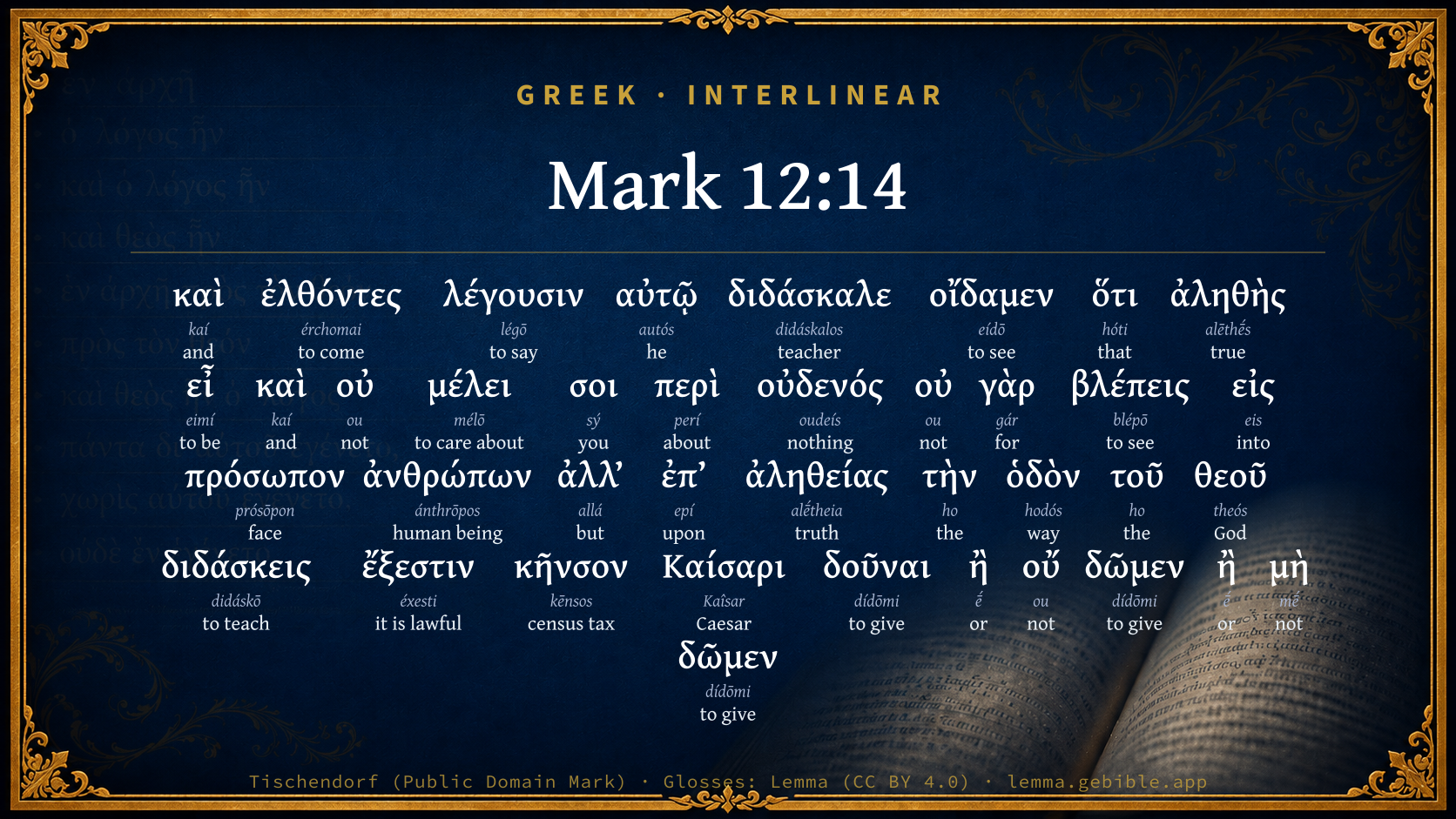
When they had come, they asked him, "Teacher, we know that you are honest, and don't defer to anyone; for you aren't partial to anyone, but truly teach the way of God. Is it lawful to pay taxes to Caesar, or not?
Download a study sheet
One document with this verse’s original text, its word-by-word gloss line, the meaning frame, cross-references with their text, attributed commentary, and full source and license credits — printable, and it pastes into notes with its structure intact.
This verse Autodidact and up
A passage Seminary Student
Up to 50 verses in one chapter. A passage sheet keeps up to 6 commentary sources and 12 cross-references per verse, in the order this page ranks them, and says so on the sheet whenever that leaves anything out. Ask for a single verse and you get the Autodidact verse sheet above.
Everything on this page stays free to read, with no account — the sheet is a download of what is already on screen, not access to it.
Compare translations 3
The same verse in 3 English versions, stacked beneath the original-language interlinear above. Click any original word for its lexicon entry.
Each is an independent rendering of the whole verse — the interlinear is not word-aligned to these translations.
Highlighted words mark where these versions differ — a whole-verse word diff, not a word-by-word alignment.
-
World English Bible Public Domain
When they had come, they asked him, "Teacher, we know that you are honest, and don't defer to anyone; for you aren't partial to anyone, but truly teach the way of God. Is it lawful to pay taxes to Caesar, or not?
-
King James Version Public Domain
And when they were come, they say unto him, Master, we know that thou art true, and carest for no man: for thou regardest not the person of men, but teachest the way of God in truth: Is it lawful to give tribute to Caesar, or not?
-
unfoldingWord Literal Text CC BY-SA 4.0
And having come, they say to him, “Teacher, we know that you are truthful, and it is not a concern to you about anyone, for you do not look at the face of men, but you teach the way of God on the basis of truth. Is it lawful to give a poll tax to Caesar, or not? Should we give, or should we not give?”
unfoldingWord Literal Text — © unfoldingWord, licensed CC BY-SA 4.0. Word-aligned USFM3 via Door43 (git.door43.org/unfoldingWord/en_ult).
Show all 19 translations
Every available English version of this verse, each an independent rendering of the whole verse.
-
World English Bible Public Domain
When they had come, they asked him, "Teacher, we know that you are honest, and don't defer to anyone; for you aren't partial to anyone, but truly teach the way of God. Is it lawful to pay taxes to Caesar, or not?
-
Berean Standard Bible Public Domain
“Teacher,” they said, “we know that You are honest and seek favor from no one. Indeed, You are impartial and teach the way of God in accordance with the truth. Is it lawful to pay taxes to Caesar or not? Should we pay them or not?”
-
Majority Standard Bible Public Domain
“Teacher,” they said, “we know that You are honest and seek favor from no one. Indeed, You are impartial and teach the way of God in accordance with the truth. Is it lawful to pay taxes to Caesar or not? Should we pay them or not?”
-
King James Version Public Domain
And when they were come, they say unto him, Master, we know that thou art true, and carest for no man: for thou regardest not the person of men, but teachest the way of God in truth: Is it lawful to give tribute to Caesar, or not?
-
American Standard Version (1901) Public Domain
And when they were come, they say unto him, Teacher, we know that thou art true, and carest not for any one; for thou regardest not the person of men, but of a truth teachest the way of God: Is it lawful to give tribute unto Caesar, or not?
-
Revised Version (1885) Public Domain
And when they were come, they say unto him, Master, we know that thou art true, and carest not for any one: for thou regardest not the person of men, but of a truth teachest the way of God: Is it lawful to give tribute unto Caesar, or not?
-
Geneva Bible (1599) Public Domain
And when they came, they saide vnto him, Master, we know that thou art true, and carest for no man: for thou considerest not the person of men, but teachest the way of God truely, Is it lawfull to giue tribute to Cesar, or not?
-
Douay-Rheims (1899) Public Domain
Who coming, say to him: Master, we know that thou art a true speaker, and carest not for any man; for thou regardest not the person of men, but teachest the way of God in truth. Is it lawful to give tribute to Caesar; or shall we not give it?
-
Young's Literal Translation Public Domain
and they having come, say to him, `Teacher, we have known that thou art true, and thou art not caring for any one, for thou dost not look to the face of men, but in truth the way of God dost teach; is it lawful to give tribute to Caesar or not? may we give, or may we not give?'
-
Literal Standard Version CC BY-SA 4.0
and they having come, say to Him, “Teacher, we have known that You are true, and You are not caring for anyone, for You do not look to the face of men, but in truth teach the way of God; is it lawful to give tribute to Caesar or not? May we give, or may we not give?”
-
Unlocked Literal Bible CC BY-SA 4.0
When they came, they said to him, “Teacher, we know that you care for no one's opinion, and you do not show partiality between people. You truly teach the way of God. Is it lawful to pay taxes to Caesar or not? Should we pay or not?”
-
unfoldingWord Literal Text CC BY-SA 4.0
And having come, they say to him, “Teacher, we know that you are truthful, and it is not a concern to you about anyone, for you do not look at the face of men, but you teach the way of God on the basis of truth. Is it lawful to give a poll tax to Caesar, or not? Should we give, or should we not give?”
-
Darby Bible Public Domain
And they come and say to him, Teacher, we know that thou art true, and carest not for any one; for thou regardest not men's person, but teachest the way of God with truth: Is it lawful to give tribute to Caesar or not?
-
World Messianic Bible Public Domain
When they had come, they asked him, “Rabbi, we know that you are honest, and don’t defer to anyone; for you aren’t partial to anyone, but truly teach the way of God. Is it lawful to pay taxes to Caesar, or not?
-
Webster's Bible Public Domain
And when they had come, they say to him, Master, we know that thou art true, and carest for no man: for thou regardest not the person of men, but teachest the way of God in truth: Is it lawful to give tribute to Cesar, or not?
-
Free Bible Version CC BY-SA 4.0
They arrived and said, “Teacher, we know you are a truthful person and you don't look for approval, because you don't care about status or position. Instead you teach God's way in accordance with the truth. So is it right to pay tribute to Caesar or not?
-
Bible in Basic English Public Domain
And when they had come, they said to him, Master, we are certain that you are true, and have no fear of anyone: you have no respect for a man's position, but you are teaching the true way of God: Is it right to give taxes to Caesar or not?
-
Text-Critical English NT CC BY 4.0
They came and said to him, “Teacher, we know that yoʋ are true and defer to no one, for yoʋ do not show partiality but teach the way of God in truth. Is it lawful to pay taxes to Caesar, or not?
-
Tyndale New Testament (1534) Public Domain
And assone as they were come they sayd vnto him: master we knowe that thou arte true and carest for no man: for thou consyderest not the degre of men but teachest the waye of God truly: Ys it laufull to paye tribute to Cesar or not?
Literal Standard Version (2020), Covenant Press — licensed CC BY-SA 4.0. Text via the HelloAO Bible API (eBible.org). Unlocked Literal Bible (unfoldingWord) — licensed CC BY-SA 4.0. Text via the HelloAO Bible API (eBible.org). unfoldingWord Literal Text — © unfoldingWord, licensed CC BY-SA 4.0. Word-aligned USFM3 via Door43 (git.door43.org/unfoldingWord/en_ult). Free Bible Version, Dr. Jonathan Gallagher — licensed CC BY-SA 4.0. Text via the HelloAO Bible API (eBible.org).
Word by word
More ways to search: Search by grammar → Find every occurrence → Compare this word →
Practice this passage: Drill this verse → Learn its vocabulary →
- Appears 4× in the Greek New Testament
- First appears at Matthew 17:25
- Part of Speech
- Noun
- Case
- Accusative
- Number
- Singular
- Gender
- Masculine
Full Thayer's Definition
- καὶ kaí G2532 “and” Conjunction
- ἐλθόντες érchomai G2064 “to come” Verb, Aorist, Active, Participle, Nominative, Plural, Masculine
- λέγουσιν légō G3004 “to say” Verb, Present, Active, Indicative, 3rd person, Plural
- αὐτῷ autós G846 “he” Personal pronoun, Dative, Singular, Masculine
- διδάσκαλε didáskalos G1320 “teacher” Noun, Vocative, Singular, Masculine
- οἴδαμεν eídō G1492 “to see” Verb, Perfect, Active, Indicative, 1st person, Plural
- ὅτι hóti G3754 “that” Conjunction
- ἀληθὴς alēthḗs G227 “true” Adjective, Nominative, Singular, Masculine
- εἶ eimí G1510 “to be” Verb, Present, Active, Indicative, 2nd person, Singular
- καὶ kaí G2532 “and” Conjunction
- οὐ ou G3756 “not” Particle, Negative
- μέλει mélō G3199 “to care about” Verb, Present, Active, Indicative, 3rd person, Singular
- σοι sý G4771 “you” Personal pronoun, 2nd person, Dative, Singular
- περὶ perí G4012 “about” Preposition
- οὐδενός oudeís G3762 “nothing” Adjective, Genitive, Singular, Masculine, Negative
- οὐ ou G3756 “not” Particle, Negative
- γὰρ gár G1063 “for” Conjunction
- βλέπεις blépō G991 “to see” Verb, Present, Active, Indicative, 2nd person, Singular
- εἰς eis G1519 “into” Preposition
- πρόσωπον prósōpon G4383 “face” Noun, Accusative, Singular, Neuter
- ἀνθρώπων ánthrōpos G444 “human being” Noun, Genitive, Plural, Masculine
- ἀλλ’ allá G235 “but” Conjunction
- ἐπ’ epí G1909 “upon” Preposition
- ἀληθείας alḗtheia G225 “truth” Noun, Genitive, Singular, Feminine
- τὴν ho G3588 “the” Article, Accusative, Singular, Feminine
- ὁδὸν hodós G3598 “way” Noun, Accusative, Singular, Feminine
- τοῦ ho G3588 “the” Article, Genitive, Singular, Masculine
- θεοῦ theós G2316 “God” Noun, Genitive, Singular, Masculine
- διδάσκεις didáskō G1321 “to teach” Verb, Present, Active, Indicative, 2nd person, Singular
- ἔξεστιν éxesti G1832 “it is lawful” Verb, Present, Active, Indicative, 3rd person, Singular
- κῆνσον kēnsos G2778 “census tax” Noun, Accusative, Singular, Masculine
- Καίσαρι Kaîsar G2541 “Caesar” Noun, Dative, Singular, Masculine
- δοῦναι dídōmi G1325 “to give” Verb, Aorist, Active, Infinitive
- ἢ ḗ G2228 “or” Particle
- οὔ ou G3756 “not” Particle, Negative
- δῶμεν dídōmi G1325 “to give” Verb, Aorist, Active, Subjunctive, 1st person, Plural
- ἢ ḗ G2228 “or” Particle
- μὴ mḗ G3361 “not” Particle, Negative
- δῶμεν dídōmi G1325 “to give” Verb, Aorist, Active, Subjunctive, 1st person, Plural
About this verse
These counts appear in no published source. They are computed here, from the morphology-tagged text and Lemma’s own curated glosses. What Lemma adds →
- 39
- words
- 32
- distinct lemmas
- Gospels
- section
Cross-references
33Topical passages linked to Mark 12:14 in the Treasury of Scripture Knowledge — connected by theme and wording, ordered by reader-vote popularity; previews shown in the World English Bible.
- Luke 20:22 Is it lawful for us to pay taxes to Caesar, or not?"
- John 7:18 He who speaks from himself seeks his own glory, but he who seeks the glory of him who sent him, the same is true, and no unrighteousness is in him.
- 2 Corinthians 2:2 For if I make you sorry, then who will make me glad but he who is made sorry by me?
- 2 Corinthians 2:17 For we are not as so many, peddling the word of God. But as of sincerity, but as of God, in the sight of God, we speak in Christ.
- 2 Corinthians 5:11 Knowing therefore the fear of the Lord, we persuade men, but we are revealed to God; and I hope that we are revealed also in your consciences.
- 2 Corinthians 5:16 Therefore we know no one after the flesh from now on. Even though we have known Christ after the flesh, yet now we know him so no more.
- Galatians 1:10 For am I now seeking the favor of men, or of God? Or am I striving to please men? For if I were still pleasing men, I wouldn't be a servant of Christ.
- Galatians 2:6 But from those who were reputed to be important (whatever they were, it makes no difference to me; God doesn't show partiality to man)--they, I say, who were respected imparted nothing to me,
- Galatians 2:11–14 But when Peter came to Antioch, I resisted him to the face, because he stood condemned.
- 1 Thessalonians 2:4 But even as we have been approved by God to be entrusted with the Gospel, so we speak; not as pleasing men, but God, who tests our hearts.
- Exodus 23:2–6 You shall not follow a crowd to do evil; neither shall you testify in court to side with a multitude to pervert justice;
- Deuteronomy 16:19 You shall not wrest justice: you shall not respect persons; neither shall you take a bribe; for a bribe does blind the eyes of the wise, and pervert the words of the righteous.
- Deuteronomy 33:9–10 Who said of his father, and of his mother, I have not seen him; Neither did he acknowledge his brothers, Nor knew he his own children: For they have observed your word, Keep your covenant.
- 2 Chronicles 18:13 Micaiah said, As Yahweh lives, what my God says, that will I speak.
- 2 Chronicles 19:7 Now therefore let the fear of Yahweh be on you; take heed and do it: for there is no iniquity with Yahweh our God, nor respect of persons, nor taking of bribes.
- Ezra 4:12–13 Be it known to the king, that the Jews who came up from you are come to us to Jerusalem; they are building the rebellious and the bad city, and have finished the walls, and repaired the foundations.
- Nehemiah 9:37 It yields much increase to the kings whom you have set over us because of our sins: also they have power over our bodies, and over our cattle, at their pleasure, and we are in great distress.
- Psalms 12:2–4 Everyone lies to his neighbor. They speak with flattering lips, and with a double heart.
- Psalms 55:21 His mouth was smooth as butter, But his heart was war. His words were softer than oil, Yet they were drawn swords.
- Psalms 120:2 Deliver my soul, Yahweh, from lying lips, From a deceitful tongue.
- Proverbs 26:23–26 Like silver dross on an earthen vessel Are the lips of a fervent one with an evil heart.
- Isaiah 50:7–9 For the Lord Yahweh will help me; therefore I have not been confounded: therefore have I set my face like a flint, and I know that I shall not be disappointed.
- Jeremiah 15:19–21 Therefore thus says Yahweh, If you return, then will I bring you again, that you may stand before me; and if you take forth the precious from the vile, you shall be as my mouth: they shall return to you, but you shall not return to them.
- Jeremiah 42:2–3 and said to Jeremiah the prophet, Let, we pray you, our supplication be presented before you, and pray for us to Yahweh your God, even for all this remnant; for we are left but a few of many, as your eyes do see us:
- Jeremiah 42:20 For you have dealt deceitfully against your own souls; for you sent me to Yahweh your God, saying, Pray for us to Yahweh our God; and according to all that Yahweh our God shall say, so declare to us, and we will do it:
- Ezekiel 2:6–7 You, son of man, don't be afraid of them, neither be afraid of their words, though briers and thorns are with you, and you do dwell among scorpions: don't be afraid of their words, nor be dismayed at their looks, though they are a rebellious house.
- Micah 3:8 But as for me, I am full of power by the Spirit of Yahweh, And of judgment, and of might, To declare to Jacob his disobedience, And to Israel his sin.
- Matthew 17:25–27 He said, "Yes." When he came into the house, Jesus anticipated him, saying, "What do you think, Simon? From whom do the kings of the earth receive toll or tribute? From their children, or from strangers?"
- Matthew 22:17 Tell us therefore, what do you think? Is it lawful to pay taxes to Caesar, or not?"
- Mark 14:45 When he had come, immediately he came to him, and said, "Rabbi! Rabbi!" and kissed him.
- Luke 23:2 They began to accuse him, saying, "We found this man perverting the nation, forbidding paying taxes to Caesar, and saying that he himself is Christ, a king."
- Romans 13:6 For this reason you also pay taxes, for they are ministers of God's service, attending continually on this very thing.
- 2 Corinthians 4:1 Therefore seeing we have this ministry, even as we obtained mercy, we don't faint.
Cross-references courtesy of OpenBible.info (CC BY 4.0).
Lesson kit
Teaching starters — assembled from the data on this page, not authored interpretation. Every prompt links to the verse data it draws on. Edit before teaching.
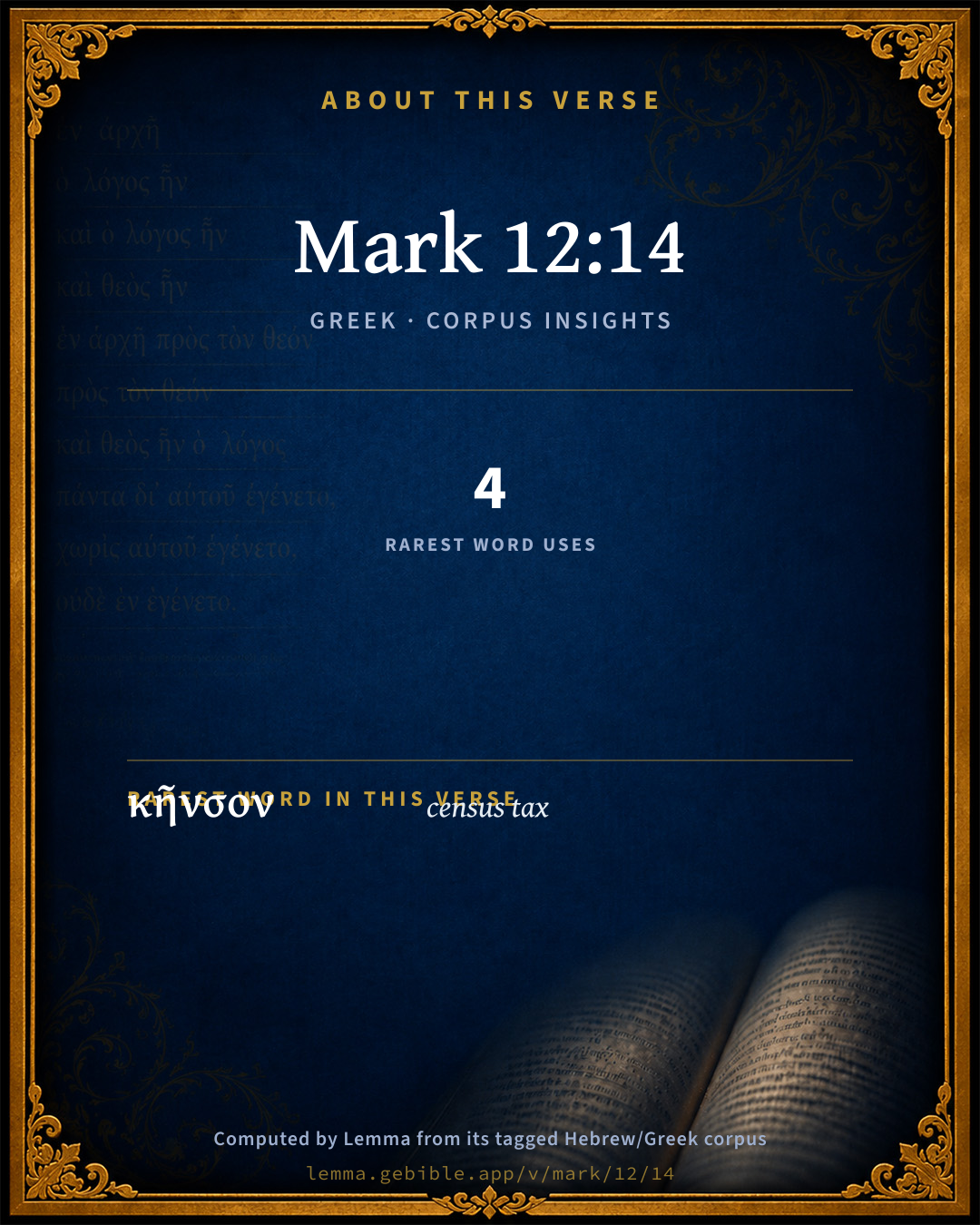
Mark, in the Gospels, opens this verse with 39 words (32 distinct Greek lemmas). Its most distinctive word is kēnsos (“census tax”). A historical commentator’s framing appears above. Read the whole chapter for the surrounding context.
Discussion questions
- How does “census tax” (kēnsos) shape what this verse is saying?
- How does Matthew 17:25, which shares the word «census tax», read alongside this verse?
- What does the repetition of “to give” (3× in this one verse) do in this verse?
- These translations render this verse differently. What is at stake in choosing one wording over another?
- Compare how Tyndale Open Study Notes and Bengel's Gnomon read this verse. Where do they agree or differ?
Things to notice
- These translations choose different wording for 38 words in this verse.
- “to give” occurs 3× in this single verse.
- 32 distinct Greek lemmas span 39 words in this verse.
Commentary
Notes on Mark 12:14 from classic Christian and Jewish commentators (each source and its license shown beneath its notes). The classic Christian expositions comment on the surrounding passage and are grouped to its opening verse, so a note may address several verses; the Jewish commentaries on the Tanakh (Rashi and others) are per-verse, so they appear only where the commentator wrote on this verse.
Lemma curates 59 commentaries, every one of them public domain or Creative Commons licensed, each selected and text-cleaned for this edition rather than reprinted as found. About our sources →
Tyndale Open Study Notes
Tyndale Open Resources
Tyndale Open Study Notes — © Tyndale Open Resources, licensed CC BY-SA 4.0. Text via the HelloAO Bible API.
Bengel's Gnomon
Johann Albrecht Bengel
Bengel's Gnomon of the New Testament — English translation (T&T Clark, Edinburgh, 1860) — public domain. Text from a community e-Sword module.
Expositor's Greek Testament
ed. W. Robertson Nicoll
The Expositor's Greek Testament, edited by W. Robertson Nicoll (1897–1910) — public domain. Text from a community e-Sword module.
Geneva Bible (1599)
Geneva Bible translators
Geneva Bible (1599) marginal notes — public domain. Text via Bolls.life.
Ellicott's Commentary for English Readers
A Bible Commentary for English Readers, edited by Charles John Ellicott (1878–1897) — public domain. Text from a community e-Sword module.
The Cambridge Bible for Schools and Colleges
gen. ed. J. J. S. Perowne
The Cambridge Bible for Schools and Colleges (gen. ed. J. J. S. Perowne; Cambridge University Press, 1878–1918) — public domain. Text from a community e-Sword module.
John Gill's Exposition
John Gill's Exposition of the Whole Bible (1746–1763) — public domain (CC PDM 1.0). Text via the HelloAO Bible API.
Trapp's Complete Commentary
John Trapp
John Trapp, A Commentary or Exposition upon All the Books of the Old and New Testament (1647–1656) — public domain. Text from a community e-Sword module.
Haydock's Catholic Bible Commentary
George Leo Haydock (1774–1849), Haydock's Catholic Family Bible and Commentary, 1859 edition — public domain. Excludes Psalms (Douay-Rheims chapter numbering differs from Protestant) and Deuterocanonical books (Catholic canon only).
Cambridge Greek Testament for Schools and Colleges
Cambridge Greek Testament for Schools and Colleges (Cambridge University Press, 1896; 21 vols, various authors incl. Carr, Maclear, Plummer, Farrar, Lumby, Moule, M. R. James, Simcox) — public domain. Text from a community e-Sword module.
Alford’s Greek Testament
Henry Alford
Henry Alford, The Greek Testament (1849–1861) — public domain. Text from a community e-Sword module.
International Critical Commentary
International Critical Commentary — older volumes (1896–1929), various authors — public domain. Text from a community e-Sword module.
Vincent's Word Studies in the New Testament
Marvin R. Vincent
Marvin R. Vincent, Word Studies in the New Testament (1887–1900) — public domain. Text from a community e-Sword/MySword module.