Luke 2:45

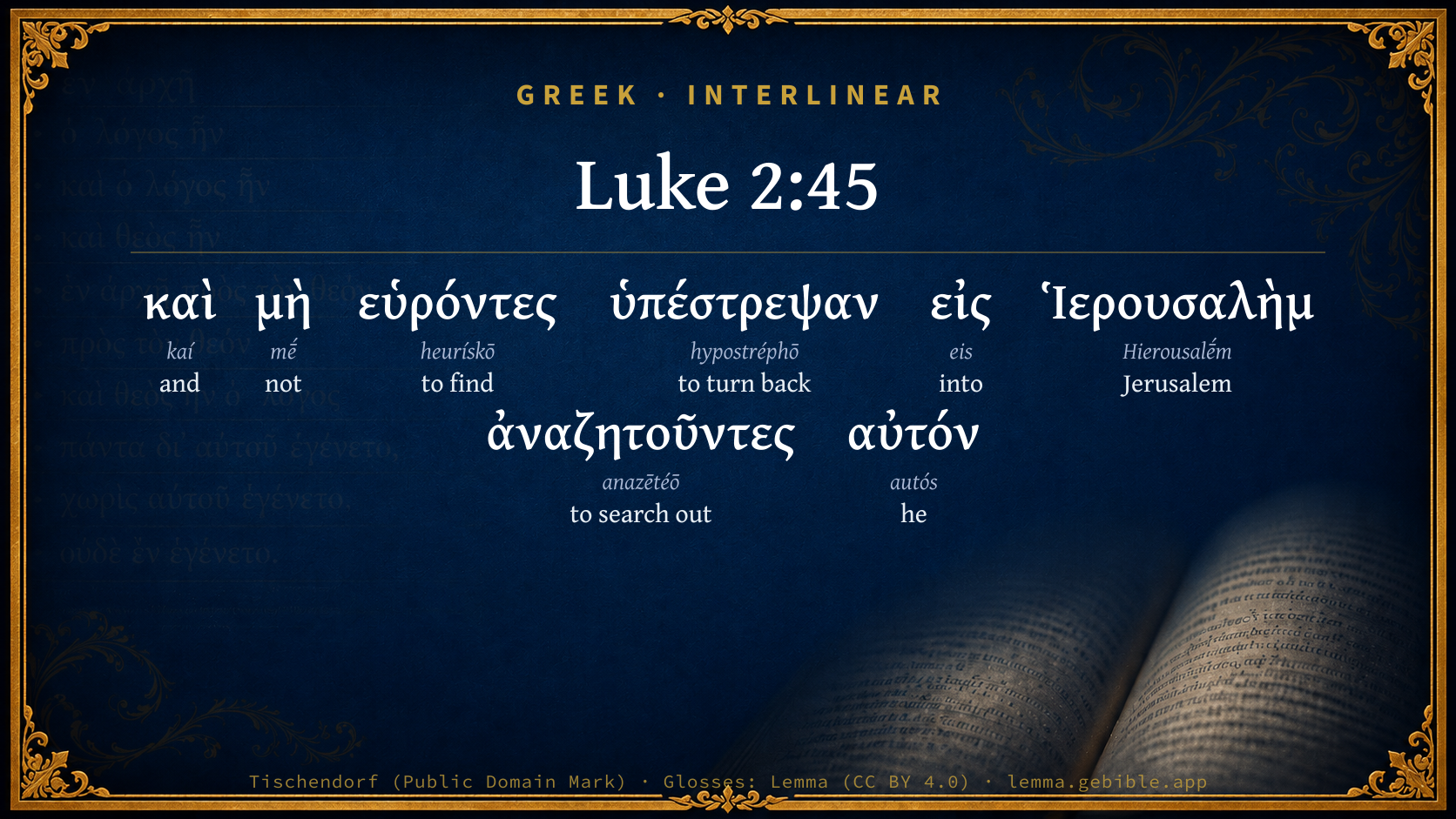
Greek (Tischendorf 8th ed.) Luke 2:45 appears in the Greek New Testament. The text above is from the Tischendorf 8th edition. Each word links to its Strong’s number and a concise gloss. Click any word for its full Thayer’s Greek Lexicon entry.
Download image
Cite this verse

Luke 2:45 (World English Bible). Public Domain. Lemma interlinear Bible study tool, https://lemma.gebible.app/v/luke/2/45.

Show BibTeX & RIS
BibTeX
RIS
English Translation
When they didn't find him, they returned to Jerusalem, looking for him.
World English Bible · Public Domain
Download a study sheet

One document with this verse’s original text, its word-by-word gloss line, the meaning frame, cross-references with their text, attributed commentary, and full source and license credits — printable, and it pastes into notes with its structure intact.

This verse Autodidact and up

Study sheet (.html) Plain text (.txt)

A passage Seminary Student

Up to 50 verses in one chapter. A passage sheet keeps up to 6 commentary sources and 12 cross-references per verse, in the order this page ranks them, and says so on the sheet whenever that leaves anything out. Ask for a single verse and you get the Autodidact verse sheet above.

Everything on this page stays free to read, with no account — the sheet is a download of what is already on screen, not access to it.

Want to remove ads? Support Godless Engineer
Compare translations 3

The same verse in 3 English versions, stacked beneath the original-language interlinear above. Click any original word for its lexicon entry.

Each is an independent rendering of the whole verse — the interlinear is not word-aligned to these translations.

Highlighted words mark where these versions differ — a whole-verse word diff, not a word-by-word alignment.

  • World English Bible Public Domain
    When they didn't find him, they returned to Jerusalem, looking for him.
  • King James Version Public Domain
    And when they found him not, they turned back again to Jerusalem, seeking him.
  • unfoldingWord Literal Text CC BY-SA 4.0
    And not finding, they returned to Jerusalem, searching for him.

unfoldingWord Literal Text — © unfoldingWord, licensed CC BY-SA 4.0. Word-aligned USFM3 via Door43 (git.door43.org/unfoldingWord/en_ult).

Versions to compare (up to 4)

3 of 4 selected

Show all 19 translations

Every available English version of this verse, each an independent rendering of the whole verse.

  • World English Bible Public Domain
    When they didn't find him, they returned to Jerusalem, looking for him.
  • Berean Standard Bible Public Domain
    When they could not find Him, they returned to Jerusalem to search for Him.
  • Majority Standard Bible Public Domain
    When they could not find Him, they returned to Jerusalem to search for Him.
  • King James Version Public Domain
    And when they found him not, they turned back again to Jerusalem, seeking him.
  • American Standard Version (1901) Public Domain
    and when they found him not, they returned to Jerusalem, seeking for him.
  • Revised Version (1885) Public Domain
    and when they found him not, they returned to Jerusalem, seeking for him.
  • Geneva Bible (1599) Public Domain
    And when they found him not, they turned backe to Hierusalem, and sought him.
  • Douay-Rheims (1899) Public Domain
    And not finding him, they returned into Jerusalem, seeking him.
  • Young's Literal Translation Public Domain
    and not having found him, they turned back to Jerusalem seeking him.
  • Literal Standard Version CC BY-SA 4.0
    and having not found Him, they turned back to Jerusalem seeking Him.
  • Unlocked Literal Bible CC BY-SA 4.0
    When they did not find him, they returned to Jerusalem and started looking for him there.
  • unfoldingWord Literal Text CC BY-SA 4.0
    And not finding, they returned to Jerusalem, searching for him.
  • Darby Bible Public Domain
    and not having found him they returned to Jerusalem seeking him.
  • World Messianic Bible Public Domain
    When they didn’t find him, they returned to Jerusalem, looking for him.
  • Webster's Bible Public Domain
    And when they found him not, they returned to Jerusalem, seeking him.
  • Free Bible Version CC BY-SA 4.0
    When they couldn't find him they returned to Jerusalem to look for him there.
  • Bible in Basic English Public Domain
    And seeing that he was not there, they went back to Jerusalem, to make search for him.
  • Text-Critical English NT CC BY 4.0
    When they did not find him, they returned to Jerusalem, looking for him.
  • Tyndale New Testament (1534) Public Domain
    And when they founde hym not they went backe agayne to Hierusalem and sought him.

Literal Standard Version (2020), Covenant Press — licensed CC BY-SA 4.0. Text via the HelloAO Bible API (eBible.org). Unlocked Literal Bible (unfoldingWord) — licensed CC BY-SA 4.0. Text via the HelloAO Bible API (eBible.org). unfoldingWord Literal Text — © unfoldingWord, licensed CC BY-SA 4.0. Word-aligned USFM3 via Door43 (git.door43.org/unfoldingWord/en_ult). Free Bible Version, Dr. Jonathan Gallagher — licensed CC BY-SA 4.0. Text via the HelloAO Bible API (eBible.org).

Word by word

More ways to search: Search by grammar → Find every occurrence → Compare this word →

Practice this passage: Drill this verse → Learn its vocabulary →

About this verse

These counts appear in no published source. They are computed here, from the morphology-tagged text and Lemma’s own curated glosses. What Lemma adds →

8
words
8
distinct lemmas
Gospels
section

Notable vocabulary

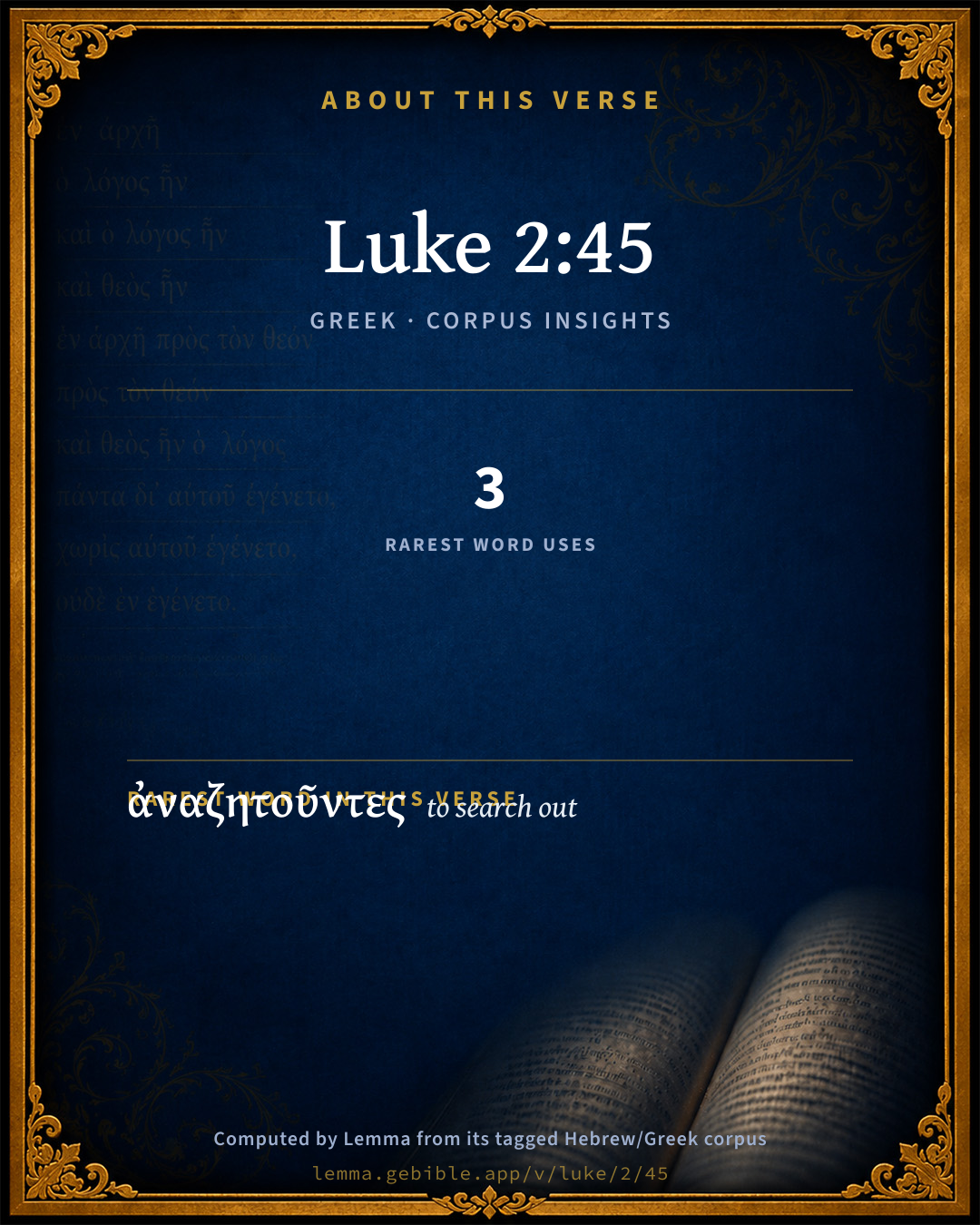
The rarest word here is ἀναζητοῦντες to search out G327 — appearing just 3 times in the whole Greek New Testament.

Shared distinctive vocabulary

ἀναζητοῦντες to search out G327 occurs in 3 verses of the Greek New Testament. Also found in:

Commentary

Notes on Luke 2:45 from classic Christian and Jewish commentators (each source and its license shown beneath its notes). The classic Christian expositions comment on the surrounding passage and are grouped to its opening verse, so a note may address several verses; the Jewish commentaries on the Tanakh (Rashi and others) are per-verse, so they appear only where the commentator wrote on this verse.

Lemma curates 59 commentaries, every one of them public domain or Creative Commons licensed, each selected and text-cleaned for this edition rather than reprinted as found. About our sources →

Meyer's Critical & Exegetical Commentary

Heinrich August Wilhelm Meyer

Luk_2:45 f. Ζητοῦντες] present participle: ubi res aliqua nondum quidem peragitur, sed tamen aut revera aut cogitatione instituitur paraturve, Kühner, ad Xen. Anab. i. 3.16. Comp. Dissen, ad Pind. Ol. vii. 14, p. 81.

μεθʼ ἡμέρας τρεῖς] is reckoned, in most accordance with the text, from the point at which the search meant by ζητ. αὐτόν began, consequently from their return to Jerusalem, the day of this return being counted as the first, and that of the finding as the third. Comp. the designation of the time of Christs resurrection as after three days. Others explain it otherwise. Grotius: Diem unum iter fecerant, altero remensi erant iter, tertio demum quaesitum inveniunt. So also Paulus, Bleek, and others, following Euthymius Zigabenus.

ἐν τῷ ἱερῷ] We are to think of the synagogue, which erat prope atrium in monte templi, Gloss. Joma, f. 68, 2; Lightfoot in loc.; Deyling, Obss. III. ed. 2, p. 285 f.

καθεζόμενον] The Rabbinic assertion: a diebus Mosis ad Rabban Gamalielem non didicerunt legem nisi stantes, Megillah, f. 21,1 (Wagenseil, ad Sotah, p. 993), according to which Jesus would thus already appear as a teacher, is rightly rejected as unfounded in the N. T., by Vitringa, Synag. p. 167, and more recent expositors.

ἐν μέσῳ] has its reference to the seeking of the parents; Jesus was not hidden, but He sat there in the midst among the teachers. We may conceive of Him at the feet of a teaching Rabbi, sitting in their circle (comp. on Act_22:3). In this there is nothing extraordinary to be discerned,[59] since Jesus was already a son of the law (see on Luk_2:42). But to find here a sitting on an equality with the teachers[60] (Strauss, comp. de Wette) is not in accordance with the text, since the report would not otherwise have limited the action of the child to the ἀκούειν and ἘΠΕΡΩΤ.

ἘΠΕΡΩΤ. ΑὐΤΟΎς] The Rabbinical instruction did not consist merely in teaching and interrogating the disciples, but these latter themselves also asked questions and received answers. See Lightfoot, p. 742 ff.; Wetstein in loc. The questioning here is that of the pure and holy desire for knowledge, not that of a guest mingling in the conversation (in opposition to de Wette).

[59] Lange, II. 1, p. 130, invents the idea that the genius of the new humanity soared above the heroes of the old decorum.

[60] So also older dogmatic writers. Ceu doctor doctorum, says Calovius, who specifies the fourfold aim: ob gloriae templi posterioris illustrationem, Hag_2:10; ob adventus sui manifestationem; ob sapientiae divinae demonstrationem; ob doctorum informationem.Into what apocryphal forms the conversation of Jesus with the doctors might be fashioned, may be seen in the Evang. infant. 50 ff. Even by Chemnitz He is said to have discoursed already de persona et officiis Messiae, de discrimine legis et evangelii, etc.

Meyer — Critical and Exegetical Commentary on the New Testament — English translation by Peter Christie, edited by Frederick Crombie (T&T Clark, 1880) — public domain. Text from a community e-Sword module.

Expositor's Greek Testament

ed. W. Robertson Nicoll

Luk 2:45 . ἀναζητοῦντες : the present participle, expressing the purpose of the journey back to Jerusalem, where (not on the road) the search took place ( cf. Act 11:25 ). The ἀνά here (as in ἀνεζήτουν , Luk 2:44 ) implies careful, anxious search.

The Expositor's Greek Testament, edited by W. Robertson Nicoll (1897–1910) — public domain. Text from a community e-Sword module.

Jamieson, Fausset & Brown

Robert Jamieson, A. R. Fausset & David Brown

After three sorrowing days, they find Him still in Jerusalem, not gazing on its architecture, or surveying its forms of busy life, but in the temple--not the "sanctuary" (as in Luk 1:9), to which only the priests had access, but in some one of the enclosures around it, where the rabbins, or "doctors," taught their scholars.

Jamieson, Fausset & Brown — Commentary Critical and Explanatory on the Whole Bible (1871) — public domain (CC PDM 1.0). Text via the HelloAO Bible API.

Adam Clarke's Commentary

Verse 45. Seeking him.] ζητουντες αυτον - or rather, seeking him diligently, ανζητουντες. This is the reading of BCDL, six others, Vulgate, and nine copies of the Itala. If they sought earnestly when they first found him missing, there is little doubt that their solicitude and diligence must be greatly increased during his three days' absence, therefore the word which I have adopted, on the above authority, is more likely to be the true reading than the ζητουντες of the common text, which simply signifies seeking; whereas the other strongly marks their solicitude and diligence.

Adam Clarke's Commentary on the Bible (1810–1826) — public domain. Text from a community e-Sword/MySword module.

John Gill's Exposition

And it came to pass, that after three days,.... From their first setting out from Jerusalem, when Jesus tarried behind; or on the third day, which may be reckoned thus; the first day was spent in journeying, and the second in coming back the same journey, and the third day they sought all Jerusalem for him, when

they found him in the temple; his Father's house, the house of God, a figure of a Gospel church, where the word and ordinances are duly administered, and where Christ is to be found. What part of the temple Christ was in, is not easy to say; it was not in the holy of holies, for none but the high priest went into that, and that only on the day of atonement; nor in the court of the priests, for he was not among them, but the doctors; nor in the court of the Israelites, where the common people worshipped: it may be best judged of, by observing where their several consistories, or courts of judicature were (a); the grand sanhedrim sat in the sanctuary, in the room Gazith; the lesser sanhedrim, which consisted of twenty three persons, and the bench of three; the one sat in the gate of the court (of the Israelites); and the other in the gate of the mountain of the house (or court of the Gentiles); it seems most likely, that he was in the room Gazith, where the grand sanhedrim sat; for here was the largest number of doctors; and it was the more amazing to his parents, to find him here; unless it should be rather thought, that he was in the synagogue in the temple, for such an one there (b) was there; where, after service was over, he might be admitted to a conversation with the learned doctors that belonged to it: it follows,

sitting in the midst of the doctors: the principal doctors in being at this time, were Hillell and Shammai, the one the president, and the other vice president of the council; and Rabban Simeon, the son of Hillell, who succeeded him in his office; and R. Judah, and R. Joshua, the sons of Bethira; Jonathan ben Uzziel, the author of the Chaldee paraphrase; and R. Jochanan ben Zaccai. The sanhedrim sat in a semicircular form, like the half of a round corn floor; so that they could see one another, and the prince, and the father of the court, could see them all; and before them sat three rows of the disciples of the wise men, or scholars; and in each row there were three and twenty men: the first row was next to the sanhedrim, and the second row below that, and the third row below that; and in every row they sat according to their superiority in wisdom (c): on a seat, in one of these rows, I think, Christ sat among the scholars; and this may be called sitting among the doctors, because these seats were just before them, and were in a semicircular form; at least he might be here at first; when upon the questions he put, and the answers he made, he was taken particular notice of by the doctors, who might call him up, and place him between them; for this, in some cases, was done to scholars. Thus, it is said (d),

"if one of the disciples, or scholars, say, I have something to say in favour of him, (one that is on his trial,) they bring him up, and "cause him to sit in the midst of them"; and he does not go down from thence all the whole day.

Both hearing them: their debates and decisions about points in the law of Moses:

and asking them questions; upon those points. Had this been a "Midrash", or school, there would be no difficulty of producing instances of putting questions to the doctors there; but there was no such place in the temple, or synagogue, where teachers were interrogated by their hearers; for which reason I think the passages, produced by Dr. Lightfoot, are not so pertinent, since they refer to such a place: it is very likely, since there were such a number of scholars admitted to sit before the sanhedrim to hear their controversies, and determinations, and were allowed, in some cases, to speak; so they might be suffered to put questions, in order to gain knowledge,

(a) Misn. Sanhedrin, c. 10. sect. 2. Maimon. Hilch. Sanhedrin, c. 1. sect. 3. (b) Jarchi in Misn. Yoma, c. 7. sect. 1. (c) Misn. Sanhedrin, c. 4. sect. 3, 4. Maimon. Hilch. Sanhedrin, c. 1. sect. 7. (d) Misn. Sanhedrin, c. 5. sect. 4.

John Gill's Exposition of the Whole Bible (1746–1763) — public domain (CC PDM 1.0). Text via the HelloAO Bible API.

Trapp's Complete Commentary

John Trapp

45 And when they found him not, they turned back again to Jerusalem, seeking him.

Ver. 45. And when they found him not] The best are sometimes at a loss, and hard put to it for three days, or so. And this, mostly, for their security, as the Church in the Canticles.

John Trapp, A Commentary or Exposition upon All the Books of the Old and New Testament (1647–1656) — public domain. Text from a community e-Sword module.

unfoldingWord translationNotes

Door43 World Missions Community

It came about that

This phrase is used here to mark an important event in the story. If your language has a way for doing this, you could consider using it here.

in the temple

This refers to the courtyard around the temple. Only the priests were allowed in the temple. AT: "in the temple courtyard" or "at the temple" (See: Assumed Knowledge and Implicit Information)

in the middle of

This does not mean the exact center. Rather, it means "among" or "together with" or "surrounded by."

the teachers

"the religious teachers" or "those who taught people about God"

All who heard him were amazed

They could not understand how a twelve-year-old boy with no religious education could answer so well.

at his understanding

"at how much he understood" or "that he understood so much about God"

his answers

"at how well he answered them" or "that he answered their questions so well"

translationWords

temple

teacher

amazed

understand

unfoldingWord translationNotes — © Distant Shores Media and the Door43 World Missions Community, licensed CC BY-SA 4.0. Source: git.door43.org/Door43/en_tn.

Cambridge Greek Testament for Schools and Colleges

45. μὴ εὑρόντες. The μὴ is causal. ‘Since they did not find Him,’ they returned.

ἀναζητοῦντες αὐτόν, ‘diligently searching for Him.’

Cambridge Greek Testament for Schools and Colleges (Cambridge University Press, 1896; 21 vols, various authors incl. Carr, Maclear, Plummer, Farrar, Lumby, Moule, M. R. James, Simcox) — public domain. Text from a community e-Sword module.

Alford’s Greek Testament

Henry Alford

45.] ἀναζητοῦντες αὐτόν—as they went back, all the way.

Henry Alford, The Greek Testament (1849–1861) — public domain. Text from a community e-Sword module.

International Critical Commentary

45. μὴ εὑρόντες. “Because they did not find”: see on 3:9.—ὑπέστρεψαν ἀναζητοῦντες. The turning back was a single act, the seeking continued a long time. Comp. Mar 8:11, Mar 10:2. In such cases the pres. part. is not virtually fut., as if it meant “in order to seek.” The seeking was present directly the turning back took place. Win. 45:1 b, p. 429. For ὑπέστρεψαν see small print on 1:56, and for ἐγένετο see detached note after ch. 1.

International Critical Commentary — older volumes (1896–1929), various authors — public domain. Text from a community e-Sword module.

Vincent's Word Studies in the New Testament

Marvin R. Vincent

Seeking him [αναζητουντες] . All the way as they went. Force of ajna, as above.

Marvin R. Vincent, Word Studies in the New Testament (1887–1900) — public domain. Text from a community e-Sword/MySword module.

Lesson kit

Teaching starters — assembled from the data on this page, not authored interpretation. Every prompt links to the verse data it draws on. Edit before teaching.

Luke, in the Gospels, opens this verse with 8 words (8 distinct Greek lemmas). Its most distinctive word is anazētéō (“to search out”). A historical commentator’s framing appears above. Read the whole chapter for the surrounding context.

Discussion questions

  1. How does “to search out” (anazētéō) shape what this verse is saying?
  2. Luke 2:44 shares the word «to search out» with this verse. How do the two illuminate each other?
  3. These translations render this verse differently; the difference is in the English rendering, not the original. What questions does that raise?
  4. Reading how Meyer's Critical & Exegetical Commentary and Expositor's Greek Testament read this verse, where do the two commentators agree and where do they part?

Things to notice

Reading settings

Reading text

Shown beneath each verse's original-language words.

Old Testament
Old Testament edition

Read the OT as the Masoretic Hebrew (MT) or the Greek Septuagint (LXX).

English shown for the Greek Septuagint (in the Hebrew ↔ Greek comparison).

Comparing translations? Open the Compare panel on any verse page to stack up to four side by side.