
Luke 1:13

Greek (Tischendorf 8th ed.) Luke 1:13 appears in the Greek New Testament. The text above is from the Tischendorf 8th edition. Each word links to its Strong’s number and a concise gloss. Click any word for its full Thayer’s Greek Lexicon entry.
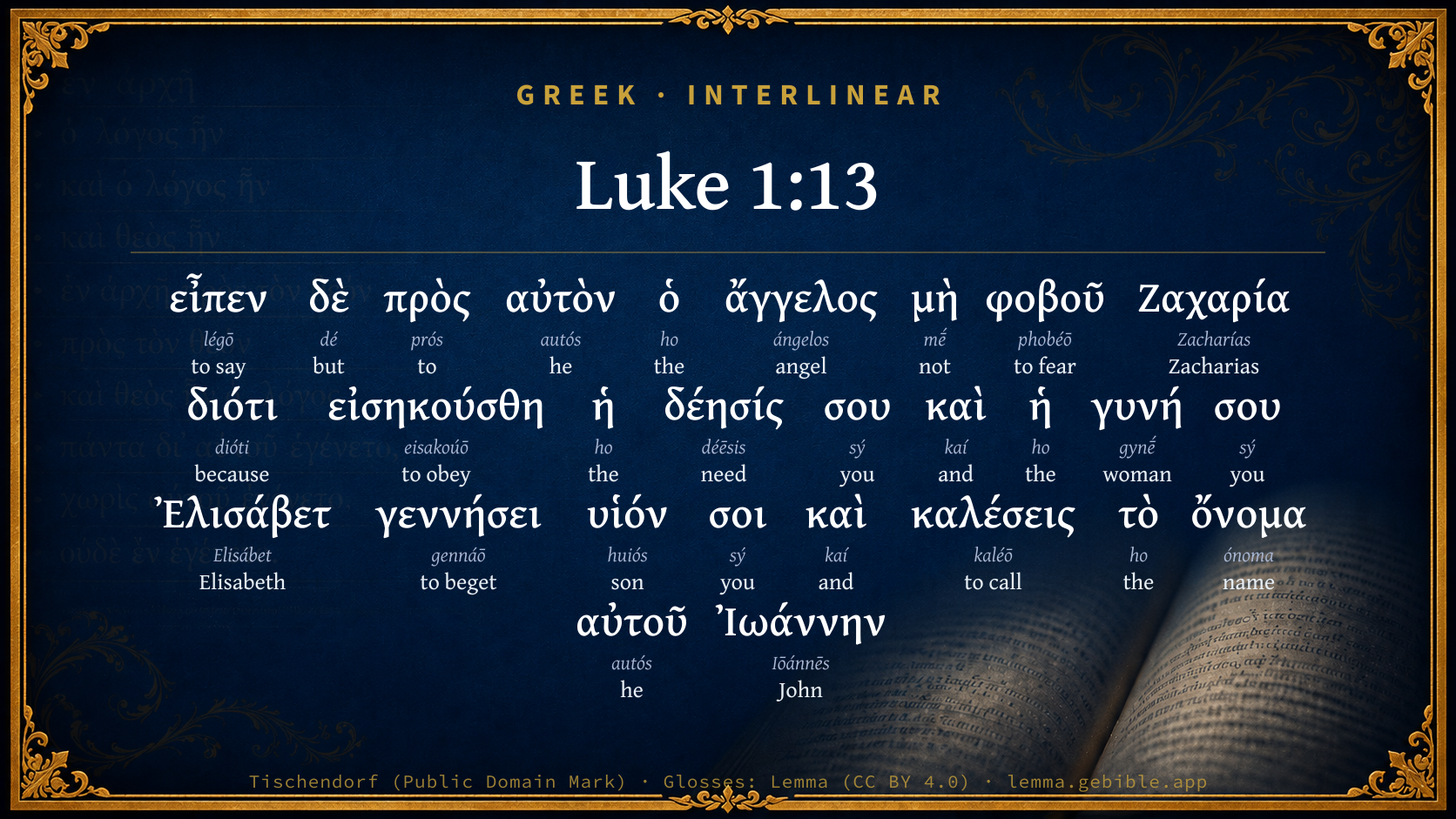
Download image
Cite this verse

Luke 1:13 (World English Bible). Public Domain. Lemma interlinear Bible study tool, https://lemma.gebible.app/v/luke/1/13.

Show BibTeX & RIS
BibTeX
RIS
English Translation
But the angel said to him, "Don't be afraid, Zacharias, because your request has been heard, and your wife, Elizabeth, will bear you a son, and you shall call his name John.
World English Bible · Public Domain
Highlights
  • 2 first appearances in the Greek New Testament
Full analysis ↓
Download a study sheet

One document with this verse’s original text, its word-by-word gloss line, the meaning frame, cross-references with their text, attributed commentary, and full source and license credits — printable, and it pastes into notes with its structure intact.

This verse Autodidact and up

Study sheet (.html) Plain text (.txt)

A passage Seminary Student

Up to 50 verses in one chapter. A passage sheet keeps up to 6 commentary sources and 12 cross-references per verse, in the order this page ranks them, and says so on the sheet whenever that leaves anything out. Ask for a single verse and you get the Autodidact verse sheet above.

Everything on this page stays free to read, with no account — the sheet is a download of what is already on screen, not access to it.

Want to remove ads? Support Godless Engineer
Compare translations 3

The same verse in 3 English versions, stacked beneath the original-language interlinear above. Click any original word for its lexicon entry.

Each is an independent rendering of the whole verse — the interlinear is not word-aligned to these translations.

Highlighted words mark where these versions differ — a whole-verse word diff, not a word-by-word alignment.

  • World English Bible Public Domain
    But the angel said to him, "Don't be afraid, Zacharias, because your request has been heard, and your wife, Elizabeth, will bear you a son, and you shall call his name John.
  • King James Version Public Domain
    But the angel said unto him, Fear not, Zacharias: for thy prayer is heard; and thy wife Elisabeth shall bear thee a son, and thou shalt call his name John.
  • unfoldingWord Literal Text CC BY-SA 4.0
    But the angel said to him, “Do not be afraid, Zechariah, because your prayer has been heard, and your wife Elizabeth will bear you a son, and you will call his name John.

unfoldingWord Literal Text — © unfoldingWord, licensed CC BY-SA 4.0. Word-aligned USFM3 via Door43 (git.door43.org/unfoldingWord/en_ult).

Versions to compare (up to 4)

3 of 4 selected

Show all 19 translations

Every available English version of this verse, each an independent rendering of the whole verse.

  • World English Bible Public Domain
    But the angel said to him, "Don't be afraid, Zacharias, because your request has been heard, and your wife, Elizabeth, will bear you a son, and you shall call his name John.
  • Berean Standard Bible Public Domain
    But the angel said to him, “Do not be afraid, Zechariah, because your prayer has been heard. Your wife Elizabeth will bear you a son, and you are to give him the name John.
  • Majority Standard Bible Public Domain
    But the angel said to him, “Do not be afraid, Zechariah, because your prayer has been heard. Your wife Elizabeth will bear you a son, and you are to give him the name John.
  • King James Version Public Domain
    But the angel said unto him, Fear not, Zacharias: for thy prayer is heard; and thy wife Elisabeth shall bear thee a son, and thou shalt call his name John.
  • American Standard Version (1901) Public Domain
    But the angel said unto him, Fear not, Zacharias: because thy supplication is heard, and thy wife Elisabeth shall bear thee a son, and thou shalt call his name John.
  • Revised Version (1885) Public Domain
    But the angel said unto him, Fear not, Zacharias: because thy supplication is heard, and thy wife Elisabeth shall bear thee a son, and thou shalt call his name John.
  • Geneva Bible (1599) Public Domain
    But the Angel saide vnto him, Feare not, Zacharias: for thy prayer is heard, and thy wise Elisabet shall beare thee a sonne, and thou shalt call his name Iohn.
  • Douay-Rheims (1899) Public Domain
    But the angel said to him: Fear not, Zachary, for thy prayer is heard; and thy wife Elizabeth shall bear thee a son, and thou shalt call his name John:
  • Young's Literal Translation Public Domain
    and the messenger said unto him, `Fear not, Zacharias, for thy supplication was heard, and thy wife Elisabeth shall bear a son to thee, and thou shalt call his name John,
  • Literal Standard Version CC BY-SA 4.0
    and the messenger said to him, “Do not fear, Zacharias, for your supplication was heard, and your wife Elizabeth will bear a son to you, and you will call his name John,
  • Unlocked Literal Bible CC BY-SA 4.0
    But the angel said to him, “Do not be afraid, Zechariah, because your prayer has been heard. Your wife Elizabeth will bear you a son. You will call his name John.
  • unfoldingWord Literal Text CC BY-SA 4.0
    But the angel said to him, “Do not be afraid, Zechariah, because your prayer has been heard, and your wife Elizabeth will bear you a son, and you will call his name John.
  • Darby Bible Public Domain
    But the angel said to him, Fear not, Zacharias, because thy supplication has been heard, and thy wife Elizabeth shall bear thee a son, and thou shalt call his name John.
  • World Messianic Bible Public Domain
    But the angel said to him, “Don’t be afraid, Zechariah, because your request has been heard. Your wife, Elisheva, will bear you a son, and you shall call his name Yochanan.
  • Webster's Bible Public Domain
    But the angel said to him, Fear not, Zacharias: for thy prayer is heard; and thy wife Elisabeth shall bear thee a son, and thou shalt call his name John.
  • Free Bible Version CC BY-SA 4.0
    But the angel told him, “Don't be afraid, Zechariah. Your prayer has been heard, and your wife Elizabeth will bear you a son, and you shall call him John.
  • Bible in Basic English Public Domain
    But the angel said, Have no fear, Zacharias, for your prayer has come to the ears of God, and your wife Elisabeth will have a son, and his name will be John.
  • Text-Critical English NT CC BY 4.0
    But the angel said to him, “Do not be afraid, Zechariah, for yoʋr prayer has been heard. Yoʋr wife Elizabeth will bear yoʋ a son, and yoʋ shall name him John.
  • Tyndale New Testament (1534) Public Domain
    And the angell sayde vnto him: feare not Zachary for thy prayer is hearde: And thy wyfe Elizabeth shall beare the a sonne and thou shalt call his name Iohn

Literal Standard Version (2020), Covenant Press — licensed CC BY-SA 4.0. Text via the HelloAO Bible API (eBible.org). Unlocked Literal Bible (unfoldingWord) — licensed CC BY-SA 4.0. Text via the HelloAO Bible API (eBible.org). unfoldingWord Literal Text — © unfoldingWord, licensed CC BY-SA 4.0. Word-aligned USFM3 via Door43 (git.door43.org/unfoldingWord/en_ult). Free Bible Version, Dr. Jonathan Gallagher — licensed CC BY-SA 4.0. Text via the HelloAO Bible API (eBible.org).

Word by word

More ways to search: Search by grammar → Find every occurrence → Compare this word →

Practice this passage: Drill this verse → Learn its vocabulary →

εἰσηκούσθη
eisakoúō
G1522
“to obey”
Verb, Aorist, Passive, Indicative, 3rd person, Singular
Part of Speech
Verb
Tense
Aorist
Voice
Passive
Mood
Indicative
Person
3rd person
Number
Singular
Full Thayer's Definition

Origin: from G1519 and G191

TDNT: 04:42,3

1. to give heed to, comply with admonition, to obey 2. to listen to, assent to, a request, to be heard, have request granted a. of persons offering prayers to God b. of prayers offered up
  1. εἶπεν légō G3004 “to say” Verb, Aorist, Active, Indicative, 3rd person, Singular
  2. δὲ dé G1161 “but” Conjunction
  3. πρὸς prós G4314 “to” Preposition
  4. αὐτὸν autós G846 “he” Personal pronoun, Accusative, Singular, Masculine
  5. ὁ ho G3588 “the” Article, Nominative, Singular, Masculine
  6. ἄγγελος ángelos G32 “angel” Noun, Nominative, Singular, Masculine
  7. μὴ mḗ G3361 “not” Particle, Negative
  8. φοβοῦ phobéō G5399 “to fear” Verb, Present, Middle or Passive deponent, Imperative, 2nd person, Singular
  9. Ζαχαρία Zacharías G2197 “Zacharias” Noun, Vocative, Singular, Masculine
  10. διότι dióti G1360 “because” Conjunction
  11. ἡ ho G3588 “the” Article, Nominative, Singular, Feminine
  12. δέησίς déēsis G1162 “need” Noun, Nominative, Singular, Feminine
  13. σου sý G4771 “you” Personal pronoun, 2nd person, Genitive, Singular
  14. καὶ kaí G2532 “and” Conjunction
  15. ἡ ho G3588 “the” Article, Nominative, Singular, Feminine
  16. γυνή gynḗ G1135 “woman” Noun, Nominative, Singular, Feminine
  17. σου sý G4771 “you” Personal pronoun, 2nd person, Genitive, Singular
  18. Ἐλισάβετ Elisábet G1665 “Elisabeth” Noun, Proper, indeclinable
  19. γεννήσει gennáō G1080 “to beget” Verb, Future, Active, Indicative, 3rd person, Singular
  20. υἱόν huiós G5207 “son” Noun, Accusative, Singular, Masculine
  21. σοι sý G4771 “you” Personal pronoun, 2nd person, Dative, Singular
  22. καὶ kaí G2532 “and” Conjunction
  23. καλέσεις kaléō G2564 “to call” Verb, Future, Active, Indicative, 2nd person, Singular
  24. τὸ ho G3588 “the” Article, Accusative, Singular, Neuter
  25. ὄνομα ónoma G3686 “name” Noun, Accusative, Singular, Neuter
  26. αὐτοῦ autós G846 “he” Personal pronoun, Genitive, Singular, Masculine
  27. Ἰωάννην Iōánnēs G2491 “John” Noun, Accusative, Singular, Masculine

About this verse

These counts appear in no published source. They are computed here, from the morphology-tagged text and Lemma’s own curated glosses. What Lemma adds →

28
words
21
distinct lemmas
Gospels
section

Notable vocabulary

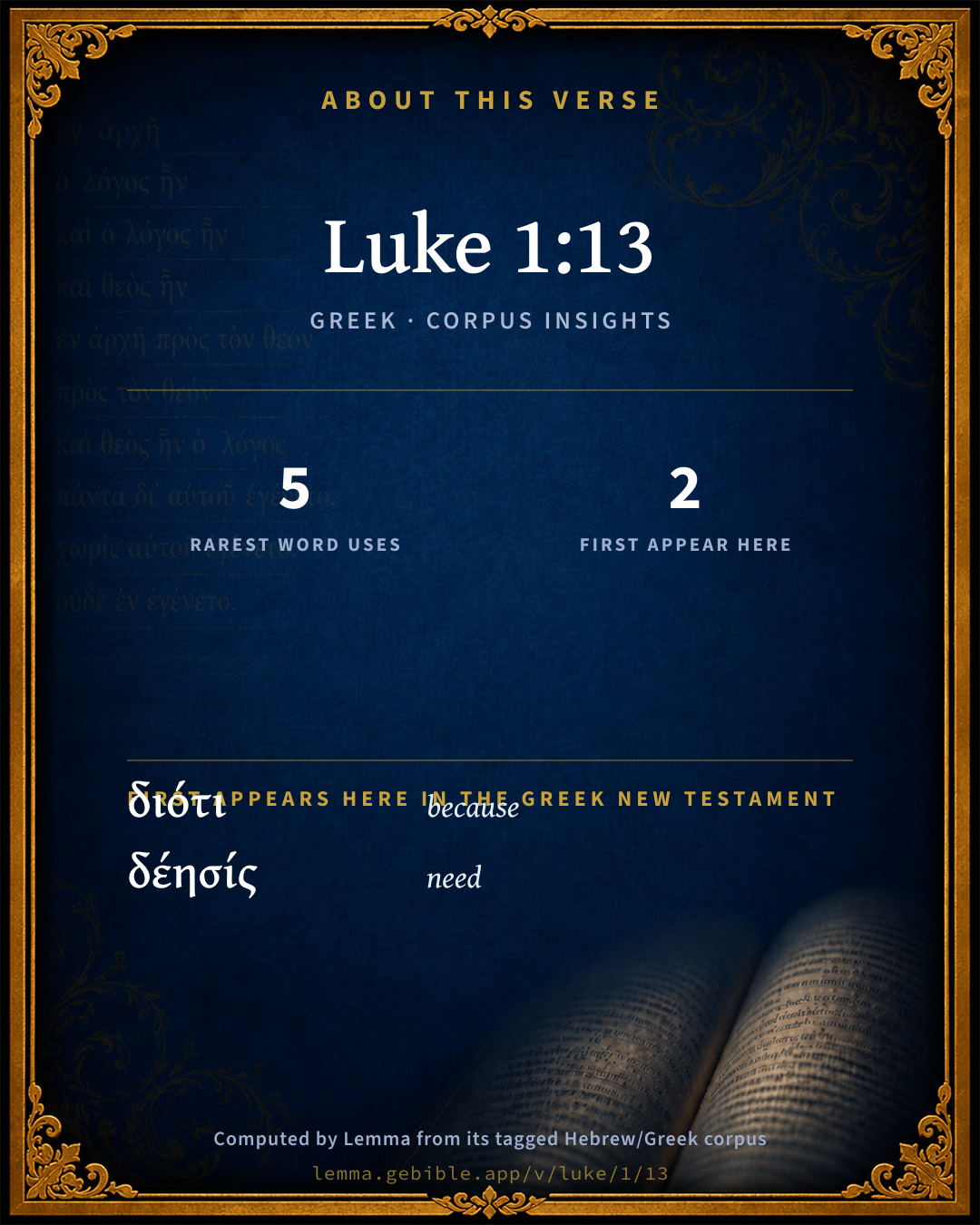
The rarest word here is εἰσηκούσθη to obey G1522 — appearing just 5 times in the whole Greek New Testament.

First appearance in Scripture

These words make their first canonical appearance in the Greek New Testament here:

Shared distinctive vocabulary

εἰσηκούσθη to obey G1522 occurs in 5 verses of the Greek New Testament. Also found in:
Repetition

Words recur within this verse:

Cross-references

26

Topical passages linked to Luke 1:13 in the Treasury of Scripture Knowledge — connected by theme and wording, ordered by reader-vote popularity; previews shown in the World English Bible.

  • 1 Samuel 2:21 Yahweh visited Hannah, and she conceived, and bore three sons and two daughters. The child Samuel grew before Yahweh.
  • Acts 10:31 and said, 'Cornelius, your prayer is heard, and your gifts to the needy are remembered in the sight of God.
  • Psalms 113:9 He settles the barren woman in her home, As a joyful mother of children. Praise Yah!
  • Genesis 25:21 Isaac entreated Yahweh for his wife, because she was barren. Yahweh was entreated by him, and Rebekah his wife conceived.
  • Psalms 127:3–5 Behold, children are a heritage of Yahweh. The fruit of the womb is his reward.
  • Luke 2:21 When eight days were fulfilled for the circumcision of the child, his name was called Jesus, which was given by the angel before he was conceived in the womb.
  • Genesis 18:14 Is anything too hard for Yahweh? At the set time I will return to you, when the season comes round, and Sarah will have a son."
  • Psalms 118:21 I will give thanks to you, for you have answered me, And have become my salvation.
  • Daniel 10:12 Then said he to me, Don't be afraid, Daniel; for from the first day that you did set your heart to understand, and to humble yourself before your God, your words were heard: and I am come for your words' sake.
  • Genesis 17:10 This is my covenant, which you shall keep, between me and you and your seed after you. Every male among you shall be circumcised.
  • Matthew 14:27 But immediately Jesus spoke to them, saying "Cheer up! I AM! Don't be afraid."
  • Judges 6:23 Yahweh said to him, Peace be to you; don't be afraid: you shall not die.
  • 1 Samuel 1:20–23 It happened, when the time was come about, that Hannah conceived, and bore a son; and she named him Samuel, [saying], Because I have asked him of Yahweh.
  • 2 Kings 4:16–17 He said, At this season, when the time comes round, you shall embrace a son. She said, No, my lord, you man of God, do not lie to your handmaid.
  • Matthew 28:5 The angel answered the women, "Don't be afraid, for I know that you seek Jesus, who has been crucified.
  • Genesis 17:19 God said, "No, but Sarah, your wife, will bear you a son. You shall call his name Isaac. I will establish my covenant with him for an everlasting covenant for his seed after him.
  • Judges 13:3–5 The angel of Yahweh appeared to the woman, and said to her, See now, you are barren, and don't bear; but you shall conceive, and bear a son.
  • Isaiah 8:3 I went to the prophetess; and she conceived, and bore a son. Then said Yahweh to me, Call his name Maher Shalal Hash Baz.
  • Luke 1:30 The angel said to her, "Don't be afraid, Mary, for you have found favor with God.
  • Luke 1:60–63 His mother answered, "Not so; but he will be called John."
  • Hosea 1:6 She conceived again, and bore a daughter. Then he said to him, "Call her name Lo-Ruhamah; for I will no longer have mercy on the house of Israel, that I should in any way pardon them.
  • Mark 16:6 He said to them, "Don't be amazed. You seek Jesus, the Nazarene, who has been crucified. He has risen. He is not here. Behold, the place where they laid him!
  • Hosea 1:9–10 He said, "Call his name Lo-Ammi; for you are not my people, and I will not be yours.
  • Matthew 1:21 She shall bring forth a son. You shall call his name Jesus, for it is he who shall save his people from their sins."
  • Hosea 1:4 Yahweh said to him, "Call his name Jezreel; for yet a little while, and I will avenge the blood of Jezreel on the house of Jehu, and will cause the kingdom of the house of Israel to cease.
  • Luke 24:36–40 As they said these things, Jesus himself stood among them, and said to them, "Peace be to you."

Cross-references courtesy of OpenBible.info (CC BY 4.0).

Commentary

Notes on Luke 1:13 from classic Christian and Jewish commentators (each source and its license shown beneath its notes). The classic Christian expositions comment on the surrounding passage and are grouped to its opening verse, so a note may address several verses; the Jewish commentaries on the Tanakh (Rashi and others) are per-verse, so they appear only where the commentator wrote on this verse.

Lemma curates 59 commentaries, every one of them public domain or Creative Commons licensed, each selected and text-cleaned for this edition rather than reprinted as found. About our sources →

The Biblical Illustrator

Joseph S. Exell

Luk_1:13

But the angel said unto him, Fear not

Human life on earth known in heaven

From the speech of Gabriel it is clear that human life, in its beginning, course, purpose, and destiny, is known in heaven before it is manifested on earth.

This is not the case with exceptional men only, but with all men. This should throw a joyous solemnity around life. Human life is intended to be the realization of a heavenly plan. Inquire what it is, accept it with all thankfulness or submission, as the case may be, and live in God. John was to be as conspicuous amongst men as a mountain is conspicuous amongst the lowlands. But did not God make the valleys as well as the hills? In great lives we only see the lines of Divine movement and purpose more clearly because of their apparent exaggeration; in humbler lives the lines are all there. This communication made by Gabriel suggests two inquiries.

1. Has every life a guardian angel?

2. Is every life reported in heaven by the angelic watcher? (Dr. Parker.)

Light will arise in due time

The barrenness necessitated the annunciation. The annunciation transfigured the barrenness. Is it not often exactly thus with trying and bitter and reproach bringing experiences of the believer? We are denied what we fain would have; we have what we would fain have been denied. We feel ourselves of those who walk in the darkness, and have no light. Well! do we trust in the Lord, and stay ourselves upon God? If only we do, sooner or later, I am satisfied increasingly, light will arise. It may not come when we wished it, nor as we wished it, but come it does. (A. B. Grosart, LL. D,)

Consider the exquisite connexion of the whole, the gradually-attained climax of the Divine message from the lips of the angel from before the throne. The messenger of joy begins with the mention of the accepted prayer, promises a son, gives him a high name, foretells for him a distinguished office. But the greatest tidings are yet to come: the longed-for coming of the Messiah, whose forerunner this child is to be. To quote Pfenninger: How tenderly interwoven, how intimately connected, the Divine with the human story I It is one of the chief perfections of a drama that all its occurrences should essentially hang together; that none of them should appear extraneous or isolated; and where are these conditions better observed than in the Divine narratives of Holy Writ? The grandest, Divinest story in the world blended at its first most human commencement with the human heart-history of a childless wedded pair, who pray to God for a son. This is certainly true, although the prayer here referred to can hardly have been confined to such a petition. The heavenly message, however, retrospectively includes former prayers, and has three separate clauses--first, the birth of a son to Zacharias; last, the coming of the Lord Himself; and as connecting link between the two, the announcement that this son shall make ready the way of this very Lord. (Rudolph Stier)

The Fear-nots of the Bible

The Fear-nots of the Bible provide an all-sufficient vade-necum for the timid and distressed. There is no apprehension possible to man which has not its complementary reassuring promise in Gods Word. (Anon.)

Long-offered prayers

The prayer of Zacharias was most probably an old prayer, going back many years, ere Elisabeth was old. But apparently unanswered prayers are not disregarded prayers. Old, very old prayers often and often bring down blessings unexpected. (A. B. Grosart, LL. D.)

The Bible abounds in assurances that all faithful earnest prayer will be heard, cannot but be heard. And Christian experience proves the truth of the Divine assurance. Let us rejoice

(1) That we are permitted to pray;

(2) That we are commanded to pray;

(3) That all true prayer is heard;

(4) That with God to hear is to answer and help.

Disappointed and weary suppliant, fear not, thy prayer is heard. And to know that it is heard is to know that in Gods good way and time it shall be answered. (Anon.)

Prayer heard though not immediately answered

I can stand in the rooms of my office in New York, and communicate with the men in the fifth story. If I want to speak to the foreman of the printing office, I go and blow the whistle, and talk through the tube. And I know that the message has got up there and that he heard it. I do not see him, and he does not answer back; but I have no doubt that, having received the message, he will attend to my wants. Soft seems to me that sometimes we speak to God in heaven, as it were through an invisible medium. He does not answer immediately, but, nevertheless, we know that He is there, and that, even if we do not conceive of Him, He conceives of us; and we send our thought or prayer up, and let it alone, and do not fret or worry about it. (H. W.Beecher.)

Unanswered prayer accepted

Prayers which are not answered at once, nor, perhaps, for a long time afterwards, may nevertheless be accepted. Gods people are apt to forget this; and that it is with prayer, to borrow an illustration from commercial transactions, as with a bill, which, though accepted, is often not paid till months or years have elapsed. Our heavenly Father knows best what to give; and also how, and where, and when to give it. Were its answer always to follow prayer, as the peal roars upon the flash, I suspect that we would be as ready in spiritual as we are in earthly matters to look only to secondary causes, and forget Gods hand--coming to look upon our prayers as being the cause of the answer, as much as we are in the habit of regarding the flash of lightning, without any reference to God, as the cause of the peal of thunder. (T. Guthrie, D. D.)

And thy wife Elisabeth … John

This promised son is added to a series whose birth has already been miraculously foretold. Isaac, Samson, Samuel. The significant names of both Zacharias [The Lord remembers] and Elisabeth [God of the oath, or covenant] are mentioned by the angel, to point out the rich fulfilment of their prophetic meaning, but the appointed name of this promised son transcends theirs. An era of new and fuller grace begins with him. Later, the name (=the grace of God) receives its special explanation, in that the stern preacher of repentance is found only to lead from grace to grace. John is the last but one of the seven names [Ishmael, Isaac, Solomon, Josiah, Cyrus, John, Jesus] given by God in Holy Scripture to those still unborn, and the seventh name is Jesus. (Rudolf Stier.)

Angelic solicitude

1. Observe how apprehensive this good angel was at Zacharys surprising fear, and encourages him against it. The holy angels, though they do not express it in words, yet pity our frailties, and suggest comfort to us. The evil angels, if they might, would kill us with terror; the good angels labour together for our tranquility and cheerfulness.

2. The comfortable words spoken by the angel to Zacharias. God sometimes hears our prayers, and bestows His mercies, when we least expect; yea, when we have given over looking for what we asked. 3: The name which the angel directed Zachary to give his son: John, which signifies gracious; because he was to open the kingdom of grace, and to preach the grace of the gospel through Jesus Christ. The giving of significant names to children has been an ancient and pious practice; names which either carried a remembrance of duty or of mercy in them. (W. Burkitt, M. A,)

Acceptable prayer defined

Prayer is the offering of our sincere desires to God. It involves a sense of our unworthiness and necessities.

1. Penitence (Psa_51:17).

2. Faith (Heb_11:6).

3. Sincerity (Jer_29:13).

4. Fervency (James v 16).

5. Love (1Ti_2:8).

6. Delight in God (Isa_25:9).

7. Perseverance (Eph_6:18).

8. Humble submission to Gods will (Mic_7:7).

9. In the name of Christ (Eph_3:12).

10. With confession of our sins (1Jn_1:9). Jewish prayers were chiefly praise and benedictions. Always answered, but in

Gods sovereign way. (W. H. Van Doren, D. D.)

The efficacy of prayer

Then you have not been modified in any way as to the efficacy of prayer? asked his visitor. Mr. Spurgeon laughed. Only in my faith growing far stronger and firmer than ever. It is not a matter of faith with me, but of knowledge, and everyday experience. I am constantly witnessing the most unmistakable instances of answers to prayer. My whole life is made up of them. To me they are so familiar as to cease to excite my surprise; but to many they would seem marvellous, no doubt. Why, I could no more doubt the efficacy of prayer than I could disbelieve in the law of gravitation. The one is as much a fact as the other, constantly verified every day of my life. Elijah, by the brook Cherith, as he received his daily rations from the ravens, could hardly be a more likely subject for scepticism than

I. Look at my Orphanage. To keep it going entails an annual expenditure of about £10,000. Only £1400 is provided for by endowment. The remaining £8000 comes to me regularly in answer to prayer. I do not know where I shall get it from day to day. I ask God for it, and He sends it. Mr. Muller, of Bristol, does the same on a far larger scale, and his experience is the same as mine. (Pall Mall Gazette.)

Prayers answered at last

During a long course of years, even to the closing fortnight of his life, in his last sickness, Dr. Judson lamented that all his efforts in behalf of the Jews had been a failure. He was departing from the world saddened with that thought. Then, at last, there came a gleam of light that thrilled his heart with grateful joy. Mrs. Judson was sitting by his side while he was in a state of great languor, with a copy of the Watchman and Reflector in her hand. She read to her husband one of Dr. Hagues letters from Constantinople. That letter contained some items of information that filled him with wonder. At a meeting of missionaries at Constantinople, Mr. Schauffler stated that a little book had been published in Germany giving an account of Dr. Judsons life and labours; that it had fallen into the hands of some Jews; and had been the means of their conversion; that a Jew had translated it for a community of Jews on the borders of the Euxine, and that a message had arrived in Constantinople asking that a teacher might be sent to show them the way of life. When Dr. Judson heard this his eyes were filled with tears, a look of almost unearthly solemnity came over him, and, clinging fast to his wifes hand as if to assure himself of being really in the world, he said, Love, this frightens me, I do not know what to make of it. To make of what? said Mrs. Judson. Why, what you have just been reading, I never was deeply interested in any object, I never prayed sincerely and earnestly for anything, but it came; at some time--no matter how distant the day--somehow, in some shape, probably the last I should have devised, it came! What a testimony was that I It lingered on the lips of the dying Jud-son; it was enbalmed with grateful tears, and is worthy to be transmitted as a legacy to the coming generation. The desire of the righteous shall be granted. Pray and wait. The answer to all true prayer will come. In Judsons case the news of the answer came before he died, but it was answered long before. So we may know of the results of prayers and toils even while we sojourn here; but if not, what sweet surprises shall await us in the great beyond! (North-Western Christian Advocate.)

The Biblical Illustrator, edited by Joseph S. Exell (c. 1880s–1900s) — public domain. Text from a community e-Sword module.

Joseph Benson's Commentary

Luk 1:13. But the angel said, Fear not, &c. — Thus encouraging him with great gentleness of aspect and voice. For thy prayer is heard — I do not come unto thee with a message of terror, but am sent to assure thee, thy prayer is heard, and thy wife shall bear thee a son — “No doubt this good man had often prayed for children; but as he seemed now to have given up all expectations of that kind, it is reasonable to conclude, that these words chiefly relate to his prayers for the deliverance of Israel by the Messiah, whose appearance was then expected by pious persons conversant in the sacred writings, (Luk 2:25; Luk 2:38; Luk 19:11; Luk 23:51;)and the more earnestly desired just at this time, as they suffered so many grievous things by the oppression of the Romans and the tyranny of Herod, which toward the close of his reign grew more and more insupportable.” — Doddridge. The priests, it must be observed, in this office, considered themselves as the mouth of the people, and made the welfare of the nation the subject of their prayers. Therefore, since it is reasonable to suppose that Zacharias now interceded for the coming of the Messiah, in whom all the families of the earth were to be blessed, we may consider the angel’s words as having a reference to such a prayer, thus: “The Messiah, for whose coming thou prayest, is about to be born, for thy wife shall bring forth his forerunner.” We may observe here with pleasure, that the prayers of pious worshippers come up with acceptance before God; to whom no costly perfume is so sweet as the fragrancy of an upright heart. An answer of peace was here returned, when the case seemed to be most helpless. Let us wait patiently for the Lord, and leave to his own wisdom the time and manner wherein he will appear for us. Thou shalt call his name John — John signifies, the grace or favour of Jehovah. A name well suiting the person who was afterward so highly in favour with God, and endued with abundance of grace; and who opened a way to the most glorious dispensation of grace in the Messiah’s kingdom.

Joseph Benson's Commentary on the Old and New Testaments (1811–1818) — public domain. Text from a community e-Sword module.

Bengel's Gnomon

Johann Albrecht Bengel

Luk 1:13. Μὴ φοβοῦ, fear not) This is the first address from heaven in the opening dawn [aurora] of the New Testament, which is most charmingly described by Luke. The fact is here sweetly set before us; then we are led by rugged and severe paths to a most delightful issue. Such is also the case in the Apocalypse subsequently.—εἰσηκούσθη, has been hearkened to [granted]) This is to speak to the heart. [Zacharias in heart desired, though he no longer spoke.] Act 10:4.—ἡ δέησίς σου, thy prayers) He had sought offspring in former days. [For he did not himself any longer cherish the expectation of the fulfilment of his desire.—V. g.]—Ἰωάννην, John) The name, John, was prescribed: the name of Mary was not prescribed.

Bengel's Gnomon of the New Testament — English translation (T&T Clark, Edinburgh, 1860) — public domain. Text from a community e-Sword module.

Meyer's Critical & Exegetical Commentary

Heinrich August Wilhelm Meyer

Luk_1:13-14. Εἰσηκούσθη κ.τ.λ.] By ἡ δέησίς σου cannot be meant the petition for offspring (yet so still Olshausen, de Wette, Bleek, Schegg, following Maldonatus and many others); for, as according to Luk_1:7 it is not to be assumed at all that the pious priest still continued now to pray for children, so least of all can he at the burning of incense in his official capacity have made such a private matter the subject of his prayer; but ἡ δέησίς σου must be referred to the prayer just made by him at the priestly burning of incense, in which also the whole of the people assembled without were associated (Luk_1:10). This prayer concerned the highest solicitude of all Israel, namely, the Messianic deliverance of the people (Augustine, Euthymius Zigabenus, Erasmus, Jansen, Calovius, Ewald, and others), ἐλθέτω ἡ βασιλεία σου. The context which follows is not opposed to this, but on the contrary the connection is: Has preces angelus dicit exauditas; jam enim prae foribus esse adventum Messiae, cujus anteambulo destinatus sit is qui Zachariae nasciturus erat filius, Grotius.

καλέσεις κ.τ.λ.] see on Mat_1:21.

Ἰωάννης is the Hebrew יְהוֹחָנָן or יוֹחָנָן (God is gracious, like the German Gotthold). The LXX. have Ἰωνά (2Ki_25:23), Ἰωνάν (Neh_6:18), Ἰωανάν (Neh_12:13; 2Ch_17:15; 2Ch_23:1), Ἰωάνης (2Ch_28:12).

γένεσις here is birth (often so in the Greek writers and in the LXX.); Xen. Ephesians 3 : ὁδοῦ ἀνθρωπίνης ἀρχὴν μὲν γένεσιν, τέλος δὲ θάνατον.

Meyer — Critical and Exegetical Commentary on the New Testament — English translation by Peter Christie, edited by Frederick Crombie (T&T Clark, 1880) — public domain. Text from a community e-Sword module.

Expositor's Greek Testament

ed. W. Robertson Nicoll

Luk 1:13 . δέησις : all prayed at that hour, therefore of course the officiating priest. The prayer of Zechariah was very special δέησις implies this as compared with προσευχή , vide Trench, Synonyms and very realistic: for offspring . Beneath the dignity of the occasion, say some interpreters; a very superficial criticism. True to human nature and to O. T. piety, and not unacceptable to God. That the prayer was for offspring appears from the angelic message, objective and subjective corresponding. γεννήσει , shall bear; originally to beget. Ἰωάννην : the name already mentioned to inspire faith in the reality of the promise: meaning, God is gracious.

The Expositor's Greek Testament, edited by W. Robertson Nicoll (1897–1910) — public domain. Text from a community e-Sword module.

Jamieson, Fausset & Brown

Robert Jamieson, A. R. Fausset & David Brown

thy prayer is heard--doubtless for offspring, which by some presentiment he even yet had not despaired of.

John--the same as "Johanan," so frequent in the Old Testament, meaning "Jehovah's gracious gift."

Jamieson, Fausset & Brown — Commentary Critical and Explanatory on the Whole Bible (1871) — public domain (CC PDM 1.0). Text via the HelloAO Bible API.

Adam Clarke's Commentary

Verse 13. Thy prayer is heard] This probably refers,

1st, to the frequent prayers which he had offered to God for a son; and

2dly, to those which he had offered for the deliverance and consolation of Israel.

They are all heard-thou shalt have a son, and Israel shall be saved. If fervent faithful prayers be not immediately answered, they should not be considered as lost; all such are heard by the Lord, are registered in heaven, and shall be answered in the most effectual way, and in the best time. Answers to prayer are to be received by faith; but faith should not only accompany prayer while offered on earth, but follow it all its way to the throne of grace, and stay with it before the throne till dismissed with its answer to the waiting soul.

Thou shalt call his name John.] For the proper exposition of this name, See Clarke on Mr 1:4.

Adam Clarke's Commentary on the Bible (1810–1826) — public domain. Text from a community e-Sword/MySword module.

Ellicott's Commentary for English Readers

(13) Thy prayer is heard.—The words imply a prayer on the part of Zacharias, not that he might have a son (that hope appears to have died out long before), but that the Kingdom of God might come. Praying for this he receives more than he asks, and the long yearning of his soul for a son who might bear his part in that Kingdom is at last realised.

Thou shalt call his name John.—The English monosyllable represents the Greek Joannes, the Hebrew Jochanan. The name appears as belonging to the men of various tribes (1Ch_3:15; Ezr_8:12; Jer_41:11). As the meaning of the Hebrew word is “Jehovah is gracious,” the announcement of the name was in itself a pledge of the outpouring of the grace of God.

A Bible Commentary for English Readers, edited by Charles John Ellicott (1878–1897) — public domain. Text from a community e-Sword module.

The Cambridge Bible for Schools and Colleges

gen. ed. J. J. S. Perowne

13. Fear not] The first utterance of the Dawn of the Gospel. St Luke begins with this angelic encouragement, and ends with the Apostles ‘blessing and praising God;’ see the beautiful remarks of Bengel ad loc.

thy prayer is heard] Rather, thy supplication was heard. Δέησις implies a special prayer, and with the aorist verb shews that Zacharias had been just praying either to have a son, or at least that the days of the Messiah might come.

John] Jehochanan, ‘the favour of Jehovah’ (comp. Gen_17:19). It is interchanged with Jona in Mat_16:17 (comp. Joh_1:42), and in various forms was not uncommon, 1Ch_3:24; 1Ch_28:12, &c.

The Cambridge Bible for Schools and Colleges (gen. ed. J. J. S. Perowne; Cambridge University Press, 1878–1918) — public domain. Text from a community e-Sword module.

Trapp's Complete Commentary

John Trapp

13 But the angel said unto him, Fear not, Zacharias: for thy prayer is heard; and thy wife Elisabeth shall bear thee a son, and thou shalt call his name John.

Ver. 13. For thy prayer is heard] Both for a son, and for a Saviour.

John Trapp, A Commentary or Exposition upon All the Books of the Old and New Testament (1647–1656) — public domain. Text from a community e-Sword module.

Albert Barnes' Notes on the Bible

Thy prayer is heard - That is, thy prayer for offspring. This, among the Jews, was an object of intense desire. No prospect was more gloomy to them than that of dying childless, so that their “name should perish.” Special pains, therefore, had been taken in the law to keep up the names of families by requiring a man to marry his brother’s wife, Deu 25:5.

Albert Barnes' Notes on the Bible (1834–1885) — public domain. Text from a community e-Sword/MySword module.

Haydock's Catholic Bible Commentary

Thy prayer is heard. We cannot suppose, as St. Augustine observes, (lib. ii. QQ. Evang. chap i., tom. 3, part 2, p. 249. Ed. Ben.) that he was praying to have children, when his wife was so advanced in years; that he did not think possible; but he was praying for the people, and for the coming of the Messias. See St. John Chrysostom, hom. ii. de incomprehensibili, tom. 1, p. 454. Nov. Ed. Ben. (Witham) --- Zacharias so far despaired of having any offspring that he did not believe the angel, when he made him the promise. When therefore the angel says, thy prayer is heard, we must understand it of the prayer he offered in behalf of the people, to whom salvation and remission of sins were to be brought by Christ. The angel, moreover, told him of the birth of his son, who was to be the precursor of Christ. (St. Augustine) --- The son that is to be born of thee, will shew that thy prayer is heard, when he cries out, behold the Lamb of God. (St. John Chrysostom) --- It is always a mark of singular merit, whenever the Almighty either appoints or changes the name of a man. (Ven. Bede) --- The name of John is derived from the Hebrew word, Jachanan, which frequently occurs in the Old Testament, as 1 Paralipomenon iii. 15. and vi. 9. and xii. 12. &c. and signifies, blessed with grace or divine favour; see also in Isaias xxx. 18, 19.

George Leo Haydock (1774–1849), Haydock's Catholic Family Bible and Commentary, 1859 edition — public domain. Excludes Psalms (Douay-Rheims chapter numbering differs from Protestant) and Deuterocanonical books (Catholic canon only).

Matthew Poole's English Annotations

Although the great God useth so to show himself to the best of his own people, as to imprint upon them a sacred awe of his majesty, yet he never suffereth the souls of his people to sink under those apprehensions. The first words the angel saith to Zacharias are,

Fear not, Zacharias. I am no bad messenger to thee, but a good messenger from God, to tell thee

thy prayer is heard. This is good news to any soul. But of what prayer the angel here speaketh is a little further question, for it follows,

and thy wife Elisabeth shall bear thee a son. It is believed that the priest, while he burned incense, did offer up prayers, but that he had now offered up prayers to God for issue is not so probable, considering that both he and Elisabeth were well stricken in years, and probably past children. Some therefore think that those words, and thy wife Elisabeth, & c., are given him only as a sign that his prayers were heard; and added to signify that, as a further mercy to him than what he asked, Elisabeth should conceive. Nor do I see any reason why we should restrain the prayer mentioned to the prayer he had now made, and not expound it of those many prayers which Zacharias had before made, which though God had delayed to answer, yet the angel assures him should now be answered with relation to issue.

And thou shalt call his name John, which is the same with Johanan in the Hebrew, and signifies gracious. The angel directed Joseph to call Christ’s name Jesus, because he was to save his people from their sins; and he directeth Zacharias to call his son’s name John, because he was to open the kingdom of grace, and to preach the grace of the gospel, through Jesus Christ.

Matthew Poole's English Annotations on the Holy Bible (1683–1685) — public domain. Text from a community e-Sword/MySword module.

Whedon's Commentary on the Bible

Daniel D. Whedon

13. Thy prayer is heard—The angel attests his reality as a true supernatural being by showing that he knew what Zacharias’s prayer had long been, as well as by the splendour of his person. His prayer had, doubtless, once been for a posterity that his name might not die in Israel. But that hope declining as his age advanced, his later desire had been for the “consolation of Israel.” And at the present moment the prayers of Israel are ascending “for the people of God,” as Grotius says; “and, if Josephus and Philo are to be believed, for the salvation of the world.” Both currents of Zacharias’s prayer are heard. The posterity and the consolation are at hand.

John—The God-given. A suitable name for one divinely given in answer to prayer. It is a suitable name, also, for him who, promised by ancient prophecy, was at last bestowed.

Daniel D. Whedon (gen. ed.), Commentary on the Old and New Testaments (1874–1909) — public domain. Text from a community e-Sword module.

The Pulpit Commentary

Thy prayer is heard. What was the nature of this prayer? The Greek word (dehsiv) used here implies that some special supplication had been offered, and which the angel tells had been listened to at the throne of grace. The righteous old man had not, as some have thought, been praying for a son, he had long resigned himself in this private sorrow to the will of his God; but we may well suppose that on that solemn occasion he prayed the unselfish patriotic prayer that the long looked for Messiah would hasten his coming. His name John; the shortened form for Jehochanan, "the grace of Jehovah." Under various diminutives, such as Jonah, it was a favorite Hebrew name.

Vers. 13-17. Parental ambition.

"What would we give to our beloved?" asks one of our poets. What would we ask for our children if we might have our hearts" desire? When the young father or mother looks down on the little child, and then looks on to the future, what is the parental hope concerning him? What is that which, if it could only be assured, would give "joy and gladness"? The history of our race, the chronicles of our own time, even the observation of our own eyes, give abundant proof that the child may rise to the highest distinction, may wield great power, may secure large wealth, may enjoy many and varied pleasures, and yet be a source of sorrow and disappointment. On the other hand, these same authorities abundantly prove that if the parent is only true to his convictions and avails himself of the resources that are open to him, there is every reason to expect that his child will be such a one as to yield to him a pride that is not unholy, a joy that nothing can surpass. Not on the same scale, but alter the same manner, every man"s child may become what Gabriel told Zacharias his son should be

I ONE TAKING HIGH RANK WITH GOD. "Great in the sight of the Lord." By faith in Jesus Christ our child may become a "son of God" in a sense not only true but high. (see Joh_1:12) "And if children, then heirs, heirs of God". (Rom_8:17) Obedience will ensure the friendship of God. (see Joh_14:23 Joh_15:14) Earnestness will make him a fellow-laborer with God. (1Co_2:9 2Co_6:1) The acceptance of all Christian privilege will make him a "king and priest unto God". (Rev_1:6) Who can compute how much better it is to be thus "great in the sight of the Lord" than to be honored and even idolized by men?

II ONE IN WHOM GOD HIMSELF DWELLS. "He shall be filled with the Holy Ghost." God desires to dwell with and in every one of his human children; and if there be purity of heart and prayerfulness of spirit, he will dwell in them continually. (Luk_11:13Jo Luk_14:17 1Co_3:16 1Co_6:19 Rev_3:20)

III ONE THAT IS MASTER OF HIMSELF. "He shall drink neither wine," etc. By right example and wise discipline any man"s child may be trained to control his own appetites, to regulate his tastes, to form temperate and pure habits, to wield the worthiest of all scepters mastery of himself.

IV ONE IN WHOM THE BEST AND NOBLEST LIVES AGAIN. "He shall go in the spirit and power of Elijah." In John the Baptist there lived again the great Prophet Elijah a man of self-denying habit; of dauntless courage, that feared the face of no man, and that rebuked kings without flinching; of strong and scathing utterance; of devoted and heroic life. In any one of our children there may live again that One who "in all things in which John was great and noble, was greater and nobler than he." In the little child who is trained in the truth and led into the love of Christ there may dwell the mind and spirit of the Son of God himself. (Rom_8:9 Php_2:5)

V ONE THAT LIVES A LIFE OF HOLY USEFULNESS. What nobler ambition can we cherish for our children than that, in their sphere, they should do as John did in his spend their life in the service of their kind? Like him, they may:

1. Make many a home holier and happier than it would have been.

2. Prepare the way for others to follow with their higher wisdom and larger influence.

3. Be instrumental in turning disobedient hearts from the way of folly to the path of wisdom.

4. Earn the benediction of" many" whom they have blessed (verse 14).

To ensure all this, there must be:

1. Parental example in righteousness and wisdom.

2. Parental training as well as teaching.

3. Parental intercession. C.

The Pulpit Commentary (1880–1919), ed. H.D.M. Spence-Jones & Joseph S. Exell — public domain. Text from a community e-Sword module.

John Wesley's Explanatory Notes

Thy prayer is heard - Let us observe with pleasure, that the prayers of pious worshippers come up with acceptance before God; to whom no costly perfume is so sweet, as the fragrancy of an upright heart. An answer of peace was here returned, when the case seemed to be most helpless. Let us wait patiently for the Lord, and leave to his own wisdom the time and manner wherein he will appear for us. Thou shalt call his name John - John signifies the grace or favour of Jehovah. A name well suiting the person, who was afterward so highly in favour with God, and endued with abundance of grace; and who opened a way to the most glorious dispensation of grace in the Messiah's kingdom. And so Zacharias's former prayers for a child, and the prayer which he, as the representative of the people, was probably offering at this very time, for the appearing of the Messiah, were remarkably answered in the birth of his forerunner.

John Wesley, Explanatory Notes Upon the Whole Bible (1754–1765) — public domain. Text via the GEBible commentary corpus.

Scofield Reference Notes

C. I. Scofield

angel

(See Scofield "Heb 1:4")

The Scofield Reference Bible (1917 edition), notes by C. I. Scofield — public domain. Text from a community e-Sword module.

Burkitt's Expository Notes on the New Testament

William Burkitt

Observe here, 1. How apprehensive this good angel was of Zacharias’s surprising fear, and encourages him against it. The holy angels, though they do not express it in words, yet they pity our frailties, and suggest comfort to us. The evil angels if they might, would kill us with terror; the good angels labour altogether for our tranquility and cheerfulness. The angel said unto him, Fear not.

Observe, 2. The comfortable words spoken unto Zacharias; Thy prayer is heard, and thy wife Elizabeth shall bear thee a son. No doubt Zacharias and Elizabeth had often prayed for a child, and now God sends them one when they least expected it.

Learn hence, that sometimes God gives in a mercy to us, when we least expect it; yea, when we have given over looking for it. No doubt it was the case here, Zachary and Elizabeth being both well stricken in age.

Observe, 3. The name which the angel directed Zacharias to give his son: Thou shalt call his name John, which signifies gracious; because he was to open the kingdom of grace, and to preach the grace of the gospel through Jesus Christ. The giving of significant names to children, has been an ancient and pious practice; names which either carried a remembrance of duty or of mercy in them.

William Burkitt's Expository Notes on the New Testament (1700–1703) — public domain. Text from a community e-Sword module.

The People's New Testament

B. W. Johnson

13. Fear not. This first celestial message at the dawning of the New Testament dispensation is one of cheer. Thy prayer is heard. The childless old priest had prayed for offspring. Shalt call his name John. That is, “the God-given.”

B. W. Johnson's The People's New Testament with Notes (1889–1891) — public domain. Electronic text from the Christian Classics Ethereal Library (CCEL) ThML edition.

Cambridge Greek Testament for Schools and Colleges

13. Μὴ φοβοῦ. The first utterance of the Dawn of the Gospel. St Luke begins with this angelic encouragement, and ends with the Apostles ‘blessing and praising God;’ see the beautiful remarks of Bengel ad loc.

εἰσηκούσθη ἡ δέησίς σου. ‘Thy supplication was heard.’ Δέησις implies a special prayer, and with the aorist verb shews that Zacharias had been just praying either to have a son, or at least that the days of the Messiah might come.

Ἰωάννην. Jehochanan, ‘the favour of Jehovah’ (comp. Gen 17:19). It is the same name as Johanan, and in various forms was not uncommon, 1Ch 3:24; 1Ch 28:12, &c. Compare the German name Gotthold.

Cambridge Greek Testament for Schools and Colleges (Cambridge University Press, 1896; 21 vols, various authors incl. Carr, Maclear, Plummer, Farrar, Lumby, Moule, M. R. James, Simcox) — public domain. Text from a community e-Sword module.

Alford’s Greek Testament

Henry Alford

13.] He had then prayed for a son—but as appears below, long since—for he now had ceased to look for an answer to his prayer. Many Commentators (, Thl., Euth., Grot., &c.) have thought his prayer was for the salvation of Israel by the appearance of the Messiah: but the former view appears more probable.

Ἰωάννην = יְהוֹחָנָן, Ἰωανάν LXX, 1Ch 3:24;—Ἰωνά, 4 Kings 25:23;—Ἰωάνης, 2Ch 28:12;—= ‘God is favourable.’

Henry Alford, The Greek Testament (1849–1861) — public domain. Text from a community e-Sword module.

International Critical Commentary

13. εἶπεν δὲ πρὸς αὐτόν. Both εἶπεν δέ and εἶπεν πρός are very freq. in Lk., who prefers εἶπεν δέ to καὶ εἶπεν even at the beginning of narratives, and uses πρὸς αὐτόν, αὐτούς, κ.τ.λ. in preference to αὐτῷ, αὐτοῖς, κ.τ.λ., after verbs of speaking, answering, etc., to an extent which is quite remarkable (vv. 18, 19, 34, 55, 61, 73, 2:15, 18, 20, 34, 48, 49, etc. etc.). This πρός is so strong a mark of his style that it should be distinguished in translation: εἶπεν πρὸς αὐτόν, “He said unto him,” and εἶπεν αὐτῷ, “He said to him.” But not even RV. does this. See pp. 62, 63.

Μὴ φοβοῦ. This gracious charge is specially common in Lk. (ver. 30, 2:10, 8:50, 12:4, 7, 32; Act 28:9, Act 27:24). Bengel says of it, Primum alloquium coeleste in aurora N.T. per Lucam amænissime descripta. Comp. Gen 15:1; Jos 8:1; Isa 43:1, Isa 43:5, 44:2 ; Jer 46:27, Jer 46:28; Dan 10:12.

διότι. “Because,” as generally in N.T. Comp. 2:7, 21:28. It never means “therefore”; not Rom 1:19 nor 1Th 2:18.

εἰσηκούσθη ἡ δέησίς σου. “Thy supplication was heard,” at the time when it was offered. The pass. is used both of the petition (Act 10:31; Ecclus. 51:11) and of the petitioner (Mat 6:7 ; Heb 5:7). The word δέησις implies personal need; it is a “special petition for the supply of want” (Lft. on Php 4:6 ; Trench, Syn. li.). Unlike προσευχή, it may be used of petitions to men. The word favours, but by no means proves, the view that the prayer of Zacharias was for a son. And the context at first seems to confirm this. But would Zacharias have made his private wishes the main subject of his prayer at so unique an opportunity? Would he have prayed for what he regarded as impossible? As Bede remarks, Nemo orat quod se accepturum desperat. Having prayed for it as possible, would he have refused to believe an Angel who told him that the petition was granted? It is much more probable that he and the people were praying for the redemption of Israel,—for the coming of the Messiah’s kingdom; and it is this supplication which was heard. To make δέησις refer to habitual supplication, and not to the prayer offered with the incense, seems unnatural.

What Didon points out (p. 298) in quite a different connexion seems to have point here. It was an axiom with the Rabbins that a prayer in which there was no mention of the kingdom of God was no prayer at all (Babyl., Beracoth, fol. 40, 2) ; and in the ritual of the temple the response of the people to the prayers of the priests was, “Blessed be the name of the glory of the Kingdom of God for ever” (Babyl., Taanith, fol. 16, 2): Jésus Christ, ed. 1891. See also Edersh. The Temple, p. 127.

καὶ ἡ γυνή σου Ἐλεισάβετ γεννήσει υἱόν σοι. Not ἡ γυνὴ γάρ. “For thy wife shall bear thee a son” would have made it clear that the son was the answer to the δέησις. But “and thy wife shall bear thee a son” may mean that this is an additional boon, which (as ver. 17 shows) is to prepare the way for the blessing prayed for and granted. Thus, like Solomon, Zacharias receives the higher blessing for which he prayed, and also the lower blessing for which he did not pray.

Γεννάω is generally used of the father (Mat 1:1-16 ; Act 7:8, Act 7:29; Gen 5:3-30, Gen 11:10-28, etc.) ; but sometimes of the mother (ver. 57, 23:29; Joh 16:21). The best authorities give Ἰωάνης, with only one ν (WH. 2. App. p. 159). In LXX we have Ἰωάνης (2Ch 28:12); Ἰωάναν 2Ch 17:15; Neh 12:13) ; Ἰωνάν (Neh 6:18) ; Ἰωνά (2Ki 25:23 ; comp. Joh 21:15-17). All these forms are abbreviations of Jehohanan, “Jehovah’s gift,” or “God is gracious.” Gotthold is a German name of similar meaning. It was a Rabbinical saying that the names of six were given before they were born—Isaac, Ishmael, Moses, Solomon, Josiah, and Messiah.

International Critical Commentary — older volumes (1896–1929), various authors — public domain. Text from a community e-Sword module.

Vincent's Word Studies in the New Testament

Marvin R. Vincent

Is heard [εισηκουσθη] . If we render the aorist literally, was heard, we avoid the question as to what prayer is referred to. The reference is to the prayer for offspring, which, owing to his extreme years, Zacharias had probably ceased to offer, and which he certainly would not be preferring in that public and solemn service. Hence the aorist is appropriate, referring back to the past acts of prayer. "The prayer, which thou no longer offerest, was heard."

John. Meaning God is favorable, or Jehovah showeth grace.

Marvin R. Vincent, Word Studies in the New Testament (1887–1900) — public domain. Text from a community e-Sword/MySword module.

Lesson kit

Teaching starters — assembled from the data on this page, not authored interpretation. Every prompt links to the verse data it draws on. Edit before teaching.

Luke, in the Gospels, opens this verse with 28 words (21 distinct Greek lemmas). Its most distinctive word is eisakoúō (“to obey”). A historical commentator’s framing appears above. Read the whole chapter for the surrounding context.

Discussion questions

  1. What does “to obey” (eisakoúō) contribute to the verse as a whole?
  2. 2 words here appear for the first time in Scripture. What is being introduced at this debut?
  3. Matthew 6:7 shares the word «to obey» with this verse. How do the two illuminate each other?
  4. “the” occurs 4× in this one verse. What is the effect of the repetition?
  5. These translations render this verse differently; the difference is in the English rendering, not the original. What questions does that raise?
  6. Reading how The Biblical Illustrator and Joseph Benson's Commentary read this verse, where do the two commentators agree and where do they part?

Things to notice

  • 2 words make their first canonical appearance in Scripture here.
  • These translations choose different wording for 16 words in this verse.
  • “the” occurs 4× in this single verse.
  • 21 distinct Greek lemmas span 28 words in this verse.

Reading settings

Reading text

Shown beneath each verse's original-language words.

Old Testament
Old Testament edition

Read the OT as the Masoretic Hebrew (MT) or the Greek Septuagint (LXX).

English shown for the Greek Septuagint (in the Hebrew ↔ Greek comparison).

Comparing translations? Open the Compare panel on any verse page to stack up to four side by side.