Luke 3:9

Greek (Tischendorf 8th ed.) Luke 3:9 appears in the Greek New Testament. The text above is from the Tischendorf 8th edition. Each word links to its Strong’s number and a concise gloss. Click any word for its full Thayer’s Greek Lexicon entry.
Download image
Cite this verse

Luke 3:9 (World English Bible). Public Domain. Lemma interlinear Bible study tool, https://lemma.gebible.app/v/luke/3/9.

Show BibTeX & RIS
BibTeX
RIS
English Translation
Even now the axe also lies at the root of the trees. Every tree therefore that doesn't bring forth good fruit is cut down, and thrown into the fire."
World English Bible · Public Domain
Download a study sheet

One document with this verse’s original text, its word-by-word gloss line, the meaning frame, cross-references with their text, attributed commentary, and full source and license credits — printable, and it pastes into notes with its structure intact.

This verse Autodidact and up

Study sheet (.html) Plain text (.txt)

A passage Seminary Student

Up to 50 verses in one chapter. A passage sheet keeps up to 6 commentary sources and 12 cross-references per verse, in the order this page ranks them, and says so on the sheet whenever that leaves anything out. Ask for a single verse and you get the Autodidact verse sheet above.

Everything on this page stays free to read, with no account — the sheet is a download of what is already on screen, not access to it.

Want to remove ads? Support Godless Engineer
Compare translations 3

The same verse in 3 English versions, stacked beneath the original-language interlinear above. Click any original word for its lexicon entry.

Each is an independent rendering of the whole verse — the interlinear is not word-aligned to these translations.

Highlighted words mark where these versions differ — a whole-verse word diff, not a word-by-word alignment.

  • World English Bible Public Domain
    Even now the axe also lies at the root of the trees. Every tree therefore that doesn't bring forth good fruit is cut down, and thrown into the fire."
  • King James Version Public Domain
    And now also the axe is laid unto the root of the trees: every tree therefore which bringeth not forth good fruit is hewn down, and cast into the fire.
  • unfoldingWord Literal Text CC BY-SA 4.0
    But indeed, the ax is already set against the root of the trees. So, every tree not producing good fruit is chopped down and thrown into a fire.”

unfoldingWord Literal Text — © unfoldingWord, licensed CC BY-SA 4.0. Word-aligned USFM3 via Door43 (git.door43.org/unfoldingWord/en_ult).

Versions to compare (up to 4)

3 of 4 selected

Show all 19 translations

Every available English version of this verse, each an independent rendering of the whole verse.

  • World English Bible Public Domain
    Even now the axe also lies at the root of the trees. Every tree therefore that doesn't bring forth good fruit is cut down, and thrown into the fire."
  • Berean Standard Bible Public Domain
    The axe lies ready at the root of the trees, and every tree that does not produce good fruit will be cut down and thrown into the fire.”
  • Majority Standard Bible Public Domain
    The axe lies ready at the root of the trees, and every tree that does not produce good fruit will be cut down and thrown into the fire.”
  • King James Version Public Domain
    And now also the axe is laid unto the root of the trees: every tree therefore which bringeth not forth good fruit is hewn down, and cast into the fire.
  • American Standard Version (1901) Public Domain
    And even now the axe also lieth at the root of the trees: every tree therefore that bringeth not forth good fruit is hewn down, and cast into the fire.
  • Revised Version (1885) Public Domain
    And even now is the axe also laid unto the root of the trees: every tree therefore that bringeth not forth good fruit is hewn down, and cast into the fire.
  • Geneva Bible (1599) Public Domain
    Nowe also is the axe layed vnto the roote of the trees: therefore euery tree which bringeth not foorth good fruite, shalbe hewen downe, and cast into the fire.
  • Douay-Rheims (1899) Public Domain
    For now the axe is laid to the root of the trees. Every tree therefore that bringeth not forth good fruit, shall be cut down and cast into the fire.
  • Young's Literal Translation Public Domain
    and already also the axe unto the root of the trees is laid, every tree, therefore, not making good fruit is cut down, and to fire it is cast.'
  • Literal Standard Version CC BY-SA 4.0
    and also the axe is already laid to the root of the trees, every tree, therefore, not making good fruit is cut down, and it is cast into fire.”
  • Unlocked Literal Bible CC BY-SA 4.0
    Even now the ax is set against the root of the trees. So every tree that does not produce good fruit is chopped down and thrown into the fire.”
  • unfoldingWord Literal Text CC BY-SA 4.0
    But indeed, the ax is already set against the root of the trees. So, every tree not producing good fruit is chopped down and thrown into a fire.”
  • Darby Bible Public Domain
    And already also the axe is applied to the root of the trees; every tree therefore not producing good fruit is cut down and cast into [the] fire.
  • World Messianic Bible Public Domain
    Even now the ax also lies at the root of the trees. Every tree therefore that doesn’t produce good fruit is cut down and thrown into the fire.”
  • Webster's Bible Public Domain
    And now also the ax is laid to the root of the trees: every tree therefore which bringeth not forth good fruit, is hewn down, and cast into the fire.
  • Free Bible Version CC BY-SA 4.0
    The ax is set to begin chopping at the base of the trees. Any tree that doesn't produce good fruit will be chopped down and thrown into the fire.”
  • Bible in Basic English Public Domain
    And even now the axe is put to the root of the trees; and every tree which does not have good fruit will be cut down and put into the fire.
  • Text-Critical English NT CC BY 4.0
    Even now the axe is laid to the root of the trees. Every tree therefore that does not produce good fruit is cut down and thrown into the fire.”
  • Tyndale New Testament (1534) Public Domain
    Now also ys the axe leyd vnto the rote of the trees: so that every tree which bringeth not forth good frute shalbe hewe doune and caste in to the fyre.

Literal Standard Version (2020), Covenant Press — licensed CC BY-SA 4.0. Text via the HelloAO Bible API (eBible.org). Unlocked Literal Bible (unfoldingWord) — licensed CC BY-SA 4.0. Text via the HelloAO Bible API (eBible.org). unfoldingWord Literal Text — © unfoldingWord, licensed CC BY-SA 4.0. Word-aligned USFM3 via Door43 (git.door43.org/unfoldingWord/en_ult). Free Bible Version, Dr. Jonathan Gallagher — licensed CC BY-SA 4.0. Text via the HelloAO Bible API (eBible.org).

Word by word

More ways to search: Search by grammar → Find every occurrence → Compare this word →

Practice this passage: Drill this verse → Learn its vocabulary →

ἀξίνη
axínē
G513
“axe”
Noun, Nominative, Singular, Feminine
Part of Speech
Noun
Case
Nominative
Number
Singular
Gender
Feminine
Full Thayer's Definition

Origin: probably from agnumi (to break, cf G4486 )

TDNT: None

1. an axe
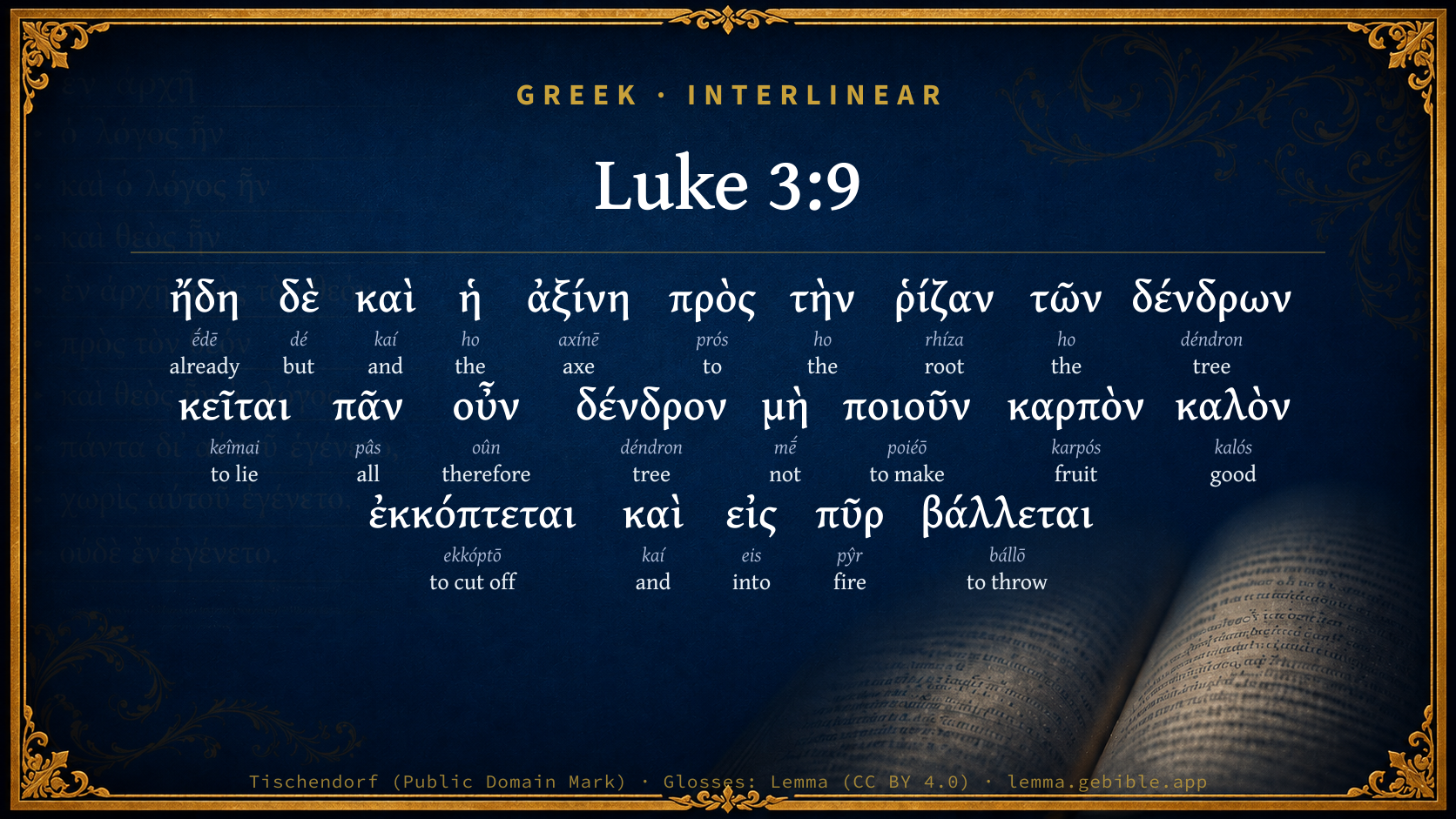
  1. ἤδη ḗdē G2235 “already” Adverb
  2. δὲ dé G1161 “but” Conjunction
  3. καὶ kaí G2532 “and” Conjunction
  4. ἡ ho G3588 “the” Article, Nominative, Singular, Feminine
  5. πρὸς prós G4314 “to” Preposition
  6. τὴν ho G3588 “the” Article, Accusative, Singular, Feminine
  7. ῥίζαν rhíza G4491 “root” Noun, Accusative, Singular, Feminine
  8. τῶν ho G3588 “the” Article, Genitive, Plural, Neuter
  9. δένδρων déndron G1186 “tree” Noun, Genitive, Plural, Neuter
  10. κεῖται keîmai G2749 “to lie” Verb, Present, Middle or Passive deponent, Indicative, 3rd person, Singular
  11. πᾶν pâs G3956 “all” Adjective, Nominative, Singular, Neuter
  12. οὖν oûn G3767 “therefore” Conjunction
  13. δένδρον déndron G1186 “tree” Noun, Nominative, Singular, Neuter
  14. μὴ mḗ G3361 “not” Particle, Negative
  15. ποιοῦν poiéō G4160 “to make” Verb, Present, Active, Participle, Nominative, Singular, Neuter
  16. καρπὸν karpós G2590 “fruit” Noun, Accusative, Singular, Masculine
  17. καλὸν kalós G2570 “good” Adjective, Accusative, Singular, Masculine
  18. ἐκκόπτεται ekkóptō G1581 “to cut off” Verb, Present, Passive, Indicative, 3rd person, Singular
  19. καὶ kaí G2532 “and” Conjunction
  20. εἰς eis G1519 “into” Preposition
  21. πῦρ pŷr G4442 “fire” Noun, Accusative, Singular, Neuter
  22. βάλλεται bállō G906 “to throw” Verb, Present, Passive, Indicative, 3rd person, Singular

About this verse

These counts appear in no published source. They are computed here, from the morphology-tagged text and Lemma’s own curated glosses. What Lemma adds →

23
words
19
distinct lemmas
Gospels
section

Notable vocabulary

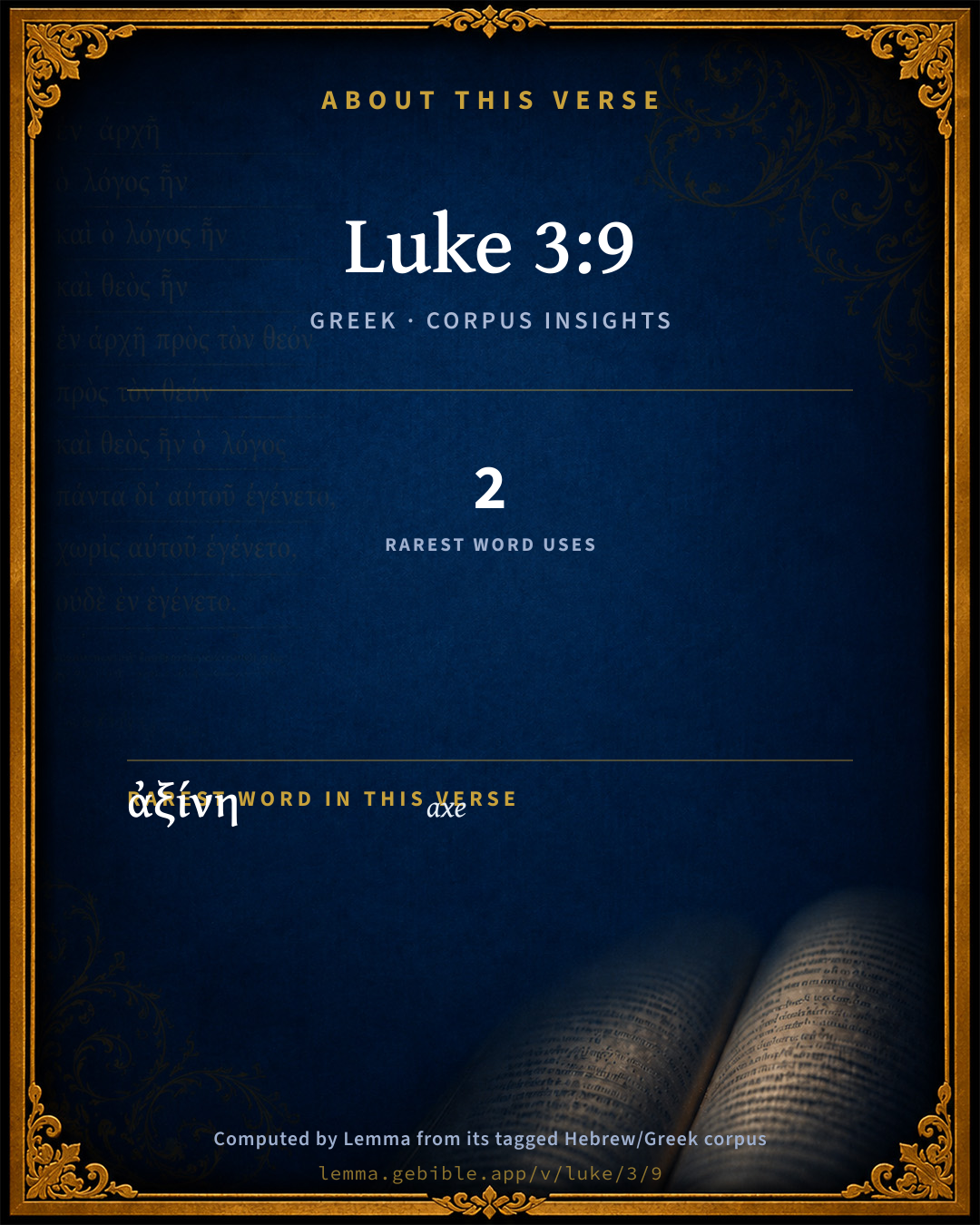
The rarest word here is ἀξίνη axe G513 — appearing just 2 times in the whole Greek New Testament.

Shared distinctive vocabulary

ἀξίνη axe G513 occurs in 2 verses of the Greek New Testament. Also found in:

Repetition

Words recur within this verse:

Cross-references

12

Topical passages linked to Luke 3:9 in the Treasury of Scripture Knowledge — connected by theme and wording, ordered by reader-vote popularity; previews shown in the World English Bible.

  • Matthew 7:19 Every tree that doesn't grow good fruit is cut down, and thrown into the fire.
  • John 15:6 If a man doesn't remain in me, he is thrown out as a branch, and is withered; and they gather them, throw them into the fire, and they are burned.
  • Luke 13:9 If it bears fruit, fine; but if not, after that, you can cut it down.'"
  • Isaiah 10:33–34 Behold, the Lord, Yahweh of Hosts, will lop the boughs with terror: and the high of stature shall be hewn down, and the lofty shall be brought low.
  • Matthew 3:10 "Even now the axe lies at the root of the trees. Therefore, every tree that doesn't bring forth good fruit is cut down, and cast into the fire.
  • Luke 13:7 He said to the vine dresser, 'Behold, these three years I have come looking for fruit on this fig tree, and found none. Cut it down. Why does it waste the soil?'
  • Ezekiel 15:2–4 Son of man, what is the vine tree more than any tree, the vine-branch which is among the trees of the forest?
  • Ezekiel 31:18 To whom are you thus like in glory and in greatness among the trees of Eden? yet shall you be brought down with the trees of Eden to the lower parts of the earth: you shall lie in the midst of the uncircumcised, with those who are slain by the sword. This is Pharaoh and all his multitude, says the Lord Yahweh.
  • Daniel 4:14 He cried aloud, and said thus, Hew down the tree, and cut off its branches, shake off its leaves, and scatter its fruit: let the animals get away from under it, and the fowls from its branches.
  • Daniel 4:23 Whereas the king saw a watcher and a holy one coming down from the sky, and saying, Hew down the tree, and destroy it; nevertheless leave the stump of the roots of it in the earth, even with a band of iron and brass, in the tender grass of the field, and let it be wet with the dew of the sky: and let his portion be with the animals of the field, until seven times pass over him;
  • Hebrews 12:29 for our God is a consuming fire.
  • Luke 23:29–31 For behold, the days are coming in which they will say, 'Blessed are the barren, the wombs that never bore, and the breasts that never nursed.'

Cross-references courtesy of OpenBible.info (CC BY 4.0).

Commentary

Notes on Luke 3:9 from classic Christian and Jewish commentators (each source and its license shown beneath its notes). The classic Christian expositions comment on the surrounding passage and are grouped to its opening verse, so a note may address several verses; the Jewish commentaries on the Tanakh (Rashi and others) are per-verse, so they appear only where the commentator wrote on this verse.

Lemma curates 59 commentaries, every one of them public domain or Creative Commons licensed, each selected and text-cleaned for this edition rather than reprinted as found. About our sources →

The Biblical Illustrator

Joseph S. Exell

Luk_3:9

The axe is laid unto the root of the trees

Radical and seminal reform

It seems to me a total mistake to apply the words of the Baptist, And now also the axe, &c.

, to any work ordained for man. When the appointed time comes, God does indeed show forth His justice by sweeping away that which is utterly corrupt. Yet even the Son of God, in His human manifestation, came not to destroy, but to save. Assuredly this is the only part of His office which we are called to discharge. As His ministers, we are to be ministers of salvation, not of destruction. The evil in ourselves, indeed, we are to pluck up, branch and root; but in our dealings with others, unless we have a special office committed to us by the laws of family or national life, our task will mainly be to contend against evil by sowing the seeds of good, not by radical reforms, but by seminal. The satirist, the rhetorician, the moralist, will indeed try the former, and will therefore fail. The Christian has a higher power entrusted to him, the power of Gods goodness and mercy, the gospel of redemption and salvation; not the woes of the Trojan prophetess, who could gain no credence, but the glad tidings of the kingdom of heaven. And if he relies on this power, he will succeed where others must needs fail. (A. W. Hare, in Guesses at Truth. )

The axe lying at the root

We may learn from it, in the first place--

I. THE KIND OF FRUIT WHICH GOD REQUIRES FROM US. In our text it is called good fruit; and, in the eighth verse, fruits meet for repentance. With what propriety, my brethren, are fruits like these denominated good. They are the result of a good principle, even of that godly sorrow which worketh repentance to salvation, not to be repented of; they proceed from a good source, for they are the fruits which the Holy Spirit Himself produces in the heart and life which He controls; and they accord with the Divine revelation and with the Divine will, for He hath showed thee, O man, what is good; and what doth the Lord thy God require of thee, but to do justly, to love mercy, and to walk humbly with thy God?

II. THE MEANS WHICH GOD EMPLOYS TO RENDER US PRODUCTIVE OF THIS KIND OF FRUIT, AND WHICH SHOW HOW REASONABLE IT IS THAT HE SHOULD EXPECT IT FROM US. In the first place, God has endowed you with a capacity to produce this kind of fruit. A stone is not capable of producing the fruits of a tree, because it is destitute of vegetable life. A tree is not capable of producing the fruits of instinct and sagacity, because it is destitute of animal life. And the beasts of the field are not capable of producing the fruits of reason and of conscience, because they are destitute of intellectual and moral life. Nor are such fruits required from them. God never requires from His creatures any actions which they are naturally incapable of performing. But there is a spirit in man, and the inspiration of the Almighty hath given him understanding. He has endowed us with reason and with affections. You retain the ability, but you have lost the disposition, to exercise the mind aright. You may destroy the eye by which you behold the surrounding universe; you may destroy the link that binds your spirit to your mortal flesh: but your responsibility to God, and your immortality of existence, you cannot destroy, you cannot touch. Secondly: In order to enable you to bring forth this good fruit, God has supplied you with the gospel of His Son. The gospel contains also the motives to fruitfulness; and these motives are the most powerful that can be presented to the mind. And the gospel contains also the promise of that Divine influence by which fruitfulness is infallibly secured! for He giveth His Holy Spirit to them that ask Him. Thirdly: God has visited you with various dispensations of providence, and with various convictions of conscience, all of which have been intended to direct your attention to the gospel, that thereby you might bring forth fruits meet for repentance.

III. THE CONTINUED UNFRUITFULNESS OF SOME PERSONS, NOTWITHSTANDING ALL THE MEANS WHICH THE GOD OF MERCY HAS EMPLOYED.

1. Some of these unfruitful persons are sensual and profane. Their bodies and their souls are given to sin.

2. Some of these unfruitful persons are intellectual, and moral, and amiable.

3. Some of these unfruitful persons are professors of the gospel. They are branches in the vine, but they bear no fruit.

IV. THE AXE WINCH IS LYING AT THE ROOT OF SUCH UNFRUITFUL PERSONS. And now also the axe is laid unto the root of the trees. This axe may therefore be considered as emblematical of death, at which period the character and condition of the fruitless, as well as of others, will be decided and fixed for ever.

1. The axe which is lying at your root reminds you of the patience and long-suffering of God. If you had had a servant in your family who had cared as little for you as you have cared for God, would you have continued him in your house as long as God has continued you? No, my brethren, you would not. You would have cut down the tree, and you would have dismissed the servant.

2. The axe which is lying at your root reminds you of the critical circumstances in which you are placed. Remember that, though you have not yet been hewn down, the axe is actually lying at your root. The axe has not to be prepared; it has been prepared, and sharpened. The axe has not to be brought to you from a distance; it has been brought, and is now lying at your root.

3. The axe which is lying at your root has sometimes admonished you of its being there. You have seen others fall under its influence; but have you never felt it yourself? Has the cold iron never sent its chilling influence through your frame?

V. THE AWFUL CONDITION TO WHICH SUCH UNFRUITFUL PERSONS ARE DOOMED. Every tree that bringeth not forth good fruit is hewn down, and cast into the fire. The nature of this condition is indescribably terrible. There is an awful peculiarity even in the death of a fruitless sinner. He is hewn down. And the language intimates at once his own unwillingness to die, and the determined and penal manner in which his death is inflicted. The certainty that this condition will be incurred by the finally impenitent is another sentiment which our text conveys--a certainty so sure and perfect, that the event is spoken of as having actually taken place. He is hewn down, and cast into the fire. If you die unfruitful, your destruction is as certain as your death. (J. Alexander, D. D.)

Little value set on trees in the East

The remarkably broad statement implied in this bold figure of speech must strike a European as somewhat extraordinary; and yet there is more of literal truth in it than one would at first thought be disposed to imagine. The fact is, in Western Asia trees, as trees, are but little valued. The fruit-trees are preserved and nourished with great care; but nearly all other trees are cut down for fuel, mineral fuel being exceedingly scarce. An exception is made in favour of poplars. These are permitted to grow to their full height for the sake of the long beams they supply. (Biblical Things, &c.)

The destructive axe

This is judgment--destruction. The axe is not for planting, or pruning, or dressing, or propping, or protecting, but for cutting down. The axe against Israel was the Roman host, and many such axes has God wielded, age after age. Every judgment is an axe: pestilence is Gods axe; famine Gods axe; adversity Gods axe. There is a great difference between the axe and the pruning-knife. Yet some of Gods judgments are both in one--an axe to the ungodly, a pruning-knife to the saint. It is Gods axe, not mans; its edge is sharp; it is heavy; it will do its work well. (H. Bonar, D. D.)

The axe laid to the root of the tree

I. THE ROOT. That which bears up the branches, and on which the trees and branches stand and grow.

1. The root, then, was the covenant God made with Abraham and his natural seed or offspring, which covenant did, in a mystical sense, as clearly bear up the national church of Israel and all the trees (i.e., members or branches thereof)

as common natural root doth the tree or trees growing out of it.

2. By the root may also be intended the foundation of all the Jews hopes, confidence, and outward privileges.

3. By root, in a more remote sense, may be meant the state and standing of every ungodly, unbelieving, and impenitent person.

II. THE TREES. Men and women, but chiefly the seed of the stock of Abraham, according to the flesh, of whom the national church of the Jews was made up, and did consist; as also, all wicked and unbelieving persons whatsoever, who embrace not the offers of grace in the gospel, or believe not in Jesus Christ.

III. THE AXE.

1. The dispensation of Gods providence, or time. Time is pictured with a scythe, but then man is compared to grass; but it may be pictured with an axe, since men are compared to trees; a scythe is no fit instrument to cut down trees.

2. The axe also may refer to the gospel: the Word of God is an axe to hew and square some persons for Gods spiritual building, and to cut down others also, as trees that are rotten, and bear no good fruit; Therefore, saith the Lord, I have hewn them by the prophets; and what follows, mark it, I have slain them by the words of My mouth (Hos_6:5).

3. The axe may refer to men, whom God makes use of, as instruments in His hand, to cut down and destroy a wicked and God-provoking people; hence wicked rulers and kings, whom God raises up, as instruments in His hand, to chastise and cut clown a rebellious people, are called His sword, and the rod of His wrath and indignation (Psa_17:14).

4. By the axe may in general be meant Gods wrath; however it is, or may be executed, or upon whom, wrath will sooner or later cut down all the ungodly, both false Churches and tyrannical powers of the earth, and all who continue in unbelief and in rebellion against God. The laying the axe to the root discovers the final fall and ruin of sinners, whether considered as a Church or as particular persons; dig up or cut down the root, and down falls the body and all the branches of the tree. Or are you self-righteous persons? Do you build on your own righteousness, like the Jews and hypocritical Pharisees? If so, the axe will cut you down also. You must bring forth good fruit, every soul of you, or perish; and this you cannot do till your hearts are changed, and so you become good trees. Make the tree good, and then the fruit will be good; an evil tree cannot bring forth good fruit, &c. All works of regenerate persons--yea, their religious duties--are but dead works, not good fruits; nor can they bring forth good fruits unless they are planted by faith into Jesus Christ. Nay, I must tell you that gospel-holiness will not save us; it must be the righteousness of God by faith. (Benjamin Keach.)

The discovery of hypocrisy

1. It cutteth the Sabbath-breaker to hear his profaneness still cried out upon; it cutteth the adulterer to hear his viciousness continually found fault with; it cutteth the drunkard to hear his excess so often threatened; it cutteth the rioter and voluptuous liver, that his course should ever and anon be so eagerly reproved. And so, in the other particulars, it doth even enrage mens hearts that the Word of God cloth so meet with them, as it were, at every turn; and it causeth many to come to hear it no more than they needs must, because, though they set a face upon it, and would make themselves and others believe that it is not so; yet this same sharp axe of the Word, when the edge thereof is turned towards them, doth strike some wound or other into them almost at every sermon. So that as Scripture hath avouched it, so common use will not suffer it to be untrue, that the ministry of the Word is a sharp axe, which hath a biting edge, and cutteth and pierceth where it goeth. The use of it, in a word, is to justify and to maintain to the faces of all gainsayers that that very Word which they hear daily, and which they would fain make themselves and others believe is but an idle word, is indeed and in truth the very Word of God.

2. Another thing in the axe is, that as it cuts, so it frameth and fashioneth the hearers to a place in the spiritual building in Gods Church. And as a crooked and knobby tree must first be hewn and squared, and cut again and again, before it can sort with the rest of the building, so must we also be even cast, as it were, in a new mould, and transformed into a new shape, before we can have a place in Gods spiritual house. There is a great deal of crookedness and corruption must be pared from us; we must pass under the workmans tool before we can be an habitation of God by His Spirit. Now, the means to frame us to become fit for the Lords building is the public ministry of His Word. By it the Lord cloth lop off the superfluity of our corruption; thereby He doth smooth us and make us plain and compact, and join us in, as it were, by certain mortices and joints with the rest of that holy frame, that being once fast coupled unto it, He may preserve us ever unto Himself. Therefore we find in Scripture that as the Church of God was never destitute of this workmanship, so likewise those whom His pleasure was to bring into the society of His chosen--they were framed thereby, and first felt the power and edge of the Word before they were linked together with Gods people.

3. It followeth, an axe put to the root of the trees; that is (as I have expounded it), urged and applied to mens consciences, laid and pressed to the hearts of the hearers, For look what the root is unto the rest of the tree; the same is the heart to the whole man. Nathan the prophet laid the axe to the root when he told David, Thou art the man. So did Elias, when he said to Ahab, It is thou and thy fathers house that have troubled Israel. So did Amos, when he preached at Bethel, the kings own chapel, the destruction of the kings own house. So did Hanani, when he said plainly to the king that he had done foolishly not to rest upon the Lord. So did Zachariah, when he told Joash he should not prosper if he forsook the Lord. So did John the Baptist, when he spake directly to the Pharisees, and called them a viperous generation, and when he told Herod to his face he might not have his brothers wife. So did Christ, when He preached woe to the Scribes and Pharisees, Woe to Chorazin and Bethsaida. So did Peter, when he told the Jews, You, I say, have crucified and slain the Lord of life. So did Paul, when he called them foolish Galatians. It is to no purpose, as it were, to stand hacking at the branches, and to strike here and there upon the outward rind; but a man must go to the root, and knock at the door of every mans conscience, that every soul may tremble, and men at the least may be convinced against the day of reckoning. If thou doest not well, saith God unto Cain, sin lieth at the door. Sin is like a cruel beast, which lieth sleeping at the door of every mans heart. It must be awaked and stirred up, that men may see their danger. (S. Hieron.)

Unfruitful trees cut down.

The axe is laid unto the root of the trees in the East with a significance which we can hardly understand in the West. It is not merely because the tree cumbers the ground in a physical sense; to even shade-trees-trees of any sort--are greatly to be desired throughout the Holy Land. But the fruit-trees are all taxed; and if unfruitful, they are a heavy incumbrance. If a tree bears no fruit, it brings its proprietor in debt, and that to the most merciless of creditors, a tax-farmer. Some four years ago, when the taxes were heavy and the olive product light, multitudes of olive-trees were cut down on the spurs of Lebanon. It was cutting off the owners means of support in the future; but that was still in the future, and uncertain. In the immediate present, all that the proprietor could see was cruelty, oppression, and taxes. Future starvation was not a heavier burden than present hunger, with debt as a load above it. It is probable that this is just the same sort of cumbering the ground which was the troublesome one in old times. Space could be spared in the ground for a tree whose only use was ornament; wild trees are still allowed for that purpose; but a fruit-tree which bore a tax is quite a different matter, and probably was so then. The fruit-trees paid a religious tithe; and the secular government could scarcely have been less exacting. The tax on fruit-trees, too, is a heavy one. Read any recent work on the political condition of Egypt, and see how much every palm must pay. Travellers are often surprised at the extra charges which they have to pay--more than the natives--for the use of a horse or a boat; but they forget that the Government is on the look-out for those who own the boat or the horse, and is apt to get the lions share of all such seeming extortions. (Professor Isaac H. Hall.)

Sternness necessary

When we lay the axe to the root of the tree--when we hew off mens very members, when we snatch them like brands out of the fire, when we make them to see their own faces in the law of liberty, the face of a guilty, and therefore cursed, conscience--there will be need of much boldness. A surgeon who is to search an inveterate wound, and to cut off a putrified member, had not need to be faint-hearted, or bring a trembling hand to so great a work. (Bishop Reynolds.)

The Biblical Illustrator, edited by Joseph S. Exell (c. 1880s–1900s) — public domain. Text from a community e-Sword module.

Tyndale Open Study Notes

Tyndale Open Resources

3:9 every tree that does not produce good fruit: Israel would be judged as an unfruitful vineyard (see Isa 5:1-7; cp. Luke 13:7-9; 20:9-19).

Tyndale Open Study Notes — © Tyndale Open Resources, licensed CC BY-SA 4.0. Text via the HelloAO Bible API.

The Cambridge Bible for Schools and Colleges

gen. ed. J. J. S. Perowne

9. is laid] Literally, “lies.” The notion is that of a woodman touching a tree with the edge of his axe to measure his blow before he lifts his arm for the sweep which fells it.

is hewn down and cast into the fire] Literally, “is being hewn down, and being cast.” It is almost impossible to reproduce in English the force of this use of the present. It is called the ‘praesens futurascens,’ and is used in cases when the doom has been long uttered, and is, by the evolution of the natural laws of God’s dealings, in course of inevitable accomplishment. But we see from prophetic imagery that even when the tree has been felled and burned “the watchers and holy ones” may still have charge to leave the stump of it in the tender grass of the field that it may grow again, Dan_4:25 : and we see from the express language of St Paul that the olive tree of Jewish life was not to be cut down and burned for ever (Rom_9:10.). A barren fig tree was also our Lord’s symbol of the Jewish nation. Luk_13:6.

The Cambridge Bible for Schools and Colleges (gen. ed. J. J. S. Perowne; Cambridge University Press, 1878–1918) — public domain. Text from a community e-Sword module.

John Gill's Exposition

And now also the axe is laid unto the root of the trees,.... Not only to Jesse's family, which as a root in a dry ground, and to Jerusalem, the metropolis of the nation; but to the root of the vain boasting of every Jew; their descent from Abraham, the covenant made with him, their ecclesiastical state and civil polity, all which would quickly be at an end: the Romans were now among them, the axe in God's hand; by means of whom, utter ruin and destruction would be brought upon their nation, city, and temple:

every tree therefore which bringeth not forth good fruit is hewn down, and cast into the fire; See Gill on Mat 3:10.

John Gill's Exposition of the Whole Bible (1746–1763) — public domain (CC PDM 1.0). Text via the HelloAO Bible API.

Trapp's Complete Commentary

John Trapp

9 And now also the axe is laid unto the root of the trees: every tree therefore which bringeth not forth good fruit is hewn down, and cast into the fire.

Ver. 9. {See Trapp on "Mat 3:10"}

John Trapp, A Commentary or Exposition upon All the Books of the Old and New Testament (1647–1656) — public domain. Text from a community e-Sword module.

Haydock's Catholic Bible Commentary

By this example is meant that anger of God, which the Jews raised against themselves by their impiety towards their Messias. The axe is laid to the root of the tree, for the branches are already lopt off; but the tree was not rooted up, for a remnant of Israel shall be saved. (St. Cyril, lib. 3. on Isai. xl.)

George Leo Haydock (1774–1849), Haydock's Catholic Family Bible and Commentary, 1859 edition — public domain. Excludes Psalms (Douay-Rheims chapter numbering differs from Protestant) and Deuterocanonical books (Catholic canon only).

Matthew Poole's English Annotations

See Poole on "Mat 3:7", and following verses to Mat 3:10, where we met with all this with no alteration, save that Matthew saith that he spoke this to the Pharisees and Sadducees, seeing them come to his baptism: though he did especially intend them, yet he spake in the hearing of the multitude, amongst whom they were.

Matthew Poole's English Annotations on the Holy Bible (1683–1685) — public domain. Text from a community e-Sword/MySword module.

The Pulpit Commentary

And now also the axe is laid unto the root of the trees: every tree therefore which bringeth not forth good fruit is hewn down, and cast into the fire. This intensifies the statement respecting the power of God to raise up, out of the very river shingle at their feet, children who should inherit the glorious promises made to Abraham. Nay, more, the Divine Woodman had already laid the axe at the root of the tree of Israel; its hours, as the peculiar people, were indeed numbered. Let these, who said they were willing to wash and be clean, be ready and bring forth fruit worthy of their high calling and the lofty prerogative of which they boasted. The last of the prophets, from his lonely watch-tower of unerring insight into the future, saw the awful coming doom of the loved city, the scattering and captivity of the remnant of the chosen people. Within forty years of that time would the fatal axe, now lying at the root of the tree, be lifted. In uttering this stern prophetic saying, we believe John was gazing at the storm gathering round Jerusalem, which in A.D. 70 swept away city and temple, and destroyed the existence of Israel as a nation. When he preached it was about A.D. 30-32.

The Pulpit Commentary (1880–1919), ed. H.D.M. Spence-Jones & Joseph S. Exell — public domain. Text from a community e-Sword module.

Burkitt's Expository Notes on the New Testament

William Burkitt

St. John having preached the doctrine of repentance in the foregoing verses, he backs it with a powerful argument in this verse, drawn from the certainty and severity of that judgment which should come upon them, if they continued their sins: Now is the axe laid to the root of the tree.

Learn, 1. That it is not unsuitable for gospel preachers to press repentance and holiness of life upon their hearers, from arguments of terror. John does it here, and Christ elsewhere.

2. That those whose hearts are not pierced with the sword of God’s word, shall certainly be cut down and destroyed by the axe of his judgments.

Observe farther, that forasmuch as the sin here specified is a sin of omission, every tree which bringeth not forth good fruit, as well as that which bringeth forth evil fruit, is hewn down, and cast into the fire. We learn that sins of omission are certainly damning as well as sins of commission. The neglects of duty are as dangerous and damnable as the acts of sin. Such trees as stand in God’s orchard, the church, and bring forth no good fruit, are marked out as fuel for the devil’s fire.

William Burkitt's Expository Notes on the New Testament (1700–1703) — public domain. Text from a community e-Sword module.

unfoldingWord translationNotes

Door43 World Missions Community

the ax is set against the root of the trees

The ax that is in position so it can cut the roots of a tree is a metaphor for the punishment that is about to begin. It can be stated in active form. AT: "God is like the man who has placed his ax against the root of the trees" (See: Active or Passive and Metaphor)

every tree ... is chopped down and thrown into the fire

"fire" here is a metaphor for punishment. This can be stated in active form. AT: "he chops down every tree ... and throws it into the fire" (See: Active or Passive and Metaphor)

translationWords

ax

unfoldingWord translationNotes — © Distant Shores Media and the Door43 World Missions Community, licensed CC BY-SA 4.0. Source: git.door43.org/Door43/en_tn.

Cambridge Greek Testament for Schools and Colleges

9. ἤδη … κεῖται. Literally, ‘already lies.’ The notion is that of a woodman touching a tree (πρὸς) with the edge of his axe to measure his blow before he lifts his arm for the sweep which fells it.

μὴ ποιοῦν, if it produce not. The μὴ points to a condition.

ἐκκόπτεται καὶ εἰς πῦρ βάλλεται. Literally, “is being hewn down, and being cast.” It is almost impossible to reproduce in English the force of this use of the present. It is called the ‘praesens futurascens’ (see note on Luk 2:29), and is used in cases when the doom has been long uttered, and is, by the evolution of the natural laws of God’s dealings, in course of inevitable accomplishment. But we see from prophetic imagery that even when the tree has been felled and burned “the watchers and holy ones” may still have charge to leave the stump of it in the tender grass of the field that it may grow again, Dan 4:25: and we see from the express language of St Paul that the olive tree of Jewish life was not to be cut down and burned for ever (Romans 9, 10). A barren fig-tree was also our Lord’s symbol of the Jewish nation. Luk 13:6.

Cambridge Greek Testament for Schools and Colleges (Cambridge University Press, 1896; 21 vols, various authors incl. Carr, Maclear, Plummer, Farrar, Lumby, Moule, M. R. James, Simcox) — public domain. Text from a community e-Sword module.

International Critical Commentary

9. ἤδη “Although you do not at all expect it.” The image of the axe is in harmony with that of the fruits (ver. 8). In the East trees are valued mainly for their fruit; and trees which produce none are usually cut down. “And even now also the axe is laid unto the root.”

The πρός after κεῖται may be explained either, “is brought to the root and lies there”; or, “lies directed towards the root.” In either case the meaning is that judgment is not only inevitable, but will come speedily: hence the presents, ἐκκόπτεται and βάλλεται.

The δὲ καί (in Mt. simply δέ) is Lk.’s favourite method of giving emphasis; ver. 12, 2:4, 4:41, 5:10, 36, 9:61, 10:32, 11:18, 12:54, 57, 14:12, 16:1, 22, 18:9, 19:19, 20:12. For μή with a participle, expressing a reason or condition, comp. 2:45, 7:30, 11:24, 12:47, 24:23; Act 9:26, Act 9:17:6, Act 9:21:34, Act 9:27:7; and see Win. Lev_5 (β), p. 607. For ἐκκόπτειν, “to cut off,” of felling trees, comp. 13:7, 9; Hdt. ix. 97, 1. See notes on 6:43.

International Critical Commentary — older volumes (1896–1929), various authors — public domain. Text from a community e-Sword module.

Vincent's Word Studies in the New Testament

Marvin R. Vincent

See on Mt 3:10.

Marvin R. Vincent, Word Studies in the New Testament (1887–1900) — public domain. Text from a community e-Sword/MySword module.

Lesson kit

Teaching starters — assembled from the data on this page, not authored interpretation. Every prompt links to the verse data it draws on. Edit before teaching.

Luke, in the Gospels, opens this verse with 23 words (19 distinct Greek lemmas). Its most distinctive word is axínē (“axe”). A historical commentator’s framing appears above. Read the whole chapter for the surrounding context.

Discussion questions

  1. What does “axe” (axínē) contribute to the verse as a whole?
  2. How does Matthew 3:10, which shares the word «axe», read alongside this verse?
  3. What does the repetition of “tree” (2× in this one verse) do in this verse?
  4. These translations render this verse differently. What is at stake in choosing one wording over another?
  5. Compare how The Biblical Illustrator and Tyndale Open Study Notes read this verse. Where do they agree or differ?

Things to notice

Reading settings

Reading text

Shown beneath each verse's original-language words.

Old Testament
Old Testament edition

Read the OT as the Masoretic Hebrew (MT) or the Greek Septuagint (LXX).

English shown for the Greek Septuagint (in the Hebrew ↔ Greek comparison).

Comparing translations? Open the Compare panel on any verse page to stack up to four side by side.