Matthew 7:9

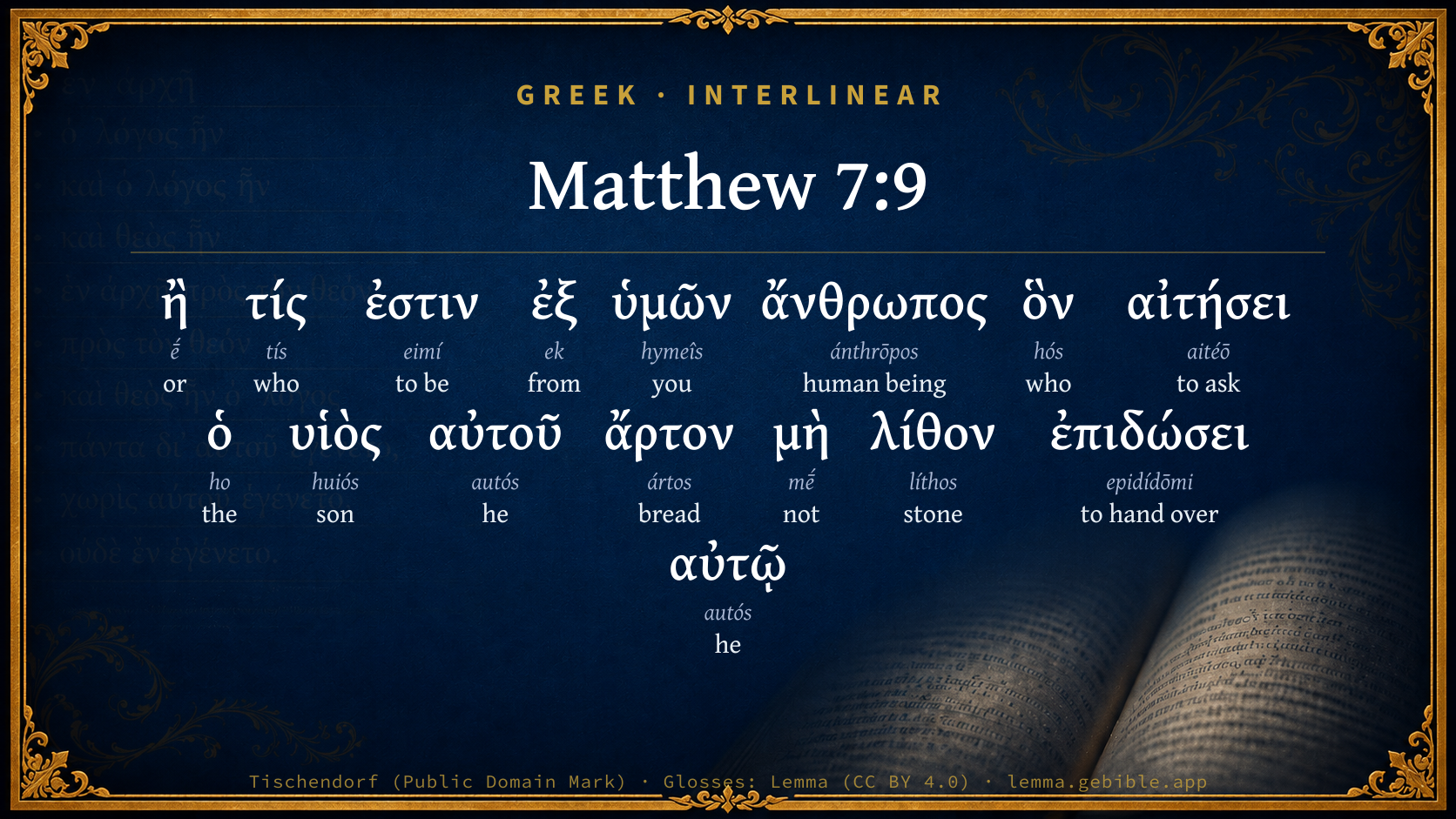
Greek (Tischendorf 8th ed.) Matthew 7:9 appears in the Greek New Testament. The text above is from the Tischendorf 8th edition. Each word links to its Strong’s number and a concise gloss. Click any word for its full Thayer’s Greek Lexicon entry.
Download image
Cite this verse

Matthew 7:9 (World English Bible). Public Domain. Lemma interlinear Bible study tool, https://lemma.gebible.app/v/matthew/7/9.

Show BibTeX & RIS
BibTeX
RIS
English Translation
Or who is there among you, who, if his son asks him for bread, will give him a stone?
World English Bible · Public Domain
Highlights
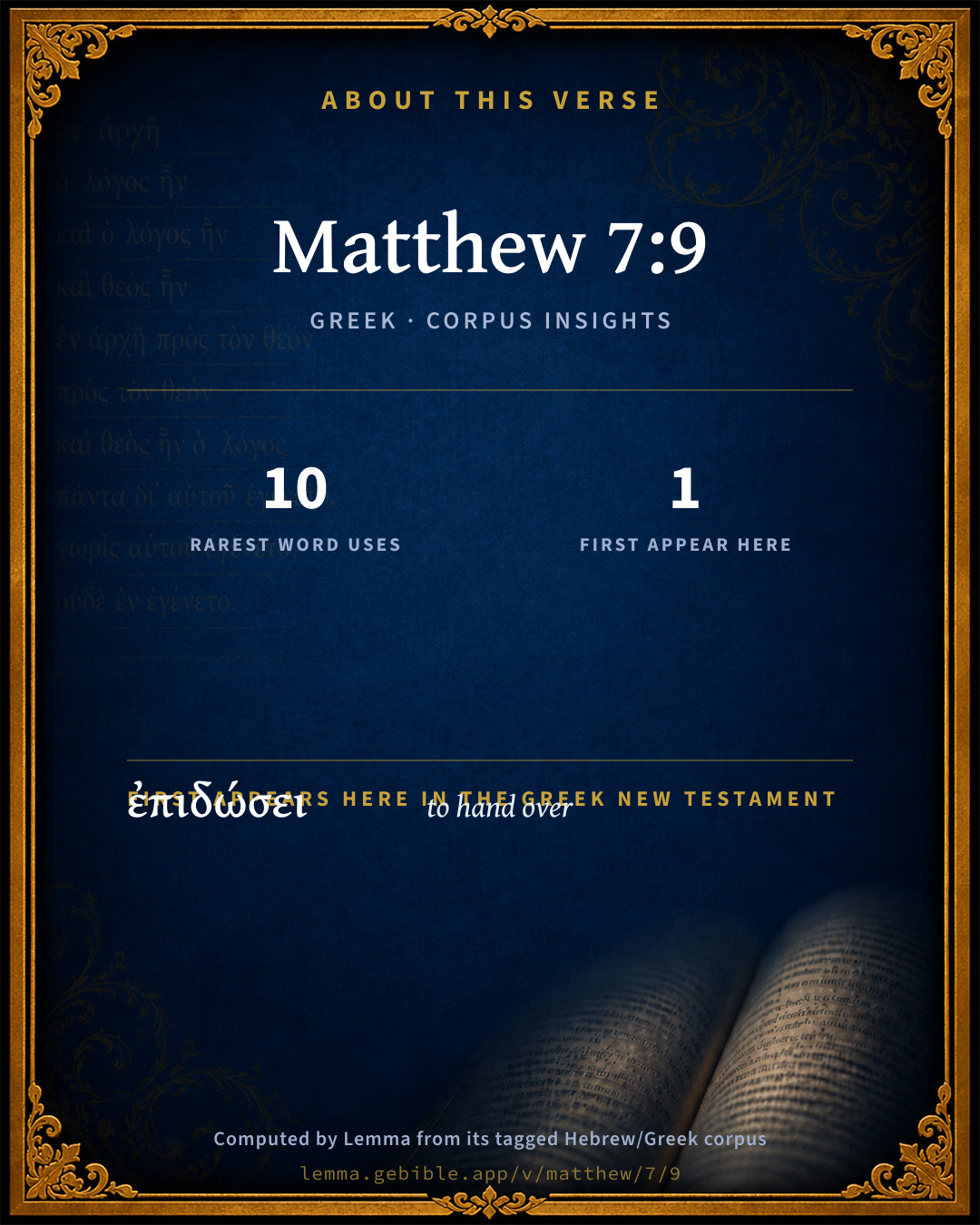
  • 1 first appearance in the Greek New Testament
Full analysis ↓
Download a study sheet

One document with this verse’s original text, its word-by-word gloss line, the meaning frame, cross-references with their text, attributed commentary, and full source and license credits — printable, and it pastes into notes with its structure intact.

This verse Autodidact and up

Study sheet (.html) Plain text (.txt)

A passage Seminary Student

Up to 50 verses in one chapter. A passage sheet keeps up to 6 commentary sources and 12 cross-references per verse, in the order this page ranks them, and says so on the sheet whenever that leaves anything out. Ask for a single verse and you get the Autodidact verse sheet above.

Everything on this page stays free to read, with no account — the sheet is a download of what is already on screen, not access to it.

Want to remove ads? Support Godless Engineer
Compare translations 3

The same verse in 3 English versions, stacked beneath the original-language interlinear above. Click any original word for its lexicon entry.

Each is an independent rendering of the whole verse — the interlinear is not word-aligned to these translations.

Highlighted words mark where these versions differ — a whole-verse word diff, not a word-by-word alignment.

  • World English Bible Public Domain
    Or who is there among you, who, if his son asks him for bread, will give him a stone?
  • King James Version Public Domain
    Or what man is there of you, whom if his son ask bread, will he give him a stone?
  • unfoldingWord Literal Text CC BY-SA 4.0
    Or what man is there from among you, of whom his son will ask for bread—he will not give him a stone, will he?

unfoldingWord Literal Text — © unfoldingWord, licensed CC BY-SA 4.0. Word-aligned USFM3 via Door43 (git.door43.org/unfoldingWord/en_ult).

Versions to compare (up to 4)

3 of 4 selected

Show all 19 translations

Every available English version of this verse, each an independent rendering of the whole verse.

  • World English Bible Public Domain
    Or who is there among you, who, if his son asks him for bread, will give him a stone?
  • Berean Standard Bible Public Domain
    Which of you, if his son asks for bread, will give him a stone?
  • Majority Standard Bible Public Domain
    Which of you, if his son asks for bread, will give him a stone?
  • King James Version Public Domain
    Or what man is there of you, whom if his son ask bread, will he give him a stone?
  • American Standard Version (1901) Public Domain
    Or what man is there of you, who, if his son shall ask him for a loaf, will give him a stone;
  • Revised Version (1885) Public Domain
    Or what man is there of you, who, if his son shall ask him for a loaf, will give him a stone;
  • Geneva Bible (1599) Public Domain
    For what man is there among you, which if his sonne aske him bread, woulde giue him a stone?
  • Douay-Rheims (1899) Public Domain
    Or what man is there among you, of whom if his son shall ask bread, will he reach him a stone?
  • Young's Literal Translation Public Domain
    `Or what man is of you, of whom, if his son may ask a loaf -- a stone will he present to him?
  • Literal Standard Version CC BY-SA 4.0
    Or what man is of you, of whom, if his son may ask [for] a loaf—a stone will he present to him?
  • Unlocked Literal Bible CC BY-SA 4.0
    Or which one of you, if his son asks for a loaf of bread, will give him a stone?
  • unfoldingWord Literal Text CC BY-SA 4.0
    Or what man is there from among you, of whom his son will ask for bread—he will not give him a stone, will he?
  • Darby Bible Public Domain
    Or what man is there of you who, if his son shall ask of him a loaf of bread, will give him a stone;
  • World Messianic Bible Public Domain
    Or who is there among you who, if his son asks him for bread, will give him a stone?
  • Webster's Bible Public Domain
    Or what man is there of you, who, if his son shall ask bread, will give him a stone?
  • Free Bible Version CC BY-SA 4.0
    Would any of you give your son a stone if he asked for bread?
  • Bible in Basic English Public Domain
    Or which of you, if his son makes a request for bread, will give him a stone?
  • Text-Critical English NT CC BY 4.0
    Or what man is there among you, who, if his son asks him for bread, will give him a stone;
  • Tyndale New Testament (1534) Public Domain
    Ys there eny man amonge you which if his sonne axed hym bread wolde offer him astone?

Literal Standard Version (2020), Covenant Press — licensed CC BY-SA 4.0. Text via the HelloAO Bible API (eBible.org). Unlocked Literal Bible (unfoldingWord) — licensed CC BY-SA 4.0. Text via the HelloAO Bible API (eBible.org). unfoldingWord Literal Text — © unfoldingWord, licensed CC BY-SA 4.0. Word-aligned USFM3 via Door43 (git.door43.org/unfoldingWord/en_ult). Free Bible Version, Dr. Jonathan Gallagher — licensed CC BY-SA 4.0. Text via the HelloAO Bible API (eBible.org).

Word by word

More ways to search: Search by grammar → Find every occurrence → Compare this word →

Practice this passage: Drill this verse → Learn its vocabulary →

ἐπιδώσει
epidídōmi
G1929
“to hand over”
Verb, Future, Active, Indicative, 3rd person, Singular
Part of Speech
Verb
Tense
Future
Voice
Active
Mood
Indicative
Person
3rd person
Number
Singular
Full Thayer's Definition

Origin: from G1909 and G1325

TDNT: None

1. to hand, give by hand 2. to give over a. give up to the power or will of one
  1. ἢ ḗ G2228 “or” Particle
  2. τίς tís G5101 “who” Interrogative pronoun, Nominative, Singular, Masculine
  3. ἐστιν eimí G1510 “to be” Verb, Present, Active, Indicative, 3rd person, Singular
  4. ἐξ ek G1537 “from” Preposition
  5. ὑμῶν hymeîs G5210 “you” Personal pronoun, 2nd person, Genitive, Plural
  6. ἄνθρωπος ánthrōpos G444 “human being” Noun, Nominative, Singular, Masculine
  7. ὃν hós G3739 “who” Relative pronoun, Accusative, Singular, Masculine
  8. αἰτήσει aitéō G154 “to ask” Verb, Future, Active, Indicative, 3rd person, Singular
  9. ὁ ho G3588 “the” Article, Nominative, Singular, Masculine
  10. υἱὸς huiós G5207 “son” Noun, Nominative, Singular, Masculine
  11. αὐτοῦ autós G846 “he” Personal pronoun, Genitive, Singular, Masculine
  12. ἄρτον ártos G740 “bread” Noun, Accusative, Singular, Masculine
  13. μὴ mḗ G3361 “not” Particle, Negative
  14. λίθον líthos G3037 “stone” Noun, Accusative, Singular, Masculine
  15. αὐτῷ autós G846 “he” Personal pronoun, Dative, Singular, Masculine

About this verse

These counts appear in no published source. They are computed here, from the morphology-tagged text and Lemma’s own curated glosses. What Lemma adds →

16
words
15
distinct lemmas
Gospels
section

Notable vocabulary

The rarest word here is ἐπιδώσει to hand over G1929 — appearing just 10 times in the whole Greek New Testament.

First appearance in Scripture

This word makes its first canonical appearance in the Greek New Testament here:

  • ἐπιδώσει to hand over G1929

Shared distinctive vocabulary

ἐπιδώσει to hand over G1929 occurs in 9 verses of the Greek New Testament. Also found in:

Repetition

A word recurs within this verse:

  • αὐτοῦ he G846 ×2

Cross-references

1

Topical passages linked to Matthew 7:9 in the Treasury of Scripture Knowledge — connected by theme and wording, ordered by reader-vote popularity; previews shown in the World English Bible.

  • Luke 11:11–13 "Which of you fathers, if your son asks for bread, will give him a stone? Or if he asks for a fish, he won't give him a snake instead of a fish, will he?

Cross-references courtesy of OpenBible.info (CC BY 4.0).

Where the printed editions differ

2 variants

Places in this verse where the major printed Greek editions disagree on the wording in a way that affects the translation — a comparison of editions, not a manuscript-by-manuscript collation. The editions are the modern critical texts (Nestlé-Aland 28/27, SBL, Westcott-Hort, Tregelles, Tyndale House) and the traditional texts behind the KJV (the Textus Receptus and the Byzantine/Majority text). It is not a claim about which reading is original.

  1. Extra text
    ἐὰν

    “if”

    In TRByz Not in NA28NA27TynSBLWHTreg

    ἐὰν (ean) 'if' is only in traditional manuscripts (TR+Byz)

  2. Different wording
    αἰτήσει

    “he will ask for”

    In NA28NA27TynSBLWHTreg Not in TRByz

    αἰτήσῃ (aitēsē) 'you shall ask' occurs in traditional manuscripts (TR+Byz) instead of αἰτήσει (aitēsei) 'he will ask for' in older manuscripts (NA28+NA27+Tyn+SBL+WH+Treg)

Textual data: Translators Amalgamated Greek New Testament (STEPBible TAGNT) · CC BY 4.0.

Commentary

Notes on Matthew 7:9 from classic Christian and Jewish commentators (each source and its license shown beneath its notes). The classic Christian expositions comment on the surrounding passage and are grouped to its opening verse, so a note may address several verses; the Jewish commentaries on the Tanakh (Rashi and others) are per-verse, so they appear only where the commentator wrote on this verse.

Lemma curates 59 commentaries, every one of them public domain or Creative Commons licensed, each selected and text-cleaned for this edition rather than reprinted as found. About our sources →

The Biblical Illustrator

Joseph S. Exell

Mat_7:9

A stone.

The bread of Gods Word not to be petrified by preachers

Petrarchs works are said to have laid so long in the roof of St. Marks, at Venice, that they became turned into stone; by what process deponent sayeth not. To many men it might well seem that the Word of God had become petrified, for they receive it as a hard, lifeless creed, a stone upon which to sharpen the daggers of controversy, a stumbling-block for young beginners, a millstone with which to break opponents heads, after the manner experienced by Abimelech at Thebez. A man must have a stout digestion to feed upon some mens theology; no sap, no sweetness, no life, but all stern accuracy, and fleshless definition. Proclaimed without tenderness, and argued without affection, the gospel from such men rather resembles a missile from a catapult than bread from a Fathers table. Teeth are needlessly broken over the grit of systematic theology, while souls are famishing. To turn stones into bread was a temptation of our Master, but how many of His servants yield readily to the far worse temptation to turn bread into stone! Go thy way, metaphysical divine, to the stone-yard, and break granite for McAdam, but stand not in the way of loving spirits who would feed the family of God with living bread. The inspired Word is to us spirit and life, and we cannot afford to have it hardened into a huge monolith, or a spiritual Stonehenge-sublime, but cold; majestic, but lifeless; far rather would we have it as our own household book, our bosom companion, the poor mans counsellor and friend. (C. H. Spurgeon.)

Mat_7:9-11

How much more shall your Father.

The heavenly and the earthly Parent

I. The facts which our text recognizes.

1. The moral condition of earthly parents-evil.

2. The natural affection of earthly parents.

II. The argument our text expresses. Suggested by contrast. Strengthened by condition. Confirmed by covenant.

III. The appeal it supplies. Addressed to your consciousness of duty, compassion for suffering, recollection of heavenly goodness. (Anon.)

I. An encouraging character of the Being to whom we pray-a father. Most endearing. He feels the tenderest concern for us. We have freedom of access to Him, etc. But the extent of His Fatherly relation is in the text illustrated-by appeal and by contrast.

II. The blessings We shall receive from our heavenly Father in answer to our prayers-good things. Temporal and spiritual things. What an encouragement to pray! How careful we should be to pray aright. Address those who do not pray. (R. Watson.)

God the best of Fathers

I. How pre-eminently he sustains the parental office.

1. The first instance of His superiority is derived from His knowledge.

2. The superiority of His correction.

3. God surpasses every earthly parent in His nearness and observation. Parents cannot always be with their children.

4. Parents may be unable to relieve their children, if with them.

5. Other parents are not suffered to continue, by reason of death.

6. The love of parents is far exceeded by the love of God.

7. Parents give good things to their offspring, however imperfectly they make known their wants and desires. (W. Jay.)

Dependence upon God

I. What is implied in this dependence? A conviction that we are not able to provide for ourselves, and therefore need to depend on Him. That there is nothing to prevent Gods providing for us.

II. How the spirit of dependence is to be expressed,

III. The support that is given to the spirit of dependence. The express promise of God. The experience of Gods people. The relationship which God bears to His people.. There is a lesson of instruction, rebuke, warning, encouragement, (R. Tuck, B. A.)

Good gifts to our children

Our Lord refers here to the disposition of the father rather than to his discernment, his willingness more than his wisdom. The impulse of affection not always wise. What are the gifts we owe to our children?

1. First among them is a careful training in obedience.

2. Another gift we owe our children is a careful training in the unselfish virtues.

3. Another gift we owe our children is a high and worthy ideal.

4. Another good gift we may impart to our children is education.

5. Finally, a good gift wherewith you may enrich your children is your confidence. (W. Gladden, D. D.)

God a royal Father concerned for the welfare of His children

A king is sitting with his council deliberating on high affairs of state involving the destiny of nations, when suddenly he hears the sorrowful cry of his little child who has fallen down, or been frightened by a wasp; he rises and runs to his relief, assuages his sorrows and relieves his fears. Is there anything unkingly here? Is it not most natural? Does it not even elevate the monarch in your esteem? Why then do we think it dishonourable to the King of kings, our heavenly Father, to consider the small matters of His children? It is infinitely condescending, but is it not also superlatively natural that being a Father He should act as such? (C. H. Spurgeon.)

The Biblical Illustrator, edited by Joseph S. Exell (c. 1880s–1900s) — public domain. Text from a community e-Sword module.

Bengel's Gnomon

Johann Albrecht Bengel

Mat 7:9. Ἤ, An interrogative particle, corresponding to the Latin an.[308]—ἐξ ὑμῶν, of you) Parables are especially popular, when they are addressed ad hominem.—ἄνθρωπος, a man) One, that is, who is not clearly devoid of humanity.[309]—ἄρτον, bread) A stone, which is useless for food, resembles outwardly a loaf or roll. A snake, which is noxious, resembles a fish. A child can more easily do without fish than bread, and yet he obtains even a fish by asking for it. Fishes were given then to children, as apples are now.—μὴ λίθον a stone?) Lat. num lapidem, [such must be the force of μὴ[310] in this place]; for the parent, when asked, will not refuse to give either bread or a stone.

[308] The second part of a disjunctive interrogation.—ED.

[309] The arrangement of the words in the original brings this idea strongly out.—(I. B.)

[310] The interrogative particle, which expects a negative answer.—“He will not give a stone, will he?”—ED.

Bengel's Gnomon of the New Testament — English translation (T&T Clark, Edinburgh, 1860) — public domain. Text from a community e-Sword module.

Expositor's Greek Testament

ed. W. Robertson Nicoll

Mat 7:9 . ἢ answers to a state of mind which doubts whether God gives in answer to prayer at all, or at least gives what we desire. τίς ἐξ ὑμῶν ἀν .: argument from analogy, from the human to the divine. The construction is broken. Instead of going on to say what the man of the parable will do, the sentence changes into a statement of what he will not do. Well indicated in W.H.’ [47] text by a after ἄρτον . The anacolouthon could be avoided by omitting the ἐστι of T. R. after τίς and μὴ before λίθον , when the sentence would stand: τίς ἐξ ὐμῶν ἀν ., ὁν αἰτῄσει ὁ υἱὸς αὐτοῦ ἄρτον , λίθον ἐπιδώσει αὐτῷ . But the broken sentence, if worse grammar, is better rhetoric. μὴ λ . ἐπιδώσει , he will not give him a stone, will he? Bread, stone; fish, serpent. Resemblance is implied, and the idea is that a father may refuse his child’s request but certainly will not mock him. Grotius quotes from Plautus: “Altera manu fert lapidem, panem ostentat altera”. Furrer suggests that by ὄφιν is meant not a literal serpent, but a scale-less fish, therefore prohibited to be eaten (Lev 11:12 ); serpent-like, found in the Sea of Galilee, three feet long, often caught in the nets, and of course thrown away like the dogfish of our waters.

[47] Westcott and Hort.

The Expositor's Greek Testament, edited by W. Robertson Nicoll (1897–1910) — public domain. Text from a community e-Sword module.

Jamieson, Fausset & Brown

Robert Jamieson, A. R. Fausset & David Brown

Or what man is there of you, whom if his son ask bread--a loaf.

will he give him a stone?--round and smooth like such a loaf or cake as was much in use, but only to mock him.

Jamieson, Fausset & Brown — Commentary Critical and Explanatory on the Whole Bible (1871) — public domain (CC PDM 1.0). Text via the HelloAO Bible API.

Adam Clarke's Commentary

Verse 9. Or what man is there - whom if his son] Men are exhorted to come unto God, with the persuasion that he is a most gracious and compassionate Parent, who possesses all heavenly and earthly good, knows what is necessary for each of his creatures, and is infinitely ready to communicate that which they need most.

Will he give him a stone?] Will he not readily give him bread if he have it? This was a proverb in other countries; a benefit grudgingly given by an avaricious man is called by Seneca, panem lapidosum, stony bread. Hence that saying in Plautus: Altera manu, fert lapidem, panem ostentat altera. - In one hand he brings a stone, and stretches out bread in the other.

Adam Clarke's Commentary on the Bible (1810–1826) — public domain. Text from a community e-Sword/MySword module.

Ellicott's Commentary for English Readers

(9) Or what man is there of you.—The meaning of the illustrations is obvious enough, yet their homeliness is noticeable as addressed to the peasants of Galilee, who found in fish and bread, as in the miracles of the Five thousand and the Four thousand, the staple of their daily food.

A Bible Commentary for English Readers, edited by Charles John Ellicott (1878–1897) — public domain. Text from a community e-Sword module.

The Cambridge Bible for Schools and Colleges

gen. ed. J. J. S. Perowne

9. bread … a stone … fish … a serpent] The things contrasted have a certain superficial resemblance, but in each case one thing is good, the other unclean or even dangerous.

The Cambridge Bible for Schools and Colleges (gen. ed. J. J. S. Perowne; Cambridge University Press, 1878–1918) — public domain. Text from a community e-Sword module.

John Gill's Exposition

Or what man is there of you,.... "That is a father", as in Luk 11:11 that is, is in the relation, and has the affections of a father; and indeed is a man, and has the nature and passions of a man; unless he is become a mere brute, and devoid of all humanity,

whom if his son ask bread, will he give him a stone? No, by no means; no man can act such a merciless, cruel part as this to a child: for though he might impose upon him by the likeness of some sort of stones with bread; yet could not hope to satisfy his hunger, or stop his mouth this way; but must expect to hear from him again with bitter complaints.

John Gill's Exposition of the Whole Bible (1746–1763) — public domain (CC PDM 1.0). Text via the HelloAO Bible API.

Trapp's Complete Commentary

John Trapp

9 Or what man is there of you, whom if his son ask bread, will he give him a stone?

Ver. 9,10. Or what man is there of you, whom if his son ask bread, &c.] By an argument from the less to the greater. Our Saviour sweetly confirmeth what he had said, that we may "ask in faith, nothing wavering," or being at an uncertainty, or at variance with himself, doubting whether he should believe or not. {a} This is no less unpleasing to God than unprofitable to us. God is the Father of all mercies, and loveth his far more than any natural father doth his own child; than Abraham did Isaac, or David Absalom. And according to his affections such are his expressions; for as he knoweth their needs, so he gives them all things richly to enjoy, 1Ti 6:18. He giveth them not as he doth the wicked, panem lapidosum, a stone for bread; he feeds them not (as we say) with a bit and a knock. {b} He puts not into their hands αντι περκης σκορπιον (as the Greek proverb hath it, whereunto our Saviour here alludeth), for a fish a scorpion; no, he feeds them with the finest wheat, Psa 81:16; "and filleth them with fat things full of marrow," Isa 25:6. He nourisheth them with the best, as Joseph did his father’s household in Egypt, according to the mouth of the little ones, or as so many little ones (saith the original), {c} tenderly and lovingly, without their care or labour. And whereas some natural parents have (monstrously) proven to be unnatural, Psa 27:10; as Saul to Jonathan, and those αστοργοι, Rom 1:31; not so God: as himself is an everlasting Father, Isa 9:6, so is his love, Isa 49:14; Joh 13:1. Men may hate their children whom they loved, but he "rests in his love," Zep 3:17; they may cast out their babes, but he gathers them. Father Abraham may forget us and Israel disown us, Isa 63:16; "but thou, O Lord, art our never failing Father, our Redeemer," &c. The fathers and governors of the Church may (out of an overflow of their misguided zeal) cast us out, and for a pretence say, "Let the Lord be glorified. But then shall he appear to your joy, and they shall be ashamed," Isa 66:5. The fathers of our flesh chasten their children after their own pleasure, but "he for our profit, that we might be partakers of his holiness," Heb 12:10. He feeds his people sometimes with "the bread of adversity and the water of affliction," Jer 30:20; or gives them (as it were) a thump on the back with a stone to drive them downwards, and makes them eat ashes for bread, as David, Psa 102:9; their bread with quaking, as Ezekiel did; {Eze 12:18} holds them to hard meat (some of the martyrs were fed with bread made, most part, with sawdust, and Ezekiel with bread prepared with cow dung, Eze 4:15). He chasteneth them also otherwise, not only with the rods of men, but with the severe discipline of scorpions, and this "seemeth not for the present to be joyous, but grievous; nevertheless, afterward it yieldeth the peaceable fruits of righteousness to them that are thereby exercised," Heb 12:11. They shall sit down with Abraham, yea, in Abraham’s bosom (as they used to lean at feasts), in the kingdom of heaven, Mat 8:11; and shall have (not a Benjamin’s mess only, but) a royal diet, as Jeconiah had, every day a portion, Jer 52:34. Then shall the Lord stand forth and say to those men of his hand, who had their portion here, and whose bellies he filled with his hidden treasure (the innkeeper gives the best bits to his guests, but reserves the patrimony for his children), "Behold, my servants shall eat, but ye shall be hungry," &c., Isa 65:13.

{a} Jas 1:6, διακρονομενος. Alternantibus sententiis secum disceptans. Budaeus.

{b} Altera manu fert lapidem, altera panem ostentat. Plaut.

{c} Gen 47:12. εσιτομετρει, say the Septuagint; whereunto our Saviour seems to allude, Luk 12:42.

John Trapp, A Commentary or Exposition upon All the Books of the Old and New Testament (1647–1656) — public domain. Text from a community e-Sword module.

Haydock's Catholic Bible Commentary

Lest any one considering the great inequality between God and man, should despair of obtaining favours of God, and therefore should not dare to offer up his petitions, he immediately introduces this similitude of the Father; so that if we were on the point of despairing on account of our sins, from his fatherly tenderness we might still have hopes. (St. Thomas Aquinas)

George Leo Haydock (1774–1849), Haydock's Catholic Family Bible and Commentary, 1859 edition — public domain. Excludes Psalms (Douay-Rheims chapter numbering differs from Protestant) and Deuterocanonical books (Catholic canon only).

Matthew Poole's English Annotations

Asking is but a verbal expression of an inward desire; no man desireth that which is evil, but that which he at least apprehends to be good, that is, suitable unto his wants. As earthly parents, knowing that their children, though through weakness of understanding they may ask that which is really evil for them, yet will not give them any such things, and gratify their ignorance; so neither will your heavenly Father, knowing what you truly need, and what is truly good for you, give you any thing which he knoweth is not suitable for you, but noxious to you: but if you ask any thing which is either absolutely good for you, and cannot be evil, or which your heavenly Father knoweth to be good for you under your present circumstances, you may be assured, considering he is your Father, and hath as great a kindness for you as an earthly father for his child, and that he is your heavenly Father, and therefore hath a sufficiency to give, will give good things to you asking them of him: and this you may be assured of from that good will and inclination which you, though you come infinitely short of the perfection and good inclinations of your heavenly Father, find in yourselves towards your children; for you derive from him, as his children, all that goodness and benignity which you have. If therefore we in prayer ask any thing of God, which may be good or evil under different circumstances, and receive it not, we may conclude, that though we thought what we asked bread, yet indeed it was a stone; though we thought it a fish, yet God saw it was a scorpion; and account that God answered our general desires, which were for some good, by denying our specific request.

Matthew Poole's English Annotations on the Holy Bible (1683–1685) — public domain. Text from a community e-Sword/MySword module.

Whedon's Commentary on the Bible

Daniel D. Whedon

9, 10. Bread… fish — The ordinary food of the fishermen of Galilee was bread and fish. Bread and stone, fish and serpent, are in couples, obviously rounded on a degree of resemblance.

9. Man… son — An argument from less to greater. How much more beneficent than human father is God to all the sons of God!

Daniel D. Whedon (gen. ed.), Commentary on the Old and New Testaments (1874–1909) — public domain. Text from a community e-Sword module.

The Pulpit Commentary

Vers. 9, 10. Or what man is there of you, etc.? Or. Is not what I say true? or if you think not what man of you yourselves would act otherwise towards his own son? Our Lord appeals to the experience and natural feelings of his hearers themselves to emphasize the readiness of the Father Father," whose nature you share, and from whom you derive your feelings of fatherhood (Eph_3:15) to grant the prayers of his children. Observe:

(1) Our Lord assumes that our natural feelings are of the same kind as God"s.

(2) Our Lord speaks of God"s children asking him for gifts. (cf. Mat_5:16, note)

(3) Our Lord does not suggest, "Will he absolutely refuse him?" but "Will he give him something which is an answer in appearance only (a stone for bread, a serpent for a fish)?" i.e. our Lord implies that God"s gifts, like an earthly father"s to his son, are such as really and completely to satisfy the need which is expressing itself. A blessed encouragement, for he will thus answer the underlying desire, though not necessarily the verbal expression of the prayer. So when Monica prayed that her son might not sail to Rome, God did not grant this, but gave her "the hinge of her desire," for it was Augustines journey to Italy that was the means of his conversion (Aug., "Conf.," 5:15). Bread... fish. The most usual food on the Lake of Galilee. (cf. Mat_14:17 Joh_6:9; cf. Mat_4:3, note)

The Pulpit Commentary (1880–1919), ed. H.D.M. Spence-Jones & Joseph S. Exell — public domain. Text from a community e-Sword module.

Kretzmann's Popular Commentary

Paul E. Kretzmann

A parable to bring home this truth:

v. 9. Or what man is there of you, whom if his son ask bread, will he give him a stone?

v. 10. Or if he ask a fish, will he give him a serpent?

v. 11. If ye then, being evil, know how to give good gifts unto your children, how much more shall your Father which is in heaven give good things to them that ask Him?

He appeals to their love as parents. It is unthinkable that a father who is worthy of the name would substitute a stone for the bread, or a serpent for the fish, which his children ask of him. There is a resemblance, purposely. A father might find it necessary to refuse a child’s petition outright, but he surely would not demean himself by mocking him. The grammatical construction is purposely made difficult in order to set the parent over against and yet beside the son. Such a selfish, grudging, mean spirit is considered unnatural even among men, from whom one might, according to the natural depravity of their heart, possibly expect a behavior of that kind. Natural affection is so strong in the average mother and father that it will not let harshness and heartlessness gain the upper hand; they have the knowledge and the common sense to give only good gifts to their children, if they give any at all. The word here used refers not only to the quality of goodness, but also to the measure in which they are given, generously, in larger amount than the children ask. Now he argues from the less important to the more important. That heavenly Father, whose benevolent power and beneficent kindness has been declared to you, that model of goodness and love toward all His children, will surely not do less! In bountiful measure, above all that we ask and think, Eph 3:20, He will give good gifts. Surely no vestige of doubt can remain with such an assurance.

Paul E. Kretzmann, Popular Commentary of the Bible (1921–1924) — public domain. Text from a community e-Sword module.

The People's New Testament

B. W. Johnson

9, 10. If his son asks bread, will he give him a stone? The assurance of an answer to prayer is based on the fact that God is our Father. He treats his children as a good and wise earthly parent would. No kind parent would mock his child by answering his cry for bread with stones. Bread and fish were the chief articles of food of the Galilean peasant.

B. W. Johnson's The People's New Testament with Notes (1889–1891) — public domain. Electronic text from the Christian Classics Ethereal Library (CCEL) ThML edition.

Cambridge Greek Testament for Schools and Colleges

9. ὃν ἐὰν αἰτήσῃ for ὃν αἰτήσει and ἐὰν αἰτήσῃ for ἢ καὶ αἰτήσει (Mat 7:10) are also grammatical corrections tending to explain the structure.

9. Translate: ‘Or what man is there from among you of whom his son shall ask a loaf—he will not give him a stone, will he?’ Here the regular interrogative form of the sentence is checked and gives place to a fresh form of interrogation which is more pointed as definitely involving the reply. μὴ asks affirmatively and expects a negative answer.

ἄρτον … λίθον … ἰχθὺν … ὄφιν. The things contrasted have a certain superficial resemblance, but in each case one thing is good, the other unclean or even dangerous.

Cambridge Greek Testament for Schools and Colleges (Cambridge University Press, 1896; 21 vols, various authors incl. Carr, Maclear, Plummer, Farrar, Lumby, Moule, M. R. James, Simcox) — public domain. Text from a community e-Sword module.

Alford’s Greek Testament

Henry Alford

9.] There are two questions here, the first of which is broken off, after an anacoluthon. See ch. 12:11. The similitude of ἄρτος and λίθος also appears in ch. 4:3. Luke (11:12) adds the egg and the scorpion.

Henry Alford, The Greek Testament (1849–1861) — public domain. Text from a community e-Sword module.

International Critical Commentary

9, 10. Or what man is there of you, who, if his son ask for bread,—will he give him a stone ? Or also (if) he shall ask for a fish, will he give him a serpent ?] Lk. has: “But which of you being a father, shall his son ask a fish, will he give him instead of a fish a serpent? or also shall he ask an egg, will he give him a scorpion?”

(L)

International Critical Commentary — older volumes (1896–1929), various authors — public domain. Text from a community e-Sword module.

Vincent's Word Studies in the New Testament

Marvin R. Vincent

Bread, a stone [αρτον, λιθον] . Rev. for bread reads loaf, which is better. On the resemblance of certain stones to cakes of bread, see on Mt 4:3.

Marvin R. Vincent, Word Studies in the New Testament (1887–1900) — public domain. Text from a community e-Sword/MySword module.

Lesson kit

Teaching starters — assembled from the data on this page, not authored interpretation. Every prompt links to the verse data it draws on. Edit before teaching.

Matthew, in the Gospels, opens this verse with 16 words (15 distinct Greek lemmas). Its most distinctive word is epidídōmi (“to hand over”). A historical commentator’s framing appears above. Read the whole chapter for the surrounding context.

Discussion questions

  1. The word epidídōmi carries the sense “to hand over.” How does it shape the verse?
  2. The word “to hand over” first appears here in Scripture. What is being introduced at this debut?
  3. Matthew 7:10 shares the word «to hand over» with this verse. How do the two illuminate each other?
  4. “he” occurs 2× in this one verse. What is the effect of the repetition?
  5. These translations render this verse differently; the difference is in the English rendering, not the original. What questions does that raise?
  6. Reading how The Biblical Illustrator and Bengel's Gnomon read this verse, where do the two commentators agree and where do they part?

Things to notice

  • 1 word makes its first canonical appearance in Scripture here.
  • These translations choose different wording for 9 words in this verse.
  • “he” occurs 2× in this single verse.
  • 15 distinct Greek lemmas span 16 words in this verse.

Reading settings

Reading text

Shown beneath each verse's original-language words.

Old Testament
Old Testament edition

Read the OT as the Masoretic Hebrew (MT) or the Greek Septuagint (LXX).

English shown for the Greek Septuagint (in the Hebrew ↔ Greek comparison).

Comparing translations? Open the Compare panel on any verse page to stack up to four side by side.