
Mark 8:26

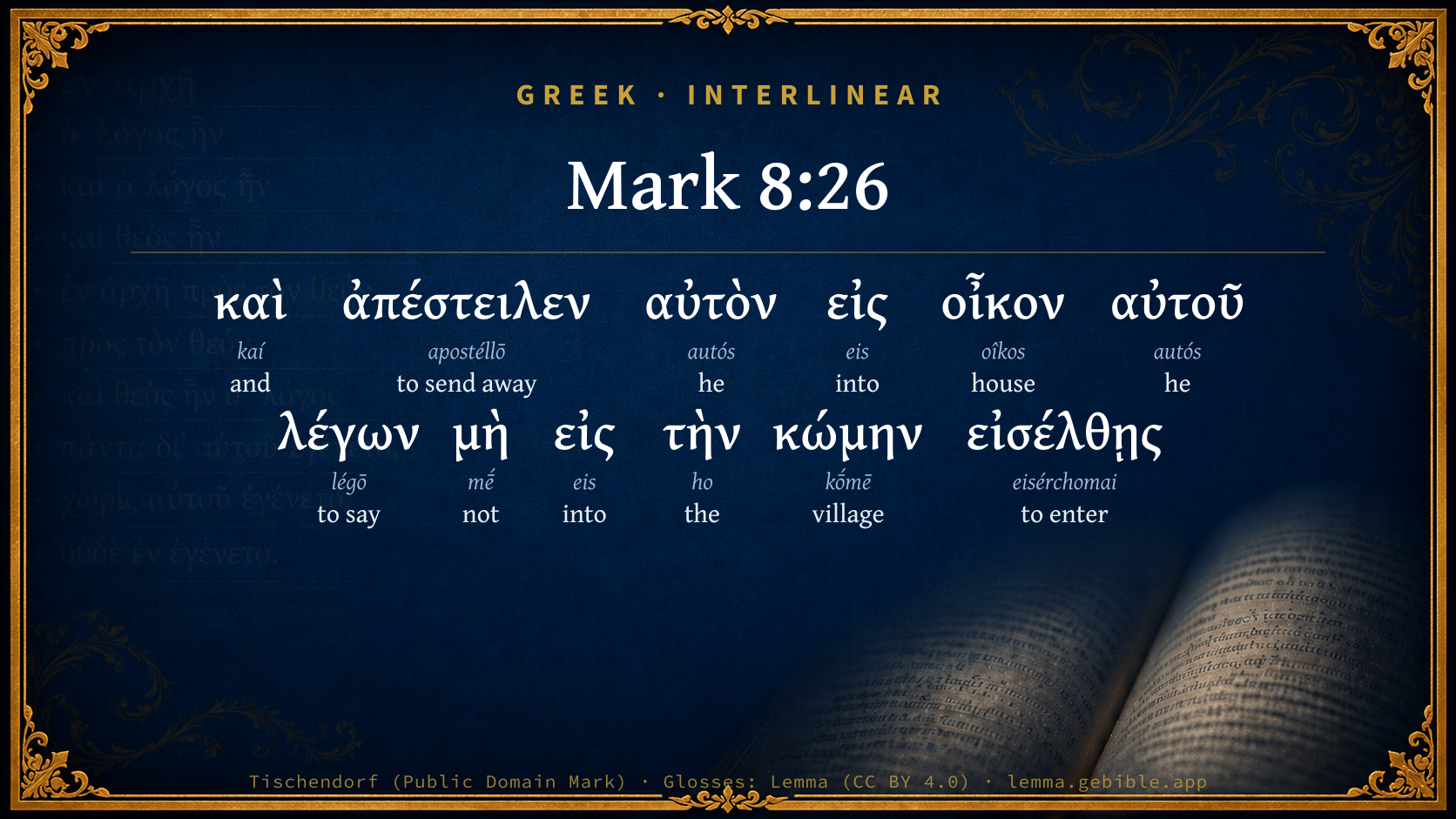
Greek (Tischendorf 8th ed.) Mark 8:26 appears in the Greek New Testament. The text above is from the Tischendorf 8th edition. Each word links to its Strong’s number and a concise gloss. Click any word for its full Thayer’s Greek Lexicon entry.
Download image
Cite this verse

Mark 8:26 (World English Bible). Public Domain. Lemma interlinear Bible study tool, https://lemma.gebible.app/v/mark/8/26.

Show BibTeX & RIS
BibTeX
RIS
English Translation
He sent him away to his house, saying, "Don't enter into the village, nor tell anyone in the village."
World English Bible · Public Domain
Download a study sheet

One document with this verse’s original text, its word-by-word gloss line, the meaning frame, cross-references with their text, attributed commentary, and full source and license credits — printable, and it pastes into notes with its structure intact.

This verse Autodidact and up

Study sheet (.html) Plain text (.txt)

A passage Seminary Student

Up to 50 verses in one chapter. A passage sheet keeps up to 6 commentary sources and 12 cross-references per verse, in the order this page ranks them, and says so on the sheet whenever that leaves anything out. Ask for a single verse and you get the Autodidact verse sheet above.

Everything on this page stays free to read, with no account — the sheet is a download of what is already on screen, not access to it.

Want to remove ads? Support Godless Engineer
Compare translations 3

The same verse in 3 English versions, stacked beneath the original-language interlinear above. Click any original word for its lexicon entry.

Each is an independent rendering of the whole verse — the interlinear is not word-aligned to these translations.

Highlighted words mark where these versions differ — a whole-verse word diff, not a word-by-word alignment.

  • World English Bible Public Domain
    He sent him away to his house, saying, "Don't enter into the village, nor tell anyone in the village."
  • King James Version Public Domain
    And he sent him away to his house, saying, Neither go into the town, nor tell it to any in the town.
  • unfoldingWord Literal Text CC BY-SA 4.0
    And he sent him away to his home, saying, “You may not even enter into the town.”

unfoldingWord Literal Text — © unfoldingWord, licensed CC BY-SA 4.0. Word-aligned USFM3 via Door43 (git.door43.org/unfoldingWord/en_ult).

Versions to compare (up to 4)

3 of 4 selected

Show all 19 translations

Every available English version of this verse, each an independent rendering of the whole verse.

  • World English Bible Public Domain
    He sent him away to his house, saying, "Don't enter into the village, nor tell anyone in the village."
  • Berean Standard Bible Public Domain
    Jesus sent him home and said, “Do not go back into the village.”
  • Majority Standard Bible Public Domain
    Jesus sent him home and said, “Do not go back or tell anyone in the village.”
  • King James Version Public Domain
    And he sent him away to his house, saying, Neither go into the town, nor tell it to any in the town.
  • American Standard Version (1901) Public Domain
    And he sent him away to his home, saying, Do not even enter into the village.
  • Revised Version (1885) Public Domain
    And he sent him away to his home, saying, Do not even enter into the village.
  • Geneva Bible (1599) Public Domain
    And hee sent him home to his house, saying, Neither goe into the towne, nor tell it to any in the towne.
  • Douay-Rheims (1899) Public Domain
    And he sent him into his house, saying: Go into thy house, and if thou enter into the town, tell nobody.
  • Young's Literal Translation Public Domain
    and he sent him away to his house, saying, `Neither to the village mayest thou go, nor tell `it' to any in the village.'
  • Literal Standard Version CC BY-SA 4.0
    and He sent him away to his house, saying, “Neither may you go into the village, nor tell [it] to any in the village.”
  • Unlocked Literal Bible CC BY-SA 4.0
    Jesus sent him away to his home and said, “Do not enter the town.”
  • unfoldingWord Literal Text CC BY-SA 4.0
    And he sent him away to his home, saying, “You may not even enter into the town.”
  • Darby Bible Public Domain
    And he sent him to his house, saying, Neither enter into the village, nor tell [it] to any one in the village.
  • World Messianic Bible Public Domain
    He sent him away to his house, saying, “Don’t enter into the village, nor tell anyone in the village.”
  • Webster's Bible Public Domain
    And he sent him away to his house, saying, Neither go into the town, nor tell it to any in the town.
  • Free Bible Version CC BY-SA 4.0
    Jesus sent the man home, and told him, “Don't go back through the village.”
  • Bible in Basic English Public Domain
    And he sent him away to his house, saying, Do not even go into the town.
  • Text-Critical English NT CC BY 4.0
    And Jesus sent him away to his house, saying, “Do not go into the village or tell anyone in the village what has happened.”
  • Tyndale New Testament (1534) Public Domain
    And he sent him home to his housse sayinge: nether goo into the toune nor tell it to eny in the toune.

Literal Standard Version (2020), Covenant Press — licensed CC BY-SA 4.0. Text via the HelloAO Bible API (eBible.org). Unlocked Literal Bible (unfoldingWord) — licensed CC BY-SA 4.0. Text via the HelloAO Bible API (eBible.org). unfoldingWord Literal Text — © unfoldingWord, licensed CC BY-SA 4.0. Word-aligned USFM3 via Door43 (git.door43.org/unfoldingWord/en_ult). Free Bible Version, Dr. Jonathan Gallagher — licensed CC BY-SA 4.0. Text via the HelloAO Bible API (eBible.org).

Word by word

More ways to search: Search by grammar → Find every occurrence → Compare this word →

Practice this passage: Drill this verse → Learn its vocabulary →

κώμην
kṓmē
G2968
“village”
Noun, Accusative, Singular, Feminine
Part of Speech
Noun
Case
Accusative
Number
Singular
Gender
Feminine
Full Thayer's Definition

Origin: from G2749

TDNT: None

1. the common sleeping place to which labourers in the field return, a village 2. the name of the city near which the villages lie and to whose municipality they belong 3. the inhabitants of villages
  1. καὶ kaí G2532 “and” Conjunction
  2. ἀπέστειλεν apostéllō G649 “to send away” Verb, Aorist, Active, Indicative, 3rd person, Singular
  3. αὐτὸν autós G846 “he” Personal pronoun, Accusative, Singular, Masculine
  4. εἰς eis G1519 “into” Preposition
  5. οἶκον oîkos G3624 “house” Noun, Accusative, Singular, Masculine
  6. αὐτοῦ autós G846 “he” Personal pronoun, Genitive, Singular, Masculine
  7. λέγων légō G3004 “to say” Verb, Present, Active, Participle, Nominative, Singular, Masculine
  8. μὴ mḗ G3361 “not” Particle, Negative
  9. εἰς eis G1519 “into” Preposition
  10. τὴν ho G3588 “the” Article, Accusative, Singular, Feminine
  11. εἰσέλθῃς eisérchomai G1525 “to enter” Verb, Aorist, Active, Subjunctive, 2nd person, Singular

About this verse

These counts appear in no published source. They are computed here, from the morphology-tagged text and Lemma’s own curated glosses. What Lemma adds →

12
words
10
distinct lemmas
Gospels
section

Shared distinctive vocabulary

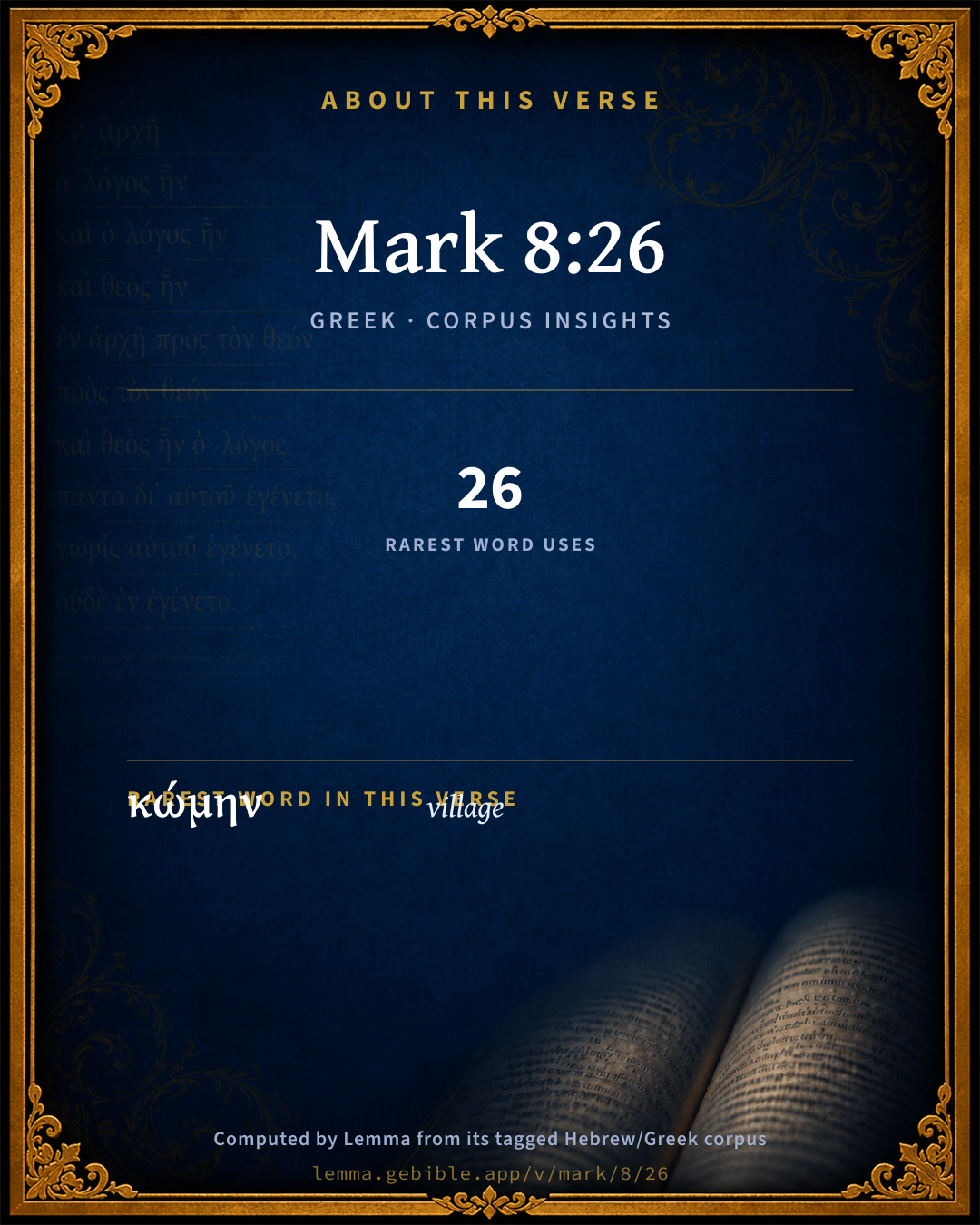
κώμην village G2968 occurs in 26 verses of the Greek New Testament. Also found in:
Repetition

Words recur within this verse:

  • εἰς into G1519 ×2
  • αὐτὸν he G846 ×2

Cross-references

6

Topical passages linked to Mark 8:26 in the Treasury of Scripture Knowledge — connected by theme and wording, ordered by reader-vote popularity; previews shown in the World English Bible.

  • Matthew 8:4 Jesus said to him, "See that you tell nobody, but go, show yourself to the priest, and offer the gift that Moses commanded, as a testimony to them."
  • Matthew 9:30 Their eyes were opened. Jesus strictly charged them, saying, "See that no one knows about this."
  • Matthew 12:16 and charged them that they should not make him known:
  • Mark 5:43 He strictly ordered them that no one should know this, and commanded that something should be given to her to eat.
  • Mark 7:36 He commanded them that they should tell no one, but the more he commanded them, so much the more widely they proclaimed it.
  • Mark 8:23 He took hold of the blind man by the hand, and brought him out of the village. When he had spit on his eyes, and laid his hands on him, he asked him if he saw anything.

Cross-references courtesy of OpenBible.info (CC BY 4.0).

Where the printed editions differ

2 variants

Places in this verse where the major printed Greek editions disagree on the wording in a way that affects the translation — a comparison of editions, not a manuscript-by-manuscript collation. The editions are the modern critical texts (Nestlé-Aland 28/27, SBL, Westcott-Hort, Tregelles, Tyndale House) and the traditional texts behind the KJV (the Textus Receptus and the Byzantine/Majority text). It is not a claim about which reading is original.

  1. Extra text
    μηδὲ εἴπῃς τινὶ ἐν τῇ

    “nor may you speak to anyone in <the>”

    In TynTregTRByz Not in NA28NA27SBLWH
  2. Extra text
    κώμῃ.¶

    “village.”

    In TynTR Not in NA28NA27SBLWHTregByz

    μηδὲ εἴπῃς τινὶ ἐν τῇ κώμῃ.¶ (mēde eipēs tini en tēa kōmē) 'nor may you speak to anyone in village.' is only in traditional manuscripts (Tyn+Treg+TR+Byz)

Textual data: Translators Amalgamated Greek New Testament (STEPBible TAGNT) · CC BY 4.0.

Commentary

Notes on Mark 8:26 from classic Christian and Jewish commentators (each source and its license shown beneath its notes). The classic Christian expositions comment on the surrounding passage and are grouped to its opening verse, so a note may address several verses; the Jewish commentaries on the Tanakh (Rashi and others) are per-verse, so they appear only where the commentator wrote on this verse.

Lemma curates 59 commentaries, every one of them public domain or Creative Commons licensed, each selected and text-cleaned for this edition rather than reprinted as found. About our sources →

Tyndale Open Study Notes

Tyndale Open Resources

8:26 The story ends with Jesus telling the healed man to keep the event a secret (see 3:11-12).

Tyndale Open Study Notes — © Tyndale Open Resources, licensed CC BY-SA 4.0. Text via the HelloAO Bible API.

Bengel's Gnomon

Johann Albrecht Bengel

Mar 8:26. Εἰς τὸν οἶκον—μηδὲ εἰς τὴν κώμην, into the house—nor into the village) His house therefore was in the remote extremity of the village.—μηδὲ εἴπης, nor tell) Jesus avoided celebrity, especially at that time. [For this miracle is the last in the Evangelists before the Feast of Tabernacles (and before the discourses recorded in John ch. 7–10—V. g.); and He forbade this miracle to be published abroad, just as He did the healing of the deaf and dumb man, ch. Mar 7:36. The people, after having celebrated the Passover, repaired to their country employments: His adversaries were thenceforth honoured with no further sign; and whatever effects were needful to be produced in the case of the disciples by miracles of this kind, had now already reached their highest point. Behold the year of grace now completed in Galilee!—Harm., p. 348.]—τινὶ, to any one) who is in the town.

Bengel's Gnomon of the New Testament — English translation (T&T Clark, Edinburgh, 1860) — public domain. Text from a community e-Sword module.

Expositor's Greek Testament

ed. W. Robertson Nicoll

Mar 8:26 . εἰς οἶκον , home. μηδὲ , etc., go not into the village; to avoid creating a sensation. It has been suggested that the gradual restoration of sight in this case was meant to symbolise the slowness of the Twelve in attaining spiritual insight. They got their eyes opened very gradually like the blind man of Bethsaida. So Klostermann.

The Expositor's Greek Testament, edited by W. Robertson Nicoll (1897–1910) — public domain. Text from a community e-Sword module.

Geneva Bible (1599)

Geneva Bible translators

Christ will not have his miracles to be separated from his doctrine.

Geneva Bible (1599) marginal notes — public domain. Text via Bolls.life.

Adam Clarke's Commentary

Verse 26. He sent him away to his house] So it appears that this person did not belong to Bethsaida, for, in going to his house, he was not to enter into the village.

This miracle is not mentioned by any other of the evangelists. It affords another proof that Mark did not abridge Matthew's Gospel.

Adam Clarke's Commentary on the Bible (1810–1826) — public domain. Text from a community e-Sword/MySword module.

Ellicott's Commentary for English Readers

(26) Neither go into the town.—As in other works of healing, so in this, our Lord seems to have prescribed quietude after, as well as before, the miracle, as a spiritual discipline—partly, we may believe, because the work that had been done called for prayer for the right use of the new, or the restored, power; partly (as in Mat_12:16), because He would not seem Himself to court the fame of publicity. Following the line of thought taken in the Note on Mar_8:24, we may extend the application to the work of spiritual illumination. Here also it is not good that the first clear apprehension of spiritual truths should be followed by the hasty utterances of the excitement of the new-born life.

A Bible Commentary for English Readers, edited by Charles John Ellicott (1878–1897) — public domain. Text from a community e-Sword module.

The Cambridge Bible for Schools and Colleges

gen. ed. J. J. S. Perowne

26. to his house] Bethsaida, therefore, was not the place of his residence; he was to go immediately from the place to his own home—not even to the village to which he had already come, and he was not to mention it to any one dwelling in that village, or whom he might meet by the way.

The Cambridge Bible for Schools and Colleges (gen. ed. J. J. S. Perowne; Cambridge University Press, 1878–1918) — public domain. Text from a community e-Sword module.

John Gill's Exposition

And he sent him away to his house,.... Which seems to have been in one of the neighbouring villages or was one of the houses scattered about in the fields for the conveniency of rural business.

Saying, neither go into the town: or "that town", as the Syriac, the town or city of Bethsaida:

nor tell it to any in the town; to any of the inhabitants of the town that he should meet with any where or at any time: the reason of this was not merely or only because Christ would have the miracle concealed; but chiefly because the inhabitants of this place were notorious for their impenitence and unbelief. Christ had done many wonderful works among them and yet they repented not; nor did they believe in him; but despised him, his doctrine and his miracles; and therefore for their neglect and contempt of such means he was determined to withdraw them from them. So Christ sometimes deals with nations cities and towns that disbelieve reject and despise his Gospel; he takes it away from them he orders his ministering servants to preach no more to them; no more to tell them of the good news of life and salvation by him: thus he dealt with the Jews who contradicted and blasphemed and judged themselves or by their conduct made themselves appear to be unworthy of the words of eternal life; he took away the kingdom of God or the Gospel from them and sent it among the Gentiles: and thus he threatened the church of Ephesus for leaving its first love to remove the candlestick out of its place in case of non-repentance; and a grievous judgment it is upon a place and people when God commands the clouds to rain no rain upon them, Isa 5:6; or, in other words when he enjoins his ministers no more to tell, or publish his Gospel to them; he determining to withdraw from them and have no more to do with them; so Christ and his disciples departed from this place, declared in the following verse.

John Gill's Exposition of the Whole Bible (1746–1763) — public domain (CC PDM 1.0). Text via the HelloAO Bible API.

Trapp's Complete Commentary

John Trapp

26 And he sent him away to his house, saying, Neither go into the town, nor tell it to any in the town.

Ver. 26. Neither go into the town] Christ would not vouchsafe such an ungrateful people the benefit of one more preacher, though never so mean. This was a greater judgment upon them than if he had turned some other way that arm of the sea that brought so much wealth into their town.

John Trapp, A Commentary or Exposition upon All the Books of the Old and New Testament (1647–1656) — public domain. Text from a community e-Sword module.

Albert Barnes' Notes on the Bible

The town - The town of Bethsaida.

Nor tell it ... - Lest it excite the jealousy of the Pharisees, and produce commotion and danger.

Albert Barnes' Notes on the Bible (1834–1885) — public domain. Text from a community e-Sword/MySword module.

Whedon's Commentary on the Bible

Daniel D. Whedon

26. Nor tell it to any in the town — Any man residing in the town. Very probably there was at this time a special suspicion existing of the authorities in regard to Jesus. Herod Philip (resident so near as Cesarea Philippi) may have been in Bethsaida. This supposition would account both for Jesus taking the man out of the town and for this prohibition to tell any man in it.

Daniel D. Whedon (gen. ed.), Commentary on the Old and New Testaments (1874–1909) — public domain. Text from a community e-Sword module.

The Pulpit Commentary

This verse, according to the best reading, runs thus: And he sent him away to his home, saying, Do not even enter into the village. It thus appears that Bethsaida was not the home of this blind man. He might naturally have wished to exhibit himself in Bethsaida, where many must have known him, and to have sung the praises of his great Benefactor. But this was far from what Christ wished. He wished to be in seclusion. He had no desire to excite more than could be helped the idle curiosity of the multitude. His miracles were for the sake of his doctrine, and not his doctrine for the sake of his miracles. The whole character of his administration was retiring and gentle. "My doctrine shall distil as the dew." "He shall not strive, nor cry; neither shall any hear his voice in the streets."

The Pulpit Commentary (1880–1919), ed. H.D.M. Spence-Jones & Joseph S. Exell — public domain. Text from a community e-Sword module.

The People's New Testament

B. W. Johnson

26. Sent him away to his house. Evidently he did not live in Bethsaida, as he was forbidden to go into the town, or to tell the story there.

B. W. Johnson's The People's New Testament with Notes (1889–1891) — public domain. Electronic text from the Christian Classics Ethereal Library (CCEL) ThML edition.

Cambridge Greek Testament for Schools and Colleges

26. The confusion in this verse is great; see WH., Introd. § 140. [1717][1718][1719] omit μηδὲ εἴπῃς κ.τ.λ.

[1717] Codex Sinaiticus. 4th cent. Discovered by Tischendorf in 1859 at the Monastery of St Katharine on Mount Sinai. Now at St Petersburg. The whole Gospel, ending at Mar 16:8. Photographic facsimile, 1911.

[1718] Codex Vaticanus. 4th cent., but perhaps a little later than א. In the Vatican Library almost since its foundation by Pope Nicolas V., and one of its greatest treasures. The whole Gospel, ending at Mar 16:8. Photographic facsimile, 1889.

[1719] Codex Regius. 8th cent. An important witness. At Paris. Contains Mar 1:1 to Mar 10:15; Mar 10:30 to Mar 15:1; Mar 15:20 to Mar 16:20, but the shorter ending is inserted between Mar 16:8 and Mar 16:9, showing that the scribe preferred it to the longer one.

26. εἰς οἶκον αὐτοῦ. Cf. Mar 2:19, Mar 5:11, Mar 7:30. There is no command to keep silence; see crit. note. But quiet meditation, free from intercourse with curious neighbours, is best for him; and over-exercise of his newly recovered power of sight is guarded against.

Μηδὲ εἰς τ. κώμην εἰσέθῃς. Do not even enter into the village (R.V.). No doubt he could reach his home without doing so. Christ had lamented over the people of Bethsaida for their callousness respecting His mighty works (Mat 11:21), and their influence on the newly healed would not be for good. The prohibition is only temporary (aor.). Contrast μηδὲ ὀνομαζέσθω (Eph 5:3) and μηδὲ ἐσθιέτω (2Th 3:10), where perpetual abstention is enjoined. In both these passages Vulg. has nec instead of ne quidem for μηδέ: here it follows a corrupt reading. The reading adopted “is simple and vigorous, and it is unique in N.T. The peculiar initial Μηδέ has the terse force of many sayings as given by St Mark, but the softening into Μή by [1836][1837] shows that it might trouble scribes” (W.H.). Even if there were a second μηδέ, “neither … nor” (A.V.) would be wrong; it should be not even … nor yet.

[1836] Codex Sinaiticus. 4th cent. Discovered by Tischendorf in 1859 at the Monastery of St Katharine on Mount Sinai. Now at St Petersburg. The whole Gospel, ending at Mar 16:8. Photographic facsimile, 1911.

[1837] An asterisk denotes that the word is not found elsewhere in N.T., and such words are included in the index, even if there is no note on them in the commentary.

Cambridge Greek Testament for Schools and Colleges (Cambridge University Press, 1896; 21 vols, various authors incl. Carr, Maclear, Plummer, Farrar, Lumby, Moule, M. R. James, Simcox) — public domain. Text from a community e-Sword module.

Alford’s Greek Testament

Henry Alford

26.] See above in this note,—and var. readd. The first and second μηδέ both carry a separate climax with them: he was not even to go into the village, no, nor so much as tell it to any who dwelt in the village.

Henry Alford, The Greek Testament (1849–1861) — public domain. Text from a community e-Sword module.

International Critical Commentary

26. Μηδὲ εἰς τὴν κώμην εἰσελθῇς—do not even go into the village. The man was to return to his house, which was outside of the village, and so far from publishing his cure in the village, he was not even to enter it.

Omit μηδὲ εἴπῃς τινὶ ἐν κώμῃ, nor tell it to any one in the village, Tisch. (Treg. marg.) RV. WH. א * and c BL 1, 209, Memph.2

Attention should be called to the characteristics of the two miracles narrated by Mk. alone, both of which, moreover, belong to the period of Jesus’ retirement, and to localities inhabited by a mixed Jewish and heathen population, and unfrequented by him in his previous ministry. In both the healing of the deaf and dumb man in Decapolis, and that of the blind man at Bethsaida, Jesus takes the man aside before performing the cure, and uses spittle on the parts affected. In the second, the healing of the blind man, the cure is gradual. As to the withdrawal from the multitude, the purpose is obvious. The miracles belong to the period of retirement, and Jesus takes more than usual pains to guard against notoriety. A secondary effect, if not purpose, in the case of the deaf and dumb man, would be to fix his attention on what Jesus was about to do for him. As to the use of the spittle, it is commonly regarded as extraordinary, and naturally so, as these are the only cases in the Synoptical Gospels in which Jesus employs any other means than the laying on of hands. In the case of the deaf and dumb man, the reason for this exceptional treatment appears in the condition of the man. The thrusting of the hands into the man’s ears, the spitting into them, the looking up to heaven, are the language of signs, by which Jesus seeks to awaken the faith of the man necessary to his cure. Certainly the thrusting of the hands into his ears is that, and the rest goes along with this symbolical act. In the case of the blind man, extraordinary conditions are not lacking, though not of the same kind. Jesus is in an unfamiliar region, and the man’s blindness withdraws him more or less from even the knowledge that those about him would have of this extraordinary personage. In these circumstances, Jesus uses something more than the ordinary laying on of hands, which would tell its story so quickly to a Jew accustomed to his ordinary procedure, and substitutes what we may call a more elaborate and significant ritual of cure. The gradualness of the cure in this case would arise out of the same extraordinary conditions. Jesus is contending here against a dull, slow-moving faith, which hinders the ordinary immediateness of the cure. This explanation matches the extraordinary methods and process of the cure with the extraordinary conditions of the case.

On the other hand, Weiss, ignoring the peculiar conditions, treats both the process and the gradualness of the cure as representing Jesus’ ordinary method and the rationale of the miracles. These are the two cases, he says, in which Mk. goes into details in telling the story of the miracles, and the matter contained in them, therefore, is to be read into the other accounts. The difficulty in this is to account for the choice of these two isolated cases for the introduction of these details. It is easy to account for them as peculiarities belonging to an exceptional period in the life of Jesus, but not at all easy to account for the choice of these, the very last of the miracles, to bring out material belonging to them all, but hitherto unrelated by Mk., and omitted altogether in the other evangelists. Moreover, it is very singular that this gradual cure occurs in the Gospel which emphasizes most the immediateness of the cures. Out of the eleven miracles of healing recorded in Mk., five speak directly of the immediateness of the cure, and of the rest three give circumstances implying the same. And yet, we are told that in this Gospel, the one account of gradual cure establishes the form to which the others must be conformed. As for the use of the spittle, that is treated as an actual means of cure, not as a symbol or sign. So Meyer. However, it is allowed that the curative power infused into this came from above. And this again is normal, telling us what really happened in the other cases. A means, which yet has no power in itself, only what is infused into it supernaturally. This is truly a tertium quid, and as long as it introduces into the miracles nothing of the nature of a secondary cause, it may be ranked among the curiosities of religious speculation.

JESUS GOES WITH HIS DISCIPLES INTO THE REGION OF CÆSAREA PHILIPPI. PETER’S CONFESSION OF JESUS AS THE MESSIAH

International Critical Commentary — older volumes (1896–1929), various authors — public domain. Text from a community e-Sword module.

Lesson kit

Teaching starters — assembled from the data on this page, not authored interpretation. Every prompt links to the verse data it draws on. Edit before teaching.

Mark, in the Gospels, opens this verse with 12 words (10 distinct Greek lemmas). Its most distinctive word is kṓmē (“village”). A historical commentator’s framing appears above. Read the whole chapter for the surrounding context.

Discussion questions

  1. How does “village” (kṓmē) shape what this verse is saying?
  2. How does Matthew 9:35, which shares the word «village», read alongside this verse?
  3. What does the repetition of “into” (2× in this one verse) do in this verse?
  4. These translations render this verse differently; the difference is in the English rendering, not the original. What questions does that raise?
  5. Compare how Tyndale Open Study Notes and Bengel's Gnomon read this verse. Where do they agree or differ?

Things to notice

Reading settings

Reading text

Shown beneath each verse's original-language words.

Old Testament
Old Testament edition

Read the OT as the Masoretic Hebrew (MT) or the Greek Septuagint (LXX).

English shown for the Greek Septuagint (in the Hebrew ↔ Greek comparison).

Comparing translations? Open the Compare panel on any verse page to stack up to four side by side.