Matthew 10:9

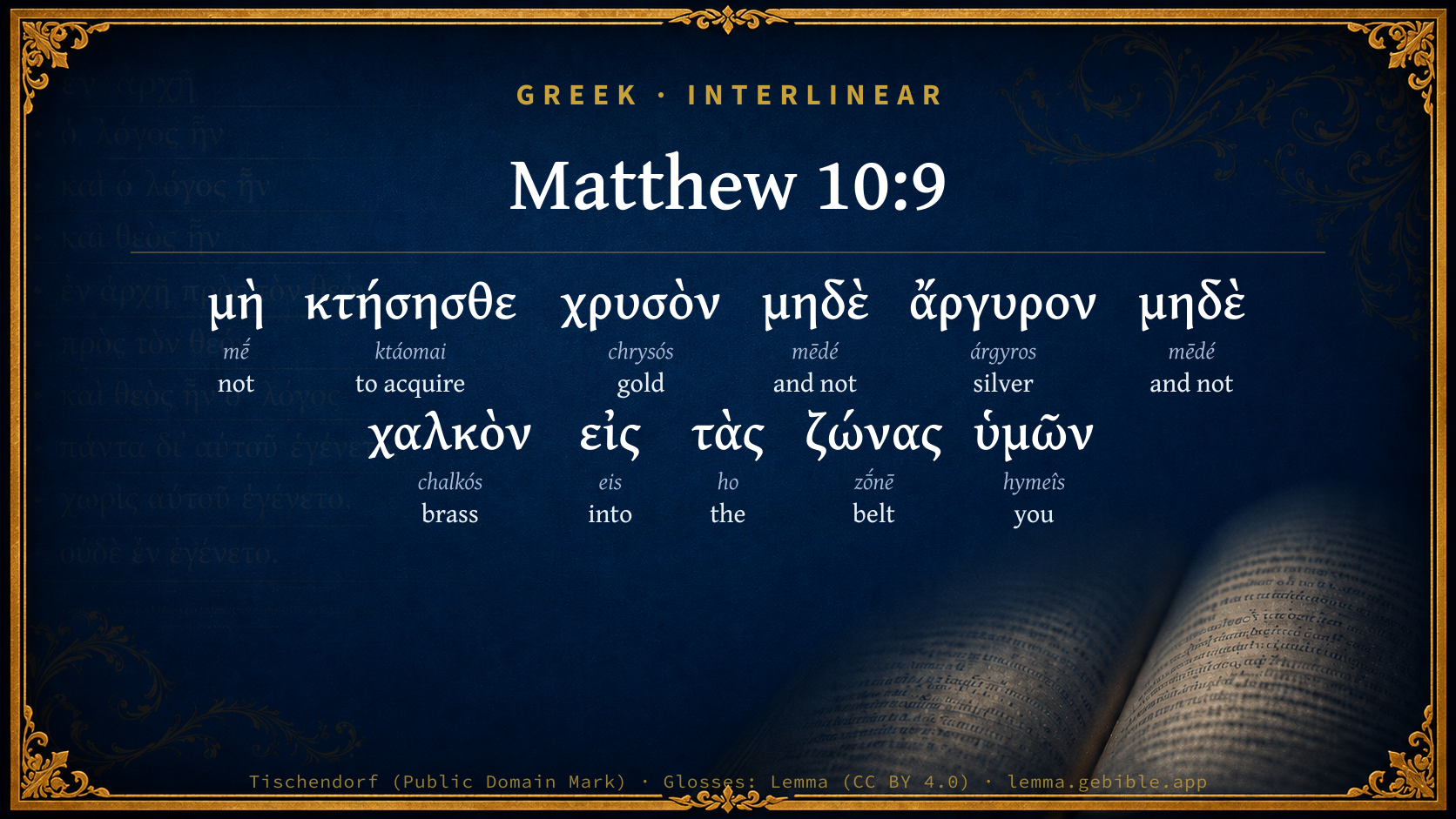
Greek (Tischendorf 8th ed.) Matthew 10:9 appears in the Greek New Testament. The text above is from the Tischendorf 8th edition. Each word links to its Strong’s number and a concise gloss. Click any word for its full Thayer’s Greek Lexicon entry.
Download image
Cite this verse

Matthew 10:9 (World English Bible). Public Domain. Lemma interlinear Bible study tool, https://lemma.gebible.app/v/matthew/10/9.

Show BibTeX & RIS
BibTeX
RIS
English Translation
Don't take any gold, nor silver, nor brass in your money belts.
World English Bible · Public Domain
Highlights
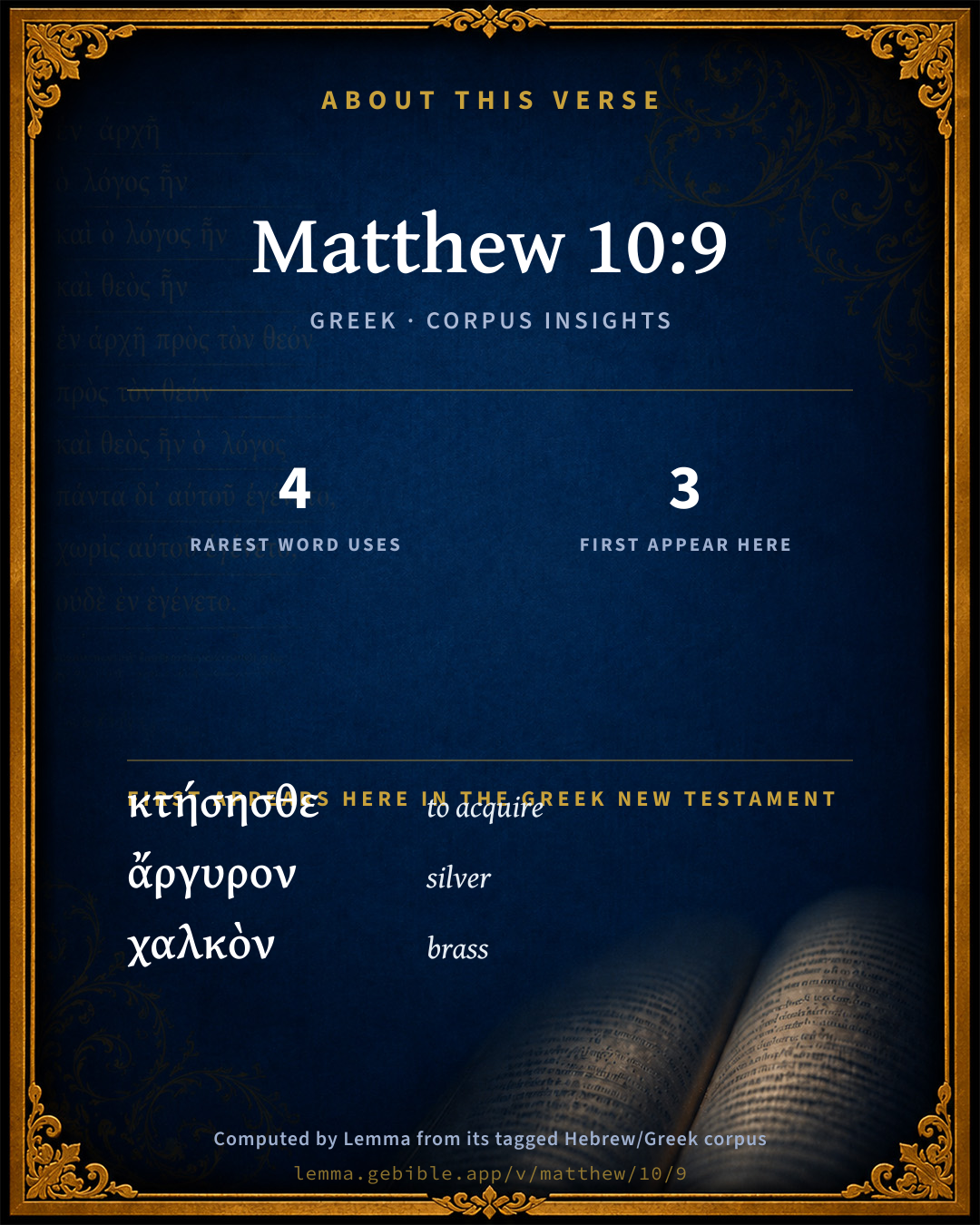
  • 3 first appearances in the Greek New Testament
Full analysis ↓
Download a study sheet

One document with this verse’s original text, its word-by-word gloss line, the meaning frame, cross-references with their text, attributed commentary, and full source and license credits — printable, and it pastes into notes with its structure intact.

This verse Autodidact and up

Study sheet (.html) Plain text (.txt)

A passage Seminary Student

Up to 50 verses in one chapter. A passage sheet keeps up to 6 commentary sources and 12 cross-references per verse, in the order this page ranks them, and says so on the sheet whenever that leaves anything out. Ask for a single verse and you get the Autodidact verse sheet above.

Everything on this page stays free to read, with no account — the sheet is a download of what is already on screen, not access to it.

Want to remove ads? Support Godless Engineer
Compare translations 3

The same verse in 3 English versions, stacked beneath the original-language interlinear above. Click any original word for its lexicon entry.

Each is an independent rendering of the whole verse — the interlinear is not word-aligned to these translations.

Highlighted words mark where these versions differ — a whole-verse word diff, not a word-by-word alignment.

  • World English Bible Public Domain
    Don't take any gold, nor silver, nor brass in your money belts.
  • King James Version Public Domain
    Provide neither gold, nor silver, nor brass in your purses,
  • unfoldingWord Literal Text CC BY-SA 4.0
    Do not acquire gold or silver or copper in your belts,

unfoldingWord Literal Text — © unfoldingWord, licensed CC BY-SA 4.0. Word-aligned USFM3 via Door43 (git.door43.org/unfoldingWord/en_ult).

Versions to compare (up to 4)

3 of 4 selected

Show all 19 translations

Every available English version of this verse, each an independent rendering of the whole verse.

  • World English Bible Public Domain
    Don't take any gold, nor silver, nor brass in your money belts.
  • Berean Standard Bible Public Domain
    Do not carry any gold or silver or copper in your belts.
  • Majority Standard Bible Public Domain
    Do not take along any gold or silver or copper in your belts.
  • King James Version Public Domain
    Provide neither gold, nor silver, nor brass in your purses,
  • American Standard Version (1901) Public Domain
    Get you no gold, nor silver, nor brass in your purses;
  • Revised Version (1885) Public Domain
    Get you no gold, nor silver, nor brass in your purses;
  • Geneva Bible (1599) Public Domain
    Possesse not golde, nor siluer, nor money in your girdels,
  • Douay-Rheims (1899) Public Domain
    Do not possess gold, nor silver, nor money in your purses:
  • Young's Literal Translation Public Domain
    `Provide not gold, nor silver, nor brass in your girdles,
  • Literal Standard Version CC BY-SA 4.0
    Do not provide gold, nor silver, nor brass in your girdles,
  • Unlocked Literal Bible CC BY-SA 4.0
    Do not carry any gold, silver, or copper in your purses.
  • unfoldingWord Literal Text CC BY-SA 4.0
    Do not acquire gold or silver or copper in your belts,
  • Darby Bible Public Domain
    Do not provide yourselves with gold, or silver, or brass, for your belts,
  • World Messianic Bible Public Domain
    Don’t take any gold, silver, or brass in your money belts.
  • Webster's Bible Public Domain
    Provide neither gold, nor silver, nor brass in your purses;
  • Free Bible Version CC BY-SA 4.0
    Don't carry any gold, silver, or copper coins in your pockets,
  • Bible in Basic English Public Domain
    Take no gold or silver or copper in your pockets;
  • Text-Critical English NT CC BY 4.0
    Take no gold, silver, or copper in your belts.
  • Tyndale New Testament (1534) Public Domain
    Posses not golde nor silver nor brassse yn youre gerdels

Literal Standard Version (2020), Covenant Press — licensed CC BY-SA 4.0. Text via the HelloAO Bible API (eBible.org). Unlocked Literal Bible (unfoldingWord) — licensed CC BY-SA 4.0. Text via the HelloAO Bible API (eBible.org). unfoldingWord Literal Text — © unfoldingWord, licensed CC BY-SA 4.0. Word-aligned USFM3 via Door43 (git.door43.org/unfoldingWord/en_ult). Free Bible Version, Dr. Jonathan Gallagher — licensed CC BY-SA 4.0. Text via the HelloAO Bible API (eBible.org).

Word by word

More ways to search: Search by grammar → Find every occurrence → Compare this word →

Practice this passage: Drill this verse → Learn its vocabulary →

About this verse

These counts appear in no published source. They are computed here, from the morphology-tagged text and Lemma’s own curated glosses. What Lemma adds →

11
words
10
distinct lemmas
Gospels
section

Notable vocabulary

The rarest word here is ἄργυρον silver G696 — appearing just 4 times in the whole Greek New Testament.

First appearance in Scripture

These words make their first canonical appearance in the Greek New Testament here:

  • κτήσησθε to acquire G2932
  • ἄργυρον silver G696
  • χαλκὸν brass G5475

Shared distinctive vocabulary

ἄργυρον silver G696 occurs in 4 verses of the Greek New Testament. Also found in:

Repetition

A word recurs within this verse:

  • μηδὲ and not G3366 ×2

Cross-references

5

Topical passages linked to Matthew 10:9 in the Treasury of Scripture Knowledge — connected by theme and wording, ordered by reader-vote popularity; previews shown in the World English Bible.

  • Luke 22:35 He said to them, "When I sent you out without purse, and wallet, and shoes, did you lack anything?" They said, "Nothing."
  • Luke 9:3–5 He said to them, "Take nothing for your journey--neither staffs, nor wallet, nor bread, nor money; neither have two coats apiece.
  • Mark 6:8–11 He charged them that they should take nothing for their journey, except a staff only: no bread, no wallet, no money in their purse,
  • Luke 10:4–12 Carry no purse, nor wallet, nor sandals. Greet no one on the way.
  • 1 Corinthians 9:7–27 What soldier ever serves at his own expense? Who plants a vineyard, and doesn't eat of its fruit? Or who feeds a flock, and doesn't drink from the flock's milk?

Cross-references courtesy of OpenBible.info (CC BY 4.0).

Commentary

Notes on Matthew 10:9 from classic Christian and Jewish commentators (each source and its license shown beneath its notes). The classic Christian expositions comment on the surrounding passage and are grouped to its opening verse, so a note may address several verses; the Jewish commentaries on the Tanakh (Rashi and others) are per-verse, so they appear only where the commentator wrote on this verse.

Lemma curates 59 commentaries, every one of them public domain or Creative Commons licensed, each selected and text-cleaned for this edition rather than reprinted as found. About our sources →

Albert Barnes' Notes on the Bible

See also Mar 6:8-11, and Luk 9:3-5. In both these places the substance of this account is given, though not so particularly as in Matthew. The general subject is the instructions given to the apostles.

Mat 10:9

Provide neither gold nor silver, nor brass - This prohibition of gold, silver, and brass is designed to prevent their providing money for their journey.

Pieces of money of “small value” were made of brass.

In your purses - Literally, in your girdles (belts). See the notes at Mat 5:38-41. A “girdle” or “sash” was an indispensable part of the dress. This girdle was made “hollow,” and answered the purpose of a purse. It was convenient, easily borne, and safe.

Mat 10:10

Nor scrip - That is, knapsack.

This was made of skin or coarse cloth, to carry provisions in. It was commonly hung around the neck.

Neither two coats - See the notes at Mat 5:40.

Neither shoes - The original is the word commonly rendered sandals. See the notes at Mat 3:11.

Mark says, in recording this discourse, “but be shod with sandals.” Between him and Matthew there is an apparent contradiction, but there is really no difference. According to Matthew, Jesus does not forbid their “wearing” the sandals which they probably had on, but only forbids their “supplying themselves with more,” or with “superfluous ones.” Instead of making provision for their feet when their “present” shoes were worn out, they were to trust to Providence to be supplied, and “go as they were.” The meaning of the two evangelists may be thus expressed: “Do not procure anything more for your journey than you have on. Go as you are, shod with sandals, without making any more preparation.”

Nor yet staves - In the margin, in all the ancient versions, and in the common Greek text, this is in the singular number - “nor yet” a staff. But Mark says that they might have a “staff:” “Jesus commanded them that they should take nothing for their journey, save a staff only.” To many this would appear to be a contradiction. Yet the “spirit” of the instruction, the main thing that the writers aim at, is the same. That was, that they were “to go just as they were, to trust to Providence, and not to spend any time in making preparation for their journey. Some of them, probably, when he addressed them, “had staves,” and some had not. To those who “had,” he did not say that they should throw them away, as the instructions he was giving them might seem to require, but he suffered them to take them (Mark). To those who had not, he said they should not spend time in procuring them (Matthew), but “they were all to go just as they were.”

The workman is worthy of his meat - This implies that they were to expect a proper supply for their needs from those who were benefited. They were not to make “bargain and sale” of the power of working miracles, but they were to expect competent support from preaching the gospel, and that not merely as a gift, but because they were “worthy” of it, and had a right to it.

Mat 10:11

Who in it is worthy - That is, who in it sustains such a character that he will be disposed to show you hospitality and to treat you kindly.

This shows that they were not needlessly to throw themselves in the way of insult.

And there abide - There remain; as Luke adds, “Go not from house to house.” They were to content themselves with one house; not to wander about in the manner of vagrants and mendicants; not to appear to be people of idleness and fond of change; not to seem dissatisfied with the hospitality of the people; but to show that they had regular, important business; that they valued their time; that they were disposed to give themselves to labor, and were intent only on the business for which he had sent them. If ministers of the gospel are useful, it will be by not spending their time in idle chit-chat, and wandering around as if they had nothing to do, but in an honest and laborious improvement of their time in study, in prayer, in preaching, and in visiting their people.

Mat 10:12

And when ye come into a house, salute it - The word “house” here evidently means “family,” as it does in the following verse.

See also Mat 12:25, and Joh 4:53; “And himself believed and his whole house.” The apostles were directed to salute the family - to show them the customary tokens of respect, and to treat them with civility. Religion never requires or permits its friends to outrage the common rules of social contact. It demands of them to exhibit to all the customary and proper tokens of respect, according to their age and station, 1Pe 2:12-25; 1Pe 3:8-11; Phi 4:8. For the mode of salutation, see the notes at Luk 10:4-5.

Mat 10:13

If the house be worthy - That is, if the “family” be worthy, or be willing to receive you as my disciples.

Let your peace come upon it - That is, let the peace or happiness which you seek or for which you pray in saluting it (see Luk 10:5), come upon it; or seek their peace and happiness by prayer, instruction, by remaining with them, and imparting to them the blessings of the gospel.

But if it be not worthy ... - If the family be unwilling to receive you; if they show themselves unfriendly to you and your message.

Let your peace return to you - This is a Hebrew mode of saying that your peace shall not come upon it, Psa 35:13. It is a mode of speaking derived from bestowing a gift. If people were willing to receive it, they derived the benefit from it; if not, then of course the present came back or remained in the hand of the giver. So Christ figuratively speaks of the peace which their labor would confer. If received kindly and hospitably by the people, they would confer on them most valuable blessings. If rejected and persecuted, the blessings which they sought for others would come upon themselves. they would reap the benefit of being cast out and persecuted for their Master’s sake, Mat 5:10.

Mat 10:14

Shake off the dust of your feet - The Jews taught uniformly that the dust of the Gentiles was impure, and was to be shaken off.

To shake off the dust from the feet, therefore, was a significant act, denoting that they regarded them as impure, profane, and paganish, and that they declined any further connection with them. It is recorded that this was actually done by some of the apostles. See Act 13:51; Act 18:6.

Mat 10:15

It shall be more tolerable for the land of Sodom ... - The cities here mentioned, together with Admah and Zeboim, were destroyed by fire and brimstone on account of their great wickedness.

They occupied the place afterward covered by the Dead Sea, bounding Palestine on the southeast, Gen 19:24-25. Christ said that their punishment will be more “tolerable” - that is, more easily borne - than that of the people who reject his gospel. The reason is, that they were not favored with so much light and instruction. See Mat 11:23-24; Luk 12:47-48. Sodom and Gomorrah are often referred to as signal instances of divine vengeance, and as sure proofs that the wicked shall not go unpunished. See 2Pe 2:6; Jud 1:7.

Albert Barnes' Notes on the Bible (1834–1885) — public domain. Text from a community e-Sword/MySword module.

The Biblical Illustrator

Joseph S. Exell

Mat_10:9

Provide neither gold.

The enthusiasm of poverty

It is impossible not to admire the noble enthusiasm of poverty which showed itself in the literal adoption of such rules by the followers of Francis of Assisi, and, to some extent, by those of Wiclif; but the history of the Mendicant Orders, and other like fraternities, forms part of that teaching of history which has led men to feel that in the long-run the beggars life will bring the beggars vices. Yet here, as in the case of the precepts of the Sermon on the Mount, the spirit is binding still, though the letter has passed away. The mission work of the Church has ever prospered in proportion as that spirit has pervaded it. (E. H. Plumptre.)

Without a purse

The word purse here literally signifies girdle, those worn by the Jews were made hollow, so as to contain money. A sort of purse convenient, light, and secure. In like manner, the long sleeves worn by the Japanese serve them in lieu of purses. This custom of missionaries going out with little store of money is carried out in its greatest literality among the Moravians who give their missionaries the incredibly small salary of five pounds a year. For anything they require beyond what this sum will procure, they have to apply to the committee of the missionary society. Once, when St. Antony was on a journey, he saw an immense piece of gold. He admired the size of the piece of metal, and ran as fast as he could to his mountain, as though he were running from a fire. Whenever money was offered to St. Vincent as he was preaching through the villages, he refused it, and forbade his companions accepting it. St. Francis was wont to say that money to the servants of God is nothing else than a devil and a poisonous snake. Our Lord gave His disciples this precept for three reasons;

(1) That being free from all earthly affections and cares, they should depend entirely upon Gods providence;

(2) That they should be wholly intent upon preaching the gospel, and give all their thoughts and cares to that;

(3) That they might give to all nations an illustrious example of simplicity, poverty, and contempt of riches, whereby they might draw all men to love and admiration of the heavenly life.

The Biblical Illustrator, edited by Joseph S. Exell (c. 1880s–1900s) — public domain. Text from a community e-Sword module.

Joseph Benson's Commentary

Mat 10:9-10. Provide neither gold — As if he said, Though I forbid you to take money for the miraculous cures which you shall perform, I do not mean that you should beforehand lay up money for your support during your journey. You are not even to provide the clothes and shoes which you may have occasion for before you return; because you shall be supplied with whatever you need by those to whom you preach the gospel. Our Lord forbade his disciples to provide beforehand such things as might be necessary during their journey, because they would be an encumbrance and would incommode them in travelling. He probably also ordered them to go out thus unfurnished, partly that they might be inured, in his own lifetime, to bear the hardships they would be exposed to afterward, when discharging the apostolical office; and partly that their faith in the providence of God might be confirmed. For it must have afforded them great comfort ever after, to reflect on the singular care that was taken of them while out on their first mission, wholly unprepared to execute such an undertaking. Accordingly this was the use which Christ himself directed them to make of it, Luk 22:35. It may not be improper to observe here, that the word ζωναις, here rendered purses, properly means girdles: because the people in the East had a custom of carrying their money in a kind of fob-pocket, or fold, made in the duplicate of their girdles. The word τηρα, rendered scrip, was a sort of large bag, in which shepherds and those who journeyed carried their provisions. Thus the bag into which David put the smooth stones wherewith he smote Goliah, is called both a scrip and a shepherd’s bag. Our Lord, in saying, Neither two coats nor shoes, means that they were only to take one coat and one pair of shoes, that is, only the articles of raiment which they were wearing. “In the account which Mark gives of the repetition of these instructions, immediately before the disciples took their journey, he says, they were permitted to be shod with sandals; (αλλ’ υποδεδεμενους σανδαλια, Mat 6:9.) The sandal was a piece of strong leather or wood fastened to the sole of the foot with strings, which they tied round the foot and ankle; but the shoe was a kind of short boot, that covered the foot and part of the leg, and was a more delicate piece of dress than the sandal.” — Macknight. Nor yet staves — Though in the margin we read, Gr. a staff, which is the common reading, many manuscripts and versions have ραβδους, staves, which some think reconciles this place with Luk 9:3; and removes the seeming contradiction from Mar 6:8, where we read, Take nothing save a staff only; that is, as they explain it, he that had a staff might take it to walk with: but none of them were to take any sort of rod or staff besides, wherewith to defend themselves, because, being the servants of the Lord, they were to be defended by his power as well as supported by his bounty. But the more probable solution of the difficulty seems to be, any one of them that had a staff in his hand, might take it: but as for those who were walking without staves, they were not to provide them.

Joseph Benson's Commentary on the Old and New Testaments (1811–1818) — public domain. Text from a community e-Sword module.

Tyndale Open Study Notes

Tyndale Open Resources

10:9-10 Jesus’ disciples were to trust in God’s provision (6:11, 25-34; 7:7-11), to avoid greed that would give others the opportunity to defame the Lord’s name, and to encourage the newly formed communities to provide for their leaders’ needs (see 1 Cor 9:3-19).

Tyndale Open Study Notes — © Tyndale Open Resources, licensed CC BY-SA 4.0. Text via the HelloAO Bible API.

Bengel's Gnomon

Johann Albrecht Bengel

Mat 10:9. Μὴ κτήσησθε, κ.τ.λ., do not procure, etc.) Thus they were taught apostolic contentedness.[457] They were permitted to use what they already possessed, but not to procure any thing new.—χρυσὸν—ἄργυρον—χαλκὸν, gold—silver—brass) i.e., money, large or small.—εἰς τὰς ζώνας, into your girdles) which served also for purses.

[457] “Sic didicere αὐτάρκειαν apostolicam.” The word αὐτάρκειαν, implies not merely the patient endurance of penury or privation, but such a state of mind and habit of acting and judging as would actually render the individual sufficiently fed, clothed, etc., and fully satisfied with that which would not meet the exigencies of another. The sense of Independence, so frequent in the classical writers, is not wholly abandoned.—(I. B.)

Bengel's Gnomon of the New Testament — English translation (T&T Clark, Edinburgh, 1860) — public domain. Text from a community e-Sword module.

Expositor's Greek Testament

ed. W. Robertson Nicoll

Mat 10:9 . μὴ κτήσησθε : Vulgate: nolite possidere. But the prohibition is directed not merely against possessing, but against acquiring ( κέκτημαι , perfect = possess). The question is as to the scope of the prohibition. Does it refer merely to the way, or also to the mission? In one case it will mean: do not anxiously procure extensive provision for your journey (Meyer); in the other it will mean, more comprehensively: do not procure for the way, or during the mission, the things named. In other words, it will be an injunction to begin and carry on the mission without reward. Though the reference seems to be chiefly to the starting point, it must be in reality to their conduct during the mission. There was no need to say: do not obtain gold before starting, for that was practically impossible. There was need to say: do not take gold or silver from those whom you benefit, for it was likely to be offered, and acceptance of gifts would be morally prejudicial. That, therefore, is what Jesus prohibits, true to His habit of insisting on the supreme value of motive. So Jerome (condemnatio avaritiae), Chrys., Hilary, etc. So also Weiss. Holtz. (H.C.), while concurring in this interpretation, thinks the prohibition suits better the conduct of the Christ-merchants in the Didache than the circumstances of the disciples. χρυσὸν , ἄργυρον , χαλκὸν : an anticlimax, not gold, not silver, not even a copper. εἰς τὰς ζώνας , in your girdles, used for this purpose as well as for gathering up the loose mantle, or in purses suspended from the girdle. “It was usual for travellers to carry purses ( φασκώλια ) suspended from their girdles in which they carried the pence” (Euthy.).

The Expositor's Greek Testament, edited by W. Robertson Nicoll (1897–1910) — public domain. Text from a community e-Sword module.

Geneva Bible (1599)

Geneva Bible translators

The ministers of the word must cast away all cares that might hinder them the least wise that might be.

For this journey, to wit, both that nothing might hinder them, and also that they might feel some taste of God’s providence: for at their return back, the Lord asketh of them, whether they lacked anything by the way, Luke 22:35.

Geneva Bible (1599) marginal notes — public domain. Text via Bolls.life.

Jamieson, Fausset & Brown

Robert Jamieson, A. R. Fausset & David Brown

Provide neither gold, nor silver, nor brass in your purses--"for" your purses; literally, "your belts," in which they kept their money.

Jamieson, Fausset & Brown — Commentary Critical and Explanatory on the Whole Bible (1871) — public domain (CC PDM 1.0). Text via the HelloAO Bible API.

Adam Clarke's Commentary

Verse 9. Provide neither gold, nor silver, nor brass, in your purses] εις τας ξωνας υμων, in your GIRDLES. It is supposed that the people of the east carry their money in a fold of their girdles. This is scarcely correct: they carry it in a purse in their bosom, under their girdles. This I have often observed.

In a thousand instances an apostolic preacher, who goes to the wilderness to seek the lost sheep, will be exposed to hunger and cold, and other inconveniences; he must therefore resign himself to God, depending on his providence for the necessaries of life. If God have sent him, he is bound to support him, and will do it: anxiety therefore, in him, is a double crime, as it insinuates a bad opinion of the Master who has employed him. Every missionary should make himself master of this subject.

Have no money in your purse, is a command, obedience to which was secured by the narrow circumstances of most of the primitive genuine preachers of the Gospel. Whole herds of friars mendicants have professed the same principle, and abandoned themselves to voluntary poverty; but if the money be in the heart it is a worse evil. In the former case, it may be a temptation to sin; in the latter, it must be ruinous.

Adam Clarke's Commentary on the Bible (1810–1826) — public domain. Text from a community e-Sword/MySword module.

Ellicott's Commentary for English Readers

(9) Neither gold, nor silver.—“Silver” alone is named in St. Luke; brass—i.e., bronze or copper coinage—in St. Mark. St. Matthew’s report includes all the three forms of the money then in circulation. The tense of the word rendered “provide” requires notice. It implies that if they had money, they might take it, but they were not to “get” or “provide” it as a condition of their journey, still less to delay till they had got it.

In your purses.—Literally, in your girdles—the twisted folds of which were, and are, habitually used in the East instead of the “purse” of the West.

A Bible Commentary for English Readers, edited by Charles John Ellicott (1878–1897) — public domain. Text from a community e-Sword module.

The Cambridge Bible for Schools and Colleges

gen. ed. J. J. S. Perowne

9. Provide neither gold, &c.] The disciples must not furnish themselves with the ordinary equipment of an Eastern traveller.

gold … silver … brass] Of the three metals named the brass or copper represents the native currency. The coinage of Herod the Great was copper only. But Greek and Roman money was also current. The Roman Denarius, a silver coin, is frequently mentioned (ch. Mat_18:28, Mat_20:2). The farthing, Mat_10:29, is the Roman as the 16th part of a denarius; the Greek drachma of nearly the same value as a denarius, and the stater (ch. Mat_17:27) were also in circulation. See Student’s O. T. History, p. 596.

in] Rather, for.

purses] Literally, girdles or money-belts, cp. “Ibit eo quo vis qui zonam perdidit,” Hor. Ep. ii. 2.40. Sometimes a fold of the tunic held up by the girdle served for a purse, “quando | major avaritiæ patuit sinus?” Juv. Sat. I. 88.

The Cambridge Bible for Schools and Colleges (gen. ed. J. J. S. Perowne; Cambridge University Press, 1878–1918) — public domain. Text from a community e-Sword module.

John Gill's Exposition

Nor scrip for your journey,.... This the Jews call "tarmil": and which their commentators (n) say, is a large leathern bag, in which shepherds and travellers put their food, and other things, and carried with them, hanging it about their necks; so that the disciples were neither to carry money with them, nor any provisions for their journey:

neither two coats; one to travel in, and another to put on, when they came to their quarters: they were not allowed change of raiment; either because superfluous, or too magnificent to appear in, or too troublesome to carry:

nor shoes, only sandals, as Mark says; for there was a difference between shoes and sandals, as appears from the case of the plucking off the shoe, when a man refused his brother's wife (o): if the "shoe" was plucked off it was regarded; but if the "sandal", it was not minded: this was the old tradition, though custom went against it. Sandals were made of harder leather than shoes (p), and sometimes of wood covered with leather, and stuck with nails, to make them more durable (q); though sometimes of bulrushes, and bark of palm trees, and of cork (r), which were light to walk with.

"Says R. Bar bar Chanah (s), I saw R. Eleazar of Nineveh go out on a fast day of the congregation, , "with a sandal of cork".''

Of what sort these were, the disciples were allowed to travel with, is not certain:

nor yet with staves: that is, with more than one staff, which was sufficient to assist them, and lean upon in journeying: for, according to Mark, one was allowed; as though they might take a travelling staff, yet not staves for defence, or to fight with; see Mat 26:55. Now these several things were forbidden them, partly because they would be burdensome to them in travelling; and partly because they were not to be out any long time, but were quickly to return again; and chiefly to teach them to live and depend upon divine providence. Now, since they were to take neither money, nor provisions with them, and were also to preach the Gospel freely, they might reasonably ask how they should be provided for, and supported: when our Lord suggests, that they should not be anxiously concerned about that, he would take care that they had a suitable supply; and would so influence and dispose the minds of such, to whom they should minister, as that they should have all necessary provisions made for them, without any care or expense of their's:

for the workman is worthy of his meat; which seems to be a proverbial expression, and by which Christ intimates, that they were workmen, or labourers in his vineyard, and they, discharging their duty aright, were entitled to food and raiment, and all the necessaries of life: this to have, was their due; and it was but a piece of justice to give it to them, and on which they might depend. So that this whole context is so far from militating against a minister's maintenance by the people, that it most strongly establishes it; for if the apostles were not to take any money or provisions with them, to support themselves with, it clearly follows, that it was the will of Christ, that they should live by the Gospel, upon those to whom they preached, as the following words show: and though they were not to make gain of the Gospel, or preach it for filthy lucre's sake; yet they might expect a comfortable subsistence, at the charge of the people, to whom they ministered, and which was their duty to provide for them.

(n) Maimon. & Bartenora in Misn. Sheviith, c. 2. sect. 8. & in Celim. c. 16. 4. & 24. 11. & Negaim. c. 11. sect. 11. (o) T. Hieros. Yebamot, fol. 12. 3. T. Bab. Yebamot, fol. 102. 1. & Menachot, fol. 32. 1. (p) Gloss. in T. Bab. Yebamot, fol. 101. 1. & Bartenora in Misn. Yebamot, c. 12. sect. 1. (q) Misn. Yebamot, c. 12. sect. 2. Maimon. Bartenora in Sabbat, c. 6. sect. 2. & Edayot, c. 2. sect. 8. (r) T. Bab. Yoma, fol. 78. 2. Gloss. in ib. Maimon. Hilch. Shebitat. Ashur, c. 3. sect. 7. (s) T. Bab. Yoma, fol. 78. 2. Juchasin, fol. 81. 1.

John Gill's Exposition of the Whole Bible (1746–1763) — public domain (CC PDM 1.0). Text via the HelloAO Bible API.

Trapp's Complete Commentary

John Trapp

9 Provide neither gold, nor silver, nor brass in your purses,

Ver. 9. Provide neither gold, &c.] To wit, for this present voyage (for at other times our Saviour had money, and he put it not in a penny pouch, but in a bag so big that it needed a bearer), but now Christ would teach them, by experience of his fatherly providence in feeding and securing them, to trust him for ever.

John Trapp, A Commentary or Exposition upon All the Books of the Old and New Testament (1647–1656) — public domain. Text from a community e-Sword module.

Matthew Poole's English Annotations

Our Saviour having in the last verse commanded them to give freely, they might reasonably be thinking that they had need to provide well for their journey. No, saith our Saviour,

Provide neither gold, nor silver, nor brass, & c. That this was but a temporary precept, the will of God concerning them for this short journey, appeareth from Luk 22:35,36, But now, he that hath a purse, let him take it, and likewise his scrip, & c. They were to finish this journey in a short time, and much provision would have been a hinderance to their motion. Besides, our Saviour designed to give them an experience of the providence of God, and to teach them to trust in it; as also to teach people that the labourer is worthy of his hire, and that God expects that his ministers should not live of their own, but upon the altar which they served; so as at once he taught his apostles not to be covetous, nor overmuch solicitous, and people to provide for those who ministered to them in things spiritual. I pass over what others have critically observed concerning the words, that being not my proper work. Mark saith, Mar 6:8,9, that he commanded them that they should take nothing for their journey, save a staff only; no scrip, no bread, no money in their purse: but be shod with sandals; and not put on two coats. From whence is plain that the staves forbidden in Matthew were either staves for defence, or to bear burdens upon, not merely travellers’ staves. The sum is, in this their first journey, which they were soon to despatch, he would have them trust God for protection and sustenance, and load themselves with nothing more than necessary.

Matthew Poole's English Annotations on the Holy Bible (1683–1685) — public domain. Text from a community e-Sword/MySword module.

Whedon's Commentary on the Bible

Daniel D. Whedon

9. Provide — Thus far our Lord has described their errand; he now comes to their equipment; which is to be no equipment at all. Whoever has money in his pocket, raiment upon his person, may keep them and go; but nothing additional must he provide. The Saviour here specifies the three current metals which formed the money of the day. Parallel to these we have, at the present day, gold, silver, and copper, making the eagle, the dollar, the cent. Not a brass penny or farthing was the apostle to provide for his journey. Purses — The folds of the girdle served, as a Jewish purse, to carry money. But allusion may be made to the custom of sewing money in a girdle or belt, to be worn next the skin, for safe keeping.

Daniel D. Whedon (gen. ed.), Commentary on the Old and New Testaments (1874–1909) — public domain. Text from a community e-Sword module.

The Pulpit Commentary

Parallel passages: Mar_6:8 Luk_9:3 (the twelve); Luk_10:4 (the seventy); cf. also our Lord"s reference in Luk_22:35 to the mission of the twelve. Provide; get you (Revised Version, Authorized Version margin). There is no connotation of foresight in the word itself, but only of acquisition. Observe that the apostles are not forbidden to take what they already have. Lightfoot, "Hor. Hebr.," shows that travellers ordinarily took with them a staff, a purse, shoes, a wallet, and sometimes a book of the Law. Neither gold, nor silver, nor brass. The brass would be the copper coinage of the Herods (examples are figured in Smith"s "Dict. of Bible," 2. p. 413), which alone might be struck by them; or some of the Greek imperial coins, especially those struck at Antioch. The silver, either Greek imperial tetradrachms or Roman denarii of a quarter their weight, didrachms having fallen into disuse; only certain free cities were allowed to coin silver. The gold, as Palestine was a subject province, must have been coined at Rome, for she retained the coining of gold entirely in her own hands (cf. Madden"s "Coins of the Jews," pp. 107, 290, ft., edit. 1881; and It. S. Peele, in Smith"s "Dict. of Bible," s.v. "Money," "Stater;" further, see ver. 29). In your purses; literally, girdles, which in the East often serve as purses. This prohibition may have been suggested by the last words of ver. 8, but can hardly refer to them. It seems to regard the journey only (cf. parallel passages).

The Pulpit Commentary (1880–1919), ed. H.D.M. Spence-Jones & Joseph S. Exell — public domain. Text from a community e-Sword module.

John Wesley's Explanatory Notes

Provide not - The stress seems to lie on this word: they might use what they had ready; but they might not stay a moment to provide any thing more, neither take any thought about it. Nor indeed were they to take any thing with them, more than was strictly necessary.

1. Lest it should retard them.

2. Because they were to learn hereby to trust to God in all future exigencies.

John Wesley, Explanatory Notes Upon the Whole Bible (1754–1765) — public domain. Text via the GEBible commentary corpus.

Scofield Reference Notes

C. I. Scofield

Provide neither gold

(Cf) Mar 6:8; Mar 6:9; Luk 9:3. The central thought here, urgency, must be kept in mind. The emphasis is upon "provide." Time is not to be taken to search for additional staves or shoes. The disciples were to go in their ordinary sandals, with such staff as they might have, or with none. Cf. Paul, Rom 1:15.

The Scofield Reference Bible (1917 edition), notes by C. I. Scofield — public domain. Text from a community e-Sword module.

Kretzmann's Popular Commentary

Paul E. Kretzmann

Instructions as to dress and baggage:

v. 9. Provide neither gold, nor silver, nor brass in your purses

v. 10. nor scrip for your journey, neither two coats, neither shoes, nor yet staves (for the workman is worthy of his meat).

Neither provide nor acquire on your trip; your mission is to be without material reward. Avarice and hoarding would prejudice your work. Money of any kind should not be taken, lest the gift and the benefit of miracles and of the Gospel seem for sale, least of all gold, not even silver, yea, not a single copper. The girdle of the upper garment was used not only for gathering up the loose mantle, but also for holding the purses or the loose change. In the same way a bag or wallet for provisions was not permitted, nor a second shirt or undergarment, nor traveling shoes, nor heavy staves, all of which would be a hindrance to you on your present journey. You should be like men in great haste, eager to begin and to carry on the great work. "Even the least profit from their office was prohibited; but implying neither a vow of poverty nor of mendicancy, in the popish sense. They were to introduce the great principle that the messengers of the Gospel had claim on daily support and free hospitality. " Worthy is the laborer of his maintenance, Mar 6:8; Luk 9:3. This is an axiom which contains, in the mouth of Christ, also a deep comfort. The workman that follows the other injunctions of the Lord need have no concern about his food and clothing; He will provide.

Paul E. Kretzmann, Popular Commentary of the Bible (1921–1924) — public domain. Text from a community e-Sword module.

Burkitt's Expository Notes on the New Testament

William Burkitt

This command of Christ was temporary, and extended only to the apostles’ first journey, which they were soon to despatch: our Saviour encourages them to trust to God; first for protection; take no staves with you, that is, no striking or smiting staves for your own defence.

Preachers must be no strikers, though a walking-staff they might take with them: itinerant preachers might be wearied with travelling, as well as with speaking.

Next for provision; he would not have them over-solicitous for that neither; saying, the workman is worthy of his meat. As it is a minister’s great duty to trust God for his maintenance; so it is the people’s duty to take for the minister’s comfortable subsistence. The labourer is worthy of his hire, and the workman is worthy of his meat.

William Burkitt's Expository Notes on the New Testament (1700–1703) — public domain. Text from a community e-Sword module.

The People's New Testament

B. W. Johnson

9, 10. Provide neither gold, etc. Because “the workman is worthy of his meat,” and those to whom they preached should supply all their wants. Compare 1 Tim. 5:18 and 1 Cor. 9:7–14. This has always been the law of Christ.

Scrip. A wallet, or valise. Nor shoes. They were allowed to wear sandals (Mark), such as the common people wore. They should go with simply their ordinary wear. They were required to dress as the people. Nor staves. With the staff each one had, but without an extra supply. A staff was always carried in walking over the rugged mountains of Palestine.

B. W. Johnson's The People's New Testament with Notes (1889–1891) — public domain. Electronic text from the Christian Classics Ethereal Library (CCEL) ThML edition.

Cambridge Greek Testament for Schools and Colleges

9. μὴ κτήσησθε. ‘Do not get, acquire,’ εἰς τὰς ζώνας ὑμῶν ‘for your girdles.’ The disciples must not furnish themselves with the ordinary equipment of an Eastern traveller.

χρυσὸν … ἄργυρον … χαλκόν. Of the three metals named the brass or copper represents the native currency. The coinage of Herod the Great was copper only. But Greek and Roman money was also current. The Roman denarius, a silver coin, is frequently mentioned (ch. Mat 18:28, Mat 20:2). The farthing, Mat 10:29, is the Roman as, the 16th part of a denarius; the Greek drachma of nearly the same value as a denarius, and the stater (ch. Mat 17:27), were also in circulation.

ζώνας. Literally, girdles or money-belts, cp. ‘Ibit eo quo vis qui zonam perdidit,’ Hor. Ep. II. 2. 40. Sometimes a fold of the tunic held up by the girdle served for a purse, ‘quando | major avaritiæ patuit sinus?’ Juv. Sat. I. 88.

Cambridge Greek Testament for Schools and Colleges (Cambridge University Press, 1896; 21 vols, various authors incl. Carr, Maclear, Plummer, Farrar, Lumby, Moule, M. R. James, Simcox) — public domain. Text from a community e-Sword module.

Alford’s Greek Testament

Henry Alford

9. μὴ κτήσησθε] All the words following depend on this verb, and it is explained by the parallel expressions in Mark and Luke, ἵνα μηδὲν αἴρωσιν and μηδὲν αἴρετε εἰς τὴν ὁδόν. They were to make no preparations for the journey, but to take it in dependence on Him who sent them, just as they were. This forbidden provision would be of three kinds (1) Money: in Mark (6:8) χαλκόν, in Luke (9:3) ἀργύριον: here all the three current metals in order of value, connected by the μηδέ introducing a climax—no gold, nor yet silver, nor yet brass (so again in ver. 10)—in their ζῶναι (=βαλάντια Luk 10:4). (2) Food: here πήρα (θήκη τῶν ἄρτων, Suidas), in Mark μὴ ἄρτον, μὴ πήραν: similarly Luke. (3) Clothing—μηδὲ δύο χιτ.: so Mark and Luke—μηδὲ ὑποδ.; in Mark expressed by ὑποδεδεμένους σανδάλια: explained in Luk 10:4, by μὴ βαστάζετε ὑποδ., i.e. a second pair.—μηδὲ ῥάβδον = εἰ μὴ ῥάβδ. μόνον Mark, i.e., the former depending on κτήσησθε, the latter on αἴρωσιν εἰς ὁδόν, which has not quite the precision of the other. They were not to procure expressly for this journey even a staff: they were to take with them their usual staff only. The missing of this explanation has probably led to the reading ῥάβδους both here and in Luke. If it be genuine, it does not mean δύο ῥάβδ.; for who would ever think of taking a spare staff? but a ῥάβδος each. The whole of this prohibition was temporary only; for their then journey, and no more. See Luk 22:35, Luk 22:36.

Henry Alford, The Greek Testament (1849–1861) — public domain. Text from a community e-Sword module.

International Critical Commentary

(M) 9, 10. Acquire neither gold, nor silver, nor brass in your girdles; nor a wallet1 for travelling, nor two coats, nor sandals, nor a staff; for the labourer is worthy of his rations.] Mk. has: “That they should take nothing for travelling except a staff only; neither bread, nor a wallet, nor brass in the girdle; but being shod with sandals, and not to put on two coats.”

In Mk. these regulations seem intended to teach the disciples that they need make no preparations for their journeys. Their wants will be supplied. A staff is all that they will require. No bread need be carried, and consequently no travelling sack will be needed. Nor need they take money to purchase food. The recommendation of sandals seems to strike a discordant note. How could it be of any importance whether the missioners went barefoot or not? The prohibition of wearing two coats seems to refer to the under and overcoats (see DB., art. “Dress”). It is, however, difficult to think that the text of Mk. is in order. The Greek is harsh (see Swete), and the command to wear sandals seems quite pointless. The command not to wear them, though difficult, would at least be easier, as having the same sort of meaning as the prohibition of two coats. In B. Berakhoth 54a it is said that men were forbidden to use the Temple courts as a thoroughfare. Consequently they went there without a staff in the hand, without shoes on the feet, and without money, whether in the girdle or in a purse. It is possible that Christ wished His missioners to avoid anything that would make them look like ordinary travellers journeying for purposes of trade or pleasure. In that case, the prohibition of staff and sandals would be more natural than the command to take them. Mt. has μηδὲ ὑποδήματα μηδὲ ῥάβδον. Lk. in the parallel section has μήτε ῥάβδον, and omits the reference to the sandals; but in the next chapter, in the charge to the Seventy, he has μὴ ὑποδήματα. Both Mt. and Lk. seem to be rewriting Mk. in the light of a more familiar tradition of Christ’s words, according to which staff and shoes were forbidden.

(L) ἄξιος γὰρ ὁ ἐργάτης τῆς τροφῆς αὐτοῦ ἐστιν.] Lk., in the charge to the Seventy (10:7), has the same words with μισθοῦ for τροφῆς, and without ἐστιν; and Lk.’s form occurs in 1Ti 5:18, where the words seem to be quoted as Scripture.

International Critical Commentary — older volumes (1896–1929), various authors — public domain. Text from a community e-Sword module.

Vincent's Word Studies in the New Testament

Marvin R. Vincent

Brass [χαλκον] . Properly copper. A descending climax. Copper would be as unnecessary as gold.

Marvin R. Vincent, Word Studies in the New Testament (1887–1900) — public domain. Text from a community e-Sword/MySword module.

Lesson kit

Teaching starters — assembled from the data on this page, not authored interpretation. Every prompt links to the verse data it draws on. Edit before teaching.

Matthew, in the Gospels, opens this verse with 11 words (10 distinct Greek lemmas). Its most distinctive word is árgyros (“silver”). A historical commentator’s framing appears above. Read the whole chapter for the surrounding context.

Discussion questions

  1. The word árgyros carries the sense “silver.” How does it shape the verse?
  2. 3 words here appear for the first time in Scripture. What is being introduced at this debut?
  3. Acts 17:29 shares the word «silver» with this verse. How do the two illuminate each other?
  4. “and not” occurs 2× in this one verse. What is the effect of the repetition?
  5. These translations render this verse differently; the difference is in the English rendering, not the original. What questions does that raise?
  6. Reading how Albert Barnes' Notes on the Bible and The Biblical Illustrator read this verse, where do the two commentators agree and where do they part?

Things to notice

  • 3 words make their first canonical appearance in Scripture here.
  • These translations choose different wording for 12 words in this verse.
  • “and not” occurs 2× in this single verse.
  • 10 distinct Greek lemmas span 11 words in this verse.

Reading settings

Reading text

Shown beneath each verse's original-language words.

Old Testament
Old Testament edition

Read the OT as the Masoretic Hebrew (MT) or the Greek Septuagint (LXX).

English shown for the Greek Septuagint (in the Hebrew ↔ Greek comparison).

Comparing translations? Open the Compare panel on any verse page to stack up to four side by side.