Matthew 18:13

Greek (Tischendorf 8th ed.) Matthew 18:13 appears in the Greek New Testament. The text above is from the Tischendorf 8th edition. Each word links to its Strong’s number and a concise gloss. Click any word for its full Thayer’s Greek Lexicon entry.
Download image
Cite this verse

Matthew 18:13 (World English Bible). Public Domain. Lemma interlinear Bible study tool, https://lemma.gebible.app/v/matthew/18/13.

Show BibTeX & RIS
BibTeX
RIS
English Translation
If he finds it, most assuredly I tell you, he rejoices over it more than over the ninety-nine which have not gone astray.
World English Bible · Public Domain
Download a study sheet

One document with this verse’s original text, its word-by-word gloss line, the meaning frame, cross-references with their text, attributed commentary, and full source and license credits — printable, and it pastes into notes with its structure intact.

This verse Autodidact and up

Study sheet (.html) Plain text (.txt)

A passage Seminary Student

Up to 50 verses in one chapter. A passage sheet keeps up to 6 commentary sources and 12 cross-references per verse, in the order this page ranks them, and says so on the sheet whenever that leaves anything out. Ask for a single verse and you get the Autodidact verse sheet above.

Everything on this page stays free to read, with no account — the sheet is a download of what is already on screen, not access to it.

Want to remove ads? Support Godless Engineer
Compare translations 3

The same verse in 3 English versions, stacked beneath the original-language interlinear above. Click any original word for its lexicon entry.

Each is an independent rendering of the whole verse — the interlinear is not word-aligned to these translations.

Highlighted words mark where these versions differ — a whole-verse word diff, not a word-by-word alignment.

  • World English Bible Public Domain
    If he finds it, most assuredly I tell you, he rejoices over it more than over the ninety-nine which have not gone astray.
  • King James Version Public Domain
    And if so be that he find it, verily I say unto you, he rejoiceth more of that sheep, than of the ninety and nine which went not astray.
  • unfoldingWord Literal Text CC BY-SA 4.0
    And if he happens to find it, truly I say to you that he rejoices over it more than over the 99 that have not gone astray.

unfoldingWord Literal Text — © unfoldingWord, licensed CC BY-SA 4.0. Word-aligned USFM3 via Door43 (git.door43.org/unfoldingWord/en_ult).

Versions to compare (up to 4)

3 of 4 selected

Show all 19 translations

Every available English version of this verse, each an independent rendering of the whole verse.

  • World English Bible Public Domain
    If he finds it, most assuredly I tell you, he rejoices over it more than over the ninety-nine which have not gone astray.
  • Berean Standard Bible Public Domain
    And if he finds it, truly I tell you, he rejoices more over that one sheep than over the ninety-nine that did not go astray.
  • Majority Standard Bible Public Domain
    And if he finds it, truly I tell you, he rejoices more over that one sheep than over the ninety-nine that did not go astray.
  • King James Version Public Domain
    And if so be that he find it, verily I say unto you, he rejoiceth more of that sheep, than of the ninety and nine which went not astray.
  • American Standard Version (1901) Public Domain
    And if so be that he find it, verily I say unto you, he rejoiceth over it more than over the ninety and nine which have not gone astray.
  • Revised Version (1885) Public Domain
    And if so be that he find it, verily I say unto you, he rejoiceth over it more than over the ninety and nine which have not gone astray.
  • Geneva Bible (1599) Public Domain
    And if so be that he finde it, verely I say vnto you, he reioyceth more of that sheepe, then of the ninetie and nine which went not astray:
  • Douay-Rheims (1899) Public Domain
    And if it so be that he find it: Amen I say to you, he rejoiceth more for that, than for the ninety-nine that went not astray.
  • Young's Literal Translation Public Domain
    and if it may come to pass that he doth find it, verily I say to you, that he doth rejoice over it more than over the ninety-nine that have not gone astray;
  • Literal Standard Version CC BY-SA 4.0
    And if it may come to pass that he finds it, truly I say to you that he rejoices over it more than over the ninety-nine that have not gone astray;
  • Unlocked Literal Bible CC BY-SA 4.0
    If he finds it, truly I say to you, he rejoices over it more than over the ninety-nine that did not go astray.
  • unfoldingWord Literal Text CC BY-SA 4.0
    And if he happens to find it, truly I say to you that he rejoices over it more than over the 99 that have not gone astray.
  • Darby Bible Public Domain
    And if it should come to pass that he find it, verily I say unto you, he rejoices more because of it than because of the ninety and nine not gone astray.
  • World Messianic Bible Public Domain
    If he finds it, most certainly I tell you, he rejoices over it more than over the ninety-nine which have not gone astray.
  • Webster's Bible Public Domain
    And if he findeth it, verily I say to you, he rejoiceth more over that sheep, than over the ninety and nine which went not astray.
  • Free Bible Version CC BY-SA 4.0
    And if he finds it, I tell you he really rejoices over that sheep more than the ninety-nine that didn't wander away.
  • Bible in Basic English Public Domain
    And if he comes across it, truly I say to you, he has more joy over it than over the ninety-nine which have not gone out of the way.
  • Text-Critical English NT CC BY 4.0
    And if he happens to find it, truly I say to you, he rejoices more over it than over the ninety-nine that have not gone astray.
  • Tyndale New Testament (1534) Public Domain
    If it happen that he fynd him veryly I say vnto you: he reioyseth more of that shepe then of the nynty and nyne which went not astray.

Literal Standard Version (2020), Covenant Press — licensed CC BY-SA 4.0. Text via the HelloAO Bible API (eBible.org). Unlocked Literal Bible (unfoldingWord) — licensed CC BY-SA 4.0. Text via the HelloAO Bible API (eBible.org). unfoldingWord Literal Text — © unfoldingWord, licensed CC BY-SA 4.0. Word-aligned USFM3 via Door43 (git.door43.org/unfoldingWord/en_ult). Free Bible Version, Dr. Jonathan Gallagher — licensed CC BY-SA 4.0. Text via the HelloAO Bible API (eBible.org).

Word by word

More ways to search: Search by grammar → Find every occurrence → Compare this word →

Practice this passage: Drill this verse → Learn its vocabulary →

ἐνενήκοντα
ennenēkontaennéa
G1768
“ninety-nine”
Adjective, Numeral (indeclinable)
Part of Speech
Adjective · Numeral (indeclinable)
Full Thayer's Definition

Origin: "from a (tenth) multiple of G1767 ">1767) and 1767 itself"

TDNT: None

1. ninety nine
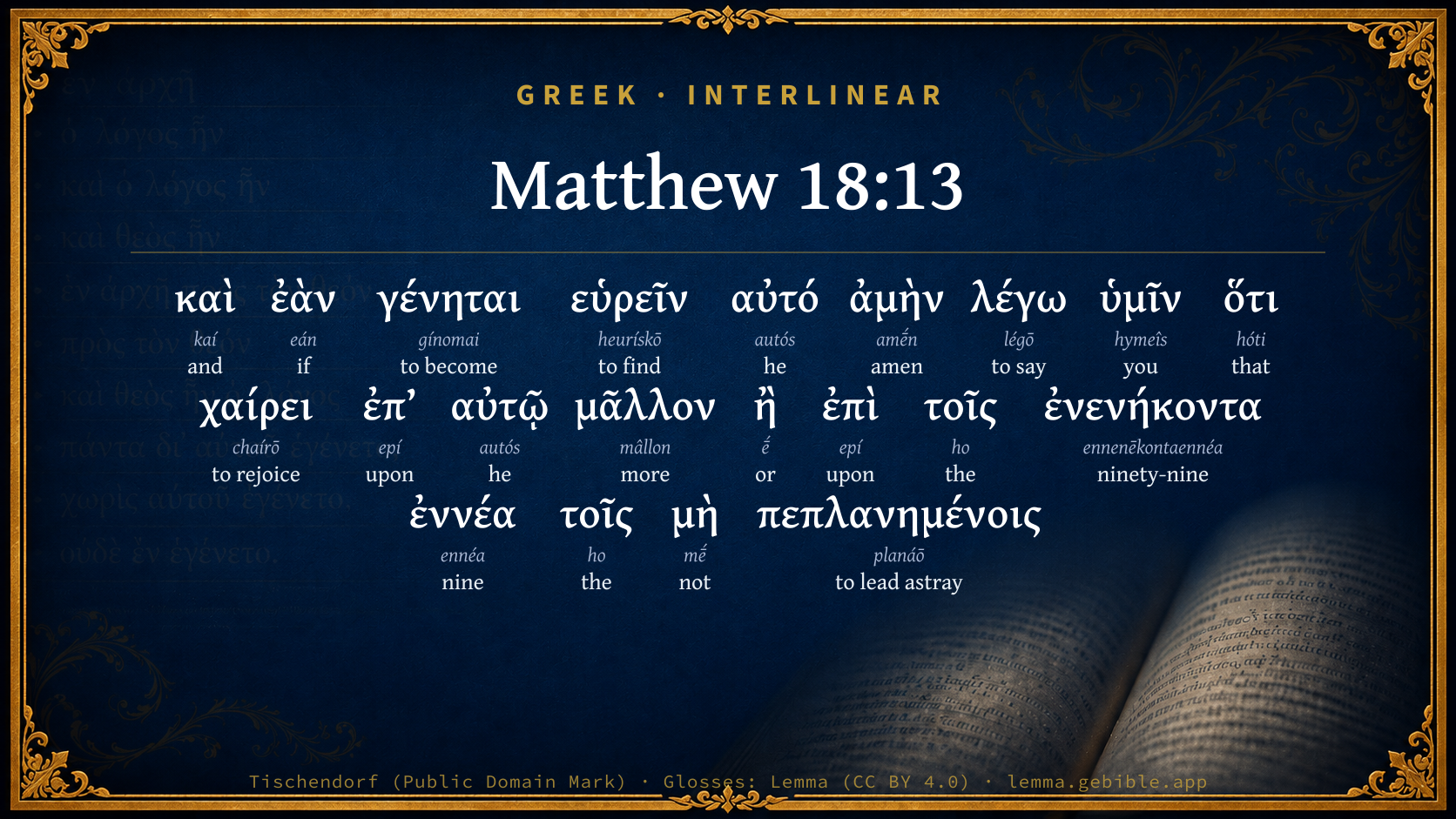
  1. καὶ kaí G2532 “and” Conjunction
  2. ἐὰν eán G1437 “if” Conditional
  3. γένηται gínomai G1096 “to become” Verb, Aorist, Middle deponent, Subjunctive, 3rd person, Singular
  4. εὑρεῖν heurískō G2147 “to find” Verb, Aorist, Active, Infinitive
  5. αὐτό autós G846 “he” Personal pronoun, Accusative, Singular, Neuter
  6. ἀμὴν amḗn G281 “amen” Hebrew transliteration
  7. λέγω légō G3004 “to say” Verb, Present, Active, Indicative, 1st person, Singular
  8. ὑμῖν hymeîs G5210 “you” Personal pronoun, 2nd person, Dative, Plural
  9. ὅτι hóti G3754 “that” Conjunction
  10. χαίρει chaírō G5463 “to rejoice” Verb, Present, Active, Indicative, 3rd person, Singular
  11. ἐπ’ epí G1909 “upon” Preposition
  12. αὐτῷ autós G846 “he” Personal pronoun, Dative, Singular, Neuter
  13. μᾶλλον mâllon G3123 “more” Adverb
  14. ἢ ḗ G2228 “or” Particle
  15. ἐπὶ epí G1909 “upon” Preposition
  16. τοῖς ho G3588 “the” Article, Dative, Plural, Neuter
  17. ἐννέα ennéa G1767 “nine” Adjective, Numeral (indeclinable)
  18. τοῖς ho G3588 “the” Article, Dative, Plural, Neuter
  19. μὴ mḗ G3361 “not” Particle, Negative
  20. πεπλανημένοις planáō G4105 “to lead astray” Verb, Perfect, Passive, Participle, Dative, Plural, Neuter

About this verse

These counts appear in no published source. They are computed here, from the morphology-tagged text and Lemma’s own curated glosses. What Lemma adds →

21
words
18
distinct lemmas
Gospels
section

Notable vocabulary

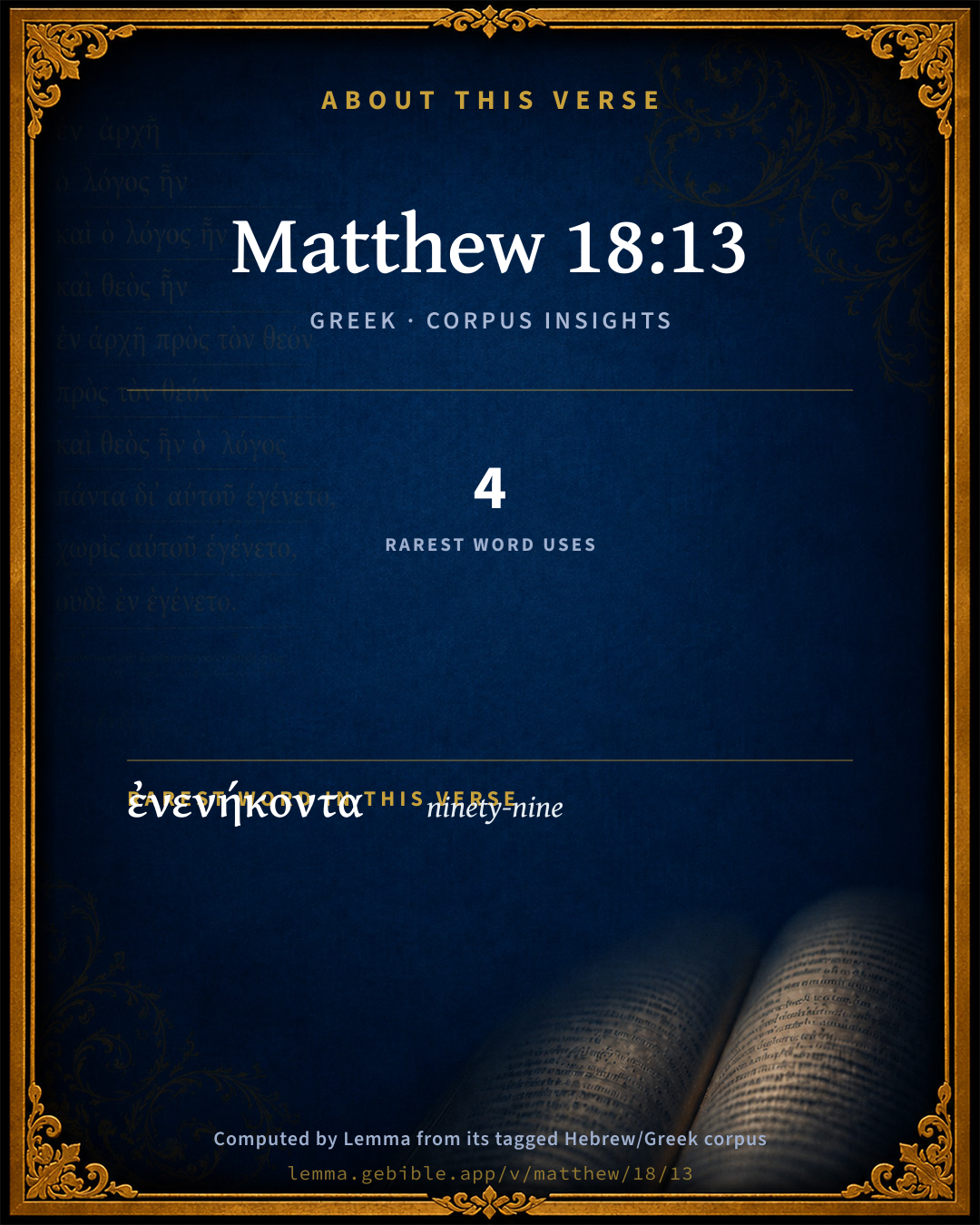
The rarest word here is ἐνενήκοντα ninety-nine G1768 — appearing just 4 times in the whole Greek New Testament.

Shared distinctive vocabulary

ἐνενήκοντα ninety-nine G1768 occurs in 4 verses of the Greek New Testament. Also found in:

Repetition

Words recur within this verse:

  • ἐπ’ upon G1909 ×2
  • αὐτό he G846 ×2
  • τοῖς the G3588 ×2

Cross-references

10

Topical passages linked to Matthew 18:13 in the Treasury of Scripture Knowledge — connected by theme and wording, ordered by reader-vote popularity; previews shown in the World English Bible.

  • Luke 15:5–10 When he has found it, he carries it on his shoulders, rejoicing.
  • Zephaniah 3:17 Yahweh, your God, is in the midst of you, a mighty one who will save. He will rejoice over you with joy. He will rest in his love. He will rejoice over you with singing.
  • Psalms 147:11 Yahweh takes pleasure in those who fear him, In those who hope in his loving kindness.
  • Micah 7:18 Who is a God like you, who pardons iniquity, And passes over the disobedience of the remnant of his heritage? He doesn't retain his anger forever, Because he delights in loving kindness.
  • Luke 15:23–24 Bring the fattened calf, kill it, and let us eat, and celebrate;
  • John 4:34–36 Jesus said to them, "My food is to do the will of him who sent me, and to accomplish his work.
  • James 2:13 For judgment is without mercy to him who has shown no mercy. Mercy triumphs over judgment.
  • Isaiah 53:11 He shall see of the travail of his soul, [and] shall be satisfied: by the knowledge of himself shall my righteous servant justify many; and he shall bear their iniquities.
  • Isaiah 62:5 For as a young man marries a virgin, so shall your sons marry you; and as the bridegroom rejoices over the bride, so shall your God rejoice over you.
  • Jeremiah 32:37–41 Behold, I will gather them out of all the countries, where I have driven them in my anger, and in my wrath, and in great indignation; and I will bring them again to this place, and I will cause them to dwell safely:

Cross-references courtesy of OpenBible.info (CC BY 4.0).

Commentary

Notes on Matthew 18:13 from classic Christian and Jewish commentators (each source and its license shown beneath its notes). The classic Christian expositions comment on the surrounding passage and are grouped to its opening verse, so a note may address several verses; the Jewish commentaries on the Tanakh (Rashi and others) are per-verse, so they appear only where the commentator wrote on this verse.

Lemma curates 59 commentaries, every one of them public domain or Creative Commons licensed, each selected and text-cleaned for this edition rather than reprinted as found. About our sources →

The Biblical Illustrator

Joseph S. Exell

Mat_18:11; Mat_18:13

If a man have an hundred sheep.

Seeking the lost

1. The image under which it pleases God to describe His creatures upon earth, Sheep gone astray.

2. What is said as to the dealings of God with His creatures under these circumstances, seeketh, etc.

3. The feelings with which the Shepherd is described as regarding the sheep when found, He rejoiceth more, etc.

4. The general deduction which our gracious Saviour draws from these several particulars Even so it is not the will of your Father which is in heaven that one of these little ones should perish.

(1) What a conception does this text lead us to form of the character of God our Redeemer.

(2) What an encouragement does the doctrine of the text supply as to our dealings with others. (J. W. Cunningham.)

The example of saving the lost

I. Who are they that are here described as persons lost, and what is meant by the expression? Our blessed Saviour means all who did not receive Him as the messenger and interpreter of the Divine will to mankind.

II. In what sense our blessed Saviour is here said to have come to save mankind.

(1) He came to instruct mankind in the true and the whole nature of the Divine will:

(2) to show, in His own example, that human nature is capable of such a degree of perfection, as will make us fit objects of the Divine favour:

(3) to make a satisfaction for us upon the cross, such as showed that God would not pardon the sins of men unless His justice was satisfied; and, therefore, Christs suffering and death upon this account were a full and proper satisfaction made to the Divine justice for the sins of such as were till then lost to the benefits of eternal life.

III. How far should the example of Christ, in this particular of saving that which was lost, be imitated by us. The natural means, those of instruction and of example, which He made use of in His life-time for reforming mankind, and improving their morals, these are what we may copy after Him. (Nich. Brady.)

A needful caution

I. A needful caution. Take heed that ye despise not, etc.

1. To despise them is fearfully dangerous.

2. The interest taken in them by the highest intelligences should prevent us from thinking lightly of them.

3. The high destiny which awaits them.

II. A blessed announcement. For the Son of Man is come, etc.

1. The title assumed.

2. The act declared, not merely to improve, but to save.

3. The miserable objects regarded.

III. A familiar comparison. How think ye (Mat_18:12). These words may be considered:

1. In their literal signification. The recovery of lost property is a principle of human nature.

2. In their spiritual allusion.

IV. As encouraging inference. Even so it is not the will of My Father, etc.

1. The harmony that existed between the mission of Christ and the purposes of the Eternal Father.

2. If it is not the, will of God that the most despised and insignificant believer should perish, their salvation is assured. (Expository Outlines.)

The Son of Man the Saviour of the lost

I. A proof and statement of the Saviours work and errand.

1. One feature of the mediatorial character is particularly displayed in the very name in which the Saviour is introduced to our attention, the Son of Man.

2. These words point out the fact of the Saviours incarnation, The Son of Man is come.

3. This description of the object of His coming we may contrast with another, when He comes a second time into this our world.

II. View the Saviours errand and work as it is exhibited to us in that figurative illustration that follows the text,

1. He represents the state of the guilty sinner whom He came into the world to save under the idea of a wandering sheep. Prone to wander.

2. The care and kindness of the Great Shepherd of the sheep. Manifests particular care over case of individual sinner.

3. Christs search for the lost embraces all the means used for the salvation of sinners.

4. He carries back the sheep when He has found it. To prevent exposure to danger.

5. His joy.

III. The great principle of the divine conduct that is developed in the work to which we have turned your attention, It is not the will of your Father which is in heaven, etc.

1. The connection that is here obviously formed between the end in view, and the means for the accomplishment of that end.

2. In redemption the will of the Father and Son are equal.

3. The work of Christ was designed to accomplish that intention, and is efficacious to its accomplishment.

4. Magnify the fulness of Christs work.

5. Have you learnt that your characters are that of lost sheep? (R. H. Cooper.)

Gods minute and all-inclusive care of the universe

I. He is the Shepherd of the flock.

II. His love is impartially shown to all who are in the fold.

III. The salvation of the least is worth all the efforts of the highest. (J. Parker, D. D.)

The shepherd faithfulness of the Son of Man in seeking the lost

I. Let us notice the consolation in His comparing them with sheep who have gone astray.

1. It reveals to us how dear every single soul is to the Lord.

2. He misses each sheep as soon as it is lost.

3. He will leave the ninety and nine on the mountains and hunt for only one that has gone astray.

4. He rejoices over the one that is found.

II. For what does it render us responsible?

1. That we keep watch over those who are liable to go astray.

2. The shepherd-faithfulness of our Lord renders you responsible for compassion on the lost.

3. Also for active, zealous seeking and leading home all who are willing to be saved.

4. It requires us to rejoice over every one who lets himself be saved. (T. Christlieb, D. D.)

The lost sheep and the seeking Shepherd

I. The figure of the one wanderer

1. All men are Christs sheep. All men are Christs because He has created them. We are His people and the sheep of His pasture.

2. The picture of the sheep as wandering, which goeth astray. It pictures the process of wandering; not the result as accomplished. The sheep has gone astray, though when it set out on its journey it never thought of straying; more mischief is wrought from want of thought than by an evil will.

3. The progressive character of our wanderings from God. A man never gets to the end of the distance that separates between him and the Father if his face is turned away from God. Every moment the separation is increasing.

4. The contrast between the description given of the wandering sheep in our text and in St. Luke. Here it is represented as wandering, there it is represented as lost. God wants to possess us through our love; if He does not we are lost to Him.

II. The picture of the seeker. The incarnation of Christ was for the seeking of man. (Dr. Maclaren.)

The Biblical Illustrator, edited by Joseph S. Exell (c. 1880s–1900s) — public domain. Text from a community e-Sword module.

Bengel's Gnomon

Johann Albrecht Bengel

Mat 18:13. Ἐὰν γένηται εὑρεῖν, if it happen that he find it) The finding of the sinner, therefore, is, in the sight of God, a something as it were contingent—IF IT HAPPEN that he find it: cf. on the loss of a sinner, Mat 18:11, and Gnomon in loc. Therefore grace is not irresistible; cf. Luk 15:6; Luk 15:9; Luk 15:24; Luk 17:18.—ἀμὴν λέγω ὑμῖν, verily I say unto you) This formula refers to the Apodosis,[817] as in Luk 11:8, and Joh 12:24; cf. the Divine adjuration in Eze 33:11.

[817] See explanation of technical terms in Appendix.—(I. B.)

Bengel's Gnomon of the New Testament — English translation (T&T Clark, Edinburgh, 1860) — public domain. Text from a community e-Sword module.

Expositor's Greek Testament

ed. W. Robertson Nicoll

Mat 18:13 . καὶ … αὐτό : if it happen that he finds it. In Lk. he searches till he finds it. ἀμὴν λέγω : specially solemn, with a view to the application to the moral sphere of what in the natural sphere is self-evident.

The Expositor's Greek Testament, edited by W. Robertson Nicoll (1897–1910) — public domain. Text from a community e-Sword module.

Adam Clarke's Commentary

Verse 13. He rejoiceth more] It is justly observed by one, on this verse, that it is natural for a person to express unusual joy at the fortunate accomplishment of an unexpected event.

Adam Clarke's Commentary on the Bible (1810–1826) — public domain. Text from a community e-Sword/MySword module.

Ellicott's Commentary for English Readers

(13) Rejoiceth more of that sheep.—More literally, over it.

A Bible Commentary for English Readers, edited by Charles John Ellicott (1878–1897) — public domain. Text from a community e-Sword module.

The Cambridge Bible for Schools and Colleges

gen. ed. J. J. S. Perowne

13. of that sheep] Rather, over that sheep.

The Cambridge Bible for Schools and Colleges (gen. ed. J. J. S. Perowne; Cambridge University Press, 1878–1918) — public domain. Text from a community e-Sword module.

John Gill's Exposition

Moreover, if thy brother shall trespass against thee,.... This is said to show, that as on the one hand, if any of those that believe in Christ, should commit a trespass against his fellow Christian, his sin is not to be connived at, for fear of offending him; for what Christ has before said, is not to be taken in such sense, as to prevent private reproof, or public censures, when there is occasion for them; so on the other hand, he is not to be despised and ill used, and treated in the same injurious manner; but gentle reproofs are to be made use of, for his good. This is spoken not to the apostles as such, but as believers in Christ; and concerns everyone that stands in the relation of a brother, or church member to each other, and only such; for they that are without, do not fall under their notice, nor are they obliged to take, nor can they take altogether, the same methods with them. This rule respects sins committed by one brother against another, either in word or deed; or such as are of a private nature, and which one only, or at least but few, are acquainted with: in such cases the advice is,

go and tell him his fault between thee, and him alone; do not wait for his coming to thee, as being the aggressor, to acknowledge his fault, testify his repentance, express his sorrow for his sin, and ask pardon: but go to him, and freely and faithfully lay his sin before him; but do not aggravate it, and reproach him with it, and bear hard on him for it, but gently rebuke and reprove him: let this be done in the most private manner; let none be present, nor any know of it, even the most intimate friend and acquaintance:

if he shall hear thee; patiently, take your reproof kindly, acknowledge his offence, declare his hearty sorrow for it, and desire it might be overlooked, and reconciliation made:

thou hast gained thy brother; recovered him from the error of his ways, restored him to his duty, and secured his friendship, and interest in his favour; nor should any mention be made of this ever after, either to him, or any other, or to the church.

John Gill's Exposition of the Whole Bible (1746–1763) — public domain (CC PDM 1.0). Text via the HelloAO Bible API.

Trapp's Complete Commentary

John Trapp

13 And if so be that he find it, verily I say unto you, he rejoiceth more of that sheep, than of the ninety and nine which went not astray.

Ver. 13. And if so be that he find it] As he will most surely, for none can take them out of his hands; nor can he discharge his trust, should he suffer any one of them to wander and perish, as they will do undoubtedly, if left to themselves, such is their sheepish simplicity, Isa 53:6. God hath charged Christ to see to the safekeeping of every true sheep, Joh 6:39-40, and he performed it to the full, Joh 17:12. As for that son of perdition there excepted, he was never of Christ’s body, yet is excepted, because he seemed to be, by reason of his office.

John Trapp, A Commentary or Exposition upon All the Books of the Old and New Testament (1647–1656) — public domain. Text from a community e-Sword module.

The Pulpit Commentary

If so be that he find it. The quest is not sure to he rewarded. Man"s perversity makes the result uncertain. No one may safely go on sinning, or living in careless unconcern, with the expectation of being finally found and saved. There is a limit to the patience of the Lord. If a man will not open his heart to good inspirations and cooperate with preventing grace, he will not be found and brought home. God forces no one to be saved against his will. Rejoiceth more. A natural feeling. Thus a mother loves better an afflicted child whom she has nursed through a long malady, than the strong and healthy children who have caused her no trouble and anxiety. The joy at the recovery of the strayed sheep is proportional to the sorrow occasioned by its loss and the pains and trouble expended in the search; and this pleasure would at the moment be greater than the satisfaction with which the other members of the flock are regarded.

The joy of recovering lost things.

Dr. M. Dods, writing on the parable of Luke 15., has the following suggestive passage. Each of the three parables "illustrates the fact that a more active interest in any possession is aroused by the very circumstance that it is lost. The sheep that is lost is not on that account disregarded by the shepherd, but receives for the time greater attention than those which remain in the fold. The piece of money that has gone amissing becomes on that very account of greater immediate importance to the woman than all she has safe in her jar in the cupboard. If one of a family turns out ill, it is a small mitigation that all the rest turn out well; it is after the lost the parent"s heart persistently goes. So is it with God. The very circumstance that men have strayed from him evokes in him a more manifest and active solicitude in their behalf. The attitude of God and of Christ towards sinners is reduced to the great principle that anything which is lost and may be regained exercises our thought more, and calls out a more solicitous regard than a thing of equal value which rests securely in our possession.

I MAN AS LOST. The word as applied to men is a figure. A lost sheep is one beyond the shepherd"s control. A lost piece of money is one that has got out of the woman"s reach. This suggests that a lost man is one who has got himself out of the Divine hands, and has taken the ordering of life into his own hands. As the sheep is the shepherd"s; as the coin is the woman"s; so man is God"s. The sheep is lost through animal perversity; the coin is lost through accident; man is lost through moral wilfulness.

II MAN AS RECOVERABLE. There would be no effort of shepherd, or woman, if they had no reasonable hope of regaining their lost things. And we may never conceive of men as lost in any sense that puts them beyond moral reach. There is a hardening through wilfulness; but we must never think of that save as a process. In the case of no brother-man may it be thought of as complete. The man beyond recovery does not exist.

III MAN AS RECOVERED. That is the work of God in Christ; it is accomplished for the race, and it is an infinite joy to the Recoverer. That is the work of the Christ-man and of the Christian Church. They should prove what joy is found in saving the lost. R.T.

The Pulpit Commentary (1880–1919), ed. H.D.M. Spence-Jones & Joseph S. Exell — public domain. Text from a community e-Sword module.

Alford’s Greek Testament

Henry Alford

13.] See notes on Luk 15:4-6, where the same parable is more expanded. Compare also Eze 34:6, Eze 34:11, Eze 34:12.

ἐπὶ τὰ ὄρη belongs to ἀφείς, not to πορευθ. See var. read. The preposition of motion, ἐπί, gives the idea of the wandering and scattering of the flock over the mountains. If we join the words to πορευθείς, we give them an unmeaning emphasis, besides destroying the elegance of the sentence.

Henry Alford, The Greek Testament (1849–1861) — public domain. Text from a community e-Sword module.

International Critical Commentary

13. And if it happen that he find it, verily I say to you, that he rejoices more over it, than over the ninety-nine which did not stray.] Luk 15:3-7 has a similar saying. The parable there illustrates the divine love which seeks to reclaim sinners. In Mt. after v. 10 and before v. 14 it apparently illustrates from another point of view the value of children in God’s sight. Their angels stand in His presence, and He cares for them as a shepherd does for his lost sheep. But this can hardly be an original connection.

(L)

International Critical Commentary — older volumes (1896–1929), various authors — public domain. Text from a community e-Sword module.

Vincent's Word Studies in the New Testament

Marvin R. Vincent

If so be [εαν γενηται] . If it should so come to pass. God 's grace is not irresistible.

Marvin R. Vincent, Word Studies in the New Testament (1887–1900) — public domain. Text from a community e-Sword/MySword module.

Lesson kit

Teaching starters — assembled from the data on this page, not authored interpretation. Every prompt links to the verse data it draws on. Edit before teaching.

Matthew, in the Gospels, opens this verse with 21 words (18 distinct Greek lemmas). Its most distinctive word is ennenēkontaennéa (“ninety-nine”). A historical commentator’s framing appears above. Read the whole chapter for the surrounding context.

Discussion questions

  1. How does “ninety-nine” (ennenēkontaennéa) shape what this verse is saying?
  2. How does Matthew 18:12, which shares the word «ninety-nine», read alongside this verse?
  3. What does the repetition of “upon” (2× in this one verse) do in this verse?
  4. The translations on this page render this verse differently — a whole-verse word diff, not a word-by-word alignment. What might account for the different wordings?
  5. Compare how The Biblical Illustrator and Bengel's Gnomon read this verse. Where do they agree or differ?

Things to notice

Reading settings

Reading text

Shown beneath each verse's original-language words.

Old Testament
Old Testament edition

Read the OT as the Masoretic Hebrew (MT) or the Greek Septuagint (LXX).

English shown for the Greek Septuagint (in the Hebrew ↔ Greek comparison).

Comparing translations? Open the Compare panel on any verse page to stack up to four side by side.