Matthew 13:19

Greek (Tischendorf 8th ed.) Matthew 13:19 appears in the Greek New Testament. The text above is from the Tischendorf 8th edition. Each word links to its Strong’s number and a concise gloss. Click any word for its full Thayer’s Greek Lexicon entry.
Download image
Cite this verse

Matthew 13:19 (World English Bible). Public Domain. Lemma interlinear Bible study tool, https://lemma.gebible.app/v/matthew/13/19.

Show BibTeX & RIS
BibTeX
RIS
English Translation
When anyone hears the word of the Kingdom, and doesn't understand it, the evil one comes, and snatches away that which has been sown in his heart. This is what was sown by the roadside.
World English Bible · Public Domain
Download a study sheet

One document with this verse’s original text, its word-by-word gloss line, the meaning frame, cross-references with their text, attributed commentary, and full source and license credits — printable, and it pastes into notes with its structure intact.

This verse Autodidact and up

Study sheet (.html) Plain text (.txt)

A passage Seminary Student

Up to 50 verses in one chapter. A passage sheet keeps up to 6 commentary sources and 12 cross-references per verse, in the order this page ranks them, and says so on the sheet whenever that leaves anything out. Ask for a single verse and you get the Autodidact verse sheet above.

Everything on this page stays free to read, with no account — the sheet is a download of what is already on screen, not access to it.

Want to remove ads? Support Godless Engineer
Compare translations 3

The same verse in 3 English versions, stacked beneath the original-language interlinear above. Click any original word for its lexicon entry.

Each is an independent rendering of the whole verse — the interlinear is not word-aligned to these translations.

Highlighted words mark where these versions differ — a whole-verse word diff, not a word-by-word alignment.

  • World English Bible Public Domain
    When anyone hears the word of the Kingdom, and doesn't understand it, the evil one comes, and snatches away that which has been sown in his heart. This is what was sown by the roadside.
  • King James Version Public Domain
    When any one heareth the word of the kingdom, and understandeth it not, then cometh the wicked one, and catcheth away that which was sown in his heart. This is he which received seed by the way side.
  • unfoldingWord Literal Text CC BY-SA 4.0
    Everyone hearing the word of the kingdom and not understanding, the evil one comes and snatches away had been sown in his heart. This is was sown beside the road.

unfoldingWord Literal Text — © unfoldingWord, licensed CC BY-SA 4.0. Word-aligned USFM3 via Door43 (git.door43.org/unfoldingWord/en_ult).

Versions to compare (up to 4)

3 of 4 selected

Show all 19 translations

Every available English version of this verse, each an independent rendering of the whole verse.

  • World English Bible Public Domain
    When anyone hears the word of the Kingdom, and doesn't understand it, the evil one comes, and snatches away that which has been sown in his heart. This is what was sown by the roadside.
  • Berean Standard Bible Public Domain
    When anyone hears the message of the kingdom but does not understand it, the evil one comes and snatches away what was sown in his heart. This is the seed sown along the path.
  • Majority Standard Bible Public Domain
    When anyone hears the message of the kingdom but does not understand it, the evil one comes and snatches away what was sown in his heart. This is the seed sown along the path.
  • King James Version Public Domain
    When any one heareth the word of the kingdom, and understandeth it not, then cometh the wicked one, and catcheth away that which was sown in his heart. This is he which received seed by the way side.
  • American Standard Version (1901) Public Domain
    When any one heareth the word of the kingdom, and understandeth it not, `then' cometh the evil `one', and snatcheth away that which hath been sown in his heart. This is he that was sown by the way side.
  • Revised Version (1885) Public Domain
    When any one heareth the word of the kingdom, and understandeth it not, then cometh the evil one, and snatcheth away that which hath been sown in his heart. This is he that was sown by the way side.
  • Geneva Bible (1599) Public Domain
    Whensoeuer any man heareth the woorde of that kingdome, and vnderstandeth it not, that euil one commeth, and catcheth away that which was sowen in his heart: and this is he which hath receiued the seede by the way side.
  • Douay-Rheims (1899) Public Domain
    When any one heareth the word of the kingdom, and understandeth it not, there cometh the wicked one, and catcheth away that which was sown in his heart: this is he that received the seed by the way side.
  • Young's Literal Translation Public Domain
    Every one hearing the word of the reign, and not understanding -- the evil one doth come, and doth catch that which hath been sown in his heart; this is that sown by the way.
  • Literal Standard Version CC BY-SA 4.0
    Everyone hearing the word of the kingdom, and not understanding—the evil one comes, and snatches that which has been sown in his heart; this is that sown by the way.
  • Unlocked Literal Bible CC BY-SA 4.0
    When anyone hears the word of the kingdom but does not understand it, the evil one comes and snatches away what has been sown in his heart. This is the seed that was sown beside the road.
  • unfoldingWord Literal Text CC BY-SA 4.0
    Everyone hearing the word of the kingdom and not understanding, the evil one comes and snatches away had been sown in his heart. This is was sown beside the road.
  • Darby Bible Public Domain
    From every one who hears the word of the kingdom and does not understand [it], the wicked one comes and catches away what was sown in his heart: this is he that is sown by the wayside.
  • World Messianic Bible Public Domain
    When anyone hears the word of the Kingdom and doesn’t understand it, the evil one comes and snatches away that which has been sown in his heart. This is what was sown by the roadside.
  • Webster's Bible Public Domain
    When any one heareth the word of the kingdom, and understandeth it not, then cometh the wicked one, and catcheth away that which was sown in his heart. This is he who received seed by the way side.
  • Free Bible Version CC BY-SA 4.0
    When people hear the message about the kingdom and don't understand it, the evil one comes along and rips out what was sown in them. This is what happens to the seeds sown on the path.
  • Bible in Basic English Public Domain
    When the word of the kingdom comes to anyone, and the sense of it is not clear to him, then the Evil One comes, and quickly takes away that which was put in his heart. He is the seed dropped by the wayside.
  • Text-Critical English NT CC BY 4.0
    When anyone hears the word of the kingdom and does not understand it, the evil one comes and snatches away what was sown in his heart. This is the seed sown along the path.
  • Tyndale New Testament (1534) Public Domain
    Whosoever heareth the worde of the kingdome and vnderstondeth it not ther cometh the evyll man and catcheth awaye that which was sowne in his hert. And this is he which was sowne by the wayesyde.

Literal Standard Version (2020), Covenant Press — licensed CC BY-SA 4.0. Text via the HelloAO Bible API (eBible.org). Unlocked Literal Bible (unfoldingWord) — licensed CC BY-SA 4.0. Text via the HelloAO Bible API (eBible.org). unfoldingWord Literal Text — © unfoldingWord, licensed CC BY-SA 4.0. Word-aligned USFM3 via Door43 (git.door43.org/unfoldingWord/en_ult). Free Bible Version, Dr. Jonathan Gallagher — licensed CC BY-SA 4.0. Text via the HelloAO Bible API (eBible.org).

Word by word

More ways to search: Search by grammar → Find every occurrence → Compare this word →

Practice this passage: Drill this verse → Learn its vocabulary →

ἁρπάζει
harpázō
G726
“to seize”
Verb, Present, Active, Indicative, 3rd person, Singular
Part of Speech
Verb
Tense
Present
Voice
Active
Mood
Indicative
Person
3rd person
Number
Singular
Full Thayer's Definition

Origin: from a derivative of G138

TDNT: 08:52,8

1. to seize, carry off by force 2. to seize on, claim for one's self eagerly 3. to snatch out or away
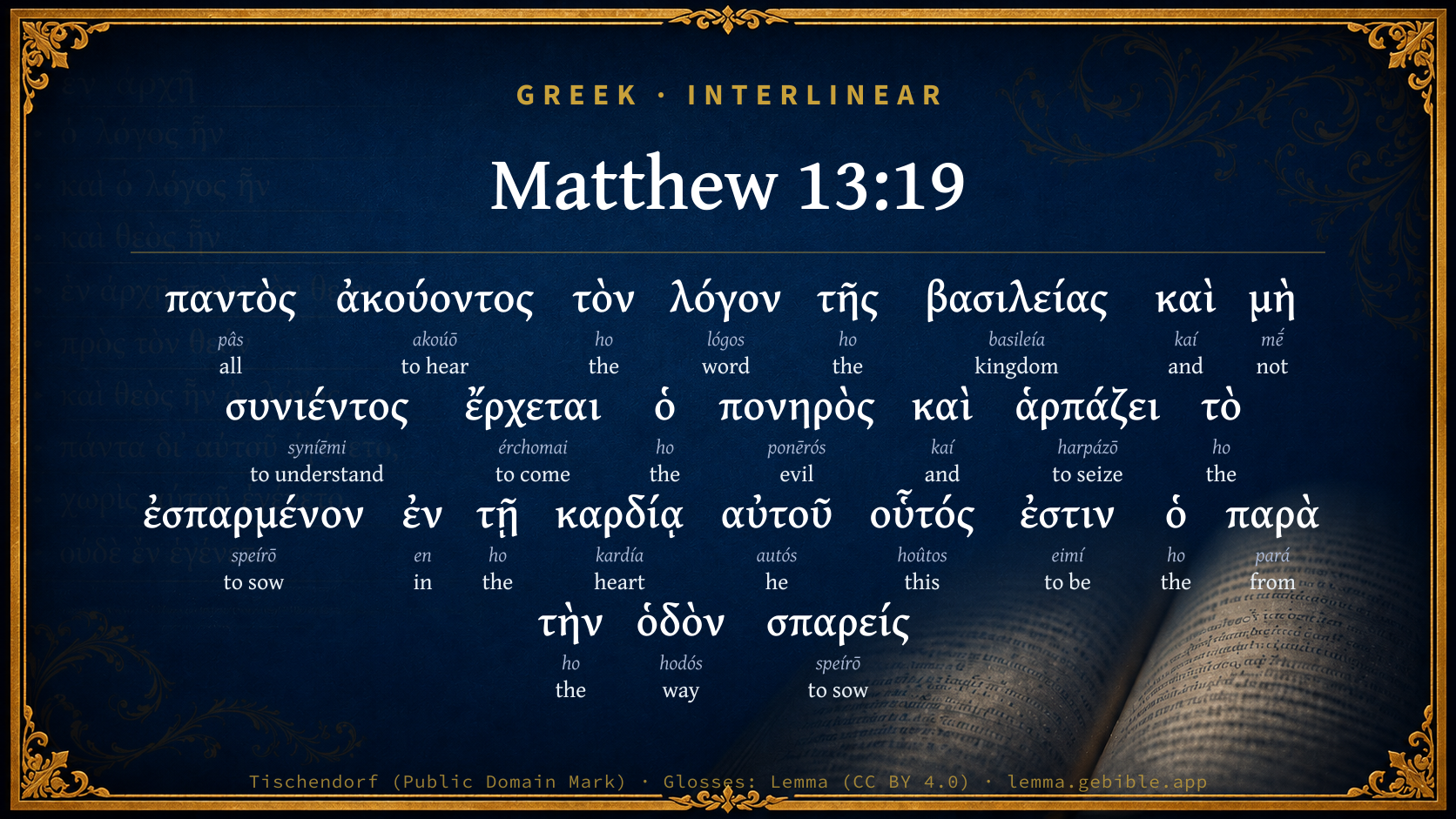
  1. παντὸς pâs G3956 “all” Adjective, Genitive, Singular, Masculine
  2. ἀκούοντος akoúō G191 “to hear” Verb, Present, Active, Participle, Genitive, Singular, Masculine
  3. τὸν ho G3588 “the” Article, Accusative, Singular, Masculine
  4. λόγον lógos G3056 “word” Noun, Accusative, Singular, Masculine
  5. τῆς ho G3588 “the” Article, Genitive, Singular, Feminine
  6. βασιλείας basileía G932 “kingdom” Noun, Genitive, Singular, Feminine
  7. καὶ kaí G2532 “and” Conjunction
  8. μὴ mḗ G3361 “not” Particle, Negative
  9. συνιέντος syníēmi G4920 “to understand” Verb, Present, Active, Participle, Genitive, Singular, Masculine
  10. ἔρχεται érchomai G2064 “to come” Verb, Present, Middle or Passive deponent, Indicative, 3rd person, Singular
  11. ὁ ho G3588 “the” Article, Nominative, Singular, Masculine
  12. πονηρὸς ponērós G4190 “evil” Adjective, Nominative, Singular, Masculine
  13. καὶ kaí G2532 “and” Conjunction
  14. τὸ ho G3588 “the” Article, Accusative, Singular, Neuter
  15. ἐσπαρμένον speírō G4687 “to sow” Verb, Perfect, Passive, Participle, Accusative, Singular, Neuter
  16. ἐν en G1722 “in” Preposition
  17. τῇ ho G3588 “the” Article, Dative, Singular, Feminine
  18. καρδίᾳ kardía G2588 “heart” Noun, Dative, Singular, Feminine
  19. αὐτοῦ autós G846 “he” Personal pronoun, Genitive, Singular, Masculine
  20. οὗτός hoûtos G3778 “this” Demonstrative pronoun, Nominative, Singular, Masculine
  21. ἐστιν eimí G1510 “to be” Verb, Present, Active, Indicative, 3rd person, Singular
  22. ὁ ho G3588 “the” Article, Nominative, Singular, Masculine
  23. παρὰ pará G3844 “from” Preposition
  24. τὴν ho G3588 “the” Article, Accusative, Singular, Feminine
  25. ὁδὸν hodós G3598 “way” Noun, Accusative, Singular, Feminine
  26. σπαρείς speírō G4687 “to sow” Verb, Aorist, Passive, Participle, Nominative, Singular, Masculine

About this verse

These counts appear in no published source. They are computed here, from the morphology-tagged text and Lemma’s own curated glosses. What Lemma adds →

27
words
19
distinct lemmas
Gospels
section

Notable vocabulary

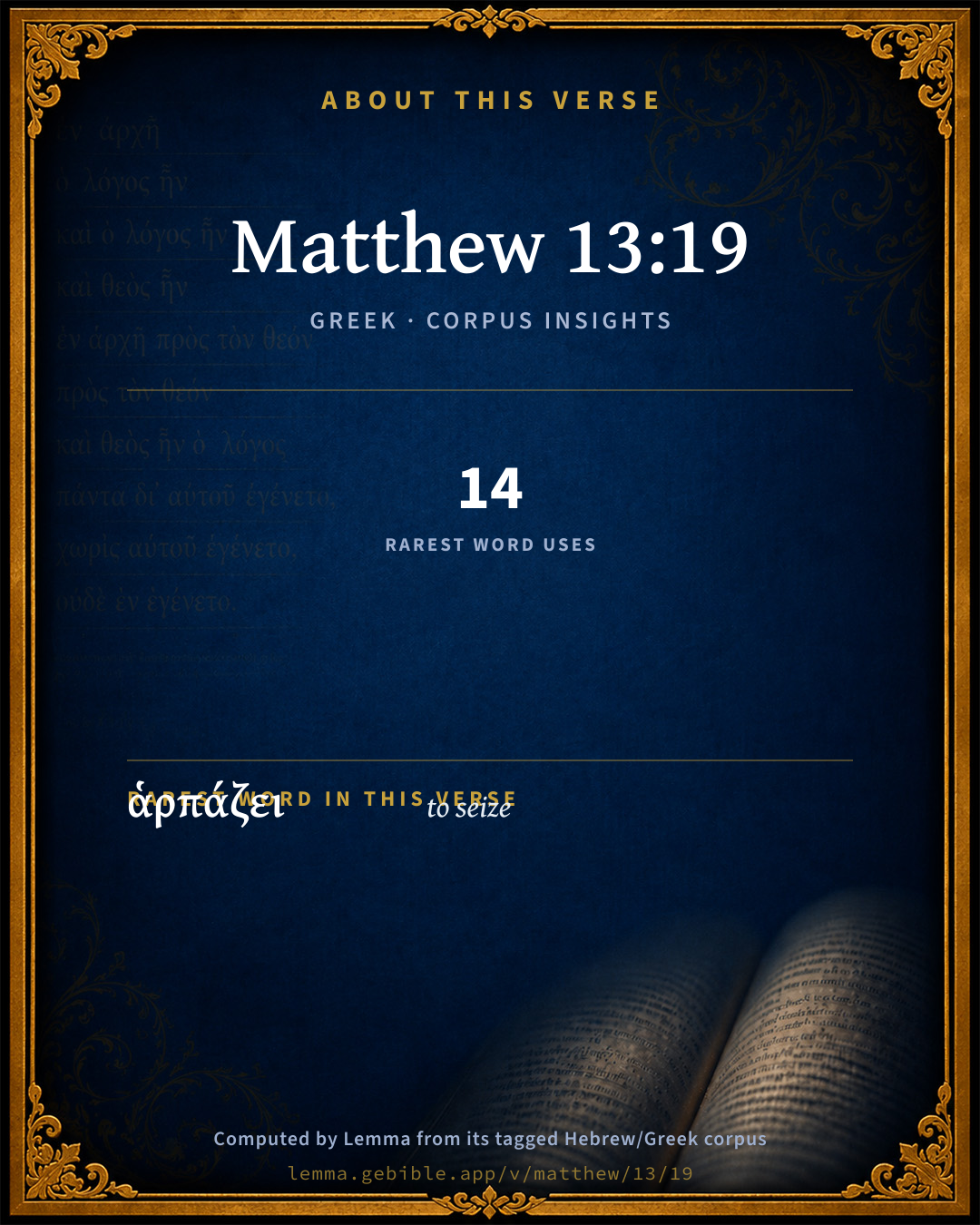
The rarest word here is ἁρπάζει to seize G726 — appearing just 14 times in the whole Greek New Testament.

Shared distinctive vocabulary

ἁρπάζει to seize G726 occurs in 14 verses of the Greek New Testament. Also found in:

Repetition

Words recur within this verse:

  • ἐσπαρμένον to sow G4687 ×2
  • τὸν the G3588 ×7
  • καὶ and G2532 ×2

Cross-references

33

Topical passages linked to Matthew 13:19 in the Treasury of Scripture Knowledge — connected by theme and wording, ordered by reader-vote popularity; previews shown in the World English Bible.

  • Luke 8:11–15 Now the parable is this: The seed is the word of God.
  • Matthew 13:38 the field is the world; and the good seed, these are the children of the Kingdom; and the darnel are the children of the evil one.
  • Hebrews 2:1 Therefore we ought to pay greater attention to the things that were heard, lest perhaps we drift away.
  • 1 John 5:18 We know that whoever is born of God doesn't sin, but he who was born of God keeps himself, and the evil one doesn't touch him.
  • Matthew 4:23 Jesus went about in all Galilee, teaching in their synagogues, preaching the Gospel of the Kingdom, and healing every disease and every sickness among the people.
  • 1 John 3:12 unlike Cain, who was of the evil one, and killed his brother. Why did he kill him? Because his works were evil, and his brother's righteous.
  • Proverbs 1:7 The fear of Yahweh is the beginning of knowledge; But the foolish despise wisdom and instruction.
  • Proverbs 2:1–6 My son, if you will receive my words, And store up my commandments within you;
  • Proverbs 17:16 Why is there money in the hand of a fool to buy wisdom, Seeing he has no understanding?
  • Proverbs 18:1–2 An unfriendly man pursues selfishness, And defies all sound judgment.
  • Matthew 5:37 But let your 'Yes' be 'Yes' and your 'No' be 'no.' Whatever is more than these is of the evil one.
  • Mark 4:15 These are the ones by the road, where the word is sown; and when they have heard, immediately Satan comes, and takes away the word which has been sown in them.
  • John 8:43 Why don't you understand my speech? Because you can't hear my word.
  • Acts 17:32 Now when they heard of the resurrection of the dead, some mocked; but others said, "We want to hear you again concerning this."
  • Romans 1:28 Even as they refused to have God in their knowledge, God gave them up to a reprobate mind, to do those things which are not fitting;
  • 1 John 2:13–14 I write to you, fathers, because you know him who is from the beginning. I write to you, young men, because you have overcome the evil one. I write to you, little children, because you know the Father.
  • Proverbs 1:20–22 Wisdom calls aloud in the street. She utters her voice in the public squares.
  • Luke 9:2 He sent them forth to preach the Kingdom of God, and to heal the sick.
  • Luke 10:9 Heal the sick who are therein, and tell them, 'The Kingdom of God has come near to you.'
  • John 3:19–20 This is the judgment, that the light has come into the world, and men loved the darkness rather than the light; for their works were evil.
  • John 18:38 Pilate said to him, "What is truth?" When he had said this, he went out again to the Jews, and said to them, "I find no basis for a charge against him.
  • Acts 18:15 but if they are questions about words and names and your own law, look to it yourselves. For I don't want to be a judge of these matters."
  • Acts 20:25 Now, behold, I know that you all, among whom I went about preaching the Kingdom of God, will see my face no more.
  • Acts 24:25–26 As he reasoned about righteousness, self-control, and the judgment to come, Felix was terrified, and answered, "Go your way for this time, and when it is convenient for me, I will summon you."
  • Acts 25:19–20 but had certain questions against him about their own religion, and about one Jesus, who was dead, whom Paul affirmed to be alive.
  • Acts 26:31–32 When they had withdrawn, they spoke one to another, saying, "This man does nothing worthy of death or of bonds."
  • Acts 28:23 When they had appointed him a day, many people came to him at his lodging. He explained to them, testifying about the Kingdom of God, and persuading them concerning Jesus, both from the law of Moses and from the prophets, from morning until evening.
  • Romans 2:8 but to those who are self-seeking, and don't obey the truth, but obey unrighteousness, will be wrath and indignation,
  • Romans 14:17 for the Kingdom of God is not eating and drinking, but righteousness, peace, and joy in the Holy Spirit.
  • 2 Corinthians 4:2–3 But we have renounced the hidden things of shame, not walking in craftiness, nor handling the word of God deceitfully; but by the manifestation of the truth commending ourselves to every man's conscience in the sight of God.
  • 2 Thessalonians 2:12 that they all might be judged who didn't believe the truth, but had pleasure in unrighteousness.
  • 1 John 5:20 We know that the Son of God has come, and has given us an understanding, that we know him who is true, and we are in him who is true, in his Son Jesus Christ. This is the true God, and eternal life.
  • Ephesians 3:8 To me, the very least of all saints, was this grace given, to preach to the Gentiles the unsearchable riches of Christ,

Cross-references courtesy of OpenBible.info (CC BY 4.0).

Commentary

Notes on Matthew 13:19 from classic Christian and Jewish commentators (each source and its license shown beneath its notes). The classic Christian expositions comment on the surrounding passage and are grouped to its opening verse, so a note may address several verses; the Jewish commentaries on the Tanakh (Rashi and others) are per-verse, so they appear only where the commentator wrote on this verse.

Lemma curates 59 commentaries, every one of them public domain or Creative Commons licensed, each selected and text-cleaned for this edition rather than reprinted as found. About our sources →

Tyndale Open Study Notes

Tyndale Open Resources

13:19 don’t understand it: Responding to the message of the Kingdom is directly related to discerning its significance.

Tyndale Open Study Notes — © Tyndale Open Resources, licensed CC BY-SA 4.0. Text via the HelloAO Bible API.

Bengel's Gnomon

Johann Albrecht Bengel

Mat 13:19. Μὴ συνίετος, understandeth it not) The verb συνίεναι signifies to understand.[612] The Evil One, or devil, who especially, rather than his angels, is meant by the fowls of the air, has less power over those things which have entered into the σύνεσις, or understanding.—ἁρπάζει, catcheth away) sc. with violence and quick cunning, like a bird of prey; see Mat 13:4.—ἐν τῂ καρδίᾳ, in his heart.—ὁ σπαρεὶς, he that is sown) i.e. as a farm is sown.

[612] That such is Bengel’s meaning is clear from his own German Version, where he renders μὴ συνίεντος by “und nicht vernimmt”—(I. B.)

Bengel's Gnomon of the New Testament — English translation (T&T Clark, Edinburgh, 1860) — public domain. Text from a community e-Sword module.

Expositor's Greek Testament

ed. W. Robertson Nicoll

Mat 13:19 . παντὸς ἀκούοντος , in the case of any one who hears, “for the classical ἐάν τις ἀκούσῃ ” (Camb. G. T.). It may be a case of interrupted construction, the sentence beginning with the intention to make the genitive dependent on an ἐκ τῆς καρδίας before ἁρπάζει (so Weiss). τὸν λόγον τῆς βασιλείας : the Sower , unlike the other parables in this chapter, contains no hint that it concerns the kingdom. But in Christ’s discourses that almost went without saying. μὴ συνιέντος : “not taking it in,” a phrase which happily combines the physical fact of the parable with the figurative sense. ὁ πονηρός , the evil one, Satan, represented by the innocent birds of the parable. What a different use of the emblem from that in Mat 6:26 ! ἐν τῇ καρδίᾳ : we should hardly say of truth not understood that it had been sown in the heart . But heart is used in Scripture in a wide sense, as the seat of intellect as well as of feeling. The word in the case supposed is in the mind, as the seed is in the ground: on it, if not in it; in it as words, if not as truth. οὗτός ἐστιν , etc., this is he sown, etc., said of the man, not of the seed. Sign and thing signified identified, cf. “this is my body”. Properly, the seed sown, etc., represents the case of such a man. So throughout the interpretation.

The Expositor's Greek Testament, edited by W. Robertson Nicoll (1897–1910) — public domain. Text from a community e-Sword module.

Geneva Bible (1599)

Geneva Bible translators

Though there be mention made of the heart yet this sowing is referred to hearing without understanding. For whether the seed be received in the heart or no, yet he that soweth, soweth to the heart.

Geneva Bible (1599) marginal notes — public domain. Text via Bolls.life.

Adam Clarke's Commentary

Verse 19. When any one heareth the word of the kingdom] Viz. the preaching of the Gospel of Christ.

And understandeth it not] μη συνιεντος, perhaps more properly, regardeth it not, does not lay his heart to it.

The wicked one] ο πονηρος, from πονος, labour, toil, he who distresses and torments the soul. Mark, Mr 4:15, calls him οσατανας, the adversary or opposer, because he resists men in all their purposes of amendment, and, to the utmost of his power opposes, in order to frustrate, the influences of Divine grace upon the heart. In the parallel place in Luke, Lu 8:12, he is called ο διαβολος, the devil, from διαβαλλειν, to shoot, or dart through. In allusion to this meaning of the name, St. Paul, Eph 6:16, speaks of the fiery DARTS of the wicked one. It is worthy of remark, that the three evangelists should use each a different appellative of this mortal enemy of mankind; probably to show that the devil, with all his powers and properties, opposes every thing that tends to the salvation of the soul.

Catcheth away] Makes the utmost haste to pick up the good seed, lest it should take root in the heart.

A careless inattentive hearer is compared to the way side-his heart is an open road, where evil affections, and foolish and hurtful desires, continually pass and repass, without either notice or restraint. "A heart where Satan has" (as one terms it) "ingress, egress, regress, and progress: in a word, the devil's thoroughfare."

Adam Clarke's Commentary on the Bible (1810–1826) — public domain. Text from a community e-Sword/MySword module.

Ellicott's Commentary for English Readers

(19) When any one heareth the word.—The explanation has become so familiar to us that it is hard to place ourselves in the position of those to whom it was the unveiling of new truths—the holding up a mirror in which they might see, it might be, their own likeness. Our interest in it may, perhaps, be quickened if we think of it as reflecting what had actually been our Lord’s experience. The classes of hearers who had gathered round Him were represented, roughly and generally, by the four issues of the seed scattered by the sower, and all preachers of the truth, from that day to this, have felt that their own experience has presented analogous phenomena.

The ethical sequence described runs thus: The man hears “the word of the kingdom,” a discourse, say, like the Sermon on the Mount, or that at Nazareth (Luk_4:16-21). He does not “understand” it (the fault being moral rather than intellectual), does not attend to it or “take it in.” The “wicked one” (note the connection with the clause in the Lord’s Prayer, “Deliver us from evil,” or the evil one) snatches it away even from his memory. At first it seems strange that “the birds of the air” in their multitude should represent the Tempter in his unity; and yet there is a terrible truth in the fact that everything which leads men to forget the truth is, in very deed, doing the work of the great enemy. On the other hand, the birds, in their rapid flight and their gathering flocks, may well represent the light and foolish thoughts that are as the Tempter’s instruments. The “way-side” thus answers to the character, which is hardened by the wear and tear of daily life, what we well call its routine, so that the words of Truth make hardly even the most transient impression on it.

This is he which received seed.—Our translators try, unsuccessfully, to combine the parable with its interpretation. Literally, and far better, here and in the following verses, this man it is that is (the seed) sown by the way side.

A Bible Commentary for English Readers, edited by Charles John Ellicott (1878–1897) — public domain. Text from a community e-Sword module.

John Gill's Exposition

Yet hath he not root in himself,.... Nor in Christ; the word is not rooted in him, nor has he the root of the matter, or the truth of grace in him:

but dureth for a while; a hearer of the word, a professor of religion, showing some outward respect to the word, and to the preachers of it:

for when tribulation or persecution ariseth, because of the word; which is often the case, and must be expected by those who embrace the Gospel, profess the name of Christ, and are willing to live godly in him. Tribulation may intend some lesser and lighter troubles for the sake of Christ, and his Gospel; such as the revilings and reproaches of men, loss of character, and trade, &c. and persecution may design something more public and vehement; such as confiscation of goods, imprisonment, and danger of life, the most exquisite tortures, and death in the most cruel form and shape; things very disagreeable to flesh and blood, and which cannot be endured, and submitted to, by persons without a principle of grace, by one that has no root in himself. Luke calls this a time "of temptation", or trial, as it is either way, both by private troubles, and more public persecutions: these try men's principles and professions, and whether the truth of grace is in them or not; and where it is not in any person,

by and by he is offended; at the cross; he shrinks back from it, does not care to take it up, and follow Christ; but drops his religion, and the profession of it; apostatises, falls away, and comes to nothing.

John Gill's Exposition of the Whole Bible (1746–1763) — public domain (CC PDM 1.0). Text via the HelloAO Bible API.

Trapp's Complete Commentary

John Trapp

19 When any one heareth the word of the kingdom, and understandeth it not, then cometh the wicked one, and catcheth away that which was sown in his heart. This is he which received seed by the way side.

Ver. 19. The word of the kingdom] So called, because it points to and paints out the way to the kingdom, and is therefore also called "The word of life, the power of God to salvation:" heaven is potentially in it, as the harvest is in the seed, as above I noted.

And understandeth it not] Considereth it not, as the Syriac here hath it, using the same word that David doth, Psa 41:1; "Blessed is the man that wisely considereth the poor and needy." Consideration sets on the word when it hath been heard (which else lies loose, and is driven away as chaff before the wind), maketh it to become an ingrafted word (λογος εμφυτος, Jas 1:21), as the scions grafted into the stock, or as a tree rooted by the river’s side, that removes not.

Then cometh the wicked one] The troubler of Israel, the master of misrule (ο πονηρος); he is one at church, whosoever is the other. A Doeg, a devil may set his foot as far within the sanctuary as a David. The sons of God cannot present themselves before the Lord but Satan comes also among them to do ill offices, Job 1:6.

And catcheth away that which was sown in his heart] That is, upon his heart (εν τη καρδια, pro επι τη καρδια); for into his heart the seed never came, because the devil had made a pathway over it. People are now so sermon trodden many of them, that their hearts, like footpaths, grow hard by the word, which takes no more impression than rain doth upon a rock: they have brawny breasts, horny heart-strings, dead and dedolent dispositions. Hence they become a prey to the devil, as Abraham’s sacrifice would have been to the fowls of the air, had he not huffed them away, Gen 15:11.

John Trapp, A Commentary or Exposition upon All the Books of the Old and New Testament (1647–1656) — public domain. Text from a community e-Sword module.

Haydock's Catholic Bible Commentary

When any one heareth. This seed faileth upon four different kinds of soil, which represent four different sorts of persons. The 1st, such as continue obdurate in vice; the 2d, such as are unsteady and inconstant in their good resolutions; the 3d, such as are absorbed in the cares and pleasures of life; the 4th, such as have every proper disposition for receiving the word of God with fruit. --- There cometh the wicked one, Greek: o poneros, the devil, and taketh away the word that was sown in their hearts, lest believing they should be saved. (Haydock)

George Leo Haydock (1774–1849), Haydock's Catholic Family Bible and Commentary, 1859 edition — public domain. Excludes Psalms (Douay-Rheims chapter numbering differs from Protestant) and Deuterocanonical books (Catholic canon only).

Matthew Poole's English Annotations

Mark hath this thus, Mar 4:14,15, The sower soweth the word. And these are they by the way-side, where the word is sown; but when they have heard, Satan cometh immediately and taketh away the word that was sown in their hearts. Luke hath it thus, Luk 8:11,12, The seed is the word of God. Those by the wayside are they that hear; then cometh the devil, and taketh away the word out of their hearts, lest they should believe and be saved. From Luke we learn that the seed is the word; from Mark, that the sower is the preacher, Christ in the first place, then all who derive from him as his ministers, and are exercised in preaching the gospel, which Matthew calleth

the word of the kingdom, because it is the instrument by which God raised up Christ’s kingdom on earth, both in the church, and in particular souls, and by which he prepareth men for the kingdom of glory. This is a mighty commendation of the word. The soil is the heart, the soul of man. Now there are some hearers to whom the word preached is like seed that a sower throws upon some footpath, or highway, the plough never turneth the earth upon it, or the harrow never goeth over it; so it lieth bare, and is trodden down by the feet of passengers, and the fowls of the air come and pick it up. So, saith our Saviour, there are some that hear the word, but never meditate upon it, never lay it to their hearts, never cover it with second thoughts; the wicked ones, the devils, who are afraid of the power of the word digested, (like the fowls of the air), by suggesting other thoughts, or by presenting other objects to them, catch away the word that was sown in their hearts. These are they whom I compared to the highway ground receiving the seed.

But some may say, how was it sown in their hearts, if the devil could thus catch it away?

Answer: By the heart here is meant the soul, which hath several powers and faculties. Every thing we hear goeth into our heart, in some sense. As the heart may signify the imaginative power of our soul, or that power by which we take the notion of a thing, the word doth enter into sinners’ hearts, so far as they spend some thoughts upon it, and gain some knowledge and notion of it, yea, they may entertain it with some sudden and temporary affection and passion: indeed it is never so in their hearts, as that they truly believe it, or that their wills are conquered into the obedience of it.

Matthew Poole's English Annotations on the Holy Bible (1683–1685) — public domain. Text from a community e-Sword/MySword module.

Whedon's Commentary on the Bible

Daniel D. Whedon

19. Heareth… and understandeth it not — So the Jewish outsider heard the parable, but it was a mere tale to him. He penetrated not the interior meaning and power. And it is wonderful how little the careless hearer of the Gospel in a Christian land, who attends church, as a form, from Sabbath to Sabbath, really understands the Gospel. When he afterwards becomes convicted of sin, the simplest truths have to be repeated and explained, which he has heard with his ear a hundred times. The truth has indeed fallen upon his ear like seed on the solid surface of a beaten path; it has lain ready for the devil to carry off and leave not a trace behind.

Daniel D. Whedon (gen. ed.), Commentary on the Old and New Testaments (1874–1909) — public domain. Text from a community e-Sword module.

The Pulpit Commentary

When any one heareth the word of the kingdom, and understandeth it not. Understandeth. The form of the explanation here is influenced by the language of vers. 14, 15. Then (not in the Greek) cometh the wicked one; the evil one (Revised Version); Mat_6:13, note. And catcheth (snatcheth, Revised Version) away seizeth for himself (arpazei , Mat_11:12, note) that which was sown in his heart. This is he which received seed. That was sown (Revised Version, o spareiv). And so throughout. The masculine is not merely concise, but also expresses the fact that, as even with land, the man who receives the seed does not put forth in turn merely the seed as something alien, but rather himself so far as he is influenced by the seed; or (regarding the subject from another point of view) he puts forth the new life and energy of the seed as conditioned by that which makes up himself.

The Pulpit Commentary (1880–1919), ed. H.D.M. Spence-Jones & Joseph S. Exell — public domain. Text from a community e-Sword module.

John Wesley's Explanatory Notes

When any one heareth the word, and considereth it not - The first and most general cause of unfruitfulness. The wicked one cometh - Either inwardly; filling the mind with thoughts of other things; or by his agent. Such are all they that introduce other subjects, when men should be considering what they have heard.

John Wesley, Explanatory Notes Upon the Whole Bible (1754–1765) — public domain. Text via the GEBible commentary corpus.

Scofield Reference Notes

C. I. Scofield

kingdom (See Scofield "Mat 3:2").

The Scofield Reference Bible (1917 edition), notes by C. I. Scofield — public domain. Text from a community e-Sword module.

Cambridge Greek Testament for Schools and Colleges

19. On some the word of God makes no impression, as we say; some hearts are quite unsusceptible of good.

παντὸς ἀκούοντος. Si quis audit, quisquis est, for the classical ἐάν τις ἀκούσῃ. πᾶς here follows the usage of Hebr. kol, ‘all,’ or ‘any.’ See note ch. Mat 24:22.

Cambridge Greek Testament for Schools and Colleges (Cambridge University Press, 1896; 21 vols, various authors incl. Carr, Maclear, Plummer, Farrar, Lumby, Moule, M. R. James, Simcox) — public domain. Text from a community e-Sword module.

Alford’s Greek Testament

Henry Alford

19.] In Luke we have an important preliminary declaration, implied indeed here also: ὁ σπόρος ἐστὶν ὁ λόγος τοῦ θεοῦ. This word is in this parable especially meant of the word preached, though the word written is not excluded: nor the word unwritten—the providences and judgments, and even the creation, of God. (See Rom 10:17, Rom 10:18.) The similitude in this parable is alluded to in 1Pe 1:23: Jas 1:21.

The sower is first the Son of Man (ver. 37), then His ministers and servants (1Co 3:6) to the end. He sows over all the field, unlikely as well as likely places; and commands His sowers to do the same, Mar 16:15. Some, Stier says, (Reden Jesu, ii. 76, Exo_2,) have objected to the parable a want of truthful correspondence to reality, because sowers do not thus waste their seed by scattering it where it is not likely to grow; but, as he rightly answers,—the simple idea of the parable must be borne in mind, and its limits not transgressed—‘a sower went out to sow’—his sowing—sowing over all places, is the idea of the parable. We see him only as a sower, not as an economist. The parable is not about Him, but about the seed and what happens to it. He is the fit representative τοῦ διδόντος θεοῦ πᾶσιν ἁπλῶς καὶ μὴ ὀνειδίζοντος, Jas 1:5.

παντὸς κ.τ.λ.] an anacoluthon, to throw the emphasis on παντὸς κ.τ.λ., for ὁ πονηρὸς … κ. ἁρπάζει τὸ ἐσπ. ἐν τῇ καρδ. παντὸς κ.τ.λ.

καὶ μὴ συνιέντος is peculiar to Matthew, and very important; as in Mark and Luke this first class of hearers are without any certain index to denote them. The reason of μὴ συνιέντος is clearly set forth by the parable: the heart is hardened, trodden down; the seed cannot penetrate.

ὁ πονηρὸς = ὁ σατανᾶς (Mark, who also inserts εὐθύς), = ὁ διάβολος (Luke). The parable itself is here most satisfactory as to the manner in which the Evil One proceeds. By fowls of the air—passing thoughts and desires, which seem insignificant and even innocent—does Satan do his work, and rob the heart of the precious seed. Luke adds the purpose of Satan in taking away the word: ἵνα μὴ πιστεύσαντες σωθῶσιν.

ὁ … σπαρείς: not ‘he that received seed by the way side,’ but he that was sown by the way side. This is not a confusion of similitudes,—no ‘primary and secondary interpretation’ of σπόρος,—but the deep truth, both of nature and of grace. The seed sown springing up in the earth, becomes the plant, and bears the fruit, or fails of bearing it; it is therefore the representative, when sown, of the individuals of whom the discourse is. And though in this first case it does not spring up, yet the same form of speech is kept up: throughout they are οἱ σπαρέντες, as, when the question of bearing fruit comes, they must be. We are said to be ἀναγεγεννημένοι διὰ λόγου ζῶντος θεοῦ, 1Pe 1:23. It takes us up into itself, as the seed the earth, and we become a new plant, a καινὴ κτίσις: cf. also below, ver. 38, τὸ δὲ καλὸν σπέρμα, οὗτοί εἰσιν κ.τ.λ.

20,

Henry Alford, The Greek Testament (1849–1861) — public domain. Text from a community e-Sword module.

International Critical Commentary

(M) 19. In the case of every one who hears the word of the kingdom, and does not understand, them comes the evil one, and wrests away that which was sown in his heart. This is he who was sown by the wayside.] Mk. has: “The sower sows the word. These are they who (are) by the wayside, where the word is sown. And when they hear, straightway cometh Satan, and taketh away the word which was sown into them.” Mk’s explanation of the parable suffers from condensation. “These are they who are by the wayside” interprets ὃ μὲν ἔπεσεν παρὰ τήν ὁδόν, v. 4, i.e. the seed which fell by the wayside describes the case of the people who hear the doctrine and allow it quickly to be lost from their memory and understanding. Properly speaking, “that which fell by the wayside” is the doctrine, and the wayside represents superficial hearers; but Mk.’s loosely connected words seem to confuse the seed sown, i.e. the doctrine, with the people amongst whom it is sown, i.e. those who hear it. Mt. might have simplified by saying in his last clause, “This is, i.e. this is represented by, that which was sown by the wayside”; but he follows Mk.’s confusion between the seed sown and the people amongst whom it is sown. He adds καὶ μὴ συνιέντος to explain why the evil one succeeds in wresting the seed from them, and substitutes ἐν τῇ καρδίᾳ αὐτοῦ for Mk.’s harsher εἰς αὐτούς—ὁ πονηρός, as in v. 38.

International Critical Commentary — older volumes (1896–1929), various authors — public domain. Text from a community e-Sword module.

Vincent's Word Studies in the New Testament

Marvin R. Vincent

When any one heareth. The rendering would be made even more graphic by preserving the continuous force of the present tense, as exhibiting action in progress, and the simultaneousness of Satan 's work with that of the gospel instructor. " While any one is hearing, the evil one is coming and snatching away, just as the birds do not wait for the sower to be out of the way, but are at work while he is sowing.

He which received seed [ο σπαρεις] . Lit., and much better, Rev., He that was sown; identifying the seed of the figure with the man signified.

Marvin R. Vincent, Word Studies in the New Testament (1887–1900) — public domain. Text from a community e-Sword/MySword module.

Lesson kit

Teaching starters — assembled from the data on this page, not authored interpretation. Every prompt links to the verse data it draws on. Edit before teaching.

Matthew, in the Gospels, opens this verse with 27 words (19 distinct Greek lemmas). Its most distinctive word is harpázō (“to seize”). A historical commentator’s framing appears above. Read the whole chapter for the surrounding context.

Discussion questions

  1. How does “to seize” (harpázō) shape what this verse is saying?
  2. Matthew 11:12 shares the word «to seize» with this verse. How do the two illuminate each other?
  3. “to sow” occurs 2× in this one verse. What is the effect of the repetition?
  4. These translations render this verse differently; the difference is in the English rendering, not the original. What questions does that raise?
  5. Reading how Tyndale Open Study Notes and Bengel's Gnomon read this verse, where do the two commentators agree and where do they part?

Things to notice

Reading settings

Reading text

Shown beneath each verse's original-language words.

Old Testament
Old Testament edition

Read the OT as the Masoretic Hebrew (MT) or the Greek Septuagint (LXX).

English shown for the Greek Septuagint (in the Hebrew ↔ Greek comparison).

Comparing translations? Open the Compare panel on any verse page to stack up to four side by side.