
Matthew 24:20

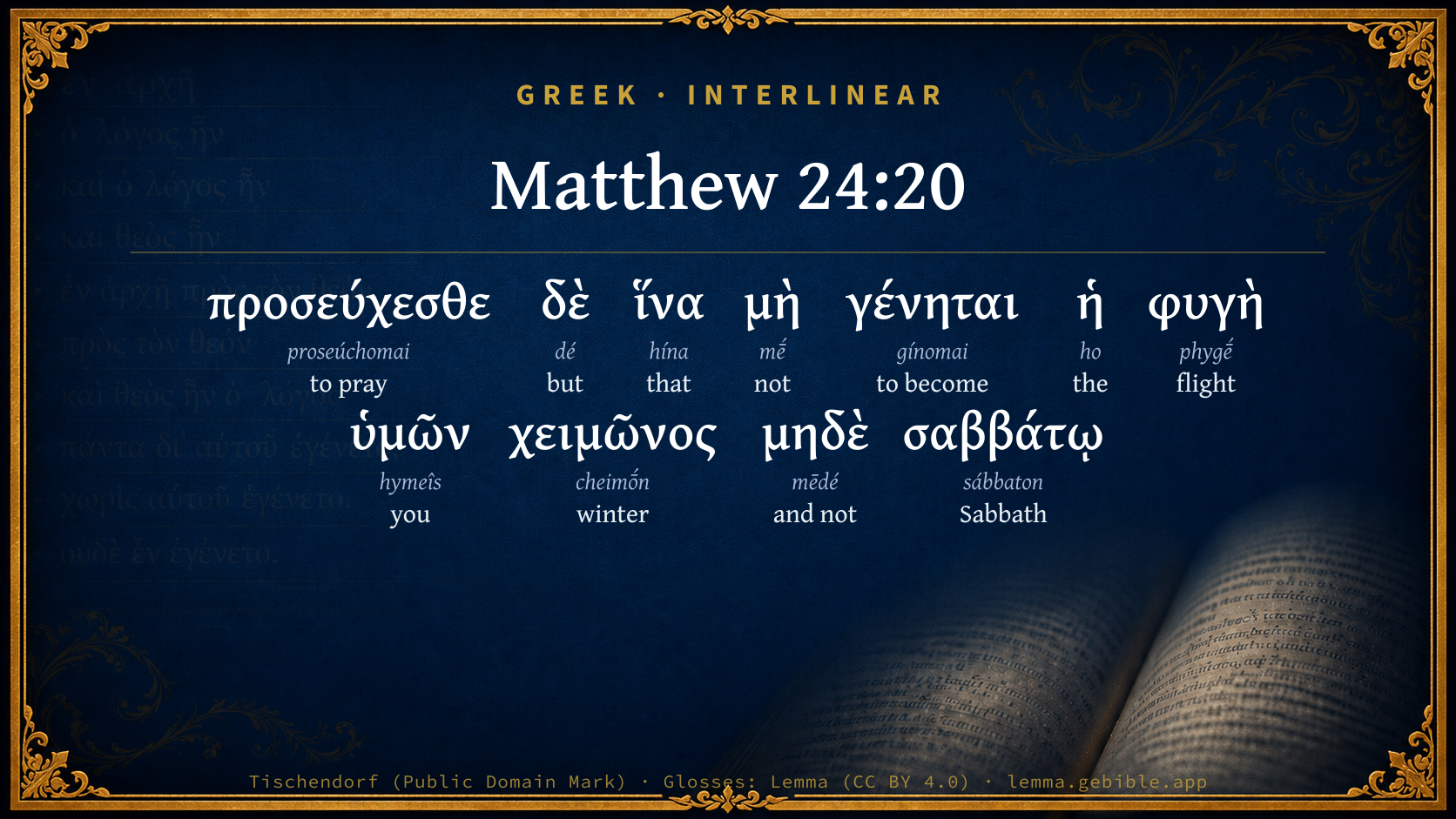
Greek (Tischendorf 8th ed.) Matthew 24:20 appears in the Greek New Testament. The text above is from the Tischendorf 8th edition. Each word links to its Strong’s number and a concise gloss. Click any word for its full Thayer’s Greek Lexicon entry.
Download image
Cite this verse

Matthew 24:20 (World English Bible). Public Domain. Lemma interlinear Bible study tool, https://lemma.gebible.app/v/matthew/24/20.

Show BibTeX & RIS
BibTeX
RIS
English Translation
Pray that your flight will not be in the winter, nor on a Sabbath,
World English Bible · Public Domain
Highlights
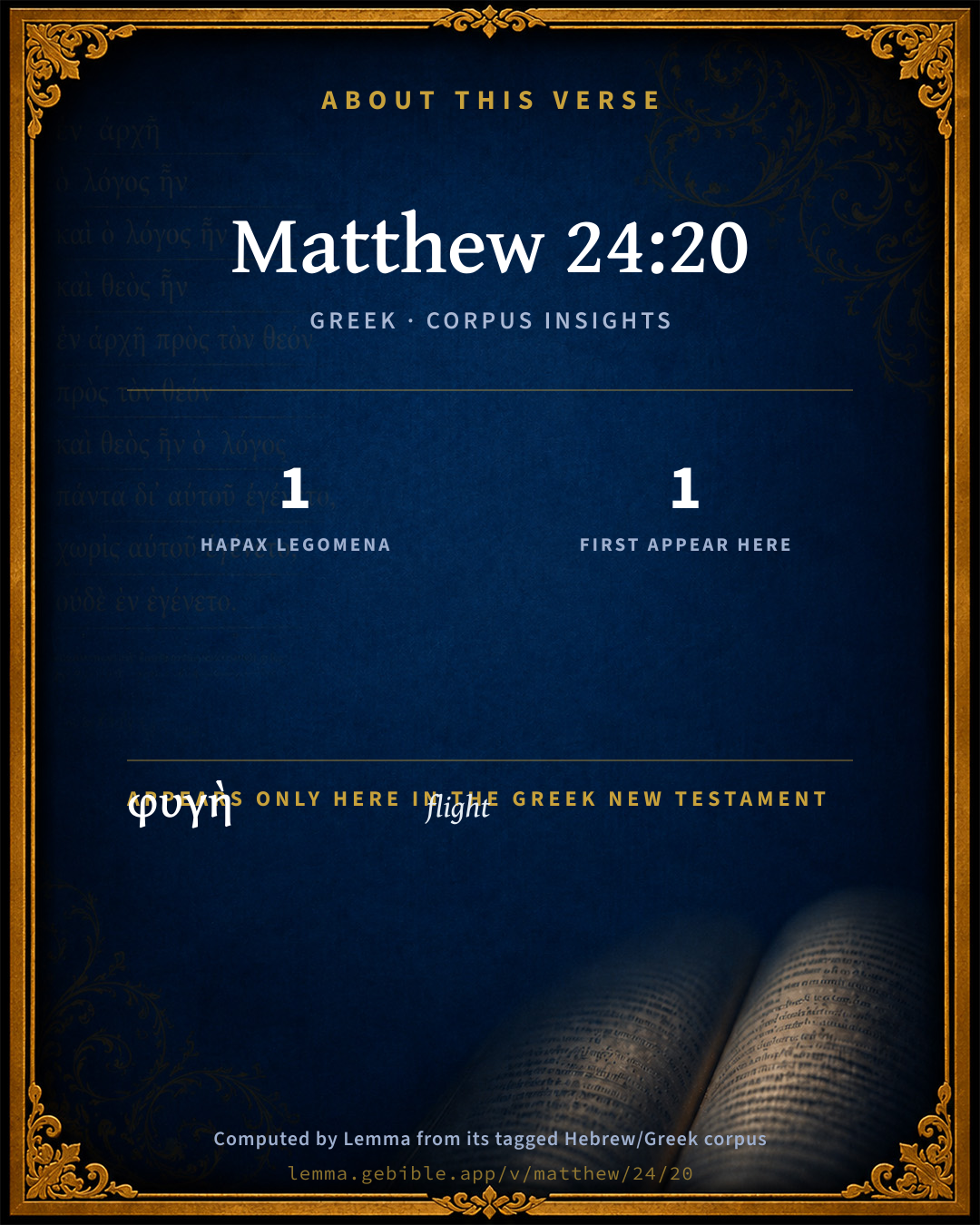
  • 1 hapax legomenon — only here in the Greek New Testament
  • 1 first appearance in the Greek New Testament
Full analysis ↓
Download a study sheet

One document with this verse’s original text, its word-by-word gloss line, the meaning frame, cross-references with their text, attributed commentary, and full source and license credits — printable, and it pastes into notes with its structure intact.

This verse Autodidact and up

Study sheet (.html) Plain text (.txt)

A passage Seminary Student

Up to 50 verses in one chapter. A passage sheet keeps up to 6 commentary sources and 12 cross-references per verse, in the order this page ranks them, and says so on the sheet whenever that leaves anything out. Ask for a single verse and you get the Autodidact verse sheet above.

Everything on this page stays free to read, with no account — the sheet is a download of what is already on screen, not access to it.

Want to remove ads? Support Godless Engineer
Compare translations 3

The same verse in 3 English versions, stacked beneath the original-language interlinear above. Click any original word for its lexicon entry.

Each is an independent rendering of the whole verse — the interlinear is not word-aligned to these translations.

Highlighted words mark where these versions differ — a whole-verse word diff, not a word-by-word alignment.

  • World English Bible Public Domain
    Pray that your flight will not be in the winter, nor on a Sabbath,
  • King James Version Public Domain
    But pray ye that your flight be not in the winter, neither on the sabbath day:
  • unfoldingWord Literal Text CC BY-SA 4.0
    But pray that your flight might not happen in winter nor on a Sabbath.

unfoldingWord Literal Text — © unfoldingWord, licensed CC BY-SA 4.0. Word-aligned USFM3 via Door43 (git.door43.org/unfoldingWord/en_ult).

Versions to compare (up to 4)

3 of 4 selected

Show all 19 translations

Every available English version of this verse, each an independent rendering of the whole verse.

  • World English Bible Public Domain
    Pray that your flight will not be in the winter, nor on a Sabbath,
  • Berean Standard Bible Public Domain
    Pray that your flight will not occur in the winter or on the Sabbath.
  • Majority Standard Bible Public Domain
    Pray that your flight will not occur in the winter or on the Sabbath.
  • King James Version Public Domain
    But pray ye that your flight be not in the winter, neither on the sabbath day:
  • American Standard Version (1901) Public Domain
    And pray ye that your flight be not in the winter, neither on a sabbath:
  • Revised Version (1885) Public Domain
    And pray ye that your flight be not in the winter, neither on a sabbath:
  • Geneva Bible (1599) Public Domain
    But pray that your flight be not in the winter, neither on the Sabbath day.
  • Douay-Rheims (1899) Public Domain
    But pray that your flight be not in the winter, or on the sabbath.
  • Young's Literal Translation Public Domain
    and pray ye that your flight may not be in winter, nor on a sabbath;
  • Literal Standard Version CC BY-SA 4.0
    and pray that your flight may not be in winter, nor on a Sabbath;
  • Unlocked Literal Bible CC BY-SA 4.0
    Pray that your flight will not occur in the winter or on a Sabbath.
  • unfoldingWord Literal Text CC BY-SA 4.0
    But pray that your flight might not happen in winter nor on a Sabbath.
  • Darby Bible Public Domain
    But pray that your flight may not be in winter time nor on sabbath:
  • World Messianic Bible Public Domain
    Pray that your flight will not be in the winter nor on a Sabbath,
  • Webster's Bible Public Domain
    But pray ye that your flight may not be in the winter, neither on the sabbath:
  • Free Bible Version CC BY-SA 4.0
    Pray that you don't have to run away in winter, or on the Sabbath day.
  • Bible in Basic English Public Domain
    And say a prayer that your flight may not be in the winter, or on a Sabbath.
  • Text-Critical English NT CC BY 4.0
    Pray that your flight will not happen in winter or on a Sabbath.
  • Tyndale New Testament (1534) Public Domain
    But praye that youre flight be not in the winter nether on the saboth daye.

Literal Standard Version (2020), Covenant Press — licensed CC BY-SA 4.0. Text via the HelloAO Bible API (eBible.org). Unlocked Literal Bible (unfoldingWord) — licensed CC BY-SA 4.0. Text via the HelloAO Bible API (eBible.org). unfoldingWord Literal Text — © unfoldingWord, licensed CC BY-SA 4.0. Word-aligned USFM3 via Door43 (git.door43.org/unfoldingWord/en_ult). Free Bible Version, Dr. Jonathan Gallagher — licensed CC BY-SA 4.0. Text via the HelloAO Bible API (eBible.org).

Word by word

More ways to search: Search by grammar → Find every occurrence → Compare this word →

Practice this passage: Drill this verse → Learn its vocabulary →

About this verse

These counts appear in no published source. They are computed here, from the morphology-tagged text and Lemma’s own curated glosses. What Lemma adds →

11
words
11
distinct lemmas
Gospels
section

Notable vocabulary

1 hapax legomenon — a word that appears only here in the entire Greek New Testament:

First appearance in Scripture

This word makes its first canonical appearance in the Greek New Testament here:

Shared distinctive vocabulary

χειμῶνος winter G5494 occurs in 6 verses of the Greek New Testament. Also found in:
Cross-references

2

Topical passages linked to Matthew 24:20 in the Treasury of Scripture Knowledge — connected by theme and wording, ordered by reader-vote popularity; previews shown in the World English Bible.

  • Exodus 16:29 Behold, because Yahweh has given you the Sabbath, therefore he gives you on the sixth day the bread of two days. Everyone stay in his place. Let no one go out of his place on the seventh day."
  • Acts 1:12 Then they returned to Jerusalem from the mountain called Olivet, which is near Jerusalem, a Sabbath day's journey away.

Cross-references courtesy of OpenBible.info (CC BY 4.0).

Commentary

Notes on Matthew 24:20 from classic Christian and Jewish commentators (each source and its license shown beneath its notes). The classic Christian expositions comment on the surrounding passage and are grouped to its opening verse, so a note may address several verses; the Jewish commentaries on the Tanakh (Rashi and others) are per-verse, so they appear only where the commentator wrote on this verse.

Lemma curates 59 commentaries, every one of them public domain or Creative Commons licensed, each selected and text-cleaned for this edition rather than reprinted as found. About our sources →

The Biblical Illustrator

Joseph S. Exell

Mat_24:20

Not in the winter.

Winter and how to meet it

The winter season is especially full of temptation, because of the long evenings allowing such full swing for evil indulgences. You can hardly expect a young man to go into his room and sit there from seven to eleven oclock in the evening, reading Morleys Dutch Republic or John Fosters Essays. It would be a very beautiful thing for him to do, but he will not do it. Then the winter has especial temptations in the fact that many homes are peculiarly unattractive at this season. In the summer months the young man can sit out on the steps, or he can have a bouquet in the vase on the mantel, or, the evenings being so short, soon after gaslight he wants to retire, anyhow. But there are many parents who do not understand how to make the long winter evenings attractive to their children.

A good use of winter nights

Employ these long nights of December, January, and February in high pursuits, in intelligent socialities, in innocent amusements, in Christian work. Do not waste this winter, for soon you will have seen your last snow shower and have gone up into the companionship of Him Whose raiment is white as snow, whiter than any fuller on earth could whiten it. For all Christian hearts the winter nights of earth will end in the June morning of heaven. The river of life from under the throne never freezes over. The foliage of lifes tree is never frost-bitten. The festivities, the hilarities, the family greetings of earthly Christmas times will give way to larger reunion and brighter lights and sweeter garlands and mightier joy in the great holiday of heaven! (Dr. Talmage.)

Winter dissipation

This season is not only a test of ones physical endurance, but in our great cities is a test of moral character. A vast number of people have by one winter of dissipation been destroyed and for ever. Seated in our homes on some stormy night, the winds howling outside, we imagine the shipping helplessly driven on the coast, but any winter night, if our ears were good enough, we could hear the crash of a thousand moral shipwrecks. There are many people who come to our city on the 1st of September who will be blasted by the 1st of March. At this season of the year temptations are especially rampant. Now that the long winter evenings have come there are many who will employ them in high pursuits, in intellectual socialities, in Christian work, in the strengthening and ennobling of moral character, and this winter to many of you will be the brightest and the best in all of your lives, and in anticipation I congratulate you. But to others it may not have such effect, and I charge you, my beloved, look out where you spend your winter nights. (Dr. Talmage.)

The Biblical Illustrator, edited by Joseph S. Exell (c. 1880s–1900s) — public domain. Text from a community e-Sword module.

Joseph Benson's Commentary

Mat 24:20-21. But pray ye that your flight be not in the winter — For the inclemency of the season, the badness of the roads, the shortness of the days, will all be great impediments to your flight: neither on the sabbath day — That you may not raise the indignation of the Jews by travelling on that day, and so meet with that death out of the city which you had endeavoured to escape by removing from it. Besides, many of them would have scrupled to travel far on that day; the Jews thinking it unlawful to walk above two thousand paces, (two miles,) on the sabbath day. In the parallel place in Mark, this latter clause, about the sabbath day, is not mentioned. For then shall be great tribulation — Never had words a more sad or full accomplishment than these: for the miseries which befell this people about the time of the destruction of Jerusalem, were such as no history can parallel. Within the city the fury of the opposite factions was so great that they filled all places, and even the temple itself, with continual slaughters. Nay, to such a pitch did their madness arise, that they destroyed the very granaries of corn which should have sustained them, and burned the magazines of arms which should have defended them. By these means, when the siege had lasted but two months, the famine began to rage, and at length reduced them to such straits, that the barbarities which they practised are not to be imagined; see Josephus, Bell., Mat 6:11. Even the mothers ate their own children, ibid., Mat 7:8. In short, from the beginning of the siege to the taking of the city, there were slain by faction, by famine, by pestilence, and by the enemy, no less than one million one hundred thousand in Jerusalem. So that, as Josephus himself observes, in his preface to his history of this war: “If all the calamities which the world, from the beginning, hath seen, were compared with those of the Jews, they would appear inferior.” And again, in another place he says, “To speak in brief, no other city ever suffered such things, as no generation from the beginning of the world was ever more fruitful of wickedness.” And that the peculiar hand of Providence was visible in this destruction of the nation, the same author affirms. For, having described the vast multitudes of people that were in Jerusalem when it was besieged, he says, Bell., Mat 7:17, “This multitude was assembled together from other places, and was there, by the providence of God, shut up. as it were, in a prison.” Besides, he tells us that Titus himself took notice that the Jews were urged on by God himself to their destruction.

Joseph Benson's Commentary on the Old and New Testaments (1811–1818) — public domain. Text from a community e-Sword module.

Tyndale Open Study Notes

Tyndale Open Resources

24:20 Josephus records the winter swelling of the Jordan River, which made it more difficult to cross (see Josephus, War 4.7.5). Muddy roads also made travel difficult in winter. • Normally Jews did not travel on the Sabbath in order to rest as God had commanded (see Gen 2:1-3; Exod 20:8-11; 23:12; 31:12-17; Lev 23:3; Deut 5:12-15; Jer 17:19-27).

Tyndale Open Study Notes — © Tyndale Open Resources, licensed CC BY-SA 4.0. Text via the HelloAO Bible API.

Bengel's Gnomon

Johann Albrecht Bengel

Mat 24:20. Προσεύχεσθε, pray ye) Many things are rendered less grievous in answer to the prayers of the righteous. They did pray, and their flight did not take place in the winter.—χειμῶνος, winter, or cold and tempestuous weather) Not merely the time of the year, but the state of the weather, seems to be intended by this word; see ch. Mat 16:3.[1046] The event certainly occurred in spring; cf. Mat 24:18 concerning the field.—Σαββάτῳ, on the Sabbath day) Not because it would have been unlawful to flee or carry burdens on the Sabbath day, especially for Christians, but because it is peculiarly miserable on that day, which is given to joy, to break off the rites of religious worship and flee, and because, being less prepared for flight, each hinders the other in attempting it by crowding the doors of synagogues or the gates of cities much more than when they are in the country or in private houses. Ptolemy Lagus, according to Josephus, took Jerusalem by surprise on the Sabbath day: Ant. xii. 1. In fine, punishments which happened to the Jews on the Sabbath day were more grievous than others: see Hainlin Chronol. Explan. fol. 19, 20. Their enemies also were more truculent on that day than on any other, from hatred of the Sabbath. At the time when sin is at its height, punishment arrives; cf. Hos 4:7. The observance of the Sabbath did not wholly expire before the destruction of the temple.

[1046] Where the word χειμὼν is rendered in E. V. foul weather. This signification is frequent in classical authors.

The Portuguese word inverno has the same double force.—(I. B.)

Bengel's Gnomon of the New Testament — English translation (T&T Clark, Edinburgh, 1860) — public domain. Text from a community e-Sword module.

Meyer's Critical & Exegetical Commentary

Heinrich August Wilhelm Meyer

Mat_24:20. Ἵνα] Object of the command, and therefore its purport; Mar_14:35; Col_1:9.

μηδὲ σαββάτῳ] without ἐν, as in Mat_12:1; Winer, p. 205 [E. T. 274]. On the Sabbath the rest and the solemnities enjoined by the law, as well as the short distance allowed for a Sabbath-days journey (2000 yards, according to Exo_16:29; see Lightfoot on Luk_24:50; Act_1:12; Schoettgen, p. 406), could not but interfere with the necessary haste, unless one were prepared in the circumstances to ignore all such enactments. Taken by themselves, the words μηδὲ σαββάτῳ seem, no doubt, to be inconsistent with Jesus own liberal views regarding the Sabbath (Mat_12:1 ff.; Joh_5:17; Joh_7:22); but he is speaking from the standpoint of His disciples, such a standpoint as they occupied at the time He addressed them, and which was destined to be outgrown only in the course of a later development of ideas (Rom_14:5; Col_2:6). As in the case of χειμῶνος, what is here said is simply with a view to everything being avoided calculated to interfere with their hasty flight. Comp. Mat_10:23.

Meyer — Critical and Exegetical Commentary on the New Testament — English translation by Peter Christie, edited by Frederick Crombie (T&T Clark, 1880) — public domain. Text from a community e-Sword module.

Expositor's Greek Testament

ed. W. Robertson Nicoll

Mat 24:20 . προσεύχεσθε , etc. ( ἵνα μὴ with subjunctive instead of infinitive as often in N. T. after verbs of exhorting, etc.), pray that your flight be not in winter ( χειμῶνος , gen. time in wh.) or on the Sabbath ( σαββάτῷ , dat., pt. of time). The Sabbatarianism of this sentence is a sure sign that it was not uttered by Jesus, but emanated from a Jewish source, say many, e.g. , Weizsäcker ( Untersuchungen , p. 124), Weiffenbach ( Wiederkunftsgedanke , i., p. 103) approving. But Jesus could feel even for Sabbatarians, if they were honest, as for those who, like John’s disciples, fasted .

The Expositor's Greek Testament, edited by W. Robertson Nicoll (1897–1910) — public domain. Text from a community e-Sword module.

Geneva Bible (1599)

Geneva Bible translators

It was not lawful to take a journey on the Sabbath day; Josephus, book 13.

Geneva Bible (1599) marginal notes — public domain. Text via Bolls.life.

Adam Clarke's Commentary

Verse 20. But pray ye that your flight be not in the winter] For the hardness of the season, the badness of the roads, the shortness of the days, and the length of the nights, will all be great impediments to your flight. Rabbi Tanchum observes, "that the favour of God was particularly manifested in the destruction of the first temple, in not obliging the Jews to go out in the winter, but in the summer." See the place in Lightfoot.

Neither on the Sabbath-day] That you may not raise the indignation of the Jews by travelling on that day, and so suffer that death out of the city which you had endeavoured to escape from within. Besides, on the Sabbath-days the Jews not only kept within doors, but the gates of all the cities and towns in every place were kept shut and barred; so that their flight should be on a Sabbath, they could not expect admission into any place of security in the land.

Our Lord had ordered his followers to make their escape from Jerusalem when they should see it encompassed with armies; but how could this be done? God took care to provide amply for this. In the twelfth year of Nero, Cestius Gallus, the president of Syria, came against Jerusalem with a powerful army. He might, says Josephus, WAR, b. ii. c. 19, have assaulted and taken the city, and thereby put an end to the war; but without any just reason, and contrary to the expectation of all, he raised the siege and departed. Josephus remarks, that after Cestius Gallus had raised the siege, "many of the principal Jewish people, πολλοιτων επιφανωνιουδαιων, forsook the city, as men do a sinking ship." Vespasian was deputed in the room of Cestius Gallus, who, having subdued all the country, prepared to besiege Jerusalem, and invested it on every side. But the news of Nero's death, and soon after that of Galba, and the disturbances that followed, and the civil wars between Otho and Vitellius, held Vespasian and his son Titus in suspense. Thus the city was not actually besieged in form till after Vespasian was confirmed in the empire, and Titus was appointed to command the forces in Judea. It was in those incidental delays that the Christians, and indeed several others, provided for their own safety, by flight. In Lu 19:43, our Lord says of Jerusalem, Thine enemies shall cast a trench about thee, and compass thee round, and keep thee in on every side. Accordingly, Titus, having made several assaults without success, resolved to surround the city with a wall, which was, with incredible speed, completed in three days! The wall was thirty-nine furlongs in length, and was strengthened with thirteen forts at proper distances, so that all hope of safety was cut off; none could make his escape from the city, and no provisions could be brought into it. See Josephus, WAR, book v. c. 12.

Adam Clarke's Commentary on the Bible (1810–1826) — public domain. Text from a community e-Sword/MySword module.

Ellicott's Commentary for English Readers

(20) Pray ye that your flight . . .—Rules were given for flight where the conditions lay within their own power. Other incidents which lay outside their will might lawfully be the subjects of their prayers. It is characteristic of St. Matthew, as writing for Jews, that he alone records the words “nor on the Sabbath day.” Living as the Christians of Judæa did in the strict observance of the Law, they would either be hindered by their own scruples from going beyond a Sabbath day’s journey (about one English mile), which would be insufficient to place them out of the reach of danger, or would find impediments—gates shut, and the like—from the Sabbath observance of others.

A Bible Commentary for English Readers, edited by Charles John Ellicott (1878–1897) — public domain. Text from a community e-Sword module.

The Cambridge Bible for Schools and Colleges

gen. ed. J. J. S. Perowne

20. not in the winter] when swollen streams, bitter cold and long nights would increase the misery and danger of the fugitives.

on the sabbath day] when religious scruples might delay the flight. The extent of a Sabbath day’s journey was 2000 cubits. Here, however, the question meets us, how far Jewish observances would affect the Christians. Probably the early Christians observed both the Sabbath and the Lord’s day. But in any case many impediments would arise against flight on the Sabbath day. St Matthew alone records these words of warning.

The Cambridge Bible for Schools and Colleges (gen. ed. J. J. S. Perowne; Cambridge University Press, 1878–1918) — public domain. Text from a community e-Sword module.

John Gill's Exposition

But pray ye that your flight be not in the winter,.... When days are short, and unfit for long journeys, and roads are bad, and sometimes not passable, through large snows, or floods of water; and when to dwell in desert places, and lodge in mountains, must be very uncomfortable: wherefore Christ directs to pray to God, who has the disposal of all events, and of the timing of them, that he would so order things in the course of his providence, that their flight might not be in such a season of the year, when travelling would be very difficult and troublesome. Dr. Lightfoot observes, from a Jewish writer (h), that it is remarked as a favour of God in the destruction of the first temple, that it happened in the summer, and not in winter; whose words are these:

"God vouchsafed a great favour to Israel, for they ought to have gone out of the land on the tenth day of the month Tebeth; as he saith Eze 24:2 "son of man, write thee the name of the day, even of this same day": what then did the Lord, holy and blessed? If they shall now go out in the winter, (saith he,) they will all die; therefore he prolonged the time to them, and carried them away in summer.''

And since therefore they received such a favour from him at the destruction of the first temple, there was encouragement to pray to him, that they might be indulged with the like favour when Jerusalem should be besieged again:

neither on the sabbath day: the word "day" is not in the Greek text; and some (i) have been of opinion, that the "sabbatical year", or the seventh year, is meant, when no fruits would be found in the fields, and a great scarcity of provisions among people; who would not have a sufficiency, and much less any to spare to strangers fleeing from their native places; but rather the sabbath day, or "day of the sabbath", as the Persic version reads it, is designed; and Beza says, four of his copies read it in the genitive case: and so four of Stephens's. And the reason why our Lord put them on praying, that their flight might not be on the sabbath day, was, because he knew not only that the Jews, who believed not in him, would not suffer them to travel on a sabbath day more than two thousand cubits; which, according to their traditions (k), was a sabbath day's journey; and which would not be sufficient for their flight to put them out of danger; but also, that those that did believe in him, particularly the Jerusalem Jews, would be all of them fond of the law of Moses, and scrupulous of violating any part of it, and especially that of the sabbath; see Act 21:20. And though the Jews did allow, that the sabbath might be violated where life was in danger, and that it was lawful to defend themselves against an enemy on the sabbath day; yet this did not universally obtain; and it was made a question of, after the time of Christ, whether it was lawful to flee from danger on the sabbath day; of which take the following account (l).

"Our Rabbins teach, that he that is pursued by Gentiles, or by thieves, may profane the sabbath for the sake of saving his life: and so we find of David, when Saul sought to slay him, he fled from him, and escaped. Our Rabbins say, that it happened that evil writings (or edicts) came from the government to the great men of Tzippore; and they went, and said to R. Eleazar ben Prata, evil edicts are come to us from the government, what dost thou say? "shall we flee?" and he was afraid to say to them "flee"; but he said to them with a nod, why do you ask me? go and ask Jacob, and Moses, and David; as it is written, of Jacob, Hos 12:12 "and Jacob fled"; and so of Moses, Exo 2:15 "and Moses fled"; and so of David, Sa1 19:18 "and David fled, and escaped": and he (God) says, Isa 26:20 "come my people, enter into thy chambers".''

From whence, it is plain, it was a question with the doctors in Tzippore, which was a town in Galilee, where there was an university, whether it was lawful to flee on the sabbath day or not; and though the Rabbi they applied to was of opinion it was lawful, yet he was fearful of speaking out his sense plainly, and therefore delivered it by signs and hints. Now our Lord's meaning, in putting them on this petition, was, not to prevent the violation of the seventh day sabbath, or on account of the sacredness of it, which he knew would be abolished, and was abolished before this time; but he says this with respect to the opinion of the Jews, and "Judaizing" Christians, who, taking that day to be sacred, and fleeing on it unlawful, would find a difficulty with themselves, and others, to make their escape; otherwise it was as lawful to flee and travel on that day, as in the winter season; though both, for different reasons, incommodious.

(h) Taachuma, fol. 57. 2. (i) Vid. Reland. Antiq. Heb. par. 4. c. 10. sect. 1. & Hammond in loc. (k) Maimon. Hilch. Sabbat, c. 27. sect. 1. (l) Bemidbar Rabba, sect. 23. fol. 231. 4.

John Gill's Exposition of the Whole Bible (1746–1763) — public domain (CC PDM 1.0). Text via the HelloAO Bible API.

Trapp's Complete Commentary

John Trapp

20 But pray ye that your flight be not in the winter, neither on the sabbath day:

Ver. 20. But pray ye] Christ saith not, Fight ye, but Pray ye. To fight it boots not; for God hath resolved the land’s ruin: but prayers are bombardae et instrumenta bellica Christianorum, as Luther hath it, the great guns and artillery of Christians, whereby they may batter heaven, and make a breach upon God himself. Flectitur iratus voce rogante Deus. Something God will yield to the prayers of his people, even when he seems most bitterly bent, and unchangeably resolved against them. Christ here bids them pray, that their flight fall not out "in the winter," when the days are short, ways foul, and all less fit for such a purpose. {a} "Nor on the Sabbath;" when though it were lawful enough, yet it would be so much the mere uncomfortable. This they were bidden to pray over thirty years before the city was besieged. Aud they had what they prayed for. Their flight was not in winter, for the siege began about Easter, and the city was taken in September. Neither was it on the Sabbath day, as we have cause to believe; for when Christ bids us pray for anything, it is sure he means to bestow it. As when we bid our children ask us this or that, it is because we mean to give it to them.

{a} χειμα παρα το χεειν. Hyems, παρα το υειν. Bruma, q. Βραχυ ημα, i.e. ημαρ. Becman.

John Trapp, A Commentary or Exposition upon All the Books of the Old and New Testament (1647–1656) — public domain. Text from a community e-Sword module.

Albert Barnes' Notes on the Bible

But pray ye ... - The destruction was certainly coming. It could not be prevented; yet it was right to pray for a mitigation of the circumstances, that it might be as mild as possible. So we know that calamity is before us; sickness, pain, bereavement, and death are in our path; yet, though we know that these things must come upon us, it is right to pray that they may come in as mild a manner as may be consistent with the will of God. We must die, but it is right to pray that the pains of our dying may be neither long nor severe.

In the winter - On account of the cold, storms, etc. To be turned then from home, and compelled to take up an abode in caverns, would be a double calamity.

Neither on the sabbath-day - Long journeys were prohibited by the law on the Sabbath, Exo 16:29. The law of Moses did not mention the distance to which persons might go on the Sabbath, but most of the Jews maintained that it should not be more than 2000 cubits. Some supposed that it was 7 furlongs, or nearly a mile. This distance was allowed in order that they might go to their places of worship. Most of them held that it was not lawful to go further, under any circumstances of war or affliction. Jesus teaches his disciples to pray that their flight might not be on the Sabbath, because, if they should not go farther than a Sabbath-day’s journey, they would not be beyond the reach of danger, and if they did, they would be exposed to the charge of violating the law. It should be added that it was almost impracticable to travel in Judea on that day, as the gates of the cities were usually closed, Neh 13:19-22.

Albert Barnes' Notes on the Bible (1834–1885) — public domain. Text from a community e-Sword/MySword module.

Haydock's Catholic Bible Commentary

In the winter: an inconvenient season for flying away. --- Or on the sabbath, when it was lawful to travel only about a mile. (Witham) --- Pray to God that you may be enabled to escape those evils, and that there may be no impediment to your flight. (Estius, in different location)

George Leo Haydock (1774–1849), Haydock's Catholic Family Bible and Commentary, 1859 edition — public domain. Excludes Psalms (Douay-Rheims chapter numbering differs from Protestant) and Deuterocanonical books (Catholic canon only).

Whedon's Commentary on the Bible

Daniel D. Whedon

20. In the winter — Or season of storms, when you or your family may perish from the inclemency. On the Sabbath — The gates of Jewish cities were shut on the Sabbath, and so their flight might be arrested.

Neh_13:19-22. The Jews might hinder them by requiring them to travel no more than a Sabbath day’s journey, which was but five furlongs.

Daniel D. Whedon (gen. ed.), Commentary on the Old and New Testaments (1874–1909) — public domain. Text from a community e-Sword module.

The Pulpit Commentary

Pray ye that, etc. (proseucesye ina). He bids them pray to and worship God, in order that he may give them a favourable time for flight. The clause introduced with the final particle does not directly denote the subject of the petition, as our version gives the impression, but rather the aim of the petitioners (Morison). Not in the winter. He spake of personal hindrances in the last verse; here he speaks of external circumstances over which man has no control, except by prayer. The weather in winter, which means the rainy season, might render the roads impassable, and would, of course, prevent any hope of obtaining food by the wayside from cornfield or fruit tree. The sabbath day, which precluded any work or the use of beast of burden, and restricted a journey to something less than a mile. We must remember that until the final catastrophe the Christians observed such Mosaic restrictions. (see Exo_16:29 Act_1:12) A flight for such a short distance would have been of no avail under the imperious circumstances which rendered escape advisable.

The Pulpit Commentary (1880–1919), ed. H.D.M. Spence-Jones & Joseph S. Exell — public domain. Text from a community e-Sword module.

John Wesley's Explanatory Notes

Pray ye that your flight be not in the winter - They did so; and their flight was in the spring. Neither on the Sabbath - Being on many accounts inconvenient; beside that many would have scrupled to travel far on that day. For the Jews thought it unlawful to walk above two thousand paces (two miles) on the Sabbath day.

John Wesley, Explanatory Notes Upon the Whole Bible (1754–1765) — public domain. Text via the GEBible commentary corpus.

Cambridge Greek Testament for Schools and Colleges

20. χειμῶνος. When swollen streams, bitter cold and long nights would increase the misery and danger of the fugitives.

σαββάτῳ. When religious scruples might delay the flight. The extent of a Sabbath day’s journey was 2000 cubits. Here, however, the question meets us, how far Jewish observances would affect the Christians. Probably the early Christians observed both the Sabbath and the Lord’s day. But in any case many impediments would arise against flight on the Sabbath day. St Matthew alone records these words of warning.

Cambridge Greek Testament for Schools and Colleges (Cambridge University Press, 1896; 21 vols, various authors incl. Carr, Maclear, Plummer, Farrar, Lumby, Moule, M. R. James, Simcox) — public domain. Text from a community e-Sword module.

Alford’s Greek Testament

Henry Alford

20.] It will be most important that so sudden a flight should not be encumbered, by personal hindrances (τ. ἐν γ. ἐχ.), or by hindrances of accompaniment (τ. θηλ.), see 1Co 7:26; and that those things which are out of our power to arrange, should be propitious,—weather, and freedom from legal prohibition. The words μηδὲ σαβ. are peculiar to Matthew, and shew the strong Jewish tint which caused him alone to preserve such portions of our Lord’s sayings. That they were not said as any sanction of observance of the Jewish Sabbath, is most certain: but merely as referring to the positive impediments which might meet them on that day, the shutting of the gates of cities, &c., and their own scruples about travelling further than the ordinary Sabbath-day’s journey (about a mile English); for the Jewish Christians adhered to the law and customary observances till the destruction of Jerusalem.

21,

Henry Alford, The Greek Testament (1849–1861) — public domain. Text from a community e-Sword module.

International Critical Commentary

(M) 20. And pray that your flight happen not in winter, nor on the Sabbath.] Mk. has: “And pray that it happen not in winter.” The subject here is probably general, “the period of affliction.” Mt. interprets with special reference to v. 16, and adds ἡ φυγὴ ὑμῶν. With this in mind, he adds also the remarkable μηδὲ σαββάτῳ, a clear proof of the Jewish predilections of the Evangelist; cf. 5:18, 10:6, 23, 19:9, 23:3, 23. The saying with this addition was no doubt familiar to him from his Palestinian sources. It may have stood in the Logia. See Introduction, p. lv.

International Critical Commentary — older volumes (1896–1929), various authors — public domain. Text from a community e-Sword module.

Lesson kit

Teaching starters — assembled from the data on this page, not authored interpretation. Every prompt links to the verse data it draws on. Edit before teaching.

Matthew, in the Gospels, opens this verse with 11 words (11 distinct Greek lemmas). Its most distinctive word is phygḗ (“flight”). A historical commentator’s framing appears above. Read the whole chapter for the surrounding context.

Discussion questions

  1. What does “flight” (phygḗ) contribute to the verse as a whole?
  2. This verse holds 1 word here found nowhere else in the Greek New Testament. What might the rare word draw attention to?
  3. The word “flight” first appears here in Scripture. What is being introduced at this debut?
  4. Matthew 16:3 shares the word «winter» with this verse. How do the two illuminate each other?
  5. These translations render this verse differently. What is at stake in choosing one wording over another?
  6. Reading how The Biblical Illustrator and Joseph Benson's Commentary read this verse, where do the two commentators agree and where do they part?

Things to notice

  • 1 word in this verse appears nowhere else in the Greek New Testament.
  • 1 word makes its first canonical appearance in Scripture here.
  • These translations choose different wording for 5 words in this verse.
  • 11 distinct Greek lemmas span 11 words in this verse.

Reading settings

Reading text

Shown beneath each verse's original-language words.

Old Testament
Old Testament edition

Read the OT as the Masoretic Hebrew (MT) or the Greek Septuagint (LXX).

English shown for the Greek Septuagint (in the Hebrew ↔ Greek comparison).

Comparing translations? Open the Compare panel on any verse page to stack up to four side by side.