Mark 13:18

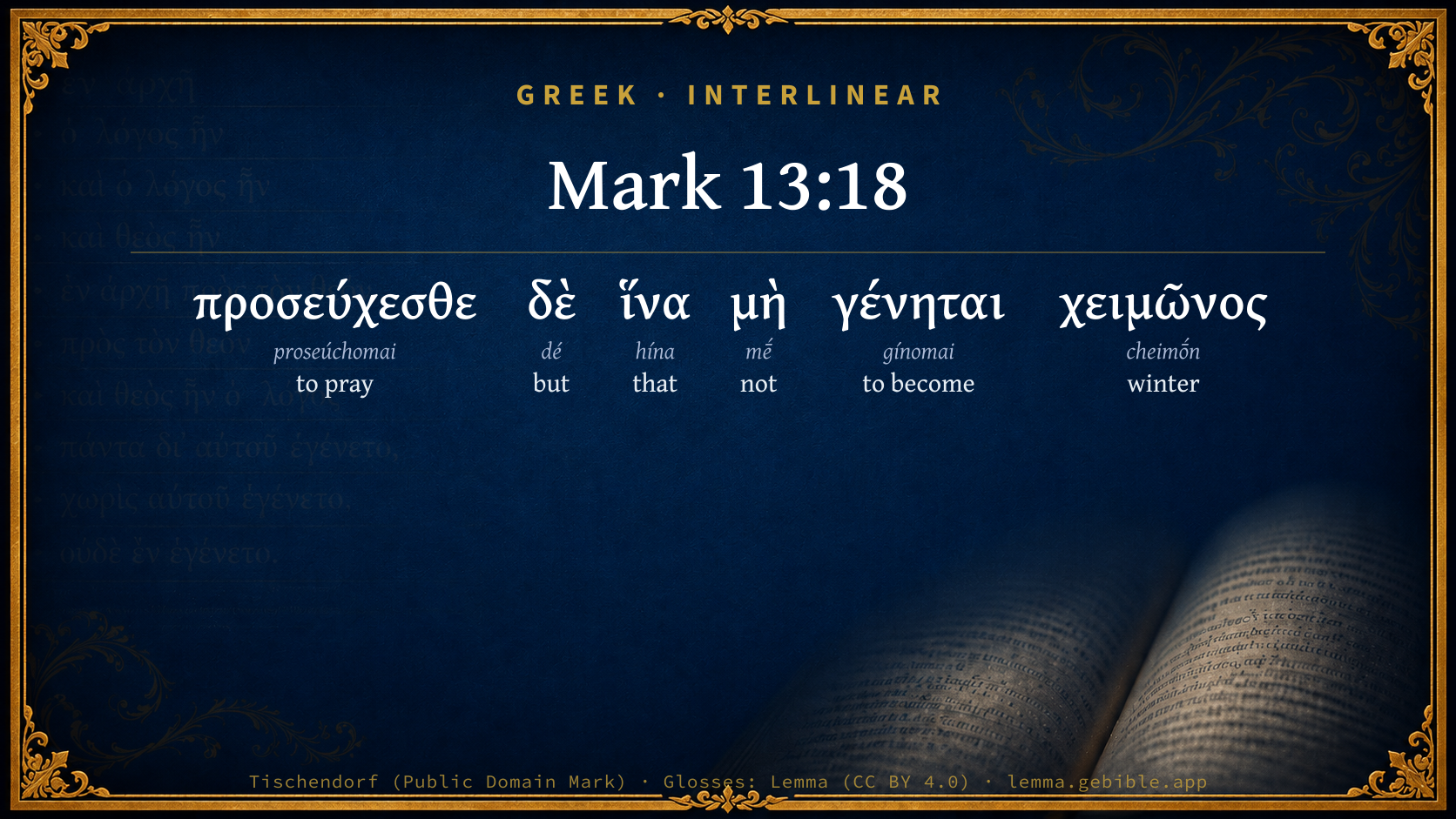
Greek (Tischendorf 8th ed.) Mark 13:18 appears in the Greek New Testament. The text above is from the Tischendorf 8th edition. Each word links to its Strong’s number and a concise gloss. Click any word for its full Thayer’s Greek Lexicon entry.
Download image
Cite this verse

Mark 13:18 (World English Bible). Public Domain. Lemma interlinear Bible study tool, https://lemma.gebible.app/v/mark/13/18.

Show BibTeX & RIS
BibTeX
RIS
English Translation
Pray that your flight won't be in the winter.
World English Bible · Public Domain
Download a study sheet

One document with this verse’s original text, its word-by-word gloss line, the meaning frame, cross-references with their text, attributed commentary, and full source and license credits — printable, and it pastes into notes with its structure intact.

This verse Autodidact and up

Study sheet (.html) Plain text (.txt)

A passage Seminary Student

Up to 50 verses in one chapter. A passage sheet keeps up to 6 commentary sources and 12 cross-references per verse, in the order this page ranks them, and says so on the sheet whenever that leaves anything out. Ask for a single verse and you get the Autodidact verse sheet above.

Everything on this page stays free to read, with no account — the sheet is a download of what is already on screen, not access to it.

Want to remove ads? Support Godless Engineer
Compare translations 3

The same verse in 3 English versions, stacked beneath the original-language interlinear above. Click any original word for its lexicon entry.

Each is an independent rendering of the whole verse — the interlinear is not word-aligned to these translations.

Highlighted words mark where these versions differ — a whole-verse word diff, not a word-by-word alignment.

  • World English Bible Public Domain
    Pray that your flight won't be in the winter.
  • King James Version Public Domain
    And pray ye that your flight be not in the winter.
  • unfoldingWord Literal Text CC BY-SA 4.0
    But pray that it might not happen in winter.

unfoldingWord Literal Text — © unfoldingWord, licensed CC BY-SA 4.0. Word-aligned USFM3 via Door43 (git.door43.org/unfoldingWord/en_ult).

Versions to compare (up to 4)

3 of 4 selected

Show all 19 translations

Every available English version of this verse, each an independent rendering of the whole verse.

  • World English Bible Public Domain
    Pray that your flight won't be in the winter.
  • Berean Standard Bible Public Domain
    Pray that this will not occur in the winter.
  • Majority Standard Bible Public Domain
    Pray that your flight will not occur in the winter.
  • King James Version Public Domain
    And pray ye that your flight be not in the winter.
  • American Standard Version (1901) Public Domain
    And pray ye that it be not in the winter.
  • Revised Version (1885) Public Domain
    And pray ye that it be not in the winter.
  • Geneva Bible (1599) Public Domain
    Pray therefore that your flight be not in the winter.
  • Douay-Rheims (1899) Public Domain
    But pray ye, that these things happen not in winter.
  • Young's Literal Translation Public Domain
    and pray ye that your flight may not be in winter,
  • Literal Standard Version CC BY-SA 4.0
    and pray that your flight may not be in winter,
  • Unlocked Literal Bible CC BY-SA 4.0
    Pray that it might not occur in the winter.
  • unfoldingWord Literal Text CC BY-SA 4.0
    But pray that it might not happen in winter.
  • Darby Bible Public Domain
    And pray that it may not be in winter time;
  • World Messianic Bible Public Domain
    Pray that your flight won’t be in the winter.
  • Webster's Bible Public Domain
    And pray ye that your flight be not in the winter.
  • Free Bible Version CC BY-SA 4.0
    Pray that this won't happen during the winter.
  • Bible in Basic English Public Domain
    And say a prayer that it may not be in the winter.
  • Text-Critical English NT CC BY 4.0
    Pray that your flight will not happen in winter.
  • Tyndale New Testament (1534) Public Domain
    But praye that youre flyght be not in the wynter.

Literal Standard Version (2020), Covenant Press — licensed CC BY-SA 4.0. Text via the HelloAO Bible API (eBible.org). Unlocked Literal Bible (unfoldingWord) — licensed CC BY-SA 4.0. Text via the HelloAO Bible API (eBible.org). unfoldingWord Literal Text — © unfoldingWord, licensed CC BY-SA 4.0. Word-aligned USFM3 via Door43 (git.door43.org/unfoldingWord/en_ult). Free Bible Version, Dr. Jonathan Gallagher — licensed CC BY-SA 4.0. Text via the HelloAO Bible API (eBible.org).

Word by word

More ways to search: Search by grammar → Find every occurrence → Compare this word →

Practice this passage: Drill this verse → Learn its vocabulary →

About this verse

These counts appear in no published source. They are computed here, from the morphology-tagged text and Lemma’s own curated glosses. What Lemma adds →

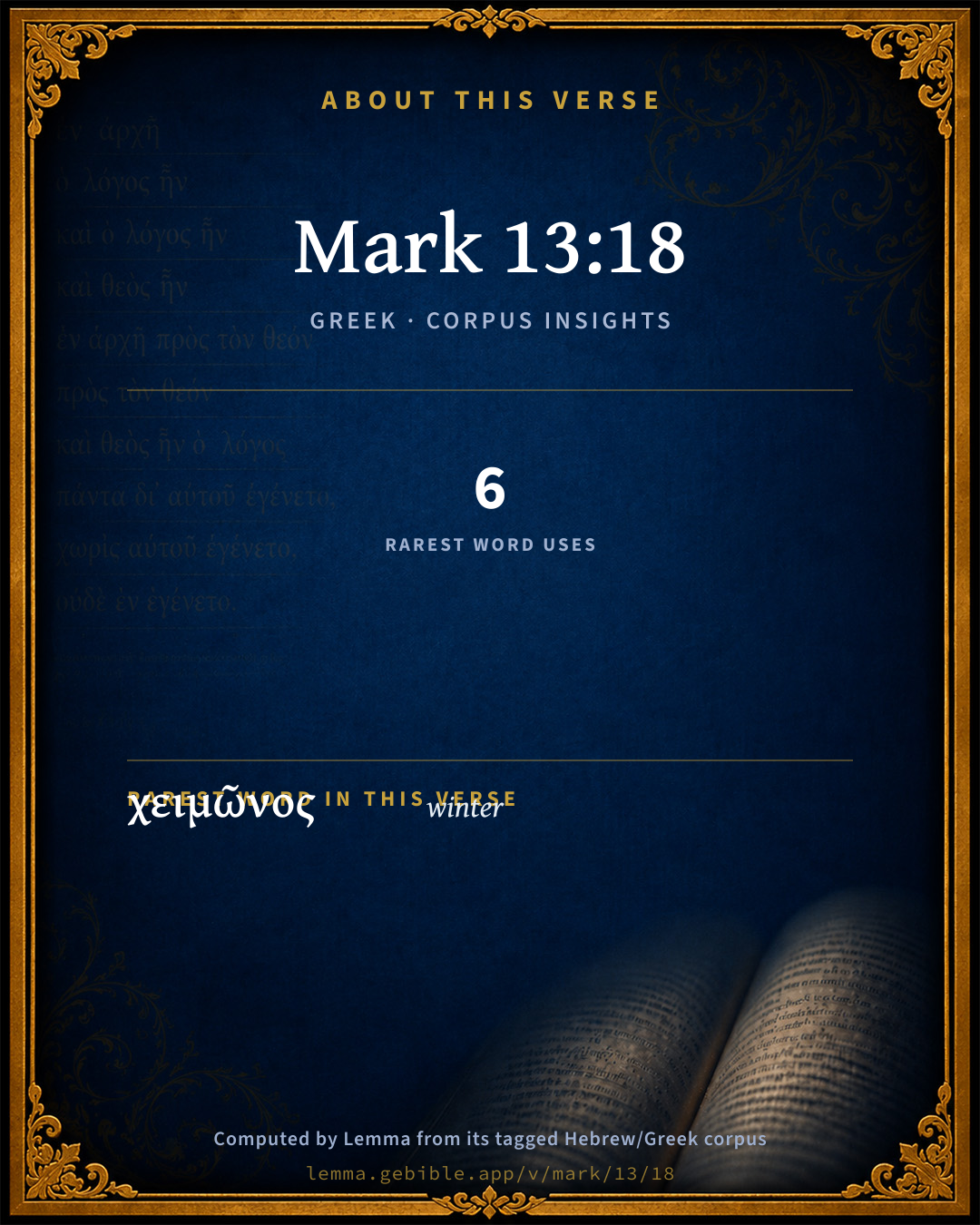
6
words
6
distinct lemmas
Gospels
section

Notable vocabulary

The rarest word here is χειμῶνος winter G5494 — appearing just 6 times in the whole Greek New Testament.

Shared distinctive vocabulary

χειμῶνος winter G5494 occurs in 6 verses of the Greek New Testament. Also found in:

Where the printed editions differ

1 variant

Places in this verse where the major printed Greek editions disagree on the wording in a way that affects the translation — a comparison of editions, not a manuscript-by-manuscript collation. The editions are the modern critical texts (Nestlé-Aland 28/27, SBL, Westcott-Hort, Tregelles, Tyndale House) and the traditional texts behind the KJV (the Textus Receptus and the Byzantine/Majority text). It is not a claim about which reading is original.

  1. Extra text
    ἡ φυγὴ ὑμῶν

    “the flight of you”

    In TRByz Not in NA28NA27TynSBLWHTreg

    ἡ φυγὴ ὑμῶν (hē phugē humōn) 'the flight of you' is only in traditional manuscripts (TR+Byz)

Textual data: Translators Amalgamated Greek New Testament (STEPBible TAGNT) · CC BY 4.0.

Commentary

Notes on Mark 13:18 from classic Christian and Jewish commentators (each source and its license shown beneath its notes). The classic Christian expositions comment on the surrounding passage and are grouped to its opening verse, so a note may address several verses; the Jewish commentaries on the Tanakh (Rashi and others) are per-verse, so they appear only where the commentator wrote on this verse.

Lemma curates 59 commentaries, every one of them public domain or Creative Commons licensed, each selected and text-cleaned for this edition rather than reprinted as found. About our sources →

The Biblical Illustrator

Joseph S. Exell

Mar_13:18

That your flight be not in the winter.

The difficulty of conversion in old age

There is a winter in human life, as there is a winter in the seasons of the year. Infancy is our spring; and the bud of existence which is then nourished and cherished, opens its flowers during the summer of youth. In riper years, and in the vigour of manhood, the fruit is put forth and this period we call the autumn of our days. But if death spare us a little longer, there will come ice in the blood, and snow on the brow; and all the emblems of a moral winter are thickly strewed over the man. And if there has been no fleeing to the mercy of the Lord, whilst the advance of summer and autumn has warned us that our year would soon draw to a close, it will be a hard thing, and a scarcely possible thing, when the limb has grown rigid, when the blood is congealed, and when the branches hang withered from the stem, to drag ourselves along; and the man, in the winter of his days, when his foot is halting, and his eye is darkening, and his blood is freezing, is so unfitted to brave the difficulties of the rugged path of winter, that no consideration should have more weight with the young and with the impenitent than the recommendation of our text. It will not be supposed, then, that, by any of my statements, I do at all limit the operations of grace, or insinuate that there can be no flight during the winter because there has been none before the winter. On the contrary, the mere fact of its being subject of prayer that our flight may not be in the winter, implies that flight is at the least practicable, though not then easy. First, the difficulty of flight in the winter.

Secondly, the danger that flight, if deferred to the winter, will not then be practicable.

I. The difficulty of flight in the winter; or, to drop the metaphor, the difficulty of conversion in old age. The Spirit doth strive with everyone; and by secret admonitions and suggestions, by working upon hope and exciting fear, it does summon all men to consider their ways, and allows not that any sinner should go on in transgression, and not have its ruinous result set before him. Well, then, if this statement be accurate-if it be true that all men are plied with inducements and threatenings, and that the Divine machinery is brought to bear on their consciences; it follows that the aged sinner must have resisted many godly motions: and now he stands, in the winter of his days, the hero of a succession of victories. But then, they have been victories won by the lust of the flesh, by the lust of the eye, and by the pride of life-over the benevolent strivings of holy angels, and the merciful interpositions of Deity Himself. And I ask whether it will not be necessarily true, that the man who has resisted such impressions will be found correspondently hardened against threatenings. The aged sinner must have been successful in stifling anxiety, and in drowning conscience: and thus he hath closed up, so to speak, the common avenues through which the gospel message finds entrance. Hence, there is less hope of the aged sinner. But not only has the aged sinner resisted much; but it will generally happen that he has invented much. He will have his own scheme of salvation: he will have devised some method of quieting alarm: he will have arranged some system of religion for himself. I cannot but suppose that this is ordinarily the case. I cannot suppose that there are many aged men, who give themselves no concern touching the things of eternity. Sometimes indeed we are presented with that sad spectacle-an old man hunting after money which his trembling hands cannot grasp; or an old woman tottering into the grave with a heap of new fashions hung on her shrivelled body. But I am ready to believe, that very commonly old people have some thought about the future; and, to use the common place phrase, cast up their account with God, and contrive by the most ingenious arithmetic to strike a balance in their own favour. They have sinned in their youth; but, thank God, He has given them time for repentance; and the seriousness of later years has made amends for the frivolities of the earlier. They may have offended a great deal, but then they have suffered a great deal; and the afflictions will be taken as an atonement for the transgression. Their lives have been excellent lives, no man was ever wronged by them: they were in trade for half a century, and kept unsullied the character of honourable dealers. They were engaged in the management of various societies, and received pieces of plate as compliments to their integrity. One old man is comforted because he has been a very moral man; and another, because he has been a very charitable man; and a third, because God is a God of wonderful mercy; and a fourth, because it is too late to alter, and things will probably not turn out so bad as they have been represented. I believe the observations I have thus advanced are grounds for deciding that conversion in the winter of life must be a work of great difficulty. It must be further obvious to you, that, as it would be in natural, so in spiritual things, the infirmities of the old man incapacitate him for flight. I ask you whether the old man, the withered man, the wasted man, is adapted for grappling with so stern a communication? Is his mind calculated to take in what is thus overpowering? Are his apprehensions likely to grasp the tidings in their length and breadth? Is one so timid, the being who is expected to arm for the battle, or to gird himself for the fight? If it be a time of hazard to set out upon a voyage when the vessel has just sprung a leak-and if it be an hour of peril to commence a journey in a foreign land when the sun has faded from the heavens-and it be a moment of danger to sit at the base of the mountain when the avalanche is just loosening from the heights-and it be an instant of imminent risk when the drawbridge is trembling between us and the citadel-then is old age and winter a dangerous season for man to flee from his present condition.

II. We have thus shown you that great difficulties are attendant on flight in the winter. We are next to consider the danger that flight, if deferred to the winter, will not then be practicable; in other words, the grounds for believing, that, if men repent not before old age, they will never repent at all. One reason for praying against postponement is, the possibility that flight, if delayed, may never take place. It is a trite saying, that tomorrow never comes; and I may add, that few men practically think themselves a year nearer the grave, because they are a year older. Once more. It is the testimony of experience that men are seldom converted in old age. Who, then, would defer flight, when the Almighty is inviting him to join the ranks of the redeemed? Let us address ourselves to the journey. The days are short, and the sunbeams are watery; the time for repentance may soon be at an end. (H. Melvill, B. D.)

Winter useful and beautiful

However disagreeable a very severe winter may be, in some respects, it yet serves most important purposes. The sap retires from the extremities of shrubs and trees, and takes refuge in the roots, thus giving them a time to rest and recuperate. The covering of snow which is spread over the earth protects the grass and the grain, and keeps all things which grow out of the ground snug and warm. Moreover, the nipping frost kills off the myriad hordes of insects; dries up the seeds of infectious and deadly diseases; improves the blood, on which our very existence depends; and gives new vigour to the worn-out and wasted system. Consumptive patients are no longer sent to gasp and faint beneath the orange groves of a debilitating southern clime, but uniform and invigorating cold weather is found much better for them. Winter, besides being an useful season, is certainly a very beautiful one. The earth spread smoothly over with its white coverlid; the icy tracery of the trees; and the fantastic pictures which the frost draws on the window panes-what could be more beautiful than these? The goodness of our heavenly Father is plainly discovered in the provision which He makes for the lower orders of creation, to protect them from the rigours of winter. The more delicate birds are instructed by their instincts to fly off to warmer latitudes. The creatures which are to remain behind, need not go to clothing stores for thick coats! The fur, and hair, and feathers on their bodies, are made abundantly warm to protect them; and the colder the winter which is approaching, the better does their gracious Creator provide for them. (J. N. Norton, D. D.)

Flight in winter

Many of you will remember an instance of such a flight, which was disastrous in the extreme. In the autumn of 1812, Napoleon entered Moscow with 120,000 soldiers, intending to pass the winter there in comfort. On the 13th of October (three weeks earlier than it had ever been known before), snow began to fall. The proud Emperor looked out of his window in dismay, and decided to hasten back at once, and establish his winter quarters in the friendly cities of Poland. It was a march through a dreary and desolate region, of more than a thousand miles; but he put on a bold front, and the troops began to retire in good order. A week later, and the grand army was in full retreat. Bleak, chilly winds howled through the leafless trees; the weary soldiers were blinded by the flakes of snow and sleet; their embittered enemies attacked them in every unguarded point; order and discipline were forgotten; the ranks were broken, and each man struggled on as best he could; the dead and the dying were trodden down; hundreds of horses were slain for food; all ideas of conquest were banished; Napoleon himself left the army to its fate; and each days weary march was marked by heaps of broken wagons, and abandoned cannon, and white hillocks of snow, beneath which the frozen bodies of man and beast were buried. With such a dreadful picture of misery before you, it will be easy to understand the tender compassion which prompted the Saviour to say: Pray ye that your flight be not in the winter. Especially ought we to remember those who are suffering the sad privations of poverty, and be glad to relieve their wants when we are able. No one can claim to have the love of God abiding in his heart, who is willing to see a fellow mortal destitute of food and clothing, and make no effort to help. The more merciful we are, the better shall we deserve to be called Gods children. (J. N. Norton, D. D.)

A blasphemers death in the snow

It was near the close of one of those storms that deposit a great volume of snow upon the earth that a middle-aged man, in one of the southern counties of Vermont, seated himself at a large fire in a log house. He was crossing the Green Mountains from the western to the eastern side; he had stopped at the only dwelling of man in a distance of more than twenty miles, being the width of the parallel ranges of gloomy mountains; he was determined to reach his dwelling on the eastern side that day. In reply to a kind invitation to tarry in the house and not dare the horrors of the increasing storm, he declared that he would go, and that the Almighty was not able to prevent him. His words were heard above the howling of the tempest. He travelled from the mountain valley where he had rested over one ridge, and one more intervened between him and his family. The labour of walking in that deep snow must have been great, as its depth became near the stature of a man; yet he kept on, and arrived within a few yards of the last summit, from whence he could have looked down upon his dwelling. He was near a large tree, partly supported by its trunk; his body bent forward, and his ghastly intent features told the stubbornness of his purpose to overpass that little eminence. But the Almighty had prevented him; the currents of his blood were frozen. For more than thirty years that tree stood by the solitary road, scarred to the branches with names, letters, and hieroglyphics of death, to warn the traveller that he trod over a spot of fearful interest. (Baxendales Dictionary of Anecdote.)

The Biblical Illustrator, edited by Joseph S. Exell (c. 1880s–1900s) — public domain. Text from a community e-Sword module.

Tyndale Open Study Notes

Tyndale Open Resources

13:18 In winter, the wadis (canyon-like riverbeds) are flooded, travel is more difficult, and survival is harder.

Tyndale Open Study Notes — © Tyndale Open Resources, licensed CC BY-SA 4.0. Text via the HelloAO Bible API.

Expositor's Greek Testament

ed. W. Robertson Nicoll

Mar 13:18 . ἵνα μὴ γένηται , that it may not be; what not said, φυγὴ (T.R.) being omitted in best texts = the nameless horror which makes flight imperative, the awful crisis of Israel.

The Expositor's Greek Testament, edited by W. Robertson Nicoll (1897–1910) — public domain. Text from a community e-Sword module.

Ellicott's Commentary for English Readers

(18) Pray ye that your flight be not in the winter.—Note St. Mark’s omission of “nor on the Sabbath day,” which is prominent in St. Matthew’s report, as characteristic of a Gospel for Gentile readers.

A Bible Commentary for English Readers, edited by Charles John Ellicott (1878–1897) — public domain. Text from a community e-Sword module.

The Cambridge Bible for Schools and Colleges

gen. ed. J. J. S. Perowne

18. be not in the winter] with its rains and storms and swollen torrents, “neither,” as St Matthew adds (Mat_24:20), “on the Sabbath day.” We may well believe that the Christians made both these petitions theirs. At any rate we know what did take place. (a) The compassing of the city by the Roman armies spoken of by St Luke (Luk_24:20) took place at the commencement of October, a.d. 66, when the weather was yet mild and favourable for travelling, (b) The final siege, if any Christian Jews lingered on till then, took place in the still more open months of April or May. See Lewin’s Fasti Sacri, p. 344 and p. 358. The Jewish custom, which forbade travelling on the Sabbath beyond a distance of 2000 ells, would make the Christian Jews’ travelling on that day infinitely more difficult, even though they might themselves be possibly free from any scruple. “They would in addition to other embarrassments, expose themselves to the severest persecutions of fanaticism.” Lange.

The Cambridge Bible for Schools and Colleges (gen. ed. J. J. S. Perowne; Cambridge University Press, 1878–1918) — public domain. Text from a community e-Sword module.

John Gill's Exposition

And except that the Lord had shortened those days,.... Had determined that those days of affliction should be but few, and not last long; that the siege should not be longer continued, and the devastations within and without be prolonged:

no flesh should be saved; there would not have been a Jew left; that nation and race of men must have been utterly destroyed from off the face of the earth:

but for elect's sake, whom he hath chosen; in Christ, unto eternal salvation; who were either then upon the spot, called or uncalled, or that were to spring from in succeeding times:

he hath shortened the days; he hath determined they shall be but few, that a remnant might be saved, and among them his elect; or from whom should descend, such as he had chosen, who should be saved with an everlasting salvation: though the people in general have been given up to blindness and unbelief, yet they are preserved as a distinct people in the world; and in the latter day will be called and converted, and all Israel shall be saved and therefore it was the will of God to shorten those days of affliction, that they might not be entirely cut off, but that a number might be left, as a stock for future ages; See Gill on Mat 24:22.

John Gill's Exposition of the Whole Bible (1746–1763) — public domain (CC PDM 1.0). Text via the HelloAO Bible API.

Trapp's Complete Commentary

John Trapp

18 And pray ye that your flight be not in the winter.

Ver. 18. {See Trapp on "Mat 24:20"}

John Trapp, A Commentary or Exposition upon All the Books of the Old and New Testament (1647–1656) — public domain. Text from a community e-Sword module.

The Pulpit Commentary

And pray ye that it be not in the winter. According to the best authorities, "your flight" (h fugh umwn) is omitted, but the meaning remains very much the same. St. Matthew (Mat_24:20) adds, "neither on a sabbath." But this would be comparatively of little interest to those to whom St. Mark was writing. Our Lord thus specifies the winter, because at that season, on account of the cold and snow, flight would be attended with special difficulty and hardship, and would be almost impossible for the aged and infirm.

The Pulpit Commentary (1880–1919), ed. H.D.M. Spence-Jones & Joseph S. Exell — public domain. Text from a community e-Sword module.

The People's New Testament

B. W. Johnson

18. Pray ye that your flight be not in the winter. Matt. 24:20 adds, “neither on the Sabbath day.” The reasons for these monitions to the Jerusalem church are given in the notes on Matthew. The sign given by the Lord for the flight, the environment of the city by the Romans, and the panic that caused their sudden withdrawal, occurred on Tuesday, in October. Hence the flight was neither in the winter, nor on the Sabbath day.

B. W. Johnson's The People's New Testament with Notes (1889–1891) — public domain. Electronic text from the Christian Classics Ethereal Library (CCEL) ThML edition.

Cambridge Greek Testament for Schools and Colleges

18. [2954][2955][2956] omit ἡ φυγὴ ὑμῶν.

[2954] Codex Sinaiticus. 4th cent. Discovered by Tischendorf in 1859 at the Monastery of St Katharine on Mount Sinai. Now at St Petersburg. The whole Gospel, ending at Mar 16:8. Photographic facsimile, 1911.

[2955] Codex Vaticanus. 4th cent., but perhaps a little later than א. In the Vatican Library almost since its foundation by Pope Nicolas V., and one of its greatest treasures. The whole Gospel, ending at Mar 16:8. Photographic facsimile, 1889.

[2956] Codex Regius. 8th cent. An important witness. At Paris. Contains Mar 1:1 to Mar 10:15; Mar 10:30 to Mar 15:1; Mar 15:20 to Mar 16:20, but the shorter ending is inserted between Mar 16:8 and Mar 16:9, showing that the scribe preferred it to the longer one.

18. χειμῶνος. Gen. of time (Mat 2:14; Joh 3:2; Act 9:24). Either “in stormy weather” or “in winter” makes good sense, but the former is better (Mat 16:3; Act 27:20). Here prayer for temporal advantages is clearly sanctioned. Mt. shows Jewish feeling in adding μηδὲ σαββάτῳ. But Mk may have omitted this as having no interest for Gentile readers. Lk. is altogether different.

Cambridge Greek Testament for Schools and Colleges (Cambridge University Press, 1896; 21 vols, various authors incl. Carr, Maclear, Plummer, Farrar, Lumby, Moule, M. R. James, Simcox) — public domain. Text from a community e-Sword module.

Alford’s Greek Testament

Henry Alford

18.] Matt. adds μηδὲ ἐν σαββάτῳ. Mark wrote mostly for Gentile readers, and thus perhaps was not likely to report this.

19,

Henry Alford, The Greek Testament (1849–1861) — public domain. Text from a community e-Sword module.

International Critical Commentary

18. προσεύχεσθε δὲ ἵνα μὴ γένηται χειμῶνος—And pray that it may not take place in the winter time. The catastrophe is meant, and not their flight. The reason given, viz. the unheard-of greatness of the calamity, shows this.

Omit ἡ φυγὴ ὑμῶν, your flight, Tisch. Treg. WH. RV. א * and ca BDL most mss. Lat. Vet. Vulg.

International Critical Commentary — older volumes (1896–1929), various authors — public domain. Text from a community e-Sword module.

Lesson kit

Teaching starters — assembled from the data on this page, not authored interpretation. Every prompt links to the verse data it draws on. Edit before teaching.

Mark, in the Gospels, opens this verse with 6 words (6 distinct Greek lemmas). Its most distinctive word is cheimṓn (“winter”). A historical commentator’s framing appears above. Read the whole chapter for the surrounding context.

Discussion questions

  1. The word cheimṓn carries the sense “winter.” How does it shape the verse?
  2. Matthew 16:3 shares the word «winter» with this verse. How do the two illuminate each other?
  3. The translations on this page render this verse differently — a whole-verse word diff, not a word-by-word alignment. What might account for the different wordings?
  4. Reading how The Biblical Illustrator and Tyndale Open Study Notes read this verse, where do the two commentators agree and where do they part?

Things to notice

Reading settings

Reading text

Shown beneath each verse's original-language words.

Old Testament
Old Testament edition

Read the OT as the Masoretic Hebrew (MT) or the Greek Septuagint (LXX).

English shown for the Greek Septuagint (in the Hebrew ↔ Greek comparison).

Comparing translations? Open the Compare panel on any verse page to stack up to four side by side.