
Matthew 17:27

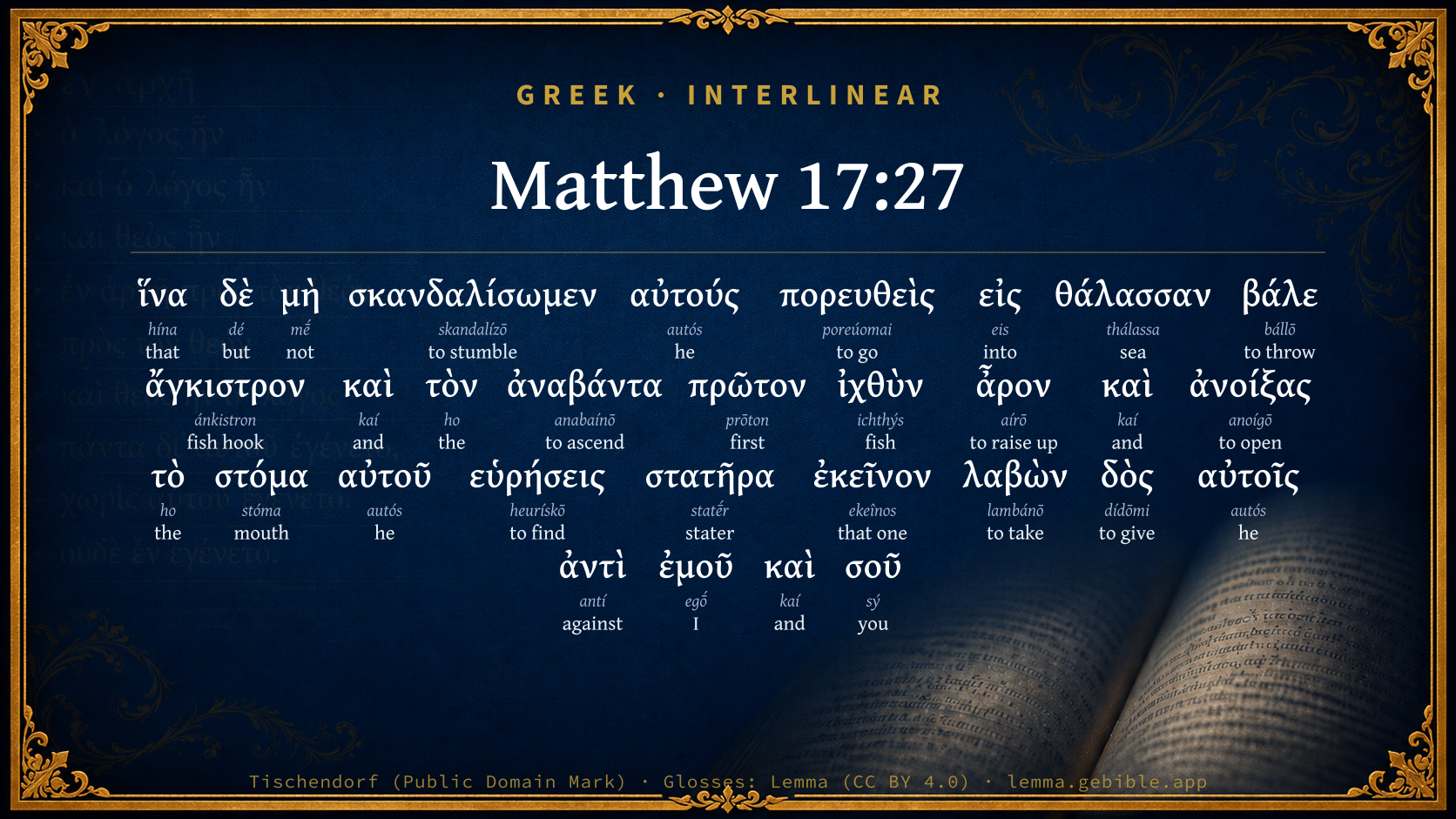
Greek (Tischendorf 8th ed.) Matthew 17:27 appears in the Greek New Testament. The text above is from the Tischendorf 8th edition. Each word links to its Strong’s number and a concise gloss. Click any word for its full Thayer’s Greek Lexicon entry.
Download image
Cite this verse

Matthew 17:27 (World English Bible). Public Domain. Lemma interlinear Bible study tool, https://lemma.gebible.app/v/matthew/17/27.

Show BibTeX & RIS
BibTeX
RIS
English Translation
But, lest we cause them to stumble, go to the sea, and cast a hook, and take up the first fish that comes up. When you have opened its mouth, you will find a stater coin. Take that, and give it to them for me and you."
World English Bible · Public Domain
Highlights
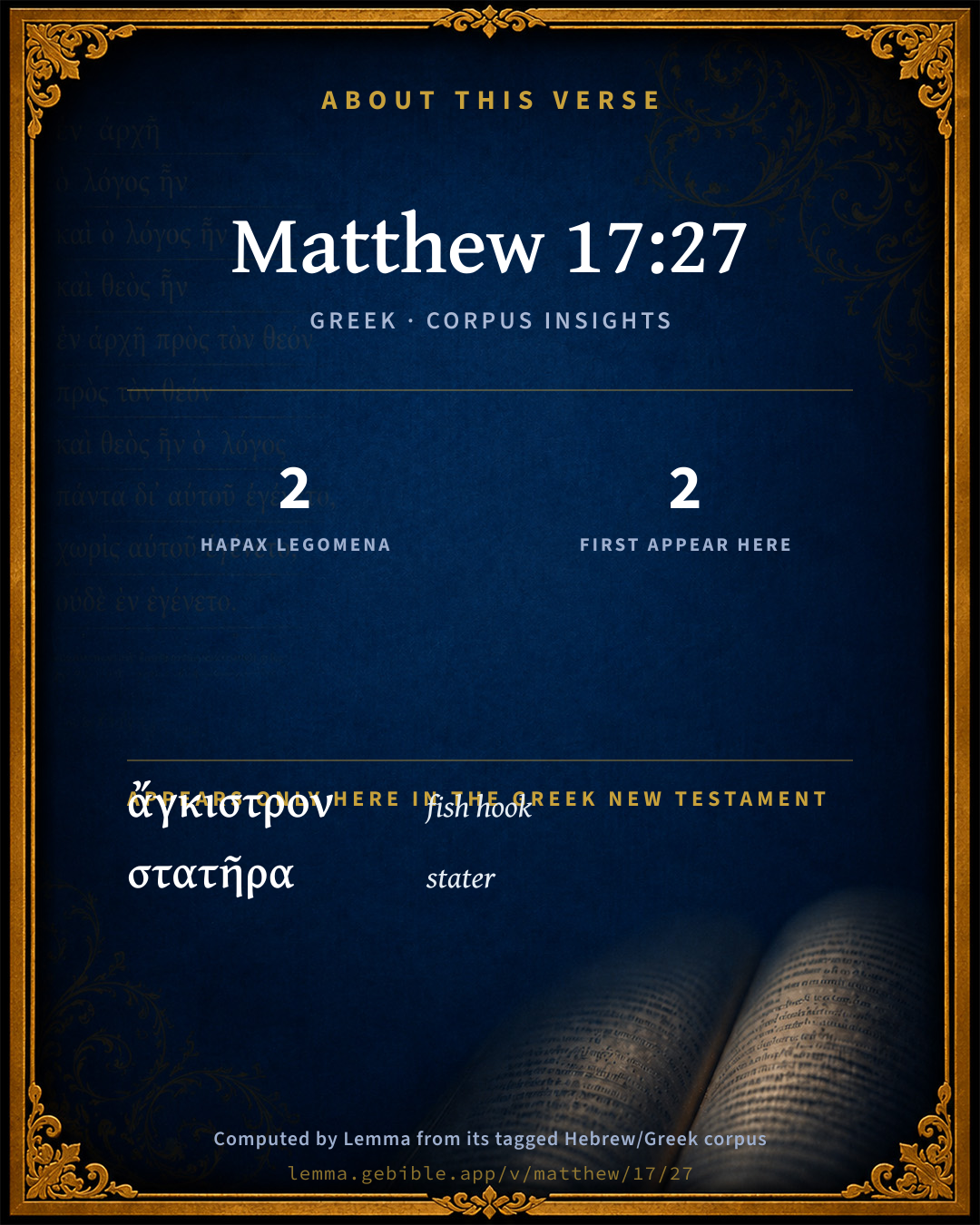
  • 2 hapax legomena — only here in the Greek New Testament
  • 2 first appearances in the Greek New Testament
Full analysis ↓
Download a study sheet

One document with this verse’s original text, its word-by-word gloss line, the meaning frame, cross-references with their text, attributed commentary, and full source and license credits — printable, and it pastes into notes with its structure intact.

This verse Autodidact and up

Study sheet (.html) Plain text (.txt)

A passage Seminary Student

Up to 50 verses in one chapter. A passage sheet keeps up to 6 commentary sources and 12 cross-references per verse, in the order this page ranks them, and says so on the sheet whenever that leaves anything out. Ask for a single verse and you get the Autodidact verse sheet above.

Everything on this page stays free to read, with no account — the sheet is a download of what is already on screen, not access to it.

Want to remove ads? Support Godless Engineer
Compare translations 3

The same verse in 3 English versions, stacked beneath the original-language interlinear above. Click any original word for its lexicon entry.

Each is an independent rendering of the whole verse — the interlinear is not word-aligned to these translations.

Highlighted words mark where these versions differ — a whole-verse word diff, not a word-by-word alignment.

  • World English Bible Public Domain
    But, lest we cause them to stumble, go to the sea, and cast a hook, and take up the first fish that comes up. When you have opened its mouth, you will find a stater coin. Take that, and give it to them for me and you."
  • King James Version Public Domain
    Notwithstanding, lest we should offend them, go thou to the sea, and cast an hook, and take up the fish that first cometh up; and when thou hast opened his mouth, thou shalt find a piece of money: that take, and give unto them for me and thee.
  • unfoldingWord Literal Text CC BY-SA 4.0
    But in order that we might not cause them to stumble, having gone to the sea, throw in a fishhook, and draw in the first fish having come up. And having opened its mouth, you will find a shekel. Having taken that, give to them on behalf of me and you.”

unfoldingWord Literal Text — © unfoldingWord, licensed CC BY-SA 4.0. Word-aligned USFM3 via Door43 (git.door43.org/unfoldingWord/en_ult).

Versions to compare (up to 4)

3 of 4 selected

Show all 18 translations

Every available English version of this verse, each an independent rendering of the whole verse.

  • World English Bible Public Domain
    But, lest we cause them to stumble, go to the sea, and cast a hook, and take up the first fish that comes up. When you have opened its mouth, you will find a stater coin. Take that, and give it to them for me and you."
  • Berean Standard Bible Public Domain
    “But so that we may not offend them, go to the sea, cast a hook, and take the first fish you catch. When you open its mouth, you will find a four-drachma coin. Take it and give it to them for My tax and yours.”
  • Majority Standard Bible Public Domain
    “But so that we may not offend them, go to the sea, cast a hook, and take the first fish you catch. When you open its mouth, you will find a four-drachma coin. Take it and give it to them for My tax and yours.”
  • King James Version Public Domain
    Notwithstanding, lest we should offend them, go thou to the sea, and cast an hook, and take up the fish that first cometh up; and when thou hast opened his mouth, thou shalt find a piece of money: that take, and give unto them for me and thee.
  • American Standard Version (1901) Public Domain
    But, lest we cause them to stumble, go thou to the sea, and cast a hook, and take up the fish that first cometh up; and when thou hast opened his mouth, thou shalt find a shekel: that take, and give unto them for me and thee.
  • Revised Version (1885) Public Domain
    But, lest we cause them to stumble, go thou to the sea, and cast a hook, and take up the fish that first cometh up; and when thou hast opened his mouth, thou shalt find a shekel: that take, and give unto them for me and thee.
  • Geneva Bible (1599) Public Domain
    Neuerthelesse, lest we should offend them: goe to the sea, and cast in an angle, and take the first fish that commeth vp, and when thou hast opened his mouth, thou shalt finde a piece of twentie pence: that take, and giue it vnto them for me and thee.
  • Young's Literal Translation Public Domain
    but, that we may not cause them to stumble, having gone to the sea, cast a hook, and the fish that hath come up first take thou up, and having opened its mouth, thou shalt find a stater, that having taken, give to them for me and thee.'
  • Literal Standard Version CC BY-SA 4.0
    but that we may not cause them to stumble, having gone to the sea, cast a hook, and the fish that has come up first take up, and having opened its mouth, you will find a stater, that having taken, give to them for Me and you.”
  • Unlocked Literal Bible CC BY-SA 4.0
    But so that we do not cause the tax collectors to sin, go to the sea, throw in a hook, and draw in the fish that comes up first. When you have opened its mouth, you will find a shekel. Take it and give it to the tax collectors for me and you.”
  • unfoldingWord Literal Text CC BY-SA 4.0
    But in order that we might not cause them to stumble, having gone to the sea, throw in a fishhook, and draw in the first fish having come up. And having opened its mouth, you will find a shekel. Having taken that, give to them on behalf of me and you.”
  • Darby Bible Public Domain
    But that we may not be an offence to them, go to the sea and cast a hook, and take the first fish that comes up, and when thou hast opened its mouth thou wilt find a stater; take that and give it to them for me and thee.
  • World Messianic Bible Public Domain
    But, lest we cause them to stumble, go to the sea, cast a hook, and take up the first fish that comes up. When you have opened its mouth, you will find a stater coin. Take that, and give it to them for me and you.”
  • Webster's Bible Public Domain
    Notwithstanding, lest we should offend them, go thou to the sea, and cast a hook, and take the fish that first cometh up: and when thou hast opened his mouth, thou shalt find a piece of money: take that, and give to them for me and thee.
  • Free Bible Version CC BY-SA 4.0
    But to avoid giving offense to anyone, go to the lake, and throw out a fishing line with a hook. Pull in the first fish you catch, and when you open its mouth there you'll find a stater coin. Take the coin and give it to them for both me and you.”
  • Bible in Basic English Public Domain
    But, so that we may not be a cause of trouble to them, go to the sea, and let down a hook, and take the first fish which comes up; and in his mouth you will see a bit of money: take that, and give it to them for me and you.
  • Text-Critical English NT CC BY 4.0
    But so that we may not offend them, go to the sea, cast a hook, and take the first fish yoʋ catch. When yoʋ open its mouth, yoʋ will find a stater coin. Take it and give it to them for yoʋ and me.”
  • Tyndale New Testament (1534) Public Domain
    Neverthelesse lest we shuld offende the: goo to the see and cast in thyne angle and take the fysshe that fyrst cometh vp: and when thou hast opened his mouthe thou shalt fynde a pece of twentie pence: that take and paye for me and the.

Literal Standard Version (2020), Covenant Press — licensed CC BY-SA 4.0. Text via the HelloAO Bible API (eBible.org). Unlocked Literal Bible (unfoldingWord) — licensed CC BY-SA 4.0. Text via the HelloAO Bible API (eBible.org). unfoldingWord Literal Text — © unfoldingWord, licensed CC BY-SA 4.0. Word-aligned USFM3 via Door43 (git.door43.org/unfoldingWord/en_ult). Free Bible Version, Dr. Jonathan Gallagher — licensed CC BY-SA 4.0. Text via the HelloAO Bible API (eBible.org).

Word by word

More ways to search: Search by grammar → Find every occurrence → Compare this word →

Practice this passage: Drill this verse → Learn its vocabulary →

ἄγκιστρον
ánkistron
G44
“fish hook”
Noun, Accusative, Singular, Neuter
Part of Speech
Noun
Case
Accusative
Number
Singular
Gender
Neuter
Full Thayer's Definition

Origin: from the same as G43

TDNT: None

1. a fishing hook, a small hook
  1. ἵνα hína G2443 “that” Conjunction
  2. δὲ dé G1161 “but” Conjunction
  3. μὴ mḗ G3361 “not” Particle, Negative
  4. σκανδαλίσωμεν skandalízō G4624 “to stumble” Verb, Aorist, Active, Subjunctive, 1st person, Plural
  5. αὐτούς autós G846 “he” Personal pronoun, Accusative, Plural, Masculine
  6. πορευθεὶς poreúomai G4198 “to go” Verb, Aorist, Passive deponent, Participle, Nominative, Singular, Masculine
  7. εἰς eis G1519 “into” Preposition
  8. θάλασσαν thálassa G2281 “sea” Noun, Accusative, Singular, Feminine
  9. βάλε bállō G906 “to throw” Verb, Aorist, Active, Imperative, 2nd person, Singular
  10. καὶ kaí G2532 “and” Conjunction
  11. τὸν ho G3588 “the” Article, Accusative, Singular, Masculine
  12. ἀναβάντα anabaínō G305 “to ascend” Verb, Aorist, Active, Participle, Accusative, Singular, Masculine
  13. πρῶτον prōton G4412 “first” Adverb, Superlative
  14. ἰχθὺν ichthýs G2486 “fish” Noun, Accusative, Singular, Masculine
  15. ἆρον aírō G142 “to raise up” Verb, Aorist, Active, Imperative, 2nd person, Singular
  16. καὶ kaí G2532 “and” Conjunction
  17. ἀνοίξας anoígō G455 “to open” Verb, Aorist, Active, Participle, Nominative, Singular, Masculine
  18. τὸ ho G3588 “the” Article, Accusative, Singular, Neuter
  19. στόμα stóma G4750 “mouth” Noun, Accusative, Singular, Neuter
  20. αὐτοῦ autós G846 “he” Personal pronoun, Genitive, Singular, Masculine
  21. εὑρήσεις heurískō G2147 “to find” Verb, Future, Active, Indicative, 2nd person, Singular
  22. στατῆρα statḗr G4715 “stater” Noun, Accusative, Singular, Masculine
  23. ἐκεῖνον ekeînos G1565 “that one” Demonstrative pronoun, Accusative, Singular, Masculine
  24. λαβὼν lambánō G2983 “to take” Verb, Aorist, Active, Participle, Nominative, Singular, Masculine
  25. δὸς dídōmi G1325 “to give” Verb, Aorist, Active, Imperative, 2nd person, Singular
  26. αὐτοῖς autós G846 “he” Personal pronoun, Dative, Plural, Masculine
  27. ἀντὶ antí G473 “against” Preposition
  28. ἐμοῦ egṓ G1473 “I” Personal pronoun, 1st person, Genitive, Singular
  29. καὶ kaí G2532 “and” Conjunction
  30. σοῦ sý G4771 “you” Personal pronoun, 2nd person, Genitive, Singular

About this verse

These counts appear in no published source. They are computed here, from the morphology-tagged text and Lemma’s own curated glosses. What Lemma adds →

31
words
26
distinct lemmas
Gospels
section

Notable vocabulary

2 hapax legomena — words that appear only here in the entire Greek New Testament:

  • ἄγκιστρον fish hook G44
  • στατῆρα stater G4715

First appearance in Scripture

These words make their first canonical appearance in the Greek New Testament here:

  • ἄγκιστρον fish hook G44
  • στατῆρα stater G4715

Shared distinctive vocabulary

ἰχθὺν fish G2486 occurs in 18 verses of the Greek New Testament. Also found in:
Repetition

Words recur within this verse:

  • αὐτούς he G846 ×3
  • καὶ and G2532 ×3
  • τὸν the G3588 ×2

Cross-references

17

Topical passages linked to Matthew 17:27 in the Treasury of Scripture Knowledge — connected by theme and wording, ordered by reader-vote popularity; previews shown in the World English Bible.

  • 2 Corinthians 6:3 We give no occasion of stumbling in anything, that our service may not be blamed,
  • 1 Corinthians 8:9 But be careful that by no means does this liberty of yours become a stumbling block to the weak.
  • 1 Corinthians 9:19–22 For though I was free from all, I brought myself under bondage to all, that I might gain the more.
  • 2 Corinthians 8:9 For you know the grace of our Lord Jesus Christ, that, though he was rich, yet for your sakes he became poor, that you through his poverty might become rich.
  • 1 Corinthians 8:13 Therefore, if food causes my brother to stumble, I will eat no meat forevermore, that I don't cause my brother to stumble.
  • Romans 15:1–3 Now we who are strong ought to bear the weaknesses of the weak, and not to please ourselves.
  • Jonah 1:17 Yahweh prepared a great fish to swallow up Jonah, and Jonah was in the belly of the fish three days and three nights.
  • Matthew 15:12–14 Then the disciples came, and said to him, "Do you know that the Pharisees were offended, when they heard this saying?"
  • 1 Kings 17:4 It shall be, that you shall drink of the brook; and I have commanded the ravens to feed you there.
  • Psalms 8:8 The birds of the sky, the fish of the sea, And whatever passes through the paths of the seas.
  • Romans 14:21 It is good to not eat meat, drink wine, nor do anything by which your brother stumbles, is offended, or is made weak.
  • Genesis 1:28 God blessed them. God said to them, "Be fruitful, multiply, fill the earth, and subdue it. Have dominion over the fish of the sea, over the birds of the sky, and over every living thing that moves on the earth."
  • Jonah 2:10 Yahweh spoke to the fish, and it vomited out Jonah on the dry land.
  • 1 Corinthians 10:32–33 Give no occasions for stumbling, either to Jews, or to Greeks, or to the assembly of God;
  • Hebrews 2:7–8 You made him a little lower than the angels; You crowned him with glory and honor.
  • James 2:5 Listen, my beloved brothers. Didn't God choose those who are poor in this world to be rich in faith, and heirs of the Kingdom which he promised to those who love him?
  • Titus 2:7–8 in all things showing yourself an example of good works; in your teaching showing integrity, seriousness, incorruptibility,

Cross-references courtesy of OpenBible.info (CC BY 4.0).

Commentary

Notes on Matthew 17:27 from classic Christian and Jewish commentators (each source and its license shown beneath its notes). The classic Christian expositions comment on the surrounding passage and are grouped to its opening verse, so a note may address several verses; the Jewish commentaries on the Tanakh (Rashi and others) are per-verse, so they appear only where the commentator wrote on this verse.

Lemma curates 59 commentaries, every one of them public domain or Creative Commons licensed, each selected and text-cleaned for this edition rather than reprinted as found. About our sources →

Adam Clarke's Commentary

Verse 27. Lest we - offend them] Be a stumbling-block to the priests, or rulers of the Jews, I will pay the tribute - go thou to the sea - cast a hook, and take the first fish - thou shalt find a piece of money, στατηρα, a stater. This piece of money was equal in value to four drachms, or two shekels, (five shillings of our money,) and consequently was sufficient to pay the tribute for our Lord and Peter, which amounted to about half-a-crown each. If the stater was in the mouth or belly of the fish before, who can help admiring the wisdom of Christ, that discovered it there? If it was not before in the mouth of the fish, who can help admiring the power of Christ, that impelled the fish to go where the stater had been lost in the bottom of the sea, take it up, come towards the shore where Peter was fishing, and, with the stater in its mouth or stomach, catch hold of the hook that was to draw it out of the water? But suppose there was no stater there, which is as likely as otherwise, then Jesus created it for the purpose, and here his omnipotence was shown; for to make a thing exist that did not exist before is an act of unlimited power, however small the thing itself may be. Some suppose that the haddock was the fish caught by Peter, because this fish has a blackish mark on each side of its neck or shoulders, as seems to exhibit the impression of a finger and thumb. The haddock is the gadus eglesinus. But this being a sea fish, could not be a native of the sea of Galilee or Tiberias, c., for the river Jordan runs through the sea of Galilee, and falls into the Dead Sea, which has no outlet to the ocean: no sea fish of any kind can be found there and we may add to this, that Belzoni, a learned traveller, who examined the produce of the lake of Tiberias, found only trouts, pikes, chevins, and tenches. That it may, besides these, have some fishes peculiar to itself, as most extensive fresh water lakes have, need not be denied; but it could have no sea fish.

THE account of the transfiguration, the peculiar case of the lunatic, with his cure, and the miracle wrought to pay the tribute money, render this one of the most interesting and instructive chapters in the New Testament.

1. To what has already been said on the subject of the transfiguration, nothing need be added: I have given that sense to it which the circumstances of the case, the construction of the words, and the analogy of faith warrant. That others have understood the whole transaction differently, is readily granted. Some of the foreign critics, who are also called divines, have stripped it, by their mode of interpretation, of all its strength, use, and meaning. With them, it is thus to be understood: - "Jesus, with his disciples, Peter, James, and John, went by night into a mountain, for the purpose of prayer and meditation; while thus engaged, the animal spirits of the disciples were overcome by watching and fatigue, and they fell asleep: in this sleep they dreamed, or Peter only dreamed, that he saw his Master encompassed with a glorious light, and that Moses and Elijah were conversing with him. That early in the morning, just as the sun was rising, there happened some electric or thunder - like explosions (a thing not unfrequent near some mountains) by which the disciples were suddenly awoke; that Peter, whose mind was strongly impressed with his dream, seeing the rising sun shine gloriously upon his Master, and his strongly impressed senses calling to remembrance his late vision, he for a moment imagined he saw, not only the glory of which he had dreamed, but the persons also - Moses and Elijah, still standing on the mount with Christ; that not being as yet sufficiently awake, finding the images impressed on his imagination fleeting away with his returning exercise of reason, he cried out, before he was aware, Lord! it is good for its to be here, let us make three tabernacles, c. but in a short time, having recovered the regular use of his senses, he perceived that it was a dream; and, having told it to our Lord and his brother disciples, lest the Jews might take occasion of jealousy from it, he was desired to tell the vision to no man." This is the substance of that strange explanation given by those learned men to this extraordinary transaction; a mode of interpretation only calculated to support that system which makes it an important point to deny and decry all supernatural and miraculous influence, and to explain away all the spirituality of the New Testament. Whatever ingenuity may be in this pretended elucidation, every unprejudiced person must see that it can never be brought to accord with the letter and concomitant circumstances of this most remarkable case.

2. The cure of the deaf and dumb lunatic has been treated, by the same critics, in nearly the same way, and for the same obvious design, namely, to exclude from the world all supernatural agency; and could they succeed in this, of what value, or, indeed, utility, could the whole New Testament be to mankind? We might be well astonished to find such a history, with such a great variety of curious and apparently interesting circumstances: - a wondrous person, labouring, preaching, suffering, dying, c., c., without having scarcely any thing in view, but a sort of merely moral reformation of the outward man! Truly, this: -

"Is like an ocean into tempest toss'd,

To waft a feather, or to drown a fly."

But the truth of God's miraculous interpositions, the miracles of the New Testament, demoniacal possessions and influence, the atonement, the inspiration of the Holy Spirit, the regeneration of the corrupted human heart, &c., &c,, must not be given up to please a certain description of persons, who have no commerce with God themselves, and cannot bear that others should either have or pretend to it.

3. The miracle wrought for the paying of the temple tribute money, is exceedingly remarkable. See Clarke on Mt 17:27, which brings this particularly to view. To what is there said, it may be added, that our Lord seems to have wrought this miracle for the following purposes: -

1. More forcibly to impress the minds of his disciples, and his followers in general, with the necessity and propriety of being subject to all the laws of the different states, kingdoms, &c., wheresoever the providence of God might cast their lot.

2. To show forth his own unlimited power and knowledge, that they might be fully convinced that he knew all things, even to the most minute and could do whatsoever he pleased and that both his wisdom and power were continually interested in behalf of his true disciples.

3. To teach all believers a firm trust and reliance on Divine Providence, the sources of which can never be exhausted; and which, directed by infinite wisdom and love, will make every provision essentially requisite for the comfort and support, of life. How many of the poor followers of Christ have been enabled to discern his kind hand, even in the means furnished them to discharge the taxes laid on them by the state! The profane and the unprincipled may deride, and mock on, but the people of God know it to be their duty, and their interest, to be subject to every ordinance of man for the Lord's sake; and, while his grace and providence render this obedience, in things both spiritual and secular, possible, his love, which their hearts feel, renders their duty their delight. The accomplishment of such ends as these is worthy both of the wisdom and benevolence of Christ.

Adam Clarke's Commentary on the Bible (1810–1826) — public domain. Text from a community e-Sword/MySword module.

The Biblical Illustrator

Joseph S. Exell

Mat_17:24; Mat_17:27

And when they were come to Capernaum, they that received tribute money came to Peter.

Christ and the tribute money

I. On what principle christ claimed exemption. This tax levied for temple services. On no principle but that of His being essentially Divine, and therefore not bound to contribute towards services virtually rendered to Himself. Christ was His own Temple.

II. The principle on which, nevertheless, he determined on paying the tax.

Not to put an occasion of stumbling in the way of others. How unwilling we are to withdraw pretensions. It requires Christian discretion to know when to give way. Christ surrendered no principle; He did not say that He was not the Son of God. He forbore from asserting it.

III. The miracle by which he procured the requisite money. Though the Proprietor of all things, He had made Himself poor for our sakes. He here gave proof of superhuman endowments; omniscience and omnipotence. He knew the money was in the mouth of the fish; His power was felt in the waters. There was propriety in the miracle when we consider which apostle our Lord dispatched on this errand. Had St. Matthew been sent the money would have been got differently, as he was a tax-gatherer; St. Peter was a fisherman, hence he got the money from a fish. Christ put honour on this honest occupation. We are not to neglect means because we seem to need miracles. (H. Melvill, B. D.)

The hidden coin

1. The Divine knowledge of the Lord Jesus Christ.

2. A lesson of moderation. The coin was only enough to pay the tax. Christ had am desire for earthly possessions.

3. For the purpose of supporting the ordinances of religion.

4. Learn to trust our Lord in trying circumstances. (C. J. Maginn, M. A.)

Peters money-fish

Christ here showed His Divine knowledge, and especially His power over the natural world.

1. Obedience to law is the true guarantee of individual safety, the preservation of justice and right, the peace of society.

2. Christ will use His mighty control of the material world to care for His followers as He did for Peter.

3. Let Christians remember, Christ has moved His treasury from the mouth of the fish to the loving hearts and purses of His people.

4. Now every Christian must cherish the idea, and act upon the recognized principle that God has right of property in all of ours as well as of ourselves, and that we are but agents to distribute, as God wills, what He has placed us in charge of as stewards. (W. H. Anderson, D. D.)

Notice respecting our Lord

I. His poverty. Hence learn: Contentment and resignation, benevolence and liberality.

II. His peaceable spirit. Hence take example-Of a candid spirit towards brethren who differ from us, particularly in meats and drinks; of prudence in our intercourse with the world, especially in attempts to do good.

III. HIS divinity. Learn, hence, that He is an all-sufficient Saviour and an Almighty Friend, a formidable enemy.

IV. His sympathy. He took on Him our nature, that He might sympathize with our weakness and suffering; He gives us a share in all His possessions (Joh_17:24; Joh_14:2-3). (J. Hirst.)

Nature attesting Christs lordship

An old ballad represents one of our English kings as losing his way in a wood, and becoming parted from his retinue. A countryman, who met him, began to pick up acquaintance with him in an easy, familiar style, not knowing his dignity. But when the nobles, having discovered their missing monarch, came riding up, with heads uncovered, and lowly homage, the countryman trembled at his mistake. So the laws and powers of nature did homage before Christ, attesting Him to be their Sovereign, and authenticating the apostles as His servants and messengers.

The lessons taught by this episode and miracle

I. The freedom of the Son. To this position and privilege Christ here lays claim for Himself. What a deduction must be made from the wisdom of His teaching, and from the meekness of His Spirit, if that claim was an illusion! For what did He reply?

1. That He had no need of a ransom for His soul.

2. That He needed no temple to worship in.

II. The voluntary submission of the Son to the bonds from which he is free. Self-sacrifice even in the smallest details of His life.

III. The supernatural glory that ever accompanies the humiliation of the Son. He so submits as, even in submitting, to assert His Divine dignity. In the midst of the act of submission, majesty flashes forth, A multiform miracle-containing many miracles in one-a miracle of omniscience, and a miracle of influence over the lower creatures, is wrought. The first fish that rises carries in its mouth the exact stun needed. The miracle was for a trivial end in appearance, but it was a demonstration, though to one man only at first, yet through him to all the world, that this Christ, in His lowliness, is the Everlasting Son of the Father.

IV. The sufficency for us all of what he provides. That which He brings to us by supernatural act, far greater than the miracle here, is enough for all the claims and obligations that God, or man, or law, or conscience, have upon any of us. His perfect obedience and stainless life discharged for Himself all the obligations under which He came as a man, to law and righteousness; His perfect life and His mighty death are for us the full discharge of all that can be brought against us. (A. Maclaren, D. D.)

Superfluities not to be coveted

The piece of money was just enough to pay the tax for Christ and Peter. Christ could as easily have commanded a bag of money as a piece of money; but he would teach as not to covet superfluities, but, having enough for our present occasions, therewith to be content, and not to distrust God, though we live but from hand to mouth. Christ made the fish His cash-keeper; and why may not we make Gods providence our storehouse and treasury? If we have a competency for to-day, let to-morrow take thought for the things of itself. (Matthew Henry.)

This singular miracle of finding the coin it? the fishs mouth is unlike our Lords other works in several particulars

I. It is the only miracle-with the exception of the cursing of the barren fig-tree, and the episode of the unclean spirits entering into the swine-in which there is no message of love or blessing for mans sorrow and pain.

II. It is the only miracle in which our Lord uses His power for His own service or help.

III. It is like the whole brood of legendary miracles, and unlike all?he rest of Christs, in that, at first sight, it seems done for a very trivial end-the providing of some three shillings of our money. Putting all these things together, the only explanation of the miracle is by regarding it as a parable, designed to teach us some important lessons with reference to Christs character, person, and work. (A. Maclaren. D. D.)

Tribute

The whole point of the story depends upon the fact that this tribute-money was not a civil, but an ecclesiastical impost. It had originally been levied in the wilderness, at the time of the numbering of the people, and was enjoined as to be repeated at each census, when every male Israelite was to pay half-a-shekel for a ransom for his soul, an acknowledgment that his life was forfeited by sin. In later years it came to be levied as an annual payment for the support of the Temple and its ceremonial. It was never compulsory; there was no power to exact it. Being an optional church-rate, Jews who were or wished to be considered patriotic would be very punctilious in the payment of it. (A. Maclaren. D. D.)

Christ identifies Himself with a life of poverty

The Prince is free, but Kings Son though He be, He goes among His Fathers poor subjects, lives their squalid life, makes experience of their poverty, and hardens His hands by labouring like them. Sympathy He learns in huts where poor men lie. (A. Maclaren. D. D.)

The payment of tribute

I. In what spirit was this question asked of Peter? It was asked, not by Roman tax-collectors, but by Jews. It is most natural to suppose that they asked the question in a captious spirit. Such a spirit is a bad sign of the state of the heart, and of the intellect too. This is not the right spirit for attaining to a knowledge of truth; it is very dishonouring to God, and very likely to endanger the stability of our faith.

II. What answer was given by Peter? The whole character of the man seems to come out in his eager, positive, instantaneous reply. He was sensitively anxious for the credit of his Master, and he spoke without thought.

III. How did our Lord prevent Peter?

IV. On what principle did our Lord claim exemption? As the Son of God He was necessarily exempt from an ecclesiastical tax.

V. The reason for his payment. Lest we should offend them. It is this delicate regard for the scruples of others which constitutes the occasion so signal an example to ourselves.

VI. Observe the dignity, as well as wisdom, of the miracle. It is Christs royal mode of answering all cavils. The very triviality (so to speak) of this miracle is part of its greatness. How minute is the knowledge of Christ! How vigilantly He watches all the things He has made! There is not a fish on a summer day under the shadow of a stone that is not Gods creature still. (Dean Howson.)

A likeness between what God does and what man invents

They say the story of a fish with a piece of money in its mouth is more like one of the tales of Eastern fiction than a sober narrative of the quiet-toned gospel. I acknowledge a likeness: why might there not be some likeness between what God does and what man invents? But there is one noticeable difference: there is nothing of colour in the style of the story. No great rock, no valley of diamonds, no earthly grandeur whatever is hinted at in the poor bare tale. Peter had to do with fishes every day of his life: an ordinary fish, taken with the hook, was here the servant of the Lord-and why should not the poor fish have its share in the service of the Master? Why should it not show for itself and its kind that they were utterly His? that along with the waters in which they dwelt, and the wind which lifteth up the waves thereof, they were His creatures, and gladly under His dominion? What the scaly minister brought was no ring, no rich jewel, but a simple piece of money, just enough, I presume, to meet the demand of those whom, although they had no legal claim, our Lord would not offend by a refusal: for He never cared to stand upon His rights, or treat that as a principle which might be waived without loss of righteousness. I take for granted that there was no other way at hand for these poor men to supply the sum required of them. (George Macdonald.)

The payment of the tribute money

I. The extreme poverty of Christ.

II. The strict integrity of Christ, render to all their due.

III. The peculiar relationship of Christ, The Fathers house.

IV. The admirable prudence of Christ.

V. The wonderful knowledge of Christ.

VI. The boundless power of Christ. (Expository Outlines.)

Finding the tribute money

I. The modesty of Jesus. Rather than offend prejudice He would waive His claim-the children are free.

II. The poverty of Jesus.

III. The resources of Jesus. Though He had-not the money, He knew where it was. If God dare trust His people He would put them in the way of getting wealth that now lies waste.

IV. God does not often act without human agency. He uses the best means-Peter was a fisherman.

V. He who works for jesus is sure to get his pay. And give unto them for thee and me. Peter in obeying Christ paid his own taxes. In keeping His commandments there is great reward. (T. Champness.)

The Divine resource

This is true of everything that God needs. He can help Himself to what He wants out of Satans lockers. Was not Saul of Tarsus as much out of the Churchs reach as the piece of money many fathoms deep? And yet Christ put a hook in Satans nostril, and brought Saul to make many rich by circulating among the heathen. It may be that some of us may live to see the work of God carried on by hands now used to build forts for Satan to occupy. Was not Luther the monk as much hidden as the piece of money? And it may be that from the Romish communion we may get some one who shall be as effective as he was. (T. Champness.)

The Temple Tax: An illustration of the Sermon

Our Lord had been preaching humility to His disciples; now He exhibits it in His own self-humiliation. He would say in effect, Were I covetous of honours I should stand on my dignity as the Son of God, and claim to be free from servile obligations; but I suffer my honours to fall into abeyance, and make no demands for a recognition which is not voluntarily conceded.

I. The manner of payment was also so contrived by Him as to reinforce the lesson. He gave directions as the Lord of nature to whom all creatures in land or sea were subject. Behold who it is that pays this tax and that is reduced to such straits; it is He who knoweth the paths of the sea.

II. The reason which moved Him to adopt the policy of submission to what was in itself an indignity, Lest we should offend. How careful was our Lord not to offend. He did not take offence. He did not resent the demand for tax as an insult. The lowly one did not assume this attitude, but gave what was asked without complaint. It teaches the children of the kingdom not to murmur because the world does not recognize their status and respect their dignity. They must wait for the manifestation of the sons of God.

III. A lesson for those who consider themselves aggrieved by demands for church rates and annuity taxes. Let the children be free if possible, but beware of imagining that it is necessary for conscience sake always to resist indignities, and to fight for a freedom which mainly concerns the purse. It is not a mark of greatness in the kingdom to bluster about rights. The higher one rises in spiritual dignity the more he can endure in the way of indignity. The humility of Jesus was thus shown in not taking, so His love was manifested by His solicitude to avoid giving, offence. Lest we should offend. How happy for the Church and world if this conciliating spirit ruled. (A. B. Bruce, D. D.)

The Biblical Illustrator, edited by Joseph S. Exell (c. 1880s–1900s) — public domain. Text from a community e-Sword module.

Bengel's Gnomon

Johann Albrecht Bengel

Mat 17:27. Ἵνα δὲ μὴ σκανδαλίσωμεν αὐτοὺς, But lest we should offend them) Our Lord even performed a miracle to avoid giving offence; cf. ch. Mat 18:6-7.—αὐτοὺς, them) who were ignorant of our Lord’s claims. Men who are occupied in worldly affairs, most easily take offence at the saints when money is in question.—τὸν ἀναβάντα πρῶτον, that first cometh up) A manifold miracle of omniscience and omnipotence: 1. That something should be caught; 2, and that quickly; 3, that there should be money in a fish; 4, and that in the first fish; 5, that the sum should be just so much as was needed; 6, that it should be in the fish’s mouth. Therefore the fish was commanded to bring a stater, or four-drachm coin, that very moment from the bottom of the sea.—ἀντὶ Ἐμοῦ καὶ σοῦ, for Me and thee) A pair of great disparity; for what was Peter compared to the greatness of Jesus? Peter had a family of his own; the other disciples[802] were the family of Jesus (cf. Gnomon on Mat 8:14); therefore they said your, not thy Master, Mat 17:24.

[802] The other disciples, as we may reasonably suppose, had not yet passed their twentieth year; and therefore were not yet bound to pay the sacred tribute.—V. g.

Bengel's Gnomon of the New Testament — English translation (T&T Clark, Edinburgh, 1860) — public domain. Text from a community e-Sword module.

Meyer's Critical & Exegetical Commentary

Heinrich August Wilhelm Meyer

Mat_17:27. But in order that we may not scandalize them (the collectors), that we may not give them occasion to misjudge us, as though we despised the temple. Bengel: illos, qui non noverant jus Jesu. Jesus thus includes others along with Himself, not because He regarded Peter as strictly entitled to claim exemption, nor because He was anticipating the time when His followers generally would cease to have such obligations in regard to the temple (Dorner, Jesu sündlose Volk. p. 37), but because Peter, who, in like manner, had his residence in Capernaum (Mat_8:14), had not paid, as yet, any more than Himself.

πορευθείς] belongs to εἰς τὴν θάλασς. (to the sea), which latter Fritzsche connects with βάλε, which, however, would have the effect of rendering it unduly emphatic.

ἄγκιστρον] It is a fish-hook (Hom. Od. iv. 369; Herod, ii. 70, al.), and not a net, which Jesus asks him to throw in, because in this instance it was a question of one particular fish. Consequently this is the only occasion in the Gospels in which mention is made of a fishing with a hook.

τὸν ἀναβάντα] out of the depths.

πρῶτον] the adjective: the first fish that has come up.

ἆρον] lift it with the hook out on the land. Jesus is therefore aware that this one will be the first to snap at the hook.

εὑρήσεις στατῆρα] that is, in the mouth of the fish. The stater was a coin equivalent to four drachmae, for which reason it is likewise called a τετράδραχμος, and must not be confounded with the gold stater (20 drachmae).

ἀντὶ ἐμοῦ κ. σοῦ] not an incorrect expression for καὶ ἀντὶ ἐμοῦ (Fritzsche), but ἀντί is used with reference to the original enactment, Exo_30:12 ff., where the half-shekel is represented as a ransom for the soul. Comp. Mat_20:28. With condescending accommodation, Jesus includes Himself in this view.

REMARK.

The naturalistic interpretation of this incident, so far as its miraculous features are concerned,which, in a teleological respect, and on account of the magical character of the occurrence, Schleiermacher, L. J. p. 228, also regarded with suspicion,has, in conformity with earlier attempts of the kind, been advocated above all by Paulus and Ammon, and consists substantially in supposing that εὑρήσεις στατ. was accomplished by the selling of the fish. But whether ἀνοίξας τὸ στόμα αὐτοῡ͂ be referred to the act of taking the fish from the hook (Paulus, Komment.), or even to Peter as offering it for sale, in which case αὐτοῦ is said to signify on the spot, we always have, as the result, an incongruous representation and unwarrantable perversion of what, for the narrative of a miracle, is extremely simple and appropriate, to say nothing of so enormous a price for a single fish, and that especially in Capernaum, though Paulus, in spite of the πρῶτον, understands the ἰχθύν in a collective sense. The mythical mode of explaining away this incident (Strauss, II. p. 184, according to whom it is a legendary offshoot of tales of the sea)the occasion of which is to be found partly in a take of fish by Peter, partly in the[462] the stories current about jewels (for example, the ring of Polycrates, Herod, iii. 42) having been found in the inside of fishbreaks down in consequence of its own arbitrariness, and the absence of any thought or Old Testament event in which the myth might be supposed to originate. Again, it would be to make it simply a curiosity (in answer to Strauss in Hilgenfeld'sZeilschr. 18G3, p. 293 ff.) to treat it as an invention for the purpose of exhibiting the superiority of Jesus over the circumstances to which He was accommodating Himself. But Hase's hypothesis, that what was a figurative way of expressing the blessing that attended the labor by means of which the little sum was handily raised, has been transformed, in the popular legend, into an apocryphal miracle, is inconsistent with the fact that the actual miraculous capture of the fish is not once mentioned, an omission which is scarcely in keeping with the usual character of apocryphal narratives. Lastly, the view is no less unfounded which derives the narrative from a parable, in which our Lord is supposed to be representing the contrast between the righteousness of faith that distinguishes the children of God, and the legal righteousness of those who are only slaves (Weisse,Evangelienfr. p. 263 ff.).

[462] Heinrich August Wilhelm Meyer, Critical and Exegetical Handbook to the Gospel of Matthew, Volume 1, ed. Frederick Crombie, trans. Peter Christie, Critical and Exegetical Commentary on the New Testament (Edinburgh: T&T Clark, 1880), 449-50.

Besides, this would be to import into the passage the Pauline contrast of a similar kind. In short, the incident must continue to be regarded as in every way as historical as the evangelist meant it to be. As for the difficulties involved in so doing, such as that of the fish snatching the hook with the stater in its mouth (not in the stomach), or that implied in the circumstance that, of all places, Capernaum was tho one where Jesus had no need whatever to have recourse to miraculous means for raising the little sum required, they must likewise continue unsolved, belonging as they do to those mysteries that are connected with miracles generally ; and while not justifying us in discarding the narrative without other reasons for so doing, they will at least warrant us in letting it stand as it is (de Wette), no matter whether the miraculous character of the affair, so fur as Jesus is concerned, is supposed to lie in what He there and then performed ("piscis eo ipso momento staterem ex fundo maris afferre jussus est," "tho fish was ordered to bring a stater at that very moment from the bottom of the sea," Bengel), or in what he knew, which latter is all that the terms of tho passage permit us to suppose (Grotius). Finally, the fact that the execution of the order given by Jesus, Mat_17:27, is nol expressly recorded, is no reason why the reality of the thing itself should be questioned ; for, considering the character of tho Gospel, as well as the attraction which the thing must have had for Peter, the execution in question is to be assumed as a matter of course. But even apart from this, the result promised by Jesus would he sure to follow in the event of His order being complied with. For this reason Ewald's view also is unsatisfactory, which is to the effect that Jesus merely wanted to indicate with what readiness the money for the tax could be procured, the phraseology which He employed being supposed to proceed upon well-known, although extremely rare, instances of such things being found in fish.

NOTE BY AMERICAN EDITOR

The distinction which Dr. Meyer draws between tho objective reality of the Transfiguration of Jesus and the purely visionary manifestation of Moses and Elias is hardly sustained by the text. For as to the words ucjQijaav avroic, the same form is used by Paul in speaking of the appearances of Christ (1Co_15:5-7), after His resurrection, which were certainly as objectively real as tho Transfiguration itself. Nor is the possibility of any bodily manifestation of Moses an insuperable difficulty. Olshausen solves this by assuming the bodily glorification of Moses as well as Elias. "In support of this idea," he writes, "Scripture itself gives sufficient intimations (Dent, 34:6 compared with Jud_1:9 ; 2Ki_2:11 compared with Sirach xlviii. 9, 13), which men have accustomed themselves to set down as biblical mythology ; but whatright they had to do so is another question.''1 Lange makes the better point, that "spirits of the blessed are not necessarily destitute of all corporeity."

Dr. Meyer disposes of the very serious objection to the assumed visionary character of the appearance of Moses and Eliasto wit, "that three persons must be supposed to have witnessed the same phenomena, and to have heard the same voice"by saying that this is deprived of its force if " it is conceded that a supernatural agency was here at work with a view to enable the three leading disciples to have a glimpse beforehand of the glory" of their Master. But if a supernatural agency is here found, may we not suppose that it was equal to the task of bringing Moses and Elias before the eyes of the disciples in visible form? Where is the occasion for departing from the obvious meaning of the text, if the supernatural is fully admitted? In disposing of the natural and mythical interpretations of this event, however, Dr. Meyer is exceedingly clear.

For a full exposition of the history of the Transfiguration, from the supernatural point of view, the reader is referred to Trench, '' Studies in the Gospels,'' pp. 184-214.

Meyer — Critical and Exegetical Commentary on the New Testament — English translation by Peter Christie, edited by Frederick Crombie (T&T Clark, 1880) — public domain. Text from a community e-Sword module.

Expositor's Greek Testament

ed. W. Robertson Nicoll

Mat 17:27 . ἵνα μὴ σκανδαλ ., that we may not create misunderstanding as to our attitude by asking exemption or refusing to pay. Nösgen, with a singular lack of exegetical insight, thinks the scandal dreaded is an appearance of disagreement between Master and disciple! It is rather creating the impression that Jesus and His followers despise the temple, and disallow its claims. And the aim of Jesus was to fix Peter’s attention on the fact that He was anxious to avoid giving offence thereby, and in that view abstained from insisting on personal claims. Over against the spirit of ambition, which has begun to show itself among His disciples, He sets His own spirit of self-effacement and desire as far as possible to live peaceably with all men, even with those with whom He has no religious affinity. πορευθεὶς ε . θ . Generally the instruction given is: go and fish for the money needful to pay the tax. ἄγκιστρον , a hook, not a net, because very little would suffice; one or two fish at most. πρῶτον ἰχθὺν : the very first fish that comes up will be enough, for a reason given in the following clause. ἀνοίξας … στατῆρα : the words point to something marvellous, a fish with a stater, the sum wanted, in its mouth. Paulus sought to eliminate the marvellous by rendering εὑρήσεις not “find” but “obtain,” i.e. , by sale. Beyschlag ( Das Leben Jesu , p. 304) suggests that the use of an ambiguous word created the impression that Jesus directed Peter to catch a fish with a coin in its mouth. Ewald ( Geschichte Christus , p. 467) thinks Jesus spoke very much as reported, but from the fact that it is not stated that a fish with a coin in its mouth was actually found, he infers that the words were not meant seriously as a practical direction, but were a spirited proverbial utterance, based on rare examples of money found in fishes. Weiss is of opinion that a simple direction to go and fish for the means of payment was in the course of oral tradition changed into a form of language implying a miraculous element. This view assumes that the report in Mt. was derived from oral tradition ( vide Weiss, Das Leben Jesu , ii. 47, and my Miraculous Element in the Gospels , pp. 231 5). In any case the miracle, not being reported as having happened, cannot have been the important point for the evangelist. What he is chiefly concerned about is to report the behaviour of Jesus on the occasion, and the words He spoke revealing its motive. ἀντὶ ἐμοῦ καὶ σοῦ : various questions occur to one here. Did the collectors expect Jesus only to pay (for Himself and His whole company), or did their question mean, does He also, even He, pay? And why pay only for Peter along with Himself? Were all the disciples not liable: Andrew, James and John there, in Capernaum, not less than Peter? Was the tax strictly collected, or for lack of power to enforce it had it become practically a voluntary contribution, paid by many, neglected by not a few? In that case it would be a surprise to many that Jesus, while so uncompromising on other matters, was so accommodating in regard to money questions. He would not conform to custom in fasting, Sabbath keeping, washing, etc., but He would pay the temple tax, though refusal would have had no more serious result than slightly to increase already existing ill-will. This view sets the generosity and nobility of Christ’s spirit in a clearer light.

The Expositor's Greek Testament, edited by W. Robertson Nicoll (1897–1910) — public domain. Text from a community e-Sword module.

Geneva Bible (1599)

Geneva Bible translators

The word here used, is stater, which is in value 4 didrachmas; every drachma is about five pence.

Geneva Bible (1599) marginal notes — public domain. Text via Bolls.life.

Jamieson, Fausset & Brown

Robert Jamieson, A. R. Fausset & David Brown

Notwithstanding, lest we should offend--stumble.

them--all ignorant as they are of My relation to the Lord of the Temple, and should misconstrue a claim to exemption into indifference to His honor who dwells in it.

go thou to the sea--Capernaum, it will be remembered, lay on the Sea of Galilee.

and cast an hook, and take up the fish that first cometh up; and when thou hast opened his mouth, thou shall find a piece of money--a stater. So it should have been rendered, and not indefinitely, as in our version, for the coin was an Attic silver coin equal to two of the afore-mentioned "didrachms" of half a shekel's value, and so, was the exact sum required for both. Accordingly, the Lord adds,

that take, and give unto them for me and thee--literally, "instead of Me and thee"; perhaps because the payment was a redemption of the person paid for (Exo 30:12) --in which view Jesus certainly was "free." If the house was Peter's, this will account for payment being provided on this occasion, not for all the Twelve, but only for him and His Lord. Observe, our Lord does not say "for us," but "for Me and thee"; thus distinguishing the Exempted One and His non-exempted disciple.

Next: Matthew Chapter 18

Jamieson, Fausset & Brown — Commentary Critical and Explanatory on the Whole Bible (1871) — public domain (CC PDM 1.0). Text via the HelloAO Bible API.

Ellicott's Commentary for English Readers

(27) Lest we should offend them.—Those who note the finer shades of language, can scarcely fail to trace in these words the tone of what we should describe in a human teacher as a half-playful, half-serious irony. When they were last at Capernaum, the disciples, Peter probably their spokesman (Mat_15:12; Mat_15:15), had remonstrated with their Master for proclaiming a bold, broad principle of spiritual morality against the traditions of the Schools: “Knowest thou that the Pharisees were offended when they heard that saying?” Now He proclaims another principle, equally bold and far-reaching, and as certain to offend. He reminds the disciple of his former fear, sees that some such feeling is already rising up in his mind, and recognises that within certain limits it is legitimate. To have refused to pay the didrachma on purely personal grounds would have been to claim prematurely that title of the Christ, the “Son of God,” which He had told His disciples at this crisis not to claim for Him (Mat_16:20). To have done so on general grounds, common to Himself and others, would have been to utter a truth for which men were not prepared, and which they were certain to pervert. Those who had not learnt the higher law of the free gift of love would be tempted to make their freedom an excuse for giving nothing. Devout and generous minds would be shocked at what would seem to them to cut off the chief support of the outward glory of the House of God. The spirit in which our Lord spoke and acted was one with that which was the guide of St. Paul’s life: “It is good” to surrender even the freedom which we might well claim, if by it “thy brother stumbleth, or is offended, or is made weak” (Rom_14:21).

A piece of money.—The Greek gives the name of the coin, the stater. It was reckoned as equal to four drachmæ, and would therefore pay the didrachma both for Peter and his Master. Incidentally, we may note the light which this throws on the poverty of our Lord and His disciples. They had returned from their wanderings in the north of Palestine, occupying some three or four weeks, and they were now absolutely penniless, not so much as a stater between them. The money was to be given for both, and so far, as has been said, our Lord includes Peter in the list of those who, as “children of the kingdom,” might have claimed exemption. No payment is made for the other disciples: most probably they had homes of their own, where the didrachma would be applied for, and were not living with Peter.

We cannot ignore the many points of contrast which difference this narrative from that of our Lord’s miracles in general. (1.) There is no actual record that a miracle was wrought at all. We expect the narrative to end with the words, “and he went and found as it had been said unto him,” but we do not find them. The story is told for the sake of the teaching, not of the wonder. Men have inferred that a miracle must have been wrought from a literal interpretation of the promise. (2.) On this assumption the wonder stands alone by itself in its nature and surroundings. It does not originate in our Lord’s compassion, nor depend upon faith in the receiver, as in the miracles of healing, nor set forth a spiritual truth, like that of the withered fig-tree. It is so far distinct and peculiar. This would not in itself, perhaps, be of much, if any, weight against a direct statement of a fact, but it may be allowed to be of some significance in the exceptional and therefore conspicuous absence of such a statement. On these grounds some have been led to explain our Lord’s words as meaning, in figurative language which the disciple would understand, that Peter was to catch the fish, and sell it for a stater. Most interpreters, however, have been content to take our Lord’s words in their literal sense, and to believe that they were literally fulfilled. If we accept this view the narrative has its parallel in the well-known story of the ring of Polycrates, the tyrant of Samos (Herod. iii. 39-41).

A Bible Commentary for English Readers, edited by Charles John Ellicott (1878–1897) — public domain. Text from a community e-Sword module.

The Cambridge Bible for Schools and Colleges

gen. ed. J. J. S. Perowne

27. a piece of money] Literally, a stater; a Greek silver coin equivalent to the Hebrew shekel, or to four drachmæ in Greek money.

The Cambridge Bible for Schools and Colleges (gen. ed. J. J. S. Perowne; Cambridge University Press, 1878–1918) — public domain. Text from a community e-Sword module.

John Gill's Exposition

Notwithstanding, lest we should offend them,.... Though Christ could have maintained his right of exemption from payment, by such strong and clear reasons and arguments; yet he chose to forego it, lest any should be offended with him, and look upon him as a transgressor of the law; one that had no regard to the temple, and slighted the worship and service of it, and so be prejudiced against him, and his doctrines: which, by the way, may teach us to be careful to give no offence, to Jew or Gentile, or the church of God; though it may be to our own disadvantage, when the honour and interest of religion lie at stake. This is following the example of Christ, who therefore said to Peter,

go thou to the sea; of Tiberias, which was near this city,

and cast an hook; a fisher's hook into it:

and take up the fish that first cometh up, and when thou hast opened his mouth, thou shalt find a piece of money: a "stater", as in the original text, the same with the of the Talmudists; and which word the Syriac version here retains, and was, they (w) tell us, of the same value with a "sela", or "shekel" of the province. The Arabic and Persic versions render it, by "four drachms", which also were the same with a "shekel": and so was just enough to pay the two half shekels, for Christ and Peter, and was worth, of our money, near "half a crown"; and not "nearly a crown", as in a late paraphrase is said, through mistake. This was a wonderful instance of the omniscience of Christ, who knew there was in such a fish, such a piece of money, as exactly answered the present exigence, and that that would come first to Peter's hook; and of his omnipotence, if not in forming this piece of money immediately in the fish's mouth, as is thought by some, yet in causing this fish to come to Peter's hook first, and as soon as cast in; and of his power and dominion over all creatures, even over the fishes of the sea; and so proved himself to be what he suggested, the Son of the King of kings; and to be a greater person than the kings of the earth, to whom tribute was paid: and yet, at the same time, it declares his great poverty as man, that he had not a shekel to pay on such an occasion, without working a miracle; and his great condescension to do it, rather than give offence by non-payment:

and take, and give unto them for me and thee; for the half shekel was expected of Peter, as well as of Christ, and he had not wherewith to pay it; and this Christ knew, and therefore provides for both. But why did not Christ pay for the other disciples, as well as for himself and Peter? It may be replied, that this money would pay for no more than two: but this is not a full answer; Christ could have ordered more money in the same way he did this: it may then be further said, that only he and Peter were looked upon as inhabitants of this place; and so the rest were not called upon here, but in their respective cities, where they might pay also, and, besides, were not now present.

(w) Gloss. in T. Bab. Cetubot, fol. 64. 1. & 105. 1. & Bava Metzia, fol. 102. 2.

Next: Matthew Chapter 18

John Gill's Exposition of the Whole Bible (1746–1763) — public domain (CC PDM 1.0). Text via the HelloAO Bible API.

Trapp's Complete Commentary

John Trapp

27 Notwithstanding, lest we should offend them, go thou to the sea, and cast an hook, and take up the fish that first cometh up; and when thou hast opened his mouth, thou shalt find a piece of money: that take, and give unto them for me and thee.

Ver. 27. Lest we should offend them] Better it is that a man part with his right than give just offence to any. This was St Paul’s great care, 1Co 9:19-27, and his constant counsel to others, Rom 14:13-15. Let no man put a stumblingblock, much less a scandal, in his brother’s way, that is, neither a lighter nor greater offence, but rather abridge himself of his lawful liberty. This is to express Christ to the world, to be made like unto him. Προσκομμα notat leviorem offensam, qua aliquis non corruat; σκανδαλον graviorem, ex qua quis prolapsus claudicet.

Go thou to the sea] Here Jerome cries out, Quid primum mirer in hoc loco nescio, I know not what chiefly here to wonder at, whether Christ’s prescience or greatness. His prescience, that he knew that the fish had money in his mouth, and that that fish should come first to hand. His greatness and power, that could create such a piece of money by his bare word, and cause it so to be, by commanding it so to be. Who would not fear this Lord of hosts? Who would not trust him for necessaries, who can and will cause all creatures to cater for his? But what a wonderful work of God was it, and a fair warning to us before these doleful days of war, had we been so wise as to have made good use of it, that God should send John Frith’s Preparation to the Cross, in the fish belly, to the University of Cambridge, a little before the commencement, some few years since. That such a book (saith the reverend man, Jer. Dyke, that relateth it) should be brought in such a manner, and to such a place, and at such a time, when by reason of people’s confluence out of all parts, notice might be given to all places of the land; in my apprehension it can be construed for no less than a divine warning, and to have this voice with it, "England, prepare for the cross."

Take up the fish] Earthly men (saith one wittily) are like the fish here mentioned: either dumb, or nothing but gold in their mouths.

Give it unto them for me and thee] Upon this place, Papists would foolishly found their pope’s primacy and clergy’s privilege of immunity from payments to civil princes and magistrates: because Christ and Peter are set together. But in what do you think? In paying of homage, not in receiving of honour. Christ paid tribute, to free us from the servitude of Satan, that rigid tax-master. Peter paid, because he had here a house and family, Mat 8:5, and further to let his successors know that they paid tribute in Peter, and should learn in all due humility to submit to magistracy; and not to withdraw from public impositions and taxations, further than of favour they shall be exempted and privileged.

John Trapp, A Commentary or Exposition upon All the Books of the Old and New Testament (1647–1656) — public domain. Text from a community e-Sword module.

Whedon's Commentary on the Bible

Daniel D. Whedon

27. Offend them — Put a snare or entrapment in their way, by which they should fall into the supposition that I depreciate God’s house. See note on Mat_18:7. Go thou to the sea — As I am Son of the King of all the universe, the earth is my patrimony, and the sea is my treasury. Go and draw upon it. Take a coin from the fish’s mouth and pay thy contribution and mine. Piece of money — In Greek a stater. This, being a half shekel for each of the two, must have been current for a shekel, which was about sixty-two cents. See note on Mat_17:24.

Daniel D. Whedon (gen. ed.), Commentary on the Old and New Testaments (1874–1909) — public domain. Text from a community e-Sword module.

The Pulpit Commentary

Lest we should offend them; cause them to stumble. In his large charity he would not take the advantage of his position to avoid the tax. Though above the Law, he would place himself under the Law. Offence would be given by the nonpayment. His motive would be unknown and misunderstood (see on ver. 24). The people would attribute it to caprice, sectarianism, contempt of religion; they would see in it dishonour to the temple. Suspicion and animosity would be aroused; ill feeling, injurious both to themselves who encouraged it and to the cause of Christ, would weaken the effects of his acts and doctrine. Further offence would supervene if he did not confirm Peter"s engagement and execute the promise which the foremost disciple had virtually made in his name; since it might thus appear that he and his followers were not of one mind in this important matter. For such considerations he was content to waive his prerogative, and to provide for the payment by a miracle, which should at once vindicate his royal character and demonstrate that, while he was obedient to the Law, he was superior to it, was the Lord of heaven and earth and sea. Go thou to the sea. The Sea of Galilee, on whose shore Capernaum stood, and with which Peter had been all his life familiar. Cast a hook. The fisherman was to ply his trade, yet not to use his customary net; he was to fish with line and hook, that the miracle might be more striking. Take up the fish that first cometh up. From the deep waters to the bait. Thou shalt find a piece of money; a stater. This Greek coin, circulating throughout the East, was about equal in value to the shekel, or two didrachms, and therefore sufficient to pay the half shekel for two persons. That fish should seize a bright object which might drop into the sea is nothing uncommon. A cod has been found with a watch in its stomach, still going. The miracle is shown in the omniscience which knew what the fish carried in its maw, and in the omnipotence which drew it to the hook. As far as we know, and regarding the present age as the sabbath of creation, (see Joh_5:17) Christ in his miracles created nothing absolutely, always using a natural and existing basis as the support of the wonder. So here he does not create the fish or the skater, but by marvellous coincidences makes them subserve his purpose. Tradition has stereotyped the miracle by assigning to a certain tribe of fish a permanent mark of the occurrence. The johndory. whose name is corrupted either from jaune dore, "gold colour," or adore, "worshipped," is called in some countries Peter"s fish, and is supposed to retain the impression of the apostle"s fingers on its sides. Others assert that it is the haddock which presents this memorial of the miracle. But neither of these fish is found in the Lake of Gennesareth. Give... for me and thee (anti emou kai sou). The form of expression recalls the original design of the institution, as a ransom of souls. (comp. Mat_20:28 in the Greek) He does not say, "for us;" for, though he submitted to the tax, it was not on the same ground as his servant. He himself paid, though exempt; Peter paid because he was liable. In the one ease it was from humility, in the other from legal obligation. The account ends somewhat abruptly, nothing being said of the result of the Lord"s command, what action Peter took, and what ensued thereon. But we need no assurance that all came to pass as Christ directed. The very silence is significant; it is the sublimest language. Neologian criticism has endeavoured to explain away or to throw discredit on the miraculous nature of this "transaction." We are asked to believe that Christ by his command meant only that Peter was to go and catch a fish and sell it for a skater. If this was the case, why did not the evangelist say so? Why did he introduce a story which he must have known to be untrue? Is there any ground for supposing that St. Matthew was a writer of myths and legends, or one who intentionally falsified the records on which he framed his history? Surely no unprejudiced person could judge thus of the writer of the First Gospel; to those who believe in inspiration the notion is sacrilegious. The incident is no embellishment of a natural fact, no mere sailor"s anecdote, but the true account of a real occurrence, which the narrator credited and probably witnessed. Another allegation equally unfounded is that Christ was rebuking Peter for precipitancy in promising payment when they had no funds in their possession, as though Jesus was saying ironically, "You had better go and catch a fish, and look for the money in its mouth!" Such attempted evasions of the miraculous are puerile and saddening. And if it be objected, as indeed it is, that the miracle was unnecessary and unworthy of Jesus, who never exerted his supernatural power for his own benefit, it is easy to show that the wonder was required in order to give and enforce a lesson to Peter and his companions. In what better way could Jesus have conveyed to them the truth that, although for the nonce he consented to the Law, he was superior to it and exempt from the obligation, and that if he paid the tax he did so by an exercise of power which proved him to be the Son of God?

The avoidance of needless offence.

The miracle of the stater in the fish"s mouth is one of the most difficult miracles to deal wisely with; and that for this reason it seems to be opposed to the principle our Lord adopted, and so readily carried through, that he would work no miracle for the supply of his own needs. All Christ"s miracles are acts of service; sometimes evidently the service of teaching moral and spiritual truth to his disciples. But if this incident be carefully observed, it will be seen that, though the supernatural element is clearly present, the precisely miraculous element is absent. Christ, by supernatural power, knew which fish would first seize St. Peter"s hook, and what would be found in that fish; but not a word is said which intimates that Christ put forth miraculous power in order to place that stater in the fish"s mouth.

There is, indeed, no miracle to explain to those who believe in the Divine-human nature of Christ. The point we take is the reason given by Jesus for allowing this tax money to be paid we should offend them." Those who note the finer shades of language can scarcely fail to trace in these words the tone of what we should describe in a human teacher as a half playful, half serious irony.

I THERE ARE TIMES WHEN WE DO WELL TO STAND TO OUR RIGHTS. There were such times in the life of Jesus. Standing on our dignity is a very doubtful thing. A man"s dignity is but a poor thing if it cannot take care of itself. But every man has rights. He ought to be prepared to assert them on all fitting occasions. A man"s rights represent his trust, his mission for God, and he must be jealous of them.

II THERE ARE TIMES WHEN WE DO WELL NOT TO PRESS OUR RIGHTS. It may be that men do not recognize them, or do not admit them, as in the case of Christ. Then we do better to live them rather than assert them. It may be that those around us are unsympathetic and prepared to object, as in the case of Christ. Then Christian prudence advises a careful reticence, lest we offend them.

III THE SKILL OF CHRISTIAN LIVING IS SEEN IN DISCERNING THE TIME TO ACT, AND THE TIME TO REFRAIN FROM ACTING. Many things are not abstractly right, but are relatively right. We have to act in view of existing circumstances, in ways we should not adopt if all the circumstances were according to our mind. A Christian should not hesitate to give offence, but he should avoid giving needless offence. R.T.

The Pulpit Commentary (1880–1919), ed. H.D.M. Spence-Jones & Joseph S. Exell — public domain. Text from a community e-Sword module.

John Wesley's Explanatory Notes

Yet that, we may not offend them - Even those unjust, unreasonable men, who claim what they have no manner of right to: do not contest it with them, but rather yield to their demand, than violate peace or love. O what would not one of a loving spirit do for peace! Any thing which is not expressly forbidden in the word of God. A piece of money - The original word is a stater, which was in value two shillings and sixpence: just the sum that was wanted. Give for me and thee - Peter had a family of his own: the other apostles were the family of Jesus. How illustrious a degree of knowledge and power did our Lord here discover! Knowledge, penetrating into this animal, though beneath the waters; and power, in directing this very fish to Peter's hook, though he himself was at a distance! How must this have encouraged both him and his brethren in a firm dependence on Divine Providence.

John Wesley, Explanatory Notes Upon the Whole Bible (1754–1765) — public domain. Text via the GEBible commentary corpus.

Kretzmann's Popular Commentary

Paul E. Kretzmann

The miracle:

v. 27. Notwithstanding, lest we should offend them, go thou to the sea, and cast an hook, and take up the fish that first cometh up; and when thou hast opened his mouth, thou shalt find a piece of money; that take, and give unto them for Me and thee.

The miracle is taken so absolutely for granted that its fulfillment is not even noted. Matthew simply puts down the command of Christ. Peter took his hook and line, went out to the lake, threw out the line, drew up the fish with the stater in his mouth, and paid this coin, which was equal to about 60 cents, or twice the Temple-tax, for himself and for his Master. Thus was it the Lord’s will. Jesus might easily have obtained the small sum of money somewhere else. He might also have paid for them all, though the text does not indicate that they were all present. Jesus purposely wanted to gain the money for the payment of the Temple-tax by a striking miracle. He, the Lord of heaven and earth, who has the fishes in the sea, the silver and gold of the whole world, in His hand, humiliates Himself thus deeply and subjects Himself to the precepts of the Jews, in order not to give offense needlessly, and perhaps, to win some of the people for His kingdom. It is a lesson for all disciples of all times, that they do not give offense, that they do not abuse the power and the liberty which they have in Christ to the detriment of their neighbor, but be willing to accommodate themselves to the wishes, demands, customs, and precepts of men, wherever love dictates this course and it may be followed without offending against a command of God. It might seem a small thing that Jesus and His followers would seem to despise the Temple, and disallow its claims, but a proper desire to live peaceably with all men, if possible, dictated His course and became a lesson for all time.

Summary.Jesus is miraculously transfigured on a mountain, gives His disciples a lesson on the coming of Elijah, heals a lunatic demoniac, chides the apostles for the smallness of their faith, again foretells His passion, and pays the Temple-tax.

Paul E. Kretzmann, Popular Commentary of the Bible (1921–1924) — public domain. Text from a community e-Sword module.

The People's New Testament

B. W. Johnson

27. Lest we offend them. While not compelled to pay it as a due, he would pay it as a matter of expediency. Sometimes things are expedient for which there is not the letter of the law. Go to the sea. Of Galilee, close at hand. Cast a hook. Peter was a fisherman. Take up the fish that first cometh. A miracle. The Lord by his power would draw the fish that had sought to swallow the coin to Peter's hook. A piece of money. Greek, a stater, corresponding to a shekel, enough for two. The Lord would pay the tax, but in a manner in accord with the Divine dignity.

B. W. Johnson's The People's New Testament with Notes (1889–1891) — public domain. Electronic text from the Christian Classics Ethereal Library (CCEL) ThML edition.

Cambridge Greek Testament for Schools and Colleges

27. στατῆρα (ἵστημι, ‘to weigh’), ‘a stater’; a Greek silver coin equivalent to the Hebrew shekel, or to four drachmæ in Greek money, hence sometimes called τετράδραχμος. ‘In paying the temple-tax it is necessary that every one should have half a shekel to pay for himself. Therefore when he comes to the changer he is obliged to allow him some gain which is called κόλλυβος (see ch. Mat 21:12). And when two pay one shekel between them each of them is obliged to allow the same gain or fee.’ The collection of the Temple tax was made in Adar, the month preceding the Passover. Lightfoot, Hor. Hebr., Mat 21:12.

ἀντὶ ἐμοῦ καὶ σοῦ. Cp. Exo 30:12-16, ‘The rich shall not give more, and the poor shall not give less than half a shekel, when they, give an offering unto the Lord to make an atonement for your souls’ (Mat 17:15). It is in accordance with this thought of atonement or substitution that the preposition ἀντὶ is used.

Cambridge Greek Testament for Schools and Colleges (Cambridge University Press, 1896; 21 vols, various authors incl. Carr, Maclear, Plummer, Farrar, Lumby, Moule, M. R. James, Simcox) — public domain. Text from a community e-Sword module.

Alford’s Greek Testament

Henry Alford

27.] In this, which has been pronounced (even by Olshausen) the most difficult miracle in the Gospels, the deeper student of our Lord’s life and actions will find no difficulty. Our Lord’s words amount to this:—“that, notwithstanding this immunity, we (graciously including the Apostle in the earthly payment, and omitting the distinction between them, which was not now to be told to any), that we may not offend them, will pay what is required—and shall find it furnished by God’s special providence for us.” In the foreknowledge and power which this miracle implies, the Lord recalls Peter to that great confession (ch. 16:16), which his hasty answer to the collectors shews him to have again in part forgotten.

Of course the miracle is to be understood in its literal historic sense. The natural interpretation (of Paulus and Storr), that the fish was to be sold for the money (and a wonderful price it would be for a fish caught with a hook), is refuted by the terms of the narrative,—and the mythical one, besides the utter inapplicability of all mythical interpretation to any part of the evangelic history,—by the absence of all possible occasion, and all possible significancy, of such a myth.

The stater = four drachmæ,—the exact payment required.

ἀντί, because the payment was a redemption paid for the person, Exo 30:12—to this also refers the ἐλεύθεροι above.

ἐμοῦ κ. σοῦ—not ἡμῶν,—as in Joh 20:17:—because the footing on which it was given was different.

Henry Alford, The Greek Testament (1849–1861) — public domain. Text from a community e-Sword module.

International Critical Commentary

27. But that we may not cause them to stumble, go to the sea and cast a hook, and take the first fish that comes up. And having opened its mouth, thou shalt find a stater. That take, and give for Me and thee.]—σκανδαλίσωμεν See on 5:29.—στατῆρα] The stater was equivalent to four drachmæ, and thus exactly equivalent to the Temple tax for two persons. The Evangelist probably recorded this tradition as illustrative of Christ’s foreknowledge and power, which emphasised His independence from obligation to pay taxes. Divine foreknowledge may also be intended in v. 25 προέφθασεν.

M the Second Gospel.

LXX. The Septuagint Version.

Th. Theodotion.

Tert. Tertullian.

Dalm. Dalman.

E editorial passages.

B. Babylonian Talmud.

S Syriac version: Curetonian.

al i.e. with other uncial MSS.

S Syriac version: Sinaitic MS.

P Palestinian traditions.

International Critical Commentary — older volumes (1896–1929), various authors — public domain. Text from a community e-Sword module.

Vincent's Word Studies in the New Testament

Marvin R. Vincent

Hook [αγκιστρον] . The only mention in the New Testament of fishing with a hook. A single fish is wanted.

A piece of money [στατηρα] . The A. V. is very inadequate, because Christ names a definite sum, the stater, which is a literal transcription of the Greek word, and represents two didrachmas, or a shekel. Hence Rev., a shekel.

Marvin R. Vincent, Word Studies in the New Testament (1887–1900) — public domain. Text from a community e-Sword/MySword module.

Lesson kit

Teaching starters — assembled from the data on this page, not authored interpretation. Every prompt links to the verse data it draws on. Edit before teaching.

Matthew, in the Gospels, opens this verse with 31 words (26 distinct Greek lemmas). Its most distinctive word is ánkistron (“fish hook”). A historical commentator’s framing appears above. Read the whole chapter for the surrounding context.

Discussion questions

  1. How does “fish hook” (ánkistron) shape what this verse is saying?
  2. 2 words here appear nowhere else in the Greek New Testament. Why might the author reach for such rare wording?
  3. 2 words make their first appearance in Scripture here. What does this debut establish?
  4. How does Matthew 7:10, which shares the word «fish», read alongside this verse?
  5. What does the repetition of “he” (3× in this one verse) do in this verse?
  6. These translations render this verse differently. What is at stake in choosing one wording over another?
  7. Compare how Adam Clarke's Commentary and The Biblical Illustrator read this verse. Where do they agree or differ?

Things to notice

  • 2 words in this verse appear nowhere else in the Greek New Testament.
  • 2 words make their first canonical appearance in Scripture here.
  • These translations choose different wording for 31 words in this verse.
  • “he” occurs 3× in this single verse.
  • 26 distinct Greek lemmas span 31 words in this verse.

Reading settings

Reading text

Shown beneath each verse's original-language words.

Old Testament
Old Testament edition

Read the OT as the Masoretic Hebrew (MT) or the Greek Septuagint (LXX).

English shown for the Greek Septuagint (in the Hebrew ↔ Greek comparison).

Comparing translations? Open the Compare panel on any verse page to stack up to four side by side.