
Mark 14:31

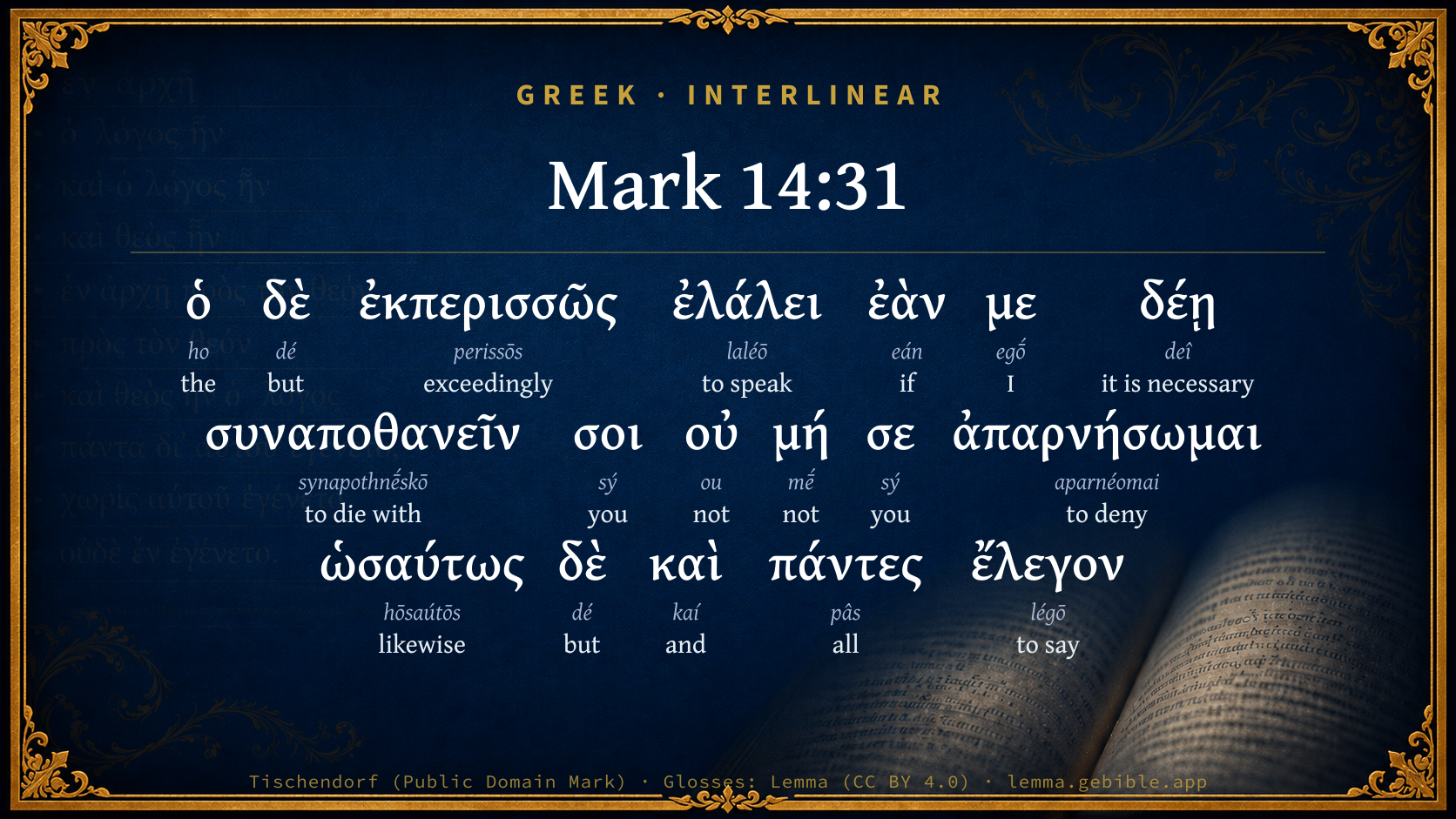
Greek (Tischendorf 8th ed.) Mark 14:31 appears in the Greek New Testament. The text above is from the Tischendorf 8th edition. Each word links to its Strong’s number and a concise gloss. Click any word for its full Thayer’s Greek Lexicon entry.
Download image
Cite this verse

Mark 14:31 (World English Bible). Public Domain. Lemma interlinear Bible study tool, https://lemma.gebible.app/v/mark/14/31.

Show BibTeX & RIS
BibTeX
RIS
English Translation
But he spoke all the more, "If I must die with you, I will not deny you." They all said the same thing.
World English Bible · Public Domain
Highlights
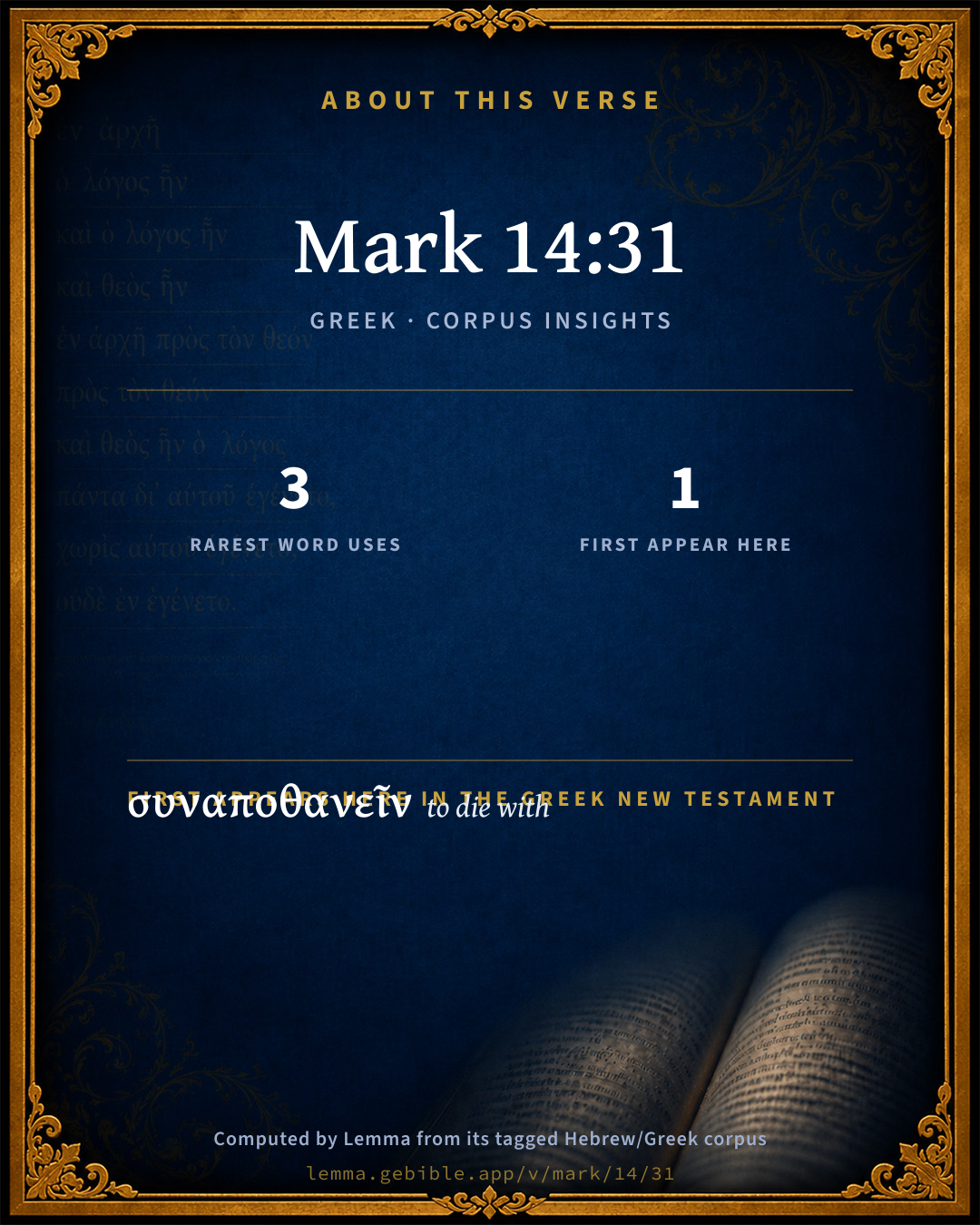
  • 1 first appearance in the Greek New Testament
Full analysis ↓
Download a study sheet

One document with this verse’s original text, its word-by-word gloss line, the meaning frame, cross-references with their text, attributed commentary, and full source and license credits — printable, and it pastes into notes with its structure intact.

This verse Autodidact and up

Study sheet (.html) Plain text (.txt)

A passage Seminary Student

Up to 50 verses in one chapter. A passage sheet keeps up to 6 commentary sources and 12 cross-references per verse, in the order this page ranks them, and says so on the sheet whenever that leaves anything out. Ask for a single verse and you get the Autodidact verse sheet above.

Everything on this page stays free to read, with no account — the sheet is a download of what is already on screen, not access to it.

Want to remove ads? Support Godless Engineer
Compare translations 3

The same verse in 3 English versions, stacked beneath the original-language interlinear above. Click any original word for its lexicon entry.

Each is an independent rendering of the whole verse — the interlinear is not word-aligned to these translations.

Highlighted words mark where these versions differ — a whole-verse word diff, not a word-by-word alignment.

  • World English Bible Public Domain
    But he spoke all the more, "If I must die with you, I will not deny you." They all said the same thing.
  • King James Version Public Domain
    But he spake the more vehemently, If I should die with thee, I will not deny thee in any wise. Likewise also said they all.
  • unfoldingWord Literal Text CC BY-SA 4.0
    But he was saying emphatically, “Even if it were necessary for me to die with you, I will certainly not deny you.” And they all also were speaking in the same manner.

unfoldingWord Literal Text — © unfoldingWord, licensed CC BY-SA 4.0. Word-aligned USFM3 via Door43 (git.door43.org/unfoldingWord/en_ult).

Versions to compare (up to 4)

3 of 4 selected

Show all 19 translations

Every available English version of this verse, each an independent rendering of the whole verse.

  • World English Bible Public Domain
    But he spoke all the more, "If I must die with you, I will not deny you." They all said the same thing.
  • Berean Standard Bible Public Domain
    But Peter kept insisting, “Even if I have to die with You, I will never deny You.” And all the others said the same thing.
  • Majority Standard Bible Public Domain
    But Peter kept insisting all the more, “Even if I have to die with You, I will never deny You.” And all the others said the same thing.
  • King James Version Public Domain
    But he spake the more vehemently, If I should die with thee, I will not deny thee in any wise. Likewise also said they all.
  • American Standard Version (1901) Public Domain
    But he spake exceedingly vehemently, If I must die with thee, I will not deny thee. And in like manner also said they all.
  • Revised Version (1885) Public Domain
    But he spake exceeding vehemently, If I must die with thee, I will not deny thee. And in like manner also said they all.
  • Geneva Bible (1599) Public Domain
    But he saide more earnestly. If I shoulde die with thee, I will not denie thee: likewise also saide they all.
  • Douay-Rheims (1899) Public Domain
    But he spoke the more vehemently: Although I should die together with thee, I will not deny thee. And in like manner also said they all.
  • Young's Literal Translation Public Domain
    And he spake the more vehemently, `If it may be necessary for me to die with thee -- I will in nowise deny thee;' and in like manner also said they all.
  • Literal Standard Version CC BY-SA 4.0
    And he spoke the more vehemently, “If it may be necessary for me to die with You—I will in no way deny You”; and in like manner also said they all.
  • Unlocked Literal Bible CC BY-SA 4.0
    But Peter said, “If I must die with you, I will not deny you.” They all made the same promise.
  • unfoldingWord Literal Text CC BY-SA 4.0
    But he was saying emphatically, “Even if it were necessary for me to die with you, I will certainly not deny you.” And they all also were speaking in the same manner.
  • Darby Bible Public Domain
    But he said [so much] exceedingly the more, If I should have to die with thee, I will in no wise deny thee. And likewise said they all too.
  • World Messianic Bible Public Domain
    But he spoke all the more, “If I must die with you, I will not deny you.” They all said the same thing.
  • Webster's Bible Public Domain
    But he spoke the more vehemently, If I should die with thee, I will not deny thee in any wise. Likewise also said they all.
  • Free Bible Version CC BY-SA 4.0
    But Peter was totally adamant, saying, “Even if I have to die with you, I will never deny you.” All of them said the same.
  • Bible in Basic English Public Domain
    But he said with passion, If I have to be put to death with you, I will not be false to you. And they all said the same.
  • Text-Critical English NT CC BY 4.0
    But Peter said all the more vehemently, “Even if I must die with yoʋ, I will certainly not deny yoʋ.” And they all said the same thing.
  • Tyndale New Testament (1534) Public Domain
    And he spake boldlyer: no yf I shulde dye with the I will not deny the. Lyke wyse also sayd they all.

Literal Standard Version (2020), Covenant Press — licensed CC BY-SA 4.0. Text via the HelloAO Bible API (eBible.org). Unlocked Literal Bible (unfoldingWord) — licensed CC BY-SA 4.0. Text via the HelloAO Bible API (eBible.org). unfoldingWord Literal Text — © unfoldingWord, licensed CC BY-SA 4.0. Word-aligned USFM3 via Door43 (git.door43.org/unfoldingWord/en_ult). Free Bible Version, Dr. Jonathan Gallagher — licensed CC BY-SA 4.0. Text via the HelloAO Bible API (eBible.org).

Word by word

More ways to search: Search by grammar → Find every occurrence → Compare this word →

Practice this passage: Drill this verse → Learn its vocabulary →

συναποθανεῖν
synapothnḗskō
G4880
“to die with”
Verb, Aorist, Active, Infinitive
Part of Speech
Verb
Tense
Aorist
Voice
Active
Mood
Infinitive
Full Thayer's Definition

Origin: from G4862 and G599

TDNT: 3:7 & 7:786,312 & 1102

1. to die together 2. to die with one
  1. ὁ ho G3588 “the” Article, Nominative, Singular, Masculine
  2. δὲ dé G1161 “but” Conjunction
  3. ἐκπερισσῶς perissōs G4057 “exceedingly” Adverb
  4. ἐλάλει laléō G2980 “to speak” Verb, Imperfect, Active, Indicative, 3rd person, Singular
  5. ἐὰν eán G1437 “if” Conditional
  6. με egṓ G1473 “I” Personal pronoun, 1st person, Accusative, Singular
  7. δέῃ deî G1163 “it is necessary” Verb, Present, Active, Subjunctive, 3rd person, Singular
  8. σοι sý G4771 “you” Personal pronoun, 2nd person, Dative, Singular
  9. οὐ ou G3756 “not” Particle, Negative
  10. μή mḗ G3361 “not” Particle, Negative
  11. σε sý G4771 “you” Personal pronoun, 2nd person, Accusative, Singular
  12. ἀπαρνήσωμαι aparnéomai G533 “to deny” Verb, Future, Active, Subjunctive, 1st person, Singular
  13. ὡσαύτως hōsaútōs G5615 “likewise” Adverb
  14. δὲ dé G1161 “but” Conjunction
  15. καὶ kaí G2532 “and” Conjunction
  16. πάντες pâs G3956 “all” Adjective, Nominative, Plural, Masculine
  17. ἔλεγον légō G3004 “to say” Verb, Imperfect, Active, Indicative, 3rd person, Plural

About this verse

These counts appear in no published source. They are computed here, from the morphology-tagged text and Lemma’s own curated glosses. What Lemma adds →

18
words
16
distinct lemmas
Gospels
section

Notable vocabulary

The rarest word here is συναποθανεῖν to die with G4880 — appearing just 3 times in the whole Greek New Testament.

First appearance in Scripture

This word makes its first canonical appearance in the Greek New Testament here:

  • συναποθανεῖν to die with G4880

Shared distinctive vocabulary

συναποθανεῖν to die with G4880 occurs in 3 verses of the Greek New Testament. Also found in:
Repetition

Words recur within this verse:

Cross-references

11

Topical passages linked to Mark 14:31 in the Treasury of Scripture Knowledge — connected by theme and wording, ordered by reader-vote popularity; previews shown in the World English Bible.

  • Exodus 19:8 All the people answered together, and said, "All that Yahweh has spoken we will do." Moses reported the words of the people to Yahweh.
  • John 13:37 Peter said to him, "Lord, why can't I follow you now? I will lay down my life for you."
  • Deuteronomy 5:27–29 Go you near, and hear all that Yahweh our God shall say: and speak you to us all that Yahweh our God shall speak to you; and we will hear it, and do it.
  • 2 Kings 8:13 Hazael said, But what is your servant, who is but a dog, that he should do this great thing? Elisha answered, Yahweh has shown me that you shall be king over Syria.
  • Job 40:4–5 "Behold, I am of small account. What shall I answer you? I lay my hand on my mouth.
  • Proverbs 16:18 Pride goes before destruction, And a haughty spirit before a fall.
  • Proverbs 18:24 A man of many companions may be ruined, But there is a friend who sticks closer than a brother.
  • Proverbs 29:23 A man's pride brings him low, But one of lowly spirit gains honor.
  • Jeremiah 10:23 Yahweh, I know that the way of man is not in himself: it is not in man who walks to direct his steps.
  • Jeremiah 17:9 The heart is deceitful above all things, and it is exceedingly corrupt: who can know it?
  • Psalms 30:6 As for me, I said in my prosperity, "I shall never be moved."

Cross-references courtesy of OpenBible.info (CC BY 4.0).

Where the printed editions differ

1 variant

Places in this verse where the major printed Greek editions disagree on the wording in a way that affects the translation — a comparison of editions, not a manuscript-by-manuscript collation. The editions are the modern critical texts (Nestlé-Aland 28/27, SBL, Westcott-Hort, Tregelles, Tyndale House) and the traditional texts behind the KJV (the Textus Receptus and the Byzantine/Majority text). It is not a claim about which reading is original.

  1. Extra text
    μᾶλλον·

    “more:”

    In TRByz Not in NA28NA27TynSBLWHTreg

    μᾶλλον· (mallon) 'more:' is only in traditional manuscripts (TR+Byz)

Textual data: Translators Amalgamated Greek New Testament (STEPBible TAGNT) · CC BY 4.0.

Commentary

Notes on Mark 14:31 from classic Christian and Jewish commentators (each source and its license shown beneath its notes). The classic Christian expositions comment on the surrounding passage and are grouped to its opening verse, so a note may address several verses; the Jewish commentaries on the Tanakh (Rashi and others) are per-verse, so they appear only where the commentator wrote on this verse.

Lemma curates 59 commentaries, every one of them public domain or Creative Commons licensed, each selected and text-cleaned for this edition rather than reprinted as found. About our sources →

The Biblical Illustrator

Joseph S. Exell

Mar_14:31

I will not deny Thee in any wise.

Peters denial of Christ

I. We may learn from this transaction not to be too forward in our professions, or too confident in our own strength, lest confidence should at last increase the guilt and shame of failure; and in the event of nonperformance, our professions be turned to our reproach. The chief of the apostles mistook the firmness of his own spirit. In the day of peace it is easy to form good resolutions, and to be confident that we shall perform them. To resolve in private and act in public are very different things, requiring very different degrees of firmness, both in exerting the powers of the understanding and in regulating the affections of the heart. Rash resolutions are foolish, and rash vows cannot be innocent. Yet our weakness is itself the decisive proof that vows and resolutions ought to be made. But let them be made as reason and duty require-deliberately not ostentatiously; not so much to be heard as to be kept; not so much to man as to God.

II. To hope the best, and to depend the most upon those whose tempers are not so warm and forward, but mild, and cool, and firm. In St. John we find no forward professions, no hasty declarations of invincible spirit. He was firm and faithful, but meek and unoffending. His zeal united gentleness. Zeal should be with moderation. The passions must not rule the conduct. The feelings of a good man are ruled by his religion. Every thought should be brought into captivity to the obedience of Christ. Without such guidance feeling is bold, forward, and capricious, liable to error, and will involve us in sin; but conviction and principle are steady and permanent; truth and right are forever the same.

III. That if we be surprised into any failure in our duty we may be forgiven upon repentance and reformation. But this great privilege must not be allowed to relax our care, or encourage our presumption. St. Peter delayed his repentance only till he knew his fault. Hand-in-hand with conviction came contrition. (W. Barrow, LL. D.)

Peter and the rest

The text shows St. Peter exercising the supreme influence.

I. Here is Peters undoubted supremacy. History circles around great names. Men are not all original. The apostles could not do without Peter.

II. This supremacy was intellectual, moral, spiritual; not economical, legal, or merely official. His supremacy rose out of qualification. There are no spiritual leaderships which can be irrespective of character. A true man must always influence others powerfully.

III. The value of such characters as that of Peter in the Church. Each age needs men who can call onward and upward because they are beyond and above.

IV. Here is noble purpose and noble feeling coming short in action. The sequel is, they all forsook Him and fled. Not even the grandest human inspirations have staying virtues in them. These must be sought from the Holy Spirit. (The Preachers Monthly.)

Presumption

I stand on a mountain in Colorado six thousand feet high. There is a man standing beneath me who says: I see a peculiar shelving to this rock, and he bends towards it. I say: Stop, you will fall. He says: No danger; I have a steady head and foot, and see a peculiar piece of moss. I say: Stand back; but he says: I am not afraid; and he bends farther and farther, and after a while his head whirls and his feet slip-and the eagles know not that it is the macerated flesh of a man they are picking at, but it is. So I have seen men come to the very verge of New York life, and they look away down in it. They say: Dont be cowardly. Let us go down. They look farther and farther. I warn them to stand back; but Satan comes behind them, and while they are swinging over the verge, pushes them off. People say they were naturally bad. They were not! They were only engaged in exploration. (Dr. Talmage.)

Fatal presumption

The present Eddystone Lighthouse stands very firmly, but that was not the character of the first structure that stood on that dangerous point. There was an eccentric man by the name of Henry Winstanly, who built a very fantastic lighthouse at that point in 1696, and when it was nearly done he felt so confident that it was strong, that he expressed the wish that he might be in it in the roughest hurricane that ever blew in the face of heaven. And he got his wish. One November night, in 1703, he and his workmen were in that light house when there came down the most raging tempest that has ever been known in that region. On the following morning the people came down to see about the lighthouse. Not a vestige of the wall, not a vestige of the men. Only two twisted iron bolts, showing where the lighthouse had stood. So there are men building up their fantastic hopes, and plans, and enterprises, and expectations, thinking they will stand forever, saying: We dont want any of the defences of the gospel. We can stand for ourselves. We are not afraid. We take all the risks and we defy everything; and suddenly the Lord blows upon them and they are gone. Only two things left-a grave and a lost soul. (Dr. Talmage.)

Accumulated sin

Peter, instead of being humbled and made self-distrustful by our Lords warning, as he ought to have been, only heaps up more sin against himself by persisting in contradicting the Lord. Let us take note from this that the child of God, through strength of his corruption, may fall often into the same sin, notwithstanding good means against it.

1. It is a very hard thing to lead people out of themselves. Almost nothing but experience of former falls brings them to see their folly.

2. Till their mind is changed their action will be the same.

3. Weakness of grace causes even the best to fall over and over again into the same sins.

4. The same reason remains still which may move the Lord to leave His children to themselves; to try, excite, humble them, work more serious sorrow, make them more watchful, etc. (Dr. Thomas Taylor.)

Repetition strengthens

Every repetition of sin makes sin the stronger; for as the body, the more it is nourished and fed, the stronger it grows, so with sin in the soul; every new act is an addition of strength till it comes to a habit. Pluck up a twig, then, before it grows up into a plant. Dash out the brains of every sin in infancy. (Dr. Thomas Taylor.)

The Biblical Illustrator, edited by Joseph S. Exell (c. 1880s–1900s) — public domain. Text from a community e-Sword module.

Bengel's Gnomon

Johann Albrecht Bengel

Mar 14:31. Ἐκ περισσοῦ μᾶλλον, the rather, the more exceedingly). Comp. ch. Mar 7:36, note. Peter, in this passage, rather (μᾶλλον) spake of his own stedfastness, than trusted [believed] in the words of Jesus.

Bengel's Gnomon of the New Testament — English translation (T&T Clark, Edinburgh, 1860) — public domain. Text from a community e-Sword module.

Expositor's Greek Testament

ed. W. Robertson Nicoll

Mar 14:31 . ἐκπερισσῶς , abundantly in matter and manner, with vehemence and iteration; a ἅπαξ λεγ . ἐλάλει , kept saying: that he would not deny his Master even if he had to die for it. ὡσαύτως , a stronger word than Mt.’s ὁμοίως = in the same way, and probably in the same words. But the words of the others were simply a faint echo of Peter’s vehement and copious talk. They feebly said once ( ἔλεγον = εἶπον ) what he said strongly again and again ( ἐλάλει ).

The Expositor's Greek Testament, edited by W. Robertson Nicoll (1897–1910) — public domain. Text from a community e-Sword module.

Geneva Bible (1599)

Geneva Bible translators

That doubling of words, setteth out more plainly Peter’s vehement affirmation.

Geneva Bible (1599) marginal notes — public domain. Text via Bolls.life.

Ellicott's Commentary for English Readers

(31) He spake the more vehemently.—The Greek tense implies frequent and continuous speaking.

A Bible Commentary for English Readers, edited by Charles John Ellicott (1878–1897) — public domain. Text from a community e-Sword module.

The Cambridge Bible for Schools and Colleges

gen. ed. J. J. S. Perowne

31. If I should] Literally, If it be necessary for me to die with Thee; as Wyclif renders it, “if it bihoue me to dye to gidere with thee.” After this the Lord engaged in earnest conversation with His Apostles, not as at the ordinary Passover on the great events of the Exodus, but on His own approaching departure to the Father and the coming of the Comforter (Joh_14:1-31); of Himself as the true Vine and His disciples as the branches (Joh_15:1-6); of the trials which the Apostles must expect and the assured aid of the Comforter (John 16); and at the close lifting up His eyes to heaven solemnly committed them to the care of the Eternal Father, and dedicated to Him His completed work (John 17). Then the concluding part of the Hallel (Psalms 115-118) was sung, i. e. chanted, and the little company went forth into the darkness towards the Mount of Olives. A perusal of these Psalms will reveal their appropriateness to this solemn occasion.

The Cambridge Bible for Schools and Colleges (gen. ed. J. J. S. Perowne; Cambridge University Press, 1878–1918) — public domain. Text from a community e-Sword module.

John Gill's Exposition

And they came to a place which is named Gethsemane,.... At the foot of the Mount of Olives, where the olives, which grew in great plenty on the mount, were pressed: and where our Lord began to be bruised, for our sins:

and be saith to his disciples: to eight of them:

sit ye here while I shall pray; at some distance from hence; See Gill on Mat 26:36.

John Gill's Exposition of the Whole Bible (1746–1763) — public domain (CC PDM 1.0). Text via the HelloAO Bible API.

Trapp's Complete Commentary

John Trapp

26 And when they had sung an hymn, they went out into the mount of Olives.

27 And Jesus saith unto them, All ye shall be offended because of me this night: for it is written, I will smite the shepherd, and the sheep shall be scattered.

28 But after that I am risen, I will go before you into Galilee.

29 But Peter said unto him, Although all shall be offended, yet will not I.

30 And Jesus saith unto him, Verily I say unto thee, That this day, even in this night, before the cock crow twice, thou shalt deny me thrice.

31 But he spake the more vehemently, If I should die with thee, I will not deny thee in any wise. Likewise also said they all.

Ver. 31. I will not deny thee] The Syriac addeth Mari, that is, Domine mi, my God. And this he affirmed, magis ex abundanti. So did Pendleton the apostate, when he said to Sanders the martyr, with greatest vehemence, I will see the uttermost drop of this grease of mine molten away, and the last gobbet of this flesh consumed to ashes, before I will forsake God and his truth. (Acts and Mon.)

John Trapp, A Commentary or Exposition upon All the Books of the Old and New Testament (1647–1656) — public domain. Text from a community e-Sword module.

The Pulpit Commentary

But he spake exeseding vehemently (ekperisswv elalei), If I must die with thee (ean me der), I will not deny thee. The right reading (elalei , imperfect) implies that he kept asserting over and over again. He was, no doubt, sincere in all this, but he had vet to learn his own weakness. St. Hilary says on this, "Peter was so carried away by the fervor of his zeal and love for Christ, that he regarded neither the weakness of his own flesh nor the truth of his Master"s word."

The Pulpit Commentary (1880–1919), ed. H.D.M. Spence-Jones & Joseph S. Exell — public domain. Text from a community e-Sword module.

Cambridge Greek Testament for Schools and Colleges

31. [3172][3173][3174][3175][3176] omit μᾶλλον after ἐλάλει ([3177][3178][3179][3180][3172] Codex Sinaiticus. 4th cent. Discovered by Tischendorf in 1859 at the Monastery of St Katharine on Mount Sinai. Now at St Petersburg. The whole Gospel, ending at Mar 16:8. Photographic facsimile, 1911.

[3173] Codex Vaticanus. 4th cent., but perhaps a little later than א. In the Vatican Library almost since its foundation by Pope Nicolas V., and one of its greatest treasures. The whole Gospel, ending at Mar 16:8. Photographic facsimile, 1889.

[3174] Codex Ephraemi. 5th cent. A palimpsest: the original writing has been partially rubbed out, and the works of Ephraem the Syrian have been written over it; but a great deal of the original writing has been recovered; of Mark we have Mar 1:17 to Mar 6:31, Mar 8:5 to Mar 12:29, Mar 13:19 to Mar 16:20. In the National Library at Paris.

[3175] Codex Bezae. 6th cent. Has a Latin translation (d) side by side with the Greek text, and the two do not quite always agree. Presented by Beza to the University Library of Cambridge in 1581. Remarkable for its frequent divergences from other texts. Contains Mark, except Mar 16:15-20, which has been added by a later hand. Photographic facsimile, 1899.

[3176] Codex Regius. 8th cent. An important witness. At Paris. Contains Mar 1:1 to Mar 10:15; Mar 10:30 to Mar 15:1; Mar 15:20 to Mar 16:20, but the shorter ending is inserted between Mar 16:8 and Mar 16:9, showing that the scribe preferred it to the longer one.

[3177] Codex Sinaiticus. 4th cent. Discovered by Tischendorf in 1859 at the Monastery of St Katharine on Mount Sinai. Now at St Petersburg. The whole Gospel, ending at Mar 16:8. Photographic facsimile, 1911.

[3178] Codex Vaticanus. 4th cent., but perhaps a little later than א. In the Vatican Library almost since its foundation by Pope Nicolas V., and one of its greatest treasures. The whole Gospel, ending at Mar 16:8. Photographic facsimile, 1889.

[3179] Codex Bezae. 6th cent. Has a Latin translation (d) side by side with the Greek text, and the two do not quite always agree. Presented by Beza to the University Library of Cambridge in 1581. Remarkable for its frequent divergences from other texts. Contains Mark, except Mar 16:15-20, which has been added by a later hand. Photographic facsimile, 1899.

[3180] odex Regius. 8th cent. An important witness. At Paris. Contains Mar 1:1 to Mar 10:15; Mar 10:30 to Mar 15:1; Mar 15:20 to Mar 16:20, but the shorter ending is inserted between Mar 16:8 and Mar 16:9, showing that the scribe preferred it to the longer one.

31. ἐκπερισσῶς ἐλάλει. Peter is not silenced, but continues (imperf.) to protest vehemently (ἐκπ. here only in N.T.) that not even the fear of death would induce him to deny his Master. In his vehemence he does not see that he is charging Christ with uttering false predictions.

πάντες ἔλεγον. Here again the imperf. is in place; one after another they echoed Peter’s protestations. As often, Mt. prefers an aor. Neither Lk. nor Jn mentions this.

Cambridge Greek Testament for Schools and Colleges (Cambridge University Press, 1896; 21 vols, various authors incl. Carr, Maclear, Plummer, Farrar, Lumby, Moule, M. R. James, Simcox) — public domain. Text from a community e-Sword module.

Alford’s Greek Testament

Henry Alford

31.] ἐκπερισσῶς ἐλάλει, went on repeating superabundantly: the ἐλάλει giving Peter’s continued and excessive iteration, the ἔλεγον following expressing merely the one, or, at all events, less frequent saying of the same by the rest. The reading ἔλεγεν has apparently been a correction, λαλεῖν signifying to speak and not to say, and its peculiar fitness here being missed.

οὐ μή with fut. indic. makes the certainty of the assertion doubly sure. The E. V. attempts to represent this by adding “in any wise.” We sometimes give the same effect by substituting the objective future for the subjective, “I never shall deny thee.”

Henry Alford, The Greek Testament (1849–1861) — public domain. Text from a community e-Sword module.

International Critical Commentary

31. ὁ δὲ ἐκπερισσῶς ἐλάλει—But he spoke with utter vehemence. περισσῶς by itself means inordinately, and is used of anything that exceeds bounds. ἐκ adds to it the sense completely, utterly.1

ἐκπερισσῶς, instead of ἐκ περισσοῦ, Tisch. Treg. WH. RV. א BCD 56, 58, 61. ἐλάλει, instead of ἔλεγε, Tisch. Treg. WH. RV. א BDL, mss. Lat. Vet. Vulg. Omit μάλλον, more, Tisch. Treg. WH. RV. א BCDL, mss. Lat. Vet. Vulg. Egyptt. Harcl.

ὡσαύτως δὲ καὶ πάντες ἔλεγον—and so said also all. Peter, according to this, did not occupy a singular position, but simply took his place of leader and spokesman, speaking out what was in the minds of all, to which they all assented.

THE AGONY IN GETHSEMANE

International Critical Commentary — older volumes (1896–1929), various authors — public domain. Text from a community e-Sword module.

Vincent's Word Studies in the New Testament

Marvin R. Vincent

I will not deny [ου μη σε απαρνησομαι] . The double negative with the future forms the strongest possible assertion.

Marvin R. Vincent, Word Studies in the New Testament (1887–1900) — public domain. Text from a community e-Sword/MySword module.

Lesson kit

Teaching starters — assembled from the data on this page, not authored interpretation. Every prompt links to the verse data it draws on. Edit before teaching.

Mark, in the Gospels, opens this verse with 18 words (16 distinct Greek lemmas). Its most distinctive word is synapothnḗskō (“to die with”). A historical commentator’s framing appears above. Read the whole chapter for the surrounding context.

Discussion questions

  1. What does “to die with” (synapothnḗskō) contribute to the verse as a whole?
  2. The word “to die with” first appears here in Scripture. What is being introduced at this debut?
  3. 2 Corinthians 7:3 shares the word «to die with» with this verse. How do the two illuminate each other?
  4. “but” occurs 2× in this one verse. What is the effect of the repetition?
  5. These translations render this verse differently; the difference is in the English rendering, not the original. What questions does that raise?
  6. Reading how The Biblical Illustrator and Bengel's Gnomon read this verse, where do the two commentators agree and where do they part?

Things to notice

  • 1 word makes its first canonical appearance in Scripture here.
  • These translations choose different wording for 22 words in this verse.
  • “but” occurs 2× in this single verse.
  • 16 distinct Greek lemmas span 18 words in this verse.

Reading settings

Reading text

Shown beneath each verse's original-language words.

Old Testament
Old Testament edition

Read the OT as the Masoretic Hebrew (MT) or the Greek Septuagint (LXX).

English shown for the Greek Septuagint (in the Hebrew ↔ Greek comparison).

Comparing translations? Open the Compare panel on any verse page to stack up to four side by side.