
Matthew 2:12

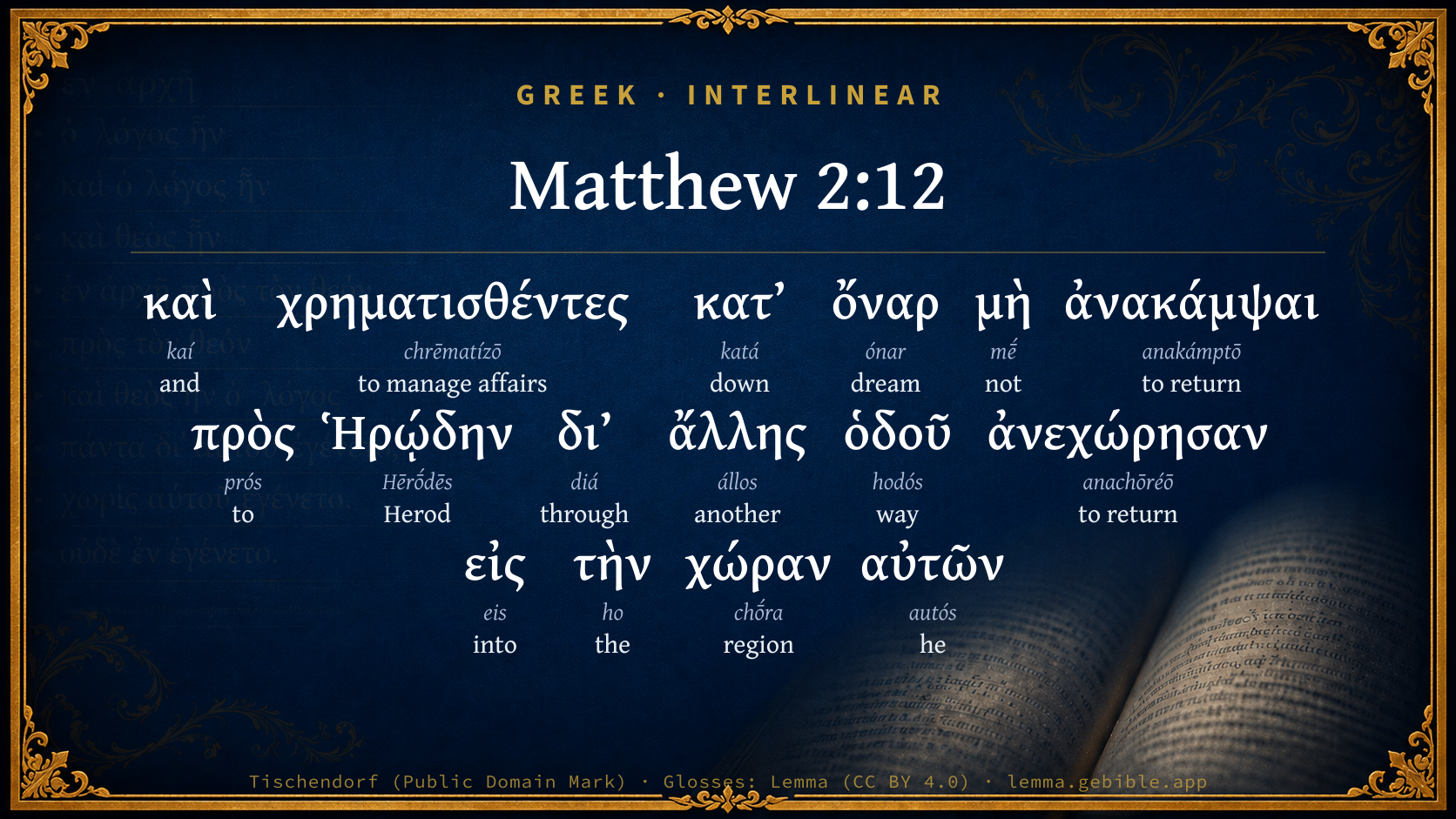
Greek (Tischendorf 8th ed.) Matthew 2:12 appears in the Greek New Testament. The text above is from the Tischendorf 8th edition. Each word links to its Strong’s number and a concise gloss. Click any word for its full Thayer’s Greek Lexicon entry.
Download image
Cite this verse

Matthew 2:12 (World English Bible). Public Domain. Lemma interlinear Bible study tool, https://lemma.gebible.app/v/matthew/2/12.

Show BibTeX & RIS
BibTeX
RIS
English Translation
Being warned in a dream that they shouldn't return to Herod, they went back to their own country another way.
World English Bible · Public Domain
Highlights
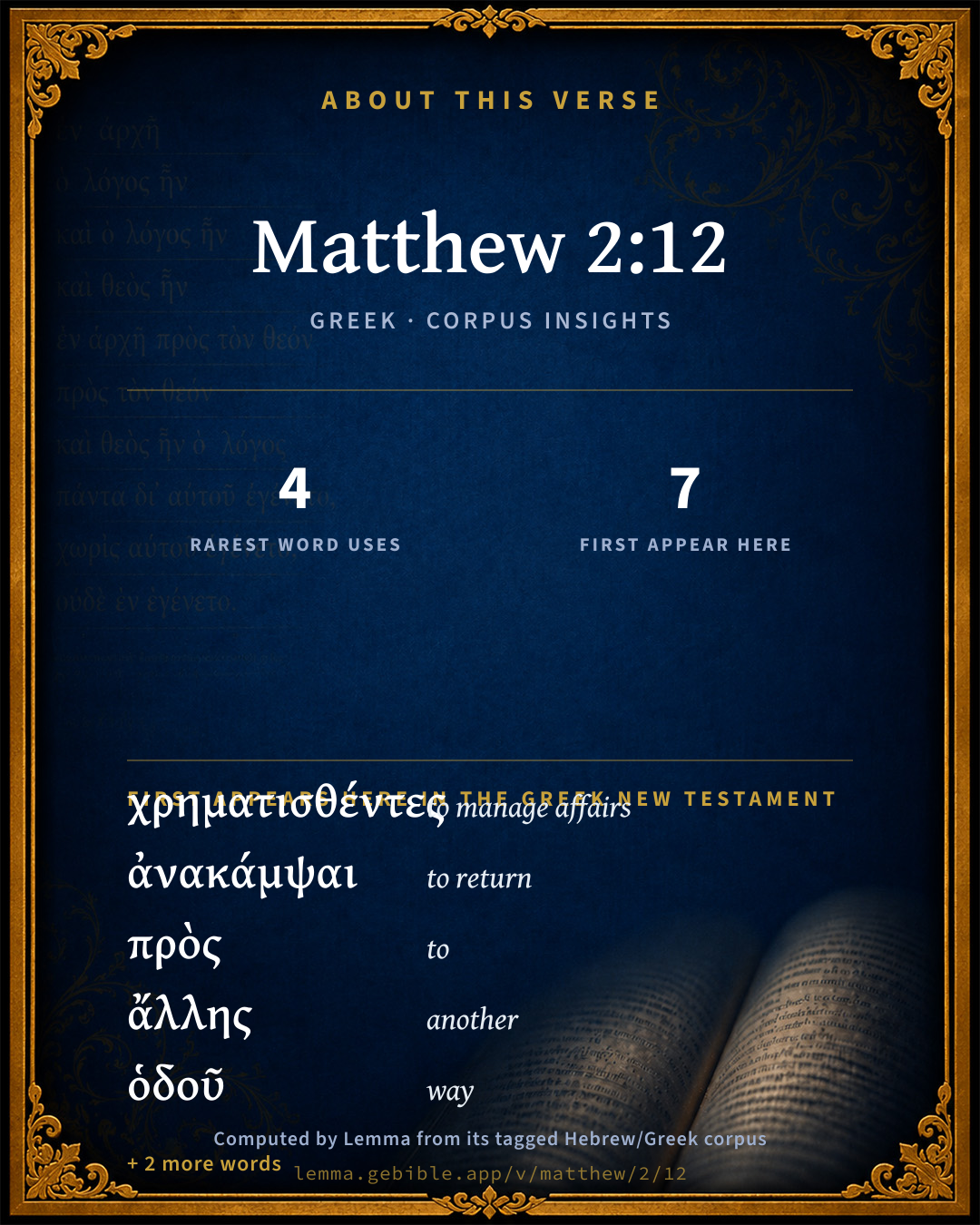
  • 7 first appearances in the Greek New Testament
Full analysis ↓
Download a study sheet

One document with this verse’s original text, its word-by-word gloss line, the meaning frame, cross-references with their text, attributed commentary, and full source and license credits — printable, and it pastes into notes with its structure intact.

This verse Autodidact and up

Study sheet (.html) Plain text (.txt)

A passage Seminary Student

Up to 50 verses in one chapter. A passage sheet keeps up to 6 commentary sources and 12 cross-references per verse, in the order this page ranks them, and says so on the sheet whenever that leaves anything out. Ask for a single verse and you get the Autodidact verse sheet above.

Everything on this page stays free to read, with no account — the sheet is a download of what is already on screen, not access to it.

Want to remove ads? Support Godless Engineer
Compare translations 3

The same verse in 3 English versions, stacked beneath the original-language interlinear above. Click any original word for its lexicon entry.

Each is an independent rendering of the whole verse — the interlinear is not word-aligned to these translations.

Highlighted words mark where these versions differ — a whole-verse word diff, not a word-by-word alignment.

  • World English Bible Public Domain
    Being warned in a dream that they shouldn't return to Herod, they went back to their own country another way.
  • King James Version Public Domain
    And being warned of God in a dream that they should not return to Herod, they departed into their own country another way.
  • unfoldingWord Literal Text CC BY-SA 4.0
    And having been warned through a dream not to return to Herod, they departed to their country by another way.

unfoldingWord Literal Text — © unfoldingWord, licensed CC BY-SA 4.0. Word-aligned USFM3 via Door43 (git.door43.org/unfoldingWord/en_ult).

Versions to compare (up to 4)

3 of 4 selected

Show all 19 translations

Every available English version of this verse, each an independent rendering of the whole verse.

  • World English Bible Public Domain
    Being warned in a dream that they shouldn't return to Herod, they went back to their own country another way.
  • Berean Standard Bible Public Domain
    And having been warned in a dream not to return to Herod, they withdrew to their country by another route.
  • Majority Standard Bible Public Domain
    And having been warned in a dream not to return to Herod, they withdrew to their country by another route.
  • King James Version Public Domain
    And being warned of God in a dream that they should not return to Herod, they departed into their own country another way.
  • American Standard Version (1901) Public Domain
    And being warned `of God' in a dream that they should not return to Herod, they departed into their own country another way.
  • Revised Version (1885) Public Domain
    And being warned of God in a dream that they should not return to Herod, they departed into their own country another way.
  • Geneva Bible (1599) Public Domain
    And after they were warned of God in a dreame, that they should not go againe to Herod, they returned into their countrey another way.
  • Douay-Rheims (1899) Public Domain
    And having received an answer in sleep that they should not return to Herod, they went back another way into their country.
  • Young's Literal Translation Public Domain
    and having been divinely warned in a dream not to turn back unto Herod, through another way they withdrew to their own region.
  • Literal Standard Version CC BY-SA 4.0
    and having been divinely warned in a dream not to return to Herod, through another way they withdrew to their own region.
  • Unlocked Literal Bible CC BY-SA 4.0
    God warned them in a dream not to return to Herod, so they departed to their own country by another way.
  • unfoldingWord Literal Text CC BY-SA 4.0
    And having been warned through a dream not to return to Herod, they departed to their country by another way.
  • Darby Bible Public Domain
    And being divinely instructed in a dream not to return to Herod, they departed into their own country another way.
  • World Messianic Bible Public Domain
    Being warned in a dream not to return to Herod, they went back to their own country another way.
  • Webster's Bible Public Domain
    And being warned by God in a dream that they should not return to Herod, they departed into their own country another way.
  • Free Bible Version CC BY-SA 4.0
    Warned by a dream not to return to Herod, they left for their own country by a different route.
  • Bible in Basic English Public Domain
    And it was made clear to them by God in a dream that they were not to go back to Herod; so they went into their country by another way.
  • Text-Critical English NT CC BY 4.0
    And being warned in a dream not to return to Herod, they departed for their own country by another way.
  • Tyndale New Testament (1534) Public Domain
    And after they were warned of God in a dreame that they shuld not go ageyne to Herod they retourned into their awne countre another waye.

Literal Standard Version (2020), Covenant Press — licensed CC BY-SA 4.0. Text via the HelloAO Bible API (eBible.org). Unlocked Literal Bible (unfoldingWord) — licensed CC BY-SA 4.0. Text via the HelloAO Bible API (eBible.org). unfoldingWord Literal Text — © unfoldingWord, licensed CC BY-SA 4.0. Word-aligned USFM3 via Door43 (git.door43.org/unfoldingWord/en_ult). Free Bible Version, Dr. Jonathan Gallagher — licensed CC BY-SA 4.0. Text via the HelloAO Bible API (eBible.org).

Word by word

More ways to search: Search by grammar → Find every occurrence → Compare this word →

Practice this passage: Drill this verse → Learn its vocabulary →

ἀνακάμψαι
anakámptō
G344
“to return”
Verb, Aorist, Active, Infinitive
Part of Speech
Verb
Tense
Aorist
Voice
Active
Mood
Infinitive
Full Thayer's Definition

Origin: from G303 and G2578

TDNT: None

1. to bend back, to turn back 2. to return
  1. καὶ kaí G2532 “and” Conjunction
  2. χρηματισθέντες chrēmatízō G5537 “to manage affairs” Verb, Aorist, Passive, Participle, Nominative, Plural, Masculine
  3. κατ’ katá G2596 “down” Preposition
  4. ὄναρ ónar G3677 “dream” Noun, Indeclinable
  5. μὴ mḗ G3361 “not” Particle, Negative
  6. πρὸς prós G4314 “to” Preposition
  7. Ἡρῴδην Hērṓdēs G2264 “Herod” Noun, Accusative, Singular, Masculine
  8. δι’ diá G1223 “through” Preposition
  9. ἄλλης állos G243 “another” Adjective, Genitive, Singular, Feminine
  10. ὁδοῦ hodós G3598 “way” Noun, Genitive, Singular, Feminine
  11. ἀνεχώρησαν anachōréō G402 “to return” Verb, Aorist, Active, Indicative, 3rd person, Plural
  12. εἰς eis G1519 “into” Preposition
  13. τὴν ho G3588 “the” Article, Accusative, Singular, Feminine
  14. χώραν chṓra G5561 “region” Noun, Accusative, Singular, Feminine
  15. αὐτῶν autós G846 “he” Personal pronoun, Genitive, Plural, Masculine

About this verse

These counts appear in no published source. They are computed here, from the morphology-tagged text and Lemma’s own curated glosses. What Lemma adds →

16
words
16
distinct lemmas
Gospels
section

Notable vocabulary

The rarest word here is ἀνακάμψαι to return G344 — appearing just 4 times in the whole Greek New Testament.

First appearance in Scripture

These words make their first canonical appearance in the Greek New Testament here:

  • χρηματισθέντες to manage affairs G5537
  • ἀνακάμψαι to return G344
  • πρὸς to G4314
  • ἄλλης another G243
  • ὁδοῦ way G3598
  • ἀνεχώρησαν to return G402
  • χώραν region G5561

Shared distinctive vocabulary

ἀνακάμψαι to return G344 occurs in 4 verses of the Greek New Testament. Also found in:
Cross-references

14

Topical passages linked to Matthew 2:12 in the Treasury of Scripture Knowledge — connected by theme and wording, ordered by reader-vote popularity; previews shown in the World English Bible.

  • Matthew 2:19 But when Herod was dead, behold, an angel of the Lord appeared in a dream to Joseph in Egypt, saying,
  • Matthew 2:22 But when he heard that Archelaus was reigning over Judea in the place of his father, Herod, he was afraid to go there. Being warned in a dream, he withdrew into the region of Galilee,
  • Matthew 2:13 Now when they had departed, behold, an angel of the Lord appeared to Joseph in a dream, saying, "Arise and take the young child and his mother, and flee into Egypt, and stay there until I tell you, for Herod will seek the young child to destroy him."
  • Matthew 27:19 While he was sitting on the judgment seat, his wife sent to him, saying, "Have nothing to do with that righteous man, for I have suffered many things this day in a dream because of him."
  • Genesis 20:6–7 God said to him in the dream, "Yes, I know that in the integrity of your heart you have done this, and I also withheld you from sinning against me. Therefore I didn't allow you to touch her.
  • Genesis 31:24 God came to Laban, the Syrian, in a dream of the night, and said to him, "Take heed to yourself that you don't speak to Jacob either good or bad."
  • Matthew 1:20 But when he thought about these things, behold, an angel of the Lord appeared to him in a dream, saying, "Joseph, son of David, don't be afraid to take to yourself Mary, your wife, for that which is conceived in her is of the Holy Spirit.
  • Exodus 1:17 But the midwives feared God, and didn't do what the king of Egypt commanded them, but saved the baby boys alive.
  • Job 33:15–17 In a dream, in a vision of the night, When deep sleep falls on men, In slumbering on the bed;
  • Daniel 2:19 Then was the secret revealed to Daniel in a vision of the night. Then Daniel blessed the God of heaven.
  • Acts 4:19 But Peter and John answered them, "Whether it is right in the sight of God to listen to you rather than to God, judge for yourselves,
  • Acts 5:29 But Peter and the apostles answered, "We must obey God rather than men.
  • Hebrews 11:7 By faith, Noah, being warned about things not yet seen, moved with godly fear, prepared an ark for the saving of his house, through which he condemned the world, and became heir of the righteousness which is according to faith.
  • 1 Corinthians 3:19 For the wisdom of this world is foolishness with God. For it is written, "He has taken the wise in their craftiness."

Cross-references courtesy of OpenBible.info (CC BY 4.0).

Commentary

Notes on Matthew 2:12 from classic Christian and Jewish commentators (each source and its license shown beneath its notes). The classic Christian expositions comment on the surrounding passage and are grouped to its opening verse, so a note may address several verses; the Jewish commentaries on the Tanakh (Rashi and others) are per-verse, so they appear only where the commentator wrote on this verse.

Lemma curates 59 commentaries, every one of them public domain or Creative Commons licensed, each selected and text-cleaned for this edition rather than reprinted as found. About our sources →

Joseph Benson's Commentary

Mat 2:12. And being warned of God in a dream, that they should not return to Herod — Which, it is probable, in the simplicity of their hearts, they were preparing to do, they departed into their own country another way — Not at all solicitous as to the consequences of Herod’s resentment. Thus did the providence of God watch over these devout Gentiles, as well as over Jesus and his parents, and would not suffer their honest simplicity to be abused, and made a prey of by the crafty designs of Herod. For into what grief and perplexity would they have been brought, had they been made even the innocent instruments of an assault on the holy child! But God delivered them, and guided their way. For while he was waiting for their return, they had time to get out of his reach, before his passion rose, which might have been fatal to them.

Joseph Benson's Commentary on the Old and New Testaments (1811–1818) — public domain. Text from a community e-Sword module.

The Preacher's Complete Homiletical Commentary

Joseph S. Exell (gen. ed.)

CRITICAL NOTES

Mat_2:13. Egypt.—At all times the readiest place of refuge for the Israelites, whether from famine or from political oppression. In Alexandria the Jews numbered a fifth of the population. Wherever, therefore, the infant Saviour’s home was in Egypt, it would be in the midst of His brethren according to the flesh (Carr).

Mat_2:15. Fulfilled.—The real key to the Evangelist’s quotation (Hos_11:1), seems to be found in the principle that the whole Old Testament is but the bud of the New. And not only so, but Israel was Israel, and God’s national son, just because it included in itself Him in whom is included the true Israel, and who is the only begotten Son of God. They were called out of Egypt chiefly that they might bring up with them the Seed of seeds—the Christ. Hence, when Hosea wrote the words which the Evangelist quotes, the kernel of Divine idea that was within their rind or outer shell could not possibly have been fully realised, or fulfilled, if the Christ had remained in Egypt (Morison).

Mat_2:16. Children.—All the male children, as is indicated by the gender of the article in the original (πάντας τοὺς παῖδας). Not mentioned by Josephus. If we consider how small a town Bethlehem was, it is not likely there would be many male children in it from two years old and under; and when we think of the number of fouler atrocities which Josephus has recorded of Herod, it is unreasonable to make anything of his silence on this (D. Brown).

Mat_2:18. Rama … Eachel.—See Jer_31:15. The passage primarily refers to the deportation of the Jews to Babylon. Rachel, the ancestress of Benjamin, who was buried near Bethlehem, is introduced as issuing from her grave to bewail the captivity of her children. The sound of her lamentation is carried northward beyond Jerusalem, and heard at Rama, a fortress of Israel on the frontier toward Judah, where the captives were collected. The meaning probably is, that the grief caused by this deportation, and the consequent lamentations of the female captives, was such as to reach even the heart of the ancestress of Benjamin (which here includes also Judah). As used by Jeremiah it was, therefore, a figurative expression for the deep sorrow of the exiled mothers of Judah. But in the massacre of the infants of Bethlehem, this earlier calamity was not only renewed, but its description verified in the fullest and most tragic manner. Rachel’s children are not merely led into exile: they are destroyed, and that by one who called himself king of Israel. Accordingly, Rachel is introduced as the representative of the mothers of Bethlehem lamenting over their children (Lange).

MAIN HOMILETICS OF THE PARAGRAPH.—Mat_2:12-18

Apparent reversal.—The first impression produced by this passage is that of contrast with the last. The exceeding brightness of the previous verses appears exchanged for corresponding darkness in these. How far this is true, therefore, may well be our first point of inquiry. How far we find anything of a different kind may equally well be our next.

I. How far the story is dark.—It is so, in the first place, in what it tells us of the flight of the heralds. For such in fact, and such eminently also, these “wise men” had been; heralds sent by, heralds guided by, heralds loyal to God. It is surprising, therefore, to see such men in danger at all; more so to see the nature of the only counsel which is given them in their danger. They are warned of God (Mat_2:12) to avoid Herod, and take “another way” home. Is this all He is pleased to do for such exceptional servants as these? Not less surprising is what we read here of the flight of their King. “Arise, and take the young child, and his mother, and flee” (Mat_2:13). How unexpected is such counsel from such a quarter, and about such persons as these! That the “child” should be in danger from the blind madness of Herod, Herod being such as he was, might have been looked for. What we should not have looked for is such a method of dealing therewith. Is this the sequel of that depth of homage of which we were told just now? Is this all that He who sent that “dream” is pleased to do for that King? Bid those who had charge of Him merely take Him away? Bid Him, in fact, become a fugitive and exile because of the enmity of about the vilest of kings? Very surprising also, in the last place, is the consequent slaughter of the infants of Bethlehem and its “coasts.” This surprise seems to throw the other two into still stronger “relief.” What we expect from a king is to preserve life, and not to destroy it. Especially do we expect this in the case of those who are both guiltless and weak. How, otherwise, can it be said of him with truth as in Rom_13:3-4? Yet what do we find brought about here in the case of this Ruler in chief? What is the first result of His being proclaimed and acknowledged as such by the “disposition” of God? The indiscriminate slaughter of many who were both offenceless and weak; and not improbably (it has been thought), from the place of their birth, near kinsfolk of Himself (Mat_2:16). Anyway, it is certain that they were very near Him, both in place and in age; also not wholly unlike Him in innocence too. How strange, therefore, that His proclamation as King should have caused destruction to them!

II. How far it is possible to trace light in this darkness.—Do we not, for example, see something of this in what is told us here about men? What is so surprising to us now does not appear to have been equally surprising to some of them at the time. Being nearer to it they appear to have seen more in it than we do so far off. In the case of the Magi, for instance, when commanded to flee, they appear to have obeyed the dream as unhesitatingly as they had previously followed the star. Joseph, also, in regard to his dream, appears to have been at least as swift to obey; rising up “by night” (Mat_2:14, cf. Gen_22:3) to do as God bid, and being evidently as satisfied here with God’s appointments or “judgments” as the Psalmist of old (Psa_119:62). Perceptibly therefore, he is not walking here like a man quite in the dark. Also, we find some light here in what is told us of God. In judging this we must bear in mind how God is represented here as speaking to His people—viz., as in long previous days, by “visions and dreams” (see chap. Mat_1:20; Mat_2:12-13; Mat_2:22; Gen_15:1; Gen_46:2; Isa_1:1; Dan. passim, etc.). We must also remember how it often is with our “visions and dreams,” how the usual sequences and distinctions of waking life are not always observed in such things, and how the dreamer himself may sometimes almost appear to be two persons in one. Viewed in this way we can see a correspondence between the experience of Israel as described in Hos_11:1, and the experience of the Hope of Israel as narrated here, in the land of Egypt. In a similar way we can understand a wide massacre of infants in the neighbourhood of Rachel’s sepulchre (Gen_35:19), being mystically viewed as though it were a bereavement of Rachel herself, especially, perhaps, when we bear in mind some of the particulars of her sad history as a mother (Gen_35:18). Anyway this is how the inspiration of the Evangelist bids us look on these prophecies. We are to see in them tokens that the things spoken of were not unexpected by God; that they were parts rather of some mighty plan which He had in view from the first; and that they are not to be judged, therefore, by merely observing their appearance at the time. If these considerations do not remove the darkness they should at least reconcile us to its existence, and show that it carries with it the seeds of that which will fully dispel it in time (cf. Psa_97:11).

See, therefore, in conclusion:—

1. The exceeding watchfulness of God’s care.—Over the Magi. How He reads the feelings of Herod about them! How He warns them in consequence! How “precious” their lives are in His “sight” (Psa_116:15). Over that holy Babe. Noting Its peril. Giving time for escape by sending the wise men away, and not back. Telling Joseph of it by night. Providing in Joseph himself so faithful a guardian, so obedient, so prompt. Providing a place of refuge at once so safe and so near, being out of Herod’s jurisdiction and yet not out of reach. Probably also (if we may judge from the “two years old” of Mat_2:16), postponing all this till the Babe and its mother should be equal to the journey required. If that holy One has to fly, it shall not be in vain.

2. The assured depth of God’s plans.—When soldiers are under the lead of a commander in whom they have fully learned to confide, and find him issuing a series of orders which they did not expect and do not understand, what do they say? Not that he is in error, but that they are in ignorance. Not that he does not know, but that he only knows, what it is he is doing. We may rightly argue in the same way of the perplexities of this case. They are like “sounding a retreat” when we should have expected a “command to advance.” It is the part of faith not to believe less, but to believe more, on this ground. Nothing is more likely than that the commands of an all-wise Commander should at times be perplexing to us. Never is this more likely than when His plans are most remarkable for their depth.

HOMILIES ON THE VERSES

Mat_2:13-23. The King in exile.—Without supposing that the Evangelist moulded his Gospel on the plan of the Pentateuch (as Dr. Delitzsch in his New Investigations into the Origin and Plan of the Canonical Gospels tries to show), we cannot but see that there is a real parallel between the beginnings of the national life of Israel and the commencement of the life of Christ. Mat_2:13-23 bring this parallel into great prominence. There are three sections, each of which has for its centre an Old Testament prophecy.

I. The flight into Egypt, and the prophecy fulfilled therein.—In their original place Hosea’s words are not a prophecy at all, but simply a part of a tender historical résumé of God’s dealings with Israel, by which the prophet would touch his contemporaries’ hearts into penitence and trust. How, then, is the Evangelist justified in regarding them as prophetic, and in looking on Christ’s flight as their fulfilment? The answer is to be found in that analogy between the national and the personal Israel which runs through all the Old Testament, and reaches its highest clearness in the second part of Isaiah’s prophecies. Jesus Christ was what Israel was destined and failed to be, the true Servant of God, His Anointed, His Son, the medium of conveying His name to the world. The ideal of the nation was realised in Him. His brief stay in Egypt served the very same purpose in His life which their four hundred years there did in theirs—it sheltered Him from His enemies, and gave Him room to grow. Just as the infant nation was unawares fostered in the very lap of the country which was the symbol of the world hostile to God, so the infant Christ was guarded and grew there. The prophecy is a prophecy just because it is history; for the history was all a shadow of the future, and He is the true Israel and the Son of God.

II. The slaughter of the innocents, and the prophecy fulfilled therein.—Jer_31:15 is still less a prophecy than was the passage in Hosea. Seeing that the prophet’s words do not describe a fact, but are a poetical personification to convey simply the idea of calamity, which might make the dead mother weep, the word “fulfilled” can obviously be applied to them only in a modified and somewhat elastic sense, and is sufficiently defended if we recognise in the slaughter of these children a woe which, though small in itself, yet, when considered in reference to its inflicter, a usurping king of the Jews, and in reference to its occasion, the desire to slay the God-sent King, and in reference to its place as first of the tragic series of martyrdoms for Messiah, was heavy with a sorer burden of national disaster, when seen by eyes made wise by death, than even the captivity, which seemed to falsify the promises of God and the hopes of a thousand years.

III. The return to Nazareth, and the prophecy fulfilled therein.—Such prophecy was fulfilled in the very fact that He was all His life known as “of Nazareth,” and the verbal assonance between that name, “the shoot,” and the word “Nazarene” is a finger-post pointing to the meaning of the place of abode chosen for Him.—A. Maclaren, D.D.

Mat_2:13. The Divine Infant sent away.—

1. Our Lord was persecuted so soon as He was known in the world. He is sought to be slain who came to save men.

2. He who is the Ancient of days, the everlasting Father, is called a young child (Isa_9:6).

3. The Lord will have ordinary means used when they may be had. He will save Christ by flight, and will do no miracle needlessly.

4. It is safe to wait for the Lord in all things, and to attend His providence. “Be thou there until I bring thee word.”—David Dickson.

Mat_2:14. Joseph’s speedy obedience.—

1. When our direction is clear, our obedience should be speedy.

2. When Christ is known He will be more dear than anything else. As the Child is first in Joseph’s commission to take care of Him, so in his obedience. “The young Child and His mother.”

3. Any place, if God send us there and if Christ be in our company, is good. Even Egypt.—Ibid.

Mat_2:15. The church’s calling.—These words, spoken by the prophet Hosea, were not accommodated to Christ, but were most truly fulfilled in Him. They are evermore finding a spiritual fulfilment also in the church of the redeemed. If we have been called out of Egypt by the voice of God to be His children, what are some of the duties which flow out from our high vocation?

I. To leave Egypt altogether behind us.—To have no going back to it, even in thought, much less drawing back to it in deed.

II. Not to expect to enter the promised land at once.—There is a time and span between, in which our God will prove us and humble us, and show us what is in our hearts. This is also a sifting time; a separating of the true members of the church from the false.—R. C. Trench, D.D.

Mat_2:16-18. Goodness v. Selfishness.—

1. The power of goodness is moral; the power of selfishness is physical.

2. The spirit of goodness is preservative; the spirit of selfishness is destructive.

3. The result of goodness is “goodwill towards men”; the result of selfishness is “lamentation and mourning and great weeping.”

4. See what the world would come to under a selfish rulership! Passion flies to the sword! Disappointment thirsts for blood! Say, who shall be king—Christ or Herod? The apparent blessings connected with the reign of Herod are connected with danger. It is always dangerous to be seeking flowers on the slopes of a volcano.—Joseph Parker, D.D.

Mat_2:16. The cruelty of the disappointed king.—

1. God turneth the wisdom of His enemies to folly. Herod found himself “mocked.”

2. Wicked heads do take it hardly if every instrument whom they employ and abuse do not serve their base designs.

3. Enemies of Christ, when fraud doth fail them, do fall to open rage.

4. Satan and his instruments do labour to overthrow such as are likest unto Christ, if they cannot overtake Himself.

5. Wicked men do not reverence God’s providence, but are incensed the more to do mischief.—David Dickson.

The Preacher's Complete Homiletical Commentary (gen. ed. Joseph S. Exell; Funk & Wagnalls, c. 1892) — public domain (pre-1929). A full-Bible homiletical/sermon-outline anthology covering 65 of 66 books (2 John is absent from the source module). Text from a community e-Sword module.

Bengel's Gnomon

Johann Albrecht Bengel

Mat 2:12. Χρηματισθέντες, being warned of God) sc. either each of them separately, or all of them through one of their number. Thus they had wished or prayed: for Χρηματισμὸς signifies an oracular answer, [and an answer implies a preceding question.] The same word occurs at Mat 2:22.—μὴ ἀνακάμψαι, not to return) They had therefore thought of doing so.—ἀνεχώρησαν, they departed) by a road, which led in another direction.

Bengel's Gnomon of the New Testament — English translation (T&T Clark, Edinburgh, 1860) — public domain. Text from a community e-Sword module.

Meyer's Critical & Exegetical Commentary

Heinrich August Wilhelm Meyer

Mat_2:12. χρηματισθέντες] Vulgate correctly renders: responso accepto: passages in Wetstein, Kypke, Krebs, and Loesner. The question that preceded is presupposed, Luk_2:26; Heb_11:7. Comp. on Act_10:22. Bengel well says: Sic optarant vel rogarant. The passive is found in this meaning only in the New Testament and in Josephus (Antt. iii. 8. 8, xi. 8. 4).

ἀνακάμψαι … ἀνεχώρησαν] The latter is not: they turned back (Mat_2:13-14; Mat_2:22; Mat_4:12), but they withdrew, went away, made off; ἀνακάμψαι is cursum reflectere. They were not to turn back to Herod, from whom they had come hither, and that with the instruction, Mat_2:8, but were to select another way to their home, Luk_10:6; Act_18:21; Heb_11:15; Herod. ii. 8; Plat. Phaed. p. 72 B; Diod. Sic. iii. 54.

The divine direction had for its object, that Herod should not at once take measures against the true Child who was pointed at.

REMARK.

The narrative regarding the Magi, as it bears in Matthew the stamp of real history, has its profound truth in the ideal sphere, in which the Messianic idea, which was afterwards set forth, realized in all its glory in the historical life of Jesus, surrounded the little known childhood of this life with the thoughtful legendsits own creationpreserved in Matthew and Luke. The ideal truth of these legends lies in their corresponding relation to the marvellous greatness of the later life of the Lord and His world-embracing work; they are thereby very definitely distinguished from the legendary poetry, which assumed various shapes in the Apocryphal narratives of the infancy. Whether, moreover, any real fact may have lain at the basis of the narrative of the Magi,[368] and what the nature of this is, cannot be more minutely ascertained. Certainly Eastern astrologers may, according to the divine appointment, have read in the stars the birth of the Jewish Messiah, who was to be the light of the heathen, and with this knowledge have come to Jerusalem; but how easily did the further miraculous formation of the history lay hold of the popular belief in the appearance of a miraculous star at the birth of the Messiah (see Fabricius, Cod. pseudepigr. I. p. 584 f.; Schoettgen, II. p. 531; Bertholdt, Christol. § 14),a belief which probably had its basis in Num_24:17 compared with Isa_60:1 ff. (Schoettgen, II. p. 151 f.), as well as in the Messianic expectation that foreign nations would bring gifts to the Messiah (Psalms 72; Isaiah 60), as on other occasions, also, rich temple gifts had arrived from the East (Zec_6:9 ff.). It was easy to connect with this, by way of antithesis to this divine glorifying of the child, the crafty and murderous interference of Herod as the type of decided hostility, with which the ruling power of the world, necessarily and conformably to experience, entered with cunning and violence the lists against the manifested Messiah (Luk_1:51 f.), but in vain. If we were to regard the whole narrative, with its details, as actual fact (see amongst the moderns, especially Ebrard and Gerlach), the matter would be very easily decided; the difficulties also which have been raised against so extraordinary an astral phenomenon, both in itself and from the science of optics, would be authoritatively removed by means of its miraculous nature (Eusebius, Demost. ev. 9; John of Damascus, de fide orthod. ii. 7), but there would still remain unexplained the impolitic cunning and falsehood of the otherwise so sly and crafty Herod, who allows the Magi to depart without even a guide to make sure of his designs, and without arrangements of any other kind, his expenditure of vigilance and bloodshed, which was as unnecessary as it was without result, and the altogether irreconcilable contradiction between our account and the history narrated by Luke,[369] according to which the child Jesus received homage of an altogether different kind, and is not threatened by any sort of persecution, but at the date when the Magi must have arrived, had been for a long time out of Bethlehem (Luk_2:39). Considering the legendary character of the star phenomenon, it is not adapted to serve as a chronological determination of the birth of Christ, for which purpose it has been used, especially by Wieseler and Anger, who calculate, according to it, the beginning of the year 750 as the date of that birth. (Ideler, Münter, Schubert, Huschke, Ebrard, 747; Kepler, 748; Lichtenstein and Weigl, 749; Wurm, 751; Seyffarth, 752.)

[368] Schleiermacher, Schr. d. Lukas, p. 47, L. J. p. 75, assigned a symbolical character to the narrative. According to Bleek, the symbolical point of view (the first destinies of the Christian church being, as it were, reflected) predominated at least in the mind of the first author; but the preference in point of historical truth is due to Luke. According to de Wette, the narratives contained in ch. 2 are to be regarded more with a dogmatico-religious than with a strictly historical eye; the dangers surrounding the child Jesus are a type of the persecutions awaiting the Messiah and His church, and an imitation of the dangers which threatened the life of the child Moses, and so on. According to Weisse, what is set forth is the recognition which Christianity met with amongst the heathen, the hatred it experienced amongst the Jews, and then how it took refuge amongst the Hellenists in Egypt. According to Ewald, the inner truth of the narrative is the heavenly Light, and the division amongst men, on the other hand, into the faith of the heathen and the hatred of the Jews. According to Hilgenfeld, it is the expression of the world-historical importance of Jesus, and of the recognition which, amid the hostility of the Jews, He was to find precisely amongst the heathen. According to Köstlin, the narrative has an apologetic object, to declare Jesus in a miraculous manner to be βασιλεὺς τῶν Ἰουδαίων, at the basis of which, perhaps, was the constellation of the year 747. According to Keim, it is an ideal history, the true form of which stands before the eyes of the Christians of all ages, and which proceeded from the fundamental thought of the conflict of the Messiah with the pseudo-Messias (Herod).

[369] The assumption (Paulus, Olshausen, Wieseler, Lichtenstein, Ebrard) that the presentation in the temple took place before the arrival of the Magi, breaks down at once before Luk_2:39. See, besides, Strauss, I. p. 284 ff. The accounts in Matthew and Luke are irreconcilable (Schleiermacher, L. J. pp. 65 ff., 75). This is also recognised by Bleek, who gives the preference to Luke.

Meyer — Critical and Exegetical Commentary on the New Testament — English translation by Peter Christie, edited by Frederick Crombie (T&T Clark, 1880) — public domain. Text from a community e-Sword module.

Expositor's Greek Testament

ed. W. Robertson Nicoll

Mat 2:12 . Their pious errand fulfilled, the Magi, warned to keep out of Herod’s way, return home by another road . χρηματισθέντες points to divine guidance given in a dream ( κατ ὄναρ ); responso accepto , Vulg [6] The passive, in the sense of a divine oracle given, is found chiefly in N. T. (Fritzsche after Casaubon). Was the oracle given in answer to a prayer for guidance? Opinions differ. It may be assumed here, as in the case of Joseph (Mat 1:20 ), that the Magi had anxious thoughts corresponding to the divine communication. Doubts had arisen in their minds about Herod’s intentions. They had, doubtless, heard something of his history and character, and his manner on reflection may have appeared suspicious. A skilful dissembler, yet not quite successful in concealing his hidden purpose even from these guileless men. Hence a sense of need of guidance, if not a formal petition for it, may be taken for granted. Divine guidance comes only to prepared hearts. The dream reflects the antecedent state of mind. μὴ ἀνακάμψαι , not to turn back on their steps towards Jerus. and Herod. Fritzsche praises the felicity of this word as implying that to go by Jerusalem was a roundabout for travellers from Bethlehem to the east. Apart from the question of fact, such a thought does not seem to be in the mind of the evangelist. He is thinking, not of the shortest road, but of avoiding Herod ἀνεχώρησαν , they withdrew not only homewards, but away from Herod’s neighbourhood. A word of frequent occurrence in our Gospel, four times in this chapter (Mat 2:13-14 ; Mat 2:22 ).

[6] Vulgate (Jerome’s revision of old Latin version).

The Expositor's Greek Testament, edited by W. Robertson Nicoll (1897–1910) — public domain. Text from a community e-Sword module.

Geneva Bible (1599)

Geneva Bible translators

God warned and told them of it, whereas they asked it not.

Geneva Bible (1599) marginal notes — public domain. Text via Bolls.life.

Jamieson, Fausset & Brown

Robert Jamieson, A. R. Fausset & David Brown

And being warned of God in a dream that they should not return to Herod, they departed--or, "withdrew."

to their own country another way--What a surprise would this vision be to the sages, just as they were preparing to carry the glad news of what they had seen to the pious king! But the Lord knew the bloody old tyrant better than to let him see their face again.

Jamieson, Fausset & Brown — Commentary Critical and Explanatory on the Whole Bible (1871) — public domain (CC PDM 1.0). Text via the HelloAO Bible API.

Ellicott's Commentary for English Readers

(12) Being warned of God.—Following the order of events in our minds, it seems probable that after their homage on the evening of their arrival, they retired, possibly to the “inn” of Bethlehem, and were then, in their sleep, warned not to return to Jerusalem the following day, but to make their way to the fords of Jordan, and so to escape from the tyrant’s jealous pursuit. So ends all that we know of the visit of the Magi. St. Matthew, writing for Hebrews, recorded it apparently as testifying to the kingly character of Jesus. Christendom, however, has rightly seen in it a yet deeper significance, and the “wise men” have been regarded as the first-fruits of the outlying heathen world, the earnest of the future ingathering. Among all the festivals that enter into the Christmas cycle, none has made so deep an impression on Christian feeling, poetry, and art as the Epiphany, or “Manifestation of Christ to the Gentiles.” The arrangement which places that festival at an interval of twelve days only from the Nativity is purely arbitrary.

We need not ignore the fact that the narrative has been treated by many critics as purely mythical. Those who so regard it, however, with hardly an exception, extend their theory to every supernatural element in the Gospel history; and so this is but a fragmentary issue, part of a far wider question, with which this is not the place to deal. The very least that can be said is that there are no special notes of a legendary character in this narrative which could warrant our regarding it as less trustworthy than the rest of the Gospel. Why St. Matthew only records this fact, and St. Luke only the visit of the shepherds, is a question which we may ask, but cannot answer. The two narratives are, at any rate, in no way whatever irreconcilable.

A Bible Commentary for English Readers, edited by Charles John Ellicott (1878–1897) — public domain. Text from a community e-Sword module.

John Gill's Exposition

Being warned of God in a dream,.... It is likely they made a short stay at Bethlehem, might lodge there a night; at least laid themselves down a while to take some refreshment in sleep, after they had paid their respects to him that was born king of the Jews, and performed the whole business they came about; when in a dream they received a divine oracle, were admonished and counselled by God,

that they should not return to Herod: which would have been going back again, and out of their way; there being a nearer one from Bethlehem to their own country, than to go by Jerusalem, though Herod had charged them to return to him. Whether they had promised him they would, is not certain; it is probable they might; however, they thought it most advisable to hearken to the divine oracle; wherefore,

they departed into their own country another way. What became of these persons afterwards, and whether they were spiritually and savingly enlightened into the knowledge of Christ; what a report they made of him when they came into their own country, and the success thereof, we have no account of, either in sacred or profane history.

John Gill's Exposition of the Whole Bible (1746–1763) — public domain (CC PDM 1.0). Text via the HelloAO Bible API.

Trapp's Complete Commentary

John Trapp

12 And being warned of God in a dream that they should not return to Herod, they departed into their own country another way.

Ver. 12. And being warned of God in a dream, &c.] Thus were they pulled by a sweet Providence out of the lion’s mouth, as Paul was; {2Ti 4:17} as Athanasius and Basil often; as Luther also; and Queen Elizabeth, of famous memory, for whose execution a warrant once came down under seal, Gardner being the chief engineer. And when through a sea of sorrows she had swum to the crown, treasons there were every year so many, that she said in parliament, "She rather marvelled that she was, than mused that she should not be." (Camden’s Elizabeth.) But no man is master of his own life, much less of another’s, as our Saviour told Pilate. See Job 24:22; "My times are in thy hands," saith David; "deliver me from the hands of mine enemies, and from them that persecute me," Psa 31:15. So Queen Elizabeth at Woodstock, after a great deliverance, "Lord, look upon the wounds of thy hands," said she, "and despise not the work of thy hands. Thou hast written me down in thy hook of preservation with thine own hand. Oh read thine own handwriting and save me," &c. (Camden’s Elizabeth.) And God heard her, and hid the silver thread of her precious life in the endless maze of his bottomless mercies. Mr Fox makes mention of one Laremouth, alias Williamson, Chaplain to Lady Anne of Cleeve, a Scotchman, to whom in prison it was said, as he thought, "Arise, and go thy ways," whereto when he gave no great heed at first, the second time it was so said; upon this, as he fell to his prayers, it was said the third time likewise to him, which was half an hour after. So he arising upon the same immediately a piece of the prison wall fell down. And as the officers came in at the outer gate of the prison, he leaping over the ditch escaped; and in the way, meeting a certain beggar, changed his coat with him, and coming to the sea shore, where he found a vessel ready to go over, was taken in and escaped the search, which was straitly laid for him all the country over. (Acts and Mon.)

John Trapp, A Commentary or Exposition upon All the Books of the Old and New Testament (1647–1656) — public domain. Text from a community e-Sword module.

Albert Barnes' Notes on the Bible

Warned of God - This was done, doubtless, because, if they had given Herod precise information where he was, it would have been easy for him to send forth and kill him. And from this we learn that God will watch over those whom He loves; that He knows how to foil the purposes of the wicked, and to deliver His own out of the hands of those who would destroy them.

In a dream - See the note at Mat 1:20.

Albert Barnes' Notes on the Bible (1834–1885) — public domain. Text from a community e-Sword/MySword module.

Matthew Poole's English Annotations

Now the wise God begins to defeat the crafty counsels of Herod, whose bloody hand he had stayed till he should from the wise men have had a perfect intelligence concerning this newborn King. God in a dream appeareth to the wise men, and warns them to go no more to Herod. The wise men came with no intention to serve Herod’s bloody designs, but came in the simplicity of their hearts. This simplicity of theirs Herod would have abused, to have made them accessaries to his guilt. God will not suffer it: He who walketh uprightly walketh safely. Thus the integrity of Abimelech in taking Sarah protected him from guilt with reference to her, Gen 20:6. The word which we here translate warned of God, is used of persons whom God is pleased to honour, so far as to discourse with, either by himself or an angel, Luk 2:26; Act 10:22; Heb 8:5; 11:7. Thus hath God honoured these wise men, whose hearts were inclined towards him and his Christ;

1. By giving them a star, to guide them.

2. Confirming their hearts by his word, from the mouth of the chief priests and scribes, that they were not mistaken concerning the star and its indication.

3. By speaking himself to them, to keep them from any guilt, or being so much as accessaries any way to that bloody tragedy, which upon their departure he knew would be acted. They take another way to go into their own country, so we hear of them no more.

Matthew Poole's English Annotations on the Holy Bible (1683–1685) — public domain. Text from a community e-Sword/MySword module.

The Pulpit Commentary

And being warned of God. (kai crhmatisyentev ; cf. Bishop Westcott, on Heb_8:5) And, not "but;" this is joined to the threefold "and" of ver. 11, and is the final example of God"s mercy and grace towards them, preserving them from probable death at Herod"s hands. In a dream. (Mat_1:20, note) That they should not return to Herod, they departed into their own country another way. Perhaps eastwards by Bet Sahur and Mar Saba and Jericho.

The blending of the ordinary and the special in Divine dealings.

These men had been led, by the ordinary exercise of their minds, on certain natural, if unusual, phenomena which they had observed in the heavens. But now they were led by special Divine intervention and direct Divine communications. This is the fact that seems to be suggestive. That very remarkable blending of the ordinary and the special, the natural and the miraculous, we find reappearing everywhere in the Divine dealings with men. A most interesting book might be made of illustrations of the strange limitations of the miracles. God will be found to work miracles when we can hardly see a pressing need for them, and to refrain from working miracles just where we think they would be most effective. Illustrate: Jacob takes every precaution against the anger of Esau, and God gives him supernatural strength. Israel knocks down the quails that fly low because of their weary flight over the sea; and gathers miraculous bread from heaven and water from smitten rocks. St. Paul raises the stunned, perhaps dead, Eutychus, but leaves Trophimus sick at Ephesus, to the chance of healing remedies. With these hints the Bible story will yield abundant instances, and we shall come to see that there is a method of Divine wisdom in this strange form of Divine dealings.

I GOD NEVER SUPERSEDES MAN. In the sense of doing for man what man can do for himself. An idea may prevail that God may desire to make a show of his power, and so he may put man aside and seem to say, "Let me do it." But we need not think thus of God. Man"s powers, in relation to man"s sphere, are the Divine arrangement, and may be left to their free working. Let man think, observe, plan, and carry out as he can; in all the ten thousand things of life he will be left alone of God. No man need look for miracle. Its intervention can be in no human ordering; it depends on Divine omniscience and sovereignty. When the supernatural can wisely supersede the natural God alone can decide, and his decisions may well seem to us strange.

II GOD EVER SUPPLEMENTS MAN. That is the place of miracle. In the Divine ides something is good for man, but either man is not ready enough, or skilful enough, or prompt enough to attain it, and therefore God graciously intervenes and supplements man"s weakness. In connection with the text, Divine action came in because prompt action was necessary; there was no time for the ordinary human forces to work the right result in. R.T.

The Pulpit Commentary (1880–1919), ed. H.D.M. Spence-Jones & Joseph S. Exell — public domain. Text from a community e-Sword module.

Kretzmann's Popular Commentary

Paul E. Kretzmann

Matthew concludes the narrative of the adoration:

v. 12. And being warned of God in a dream that they should not return to Herod, they departed into their own country another way.

Here is another instance of divine intervention to frustrate the bloodthirsty designs of Herod toward the Savior. It does not appear from the text that the simple trustfulness of the wise men had given way to suspicion as to the king’s intention, and that they had asked God for a sign. It is simply narrated that by command of God they received an earnest admonition, an emphatic warning, not to turn back on their steps over Jerusalem. Whether each individual member of the party had the vision; or whether their leader alone received God’s command, is immaterial. Enough that they complied with the request. They departed, they withdrew, and thus escaped into their own country by taking a different caravan route, away from the dangerous neighborhood of Herod. Their object had been gained, they had seen the light of the Gentiles; their hearts were filled with the content of the believing soul that has seen the salvation of the Lord.

Paul E. Kretzmann, Popular Commentary of the Bible (1921–1924) — public domain. Text from a community e-Sword module.

Burkitt's Expository Notes on the New Testament

William Burkitt

God having warned these wise men in a dream not to go back to Herod, they returned home another way.

But did these wise men play the parts of honest men, in that they returned not again to Herod?

Answer, it appears not that they promised Herod to return, though he expected it; or if they did, it was in consideration that Herod should come and worship Christ, not to murder and destroy him.

But if they promised him never so positively, God Almighty gave them a dispensation from that promise, by commanding them to return home another way.

Herod kept his design against Christ close from the wise men, but he could not conceal his intentions from the infinitely wise God; he knew the purposes of his heart, and, by his providence, kept Christ out of his hand.

There is no wisdom, nor understanding, nor counsel, against the Lord.

William Burkitt's Expository Notes on the New Testament (1700–1703) — public domain. Text from a community e-Sword module.

The People's New Testament

B. W. Johnson

12. Being warned of God in a dream. Probably they were suspicious of Herod, for they could not fail to know his character, and asked God to guide them. He did so by a dream, and hence they avoided Jerusalem on their return.

B. W. Johnson's The People's New Testament with Notes (1889–1891) — public domain. Electronic text from the Christian Classics Ethereal Library (CCEL) ThML edition.

Cambridge Greek Testament for Schools and Colleges

12. χρηματισθέντες κατʼ ὄναρ, ‘divinely warned by a dream.’ χρηματίζειν. (1) ‘To transact business,’ ‘to deal or act or confer’ with any one. (2) Of divine dealings with men, ‘to answer,’ ‘warn’ or ‘command,’—a late use frequent in Diod. Sic., Plutarch and Polyb., e.g. θεοὺς αὐτοῖς ταῦτα κεχρηματικέναι. Diod. Sic., I. 177. Hence ὁ χρηματισμός (Rom 11:4), ‘the divine word,’ ‘the oracle.’ With Diod. Sic. who retains the classical use of χρησμός, χρηματισμὸς = ‘a judicial decree.’ (3) From the notion of transacting business under a particular name χρηματίζειν has the meaning of ‘to assume a title,’ ‘to be named,’ τὸ λοιπὸν ἐχρημάτισε βασιλεύς. Diod. Sic. XX. 789. βασιλεὺς ἐτόλμιζε χρηματίζειν. Polyb. 2:57. 5. χρηματίσαι τε πρώτως ἐν Ἀντιοχείᾳ τοὺς μαθητὰς Χριστιανούς. Act 11:26. Hence still later χρηματισμὸς means ‘a name.’ (4) In modern Greek χρηματίζειν is used for the substantive verb ‘to be.’

κατʼ ὄναρ. See ch. Mat 1:20.

Cambridge Greek Testament for Schools and Colleges (Cambridge University Press, 1896; 21 vols, various authors incl. Carr, Maclear, Plummer, Farrar, Lumby, Moule, M. R. James, Simcox) — public domain. Text from a community e-Sword module.

International Critical Commentary

12. And having been divinely warned in a dream not to return to Herod, they departed to their own country by another way.]—χρηματισθέντες] The verb in the passive means to be instructed, admonished; cf. Luk 2:26, Heb 8:5; Fayûm Towns (Grenfell and Hunt), 137. 2; Ditt. Syll. 738. 8, 807. 1, 7, 11, 15.—κατʼ ὄναρ] cf. on 1:20.—δἰ ἄλλης ὁδοῦ] The same feature occurs in the story of Tiridates’ visit to Nero, Dio Cassius, lxiii. 7. ἀναχωρεῖν occurs in Mat_10 times, Mar_1, Lk. 0.

The main outline of the story of the Magi is in many respects noteworthy for its historical probability. The expectation of a world’s Redeemer, or in Palestine of a Jewish Messiah; the interest of Eastern Magi in these questions; their presence in the west to do homage to the supposed Saviour; the inference from Mic 5:1 that Bethlehem was to be His birthplace: all this violates no canon of historical probability. The only detail that has a legendary atmosphere about it is the statement that the star moved before the Magi as they went to Bethlehem, until it stayed over the house where the child lay. This may be due to the Jewish narrator poetically accounting for the fact that the Magi were successful in their search for the child. It is extremely unlikely that he intended it to be taken as a bald statement of fact, literally describing how the star in some strange manner enabled the searchers without other aid to identify the particular house in Bethlehem in which the holy family were dwelling. In view of the editor’s interest in the fulfilment of prophecy, it is very strange that he does not cite Num 24:17 for the star, or Isa 60:6, Psa 72:10, Psa 72:11, Psa 72:15, for the bringing of gifts. But it is difficult to think that the two last passages were not in his mind, and that they may account for the specification of two of the gifts as gold and frankincense. On the other hand, such gifts would be natural enough as the offerings of Magi who came to search for a world’s Redeemer. The modern theory, that the story is a literary fiction, based only upon legendary motives and folklore analogies, violates every probability. In view of the matter of fact character of the editor of this Gospel, it is almost certain that he believed that he was transmitting matters of actual fact. And it is in every respect probable that he was not altogether mistaken. If we suppose that astrologers in Babylon were acquainted with current expectation of the birth of a universal King, that they inferred from some unique astral phenomenon that He had been born in the west, i.e. in Palestine; that some of them came to Jerusalem in search of Him; that their errand came to the ears of Herod, and that the Jewish authorities suggested Bethlehem as the right place in which to expect the birth of the Messiah; that the Magi went there and found the newborn babe, whether by popular rumour that Mary, wife of Joseph ben David, had given birth to a child under strange circumstances, or by inference from the position of the heavenly bodies; that they did homage to the child, and, thinking it best not to trust Herod, left secretly on their journey homewards: we need not press every detail of the narrative. Descriptive detail may in some small measure have crept into it from the Old Testament or from analogous literary or folklore stories, just as they have certainly been used to embellish the story in its later history in the Church (cf. Zahn, in loc.). But these, if they exist at all in Mt.’s account, are mere literary embellishments of a story which in outline is intrinsically probable in view of the atmosphere of thought of the period described.

International Critical Commentary — older volumes (1896–1929), various authors — public domain. Text from a community e-Sword module.

Vincent's Word Studies in the New Testament

Marvin R. Vincent

Being warned [χρηματισθεντες] . The verb means to give a response to one who asks or consults : hence, in the passive, as here, to receive an answer. The word therefore implies that the wise men had sought counsel of God; and so Wycliffe, "And answer taken in sleep."

Marvin R. Vincent, Word Studies in the New Testament (1887–1900) — public domain. Text from a community e-Sword/MySword module.

Lesson kit

Teaching starters — assembled from the data on this page, not authored interpretation. Every prompt links to the verse data it draws on. Edit before teaching.

Matthew, in the Gospels, opens this verse with 16 words (16 distinct Greek lemmas). Its most distinctive word is anakámptō (“to return”). A historical commentator’s framing appears above. Read the whole chapter for the surrounding context.

Discussion questions

  1. How does “to return” (anakámptō) shape what this verse is saying?
  2. 7 words make their first appearance in Scripture here. What does this debut establish?
  3. How does Luke 10:6, which shares the word «to return», read alongside this verse?
  4. These translations render this verse differently. What is at stake in choosing one wording over another?
  5. Compare how Joseph Benson's Commentary and The Preacher's Complete Homiletical Commentary read this verse. Where do they agree or differ?

Things to notice

Reading settings

Reading text

Shown beneath each verse's original-language words.

Old Testament
Old Testament edition

Read the OT as the Masoretic Hebrew (MT) or the Greek Septuagint (LXX).

English shown for the Greek Septuagint (in the Hebrew ↔ Greek comparison).

Comparing translations? Open the Compare panel on any verse page to stack up to four side by side.