
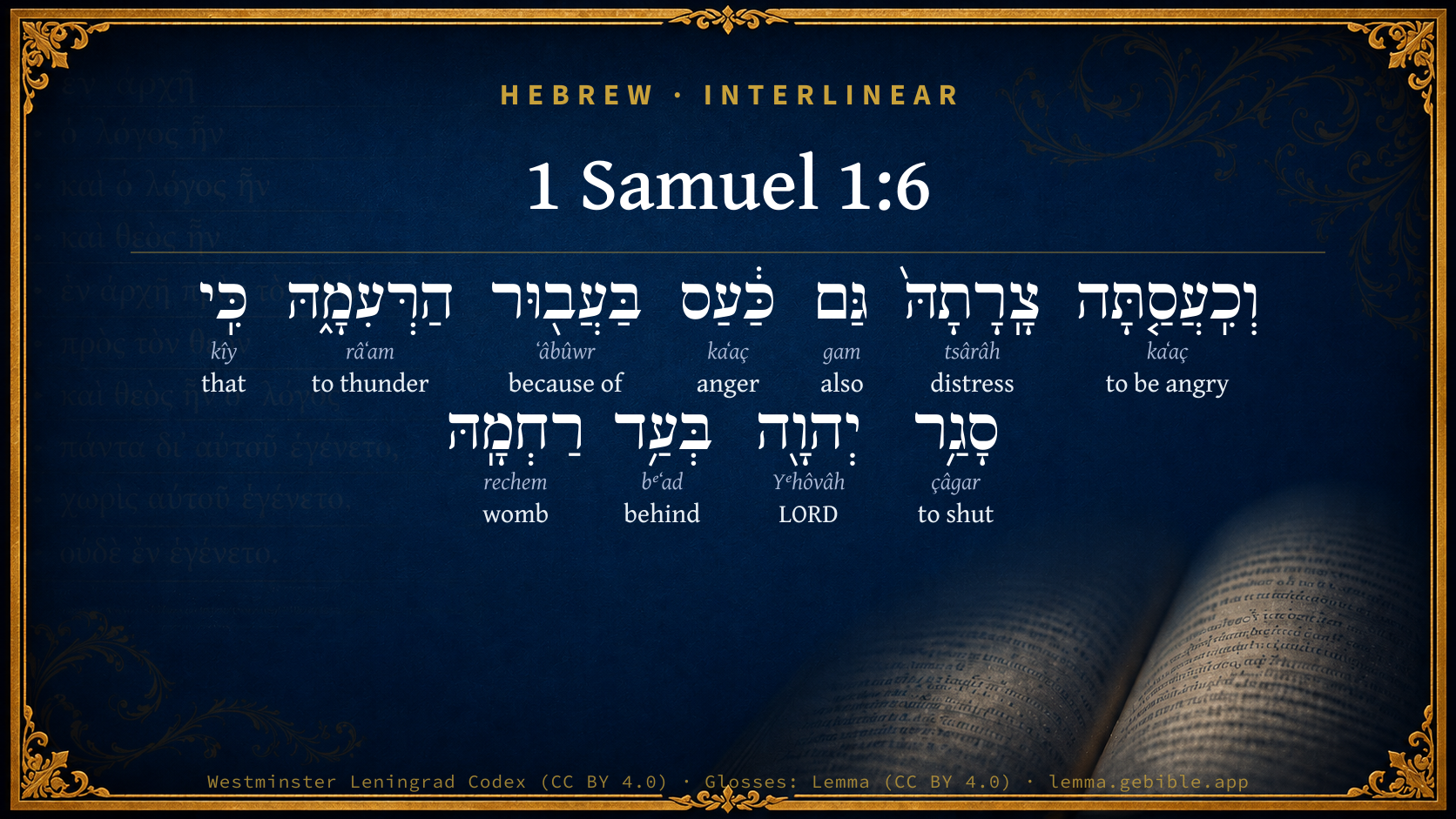
1 Samuel 1:6

Hebrew (Westminster Leningrad Codex) 1 Samuel 1:6 appears in the Hebrew Old Testament. The text above is from the Westminster Leningrad Codex. Each word links to its Strong’s number, a concise gloss, and parsing drawn from the Open Scriptures Hebrew Bible morphology. Click any word for its full Brown-Driver-Briggs (BDB) entry.
Download image
Cite this verse

1 Samuel 1:6 (World English Bible). Public Domain. Lemma interlinear Bible study tool, https://lemma.gebible.app/v/1-samuel/1/6.

Show BibTeX & RIS
BibTeX
RIS
English Translation
Her rival provoked her sore, to make her fret, because Yahweh had shut up her womb.
World English Bible · Public Domain
Highlights Full analysis ↓
Download a study sheet

One document with this verse’s original text, its word-by-word gloss line, the meaning frame, cross-references with their text, attributed commentary, and full source and license credits — printable, and it pastes into notes with its structure intact.

This verse Autodidact and up

Study sheet (.html) Plain text (.txt)

A passage Seminary Student

Up to 50 verses in one chapter. A passage sheet keeps up to 6 commentary sources and 12 cross-references per verse, in the order this page ranks them, and says so on the sheet whenever that leaves anything out. Ask for a single verse and you get the Autodidact verse sheet above.

Everything on this page stays free to read, with no account — the sheet is a download of what is already on screen, not access to it.

Want to remove ads? Support Godless Engineer
Compare translations 3

The same verse in 3 English versions, stacked beneath the original-language interlinear above. Click any original word for its lexicon entry.

Each is an independent rendering of the whole verse — the interlinear is not word-aligned to these translations.

Highlighted words mark where these versions differ — a whole-verse word diff, not a word-by-word alignment.

  • World English Bible Public Domain
    Her rival provoked her sore, to make her fret, because Yahweh had shut up her womb.
  • King James Version Public Domain
    And her adversary also provoked her sore, for to make her fret, because the LORD had shut up her womb.
  • unfoldingWord Literal Text CC BY-SA 4.0
    but her adversary also provoked her provocation in order to make her thunder, because Yahweh had shut up her womb.

unfoldingWord Literal Text — © unfoldingWord, licensed CC BY-SA 4.0. Word-aligned USFM3 via Door43 (git.door43.org/unfoldingWord/en_ult).

Versions to compare (up to 4)

3 of 4 selected

Show all 18 translations

Every available English version of this verse, each an independent rendering of the whole verse.

  • World English Bible Public Domain
    Her rival provoked her sore, to make her fret, because Yahweh had shut up her womb.
  • Berean Standard Bible Public Domain
    Because the LORD had closed Hannah’s womb, her rival would provoke her and taunt her viciously.
  • Majority Standard Bible Public Domain
    Because the LORD had closed Hannah’s womb, her rival would provoke her viciously to taunt her.
  • King James Version Public Domain
    And her adversary also provoked her sore, for to make her fret, because the LORD had shut up her womb.
  • American Standard Version (1901) Public Domain
    And her rival provoked her sore, to make her fret, because Jehovah had shut up her womb.
  • Revised Version (1885) Public Domain
    And her rival provoked her sore, for to make her fret, because the LORD had shut up her womb.
  • Geneva Bible (1599) Public Domain
    And her aduersarie vexed her sore, forasmuch as she vpbraided her, because the Lord had made her barren.
  • Douay-Rheims (1899) Public Domain
    Her rival also afflicted her, and troubled her exceedingly, insomuch that she upbraided her, that the Lord had shut up her womb:
  • Young's Literal Translation Public Domain
    and her adversity hath also provoked her greatly, so as to make her tremble, for Jehovah hath shut up her womb.
  • Literal Standard Version CC BY-SA 4.0
    and her rival has also provoked her greatly, so as to make her tremble, for YHWH has shut up her womb.
  • Unlocked Literal Bible CC BY-SA 4.0
    Her rival provoked her severely in order to irritate her, because Yahweh had closed her womb.
  • unfoldingWord Literal Text CC BY-SA 4.0
    but her adversary also provoked her provocation in order to make her thunder, because Yahweh had shut up her womb.
  • Darby Bible Public Domain
    And her adversary provoked her much also, to make her fret, because Jehovah had shut up her womb.
  • World Messianic Bible Public Domain
    Her rival provoked her severely, to irritate her, because the LORD had shut up her womb.
  • Webster's Bible Public Domain
    And her adversary also provoked her greatly, to make her fret, because the LORD had made her barren.
  • Free Bible Version CC BY-SA 4.0
    Her rival—the other wife—would taunt her badly to upset her because the Lord hadn't given her any children.
  • Bible in Basic English Public Domain
    And the other wife did everything possible to make her unhappy, because the Lord had not let her have children;
  • JPS Tanakh (1917) Public Domain
    And her rival vexed her sore, to make her fret, because the LORD had shut up her womb.

Literal Standard Version (2020), Covenant Press — licensed CC BY-SA 4.0. Text via the HelloAO Bible API (eBible.org). Unlocked Literal Bible (unfoldingWord) — licensed CC BY-SA 4.0. Text via the HelloAO Bible API (eBible.org). unfoldingWord Literal Text — © unfoldingWord, licensed CC BY-SA 4.0. Word-aligned USFM3 via Door43 (git.door43.org/unfoldingWord/en_ult). Free Bible Version, Dr. Jonathan Gallagher — licensed CC BY-SA 4.0. Text via the HelloAO Bible API (eBible.org).

Word by word

More ways to search: Search by grammar → Find every occurrence → Compare this word →

Practice this passage: Drill this verse → Learn its vocabulary →

הַרְּעִמָ֑הּ
râʻam
H7481
“to thunder · her”
Verb, Hiphil, Infinitive Construct + Suffix, Personal, 3rd Person, Feminine, Singular
Part of Speech
Verb
Stem
Hiphil
Form
Infinitive Construct
Full BDB Definition

Origin: a primitive root

TWOT: 2189

to thunder - (Qal) - to make the sound of thunder, thunder - to rage - (Hiphil) - to thunder, cause thunder - to tremble, cause to tremble (by extension)
  1. וְכִֽעֲסַ֤תָּה kaʻaç H3707 “and · to be angry · her” Conjunction + Verb, Piel, Perfect, 3rd Person, Feminine, Singular + Suffix, Personal, 3rd Person, Feminine, Singular
  2. צָֽרָתָהּ֙ tsârâh H6869 “distress · her” Noun, Common, Feminine, Singular, Construct + Suffix, Personal, 3rd Person, Feminine, Singular
  3. גַּם gam H1571 “also” Particle, Accusative
  4. כַּ֔עַס kaʻaç H3708 “anger” Noun, Common, Masculine, Singular, Absolute
  5. בַּעֲב֖וּר ʻâbûwr H5668 “in/at · because of of” Preposition + Noun, Common, Masculine, Singular, Construct
  6. כִּֽי kîy H3588 “that” Conjunction
  7. סָגַ֥ר çâgar H5462 “to shut” Verb, Qal, Perfect, 3rd Person, Masculine, Singular
  8. יְהוָ֖ה Yᵉhôvâh H3068 “LORD” Noun, Proper
  9. בְּעַ֥ד bᵉʻad H1157 “behind” Preposition
  10. רַחְמָֽהּ rechem H7358 “womb · her” Noun, Common, Masculine, Singular, Construct + Suffix, Personal, 3rd Person, Feminine, Singular

About this verse

These counts appear in no published source. They are computed here, from the morphology-tagged text and Lemma’s own curated glosses. What Lemma adds →

11
words
11
distinct lemmas
Historical
section

Notable vocabulary

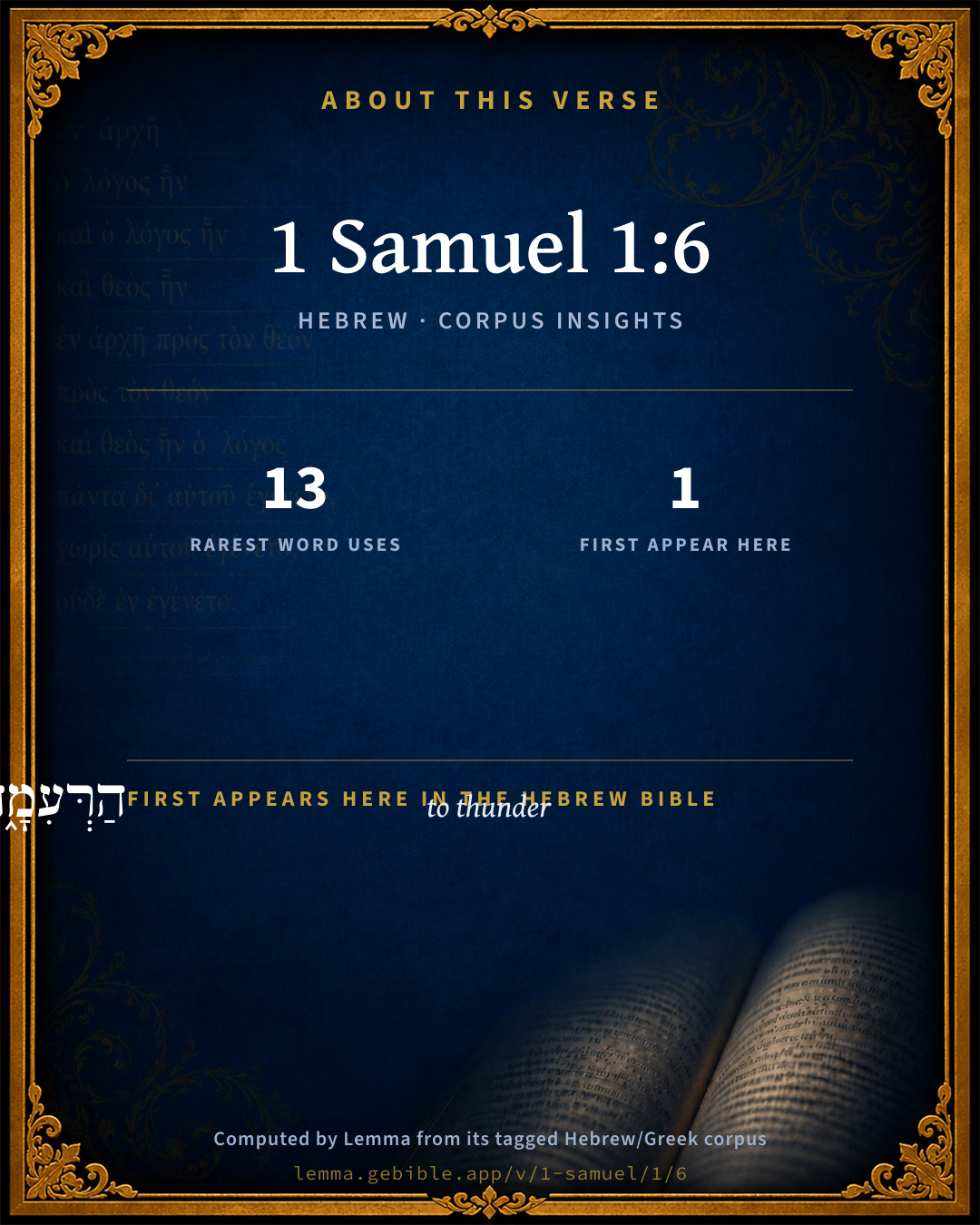
The rarest word here is הַרְּעִמָ֑הּ to thunder H7481 — appearing just 13 times in the whole Hebrew Bible.

First appearance in Scripture

This word makes its first canonical appearance in the Hebrew Bible here:

  • הַרְּעִמָ֑הּ to thunder H7481

Shared distinctive vocabulary

הַרְּעִמָ֑הּ to thunder H7481 occurs in 13 verses of the Hebrew Bible. Also found in:

Grammatical profile

  • 3 verbs
  • 5 nouns
  • 1 preposition
  • 1 conjunction
  • 1 particle

Verb forms

  • וְכִֽעֲסַ֤תָּה Piel · Perfect
  • הַרְּעִמָ֑הּ Hiphil · Infinitive Construct
  • סָגַ֥ר Qal · Perfect

Hebrew & Septuagint length

In English translation the verse runs 16 words from the Hebrew and 40 from the Septuagint (LXX English) — the Septuagint runs noticeably longer here. See the side-by-side →

A rough comparison of the two English renderings, which tokenize alike — not a word-level alignment.

Word counts can differ between the Hebrew and the Greek without any difference in meaning — e.g. the Hebrew direct-object marker אֵת has no separate Greek word, and Greek often adds the article ὁ.

Cross-references

3

Topical passages linked to 1 Samuel 1:6 in the Treasury of Scripture Knowledge — connected by theme and wording, ordered by reader-vote popularity; previews shown in the World English Bible.

  • Job 6:14 "To him who is ready to faint, kindness should be shown from his friend; Even to him who forsakes the fear of the Almighty.
  • Job 24:21 He devours the barren who don't bear. He shows no kindness to the widow.
  • Leviticus 18:18 "'You shall not take a wife to her sister, to be a rival, to uncover her nakedness, while her sister is yet alive.

Cross-references courtesy of OpenBible.info (CC BY 4.0).

Hebrew and Greek witnesses Masoretic Hebrew ↔ Greek Septuagint

The same verse in the two great witnesses to the Old Testament, shown verse-for-verse.

Here the Septuagint runs noticeably longer than the Hebrew — LXX2012 (modern English Septuagint) 40 words vs World English Bible 16. A rough length comparison of the two English translations, not a word-level alignment — read both below.

These are two independent witnesses, not word-aligned to each other, and the Septuagint is shown in lemma (dictionary) form.

Hebrew 1 Samuel 1:6 Masoretic · Westminster Leningrad Codex

וְכִֽעֲסַ֤תָּה צָֽרָתָהּ֙ גַּם כַּ֔עַס בַּעֲב֖וּר הַרְּעִמָ֑הּ כִּֽי סָגַ֥ר יְהוָ֖ה בְּעַ֥ד רַחְמָֽהּ

Her rival provoked her sore, to make her fret, because Yahweh had shut up her womb.

World English Bible · Public Domain

Greek LXX 1 Samuel 1:6 Septuagint · lemma form

ὅτι οὐ δίδωμι αὐτός κύριος παιδίον κατά ὁ θλῖψις αὐτός καί κατά ὁ ἀθυμία ὁ θλῖψις αὐτός καί ἀθυμέω διά οὗτος ὅτι συνκλείω κύριος ὁ περί ὁ μήτρα αὐτός ὁ μή δίδωμι αὐτός παιδίον

For the Lord gave her no child in her affliction, and according to the despondency of her affliction; and she was dispirited on this account, that the Lord shut up her womb so as not to give her a child.

LXX2012 (modern English Septuagint) · Public Domain

On this verse, The Pulpit Commentary discusses the Septuagint’s reading. Read the note in Commentary ↓

Hebrew: Westminster Leningrad Codex (CC BY 4.0). Greek: Septuagint (public domain); English from LXX2012 (modern English Septuagint) (Public Domain). How the Septuagint differs from the Hebrew →

Targum (Aramaic paraphrase)

1

The Targum is the ancient Jewish Aramaic paraphrase of the Hebrew Scriptures — an interpretive translation, not the Hebrew text itself. Onkelos (literal) and Pseudo-Jonathan (expansive) render the Torah, and Jonathan the Prophets. Coverage is partial: where no permissively-licensed English translation exists for a verse, only the Aramaic is shown. This is verse-level text, not a word-by-word alignment to the Hebrew.

  1. Targum Jonathan Prophets (Joshua–Malachi)
    וּמְצַהֲבָא לָהּ צָרָתָהּ אַף מַרְגְזָא לָהּ בְּדִיל לְאַקְנָיוּתָהּ אֲרֵי אִתְמְנַע מִן קֳדָם יְיָ מִנָהּ וְלָד:

    (no public-domain English translation for this verse)

    Targum Jonathan — Aramaic: “Mikraot Gedolot” (public domain). English: “Sefaria Community Translation” (CC0 1.0 (public-domain dedication)); “London "Chaldee Paraphrase," 1871” (public domain). Text via Sefaria.

Commentary

Notes on 1 Samuel 1:6 from classic Christian and Jewish commentators (each source and its license shown beneath its notes). The classic Christian expositions comment on the surrounding passage and are grouped to its opening verse, so a note may address several verses; the Jewish commentaries on the Tanakh (Rashi and others) are per-verse, so they appear only where the commentator wrote on this verse.

Lemma curates 59 commentaries, every one of them public domain or Creative Commons licensed, each selected and text-cleaned for this edition rather than reprinted as found. About our sources →

Trapp's Complete Commentary

John Trapp

1Sa 1:6 And her adversary also provoked her sore, for to make her fret, because the LORD had shut up her womb.

Ver. 6. And her adversary also provoked her sore.] Aemula eius: num ita vocantur uxores digamorum {Lev 18:18} Peninnah, her corival, an insolent spiteful creature, vexatious, as the Hebrew word signifieth, and violent. {a}

For to make her fret.] Or, To make her to thunder, and cause a rattle in the house, by chiding and chafing. Peninnah provoked her on purpose, and for that purpose: this was an aggravation of her sin, as it is likewise of theirs that put a word out on purpose to enrage, vex, disgrace, or discountenance another. Piscator rendereth it, Propterea quid intonabat, because she, that is, Peninnah, thundered, that is, impetuously railed, and reproached her with her barrenness. This was to add affliction to the afflicted; which is greatest inhumanity.

{a} Angens.

John Trapp, A Commentary or Exposition upon All the Books of the Old and New Testament (1647–1656) — public domain. Text from a community e-Sword module.

Jamieson, Fausset & Brown

Robert Jamieson, A. R. Fausset & David Brown

her adversary also provoked her sore--The conduct of Peninnah was most unbecoming. But domestic broils in the houses of polygamists are of frequent occurrence, and the most fruitful cause of them has always been jealousy of the husband's superior affection, as in this case of Hannah.

Jamieson, Fausset & Brown — Commentary Critical and Explanatory on the Whole Bible (1871) — public domain (CC PDM 1.0). Text via the HelloAO Bible API.

Adam Clarke's Commentary

Verse 6. And her adversary] That is, Peninnah.

Provoked her sore] Was constantly striving to irritate and vex her, to make her fret - to make her discontented with her lot, because the Lord had denied her children.

Adam Clarke's Commentary on the Bible (1810–1826) — public domain. Text from a community e-Sword/MySword module.

Ellicott's Commentary for English Readers

(6) And her adversary also provoked her sore.—Jealousy, grief, anger, malice, the many bitter fruits of this way of living, so different to God’s original appointment, here show themselves. The one sin of polygamy poisons the whole home life of the family, in all other respects apparently a quiet, Godfearing, orderly household.

A Bible Commentary for English Readers, edited by Charles John Ellicott (1878–1897) — public domain. Text from a community e-Sword module.

The Cambridge Bible for Schools and Colleges

gen. ed. J. J. S. Perowne

6. her adversary] Peninnah. The cognate verb is used in Lev_18:18, “Thou shalt not take a wife to her sister to vex her.”

The Cambridge Bible for Schools and Colleges (gen. ed. J. J. S. Perowne; Cambridge University Press, 1878–1918) — public domain. Text from a community e-Sword module.

John Gill's Exposition

And her adversary also provoked her sore,.... That is, Peninnah, the other wife of Elkanah; for when a man had more wives, two or more, they were usually at enmity to one another, as the two wives of Socrates were, being always jealous lest one should have more love and respect than the other from the husband; and this woman provoked Hannah one time after another, and continually, by upbraiding her with her barrenness; and this was another reason why Elkanah did all he could to comfort her, not only because the Lord had restrained her from bearing children, but because also she that envied and emulated her sadly provoked her:

for to make her fret; and be uneasy, and murmur at and complain of her unhappy circumstances: some render it, "because she thundered" (l) against her; that is, Peninnah was exceeding loud and clamorous with her reproaches and scoffs, which were grievously provoking to Hannah. So said Socrates, when Xantippe first scolded at him, and then poured foul water on him: did not I say, says he, that Xantippe first thunders, and then rains (m)?

because the Lord had shut up her womb; it was this Peninnah upbraided her with, and at which Hannah fretted and grieved.

(l) "propterea quod intonabat contra eam", Piscator. (m) Laert. in Vit. Socrat. p. 112.

John Gill's Exposition of the Whole Bible (1746–1763) — public domain (CC PDM 1.0). Text via the HelloAO Bible API.

Haydock's Catholic Bible Commentary

Insomuch. Hebrew, "to make her fret, or rage; because the Lord," &c. (Calmet)

George Leo Haydock (1774–1849), Haydock's Catholic Family Bible and Commentary, 1859 edition — public domain. Excludes Psalms (Douay-Rheims chapter numbering differs from Protestant) and Deuterocanonical books (Catholic canon only).

Matthew Poole's English Annotations

Her adversary, or, her troubler, or vexer, or enemy; for so her envy or jealousy made her, though so nearly related. Compare Gen 29:30; Lev 18:18.

To make her fret, against her husband, or against God, or within herself.

Matthew Poole's English Annotations on the Holy Bible (1683–1685) — public domain. Text from a community e-Sword/MySword module.

Whedon's Commentary on the Bible

Daniel D. Whedon

6. Her adversary — Peninnah, who was jealous of Hannah because of the peculiar favours shown her.

Provoked her sore, to make her fret — Tantalized her by parading sons and daughters before her eyes, and reminding her that she was barren.

Daniel D. Whedon (gen. ed.), Commentary on the Old and New Testaments (1874–1909) — public domain. Text from a community e-Sword module.

The Pulpit Commentary

Vers. 6, 7, 8. Her adversary also provoked her sore. The pleasure of this domestic festival was spoiled by the discord of the wives. Peninnah, triumphant in her fruitfulness, is yet Hannah"s adversary, because, in spite of her barrenness, she has the larger portion of the husband"s love; while Hannah is so sorely vexed at the taunts of her rival, that she weeps from sheer vexation. In vain Elkanah tries to give her comfort. The husband really is not "better than ten sons," for the joy of motherhood is quite distinct from that of conjugal affection, and especially to a Hebrew woman, who had special hopes from which she was cut off by barrenness. In ver. 7 there is a strange confusion of subject, owing to the first verb having been read as an active instead of a passive. It should be, "And so it happened year by year: when she (Hannah) went up to the house of Jehovah she (Peninnah) thus provoked her, and she wept and did not eat." It must be remembered that the Hebrews had no written vowels, but only consonants; the vowels were added in Christian times, many centuries after the coming of our Lord, and represent the traditional manner of reading of one great Jewish school. They are to be treated with the greatest respect, because as a rule they give us a sense confirmed by the best authorities; but they are human, and form no part of Holy Scripture. The ancient versions, the Septuagint, the Syriac, and the Vulgate, which are all three older than the Masoretic vowels, translate, "And so she (Peninnah) did year by year;" but this requires a slight change of the consonants.

The Pulpit Commentary (1880–1919), ed. H.D.M. Spence-Jones & Joseph S. Exell — public domain. Text from a community e-Sword module.

John Wesley's Explanatory Notes

Her adversary - Peninnah: so her envy or jealousy made her though so nearly related.

John Wesley, Explanatory Notes Upon the Whole Bible (1754–1765) — public domain. Text via the GEBible commentary corpus.

Rashi

Rabbi Shlomo Yitzchaki (Rashi)

Her rival. Her husband's other wife, Penina.

Frequently anger. Anger after anger, i.e., always.' Therefore it is written 'also [גֵם] anger.' She would say to her, "Did you buy your older son a cloak today, or your younger son, a shirt?"

In order that she should complain. In order to make her complain. Our Rabbis explain, 'in order to make her storm,' that she pray. Penina had good intentions.

Her womb. Lit., opposite her womb, and so is every expression of the word. בְּעַד

Rashi on the Tanakh — English translations: “The Judaica Press complete Tanach with Rashi, translated by A. J. Rosenberg” (CC BY 4.0); “Pentateuch with Rashi's commentary by M. Rosenbaum and A.M. Silbermann, 1929-1934” (public domain); “The Metsudah Tanach series, Lakewood, N.J” (CC BY 4.0); and “The Book of Joshua, Metsudah Publications, 1997” (CC BY 4.0). Text via Sefaria.

Radak

Rabbi David Kimhi (Radak)

Her rival (tzarah): Peninah, who was a tribulation (tzarah) to her. And likewise, all two wives [married] to the same man are called tribulations (tzarot), since they are generally each other's enemies. And likewise in the Mishnah (Yevamot 1), "exempt their tzarot."

Very much anger: One anger after another. She would say things [that cause] anger, since she did not have children. And in the homiletical teachings: She would anger [her] and anger [her] again. What would she say to her? "Did you buy your older son a cloak today, or your younger son, a shirt?"

So that she should harraeim: From [the same usage as] (Ezekiel 27:35), "raamu panim (contorted [their] faces)." And the [letter], reish, in harraeimah is accented, against the rules, to strengthen the reading - as with the kof in (Judges 20:13), "netakkenhu (we shall draw them) from the city," and others that are accented for the beauty of the reading. And Yonatan translated it [in the Targum] as, harraeimah, as "to make her jealous." Meaning to say, in order that she would be jealous, she would say things about childraising in front of her and that which is similar, so that she would be jealous and her heart would ache.

Before (be'ad) her womb: Upon her womb, like (Joel 2:8), "before they fell before (be'ad) the loopholes"; (Leviticus 16:6), "and atoned before (be'ad) him" (in both of these cases, be'ad means, upon).

Radak on the Tanakh — English translations: “Sefaria Community Translation” (CC0 1.0 (public-domain dedication)); “Eliyahu Munk, HaChut Hameshulash” (CC BY 4.0); “Rabbi Mike Feuer, Jerusalem Anthology” (CC BY 4.0); and “R. David Kimhi on the first book of Psalms, Translated by R.G. Finch, London, 1919” (public domain). Text via Sefaria.

Lesson kit

Teaching starters — assembled from the data on this page, not authored interpretation. Every prompt links to the verse data it draws on. Edit before teaching.

1 Samuel, in the Historical, opens this verse with 11 words (11 distinct Hebrew lemmas). Its most distinctive word is râʻam (“to thunder”). The Greek Septuagint runs longer here. A historical commentator’s framing appears above. Read the whole chapter for the surrounding context.

Discussion questions

  1. What does “to thunder” (râʻam) contribute to the verse as a whole?
  2. This is the first place “to thunder” appears in Scripture (first appears here). What does its debut here establish?
  3. How does 1 Samuel 2:10, which shares the word «to thunder», read alongside this verse?
  4. The Septuagint runs longer here than the Hebrew. What might account for the difference?
  5. These translations render this verse differently. What is at stake in choosing one wording over another?
  6. «וְכִֽעֲסַ֤תָּה» is a Piel Perfect verb. How does that grammatical form shape the action described?
  7. Compare how Trapp's Complete Commentary and Jamieson, Fausset & Brown read this verse. Where do they agree or differ?

Things to notice

Reading settings

Reading text

Shown beneath each verse's original-language words.

Old Testament
Old Testament edition

Read the OT as the Masoretic Hebrew (MT) or the Greek Septuagint (LXX).

English shown for the Greek Septuagint (in the Hebrew ↔ Greek comparison).

Comparing translations? Open the Compare panel on any verse page to stack up to four side by side.