Mark 9:29

Greek (Tischendorf 8th ed.) Mark 9:29 appears in the Greek New Testament. The text above is from the Tischendorf 8th edition. Each word links to its Strong’s number and a concise gloss. Click any word for its full Thayer’s Greek Lexicon entry.
Download image
Cite this verse

Mark 9:29 (World English Bible). Public Domain. Lemma interlinear Bible study tool, https://lemma.gebible.app/v/mark/9/29.

Show BibTeX & RIS
BibTeX
RIS
English Translation
He said to them, "This kind can come out by nothing, except by prayer and fasting."
World English Bible · Public Domain
Download a study sheet

One document with this verse’s original text, its word-by-word gloss line, the meaning frame, cross-references with their text, attributed commentary, and full source and license credits — printable, and it pastes into notes with its structure intact.

This verse Autodidact and up

Study sheet (.html) Plain text (.txt)

A passage Seminary Student

Up to 50 verses in one chapter. A passage sheet keeps up to 6 commentary sources and 12 cross-references per verse, in the order this page ranks them, and says so on the sheet whenever that leaves anything out. Ask for a single verse and you get the Autodidact verse sheet above.

Everything on this page stays free to read, with no account — the sheet is a download of what is already on screen, not access to it.

Want to remove ads? Support Godless Engineer
Compare translations 3

The same verse in 3 English versions, stacked beneath the original-language interlinear above. Click any original word for its lexicon entry.

Each is an independent rendering of the whole verse — the interlinear is not word-aligned to these translations.

Highlighted words mark where these versions differ — a whole-verse word diff, not a word-by-word alignment.

  • World English Bible Public Domain
    He said to them, "This kind can come out by nothing, except by prayer and fasting."
  • King James Version Public Domain
    And he said unto them, This kind can come forth by nothing, but by prayer and fasting.
  • unfoldingWord Literal Text CC BY-SA 4.0
    And he said to them, “This kind is able to come out by nothing except by prayer and fasting.”

unfoldingWord Literal Text — © unfoldingWord, licensed CC BY-SA 4.0. Word-aligned USFM3 via Door43 (git.door43.org/unfoldingWord/en_ult).

Versions to compare (up to 4)

3 of 4 selected

Show all 19 translations

Every available English version of this verse, each an independent rendering of the whole verse.

  • World English Bible Public Domain
    He said to them, "This kind can come out by nothing, except by prayer and fasting."
  • Berean Standard Bible Public Domain
    Jesus answered, “This kind cannot come out, except by prayer.”
  • Majority Standard Bible Public Domain
    Jesus answered, “This kind cannot come out, except by prayer and fasting.”
  • King James Version Public Domain
    And he said unto them, This kind can come forth by nothing, but by prayer and fasting.
  • American Standard Version (1901) Public Domain
    And he said unto them, This kind can come out by nothing, save by prayer.
  • Revised Version (1885) Public Domain
    And he said unto them, This kind can come out by nothing, save by prayer.
  • Geneva Bible (1599) Public Domain
    And he saide vnto them, This kinde can by no other meanes come foorth, but by prayer and fasting.
  • Douay-Rheims (1899) Public Domain
    And departing from thence, they passed through Galilee, and he would not that any man should know it.
  • Young's Literal Translation Public Domain
    And he said to them, `This kind is able to come forth with nothing except with prayer and fasting.'
  • Literal Standard Version CC BY-SA 4.0
    And He said to them, “This kind is able to come forth with nothing except with prayer and fasting.”
  • Unlocked Literal Bible CC BY-SA 4.0
    He said to them, “This kind cannot be cast out except by prayer.”
  • unfoldingWord Literal Text CC BY-SA 4.0
    And he said to them, “This kind is able to come out by nothing except by prayer and fasting.”
  • Darby Bible Public Domain
    And he said to them, This kind can go out by nothing but by prayer and fasting.
  • World Messianic Bible Public Domain
    He said to them, “This kind can come out by nothing but by prayer and fasting.”
  • Webster's Bible Public Domain
    And he said to them, This kind can come forth by nothing, but by prayer and fasting.
  • Free Bible Version CC BY-SA 4.0
    “This kind can't be driven out except by prayer,” Jesus told them.
  • Bible in Basic English Public Domain
    And he said to them, Nothing will make this sort come out but prayer.
  • Text-Critical English NT CC BY 4.0
    He said to them, “This kind cannot come out by anything except prayer and fasting.”
  • Tyndale New Testament (1534) Public Domain
    And he sayde vnto them: this kynde can by no nother meanes come forth but by prayer and fastynge.

Literal Standard Version (2020), Covenant Press — licensed CC BY-SA 4.0. Text via the HelloAO Bible API (eBible.org). Unlocked Literal Bible (unfoldingWord) — licensed CC BY-SA 4.0. Text via the HelloAO Bible API (eBible.org). unfoldingWord Literal Text — © unfoldingWord, licensed CC BY-SA 4.0. Word-aligned USFM3 via Door43 (git.door43.org/unfoldingWord/en_ult). Free Bible Version, Dr. Jonathan Gallagher — licensed CC BY-SA 4.0. Text via the HelloAO Bible API (eBible.org).

Word by word

More ways to search: Search by grammar → Find every occurrence → Compare this word →

Practice this passage: Drill this verse → Learn its vocabulary →

γένος
génos
G1085
“nation”
Noun, Nominative, Singular, Neuter
Part of Speech
Noun
Case
Nominative
Number
Singular
Gender
Neuter
Full Thayer's Definition

Origin: from G1096

TDNT: 12:24,1

1. kindred a. offspring b. family c. stock, tribe, nation 1. i.e. nationality or descent from a particular people d. the aggregate of many individuals of the same nature, kind, sort
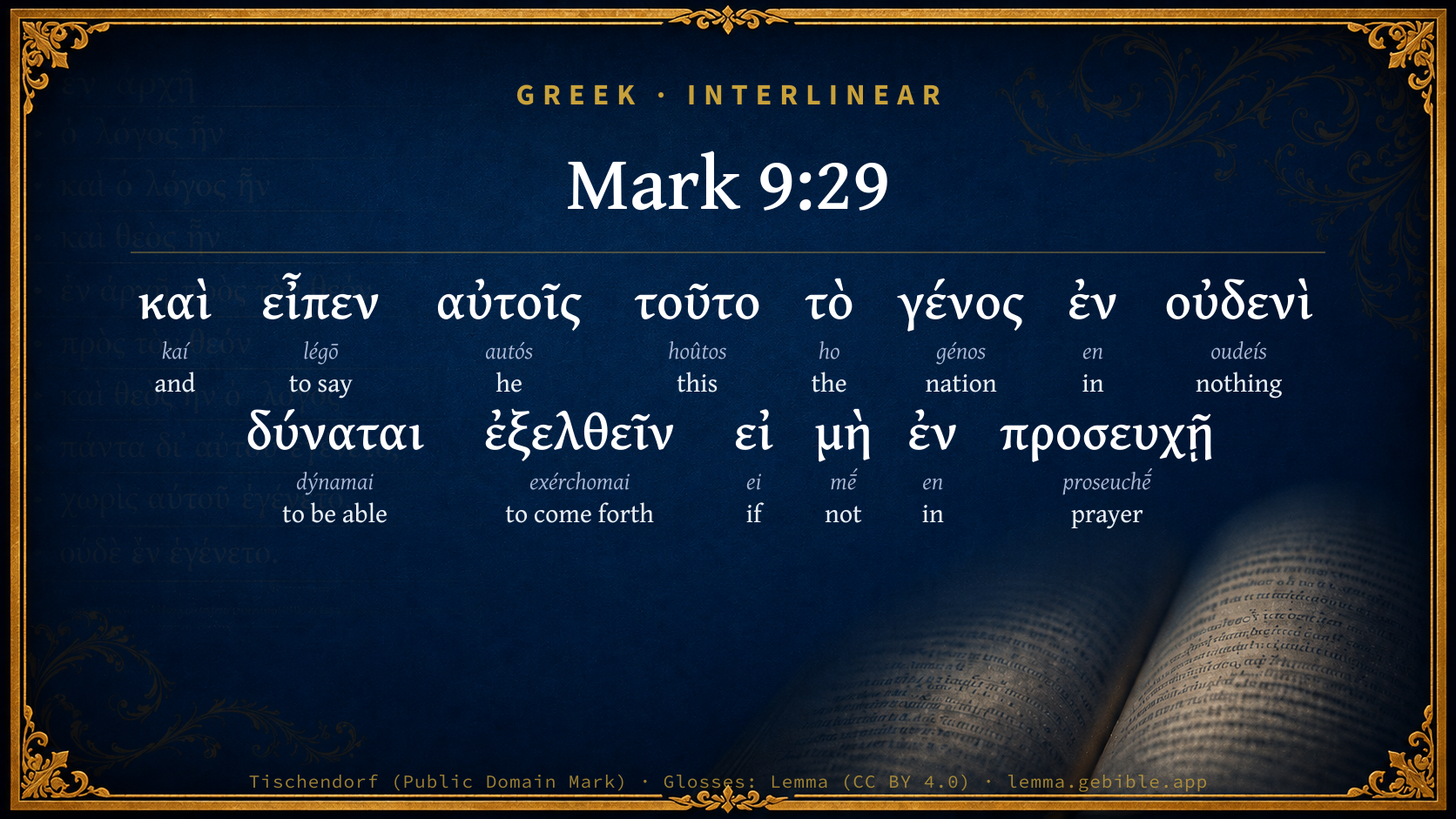
  1. καὶ kaí G2532 “and” Conjunction
  2. εἶπεν légō G3004 “to say” Verb, Aorist, Active, Indicative, 3rd person, Singular
  3. αὐτοῖς autós G846 “he” Personal pronoun, Dative, Plural, Masculine
  4. τοῦτο hoûtos G3778 “this” Demonstrative pronoun, Nominative, Singular, Neuter
  5. τὸ ho G3588 “the” Article, Nominative, Singular, Neuter
  6. ἐν en G1722 “in” Preposition
  7. οὐδενὶ oudeís G3762 “nothing” Adjective, Dative, Singular, Neuter, Negative
  8. δύναται dýnamai G1410 “to be able” Verb, Present, Middle or Passive deponent, Indicative, 3rd person, Singular
  9. ἐξελθεῖν exérchomai G1831 “to come forth” Verb, Aorist, Active, Infinitive
  10. εἰ ei G1487 “if” Conditional
  11. μὴ mḗ G3361 “not” Particle, Negative
  12. ἐν en G1722 “in” Preposition
  13. προσευχῇ proseuchḗ G4335 “prayer” Noun, Dative, Singular, Feminine

About this verse

These counts appear in no published source. They are computed here, from the morphology-tagged text and Lemma’s own curated glosses. What Lemma adds →

14
words
13
distinct lemmas
Gospels
section

Notable vocabulary

The rarest word here is γένος nation G1085 — appearing just 20 times in the whole Greek New Testament.

Shared distinctive vocabulary

γένος nation G1085 occurs in 20 verses of the Greek New Testament. Also found in:

Repetition

A word recurs within this verse:

Cross-references

13

Topical passages linked to Mark 9:29 in the Treasury of Scripture Knowledge — connected by theme and wording, ordered by reader-vote popularity; previews shown in the World English Bible.

  • James 5:15 and the prayer of faith will heal him who is sick, and the Lord will raise him up. If he has committed sins, he will be forgiven.
  • Daniel 9:3 I set my face to the Lord God, to seek by prayer and petitions, with fasting and sackcloth and ashes.
  • Matthew 17:20 He said to them, "Because of your unbelief. For most assuredly I tell you, if you have faith as a grain of mustard seed, you will tell this mountain, 'Move from here to there,' and it will move; and nothing will be impossible for you.
  • Ephesians 6:18 with all prayer and requests, praying at all times in the Spirit, and being watchful to this end in all perseverance and requests for all the saints:
  • 2 Corinthians 12:8 Concerning this thing, I begged the Lord three times that it might depart from me.
  • 2 Corinthians 11:27 in labor and travail, in watchings often, in hunger and thirst, in fastings often, and in cold and nakedness.
  • 1 Kings 17:20–22 He cried to Yahweh, and said, Yahweh my God, have you also brought evil on the widow with whom I sojourn, by killing her son?
  • Luke 11:26 Then he goes, and takes seven other spirits more evil than himself, and they enter in and dwell there. The last state of that man becomes worse than the first."
  • 1 Corinthians 9:27 but I beat my body and bring it into submission, lest by any means, after I have preached to others, I myself should be rejected.
  • Acts 14:23 When they had appointed elders for them in every assembly, and had prayed with fasting, they commended them to the Lord, on whom they had believed.
  • Matthew 12:45 Then he goes, and takes with himself seven other spirits more evil than he is, and they enter in and dwell there. The last state of that man becomes worse than the first. Even so will it be also to this evil generation."
  • Acts 9:40–41 Peter put them all out, and kneeled down and prayed. Turning to the body, he said, "Tabitha, get up!" She opened her eyes, and when she saw Peter, she sat up.
  • 2 Kings 4:33–34 He went in therefore, and shut the door on them both, and prayed to Yahweh.

Cross-references courtesy of OpenBible.info (CC BY 4.0).

Where the printed editions differ

1 variant

Places in this verse where the major printed Greek editions disagree on the wording in a way that affects the translation — a comparison of editions, not a manuscript-by-manuscript collation. The editions are the modern critical texts (Nestlé-Aland 28/27, SBL, Westcott-Hort, Tregelles, Tyndale House) and the traditional texts behind the KJV (the Textus Receptus and the Byzantine/Majority text). It is not a claim about which reading is original.

  1. Extra text
    καὶ νηστείᾳ.

    “and with fastings.”

    In TynTregTRByz Not in NA28NA27SBLWH

    καὶ νηστείᾳ.¶ (kai nēsteia) 'and with fastings.' is only in traditional manuscripts (Tyn+Treg+TR+Byz)

Textual data: Translators Amalgamated Greek New Testament (STEPBible TAGNT) · CC BY 4.0.

Commentary

Notes on Mark 9:29 from classic Christian and Jewish commentators (each source and its license shown beneath its notes). The classic Christian expositions comment on the surrounding passage and are grouped to its opening verse, so a note may address several verses; the Jewish commentaries on the Tanakh (Rashi and others) are per-verse, so they appear only where the commentator wrote on this verse.

Lemma curates 59 commentaries, every one of them public domain or Creative Commons licensed, each selected and text-cleaned for this edition rather than reprinted as found. About our sources →

Bengel's Gnomon

Johann Albrecht Bengel

Mar 9:29. Δύναται, can) That is, by no means can you cast out this class of enemies, save with the accompaniment of prayer and fasting.

Bengel's Gnomon of the New Testament — English translation (T&T Clark, Edinburgh, 1860) — public domain. Text from a community e-Sword module.

Expositor's Greek Testament

ed. W. Robertson Nicoll

Mar 9:29 . τοῦτο τὸ γένος , etc.: This is one of the texts which very soon became misunderstood, the ascetic addition, καὶ νηστείᾳ , being at once a proof and a cause of misunderstanding. The traditional idea has been that Jesus here prescribes a certain discipline by which the exorcist could gain power to cope successfully with the most obstinate cases of possession, a course of prayer and fasting. This idea continues to dominate the mind even when the ascetic addition to the text has come to be regarded as doubtful; witness this remark: “The authorisation, however (for omitting καὶ νησ .), is not sufficient. But even if it were overwhelming, fasting would, in its essence , be implied” (Morison on Mark). What Jesus said doubtless was: “This kind can go out in (on the ground of) nothing except prayer,” and His meaning that there was no hope of success except through a believing (of course faith is implied) appeal to the almighty power of God. It was a thought of the same kind as that in Mat 19:26 (Mar 10:27 ): the impossible for man is possible for God. Of course in the view of Christ, prayer, faith ( vide Mat 17:20 ), both in healer and in healed, was needful in all cases, but He recognised that there were certain aggravated types of disease (the present, one of them) in which the sense of dependence and trust was very specially required. In the case of the epileptic boy this had been lacking both in the father and in the disciples. Neither he nor they were hopeful of cure.

The Expositor's Greek Testament, edited by W. Robertson Nicoll (1897–1910) — public domain. Text from a community e-Sword module.

Cambridge Greek Testament for Schools and Colleges

29. [1984][1985] k omit καὶ νηστείᾳ. Cf. 1Co 7:5.

[1984] Codex Sinaiticus. 4th cent. Discovered by Tischendorf in 1859 at the Monastery of St Katharine on Mount Sinai. Now at St Petersburg. The whole Gospel, ending at Mar 16:8. Photographic facsimile, 1911.

[1985] Codex Vaticanus. 4th cent., but perhaps a little later than א. In the Vatican Library almost since its foundation by Pope Nicolas V., and one of its greatest treasures. The whole Gospel, ending at Mar 16:8. Photographic facsimile, 1889.

29. Τοῦτο τὸ γένος κ.τ.λ. The reply is obscure in two particulars. 1. What γένος? Evil spirits of any kind? or those which render their victims deaf and dumb? 2. Who is to pray? The exorcist? or the victim’s friends? or the possessed person himself? Mt. gives a much simpler answer, which may be regarded as interpreting Mk, Διὰ τὴν ὀλιγοπιστίαν. To be effectual, prayer must be accompanied by faith, and the disciples who had proved powerless either had not prayed, or had prayed without faith. They may have thought that the power to heal was inherent in themselves, and that there was no need to pray; or they had had little trust that God would hear their prayer. Mt. sometimes gives his interpretation of Christ’s words as having been actually spoken; see on Mar 9:1, Mar 8:29.

ἐν προσευχῇ. See crit. note. The widely diffused addition και νηστείᾳ may be safely rejected as an early interpolation in the interests of asceticism. In Act 10:30, νηστεύων καὶ is condemned on still stronger evidence ([2087][2088][2089][2090] and Versions), while the evidence against τῇ νηστείᾳ καὶ in 1Co 7:5 is overwhelming. Mat 17:21 is an interpolation from Mar 9:29 after καὶ νηστείᾳ had been added. Here the internal evidence is as strong as the external. When a demoniac was brought to the disciples to be healed, were they to say, “We must first fast for so many hours”?

[2087] Codex Sinaiticus. 4th cent. Discovered by Tischendorf in 1859 at the Monastery of St Katharine on Mount Sinai. Now at St Petersburg. The whole Gospel, ending at Mar 16:8. Photographic facsimile, 1911.

[2088] Codex Alexandrinus. 5th cent. Brought by Cyril Lucar, Patriarch of Constantinople, from Alexandria, and afterwards presented by him to King Charles I. in 1628. In the British Museum. The whole Gospel. Photographic facsimile, 1879.

[2089] Codex Vaticanus. 4th cent., but perhaps a little later than א. In the Vatican Library almost since its foundation by Pope Nicolas V., and one of its greatest treasures. The whole Gospel, ending at Mar 16:8. Photographic facsimile, 1889.

[2090] Codex Ephraemi. 5th cent. A palimpsest: the original writing has been partially rubbed out, and the works of Ephraem the Syrian have been written over it; but a great deal of the original writing has been recovered; of Mark we have Mar 1:17 to Mar 6:31, Mar 8:5 to Mar 12:29, Mar 13:19 to Mar 16:20. In the National Library at Paris.

Cambridge Greek Testament for Schools and Colleges (Cambridge University Press, 1896; 21 vols, various authors incl. Carr, Maclear, Plummer, Farrar, Lumby, Moule, M. R. James, Simcox) — public domain. Text from a community e-Sword module.

Adam Clarke's Commentary

Verse 29. Prayer and fasting.] See Clarke on Mt 17:21.

This demon may be considered as an emblem of deeply rooted vices, and inveterate habits, over which the conquest is not generally obtained, but through extraordinary humiliations.

This case is related by both Matthew and Luke, but it is greatly amplified in Mark's account, and many new circumstances related. Another proof that Mark did not abridge Matthew.

Adam Clarke's Commentary on the Bible (1810–1826) — public domain. Text from a community e-Sword/MySword module.

Ellicott's Commentary for English Readers

(29) But by prayer and fasting.—The better MSS. omit the last two words. It is possible that they may have been added, like the “tears” of Mar_9:24, to strengthen the words actually spoken, by bringing in what had been found to bring with it a new intensity of spiritual volition, and therefore of power to rescue human souls from the frenzy and despair into which they had been plunged by the unclean spirits that possessed them. A like addition of “fasting” to prayer, apparently from a like ascetic tendency, is found in 1Co_7:5, where see Note. In St. Matthew both words are found, but some of the most ancient MSS. omit the whole verse. On the whole, however, there is a balance of evidence in their favour; and, as shown in the Note on Mat_17:21, what they teach is in harmony with other portions of the teaching both of our Lord and His Apostles.

A Bible Commentary for English Readers, edited by Charles John Ellicott (1878–1897) — public domain. Text from a community e-Sword module.

The Cambridge Bible for Schools and Colleges

gen. ed. J. J. S. Perowne

29. This kind] In His reply to their question our Lord impresses upon them a twofold lesson: (i) The omnipotence of a perfect faith (see Mat_17:20-21); (ii) that, as there is order and gradation in the hierarchy of blessed spirits, so is it with the spirits of evil (see Eph_6:12). There are degrees of spiritual and moral wickedness so intense and malignant that they can be exorcised by nothing save by prayer and fasting, and the austerest rules of rigour and self-denial. These last words and fasting are wanting in the Sinaitic MS. and some Versions.

The Cambridge Bible for Schools and Colleges (gen. ed. J. J. S. Perowne; Cambridge University Press, 1878–1918) — public domain. Text from a community e-Sword module.

John Gill's Exposition

And he said unto them,.... Matthew, besides the following reason, assigns another, as given by our Lord, why they could not cast out the foul spirit, which was their unbelief; of which they were guilty in some sort, as well as the Jews, and the father of the child; but Mark omits it, and only relates this as the reason;

this kind can come forth by nothing, but by prayer and fasting; which they had not observed; See Gill on Mat 17:21.

John Gill's Exposition of the Whole Bible (1746–1763) — public domain (CC PDM 1.0). Text via the HelloAO Bible API.

Trapp's Complete Commentary

John Trapp

29 And he said unto them, This kind can come forth by nothing, but by prayer and fasting.

Ver. 29. But by prayer and fasting] The cause why they could not cure the child, was unbelief; the cure of unbelief is sought and wrought by fasting and prayer.

John Trapp, A Commentary or Exposition upon All the Books of the Old and New Testament (1647–1656) — public domain. Text from a community e-Sword module.

The Pulpit Commentary

"And he said unto them, This kind can come out by nothing, save by prayer.

The work of the Christian Church essentially the same from age to age, although the external phase of it may change and pass away. "Casting out devils" sounds strangely on modern ears; its associations, whilst they are weird and picturesque, are too far away to seriously engage our attention. We are in the habit of dismissing it in an offhand fashion, as a form of religious activity necessarily confined to a transitional period of the development of Christianity, and having no relation to our own or any other age. But that is only a superficial view of the work of the gospel which will lead to such a judgment. "Casting out devils" is a task which belongs as much to the servant of Christ to-day as in the apostolicage. The particular form assumed by the "possession" may not be the same, but the fact of "possession" still continues; and the mission of the Son of God to "destroy the works of the devil" must be fulfilled, until human souls are freed from the thraldom to which Satan subjects them. In every sinful wish or thought Satan gains a foothold; in every sinful habit formed he may be said to "possess" the nature in which it exists. Until we regard sinful habits as not mere habits, but as involving the presence and power of the evil one, we need not expect to grasp or deal with the problem of evil in our world. In the work of converting human souls, we are contending not merely with those who are the immediate objects of our solicitude, but with a supernatural antagonist, holding them in subjection, and deeply skilled in the arts requisite for the maintenance of his influence. "For our wrestling is not against flesh and blood, but against principalities, against the powers, against the world-rulers of this darkness, against the spiritual hosts of wickedness in the heavenly places". (Eph_6:12) It is due to this permanent characteristic of evil in human nature that such difficulties are met with as the text explains.

I EXCEPTIONAL DIFFICULTIES IN SPIRITUAL WORK.

1. Occasioned by

(1) a peculiar intensity of indwelling evil. We cannot explain it, but it is full of stubbornness, subtlety, and power of resistance. There is a mysterious sympathy, it may be, between the sinner and the special sin that besets him, or prevents his yielding himself to Divine grace. And this may go the length of

(2) total enslavement of the nature. Like the epileptic of the story, not only the body but the spirit may be enthralled. The will is so weak that it is practically powerless. The external ministries of the Church are insufficient to deliver, unaccompanied as they are by any strong desire for salvation on the part of the sinner. It sometimes happens, too, in more general work, that a spirit of opposition displays itself, or circumstances are persistently unfavourable. The Christian toils on, but his efforts are like the dashing of himself against a rock, or the ploughing of the sand. There are none of God"s people who are strangers to such experiences, which are:

2. From their very nature unexpected. The spiritual worker goes on with comparative or even brilliant success for a time, and then encounters sudden breakdown. The reason of this in most instances is, that a great proportion of Christian work is all but mechanical. It consists in a routine of duties; its results represent a sum total of indirect and sometimes unconscious agencies; religious institutions are originated perhaps in an impulse once imparted but not repeated, and are carried on thus far by "their own momentum." There occurs all at once a check, and a sense of helplessness and humiliation ensues, involving the baffled worker in spiritual perplexity. Such difficulties are:

3. Not an unmitigated calamity. They have their uses in the Divine economy. When searching of heart is induced, and hidden sins are revealed, or absence of direct communion with God is made manifest, or pride and self-sufficiency are brought low, they have accomplished a good and necessary work.

II HOW ARE THEY TO BE OVERCOME?

1. The means. "Prayer," or, in the Authorized or peculiar, but general. Could devils, then, come out by anything else than prayer, when man was the exorciser? It would almost seem as if the disciples had done their work hitherto by virtue of an external commission, using the name of Christ as a sort of talisman. This was sufficient for ordinary cases, but whenever one out of the usual occurred they were at a loss.

2. The reason for its necessity. The immediate occasion for the Master"s admonition probably was the increasing laxity of the disciples in personal prayer, their outwardness, and their failure to grasp the essential principles of his kingdom. But there was a more profound reason for the advice. The servant of God should be in complete sympathy and oneness with his Master, and that can only be cultivated by frequent acts of devotion and the exercise of a constant faith. It is not in his own strength that difficulties are to be met, but in Christ"s. But that can only be imparted through fellowship with his spirit, which depends for its efficiency and depth upon repeated acts of the spiritual nature. The disciple by this rule is called into conscious personal fellowship with God, whose power will only then be granted. Oneness with God is the secret of spiritual power.

3. The came principle applies to the whole fife of the Christian. True success depends upon vital spiritual effort, upon conscious co-operation with God, and consequent fasting from self. If we would not be taken at unawares we must be watchful, in constant actual exercise of faith, and uninterrupted personal communion with God. We are in danger of making too much of the external and accidental element in religion; we can never make too much of him who "worketh in" and through "us to will and to do of his good pleasure". (Php_2:13)

The Pulpit Commentary (1880–1919), ed. H.D.M. Spence-Jones & Joseph S. Exell — public domain. Text from a community e-Sword module.

Scofield Reference Notes

C. I. Scofield

This

See, 1Ki 18:42-45; Act 13:2 The two best MSS. omit "and fasting." Cf. Mat 17:21

The Scofield Reference Bible (1917 edition), notes by C. I. Scofield — public domain. Text from a community e-Sword module.

Alford’s Greek Testament

Henry Alford

29.] The answer is given more at length in Matt. ver. 20, and the Lord there distinctly includes the disciples in the γενεὰ ἄπιστος, by telling them διὰ τὴν ἀπιστίαν ὑμῶν. The assurance also occurs there, which was repeated Mat 21:21, where see notes.

τοῦτο τὸ γένος] That there are kinds, more and less malicious, of evil spirits, we find from Mat 12:45—and the pertinacity and cruelty of this one shewed him to belong to the worst kind. The Lord’s saying here (if the doubtful words are to stand) is rather for their after guidance, than their present; for they could not fast while He was with them, ch. 2:19.

Henry Alford, The Greek Testament (1849–1861) — public domain. Text from a community e-Sword module.

International Critical Commentary

29. τοῦτο τὸ γένος—this kind of thing, i.e. the genus evil spirit; not this kind of spirit, as if this was a specially vicious kind of spirit, that it took a good deal to exorcise. ἐν προσευχῇ—in prayer. καὶ νηστείᾳ, and fasting, is an evident gloss. It is one of the things that a later asceticism imported into the spiritual teaching of Jesus. It seems to be implied in the question of the disciples that they had expected to cast out the demon, so that their lack of faith in the matter had not taken the shape of doubt of their power. But what was lacking was prayer, which is the expression of faith considered as dependence on the Divine power and confidence in that. It is the sense of God that conveys all kinds of spiritual power. But this power was not subjective, it did not reside in themselves, but was power to move God, and this precludes the idea that a special degree of this power was necessary in the case of so stubborn a demon as this. But it is a general statement that miracles of any kind are possible only to him who prays.

Omit καὶ νηστείᾳ, Tisch. (Treg. marg.) WH. RV. א* B one ms. Lat. Vet. It is one of the things that would stand no chance of omission, if found in the original. Evidence shows that it was interpolated in a like passage (1Co 7:5).

SECOND PREDICTION OF DEATH

International Critical Commentary — older volumes (1896–1929), various authors — public domain. Text from a community e-Sword module.

Lesson kit

Teaching starters — assembled from the data on this page, not authored interpretation. Every prompt links to the verse data it draws on. Edit before teaching.

Mark, in the Gospels, opens this verse with 14 words (13 distinct Greek lemmas). Its most distinctive word is génos (“nation”). A historical commentator’s framing appears above. Read the whole chapter for the surrounding context.

Discussion questions

  1. How does “nation” (génos) shape what this verse is saying?
  2. How does Matthew 13:47, which shares the word «nation», read alongside this verse?
  3. What does the repetition of “in” (2× in this one verse) do in this verse?
  4. The translations on this page render this verse differently — a whole-verse word diff, not a word-by-word alignment. What might account for the different wordings?
  5. Compare how Bengel's Gnomon and Expositor's Greek Testament read this verse. Where do they agree or differ?

Things to notice

Reading settings

Reading text

Shown beneath each verse's original-language words.

Old Testament
Old Testament edition

Read the OT as the Masoretic Hebrew (MT) or the Greek Septuagint (LXX).

English shown for the Greek Septuagint (in the Hebrew ↔ Greek comparison).

Comparing translations? Open the Compare panel on any verse page to stack up to four side by side.