Judges 2:3

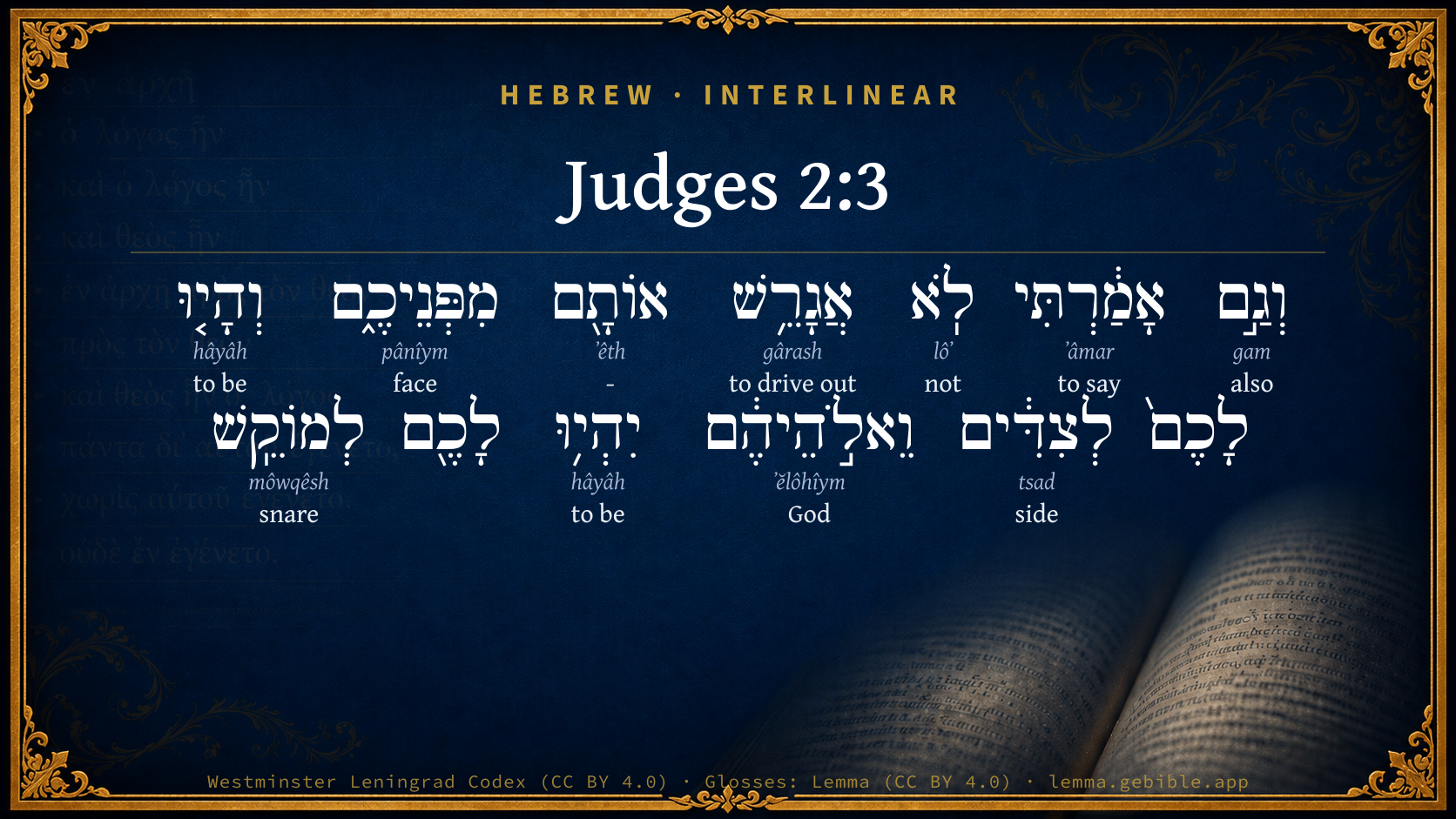
Hebrew (Westminster Leningrad Codex) Judges 2:3 appears in the Hebrew Old Testament. The text above is from the Westminster Leningrad Codex. Each word links to its Strong’s number, a concise gloss, and parsing drawn from the Open Scriptures Hebrew Bible morphology. Click any word for its full Brown-Driver-Briggs (BDB) entry.
Download image
Cite this verse

Judges 2:3 (World English Bible). Public Domain. Lemma interlinear Bible study tool, https://lemma.gebible.app/v/judges/2/3.

Show BibTeX & RIS
BibTeX
RIS
English Translation
Therefore I also said, I will not drive them out from before you; but they shall be [as thorns] in your sides, and their gods shall be a snare to you.
World English Bible · Public Domain
Download a study sheet

One document with this verse’s original text, its word-by-word gloss line, the meaning frame, cross-references with their text, attributed commentary, and full source and license credits — printable, and it pastes into notes with its structure intact.

This verse Autodidact and up

Study sheet (.html) Plain text (.txt)

A passage Seminary Student

Up to 50 verses in one chapter. A passage sheet keeps up to 6 commentary sources and 12 cross-references per verse, in the order this page ranks them, and says so on the sheet whenever that leaves anything out. Ask for a single verse and you get the Autodidact verse sheet above.

Everything on this page stays free to read, with no account — the sheet is a download of what is already on screen, not access to it.

Want to remove ads? Support Godless Engineer
Compare translations 3

The same verse in 3 English versions, stacked beneath the original-language interlinear above. Click any original word for its lexicon entry.

Each is an independent rendering of the whole verse — the interlinear is not word-aligned to these translations.

Highlighted words mark where these versions differ — a whole-verse word diff, not a word-by-word alignment.

  • World English Bible Public Domain
    Therefore I also said, I will not drive them out from before you; but they shall be [as thorns] in your sides, and their gods shall be a snare to you.
  • King James Version Public Domain
    Wherefore I also said, I will not drive them out from before you; but they shall be as thorns in your sides, and their gods shall be a snare unto you.
  • unfoldingWord Literal Text CC BY-SA 4.0
    And I have also said, ‘I will not expel them from the face of you, but they will be to you in the sides, and their gods will be to you for a snare.’”

unfoldingWord Literal Text — © unfoldingWord, licensed CC BY-SA 4.0. Word-aligned USFM3 via Door43 (git.door43.org/unfoldingWord/en_ult).

Versions to compare (up to 4)

3 of 4 selected

Show all 18 translations

Every available English version of this verse, each an independent rendering of the whole verse.

  • World English Bible Public Domain
    Therefore I also said, I will not drive them out from before you; but they shall be [as thorns] in your sides, and their gods shall be a snare to you.
  • Berean Standard Bible Public Domain
    So now I tell you that I will not drive out these people before you; they will be thorns in your sides, and their gods will be a snare to you.”
  • Majority Standard Bible Public Domain
    So now I tell you that I will not drive out these people before you; they will be thorns in your sides, and their gods will be a snare to you.”
  • King James Version Public Domain
    Wherefore I also said, I will not drive them out from before you; but they shall be as thorns in your sides, and their gods shall be a snare unto you.
  • American Standard Version (1901) Public Domain
    Wherefore I also said, I will not drive them out from before you; but they shall be `as thorns' in your sides, and their gods shall be a snare unto you.
  • Revised Version (1885) Public Domain
    Wherefore I also said, I will not drive them out from before you; but they shall be as thorns in your sides, and their gods shall be a snare unto you.
  • Geneva Bible (1599) Public Domain
    Wherefore, I sayd also, I wil not cast them out before you, but they shalbe as thornes vnto your sides, and their gods shalbe your destruction.
  • Douay-Rheims (1899) Public Domain
    Wherefore I would not destroy them from before your face: that you may have enemies, and their gods may be your ruin.
  • Young's Literal Translation Public Domain
    And I also have said, I do not cast them out from your presence, and they have been to you for adversaries, and their gods are to you for a snare.'
  • Literal Standard Version CC BY-SA 4.0
    And I have also said, I do not cast them out from your presence, and they have been for adversaries to you, and their gods are for a snare to you.”
  • Unlocked Literal Bible CC BY-SA 4.0
    So now I say, 'I will not drive the Canaanites out before you, but they will become thorns in your sides, and their gods will become a trap for you.'”
  • unfoldingWord Literal Text CC BY-SA 4.0
    And I have also said, ‘I will not expel them from the face of you, but they will be to you in the sides, and their gods will be to you for a snare.’”
  • Darby Bible Public Domain
    So now I say, I will not drive them out before you; but they shall become adversaries to you, and their gods shall be a snare to you."
  • World Messianic Bible Public Domain
    Therefore I also said, ‘I will not drive them out from before you; but they shall be in your sides, and their gods will be a snare to you.’”
  • Webster's Bible Public Domain
    Wherefore I also said, I will not drive them out from before you; but they shall be as thorns in your sides, and their gods shall be a snare to you.
  • Free Bible Version CC BY-SA 4.0
    I also warned you, ‘I will not drive them out before you, and they will be snares for you, and their gods will be traps for you.’”
  • Bible in Basic English Public Domain
    And so I have said, I will not send them out from before you; but they will be a danger to you, and their gods will be a cause of falling to you.
  • JPS Tanakh (1917) Public Domain
    Wherefore I also said: I will not drive them out from before you; but they shall be unto you as snares, and their gods shall be a trap unto you.'

Literal Standard Version (2020), Covenant Press — licensed CC BY-SA 4.0. Text via the HelloAO Bible API (eBible.org). Unlocked Literal Bible (unfoldingWord) — licensed CC BY-SA 4.0. Text via the HelloAO Bible API (eBible.org). unfoldingWord Literal Text — © unfoldingWord, licensed CC BY-SA 4.0. Word-aligned USFM3 via Door43 (git.door43.org/unfoldingWord/en_ult). Free Bible Version, Dr. Jonathan Gallagher — licensed CC BY-SA 4.0. Text via the HelloAO Bible API (eBible.org).

Word by word

More ways to search: Search by grammar → Find every occurrence → Compare this word →

Practice this passage: Drill this verse → Learn its vocabulary →

לְמוֹקֵֽשׁ
môwqêsh
H4170
“to/for · snare”
Preposition + Noun, Common, Masculine, Singular, Absolute
Part of Speech
Preposition + Noun
Type
Common
Gender
Masculine
Number
Singular
State
Absolute
Full BDB Definition

Origin: from H3369

TWOT: 906c

bait, lure, snare
  1. וְגַ֣ם gam H1571 “and · also” Conjunction + Particle, Accusative
  2. אָמַ֔רְתִּי ʼâmar H559 “to say” Verb, Qal, Perfect, 1st Person, Common, Singular
  3. לֹֽא lôʼ H3808 “not” Particle, Negative
  4. אֲגָרֵ֥שׁ gârash H1644 “to drive out” Verb, Piel, Imperfect, 1st Person, Common, Singular
  5. אוֹתָ֖ם ʼêth H853 “- · them” Particle, Direct Object + Suffix, Personal, 3rd Person, Masculine, Plural
  6. מִפְּנֵיכֶ֑ם pânîym H6440 “from · face(s) · your” Preposition + Noun, Common, Both, Plural, Construct + Suffix, Personal, 2nd Person, Masculine, Plural
  7. וְהָי֤וּ hâyâh H1961 “and · to be” Conjunction + Verb, Qal, Sequential Perfect, 3rd Person, Common, Plural
  8. לְצִדִּ֔ים tsad H6654 “to/for · sides” Preposition + Noun, Common, Masculine, Plural, Absolute
  9. וֵאלֹ֣הֵיהֶ֔ם ʼĕlôhîym H430 “and · God(s) · their” Conjunction + Noun, Common, Masculine, Plural, Construct + Suffix, Personal, 3rd Person, Masculine, Plural
  10. יִהְי֥וּ hâyâh H1961 “to be” Verb, Qal, Imperfect, 3rd Person, Masculine, Plural

About this verse

These counts appear in no published source. They are computed here, from the morphology-tagged text and Lemma’s own curated glosses. What Lemma adds →

13
words
10
distinct lemmas
Historical
section

Shared distinctive vocabulary

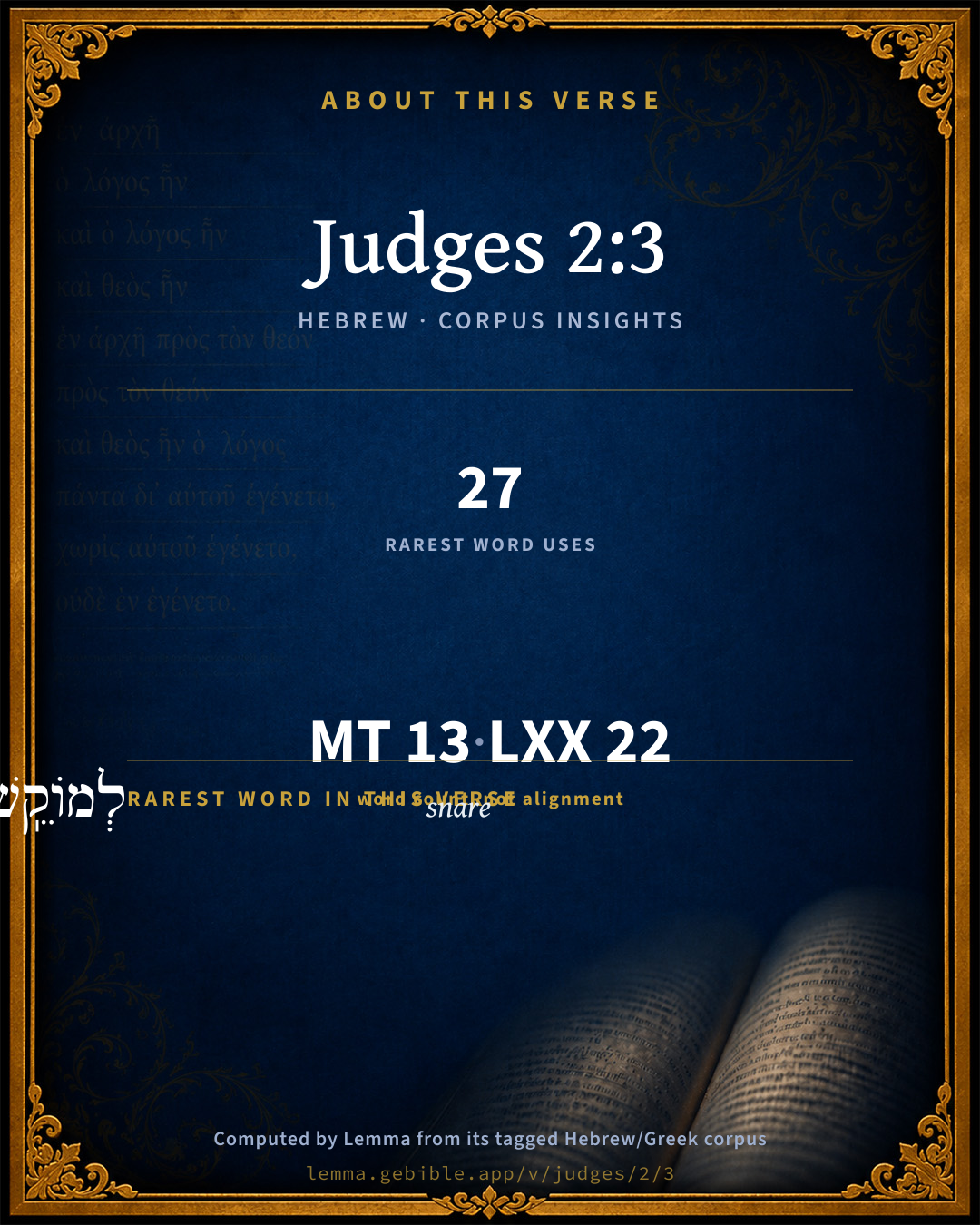
לְמוֹקֵֽשׁ snare H4170 occurs in 27 verses of the Hebrew Bible. Also found in:

Grammatical profile

  • 4 verbs
  • 4 nouns
  • 2 prepositions
  • 3 particles

Verb forms

  • אָמַ֔רְתִּי Qal · Perfect
  • אֲגָרֵ֥שׁ Piel · Imperfect
  • וְהָי֤וּ Qal · Sequential Perfect
  • יִהְי֥וּ Qal · Imperfect

Repetition

A word recurs within this verse — often emphatic in Hebrew:

  • וְהָי֤וּ to be H1961 ×2

Hebrew & Septuagint length

In English translation the verse runs 31 words from the Hebrew and 31 from the Septuagint (LXX English) — the same length.

A rough comparison of the two English renderings, which tokenize alike — not a word-level alignment.

Word counts can differ between the Hebrew and the Greek without any difference in meaning — e.g. the Hebrew direct-object marker אֵת has no separate Greek word, and Greek often adds the article ὁ.

In the original languages it is 13 Hebrew tokens and 22 Greek tokens — but the two are counted differently (Hebrew bundles its prefixes and suffixes into one token; the Greek is in lemma form), so that isn’t a like-for-like length.

Cross-references

9

Topical passages linked to Judges 2:3 in the Treasury of Scripture Knowledge — connected by theme and wording, ordered by reader-vote popularity; previews shown in the World English Bible.

  • Joshua 23:13 know for a certainty that Yahweh your God will no more drive these nations from out of your sight; but they shall be a snare and a trap to you, and a scourge in your sides, and thorns in your eyes, until you perish from off this good land which Yahweh your God has given you.
  • Numbers 33:55 But if you will not drive out the inhabitants of the land from before you, then shall those who you let remain of them be as pricks in your eyes, and as thorns in your sides, and they shall vex you in the land in which you dwell.
  • Deuteronomy 7:16 You shall consume all the peoples who Yahweh your God shall deliver to you; your eye shall not pity them: neither shall you serve their gods; for that will be a snare to you.
  • Psalms 106:36 They served their idols, Which became a snare to them.
  • Exodus 23:33 They shall not dwell in your land, lest they make you sin against me, for if you serve their gods, it will surely be a snare to you."
  • Exodus 34:12 Be careful, lest you make a covenant with the inhabitants of the land where you are going, lest it be for a snare in the midst of you:
  • Judges 2:21 I also will not henceforth drive out any from before them of the nations that Joshua left when he died;
  • Judges 3:6 and they took their daughters to be their wives, and gave their own daughters to their sons and served their gods.
  • 1 Kings 11:1–7 Now king Solomon loved many foreign women, together with the daughter of Pharaoh, women of the Moabites, Ammonites, Edomites, Sidonians, and Hittites;

Cross-references courtesy of OpenBible.info (CC BY 4.0).

Hebrew and Greek witnesses Masoretic Hebrew ↔ Greek Septuagint

The same verse in the two great witnesses to the Old Testament, shown verse-for-verse.

These are two independent witnesses, not word-aligned to each other, and the Septuagint is shown in lemma (dictionary) form.

Hebrew Judges 2:3 Masoretic · Westminster Leningrad Codex

וְגַ֣ם אָמַ֔רְתִּי לֹֽא אֲגָרֵ֥שׁ אוֹתָ֖ם מִפְּנֵיכֶ֑ם וְהָי֤וּ לָכֶם֙ לְצִדִּ֔ים וֵאלֹ֣הֵיהֶ֔ם יִהְי֥וּ לָכֶ֖ם לְמוֹקֵֽשׁ

Therefore I also said, I will not drive them out from before you; but they shall be [as thorns] in your sides, and their gods shall be a snare to you.

World English Bible · Public Domain

Greek LXX Judges 2:3 Septuagint · lemma form

καΐἐγώ εἶπον οὐ μή ἐκαἴρω αὐτός ἐκ πρόσωπον σύ καί εἰμί σύ εἰς συνοχή καί ὁ θεός αὐτός εἰμί σύ εἰς σκάνδαλον

And I said, I will not drive them out from before you, but they shall be for a distress to you, and their gods shall be to you for an offense.

LXX2012 (modern English Septuagint) · Public Domain

On this verse, Ellicott's Commentary for English Readers discusses the Septuagint’s reading. Read the note in Commentary ↓

Hebrew: Westminster Leningrad Codex (CC BY 4.0). Greek: Septuagint (public domain); English from LXX2012 (modern English Septuagint) (Public Domain). How the Septuagint differs from the Hebrew →

Targum (Aramaic paraphrase)

1

The Targum is the ancient Jewish Aramaic paraphrase of the Hebrew Scriptures — an interpretive translation, not the Hebrew text itself. Onkelos (literal) and Pseudo-Jonathan (expansive) render the Torah, and Jonathan the Prophets. Coverage is partial: where no permissively-licensed English translation exists for a verse, only the Aramaic is shown. This is verse-level text, not a word-by-word alignment to the Hebrew.

  1. Targum Jonathan Prophets (Joshua–Malachi)
    וְאַף אַמְרֵית לָא אֲתָרֵיךְ יַתְהוֹן מִן קֳדָמֵיכוֹן וִיהוֹן לְכוֹן לִמְעִיקִין וְטַעֲוַתְהוֹן יְהוֹן לְכוֹן לְתַקָלָא:

    (no public-domain English translation for this verse)

    Targum Jonathan — Aramaic: “Mikraot Gedolot” (public domain). English: “Sefaria Community Translation” (CC0 1.0 (public-domain dedication)); “London "Chaldee Paraphrase," 1871” (public domain). Text via Sefaria.

Commentary

Notes on Judges 2:3 from classic Christian and Jewish commentators (each source and its license shown beneath its notes). The classic Christian expositions comment on the surrounding passage and are grouped to its opening verse, so a note may address several verses; the Jewish commentaries on the Tanakh (Rashi and others) are per-verse, so they appear only where the commentator wrote on this verse.

Lemma curates 59 commentaries, every one of them public domain or Creative Commons licensed, each selected and text-cleaned for this edition rather than reprinted as found. About our sources →

Trapp's Complete Commentary

John Trapp

Jdg 2:3 Wherefore I also said, I will not drive them out from before you; but they shall be [as thorns] in your sides, and their gods shall be a snare unto you.

Ver. 3. As thorns in your sides.] See Jos 23:13.

John Trapp, A Commentary or Exposition upon All the Books of the Old and New Testament (1647–1656) — public domain. Text from a community e-Sword module.

Keil & Delitzsch

C. F. Keil & F. Delitzsch

"And I also have said to you:" these words point to the threat already expressed in Num 33:55; Jos 23:13, in the event of their not fulfilling the command of God, which threat the Lord would now fulfil. From the passages mentioned, we may also explain the expression לצדּים לכם והיוּ, they shall be in your sides, i.e., thorns in your sides. לצדּים is an abbreviated expression for בּצדּיכם לצנינים in Num 33:55, so that there is no necessity for the conjecture that it stands for לצרים. The last clause of Jdg 2:3 is formed after Exo 23:33.

Keil & Delitzsch — Biblical Commentary on the Old Testament (1861–1891) — public domain (CC PDM 1.0). Text via the HelloAO Bible API. (Old Testament only.)

Geneva Bible (1599)

Geneva Bible translators

Or, snare.

Geneva Bible (1599) marginal notes — public domain. Text via Bolls.life.

Adam Clarke's Commentary

Verse 3. I will not drive them out from before you] Their transgressions, and breach of the covenant, were the reasons why they were not put in entire possession of the promised land. See note at the end of this chapter. Clarke "Jdg 2:23".

Adam Clarke's Commentary on the Bible (1810–1826) — public domain. Text from a community e-Sword/MySword module.

Ellicott's Commentary for English Readers

(3) Wherefore I also said.—Rather, And now I have said.

I will not drive them out.—The withdrawal of the conditional promises in Exo_23:31.

They shall be as thorns in your sides.—The Hebrew is, “they shall be to you for sides.” The words “as thorns” are conjecturally supplied from Num_33:55. In Jos_23:13 we have “scourges in your sides.” The LXX. render “for pressures,” and the Vulgate “that you may have enemies.” The Hebrew word for “sides” is tsiddim, and would differ little from tsarim (“nets”), which is the conjecture of R. Jonas; and this root is found in the verb, “and they shall vex you,” in Num_33:55. Whether we adopt this reading, or tsinnim (“thorns”), or suppose that a word has dropped out, the general sense is the same.

Their gods shall be a snare unto you.—See Jdg_2:12-13; Psa_106:36.

A Bible Commentary for English Readers, edited by Charles John Ellicott (1878–1897) — public domain. Text from a community e-Sword module.

The Cambridge Bible for Schools and Colleges

gen. ed. J. J. S. Perowne

3. Wherefore I also said] Moreover also I said; perhaps referring to the warning in Jos_23:13 D, Num_33:55 P, from which latter place the expressions in this verse appear to be borrowed. Others translate ‘and I have also said,’ a present, resolve in antithesis to the past promise ‘And I said, I will never break’ etc. in Jdg_2:1 b; but the antithesis is hardly to be extracted from the Hebr.

they shall be as thorns in your sides] Supplying ‘as thorns’ from Num_33:55, to make sense; cf. Jos_23:13 ‘thorns in your eyes’; the word ‘as thorns’ may have been omitted here by accident. Instead of ‘they shall be sides (!) unto you’ (ṣiddim) the Vulgate and Targ. have ‘they shall be adversaries’ (ṣarim); the LXX, taking ṣarim as = ṣaroth, render ‘straits,’ ‘distresses,’ so Vet. Ital. in angustias, in pressura: these are probably only conjectures. It has been proposed to pronounce ṣiddim ‘sides’ as ṣaddim, and give it the sense of the Assyrian ṣaddu ‘a net, trap’; this would make a good parallel to ‘snare’ at the end of the verse; but the Assyr. form is not quite certain (? zaddu).

their gods … a snare unto you] Cf. Exo_23:33; Exo_34:12; Deu_7:16; Jos_23:13.

The Cambridge Bible for Schools and Colleges (gen. ed. J. J. S. Perowne; Cambridge University Press, 1878–1918) — public domain. Text from a community e-Sword module.

John Gill's Exposition

Wherefore I also said,.... Supposing, or on condition of their being guilty of the above things, which was foreseen they would:

I will not drive them out from before you; the seven nations of the Canaanites entirely, and which accounts for the various instances related in the preceding chapter; where it is observed, that they could not, or did not, drive the old inhabitants out of such and such places, because they sinned against the Lord, and he forsook them, and would not assist them in their enterprises, or them to their sloth and indolence:

but they shall be as thorns in your sides: very troublesome and afflicting, see Num 33:55; or for straits, as the Septuagint, or be such as would bring them into tribulation, and distress them, as the Targum; so they often did:

and their gods shall be a snare unto you; which they suffered to continue, and did not destroy them, as they ought to have done; they would be, as they proved, ensnaring to them, and whereby they were drawn to forsake the worship of the true God, and bow down to them, as we read in some following verses.

John Gill's Exposition of the Whole Bible (1746–1763) — public domain (CC PDM 1.0). Text via the HelloAO Bible API.

Albert Barnes' Notes on the Bible

“Wherefore I also said” - Rather because ye have done the things mentioned in Jdg 2:2, “I have now said (i. e. I now protest and declare) that I will not drive them out from before you” (compare Jdg 19:29). And it was the annonncement of this resolution by the Angel that caused the people to weep.

The word thorns in this verse is supplied by the King James Version from the similar passage in Joshua (see the marginal reference). Other versions adopt a different reading of the original text, and prefer the sense “they shall be to you for adversaries” (compare the last words of Num 33:55).

Albert Barnes' Notes on the Bible (1834–1885) — public domain. Text from a community e-Sword/MySword module.

Haydock's Catholic Bible Commentary

Ruin. Septuagint, "stumbling block," the occasion of ruin. (Menochius) --- Thus by a false compassion (Calmet) and negligence, the Israelites brought upon themselves the most serious difficulties, while those whom they had spared, turned against them by a just judgment of God, and proved the ruin both of their souls and bodies, by drawing them into idolatry and then putting them to the sword. (Haydock)

George Leo Haydock (1774–1849), Haydock's Catholic Family Bible and Commentary, 1859 edition — public domain. Excludes Psalms (Douay-Rheims chapter numbering differs from Protestant) and Deuterocanonical books (Catholic canon only).

Matthew Poole's English Annotations

I also said with myself; I have now taken up this peremptory resolution.

Thorns in your sides: See Poole "Num 33:55"; See Poole "Jos 23:13".

Matthew Poole's English Annotations on the Holy Bible (1683–1685) — public domain. Text from a community e-Sword/MySword module.

Whedon's Commentary on the Bible

Daniel D. Whedon

3. Wherefore I also said — By the lips of Moses (Num_33:55) and of Joshua (Jos_23:12-13) the declaration was made that if they clave unto the remnant of the nations, and had social and commercial intercourse with them. God would not drive out these nations. They had received a fair warning.

As thorns — These words are not found in the Hebrew of this passage, but are here supplied by our translators from Num_33:55, and Jos_23:13. Literally this text reads, They shall be to you to sides; but it is to be regarded as an abbreviation of the proverb, They shall be for thorns to your sides. “The figure is taken from rural life. Israel has acted like a slothful gardener. He has not thoroughly destroyed the thorns and thistles of his fields. The consequence will be that sowing and planting and other field labours will soon be rendered painful by the presence of spiteful thorns. The influence of habitual intercourse will make the Canaanites stinging weeds and snares for Israel.” — Cassel.

Daniel D. Whedon (gen. ed.), Commentary on the Old and New Testaments (1874–1909) — public domain. Text from a community e-Sword module.

The Pulpit Commentary

I said, i.e. I now declare to you my resolve. It was this that made the people weep. Thorns in your sides. This is not a translation of the Hebrew text, which only has "for sides," but a partial adaptation of Jos_23:13, where the phrase is "scourges in your sides and thorns in your eyes." Either the words for "scourges in" have fallen out of the text, or the word here rendered "sides" should be rendered, as some think, "enemies." A snare. See Jud_1:8:27, note.

The Pulpit Commentary (1880–1919), ed. H.D.M. Spence-Jones & Joseph S. Exell — public domain. Text from a community e-Sword module.

John Wesley's Explanatory Notes

I said - With myself, I have now taken up this peremptory resolution.

John Wesley, Explanatory Notes Upon the Whole Bible (1754–1765) — public domain. Text via the GEBible commentary corpus.

unfoldingWord translationNotes

Door43 World Missions Community

General Information:

The angel of Yahweh continues to speak to the people of Israel.

So now I say, 'I will not ... trap for you.'

This has a quotation within a quotation. This direct quotation can be stated as an indirect quotation. AT: "So now I tell you that I will not ... trap for you.'" (See: Quotes Within Quotes and Direct and Indirect Quotations)

become thorns in your sides

The Canaanites troubling the Israelites is spoken of as if the Canaanites would be thorns in the side of the Israelites. AT: "cause you trouble" (See: Metaphor)

thorns

sharp pieces of wood up to 7 centimeters long that stick out from some plants

their gods will become a trap for you

The Israelites worshiping the Canaanite gods is spoken of as if the false gods were a hunter's trap that catches an animal and causes it harm. (See: Metaphor)

shouted and wept

"cried many tears"

translationWords

cast out

Canaan

thorn

false god

snare

angel

Yahweh

Israel

sacrifice

unfoldingWord translationNotes — © Distant Shores Media and the Door43 World Missions Community, licensed CC BY-SA 4.0. Source: git.door43.org/Door43/en_tn.

Rashi

Rabbi Shlomo Yitzchaki (Rashi)

Now I have also declared. At present I have declared, in My fury.

At your flanks. They will harass your flanks with bandits and troops, pillaging and plundering.

Rashi on the Tanakh — English translations: “The Judaica Press complete Tanach with Rashi, translated by A. J. Rosenberg” (CC BY 4.0); “Pentateuch with Rashi's commentary by M. Rosenbaum and A.M. Silbermann, 1929-1934” (public domain); “The Metsudah Tanach series, Lakewood, N.J” (CC BY 4.0); and “The Book of Joshua, Metsudah Publications, 1997” (CC BY 4.0). Text via Sefaria.

Lesson kit

Teaching starters — assembled from the data on this page, not authored interpretation. Every prompt links to the verse data it draws on. Edit before teaching.

Judges, in the Historical, opens this verse with 13 words (10 distinct Hebrew lemmas). Its most distinctive word is môwqêsh (“snare”). A historical commentator’s framing appears above. Read the whole chapter for the surrounding context.

Discussion questions

  1. What does “snare” (môwqêsh) contribute to the verse as a whole?
  2. How does Exodus 10:7, which shares the word «snare», read alongside this verse?
  3. What does the repetition of “to be” (2× in this one verse) do in this verse?
  4. These translations render this verse differently. What is at stake in choosing one wording over another?
  5. «אָמַ֔רְתִּי» is a Qal Perfect verb. How does that grammatical form shape the action described?
  6. Compare how Trapp's Complete Commentary and Keil & Delitzsch read this verse. Where do they agree or differ?

Things to notice

Reading settings

Reading text

Shown beneath each verse's original-language words.

Old Testament
Old Testament edition

Read the OT as the Masoretic Hebrew (MT) or the Greek Septuagint (LXX).

English shown for the Greek Septuagint (in the Hebrew ↔ Greek comparison).

Comparing translations? Open the Compare panel on any verse page to stack up to four side by side.