Genesis 24:49

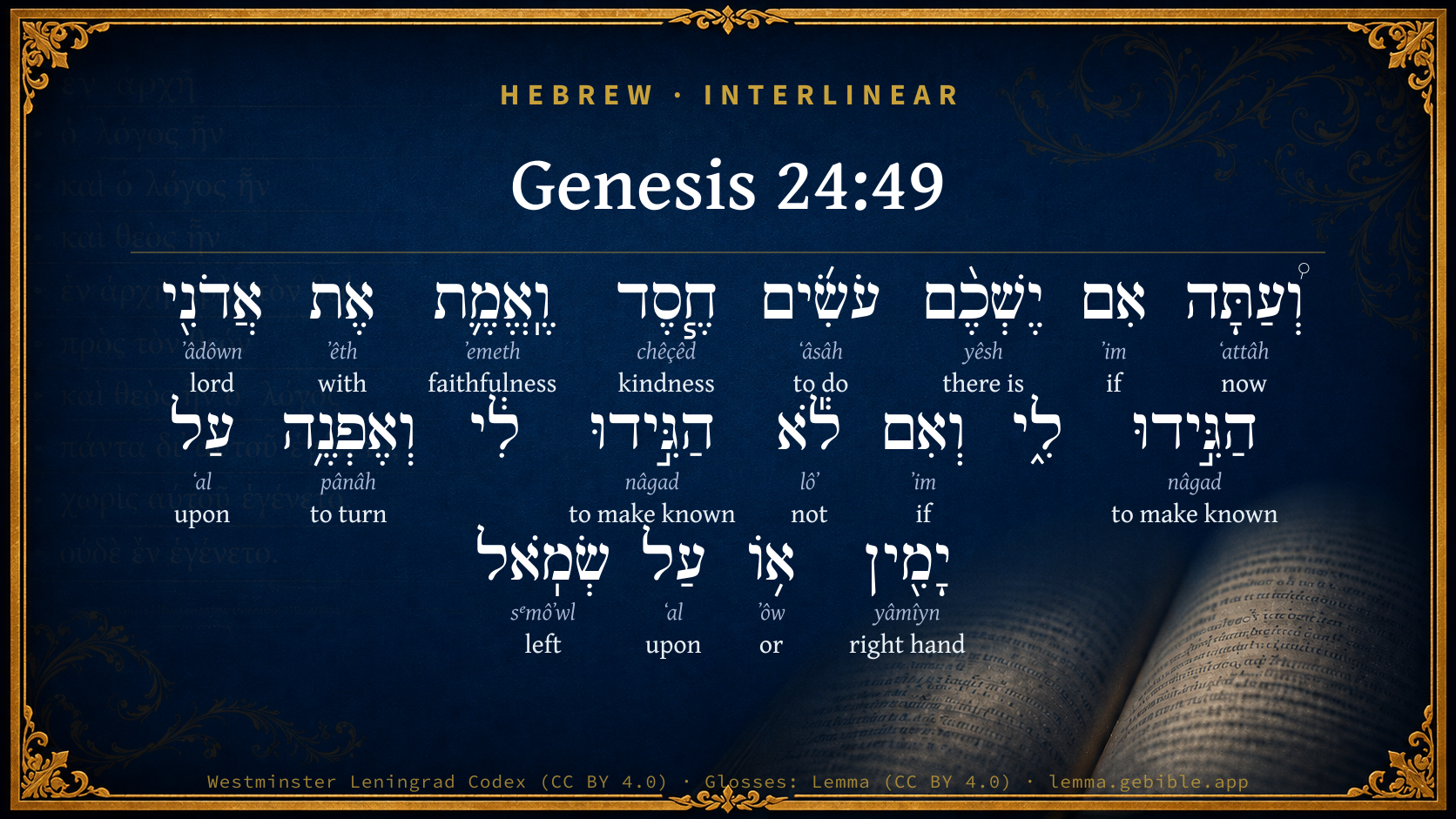
Hebrew (Westminster Leningrad Codex) Genesis 24:49 appears in the Hebrew Old Testament. The text above is from the Westminster Leningrad Codex. Each word links to its Strong’s number, a concise gloss, and parsing drawn from the Open Scriptures Hebrew Bible morphology. Click any word for its full Brown-Driver-Briggs (BDB) entry.
Download image
Cite this verse

Genesis 24:49 (World English Bible). Public Domain. Lemma interlinear Bible study tool, https://lemma.gebible.app/v/genesis/24/49.

Show BibTeX & RIS
BibTeX
RIS
English Translation
Now if you will deal kindly and truly with my master, tell me. If not, tell me. That I may turn to the right hand, or to the left."
World English Bible · Public Domain
Highlights
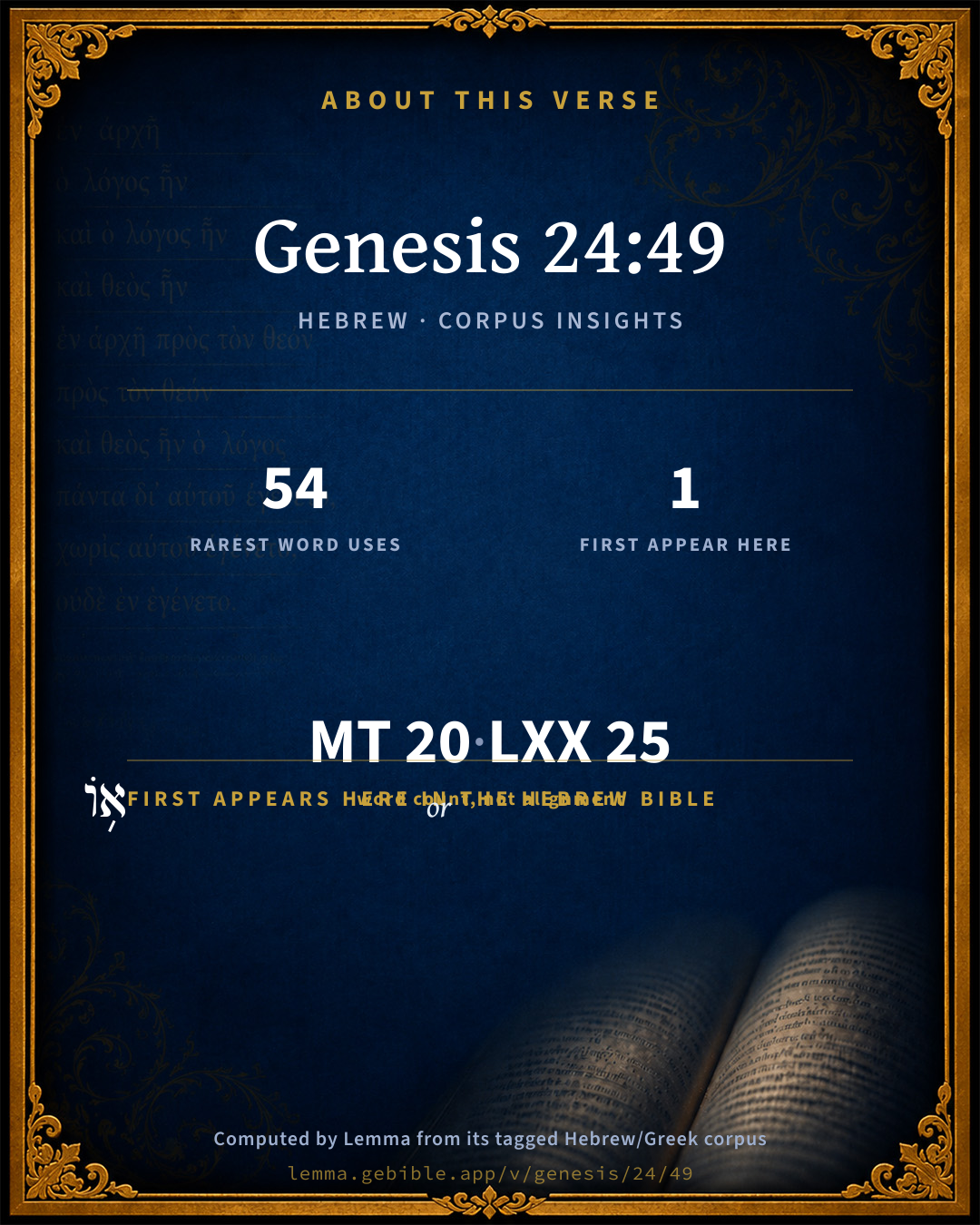
  • 1 first appearance in the Hebrew Bible
Full analysis ↓
Download a study sheet

One document with this verse’s original text, its word-by-word gloss line, the meaning frame, cross-references with their text, attributed commentary, and full source and license credits — printable, and it pastes into notes with its structure intact.

This verse Autodidact and up

Study sheet (.html) Plain text (.txt)

A passage Seminary Student

Up to 50 verses in one chapter. A passage sheet keeps up to 6 commentary sources and 12 cross-references per verse, in the order this page ranks them, and says so on the sheet whenever that leaves anything out. Ask for a single verse and you get the Autodidact verse sheet above.

Everything on this page stays free to read, with no account — the sheet is a download of what is already on screen, not access to it.

Want to remove ads? Support Godless Engineer
Compare translations 3

The same verse in 3 English versions, stacked beneath the original-language interlinear above. Click any original word for its lexicon entry.

Each is an independent rendering of the whole verse — the interlinear is not word-aligned to these translations.

Highlighted words mark where these versions differ — a whole-verse word diff, not a word-by-word alignment.

  • World English Bible Public Domain
    Now if you will deal kindly and truly with my master, tell me. If not, tell me. That I may turn to the right hand, or to the left."
  • King James Version Public Domain
    And now if ye will deal kindly and truly with my master, tell me: and if not, tell me; that I may turn to the right hand, or to the left.
  • unfoldingWord Literal Text CC BY-SA 4.0
    And now if it is your will to show kindness and faithfulness to my master, tell me. But if not, tell me, so that I will turn to the right or to the left.”

unfoldingWord Literal Text — © unfoldingWord, licensed CC BY-SA 4.0. Word-aligned USFM3 via Door43 (git.door43.org/unfoldingWord/en_ult).

Versions to compare (up to 4)

3 of 4 selected

Show all 18 translations

Every available English version of this verse, each an independent rendering of the whole verse.

  • World English Bible Public Domain
    Now if you will deal kindly and truly with my master, tell me. If not, tell me. That I may turn to the right hand, or to the left."
  • Berean Standard Bible Public Domain
    Now if you will show kindness and faithfulness to my master, tell me; but if not, let me know, so that I may go elsewhere.”
  • Majority Standard Bible Public Domain
    Now if you will show kindness and faithfulness to my master, tell me; but if not, let me know, so that I may go elsewhere.”
  • King James Version Public Domain
    And now if ye will deal kindly and truly with my master, tell me: and if not, tell me; that I may turn to the right hand, or to the left.
  • American Standard Version (1901) Public Domain
    And now if ye will deal kindly and truly with my master, tell me. And if not, tell me. That I may turn to the right hand, or to the left.
  • Revised Version (1885) Public Domain
    And now if ye will deal kindly and truly with my master, tell me: and if not, tell me; that I may turn to the right hand, or to the left.
  • Geneva Bible (1599) Public Domain
    Now therefore, if ye will deale mercifully and truely with my master, tell me: and if not, tell me that I may turne me to the right hand or to the left.
  • Douay-Rheims (1899) Public Domain
    Wherefore if you do according to mercy and truth with my master, tell me: but if it please you otherwise, tell me that also, that I may go to the right hand, or to the left.
  • Young's Literal Translation Public Domain
    `And now, if ye are dealing kindly and truly with my lord, declare to me; and if not, declare to me; and I turn unto the right or unto the left.'
  • Literal Standard Version CC BY-SA 4.0
    And now, if you are dealing kindly and truly with my lord, declare to me; and if not, declare to me; and I turn to the right or to the left.”
  • Unlocked Literal Bible CC BY-SA 4.0
    Now therefore, if you are prepared to show covenant faithfulness and trustworthiness to my master, tell me. But if not, tell me, so that I may turn to the right hand or to the left.”
  • unfoldingWord Literal Text CC BY-SA 4.0
    And now if it is your will to show kindness and faithfulness to my master, tell me. But if not, tell me, so that I will turn to the right or to the left.”
  • Darby Bible Public Domain
    And now, if ye will deal kindly and truly with my master, tell me; and if not, tell me; and I will turn to the right hand or to the left.
  • World Messianic Bible Public Domain
    Now if you will deal kindly and truly with my master, tell me. If not, tell me, that I may turn to the right hand, or to the left.”
  • Webster's Bible Public Domain
    And now if you will deal kindly and truly with my master, tell me; and if not, tell me; that I may turn to the right hand, or to the left.
  • Free Bible Version CC BY-SA 4.0
    So please tell me now, will you show commitment and faithfulness to my master? Please tell me yes or no so I can decide what to do next.”
  • Bible in Basic English Public Domain
    And now, say if you will do what is good and right for my master or not, in order that it may be clear to me what I have to do.
  • JPS Tanakh (1917) Public Domain
    And now if ye will deal kindly and truly with my master, tell me; and if not, tell me; that I may turn to the right hand, or to the left.'

Literal Standard Version (2020), Covenant Press — licensed CC BY-SA 4.0. Text via the HelloAO Bible API (eBible.org). Unlocked Literal Bible (unfoldingWord) — licensed CC BY-SA 4.0. Text via the HelloAO Bible API (eBible.org). unfoldingWord Literal Text — © unfoldingWord, licensed CC BY-SA 4.0. Word-aligned USFM3 via Door43 (git.door43.org/unfoldingWord/en_ult). Free Bible Version, Dr. Jonathan Gallagher — licensed CC BY-SA 4.0. Text via the HelloAO Bible API (eBible.org).

Word by word

More ways to search: Search by grammar → Find every occurrence → Compare this word →

Practice this passage: Drill this verse → Learn its vocabulary →

שְׂמֹֽאל
sᵉmôʼwl
H8040
“left”
Noun, Common, Masculine, Singular, Absolute
Part of Speech
Noun
Type
Common
Gender
Masculine
Number
Singular
State
Absolute
Full BDB Definition

Origin: a primitive word [rather perhaps from the same as H8071 (by insertion of the aleph) through the idea of wrapping up]

TWOT: 2267a

the left, the left hand, the left side - left - left hand - north (as one faces east)
  1. וְ֠עַתָּה ʻattâh H6258 “and · now” Conjunction + Adverb
  2. אִם ʼim H518 “if” Conjunction
  3. יֶשְׁכֶ֨ם yêsh H3426 “there is · you” Particle, Demonstrative + Suffix, Personal, 2nd Person, Masculine, Plural
  4. עֹשִׂ֜ים ʻâsâh H6213 “doing” Verb, Qal, Participle Active, Masculine, Plural, Absolute
  5. חֶ֧סֶד chêçêd H2617 “kindness” Noun, Common, Masculine, Singular, Absolute
  6. וֶֽאֱמֶ֛ת ʼemeth H571 “and · faithfulness” Conjunction + Noun, Common, Feminine, Singular, Absolute
  7. אֶת ʼêth H854 “with” Preposition
  8. אֲדֹנִ֖י ʼâdôwn H113 “lord · my” Noun, Common, Masculine, Singular, Construct + Suffix, Personal, 1st Person, Common, Singular
  9. הַגִּ֣ידוּ nâgad H5046 “make known” Verb, Hiphil, Imperative, 2nd Person, Masculine, Plural
  10. וְאִם ʼim H518 “and · if” Conjunction + Conjunction
  11. לֹ֕א lôʼ H3808 “not” Particle, Negative
  12. הַגִּ֣ידוּ nâgad H5046 “make known” Verb, Hiphil, Imperative, 2nd Person, Masculine, Plural
  13. וְאֶפְנֶ֥ה pânâh H6437 “and · to turn” Conjunction + Verb, Qal, Imperfect, 1st Person, Common, Singular
  14. עַל ʻal H5921 “upon” Preposition
  15. יָמִ֖ין yâmîyn H3225 “right hand” Noun, Common, Feminine, Singular, Absolute
  16. א֥וֹ ʼôw H176 “or” Conjunction
  17. עַל ʻal H5921 “upon” Preposition

About this verse

These counts appear in no published source. They are computed here, from the morphology-tagged text and Lemma’s own curated glosses. What Lemma adds →

20
words
15
distinct lemmas
Pentateuch
section

First appearance in Scripture

This word makes its first canonical appearance in the Hebrew Bible here:

Shared distinctive vocabulary

שְׂמֹֽאל left H8040 occurs in 53 verses of the Hebrew Bible. Also found in:

Grammatical profile

  • 4 verbs
  • 5 nouns
  • 5 prepositions
  • 3 conjunctions
  • 1 adverb
  • 2 particles

Verb forms

  • עֹשִׂ֜ים Qal · Participle Active
  • הַגִּ֣ידוּ Hiphil · Imperative
  • הַגִּ֣ידוּ Hiphil · Imperative
  • וְאֶפְנֶ֥ה Qal · Imperfect

Repetition

Words recur within this verse — often emphatic in Hebrew:

  • הַגִּ֣ידוּ to make known H5046 ×2
  • עַל upon H5921 ×2
  • אִם if H518 ×2

Hebrew & Septuagint length

In English translation the verse runs 29 words from the Hebrew and 30 from the Septuagint (LXX English) — closely comparable.

A rough comparison of the two English renderings, which tokenize alike — not a word-level alignment.

Word counts can differ between the Hebrew and the Greek without any difference in meaning — e.g. the Hebrew direct-object marker אֵת has no separate Greek word, and Greek often adds the article ὁ.

In the original languages it is 20 Hebrew tokens and 25 Greek tokens — but the two are counted differently (Hebrew bundles its prefixes and suffixes into one token; the Greek is in lemma form), so that isn’t a like-for-like length.

Cross-references

6

Topical passages linked to Genesis 24:49 in the Treasury of Scripture Knowledge — connected by theme and wording, ordered by reader-vote popularity; previews shown in the World English Bible.

  • Genesis 47:29 The time drew near that Israel must die, and he called his son Joseph, and said to him, "If now I have found favor in your sight, please put your hand under my thigh, and deal kindly and truly with me. Please don't bury me in Egypt,
  • Joshua 2:14 The men said to her, Our life for yours, if you don't utter this our business; and it shall be, when Yahweh gives us the land, that we will deal kindly and truly with you.
  • Genesis 32:10 I am not worthy of the least of all the loving kindnesses, and of all the truth, which you have shown to your servant; for with just my staff I passed over this Jordan; and now I have become two companies.
  • Proverbs 3:3 Don't let kindness and truth forsake you. Bind them around your neck. Write them on the tablet of your heart.
  • Numbers 20:17 Please let us pass through your land: we will not pass through field or through vineyard, neither will we drink of the water of the wells: we will go along the king's highway; we will not turn aside to the right hand nor to the left, until we have passed your border.
  • Deuteronomy 2:27 Let me pass through your land: I will go along by the highway, I will turn neither to the right hand nor to the left.

Cross-references courtesy of OpenBible.info (CC BY 4.0).

Hebrew and Greek witnesses Masoretic Hebrew ↔ Greek Septuagint

The same verse in the two great witnesses to the Old Testament, shown verse-for-verse.

These are two independent witnesses, not word-aligned to each other, and the Septuagint is shown in lemma (dictionary) form.

Hebrew Genesis 24:49 Masoretic · Westminster Leningrad Codex

וְ֠עַתָּה אִם יֶשְׁכֶ֨ם עֹשִׂ֜ים חֶ֧סֶד וֶֽאֱמֶ֛ת אֶת אֲדֹנִ֖י הַגִּ֣ידוּ לִ֑י וְאִם לֹ֕א הַגִּ֣ידוּ לִ֔י וְאֶפְנֶ֥ה עַל יָמִ֖ין א֥וֹ עַל שְׂמֹֽאל

Now if you will deal kindly and truly with my master, tell me. If not, tell me. That I may turn to the right hand, or to the left."

World English Bible · Public Domain

Greek LXX Genesis 24:49 Septuagint · lemma form

εἰ οὖν ποιέω σύ ἔλεος καί δικαιοσύνη πρός ὁ κύριος ἐγώ ἀποἀγγέλλω ἐγώ εἰ δέ μή ἀποἀγγέλλω ἐγώ ἵνα ἐπιστρέφω εἰς δεξιός ἤ εἰς ἀριστερός

If then you⌃ will deal mercifully and justly with my lord, tell me, and if not, tell me, that I may turn to the right hand or to the left.

LXX2012 (modern English Septuagint) · Public Domain

Hebrew: Westminster Leningrad Codex (CC BY 4.0). Greek: Septuagint (public domain); English from LXX2012 (modern English Septuagint) (Public Domain). How the Septuagint differs from the Hebrew →

Targum (Aramaic paraphrase)

2

The Targum is the ancient Jewish Aramaic paraphrase of the Hebrew Scriptures — an interpretive translation, not the Hebrew text itself. Onkelos (literal) and Pseudo-Jonathan (expansive) render the Torah, and Jonathan the Prophets. Coverage is partial: where no permissively-licensed English translation exists for a verse, only the Aramaic is shown. This is verse-level text, not a word-by-word alignment to the Hebrew.

  1. Targum Onkelos Torah (Genesis–Deuteronomy)
    וּכְעַן אִם אִיתֵיכוֹן עָבְדִין טִיבוּ וּקְשׁוֹט עִם רִבּוֹנִי חַוּוֹ לִי וְאִם לָא חַוּוֹ לִי וְאִתְפְּנֵי עַל יַמִּינָא אוֹ עַל שְׂמָאלָא

    (no public-domain English translation for this verse)

    Targum Onkelos — Aramaic: “Onkelos Genesis” (public domain); “Onkelos Exodus” (public domain); “Onkelos Leviticus” (public domain); “Onkelos Numbers” (public domain); “Onkelos Deuteronomy” (public domain). English: “Sefaria Community Translation” (CC0 1.0 (public-domain dedication)); “J.W. Etheridge. The Targums of Onkelos and Jonathan Ben Uzziel on the Pentateuch. London: Longmans, Green, 1862” (public domain). Text via Sefaria.

  2. Targum Pseudo-Jonathan Torah (Genesis–Deuteronomy)
    וּכְדוֹן אִין אִיתֵיכוֹן עָבְדִין טִיבוּ וּקְשׁוֹט עִם רִבּוֹנִי תָּנוּ לִי וְאִין לָא תָּנוּ לִי וְאִיפְנֵי עַל דָרוֹמָא אוֹ עַל צִפוּנָא

    And now, if you will deal kindly and truly with my master, tell me; and if not, tell me, that I may turn to the south or to the north.

    Targum Pseudo-Jonathan — Aramaic: “Targum Jonathan on Genesis” (public domain); “Targum Jonathan on Exodus” (public domain); “Targum Jonathan on Leviticus” (public domain); “Targum Jonathan on Numbers” (public domain); “Targum Jonathan on Deuteronomy” (public domain). English: “The Targum of Jonathan ben Uzziel, trans. J. W. Etheridge, London, 1862” (public domain). Text via Sefaria.

Commentary

Notes on Genesis 24:49 from classic Christian and Jewish commentators (each source and its license shown beneath its notes). The classic Christian expositions comment on the surrounding passage and are grouped to its opening verse, so a note may address several verses; the Jewish commentaries on the Tanakh (Rashi and others) are per-verse, so they appear only where the commentator wrote on this verse.

Lemma curates 59 commentaries, every one of them public domain or Creative Commons licensed, each selected and text-cleaned for this edition rather than reprinted as found. About our sources →

Trapp's Complete Commentary

John Trapp

Gen 24:49 And now if ye will deal kindly and truly with my master, tell me: and if not, tell me; that I may turn to the right hand, or to the left.

Ver. 49. That I may turn to the right hand, &c., ] i.e., Seek somewhere else: for something I must do, in answer to my trust. "It is required in stewards, that a man be found faithful". {1Co 4:2}

John Trapp, A Commentary or Exposition upon All the Books of the Old and New Testament (1647–1656) — public domain. Text from a community e-Sword module.

Geneva Bible (1599)

Geneva Bible translators

That is, that I may provide elsewhere.

If you will freely and faithfully give your daughter to my master’s son.

Geneva Bible (1599) marginal notes — public domain. Text via Bolls.life.

Adam Clarke's Commentary

Verse 49. That I may turn to the right hand or to the left] That is, That I may go elsewhere and seek a proper match for the son of my master. Some have imagined that Eliezer intimated by these expressions that if he did not succeed in obtaining Rebekah, he would go and seek for a wife either among the descendants of Ishmael or the descendants of Lot. This interpretation is fanciful.

Adam Clarke's Commentary on the Bible (1810–1826) — public domain. Text from a community e-Sword/MySword module.

The Cambridge Bible for Schools and Colleges

gen. ed. J. J. S. Perowne

49. deal kindly and truly] Lit. “do kindness and truth”; cf. Gen_47:29. See note on Gen_24:27.

to the right hand, or to the left] The servant asks for a prompt reply, so that, if his request is refused, he may consider what course next to pursue. For fanciful Rabbinic interpretations of “the right hand and the left,” cf. Calvin’s note, futilis autem argutia quam adducunt quidam Hebraei quod iturus sit ad Lot vel ad Ismael.

The Cambridge Bible for Schools and Colleges (gen. ed. J. J. S. Perowne; Cambridge University Press, 1878–1918) — public domain. Text from a community e-Sword module.

John Gill's Exposition

And they did eat and drink, he, and the men that were with him,.... Every thing being settled with respect to the affair he came about, he then sat down at table, and ate of the provisions set before him; he and the men that came along with him; and refreshed themselves:

and tarried all night; lodged there all night:

and they rose up in the morning; the servant and his men:

and he said, send me away to my master; either to Abraham, who was waiting to hear what success his servant would have; or to Isaac, who also was solicitous about the matter: the sense is, that he desired leave to go away, and begged he might not be detained any longer, having now done the business he came about; still showing himself a diligent faithful servant, heartily and sincerely attached to his master's interest, and not consulting his own ease and pleasure, which might have been indulged by staying longer in a family, where he would have been entertained in a sumptuous manner.

John Gill's Exposition of the Whole Bible (1746–1763) — public domain (CC PDM 1.0). Text via the HelloAO Bible API.

Haydock's Catholic Bible Commentary

Left, in quest of some other lady of my master’s kindred; as some of Bathuel’s brothers might also have children. He was the youngest. (Haydock)

George Leo Haydock (1774–1849), Haydock's Catholic Family Bible and Commentary, 1859 edition — public domain. Excludes Psalms (Douay-Rheims chapter numbering differs from Protestant) and Deuterocanonical books (Catholic canon only).

Matthew Poole's English Annotations

If you will show true kindness and real friendship to him in giving your daughter to his son,

tell me; and if not, tell me, that I may look out a wife for him elsewhere. It is a proverbial expression, Num 20:17; 22:26; Deu 2:27.

Matthew Poole's English Annotations on the Holy Bible (1683–1685) — public domain. Text from a community e-Sword/MySword module.

unfoldingWord translationNotes

Door43 World Missions Community

General Information:

Abraham's servant continues speaking to Rebekah's family.

Now therefore

"Now." Here "Now" does not mean "at this moment," but is used to draw attention to the important point that follows.

if you are prepared to show covenant faithfulness and trustworthiness to my master, tell me

How they could show the covenant faithfulness and trustworthiness can be stated explicitly. AT: "tell me if you will be faithful and trustworthy to my master by giving Rebekah to be his son's wife" (See: Assumed Knowledge and Implicit Information)

you

The word "you" refers to Laban and Bethuel. (See: Forms of You)

faithfulness and trustworthiness

These abstract nouns can be stated as "faithful and trustworthy." (See: Abstract Nouns)

But if not

The understood information can be stated clearly. AT: "But if you are not prepared to treat my master with family faithfulness and trustworthiness" (See: Ellipsis)

so that I may turn to the right hand or to the left

Possible meanings are 1) deciding what to do is spoken of as if the person will physically turn one direction or another. AT: "so that I will know what do" or 2) the servant wants to know if he needs to travel somewhere else. AT: "so that I may continue on my journey" (See: Metaphor and Idiom)

translationWords

faithful

unfoldingWord translationNotes — © Distant Shores Media and the Door43 World Missions Community, licensed CC BY-SA 4.0. Source: git.door43.org/Door43/en_tn.

Rashi

Rabbi Shlomo Yitzchaki (Rashi)

על ימין TO THE RIGHT HAND — to take a wife of the daughters of Ishmael.

על שמאל TO THE LEFT — to take a wife of the daughters of Lot who dwelt at the left of Abraham (Genesis Rabbah 60:9).

Rashi on the Tanakh — English translations: “The Judaica Press complete Tanach with Rashi, translated by A. J. Rosenberg” (CC BY 4.0); “Pentateuch with Rashi's commentary by M. Rosenbaum and A.M. Silbermann, 1929-1934” (public domain); “The Metsudah Tanach series, Lakewood, N.J” (CC BY 4.0); and “The Book of Joshua, Metsudah Publications, 1997” (CC BY 4.0). Text via Sefaria.

Radak

Rabbi David Kimhi (Radak)

ועתה...חסד ואמת, emet is the honour and respect that you owe members of your family. You owe even more respect to Araham the most illustrious member of your family. If he requested the hand of your daughter in marriage for his son, you are duty-bound to honour his wish. If you agree to this even though it entails her leaving her homeland and moving far away, this may be considered an act of loving kindness, חסד, on your part.

ואפנה על ימין או על שמאל, either more prominent and important members of his family than you, or less prominent family members than you. At any rate, I will take a wife for Avraham’s son for Yitzchok from this country since he does not want a daughter-in-law who grew up in the land of the Canaanites.

Radak on the Tanakh — English translations: “Sefaria Community Translation” (CC0 1.0 (public-domain dedication)); “Eliyahu Munk, HaChut Hameshulash” (CC BY 4.0); “Rabbi Mike Feuer, Jerusalem Anthology” (CC BY 4.0); and “R. David Kimhi on the first book of Psalms, Translated by R.G. Finch, London, 1919” (public domain). Text via Sefaria.

Ibn Ezra

Rabbi Abraham ibn Ezra

Kind. It is a kindness, because you are not obliged to agree.

And true. Or, “in good faith” — that is, if you will then carry out the promised kindness in deed.

Ibn Ezra on the Tanakh — English translations: “Sefaria Community Translation” (CC0 1.0 (public-domain dedication)); “Yalkut, Sifsei Chachomim Chumash, Metsudah Publications, 2009” (CC BY 4.0); and “Commentary of Ibn Ezra on Isaiah - trans. by M. Friedlander, 1873” (public domain). Text via Sefaria.

Lesson kit

Teaching starters — assembled from the data on this page, not authored interpretation. Every prompt links to the verse data it draws on. Edit before teaching.

Genesis, in the Pentateuch, opens this verse with 20 words (15 distinct Hebrew lemmas). Its most distinctive word is sᵉmôʼwl (“left”). A historical commentator’s framing appears above. Read the whole chapter for the surrounding context.

Discussion questions

  1. What does “left” (sᵉmôʼwl) contribute to the verse as a whole?
  2. This is the first place “or” appears in Scripture (first appears here). What does its debut here establish?
  3. How does Genesis 13:9, which shares the word «left», read alongside this verse?
  4. What does the repetition of “to make known” (2× in this one verse) do in this verse?
  5. The translations on this page render this verse differently — a whole-verse word diff, not a word-by-word alignment. What might account for the different wordings?
  6. «עֹשִׂ֜ים» is a Qal Participle Active verb. How does that grammatical form shape the action described?
  7. Compare how Trapp's Complete Commentary and Geneva Bible (1599) read this verse. Where do they agree or differ?

Things to notice

Reading settings

Reading text

Shown beneath each verse's original-language words.

Old Testament
Old Testament edition

Read the OT as the Masoretic Hebrew (MT) or the Greek Septuagint (LXX).

English shown for the Greek Septuagint (in the Hebrew ↔ Greek comparison).

Comparing translations? Open the Compare panel on any verse page to stack up to four side by side.