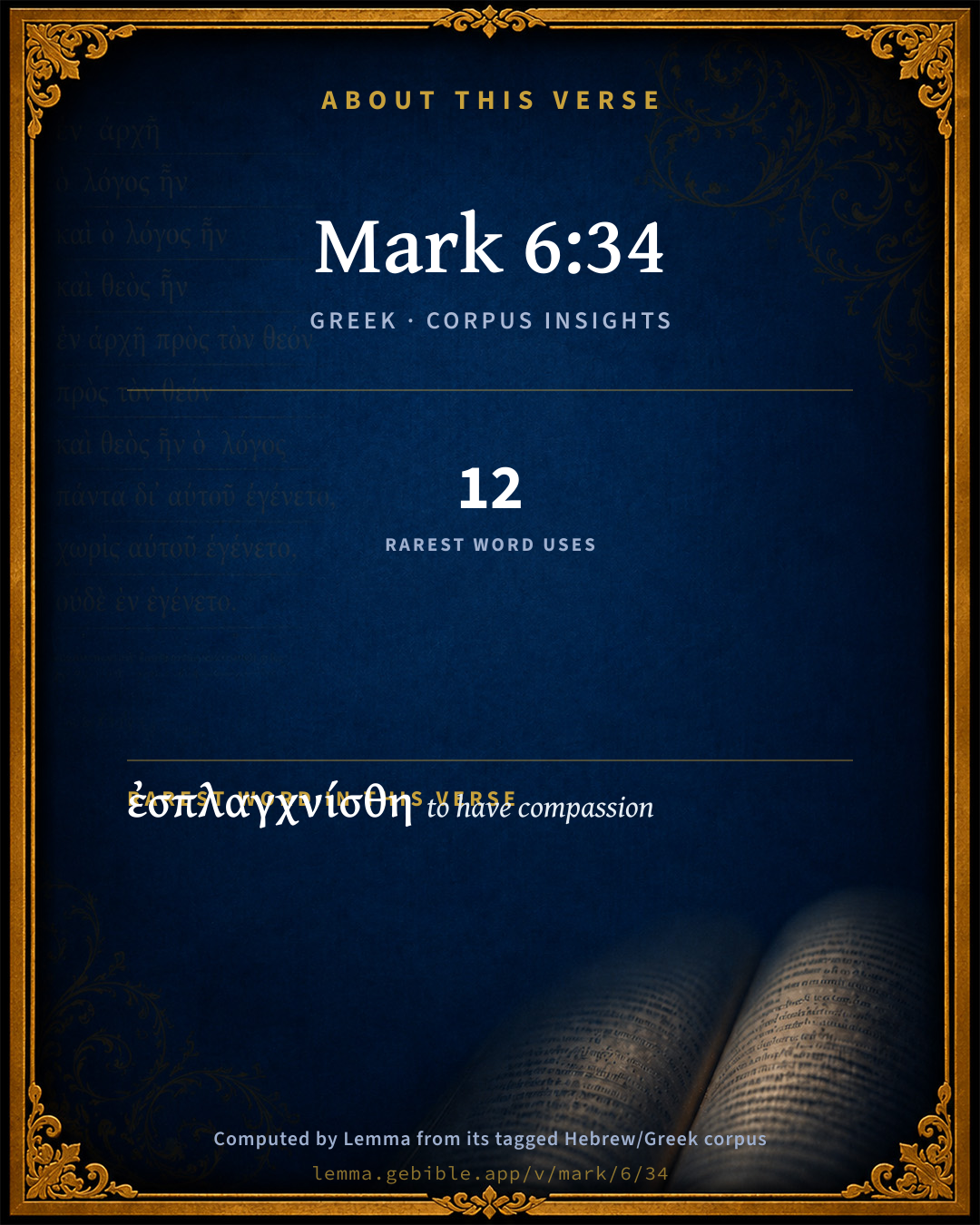
Mark 6:34

Greek (Tischendorf 8th ed.) Mark 6:34 appears in the Greek New Testament. The text above is from the Tischendorf 8th edition. Each word links to its Strong’s number and a concise gloss. Click any word for its full Thayer’s Greek Lexicon entry.

Download image
Cite this verse

Mark 6:34 (World English Bible). Public Domain. Lemma interlinear Bible study tool, https://lemma.gebible.app/v/mark/6/34.

Show BibTeX & RIS
BibTeX
RIS
English Translation
Jesus came out, saw a great multitude, and he had compassion on them, because they were like sheep without a shepherd, and he began to teach them many things.
World English Bible · Public Domain
Download a study sheet

One document with this verse’s original text, its word-by-word gloss line, the meaning frame, cross-references with their text, attributed commentary, and full source and license credits — printable, and it pastes into notes with its structure intact.

This verse Autodidact and up

Study sheet (.html) Plain text (.txt)

A passage Seminary Student

Up to 50 verses in one chapter. A passage sheet keeps up to 6 commentary sources and 12 cross-references per verse, in the order this page ranks them, and says so on the sheet whenever that leaves anything out. Ask for a single verse and you get the Autodidact verse sheet above.

Everything on this page stays free to read, with no account — the sheet is a download of what is already on screen, not access to it.

Want to remove ads? Support Godless Engineer
Compare translations 3

The same verse in 3 English versions, stacked beneath the original-language interlinear above. Click any original word for its lexicon entry.

Each is an independent rendering of the whole verse — the interlinear is not word-aligned to these translations.

Highlighted words mark where these versions differ — a whole-verse word diff, not a word-by-word alignment.

  • World English Bible Public Domain
    Jesus came out, saw a great multitude, and he had compassion on them, because they were like sheep without a shepherd, and he began to teach them many things.
  • King James Version Public Domain
    And Jesus, when he came out, saw much people, and was moved with compassion toward them, because they were as sheep not having a shepherd: and he began to teach them many things.
  • unfoldingWord Literal Text CC BY-SA 4.0
    And having come out, he saw a large crowd, and he had compassion on them because they were like sheep not having a shepherd, and he began to teach them many things.

unfoldingWord Literal Text — © unfoldingWord, licensed CC BY-SA 4.0. Word-aligned USFM3 via Door43 (git.door43.org/unfoldingWord/en_ult).

Versions to compare (up to 4)

3 of 4 selected

Show all 19 translations

Every available English version of this verse, each an independent rendering of the whole verse.

  • World English Bible Public Domain
    Jesus came out, saw a great multitude, and he had compassion on them, because they were like sheep without a shepherd, and he began to teach them many things.
  • Berean Standard Bible Public Domain
    When Jesus stepped ashore and saw a large crowd, He had compassion on them, because they were like sheep without a shepherd. And He began to teach them many things.
  • Majority Standard Bible Public Domain
    When Jesus stepped ashore and saw a large crowd, He had compassion on them, because they were like sheep without a shepherd. And He began to teach them many things.
  • King James Version Public Domain
    And Jesus, when he came out, saw much people, and was moved with compassion toward them, because they were as sheep not having a shepherd: and he began to teach them many things.
  • American Standard Version (1901) Public Domain
    And he came forth and saw a great multitude, and he had compassion on them, because they were as sheep not having a shepherd: and he began to teach them many things.
  • Revised Version (1885) Public Domain
    And he came forth and saw a great multitude, and he had compassion on them, because they were as sheep not having a shepherd: and he began to teach them many things.
  • Geneva Bible (1599) Public Domain
    Then Iesus went out, and sawe a great multitude, and had compassion on them, because they were like sheepe which had no shepheard: and he began to teach them many things.
  • Douay-Rheims (1899) Public Domain
    And Jesus going out saw a great multitude: and he had compassion on them, because they were as sheep not having a shepherd, and he began to teach them many things.
  • Young's Literal Translation Public Domain
    and having come forth, Jesus saw a great multitude, and was moved with compassion on them, that they were as sheep not having a shepherd, and he began to teach many things.
  • Literal Standard Version CC BY-SA 4.0
    and having come forth, Jesus saw a great multitude, and was moved with compassion on them, that they were as sheep not having a shepherd, and He began to teach many things.
  • Unlocked Literal Bible CC BY-SA 4.0
    When they came ashore, he saw a great crowd and he had compassion on them because they were like sheep without a shepherd. So he began to teach them many things.
  • unfoldingWord Literal Text CC BY-SA 4.0
    And having come out, he saw a large crowd, and he had compassion on them because they were like sheep not having a shepherd, and he began to teach them many things.
  • Darby Bible Public Domain
    And on leaving [the ship] [Jesus] saw a great crowd, and he was moved with compassion for them, because they were as sheep not having a shepherd. And he began to teach them many things.
  • World Messianic Bible Public Domain
    Yeshua came out, saw a great multitude, and he had compassion on them because they were like sheep without a shepherd; and he began to teach them many things.
  • Webster's Bible Public Domain
    And Jesus, when he came out, saw many people, and was moved with compassion towards them, because they were as sheep not having a shepherd: and he began to teach them many things.
  • Free Bible Version CC BY-SA 4.0
    When Jesus got off the boat he saw a huge crowd, and he felt pity for them, because they were like sheep without a shepherd. So he began to teach them about many things.
  • Bible in Basic English Public Domain
    And he got out, and saw a great mass of people, and he had pity on them, because they were like sheep without a keeper: and he gave them teaching about a number of things.
  • Text-Critical English NT CC BY 4.0
    When Jesus went ashore and saw a large crowd, he was moved with compassion for them, because they were like sheep without a shepherd. So he began to teach them many things.
  • Tyndale New Testament (1534) Public Domain
    And Iesus went out and sawe moche people and had compassion on them because they were lyke shepe which had no shepeherde. And he beganne to teache them many thinges.

Literal Standard Version (2020), Covenant Press — licensed CC BY-SA 4.0. Text via the HelloAO Bible API (eBible.org). Unlocked Literal Bible (unfoldingWord) — licensed CC BY-SA 4.0. Text via the HelloAO Bible API (eBible.org). unfoldingWord Literal Text — © unfoldingWord, licensed CC BY-SA 4.0. Word-aligned USFM3 via Door43 (git.door43.org/unfoldingWord/en_ult). Free Bible Version, Dr. Jonathan Gallagher — licensed CC BY-SA 4.0. Text via the HelloAO Bible API (eBible.org).

Word by word

More ways to search: Search by grammar → Find every occurrence → Compare this word →

Practice this passage: Drill this verse → Learn its vocabulary →

ἐσπλαγχνίσθη
splanchnízomai
G4697
“to have compassion”
Verb, Aorist, Passive deponent, Indicative, 3rd person, Singular
Part of Speech
Verb
Tense
Aorist
Voice
Passive deponent
Mood
Indicative
Person
3rd person
Number
Singular
Full Thayer's Definition

Origin: middle voice from G4698

TDNT: 16:08,1

1. to be moved as to one's bowels, hence to be moved with compassion, have compassion (for the bowels were thought to be the seat of love and pity)
  1. Καὶ kaí G2532 “and” Conjunction
  2. ἐξελθὼν exérchomai G1831 “to come forth” Verb, Aorist, Active, Participle, Nominative, Singular, Masculine
  3. εἶδεν horáō G3708 “to see” Verb, Aorist, Active, Indicative, 3rd person, Singular
  4. πολὺν polýs G4183 “many” Adjective, Accusative, Singular, Masculine
  5. ὄχλον óchlos G3793 “multitude” Noun, Accusative, Singular, Masculine
  6. καὶ kaí G2532 “and” Conjunction
  7. ἐπ’ epí G1909 “upon” Preposition
  8. αὐτοὺς autós G846 “he” Personal pronoun, Accusative, Plural, Masculine
  9. ὅτι hóti G3754 “that” Conjunction
  10. ἦσαν eimí G1510 “to be” Verb, Imperfect, Active, Indicative, 3rd person, Plural
  11. ὡς hōs G5613 “as” Adverb
  12. πρόβατα próbaton G4263 “sheep” Noun, Nominative, Plural, Neuter
  13. μὴ mḗ G3361 “not” Particle, Negative
  14. ἔχοντα échō G2192 “to have” Verb, Present, Active, Participle, Nominative, Plural, Neuter
  15. ποιμένα poimḗn G4166 “shepherd” Noun, Accusative, Singular, Masculine
  16. καὶ kaí G2532 “and” Conjunction
  17. ἤρξατο árchomai G756 “to lead” Verb, Aorist, Middle deponent, Indicative, 3rd person, Singular
  18. διδάσκειν didáskō G1321 “to teach” Verb, Present, Active, Infinitive
  19. αὐτοὺς autós G846 “he” Personal pronoun, Accusative, Plural, Masculine
  20. πολλά polýs G4183 “many” Adjective, Accusative, Plural, Neuter

About this verse

These counts appear in no published source. They are computed here, from the morphology-tagged text and Lemma’s own curated glosses. What Lemma adds →

21
words
17
distinct lemmas
Gospels
section

Notable vocabulary

The rarest word here is ἐσπλαγχνίσθη to have compassion G4697 — appearing just 12 times in the whole Greek New Testament.

Shared distinctive vocabulary

ἐσπλαγχνίσθη to have compassion G4697 occurs in 12 verses of the Greek New Testament. Also found in:

Repetition

Words recur within this verse:

  • πολὺν many G4183 ×2
  • Καὶ and G2532 ×3
  • αὐτοὺς he G846 ×2

Cross-references

13

Topical passages linked to Mark 6:34 in the Treasury of Scripture Knowledge — connected by theme and wording, ordered by reader-vote popularity; previews shown in the World English Bible.

  • Matthew 9:36 But when he saw the multitudes, he was moved with compassion for them, because they were harassed and scattered, like sheep without a shepherd.
  • Numbers 27:17 who may go out before them, and who may come in before them, and who may lead them out, and who may bring them in; that the congregation of Yahweh not be as sheep which have no shepherd.
  • Luke 9:11 But the multitudes, perceiving it, followed him. He welcomed them, and spoke to them of the Kingdom of God, and he cured those who needed healing.
  • 2 Chronicles 18:16 He said, I saw all Israel scattered on the mountains, as sheep that have no shepherd: and Yahweh said, These have no master; let them return every man to his house in peace.
  • Isaiah 61:1–3 The Spirit of the Lord Yahweh is on me; because Yahweh has anointed me to preach good news to the humble; he has sent me to bind up the broken-hearted, to proclaim liberty to the captives, and the opening [of the prison] to those who are bound;
  • Hebrews 4:15 For we don't have a high priest who can't be touched with the feeling of our infirmities, but one who has been in all points tempted like we are, yet without sin.
  • 1 Kings 22:17 He said, I saw all Israel scattered on the mountains, as sheep that have no shepherd: and Yahweh said, These have no master; let them return every man to his house in peace.
  • Jeremiah 50:6 My people have been lost sheep: their shepherds have caused them to go astray; they have turned them away on the mountains; they have gone from mountain to hill; they have forgotten their resting-place.
  • Zechariah 10:2 For the teraphim have spoken vanity, and the diviners have seen a lie; And they have told false dreams. They comfort in vain. Therefore they go their way like sheep. They are oppressed, because there is no shepherd.
  • Matthew 14:14 Jesus went out, and he saw a great multitude. He had compassion on them, and healed their sick.
  • Matthew 15:32 Jesus summoned his disciples and said, "I have compassion on the multitude, because they continue with me now three days and have nothing to eat. I don't want to send them away fasting, or they might faint on the way."
  • Romans 15:2–3 Let each one of us please his neighbor for that which is good, to be building him up.
  • Hebrews 2:17 Therefore he was obligated in all things to be made like his brothers, that he might become a merciful and faithful high priest in things pertaining to God, to make atonement for the sins of the people.

Cross-references courtesy of OpenBible.info (CC BY 4.0).

Commentary

Notes on Mark 6:34 from classic Christian and Jewish commentators (each source and its license shown beneath its notes). The classic Christian expositions comment on the surrounding passage and are grouped to its opening verse, so a note may address several verses; the Jewish commentaries on the Tanakh (Rashi and others) are per-verse, so they appear only where the commentator wrote on this verse.

Lemma curates 59 commentaries, every one of them public domain or Creative Commons licensed, each selected and text-cleaned for this edition rather than reprinted as found. About our sources →

The Biblical Illustrator

Joseph S. Exell

Mar_6:32; Mar_6:34

And Jesus, when He came out, saw much people, and was moved with compassion.

-

Christs teaching the worlds great need

I. The people.

1. The people saw Him.

2. They knew Him.

3. They ran afoot thither.

4. They outran and reached Him.

II. The Lord.

1. He came.

2. He saw.

3. He pitied.

4. He taught. (H. Bonar, D. D.)

The compassion of Christ

I. The compassion of Jesus Christ. Compassion is a branch or modification of kindness of heart, or of benevolence. Under the influence of it we enter into the circumstances and feelings of others; prompted to aid and relieve them. The term compassion signifies to sympathize, or to suffer along with others; and, therefore, while it is a most lovely affection, and the exercise of it yields the purest delight on the one hand; yet, on the other, it is always attended with uneasy feelings and painful sensations, and that in exact proportion to the strength of our compassion. Hence you will see, that when compassion is ascribed in Scripture, as it often is, to God, it must differ in some essential points from human compassion. We are compound beings, having not only bodies, but rational souls; and possessing not only the powers of understanding, will, and conscience, but instincts, affections, or passions. But God is a Spirit a simple uncompounded being. In Him there is no such thing as passion; and, consequently, no uneasy feelings or painful sensations can attend the exercise of compassion in Him. It is the benevolent and ready tendency o! His gracious nature to pity and relieve the miserable, when this is consistent with His sovereign and wise pleasure. I will have compassion on whom I will have compassion. This ready and benevolent tendency of nature, to pity and relieve the miserable, was one of the brightest and loveliest features in the character of the Saviour; and, from eternity, and as He was a Divine person, it was exactly the same in Him as in the other persons of the adorable Trinity. But in the person of Jesus Christ are now closely united both the Divine and human natures; and, thus, when He was in this world, in the form of a servant, and acting and suffering in our stead, compassion in Him partook of the nature and properties both of Divine and human compassion. He possessed not only the perfections of Godhead, but the sinless feelings and affections of manhood. In all things it behooved Him to be made like unto His brethren, that He might be a merciful and faithful High Priest in things pertaining to God. In His present state of glory, He wears our nature, and will do so forever; and He is said to be touched with the feeling of our infirmities, yet, as His humbled suffering state is completely at an end, He is really and tenderly, though not painfully, impressed with our weaknesses, sorrows, and dangers. But the case was widely different with Him while in this world. It was then a part of His humbled suffering state to take our infirmities on Him, to bear our griefs and carry our sorrows. In His human nature, He felt our sorrows and wretchedness as far as His sinless and unsinning nature could feel them. He was then literally moved with compassion. He felt as a shepherd does for his straying sheep; as a compassionate man for suffering humanity; as the incarnate Son of God, in the character of Redeemer, for perishing sinners. And Jesus, when He came out, saw much people, and was moved with compassion toward them, because they were as sheep not having a shepherd; and He began to teach them many things.

II. I shall speak of the objects of the Saviours compassion:-

1. Sinners of the human race were the objects of His Divine and eternal compassion. In common with the Father and Spirit, He remembered us in our low estate; for His mercy endureth forever. His compassion was not of the sentimental speculative kind, which leads many to say to the naked and destitute, Depart in peace, be ye warmed and filled; but to do no more. No. It was real, deep, operative. He pitied sinners, and so He was their Saviour, and did and suffered all that infinite wisdom and justice saw to be necessary to procure eternal redemption for them.

2. During the time the Saviour was in this world, the condition of sinners daily moved His compassion. When He saw the widow of Nain following the bier of her only son to the grave, He had compassion on her, and said unto her, Weep not.

3. All His people, even the best and holiest in this world, are the objects of His compassion. All need it. Not as though I had already attained, either were already perfect. For in many things we offend all.

4. The weak, the timid and doubting, are peculiarly the objects of His compassion-who are weak in the faith, who are of a fearful mind, who are harassed with temptations, and borne down with poverty and oppression, vexations and bereavements.

Application:

1. Do you wish to have objects of compassion presented to your view? Think of the heathen.

2. This subject reads an important lesson to all ministers of the gospel We should be imitators of the compassion of Christ.

3. Will sinners have no compassion on themselves?

4. Let weak and timid Christians be encouraged, We have set before you the compassionate Saviour. Put your case into His hands. Trust in His compassion. (Scottish Pulpit.)

Pity more unselfish than love

We often speak of love as the ultimate passion, but there is a depth even beyond love. For love is largely its own reward, and so may possibly have an element of imperfection, but pity or compassion has not only all the glory or power of love, but it forgets itself and its own returning satisfactions, and goes wholly over into the sufferings of others, and there expends itself, not turning back or within to say to itself, as does love, How good it is to love! It may be a factor in the solution of the problem of evil that it calls out the highest measure of the Divine love; a race that does not suffer might not have a full revelation of Gods heart. What! Create a race miserable in order to love it! Yes, if so thereby its members shall learn to love one another and if thus only it may know the love of its Creator. In the same way it is mans consciousness of misery, or self-pity, that reveals to him his own greatness-a thought that Pascal turns over and over. Pity is love and something more: love at its utmost, love with its principle outside of itself and therefore moral, love refined to utter purity by absorption with suffering. A mother loves her child when it is well, but pities it when it is sick, and how much more is the pity than the love! How much nearer does it bring her, rendering the flesh that separates her from it a hated barrier because it prevents absolute oneness, dying out of her own consciousness, and going wholly over into that of the child whose pains she would thus, as it were, draw off into her own body! To die with and for one who is loved-as the poets are fond of showing-is according to the philosophy of human nature. Might not something like it be expected of God, who is absolute love? And how shall He love in this absolute way except by union with His suffering children? Such is the nature of pity; it is a vicarious thing, which bare love is not, because it creates identity with the sufferer. (T. T. Munger.)

Christs pity embraced the unconscious suffering of men

It is not to be thought, however, that this Christly pity embraced only the conscious suffering of men. It is an undiscerning sympathy that reaches only to ills that are felt and confessed. We every day meet men with laughter on their lips, and unclouded brows, who are very nearly the greatest claimants of pity. Pity him who laughs but never thinks. Pity the men or women who fritter away the days in busy idleness, calling it society, when they might read a book. Pity those, who, without evil intent, are making great mistakes, who live as though life had no purpose or end, who gratify a present desire unmindful of future pain. Pity parents who have not learned how to rear and train their children: pity the children so reared as they go forth unto life with undermined health and weakened nerves, prematurely wearied of Society, lawless in their dispositions, rude and inconsiderate in their manners, stamped with the impress of chance associations and unregulated pleasures. No! it is not pain that is to be pitied so much as mistake, not conscious suffering, but courses that breed future suffering. Who then calls for it more than those who have settled to so low and dull a view of life as not to feel the loss of its higher forms, content with squalor and ignorance and low achievement or mere sustenance? It is now quite common to say at the suggestion of some very earnest philanthropists that the poor and degraded do not suffer as they seem: that they get to be en rapport with their surroundings, and so unmindful of their apparent misery. This may be so, but even if the wind is thus tempered to these shorn lambs of adversity, it is no occasion for withholding pity. Nay! the pity should be all the deeper. The real misery here is, that these poor beings do not look upon their wretched condition with horror and disgust, that they are without that sense and standard of life which would lead them to cry, This is intolerable; I must escape from it. Hence, the discerning Christ-like eye will look through all such low contentedness to the abject spirit behind it, and there extend its pity. Not those who suffer most, but oftener those who suffer least, are the most pitiable. (T. T. Munger.)

The Biblical Illustrator, edited by Joseph S. Exell (c. 1880s–1900s) — public domain. Text from a community e-Sword module.

Tyndale Open Study Notes

Tyndale Open Resources

6:34 they were like sheep without a shepherd: God’s people need a shepherd (Num 27:16-17; 1 Kgs 22:17; 2 Chr 18:16; see Jer 13:10; Ezek 34:23). Teaching people God’s word is compared to feeding sheep in Jewish literature (e.g., Ezek 34:1-24; 2 Baruch 77:13-15).

Tyndale Open Study Notes — © Tyndale Open Resources, licensed CC BY-SA 4.0. Text via the HelloAO Bible API.

Bengel's Gnomon

Johann Albrecht Bengel

Mar 6:34. Ἤρξατο, He began) afresh, as if He had not taught them previously. There is need of real compassion, to enable one to teach; and compassion is the virtue of a good teacher.

Bengel's Gnomon of the New Testament — English translation (T&T Clark, Edinburgh, 1860) — public domain. Text from a community e-Sword module.

Expositor's Greek Testament

ed. W. Robertson Nicoll

Mar 6:34-44 . The feeding (Mat 14:14-21 , Luk 9:11-17 ).

Mar 6:34 . ἤρξατο διδάσκειν , He began to teach, constrained by pity ( ἐσπλαγχνίσθη ), though weary of toil and of popularity . To teach ; Mt. says to heal . There could be few, if any, sick in a crowd that had come in such a hurry.

The Expositor's Greek Testament, edited by W. Robertson Nicoll (1897–1910) — public domain. Text from a community e-Sword module.

Adam Clarke's Commentary

Verse 34. Much people, &c.] See this miracle explained on Mt 14:14, &c.

Adam Clarke's Commentary on the Bible (1810–1826) — public domain. Text from a community e-Sword/MySword module.

The Cambridge Bible for Schools and Colleges

gen. ed. J. J. S. Perowne

34. he came out] Comparing the account in the Fourth Gospel, we may conjecture that on landing the Lord and His disciples ascended the hill-side (Joh_6:3) and there waited awhile till the whole multitude was assembled. Then descending, He saw them all, and moved with compassion began to “teach them many things concerning the kingdom of God” (Luk_9:11), and healed them that had need of healing.

The Cambridge Bible for Schools and Colleges (gen. ed. J. J. S. Perowne; Cambridge University Press, 1878–1918) — public domain. Text from a community e-Sword module.

John Gill's Exposition

And Jesus, when he came out,.... Of the ship, and was got ashore,

saw much people; who came partly from the places where he came from, and partly from the cities and towns adjacent:

and was moved with compassion towards them; See Gill on Mat 14:14, the reason follows,

because they were as sheep, not having a shepherd. Christ observed, that they were hungering and thirsting after the word of righteousness, and had no faithful, spiritual pastors to feed them with knowledge and understanding; for the Scribes and Pharisees were blind guides, and shepherds that could not understand; so that the people were ready to perish for lack of knowledge, not having any spiritual comfort and refreshment under their ministry: hence they followed Christ, wherever he went, with great zeal and fervency, earnestly desiring the bread of life: this moved his compassion, so that though his view in coming to this place was retirement, and that his disciples might have some rest and refreshment, and might solace themselves in private conversation with him, and each other; yet postponing private advantage to public good, instead of reproving them for giving him this fresh trouble, kindly and tenderly received them:

and he began to teach them many things; relating to the kingdom of God, the Gospel dispensation, the doctrines and ordinances of it; things relating to their spiritual and eternal welfare, the comfort, and salvation of their immortal souls: and he dwelt long upon these subjects, because he found they were very ignorant, and needed instruction, and were very desirous of it; as well as healed all such of bodily diseases that stood in need thereof; of which Matthew only takes notice, Mat 14:14; as Mark only of doctrine; but Luke mentions both doctrine and miracles of healing, Luk 9:11.

John Gill's Exposition of the Whole Bible (1746–1763) — public domain (CC PDM 1.0). Text via the HelloAO Bible API.

Trapp's Complete Commentary

John Trapp

34 And Jesus, when he came out, saw much people, and was moved with compassion toward them, because they were as sheep not having a shepherd: and he began to teach them many things.

Ver. 34. They were as sheep, &c.] They were all slaves to the Romans, and many of them lame and diseased, but nothing troubled Christ so much as this, that they lacked pastors and teachers. They that are without a teaching priest are said to be without God in the world, 2Ch 15:3.

John Trapp, A Commentary or Exposition upon All the Books of the Old and New Testament (1647–1656) — public domain. Text from a community e-Sword module.

Matthew Poole's English Annotations

When Christ came out of the ship, on the other side of the water, he found that the people had outwent the ship; they were come about with a desire to hear the word. He considered what miserable priests and teachers they had, so that they were indeed as sheep without a shepherd, having none but such as were as bad or worse than none. Though he was weary, and came hither for some rest and repose, yet he will deny himself as to his bodily cravings, to do good to their souls: he first preacheth to them, and teacheth them many things; then he confirmeth his doctrine by a miracle, the relation of which followeth (see Mar 6:35-44).

Matthew Poole's English Annotations on the Holy Bible (1683–1685) — public domain. Text from a community e-Sword/MySword module.

The Pulpit Commentary

Our Lord had gone to this desert place for retirement and rest; but finding the multitude waiting For him, his compassions were stirred, and he began to teach them many things. He was moved with compassion, because they were as sheep not having a shepherd. No animal is more helpless, more stupid, more in need of a shepherd, than the sheep. St. Chrysostom observes that the scribes were not so much pastors as wolves, because, by teaching errors both by word and by example, they perverted the minds of the simple.

The shepherdly emotion of Christ.

I NATURALLY ELICITED.

II A DIVINE INTERPRETATION OF HUMAN DISTRESS,

III A FULFILMENT OF THE WORLD"S HOPE.

IV AN UNCONSCIOUS PROOF OF HIS BEING THE SAVIOUR OF MANKIND. M.

The Pulpit Commentary (1880–1919), ed. H.D.M. Spence-Jones & Joseph S. Exell — public domain. Text from a community e-Sword module.

John Wesley's Explanatory Notes

Coming out - of the vessel.

John Wesley, Explanatory Notes Upon the Whole Bible (1754–1765) — public domain. Text via the GEBible commentary corpus.

Cambridge Greek Testament for Schools and Colleges

34. [1284][1285][1286] Memph. Arm. omit ὁ Ἰησοῦς. Seen on Mar 5:13.

[1284] Codex Sinaiticus. 4th cent. Discovered by Tischendorf in 1859 at the Monastery of St Katharine on Mount Sinai. Now at St Petersburg. The whole Gospel, ending at Mar 16:8. Photographic facsimile, 1911.

[1285] Codex Vaticanus. 4th cent., but perhaps a little later than א. In the Vatican Library almost since its foundation by Pope Nicolas V., and one of its greatest treasures. The whole Gospel, ending at Mar 16:8. Photographic facsimile, 1889.

[1286] Codex Regius. 8th cent. An important witness. At Paris. Contains Mar 1:1 to Mar 10:15; Mar 10:30 to Mar 15:1; Mar 15:20 to Mar 16:20, but the shorter ending is inserted between Mar 16:8 and Mar 16:9, showing that the scribe preferred it to the longer one.

34. ἐξελθὼν εἶδεν. This does not mean that He saw no multitude till He left the boat; He would see them from the boat. But now the sight excites compassion and leads to action. Mk, as usual, has ὄχλον, not ὄχλους. See on Mar 2:4. It is instructive to note how each Evangelist uses his favourite expressions.

ἐσπλαγχνίσθη ἐπʼ αὐτούς. See on Mar 1:41 and cf. Mar 8:2, Mar 9:22. They had frustrated His purpose (Mar 6:31), yet His compassion at once went out to them; or (as Lk.’s favourite ἀποδεξάμενος puts it) He welcomed them; and the physician adds, that “He healed (ἰᾶτο) those who had need of treatment.” All this is evidence of the reality of Christ’s human nature. He might have prevented the frustration of His purpose.

ὡς πρόβατα μὴ ἔχοντα ποιμένα. A proverbial expression (Num 27:17; 1Ki 22:17; 2Ch 18:16; Jdt 11:19). Cf. Eze 34:5; Eze 34:8, which is parallel to this; in both cases it is a faithful and capable spiritual shepherd which God’s people need, a true successor of Moses (Num 27:17 f.). The people ran after Christ in order to see others healed (Joh 6:2). As usual (see on Mar 2:4), we have μή, not οὐ, with a participle; but we might have μή in class. Grk.

ἤρξατο διδάσκειν. This was their primary need. Some had never heard Him before, and all had the first elements of true religion to learn; so “He began to teach them many things.” Here, as in Mar 5:26, πολλά is cogn. acc. rather than adverbial, multa not multum. For this Mt. (Mat 14:15) substitutes “He healed their sick,” a change which he makes in Mat 19:2 = Mar 10:1 and in Mat 21:14-15 = Mar 11:17-18. Here Lk. has both the teaching and the healing.

Cambridge Greek Testament for Schools and Colleges (Cambridge University Press, 1896; 21 vols, various authors incl. Carr, Maclear, Plummer, Farrar, Lumby, Moule, M. R. James, Simcox) — public domain. Text from a community e-Sword module.

Alford’s Greek Testament

Henry Alford

34. ἐξελθών] having disembarked, most probably. Meyer would render it, ‘having come forth from his solitude,’ in Matt.,—and ‘having disembarked’ here: but I very much doubt the former. There is nothing in Matt. to imply that He had reached his place of solitude before the multitudes came up. John indeed, vv. 3-7, seems to imply this; but He may very well have mounted the hill or cliff from the sea before He saw the multitudes, and this would be on his disembarkation.

To shew how arbitrary is the assumption of Mark having combined Matt. and Luke,—see how easily the same might be said of Luke himself, with regard to Matt. and Mark here:—ἐθεράπευσεν τοὺς ἀῤῥώστους αὐτῶν, Matt.:—ἤρξατο διδάσκειν αὐτ. πολ., Mark;—ἐλάλει αὐτοῖς περὶ τ. βας. τ. θ., κ. τοὺς χρείαν ἔχ. θεραπείας ἰᾶτο, Luke: = Matt. † Mark.

Henry Alford, The Greek Testament (1849–1861) — public domain. Text from a community e-Sword module.

International Critical Commentary

34. καὶ ἐξελθὼν εἶδεν πολὺν ὄχλον—And having come forth, he saw a great multitude. The part. refers to the disembarking from the boat. J., who is here parallel to the Synoptics for the only time between the account of the ministry of the Baptist and the final coming to Jerusalem, says that Jesus spent some time in the mountain with his disciples before the multitude came to him.

Omit ὁ Ἰησοῦς after εἶδεν Tisch. Treg. WH. RV. א BL 1, 20, 33, 69, 124, 209, one ms. Lat. Vet. Memph. αὐτούς, instead of αὐτοῖς, after ἐπʼ Tisch. Treg. WH. RV. א BDF 245, 253, mss. Lat. Vet. Vulg.

ἐσπλαγχνίσθη—had compassion.1

μὴ ἔχοντα ποιμένα—μή is used here, instead of οὐκ, because it denotes Jesus’ conception of the people, his thought about them. It is the fact, but the fact transferred to his mind.2 This expression is used also by Mat 9:36, in the passage which leads up to the account of the appointment of the twelve, and the sending them forth to supply the lack. It seems as if this feeling of Jesus towards the multitude had somehow impressed itself on the minds of the disciples especially at this period of his life, the period just preceding the close of the ministry in Galilee. The figure itself denotes the lack of spiritual guidance. Then, as always, there was no lack of official religious leadership, but the officials, the priests, and rabbis, were blind leaders of the blind. Notice also the human quality of Jesus’ action here. He seeks a quiet place to escape from the crowd for a time; is defeated in his purpose by the multitude invading his retreat; and he yields to their importunity and to his own exacting pity. It is a distinctly human change of purpose, such as foreknowledge would have prevented, and as an attestation of his humanity it brings him blessedly near to us.

International Critical Commentary — older volumes (1896–1929), various authors — public domain. Text from a community e-Sword module.

Lesson kit

Teaching starters — assembled from the data on this page, not authored interpretation. Every prompt links to the verse data it draws on. Edit before teaching.

Mark, in the Gospels, opens this verse with 21 words (17 distinct Greek lemmas). Its most distinctive word is splanchnízomai (“to have compassion”). A historical commentator’s framing appears above. Read the whole chapter for the surrounding context.

Discussion questions

  1. The word splanchnízomai carries the sense “to have compassion.” How does it shape the verse?
  2. Matthew 9:36 shares the word «to have compassion» with this verse. How do the two illuminate each other?
  3. “many” occurs 2× in this one verse. What is the effect of the repetition?
  4. The translations on this page render this verse differently — a whole-verse word diff, not a word-by-word alignment. What might account for the different wordings?
  5. Reading how The Biblical Illustrator and Tyndale Open Study Notes read this verse, where do the two commentators agree and where do they part?

Things to notice

Reading settings

Reading text

Shown beneath each verse's original-language words.

Old Testament
Old Testament edition

Read the OT as the Masoretic Hebrew (MT) or the Greek Septuagint (LXX).

English shown for the Greek Septuagint (in the Hebrew ↔ Greek comparison).

Comparing translations? Open the Compare panel on any verse page to stack up to four side by side.