
Matthew 12:29

Greek (Tischendorf 8th ed.) Matthew 12:29 appears in the Greek New Testament. The text above is from the Tischendorf 8th edition. Each word links to its Strong’s number and a concise gloss. Click any word for its full Thayer’s Greek Lexicon entry.
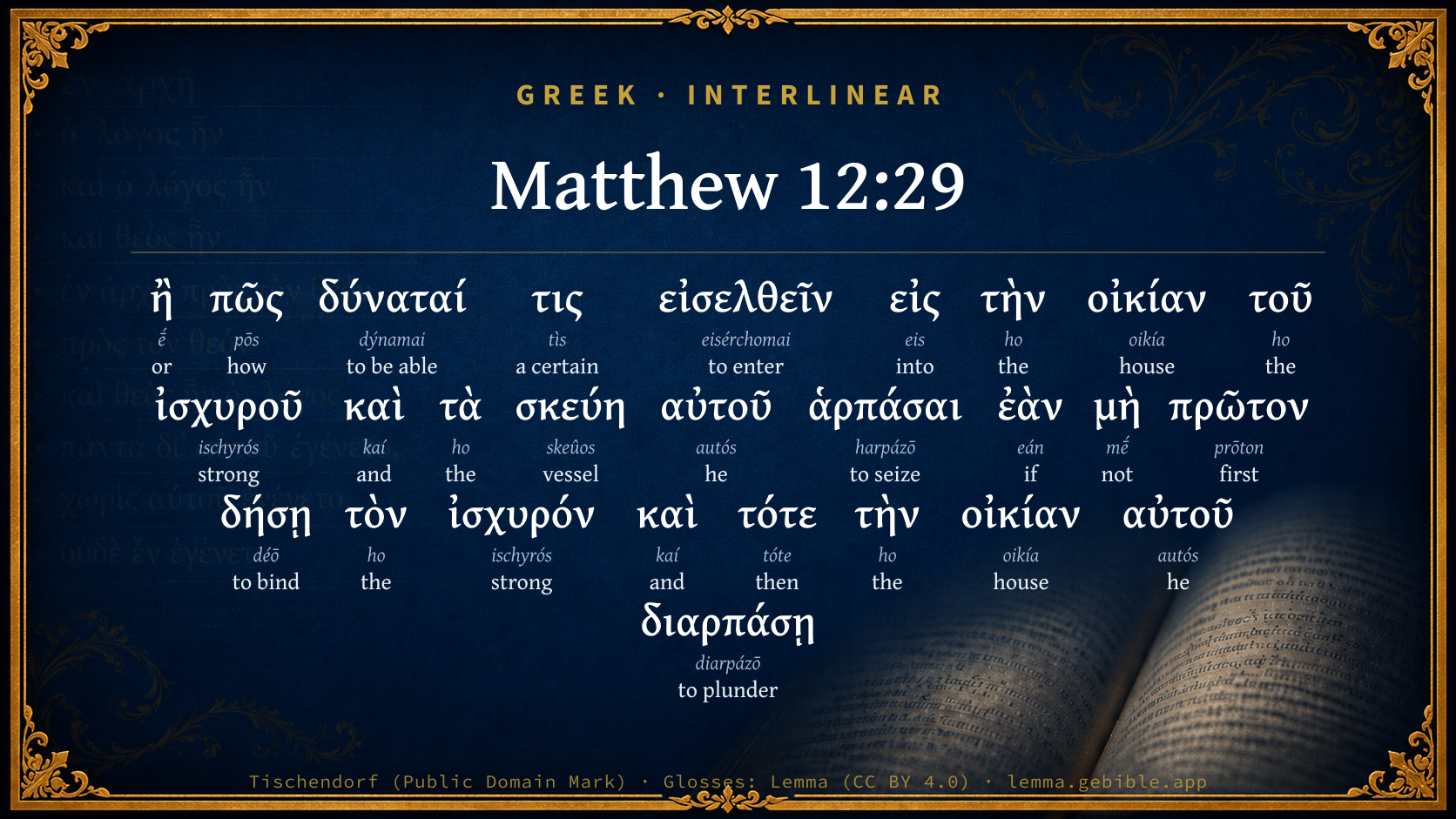
Download image
Cite this verse

Matthew 12:29 (World English Bible). Public Domain. Lemma interlinear Bible study tool, https://lemma.gebible.app/v/matthew/12/29.

Show BibTeX & RIS
BibTeX
RIS
English Translation
Or how can one enter into the house of the strong man, and plunder his goods, unless he first bind the strong man? Then he will plunder his house.
World English Bible · Public Domain
Highlights
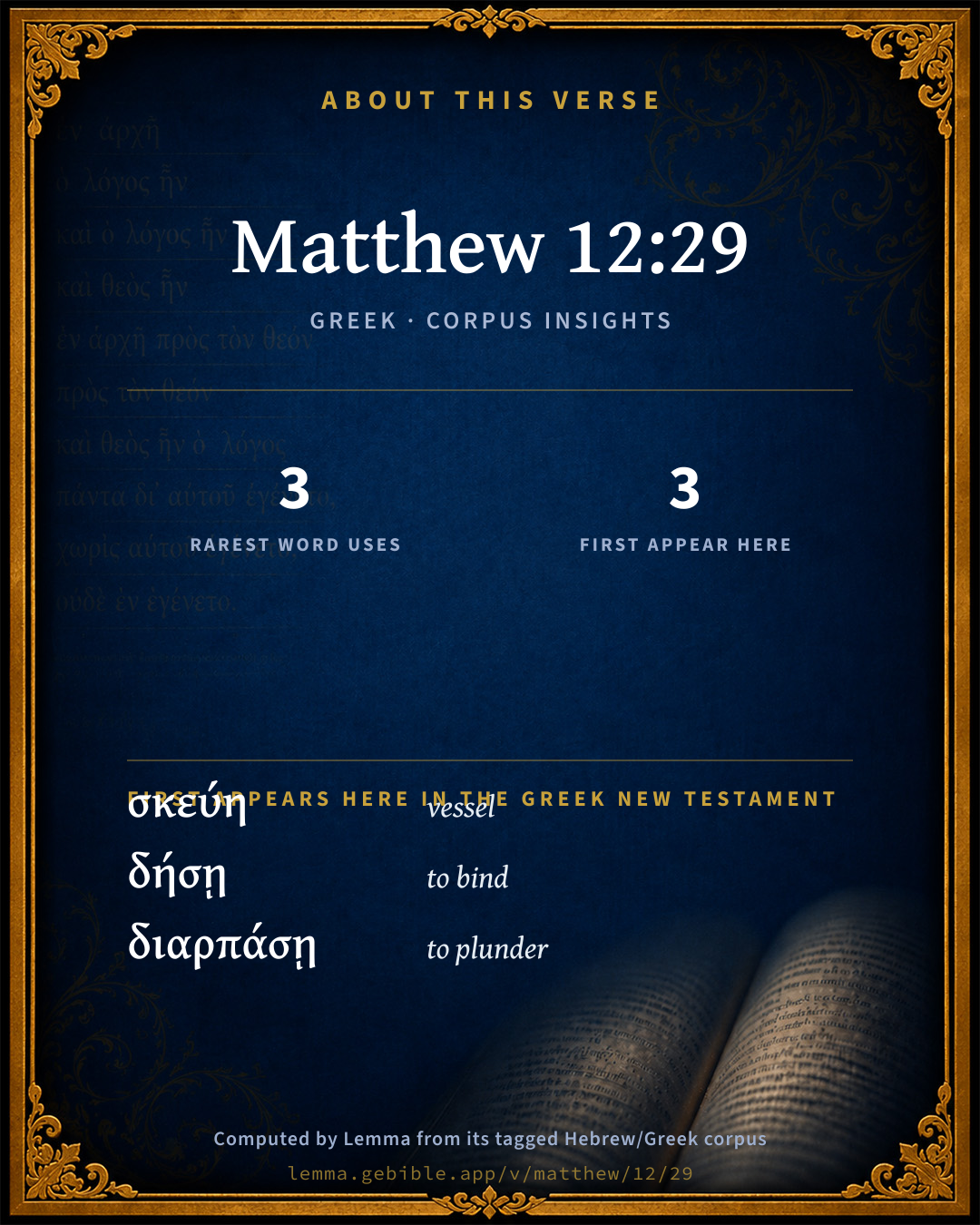
  • 3 first appearances in the Greek New Testament
Full analysis ↓
Download a study sheet

One document with this verse’s original text, its word-by-word gloss line, the meaning frame, cross-references with their text, attributed commentary, and full source and license credits — printable, and it pastes into notes with its structure intact.

This verse Autodidact and up

Study sheet (.html) Plain text (.txt)

A passage Seminary Student

Up to 50 verses in one chapter. A passage sheet keeps up to 6 commentary sources and 12 cross-references per verse, in the order this page ranks them, and says so on the sheet whenever that leaves anything out. Ask for a single verse and you get the Autodidact verse sheet above.

Everything on this page stays free to read, with no account — the sheet is a download of what is already on screen, not access to it.

Want to remove ads? Support Godless Engineer
Compare translations 3

The same verse in 3 English versions, stacked beneath the original-language interlinear above. Click any original word for its lexicon entry.

Each is an independent rendering of the whole verse — the interlinear is not word-aligned to these translations.

Highlighted words mark where these versions differ — a whole-verse word diff, not a word-by-word alignment.

  • World English Bible Public Domain
    Or how can one enter into the house of the strong man, and plunder his goods, unless he first bind the strong man? Then he will plunder his house.
  • King James Version Public Domain
    Or else how can one enter into a strong man's house, and spoil his goods, except he first bind the strong man? and then he will spoil his house.
  • unfoldingWord Literal Text CC BY-SA 4.0
    Or how is anyone able to enter into the house of the strong man and steal his possessions if he has not first bound the strong man? And then he will plunder his house.

unfoldingWord Literal Text — © unfoldingWord, licensed CC BY-SA 4.0. Word-aligned USFM3 via Door43 (git.door43.org/unfoldingWord/en_ult).

Versions to compare (up to 4)

3 of 4 selected

Show all 19 translations

Every available English version of this verse, each an independent rendering of the whole verse.

  • World English Bible Public Domain
    Or how can one enter into the house of the strong man, and plunder his goods, unless he first bind the strong man? Then he will plunder his house.
  • Berean Standard Bible Public Domain
    Or again, how can anyone enter a strong man’s house and steal his possessions, unless he first ties up the strong man? Then he can plunder his house.
  • Majority Standard Bible Public Domain
    Or again, how can anyone enter a strong man’s house and steal his possessions, unless he first ties up the strong man? Then he can plunder his house.
  • King James Version Public Domain
    Or else how can one enter into a strong man's house, and spoil his goods, except he first bind the strong man? and then he will spoil his house.
  • American Standard Version (1901) Public Domain
    Or how can one enter into the house of the strong `man,' and spoil his goods, except he first bind the strong `man'? and then he will spoil his house.
  • Revised Version (1885) Public Domain
    Or how can one enter into the house of the strong man, and spoil his goods, except he first bind the strong man? and then he will spoil his house.
  • Geneva Bible (1599) Public Domain
    Els howe can a man enter into a strong mans house and spoyle his goods, except he first bind the strong man, and then spoile his house.
  • Douay-Rheims (1899) Public Domain
    Or how can any one enter into the house of the strong, and rifle his goods, unless he first bind the strong? and then he will rifle his house.
  • Young's Literal Translation Public Domain
    `Or how is one able to go into the house of the strong man, and to plunder his goods, if first he may not bind the strong man? and then his house he will plunder.
  • Literal Standard Version CC BY-SA 4.0
    Or how is one able to go into the house of the strong man, and to snatch his goods, if first he may not bind the strong man? And then his house he will plunder.
  • Unlocked Literal Bible CC BY-SA 4.0
    How can anyone enter the house of the strong man and steal his belongings without tying up the strong man first? Then he will steal his belongings from his house.
  • unfoldingWord Literal Text CC BY-SA 4.0
    Or how is anyone able to enter into the house of the strong man and steal his possessions if he has not first bound the strong man? And then he will plunder his house.
  • Darby Bible Public Domain
    Or how can any one enter into the house of the strong [man] and plunder his goods, unless first he bind the strong [man]? and then he will plunder his house.
  • World Messianic Bible Public Domain
    Or how can one enter into the house of the strong man and plunder his goods, unless he first bind the strong man? Then he will plunder his house.
  • Webster's Bible Public Domain
    Or else, how can one enter into a strong man's house, and seize his goods, except he shall first bind the strong man? and then he will plunder his house.
  • Free Bible Version CC BY-SA 4.0
    Can you enter a strong man's house and take his belongings unless you tie him up first? If you do that then you can take everything in his house.
  • Bible in Basic English Public Domain
    Or how may one go into a strong man's house and take his goods, if he does not first put cords round the strong man? and then he may take his goods.
  • Text-Critical English NT CC BY 4.0
    Or how can anyone enter the house of a strong man and plunder his goods unless he first binds the strong man? Then he will plunder his house.
  • Tyndale New Testament (1534) Public Domain
    Ether how can a man enter into a stroge mannes housse and violently take awaye his goodes: excepte he fyrst binde the stroge man and the spoyle his housse?

Literal Standard Version (2020), Covenant Press — licensed CC BY-SA 4.0. Text via the HelloAO Bible API (eBible.org). Unlocked Literal Bible (unfoldingWord) — licensed CC BY-SA 4.0. Text via the HelloAO Bible API (eBible.org). unfoldingWord Literal Text — © unfoldingWord, licensed CC BY-SA 4.0. Word-aligned USFM3 via Door43 (git.door43.org/unfoldingWord/en_ult). Free Bible Version, Dr. Jonathan Gallagher — licensed CC BY-SA 4.0. Text via the HelloAO Bible API (eBible.org).

Word by word

More ways to search: Search by grammar → Find every occurrence → Compare this word →

Practice this passage: Drill this verse → Learn its vocabulary →

διαρπάσῃ
diarpázō
G1283
“to plunder”
Verb, Aorist, Active, Subjunctive, 3rd person, Singular
Part of Speech
Verb
Tense
Aorist
Voice
Active
Mood
Subjunctive
Person
3rd person
Number
Singular
Full Thayer's Definition

Origin: from G1223 and G726

TDNT: None

1. to plunder
  1. ἢ ḗ G2228 “or” Particle
  2. πῶς pōs G4459 “how” Adverb, Interrogative
  3. δύναταί dýnamai G1410 “to be able” Verb, Present, Middle or Passive deponent, Indicative, 3rd person, Singular
  4. τις tìs G5100 “a certain” Indefinite pronoun, Nominative, Singular, Masculine
  5. εἰσελθεῖν eisérchomai G1525 “to enter” Verb, Aorist, Active, Infinitive
  6. εἰς eis G1519 “into” Preposition
  7. τὴν ho G3588 “the” Article, Accusative, Singular, Feminine
  8. οἰκίαν oikía G3614 “house” Noun, Accusative, Singular, Feminine
  9. τοῦ ho G3588 “the” Article, Genitive, Singular, Masculine
  10. ἰσχυροῦ ischyrós G2478 “strong” Adjective, Genitive, Singular, Masculine
  11. καὶ kaí G2532 “and” Conjunction
  12. τὰ ho G3588 “the” Article, Accusative, Plural, Neuter
  13. σκεύη skeûos G4632 “vessel” Noun, Accusative, Plural, Neuter
  14. αὐτοῦ autós G846 “he” Personal pronoun, Genitive, Singular, Masculine
  15. ἁρπάσαι harpázō G726 “to seize” Verb, Aorist, Active, Infinitive
  16. ἐὰν eán G1437 “if” Conditional
  17. μὴ mḗ G3361 “not” Particle, Negative
  18. πρῶτον prōton G4412 “first” Adverb, Superlative
  19. δήσῃ déō G1210 “to bind” Verb, Aorist, Active, Subjunctive, 3rd person, Singular
  20. τὸν ho G3588 “the” Article, Accusative, Singular, Masculine
  21. ἰσχυρόν ischyrós G2478 “strong” Adjective, Accusative, Singular, Masculine
  22. καὶ kaí G2532 “and” Conjunction
  23. τότε tóte G5119 “then” Adverb
  24. τὴν ho G3588 “the” Article, Accusative, Singular, Feminine
  25. οἰκίαν oikía G3614 “house” Noun, Accusative, Singular, Feminine
  26. αὐτοῦ autós G846 “he” Personal pronoun, Genitive, Singular, Masculine

About this verse

These counts appear in no published source. They are computed here, from the morphology-tagged text and Lemma’s own curated glosses. What Lemma adds →

27
words
19
distinct lemmas
Gospels
section

Notable vocabulary

The rarest word here is διαρπάσῃ to plunder G1283 — appearing just 3 times in the whole Greek New Testament.

First appearance in Scripture

These words make their first canonical appearance in the Greek New Testament here:

  • σκεύη vessel G4632
  • δήσῃ to bind G1210
  • διαρπάσῃ to plunder G1283

Shared distinctive vocabulary

διαρπάσῃ to plunder G1283 occurs in 2 verses of the Greek New Testament. Also found in:
Repetition

Words recur within this verse:

  • οἰκίαν house G3614 ×2
  • ἰσχυροῦ strong G2478 ×2
  • τὴν the G3588 ×5
  • καὶ and G2532 ×2
  • αὐτοῦ he G846 ×2

Cross-references

9

Topical passages linked to Matthew 12:29 in the Treasury of Scripture Knowledge — connected by theme and wording, ordered by reader-vote popularity; previews shown in the World English Bible.

  • Isaiah 49:24 Shall the prey be taken from the mighty, or the lawful captives be delivered?
  • Mark 3:27 But no one can enter into the house of the strong man to plunder, unless he first binds the strong man; and then he will plunder his house.
  • Luke 11:21–22 "When the strong man, fully armed, guards his own dwelling, his goods are safe.
  • 1 John 4:4 You are of God, little children, and have overcome them; because greater is he who is in you than he who is in the world.
  • Revelation 20:7–9 And after the thousand years, Satan will be released from his prison,
  • 1 John 3:8 He who sins is of the devil, for the devil has been sinning from the beginning. To this end the Son of God was revealed, that he might destroy the works of the devil.
  • Isaiah 53:12 Therefore will I divide him a portion with the great, and he shall divide the spoil with the strong; because he poured out his soul to death, and was numbered with the transgressors: yet he bore the sin of many, and made intercession for the transgressors.
  • Revelation 20:1–3 I saw an angel coming down out of heaven, having the key of the abyss and a great chain in his hand.
  • Revelation 12:7–10 There was war in the sky. Michael and his angels made war on the dragon. The dragon and his angels made war.

Cross-references courtesy of OpenBible.info (CC BY 4.0).

Where the printed editions differ

1 variant

Places in this verse where the major printed Greek editions disagree on the wording in a way that affects the translation — a comparison of editions, not a manuscript-by-manuscript collation. The editions are the modern critical texts (Nestlé-Aland 28/27, SBL, Westcott-Hort, Tregelles, Tyndale House) and the traditional texts behind the KJV (the Textus Receptus and the Byzantine/Majority text). It is not a claim about which reading is original.

  1. Different wording
    διαρπάσει.

    “he will rob.”

    In NA28NA27TynSBLWHTregTRByz03

    διαρπάσῃ (diarpasē) 'he may rob' occurs in a few manuscripts (NIV+01+05+032) instead of διαρπάσει.¶ (diarpasei) 'he will rob.' in older manuscripts (NA28+NA27+Tyn+SBL+WH+Treg+TR+Byz+03)

Textual data: Translators Amalgamated Greek New Testament (STEPBible TAGNT) · CC BY 4.0.

Commentary

Notes on Matthew 12:29 from classic Christian and Jewish commentators (each source and its license shown beneath its notes). The classic Christian expositions comment on the surrounding passage and are grouped to its opening verse, so a note may address several verses; the Jewish commentaries on the Tanakh (Rashi and others) are per-verse, so they appear only where the commentator wrote on this verse.

Lemma curates 59 commentaries, every one of them public domain or Creative Commons licensed, each selected and text-cleaned for this edition rather than reprinted as found. About our sources →

The Biblical Illustrator

Joseph S. Exell

Mat_12:22; Mat_12:29

One possessed with a devil, blind and dumb.

I. What kind of power satan still exercises generally over mankind.

II. All who apply to, Jesus shall surely obtain deliverance.

III. On this deliverance an experience of Christs mercy will excite our admiration and confirm our faith. (W. P. Wait, M. A.)

I. A miracle of singular power and mercy.

II. The effect produced by this miracle on the minds of the people-They were amazed, etc.

III. The impious calumnies of the enemies of Christ. This charge displayed their malignity. There are two principles involved in our Lords reply.

1. That the power of Christ is greater than that of all the powers of darkness.

2. That the manifestation of His superior power establishes His claims as the Author of the new dispensation-Then the kingdom of God is come unto you.

IV. To awake salutary self-inspection the redeemer uttered the solemn admonition respecting the danger of neutrality and indecision in reference to his claims.

1. The danger of an undecided state.

2. Adore the gracious power of Christ.

3. Rejoice in the service and cause of Christ.

4. Dread the thought of being found amongst the enemies of Christ. (J. Fletcher.)

Christ and the Pharisees

I. The good mans relation to the world of want.

1. The good man is approachable.

2. He is sympathetic.

3. He is unostentatious.

II. The devils relation to good men. How did these Devils men use Christ?

1. They resorted to personal abuse-This fellow.

2. They ignored the value of the greatest blessings.

3. They insulted the plainest common-sense.

4. They attempted to trace good results to a bad cause.

5. They falsified the deepest and truest instincts of human nature. (J. Parker.)

The Biblical Illustrator, edited by Joseph S. Exell (c. 1880s–1900s) — public domain. Text from a community e-Sword module.

Joseph Benson's Commentary

Mat 12:29-30. How can one enter, &c. — How could I cast out Satan, and destroy his works, if I did not first overcome him? “The house of the strong man (or, strong one, as του ισχυρου should rather be rendered) into which Christ entered, was the world, fitly called Beelzebub’s house, or palace, because there he is served by luxury, lust, covetousness, pride, anger, and the other evil passions of men. The goods or vessels belonging to the strong one are the wicked, called Satan’s vessels metaphorically, as Paul is called Christ’s chosen vessel, Act 9:15. Or, by the vessels, or furniture of Beelzebub’s house, we may understand the lusts and passions of men’s hearts, the instruments by which he keeps possession of them.” He that is not with me is against me — He that does not unite and co- operate with me, who am contending against Satan and his kingdom, is against me, as being unwilling that his kingdom should be destroyed. And he that gathereth not with me — That does not set himself, according to his ability, to gather subjects into my kingdom, and promote the cause of truth and grace among men, scattereth abroad — Hinders the work of God upon earth, and either prevents men from entering upon a life of piety and virtue, or obstructs their progress therein. In other words, there are no neuters in this war: every one must be either with Christ or against him; either a loyal subject or a rebel; and there are none upon earth who neither promote nor obstruct his kingdom. For every one does either one or the other daily. Much more criminal and fatal, then, must the character and conduct of those be, who, with deliberate, implacable malice, oppose Christ’s cause, and are resolved, at all adventures, to do their utmost to bring it down, as the Pharisees were now attempting to do by these vile suggestions, whereby they endeavoured to represent Christ, who came to save men, as an accomplice with Satan, who was labouring to destroy them.

Joseph Benson's Commentary on the Old and New Testaments (1811–1818) — public domain. Text from a community e-Sword module.

Tyndale Open Study Notes

Tyndale Open Resources

12:29 This parable forced the Pharisees to answer a simple question: Can anyone cast out demons without first binding Satan’s powers and thus opposing him (see Isa 49:24-26; 53:12)? • tie him up: Jesus overcame Satan first at his temptation (Matt 4:1-11), then throughout his ministry (see Luke 10:17-20), and ultimately on the cross (see Col 2:14-15).

Tyndale Open Study Notes — © Tyndale Open Resources, licensed CC BY-SA 4.0. Text via the HelloAO Bible API.

Bengel's Gnomon

Johann Albrecht Bengel

Mat 12:29. ἤ, or else?)=Latin, an? A disjunctive interrogation.—οἰκίαν, house) The world was the house of Satan.—τοῦ ἰσχυροῦ, of the strong) sc. of any one who is strong; cf. Heb 2:14.—πρῶτον, first) Jesus bound Satan: then took his spoils.—δήση, shall have bound) by superior strength.—διαρπάσει, shall spoil) See Gnomon on Mar 3:27.

Bengel's Gnomon of the New Testament — English translation (T&T Clark, Edinburgh, 1860) — public domain. Text from a community e-Sword module.

Meyer's Critical & Exegetical Commentary

Heinrich August Wilhelm Meyer

Mat_12:29. Ἤ] Transition by way of proceeding to give further proof of the actual state of the case.

τοῦ ἰσχυροῦ] The article indicates the particular strong man (hero) with whom the τίς has to do.

The thought embodied in this illustration is as follows: Orif you still hesitate to admit the inference in Mat_12:28how is it possible for me to despoil Satan of his servants and instruments (τὰ σκεύη αὐτοῦ corresponding to the demons in the application)withdraw them from his controlwithout having first of all conquered him? Does my casting out of demons not prove that I have subdued Satan,have deprived him of his power, just as it is necessary to bind a strong man before plundering his house? For ἤ, when serving to introduce a question by way of rejoinder, see Bäumlein, Partik. p. 132. The σκεύη in the illustration are the furniture of the house (not the weapons), as is evident from τ. οἰκίαν αὐτοῦ below. Mar_3:27.

The figurative language may have been suggested by a recollection of Isa_49:24 f.

Meyer — Critical and Exegetical Commentary on the New Testament — English translation by Peter Christie, edited by Frederick Crombie (T&T Clark, 1880) — public domain. Text from a community e-Sword module.

Expositor's Greek Testament

ed. W. Robertson Nicoll

Mat 12:29 . o help them to decide Jesus throws out yet another parabolic line of thought. ἢ : if all that I have said does not convince you consider this. The parable seems based on Isa 49:24-25 , and like all Christ’s parabolic utterances appeals to common sense. The theme is, spoiling the spoiler, and the argument that the enterprise implies hostile purpose and success in it superior power . The application is: the demoniac is a captive of Satan; in seeking to cure him I show myself Satan’s enemy ; in actually curing him I show myself Satan’s master . τοῦ ἰσχυροῦ : the article is either generic, or individualising after the manner of parabolic speech. Proverbs and parables assume acquaintance with their characters. σκεύη , household furniture (Gen 31:37 ); ἁρπάσαι , seize (Jdg 21:21 ). διαρπάσει , make a clean sweep of all that is in the house, the owner, bound hand and foot, being utterly helpless. The use of this compound verb points to the thoroughness of the cures wrought on demoniacs, as in the case of the demoniac of Gadara: quiet, clothed, sane (Mar 5:15 ).

The Expositor's Greek Testament, edited by W. Robertson Nicoll (1897–1910) — public domain. Text from a community e-Sword module.

Jamieson, Fausset & Brown

Robert Jamieson, A. R. Fausset & David Brown

Or else how can one enter into a strong man's house--or rather, "the strong man's house."

and spoil his goods, except he first bind the strong man? and then he will spoil his house.

Jamieson, Fausset & Brown — Commentary Critical and Explanatory on the Whole Bible (1871) — public domain (CC PDM 1.0). Text via the HelloAO Bible API.

Adam Clarke's Commentary

Verse 29. Else how can one enter into a strong man's house] Men, through sin, are become the very house and dwelling place of Satan, having of their own accord surrendered themselves to this unjust possessor; for whoever gives up his soul to sin gives it up to the devil. It is Jesus, and Jesus alone, who can deliver from the power of this bondage. When Satan is cast out, Jesus purifies and dwells in the heart.

Adam Clarke's Commentary on the Bible (1810–1826) — public domain. Text from a community e-Sword/MySword module.

Ellicott's Commentary for English Readers

(29) How can one enter into a strong man’s house.—The parable implied in the question appears in a fuller form in Luk_11:21-22. Here it will be enough to note that the “strong man” is Satan. The “house” is the region which is subject to him—i.e., either the world at large, or the spirits of individual men; the “goods” or “instruments” (comp. the “armour” of Luk_11:22) are the demons or subordinate powers of evil by which he maintains his dominion; the “binding of the strong man” is the check given to the tyranny of Satan by emancipating the possessed sufferers from their thraldom; the “spoiling of the house” implies the final victory over him.

A Bible Commentary for English Readers, edited by Charles John Ellicott (1878–1897) — public domain. Text from a community e-Sword module.

The Cambridge Bible for Schools and Colleges

gen. ed. J. J. S. Perowne

29. Not only is Satan not an ally, but he is an enemy and a vanquished enemy.

The Cambridge Bible for Schools and Colleges (gen. ed. J. J. S. Perowne; Cambridge University Press, 1878–1918) — public domain. Text from a community e-Sword module.

John Gill's Exposition

O generation of vipers,.... Though they boasted of their being the seed of Abraham, yet their immediate ancestors were no other than vipers, deceitful, hurtful, poisonous creatures; and they were exactly like them: for though they made a fair show in the flesh, and outwardly appeared righteous, yet were inwardly full of the poison of wickedness, envy and malice; and which their pestilential breath, their blasphemy against the Spirit, fully discovered; and gave just cause and reason for so severe a reproof, and such resentment, as here made by Christ.

How can ye, being evil, speak good things? This is not to be expected, nor is it commonly and constantly done; an evil man may sometimes speak good things, or which seem to be so; but these are not his common talk; as he is, so, for the most part, is his language; his speech betrays him: and since these men were by nature evil, were destitute of the Spirit and grace of God, had no good thing in them, how should any good thing come out of them? And since they were so full of wickedness, spite and malice, it is no wonder that they belched out such blasphemous expressions concerning the miracles of Christ;

for out of the abundance of the heart the mouth speaketh: a phrase much like this is used by the Septuagint, in Ecc 2:15. "I spoke abundance", or "much in my heart"; "for the fool out of his abundance speaketh": as there is abundance of folly in him, there is much delivered out by him; and where there is abundance of wickedness in the heart, if the grace of God is wanting to restrain it, much of it will come out by the lips; as is a man's heart, ordinarily is his language.

John Gill's Exposition of the Whole Bible (1746–1763) — public domain (CC PDM 1.0). Text via the HelloAO Bible API.

Trapp's Complete Commentary

John Trapp

29 Or else how can one enter into a strong man’s house, and spoil his goods, except he first bind the strong man? and then he will spoil his house.

Ver. 29. A strong man’s house, &c.] The devil is strong, but overpowered by Christ. He hath forcibly delivered us from the power of darkness, snatched us out of the Devil’s danger; {ερρυσατο, Col 1:13} so that, though he shake his chain at us, he cannot fasten his fangs in us. Stronger is he that is in the saints, than he that is in the world. Through Christ we shall overcome him, Rom 8:37.

John Trapp, A Commentary or Exposition upon All the Books of the Old and New Testament (1647–1656) — public domain. Text from a community e-Sword module.

Haydock's Catholic Bible Commentary

How can any one enter; how can I drive Satan from his possession? i.e. cast him out from the bodies of men, unless I am stronger than he, and first unarm him. (Maldonatus)

George Leo Haydock (1774–1849), Haydock's Catholic Family Bible and Commentary, 1859 edition — public domain. Excludes Psalms (Douay-Rheims chapter numbering differs from Protestant) and Deuterocanonical books (Catholic canon only).

Matthew Poole's English Annotations

Mark hath the same words, with little variation, Mar 3:27; Luke saith, Luk 11:21,22, When a strong man armed keepeth his palace, his goods are in peace: but when a stronger than he shall come upon him and overcome him, he taketh from him all his armour wherein he trusted, and divideth his spoil. The sense is the same, though the words be multiplied. Our Saviour showeth how his casting out of devils by the Spirit and power of God argued that the Messiah was come, and the time come when God would set up his kingdom amongst men. The devil, (saith he), who is the god of the world, and the prince of the power of the air, is very strong; there is none, save God only, who is stronger than he. If I were not God, I could never cast out this strong man, who reigns in the world as in his house; as you see amongst men, the strong man is not overcome but by one stronger. He by this also lets them know, that he was so far from any covenant or compact with Beelzebub, that he came into the world a professed enemy to him, to dispossess him of that tyrannical power he exercised amongst men, by his keeping them in darkness, blinding them with error and superstition, and seducing them to sinful practices, till God, for their prodigious sins, had also given him a power over their bodies, variously to vex, afflict, and torment them. Christ took from this strong man all his armour: by scattering the darkness which was in the world by the full revelation of gospel truth: by expelling error and superstition, teaching people the truths of God, and the right way of his worship: by taking away the guilt, and destroying the power of sin and death, ignorance, error, profaneness; the sense of the guilt of sin, and the power of lusts within us, being the devil’s armour, by which he kept up his power, and doth yet keep up what dominion he hath in the world.

Matthew Poole's English Annotations on the Holy Bible (1683–1685) — public domain. Text from a community e-Sword/MySword module.

Whedon's Commentary on the Bible

Daniel D. Whedon

29. A strong man’s house — Our Lord here argues that his expelling devils proves his superiority over them. As a strong man enters the house of a weaker and spoils his goods, so our Lord enters the devil’s tenement and despoils him of it.

Daniel D. Whedon (gen. ed.), Commentary on the Old and New Testaments (1874–1909) — public domain. Text from a community e-Sword module.

The Pulpit Commentary

Parallel passages: Mar_3:27 Luk_11:21, Luk_11:22. Mark is practically identical with Matthew. Luke ("the strong man armed," etc.) is more detailed and vivid, and is perhaps the original form of the saying. Or else; or (Revised Version); i.e. if this be not the case, that the kingdom of God is come upon you, how else do you explain what has happened, the fact of Satan"s instruments being taken from him? How can one enter into a strong man"s house; the house of the strong man (Revised Version). (For the article, cf. Mat_1:23, note) And spoil (arpasai) his goods. Carry off his household tools and utensils (ta skeuh autou ). Except he first bind the strong man? and then he will spoil his house.

This is more than merely the conclusion. It is an emphatic statement that it will do this, yes, utterly plunder (diarpasei) the whole house. The interpretation of the parable is self-evident: the strong man is Satan; his vessels are those afflicted by him; the one who binds, etc., is Christ. For Christ"s appearance and work, even before the Crucifixion and Resurrection, bound Satan in this respect. Observe that there is probably a tacit reference to Isa_49:25, which at any rate now received a fulfilment.

Robbing the strong man"s house.

The circumstances under which it was spoken explain this parable. Our Lord had just cast out a demon from a poor creature who was both blind and dumb. A more pitiable object than such a demoniac can hardly be conceived. And yet in this extreme instance of the tenderness of Jesus to the bruised reed his enemies only see sinister motives and suspect malign influences. they charge the great Deliverer with being in league with Satan. The parable is our Lord"s reply to this monstrous allegation.

I SATAN IS LIKE A STRONG MAN. Some men speak lightly of temptation, and boast of their strength to resist it. These may be its earliest victims. Christ knew the powers of evil, and he did not despise their magnitude. He had met the tempter in the wilderness, and though he had come off completely victorious, he had seen the awful might of the great enemy of souls. Satan is so strong that no human being can master him alone. Only a stronger can bind him.

II THE SIX-POSSESSED WORLD IS A HOUSE OF SATAN. The miserable demoniac was like a house of Satan, in the power of the prince of evil. But the whole world is described as under the spirit of evil. tie is the prince of this world.

III EVIL INFLUENCES ARE THE WEAPONS AND TOOLS OF SATAN. We might render the word "goods" as "instruments." The demon in the poor possessed man was one of Satan"s instruments. In a secondary sense we may now say that evil passions and corrupt habits are Satan"s weapons, because it is through them that the power of evil works in the world and inflicts his cruel tortures on his victims.

IV IT IS THE PURPOSE OF CHRIST TO DELIVER THE WORLD FROM EVIL INFLUENCES. His principal miracle-working is described as the casting out of demons. Doubtless this was intended to be suggestive of his great spiritual work in liberating souls from the bad influences, the sinful habits and passions with which they are possessed. Thus he is a robber, breaking into the house of Satan to take away his detestable instruments. When he has done this the house itself will no longer be in the power of the evil one.

V THE HOUSE OF SATAN CANNOT BE ROBBED TILL ITS MASTER IS OVERMASTERED. The strong man will keep his house and will permit no weak intruder to rob it.

1. The first work in the salvation of the world must be the binding of Satan. Something more must be done than to bring gracious influences to bear on individual men. An awful conflict must go on till the power of evil itself is restrained.

2. It is impossible to raise the fallen till the sin that has ruined them is conquered. The problem of rescuing the degraded inhabitants of great cities must be faced on its moral side. Drunkenness, gambling, and profligacy must be fought and conquered before the wretched condition of these people can be effectually overcome.

3. Evil must be east out by conquering temptation. The tempter must be bound. It is a Christian work to restrain or remove the influences that tempt to vice.

VI CHRIST REDEEMS THE WORLD BY MASTERING THE POWER OF EVIL.

1. He worsted Satan in his temptation.

2. He effectually vanquished the spirit of evil in his work, and beheld him fall like lightning from heaven.

3. He completely mastered the evil one at Calvary and in the resurrection.

4. He now hinds Satan in individual hearts, conquering the ruling powers of evil within. W.F.A.

The Pulpit Commentary (1880–1919), ed. H.D.M. Spence-Jones & Joseph S. Exell — public domain. Text from a community e-Sword module.

John Wesley's Explanatory Notes

How can one enter into the strong one's house, unless he first bind the strong one - So Christ coming into the world, which was then eminently the strong one's, Satan's house, first bound him, and then took his spoils.

John Wesley, Explanatory Notes Upon the Whole Bible (1754–1765) — public domain. Text via the GEBible commentary corpus.

Kretzmann's Popular Commentary

Paul E. Kretzmann

Another illustration:

v. 29. Or else, how can one enter into a strong man’s house, and spoil his goods, except he first bind the strong man? and then he will spoil his house.

v. 30. He that is not with Me is against Me; and he that gathereth not with Me scattereth abroad.

In case they were not yet convinced, He will attempt to establish His position by another parabolic saying. Every demoniac is a captive of Satan, bound, body and soul, in his power, to do his will. But Christ has come to destroy the works of the devil, 1Jn 3:8. He wants to take the stronghold of the enemy and wrest his prey from him. This Jesus did, not only in the individual cases when He cured demoniacs, but by His entire life, suffering, and death, by His active and passive obedience in behalf of all men. He has gained a complete deliverance from the bondage of the devil. On His side, in His strength is victory, and there alone. This fact gives emphasis to the warning statement as to the alternative: either for or against Christ. There is no middle ground in this decision, there is no neutrality in this fight. This referred not only to the Pharisees, whose enmity was growing more evident every day, but especially to those among the people that were still undecided. The so-called neutral people that do not wish to oppose Christ outright, but also do not wish to antagonize the children of the world, the wise blasphemers, are, in the last analysis, enemies of the work of Christ and hinder the coming of the Kingdom. Instead of gathering with the Lord of the harvest, their hesitancy, their vacillating policy, harms His cause.

Paul E. Kretzmann, Popular Commentary of the Bible (1921–1924) — public domain. Text from a community e-Sword module.

The People's New Testament

B. W. Johnson

29. How can … spoil his goods, etc.? No one can enter a man's house and take his goods unless he has first conquered him. If I am not the Messiah, stronger than Satan, how could I spoil him?

B. W. Johnson's The People's New Testament with Notes (1889–1891) — public domain. Electronic text from the Christian Classics Ethereal Library (CCEL) ThML edition.

Cambridge Greek Testament for Schools and Colleges

29. Not only is Satan not an ally, but he is an enemy and a vanquished enemy.

τὰ σκεύη. Including τὴν πανοπλίαν ἐφʼ ᾗ ἐπεποίθει, as well as the τὰ ὑπάρχοντα of St Luke—his goods and furniture, his armour and equipment generally. Cp. Isa 53:12, τῶν ἰσχυρῶν μεριεῖ σκῦλα (LXX).

Cambridge Greek Testament for Schools and Colleges (Cambridge University Press, 1896; 21 vols, various authors incl. Carr, Maclear, Plummer, Farrar, Lumby, Moule, M. R. James, Simcox) — public domain. Text from a community e-Sword module.

Alford’s Greek Testament

Henry Alford

29.] Luke has the word ἰσχυρότερος applied to the spoiler in this verse; a title given to our Lord by the Baptist, ch. 3:11 , and also in prophecy, Isa 40:10 (μετὰ ἰσχύος, LXX). See also Isa 53:12 (LXX); 49:24, 25. See note on Luk 11:21 f., which is the fuller report of this parabolic saying.

Henry Alford, The Greek Testament (1849–1861) — public domain. Text from a community e-Sword module.

International Critical Commentary

(M) 29. Or how can any one enter into the house of “the strong man,” and spoil his goods? unless first he bind “the strong man,” and then he will spoil his house.] Mk. has: “But no one can, having entered into,” etc. Lk. has a different version of the saying.—ἢ πῶς] In Mk. the saying is loosely appended to the preceding with ἀλλά. The saying about the strong man and his goods had probably become proverbial; cf. Ps.-Son 5:4 οὐ γὰρ λήψεται σκῦλα ἄνθρωπος παρὰ ἀνδρὸς δυνατοῦ; Isa 49:24 μὴ λήμψεταί τις παρὰ γίγαντος σκῦλα.

So far from acting as a subordinate of Beelzeboul, Christ had invaded his territory, and by ejecting devils from the possessed, was spoiling his goods. This implied a previous victory over him.

International Critical Commentary — older volumes (1896–1929), various authors — public domain. Text from a community e-Sword module.

Vincent's Word Studies in the New Testament

Marvin R. Vincent

Of a strong man [του ισχυρου] . Rev. rightly gives the force of the article, the strong man. Christ is not citing a general illustration, but is pointing to a specific enemy - Satan. How can I despoil Satan without first having conquered him?

Goods [σκευη] . The word originally means a vessel, and so mostly in the New Testament. See Mr 11:16; Joh 19:29. But also the entire equipment of a house, collectively : chattels, house - gear. Compare Luk 17:31; Act 27:17, of the gear or tackling of the ship. Rev., lowered the gear.

Marvin R. Vincent, Word Studies in the New Testament (1887–1900) — public domain. Text from a community e-Sword/MySword module.

Lesson kit

Teaching starters — assembled from the data on this page, not authored interpretation. Every prompt links to the verse data it draws on. Edit before teaching.

Matthew, in the Gospels, opens this verse with 27 words (19 distinct Greek lemmas). Its most distinctive word is diarpázō (“to plunder”). A historical commentator’s framing appears above. Read the whole chapter for the surrounding context.

Discussion questions

  1. What does “to plunder” (diarpázō) contribute to the verse as a whole?
  2. 3 words here appear for the first time in Scripture. What is being introduced at this debut?
  3. Mark 3:27 shares the word «to plunder» with this verse. How do the two illuminate each other?
  4. “house” occurs 2× in this one verse. What is the effect of the repetition?
  5. The translations on this page render this verse differently — a whole-verse word diff, not a word-by-word alignment. What might account for the different wordings?
  6. Reading how The Biblical Illustrator and Joseph Benson's Commentary read this verse, where do the two commentators agree and where do they part?

Things to notice

  • 3 words make their first canonical appearance in Scripture here.
  • These translations choose different wording for 16 words in this verse.
  • “house” occurs 2× in this single verse.
  • 19 distinct Greek lemmas span 27 words in this verse.

Reading settings

Reading text

Shown beneath each verse's original-language words.

Old Testament
Old Testament edition

Read the OT as the Masoretic Hebrew (MT) or the Greek Septuagint (LXX).

English shown for the Greek Septuagint (in the Hebrew ↔ Greek comparison).

Comparing translations? Open the Compare panel on any verse page to stack up to four side by side.