Matthew 6:13

Greek (Tischendorf 8th ed.) Matthew 6:13 appears in the Greek New Testament. The text above is from the Tischendorf 8th edition. Each word links to its Strong’s number and a concise gloss. Click any word for its full Thayer’s Greek Lexicon entry.
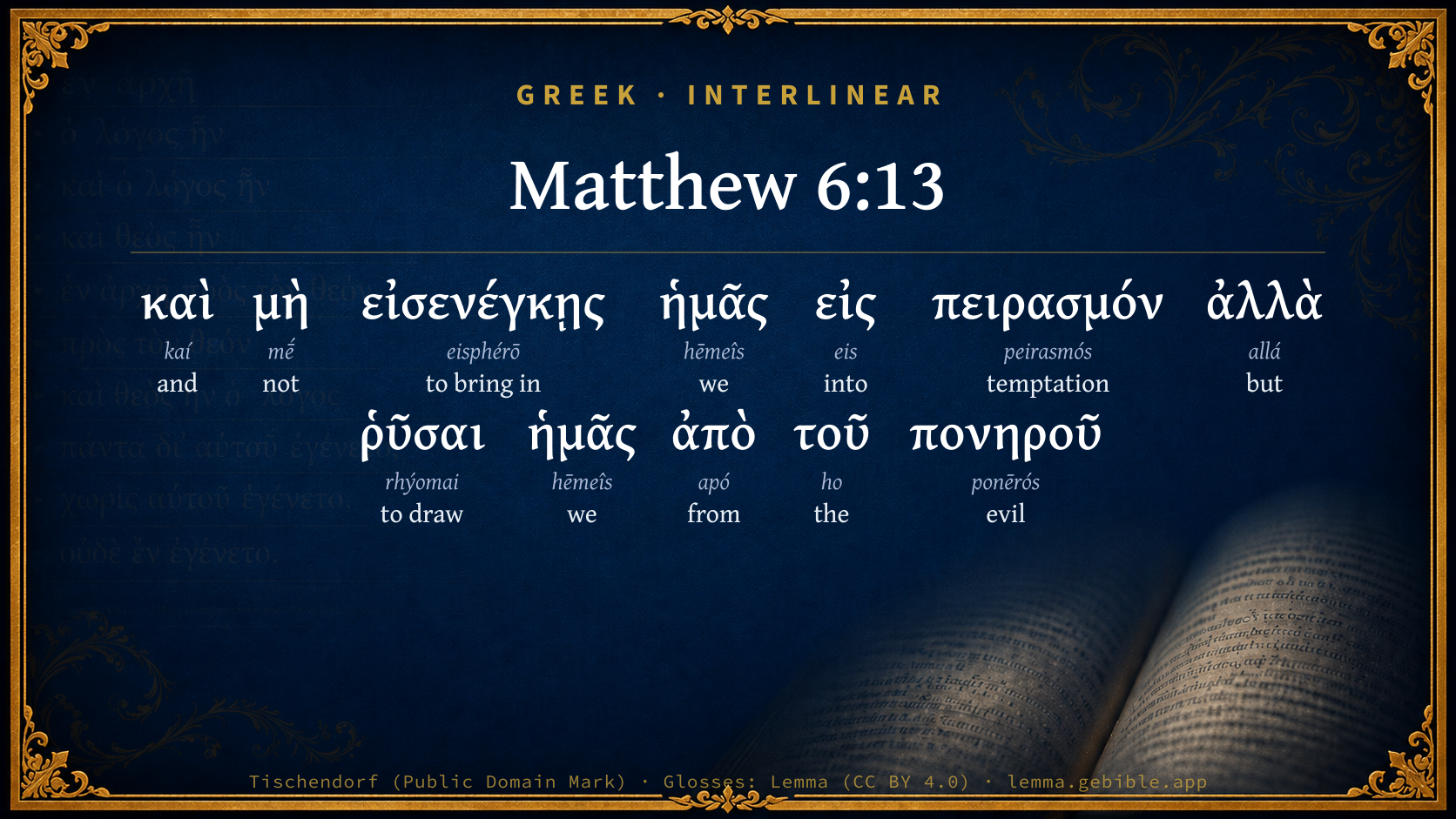
Download image
Cite this verse

Matthew 6:13 (World English Bible). Public Domain. Lemma interlinear Bible study tool, https://lemma.gebible.app/v/matthew/6/13.

Show BibTeX & RIS
BibTeX
RIS
English Translation
Bring us not into temptation, but deliver us from the evil one. For yours is the Kingdom, the power, and the glory forever. Amen.'
World English Bible · Public Domain
Highlights
  • 3 first appearances in the Greek New Testament
Full analysis ↓
Download a study sheet

One document with this verse’s original text, its word-by-word gloss line, the meaning frame, cross-references with their text, attributed commentary, and full source and license credits — printable, and it pastes into notes with its structure intact.

This verse Autodidact and up

Study sheet (.html) Plain text (.txt)

A passage Seminary Student

Up to 50 verses in one chapter. A passage sheet keeps up to 6 commentary sources and 12 cross-references per verse, in the order this page ranks them, and says so on the sheet whenever that leaves anything out. Ask for a single verse and you get the Autodidact verse sheet above.

Everything on this page stays free to read, with no account — the sheet is a download of what is already on screen, not access to it.

Want to remove ads? Support Godless Engineer
Compare translations 3

The same verse in 3 English versions, stacked beneath the original-language interlinear above. Click any original word for its lexicon entry.

Each is an independent rendering of the whole verse — the interlinear is not word-aligned to these translations.

Highlighted words mark where these versions differ — a whole-verse word diff, not a word-by-word alignment.

  • World English Bible Public Domain
    Bring us not into temptation, but deliver us from the evil one. For yours is the Kingdom, the power, and the glory forever. Amen.'
  • King James Version Public Domain
    And lead us not into temptation, but deliver us from evil: For thine is the kingdom, and the power, and the glory, for ever. Amen.
  • unfoldingWord Literal Text CC BY-SA 4.0
    and do not bring us into temptation, but deliver us from the evil one.’

unfoldingWord Literal Text — © unfoldingWord, licensed CC BY-SA 4.0. Word-aligned USFM3 via Door43 (git.door43.org/unfoldingWord/en_ult).

Versions to compare (up to 4)

3 of 4 selected

Show all 19 translations

Every available English version of this verse, each an independent rendering of the whole verse.

  • World English Bible Public Domain
    Bring us not into temptation, but deliver us from the evil one. For yours is the Kingdom, the power, and the glory forever. Amen.'
  • Berean Standard Bible Public Domain
    And lead us not into temptation, but deliver us from the evil one.’
  • Majority Standard Bible Public Domain
    And lead us not into temptation, but deliver us from the evil one. For Yours is the kingdom and the power and the glory forever. Amen.’
  • King James Version Public Domain
    And lead us not into temptation, but deliver us from evil: For thine is the kingdom, and the power, and the glory, for ever. Amen.
  • American Standard Version (1901) Public Domain
    And bring us not into temptation, but deliver us from the evil `one.'
  • Revised Version (1885) Public Domain
    And bring us not into temptation, but deliver us from the evil one.
  • Geneva Bible (1599) Public Domain
    And leade vs not into tentation, but deliuer vs from euill: for thine is the kingdome, and the power, and the glorie for euer. Amen.
  • Douay-Rheims (1899) Public Domain
    And lead us not into temptation. But deliver us from evil. Amen.
  • Young's Literal Translation Public Domain
    `And mayest Thou not lead us to temptation, but deliver us from the evil, because Thine is the reign, and the power, and the glory -- to the ages. Amen.
  • Literal Standard Version CC BY-SA 4.0
    And may You not lead us into temptation, but deliver us from the evil [one], because Yours is the kingdom, and the power, and the glory—for all ages. Amen.
  • Unlocked Literal Bible CC BY-SA 4.0
    Do not bring us into temptation, but deliver us from the evil one.'
  • unfoldingWord Literal Text CC BY-SA 4.0
    and do not bring us into temptation, but deliver us from the evil one.’
  • Darby Bible Public Domain
    and lead us not into temptation, but save us from evil.
  • World Messianic Bible Public Domain
    Bring us not into temptation, but deliver us from the evil one. For yours is the Kingdom, the power, and the glory forever. Amen.’
  • Webster's Bible Public Domain
    And lead us not into temptation, but deliver us from evil. For thine is the kingdom, and the power, and the glory, for ever. Amen.
  • Free Bible Version CC BY-SA 4.0
    Please don't let us give in to temptation, and save us from the evil one.
  • Bible in Basic English Public Domain
    And let us not be put to the test, but keep us safe from the Evil One.
  • Text-Critical English NT CC BY 4.0
    And lead us not into temptation, but deliver us from evil. For yoʋrs is the kingdom and the power and the glory forever. Amen.
  • Tyndale New Testament (1534) Public Domain
    And leade vs not into temptacion: but delyver vs from evell. For thyne is the kyngedome and the power and the glorye for ever. Amen.

Literal Standard Version (2020), Covenant Press — licensed CC BY-SA 4.0. Text via the HelloAO Bible API (eBible.org). Unlocked Literal Bible (unfoldingWord) — licensed CC BY-SA 4.0. Text via the HelloAO Bible API (eBible.org). unfoldingWord Literal Text — © unfoldingWord, licensed CC BY-SA 4.0. Word-aligned USFM3 via Door43 (git.door43.org/unfoldingWord/en_ult). Free Bible Version, Dr. Jonathan Gallagher — licensed CC BY-SA 4.0. Text via the HelloAO Bible API (eBible.org).

Word by word

More ways to search: Search by grammar → Find every occurrence → Compare this word →

Practice this passage: Drill this verse → Learn its vocabulary →

About this verse

These counts appear in no published source. They are computed here, from the morphology-tagged text and Lemma’s own curated glosses. What Lemma adds →

12
words
11
distinct lemmas
Gospels
section

Notable vocabulary

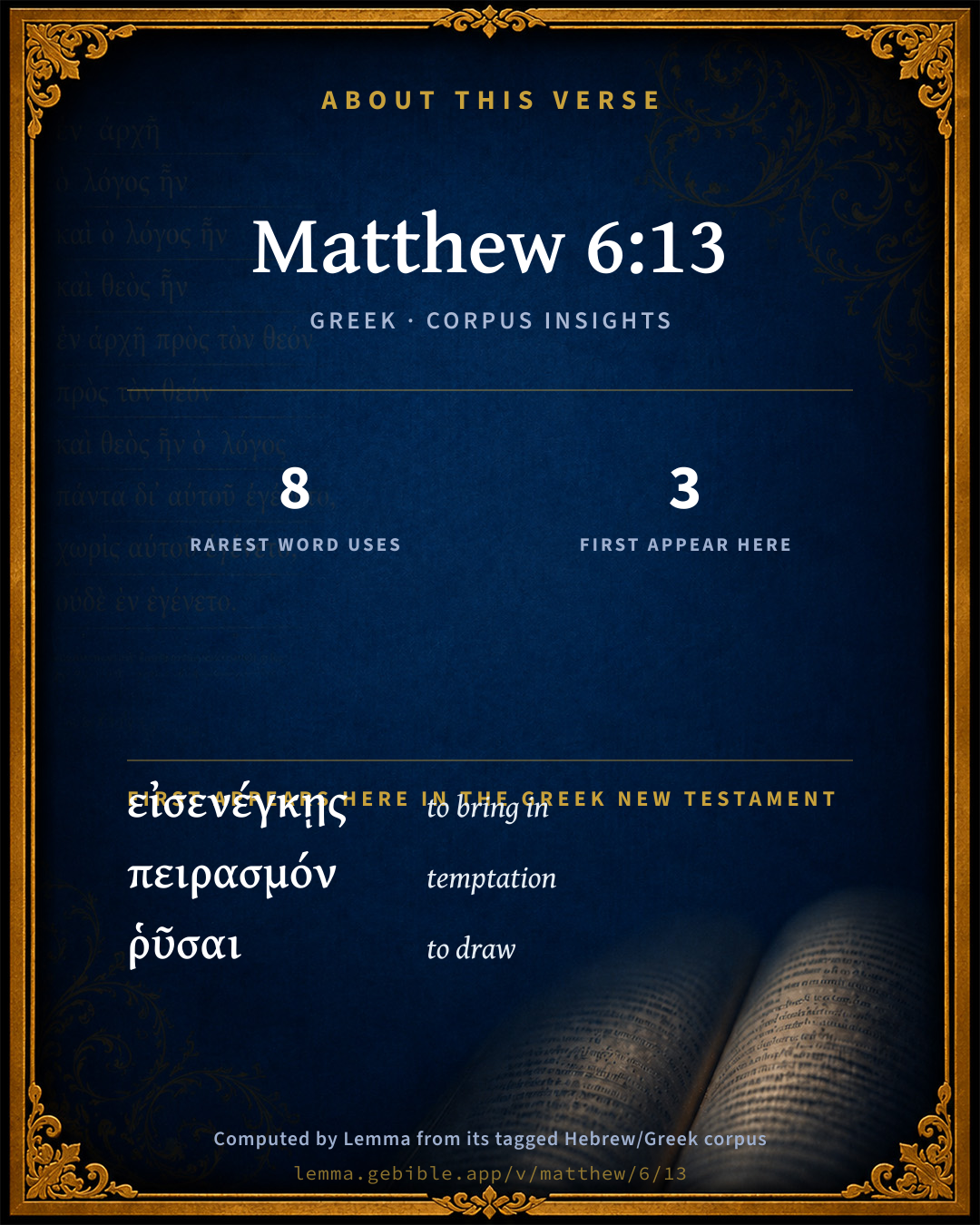
The rarest word here is εἰσενέγκῃς to bring in G1533 — appearing just 8 times in the whole Greek New Testament.

First appearance in Scripture

These words make their first canonical appearance in the Greek New Testament here:

  • εἰσενέγκῃς to bring in G1533
  • πειρασμόν temptation G3986
  • ῥῦσαι to draw G4506

Shared distinctive vocabulary

εἰσενέγκῃς to bring in G1533 occurs in 8 verses of the Greek New Testament. Also found in:

Repetition

A word recurs within this verse:

  • ἡμᾶς we G2249 ×2

Cross-references

56

Topical passages linked to Matthew 6:13 in the Treasury of Scripture Knowledge — connected by theme and wording, ordered by reader-vote popularity; previews shown in the World English Bible.

  • 1 Corinthians 10:13 No temptation has taken you except what is common to man. God is faithful, who will not allow you to be tempted above what you are able, but will with the temptation also make the way of escape, that you may be able to endure it.
  • Matthew 26:41 Watch and pray, that you don't enter into temptation. The spirit indeed is willing, but the flesh is weak."
  • John 17:15 I pray not that you would take them from the world, but that you would keep them from the evil one.
  • Revelation 7:14–17 I told him, "My lord, you know." He said to me, "These are those who came out of the great tribulation. They washed their robes, and made them white in the Lamb's blood.
  • 2 Thessalonians 3:3 But the Lord is faithful, who will establish you, and guard you from the evil one.
  • Matthew 6:10 Let your Kingdom come. Let your will be done, as in heaven, so on earth.
  • Revelation 19:1 After these things I heard something like a loud voice of a great multitude in heaven, saying, "Hallelujah! Salvation, power, and glory belong to our God:
  • Jeremiah 15:21 I will deliver you out of the hand of the wicked, and I will redeem you out of the hand of the terrible.
  • 2 Peter 2:9 the Lord knows how to deliver the godly out of temptation and to keep the unrighteous under punishment for the day of judgment;
  • 1 John 5:18–19 We know that whoever is born of God doesn't sin, but he who was born of God keeps himself, and the evil one doesn't touch him.
  • 1 Chronicles 29:11 Yours, Yahweh, is the greatness, the power, the glory, the victory, and the majesty: for all that is in the heavens and in the earth is yours. Yours is the kingdom, Yahweh, and you are exalted as head above all.
  • Psalms 47:7 For God is the King of all the earth. Sing praises with understanding.
  • Psalms 10:16 Yahweh is King forever and ever! The nations will perish out of his land.
  • 1 Thessalonians 1:10 and to wait for his Son from heaven, whom he raised from the dead-- Jesus, who delivers us from the wrath to come.
  • Exodus 15:18 Yahweh shall reign forever and ever."
  • 2 Timothy 4:17–18 But the Lord stood by me, and strengthened me, that through me the message might be fully proclaimed, and that all the Gentiles might hear; and I was delivered out of the mouth of the lion.
  • 1 John 3:8 He who sins is of the devil, for the devil has been sinning from the beginning. To this end the Son of God was revealed, that he might destroy the works of the devil.
  • Revelation 3:10 Because you kept my command to endure, I also will keep you from the hour of testing, which is to come on the whole world, to test those who dwell on the earth.
  • Revelation 21:4 He will wipe away from them every tear from their eyes. Death will be no more; neither will there be mourning, nor crying, nor pain, any more. The first things have passed away."
  • Genesis 22:1 It happened after these things, that God tested Abraham, and said to him, "Abraham!" He said, "Here I am."
  • Deuteronomy 8:16 who fed you in the wilderness with manna, which your fathers didn't know; that he might humble you, and that he might prove you, to do you good at your latter end:
  • 1 Chronicles 4:10 Jabez called on the God of Israel, saying, Oh that you would bless me indeed, and enlarge my border, and that your hand might be with me, and that you would keep me from evil, that it not be to my sorrow! God granted him that which he requested.
  • 1 Chronicles 16:36 Blessed be Yahweh, the God of Israel, From everlasting even to everlasting. All the people said, Amen, and praised Yahweh.
  • Psalms 41:13 Blessed be Yahweh, the God of Israel, From everlasting and to everlasting! Amen and amen.
  • Psalms 47:2 For Yahweh Most High is awesome. He is a great King over all the earth.
  • 1 Peter 5:8 Be sober and self-controlled. Be watchful. Your adversary the devil, walks around like a roaring lion, seeking whom he may devour.
  • Numbers 5:22 and this water that brings a curse will go into your bowels, and make your body swell, and your thigh fall away.' The woman shall say, 'Amen, Amen.'
  • Psalms 121:7–8 Yahweh will keep you from all evil. He will keep your soul.
  • Daniel 4:25 that you shall be driven from men, and your dwelling shall be with the animals of the field, and you shall be made to eat grass as oxen, and shall be wet with the dew of the sky, and seven times shall pass over you; until you know that the Most High rules in the kingdom of men, and gives it to whoever he will.
  • Luke 22:31–46 The Lord said, "Simon, Simon, behold, Satan asked to have you, that he might sift you as wheat,
  • 2 Corinthians 1:20 For however many are the promises of God, in him is the "Yes." Therefore also through him is the "Amen," to the glory of God through us.
  • 2 Corinthians 12:7–9 By reason of the exceeding greatness of the revelations, that I should not be exalted excessively, there was given to me a thorn in the flesh, a messenger of Satan to buffet me, that I should not be exalted excessively.
  • Galatians 1:4 who gave himself for our sins, that he might deliver us out of this present evil age, according to the will of our God and Father--
  • Psalms 72:19 Blessed be his glorious name forever! Let the whole earth be filled with his glory! Amen and amen.
  • Proverbs 30:8 Remove far from me falsehood and lies. Give me neither poverty nor riches. Feed me with the food that is needful for me;
  • Matthew 5:37 But let your 'Yes' be 'Yes' and your 'No' be 'no.' Whatever is more than these is of the evil one.
  • 1 Timothy 1:17 Now to the King eternal, immortal, invisible, to God who alone is wise, be honor and glory forever and ever. Amen.
  • Revelation 1:18 and the Living one. I was dead, and behold, I am alive forevermore. Amen. I have the keys of Death and of Hades.
  • Revelation 2:10 Don't be afraid of the things which you are about to suffer. Behold, the devil is about to throw some of you into prison, that you may be tested; and you will have oppression for ten days. Be faithful to death, and I will give you the crown of life.
  • Deuteronomy 8:2 You shall remember all the way which Yahweh your God has led you these forty years in the wilderness, that he might humble you, to prove you, to know what was in your heart, whether you would keep his commandments, or not.
  • Deuteronomy 27:15–26 Cursed be the man who makes an engraved or molten image, an abomination to Yahweh, the work of the hands of the craftsman, and sets it up in secret. All the people shall answer and say, Amen.
  • 1 Kings 1:36 Benaiah the son of Jehoiada answered the king, and said, Amen: Yahweh, the God of my lord the king, say so [too].
  • Psalms 89:52 Blessed be Yahweh forevermore. Amen, and Amen.
  • Psalms 106:48 Blessed be Yahweh, the God of Israel, From everlasting even to everlasting! Let all the people say, "Amen." Praise Yah!
  • Psalms 145:10–13 All your works will give thanks to you, Yahweh. Your saints will extol you.
  • Daniel 4:34–35 At the end of the days I, Nebuchadnezzar, lifted up my eyes to heaven, and my understanding returned to me, and I blessed the Most High, and I praised and honored him who lives forever; for his dominion is an everlasting dominion, and his kingdom from generation to generation.
  • Daniel 7:18 But the saints of the Most High shall receive the kingdom, and possess the kingdom forever, even forever and ever.
  • Matthew 28:20 teaching them to observe all things that I commanded you. Behold, I am with you always, even to the end of the age." Amen.
  • 1 Corinthians 14:16 Otherwise if you bless with the spirit, how will he who fills the place of the unlearned say the "Amen" at your giving of thanks, seeing he doesn't know what you say?
  • Revelation 3:14 "To the angel of the assembly in Laodicea write: "The Amen, the Faithful and True Witness, the Head of God's creation, says these things:
  • Revelation 5:13 I heard every created thing which is in heaven, on the earth, under the earth, on the sea, and everything in them, saying, "To him who sits on the throne, and to the Lamb be the blessing, the honor, the glory, and the dominion, forever and ever! Amen!"
  • 1 Timothy 6:15–17 which in its own times he will show, who is the blessed and only Ruler, the King of kings, and Lord of lords;
  • Hebrews 2:14–15 Since then the children have shared in flesh and blood, he also himself in like manner partook of the same, that through death he might bring to nothing him who had the power of death, that is, the devil,
  • Hebrews 11:36 Others were tried by mocking and scourging, yes, moreover by bonds and imprisonment.
  • Revelation 19:4 The twenty-four elders and the four living creatures fell down and worshiped God who sits on the throne, saying, "Amen! Hallelujah!"
  • Jeremiah 28:6 even the prophet Jeremiah said, Amen: Yahweh do so; Yahweh perform your words which you have prophesied, to bring again the vessels of Yahweh's house, and all them of the captivity, from Babylon to this place.

Cross-references courtesy of OpenBible.info (CC BY 4.0).

Where the printed editions differ

1 variant

Places in this verse where the major printed Greek editions disagree on the wording in a way that affects the translation — a comparison of editions, not a manuscript-by-manuscript collation. The editions are the modern critical texts (Nestlé-Aland 28/27, SBL, Westcott-Hort, Tregelles, Tyndale House) and the traditional texts behind the KJV (the Textus Receptus and the Byzantine/Majority text). It is not a claim about which reading is original.

  1. Extra text
    ὅτι σοῦ ἐστιν ἡ βασιλεία καὶ ἡ δύναμις καὶ ἡ δόξα εἰς τοῦς αἰῶνας ἀμήν.

    “Since of you is the kingdom and the power and the glory into the ages Amen.”

    In TRByz Not in NA28NA27TynSBLWHTreg

    ὅτι σοῦ ἐστιν ἡ βασιλεία καὶ ἡ δύναμις καὶ ἡ δόξα εἰς τοῦς αἰῶνας ἀμήν. (hoti sou estin hē basileia kai hē dunamis kai hē doxa eis tous aiōnas amēn) 'Since of you is the kingdom and the power and the glory into the ages Amen.' is only in traditional manuscripts (TR+Byz)

Textual data: Translators Amalgamated Greek New Testament (STEPBible TAGNT) · CC BY 4.0.

Commentary

Notes on Matthew 6:13 from classic Christian and Jewish commentators (each source and its license shown beneath its notes). The classic Christian expositions comment on the surrounding passage and are grouped to its opening verse, so a note may address several verses; the Jewish commentaries on the Tanakh (Rashi and others) are per-verse, so they appear only where the commentator wrote on this verse.

Lemma curates 59 commentaries, every one of them public domain or Creative Commons licensed, each selected and text-cleaned for this edition rather than reprinted as found. About our sources →

The Biblical Illustrator

Joseph S. Exell

Mat_6:13

And lead us not into temptation.

I. God permits us to be tempted for his own glory, to discover the freeness and riches of His grace, that men may be driven the more earnestly to sue out their place in the name of Jesus Christ. We keep off from the throne of grace till temptations drive us thither. As when the sheep wander, the shepherd lets loose his dog upon them, not to worry them, but to bring them back again to the fold: so God lets loose Satan to drive us to Himself.

II. For the trial of that grace which he hath wrought in us. Grace doth appear better in temptation than out of it. A great tempest discovereth the goodness of a ship and skill of the pilot; so these great trials discover the soundness of our hearts and the fruit of that grace which God hath wrought in us. Gold is most tried in the fire, and discovered to be pure and perfect. Stars that lie hidden in the day shine in the night. The valour and worth of a soldier is not known in times of peace, but when he is out in action. When we are put to some difficulty and straits, then is faith seen.

III. To humble us. That we may never be proud of what we have, nor conceited of what we have not. Spiritual evils need a spiritual cure. Outward afflictions humble, but not so much as temptations do.

IV. To conform us to Christ. We must pledge Him in His own cup; it must go round; He Himself was tempted.

V. To mortify sin. When men have smarted they grow more cautious.

VI. To make us more meek to others. We are very apt to be severe upon the failings of others. But now, when we are tempted ourselves, we learn more pity to them.

VII. To give us experience of the care and providence of God, and the comforts of His promises. A man doth not know what the comforts of faith mean till he be exercised by temptation. (Thomas Manton, D. D.)

Temptation

1. This prayer recognizes temptation as part of the discipline of life.

2. It traces temptation to the source whence it originates.

3. It intimates that temptation generally results in sin.

4. It expresses on our part a shrinking from temptation through a sense of weakness.

5. It is a joyful acknowledgment of Gods power and strength to rescue us. (F. Edwards, B. A.)

The temptations of those who are unhappy

I. Those temptations that are related to God himself.

1. Persons who are unhappy often murmur against the government of God.

2. To withhold prayer before Him.

II. Those temptations respecting mankind.

1. They are tempted to hate their race.

2. A determination to change their position.

3. A temptation to destroy their enemies.

III. The temptation that comes upon the unhappy themselves.

1. To obtain unlawful information respecting their destiny.

2. To secure an oblivion of their wretchedness.

3. To seek to obtain relief by suicide. (J. Blackburn.)

I. If God, provoked thereto by our careless-hess, doth justly bring us into, or doth let us enter into temptation, we shall infallibly run into many grievous sins and mischief.

II. We continually need Gods instruction to guide us, Gods hand to uphold us, Gods care to guard us.

(1) When our condition and circumstances minister dangerous occasions of sin;

(2) When the world would frown or smile us into it; or

(3) Satan thrust us toward it;

(4) Then, in such cases and seasons, Gods interposal is necessary to remove those temptations, or to support and defend us from the prevalence of them. (Isaac Barrow, D. D.)

Lead us not into temptation

I. In praying thus, we desire not to be absolutely freed from that reluctance of flesh against the spirit, but from those additional trials that surprise, forgetfulness, or public affairs may bring upon us more at one time than another.

II. The petition is not the effect of sloth, but a wise provision for our safety, and we thereby only desire to be discharged from such trials as make our perseverance not only difficult, but doubtful.

III. We, in this petition, desire God to excite our own care and watchfulness. Humility, caution, and charity are the several lessons which we are taught in the right use of this prayer. (Thomas Mangey.)

The sixth petition

I. This is an appeal to our leader.

1. It implies that our Father is our Leader.

2. We make this appeal to our Father with a sense of His nearness.

II. This petition comes from the fear that when, in answer to the last petition, our sins are forgiven, we shall be tempted to sin again.

III. We thus pray because we know that our path abounds with instruments and occasions of temptation.

1. In business.

2. By the habits of society.

3. We may be led into temptation by retiring from the world.

4. We may be so led even when we feel most secure from it by communion with God.

IV. It implies a sense of our own temptableness.

V. That we have no will to go into temptation unless it be the will of God to lead us into it. (Dr. Stanford.)

The sixth petition

I. What is meant by temptation? The primary idea is test, or trial for discovery. The test may be applied with various motives-by friend or foe.

1. Inducement to sin.

2. Afflictions or trials are temptations in the sense of being tests of faith.

3. Temptation for the distinct purpose of testing (Gen_22:1).

II. What is meant by asking God not to lead us into temptation.

III. Consolation for the tempted.

1. Temptation is not sin.

2. Temptation is not peculiar to the individual.

3. Christ Himself was tempted.

4. The prayer is presented to our Father.

IV. Practical lessons:

1. We should not go into temptation.

2. We must resist temptation in the way Christ Himself has appointed.

3. We should specially guard weak places in our defence.

4. Turn stumbling-blocks into stepping-stones.

5. We should not bring others into temptation. (Newman Hall, LL. B.)

Believers tempted, yet safe

1. The universality of temptation.

2. We are concerned about the safety of others as well as our own.

3. When you notice the sins and failings of your fellow-Christians, remember they were tempted.

4. The special temptations of the believer.

5. The most gifted, perhaps the most tempted.

6. The safety of the believer.

7. Jesus protects us by His loving sympathy, faithful intercession, and by the gift of the Holy Spirit. (Dr. Saphir.)

Lead us not into temptation

I. Gods people are exposed to much temptation. In the old dispensation they were a tempted people. It is exemplified in the varied experiences of the saints. The world is a great temptation. The outward plague of sin: Satan. There are peculiar seasons of temptation: Abraham.

II. What is to be understood by this petition. It does not imply exemption from temptation. The Lord likes to know the reality of the grace of His people. Leads them to watchfulness. God does not entice men to sin. A wise prayer. A holy prayer. (J. H. Evans.)

The watchful spirit of the Lords prayer

I. The present scene of the christian one of temptation.

1. There are temptations that arise from the power of Satan.

2. From the world.

3. From within the Christian.

II. The petition.

1. The entire exemption of the believer from temptation would be exemption from some of the greatest blessings of his life.

2. We are not to infer that God can solicit men to evil.

3. The prayer is that God would, by His providence, keep His child out of the way of temptation.

4. That God would either weaken the power or remove entirely all existing temptation.

5. It is a petition that God would not withdraw His restraining check from the believer.

6. It asks to be preserved from the great tempter.

III. Practical conclusions:

1. While praying not to be led into temptation, we should be watchful against voluntarily running into it

2. The unselfishness of the petition-us.

3. It is offered in the name of the Tempted One. (Dr. O. Winslow.)

The sixth petition

Pardon for past is followed by implored grace for the future.

I. Temptation generally, as belonging of necessity to the condition of moral agents. The word temptation suggests moral experiment for good or evil. It has come to mean invitation to sin. Exposure to illusory suggestions is only what the analogy of natural government would lead us to expect. In our ordinary worldly interests what attractiveness appears to hang about a wrong course of conduct, whilst difficulty seems ever to dissuade us from what is right. We find that men are free to stand or fall.

II. In what sense God can be said to lead us into temptation,

1. When God brings us providentially into the neighbourhood of hurtful influences.

2. When He allows temptations to come upon us with all their unmitigated force without restraining influences. God never leads us into temptation to make us fall.

III. How much of the leading into temptation is due to ourselves.

1. The blame is our own when we without cause expose ourselves to any moral hazzard.

2. When we allow ourselves to be carried away by sinful conformity to the world.

3. When we do not habitually restrain those tendencies and appetites, without which any temptation would be powerless.

IV. The beneficial ends for which our temptations may be permitted.

1. In order to the trial of our religious sincerity.

2. In order that God may get honour to Himself by our successful resistance.

3. The mercifulness of those permitted trials, in that our very failures may conduce to our greater spiritual humility. We should never separate the prayer for deliverance from the pledge to keep ourselves. (D. Moore, M. A.)

Lead us not into temptation

No man should go into the future with God till he has a clear past. When the soul has tasted forgiveness, it has the fear of sinning again. Shall a man recovered from a malignant fever, go and breathe infection? Temptation is the precincts of sin. Admire the anticipatory character of Gods care for us. Preventatives of temptation. Prevention may be effected in three ways. The occasion may not be presented. Every sinful inclination may be taken away and overruled, or the power of Satan to deal with one or the other may be abridged or withdrawn. Temptation depends mainly upon the bias of the natural character. (J. Vaughan, M. A.)

The Divine guidance in the midst of dangers

A guide on the mountains leads the Alpine climber where dangers exist. The summit cannot otherwise be reached. In avoiding or conquering the danger, the travellers skill, courage, and endurance are both tested and improved. His health and manhood, as well as his enjoyment, are secured by his being thus led where dangers abound. But the leader knows what path is practicable, what perils should be shunned, and is ever ready to lend a helping hand. Thus our Heavenly Guide leads us by His Providence even when we are beset by snares. (Newman Hall, LL. D.)

Men should avoid circumstances favourable to the development of evil tendencies

It would be a great misfortune to a man with weak lungs to call him to live in a cold, bleak air. So would it be to a man with weak eyes, to fix him in a situation which required much study by candle.light. Now it is to the full as dangerous for the soul of the ambitious man to be put into the road which leads to high stations, as it can be for the lungs of the consumptive man to give him a house on a bleak hill. (Newman Hall, LL. D.)

Men must not unnecessarily expose themselves to temptation

It is said that at the battle of Waterloo, a wealthy merchant of Brussels, who had been allowed access to headquarters, asked Wellington whether he was not exposing his person to great danger, as shot and shell were falling around. The general replied, You have no business here, but I am performing my duty. So let us never go into spiritual danger from idle curiosity, but only when duty calls: then, and then alone, may we expect to be safe. (Newman Hall, LL. D.)

There are certain temptations which our natural constitution and temperament should lead us to avoid

There is in old Arabic fable the story of a great rock that was a great magnet, drawing ships, so that they were dashed into splinters on it. If I have been magnetized by a certain sin, I would not be led near the loadstone that might draw me into destruction by its malignant potency. If I carry in me the gunpowder of some slumbering badness, I would not be led where sparks are flying. If I am Little Faith bearing precious jewels, I would not be led through Dead Mans Lane, where robbers lurk. If I am short-sighted, I would not be led into the land of pits. If I am timid and fear the power of the dog, I would not be led near his chain, but far as may be beyond the reach of his spring. (Dr. Stanford.)

In the moment of defeat temptation may gather new force

But sin seems to be strongest when it has had its death blow. The eagle, when down, strikes at you with a beak like a bolt of iron, and may flap you dead with its wing. The red deer, when down, may fell you with its antlers. The dying horse may, in the plunge of its agony, break a mans limb. A harpooned whale may dash a boat over. Sin is like that. Speared through by its conqueror, it may grasp us in its last convulsions, and seem to be stronger dying than living; but we shall soon spring out from it, and cry, Deliverance! (Dr. Stanford.)

Lead us not into temptation

1. There is no evil in temptation unless complied with.

2. Temptation is a necessary element in a life of probation, such as our life on earth is.

3. It is a useful discipline to brace our energies and increase our strength.

4. If successfully overcome they confirm our graces and become helps in the way to heaven.

God may be said to lead us into temptation-

1. By the dispensations of His providence.

2. By giving Satan permission to tempt us.

3. When He leaves us to ourselves.

Lessons:

1. To know and acknowledge our own weakness.

2. Temptation not a thing to be courted, but feared.

3. Cannot be avoided by the saintliest.

4. Are under Gods control.

5. We must pray against temptations, especially such aa we feel we are most likely to fall under.

6. To prayer we must add watchfulness.

7. We must avoid the seducing opportunities of evil.

8. How many lead themselves into temptation.

9. We must be content to deny ourselves some things that are lawful if we would not be lead to the commission of what is unlawful,

10. We mast be jealous about the approaches of temptation.

11. We must beware of little temptations.

12. We must listen to the slightest whispers of conscience.

13. We must remember the devil varies his temptations to suit the changing circumstances of our life.

14. The consciousness of our own individual danger must not make us insensible to the need of our brethren.

Us We are not fighting alone. (F. C. Blyth, M. A.)

Keep far from danger

He who has no mind to trade with the devil should be so wise as to keep away from his shop. (South.)

If you would not be drowned, what do you so near the waterside. (Baxter.)

Let us not tempt the devil to tempt us

The lion may cross our path, or leap upon us from the thicket, but we have nothing to do with hunting him. (C. H. Surgeon.)

Temptation

1. The source, of temptation may be divided into three: those within ourselves, those that surround us, those from the spirit-world.

2. This petition does not mean that we should ask God to give us an easy time.

3. Temptations are just as liable to come to men from things that are good as from things that are bad. What is nobler than industry well applied-property-regulated anger? These are full of temptations to avarice, etc. The Divine conception of life is that it is a conflict.

4. Modes of resisting temptation. Many of them are to be forestalled. We are to watch against weak hours. A safeguard against temptation is the strengthening of the natural antagonisms of the passions; over against cruelty lies benevolence, etc. (Beecher.)

Deliver us from evil.

Deliver us from evil

I. That is, if we be led into temptation, let us be kept from the evil of it. It is a more wonderful providence to be kept from the evil, than from temptation. If a garrison be never assaulted it is no wonder that it standeth exempt from the calamity of war.

II. The evil of sin is greater than the evil of temptation.

1. Because it separateth us from God. Poverty, sickness, blindness, loss of goods-let a man be never so low, yet, if in a state of grace, the Lord taketh pleasure in him.

2. Because it depriveth us of God, who is the fountain of our comfort.

3. It reproveth our folly. We complain of other things, but do not complain of sin, which is the greatest evil. The evil of affliction is but for a moment; like rain, it drieth up of its own accord; but the evil of sin is for ever, unless it be pardoned and taken away. Sin is the cause of all the evils of affliction; therefore, when we complain, we should complain not so much of the smart, as of the cause of it. (Thomas Manton, D. D.)

Deliver us from evil

1. This prayer looks upon evil as something separate from ourselves.

2. It regards our personal deliverance from evil as our great need.

3. It leaves with God the decision as to what is evil.

4. It leaves with God both the mode and time of the desired deliverance.

5. It recognizes our dependence on God for this desired deliverance. (F. Edwards, B. A.)

Deliver us from evil

I. That is principally from sin, or evil,

(1) moral and spiritual; or evil,

(2) penal and afflictive. From all

(3) mischief, from the

(4) root of all evil.

II. We absolutely request of God that He, in His mercy, would also deliver and free us from

(1) remorse of conscience,

(2) anguish of spirit for having violated His laws, and neglect of duty; from

(3) blindness of mind,

(4) hardness of heart,

(5) want of love, reverence, devotion toward God; of

(6) charity and good-will toward our neighbour.

III. We are hereby taught not to be studiously punctual and particular in oar prayers, as if God needed our information, or were apt to neglect the particulars concerning our good. (Isaac Barrow, D. D.)

Our supplication for deliverance

1. This petition is supported by the authority of human experience and history. We are led into situations of trial.

2. It is the natural language of the human heart. It is the utterance of fear.

3. It is the prayer of wise self-distrust.

4. It must always be a prayer springing from our trust in God.

5. The prayer now beet)rues an aspiration, a prophecy. It gathers up all the great hopes and faiths of the gospel. (W. Hubbard.)

This prayer implies-

I. That we are living in a world in which is the presence of evil.

II. That those who use it are under a sense of being in bondage to evil.

III. Nothing less than the omnipotent arm of God can deliver us from this evil.

IV. That nothing can be satisfying to the Christian but the entire expulsion of evil from the world.

V. Let our petition be presented in fervent faith of an answer. (W. Dodsworth.)

The devotional spirit of the Lords prayer

Deliverance from evil. This the cry of humanity.

1. From the evil of sin.

2. From the evil of the world.

3. From evil men.

4. From the Evil One.

5. A daily prayer: what evil one day may expose us to. (Dr. O. Winslow.)

The seventh petition

I. The agency of satan.

1. The existence of orders of beings superior to the human race is antecedently probable; as those below us, so some above. Scripture confirms this.

2. What are the limits of this agency, and how are the personal attributes requisite for its success to be reconciled with our notions of a finite being? Satan has some form of access to the heart, he has insight into our ruling mental tendencies.

II. The means used by Satan for the carrying on of his designs.

1. Our enemy is personal.

2. He avails himself of outward accidents to stir up motions to evil.

3. When he cannot find, he seeks to make, occasions of sin.

4. He turns our permitted enjoyments into evil; our friendship, our religious feelings.

III. The provisions made for our deliverance from this adversary,

1. The restraints constantly put upon the tempter in the exercise of his own power.

2. A gracious Father has provided many forms of unseen and unknown deliverance.

3. God more generally delivers His children from the adversary by enabling them to deliver themselves. We must resist

(1) at first

(2) earnestly. (D. Moore, M. A.)

The last petition

It stands last because all previous petitions are summed up in it.

I. Evil is around and within us.

II. Evil has a central unity-the evil.

III. Who delivers. God delivers in Christ.

IV. The promise involved in the petition. In the resurrection delivered from evil. (Dr. Saphir.)

But deliver us from evil

It surrounds the purest, clings to the holiest, shadows the brightest, embitters the happiest.

1. The true suppliant will try to see evil from the point of view from which God sees it.

2. There is no good which has not in its constitution some evil, so there is no evil that is not mingled with some good.

3. An enlightened man will leave the time and way of deliverance to God.

4. Gods plan is by ransom; He delivered Christ to evil that He might deliver you from it.

5. The believers liberty, sanctity, and rest. (J. Vaughan, M. A.)

The seventh petition

I. The evil one.

II. The evil caused by yielding to the evil one-the result of sin.

III. The evil in ourselves. (Newman Hall, LL. B.)

The seventh petition

I. Identify the evil.

1. Not the world.

2. Not affliction.

3. Not death.

4. But sin.

II. Notes on the petition.

1. In offering this petition we have to keep in mind the whole connection-connect it with the prayer for forgiveness, with the prayer against temptation.

2. We offer this prayer in that Jesus is the medium of deliverance.

3. This prayer fits the lips of Christians in a time when old sins seem to recover new power.

4. Our thoughts rush forward to the day when this prayer for deliverance from evil will have its finished and perfect answer. (Dr. Stanford.)

Evil may be productive of good

Like the merchant who lost his all in a storm, and was thus driven to learn philosophy at Athens, many who have been deprived of earthly comforts, have learned that Wisdom is better than Wealth. (F. C. Blyth, M. A.)

The universal prayer-cry

1. The evidence of all all-pervading and ever-present evil is irresistible.

2. If we cry for deliverance it is because we have a lingering recollection of a promise that there will be a Deliverer.

3. But Gods children intelligently offer this prayer to the Divine Father; they feel that He is not the Author of evil.

4. As brethren we pray this petition: the successive generations have used it.

5. Estimate the price paid for deliverance; not silver and gold. (Dr. Cumming.)

Afflictions not necessarily evil

Only as you call a flail evil that separates the grain from the chaff; a wheel evil that grinds jewels to shine ins crown; a knife evil that prunes a tree; a tree evil that bears good fruit; a plough evil whose coulter crashes through the hard soil, opens it to the chemistry of nature, and makes it a soft, porous, receptive seed-plot for the harvest; the medicine evil that brings back the colour of health to the white face, and the flash of gladness to the dim eye; the hand evil that snatches back a heedless child from the nest of the serpent, or the lip of the river, just in time to save its life-only in this qualified sense can you call an affliction an evil. Out of our greatest sorrows grow our greatest joys. (Dr. Stanford.)

Suitable that this should be the last petition in the pra

yer:-

1. If this be granted all other blessings are comprehended in it.

2. It will grant us the gift of perseverance.

3. It presupposes all that has gone before. (F. C. Blyth, M. A.)

For Thine is the kingdom.-

Thine is the kingdom, the power, and the glory

I. The kingdom.

1. Gods kingdom is universal over all men or things, over all persons in the world.

2. It is special. Which notes His relation to the saints. It is the duty of a king to defend his subjects and provide for their welfare.

II. The power. Titles without power make authority ridiculous. We can ask nothing but what God is able to give-yea, above our asking.

III. The glory. The honour and glory of all will redound to God, the comfort accrueth to us.

IV. The duration. For ever. All excellencies which are in God, are eternally in God. (Thomas Manton, D. D.)

Thine is the kingdom

That is:

I. Thou hast a perpetual and unmoveable authority whereby justly to dispose of all things; an indefectible and irresistible power, whereby Thou canst effect whatever seems just and good to Thee.

II. Therefore we profess only to rely upon, and seek help from, Thee; with hope and confidence we address ourselves to Thee for the supply of our needs.

III. Thine is the glory; all honour and reverence, all love and thankfulness, are due unto Thee, therefore we render our adorations and acknowledgments to Thee. (Isaac Barrow, D. D.)

I. The kingdom-Thine.

1. By eternal right.

2. By assuaging wrath.

3. By infinite purchase.

II. Thine is the power.

1. Upon the intellectual world.

2. Upon the political world.

3. Upon the ecclesiastical world.

4. Upon the invisible world.

III. Thine is the glory. (T. Mortimer, M. A.)

The doxology

1.Our confidence in the acceptableness of our prayers is derived from God and not from ourselves.

2. That the power by which our desires are brought about is Divine, and not human.

3. That our certainty of success is based upon our faith in God.

4. That our confidence in our prayers ought not to waver.

5. That our prayers ought always to be confirmed and ratified by ourselves. (F. Edwards, B. A.)

I. What is here ascribed to God. The kingdom. The glory.

II. The advantages arising from this ascription of praise. We shall feel that we have presented to God the strongest arguments to ensure an answer to our prayers. We should be encouraged to expect great things in answer to our prayers. We shall feel how eternal and unchangeable is the basis upon which our expectation rests. We shall feel calm and hopeful after prayer, whatever the circumstances in which we are placed, or our views of the world around us, (W. O. Lilley.)

The ordering spirit of the Lords prayer

There is the kingdom:-

1. Of nature.

2. Providence.

3. Grace.

4. Glory. (Dr. O. Winslow.)

The doxology

I. The offering of praise as a necessary part of religious worship.

1. Praise is the most disinterested form of religious worship.

2. It is a divinely appointed type of devotion because of its inspiring and elevating influence upon the mind of the worshipper himself.

3. Praise comes nearest to the worship of heaven.

II. Those characteristics of His holy nature and ground for which we are here taught to show forth His praise.

1. We ascribe to the object of our adoration boundless and universal sovereignty.

2. We are instructed to make grateful mention of His omnipotence.

3. His glory.

4. But our doxology rises in the majesty of its ascriptions-dominion, power, glory-for ever. (D. Moore, M. A.)

The doxology

I. A sevenfold view of praise.

1. Prayer ends in praise. Our God who sees the end from the beginning, sees praise in every petition.

2. Praise is the language of the soul in communion with God.

3. It is the culminating point of prayer.

4. The doxology is an argument.

5. Praise is faith and more than faith, it is an anticipation of heaven.

6. The great bond of union is praise.

7. Praise is Gods gift.

II. The threefold ascription of praise.

1. There is the kingdom.

2. The power.

3. The glory.

III. The kingdom, power, and glory, as belonging to the triune God.

IV. For ever. (Dr. Saphir.)

The doxology

I. The doxology a confession of faith.

II. An argument in prayer.

III. An ascription of praise. (Newman Hall, LL. B.)

For Thine is the kingdom

I. Doxology.

1. All prayer should gather itself up and crown itself in praise.

2. Praise should not be for gifts and graces, but for what God is in Himself.

`II. An argumentative doxology. For thine, etc. It establishes a plea for every petition.

III. The virtue and sufficiency of prayer lie in a threefold recognition of God.

1. His kingdom-perfect, sovereign, regal.

2. True prayer never stops to ask how.

3. It fixes itself on the glory of God. (T. Vaughan, M. A.)

Amen

1. It is a word of veritable history in Israel and in the Church.

2. It announces Gods truth and faithfulness.

3. It is the name of Christ.

4. It is the seal of prayer.

5. It is the voice of faith.

6. It is the answer of a good conscience.

7. It is a renewal of our dedication to God. (Dr. Saphir.)

The Amen of Christ

1. Christ is the amen of the Fathers love.

2. Christ is the amen of the Fathers holiness.

3. Christ is the amen of the Fathers sovereignty.

4. Christ is the amen of the Fathers will.

5. Christ is the amen of the Fathers bestowment.

6. Christ is the amen of the Fathers forgiveness.

7. Christ is the amen of the Fathers guidance.

8. Christ is the amen of the Fathers deliverance.

9. Christ is the amen of the Fathers eternal kingdom and power and glory. (R. W. Percival, M. A.)

The Biblical Illustrator, edited by Joseph S. Exell (c. 1880s–1900s) — public domain. Text from a community e-Sword module.

Joseph Benson's Commentary

Mat 6:13. And lead us not into temptation — Or, into trial, as the word πειρασμος, here used, signifies: see note on Mat 4:1: that is, into such trial or temptation, as will be too hard for our weakness to endure. But deliver us from evil — Απο του πονερου, from the evil one, viz., the devil; enabling us to resist and overcome him in all his assaults, of whatever kind they may be. Or, perhaps, the clause may be translated, Lead us not into temptation, but so as to deliver us from the evil, viz., either by removing the temptation, when it is too strong for us to withstand; or by mitigating its force, or by increasing our strength to resist it, as God shall see most for his glory. This correction of the translation, suggested by Macknight, is proposed on this ground; that to pray for an absolute freedom from temptation is to seek deliverance from the common lot of humanity, which is absurd; because temptations are wisely appointed by God for the exercise and improvement of piety and virtue in good men, and that others may be encouraged by the constancy and patience which they show in trials. Hence, instead of praying to be absolutely delivered from them, we are taught to rejoice when, by the divine appointment, we fall into them. See Jas 1:2-3. This petition teaches us to preserve a sense of our own inability to repel and overcome temptation, and of the necessity of assistance from above, to enable us to stand in the evil day. For thine is the kingdom, &c., for ever — The government of the universe is thine for ever, and thou alone possessest the power of creating and upholding all things; also the glory of infinite perfections remains eternally with thee, therefore all men ought to hallow thy name, submit themselves to thy government, and perform thy will; also, in an humble sense of their dependance, should seek from thee the supply of their wants, the pardon of their sins, and the kind protection of thy providence.

After the preceding exposition of the different clauses of this divine prayer, the reader will not be displeased to see a summary of the whole, in the following concise, clear, and instructive paraphrase, taken from the short notes of Mr. Wesley.

I. Our Father — Who art good and gracious to all, our Creator, our Preserver: the Father of our Lord, and of us in him, thy children by adoption and grace: not my Father only, who now cry unto thee, but the Father of the universe, of angels and men: who art in heaven — Beholding all things, both in heaven and earth; knowing every creature, and all the works of every creature, and every possible event from everlasting to everlasting: the Almighty Lord and Ruler of all, superintending and disposing all things: In heaven — Eminently there, but not there alone, seeing thou fillest heaven and earth.

II. 1st, Hallowed be thy name — Mayest thou, O Father, be truly known by all intelligent beings, and with affections suitable to that knowledge: mayest thou be duly honoured, loved, feared, by all in heaven and in earth, by all angels and all men. 2d, Thy kingdom come — May thy kingdom of grace come quickly, and swallow up all the kingdoms of the earth: may all mankind, receiving thee, O Christ, for their king, truly believing in thy name, be filled with righteousness, and peace, and joy; with holiness and happiness; till they are removed hence into thy kingdom of glory, to reign with thee for ever and ever. 3d, Thy will be done on earth as it is in heaven — May all the inhabitants of the earth do thy will as willingly as the holy angels: may these do it continually even as they, without any interruption of their willing service; yea, and perfectly as they; mayest thou, O Spirit of grace, through the blood of the everlasting covenant, make them perfect in every good work to do thy will, and work in them all that is well pleasing in thy sight. 4th, Give us — O Father, (for we claim nothing of right, but only of thy free mercy,) this day — (for we take no thought for the morrow,) our daily bread — All things needful for our souls and bodies; not only the meat that perisheth, but the sacramental bread, and thy grace, the food which endureth to everlasting life. 5th, And forgive us our debts as we also forgive our debtors — Give us, O Lord, redemption in thy blood, even the forgiveness of sins: as thou enablest us freely and fully to forgive every man, so do thou forgive all our trespasses. 6th, And lead us not into temptation, but deliver us from evil — Whenever we are tempted, O thou that helpest our infirmities, suffer us not to enter into temptation; to be overcome or suffer loss thereby; but make a way for us to escape, so that we may be more than conquerors through thy love, over sin and all the consequences of it. Now the principal desire of a Christian’s heart being the glory of God, (Mat 6:9-10,) and all he wants for himself or his brethren, being the daily bread of soul and body, (or the support of life, animal and spiritual,) pardon of sin, and deliverance from the power of it and of the devil; (Mat 6:11-13;) there is nothing besides that a Christian can wish for; therefore this prayer comprehends all his desires. Eternal life is the certain consequence, or rather completion, of holiness.

III. For thine is the kingdom — The sovereign right of all things that are or ever were created: the power — The executive power, whereby thou governest all things in thy everlasting kingdom: and the glory — The praise due from every creature for thy power, and all thy wondrous works, and the mightiness of thy kingdom, which endureth through all ages, even for ever and ever. It is observable, that, though the doxology, as well as the petitions of this prayer, is threefold, and is directed to the Father, Son, and Holy Ghost distinctly, yet is the whole fully applicable both to every person, and to the ever-blessed and undivided Trinity.

Joseph Benson's Commentary on the Old and New Testaments (1811–1818) — public domain. Text from a community e-Sword module.

Tyndale Open Study Notes

Tyndale Open Resources

6:13 And don’t let us yield to temptation: Just as Jesus was tested (4:1-11), temptation will test the disciple’s character. Jesus urges prayer for God’s enabling to stand the test (see 26:41; Ps 141:4). • from the evil one: Or from evil. The alternate reading refers to sin in general; the NLT reading refers to Satan, the tempter (see Jas 1:13). • The doxology appended to some manuscripts was added later (probably based on 1 Chr 29:11-13) to tailor the prayer to the liturgy.

Tyndale Open Study Notes — © Tyndale Open Resources, licensed CC BY-SA 4.0. Text via the HelloAO Bible API.

Bengel's Gnomon

Johann Albrecht Bengel

Mat 6:13. Μὴ εἰσενέγκης ἡμᾶς, Lead us not into) Temptation is always in the way: wherefore we pray, not that it may not exist, but that it may not touch or overpower us.—See ch. Mat 26:41; 1Co 10:13.—ἀλλὰ, but) The sixth and seventh petitions are so closely connected that they are considered by many as forming only one.—ρῦσαι, deliver) See 2Ti 4:18.—ἀπὸ τοῦ πονηροῦ, from the evil one) i.e., from Satan.—See ch. Mat 13:19; Mat 13:38.

Ὅτι σοῦ ἐστιν ἡ βασιλεία καί ἡ δύναμις καὶ ἡ δόξα εἰς τοὺς αἰῶνας· Ἀμήν, For thine is the kingdom, and the power, and the glory, for ever and ever. Amen) This is the scope of the Lord’s Prayer, that we may be taught to pray in few words (Mat 6:8), for the things which we require; and the prayer itself, even without the doxology, involves the praise of God in all its fulness (summam laudis Divinae imbibit). For our Heavenly Father is sanctified and glorified by us, when He is invoked as our Heavenly Father, when things of such magnitude are asked of Him alone, when to Him alone all things are referred. We celebrate Him, however, in such a manner as should content those who are fighting the fight of their salvation in a foreign land. When the whole number of the sons of God shall have reached their goal, a simple (mera) doxology will arise in Heaven, Hallowed be the name of our God. His kingdom has come: His will has been done. He has forgiven us our sins: He has brought temptation to an end: He has delivered us from the evil one. His is the kingdom, and the power, and the glory, for ever and ever. Amen. A prayer was more suitable than a hymn, especially at the time in which our Lord prescribed this form to His disciples. Jesus was not yet glorified: the disciples as yet scarcely comprehended the full extent of these petitions, much less the amount of thanksgiving corresponding thereto. In fine, no one denies that the spirit of the whole clause is pious and holy, and conformable to the doxologies which frequently occur in Scripture: but the question is whether the Lord prescribed it in this place in these words. Faithful criticism regards little, in doubtful passages, what may happen to be the reading of the majority of Greek MSS. now extant, which are more modern and less numerous than is generally supposed: the question under consideration is rather, what was the reading of the Greek MSS. of the first ages, and therefore of the spring itself, i.e. the first hand.[264] The Latin Vulgate, which is certainly without this clause, stands, and will continue to stand, nearest in antiquity to the spring: but the force of its testimony is not appreciated till after long experience. In this passage, however, Greek witnesses, few indeed, but those of high authority, support the reading of the Vulgate. I wish what I have said on this subject in my Apparatus[265] to be carefully considered.[266] Nothing has occurred since I published that work to weaken the arguments which I there brought together on this point, whereas something has occurred to confirm them very greatly: I allude to a passage in Enthymius, who flourished at the beginning of the twelfth century. For when inveighing the against the Bogomili[267] for not using this clause, he does so only on the ground that it was an addition of the Fathers, calling it τὸ παρὰ τῶν θείων φωστήρων καὶ τῆς ἐκκλησίας καθηγητῶν προστεθὲν ἀκροτελεύτιον ἐπιφώνημα, The choral conclusion added by those who were the divine illuminators and guides of the Church. La Croze,[268] relying on this testimony, clearly prefers in this passage the Latin to the Syriac version; see his Histoire du Christianisme des Indes, p. 313. One thing ought to be considered again and again: the more that any one diminishes the authority of the Vulgate on this passage, so much the more does he injure his own cause if he maintains the genuineness of that most important passage in 1Jn 5:7: for it at present rests solely on the single testimony of the Latin Interpreter, and rests upon it firmly.

[264] BDZabc Vulg. Memph. Omen, Cypr. (who adds “Amen”) omit the doxology. Orig. Nyssen, Cyril, Maximus all omit it in giving expressly an explanation of the prayer. So all the Latin Fathers. It rather too widely separates Mat 6:12; Mat 6:14, which are connected together. Moreover Jesus was not yet glorified when He gave the prayer: it therefore was hardly then appropriate. It was probably added after the kingdom had been founded by the Holy Ghost on Pentecost. Ambrose de Sacram. Mat 6:5 implies that the doxology was recited by the priest alone, as a response (ἐπιφώνημα) after the people had repeated the Lord’s prayer. Alford, from 2Ti 4:18 where similarly ῥύσεται ἀπὸ πονηροῦ is followed by the doxology, argues that some such way of ending the prayer existed at that time.—ED.

[265] He has devoted more than eight pages to the subject: See App. Crit. pp. 101–109.—(I. B.)

[266] E. B. and those who have adopted his text, add here “especially § x. on this passage.” It runs thus:—

[267] The BOGOMILES were a sect of heretics which arose about the year 1079. Their founder was Basilius, a monk, who was burnt at Constantinople in the reign of Alexius Conmenus. He maintained that the world and all animal bodies were formed, not by the Deity, but by an evil demon who had been cast down from heaven by the Supreme Being. Hence that the body was only the prison of the soul, and was to be enervated by fasting, contemplation, etc., that the soul might be gradually restored to its primitive liberty. Marriage therefore was to be avoided. Basilius also denied the reality of Christ’s body, which he considered to be only a phantom, rejected the law of Moses, and maintained that the body on its separation by death returned to the malignant mass of matter, without possibility of a future resurrection to life and felicity.—See Mosheim.—(I. B.)

[268] MATHURIN VEYSSIERE DE LA CROZE, a distinguished Oriental scholar, born at Nantes in 1661. In the course of his life he abjured Romanism, and died at Berlin in 1739.—(I. B.)

De tota re, lector judicet.

Prætermisit clausulam Lutherus, in Agendis Baptismi, eisque renovatis; in Tract. de Decalogo, symbolo Apost. et oratione Dominica; in Catechismo utroque, et Hymno: ubi etiam Amen cum Hieronymo ad rogationes refert non ad clausulam, quanquam in Homil. ad. capp. v. vi. vii. Matth. eam tractat. Appendicem eam esse persuadent nobis rationes § ix. collectae; quanquam margo noster in suspenso rem reliquit, dum rationes fuissent expositæ: et plane pro appendice babet Brentius; Hunnius vel pro appendice vel pro epilogo, cujus moderationem recte sequentur, qui nil certi secum hic possunt constituere. Liberum saltem est privatim vel Matthæi receptam, vel Lucæ lectionem in orando sequi: quin etiam publice, in choro cænobiorum Wirtembergieorum, et alibi hodienum prætermitti solita est clausula. Cavendum vero, ne idiotæ intempestivis de hâc clausulâ sermonibus perturbentur. Hâc quoque in re et veritati et paci inserviendum est. “Sincera crisis,” etc., as in the Gnomon Ed. MDCCLIX, which is followed in this translation.—(I. B.)

Bengel's Gnomon of the New Testament — English translation (T&T Clark, Edinburgh, 1860) — public domain. Text from a community e-Sword module.

Meyer's Critical & Exegetical Commentary

Heinrich August Wilhelm Meyer

Mat_6:13. After the petition for forgiveness of sin, comes now the request to be preserved from new sin, negatively and positively, so that both elements constitute but one petition. Luke makes no mention whatever of the ἀλλὰ ῥῦσαι, etc.

μὴ εἰσενέγκῃς, κ.τ.λ.] Neither the idea of mere permission (μὴ παραχωρήσῃς εἰσενεχθῆναι, Euth. Zigabenus, Tertullian, Melanchthon), nor the emphatic meanings which have been given, first to the εἰσενέγκῃς (μὴ καταποθῆναι ὑπὸ τοῦ πειρασμοῦ, Theophylact), then to the πειρασμός (Jerome, in Ezekiel 48 : in tentationem, quam ferre non possumus), and lastly, to the εἰς (Grotius: penitus introducere, ut ei succumbas), are in keeping with the simple terms employed; such interpretations are rationalistic in their character, as is also, once more, the case with Kamphausens limitation to temptations with an evil result. God leads into temptation in so far as, in the course of His administration, He brings about a state of things that may lead to temptation, i.e. the situations and circumstances that furnish an occasion for sinning; and therefore, if a man happens to encounter such dangers to his soul, it is caused by Godit is He who does it (1Co_10:13). In this way is solved, at the same time, the apparent contradiction with Jam_1:13, where it is a question of subjective inward temptation, the active principle of which is, not God, but the mans own lusts.[424] In these latter are also to be found, in the case of the believer, and that in consequence of his σάρξ (Mat_26:41; Gal_5:17), the great moral danger which renders this prayer a matter of necessity.

ἀλλὰ ῥῦσαι ἡμᾶς ἀπὸ τοῦ πονηροῦ] Rom_15:31; 1Th_1:10; 2Th_3:2; 2Ti_4:18. But ΤΟῦ ΠΟΝΗΡΟῦ may be neuter (Augustine, Luther,see, however, Catech. maj. p. 532 f.,

Tholuck, Ewald, Lange, Bleek, Kamphausen) as well as masculine (Tertullian, Origen, Chrysostom, Theophylact, Erasmus, Beza, Maldonatus, Kuinoel, Fritzsche, Olshausen, Ebrard, Keim, Hilgenfeld, Hanne). In the former case, it would not mean evil in general (omne id, quod felicitati nostrae adversum est, Olearius), but, according to the New Testament use of πονηρός, as well as the context, moral wickedness, Rom_12:9. However, it is more in keeping with the concrete graphic manner of view of the New Testament (Mat_5:37, Mat_13:19; Joh_17:15; 1Jn_2:13; 1Jn_3:8; 1Jn_3:12; Rom_16:20; Eph_6:16; 2Th_3:3), to prefer the masculine as meaning the devil (κατʼ ἐξοχὴν δὲ οὕτως ἐκεῖνος καλεῖται, Chrysostom), whose seductive influence, even over believers, is presupposed in the seventh petition, which also supplicates divine deliverance from this danger, by which they know themselves to be threatened (ἀπό: away, from; not ἐκ, as in Rom_7:24; 2Co_1:10; Col_1:13; 2Ti_3:11; 2Ti_4:17; 2Pe_2:9). Hofmann, Schriftbeweis, I. p. 447; Krummacher in the Stud. u. Krit. 1860, p. 122 ff. For an opposite view of a by no means convincing kind, see Kamphausen, p. 136 ff.

[424] Comp. Köster, bibl. Lehre v. d. Versuch, p. 19 f.

REMARKS.

The Lords Prayer, as it stands in Matthew, is an example of a prayer rich and true in respect of its contents, and expressed in language at once brief and comprehensive; see on Mat_6:9. It is only in an indirect way that it presents itself in the light of a summary of the principal matters for which one is to pray (Nösselt, Exercitatt. sacr. p. 2 ff., Kuinoel, de Wette), inasmuch as Jesus, as matter of course, selected and connected with each other such leading requests as were appropriate to the solemn period when the establishment of His kingdom was at hand, that, by setting before us a prayer of so comprehensive a character, He might render the model thus supplied all the more instructive. Tertullian, indeed, correctly describes the contents of it as breviarium totius evangelii. According to Möller (neue Ansichten, p. 34 ff.) and Augusti (Denkwürdigk. IV. p. 132), the prayer before us is made up merely of the opening words of well-known Jewish prayers, which Jesus is supposed to have selected from the mass of Jewish forms of devotion as being eminently adapted for the use of His disciples. Wetstein already was of opinion that it was ex formulis Hebraeorum concinnata. But between the whole of the parallels (Light-foot, Schoettgen, Wetstein), not even excepting those taken from the synagogal prayer Kaddisch, there is only a partial correspondence, especially in the case of the first and second petitions; but lively echoes of familiar prayers would so naturally suggest themselves to our Lord, and any reason for rejecting them was so entirely wanting, that the absence of such popularly consecrated echoes, extending to the very words, would even have been matter for surprise.

Augustine divides the contents into seven petitions; and in this he is followed by the Lutheran practice, as also by Tholuck, Bleek, Hilgenfeld. On the other hand, Origen and Chrysostom correctly make six, in which they are followed by the practice of the Reformed church in the catechisms of Geneva and of the Palatinate, as also by Calvin, Keim. As to the division of the prayer in respect of form, it is sufficient to observe, with Bengel: Petita sunt septem, quae universa dividuntur in duas partes. Prior continet tria priora, Patrem spectantia: tuum, tuum, tua; posterior quatuor reliqua, nos spectantia. According to Calvin, the fourth petition is the beginning of quasi secunda tabula of the prayer. In regard to the matter, the twofold division into coelestia and terrena, which has been in vogue since Tertullians time, is substantially correct; and in the more detailed representation of which there followsafter the upward flight towards what is of highest and holiest interest for believers, and the specific nature of which, with the aim for which it longs, and its moral condition, floats before the praying spirita humble frame of spirit, produced by the consciousness of mans need of Gods favour, first in the temporal and then in the moral sphere, in which the realization of that with which the prayer begins can be brought about only through forgiveness, divine guidance, and deliverance from the power of the devil. The division into vows and petitions (Hanne) is inaccurate; see on Mat_6:9.

Meyer — Critical and Exegetical Commentary on the New Testament — English translation by Peter Christie, edited by Frederick Crombie (T&T Clark, 1880) — public domain. Text from a community e-Sword module.

Expositor's Greek Testament

ed. W. Robertson Nicoll

Mat 6:13 . Sixth petition : consists of two members, one qualifying or limiting the other. μὴ … πειρασμόν , expose us not to moral trial. All trial is of doubtful issue, and may therefore naturally and innocently be shrunk from, even by those who know that the result may be good, confirmation in faith and virtue. The prayer is certainly in a different key from the Beatitude in Mat 5:10 . There Jesus sets before the disciple a heroic temper as the ideal. But here He does not assume the disciple to have attained. The Lord’s Prayer is not merely for heroes, but for the timid, the inexperienced. The teacher is considerate, and allows time for reaching the heights of heroism on which St. James stood when he wrote (Mat 1:2 ) πᾶσαν χαρὰν ἡγήσασθε , ἀδελφοί μου , ὅταν πειρασμοῖς περιπέσητε ποικίλοις . ἀλλὰ , not purely adversative, cancelling previous clause, but confirming it and going further (Schanz, in accordance with original meaning of ἀλλὰ , derived from ἄλλο or ἄλλα , and signifying that what is going to be said is another thing, aliud , in relation to what has been said, Klotz, Devar. ii., p. 2) = Lead us not into temptation, or so lead us that we may be safe from evil: may the issue ever be beneficent. ῥῦσαι ἀπὸ , not ἐκ ; the latter would imply actual implication in, the former implies danger merely. Both occur in N. T. (on the difference cf. Kamphausen, Das G. des H.). τοῦ πονηροῦ , either masculine or neuter, which? Here again there is an elaborate debate on a comparatively unimportant question. The probability is in favour of the masculine, the evil one. The Eastern naturally thought of evil in the concrete. But we as naturally think of it in the abstract; therefore the change from A. V [39] in R. V [40] is unfortunate. It mars the reality of the Lord’s Prayer on Western lips to say, deliver us from the evil one. Observe it is moral evil, not physical, that is deprecated. ὅτι σοῦ ἐστιν … Αμήν : a liturgical ending, no part of the original prayer, and tending to turn a religious reality into 2 devotional form.

[39] Authorised Version.

[40] Revised Version.

On Mat 6:14-15 vide under Mat 6:12 .

The Expositor's Greek Testament, edited by W. Robertson Nicoll (1897–1910) — public domain. Text from a community e-Sword module.

Geneva Bible (1599)

Geneva Bible translators

From the Devil, or from all adversity.

Geneva Bible (1599) marginal notes — public domain. Text via Bolls.life.

Jamieson, Fausset & Brown

Robert Jamieson, A. R. Fausset & David Brown

And lead us not into temptation--He who honestly seeks and has the assurance of, forgiveness for past sin, will strive to avoid committing it for the future. But conscious that "when we would do good evil is present with us," we are taught to offer this sixth petition, which comes naturally close upon the preceding, and flows, indeed, instinctively from it in the hearts of all earnest Christians. There is some difficulty in the form of the petition, as it is certain that God does bring His people--as He did Abraham, and Christ Himself--into circumstances both fitted and designed to try them, or test the strength of their faith. Some meet this by regarding the petition as simply an humble expression of self-distrust and instinctive shrinking from danger; but this seems too weak. Others take it as a prayer against yielding to temptation, and so equivalent to a prayer for support and deliverance when we are tempted; but this seems to go beyond the precise thing intended. We incline to take it as a prayer against being drawn or sucked, of our own will, into temptation, to which the word here used seems to lend some countenance--"Introduce us not." This view, while it does not put into our mouths a prayer against being tempted--which is more than the divine procedure would seem to warrant--does not, on the other hand, change the sense of the petition into one for support under temptation, which the words will hardly bear; but it gives us a subject for prayer, in regard to temptation, most definite, and of all others most needful. It was precisely this which Peter needed to ask, but did not ask, when--of his own accord, and in spite of difficulties--he pressed for entrance into the palace hall of the high priest, and where, once sucked into the scene and atmosphere of temptation, he fell so foully. And if so, does it not seem pretty clear that this was exactly what our Lord meant His disciples to pray against when He said in the garden--"Watch and pray, that ye enter not into temptation"? (Mat 26:41).

Seventh Petition:

But deliver us from evil--We can see no good reason for regarding this as but the second half of the sixth petition. With far better ground might the second and third petitions be regarded as one. The "but" connecting the two petitions is an insufficient reason for regarding them as one, though enough to show that the one thought naturally follows close upon the other. As the expression "from evil" may be equally well rendered "from the evil one," a number or superior critics think the devil is intended, especially from its following close upon the subject of "temptation." But the comprehensive character of these brief petitions, and the place which this one occupies, as that on which all our desires die away, seems to us against so contracted a view of it. Nor can there be a reasonable doubt that the apostle, in some of the last sentences which he penned before he was brought forth to suffer for his Lord, alludes to this very petition in the language of calm assurance--"And the Lord shall deliver me from every evil work (compare the Greek of the two passages), and will preserve me unto his heavenly kingdom" (Ti2 4:18). The final petition, then, is only rightly grasped when regarded as a prayer for deliverance from all evil of whatever kind--not only from sin, but from all its consequences--fully and finally. Fitly, then, are our prayers ended with this. For what can we desire which this does not carry with it?

For thine is the kingdom, and the power, and the glory, for ever. Amen--If any reliance is to be placed on external evidence, this doxology, we think, can hardly be considered part of the original text. It is wanting in all the most ancient manuscripts; it is wanting in the Old Latin version and in the Vulgate: the former mounting up to about the middle of the second century, and the latter being a revision of it in the fourth century by JEROME, a most reverential and conservative as well as able and impartial critic. As might be expected from this, it is passed by in silence by the earliest Latin fathers; but even the Greek commentators, when expounding this prayer, pass by the doxology. On the other hand, it is found in a majority of manuscripts, though not the oldest; it is found in all the Syriac versions, even the Peschito--dating probably as early as the second century--although this version lacks the "Amen," which the doxology, if genuine, could hardly have wanted; it is found in the Sahidic or Thebaic version made for the Christians of Upper Egypt, possibly as early as the Old Latin; and it is found in perhaps most of the later versions. On a review of the evidence, the strong probability, we think, is that it was no part of the original text.

Jamieson, Fausset & Brown — Commentary Critical and Explanatory on the Whole Bible (1871) — public domain (CC PDM 1.0). Text via the HelloAO Bible API.

Adam Clarke's Commentary

Verse 13. And lead us not into temptation] That is, bring us not in to sore trial. πειρασμον, which may be here rendered sore trial, comes from πειρω, to pierce through, as with a spear, or spit, used so by some of the best Greek writers. Several of the primitive fathers understood it something in this way; and have therefore added quam ferre non possimus, "which we cannot bear." The word not only implies violent assaults from Satan, but also sorely afflictive circumstances, none of which we have, as yet, grace or fortitude sufficient to bear. Bring us not in, or lead us not in. This is a mere Hebraism: God is said to do a thing which he only permits or suffers to be done.

The process of temptation is often as follows:

1st. A simple evil thought.

2ndly. A strong imagination, or impression made on the imagination, by the thing to which we are tempted.

3dly. Delight in viewing it.

4thly. Consent of the will to perform it. Thus lust is conceived, sin is finished, and death brought forth. Jas 1:15.

See also on Mt 4:1. A man may be tempted without entering into the temptation: entering into it implies giving way, closing in with, and embracing it.

But deliver us from evil] απο του πονηρου, from the wicked one. Satan is expressly called οπονηρος, the wicked one. Mt 13:19; Mt 13:38, compare with Mr 4:15; Lu 8:12. This epithet of Satan comes from πονος, labour, sorrow, misery, because of the drudgery which is found in the way of sin, the sorrow that accompanies the commission of it, and the misery which is entailed upon it, and in which it ends.

It is said in the MISHNA, Tit. Beracoth, that Rabbi Judah was wont to pray thus: "Let it be thy good pleasure to deliver us from impudent men, and from impudence: from an evil man and an evil chance; from an evil affection, an evil companion, and an evil neighbour: from Satan the destroyer, from a hard judgment, and a hard adversary." See Lightfoot.

Deliver us] ρυσαι ημας - a very expressive word-break our chains, and loose our bands-snatch, pluck us from the evil, and its calamitous issue.

For thine is the kingdom, c.] The whole of this doxology is rejected by Wetstein, Griesbach, and the most eminent critics. The authorities on which it is rejected may be seen in Griesbach and, Wetstein, particularly in the second edition of Griesbach's Testament, who is fully of opinion that it never made a part of the sacred text. It is variously written in several MSS., and omitted by most of the fathers, both Greek and Latin. As the doxology is at least very ancient, and was in use among the Jews, as well as all the other petitions of this excellent prayer, it should not, in my opinion, be left out of the text, merely because some MSS. have omitted it, and it has been variously written in others. See various forms of this doxology, taken from the ancient Jewish writers, in Lightfoot and Schoettgen.

By the kingdom, we may understand that mentioned Mt 6:10, and explained Mt 3:2.

By power, that energy by which the kingdom is governed and maintained.

By glory, the honour that shall redound to God in consequence of the maintenance of the kingdom of grace, in the salvation of men.

For ever and ever.] εις τους αιωνας, to the for evers. Well expressed by our common translation - ever in our ancient use of the word taking in the whole duration of time the second ever, the whole of eternity. May thy name have the glory both in this world, and in that which is to come! The original word αιων comes from αει always, and ων being, or existence. This is Aristotle's definition of it. See Clarke on Ge 21:33. There is no word in any language which more forcibly points out the grand characteristic of eternity-that which always exists. It is often used to signify a limited time, the end of which is not known; but this use of it is only an accommodated one; and it is the grammatical and proper sense of it which must be resorted to in any controversy concerning the word. We sometimes use the phrase for evermore: i.e. for ever and more, which signifies the whole of time, and the more or interminable duration beyond it. See Clarke on Mt 25:46.

Amen.] This word is Hebrew, אמן, and signifies faithful or true. Some suppose the word is formed from the initial letters of אדוני מלך נאם adoni melech neetnan, My Lord, the faithful King. The word itself implies a confident resting of the soul in God, with the fullest assurance that all these petitions shall be fulfilled to every one who prays according to the directions given before by our blessed Lord.

The very learned Mr. Gregory has shown that our Lord collected this prayer out of the Jewish Euchologies, and gives us the whole form as follows: -

"Our Father who art in heaven, be gracious unto us! O Lord our God, hallowed be thy name, and let the remembrance of Thee be glorified in heaven above, and in the earth here below! Let thy kingdom reign over us now, and for ever! The holy men of old said, remit and forgive unto all men whatsoever they have done against me! And lead us not into the hands of temptation, but deliver us from the evil thing! For thine is the kingdom, and thou shalt reign in glory for ever and for evermore." Gregory's Works, 4to. 1671, p. 162.

See this proved at large in the collections of Lightfoot and Schoettgenius,

Adam Clarke's Commentary on the Bible (1810–1826) — public domain. Text from a community e-Sword/MySword module.

Ellicott's Commentary for English Readers

(13) Lead us not into temptation.—The Greek word includes the two thoughts which are represented in English by “trials,” i.e., sufferings which test or try, and “temptations,” allurements on the side of pleasure which tend to lead us into evil. Of these the former is the dominant meaning in the language of the New Testament, and is that of which we must think here. (Comp. Mat_26:41.) We are taught not to think of the temptation in which lust meets opportunity as that into which God leads us (Jas_1:13-14); there is therefore something that shocks us in the thought of asking Him not to lead us into it. But trials of another kind, persecution, spiritual conflicts, agony of body or of spirit, these may come to us as a test or as a discipline. Should we shrink from these? An ideal stoicism, a perfected faith, would say, “No, let us accept them, and leave the issue in our Father’s hands.” But those who are conscious of their weakness cannot shake off the thought that they might fail in the conflict, and the cry of that conscious weakness is therefore, “Lead us not into such trials,” even as our Lord prayed, “If it be possible, let this cup pass away from me” (Mat_26:39). And the answer to the prayer may come either directly in actual exemption from the trial, or in “the way to escape” (1Co_10:13), or in strength to bear it. It is hardly possible to read the prayer without thinking of the recent experience of “temptation” through which our Lord had passed. The memory of that trial in all its terrible aspects was still present with Him, and in His tender love for His disciples He bade them pray that they might not be led into anything so awful.

Deliver us from evil.—The Greek may grammatically be either neuter or masculine, “evil” in the abstract, or the “evil one” as equivalent to the “devil.” The whole weight of the usage of New Testament language is in favour of the latter meaning. In our Lord’s own teaching we have the “evil one” in Mat_13:19; Mat_13:38; Joh_17:15 (probably); in St. Paul’s (Eph_6:16; 2Th_3:3), in St. John’s (1Jn_2:13-14; 1Jn_3:12; 1Jn_5:18-19) this is obviously the only possible interpretation. Rom_12:9, and possibly Joh_17:15, are the only instances of the other. Added to this, there is the thought just adverted to, which leads us to connect our Lord’s words with His own experience. The prayer against temptation would not have been complete without reference to the Tempter whose presence was felt in it. We may lawfully pray to be spared the trial. If it comes, there is yet room for the prayer, “Deliver us from the power of him who is our enemy and Thine.”

For thine is the kingdom. . . .—The whole clause is wanting in the best MSS. and in the earlier versions, and is left unnoticed by the early Fathers, who comment on the rest of the Prayer. Most recent editors have accordingly omitted it, as probably an addition made at first (after the pattern of most Jewish prayers) for the liturgical use of the Prayer, and then interpolated by transcribers to make the text of the discourse harmonise with the liturgies.

A Bible Commentary for English Readers, edited by Charles John Ellicott (1878–1897) — public domain. Text from a community e-Sword module.

The Cambridge Bible for Schools and Colleges

gen. ed. J. J. S. Perowne

13. lead us not into temptation] The statement of James, Jas_1:2, “Count it all joy when ye fall into divers temptations,” is not really contradictory. The Christian character is strengthened and purified by temptation, but no one can think of temptation without dread.

deliver] Lit. draw to thyself, “rescue,” as from an enemy. Cp. 1Th_1:10, “Jesus which delivered us from the wrath to come.”

from evil] Or, from the Evil One, Satan. The Greek bears either rendering, but the neuter is preferable and gives a deeper sense. We pray to be delivered not only from external evil, but from the evil within us.

For thine is the kingdom, &c.] This doxology is not supported by high MS. authority, it was doubtless an insertion from the liturgy. The Roman use omits the doxology. In the retention of it the English Church follows the Greek and Gallican uses.

The Cambridge Bible for Schools and Colleges (gen. ed. J. J. S. Perowne; Cambridge University Press, 1878–1918) — public domain. Text from a community e-Sword module.

John Gill's Exposition

And lead us not into temptation,.... Such a petition as this is often to be observed in the prayers of the Jews (a),

, "do not lead me" neither into sin, nor into transgression and iniquity, , "nor into temptation", or "into the hands of temptation";''

that is, into the power of it, so as to be overcome by it, and sink under it; in which sense the phrase is to be understood here. We are not here taught to pray against temptations at all, or in any sense, for they are sometimes needful and useful; but that they may not have the power over us, and destroy us. There are various sorts of temptations. There are the temptations of God; who may be said to tempt, not by infusing anything that is sinful, or by soliciting to it; but by enjoining things hard and disagreeable to nature, as in the case of Abraham; by afflicting, either in body or estate, of which Job is an instance; by permitting and letting loose the reins to Satan, and a man's own corruptions; by withdrawing his presence, and withholding the communications of his grace; and sometimes by suffering false prophets to arise among his people: his ends in them are on his own account, the display of his power; grace, wisdom, and faithfulness; on account of his Son, that his saints might be like him, and he might have an opportunity of exercising his power and pity: and on his people's account, that they might be humbled; their faith and patience tried; might see their weakness, and need of Christ, and be excited to prayer and watchfulness. There are also the temptations of Satan; which lie in soliciting to evil, suggesting hard and blasphemous thoughts of God, and filling with doubts and fears; which are cunningly formed by him, and are very afflictive. There are moreover the temptations of the world, which arise from poverty and riches, from the men of the world, the lusts of it, and from both its frowns and flatteries: add to all this, that there are temptations arising from a man's own heart. Now, in this petition, the children of God pray, that they may be kept from every occasion and object of sinning; from those sins they are most inclined to; that God would not leave them to Satan, and their own corrupt hearts; nor suffer them to sink under the weight of temptations of any sort; but that, in the issue, they might have a way to escape, and be victorious over all.

But deliver us from evil. This petition, with the Jews, is in this (b) form:

"er egpm ynlyutw, "but deliver me from an evil accident", and diseases; and do not trouble me with evil dreams, and evil imaginations.''

R. Juda, after his prayer, or at the close of it, as is this petition, used (c) to say;

"let it be thy good pleasure, 0 Lord our God, and the God of our fathers, "that thou wouldst deliver us" from impudent men, and impudence; from an "evil" man, and from an "evil" accident; from the "evil" imagination, i.e. the corruption of nature; from an "evil" companion; from an "evil" neighbour; and from Satan the destroyer; and from hard judgment; and from an hard adversary, whether he is the son of the covenant, or is not the son of the covenant.''

And most, if not all of these things, may be very well thought to be comprised in the word "evil" here: particularly Satan may be meant, by "evil", or "the evil one", as the word may be rendered; who is eminently, originally, and immutably evil; his whole work and employment is nothing else but evil: and to be delivered from him, is to be rescued out of his hands, preserved from his snares, and delivered from his temptations. Evil men may also be intended: all men are naturally evil, and unalterably so, without the grace of God; and some are notoriously wicked; from whose company, sinful lusts, and pleasures, to which they are addicted, as well as from their rage and persecution, good men cannot but desire deliverance; as also from the evil of afflictions, and especially from the evil of sin; as that they may be kept from the commission of it; have the guilt of it removed; be preserved from its power and dominion; and, at last, be freed from the very being of it.

For thine is the kingdom, and the power, and the glory, for ever, Amen. This conclusion is left out in the Arabic and Vulgate Latin versions, as it is in Luk 11:4. It stands thus in the Jewish prayers (d),

, "for the kingdom is thine", and thou shalt reign in glory for ever and ever.''

The usual response at the close of prayers, and reading the Shema, instead of "Amen", was (e) this:

"Blessed be the name of the glory of his kingdom, for ever and ever.''

Which bears some resemblance to this concluding expression, which ascribes everlasting kingdom, power, and glory, to God: which may be considered either as a doxology, or an ascription of glory to God, which is his due; and ought be given him in all our prayers to him; or as so many reasons strengthening our faith in prayer; or as many arguments with God, with respect to the petitions made; since the kingdom of nature, providence, grace, and glory, is his: he is omnipotent, he has power to give us our daily bread; to forgive our sins; to preserve from, support under, and deliver out of temptation; to keep from all evil, and preserve from a total and final falling away: whose glory is concerned in all, to whom the glory of all is, and to whom it must, and shall be given; and all this for ever: and the whole is concluded with the word "Amen"; which is a note of asseveration, of the truth herein contained; is added by way of assent to every petition made; is expressive of an hearty wish, and desire to have all fulfilled; and also of faith and confidence, that they will be answered. And this word being retained, and kept the same in all languages, signifies the unity of the spirit, and faith in prayer, in all the saints, in all ages. I leave this prayer with one observation, and that is, whereas it has been so long, and so often said, that this is the Lord's prayer, it can never be proved that he ever made use of it; and it is certain that he did not make it, as appears from what has been cited out of the Jewish records: the several petitions in it were in being and use before he directed to them; and not only the petitions, but even the very preface and conclusion, are manifestly of Jewish original: what our Lord did was, he took the most proper and pertinent petitions, that had been used by good men among that people; which, with some alterations much for the better, he put together in this order, and gave his approbation of; and that with this view, to point out to his disciples some of the best and most suitable petitions to be made; and to give them a pattern of brevity and conciseness in prayer; and teach them to pray after such a manner, or in some such like words and expressions. This I observe, not to lessen the usefulness of this excellent pattern of sound words; the whole, and every part of it, being exceedingly instructive, and worthy of imitation; but to rectify a vulgar mistake, and to abate the formal and superstitious observance of it.

(a) Seder Tephillot, fol. 3. 1. Ed. Basil. fol. 4. 2. Ed. Amstelod. Shaare Zion, fol. 73. 1. T. Bab. Beracot, fol. 60. 2. (b) T. Bab. Beracot, fol. 60. 2. (c) Ib. fol. 16. 2. (d) Seder Tephillot, fol. 280. 1. Ed. Basil. (e) Misn. Yoma, c. 4. sect. 1. & 6. 2. T. Bab. Pesachim, fol. 56. 1. & Taanith, fol. 16. 2. Seder Tephillot, fol. 70. 2. Ed. Basil.

John Gill's Exposition of the Whole Bible (1746–1763) — public domain (CC PDM 1.0). Text via the HelloAO Bible API.

Trapp's Complete Commentary

John Trapp

13 And lead us not into temptation, but deliver us from evil: For thine is the kingdom, and the power, and the glory, for ever. Amen.

Ver. 13. And lead us not into temptation] Here we beg sanctification, as in the former petition, justification; and are taught, after forgiveness of sins, to look for temptations, and to pray against them. Temptations are either of probation (and so God tempts men) or of perdition, and so the devil. Both Abraham’s great temptations began with one strain, לד-לד Get thee gone, Gen 12:1; Gen 22:2. Here God led Abraham into temptation, but he delivered him from evil; yea, he tempted him and proved him, to do him good in his latter end, Deu 8:6. His usual way is to bring us to heaven by hell’s gates, to draw light out of darkness, good out of evil. As the skilful apothecary maketh of a poisonful viper, a wholesome treacle; as the cunning artificer with a crooked unsightly tool frameth a straight and beautiful piece of work; as the Egyptian birds are said to pick wholesome food out of the serpent’s eggs; or as the Athenian magistrates by giving to malefactors hemlock (a poisonous herb) preserved the commonwealth. The devil tempts either by way of seducement, Jas 1:15, or grievance, 2Co 12:7. In the former he excites our concupiscence, rubs the firebrand, and makes it send forth many sparkles, carries us away by some pleasing object, as the fish by the bait. Yet hath he only a persuading sleight, not an enforcing might: our own concupiscence carrieth the greatest stroke. In the latter (those temptations of buffeting or grievance, horrid and hideous thoughts of atheism, idolatry, blasphemy, suicide, &c.) himself, for most part, is the sole doer, to trouble us in our Christian course, and make us run heavily toward heaven. The Russians are so malicious one towards another, that you shall have a man hide some of his own goods in his house whom he hateth, and then accuse him of the stealth of them. Such is the devil’s dealing often times with God’s dearest children. He darts into their hearts his detestable injections, and then would persuade them that they are accessory to the act. Here our victory is, not to give place to the devil, but to resist steadfast in the faith: which that we may, pray we always "with all prayer and supplication," Eph 6:18, pray as our Saviour did, "Father, keep them from the evil," or from wickedness, Joh 17:15. Pray as our Saviour bids, "Lead us not," &c., that is, either keep us from occasions of sin, or carry us over them. Either preserve us from falling into sin, or help us to rise out of sin by repentance: grant us to be either innocent or pertinent. Deliver us from those devoratory evils (as Tertullian calleth them), such sins as might frustrate perseverance, 2Th 3:3; and from that evil and wicked one, that he touch us not, 1Jn 5:18, that is, tactu qualitativo (as Cajetan expounds it), with a deadly touch, so as to alter us from our gracious disposition. Howbeit, sin and temptation come both under one name in this petition, to warn us and teach us that we can no further shun sin than we do temptation thereunto.

For thine is the kingdom] That is, all sovereignty is originally and transcendently invested in thee. Other kings are but thy servants and feudatories, by thee they reign, Pro 8:15, and of thee they receive their power, Rom 13:1. Where then will they appear, that say to the king, Apostata, Job 34:18, that send messages after him, saying, "We will not have this man to reign over us," Luk 19:14; that bespeak him, as that Hebrew did Moses, "Who made thee a prince and a judge among us?" Exo 2:14; should they not rather send a lamb to this ruler of the earth? Isa 16:1, and bring a present to fear? Psa 76:11; should they not submit to his sceptre and confess his sovereignty?

And the power] Some have kingdoms, that yet lack power to help their subjects: as that king of Israel that answered her that had sodden her child, in that sharp famine of Samaria, where an ass’s head was worth four pounds: "If the Lord do not help, whence shall I help?" 2Ki 6:27. But the King of heaven is never at such a nonplus: he can do whatsoever he will; and he will do whatsoever is meet to be done, for the good of his servants and suppliants. Peter lacked power to deliver Christ, Pilate lacked will, but God lacks neither: what a comfort is that! Let us rest on his mighty arm, and cast the labouring Church into his everlasting arms, Deu 33:27. He is "able to do more than we can ask or think," Eph 3:20, and will not fail to keep that which we have committed unto him against that day, 2Ti 1:14.

And the glory] To wit, of granting our requests. Praises will follow upon prayers obtained, Psa 50:15; what a man wins by prayer he will wear with thankfulness. Now "whoso offereth praise, he glorifieth me," saith God, Psa 50:23: and the Gentiles did not glorify God, neither were thankful, Rom 1:21; Rom 1:28; but the 24 elders ascribe unto him glory and honour, Rev 4:11. And this is a most powerful argument in prayer, as are also the two former. And it pleaseth God well to hear his children reason it out with him lustily, as Jacob did, and the woman of Canaan, Gen 32:9-12 Mat 15:25; Mat 15:28. Because by showing such reasons of their requests, as our Saviour here directs us, they show proof of their knowledge, faith, confidence, &c. And besides they do much confirm their own faith and stir up good affections in prayer.

Amen] This Hebrew word, that remaineth untranslated in most languages, is either prefixed or preposed to a sentence, and so it is a note of certain and earnest asseveration; or else it is affixed, and opposed, and so it is a note either of assent or assurance. {a} Of assent; and that either of the understanding to the truth of that which is uttered, as in the end of the Creed and four Gospels; or of the will and affections, for the obtaining of our petitions; 1Co 14:16, how shall he say Amen at thy giving of thanks? Of assurance next, as in this place and many others. It is the voice of one that believeth and expecteth that he shall have his prayers granted. It is as much as so be it, yea, so it shall be.

{a} It is used in all languages to betoken unity of faith and spirit. Ainsworth. Christus Amen utitur quinquagies. Gerard,

John Trapp, A Commentary or Exposition upon All the Books of the Old and New Testament (1647–1656) — public domain. Text from a community e-Sword module.

Haydock's Catholic Bible Commentary

God is not the tempter of evil, or author of sin. (James i. 13.) He tempteth no man: we pray that he would not suffer the devil to tempt us above our strength: that he would remove the temptations, or enable us to overcome them, and deliver us from evil, particularly the evil of sin, which is the first, and the greatest, and the true efficient cause of all evils. (Haydock) --- In the Greek we here read, for thine is the kingdom, and the power, and the glory; which words are found is some old Greek liturgies, and there is every appearance that they have thence slipped into the text of St. Matthew. They do not occur in St. Luke (vi. 4.), nor in any one of the old Latin copies, nor yet in the most ancient of the Greek texts. The holy Fathers prior to St. John Chrysostom, as Grotius observes, who have explained the Lord’s prayer, never mention these words. --- And not being found in Tertullian, St. Cyprian, St. Jerome, St. Ambrose, St. Augustine, &c., nor in the Vatican Greek copy, nor in the Cambridge manuscripts. &c. as Dr. Wells also observes, it seems certain that they were only a pious conclusion, or doxology, with which the Greeks of the fourth age began to conclude their prayers, much after the same manner as, Glory be to the Father, &c. was added to the end of each psalm. We may reasonably presume, that these words at first were in the margin of some copies, and afterwards by some transcribers taken into the text itself. (Witham)

George Leo Haydock (1774–1849), Haydock's Catholic Family Bible and Commentary, 1859 edition — public domain. Excludes Psalms (Douay-Rheims chapter numbering differs from Protestant) and Deuterocanonical books (Catholic canon only).

Matthew Poole's English Annotations

The term temptation in the general signifieth a trial, and is sometimes used to express God’s trials of his people’s faith and obedience, but most ordinarily to express Satan’s trials of us, by motions to sin; which may be from our own lusts, Jam 1:13,14; or from the devil, who is therefore called the tempter; or from the world. These are the temptations which we are commanded to pray against: not that God leads any persons into such temptations, unless by the permission of his providence.

But deliver us from evil; from the evil one, as some read it, because of the article prefixed; but others think it not material whether we understand the devil, who is the evil one, or the evil of temptations, which harm us not if we be not overcome by them.

For thine is the kingdom, and the power, and the glory, for ever. Amen. These words are omitted by Luke, Luk 11:4; but many think that Luke speaks of another time, when he dictated this prayer. The words both show us that the honour and glory of God ought to be the end and scope of all our prayers, and that we can expect no audience but upon the account of God’s grace and mercy; and they likewise confirm our faith, that God is able to grant what we ask of him.

Amen: this in the close of a sentence is a particle of wishing, and signifieth our desire to be heard; and as it is a term that signifies truth and certainty, it likewise signifieth our faith in God that we shall be heard.

Matthew Poole's English Annotations on the Holy Bible (1683–1685) — public domain. Text from a community e-Sword/MySword module.

Whedon's Commentary on the Bible

Daniel D. Whedon

13. Lead us not into temptation — Bring us not into trials that may endanger our souls. This prayer is, however, to be uttered with submission to whatever trials of our virtue God pleases. And hence our Lord immediately adds, deliver us from evil — as much as to say, If thou dost lead us into dangers to our virtue, give us strength to overcome.

The evil here named does not mean simply the Evil One; but all evil, including all sin and hell as well as the devil.

All this prayer and submission we offer to thee, O God, for thine is every supreme excellence; namely, the wide kingdom of the world, the absolute power over it, and the glory of all thine own attributes, of all thy vast monarchy, and of all its grand events and results. Amen — So let it be. It has the entire consent of our own hearts.

Daniel D. Whedon (gen. ed.), Commentary on the Old and New Testaments (1874–1909) — public domain. Text from a community e-Sword module.

The Pulpit Commentary

And lead us not into temptation, but deliver us from evil. Luke omits the second half. And lead us not (kai mh eisenegkhv hmav); and bring us not (Revised Version), for eisferw thinks rather of the issue (cf. Luk_5:18, Luk_19:12:11) than of the personal guidance. This first clause is a prayer against being brought into the fulness and awfulness of temptation. (cf. Mat_26:41; parallel passage"s: Mar_14:38 Luk_22:46) As such it cannot, indeed, always be granted, since in exceptional cases this may be part of the permission given to the prince of this world. So it was in our Lord"s case. (cf. Mat_26:41, and context) The words are a cry issuing from a deep sense of our personal weakness against the powers of evil. Into temptation; i.e. spiritual. External trials, e.g. persecution, may be included, but only in so far as they are the occasion of real temptation to the soul. But. Do not bring us into the full force of temptation, but, instead, rescue us now and at any other time from the attack of the evil one (vide infra). Thus this clause is more than a merely positive form of the preceding. It is a prayer against even the slightest attacks of the enemy when they are made. Deliver us (rusai hmav). The thought is not merely preserve (swzein threin) or even guard (frourein, fulassein) from possible or impending danger, but rescue" from it when it confronts us. From. If we may press the contrast to Col_1:13 (erusato ... ek), apo suggests that the child of God is no longer actually in the power (1Jn_5:19) of the evil one. but has been already delivered thence. The peril is, as it were, something outside him (compare, however, Chase, loc. cit. ). Evil. So also the Revised Version margin; but the evil one (Revised Version). In itself tou ponhrou might, of course, be either neuter or masculine, but in view of

(a) Mat_13:19,

(b) the many passages in the New Testament where the expression is either certainly or probably masculine; e.g. 1Jn_2:13, 14 5:18, 19 Joh_17:15 2Th_3:3;

(c) the many allusions to the masculine reference of this petition shown by Bishop Lightfoot ("Revision," etc., edit. 1891) and Mr. Chase (lot. cit. ) to exist in early Christian literature there seems little doubt that the Revised Version is right. Chase (loc. cit. ) shows that the primary notion of both ponhrov , and its Hebrew equivalent r, is not malignity (Trench), but worthless ness, essential badness. For thine is the kingdom, etc. Omitted in the Revised Ver sion on overwhelming authority (e.g. a, B, D, Z, Old Latin, Memphitic, "all Greek commentators on the Lord"s Prayer except Chrysostom and his followers," Westcott and Hort, "App., q.v. ). In the "Didache," 9, 10, however, we find our doxology with very little other variation than the omission of "the kingdom," this itself being explained in the two latter sections by the immediately preceding mention of the kingdom. Similar omissions of one or more of the three terms, "kingdom, power, glory," are found in the Old Syriac, an "African" text of the Old Latin, and the Thebaic. "It was probably derived ultimately from 1Ch_29:11 (Hebrews), but, it may be, through the medium of some contemporary Jewish usage: the people"s response to prayers in the temple is said to have been "Blessed be the name of the glory of his kingdom for ever and ever (Westcott and Hort, loc. cit. ). Indeed, it was so usual for doxologies of one kind or another to be added by the Jews to prayers, that, though we cannot for one moment accept the words here as genuine, we must consider it very doubtful in the Lord"s Prayer was ever used in Jewish circles without a doxology, or that our Lord, as Man, ever intended it to be so used (cf. further, Taylor, "Lectures," p. 64). At all events, the feeling of the Christian Church in using the doxology is fully justified by its contents; for it places us more emphatically than ever in a right relation to God. By our praise to him it induces in us the remembrance that it is to God"s kingdom that we belong, having him for King and Source of law; that it is by God"s power that we live on earth and stand freed from Satan"s grasp; that it is for the furtherance of God"s glory that all has been done for us, all wrought in us, all these petitions are now made and all our hopes and aims are directed. Hereafter, as Bengel says. the whole prayer will be doxology: "Hallowed be the Name of our God. His kingdom has come; his will is done. He has forgiven us our sins. He has brought our temptation to an end; He has delivered us from the evil one. His is the kingdom and the power and the glory for ever. Amen.

The sixth petition.

Point out that the word "lead" is not an exactly correct rendering, and but for long use would be pretty certainly a somewhat misleading one. The plain meaning of the petition is that we may be spared the conflict and the danger and the pain of temptation, so far as may be accordant with Divine wisdom and the Divine will. Hence a very old version renders carry," and the Revised Version renders "bring;" and for this may be substituted such other words as "put," or "place." Though indeed circumstances, as we call them (and God certainly uses not unfrequently the ministry of circumstance), may be largely described as partaking of the nature of leading, yet the last intended implication of the petition is that God would, by unconscious leading, betray us into temptation, so that we should be more liable to fall by it. Consider

I THE NATURE OF THE THING CALLED TEMPTATION.

1. It is not the word rightly used, unless the person is free to choose, to do, or to refuse to do.

2. It is not the word rightly used, unless the thing that tempts is for some reason evil evil not necessarily in itself, but for us at the time being.

3. It involves our facing what is either intrinsically evil, or in this sense evil; wishing or being inclined to wish or liable to wish it; and finally either mastering and banishing the wish, or yielding to it, and turning it into action.

II THE OBJECTS OF TEMPTATION.

1. To reveal to the nature of an inquiring, intelligent being what forces there are without him, for good or for bad, in this world.

2. To reveal to that nature the forces that are within it also; and to waken its knowledge as much of their difference in kind as of their existence.

III THE USES OF TEMPTATION.

1. To challenge, determine, fix the tone and direction of the character of any and every person.

2. To strengthen greatly, by decision and by exercise, goodness, if temptation is resisted and mastered; or if the opposite, at any rate to acquaint the sufferer with what is going on in his life.

IV THE JUSTIFICATION OF PRAYING AGAINST THE ORDEAL OF TEMPTATION.

1. Such praying expresses a very permissible, just, modest distrust of self. It expresses the opposite of self-confidence.

2. It expresses a just and natural dread of being worsted of our worst enemy.

3. It expresses a justifiable shrinking from the conflict, and the pain of being tempted, even if we are not victims to the danger of it. That "the cup may pass away" we know is a lawful and even hallowed prayer, if coupled with submission still to the Divine will, and with the resolute drinking of it if it be still held to our lips. Such praying may be regarded as the fit response also to the most gracious utterances of all the ages; e.g. "Like as a father pitieth his children... for he knoweth our frame, and remembereth that we are dust. B.

The seventh petition.

This latter clause of what might be viewed almost as one petition, though expressed in the shape of two antithetic parts, confirms what may be called the common-sense interpretation of the words, "Lead us not into temptation." All the matter of temptation is evil. The evil that is without, its material; the evil that is within, its occasion and fearful purchase. The attraction of what is good, and any readiness within us to yield to that attraction, we do not designate temptation. But now the petition, "Lead us not into temptation," all the material of which is evil, is pronouncedly followed by this other," But deliver us," i.e. draw us away, rescue us, save us, "from evil," or from the evil one, in every form and in every degree. The petition is, therefore, certainly not mere repetition of the former, nor the former put in somewhat different shape, but it is substantial addition to it. Notice, then, that the prayer

I BREATHES THE EARNEST DESIRE TO BE DELIVERED FROM THE WHOLE BODY OF EVIL. That which was ever round us; that which is ever too likely to he within us, though dormant, perhaps; that which might still invade our peace and safety. We need to be set free from that which has in past time, and perhaps long, dominated us.

II EXPRESSES THE CONVICTION THAT THE FINAL, COMPREHENSIVE THING TO BE DESIRED IS TO BE DRAWN BY DIVINE POWER FROM EVIL. We need to be both

(1) weaned from the love of it and all native inclination to it, so far as it takes any shape, by virtue of which we may wish for the time to east in our lot with it; and

(2) rescued and, if need be, snatched from its tyrannical hold and merciless thraldom. The significance of the position of this petition, last of all, so placed by Christ himself, well deserves notice and enforcing.

III RECOGNIZES AND RECORDS OUR CREED THAT EVIL HAS ITS MASTER; AND THAT WE KNOW WHO THAT MASTER ALONE IS; OUR DEPENDENCE ON HIM, AND OUR INDEBTEDNESS TO HIM. To him we rightly carry our solemn, suffering, last appeal against it, whether the fault of it be more or less chargeable on ourselves. A short life, which nevertheless dragged even its very briefness, its "days few and evil," as though tedious time needed to be "killed," may have witnessed a careless indifference to evil on our part; again, an utter misestimate of its nature, malignity, mass of resistance; again, a mere defiant attitude towards it; again, a self-confident assurance of our own power over it, when only we should choose to rise to the occasion, and put forth that supposed power; and once again, after many a shameful fall, as the natural reaction, a crouching, craven, crushed, despairing dread of it! The humbling tale of these self-condemning transformations, and of the innumerable by-victories of evil, own to one safe outcome, one only! It is this put into our lips by Jesus himself the sad, intensely earnest, all-trusting, last appeal against it, addressed to that Master of it, before whom itself has ever quailed, "Deliver us from evil. B.

The Pulpit Commentary (1880–1919), ed. H.D.M. Spence-Jones & Joseph S. Exell — public domain. Text from a community e-Sword module.

Kretzmann's Popular Commentary

Paul E. Kretzmann

A final plea for help:

v. 13. And lead us not into temptation, but deliver us from evil.

There are not many that reach the heights of moral heroism by which they welcome persecutions, Mat 5:10; Jas 1:2. For the average Christian the thought of temptation and trial is in itself depressing. The petition not to be exposed to moral trial, to violent assaults of Satan, to such circumstances as are extremely hard to bear for mere flesh and blood, is therefore very necessary. God sometimes, for reasons of His own, suffers or permits a temptation to come near a Christian, in order to test and strengthen his faith, 1Co 10:13. We ask that He would so lead us and cause us to walk circumspectly that no evil results of the temptation may strike us, that the final outcome may ever be beneficent. This is included in the "deliver" of the last sentence. Since trials and temptations are sure to come, therefore we turn to God to draw us out of their snares, out of their bondage, and especially to deliver us from the evil one, the devil, who makes use of every occasion to bring us into his power. Thus every possible contingency in the life of the average human being is provided for. And so the doxology is most appropriate:

v. 13. For Thine is the kingdom and the power and the glory forever. Amen.

He is our great King and Ruler, who has our well-being at heart; He is the almighty God, in whose power lies the fulfillment of our every need; to Him we therefore intend to give all honor and glory for all the gifts and benefits which He showers upon us

so freely. Of this we are so sure that we close the Lord’s Prayer with a fervent Amen, to indicate our faith and trust in our Father.

Paul E. Kretzmann, Popular Commentary of the Bible (1921–1924) — public domain. Text from a community e-Sword module.

The People's New Testament

B. W. Johnson

13. Lead us not into temptation. The thought is that God may preserve us from temptations that might lead us astray. No man can pray these words who does not try to keep out of temptation. For thine is the kingdom. This clause, called the doxology, is wanting in the oldest and best manuscripts, and is undoubtedly an addition by men.

B. W. Johnson's The People's New Testament with Notes (1889–1891) — public domain. Electronic text from the Christian Classics Ethereal Library (CCEL) ThML edition.

Cambridge Greek Testament for Schools and Colleges

13. The doxology was an early insertion from the liturgy, it is absent from the oldest MSS. (אBD). The receptus reads ὅτι σοῦ ἐστιν ἡ βασιλεία καὶ ἡ δύναμις καὶ ἡ δόξα εἰς τοὺς αἰῶνας ἀμήν.

13. μὴ εἰσενέγκῃς ἡμᾶς εἰς πειρασμόν. The statement of Jas 1:2, χαρὰν ἡγήσασθε ὅταν πειρασμοῖς περιπέσητε ποικίλοις, is not really contradictory. The Christian character is strengthened and purified by temptation, but no one can think of temptation without dread.

ῥῦσαι. Lit. ‘draw to thyself,’ ‘rescue,’ as from an enemy. Cp. 1Th 1:10, Ἰησοῦν τὸν ῥυόμενον ἡμᾶς ἀπὸ τῆς ὀργῆς τῆς ἐρχομένης, where the act of rescuing is regarded as continuous, and Col 1:13, ὃς ἐρύσατο ἡμᾶς ἐκ τῆς ἐξουσίας τοῦ σκότους, where the reference is to a single act of salvation. The aorist imperative (ῥῦσαι) indicates a prayer for instant and special deliverance, not continued preservation from danger, cp. δὸς and ἄφες above and σῶσον, ἀπολλύμεθα, ch. Mat 8:25.

ἀπὸ τοῦ πονηροῦ. (1) From the evil one, i.e. Satan, or (2) from evil. The Greek bears either rendering, but the neuter is preferable and gives a deeper sense. We pray to be delivered from all that is included under the name of evil, not only from external evil but from the principle of evil within us.

The Formal Structure of the Lord’s Prayer

The Lord’s Prayer falls naturally into two divisions answering to one another. The thought of the first line—God addressed as Father—is felt in each petition. The next three lines correspond to one another precisely in structure and in rhythm. Note the sense of earnestness expressed by the aorist imperative with which each line begins, and the sense of devotion expressed by the thrice repeated σου.

These three petitions are in gradation, forming a climax. (1) The preparation for the Kingdom; (2) the coming of it; (3) the perfection of it. This answers to three historical stages: the acknowledgement of Jehovah in the O.T.; the advent of the Kingdom in the N.T.; the realised Kingdom in the Church of Christ.

The addition to the third petition ὡς ἐν οὐρ. καὶ ἐπὶ γῆς at once recalls the address in the first line ὁ ἐν οὐρ, and connects the second division of the prayer with the first by linking οὐρανὸς and γῆ.

In the three last petitions there is also a climax. (1) Prayer for the supply of present temporal need—the necessary condition of earthly life. (2) Prayer for forgiveness of past sin—the necessary condition of spiritual life. (3) Prayer for future exemption from evil, even from temptation to evil, i.e. σωτηρία or salvation. Cp. with the three points of time thus faintly indicated, Soph. Ant. 607, τό τʼ ἔπειτα καἱ τὸ μέλλον | καὶ τὸ πρὶν ἐπαρκέσει, ‘shall hold good for future near and far as through the past,’ where τὸ ἔπειτα = ἐπιούσιον, see note supra.

Last, observe the correspondence of the several clauses in each division: (1) God’s name hallowed, with the food and sustenance of the Christian life. (2) The Kingdom of God, with forgiveness of sins (cp. Mat 3:2 with Mar 1:4). (3) The will of God, with freedom from evil (1Th 4:3, Heb 10:10). In accordance with this interpretation a spiritual sense is given to ἄρτον also, as Christ, the Bread of Life.

Cambridge Greek Testament for Schools and Colleges (Cambridge University Press, 1896; 21 vols, various authors incl. Carr, Maclear, Plummer, Farrar, Lumby, Moule, M. R. James, Simcox) — public domain. Text from a community e-Sword module.

Alford’s Greek Testament

Henry Alford

13.] The sentiment is not in any way inconsistent with the Christian’s joy when he πειρασμοῖς περιπέσῃ ποικίλοις, Jas 1:2, but is a humble self-distrust and shrinking from such trial in the prospect. As Euthym. says: παιδεύει ἡμᾶς ὁ λόγος μὴ θαῤῥεῖν ἑαυτοῖς, μηδʼ ἐπιπηδᾷν τοῖς πειρασμοῖς ὑπὸ θαῤῥότητος … μὴ ἐπαγομένων μὲν τῶν πειρασμῶν παραιτητέον αὐτούς· ἐπαγομένων δὲ ἀνδριστέον. The leading into temptation must be understood in its plain literal sense: see ποιήσει σὺν τῷ πειρασμῷ καὶ τὴν ἔκβασιν, 1Co 10:13. There is no discrepancy with Jas 1:13, which speaks not of the providential bringing about of, but the actual solicitation of, the temptation. Some (e.g. on ch. xxvi. 41, Thl. on Luk 22:46, Aug., Bengel, al.) have attempted to fix on εἰσενέγκῃς and εἰσελθεῖν εἰς πειρ. the meaning of bringing into the power of, and entering into, so as to be overcome by, temptation. But this surely the words will not bear. ἀλλά must not be taken as equivalent to εἰ δὲ μή, q. d. ‘but if thou dost, deliver,’ &c., but is rather the opposition to the former clause, and forms in this sense, but one petition with it,—‘bring us not into conflict with evil, nay rather deliver (rid) us from it altogether.’ In another view, however, as expressing the deep desire of all Christian hearts to be delivered from all evil (for τοῦ πονηροῦ is here certainly neuter, though taken masculine by Chrys., Thl., Erasm., Beza, al.; the introduction of the mention of ‘the evil one’ would seem here to be incongruous. Besides, compare the words of St. Paul, 2Ti 4:18, which look very like a reminiscence of this prayer: see note there) these words form a seventh and most affecting petition, reaching far beyond the last. They are the expression of the yearning for redemption of the sons of God (Rom 8:23), and so are fitly placed at the end of the prayer, and as the sum and substance of the personal petitions. So Augustine very beautifully says (Ep. cxxx. c. 11 (21), vol. ii.): “Cum dicimus libera nos a malo, nos admonemus cogitare, nondum nos esse in eo bono, ubi nullum patiemur malum. Et hoc quidem ultimum quod in dominica oratione positum est, tam late patet, ut homo Christianus in qualibet tribulatione constitutus in hoc gemitus edat, in hoc lacrymas fundat, hinc exordiatur, in hoc immoretur, ad hoc terminet orationem.”

The doxology must on every ground of sound criticism be omitted. Had it formed part of the original text, it is absolutely inconceivable that all the ancient authorities should with one consent have omitted it. They could have had no reason for doing so; whereas the habit of terminating liturgical prayers with ascriptions of praise would naturally suggest some such ending, and make its insertion almost certain in course of time. And just correspondent to this is the evidence in the var. readd. We find absolutely no trace of it in early times, in any family of mss. or in any expositors. The Peschito has it, but whether it always had, is another question. Stier eloquently defends its insertion, but solely on subjective grounds: maintaining that the prayer is incomplete without it, and asserting the right of such “innere Kritit” to over-ride all evidence whatever. It is evident that thus we should have no fixed principles at all by which to determine the sacred text: for what seems to one critic appropriate and necessary, is in the view of another an incongruous addition. It is quite open for us to regard it with Euthymius as τὸ παρὰ τῶν θείων φωστήρων κ. τ. ἐκκλησίας καθηγητῶν προστεθὲν ἀκροτελεύτιον ἐπιφώνημα, and to retain it as such in our liturgies; but in dealing with the sacred text we must not allow any à priori considerations, of which we are such poor judges, to outweigh the almost unanimous testimony of antiquity. The inference to be drawn from the words of St. Paul, 2Ti 4:18, is rather against than for the genuineness of the doxology. The fact that he there adds a doxology, different from that commonly read here, seems to testify to the practice, begun thus early, of concluding the Lord’s prayer with a solemn ascription of glory to God. This eventually fell into one conventional form, and thus got inserted in the sacred text.

14,

Henry Alford, The Greek Testament (1849–1861) — public domain. Text from a community e-Sword module.

International Critical Commentary

13. The doxology is omitted by א B D Z. Its insertion seems to be due to the liturgical use of the Lord’s Prayer, and the early forms of it vary. k has: “quoniam est tibi virtus in sæcula sæculorum”; S2 “Because Thine is the kingdom and the glory for ever and ever, Amen.” The Acts of Thomas omits it. The Didaché has: “For thine is the power and the glory for ever.”

With vv. 9-12 compare the ancient synagogal prayer known as the Kaddisch. I translate from Dalman’s Messianische Texte, appended to his Die Worte Jesu, Leipzig, 1898:

“May His great name be magnified and sanctified in the world which He has created according to His will. May His sovereignty reign” (or kingdom rule); or, “And may He cause His sovereignty to reign [and His redemption to shoot forth, and may He bring near His Messiah, and redeem His people] in your life and in your days, and in the life of all the house of Israel, speedily, and at a near time. And say ye Amen.”

(L)

International Critical Commentary — older volumes (1896–1929), various authors — public domain. Text from a community e-Sword module.

Vincent's Word Studies in the New Testament

Marvin R. Vincent

Temptation [πειρασμον] . It is a mistake to define this word as only solicitation to evil. It means trial of any kind, without reference to its moral quality. Thus, Gen 22:1 (Sept.), "God did tempt Abraham;" " This he said to prove him "(Joh 6:6); Paul and Timothy assayed to go to Bithynia (Act 16:7);" Examine yourselves "(2Co 13:5). Here, generally of all situations and circumstances which furnish an occasion for sin. We cannot pray God not to tempt us to sin," for God cannot be tempted with evil, neither tempteth he any man " (Jas 1:13).

Marvin R. Vincent, Word Studies in the New Testament (1887–1900) — public domain. Text from a community e-Sword/MySword module.

Lesson kit

Teaching starters — assembled from the data on this page, not authored interpretation. Every prompt links to the verse data it draws on. Edit before teaching.

Matthew, in the Gospels, opens this verse with 12 words (11 distinct Greek lemmas). Its most distinctive word is eisphérō (“to bring in”). A historical commentator’s framing appears above. Read the whole chapter for the surrounding context.

Discussion questions

  1. The word eisphérō carries the sense “to bring in.” How does it shape the verse?
  2. 3 words here appear for the first time in Scripture. What is being introduced at this debut?
  3. Luke 5:18 shares the word «to bring in» with this verse. How do the two illuminate each other?
  4. “we” occurs 2× in this one verse. What is the effect of the repetition?
  5. These translations render this verse differently. What is at stake in choosing one wording over another?
  6. Reading how The Biblical Illustrator and Joseph Benson's Commentary read this verse, where do the two commentators agree and where do they part?

Things to notice

  • 3 words make their first canonical appearance in Scripture here.
  • These translations choose different wording for 11 words in this verse.
  • “we” occurs 2× in this single verse.
  • 11 distinct Greek lemmas span 12 words in this verse.

Reading settings

Reading text

Shown beneath each verse's original-language words.

Old Testament
Old Testament edition

Read the OT as the Masoretic Hebrew (MT) or the Greek Septuagint (LXX).

English shown for the Greek Septuagint (in the Hebrew ↔ Greek comparison).

Comparing translations? Open the Compare panel on any verse page to stack up to four side by side.