Revelation 22:10

Greek (Tischendorf 8th ed.) Revelation 22:10 appears in the Greek New Testament. The text above is from the Tischendorf 8th edition. Each word links to its Strong’s number and a concise gloss. Click any word for its full Thayer’s Greek Lexicon entry.
Download image
Cite this verse

Revelation 22:10 (World English Bible). Public Domain. Lemma interlinear Bible study tool, https://lemma.gebible.app/v/revelation/22/10.

Show BibTeX & RIS
BibTeX
RIS
English Translation
He said to me, "Don't seal up the words of the prophecy of this book, for the time is at hand.
World English Bible · Public Domain
Download a study sheet

One document with this verse’s original text, its word-by-word gloss line, the meaning frame, cross-references with their text, attributed commentary, and full source and license credits — printable, and it pastes into notes with its structure intact.

This verse Autodidact and up

Study sheet (.html) Plain text (.txt)

A passage Seminary Student

Up to 50 verses in one chapter. A passage sheet keeps up to 6 commentary sources and 12 cross-references per verse, in the order this page ranks them, and says so on the sheet whenever that leaves anything out. Ask for a single verse and you get the Autodidact verse sheet above.

Everything on this page stays free to read, with no account — the sheet is a download of what is already on screen, not access to it.

Want to remove ads? Support Godless Engineer
Compare translations 3

The same verse in 3 English versions, stacked beneath the original-language interlinear above. Click any original word for its lexicon entry.

Each is an independent rendering of the whole verse — the interlinear is not word-aligned to these translations.

Highlighted words mark where these versions differ — a whole-verse word diff, not a word-by-word alignment.

  • World English Bible Public Domain
    He said to me, "Don't seal up the words of the prophecy of this book, for the time is at hand.
  • King James Version Public Domain
    And he saith unto me, Seal not the sayings of the prophecy of this book: for the time is at hand.
  • unfoldingWord Literal Text CC BY-SA 4.0
    And he says to me, “Do not seal the words of the prophecy of this book, for the time is near.

unfoldingWord Literal Text — © unfoldingWord, licensed CC BY-SA 4.0. Word-aligned USFM3 via Door43 (git.door43.org/unfoldingWord/en_ult).

Versions to compare (up to 4)

3 of 4 selected

Show all 19 translations

Every available English version of this verse, each an independent rendering of the whole verse.

  • World English Bible Public Domain
    He said to me, "Don't seal up the words of the prophecy of this book, for the time is at hand.
  • Berean Standard Bible Public Domain
    Then he told me, “Do not seal up the words of prophecy in this book, because the time is near.
  • Majority Standard Bible Public Domain
    Then he told me, “Do not seal up the words of prophecy in this book, because the time is near.
  • King James Version Public Domain
    And he saith unto me, Seal not the sayings of the prophecy of this book: for the time is at hand.
  • American Standard Version (1901) Public Domain
    And he saith unto me, Seal not up the words of the prophecy of this book; for the time is at hand.
  • Revised Version (1885) Public Domain
    And he saith unto me, Seal not up the words of the prophecy of this book; for the time is at hand.
  • Geneva Bible (1599) Public Domain
    And he said vnto me, Seale not the wordes of the prophecie of this booke: for the time is at hand.
  • Douay-Rheims (1899) Public Domain
    And he saith to me: Seal not the words of the prophecy of this book: for the time is at hand.
  • Young's Literal Translation Public Domain
    And he saith to me, `Thou mayest not seal the words of the prophecy of this scroll, because the time is nigh;
  • Literal Standard Version CC BY-SA 4.0
    And He says to me, “You may not seal the words of the prophecy of this scroll, because the time is near.
  • Unlocked Literal Bible CC BY-SA 4.0
    He said to me, “Do not seal up the words of the prophecy of this book, for the time is near.
  • unfoldingWord Literal Text CC BY-SA 4.0
    And he says to me, “Do not seal the words of the prophecy of this book, for the time is near.
  • Darby Bible Public Domain
    And he says to me, Seal not the words of the prophecy of this book. The time is near.
  • World Messianic Bible Public Domain
    He said to me, “Don’t seal up the words of the prophecy of this book, for the time is at hand.
  • Webster's Bible Public Domain
    And he saith to me, Seal not the sayings of the prophecy of this book: for the time is at hand.
  • Free Bible Version CC BY-SA 4.0
    Then he told me, “Don't seal up the words of prophecy of this book and keep them secret, for the time is near.
  • Bible in Basic English Public Domain
    And he said to me, Let not the words of this prophet's book be kept secret, because the time is near.
  • Text-Critical English NT CC BY 4.0
    Then he said to me, “Do not seal up the words of the prophecy of this book, for the time is near.
  • Tyndale New Testament (1534) Public Domain
    And he sayde vnto me: seale not the sayinges of prophesy of this boke. For the tyme is at honde.

Literal Standard Version (2020), Covenant Press — licensed CC BY-SA 4.0. Text via the HelloAO Bible API (eBible.org). Unlocked Literal Bible (unfoldingWord) — licensed CC BY-SA 4.0. Text via the HelloAO Bible API (eBible.org). unfoldingWord Literal Text — © unfoldingWord, licensed CC BY-SA 4.0. Word-aligned USFM3 via Door43 (git.door43.org/unfoldingWord/en_ult). Free Bible Version, Dr. Jonathan Gallagher — licensed CC BY-SA 4.0. Text via the HelloAO Bible API (eBible.org).

Word by word

More ways to search: Search by grammar → Find every occurrence → Compare this word →

Practice this passage: Drill this verse → Learn its vocabulary →

σφραγίσῃς
sphragízō
G4972
“to seal”
Verb, Aorist, Active, Subjunctive, 2nd person, Singular
Part of Speech
Verb
Tense
Aorist
Voice
Active
Mood
Subjunctive
Person
2nd person
Number
Singular
Full Thayer's Definition

Origin: from G4973

TDNT: 22:39,1

1. to set a seal upon, mark with a seal, to seal a. for security: from Satan b. since things sealed up are concealed (as the contents of a letter), to hide, keep in silence, keep secret c. in order to mark a person or a thing 1. to set a mark upon by the impress of a seal or a stamp 2. angels are said to be sealed by God d. in order to prove, confirm, or attest a thing 1. to confirm authenticate, place beyond doubt 1d e. of a written document 1d f. to prove one's testimony to a person that he is what he professes to be
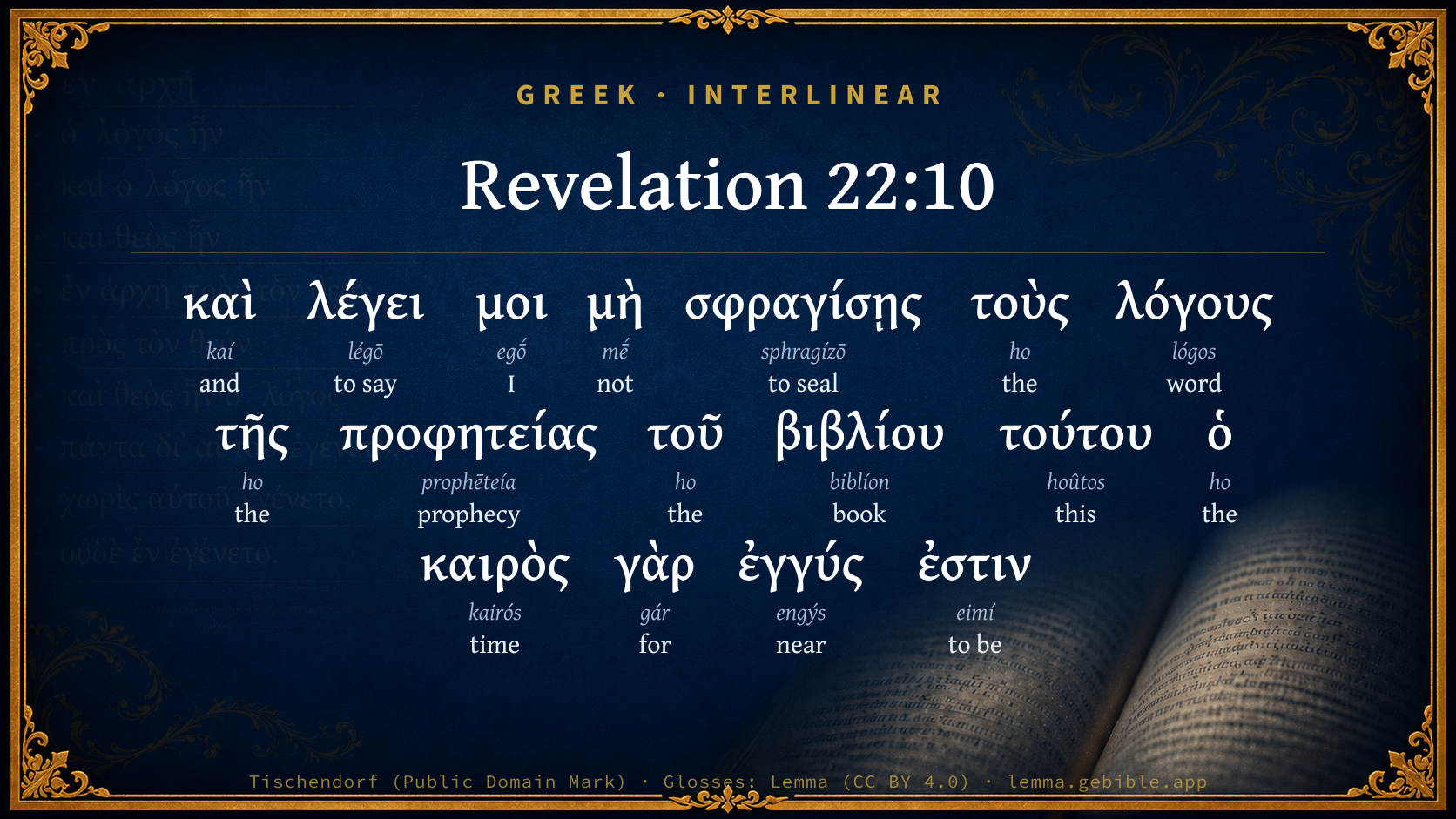
  1. καὶ kaí G2532 “and” Conjunction
  2. λέγει légō G3004 “to say” Verb, Present, Active, Indicative, 3rd person, Singular
  3. μοι egṓ G1473 “I” Personal pronoun, 1st person, Dative, Singular
  4. μὴ mḗ G3361 “not” Particle, Negative
  5. τοὺς ho G3588 “the” Article, Accusative, Plural, Masculine
  6. λόγους lógos G3056 “word” Noun, Accusative, Plural, Masculine
  7. τῆς ho G3588 “the” Article, Genitive, Singular, Feminine
  8. προφητείας prophēteía G4394 “prophecy” Noun, Genitive, Singular, Feminine
  9. τοῦ ho G3588 “the” Article, Genitive, Singular, Neuter
  10. βιβλίου biblíon G975 “book” Noun, Genitive, Singular, Neuter
  11. τούτου hoûtos G3778 “this” Demonstrative pronoun, Genitive, Singular, Neuter
  12. ὁ ho G3588 “the” Article, Nominative, Singular, Masculine
  13. καιρὸς kairós G2540 “time” Noun, Nominative, Singular, Masculine
  14. γὰρ gár G1063 “for” Conjunction
  15. ἐγγύς engýs G1451 “near” Adverb
  16. ἐστιν eimí G1510 “to be” Verb, Present, Active, Indicative, 3rd person, Singular

About this verse

These counts appear in no published source. They are computed here, from the morphology-tagged text and Lemma’s own curated glosses. What Lemma adds →

17
words
14
distinct lemmas
Revelation
section

Notable vocabulary

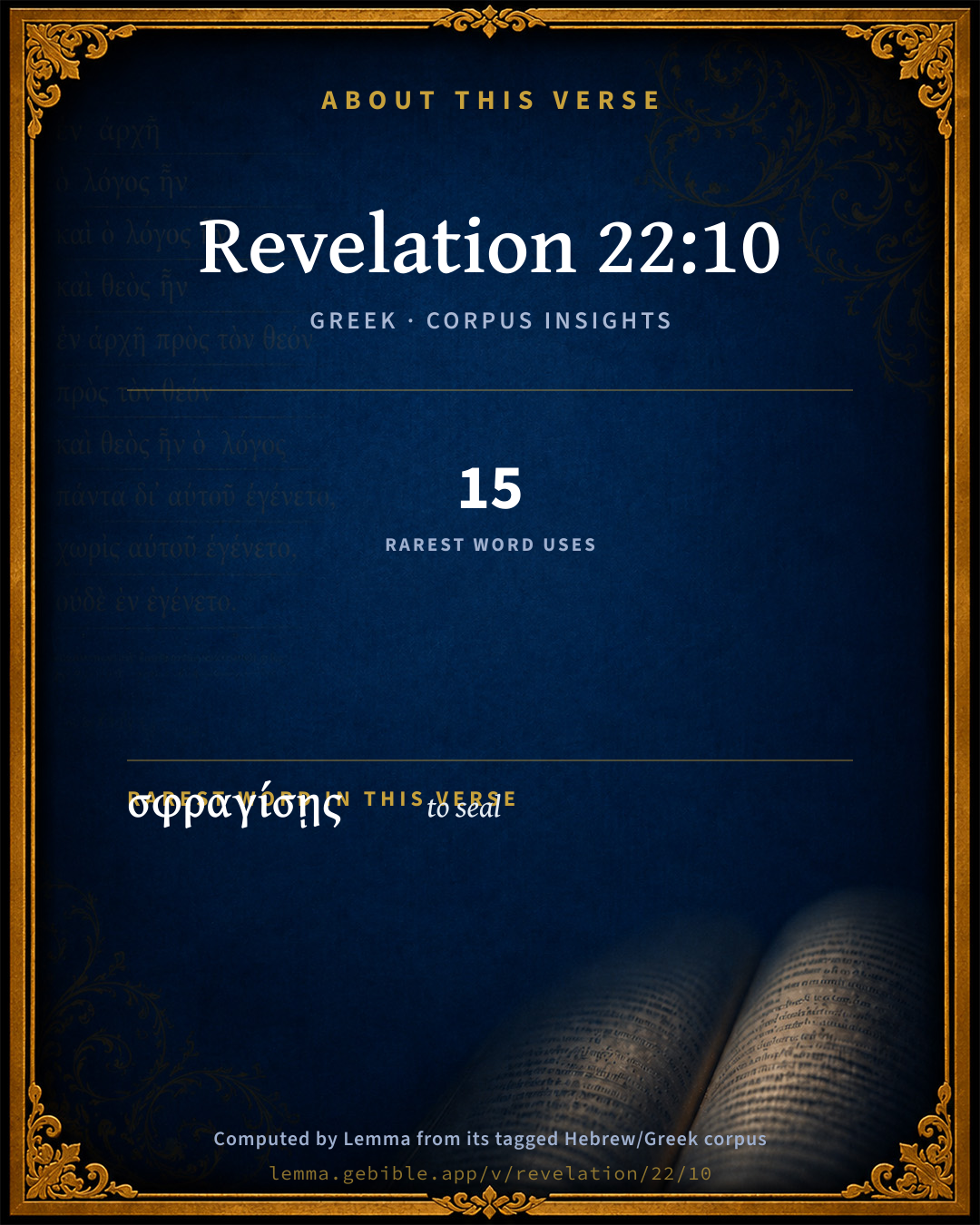
The rarest word here is σφραγίσῃς to seal G4972 — appearing just 15 times in the whole Greek New Testament.

Shared distinctive vocabulary

σφραγίσῃς to seal G4972 occurs in 14 verses of the Greek New Testament. Also found in:

Repetition

A word recurs within this verse:

  • τοὺς the G3588 ×4

Cross-references

16

Topical passages linked to Revelation 22:10 in the Treasury of Scripture Knowledge — connected by theme and wording, ordered by reader-vote popularity; previews shown in the World English Bible.

  • Daniel 8:26 The vision of the evenings and mornings which has been told is true: but seal up the vision; for it belongs to many days [to come].
  • 1 Peter 4:7 But the end of all things is near. Therefore be of sound mind, self-controlled, and sober in prayer.
  • Revelation 1:3 Blessed is he who reads and those who hear the words of the prophecy, and keep the things that are written in it, for the time is at hand.
  • Revelation 10:4 When the seven thunders sounded, I was about to write; but I heard a voice from the sky saying, "Seal up the things which the seven thunders said, and don't write them."
  • Matthew 10:27 What I tell you in the darkness, speak in the light; and what you hear whispered in the ear, proclaim on the housetops.
  • Ezekiel 12:23 Tell them therefore, Thus says the Lord Yahweh: I will make this proverb to cease, and they shall no more use it as a proverb in Israel; but tell them, The days are at hand, and the fulfillment of every vision.
  • Daniel 12:4 But you, Daniel, shut up the words, and seal the book, even to the time of the end: many shall run back and forth, and knowledge shall be increased."
  • Daniel 12:9 He said, Go your way, Daniel; for the words are shut up and sealed until the time of the end.
  • Romans 13:12 The night is far gone, and the day is near. Let's therefore throw off the works of darkness, and let's put on the armor of light.
  • Isaiah 8:16 Bind up the testimony, seal the law among my disciples.
  • Isaiah 13:6 Wail; for the day of Yahweh is at hand; as destruction from the Almighty shall it come.
  • Revelation 5:1 I saw, in the right hand of him who sat on the throne, a book written inside and outside, sealed shut with seven seals.
  • Revelation 22:12–13 "Behold, I come quickly. My reward is with me, to repay to each man according to his work.
  • Revelation 22:16 I, Jesus, have sent my angel to testify these things to you for the assemblies. I am the root and the offspring of David; the Bright and Morning Star."
  • 2 Thessalonians 2:3 Let no one deceive you in any way. For it will not be, unless the departure comes first, and the man of sin is revealed, the son of destruction,
  • Revelation 22:20 He who testifies these things says, "Yes, I come quickly." Amen! Yes, come, Lord Jesus.

Cross-references courtesy of OpenBible.info (CC BY 4.0).

Commentary

Notes on Revelation 22:10 from classic Christian and Jewish commentators (each source and its license shown beneath its notes). The classic Christian expositions comment on the surrounding passage and are grouped to its opening verse, so a note may address several verses; the Jewish commentaries on the Tanakh (Rashi and others) are per-verse, so they appear only where the commentator wrote on this verse.

Lemma curates 59 commentaries, every one of them public domain or Creative Commons licensed, each selected and text-cleaned for this edition rather than reprinted as found. About our sources →

Joseph Benson's Commentary

Rev 22:10-11. And he saith unto me — After a little pause; Seal not the sayings of this book — Conceal them not, like the things that are sealed up; for the time is at hand — When they shall begin to take place. He that is unjust — Or unrighteous; that is, who lives and dies unjustified, let him be unjust, or unrighteous, still — For after death his state can admit of no change, he that is filthy — Unholy, unsanctified, and dies in that condition; let him, that is, he shall be, filthy, or unholy, still; and he that is righteous — That lives and dies justified, or accounted righteous; let him be, he shall be, righteous still; and he that is holy — That is, renewed in the spirit of his mind, and stamped with the divine image, and perseveres until death in that state; shall be holy still — Shall be found so at the day of judgment, and shall remain so for ever. Dr. Doddridge’s paraphrase on the verse, connecting it with the preceding, is, “The time is just approaching when the last seal shall be put on the characters of men, and when it shall be said, on the one hand, Let him that is unjust be unjust still, &c., for no more opportunities shall ever be granted for reforming what has been amiss, and recovering the unrighteous and polluted soul to rectitude and purity; and on the other hand, it shall be said, Let him that is righteous be righteous still, &c.; nothing shall ever happen to bring the virtues and graces of good men into any future danger, or under any cloud; but their righteousness and their holiness shall for ever shine, yea, shine with an increasing lustre.”

Joseph Benson's Commentary on the Old and New Testaments (1811–1818) — public domain. Text from a community e-Sword module.

Whedon's Commentary on the Bible

Daniel D. Whedon

3. By GOD, bringing before us and realizing the judgment as immediate, Rev_22:10-15.

10. And he saith—Who saith? The connexion, as well as the entire tenor of the words said, show that it is none other than the Lord God of Rev_22:6 who sent the angel so over-honoured by John. God sent the angel; John saw, heard, and almost worshipped; and then God saith as follows.

God testifies to this apocalypse most strongly, by forbidding it to be sealed up, and by furnishing a vivid realization of its immediate fulfilment.

In the words of God which follow, the seer is in spirit transferred to the last hours and minutes before the impending judgment-advent. Rather, we may say, that the advent is conceptually brought to the immediate future. See note, Rev_1:7. That the judgment-advent is not taught to be literally at hand, is certain from the very fact that the millennium (xx) is made to intervene. It is in God’s own view that the divine coming is just at hand. See 2Pe_3:8.

Seal not… at hand—The book was to be kept unsealed and ready for the reading of all, as the event is virtually at hand to every human reader.

Daniel D. Whedon (gen. ed.), Commentary on the Old and New Testaments (1874–1909) — public domain. Text from a community e-Sword module.

Tyndale Open Study Notes

Tyndale Open Resources

22:10 Do not seal up: The angel expands John’s initial instruction to “write in a book” (1:11) and warns against curtailing its communication. Although some things are sealed—God does not reveal everything (cp. 10:4)—what has been written must be communicated so that people will understand the seriousness of the message and that the time is near (see 1:1, 3; 22:6-7; cp. Dan 12:4).

Tyndale Open Study Notes — © Tyndale Open Resources, licensed CC BY-SA 4.0. Text via the HelloAO Bible API.

Bengel's Gnomon

Johann Albrecht Bengel

Rev 22:10. Καὶ λέγει μοι, and he says to me) It is the same angel, whose addresses are mentioned in Rev 22:9-10; and yet the formula, and he says to me, is placed between, because the angel here (Rev 22:10) follows up afresh the discourse mentioned in Rev 22:6, after the interruptions made in Rev 22:7-9. Comp. and he says to me, ch. Rev 17:15, Rev 19:9.—μὴ σφραγίσῃς, seal not) They are like persons sealing, whose purpose it appears to be, under specious pretexts, to restrain the fuller handling of this prophecy.

Bengel's Gnomon of the New Testament — English translation (T&T Clark, Edinburgh, 1860) — public domain. Text from a community e-Sword module.

Vincent's Word Studies in the New Testament

Marvin R. Vincent

Seal [σφραγισης] . Rev., seal up. This word occurs eighteen times in Revelation and twice in the Gospel, and only five times elsewhere in the New Testament. It means to confirm or attest (Joh 3:33); to close up for security (Mt 27:66; Rev 20:3); to hide or keep secret (Rev 10:4; Rev 22:10); to mark a person or thing (Rev 7:3; Eph 1:13; Eph 4:30) Time [καιρος] . See on Mt 12:1.

Marvin R. Vincent, Word Studies in the New Testament (1887–1900) — public domain. Text from a community e-Sword/MySword module.

Geneva Bible (1599)

Geneva Bible translators

That is, propound this prophecy openly unto all, and conceal no part of it. The contrary whereunto is commanded, Isa. 8:6 and Dan. 8:26.

The Angel returneth unto his former speech: in which he teacheth the use of this book, both towards ourselves, in this and the next verse and in respect of God for declaration of his truth, thence unto verse 15.

Geneva Bible (1599) marginal notes — public domain. Text via Bolls.life.

Jamieson, Fausset & Brown

Robert Jamieson, A. R. Fausset & David Brown

Seal not--But in Dan 12:4, Dan 12:9 (compare Dan 8:26), the command is, "Seal the book," for the vision shall be "for many days." The fulfilment of Daniel's prophecy was distant, that of John's prophecy is near. The New Testament is the time of the end and fulfilment. The Gentile Church, for which John wrote his Revelation, needs more to be impressed with the shortness of the period, as it is inclined, owing to its Gentile origin, to conform to the world and forget the coming of the Lord. The Revelation points, on the one hand, to Christ's coming as distant, for it shows the succession of the seven seals, trumpets, and vials; on the other hand, it proclaims, "Behold, I come quickly." So Christ marked many events as about to intervene before His coming, and yet He also says "Behold, I come quickly," because our right attitude is that of continual prayerful watching for His coming (Mat 25:6, Mat 25:13, Mat 25:19; Mar 13:32-37 [AUBERLEN]; compare Rev 1:3).

Jamieson, Fausset & Brown — Commentary Critical and Explanatory on the Whole Bible (1871) — public domain (CC PDM 1.0). Text via the HelloAO Bible API.

Adam Clarke's Commentary

Verse 10. Seal not the sayings] Do not lay them up for future generations; they concern the present times; they must shortly come to pass, for the time is at hand. See above, Re 22:6. What concerned the Jews was certainly at hand.

Adam Clarke's Commentary on the Bible (1810–1826) — public domain. Text from a community e-Sword/MySword module.

Ellicott's Commentary for English Readers

(10) And he saith to me . . .—The angel, in contrast to the injunctions given to Daniel (Dan_12:9-13), bids the prophet “Seal not the words of the prophecy”: the reason is added, “for the time is near.” “Such is ever the difference between the prophecy of the old, and the prophecy of the new dispensation. The one belonged to a preliminary and prefatory state; the other to a completive and final condition. However long the gospel age may have lasted, or may yet continue, it is the last time (1Jn_2:18): after it there is none other: then shall the end come” (Mat_24:14), (Dean Vaughan).

A Bible Commentary for English Readers, edited by Charles John Ellicott (1878–1897) — public domain. Text from a community e-Sword module.

The Cambridge Bible for Schools and Colleges

gen. ed. J. J. S. Perowne

10. he saith] Still, probably, the same angel. He speaks still more unmistakeably in Christ’s person, now that St John understands beyond mistake that he is not Christ Himself.

Seal not &c.] Pointedly contrasted with Dan_12:4; Dan_12:9. In Daniel’s time, both the coming of Antichrist and the deliverance from him were far off: Daniel was bidden to write what he saw and heard, but not to make it public, for it would be unintelligible till long after his own generation:—at least till the typical persecution of Antiochus, and the typical day of vengeance and deliverance of the Maccabees. But to St John’s readers, all was to be as plain as an unfulfilled prophecy ever can be: except one detail (Rev_10:4) the whole vision is to be laid before the Church. It may be meant further, that the typical persecution of Nero was already within the Church’s experience, and that its typical revival under Domitian was to fall within the present generation.

for the time is at hand] Son_1:3. Besides the fact that partial and typical fulfilments were nearer to St John’s age than to Daniel’s, it is intimated that the same age, the same dispensation under which St John and his readers lived was to last till the time of the end; while the Jewish age in which Daniel lived passed away long before the end. For in mere chronology the difference is slight: from St John’s day to the end is, as we know, more than 1800 years, and from Daniel’s more than 2400: in comparison with the longer period, the shorter can hardly be spoken of as short.

The Cambridge Bible for Schools and Colleges (gen. ed. J. J. S. Perowne; Cambridge University Press, 1878–1918) — public domain. Text from a community e-Sword module.

John Gill's Exposition

And he saith unto me,.... Not the angel, but Christ, as is manifest from Rev 22:12. This clause is left out in the Ethiopic version.

Seal not the sayings of the prophecy of this book; as the orders are, when things are intended not to be published, but concealed, at least as yet, because of the distance of the accomplishment of them, which was not the case here; see Rev 10:4. Christ would have the things John saw and heard, written, and made public, sent in an open book, unsealed, to the churches, that they might be seen and read of all; that so the afflictions and persecutions of the people of God, both under Rome Pagan, and Rome Papal, might be known, and the saints not be offended at them when they came, but be prepared for them, to endure them patiently; and that they might be apprised of the errors and heresies that were to spring up, and of the appearance and wickedness of the man of sin, and his followers, and beware of them; and that they might have some assurance of the destruction of antichrist, and of the glorious state of the church, both in the spiritual and personal reign of Christ, and so be comforted in the midst of their tribulations, and rejoice in the faith and hope of these things. We may learn from hence, that the Scriptures in general are not to be locked up, and concealed from the common people, but lie open, and are to be read by all; and in particular, that this book is not so dark and obscure as it is thought to be:

for the time is at hand; when the things in this book shall begin to be fulfilled; see Rev 1:1.

John Gill's Exposition of the Whole Bible (1746–1763) — public domain (CC PDM 1.0). Text via the HelloAO Bible API.

Trapp's Complete Commentary

John Trapp

10 And he saith unto me, Seal not the sayings of the prophecy of this book: for the time is at hand.

Ver. 10. Seal not] Keep them not up for thine own proper use (as he did that wrote upon his writings, τα εις εμαυτον, things for myself), but freely impart them, and in such sort as that others may conceive and improve them.

For the time is at hand] And every day’s events shall explain the prophecy.

John Trapp, A Commentary or Exposition upon All the Books of the Old and New Testament (1647–1656) — public domain. Text from a community e-Sword module.

Albert Barnes' Notes on the Bible

And he saith unto me - The angel.

Seal not the sayings of the prophecy of this book - That is, seal not the book itself, for it may be regarded altogether as a prophetic book. On the sealing of a book, see the notes on Rev 5:1 . Isaiah (Isa 8:16; Isa 30:8) and Daniel (Dan 8:26; Dan 12:4, Dan 12:9) were commanded to seal up their prophecies. Their prophecies related to far-distant times, and the idea in their being commanded to seal them was, that they should make the record sure and unchangeable; that they should finish it, and lay it up for future ages; so that, in far-distant times, the events might be compared with the prophecy, and it might be seen that there was an exact correspondence between the prophecy and the fulfillment. Their prophecies would not be immediately demanded for the use of persecuted saints, but would pertain to future ages. On the other hand, the events which John had predicted, though in their ultimate development they were to extend to the end of the world, and even into eternity, were about to begin to be fulfilled, and were to be of immediate use in consoling a persecuted church. John, therefore, was directed not to seal up his predictions; not to lay them away, to be opened, as it were, in distant ages; but to leave them open, so that a persecuted church might have access to them, and might, in times of persecution and trial, have the assurance that the principles of their religion would finally triumph. See the notes on Rev 10:2.

For the time is at hand - That is, they are soon to commence. It is not implied that they would be soon completed. The idea is, that as the scenes of persecution were soon to open upon the church, it was important that the church should have access to these prophecies of the final triumph of religion, to sustain it in its trials. Compare the notes on Rev 1:1, Rev 1:3.

Albert Barnes' Notes on the Bible (1834–1885) — public domain. Text from a community e-Sword/MySword module.

Haydock's Catholic Bible Commentary

Seal not the words; as not designed to be kept sealed or secret, but to be delivered to the faithful for their instruction, that they may be prepared to suffer persecutions; that their faith, hope, and charity may be enlivened and increased by a firm expectation of their happiness in the next world, after short sufferings in this. (Witham)

George Leo Haydock (1774–1849), Haydock's Catholic Family Bible and Commentary, 1859 edition — public domain. Excludes Psalms (Douay-Rheims chapter numbering differs from Protestant) and Deuterocanonical books (Catholic canon only).

Matthew Poole's English Annotations

And he saith unto me; this he is Christ, as appeareth from Rev 22:12,13.

Seal not the sayings of the prophecy of this book; let these things be open to be promulgated, and published to the whole church.

For the time is at hand; for it will not be long before they shall begin to be fulfilled.

Matthew Poole's English Annotations on the Holy Bible (1683–1685) — public domain. Text from a community e-Sword/MySword module.

The Pulpit Commentary

And he saith unto me, Seal not the sayings of the prophecy of this book: for the time is at hand. The visions being now complete, St. John is commanded to communicate them to the world. (cf. Rev_10:4, where a contrary direction is given) The last sentence is again a repetition of the assertion of the shortness of this our time of preparation (cf. on ver. 7). The revelation deals not with events far distant in the future, but with those immediately present; for this reason the message is to be communicated. (cf. Dan_8:26, where the reason given for "shutting up the vision" is that the visions "belong to many days to come," Revised Version)

Vers. 10, 11. (See homily on Rev_20:11-15)

The Pulpit Commentary (1880–1919), ed. H.D.M. Spence-Jones & Joseph S. Exell — public domain. Text from a community e-Sword module.

John Wesley's Explanatory Notes

And he saith to me - After a little pause. Seal not the sayings of this book - Conceal them not, like the things that are sealed up. The time is nigh - Wherein they shall begin to take place.

John Wesley, Explanatory Notes Upon the Whole Bible (1754–1765) — public domain. Text via the GEBible commentary corpus.

Kretzmann's Popular Commentary

Paul E. Kretzmann

Christ’s announcement as to sharing in the blessings of heaven:

v. 10. And he saith unto me, Seal not the sayings of the prophecy of this book; for the time is at hand.

v. 11. He that is unjust, let him be unjust still; and he which is filthy, let him be filthy still; and he that is righteous, let him be righteous still; and he that is holy, let him be holy still.

v. 12. And, behold, I come quickly; and My reward is with Me, to give every man according as his work shall be.

v. 13. I am Alpha and Omega, the Beginning and the End, the First and the Last.

v. 14. Blessed are they that do His commandments, that they may have right to the tree of life and may enter in through the gates into the city.

v. 15. For without are dogs and sorcerers and whoremongers and murderers and idolaters, and whosoever loveth and maketh a lie.

Here the Lord Himself lifts up His voice in words of admonition and warning: And He says to me, Do not seal the words of the prophecy of this book; for the time is near. In the case of Daniel the opposite command was given, namely, to seal up his prophecy. But the revelations that had been made to John were to be fulfilled very soon, and the believers would be able to recognize their fulfillment within a short time. See Rev. l: 3. It is true, of course, that men abuse this book, and therefore the Lord adds at once: Let the wicked still be wicked, and let the filthy still be filthy, and let the righteous still practice righteousness, and let the holy still be holy. There has been warning enough given to the unbelievers, to all the enemies of Christ, to all the wicked and filthy. If they persist in their course, then their course will finally lead them into eternal damnation; the more they harden their hearts, the smaller will be their chances of salvation, and their latter end will be a matter of weeping and of gnashing of teeth. But those that are righteous and holy through their acceptance of the righteousness of Christ shall not permit themselves to be led aside from this path of holiness in the power of God. It is the Lord that will strengthen them and bring them to the goal, to the salvation of their souls.

The Lord now repeats His solemn call: Behold, I am coming very soon, and My reward is with Me, to pay out to every one as his work is. I am Alpha and Omega, the First and the Last, the Beginning and the End. It is the last hour of this world, and the return of the Lord to judgment may be expected at any time. He is the just and righteous Judge, who can and will reward every one according to the works that he has done in this life, as these works indicate a state of faith or a state of unbelief. He is the almighty, eternal God, who has the world and all that is in it in the hollow of His hand; He is a source of unfailing comfort to the believers, but one of terror to all those that have rejected His salvation.

Like an antiphonal chant the voice of the angel here chimed in: Blessed are they that wash their garments, that they may have a right to the tree of life and to enter through the gates into the city; without are the dogs and the sorcerers and the adulterers and the murderers and the idolaters, and every one that practices and loves falsehood. That is the glorious privilege of the believers, to wash their sin-stained garments in the blood of the Lamb, and thus to appear before the throne of God in the pure white garments of the righteousness of Christ. These are the ones that have a right to eat of the fruit of the tree of life; they are the ones whom God invites to enter into the gates of the heavenly Jerusalem. There eternal joy will rest upon them, and pain and sighing will be a thing of the past. But of the unbelievers and the deliberate transgressors of God’s commandments, of the false teachers and blasphemers, of those that beguile men of their faith, of those that delight in spiritual adultery, of those that indulge in hatred and persecution against the Church of God, of those that practice idolatry in any form, in short, of all those that love falsehood and practice it in any form, it is said that they are outside of the heavenly Jerusalem and shall not enter. They have chosen their lot, and they shall be given their preference, in the abyss that burns with fire and brimstone.

Paul E. Kretzmann, Popular Commentary of the Bible (1921–1924) — public domain. Text from a community e-Sword module.

Burkitt's Expository Notes on the New Testament

William Burkitt

Observe here, 1. A strict charge given unto St. John, not to seal or close up the words of this prophecy, but to publish and make it known for the use and benefit of the church, for which reason this book is called a revelation: Seal not the sayings of the prophecy of this book.

Where mark, That although this book be the obscurest part of the scripture, yet it is Christ’s command that it should not be concealed from the knowledge of the people: how sacrilegious then is the practice of the church of Rome in robbing the common people of all the scriptures, locking them up in an unknown tongue, and forbidding the people to read the same!

Observe, 2. How the Holy Ghost here pre-occupates an objection, which St. John might be ready to make, "If I seal not up, but make known this prophecy, the wicked men of the world, persecutors especially, will be made worse by it; they will be unjust still, and filthy still, and more so than ever." Be it so, says he, yet the righteous will be more confirmed in their course of obedience: and such as are holy, will be holy still, and such as are righteous, will be righteous still. There is, we see, a dangerous perseverance in sin, as well as a desirable perseverance in grace and holiness; let him that is unclean, be unclean still.

Where mark, this is no permission, much less a persuasion, to sin, but a dreadful threatening or commination, that such as give up themselves to sinning, shall be judicially given up by God to sin as a punishment; such a liberty as this to sin, is the worst of bondage.

Again, he that is holy, let him be holy still; the words carry with them not only the force of a command, and the direction of a rule, but the sweetness of a promise, and a gracious privilege that they shall persevere in holiness unto the end.

William Burkitt's Expository Notes on the New Testament (1700–1703) — public domain. Text from a community e-Sword module.

The People's New Testament

B. W. Johnson

10–12. Seal not the sayings of the prophecy of this book. To seal them would mean to conceal them and store them away. But they are not to be hidden. The time had come for the fulfillment to begin.

B. W. Johnson's The People's New Testament with Notes (1889–1891) — public domain. Electronic text from the Christian Classics Ethereal Library (CCEL) ThML edition.

unfoldingWord translationNotes

Door43 World Missions Community

Connecting Statement:

The angel finishes speaking to John.

Do not seal up ... this book

To seal a book was to keep it closed with something that makes it impossible for anyone to read what was inside without breaking the seal. The angel is telling John not to keep the message a secret. AT: "Do not keep secret ... this book" (See: Assumed Knowledge and Implicit Information)

the words of the prophecy of this book

Here "words" refers to the message that they formed. See how you translated this in Revelation 22:7. AT: "This prophetic message of this book" (See: Metonymy)

translationWords

seal

word

prophet

righteous

righteous

holy

unfoldingWord translationNotes — © Distant Shores Media and the Door43 World Missions Community, licensed CC BY-SA 4.0. Source: git.door43.org/Door43/en_tn.

Expositor's Greek Testament

ed. W. Robertson Nicoll

The book of Daniel, the great classic of apocalyptic literature, is represented ( cf. Slav. En. xxxiii. 9 11, xxxv. 3; En. xciii. 10, civ. 12, etc.) as having been providentially kept secret at the time of its composition, since it referred to a future period (Dan 8:26 , Dan 12:4 ; Dan 12:9 ). This was a literary device, to explain why it had not been divulged before. As John’s apocalypse is for an immediate crisis, it is not to be reserved for days to come. It is not merely valid (7) but intended for the prophet’s contemporaries (unlike Isa 30:8 , cf. Cheyne’s note), though reserved, like most of its class, as esoteric literature for the “wise” (contrast 4 Esd. 14:38 48). Some interval, however, is presupposed between the vision and its fulfilment, otherwise it would be futile to write the visions down, and to arrange for their circulation throughout the churches. A certain career (Rev 22:7 ; Rev 22:9 ; Rev 22:18-19 ) is anticipated for the Apocalypse. But (Rev 22:11 .) persistence in good and evil is about all the writer expects a stereotyped feature of the apocalyptic outlook on the obduracy of the wicked and the perseverance of the saints. Apocalyptic never encouraged propaganda, and no radical or widespread change is anticipated during the brief interval before the end. As in Dan 12:10-11 , so here, the crisis simply accentuates and accelerates human character along previous lines. No anxiety is shown, however, as in 4 Esd. 4:50 f., whether the prophet himself is to see the end.

The Expositor's Greek Testament, edited by W. Robertson Nicoll (1897–1910) — public domain. Text from a community e-Sword module.

Cambridge Greek Testament for Schools and Colleges

10. τοὺς λόγους. א adds τούτους here and τούτων in Rev 22:19.

10. λέγει. Still, probably, the same angel. He speaks still more unmistakeably in Christ’s person, now that St John understands beyond mistake that he is not Christ Himself.

μὴ σφραγίσῃς. Pointedly contrasted with Dan 12:4; Dan 12:9. In Daniel’s time, both the coming of Antichrist and the deliverance from him were far off: Daniel was bidden to write what he saw and heard, but not to make it public, for it would be unintelligible till long after his own generation:—at least till the typical persecution of Antiochus, and the typical day of vengeance and deliverance of the Maccabees. But to St Johu’s readers, all was to be as plain as an unfulfilled prophecy ever can be: except one detail (Rev 10:4) the whole vision is to be laid before the Church. It may be meant further, that the typical persecution of Nero was already within the Church’s experience, and that its typical revival under Domitian was to fall within the present generation.

ὁ … ἐστιν. Son 1:3. Besides the fact that partial and typical fulfilments were nearer to St John’s age than to Daniel’s, it is intimated that the same age, the same dispensation under which St John and his readers lived was to last till the time of the end; while the Jewish age in which Daniel lived passed away long before the end. For in mere chronology the difference is slight: from St John’s day to the end is, as we know, more than 1800 years, and from Daniel’s more than 2400: in comparison with the longer period, the shorter can hardly be spoken of as short.

Cambridge Greek Testament for Schools and Colleges (Cambridge University Press, 1896; 21 vols, various authors incl. Carr, Maclear, Plummer, Farrar, Lumby, Moule, M. R. James, Simcox) — public domain. Text from a community e-Sword module.

Lesson kit

Teaching starters — assembled from the data on this page, not authored interpretation. Every prompt links to the verse data it draws on. Edit before teaching.

Revelation, in the Revelation, opens this verse with 17 words (14 distinct Greek lemmas). Its most distinctive word is sphragízō (“to seal”). A historical commentator’s framing appears above. Read the whole chapter for the surrounding context.

Discussion questions

  1. What does “to seal” (sphragízō) contribute to the verse as a whole?
  2. Matthew 27:66 shares the word «to seal» with this verse. How do the two illuminate each other?
  3. “the” occurs 4× in this one verse. What is the effect of the repetition?
  4. These translations render this verse differently; the difference is in the English rendering, not the original. What questions does that raise?
  5. Reading how Joseph Benson's Commentary and Whedon's Commentary on the Bible read this verse, where do the two commentators agree and where do they part?

Things to notice

Reading settings

Reading text

Shown beneath each verse's original-language words.

Old Testament
Old Testament edition

Read the OT as the Masoretic Hebrew (MT) or the Greek Septuagint (LXX).

English shown for the Greek Septuagint (in the Hebrew ↔ Greek comparison).

Comparing translations? Open the Compare panel on any verse page to stack up to four side by side.