
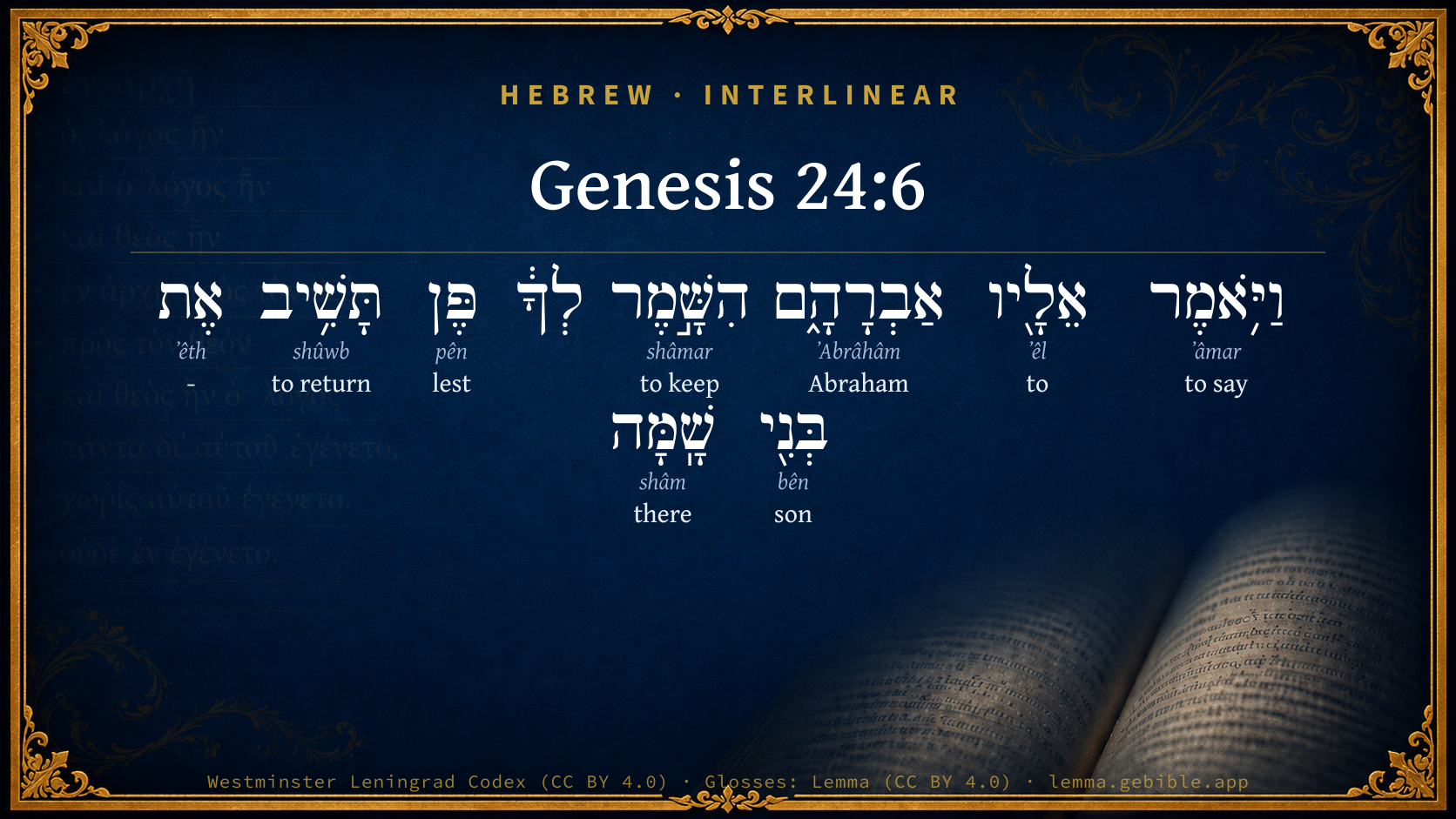
Genesis 24:6

Hebrew (Westminster Leningrad Codex) Genesis 24:6 appears in the Hebrew Old Testament. The text above is from the Westminster Leningrad Codex. Each word links to its Strong’s number, a concise gloss, and parsing drawn from the Open Scriptures Hebrew Bible morphology. Click any word for its full Brown-Driver-Briggs (BDB) entry.
Download image
Cite this verse

Genesis 24:6 (World English Bible). Public Domain. Lemma interlinear Bible study tool, https://lemma.gebible.app/v/genesis/24/6.

Show BibTeX & RIS
BibTeX
RIS
English Translation
Abraham said to him, "Beware that you don't bring my son there again.
World English Bible · Public Domain
Download a study sheet

One document with this verse’s original text, its word-by-word gloss line, the meaning frame, cross-references with their text, attributed commentary, and full source and license credits — printable, and it pastes into notes with its structure intact.

This verse Autodidact and up

Study sheet (.html) Plain text (.txt)

A passage Seminary Student

Up to 50 verses in one chapter. A passage sheet keeps up to 6 commentary sources and 12 cross-references per verse, in the order this page ranks them, and says so on the sheet whenever that leaves anything out. Ask for a single verse and you get the Autodidact verse sheet above.

Everything on this page stays free to read, with no account — the sheet is a download of what is already on screen, not access to it.

Want to remove ads? Support Godless Engineer
Compare translations 3

The same verse in 3 English versions, stacked beneath the original-language interlinear above. Click any original word for its lexicon entry.

Each is an independent rendering of the whole verse — the interlinear is not word-aligned to these translations.

Highlighted words mark where these versions differ — a whole-verse word diff, not a word-by-word alignment.

  • World English Bible Public Domain
    Abraham said to him, "Beware that you don't bring my son there again.
  • King James Version Public Domain
    And Abraham said unto him, Beware thou that thou bring not my son thither again.
  • unfoldingWord Literal Text CC BY-SA 4.0
    Then Abraham said to him, “Be sure that you do not take my son back there.

unfoldingWord Literal Text — © unfoldingWord, licensed CC BY-SA 4.0. Word-aligned USFM3 via Door43 (git.door43.org/unfoldingWord/en_ult).

Versions to compare (up to 4)

3 of 4 selected

Show all 18 translations

Every available English version of this verse, each an independent rendering of the whole verse.

  • World English Bible Public Domain
    Abraham said to him, "Beware that you don't bring my son there again.
  • Berean Standard Bible Public Domain
    Abraham replied, “Make sure that you do not take my son back there.
  • Majority Standard Bible Public Domain
    Abraham replied, “Make sure that you do not take my son back there.
  • King James Version Public Domain
    And Abraham said unto him, Beware thou that thou bring not my son thither again.
  • American Standard Version (1901) Public Domain
    And Abraham said unto him, Beware thou that thou bring not my son thither again.
  • Revised Version (1885) Public Domain
    And Abraham said unto him, Beware thou that thou bring not my son thither again.
  • Geneva Bible (1599) Public Domain
    To whom Abraham answered, Beware that thou bring not my sonne thither againe.
  • Douay-Rheims (1899) Public Domain
    And Abraham said: Beware thou never bring my son back again thither.
  • Young's Literal Translation Public Domain
    And Abraham saith unto him, `Take heed to thyself, lest thou cause my son to turn back thither;
  • Literal Standard Version CC BY-SA 4.0
    And Abraham says to him, “Take heed to yourself lest you cause my son to return there;
  • Unlocked Literal Bible CC BY-SA 4.0
    Abraham said to him, “Make sure that you do not take my son back there!
  • unfoldingWord Literal Text CC BY-SA 4.0
    Then Abraham said to him, “Be sure that you do not take my son back there.
  • Darby Bible Public Domain
    And Abraham said to him, Beware that thou bring not my son thither again.
  • World Messianic Bible Public Domain
    Abraham said to him, “Beware that you don’t bring my son there again.
  • Webster's Bible Public Domain
    And Abraham said to him, Beware that thou bring not my son thither again.
  • Free Bible Version CC BY-SA 4.0
    “No, you mustn't take my son back there,” Abraham replied.
  • Bible in Basic English Public Domain
    And Abraham said, Take care that you do not let my son go back to that land.
  • JPS Tanakh (1917) Public Domain
    And Abraham said unto him: 'Beware thou that thou bring not my son back thither.

Literal Standard Version (2020), Covenant Press — licensed CC BY-SA 4.0. Text via the HelloAO Bible API (eBible.org). Unlocked Literal Bible (unfoldingWord) — licensed CC BY-SA 4.0. Text via the HelloAO Bible API (eBible.org). unfoldingWord Literal Text — © unfoldingWord, licensed CC BY-SA 4.0. Word-aligned USFM3 via Door43 (git.door43.org/unfoldingWord/en_ult). Free Bible Version, Dr. Jonathan Gallagher — licensed CC BY-SA 4.0. Text via the HelloAO Bible API (eBible.org).

Word by word

More ways to search: Search by grammar → Find every occurrence → Compare this word →

Practice this passage: Drill this verse → Learn its vocabulary →

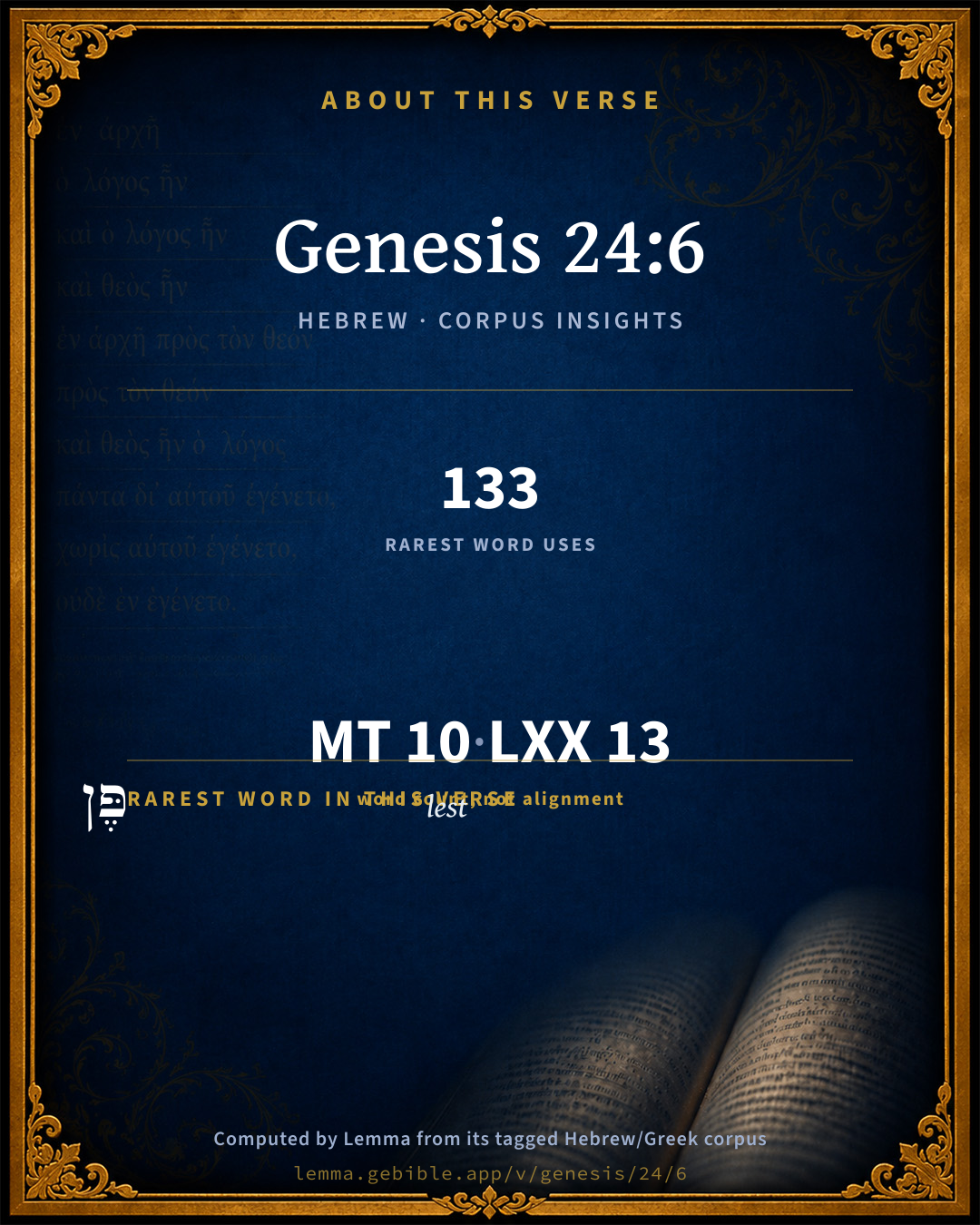
About this verse

These counts appear in no published source. They are computed here, from the morphology-tagged text and Lemma’s own curated glosses. What Lemma adds →

10
words
9
distinct lemmas
Pentateuch
section

Grammatical profile

  • 3 verbs
  • 2 nouns
  • 2 prepositions
  • 1 conjunction
  • 1 adverb
  • 1 particle

Verb forms

  • וַיֹּ֥אמֶר Qal · Sequential Imperfect
  • הִשָּׁ֣מֶר Niphal · Imperative
  • תָּשִׁ֥יב Hiphil · Imperfect

Hebrew & Septuagint length

In English translation the verse runs 13 words from the Hebrew and 17 from the Septuagint (LXX English) — closely comparable.

A rough comparison of the two English renderings, which tokenize alike — not a word-level alignment.

Word counts can differ between the Hebrew and the Greek without any difference in meaning — e.g. the Hebrew direct-object marker אֵת has no separate Greek word, and Greek often adds the article ὁ.

In the original languages it is 10 Hebrew tokens and 13 Greek tokens — but the two are counted differently (Hebrew bundles its prefixes and suffixes into one token; the Greek is in lemma form), so that isn’t a like-for-like length.

Cross-references

5

Topical passages linked to Genesis 24:6 in the Treasury of Scripture Knowledge — connected by theme and wording, ordered by reader-vote popularity; previews shown in the World English Bible.

  • Galatians 5:1 Stand firm therefore in the liberty by which Christ has made us free, and don't be entangled again with a yoke of bondage.
  • Hebrews 10:39 But we are not of those who shrink back to destruction, but of those who have faith to the saving of the soul.
  • 2 Peter 2:20–22 For if, after they have escaped the defilement of the world through the knowledge of the Lord and Savior Jesus Christ, they are again entangled therein and overcome, the last state has become worse with them than the first.
  • Hebrews 11:9 By faith, he lived as an alien in the land of promise, as in a land not his own, dwelling in tents, with Isaac and Jacob, the heirs with him of the same promise.
  • Hebrews 11:13–16 These all died in faith, not having received the promises, but having seen them and embraced them from afar, and having confessed that they were strangers and pilgrims on the earth.

Cross-references courtesy of OpenBible.info (CC BY 4.0).

Hebrew and Greek witnesses Masoretic Hebrew ↔ Greek Septuagint

The same verse in the two great witnesses to the Old Testament, shown verse-for-verse.

These are two independent witnesses, not word-aligned to each other, and the Septuagint is shown in lemma (dictionary) form.

Hebrew Genesis 24:6 Masoretic · Westminster Leningrad Codex

וַיֹּ֥אמֶר אֵלָ֖יו אַבְרָהָ֑ם הִשָּׁ֣מֶר לְךָ֔ פֶּן תָּשִׁ֥יב אֶת בְּנִ֖י שָֽׁמָּה

Abraham said to him, "Beware that you don't bring my son there again.

World English Bible · Public Domain

Greek LXX Genesis 24:6 Septuagint · lemma form

εἶπον δέ πρός αὐτός αβρααμ προςἔχω σεαυτοῦ μή ἀποστρέφω ὁ υἱός ἐγώ ἐκεῖ

And Abraam said to him, Take heed to yourself that you carry not my son back there.

LXX2012 (modern English Septuagint) · Public Domain

Hebrew: Westminster Leningrad Codex (CC BY 4.0). Greek: Septuagint (public domain); English from LXX2012 (modern English Septuagint) (Public Domain). How the Septuagint differs from the Hebrew →

Targum (Aramaic paraphrase)

2

The Targum is the ancient Jewish Aramaic paraphrase of the Hebrew Scriptures — an interpretive translation, not the Hebrew text itself. Onkelos (literal) and Pseudo-Jonathan (expansive) render the Torah, and Jonathan the Prophets. Coverage is partial: where no permissively-licensed English translation exists for a verse, only the Aramaic is shown. This is verse-level text, not a word-by-word alignment to the Hebrew.

  1. Targum Onkelos Torah (Genesis–Deuteronomy)
    וַאֲמַר לֵהּ אַבְרָהָם אִסְתַּמַּר לָךְ דִּילְמָא תָתֵיב יָת בְּרִי לְתַמָּן

    (no public-domain English translation for this verse)

    Targum Onkelos — Aramaic: “Onkelos Genesis” (public domain); “Onkelos Exodus” (public domain); “Onkelos Leviticus” (public domain); “Onkelos Numbers” (public domain); “Onkelos Deuteronomy” (public domain). English: “Sefaria Community Translation” (CC0 1.0 (public-domain dedication)); “J.W. Etheridge. The Targums of Onkelos and Jonathan Ben Uzziel on the Pentateuch. London: Longmans, Green, 1862” (public domain). Text via Sefaria.

  2. Targum Pseudo-Jonathan Torah (Genesis–Deuteronomy)
    וַאֲמַר לֵיהּ אַבְרָהָם אִסְתַּמַר לָךְ דִילְמָא תָתֵיב יַת בְּרִי לְתַמָן

    And Abraham said to him, Beware, lest thou make my son return thither!

    Targum Pseudo-Jonathan — Aramaic: “Targum Jonathan on Genesis” (public domain); “Targum Jonathan on Exodus” (public domain); “Targum Jonathan on Leviticus” (public domain); “Targum Jonathan on Numbers” (public domain); “Targum Jonathan on Deuteronomy” (public domain). English: “The Targum of Jonathan ben Uzziel, trans. J. W. Etheridge, London, 1862” (public domain). Text via Sefaria.

Commentary

Notes on Genesis 24:6 from classic Christian and Jewish commentators (each source and its license shown beneath its notes). The classic Christian expositions comment on the surrounding passage and are grouped to its opening verse, so a note may address several verses; the Jewish commentaries on the Tanakh (Rashi and others) are per-verse, so they appear only where the commentator wrote on this verse.

Lemma curates 59 commentaries, every one of them public domain or Creative Commons licensed, each selected and text-cleaned for this edition rather than reprinted as found. About our sources →

Trapp's Complete Commentary

John Trapp

Gen 24:6 And Abraham said unto him, Beware thou that thou bring not my son thither again.

Ver. 6. That thou bring not my son thither again.] Where yet he had never been, but in his father’s loins. He would not his son should part with the Promised Land for any outward accommodations. "Let us fear, lest a promise being left us of entering into God’s rest, any of us should seem to come short, to fail back, or be left behind". {υστερηκεναι, Heb 4:1} Take we all heed lest, for our lingering and hankering after the flesh pots of Egypt, God carry us back again into Egypt, which was the last and greatest curse threatened against the people of Israel, and is the greatest misery that can come upon this nation. {Deu 28:68}

John Trapp, A Commentary or Exposition upon All the Books of the Old and New Testament (1647–1656) — public domain. Text from a community e-Sword module.

Tyndale Open Study Notes

Tyndale Open Resources

24:6-8 Under no circumstances was the servant to take Isaac from the Promised Land to seek a wife. Abraham ensured Isaac’s safety and secured God’s promises in the land of blessing.

Tyndale Open Study Notes — © Tyndale Open Resources, licensed CC BY-SA 4.0. Text via the HelloAO Bible API.

Geneva Bible (1599)

Geneva Bible translators

Lest he should lose the inheritance promised.

Geneva Bible (1599) marginal notes — public domain. Text via Bolls.life.

John Calvin's Commentaries

6. Beware that thou bring not my son thither again. If the woman should not be found willing, Abraham, commending the event to God, firmly adheres to the principal point, that his son Isaac should not return to his country, because in this manner he would have deprived himself of the promised inheritance. He therefore chooses rather to live by hope, as a stranger, in the land of Canaan, than to rest among his relatives in his native soil: and thus we see that, in perplexed and confused affairs, the mind of the holy man was not drawn aside from the command of God by any agitating cares; and we are taught, by his example, to follow God through every obstacle. However, he afterwards declares that he looks for better things. By such words he confirms the confidence of his servant, so that he, anticipating with greater alacrity a prosperous issue, might prepare for the journey.

John Calvin's Commentaries (1540-1563) — public domain. Text from the Calvin Translation Society English edition (1840s-50s) via the Christian Classics Ethereal Library (ccel.org). Calvin's coverage is partial (roughly two-thirds of the Bible); uncommented books and verses are honest gaps, never fabricated. The 19th-century editor's footnotes and remarks are omitted so the notes are faithfully Calvin's own voice.

John Gill's Exposition

And Abraham said unto him,.... Not blaming him for putting such a question, nor charging him with impertinence, but plainly seeing the propriety of it: and in order to clear up this matter to him, gives the following instructions:

beware thou, that thou bring not my son thither again; for the command to come out of the land of Chaldea, never to return more, and to come into the land of Canaan, and there abide, respected both Abraham and his posterity; and besides, it was dangerous for Isaac to go into a family, where, though there was some knowledge of the true God, yet there was much superstition and idolatry in it, as appears by various hints in the sequel of this history, lest he should be corrupted, and degenerate from the true religion.

John Gill's Exposition of the Whole Bible (1746–1763) — public domain (CC PDM 1.0). Text via the HelloAO Bible API.

Matthew Poole's English Annotations

In case she will not come hither, do not thou engage that he shall go thither. Why so?

1. Because there was more danger of infection from his wife and her kindred, because of their friendly, and familiar, and constant converse with him, than from the Canaanites, who were strangers to him, and lived separately from him, and had but little conversation with him.

2. Because the command of God to Abraham to come out of Chaldea, and into Canaan, did extend to his posterity also, whom God would oblige to dwell there as long as they could, that they might live in constant faith and expectation of the performance of God’s promise in giving this land unto them.

Quest. How could he bring Isaac thither again, where he never was?

Answ.

1. Isaac might be said to be there before virtually, or in the loins of his father, as Levi is said to pay tithes to Melchziedek by Abraham in whose loins he was.

2. This

again may be referred to the servant, that when he returned again he would not carry Isaac along with them.

3. He might reasonably suppose that Isaac must go once thither to fetch his wife; (for her coming so suddenly to him was an unexpected thing); but he would not have him promise, that when he had done so once, he should go thither again to live there with her.

Matthew Poole's English Annotations on the Holy Bible (1683–1685) — public domain. Text from a community e-Sword/MySword module.

Whedon's Commentary on the Bible

Daniel D. Whedon

6. Beware — Whatever hinderances come, in no case will Abraham allow his son to go back to the land from which he himself had been called.

Daniel D. Whedon (gen. ed.), Commentary on the Old and New Testaments (1874–1909) — public domain. Text from a community e-Sword module.

The Pulpit Commentary

Vers. 6-8. And Abraham said, Beware thou literally, beware for thyself, the pleonastic pronoun being added by way of emphasis (cf. Gen_12:1 Gen_21:16 Gen_22:5) that thou bring not my son thither again. Literally, lest thou cause my son to, return thither; Abraham speaking of Isaac s going to Mesopotamia as a return, either because he regarded Isaac, though then unborn, as having come out with him from Mesopotamia, cf., (Heb_7:10) (Wordsworth) or because he viewed himself and his descendants as a whole, as in Gen_15:16 (Rosenm The Lord God of heaven, who took me from my father"s house, and from the house of my kindred, vide @Gen_15:17, Gen_15:18; the covenant transaction therein recordedhaving all the force of an oath (cf. Gen_22:16) saying, Unto thy seed will I give this land. Here was a second consideration that negatived the idea of Isaac"s return, he was the God-appointed heir of the soil, and from this, in conjunction with the former, he argued that the Divine promise was certain of fulfillment, and that accordingly the mission for a bride would be successful. He shall send his angel before thee,i.e. to lead and protect, as was afterwards promised to Israel, (Exo_23:20) and to the Christian Church (Heb_1:14) and thou shalt take a wife unto my Ben from thence (meaning, thy mission shall be successful). And if the woman will not be willing to follow thee, then shalt thou be clear of this my oath (i.e. at liberty to bold thyself as no longer under obligation in the matter; thy responsibility will at that point cease and determine): only bring not my son thither again or, observing the order of the Hebrew words, only my son bring not again to that place; with almost feverish entreaty harping on the solemn refrain that on no account must Isaac leave the promised land, since in that would be the culmination of unbelief and disobedience.

HOMILIES BY J.F. MONTGOMERY

Ver. 6.

No turning back.

And Abraham said unto him, Beware thou that thou bring not my son thither again." Abraham"s care to prevent the leaven of idolatry entering his family (cf. Exo_34:16; 1Co_15:33; Jam_1:27) Worldly wisdom would have led him to seek a wife for his son among the families of Canaan, so as to give him a firmer footing in the land; but he solemnly charged his steward, in sending him on a marriage embassy, not to do this (cf. 1Ki_11:3; 2Co_6:14) A wife was to be sought from his brother"s family. Out of the earnestness of this godly desire came the trial of his faith. An obvious difficulty; what if the damsel should not be willing to follow a stranger? There had been little intercourse between the families. The news is Gen_22:20 was plainly the first for many years. Must Isaac go in person to take a wife from her father"s house? Much might be urged in favor of this. If the presence of Isaac were of importance, might he not return for a little, though Canaan was his appointed home? Was it not hindering the very thing Abraham desired, to refuse to do so? Was it not unreasonable to look for a blessing and yet to neglect obvious means for obtaining it? Not for a moment would Abraham listen to the suggestion. At God"s call he had left Mesopotamia forever. To send his son back would he contrary to the principle of his whole life. It would be to put expediency above faith, to distrust God"s promise, to think his will changeable (cf. 1Ki_13:19) Contrast the faithlessness of the Israelites in their wilderness journeys. Abraham would not allow even a temporary return. They "in their hearts turned back again into Egypt" (cf. Luk_9:62)

I IN A GODLY LIFE THERE IS OFTEN A TEMPTATION TO TURN BACK FOR A LITTLE. With a laudable aim, some step which seems likely to lead to it is not quite what in itself we know to be right. To gain the means of doing good, some little departure from truth may seem almost necessary. In the eagerness of some plan of usefulness the time for prayer can hardly be found, or the ordinary daily duties of life seem to interrupt the greater and higher work; or, to gain an influence over the gay and worldly, it may seem the course of wisdom to go, a little way at least, with them. And is not a Christian, under the law of liberty, freed from strict observance of the letter? Does not that savor of the spirit of bondage? Nay, "to obey is better than sacrifice." Always danger when men seek to be wiser than God. (Pro_14:12) We cannot foresee the difficulties of returning.

II TRUE FAITH POINTS TO IMPLICIT OBEDIENCE. Can we not trust God to order all not only the ends towards which he would have us strive, but the means to be used? We are to live by every word of God, not by some special saying only. Promise and precept, instruction and direction, are alike his words, by which every step should be guided. It is want of faith which leads to departure from obedience; want of full trust in God which leads to ways of fancied wisdom. We have to do -with efforts, not with results; these are in God"s hand. Where obedience is not in question we rightly use our judgment; reason was given us to be our guide, but not to take the guidance out of God"s hands. M.

The Pulpit Commentary (1880–1919), ed. H.D.M. Spence-Jones & Joseph S. Exell — public domain. Text from a community e-Sword module.

Radak

Rabbi David Kimhi (Radak)

ויאמר...השמר לך, for Avraham did not want the claim on the land of Israel which G’d had promised him and which had been established through his physical presence in that land, to become subject to doubt through an even temporary migration of Yitzchok.

פן תשיב, so that you do not bring back. We find a similar formulation in Genesis 3,3 פן תמותון, “so that you will not die,” and in Genesis 31,24 פן תדבר עם יעקב, “so that you will not speak with Yaakov, etc.”

Radak on the Tanakh — English translations: “Sefaria Community Translation” (CC0 1.0 (public-domain dedication)); “Eliyahu Munk, HaChut Hameshulash” (CC BY 4.0); “Rabbi Mike Feuer, Jerusalem Anthology” (CC BY 4.0); and “R. David Kimhi on the first book of Psalms, Translated by R.G. Finch, London, 1919” (public domain). Text via Sefaria.

Lesson kit

Teaching starters — assembled from the data on this page, not authored interpretation. Every prompt links to the verse data it draws on. Edit before teaching.

Genesis, in the Pentateuch, opens this verse with 10 words (9 distinct Hebrew lemmas). Its most distinctive word is pên (“lest”). A historical commentator’s framing appears above. Read the whole chapter for the surrounding context.

Discussion questions

  1. What does “lest” (pên) contribute to the verse as a whole?
  2. Galatians 5:1 shares this passage’s theme. How do the two illuminate each other?
  3. The translations on this page render this verse differently — a whole-verse word diff, not a word-by-word alignment. What might account for the different wordings?
  4. The verb «וַיֹּ֥אמֶר» is Qal Sequential Imperfect. How does its form color the action?
  5. Reading how Trapp's Complete Commentary and Tyndale Open Study Notes read this verse, where do the two commentators agree and where do they part?

Things to notice

Reading settings

Reading text

Shown beneath each verse's original-language words.

Old Testament
Old Testament edition

Read the OT as the Masoretic Hebrew (MT) or the Greek Septuagint (LXX).

English shown for the Greek Septuagint (in the Hebrew ↔ Greek comparison).

Comparing translations? Open the Compare panel on any verse page to stack up to four side by side.